Article

Pretreatment of Corncob with Typical Anaerobic Digestion-Derived Organic Acids for Improving Enzymatic Saccharification and Bioethanol Production


School of Life Science and Food Engineering, Huai’an University, Huai’an 223003, China
*
Authors to whom correspondence should be addressed.
Fuels 2026, 7(3), 63; https://doi.org/10.3390/fuels7030063
Submission received: 21 July 2026 / Revised: 29 August 2026 / Accepted: 16 September 2026 / Published: 17 September 2026

Abstract

The transition to renewable energy is essential for mitigating greenhouse gas emissions and advancing carbon neutrality. Lignocellulosic biomass offers an abundant and sustainable feedstock for biofuel production, but its inherent recalcitrance demands effective pretreatment to enable enzymatic saccharification. This study evaluated five commercial organic acids typical of anaerobic digestion (AD) effluents, namely acetic, propionic, butyric, valeric, and caproic acids, for corncob pretreatment. Compared with untreated corncob, which gave a glucose yield of only 23%, all acid pretreatments substantially enhanced enzymatic hydrolysis. A strong correlation between xylan removal and total sugar yield (R2 = 0.98) confirmed that hemicellulose solubilization is the primary factor governing digestibility in typical AD-derived organic acid pretreatment. Among the conditions tested, pretreatment with 2.5% butyric acid at 180 °C for 45 min was optimal, removing 91.84% xylan and 53.10% lignin while retaining 75.24% glucan, which led to a near-complete glucose release during subsequent enzymatic hydrolysis at 2% solid loading with cellulase (15 FPU/g substrate). Fermentation of the butyric acid-pretreated hydrolysate via separate hydrolysis and fermentation produced 43.32 g/L ethanol with ~99% glucose consumption. In this case, the final ethanol yield from consumed sugars was 79.8% of the theoretical yield. These findings demonstrate that typical AD-derived pure organic acids serve as effective pretreatment agents, offering a promising route for lignocellulose valorization and biofuel production within a circular biorefinery framework.

1. Introduction

The escalating global energy demand, driven by rapid industrialization and population growth, has placed unprecedented strain on finite fossil fuel reserves. The combustion of coal, petroleum, and natural gas not only depletes these non-renewable resources but also releases substantial amounts of greenhouse gases (GHGs) and airborne pollutants, exacerbating climate change and environmental degradation. In response, the transition toward a low-carbon, circular economy has become a central force of sustainable development strategies worldwide [1,2]. Lignocellulosic biomass, as the only renewable carbon source capable of directly supplying liquid fuels, platform chemicals, and high-quality biomaterials, offers a promising avenue to mitigate fossil fuel dependence while achieving carbon neutrality [3,4]. Among the various bioenergy routes, the production of cellulosic ethanol from lignocellulosic feedstocks has attracted particular interest due to its compatibility with existing fuel infrastructure and its potential to utilize abundant agricultural and forestry residues without competing with food supply [5,6].
Lignocellulose, the principal structural component of plant cell walls, represents the most abundant and cost-effective renewable biomass resource on Earth. It is primarily composed of three polymers of cellulose, hemicellulose, and lignin. These components are covalently and non-covalently linked through ester, ether, and hydrogen bonds, forming a rigid lignin-carbohydrate complex (LCC) that confers mechanical strength and resistance to microbial degradation [7,8]. This intrinsic recalcitrance poses a major bottleneck for bioconversion [9]. The encapsulated cellulose is physically shielded from enzymatic hydrolysis, while lignin also non-productively adsorbs cellulases, reducing their effective activity [10]. Consequently, without effective pretreatment, enzymatic saccharification yields are typically below 20% of the theoretical maximum, rendering direct enzymatic hydrolysis economically unviable [11,12].
In general, an ideal pretreatment should simultaneously achieve multiple objectives, including efficient LCC disruption, cellulose preservation, minimal inhibitor formation, and low energy and capital costs [13,14,15]. Recently, a wide range of methods including mechanical comminution, steam explosion, liquid hot water, dilute acid, alkaline, organosolv, oxidative, and deep eutectic solvents (DESs) pretreatments, have been extensively investigated [14,16,17]. For instance, dilute sulfuric acid achieves high hemicellulose removal but produces corrosive streams and it requires costly neutralization; alkaline pretreatments effectively delignify but generate black liquor and cause sugars degradation under severe conditions [18,19,20]. In this context, as a mild and green-like process, organic acid pretreatment is a promising alternative [12,21]. Organic acid, such as acetic, propionic, gluconic, xylonic, butyric, and levulinic acid, is less corrosive than mineral acids, enabling the use of lower-cost materials and simplifies operational procedures [11,12]. Their mild acidity facilitates targeted fermentable sugars hydrolysis while limiting the formation of sugar-derived degradation products. Moreover, certain organic acids exhibit superior selectivity in dissolving xylan/lignin and cleaving ester bonds within LCC, thereby enhancing enzymatic efficiency.
Despite the promising outcomes reported in previous studies, the widespread adoption of organic acid pretreatment remains constrained by the high cost of commercial reagents and the need for recovery and recycling operations [22,23]. However, a promising solution lies in the valorization of volatile fatty acids (VFAs) produced by anaerobic digestion (AD) of organic waste streams. AD, a well-established bioprocess for treating food waste, and agricultural residues, generates a mixed acid effluent rich in acetic, propionic, and butyric acids, often accompanied by minor amounts of valeric and caproic acids [24,25]. These VFAs represent a renewable acid source that can be directly harnessed for biomass pretreatment, circumventing the expense of purified chemicals and simultaneously providing an outlet for waste-derived products. This integrated approach aligns with the circular economy paradigm, where waste streams serve as feedstock for biorefining. Nevertheless, the direct application of commercial AD-derived pure organic acids to lignocellulose pretreatment remains largely unexplored, with most studies relying on single acid under defined conditions. A systematic comparison of the pretreatment performance of different VFA species, particularly across varying temperatures and acid concentrations, is essential to establish feasibility and optimal operational windows for this concept.
Therefore, the present study aims to fill this knowledge gap by evaluating the pretreatment of corncob using five commercial organic acids that represent the major components of AD effluents including acetic, propionic, butyric, valeric, and caproic acids. Different pretreatment conditions were performed to assess their effects on solid recovery, compositional changes (glucan, xylan, and lignin), and enzymatic saccharification yields. The best-performing pretreatment is subsequently selected for ethanol fermentation via separate hydrolysis and fermentation (SHF), with both undiluted and diluted hydrolysates examined to evaluate fermentability. By correlating xylan removal with enzymatic digestibility and by tracking sugar consumption and ethanol production profiles, this work seeks to unravel the relationships between different organic acids and pretreatment/bioethanol production performance, and to provide a proof-of-concept for the use of typical AD-derived VFAs as effective pretreatment agents. Ultimately, the findings are expected to offer practical guidelines for designing sustainable pretreatment strategies that integrate waste management with biofuel production.

2. Materials and Methods

2.1. Lignocellulosic Biomass, Chemicals, and Enzyme

Corncob powder was sourced from a local supplier in Weifang, Shandong, China, and milled to pass a 40-mesh sieve. Acetic acid, propionic acid, butyric acid, valeric acid and caproic acid were purchased from Macklin Co., Ltd. (Shanghai, China). These organic acids were used as the model compounds representing volatile fatty acids (VFAs) in AD effluents. The cellulase preparation Cellic CTec3, with an activity of 220 FPU/mL, was purchased by Novozymes (Beijing, China). Other chemicals of analytical grade were obtained from Sinopharm Co., Ltd. (Shanghai, China). The yeast strain Saccharomyces cerevisiae was purchased from Angel Yeast Co., Ltd. (Yichang, China) and maintained on agar slants at 4 °C.

2.2. Pretreatment of Corncob

Pretreatment with organic acids was conducted in a stainless-steel reactor. In detail, 10.0 g of dry corncob powder was loaded to the reactor vessel, and a given organic acid solution was added at the solid-to-liquid ratio of 1:10 (w/v). Five acids, namely acetic, propionic, butyric, valeric and caproic acid, were individually tested at two concentrations (2.5% and 5.0%, w/v) and two temperatures (130 °C and 180 °C), with 45 min. After the reaction, the pretreated slurry was filtered through a Buchner funnel under vacuum, and the solid residue was rinsed repeatedly with deionized water until the washings reached neutral pH. The washed solid was then dried at 85 °C for 8 h, equilibrated in a desiccator, and weighed to calculate the solid recovery. These dried materials were subsequently employed for compositional analysis, enzymatic hydrolysis, and ethanol fermentation experiments.

2.3. Enzymatic Hydrolysis of Pretreated Corncob

Two enzymatic hydrolysis schemes were adopted depending on the downstream application of the hydrolysate. For evaluating the saccharification performance of the pretreated solids, the hydrolysis was carried out at a solid loading of 2% (w/v), corresponding to 0.5 g of dry matter in 25 mL of citrate buffer. Each sample was mixed with 25 mL of 50 mM citrate buffer (pH 4.8) and supplemented with cellulase at 15 FPU/g dry substrate. The mixture was incubated in a shaker at 50 °C and 150 rpm for 72 h. At 12 h intervals, an aliquot was withdrawn and immediately centrifuged at 10,000 rpm for 8 min. The supernatant was assayed for glucose and total reducing sugars to construct the time-course profile. In addition, for producing fermentable hydrolysate for yeast fermentation, a high-solid enzymatic hydrolysis was performed at a solid loading of 13 wt% with the same enzyme loading (15 FPU/g substrate) and the same buffer system. The reaction proceeded at 50 °C and 150 rpm for 72 h. Upon completion, the slurry was centrifuged to separate the liquid hydrolysate from the residual solids, and the resulting sugar-rich liquor was collected for subsequent ethanol fermentation.

2.4. Ethanol Fermentation

The hydrolysate obtained from the high-solid enzymatic hydrolysis was first centrifuged and its initial glucose concentration was measured. Two initial glucose levels were established, namely approximately 70 g/L and 50 g/L. The original hydrolysate (~70 g/L glucose) was used directly for the high-sugar group, whereas the low-sugar group was obtained by diluting the same hydrolysate with sterile citrate buffer to reach about 50 g/L glucose. The media were supplemented with yeast extract (5 g/L), peptone (3 g/L) and MgSO4·7H2O (2 g/L), and the pH was adjusted to 6.0 with 1 M NaOH. The media were sterilized by autoclaving at 121 °C for 15 min. The preculture of Angel S. cerevisiae was cultured overnight in YPD medium at 30 °C and 150 rpm. An appropriate volume of the preculture was inoculated into each fermentation flask to yield an initial cell density of approximately 0.2 g/L. Fermentation was conducted at 30 °C with 150 rpm. Samples were withdrawn periodically to determine ethanol, glucose and total sugar concentrations.

2.5. Analytical Methods

The compositional profile of raw and pretreated corncob solids was determined following the standard two-step acid hydrolysis protocol described in the NREL procedure (NREL/TP-510-42618). Glucose in enzymatic hydrolysates and fermentation broths was measured with a biosensor analyzer. Xylose and inhibitors were analyzed via high-performance liquid chromatography (HPLC) on an Aminex HPX-87H column (Bio-Rad, Hercules, CA, USA) coupled with a refractive index detector (RID). Ethanol was quantified by gas chromatography (GC1290) fitted with an FFAP capillary column and a flame ionization detector (FID). The solid recovery, delignification extent, glucan retention, and glucose/xylose yields were computed based on the initial dry matter, following the equations provided in prior reports [26,27]. All pretreatment and hydrolysis experiments were carried out in triplicate, and the results are expressed as the arithmetic mean with standard deviation. Statistical analysis was performed using commercial SPSS Statistics 27 (SPSS Statistical Software Inc., Chicago, IL, USA). One-way analysis of variance (ANOVA) was used with Tukey’s post hoc test. Differences were considered statistically significant at p < 0.05.

3. Results and Discussion

3.1. Effects of Typical AD-Derived Organic Acid Pretreatment on Chemical Composition of Corncob

3.1.1. Compositional Changes in Corncob Pretreated with Low-Concentration Organic Acids

Five organic acids examined in this study, including acetic, propionic, butyric, valeric, and caproic acids, are the predominant VFAs typically found in AD effluents derived from lignocellulosic and organic wastes [24,25]. Therefore, evaluating their pretreatment performance provides a fundamental understanding of how each acid species influences biomass fractionation, which is a necessary first step before transitioning to real digestion liquor that contains additional components such as ammonia, salts, etc.
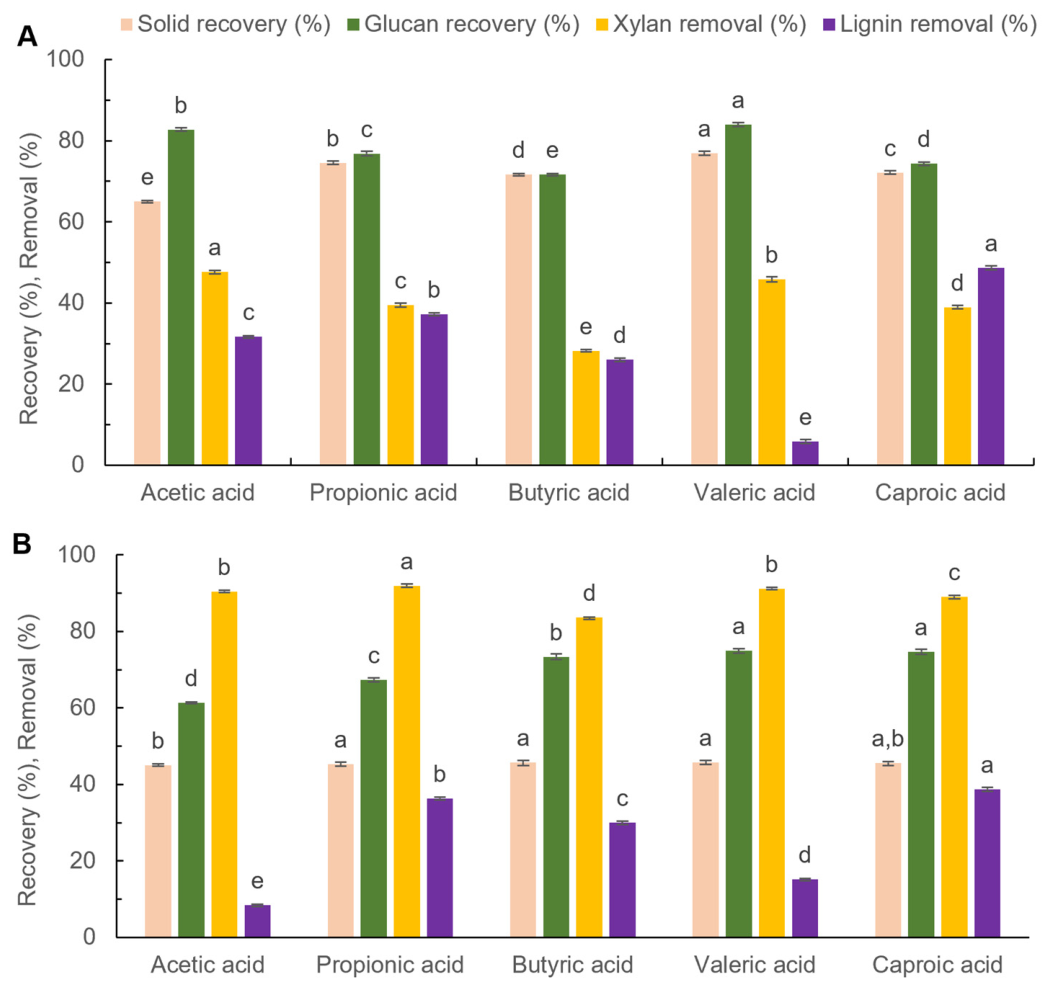
The raw corncob contained 34.45% glucan, 41.80% xylan, 18.73% lignin, and 5.02% other components. Compared with other lignocellulosic feedstock (such as corn stover, wheat straw), corncob generally has relatively higher content of xylan, which is used for the commercially production of xylose, and xylooligosaccharides (XOS) [28,29]. Meanwhile, the use of glucan for fermentable sugars and bioethanol production would broaden the economic performance of corncob-based biorefinery process. As shown in Figure 1A, pretreatment with 2.5% organic acids at 130 °C gave solid recovery of 70.90–78.20% and glucan retention of 79.74–85.39%, indicating that the cellulose framework was largely preserved under these mild conditions. Only partial solubilization of hemicellulose and lignin occurred, with xylan removal remaining below 51% across all treatments. This limited hemicellulose hydrolysis is consistent with earlier reports that low-intensity organic acid pretreatment primarily causes finite solubilization of hemicellulose rather than extensive structural disruption [30,31]. Among the five acids, propionic acid stood out by achieving the highest glucan retention alongside considerable xylan removal, suggesting a favorable balance between preserving cellulose and promoting hemicellulose hydrolysis. Caproic acid, in contrast, exhibited relatively higher delignification efficiency, implying that longer carbon chain length may enhance affinity toward lignin structures. However, the modest xylan removal at 130 °C appeared insufficient to adequately disrupt the compact lignocellulosic matrix, as reflected by the limited compositional changes across all treatment groups.
Elevating the temperature to 180 °C dramatically altered the fractionation profile (Figure 1B). Solid recovery dropped to 41.38–46.54%, while xylan removal surged to 84.08–94.05%, demonstrating that temperature is the dominant factor governing hemicellulose solubilization. This sharp increase can be attributed to accelerated deacetylation of hemicellulose side chains and cleavage of glycosidic bonds in the xylan backbone, together with disruption of ester and ether linkages within the LCC [32]. Under these severe conditions, the differential effects of acid type became more nuanced. Butyric acid treatment achieved 91.84% xylan removal and 53.10% lignin removal with a glucan retention of 75.24%, representing a well-balanced trade-off between glucan preservation and the removal of the two major recalcitrant components. Caproic acid gave the highest xylan removal at 94.05%, whereas propionic acid afforded the highest glucan retention at 77.57%. Acetic acid treatment resulted in the lowest glucan retention at 62.51%, suggesting more pronounced cellulose degradation under high-temperature conditions. In comparison with a previous study in which butyric acid pretreatment of corn stover at 50 g/L and 180 °C for 30 min achieved 83.17% xylan removal and 86.99% glucan recovery, the present work obtained an 8.67% higher xylan removal with butyric acid pretreatment [22]. This difference likely reflects the higher susceptibility of corncob hemicellulose to acid hydrolysis compared with corn stover, though the lower glucan retention also underscores the trade-off between deconstruction efficiency and carbohydrate preservation at elevated severity. It is worth noting that lignin depolymerization may be accompanied by condensation and redeposition reactions, contributing to the observed variations in delignification among different organic acid treatments [33,34]. Overall, butyric acid at 180 °C provided the most balanced fractionation, achieving high xylan and lignin removal while preserving glucan, making it the most promising candidate for further evaluation.

3.1.2. Compositional Changes in Corncob Pretreated with High-Concentration Organic Acids at Different Temperatures

As shown in Figure 2A, when the organic acid concentration was increased to 5.0%, pretreatment at 130 °C resulted in solid recovery of 65.02–76.96%, glucan retention of 71.65–83.96%, xylan removal of 28.23–47.61%, and lignin removal of 5.85–48.66%. These results confirm that cellulose remained largely intact at this temperature, though the fractionation selectivity varied considerably among the organic acids. Valeric acid treatment gave the highest solid recovery and glucan retention, acetic acid achieved the maximum xylan removal, and caproic acid again exhibited the greatest delignification efficiency. Notably, increasing acid concentration from 2.5% to 5.0% did not consistently enhance pretreatment performance at 130 °C. Xylan removal with propionic acid declined from 50.64% to 39.43%, and with butyric acid from 30.35% to 28.23%; only valeric acid showed an increase from 34.13% to 45.83%. These results suggest that at 130 °C, simply elevating the acid concentration may not effectively promote hemicellulose hydrolysis. This could be due to the limited thermal energy available to overcome the activation energy barrier for glycosidic bond cleavage. Furthermore, higher acid concentrations at moderate temperatures might intensify lignin condensation and redeposition onto the biomass surface, thereby hindering the solubilization of hemicellulose [33,35].
At 180 °C with 5.0% organic acids, solid recovery across all treatments converged within a range of 44.98–45.76%, and xylan removal reached 83.58–91.85% (Figure 2B). The overall trends were similar to those observed at 2.5% concentration, further reinforcing the conclusion that temperature elevation is the primary driver of hemicellulose solubilization and structural deconstruction. Propionic acid achieved the highest xylan removal at 91.85%, while valeric and caproic acids gave higher glucan retention of 74.88% and 74.66%, respectively. Acetic acid again showed the lowest glucan retention (61.33%) and lignin removal (8.37%), suggesting that acetic acid may be less selective toward lignin solubilization while causing more cellulose loss under severe conditions [36,37]. Compared with the 2.5% level, increasing acid concentration to 5.0% did not universally improve fractionation performance. Propionic acid showed only a marginal increase in xylan removal from 90.05% to 91.85%, whereas butyric acid exhibited declines in both xylan removal (from 91.84% to 83.58%) and lignin removal (from 53.10% to 29.94%). Jiang et al. observed that temperature and acid loading jointly influence xylan removal, and excessive pretreatment severity may promote further conversion of sugars and lignin fragments into furans, organic acids, and phenolic byproducts, thereby reducing effective sugar recovery [38]. The present results corroborate this view, indicating that higher acid loading does not necessarily translate into superior fractionation selectivity. Overall, among all conditions tested, 2.5% butyric acid at 180 °C emerged as a particularly balanced condition, offering favorable glucan retention combined with substantial xylan and lignin removal. This condition also corresponds to a moderate acid concentration that is closer to what might be expected in AD effluent, making the findings more directly relevant for practical applications.

3.2. Effects of Organic Acid Pretreatment on Enzymatic Hydrolysis Efficiency of Corncob

3.2.1. Enzymatic Hydrolysis Performance of Corncob Pretreated with Low-Concentration Organic Acids at Different Temperatures

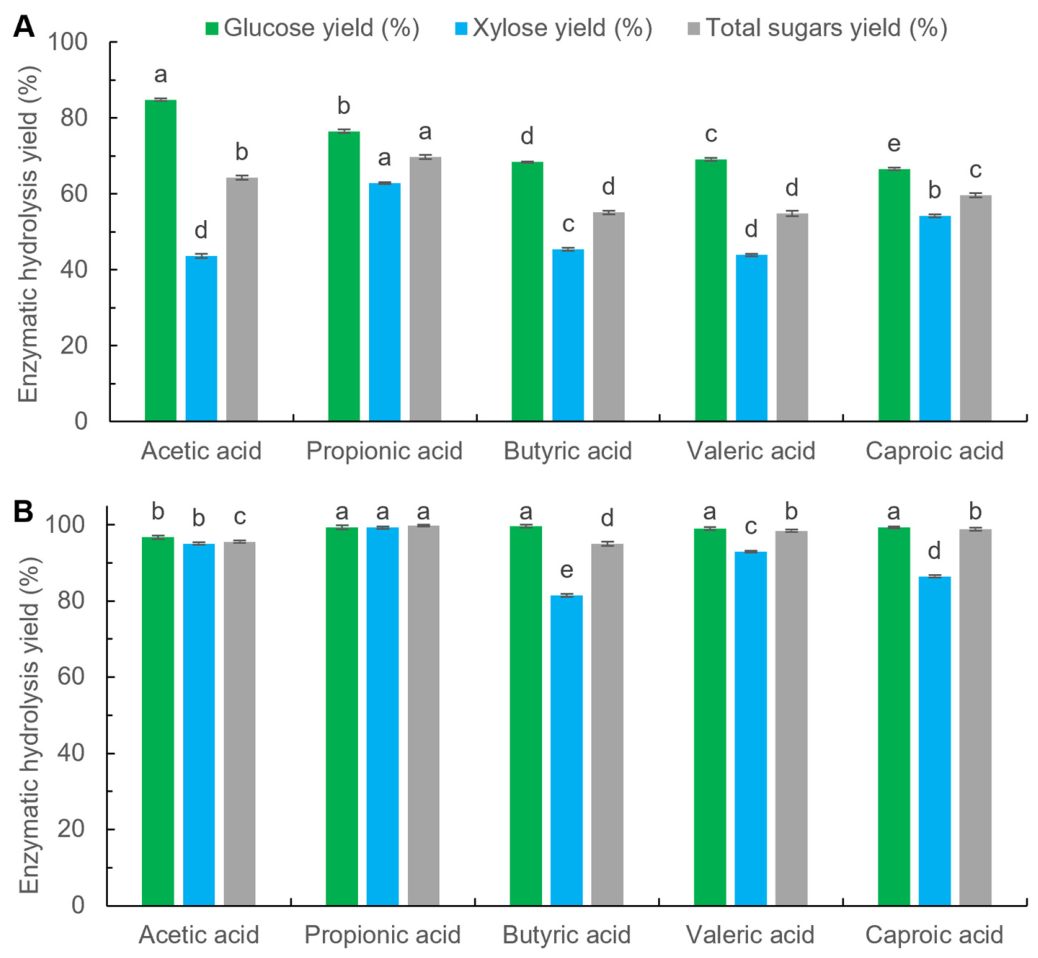
Enzymatic hydrolysis of pretreated solids provided direct evidence of the effectiveness of organic acid pretreatment in improving substrate digestibility. When using the untreated corncob as the substrate for enzymatic hydrolysis (15 FPU/g), the yields of glucose, xylose, and total sugar were 23.31%, 14.12%, and 18.22%, respectively. As shown in Figure 3A, at 130 °C with 2.5% organic acids, glucose, xylose, and total sugar yields ranged from 66.59% to 84.85%, 43.67% to 62.88%, and 54.90% to 69.77%. Acetic acid treatment gave the highest glucose yield at 84.85%, while propionic acid achieved the maximum xylose yield (62.88%) and total sugar yield (69.77%), consistent with its higher glucan retention and xylan removal. The relatively lower total sugar yields observed for butyric, valeric, and caproic acid treatments, particularly the 54.90% yield for valeric acid, likely reflect the persistent physical barrier of residual hemicellulose and lignin, which restricts enzyme access to cellulose and promotes non-productive cellulase adsorption. Yao et al. demonstrated that phenolic hydroxyl groups in residual lignin, especially p-hydroxyphenyl structures, enhance non-productive cellulase adsorption via hydrogen bonding and π–π interactions, thereby inhibiting cellulose hydrolysis [39]. Thus, the limited removal of hemicellulose and lignin at 130 °C remained a critical constraint on enzymatic digestibility, regardless of the acid type employed.
A substantial improvement was observed when the pretreatment temperature was raised to 180 °C. Glucose yields in all treatment groups exceeded 96.75%, and total sugar yields reached 93.02–99.85% (Figure 3B), indicating that high-temperature pretreatment largely enhanced the enzymatic accessibility of the pretreated solids. Propionic acid treatment achieved the highest xylose and total sugar yields at 99.32% and 99.85%, respectively. Valeric and caproic acid treatments also gave total sugar yields of 98.46% and 98.87%, respectively, suggesting that these longer-chain acids performed comparably to propionic acid in overall saccharification. Notably, although butyric acid treatment afforded the highest glucose yield (99.59%), its xylose yield was 81.42%, resulting in a total sugar yield of >95%. This disparity is more plausibly attributed to extensive xylan solubilization into the liquid phase during pretreatment, leaving less residual xylan available for enzymatic hydrolysis, rather than to inhibition of xylanase activity. This interpretation is supported by the compositional data showing that butyric acid achieved 91.84% xylan removal. Previous studies have established that sufficient removal of hemicellulose and weakening of the lignin barrier during pretreatment significantly increase cellulose exposure and enzyme accessibility [40]. However, when substantial xylan has already been solubilized in the pretreatment stage, xylose yield in the subsequent enzymatic step may be correspondingly reduced. Hao et al. employed hydrogen peroxide-acetic acid pretreatment of corncob followed by a two-step enzymatic hydrolysis and obtained a glucose yield of 79.1%, confirming that delignification pretreatment effectively improves subsequent saccharification [41]. Lian et al. used maleic acid pretreatment of corncob to construct a cascade biorefinery process and achieved 85.4% enzymatic glucose yield at 10% solid loading, with co-production of XOS and glucose, indicating that moderate hemicellulose removal significantly enhances substrate enzymatic accessibility [42]. Collectively, these findings show that effective deconstruction of cell wall structure during pretreatment is the key to improving enzymatic hydrolysis efficiency, a trend consistently observed in the present work. On balance, propionic acid treatment was more favorable for the synergistic recovery of glucose and xylose, whereas 2.5% butyric acid at 180 °C showed superior performance specifically in promoting glucose release. Given that AD effluents typically contain a mixture of these acids rather than a single species, the distinct behaviors observed here provide guidance for adjusting the acid composition or selecting appropriate digestion conditions to favor the most effective acids.

3.2.2. Enzymatic Hydrolysis Performance of Corncob Pretreated with High-Concentration Organic Acids at Different Temperatures

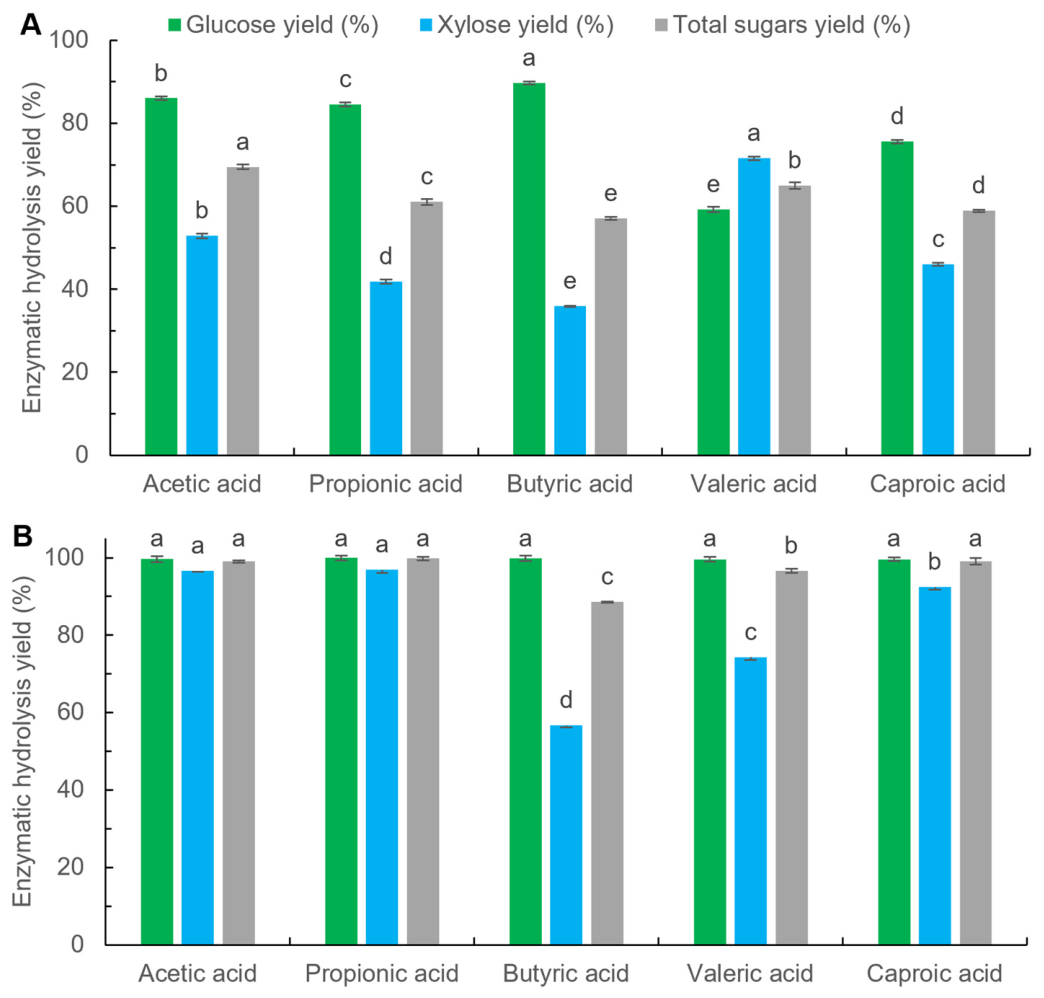
The glucose, xylose, and total sugar yields ranged from 59.26% to 89.72%, 35.88% to 71.53%, and 57.08% to 69.47%, respectively, with 5.0% organic acids at 130 °C (Figure 4A). These results confirm that pretreatment at this lower temperature had not yet fully overcome the structural constraints imposed by lignocellulose. Distinct hydrolysis profiles emerged among the acids. Acetic acid treatment achieved the highest total sugar yield at 69.47%. Butyric acid gave the maximum glucose yield at 89.72% but a low xylose yield of only 35.88%, resulting in a reduced total sugar yield of 57.08%. Valeric acid treatment achieved the highest xylose yield at 71.53% but a relatively low glucose yield of 59.26%. This divergence in glucose versus xylose release highlights the trade-off between preserving cellulose and removing hemicellulose at moderate pretreatment intensities. Compared with 2.5% organic acids, increasing acid concentration did not consistently improve total sugar yields; only acetic and valeric acids showed increases, while propionic and caproic acids exhibited declines. This observation reinforces the view that at 130 °C, raising acid concentration does not reliably enhance enzymatic hydrolysis performance, and the effect is strongly dependent on the organic acid type. The limited removal of hemicellulose and lignin remained the primary factor restricting enzymatic efficiency across all treatments.
As shown in Figure 4B, at 180 °C with 5.0% organic acids, glucose yields in all treatment groups exceeded 99.59%, and total sugar yields increased to 88.55–99.77%, demonstrating that all five organic acids achieved high glucose conversion efficiency at the elevated temperature. Propionic acid treatment gave the highest xylose and total sugar yields at 96.91% and 99.77%, respectively. Acetic and caproic acid treatments also achieved total sugar yields of 99.04% and 99.12%, indicating good overall saccharification performance at 5.0% concentration. In contrast, although butyric acid maintained a high glucose yield of 99.82%, xylose yield dropped to 56.65%, resulting in a total sugar yield of only 88.55%. This pattern mirrors the results observed at 2.5% concentration and further supports the interpretation that butyric acid pretreatment achieves extensive xylan solubilization during the pretreatment stage, thereby reducing the xylan available for enzymatic hydrolysis [22]. It was reported that pretreatment severity influences the partitioning of hemicellulose between the pretreatment liquor and the enzymatic hydrolysis solids, thereby altering the composition of saccharification products [42]. The relatively low xylose yield with butyric acid in the present study is consistent with this understanding. Comparison across different acid concentrations reveals that increasing organic acid concentration did not further improve saccharification performance and in some cases, notably with butyric acid, decreased total sugar yield. This suggests that while ensuring high glucose release, moderate pretreatment intensity is more conducive to the synergistic recovery of both glucose and xylose. Therefore, considering the combined effects on component fractionation, enzymatic hydrolysis performance, and acid consumption, 2.5% butyric acid at 180 °C for 45 min remained a particularly promising pretreatment condition. This concentration is also within the range that could be achieved by concentrating AD effluents, reinforcing the practical relevance of the optimized condition.

3.3. Correlation Between Xylan Removal and Enzymatic Hydrolysis Efficiency Under Typical AD-Derived Organic Acid Pretreatment

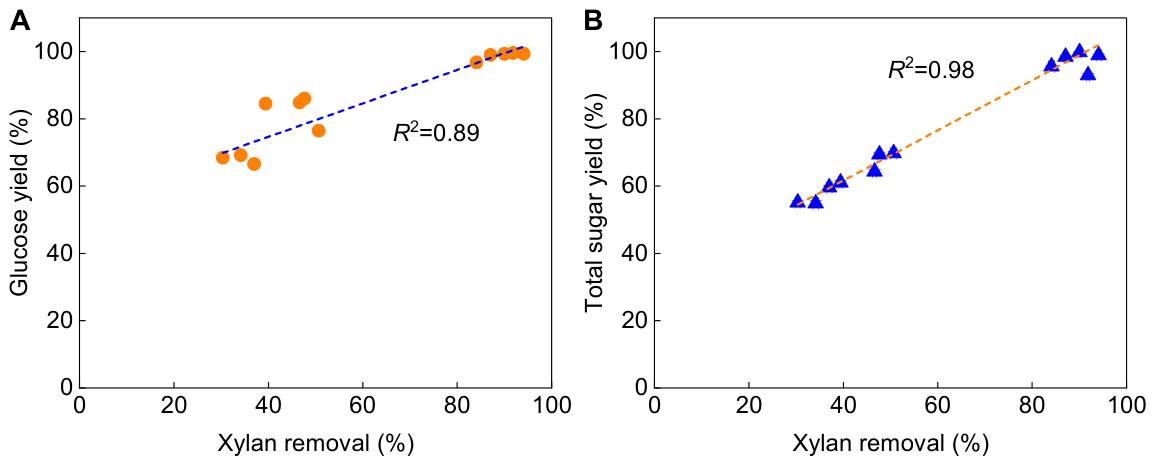
To elucidate the relationship between pretreatment efficacy and subsequent saccharification performance, xylan removal was plotted against enzymatic total sugar yield for all pretreatment conditions (Figure 5). A positive correlation was observed for glucose yield (R2 = 0.89) and total sugar yield (R2 = 0.98). It confirms that hemicellulose solubilization is a major determinant of enzymatic digestibility. This finding is consistent with the widely recognized findings that xylan removal facilitates enzymatic hydrolysis by increasing cellulose accessibility and reducing the physical barrier imposed by the hemicellulose-lignin matrix [43,44].
A closer examination of the correlation reveals a threshold effect. When xylan removal was below approximately 80%, total sugar yield increased sharply with increasing xylan removal, suggesting that hemicellulose removal in this range effectively opens the lignocellulose structure and exposes cellulose microfibrils to enzymatic attack. This steep ascending portion predominantly corresponds to the 130 °C pretreatment groups, where limited hemicellulose solubilization remained the primary constraint on enzymatic hydrolysis. In contrast, when xylan removal exceeded approximately 85%, further increases in xylan removal yielded only marginal improvements in total sugar yield. This region mainly comprises the 180 °C treatment groups, where extensive hemicellulose removal had already been achieved and the enzymatic digestibility approached its theoretical maximum. These observations imply that once a critical level of xylan removal is reached, other factors such as lignin content, cellulose crystallinity, and the degree of polymerization may become the limiting factors for enzymatic hydrolysis. It was reported that pretreatments with higher lignin removal tended to yield slightly higher total sugar yields at comparable xylan removal levels, consistent with the known inhibitory effect of residual lignin on cellulase activity through non-productive adsorption [10,45]. Conversely, treatments that caused more extensive sugar degradation or lignin condensation during pretreatment may show lower total sugar yields than expected based on xylan removal alone. This highlights that while xylan removal serves as a useful indicator of pretreatment effectiveness, it does not capture all aspects of substrate quality that influence enzymatic hydrolysis. The combined effects of xylan and lignin removal, together with structural modifications to the residual cellulose, collectively determine the overall enzymatic digestibility.

3.4. Mass Balance Analysis of Fermentable Sugar Production Under Optimized Pretreatment Conditions

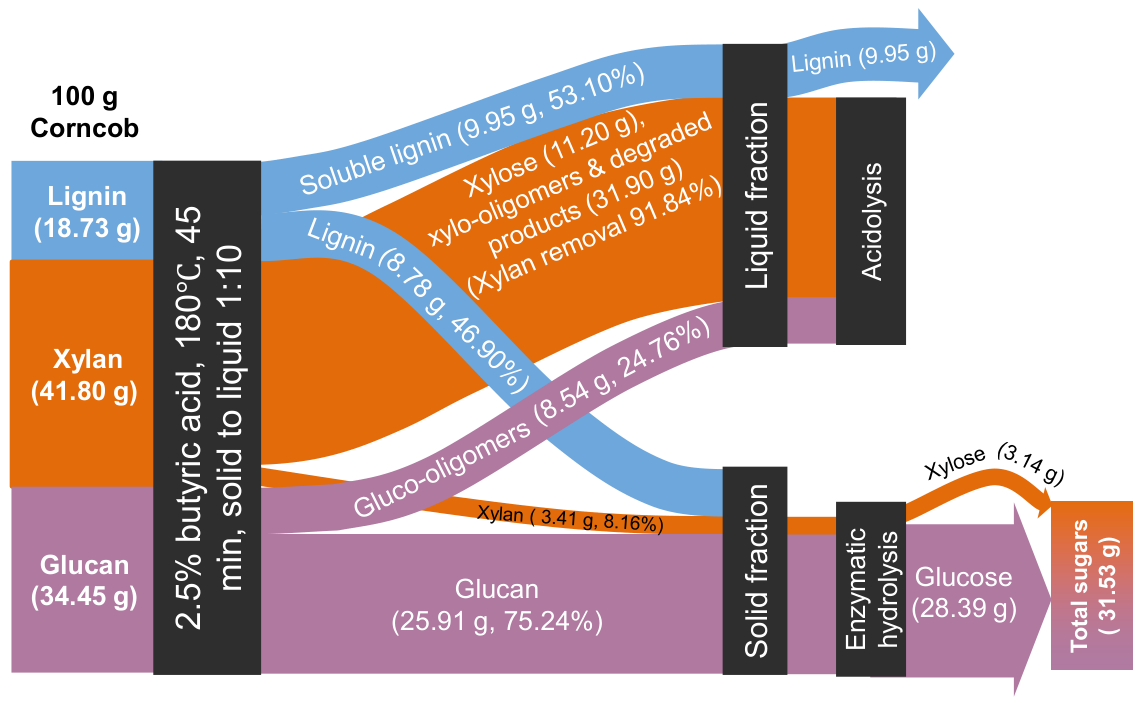
Based on the comprehensive evaluation of component fractionation and enzymatic hydrolysis performance, the pretreatment condition of 2.5% butyric acid at 180 °C for 45 min was selected as the optimized condition for mass balance analysis. Figure 6 presents the detailed mass balance of the entire process from raw corncob to fermentable sugars. Starting from 100 g of raw corncob (dry basis) containing 34.45 g glucan, 41.80 g xylan, and 18.73 g lignin, the butyric acid pretreatment resulted in a solid recovery of approximately 41.38 g. Compositional analysis of the pretreated solids showed that the majority of glucan was retained, with a glucan recovery of approximately 75.24% corresponding to 25.91 g glucan, while xylan was extensively removed, leaving only about 8.16% of the original xylan in the solid fraction (approximately 3.41 g). Lignin removal reached approximately 53.10%, leaving about 8.78 g of lignin in the pretreated solids. The pretreatment liquor thus contained the solubilized xylan together with solubilized lignin fragments and other degradation products. As shown in Figure 6, the liquid fraction contained 11.20 g of xylose, and approximately 31.90 g of xylooligosaccharides (XOS) and the xylan-degraded products. Xylose can be hydrogenated to xylitol [46], a high-value sugar alcohol with applications in food and pharmaceutical industries [47]. In addition, XOS have prebiotic properties and can be sold as functional food ingredients [48,49]. Subsequent enzymatic hydrolysis of the pretreated solids at 13% solid loading with 15 FPU/g cellulase for 72 h converted the retained glucan into glucose. The molecular weight of anhydroglucose units in glucan is 162 g/mol and the molecular weight of glucose is 180 g/mol; thus, the conversion factor during glucan hydrolysis is 1.11 (i.e., 180/162). In this case, an efficiency exceeding 99% was obtained, yielding approximately 28.39 g of glucose from the 25.91 g of glucan present in the pretreated solids. Meanwhile, the residual xylan in the pretreated solids was also partially hydrolyzed, contributing additional fermentable sugars. The overall sugar recovery from the original corncob, calculated as the fermentable sugars obtained relative to the theoretical maximum based on initial glucan content, reached approximately 75% for glucose, with a total fermentable sugar yield of approximately 31.53 g per 100 g raw corncob. This total sugar yield is comparable to or higher than those reported for other organic acid pretreatment systems, and the glucose yield is particularly competitive. Overall, the mass balance confirms that the butyric acid pretreatment process enables efficient conversion of corncob glucan to glucose while generating a xylan-rich liquid stream that could be exploited in an integrated biorefinery. When considering the coupling with AD, the pretreatment liquor containing xylose and organic acid residues might potentially be recycled back to the digester, thereby closing the material loop and enhancing the overall sustainability of the process.

3.5. Ethanol Fermentation Performance of Optimized Butyric Acid-Pretreated Corncob Hydrolysates

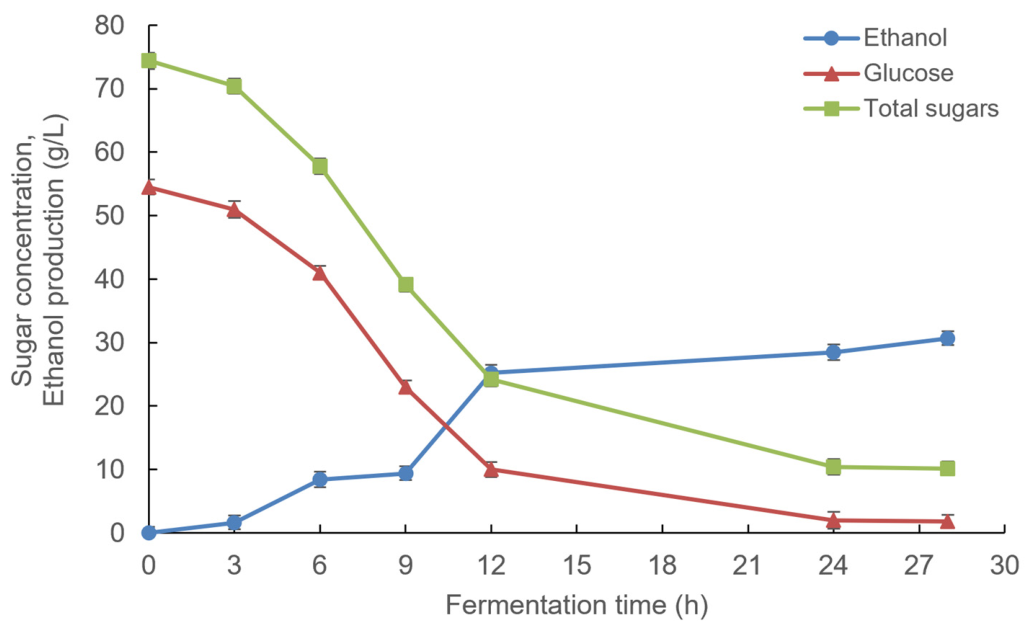
Corncob pretreated with 2.5% butyric acid at 180 °C for 45 min was used as the substrate for ethanol fermentation. High-solid enzymatic hydrolysis was performed at 13 wt% solid loading with 15 FPU/g cellulase to obtain the sugar-rich hydrolysate, which was then used as the fermentation carbon source. High-solid loading hydrolysis is essential for achieving elevated sugar concentrations, a prerequisite for obtaining high ethanol titers in fermentation [50]. The pretreated corncob was subjected to enzymatic hydrolysis for 72 h, and the resulting hydrolysate was inoculated with S. cerevisiae for ethanol fermentation. For the low initial sugar group, the hydrolysate was diluted to initial glucose and total sugar concentrations of ~54.50 g/L and ~74.40 g/L, respectively (Figure 7). During fermentation, glucose concentration declined progressively while ethanol concentration increased, exhibiting the typical fermentation profile of S. cerevisiae. Within the first 6 h, glucose decreased from 54.50 g/L to 41.00 g/L, while ethanol increased to 8.43 g/L. Glucose consumption accelerated thereafter, reaching 23 g/L and 10 g/L at 9 h and 12 h, respectively, with corresponding ethanol concentrations of 9.39 g/L and 25.21 g/L. By 24 h, glucose was nearly exhausted at approximately 2 g/L, with ethanol reaching 28.46 g/L. At 28 h, ethanol stabilized at 30.68 g/L, corresponding to glucose and total sugar consumption rates of 96.61% and 86.31%, respectively. In this case, the final ethanol yield from fermentable sugars was 93.5% of the theoretical yield. The total sugar concentration remained higher than glucose concentration throughout fermentation, and 10.19 g/L of total sugar remained after fermentation, suggesting that the residual sugars consisted mainly of xylose that were not fully hydrolyzed or utilized. Wild-type S. cerevisiae ferments glucose efficiently but lacks a complete and efficient xylose metabolic pathway, making inadequate xylose utilization a significant limitation in lignocellulosic ethanol production [51]. In addition, the concentration of inhibitors in the enzymatic hydrolysates under 13 wt% solid loading was 42.3 mg/L (furfural), 12.8 mg/L (5-hydroxymethylfurfural, HMF), 285 mg/L (acetic acid), and 48 mg/L (formic acid). The present of inhibitors in lignocellulosic hydrolysates may affect sugar fermentation, with xylose fermentation generally being more sensitive to inhibitors than glucose fermentation [52].
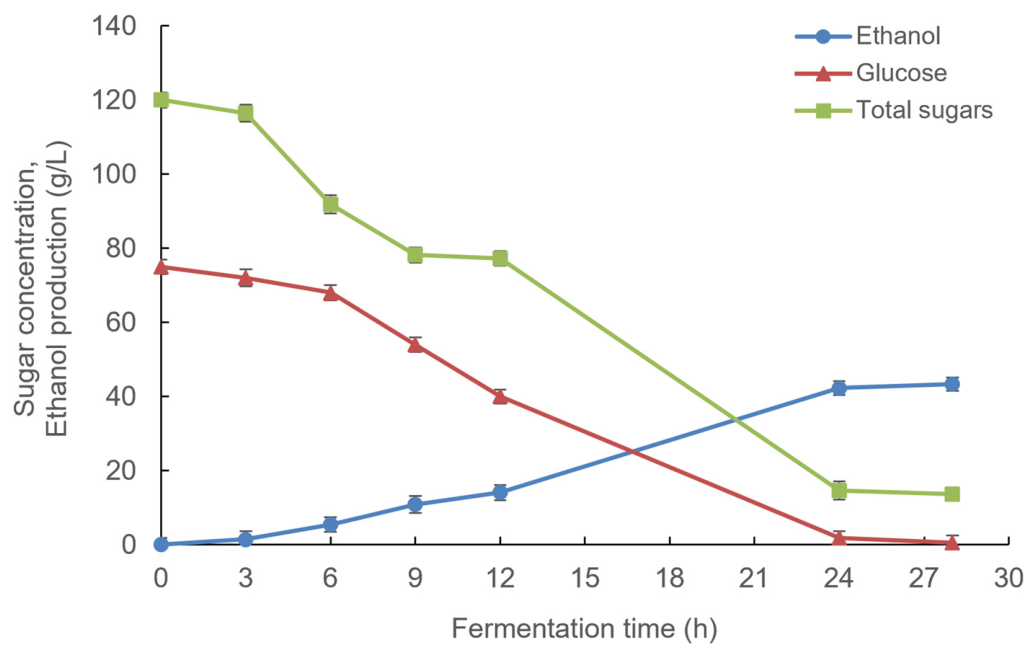
To increase the initial glucose concentration, the undiluted high-solid enzymatic hydrolysate was used directly for fermentation (Figure 8). The high initial sugar group had initial glucose and total sugar concentrations of 75 g/L and 120 g/L, respectively. Ethanol concentration increased continuously while glucose and total sugar concentrations declined, following a similar trend to the former group (Figure 7), though glucose consumption proceeded over a longer duration due to the higher initial sugar concentration. During the first 12 h, glucose decreased from 75 g/L to 40 g/L, with ethanol gradually reaching 14.11 g/L. Glucose then entered a rapid consumption phase, dropping to 1.90 g/L at 24 h with ethanol reaching 42.27 g/L. At 28 h, ethanol further increased to 43.32 g/L, while glucose decreased to 0.63 g/L and total sugar to 13.71 g/L, corresponding to glucose and total sugar consumption rates of 99.16% and 88.58%, respectively (Figure 8). The final ethanol yield from sugars was calculated as 79.8% of the theoretical yield, which was lower than that of fermentation under lower initial sugars concentration (Figure 7). Compared with the low initial sugar group, the high initial glucose concentration increased the final ethanol titer from 30.68 g/L to 43.32 g/L, though the time required to reduce glucose to low levels was extended. This indicates that increasing sugar loading is beneficial for improving ethanol titer but may impose higher osmotic stress on yeast during the early fermentation stage. Ahmad et al. reported that osmotic stress caused by elevated sugar concentrations in high-gravity fermentation (10–30% glucose) affects yeast growth and fermentation performance, while salt-adapted yeasts can shorten the lag phase and improve ethanol production under high-sugar conditions [53].
Table 1 shows the bioethanol production performance from lignocellulose under different pretreatments, such as alkaline [16,54], oxalic acid [55,56], inorganic acid [57], and organic acid [58]. Zhao et al. achieved 110.9 g/L ethanol with 92.9% of theoretical yield at 36 h with engineered yeast strains from high-solid corn stover hydrolysate based on NaOH-assisted ball milling pretreatment, demonstrating that increasing solid and fermentable sugar concentrations is an effective strategy for achieving high ethanol titers, though fermentation performance is also influenced by strain tolerance and mixed-sugar utilization capacity [54]. In the present study, glucose was nearly depleted after fermentation, while total sugar residual of 13.71 g/L remained, indicating that the residual sugars mainly comprised xylose and oligosaccharides. Engineered S. cerevisiae strains capable of co-utilizing glucose, xylose, cellobiose, and xylooligosaccharides have been reported to achieve 33.96 g/L ethanol with 84.3% theoretical yield, suggesting that enhancing C5/C6 co-fermentation capacity could further reduce residual sugars in the hydrolysate and improve overall carbohydrate conversion efficiency [59]. In the SHF mode, increasing initial sugar concentration effectively improves the final ethanol titer; future work could focus on screening or constructing xylose-utilizing yeast strains to further enhance mixed-sugar utilization and ethanol production performance. Moreover, the integration of this pretreatment approach with AD offers a promising route to utilize the organic acid-rich effluent directly, thereby might reducing the cost of purchased chemicals. Finally, some complementary thermochemical route, such as the granulation and pyrolysis of agricultural residues [60], can effectively prompt the development of a closed-loop biorefinery system.

4. Conclusions

The present study systematically compared five commercial organic acids typical of AD effluents for pretreating corncob, aiming to enhance enzymatic saccharification and ethanol production. The results indicate that pretreatment with 2.5% butyric acid at 180 °C for 45 min yielded the most favorable performance, preserving 75.24% of glucan while removing 91.84% of xylan and 53.10% of lignin. This treatment enabled over 99% glucose release during enzymatic hydrolysis. A strong correlation between xylan removal and total sugar yield (R2 = 0.98) confirmed that hemicellulose solubilization in typical AD-derived organic acid pretreatment is the primary factor governing enzymatic digestibility. By using butyric acid-pretreated corncob hydrolysates as the substrate, a higher ethanol titer of 43.32 g/L with 99.2% glucose consumption in SHF mode was obtained. In addition, under different initial sugar concentrations, the ethanol yields of S. cerevisiae from consuming sugars maintained 79.8–93.5% of the theoretical yield. These findings demonstrate that typical AD-derived organic acids, particularly butyric acid, are effective pretreatment reagents. This integrated strategy not only might reduce reliance on purchased chemicals but also provides a viable route for valorizing lignocellulose/organic waste streams within a circular biorefinery framework. Future work should focus on the following issues, including validation the feasibility with real AD effluent, optimization of mixed-VFA pretreatment systems, analysis of acid recovery and recycling, and techno-economic and life-cycle assessment to confirm the cost-effectiveness and environmental sustainability of the proposed strategy.

Author Contributions

Conceptualization, H.L. and R.Y.; methodology, H.L. and Y.S.; validation, H.L. and X.Y.; investigation, H.L. and X.P.; data curation, H.L. and W.Z.; writing—original draft preparation, H.L., Y.S. and X.P.; writing—review and editing, H.L.; visualization, F.X.; supervision, H.L. and R.Y.; project administration, H.L.; funding acquisition, H.L. and R.Y. All authors have read and agreed to the published version of the manuscript.

Funding

The work was supported by the National Natural Science Foundation of China (22578155, 22478147), Natural Science Foundation of Huaian City (HAB2024051), and Qinglan Project of Jiangsu Province of China.

Data Availability Statement

Data will be made available from corresponding authors on request.

Conflicts of Interest

The authors declare no conflicts of interest.

References

  1. Long, B.; Zhang, F.; Dai, S.Y.; Foston, M.; Tang, Y.J.; Yuan, J.S. Engineering strategies to optimize lignocellulosic biorefineries. Nat. Rev. Bioeng. 2025, 3, 230–244. [Google Scholar] [CrossRef] [Scilit]
  2. Liao, J.C.; Mi, L.; Pontrelli, S.; Luo, S. Fuelling the future: Microbial engineering for the production of sustainable biofuels. Nat. Rev. Microbiol. 2016, 14, 288–304. [Google Scholar] [CrossRef] [Scilit] [PubMed]
  3. Troiano, D.T.; Studer, M.H.P. Microbial consortia for the conversion of biomass into fuels and chemicals. Nat. Commun. 2025, 16, 6712. [Google Scholar] [CrossRef] [Scilit] [PubMed]
  4. Wang, M.; Wang, Y.; Liu, J.; Yu, H.; Liu, P.; Yang, Y.; Sun, D.; Kang, H.; Wang, Y.; Tang, J.; et al. Integration of advanced biotechnology for green carbon. Green Carbon 2024, 2, 164–175. [Google Scholar] [CrossRef] [Scilit]
  5. Wu, Y.; Cai, D.; Su, C.; Liao, Z.; Zhang, G.; Jiang, Y.; Wang, Y.; Gao, Y.; Liu, Y.; Tan, T. Robust Saccharomyces cerevisiae by rational metabolic engineering for effective ethanol production from undetoxified steam-exploded corn stover hydrolysate. Bioresour. Technol. 2025, 431, 132605. [Google Scholar] [CrossRef] [Scilit] [PubMed]
  6. Andrade, S.; García, C.; Iturralde, S.; Delgado-Noboa, J.; Pinos-Vélez, V.; Abril-González, M.; Vele-Salto, A. Sustainable Bioethanol Production from Cocoa Pod Husk with and Without Reductive Catalytic Fractionation (RCF). Fermentation 2026, 12, 257. [Google Scholar] [CrossRef] [Scilit]
  7. Santos, C.A.; Morais, M.A.B.; Mandelli, F.; Lima, E.A.; Miyamoto, R.Y.; Higasi, P.M.R.; Araujo, E.A.; Paixão, D.A.A.; Junior, J.M.; Motta, M.L.; et al. A metagenomic ‘dark matter’ enzyme catalyses oxidative cellulose conversion. Nature 2025, 639, 1076–1083, Correction in Nature 2025, 640, E7. https://doi.org/10.1038/s41586-025-08872-9. [Google Scholar] [CrossRef] [Scilit] [PubMed]
  8. Petridis, L.; Smith, J.C. Molecular-level driving forces in lignocellulosic biomass deconstruction for bioenergy. Nat. Rev. Chem. 2018, 2, 382–389. [Google Scholar] [CrossRef] [Scilit]
  9. Zhang, M.; Hwang, H.J.; Jeong, D.; Jia, L.; Oh, E.J.; Liu, D.; Zhao, J. A green biomass pretreatment strategy to produce 3-hydroxypropionic acid and ethanol with engineered Saccharomyces cerevisiae, Rhodosporidium toruloides, and Issatchenkia orientalis. Bioresour. Technol. 2026, 441, 133576. [Google Scholar] [CrossRef] [Scilit] [PubMed]
  10. Zhao, X.; Meng, X.; Ragauskas, A.J.; Lai, C.; Ling, Z.; Huang, C.; Yong, Q. Unlocking the secret of lignin-enzyme interactions: Recent advances in developing state-of-the-art analytical techniques. Biotechnol. Adv. 2022, 54, 107830. [Google Scholar] [CrossRef] [Scilit] [PubMed]
  11. Rabelo, S.C.; Nakasu, P.Y.S.; Scopel, E.; Araújo, M.F.; Cardoso, L.H.; Costa, A.C.d. Organosolv pretreatment for biorefineries: Current status, perspectives, and challenges. Bioresour. Technol. 2023, 369, 128331. [Google Scholar] [CrossRef] [Scilit] [PubMed]
  12. Huang, K.; Su, K.; Mohan, M.; Chen, J.; Xu, Y.; Zhou, X. Research progress on organic acid pretreatment of lignocellulose. Int. J. Biol. Macromol. 2025, 307, 142325. [Google Scholar] [CrossRef] [Scilit] [PubMed]
  13. Cai, T.; Liu, C.; Jiang, J.; Meng, X.; Ragauskas, A.J.; Wang, K. Innovative biphasic solvent systems for lignocellulosic biorefinery. Trends Chem. 2024, 6, 219–233. [Google Scholar] [CrossRef] [Scilit]
  14. Nair, L.G.; Agrawal, K.; Verma, P. Organosolv pretreatment: An in-depth purview of mechanics of the system. Bioresour. Bioprocess. 2023, 10, 50. [Google Scholar] [CrossRef] [Scilit] [PubMed]
  15. Morán-Aguilar, M.G.; Calderón-Santoyo, M.; de Souza Oliveira, R.P.; Aguilar-Uscanga, M.G.; Domínguez, J.M. Deconstructing sugarcane bagasse lignocellulose by acid-based deep eutectic solvents to enhance enzymatic digestibility. Carbohydr. Polym. 2022, 298, 120097. [Google Scholar] [CrossRef] [Scilit] [PubMed]
  16. Alam, A.; Zhang, R.; Liu, P.; Huang, J.; Wang, Y.; Hu, Z.; Madadi, M.; Sun, D.; Hu, R.; Ragauskas, A.J.; et al. A finalized determinant for complete lignocellulose enzymatic saccharification potential to maximize bioethanol production in bioenergy Miscanthus. Biotechnol. Biofuels 2019, 12, 99. [Google Scholar] [CrossRef] [Scilit] [PubMed]
  17. Luo, H.; Zhou, T.; Zhang, R.; Yang, Q.; You, X.; Wang, S.; Wang, J.; Xie, F.; Yang, R. Conversion of biomass to biofuels: Integration of a ternary deep eutectic solvent pretreatment and microbial fermentation for C2-C4 bioalcohols production from lignocellulose. Ind. Crops Prod. 2024, 220, 119271. [Google Scholar] [CrossRef] [Scilit]
  18. Dharmaraja, J.; Shobana, S.; Arvindnarayan, S.; Francis, R.R.; Jeyakumar, R.B.; Saratale, R.G.; Ashokkumar, V.; Bhatia, S.K.; Kumar, V.; Kumar, G. Lignocellulosic biomass conversion via greener pretreatment methods towards biorefinery applications. Bioresour. Technol. 2023, 369, 128328. [Google Scholar] [CrossRef] [Scilit] [PubMed]
  19. Zhao, L.; Sun, Z.-F.; Zhang, C.-C.; Nan, J.; Ren, N.-Q.; Lee, D.-J.; Chen, C. Advances in pretreatment of lignocellulosic biomass for bioenergy production: Challenges and perspectives. Bioresour. Technol. 2022, 343, 126123. [Google Scholar] [CrossRef] [Scilit] [PubMed]
  20. Xu, N.; Zhang, W.; Ren, S.; Liu, F.; Zhao, C.; Liao, H.; Xu, Z.; Huang, J.; Li, Q.; Tu, Y.; et al. Hemicelluloses negatively affect lignocellulose crystallinity for high biomass digestibility under NaOH and H2SO4 pretreatments in Miscanthus. Biotechnol. Biofuels 2012, 5, 58. [Google Scholar] [CrossRef] [Scilit] [PubMed]
  21. Zhang, R.; Gao, H.; Wang, Y.; He, B.; Lu, J.; Zhu, W.; Peng, L.; Wang, Y. Challenges and perspectives of green-like lignocellulose pretreatments selectable for low-cost biofuels and high-value bioproduction. Bioresour. Technol. 2023, 369, 128315. [Google Scholar] [CrossRef] [Scilit] [PubMed]
  22. Luo, H.; Shi, Y.; Xie, F.; Zhou, T.; Gao, L.; Yang, R.; Wang, Z. Efficient co-production of fermentable sugars and biobutanol from corn stover based on a novel butyric acid pretreatment strategy. Ind. Crops Prod. 2023, 191, 115976. [Google Scholar] [CrossRef] [Scilit]
  23. Zhu, Z.; Huang, R.; Yao, S.; Liu, Y.; Zhang, Q.; Zhou, X.; Jiang, K. An integrated process for co-producing fermentable sugars and xylonate from sugarcane bagasse based on xylonic acid assisted pretreatment. Bioresour. Technol. 2023, 369, 128464. [Google Scholar] [CrossRef] [Scilit] [PubMed]
  24. Khan, W.; Lee, J.-S.; Yun, Y.-M. Enhancing anaerobic digestion of swine manure using magnetite: Insights into methane production and organic acids metabolism. Bioresour. Technol. 2026, 439, 133397. [Google Scholar] [CrossRef] [Scilit] [PubMed]
  25. Harirchi, S.; Wainaina, S.; Sar, T.; Nojoumi, S.A.; Parchami, M.; Parchami, M.; Varjani, S.; Khanal, S.K.; Wong, J.; Awasthi, M.K.; et al. Microbiological insights into anaerobic digestion for biogas, hydrogen or volatile fatty acids (VFAs): A review. Bioengineered 2022, 13, 6521–6557. [Google Scholar] [CrossRef] [Scilit] [PubMed]
  26. Wang, J.; Zhou, X.; Zhang, R.; You, X.; Yang, Q.; Zhang, C.; Shao, Y.; Xie, F.; He, A.; Yang, R.; et al. N-heterocycle-based deep eutectic solvent-driven lignocellulosic biomass valorization: Efficient extraction of lignin facilitates enzymatic hydrolysis to produce bioethanol and butyric acid from corn stover. Renew. Energy 2026, 262, 125361. [Google Scholar] [CrossRef] [Scilit]
  27. Zhang, C.; Wang, J.; Shao, Y.; Zhang, R.; Liu, L.; Xie, F.; Yang, R.; Luo, H. Utilization of N,N-Dimethylethanolamine for Deconstruction of Lignocellulose by Removing Lignin to Enhance Enzymatic Hydrolysis Efficiency and Microbial Fermentability for Bioalcohol Production. ACS Sustain. Chem. Eng. 2026, 14, 9328–9338. [Google Scholar] [CrossRef] [Scilit]
  28. Chakraborty, M.; Bhowal, J. Prospects of Health Beneficial Functional Xylooligosaccharides Produced by Enzymatic Hydrolysis of Xylan and Application in Food Industry: A Comprehensive Review. Food Rev. Int. 2025, 41, 643–670. [Google Scholar] [CrossRef] [Scilit]
  29. Palaniappan, A.; Antony, U.; Emmambux, M.N. Current status of xylooligosaccharides: Production, characterization, health benefits and food application. Trends Food Sci. Technol. 2021, 111, 506–519. [Google Scholar] [CrossRef] [Scilit]
  30. Liu, B.; Liu, L.; Deng, B.; Huang, C.; Zhu, J.; Liang, L.; He, X.; Wei, Y.; Qin, C.; Liang, C.; et al. Application and prospect of organic acid pretreatment in lignocellulosic biomass separation: A review. Int. J. Biol. Macromol. 2022, 222, 1400–1413. [Google Scholar] [CrossRef] [Scilit] [PubMed]
  31. Sun, Q.; Chen, W.-J.; Pang, B.; Sun, Z.; Lam, S.S.; Sonne, C.; Yuan, T.-Q. Ultrastructural change in lignocellulosic biomass during hydrothermal pretreatment. Bioresour. Technol. 2021, 341, 125807. [Google Scholar] [CrossRef] [Scilit] [PubMed]
  32. Jeong, S.-Y.; Lee, E.-J.; Ban, S.-E.; Lee, J.-W. Structural characterization of the lignin-carbohydrate complex in biomass pretreated with Fenton oxidation and hydrothermal treatment and consequences on enzymatic hydrolysis efficiency. Carbohydr. Polym. 2021, 270, 118375. [Google Scholar] [CrossRef] [Scilit] [PubMed]
  33. Liu, S.; Cheng, G. Developments and perspectives on lignin-first biomass pretreatment for efficient enzymatic hydrolysis and isolation of lignin with minimized degradation. Ind. Crops Prod. 2024, 208, 117926. [Google Scholar] [CrossRef] [Scilit]
  34. Wang, S.; Xu, W.; Tao, Y.; Hu, J.; Du, J.; Lu, J.; Lv, Y.; Fu, C.; Li, B.; Wang, H. Synergistic phenolic acid-ethylene glycol pretreatment for enhanced saccharification and ethanol fermentation of reed through suppressed lignin repolymerization. Int. J. Biol. Macromol. 2026, 351, 151027. [Google Scholar] [CrossRef] [Scilit] [PubMed]
  35. Wang, S.; Liu, B.; Liang, J.; Wang, F.; Bao, Y.; Qin, C.; Liang, C.; Huang, C.; Yao, S. Rapid and mild fractionation of hemicellulose through recyclable mandelic acid pretreatment. Bioresour. Technol. 2023, 382, 129154. [Google Scholar] [CrossRef] [Scilit] [PubMed]
  36. Chen, Y.; Yan, Z.; Liang, L.; Ran, M.; Wu, T.; Wang, B.; Zou, X.; Zhao, M.; Fang, G.; Shen, K. Comparative Evaluation of Organic Acid Pretreatment of Eucalyptus for Kraft Dissolving Pulp Production. Materials 2020, 13, 361. [Google Scholar] [CrossRef] [Scilit] [PubMed]
  37. Xu, X.; Zhang, S.; Gai, J.; Xie, X.; Wu, S.; Hu, J.; Song, K.; Chu, Q. A combination of acetic acid and deep eutectic solvent pretreatment on poplar for coproduction of bioethanol, bio-oil and energy recovery. Energy 2024, 313, 133956. [Google Scholar] [CrossRef] [Scilit]
  38. Jiang, X.; Zhai, R.; Li, H.; Li, C.; Deng, Q.; Jin, M. Understanding acid hydrolysis of corn stover during densification pretreatment for quantitative predictions of enzymatic hydrolysis efficiency using modified pretreatment severity factor. Bioresour. Technol. 2023, 386, 129487. [Google Scholar] [CrossRef] [Scilit] [PubMed]
  39. Yao, F.; Xu, S.; Jiang, Z.; Zhao, J.; Hu, C. The inhibition of p-hydroxyphenyl hydroxyl group in residual lignin on enzymatic hydrolysis of cellulose and its underlying mechanism. Bioresour. Technol. 2022, 346, 126585. [Google Scholar] [CrossRef] [Scilit] [PubMed]
  40. Yuan, Y.; Jiang, B.; Chen, H.; Wu, W.; Wu, S.; Jin, Y.; Xiao, H. Recent advances in understanding the effects of lignin structural characteristics on enzymatic hydrolysis. Biotechnol. Biofuels 2021, 14, 205. [Google Scholar] [CrossRef] [Scilit] [PubMed]
  41. Hao, X.; Xu, F.; Zhang, J. Effect of pretreatments on production of xylooligosaccharides and monosaccharides from corncob by a two-step hydrolysis. Carbohydr. Polym. 2022, 285, 119217. [Google Scholar] [CrossRef] [Scilit] [PubMed]
  42. Lian, Z.; Zhang, Q.; Xu, Y.; Zhou, X.; Jiang, K. Biorefinery Cascade Processing for Converting Corncob to Xylooligosaccharides and Glucose by Maleic Acid Pretreatment. Appl. Biochem. Biotechnol. 2022, 194, 4946–4958. [Google Scholar] [CrossRef] [Scilit] [PubMed]
  43. Su, Y.; Fang, L.; Wang, P.; Lai, C.; Huang, C.; Ling, Z.; Yong, Q. Coproduction of xylooligosaccharides and monosaccharides from hardwood by a combination of acetic acid pretreatment, mechanical refining and enzymatic hydrolysis. Bioresour. Technol. 2022, 358, 127365. [Google Scholar] [CrossRef] [Scilit] [PubMed]
  44. Yang, Q.; Ying, W.; Wen, P.; Zhu, J.; Xu, Y.; Zhang, J. Delignification of poplar for xylo-oligosaccharides production using lactic acid catalysis. Bioresour. Technol. 2021, 342, 125943. [Google Scholar] [CrossRef] [Scilit] [PubMed]
  45. Zhang, F.; Lan, W.; Zhang, A.; Liu, C. Green approach to produce xylo-oligosaccharides and glucose by mechanical-hydrothermal pretreatment. Bioresour. Technol. 2022, 344, 126298. [Google Scholar] [CrossRef] [Scilit] [PubMed]
  46. Awad, A.; Valekar, A.H.; Oh, K.-R.; Prihatno, F.; Jung, J.; Nimbalkar, A.S.; Upare, P.P.; Hoon Kim, J.; Kyu Hwang, Y. Simultaneous Coproduction of Xylonic Acid and Xylitol: Leveraging In Situ Hydrogen Generation and Utilization from Xylose. ChemSusChem 2025, 18, e202401651. [Google Scholar] [CrossRef] [Scilit] [PubMed]
  47. Sukkasem, T.; Lakhani, P.; Srifa, A. A Comprehensive Review on Xylitol Production: Experimental and Theoretical Insights, Research Gaps, and Future Perspectives. Adv. Energy Sustain. Res. 2026, 7, e70208. [Google Scholar] [CrossRef] [Scilit]
  48. Valladares-Diestra, K.K.; de Souza Vandenberghe, L.P.; Vieira, S.; Goyzueta-Mamani, L.D.; de Mattos, P.B.; Manzoki, M.C.; Soccol, V.T.; Soccol, C.R. The Potential of Xylooligosaccharides as Prebiotics and Their Sustainable Production from Agro-Industrial by-Products. Foods 2023, 12, 2681. [Google Scholar] [CrossRef] [Scilit] [PubMed]
  49. Victoria Gautério, G.; Amorim, C.; Silvério, S.C.; Cardoso, B.B.; Ballesteros, L.F.; Alves, J.I.; Alcina Pereira, M.; Silva, S.P.; Coelho, E.; Coimbra, M.A.; et al. Hydrolysates containing xylooligosaccharides produced by different strategies: Structural characterization, antioxidant and prebiotic activities. Food Chem. 2022, 391, 133231. [Google Scholar] [CrossRef] [Scilit] [PubMed]
  50. Chen, S.; Xu, Z.; Ding, B.; Zhang, Y.; Liu, S.; Cai, C.; Li, M.; Dale, B.E.; Jin, M. Big data mining, rational modification, and ancestral sequence reconstruction inferred multiple xylose isomerases for biorefinery. Sci. Adv. 2023, 9, eadd8835. [Google Scholar] [CrossRef] [Scilit] [PubMed]
  51. Zhang, Y.-W.; Yang, J.-J.; Qian, F.-H.; Sutton, K.B.; Hjort, C.; Wu, W.-P.; Jiang, Y.; Yang, S. Engineering a xylose fermenting yeast for lignocellulosic ethanol production. Nat. Chem. Biol. 2025, 21, 443–450. [Google Scholar] [CrossRef] [Scilit] [PubMed]
  52. Li, B.; Wang, L.; Xie, J.-Y.; Xia, Z.-Y.; Xie, C.-Y.; Tang, Y.-Q. Regulatory mechanism of Haa1p and Tye7p in Saccharomyces cerevisiae when fermenting mixed glucose and xylose with or without inhibitors. Microb. Cell Fact. 2022, 21, 105. [Google Scholar] [CrossRef] [Scilit] [PubMed]
  53. Ahmad, M.; Pathania, R.; Chowdhury, A.; Gupta, J.K.; Dev, C.; Srivastava, S. Salt-stress adaptation of yeast as a simple method to improve high-gravity fermentation in an industrial medium. Appl. Microbiol. Biotechnol. 2021, 105, 8009–8018. [Google Scholar] [CrossRef] [Scilit] [PubMed]
  54. Zhao, R.; Li, H.; Li, Q.; Jia, Z.; Li, S.; Zhao, L.; Li, S.; Wang, Y.; Fan, W.; Ren, R.; et al. High titer (>100 g/L) ethanol production from pretreated corn stover hydrolysate by modified yeast strains. Bioresour. Technol. 2024, 391, 129993. [Google Scholar] [CrossRef] [Scilit] [PubMed]
  55. Dharmalingam, B.; Tantayotai, P.; Panakkal, E.J.; Cheenkachorn, K.; Kirdponpattara, S.; Gundupalli, M.P.; Cheng, Y.-S.; Sriariyanun, M. Organic Acid Pretreatments and Optimization Techniques for Mixed Vegetable Waste Biomass Conversion into Biofuel Production. Bioenergy Res. 2023, 16, 1667–1682. [Google Scholar] [CrossRef] [Scilit]
  56. Yu, X.; Zhang, Y.; Wang, X.; Luo, Y.; Shao, S.; Qiu, Z. Enhanced bioethanol Production from Wheat Bran Feedstock by a Mild Oxalic Acid Pretreatment. Appl. Biochem. Biotechnol. 2025, 197, 4935–4948. [Google Scholar] [CrossRef] [Scilit] [PubMed]
  57. Rajabi, M.; Nourisanami, F.; Ghadikolaei, K.K.; Changizian, M.; Noghabi, K.A.; Zahiri, H.S. Metagenomic psychrohalophilic xylanase from camel rumen investigated for bioethanol production from wheat bran using Bacillus subtilis AP. Sci. Rep. 2022, 12, 8152. [Google Scholar] [CrossRef] [Scilit] [PubMed]
  58. Ying, W.; Zhu, J.; Zhang, J. Improving enzymatic hydrolysis efficiency of highly recalcitrant Chinese fir biomass via hydrogen peroxide/acetic acid pretreatment and alkaline incubation. Renew. Energy 2025, 239, 122116. [Google Scholar] [CrossRef] [Scilit]
  59. Zhao, J.; Zhao, Y.; Wu, L.; Yan, N.; Yang, S.; Xu, L.; He, D.; Li, H.; Bao, X. Development of a Robust Saccharomyces cerevisiae Strain for Efficient Co-Fermentation of Mixed Sugars and Enhanced Inhibitor Tolerance through Protoplast Fusion. Microorganisms 2024, 12, 1526. [Google Scholar] [CrossRef] [Scilit] [PubMed]
  60. Zhylina, M.; Shishkin, A.; Miroshnichenko, D.; Sterna, V.; Ozolins, J.; Ansone-Bertina, L.; Klavins, M.; Goel, G.; Goel, S. Granulation and pyrolysis of agricultural residues for an enhanced circular economy. Results Eng. 2025, 26, 104919. [Google Scholar] [CrossRef] [Scilit]
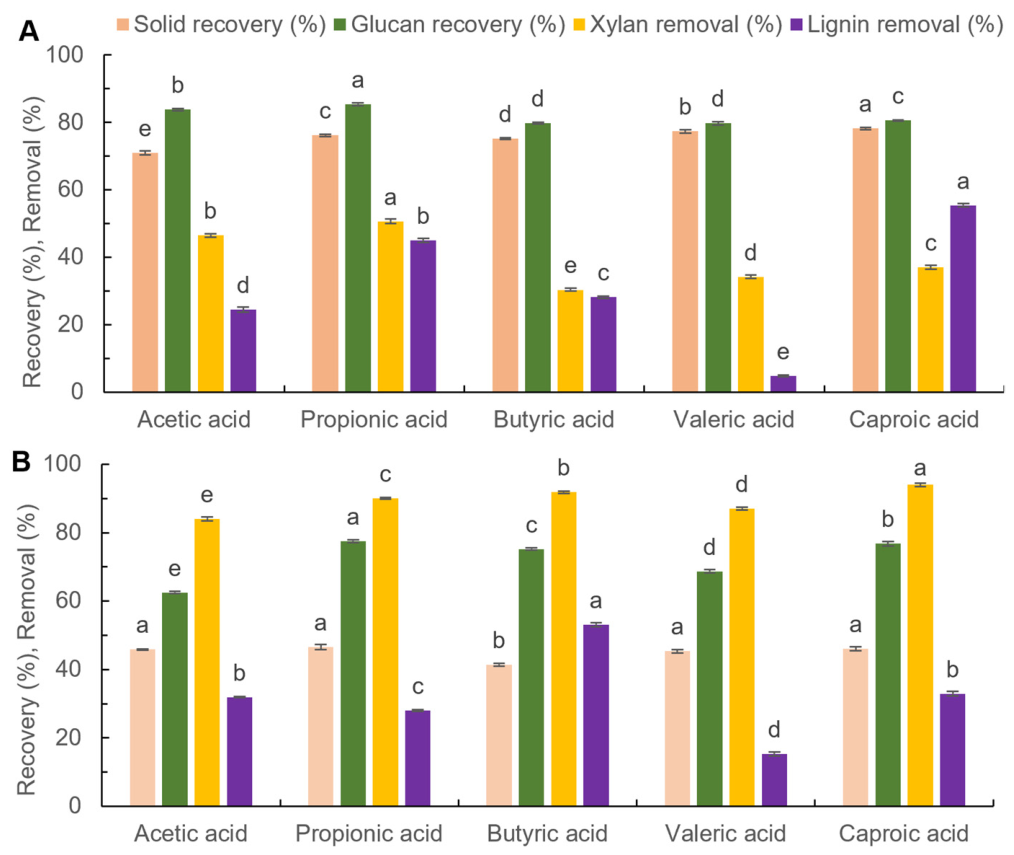
Figure 1. The effects of organic acid pretreatment on the chemical composition of glucan, xylan, and lignin in corncob. The concentration of organic acids was maintained at 2.5% in all pretreatments. (A) The pretreatment was conducted at 130 °C. (B) The pretreatment was conducted at 180 °C. The different superscript letters in the same column represent significant differences (p < 0.05).
Fuels 07 00063 g001
Figure 2. The effects of typical AD-derived organic acid pretreatment on the chemical composition of glucan, xylan, and lignin in corncob. The concentration of organic acids was maintained at 5.0% in all pretreatments. (A) The pretreatment was conducted at 130 °C; (B) The pretreatment was conducted at 180 °C. The different superscript letters in the same column represent significant differences (p < 0.05).
Fuels 07 00063 g002
Figure 3. The effects of typical AD-derived organic acid pretreatment on the enzymatic efficiency of corncob. The concentration of organic acids was maintained at 2.5% in all pretreatments, and the solid to liquid ratio was kept at 1:50 with cellulase dosage of 15 FPU/g substrate. (A) The pretreatment was conducted at 130 °C; (B) The pretreatment was conducted at 180 °C. The different superscript letters in the same column represent significant differences (p < 0.05).
Fuels 07 00063 g003
Figure 4. The effects of typical AD-derived organic acid pretreatment on the enzymatic efficiency of corncob. The concentration of organic acids was maintained at 5.0% in all pretreatments, and the solid to liquid ratio was kept at 1:50 with cellulase dosage of 15 FPU/g substrate. (A) The pretreatment was conducted at 130 °C. (B) The pretreatment was conducted at 180 °C. The different superscript letters in the same column represent significant differences (p < 0.05).
Fuels 07 00063 g004
Figure 5. The correlations between xylan removal and glucose yield (A) and correlations between xylan removal and total fermentable sugar yield (B) under typical AD-derived organic acid pretreatments.
Fuels 07 00063 g005
Figure 6. Mass balance for the optimized butyric acid pretreatment and enzymatic hydrolysis of corncob for the production of glucose and xylose.
Fuels 07 00063 g006
Figure 7. Ethanol production from corncob hydrolysates under batch fermentation with an initial glucose concentration of ∼50 g/L.
Fuels 07 00063 g007
Figure 8. Ethanol production from corncob hydrolysates under batch fermentation with an initial glucose concentration of ∼70 g/L.
Fuels 07 00063 g008
Table 1. Bioethanol production performance from lignocellulose based on acid/alkali pretreatments.
LignocellulosePretreatment ConditionsFermentation Strains and Operation ModeEthanol Titer (g/L)Ethanol Yield (%) 1Refs.
Miscanthus4% NaOH, 50 °C, 2 hS. cerevisiae (Angel Yeast), SHFN/A94–98[16]
Corn stover10% NaOH-assisted ball milling, room temperature, 1 hEngineered S. cerevisiaesnR4), SHF110.992.9[54]
Mixed vegetable waste8.5% Oxalic acid, 101 °C, 31 minS. cerevisiae TISTR5606, SHF7.686.4[55]
Wheat bran0.8% Oxalic acid, 130 °C, 15 minS. cerevisiae DQ1, SHF23.87N/A[56]
Wheat bran0.3% HCl, 120 °C, 20 minBacillus subtilis AP, SSF7.326.8[57]
Chinese firAcetic acid/H2O2 (HPAC), 60 °C, 120 min; 0.5% NaOH, 22 °C, 1 h 2S. cerevisiae H06, SSF60.370.1[58]
Corncob2.5% Butyric acid, 180 °C, 45 minS. cerevisiae (Angel Yeast), SHF30.68–43.3279.8–93.5This study
SHF, separate hydrolysis and fermentation; SSF, simultaneous hydrolysis and fermentation; N/A, not available. 1 Ethanol yield (%) was calculated by “Ethanol titer/Consumed sugars/0.511 × 100%”. 2 Two-stage pretreatment was conducted which includes HPAC pretreatment (Step I) and alkaline incubation (Step II).
Disclaimer/Publisher’s Note: The statements, opinions and data contained in all publications are solely those of the individual author(s) and contributor(s) and not of MDPI and/or the editor(s). MDPI and/or the editor(s) disclaim responsibility for any injury to people or property resulting from any ideas, methods, instructions or products referred to in the content.