Coal is a pore-fracture medium composed of coal matrix and fractures, in which coal matrix is composed of solid skeleton and pores [
23,
24]. According to the differences in connectivity and direction, cracks can be divided into face cleats, butt cleats and bedding planes.
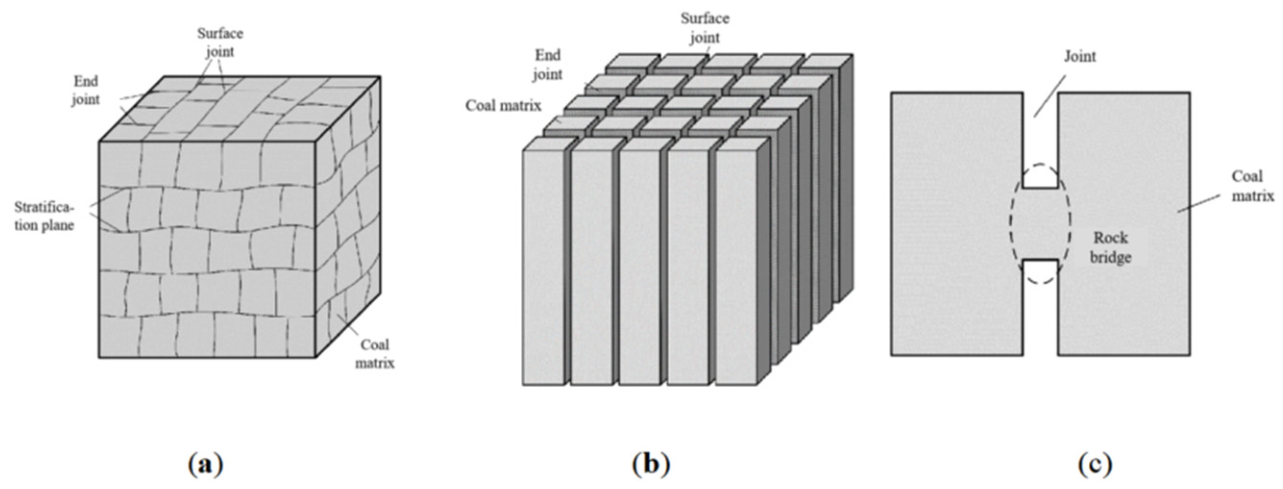
Figure 1a shows this structure of coal. Face cleats and butt cleats are the primary conduits for the movement of gas within coal layers. Face cleats have long extension length, good connectivity, smooth surface and are close to each other. The surface of butt cleats is also very flat, but the connectivity is worse than that of face cleats, so the permeability of butt cleats is often smaller than that of face cleats. The permeability of bedding plane compressed by vertical geostress is usually much lower than that of face cleats and butt cleats. Based on this idealized structure of coal, the permeability model generally assumes the geometric configuration of coal’s structure called “matchstick”. As shown in
Figure 1b. The matchstick model assumes that the coal matrix is totally separated by the joints and is not interconnected. Theoretically, given the boundary condition of unvarying confining pressure. The adsorption expansion deformation of coal matrix has negligible influence on permeability, but this is contrary to the experimental observation of coal permeability: when the confining pressure is constant, a rise in the pore pressure of the adsorption gas results in reduced permeability. In order to explain this contradiction, an improved version of the matchstick model has been proposed. The improved model assumes that the matrix of coal remains partially unseparated, but connected by rock bridges, as shown in
Figure 1c [
25]. In this paper, the enhanced “matchstick” model will be used to infer the coal’s permeability model.
2.1. Expansion Strain Within the Coal Matrix
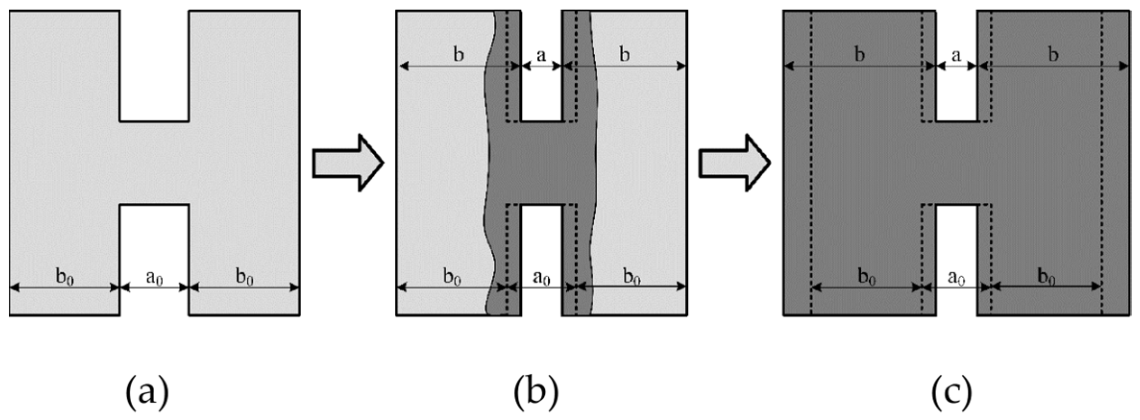
A coal body consisting of two coal matrices and a rock bridge connecting them is shown in
Figure 2a. Under boundary constraints, after coal adsorbs gas, the rock bridge and the adjacent coal matrix on the joint side expand. Since the cross-sectional area of the coal matrix is greater than that of the rock bridge, the expansive force generated by the adsorbed gas in the coal matrix is also greater than that generated by the adsorbed gas in the rock bridge. Assuming that the mechanical parameters of the coal matrix and rock bridges are identical, after gas adsorption, the rock bridges are compressed by the coal matrix, and the joint width decreases, as shown in
Figure 2b. At this point, the changes in the coal layer caused by adsorption are as follows:
where,
is the alteration in length of the coal body due to adsorption, is the length of coal body after adsorption,
is the starting extent of the coal body before adsorption,
is the width of cleat after adsorption, a represents the breadth of a coal matrix after adsorption,
is the initial width of cleat before adsorption.
With the continuous absorption, the gas expands and fills the entire coal matrix, which makes the coal matrix expand and deform outward, as illustrated in
Figure 2c. Currently, the alteration of the coal matrix due to adsorption is:
where
represents the total expansion stress of the coal matrix caused by adsorption under boundary constraints.
It can also be inferred from
Figure 2 that adsorption may cause internal expansion strain in the coal matrix even under unconfined boundary conditions due to the presence of rock bridges, so very small coal samples are usually used in experimental determination of adsorption-expansion deformation of the coal matrix to shield the effect of joints [
26,
27].
Considering
, the adsorption expansion strain of the whole coal body can be calculated by the following equation
where
represents the total expansion stress exerted on the coal body. due to adsorption.
If the internal expansion strain of the coal matrix is considered as part of its total adsorption strain, the equation can be rewritten as:
where
is the proportion of The relationship between the expansion stress present in coal matrix and the total adsorption expansion strain under boundary constraints, and
is the initial value.
Certain experimental findings indicate that both the quantity and expansion strain of coal adsorption in boundary-restricted scenarios are less than in boundary-unrestricted situations, but the numerical correlation between coal’s adsorption expansion strain and the boundary conditions is not clear [
28]. This document presupposes a proportional correlation between the coal matrix’s adsorption expansion strain when subjected to boundary constraints and the same strain when the boundary is not constrained.
where
represents the overall strain on the coal matrix due to adsorption expansion at the boundary’s unconfined state, and it’s the proportion of the coal matrix’s total adsorption expansion strain at the boundary’s confined state to that at the boundary’s unconfined condition.
Bringing Equation (5) into Equation (4) yields.
Bringing Equations (5) and (6) into Equation (3) and collating them gives.
where
represents the ratio between the intrinsic expansion strain of the coal matrix under constrained conditions and the adsorption-induced expansion strain of the coal matrix under unconstrained boundary conditions.
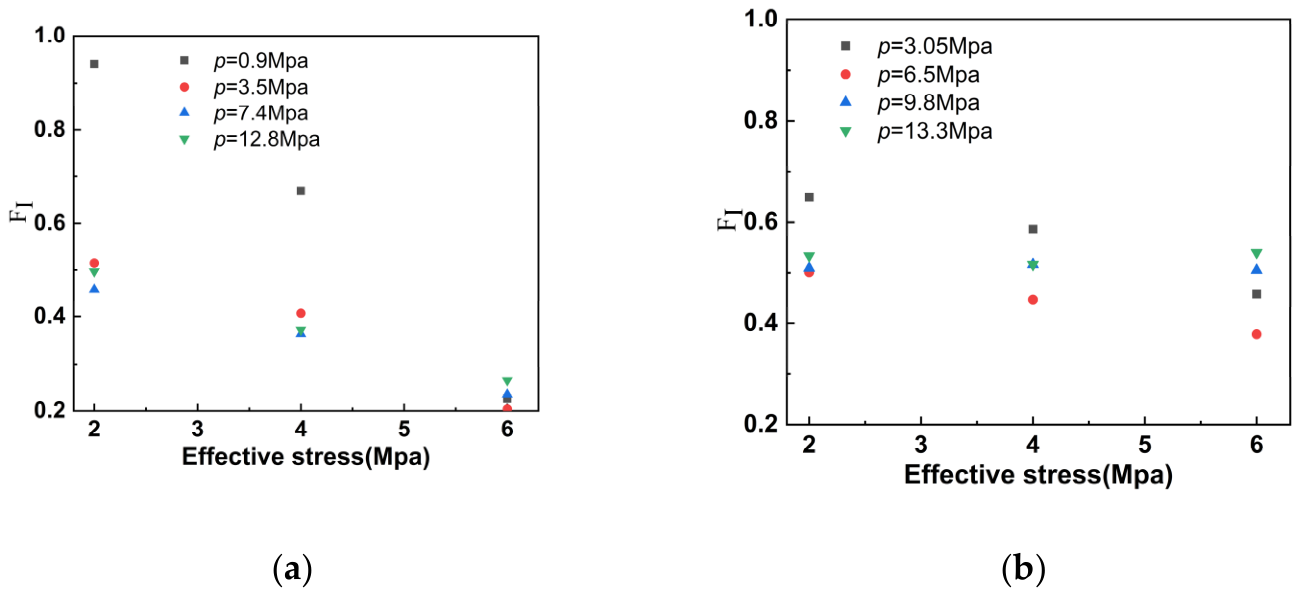
The internal expansion strain coefficient is defined as the ratio between internal expansion strain and adsorption-induced expansion strain, and therefore represents a dimensionless parameter. Physically, characterizes the contribution of adsorption-induced internal matrix deformation to the overall adsorption expansion response under constrained conditions. The magnitude of may depend on multiple factors, including stress conditions, gas adsorption characteristics, coal structure heterogeneity, and fracture distribution. Under typical coal seam conditions, is generally expected to remain within a physically reasonable positive range, although it is not necessarily strictly bounded between 0 and 1 because local deformation compatibility and anisotropic structural effects may influence the internal deformation response. In addition, different gases may produce different values due to variations in adsorption affinity and swelling behavior.
From Equation (7), it can be seen that compared with the adsorption-induced expansion strain of the coal matrix under unconstrained conditions, the internal expansion strain under constrained conditions includes not only the internal deformation of the coal matrix, but also the reduction in the overall adsorption-induced expansion strain caused by boundary constraints.
When replace the parameters in the equation with the adsorption expansion strain experienced by the coal body under restricted and unrestricted boundary conditions.
The equation still holds. Presuming the coal body’s adsorptive expansion strain under a certain boundary condition is known, according to Equation (6),
and
the sum can be expressed by the following equation:
where the subscript ‘1’ indicates a known boundary condition. Under another boundary condition, the internal expansion strain can be expressed as follows.
where
represents the ratio of internal expansion strain of coal matrix to adsorption expansion strain of coal body under known boundary conditions.
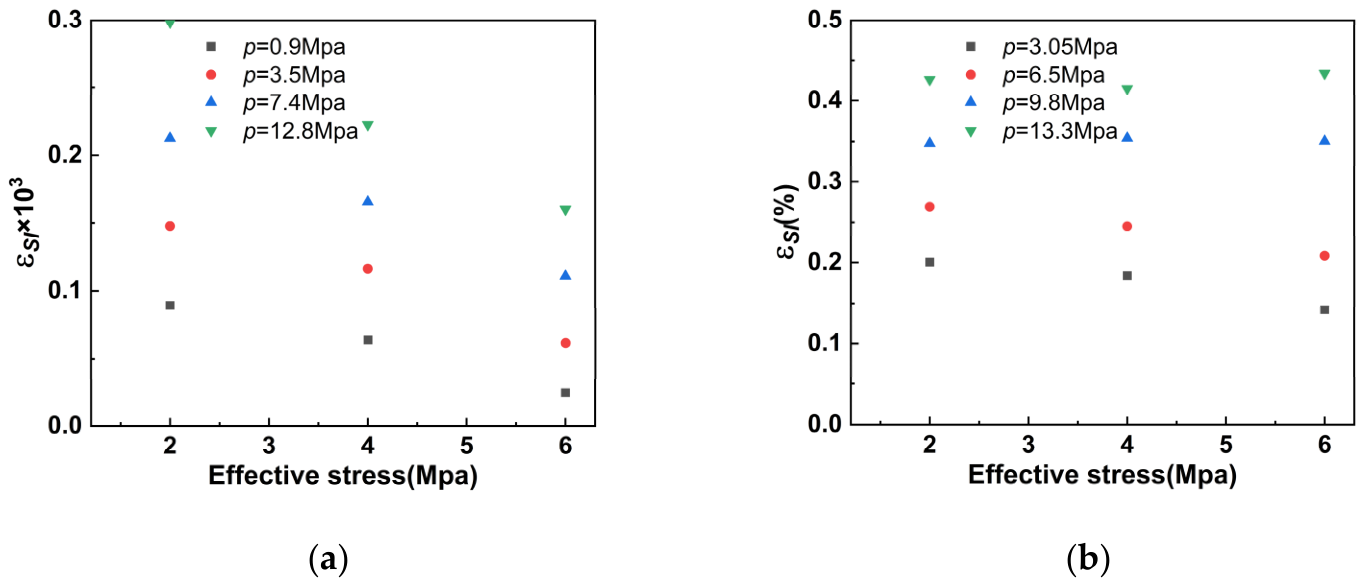
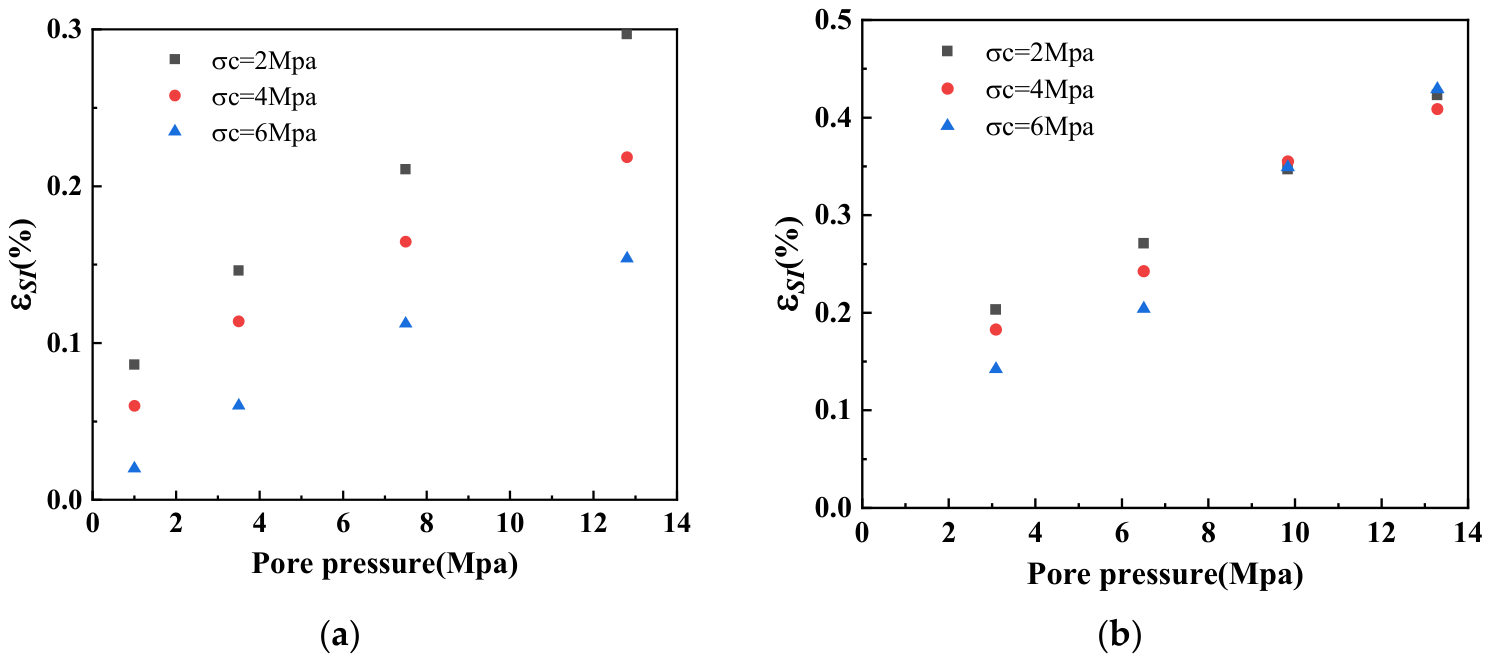
The internal expansion strain and internal expansion coefficient Various elements, including pore pressure, influence the coal matrix, enclosure pressure, gas type, coal structure and organic microcomposition of the coal.
2.2. Model Derivation
(1) Coal contains free gases that are both single-phase and fully saturated.
(2) Processes of a physical nature taking place in the coal, such as adsorption and flow of gases, are taking place at a constant temperature. The processes of adsorption and desorption can be reversed, adhering to the principles of the Langmuir isothermal adsorption Equation [
29].
(3) Coal, being a uniform elastic substance, exhibits deformation in alignment with Hooke’s law [
30].
(4) The emphasis is solely on the permeability of the cleat, ignoring the permeability of the coal matrix.
Coal may be viewed as a collection of ‘coal matrix-cleat’ segments. Every unit of ‘coal matrix-cleat’ is composed of five segments, specifically, the coal matrix block, rock bridge, facet joints, butt cleats, and bedding fractures [
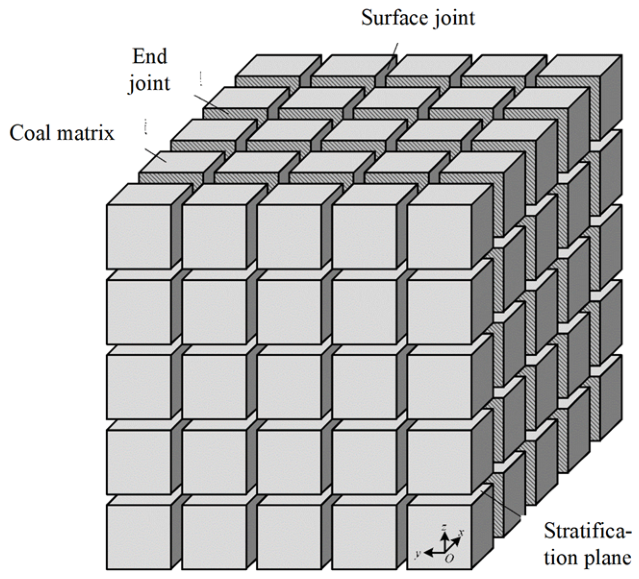
31]. Bear out the principle of determining the face porosity characterisation element: in order to make the parameters of the unit (e.g., porosity, permeability, etc.) reach the statistical average, the unit size should be as large as possible compared with the pore (cleat); at the same time, the unit size should be as small as possible compared with the whole model, which is in order to make the unit size and pore (joint) as large as possible compared with the whole model. According to this principle, the coal representative voxel should contain ‘enough’ ‘coal matrix-cleat’ units, as shown in
Figure 3. It’s important to recognize that the term ‘sufficient’ in this context isn’t a fixed figure, but rather fluctuates based on the dimensions of the model and the precision of computational demands. For example, for the indoor experimental scale model, the number of ‘coal matrix-cleat’ cells in the characterisation voxel is smaller due to the smaller model size. For field-scale models, the size of the representation element should be as large as possible for a given computational accuracy, and the number of ‘coal matrix-cleat’ units in it should be larger in order to improve the computational efficiency [
32].
Within the representational body element, it is assumed that the cleat surfaces are planar and that the parameters (e.g., cleat width and spacing, etc.) are the same for the same group of cleats. In comparison to the coal matrix, the size of the rock bridges is trivial. The representative voxel is placed in the Cartesian orthogonal right-angle coordinate system (Oxyz) as shown in
Figure 3. The
x-axis runs parallel to the intersection line between the face joints and the bedding plane,
y-axis is parallel to the intersection line between the butt cleats and the bedding plane, and
z-axis is perpendicular to the bedding plane. It should be noted that in
Figure 3 the coal matrix is not completely separated but connected by rock bridges [
33].
2.2.1. Relationship Between Face Porosity and Anisotropic Permeability
Within the existing research framework, the performance evaluation of CH
4 adsorbent materials relies predominantly on single-component adsorption isotherms, ideal adsorption solution theory (IAST)-derived selectivity values, and maximum adsorption capacity as primary assessment metrics [
6]. These indicators are conventionally obtained through pure-gas measurements conducted under anhydrous conditions and presuppose thermodynamic equilibrium as a foundational premise, serving to characterize the theoretical adsorption capability and potential separation performance of candidate materials. Within this evaluation paradigm, specific surface area, micropore volume, and surface functional group chemistry are regarded as the governing structural parameters determining adsorption performance, and research efforts have been predominantly directed toward maximizing limiting adsorption capacity and ideal selectivity coefficients [
7].
Bear proposed the concept of face porosity for porous media, which refers to the ratio of pore area on a given plane to the total area of that plane within the representative voxel. In this study, the term “face porosity” is uniformly adopted to characterize the directional pore distribution associated with different fracture sets in coal seams. Therefore, from
Figure 3, the face porosity of a certain directional cleat can be expressed as
The face porosity of a given plane is the sum of the face porosities of the two groups of cleats, i.e.,:
where
and
represent the porosity of the face joints along the
x and
z axes, correspondingly, and the porosity of the butt cleats along the y and z axes, and correspond to the porosity of the laminated surfaces in the x and y axes, respectively. For a particular set of cleats with a face porosity of
As shown in
Figure 3, the nodal and representational voxels on a given plane can be represented by the following equations, respectively
where
is the width of a single cleat,
is the number of cleats in the characterised body element,
is the length of the characterised body element in the direction parallel to the cleat surface,
and is the length of the characterised body element in the direction perpendicular to the cleat surface. Considering a cleat and a coal matrix block as a unit, it is equal to the product of the length of the unit of ‘coal matrix-cleat’ and the count of cleats.
where
represents the measurement of a ‘matrix-cleat’ unit, describable through the subsequent equation
where
is the nodal spacing, i.e., the width of the coal matrix.
Substituting Equations (14)–(17) into Equation (13) yields
From Equation (18), the face porosity of the cleat is only related to the cleat width and the cleat spacing but not to the orientation of the cleat, then we have
Then the face porosity of face joints, butt cleats and laminated surfaces is representable through this equation, respectively
Equation (20) shows that the face porosity of joints remains unaffected by the count of ‘coal matrix-joint’ units in the analyzed body part. Therefore, the permeability model developed in this study can be used to describe the variation of coal permeability at both indoor and field levels.
Substituting Equation (20) into Equation (12) gives
Equations (20) and (21) also reveal that body porosity equals the sum of face joint porosity, end joint porosity, and lamination face porosity.
where is the body porosity of the coal. From Equation (22), the body porosity is equal to one-half of the sum of the face porosities.
Under the assumption of isotropy, permeability and bulk porosity satisfy the following relationship
where
represents isotropic permeability,
represents the initial state’s permeability. In this chapter. Assuming that the anisotropic permeability and face porosity still correspond to this three-way relationship.
2.2.2. Evolution of Anisotropic Permeability
For faceted nodal theory, the derivation of Equation (20) yields
which
Bringing Equation (26) into Equation (25) yields
Expanding Equation (27) by Taylor series and neglecting the higher order derivative terms yields
Since the porosity of coal tends to be much less than 1, i.e.,
, Equation (28) can be further collapsed into
where
represents the pressure exerted on the coal body along the
y-axis.
In the indoor experiments on gas extraction and coal permeability in coal seams. There are two types of influence on the deformation of the coal body, namely effective changes in stress and absorption (or desorption) of gases.
Therefore
and
can be expressed as
where
is the coal body strain due to effective stress change,
is the coal matrix strain due to effective stress change,
is the coal body strain due to gas adsorption, and
represents the strain on the coal matrix caused by gas absorption.
For an anisotropic elastic medium, the strain resulting from a change in the equation below can represent effective stress
where, it regarding the alterations in effective stress. Assuming that the number of Biorthogonal is equal to 1.
where
is the total stress change in direction i. The negative sign indicates that the total stress is compressive stress.
From Equations (5) and (6),
and
can be expressed as
where
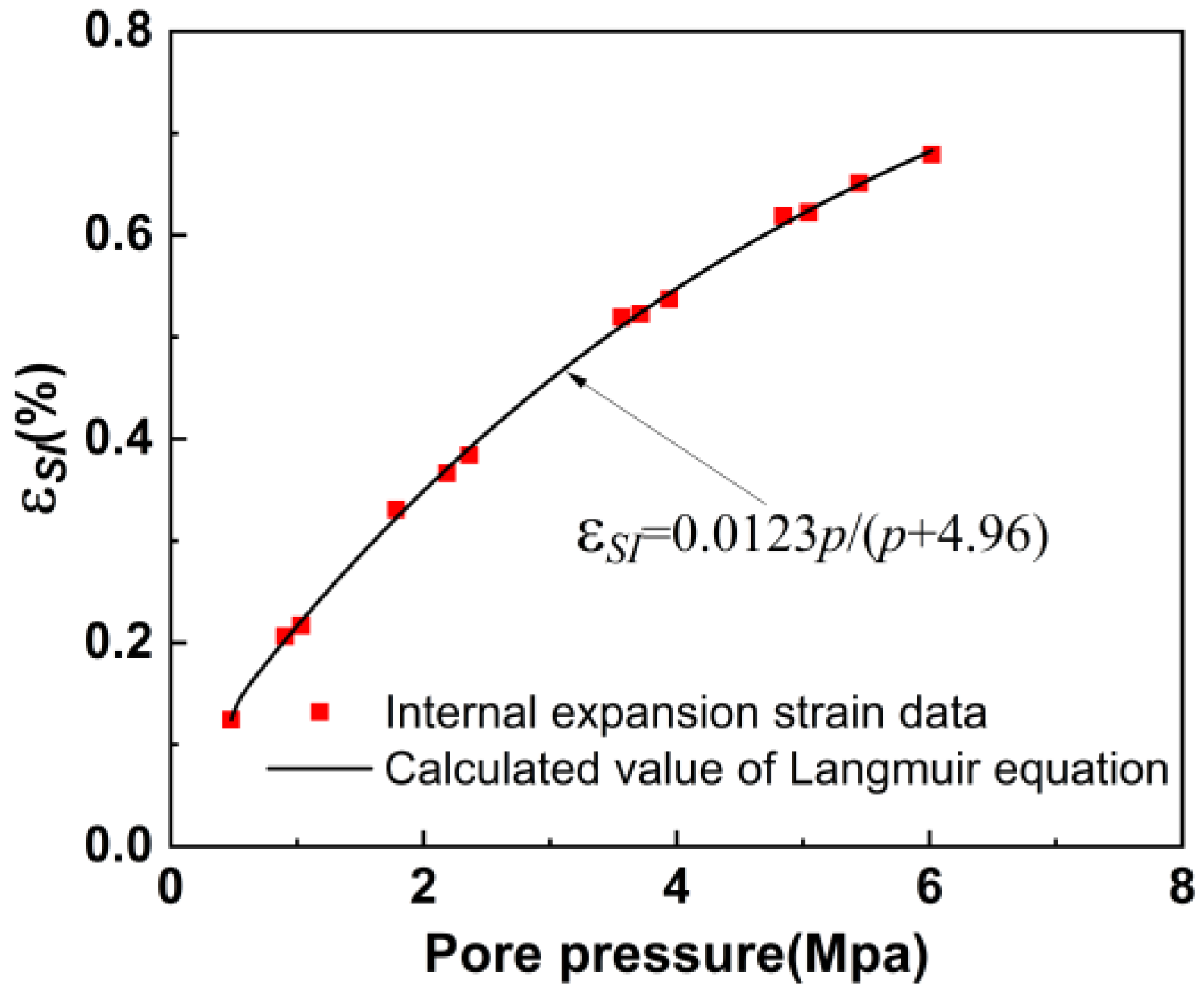
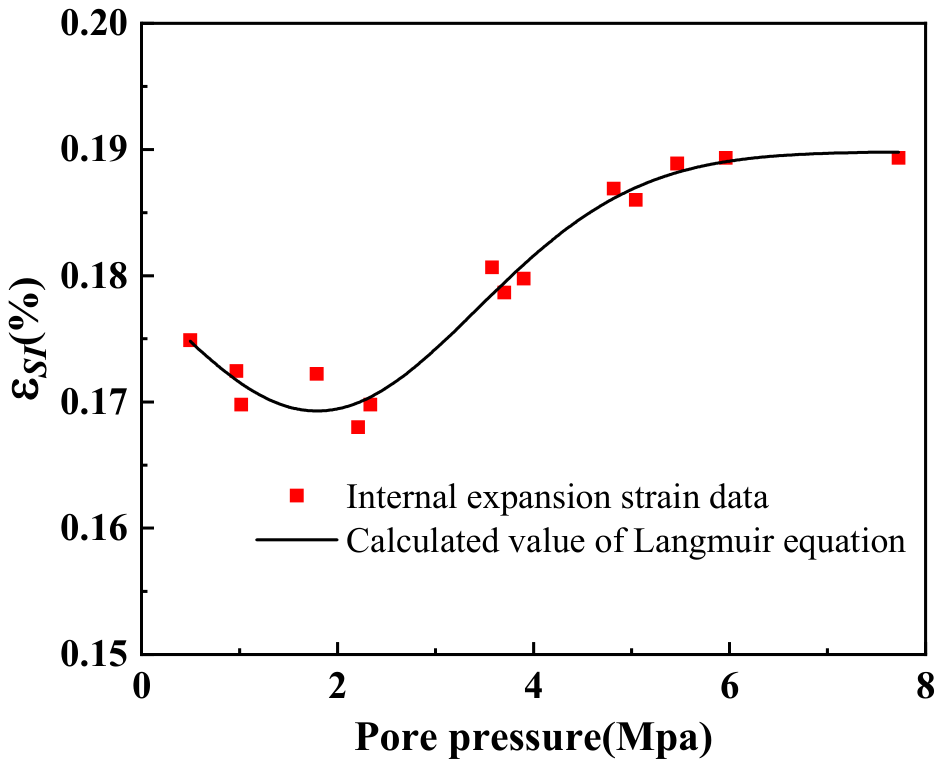
is computable using the Langmuir equation
where
and
are Langmuir adsorption strain constants, where
represents the ultimate adsorption expansion strain of the coal matrix in the
y-axis direction, while
represents the pressure within the pore when the
y-axis adsorption expansion strain of the coal matrix matches.
Bringing Equations (32), (33) and (35)–(37) into Equations (30) and (31) and then into Equation (28) gives
The same reasoning leads to
Assuming Poisson’s ratio symmetry
Substituting Equation (41) into Equations (38)–(40) and then into Equation (21) gives
Substituting Equation (42) into Equation (24) gives
Assuming that the coal matrix is incompressible compared to the coal body, i.e., Equation (43) reduces to
The simplification from Equation (43) to Equation (44) assumes that the compressibility of the coal matrix is negligible compared with cleat deformation during permeability evolution. This assumption is introduced primarily for analytical simplification, because permeability changes in coal seams are generally dominated by the evolution of cleat aperture rather than matrix volumetric compression. It should be noted that neglecting matrix compressibility does not eliminate the effects of adsorption-induced swelling, since adsorption-induced internal matrix deformation is still incorporated into the model through the adsorption strain term and the internal expansion strain coefficient. Therefore, the simplified formulation can still capture the coupled influence of gas adsorption and stress evolution on permeability variation under typical stress–adsorption coupling conditions in coal seams.
In Equation (44), only the Young’s modulus and Poisson’s ratio of the coal body are retained of the coal body are available, so the superscript b representing the coal body is omitted. Unless otherwise specified, the Youngs modulus and Poissons ratio referred to are those of the coal body.
The coal permeability model represented by Equation (44) is formulated independently of specific boundary conditions, and the model can be expanded into the corresponding expression based on specific boundary conditions. The framework therefore provides broader adaptability than permeability formulations derived for specific boundary conditions than permeability models derived for specific boundary conditions.
2.2.3. Model Expressions for Different Boundary Conditions
Four types of boundary conditions frequently encountered in indoor experiments on coal seam gas extraction and coal permeability are uniaxial strain, constant confining pressure, constant effective stress and constant pore pressure. In this section, Equation (44) is developed for these four types of boundary conditions.
Under the uniaxial strain boundary condition, the stress in the vertical direction is kept constant, with the coal body’s horizontal strain being nil, then there exist
From Equation (32), the effective stress in the horizontal direction is
Substituting Equations (45)–(48) into Equation (44) gives
From Equation (22), assuming isotropy, the correlation between body and face porosity is
Currently, the model of permeability can be reduced to
Note that in Equation (53) is the volumetric strain.
The total stress in all directions remains constant under constant confining pressure boundary conditions, i.e.,
Thus the effective stress in each direction is
Substituting Equation (55) into Equation (44) gives
Under the assumption of isotropy, the permeability model can be simplified as
When the effective stress boundary condition is maintained uniformly, the effective stress stays unvarying in every direction.
Substituting Equation (58) into Equation (44) gives
Under the assumption of isotropy, the permeability model can be simplified as
Pore pressure remains constant under constant pore pressure boundary conditions
Substituting Equation (61) into Equation (44) gives
Under the assumption of isotropy, the permeability model can be simplified as
2.3. Analysis of Factors Affecting Coal Seam Permeability
Owing to the reduced Young’s modulus in coal, soft and brittle mechanical properties. The influence of external conditions on crack formation and permeability is achieved through deformation of the coal storage area itself, and changes in stress are most likely to cause deformation. Some scholars believe that it is the ancient tectonic stress is the primary determinant in regulating the development level of cuttings, and the tectonic activity after the coal-forming period is the main factor to produce tectonic cracks in coal seams, and the magnitude of the intensity of tectonic activity has both constructive and destructive effects on the permeability of coal reservoirs [
34].
Moderate tectonic action such as fracture and folding can increase the density of cuttings in coal seams and improve the permeability, so the zone of tectonic fissure development can be the development zone of high-permeability coal seams. In addition. The endogenous fractures generated during coal formation will evolve into fracture zones in the coal rock mass under subsequent tectonic action, forming stress concentration zones, which will then evolve into tectonic fractures.
The direction of the maximum principal stress in the stress field determines the permeability of the coal seam: if this stress direction aligns with the reservoir’s primary fracture group’s development direction, the fissure undergoes tensile stress, expands in width and permeability, reaching its peak at this juncture; conversely, when the tectonic stress field’s maximum principal stress direction is orthogonal to the coal reservoir’s dominant fracture group’s development, the fissure experiences compressive stress, leading to a reduction in its width and a decrease in permeability. If the peak principal stress direction of the tectonic stress field aligns perpendicularly to the dominant fracture group’s development in the coal reservoir, it leads to compressive stress, a reduction in fracture width, a decrease in permeability, and the lowest permeability currently observed.
Previous studies have shown that cuttings are more developed in bright coals, and cuttings can also be seen in dull coals, but their cleat density is much smaller than that of bright coals. Therefore, in terms of the composition of microscopic components, the higher the content of the vitrinite, the more developed the cuttings, and the better the permeability. Regarding the type of coal rock, bright coal exhibits superior permeability, succeeded by semi-bright, semi-dark, and dull coal varieties.
In the process of coalification, the composition and structure of coal undergo a series of changes, and with these changes, the pore characteristics of coal also show a unique evolutionary law, which affects the permeability. When some scholars studied the relationship between the density of cuttings and coal rank, they found that the density of cuttings increased from lignite to bituminous coal (fat coal, coking coal) and decreased from bituminous coal to anthracite, which is normally distributed, i.e., the cuttings of coals with low metamorphism and high metamorphism are underdeveloped, and those of coals with medium metamorphism are developed, and the more the cuttings are developed, the larger the permeability is.
Coal body structure is the basis for the evaluation and prediction of the permeability of coal seams, and the good or bad structure of the coal body affects the permeability to a large extent. Since coal is a kind of rock with low Young’s modulus and high Poissons ratio, its deformation resistance is much lower than that of other rocks, thus, during the final phase of the process of forming coal, the coal-bearing system experienced different contemporaneous tectonic movements, which made the coal reservoirs undergo deformation of different degrees and natures, and the result is that the primary structural coal reservoirs are destroyed into fractured coal, crushed-grain coal, and cretaceous coal bodies in turn.
Inside the pore space, the fluid acts to distribute the pressure exerted by the rock above. This changes the stress in the rock, and as the pore fluid pressure increases, the stress decreases. As the pressure exerted on the rock intensifies during its formation, when the rock is incompressible, the particles become more and more compact with each other, the pore space becomes smaller and smaller, and the connectivity between the pores becomes poorer and poorer. So it can be seen that the permeability of the rock has a tendency to decrease with the escalation of actual stress, the reduction occurs more rapidly with minimal effective stress, while the reverse is less rapid.
It has been shown that under different peripheral stress conditions, the temperature has two influencing effects on the coal matrix, namely, external expansion and internal expansion, which in turn makes the permeability show different patterns of change: the permeability shows two different patterns of change with the increase of temperature, i.e., in high-stress scenarios, temperature rises leading to reduced permeability; conversely, in low-stress situations, the coal body’s permeability escalates with higher temperatures. Under conditions where the effective stress ranges from 1.7 MPa to 2.0 MPa, the permeability of coal is higher at 55 °C than at 30 °C, while at 45 °C it lies between these two values. Conversely, when effective stress exceeds 2.0 MPa, the coal body’s permeability diminishes as the temperature rises in each identical stress scenario.
In addition, comparing the seepage curves at different temperatures, it can also be found that changing the same effective stress value, the permeability curve at 55 °C decreases more than the permeability curves at 30 °C and 45 °C, and the decrease in the 45 °C curve is greater than that at 30 °C. This is due to the increase in temperature, the compressibility of the coal pore space becomes larger, which in turn makes the permeability change amplitude also becomes larger, it can be seen that the increase in temperature makes the permeability of the effective stress changes in the degree of sensitivity greatly increased.
Under the normal unmined condition of coal reservoir, if it is not affected by large tectonic movement, its permeability is basically a certain value. However, along with the coal seam gas extraction, its equilibrium state is damaged, resulting in permeability changes. During coalbed methane extraction, as gas pressure falls beneath the crucial desorption point, the gas begins to desorb, causing the coal matrix to contract. This results in reduced horizontal stress, a lowered effective stress, a wider fissure, and enhanced permeability.
The main stratification of coal seams also has a more significant impact on their permeability. The same piece of coal samples under the same conditions to determine the permeability, the direction of the permeability pressure if perpendicular to the stratification surface of the coal specimens, followed by the permeability of the tiniest; permeability of the direction of the permeability pressure if the stratification surface alongside the coal specimens, the permeability of the biggest, and the permeability of the parallel layer of the perpendicular layer of the permeability of the 2 to 10 times. The phenomenon indicates that permeability varies in different directions in coal reservoirs as influenced by the original sedimentary stratification.
At the microscopic level, coal is heterogeneous, and the stress generated by expansion within the coal matrix is also heterogeneous.
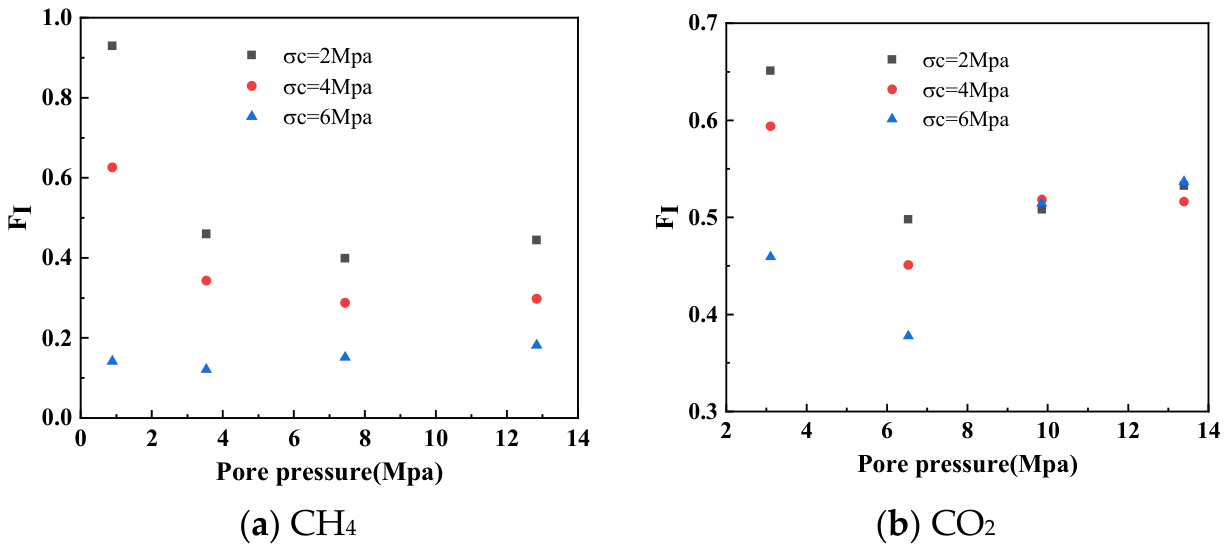
At the macro-scale, the internal expansion strain has an average statistical figure, yet presently, directly measuring this figure poses a challenge. This section describes methods for inverting the internal expansion strain from permeability models and permeability experimental data.
Assuming that the coal matrix is incompressible compared to the coal body, Alterations in anisotropic permeability, resulting from shifts in effective stress and adsorption, are represented by the subsequent equation:
Under the assumption of isotropy, Equation (64) reduces to
where
is the volume strain of volume expansion in the coal matrix.
According to Equation (65),
can be expressed by the following equation
In Equation (66),
and
are unknown quantities, so in order to obtain ε_
sI, the pore pressure in the initial state needs to be set to zero, at which point
= 0. Equation (66) reduces to
The equation serves to determine the internal expansion strain, utilizing experimental data on permeability and coal’s mechanical properties, with the coefficient of internal expansion strain being represented by the subsequent equation:
where
adsorption-induced strain expansion can occur within the unconstrained boundaries of coal-based substrates. At unconstrained boundaries, adsorption expansion strain within the coal matrix. or the strain caused by the coal body’s adsorptive expansion at the restricted boundary,
can be regarded as the ‘baseline’. The importance of the internal expansion strain coefficient lies in linking the readily quantifiable ‘baseline’ with permeability. Since it is currently difficult to measure the internal expansion strain directly, the internal expansion strain coefficient provides a simple way to describe the effect of adsorption on permeability.