Article

A Novel Permeability Evolution Model for Gas Flow in Coal Seams

1
School of Safety Engineering, Heilongjiang University of Science & Technology, Harbin 150022, China
2
School of Mining Engineering, Heilongjiang University of Science & Technology, Harbin 150022, China
*
Authors to whom correspondence should be addressed.
Fuels 2026, 7(2), 39; https://doi.org/10.3390/fuels7020039 (registering DOI)
Submission received: 28 April 2026 / Revised: 28 May 2026 / Accepted: 8 June 2026 / Published: 13 June 2026

Abstract

The permeability of coal seams plays a critical role in the efficiency of coalbed methane extraction and gas disaster prevention. Traditional permeability models often overlook the anisotropic and dynamic evolution characteristics of coal under varying stress and gas adsorption conditions. This paper proposes a novel permeability evolution model that integrates the effects of effective stress variation and gas sorption-induced deformation on coal permeability. Starting from the concept of face porosity and utilizing a representative voxel approach, the model incorporates the anisotropy of mechanical parameters and adsorption expansion strain to derive the evolution of permeability in three dimensions. The model is validated against experimental permeability data from two distinct coal samples (Sulcis and Sydney), demonstrating its ability to accurately capture permeability changes under different boundary conditions. Furthermore, the concept of “internal expansion strain coefficient” is introduced to quantify the impact of adsorption-induced matrix deformation on permeability. The model provides a theoretical foundation for predicting gas flow behavior in coal seams under complex in-situ conditions and offers significant insights into the optimization of gas extraction strategies.

1. Introduction

The prevention and control of coalbed methane disasters and the efficient development of coalbed methane are core issues in the fields of coal mine safety and energy. According to statistics, more than 95% of high gas mines in China face the risk of gas protrusion, while the geological resources of coalbed methane amount to 36.8 trillion cubic metres, with an exploitation rate of less than 50%. The core of this contradiction lies in the dynamic evolution of coal seam permeability: the efficiency of gas transport within coal seams is directly affected by their permeability, which in turn shows significant nonlinear changes with mining disturbance, stress redistribution and gas adsorption/desorption. Coal, as a typical sedimentary rock, exhibits pronounced anisotropic characteristics in its stratigraphy, fracture system and organic matter distribution, which makes the traditional isotropic permeability model have significant errors in engineering applications [1,2,3,4,5]. Therefore, the establishment of a gas permeability evolution model that can characterise the anisotropic features of coal bodies is not only an important breakthrough in deepening the coupled multi-physical field theory, but also a key technological support for the precise extraction of natural gas and disaster prevention and management strategies.
The anisotropy of coal bodies originates from their complex multiscale structural characteristics: at the microscopic scale, the directional arrangement of organic microcomponents such as vitrinite and inertinite forms the primary anisotropy; at the mesoscopic scale, the network of structural surfaces such as laminated surfaces and cleat systems dominates the orientation dependence of permeability; at the macroscopic scale. The formation of cleat network and spatial heterogeneity of permeability is further enhanced by the tectonic stress field [6,7]. The experimental results indicate that the permeability in parallel lamination can increase by one to two orders of magnitude compared with the vertical direction. For example, during triaxial compression, the permeability decay rate in the vertical lamination direction is 37–62% faster than that in the parallel direction, and this difference originates from the coupling between the closure mode of the fracture network and the deformation of the coal matrix [8,9,10]. These findings reveal the limitations of the traditional isotropic assumptions [11] and emphasise the need for an anisotropic permeability model. The construction of an anisotropic gas permeability evolution model faces multiple challenges: firstly, it is necessary to establish an intrinsic framework that can unify the description of the anisotropy of coal mechanics and the anisotropy of permeability, which involves experimental calibration of the higher-order tensor parameters and theoretical coupling; secondly, strains resulting from expansion or contraction due to adsorption and desorption of gas are directionally dependent. Developing a model for anisotropic adsorption strain, grounded in coal’s molecular structure, is essential; Furthermore, the damage evolution of coal body due to mining disturbance is spatially asymmetric, and how to dynamically correlate the damage tensor with the permeability tensor has become a key scientific issue. Recent studies have attempted to introduce transverse isotropic elasticity theory or anisotropic damage mechanics (e.g., Murakami-Ohno tensor decomposition method), but these methods still face the double constraints of computational complexity and parameter identifiability when coupling seepage-stress fields.
Literature [12,13,14,15] investigated permeability experiments under genuine triaxial stress to determine the penetrability of coal-sandstone-composite coal rock bodies. It was found that stress causes compression of fractures first, which in turn causes a decrease in permeability. Under continuous stress, the initiation and expansion of fractures increase the seepage channels of the rock body, and the permeability changes abruptly. In addition, it is well verified by testing the actual permeability. Post-fracture, the model more accurately represents the reservoir’s uneven permeability traits. This project’s findings will lay a theoretical groundwork for understanding the permeability evolution law in deep reservoirs and evaluating reserves that can be recovered [16,17,18].
Underground gas drainage through boreholes is of great significance for reducing coal seam gas content and improving mining safety. Due to the inhomogeneity of the permeability of the coal body, the dominant direction of gas seepage is changed, which results in gas extraction in different directions. On this basis, a new method of coal seam gas extraction is proposed [19]. Firstly, a coal-rock seepage model based on the seepage theory of non-homogeneous media was proposed through numerical modeling and empirical research. Numerical simulations conducted on coal gas discharge parameters around the boreholes within the coal body. Numerical simulations found that extracting methane from boreholes that run at right angles to the direction where permeability is most prevalent was significantly higher than that in boreholes along its dominant direction, and the CH4 extraction rate increased with the increased angular measurement between the borehole and the direction where permeability is most prominent. On this basis, a three-direction permeability comparison experiment was carried out with the Gaohe mine as the research object to study the seepage law of gas at different inclination angles. And based on this method, the drainage and extraction effect of wells with five different inclination angles was analysed [20]. Through field experiments, the optimal pumping scheme was derived, and it was concluded that the optimal pumping scheme, the pumping rate and the angular measurement between the borehole and the angle of tilt of the coal seam were linearly related [16,21,22].
Despite the substantial progress achieved in permeability evolution modeling for coal seams, several limitations remain in existing studies. Most classical permeability models, including representative Palmer–Mansoori and Shi–Durucan formulations, primarily focus on isotropic permeability evolution under specific boundary conditions and generally simplify the coupled effects of adsorption-induced deformation and anisotropic mechanical behavior. In addition, the adsorption-induced internal matrix deformation within constrained coal matrices has rarely been quantitatively characterized in existing permeability formulations. Furthermore, many current models are developed for particular experimental or engineering conditions, limiting their adaptability to complex in-situ stress environments.
To address these issues, this study develops a generalized anisotropic permeability evolution framework for coal seams based on the concepts of representative voxel and face porosity. The proposed framework incorporates anisotropic mechanical parameters, adsorption-induced matrix deformation, and effective stress evolution within a unified theoretical formulation. An internal expansion strain coefficient is introduced to quantitatively characterize the contribution of adsorption-induced internal matrix deformation to permeability evolution under constrained conditions. In addition, permeability evolution equations under different boundary conditions are systematically derived, and an inversion approach for estimating the internal expansion strain coefficient from permeability data is proposed.
The proposed framework provides an extended interpretation of coal permeability evolution under coupled stress–adsorption conditions and offers a theoretical basis for analyzing gas transport behavior in heterogeneous coal seams and optimizing coalbed methane extraction strategies.

2. Coal Structure Model

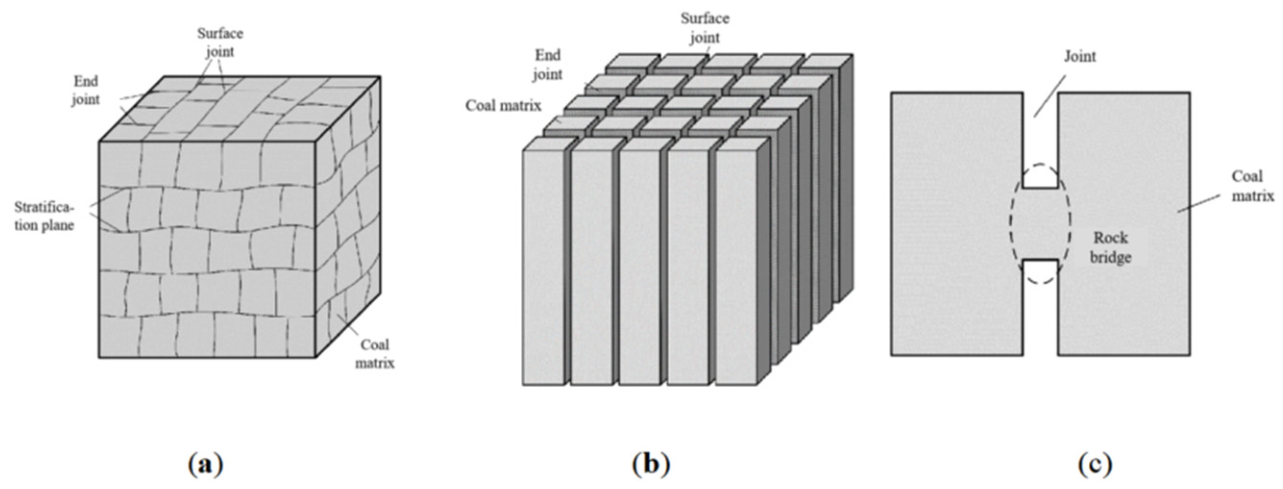
Coal is a pore-fracture medium composed of coal matrix and fractures, in which coal matrix is composed of solid skeleton and pores [23,24]. According to the differences in connectivity and direction, cracks can be divided into face cleats, butt cleats and bedding planes. Figure 1a shows this structure of coal. Face cleats and butt cleats are the primary conduits for the movement of gas within coal layers. Face cleats have long extension length, good connectivity, smooth surface and are close to each other. The surface of butt cleats is also very flat, but the connectivity is worse than that of face cleats, so the permeability of butt cleats is often smaller than that of face cleats. The permeability of bedding plane compressed by vertical geostress is usually much lower than that of face cleats and butt cleats. Based on this idealized structure of coal, the permeability model generally assumes the geometric configuration of coal’s structure called “matchstick”. As shown in Figure 1b. The matchstick model assumes that the coal matrix is totally separated by the joints and is not interconnected. Theoretically, given the boundary condition of unvarying confining pressure. The adsorption expansion deformation of coal matrix has negligible influence on permeability, but this is contrary to the experimental observation of coal permeability: when the confining pressure is constant, a rise in the pore pressure of the adsorption gas results in reduced permeability. In order to explain this contradiction, an improved version of the matchstick model has been proposed. The improved model assumes that the matrix of coal remains partially unseparated, but connected by rock bridges, as shown in Figure 1c [25]. In this paper, the enhanced “matchstick” model will be used to infer the coal’s permeability model.

2.1. Expansion Strain Within the Coal Matrix

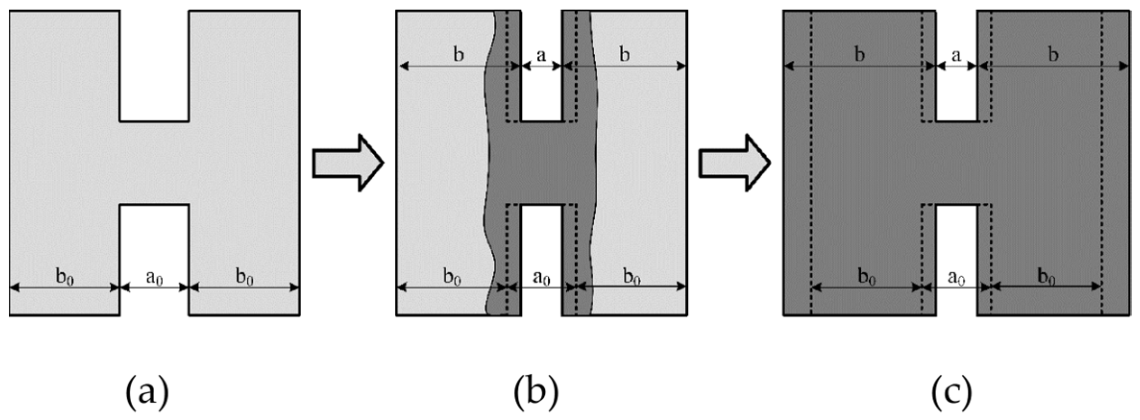
A coal body consisting of two coal matrices and a rock bridge connecting them is shown in Figure 2a. Under boundary constraints, after coal adsorbs gas, the rock bridge and the adjacent coal matrix on the joint side expand. Since the cross-sectional area of the coal matrix is greater than that of the rock bridge, the expansive force generated by the adsorbed gas in the coal matrix is also greater than that generated by the adsorbed gas in the rock bridge. Assuming that the mechanical parameters of the coal matrix and rock bridges are identical, after gas adsorption, the rock bridges are compressed by the coal matrix, and the joint width decreases, as shown in Figure 2b. At this point, the changes in the coal layer caused by adsorption are as follows:
l   =   l     l 0   =   a   +   2 b     a 0   +   2 b 0   =   a 0     2 b 0 ε sI     a 0   +   2 b 0
where, l is the alteration in length of the coal body due to adsorption, is the length of coal body after adsorption, l is the starting extent of the coal body before adsorption, l 0 is the width of cleat after adsorption, a represents the breadth of a coal matrix after adsorption, b is the initial width of cleat before adsorption.
With the continuous absorption, the gas expands and fills the entire coal matrix, which makes the coal matrix expand and deform outward, as illustrated in Figure 2c. Currently, the alteration of the coal matrix due to adsorption is:
l   =   a 0     2 b 0 ε sI   +   2 b 0 1   +   ε scon m     a 0   +   2 b 0   =   2 b 0 ε scon m     ε sI
where ε scon m represents the total expansion stress of the coal matrix caused by adsorption under boundary constraints.
It can also be inferred from Figure 2 that adsorption may cause internal expansion strain in the coal matrix even under unconfined boundary conditions due to the presence of rock bridges, so very small coal samples are usually used in experimental determination of adsorption-expansion deformation of the coal matrix to shield the effect of joints [26,27].
Considering a 0 b 0 , the adsorption expansion strain of the whole coal body can be calculated by the following equation
ε scon b = l l 0 = 2 b 0 ε scon m     ε sI a 0 + 2 b 0     2 b 0 ε scon m     ε sI 2 b 0 = ε scon m     ε sI
where ε scon b represents the total expansion stress exerted on the coal body. due to adsorption.
If the internal expansion strain of the coal matrix is considered as part of its total adsorption strain, the equation can be rewritten as:
ε scon b   =   ε scon m     ε scon 0 m     f in ε scon m     f in 0 ε scon 0 m
where f in is the proportion of The relationship between the expansion stress present in coal matrix and the total adsorption expansion strain under boundary constraints, and f in 0 is the initial value.
Certain experimental findings indicate that both the quantity and expansion strain of coal adsorption in boundary-restricted scenarios are less than in boundary-unrestricted situations, but the numerical correlation between coal’s adsorption expansion strain and the boundary conditions is not clear [28]. This document presupposes a proportional correlation between the coal matrix’s adsorption expansion strain when subjected to boundary constraints and the same strain when the boundary is not constrained.
ε scon m = ε scon m     ε scon 0 m =   f con ε suncon m     f con 0 ε suncon 0 m
where ε scon m represents the overall strain on the coal matrix due to adsorption expansion at the boundary’s unconfined state, and it’s the proportion of the coal matrix’s total adsorption expansion strain at the boundary’s confined state to that at the boundary’s unconfined condition.
Bringing Equation (5) into Equation (4) yields.
  ε scon b =   ε scon b     ε scon 0 b =   f con 1     f in ε suncon m     f con 0 1     f in 0 ε suncon 0 m
Bringing Equations (5) and (6) into Equation (3) and collating them gives.
ε sI = f con f in ε suncon m     f con 0 f in 0 ε suncon 0 m = F I ε suncon m     F I 0 ε suncon 0 m
where F I   =   f con f in represents the ratio between the intrinsic expansion strain of the coal matrix under constrained conditions and the adsorption-induced expansion strain of the coal matrix under unconstrained boundary conditions.
The internal expansion strain coefficient F I is defined as the ratio between internal expansion strain and adsorption-induced expansion strain, and therefore represents a dimensionless parameter. Physically, F I characterizes the contribution of adsorption-induced internal matrix deformation to the overall adsorption expansion response under constrained conditions. The magnitude of F I may depend on multiple factors, including stress conditions, gas adsorption characteristics, coal structure heterogeneity, and fracture distribution. Under typical coal seam conditions, F I is generally expected to remain within a physically reasonable positive range, although it is not necessarily strictly bounded between 0 and 1 because local deformation compatibility and anisotropic structural effects may influence the internal deformation response. In addition, different gases may produce different F I values due to variations in adsorption affinity and swelling behavior.
From Equation (7), it can be seen that compared with the adsorption-induced expansion strain of the coal matrix under unconstrained conditions, the internal expansion strain under constrained conditions includes not only the internal deformation of the coal matrix, but also the reduction in the overall adsorption-induced expansion strain caused by boundary constraints.
When ε suncon m replace the parameters in the equation with the adsorption expansion strain experienced by the coal body under restricted and unrestricted boundary conditions.
The equation still holds. Presuming the coal body’s adsorptive expansion strain under a certain boundary condition is known, according to Equation (6), ε suncon m and ε suncon 0 m the sum can be expressed by the following equation:
ε suncon m   =   ε scon 1 b f con 1 1     f in 1
ε suncon 0   m = ε scon 10 b f con 10 1     f in 10
where the subscript ‘1’ indicates a known boundary condition. Under another boundary condition, the internal expansion strain can be expressed as follows.
ε sI 2 = F I 2 ε scon 1 b f con 1 1     f in 1     F I 20 ε scon 10 b f con 10 1     f in 10 = F I ε scon 1 b     F I 0 ε scon 10 b
where F I represents the ratio of internal expansion strain of coal matrix to adsorption expansion strain of coal body under known boundary conditions.
The internal expansion strain and internal expansion coefficient Various elements, including pore pressure, influence the coal matrix, enclosure pressure, gas type, coal structure and organic microcomposition of the coal.

2.2. Model Derivation

(1) Coal contains free gases that are both single-phase and fully saturated.
(2) Processes of a physical nature taking place in the coal, such as adsorption and flow of gases, are taking place at a constant temperature. The processes of adsorption and desorption can be reversed, adhering to the principles of the Langmuir isothermal adsorption Equation [29].
(3) Coal, being a uniform elastic substance, exhibits deformation in alignment with Hooke’s law [30].
(4) The emphasis is solely on the permeability of the cleat, ignoring the permeability of the coal matrix.
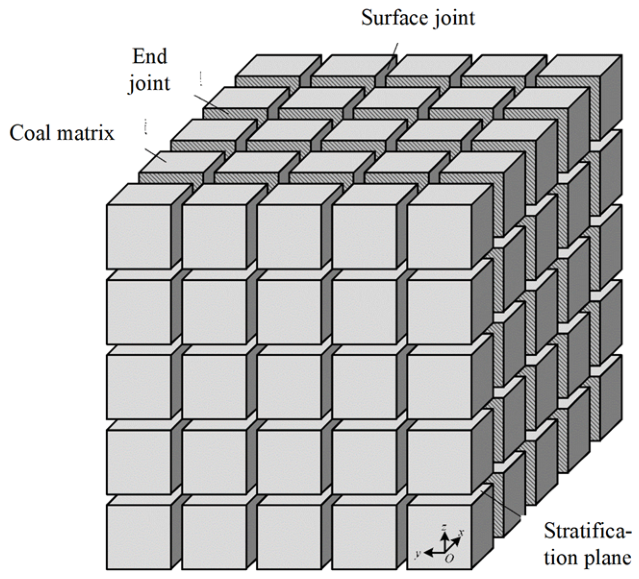
Coal may be viewed as a collection of ‘coal matrix-cleat’ segments. Every unit of ‘coal matrix-cleat’ is composed of five segments, specifically, the coal matrix block, rock bridge, facet joints, butt cleats, and bedding fractures [31]. Bear out the principle of determining the face porosity characterisation element: in order to make the parameters of the unit (e.g., porosity, permeability, etc.) reach the statistical average, the unit size should be as large as possible compared with the pore (cleat); at the same time, the unit size should be as small as possible compared with the whole model, which is in order to make the unit size and pore (joint) as large as possible compared with the whole model. According to this principle, the coal representative voxel should contain ‘enough’ ‘coal matrix-cleat’ units, as shown in Figure 3. It’s important to recognize that the term ‘sufficient’ in this context isn’t a fixed figure, but rather fluctuates based on the dimensions of the model and the precision of computational demands. For example, for the indoor experimental scale model, the number of ‘coal matrix-cleat’ cells in the characterisation voxel is smaller due to the smaller model size. For field-scale models, the size of the representation element should be as large as possible for a given computational accuracy, and the number of ‘coal matrix-cleat’ units in it should be larger in order to improve the computational efficiency [32].
Within the representational body element, it is assumed that the cleat surfaces are planar and that the parameters (e.g., cleat width and spacing, etc.) are the same for the same group of cleats. In comparison to the coal matrix, the size of the rock bridges is trivial. The representative voxel is placed in the Cartesian orthogonal right-angle coordinate system (Oxyz) as shown in Figure 3. The x-axis runs parallel to the intersection line between the face joints and the bedding plane, y-axis is parallel to the intersection line between the butt cleats and the bedding plane, and z-axis is perpendicular to the bedding plane. It should be noted that in Figure 3 the coal matrix is not completely separated but connected by rock bridges [33].

2.2.1. Relationship Between Face Porosity and Anisotropic Permeability

Within the existing research framework, the performance evaluation of CH4 adsorbent materials relies predominantly on single-component adsorption isotherms, ideal adsorption solution theory (IAST)-derived selectivity values, and maximum adsorption capacity as primary assessment metrics [6]. These indicators are conventionally obtained through pure-gas measurements conducted under anhydrous conditions and presuppose thermodynamic equilibrium as a foundational premise, serving to characterize the theoretical adsorption capability and potential separation performance of candidate materials. Within this evaluation paradigm, specific surface area, micropore volume, and surface functional group chemistry are regarded as the governing structural parameters determining adsorption performance, and research efforts have been predominantly directed toward maximizing limiting adsorption capacity and ideal selectivity coefficients [7].
Bear proposed the concept of face porosity for porous media, which refers to the ratio of pore area on a given plane to the total area of that plane within the representative voxel. In this study, the term “face porosity” is uniformly adopted to characterize the directional pore distribution associated with different fracture sets in coal seams. Therefore, from Figure 3, the face porosity of a certain directional cleat can be expressed as
ϕ areali = A cleatjk A REVjk
The face porosity of a given plane is the sum of the face porosities of the two groups of cleats, i.e.,:
ϕ arealx   =   ϕ facex   +   ϕ bedx ϕ arealy   =   ϕ butty   +   ϕ bedy ϕ arealz   =   ϕ facez   +   ϕ buttz
where ϕ arealx and ϕ arealz represent the porosity of the face joints along the x and z axes, correspondingly, and the porosity of the butt cleats along the y and z axes, and correspond to the porosity of the laminated surfaces in the x and y axes, respectively. For a particular set of cleats with a face porosity of
ϕ cleat = A cleat A REV
As shown in Figure 3, the nodal and representational voxels on a given plane can be represented by the following equations, respectively
A cleat =   a cleat l p n cleat
A REV =   l p l n
where a cleat is the width of a single cleat, n cleat is the number of cleats in the characterised body element, l p is the length of the characterised body element in the direction parallel to the cleat surface, l n and is the length of the characterised body element in the direction perpendicular to the cleat surface. Considering a cleat and a coal matrix block as a unit, it is equal to the product of the length of the unit of ‘coal matrix-cleat’ and the count of cleats.
l n = l unit n cleat
where l unit represents the measurement of a ‘matrix-cleat’ unit, describable through the subsequent equation
l unit = a cleat + b cleat
where b cleat is the nodal spacing, i.e., the width of the coal matrix.
Substituting Equations (14)–(17) into Equation (13) yields
ϕ cleat = A cleat A REV = a cleat l p n cleat l p l unit n cleat = a cleat l unit = a cleat a cleat + b cleat
From Equation (18), the face porosity of the cleat is only related to the cleat width and the cleat spacing but not to the orientation of the cleat, then we have
ϕ facex = ϕ facez ϕ butty = ϕ buttz ϕ bedz = ϕ buttx
Then the face porosity of face joints, butt cleats and laminated surfaces is representable through this equation, respectively
ϕ face = a face l face = a face a face + b face ϕ butt = a butt l butt = a butt a butt + b butt   ϕ bed = a bed l bed = a bed a bed + b bed
Equation (20) shows that the face porosity of joints remains unaffected by the count of ‘coal matrix-joint’ units in the analyzed body part. Therefore, the permeability model developed in this study can be used to describe the variation of coal permeability at both indoor and field levels.
Substituting Equation (20) into Equation (12) gives
ϕ arealx = a face a face + b face + a bed a bed + b bed ϕ arealy = a butt a butt + b butt + a bed a bed + b bed ϕ arealz = a face a face + b face + a butt a butt + b butt
Equations (20) and (21) also reveal that body porosity equals the sum of face joint porosity, end joint porosity, and lamination face porosity.
ϕ bulk =   ϕ face + ϕ butt + ϕ bed = 1 2 ϕ arealx + ϕ arealy + ϕ arealz
where is the body porosity of the coal. From Equation (22), the body porosity is equal to one-half of the sum of the face porosities.
Under the assumption of isotropy, permeability and bulk porosity satisfy the following relationship
k k 0 = ϕ bulk ϕ bulk 0 3
where k represents isotropic permeability, k 0 represents the initial state’s permeability. In this chapter. Assuming that the anisotropic permeability and face porosity still correspond to this three-way relationship.
k i k i 0 = ϕ areali ϕ areali 0 3

2.2.2. Evolution of Anisotropic Permeability

For faceted nodal theory, the derivation of Equation (20) yields
d ϕ face = d a face l face = d l face     b face l face = b face l face d l face l face     d b face b face
which
b face l face = 1     ϕ face
Bringing Equation (26) into Equation (25) yields
d ϕ face 1     ϕ face = d l face l face     d b face b face
Expanding Equation (27) by Taylor series and neglecting the higher order derivative terms yields
ϕ face 1   ϕ face = l face l face     b face b face
Since the porosity of coal tends to be much less than 1, i.e., 1     ϕ face     1 , Equation (28) can be further collapsed into
ϕ face = ϕ face 0 + l face l face     b face b face = ϕ face 0 + ε y b     ε y m
where ε y b represents the pressure exerted on the coal body along the y-axis.
In the indoor experiments on gas extraction and coal permeability in coal seams. There are two types of influence on the deformation of the coal body, namely effective changes in stress and absorption (or desorption) of gases.
Therefore ε y b and ε y m can be expressed as
ε y b = ε ey b + ε sy b
ε y m = ε ey m + ε sy m
where ε ey b is the coal body strain due to effective stress change, ε ey m is the coal matrix strain due to effective stress change, ε sy b is the coal body strain due to gas adsorption, and ε sy m represents the strain on the coal matrix caused by gas absorption.
For an anisotropic elastic medium, the strain resulting from a change in the equation below can represent effective stress
ε ey b = σ ey     ν zy b σ ez     ν xy b σ ex E y b
ε ey m = σ ey     ν zy m σ ez     ν xy m σ ex E y m
where, it regarding the alterations in effective stress. Assuming that the number of Biorthogonal is equal to 1.
σ ei = σ ti + p
where σ ti is the total stress change in direction i. The negative sign indicates that the total stress is compressive stress.
From Equations (5) and (6), ε sy b and ε sy m can be expressed as
ε sy b = f cony 1     f iny ε suncony m     f cony 0 1     f iny 0 ε suncony 0 m
ε sy m = f cony ε suncony m   f cony 0 ε suncony 0 m
where ε suncony m is computable using the Langmuir equation
ε suncony m = ε Ly p p Ly + p
where ε Ly and p Ly are Langmuir adsorption strain constants, where ε Ly represents the ultimate adsorption expansion strain of the coal matrix in the y-axis direction, while p Ly represents the pressure within the pore when the y-axis adsorption expansion strain of the coal matrix matches.
Bringing Equations (32), (33) and (35)–(37) into Equations (30) and (31) and then into Equation (28) gives
ϕ face = ϕ face 0 + σ ey     ν zy b σ ez     ν xy b σ ex E y b σ ey     ν zy m σ ez     ν xy m σ ex E y m     ε Ly F Iy p p Ly + p     F Iy 0 p 0 p Ly + p 0
The same reasoning leads to
ϕ butt = ϕ butt 0 + σ ex     ν yx b σ ey     ν zx b σ ez E x b σ ex     ν yx m σ ey     ν zx m σ ez E x m     ε Lx F Ix p p Lx + p     F Ix 0 p 0 p Lx + p 0
ϕ bed = ϕ bed 0   + σ ez     ν xz b σ ex     ν yz b σ ey E z b σ ez     ν xz m σ ex     ν yz m σ ey E z m     ε Lz F Iz p p Lz + p     F Iz 0 p 0 p Lz + p 0
Assuming Poisson’s ratio symmetry
ν ij b = ν ji b ν ij m =   ν ji m
Substituting Equation (41) into Equations (38)–(40) and then into Equation (21) gives
ϕ areali = ϕ areali 0 + σ ej     ν jk b σ ek     ν ij b σ ei E j b     σ ej     ν jk m σ ek     ν ij m σ ei E j m + σ ek     ν ki b σ ei     ν jk b σ ej E k b   σ ek     ν ki m σ ei     ν jk m σ ej E k m ε Lj F Ij p p Lj + p     F Ij 0 p 0 p Lj + p 0     ε Lk F Ik p p Lk + p     F Ik 0 p 0 p Lk + p 0
Substituting Equation (42) into Equation (24) gives
k i = k i 0 1 + 1 ϕ areali 0 σ ej     ν jk b σ ek     ν ij b σ ei E j b     σ ej     ν jk m σ ek     ν ij m σ ei E j m + σ ek     ν ki b σ ei     ν jk b σ ej E k b     σ ek     ν ki m σ ei     ν jk m σ ej E k m ε Lj F Ij p p Lj + p     F Ij 0 p 0 p Lj + p 0     ε Lk F Ik p p Lk + p     F Ik 0 p 0 p Lk + p 0 3
Assuming that the coal matrix is incompressible compared to the coal body, i.e., Equation (43) reduces to
k i = k i 0 1 + 1 ϕ areali 0 σ ej     ν jk σ ek     ν ij σ ei E j + σ ek     ν ki σ ei     ν jk σ ej E k ε Lj F Ij p p Lj + p     F Ij 0 p 0 p Lj + p 0     ε Lk F Ik p p Lk + p     F Ik 0 p 0 p Lk + p 0 3
The simplification from Equation (43) to Equation (44) assumes that the compressibility of the coal matrix is negligible compared with cleat deformation during permeability evolution. This assumption is introduced primarily for analytical simplification, because permeability changes in coal seams are generally dominated by the evolution of cleat aperture rather than matrix volumetric compression. It should be noted that neglecting matrix compressibility does not eliminate the effects of adsorption-induced swelling, since adsorption-induced internal matrix deformation is still incorporated into the model through the adsorption strain term and the internal expansion strain coefficient. Therefore, the simplified formulation can still capture the coupled influence of gas adsorption and stress evolution on permeability variation under typical stress–adsorption coupling conditions in coal seams.
In Equation (44), only the Young’s modulus and Poisson’s ratio of the coal body are retained of the coal body are available, so the superscript b representing the coal body is omitted. Unless otherwise specified, the Youngs modulus and Poissons ratio referred to are those of the coal body.
The coal permeability model represented by Equation (44) is formulated independently of specific boundary conditions, and the model can be expanded into the corresponding expression based on specific boundary conditions. The framework therefore provides broader adaptability than permeability formulations derived for specific boundary conditions than permeability models derived for specific boundary conditions.

2.2.3. Model Expressions for Different Boundary Conditions

Four types of boundary conditions frequently encountered in indoor experiments on coal seam gas extraction and coal permeability are uniaxial strain, constant confining pressure, constant effective stress and constant pore pressure. In this section, Equation (44) is developed for these four types of boundary conditions.
Under the uniaxial strain boundary condition, the stress in the vertical direction is kept constant, with the coal body’s horizontal strain being nil, then there exist
σ ez = σ tz + p = p     p 0
ε ex + ε sx b = ε ey + ε sy b = 0
From Equation (32), the effective stress in the horizontal direction is
σ ex = E x E z ν zx + ν xy ν yz p     E x ε sx b + ν xy ε sy b 1     ν xy 2
σ ey = E y E z ν yz + ν xy ν zx p     E y ε sy b + ν xy ε sx b 1     ν xy 2
Substituting Equations (45)–(48) into Equation (44) gives
k x =   k x 0 1 + 1 ϕ arealx 0 ν xy ν zx E y     E x + ν yz E y     ν xy 2 E x     1     ν xy 2 ν yz E z 1     ν xy 2 E z E y p     p 0 + 1     ν xy 2 E z     ν zx 2 E x     ν yz 2 E y     E x + E y ν xy ν yz ν zx 1     ν xy 2 E z 2 p     p 0 ε Ly F Iy p p Ly + p     F Iy 0 p 0 p Ly + p 0     ε Lz F Iz p p Lz + p     F Iz 0 p 0 p Lz + p 0 3
k y = k y 0 1 + 1 ϕ arealy 0 ν xy ν yz E x     E y + ν zx E x     ν xy 2 E y   1     ν xy 2 ν zx E z 1     ν xy 2 E z E x p     p 0 + 1     ν xy 2 E z     ν zx 2 E x     ν yz 2 E y     E x + E y ν xy ν yz ν zx 1     ν xy 2 E z 2 p     p 0 ε Lx F Ix p p Lx + p     F Ix 0 p 0 p Lx + p 0     ε Lz F Iz p p Lz + p     F Iz p 0 p Lz + p 0 3
k z = k z 0 1 + 1 ϕ arealz 0 ν xy ν yz E x     E y + ν zx E x     ν xy 2 E y     1     ν xy 2 ν zx E z 1     ν xy 2 E z E x p     p 0 + ν xy ν zx E y     E x + ν yz E y     ν xy 2 E x     1     ν xy 2 ν yz E z 1     ν xy 2 E z E y p p 0 ε Lx F Ix p p Lx + p   F Ix 0 p 0 p Lx + p 0   ε Ly F Iy p p Ly + p     F Iy 0 p 0 p Ly + p 0 3
From Equation (22), assuming isotropy, the correlation between body and face porosity is
ϕ bulk = 1 2 ϕ areal + ϕ areal + ϕ areal = 3 2 ϕ areal
Currently, the model of permeability can be reduced to
k = k 0 1 + 1 ϕ bulk 0 3 1 + ν 1     2 ν 1     ν E p     p 0     ε L F I p p L + p     F I 0 p 0 p L + p 0 3
Note that in Equation (53) ε L is the volumetric strain.
The total stress in all directions remains constant under constant confining pressure boundary conditions, i.e.,
σ tx = σ ty = σ tz = 0
Thus the effective stress in each direction is
σ ex = σ ey = σ ez = p     p 0
Substituting Equation (55) into Equation (44) gives
k i = k i 0 1 + 1 ϕ areali 0 1   ν jk   ν ij E j p   p 0 + 1     ν ki     ν jk E k p     p 0 ε Lj F Ij p p Lj + p     F Ij 0 p 0 p Lj + p 0     ε Lk F Ik p p Lk + p     F Ik 0 p 0 p Lk + p 0 3
Under the assumption of isotropy, the permeability model can be simplified as
k =   k 0 1 + 1 ϕ bulk 0 p     p 0 K     ε L F I p p L + p     F I 0 p 0 p L + p 0 3
When the effective stress boundary condition is maintained uniformly, the effective stress stays unvarying in every direction.
σ ex = σ ey = σ ez = 0
Substituting Equation (58) into Equation (44) gives
k i = k i 0 1     1 ϕ areali 0 ε Lj F Ij p p Lj + p     F Ij 0 p 0 p Lj + p 0 +   ε Lk F Ik p p Lk + p     F Ik 0 p 0 p Lk + p 0 3
Under the assumption of isotropy, the permeability model can be simplified as
k =   k 0 1     1 ϕ bulk 0 ε L F I p p L + p     F I 0 p 0 p L + p 0 3
Pore pressure remains constant under constant pore pressure boundary conditions
p     p 0 = 0
Substituting Equation (61) into Equation (44) gives
k i = k i 0 1     1 ϕ areali 0 σ tj     ν jk σ tk     ν ij σ ti E j + σ tk     ν ki σ ti     ν jk σ tj E k + F Ij     F Ij 0 ε Lj p 0 p Lj + p 0 + F Ik     F Ik 0 ε Lk p 0 p Lk + p 0 3
Under the assumption of isotropy, the permeability model can be simplified as
k =   k 0 1     1 ϕ bulk 0 σ t K + F I     F I 0 ε L p 0 p L + p 0

2.3. Analysis of Factors Affecting Coal Seam Permeability

Owing to the reduced Young’s modulus in coal, soft and brittle mechanical properties. The influence of external conditions on crack formation and permeability is achieved through deformation of the coal storage area itself, and changes in stress are most likely to cause deformation. Some scholars believe that it is the ancient tectonic stress is the primary determinant in regulating the development level of cuttings, and the tectonic activity after the coal-forming period is the main factor to produce tectonic cracks in coal seams, and the magnitude of the intensity of tectonic activity has both constructive and destructive effects on the permeability of coal reservoirs [34].
Moderate tectonic action such as fracture and folding can increase the density of cuttings in coal seams and improve the permeability, so the zone of tectonic fissure development can be the development zone of high-permeability coal seams. In addition. The endogenous fractures generated during coal formation will evolve into fracture zones in the coal rock mass under subsequent tectonic action, forming stress concentration zones, which will then evolve into tectonic fractures.
The direction of the maximum principal stress in the stress field determines the permeability of the coal seam: if this stress direction aligns with the reservoir’s primary fracture group’s development direction, the fissure undergoes tensile stress, expands in width and permeability, reaching its peak at this juncture; conversely, when the tectonic stress field’s maximum principal stress direction is orthogonal to the coal reservoir’s dominant fracture group’s development, the fissure experiences compressive stress, leading to a reduction in its width and a decrease in permeability. If the peak principal stress direction of the tectonic stress field aligns perpendicularly to the dominant fracture group’s development in the coal reservoir, it leads to compressive stress, a reduction in fracture width, a decrease in permeability, and the lowest permeability currently observed.
Previous studies have shown that cuttings are more developed in bright coals, and cuttings can also be seen in dull coals, but their cleat density is much smaller than that of bright coals. Therefore, in terms of the composition of microscopic components, the higher the content of the vitrinite, the more developed the cuttings, and the better the permeability. Regarding the type of coal rock, bright coal exhibits superior permeability, succeeded by semi-bright, semi-dark, and dull coal varieties.
In the process of coalification, the composition and structure of coal undergo a series of changes, and with these changes, the pore characteristics of coal also show a unique evolutionary law, which affects the permeability. When some scholars studied the relationship between the density of cuttings and coal rank, they found that the density of cuttings increased from lignite to bituminous coal (fat coal, coking coal) and decreased from bituminous coal to anthracite, which is normally distributed, i.e., the cuttings of coals with low metamorphism and high metamorphism are underdeveloped, and those of coals with medium metamorphism are developed, and the more the cuttings are developed, the larger the permeability is.
Coal body structure is the basis for the evaluation and prediction of the permeability of coal seams, and the good or bad structure of the coal body affects the permeability to a large extent. Since coal is a kind of rock with low Young’s modulus and high Poissons ratio, its deformation resistance is much lower than that of other rocks, thus, during the final phase of the process of forming coal, the coal-bearing system experienced different contemporaneous tectonic movements, which made the coal reservoirs undergo deformation of different degrees and natures, and the result is that the primary structural coal reservoirs are destroyed into fractured coal, crushed-grain coal, and cretaceous coal bodies in turn.
Inside the pore space, the fluid acts to distribute the pressure exerted by the rock above. This changes the stress in the rock, and as the pore fluid pressure increases, the stress decreases. As the pressure exerted on the rock intensifies during its formation, when the rock is incompressible, the particles become more and more compact with each other, the pore space becomes smaller and smaller, and the connectivity between the pores becomes poorer and poorer. So it can be seen that the permeability of the rock has a tendency to decrease with the escalation of actual stress, the reduction occurs more rapidly with minimal effective stress, while the reverse is less rapid.
It has been shown that under different peripheral stress conditions, the temperature has two influencing effects on the coal matrix, namely, external expansion and internal expansion, which in turn makes the permeability show different patterns of change: the permeability shows two different patterns of change with the increase of temperature, i.e., in high-stress scenarios, temperature rises leading to reduced permeability; conversely, in low-stress situations, the coal body’s permeability escalates with higher temperatures. Under conditions where the effective stress ranges from 1.7 MPa to 2.0 MPa, the permeability of coal is higher at 55 °C than at 30 °C, while at 45 °C it lies between these two values. Conversely, when effective stress exceeds 2.0 MPa, the coal body’s permeability diminishes as the temperature rises in each identical stress scenario.
In addition, comparing the seepage curves at different temperatures, it can also be found that changing the same effective stress value, the permeability curve at 55 °C decreases more than the permeability curves at 30 °C and 45 °C, and the decrease in the 45 °C curve is greater than that at 30 °C. This is due to the increase in temperature, the compressibility of the coal pore space becomes larger, which in turn makes the permeability change amplitude also becomes larger, it can be seen that the increase in temperature makes the permeability of the effective stress changes in the degree of sensitivity greatly increased.
Under the normal unmined condition of coal reservoir, if it is not affected by large tectonic movement, its permeability is basically a certain value. However, along with the coal seam gas extraction, its equilibrium state is damaged, resulting in permeability changes. During coalbed methane extraction, as gas pressure falls beneath the crucial desorption point, the gas begins to desorb, causing the coal matrix to contract. This results in reduced horizontal stress, a lowered effective stress, a wider fissure, and enhanced permeability.
The main stratification of coal seams also has a more significant impact on their permeability. The same piece of coal samples under the same conditions to determine the permeability, the direction of the permeability pressure if perpendicular to the stratification surface of the coal specimens, followed by the permeability of the tiniest; permeability of the direction of the permeability pressure if the stratification surface alongside the coal specimens, the permeability of the biggest, and the permeability of the parallel layer of the perpendicular layer of the permeability of the 2 to 10 times. The phenomenon indicates that permeability varies in different directions in coal reservoirs as influenced by the original sedimentary stratification.
At the microscopic level, coal is heterogeneous, and the stress generated by expansion within the coal matrix is also heterogeneous.
At the macro-scale, the internal expansion strain has an average statistical figure, yet presently, directly measuring this figure poses a challenge. This section describes methods for inverting the internal expansion strain from permeability models and permeability experimental data.
Assuming that the coal matrix is incompressible compared to the coal body, Alterations in anisotropic permeability, resulting from shifts in effective stress and adsorption, are represented by the subsequent equation:
k i   =   k i 0 1   +   1 ϕ areali 0 σ ej     ν jk σ ek     ν ij σ ei E j b   +   σ ek     ν ki σ ei     ν jk σ ej E k b ε Lj F Ij p p Lj   +   p     F Ij 0 p 0 p Lj   +   p 0     ε Lk F Ik p p Lk   +   p     F Ik 0 p 0 p Lk   +   p 0 3
Under the assumption of isotropy, Equation (64) reduces to
k   = k 0 1 + 3 2 ϕ bulk 0 2 σ e     ν σ e     ν σ e E 2 ε L F I p p L + p     F I 0 p 0 p L + p 0 = k 0 1 + 1 ϕ bulk 0 σ e K     ε sI 3
where ε sI is the volume strain of volume expansion in the coal matrix.
According to Equation (65), ε sI 0 can be expressed by the following equation
ε sI = ε sI 0 + σ e K     ϕ bulk 0 k k 0 1 / 3     1
In Equation (66), ε sI and ε sI 0 are unknown quantities, so in order to obtain ε_sI, the pore pressure in the initial state needs to be set to zero, at which point ε sI 0 = 0. Equation (66) reduces to
ε sI = σ e K     ϕ bulk 0 k k 0 1 / 3     1
The equation serves to determine the internal expansion strain, utilizing experimental data on permeability and coal’s mechanical properties, with the coefficient of internal expansion strain being represented by the subsequent equation:
F I   =   ε sI ε s
where ε s adsorption-induced strain expansion can occur within the unconstrained boundaries of coal-based substrates. At unconstrained boundaries, adsorption expansion strain within the coal matrix. or the strain caused by the coal body’s adsorptive expansion at the restricted boundary, ε s can be regarded as the ‘baseline’. The importance of the internal expansion strain coefficient lies in linking the readily quantifiable ‘baseline’ with permeability. Since it is currently difficult to measure the internal expansion strain directly, the internal expansion strain coefficient provides a simple way to describe the effect of adsorption on permeability.


2.4. Applicability and Limitations of the Model Assumptions

To facilitate analytical derivation, the proposed framework assumes that coal behaves as a homogeneous elastic medium at the representative voxel scale and that the compressibility of the coal matrix is negligible compared with cleat deformation. These assumptions are commonly adopted in permeability evolution analyses of coal seams, particularly when permeability is primarily controlled by cleat aperture evolution under coupled stress–adsorption conditions.
The homogeneous elastic assumption is considered reasonable for macroscopic permeability analysis under relatively small deformation conditions, where the representative voxel can approximately characterize the averaged mechanical and seepage behavior of heterogeneous coal structures, provided that sufficient baseline characterization data are available [35]. However, under conditions involving significant plastic deformation, intense fracture propagation, or strong damage localization, the applicability of the equivalent elastic approximation may be limited.
In addition, the assumption of negligible matrix compressibility is introduced to simplify the analytical formulation because cleat deformation generally contributes more significantly to permeability evolution than matrix volumetric compression. The effects of adsorption-induced matrix deformation are still incorporated into the model through the internal expansion strain coefficient. Nevertheless, under extremely high stress conditions or strong nonlinear deformation processes, matrix compressibility and nonlinear mechanical effects may become non-negligible, which should be further considered in future model development.
In addition, the current framework does not explicitly incorporate several complex processes that may influence coal permeability under specific reservoir conditions, including non-Darcy [36] flow behavior, gas slippage effects, stress-path dependency, supercritical adsorption behavior, and cleat compressibility. These mechanisms may become increasingly important under high-pressure, high-temperature, or strongly nonlinear deformation conditions. Further incorporation of these coupled processes may further improve the applicability of the proposed framework for complex coal reservoir environments.

3. Inversion Results for Internal Expansion Strain and Internal Expansion Strain Coefficient

3.1. Coal Permeability Data Sources

In this paper, the internal expansion strain and internal expansion strain coefficient will be inverted using the permeability experimental data The parameter values of the coal samples are shown in Table 1 and Table 2. The initial condition of Sulcis coal sample is that the confining pressure is 10 MPa and the pore pressure is zero. The initial body porosity and initial permeability of this coal sample are derived from the porosity and permeability data of He.Sydney’s coal sample starts with both enclosing and pore pressures at zero. Its initial body porosity and permeability are based on He’s permeability data, with Sydney’s initial porosity ranging from 1.2% to 1.5%. Sydney’s starting porosity ranges between 1.2% and 1.5%, with 1.2% being the standard in this study.
The Langmuir adsorption-expansion strain constants for the Sulcis coal samples in Table 2 were measured using a 22 mm diameter disc-shaped coal sample under unconfined boundary conditions. The Langmuir adsorption-expansion strain constants obtained for the Sulcis coal sample can be regarded as parameters of the unconfined coal matrix due to the small size of the sample, which can be assumed to contain no joints, and the Langmuir adsorption-expansion strain constants obtained for the Sydney coal sample are the parameters regarding the lump coal specimen featuring joints under the unconfined boundary condition, but they are derived from the adsorption-expansion strains regarding the lump coal specimen featuring joints under unrestricted boundary conditions. adsorption-expansion strain extrapolated from the lumped coal samples with joints in the boundary-restricted condition. The physical significance of the internal expansion strain coefficients is different for the two sets of samples due to the different ‘baselines’ chosen: for the Sulcis samples, the internal expansion strain coefficient is the ratio of the internal expansion strain in the coal matrix to the total adsorbed expansion strain in the unrestricted coal matrix at the boundary, and for the Sydney samples, This refers to the proportion between the internal expansion strain and the overall adsorbed expansion strain within the unrestricted coal matrix at the boundary. The ratio of the total adsorbed expansion strain of the unconfined coal matrix at the boundary.
The permeability data for the Suris and Sydney samples are shown in Table 2 and Table 3, respectively. The permeability data for the Surcis specimen is explained in detail in the original text. The permeability data for the Sydney sample were obtained by digitising the data from the original graphs, which may have minor errors from the original data, but the digitisation of the data was carried out with great care to ensure that the data obtained were as close as possible to the original data. However, the data were digitised very carefully to ensure that they were as close as possible to the original data, and therefore the errors do not affect the subsequent analyses and conclusions. It should be noted that the pore pressures and temperatures of some experiments exceeded the critical points of the experimental gases (CH4’s pivotal temperature stood at 190.6 K with a critical pressure of 4.6 MPa; CO2’s pivotal temperature reached 304.1 K, and its critical pressure was 7.38 MPa), and thus the corresponding permeability data were in the supercritical state [37].
The pore pressure of the CO2 experiment of Sydney coal samples reaches 12.8 MPa. The technique proposed in this document for reversing internal expansion stress based on a permeability model, together with the permeability test results, inherently presumes coal to be an elastic material. Therefore, it is worth exploring whether coal is still an elastic medium under such a high pore pressure. However, after degassing the coal samples the coal samples were completely restored to their original size and no hysteresis effect between adsorption and desorption was found. Sydney coal samples can still be considered elastic media even at pore pressures as high as 12.8 MPa.

3.2. Internal Expansion Strain

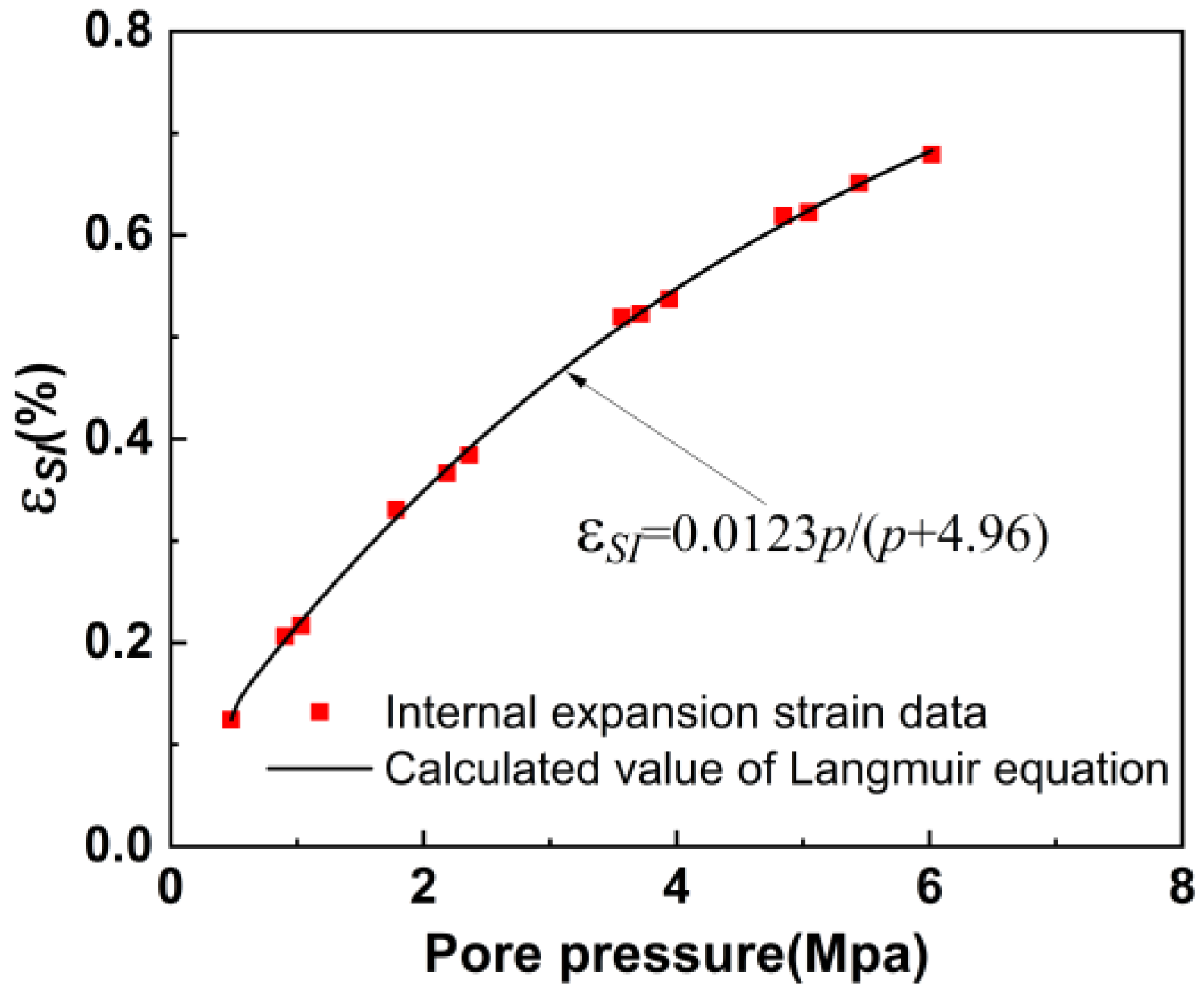
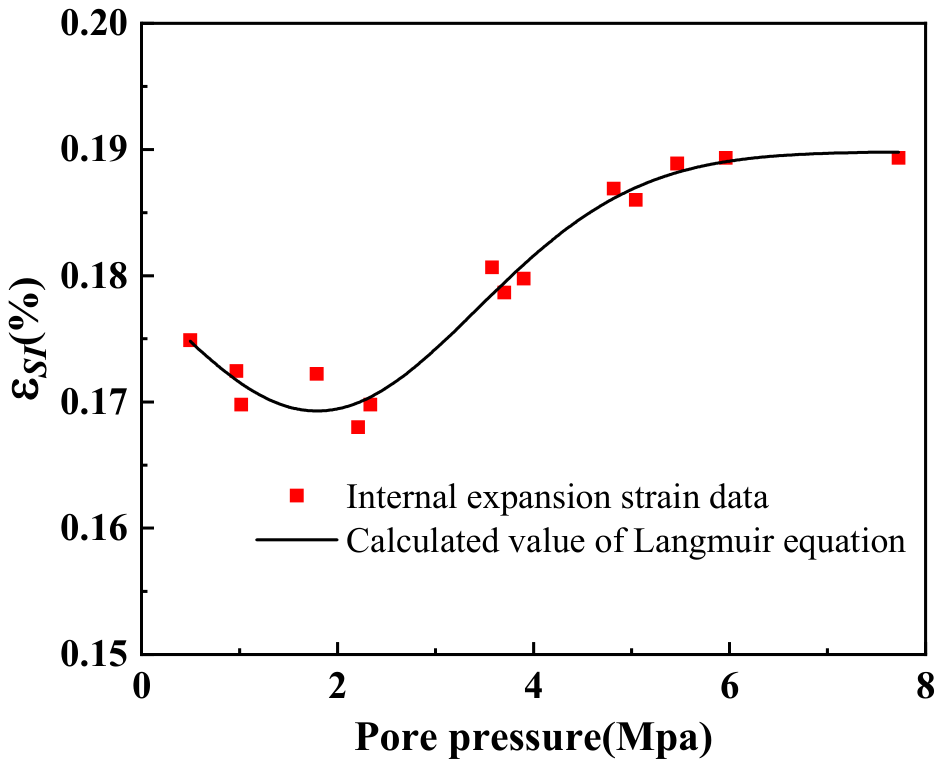
The variation of internal expansion strain with pore pressure of Sulcis coal samples at an confining pressure of 10 MPa is shown in Figure 4. As pore pressure increases, internal expansion strain also increases. When the s confining pressure remains constant, the correlation between internal expansion strain and pore pressure is still consistent with the Langmuir equation.
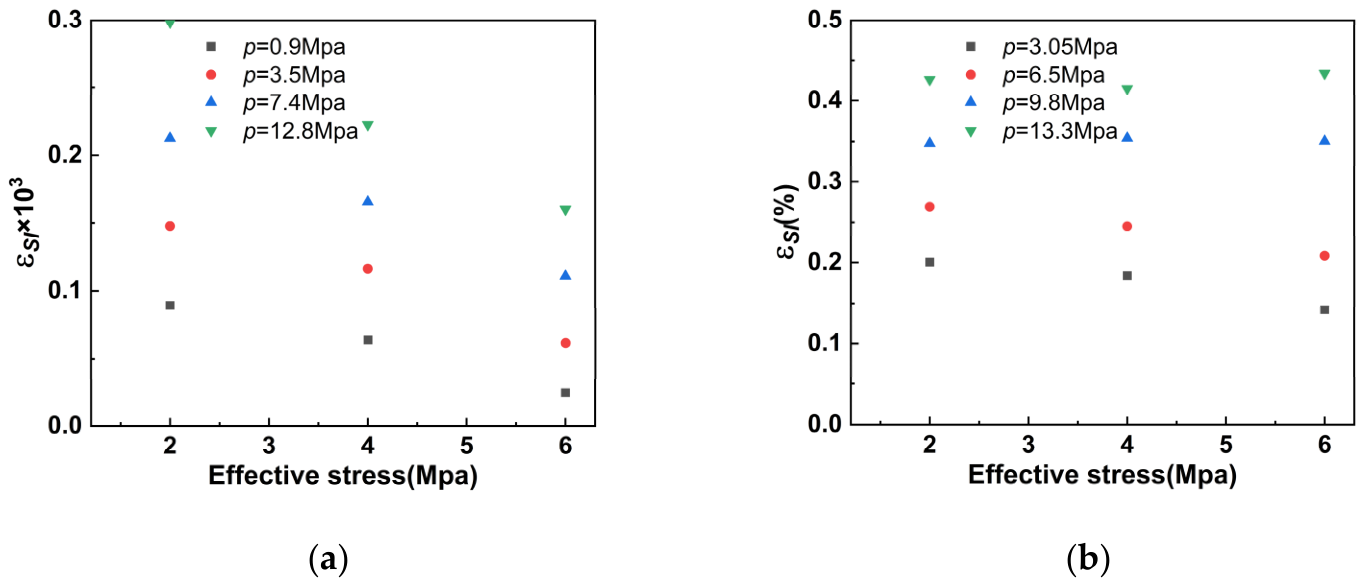
The variation of internal expansion strain with effective stress under different pore pressures for Sydney coal samples is shown in Figure 5. Under different pore pressure conditions, the internal expansion strain decreases with increasing effective stress for both CH4 and CO2.
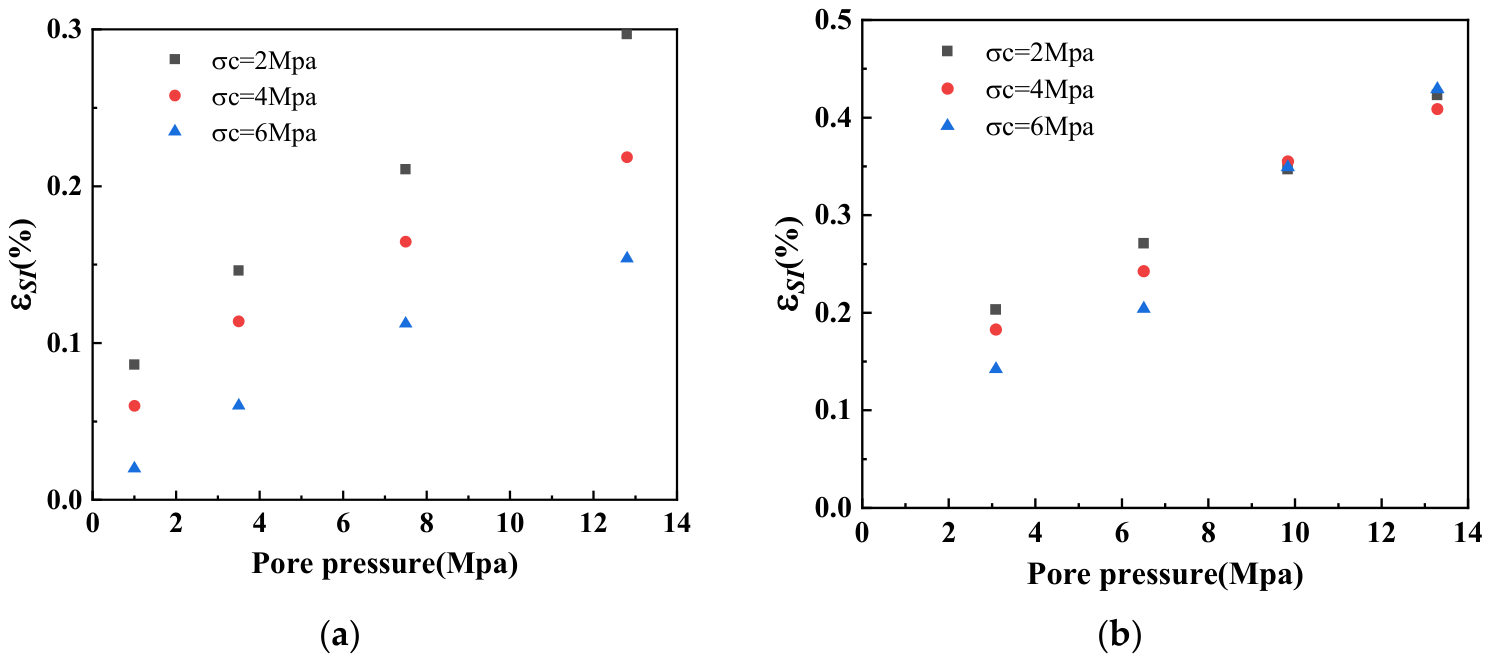
Figure 6 depicts the variation in internal expansion strain relative to pore pressure in Sydney coal samples under different stress conditions. With a steady effective stress boundary, the internal expansion strains from gaseous CH4 and CO2 escalate as pore pressure rises.

3.3. Internal Expansion Strain Factor

The variation of internal expansion strain coefficient with pore pressure in Sulcis coal samples when the confining pressure is constant at 10 MPa is shown in Figure 7, where the squares indicate the internal expansion strain coefficients calculated from the internal expansion strain data, and the solid lines indicate the internal expansion strain coefficients calculated according to the Langmuir equation in Figure 4. When the pore pressure rises, the internal expansion strain coefficient generally tends to increase. Since the internal expansion strain in Figure 4 does not exactly agree with the calculated value of Langmuir’s equation, there is some error between the internal expansion strain coefficient calculated from the internal expansion strain data and the internal expansion strain coefficient calculated from Langmuir’s equation in Figure 7.
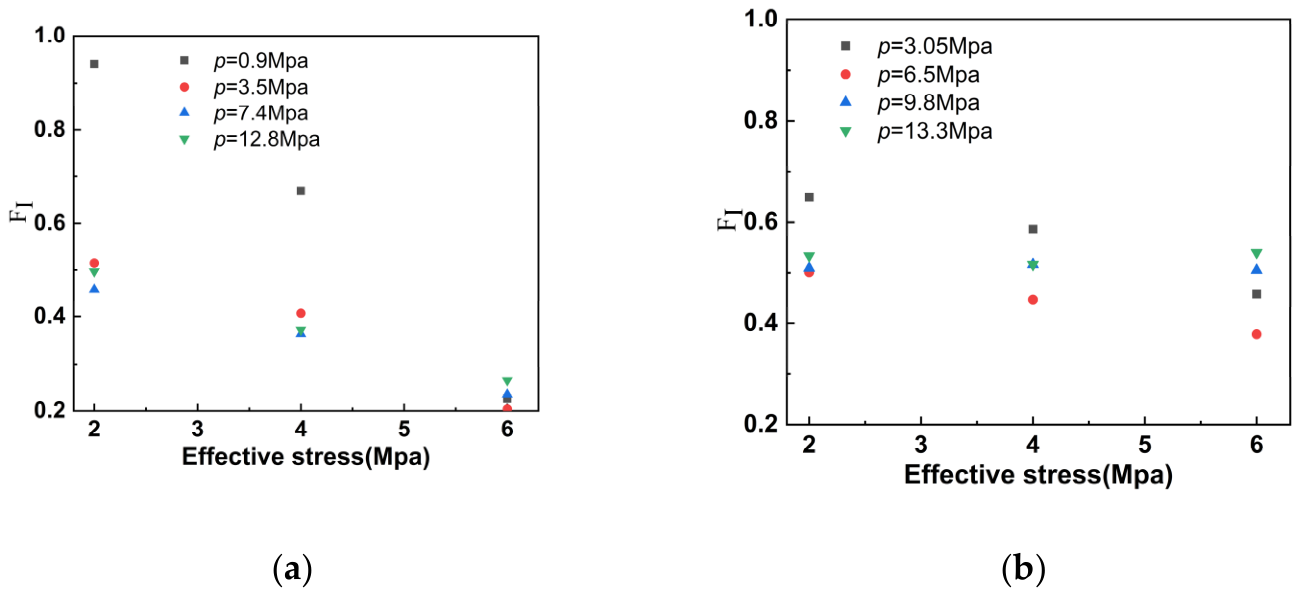
Figure 8 illustrates how the internal expansion strain coefficient changes with effective stress in Sydney coal samples under varying pore pressure conditions. Across every level of pore pressure, the internal expansion strain coefficient caused by CH4 lessens as the peripheral pressure rises. A decrease in pore pressure (0.9 MPa) leads to a faster reduction in the internal expansion strain coefficient due to CH4. At pore pressures of 3.5 MPa, 7.4 MPa, and 12.8 MPa, the reduction in CH4-induced internal expansion strain coefficients was more gradual. As the confining pressure rises, the internal expansion strain coefficient caused by gaseous CO2 diminishes, and similarly, the internal expansion strain coefficient resulting from supercritical CO2 remains largely unaltered by the confining pressure.
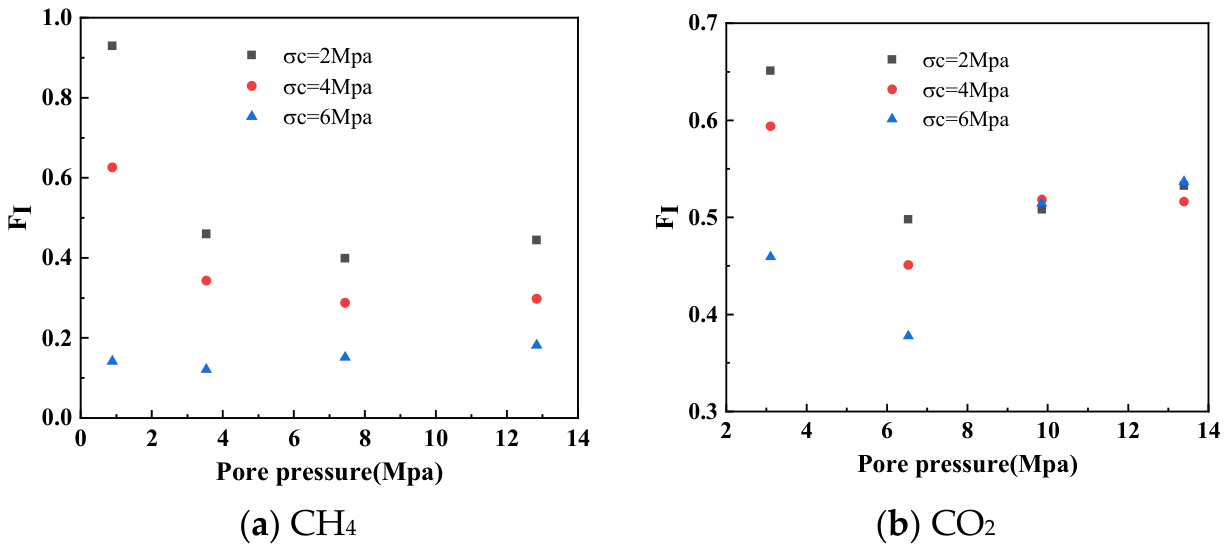
The variation of internal expansion strain coefficient with pore pressure in Sydney coal samples under varied levels of effective stress are depicted in Figure 9. Within the effective stress range of 2 to 4 MPa, the gas-induced internal expansion deformation coefficient exhibits a distinct non-linear relationship with pore pressure. When the hole pressure is low, during the phase of low pore pressure, the CH4-induced internal expansion strain coefficient decreased rapidly. With the ongoing rise in pore pressure, the CH4-induced internal expansion strain coefficient begins to rise slowly. When the stress level reached 6 MPa, the internal expansion strain coefficient triggered by CH4 diminished and then rose, aligning with a rise in pore pressure. However, the internal expansion strain coefficient’s variation was slight, fluctuating between 0.21 and 0.26. As pore pressure increased, there was a pattern of CO2-induced internal expansion strain coefficient initially decreasing and subsequently rising.
The observed differences between CH4 and CO2 permeability behavior are closely associated with their distinct adsorption characteristics and swelling responses within the coal matrix. Compared with CH4, CO2 generally exhibits stronger adsorption affinity and larger adsorption capacity in coal, resulting in more pronounced adsorption-induced matrix swelling. The enhanced matrix swelling promotes cleat aperture reduction, thereby producing a stronger permeability reduction effect under similar stress conditions.
In addition, several CO2 experimental conditions approached or exceeded the critical-state region, where the density and adsorption behavior of CO2 become significantly different from those of conventional gaseous CH4. Under supercritical conditions, CO2 may induce stronger nonlinear deformation responses in the coal matrix, further enhancing the coupling between adsorption-induced swelling and permeability evolution. By contrast, CH4-induced matrix swelling is relatively weaker, and the permeability evolution is more strongly influenced by effective stress variation and cleat deformation.
Therefore, the permeability evolution behavior observed in this study reflects the competition between adsorption-induced cleat closure and effective stress-controlled fracture opening, with CO2 adsorption effects being more dominant than those of CH4 under comparable conditions.

4. Conclusions

(1) A generalized anisotropic permeability evolution framework for gas flow in coal seams was developed based on the concepts of representative voxel and face porosity. The proposed framework incorporates effective stress evolution, adsorption-induced matrix deformation, and anisotropic mechanical behavior within a unified permeability formulation. The framework can be further extended to different boundary conditions, providing broader adaptability for permeability analysis under complex coal seam environments.
(2) An internal expansion strain coefficient was introduced to quantitatively characterize the contribution of adsorption-induced internal matrix deformation to permeability evolution under constrained conditions. The results indicate that permeability evolution is governed by the coupled competition between effective stress-induced cleat deformation and adsorption-induced matrix swelling.
(3) An inversion approach based on permeability data was proposed for estimating the internal expansion strain coefficient under different boundary conditions. The permeability responses of CH4 and CO2 exhibit distinct characteristics due to differences in adsorption affinity and matrix swelling behavior, with CO2 generally inducing stronger permeability reduction effects.
(4) Although the proposed framework provides a generalized analytical description of permeability evolution, the current model is primarily applicable to elastic deformation conditions and does not explicitly consider nonlinear damage evolution, non-Darcy flow, or cleat compressibility effects. Future work should further incorporate multiphysics coupling mechanisms and independent experimental validation to improve the predictive capability of the framework under complex reservoir conditions.

Author Contributions

Conceptualization, R.D., Y.L. and L.L.; Methodology, R.D. and Y.L.; Software, R.D.; Formal analysis, R.D.; Investigation, R.D.; Validation, R.D., Y.L. and L.L.; Resources, Y.L. and L.L.; Data curation, R.D.; Visualization, R.D.; Writing—original draft preparation, R.D.; Writing—review and editing, Y.L. and L.L.; Supervision, Y.L. and L.L.; Project administration, Y.L.; Funding acquisition, Y.L. All authors have read and agreed to the published version of the manuscript.

Funding

This research was funded by Basic Scientific Research Expenses Project of Provincial Colleges and Universities in Heilongjiang Province, grant number: 2024-KYYWF-1106, awarded to Y.L.

Data Availability Statement

No new data were created or analyzed in this study.

Conflicts of Interest

The funders had no role in the design of the study; in the collection, analyses, or interpretation of data; in the writing of the manuscript; or in the decision to publish the results.

References

  1. Chen, X.; Ma, X.; Hu, J.; Yang, T.; Zhou, A.; Bi, R.; Sun, J. Combined Effect of Multiple Slotting Spatial Parameters on Gas Extraction Efficiency: Numerical Analysis and Field Verification. Processes 2024, 12, 2482. [Google Scholar] [CrossRef]
  2. Nian, F.; Ju, F.; Zheng, C.; Wu, H.; Cheng, X. Effects of Coal Permeability Anisotropy on Gas Extraction Performance. Processes 2023, 11, 1408. [Google Scholar] [CrossRef]
  3. Ren, Y.; Zhao, D.; Fu, C.; Zhou, F.; Wang, Q.; Fu, Y.; Gong, T.; Wu, Z. Fe-doped H2TiO3 for rapid and efficient lithium extraction from shale gas wastewater. Desalination 2025, 606, 118761. [Google Scholar] [CrossRef]
  4. Wang, L.; Wang, D.; Chen, X.; Min, R. Promoting Gas Extraction Technology with Screen Pipe for Long Borehole Protection in Soft Seam. Processes 2024, 12, 1996. [Google Scholar] [CrossRef]
  5. Yin, Y.; Wang, D.; Zhu, Q.; Yang, G.; Chen, X.; Liu, X.; Liu, Y. Research on Intelligent Design and Visualization of Gas Extraction Drilling Based on PSO–LSTM. Processes 2024, 12, 1691. [Google Scholar] [CrossRef]
  6. Zhao, Y.; Zhao, Y.; Liu, J.; Wei, M.; Cui, D.; Gao, S. Coal permeability behaviors and non-uniform deformations under various boundary conditions: Part 1—Experimental observations. Fuel 2023, 341, 127649. [Google Scholar] [CrossRef]
  7. Zhao, Y.; Zhao, Y.; Liu, J.; Wei, M.; Huang, Y.; Jiang, C. Coal permeability behaviors and non-uniform deformations under various boundary conditions: Part 2—Modelling study. Fuel 2023, 343, 127914. [Google Scholar] [CrossRef]
  8. Duan, S.; Li, B.; Gao, Z.; Li, J.; Song, H.; Ding, Y. Fractal Apparent Permeability Model for Coal under the Coupling Actions of Stress and Water. Energy Fuels 2023, 37, 4996–5012. [Google Scholar] [CrossRef]
  9. Li, J.; Li, B.; Cheng, Q.; Gao, Z. Characterization of anisotropic coal permeability with the effect of sorption-induced deformation and stress. Fuel 2022, 309, 122089. [Google Scholar] [CrossRef]
  10. Zhao, Y.; Zhao, Y.; Zhao, Z.; Wei, M.; Wang, Z.; Zhang, J. Time dependency of permeability and deformation of coal during gas storage in deep coal reservoirs. Int. J. Hydrogen Energy 2025, 98, 341–352. [Google Scholar] [CrossRef]
  11. Zheng, G.; Pan, Z.; Chen, Z.; Tang, S.; Connell, L.D.; Zhang, S.; Wang, B. Laboratory study of gas permeability and cleat compressibility for CBM/ECBM in Chinese coals. Energy Explor. Exploit. 2012, 30, 451−476. [Google Scholar] [CrossRef]
  12. Fan, Z.; Fan, G.; Zhang, D. Representation of mining permeability and borehole layout optimization for efficient methane drainage. Energy Rep. 2021, 7, 3911–3921. [Google Scholar] [CrossRef]
  13. Guo, M.; Guo, W.; Zhao, G.; Yuan, R.; Tan, Y.; Bai, E.; Ma, Z. A new method for layout layer optimization of long horizontal boreholes for gas extraction in overlying strata: A case study in Guhanshan coal mine, China. Energy Sci. Eng. 2024, 12, 2435–2455. [Google Scholar] [CrossRef]
  14. Qadir, S.; Gu, Y.; Ali, S.; Li, D.; Zhao, S.; Wang, S.; Xu, H.; Wang, S. A thermally stable isoquinoline based ultra-microporous metal-organic framework for CH4 separation from coal mine methane. Chem. Eng. J. 2022, 428, 131136. [Google Scholar] [CrossRef]
  15. Wei, K.; Liu, H.; Qiu, P.; Guo, Z. Efficient upgrading of low-concentration coal mine methane with carbon molecular sieves: Performance evaluation and process optimization. Chem. Eng. J. 2025, 512, 162352. [Google Scholar] [CrossRef]
  16. He, S.; Ou, S.; Lu, Y.; Jin, L.; Chen, T.; Ma, Y. Failure mechanism of methane drainage borehole in soft coal seams: Insights from simulation, theoretical analysis and in-borehole imaging. Process Saf. Environ. Prot. 2022, 168, 410–421. [Google Scholar] [CrossRef]
  17. Zhang, F.; Liu, W.; Qin, Y.; Chu, X.; Xu, H.; Wu, F.; Li, Y. Optimization of coalbed methane recovery from extraction borehole using novel plastic spraying material: A field application and evaluation. Process Saf. Environ. Prot. 2023, 169, 534–546. [Google Scholar] [CrossRef]
  18. Zhang, L.; Qi, Q.; Deng, K.; Zuo, S.; Liu, Y. Optimum Layout of Multiple Tree-type Boreholes in Low-Permeability Coal Seams to Improve Methane Drainage Performance. Front. Energy Res. 2021, 9, 732827. [Google Scholar] [CrossRef]
  19. Liu, J.; Song, Z.; Yang, C.; Li, B.; Ren, J.; Chen, S. Changing Law of Permeability of Coal Reservoirs under Variable Pressure Conditions and Its Influence on Extraction Efficiency of Coalbed Methane. Processes 2023, 11, 2455. [Google Scholar] [CrossRef]
  20. Lou, Z.; Wang, K.; Zang, J.; Zhao, W.; Qin, B.; Kan, T. Effects of permeability anisotropy on coal mine methane drainage performance. J. Nat. Gas Sci. Eng. 2021, 86, 103733. [Google Scholar] [CrossRef]
  21. Guo, D.; Li, S.-s.; Wang, H.; Zheng, Q.-r. Adsorption equilibrium of methane on activated carbon and typical metal organic frameworks. J. Fuel Chem. Technol. 2023, 51, 1879–1888. [Google Scholar] [CrossRef]
  22. Yang, Y.; Jin, Y.; Song, H.; Dong, J.; Zheng, J.; Zhao, M.; He, J. Shape and size effects on adsorption performance of methane from pores in coal. Energy 2025, 318, 134814. [Google Scholar] [CrossRef]
  23. Han, T.; Shan, R.; Jing, G.; Zhao, W.; Xu, Z.; Qiao, D.; Wu, H. Interface structure between coal gangue ceramsite and cement matrix. Case Stud. Constr. Mater. 2025, 22, e04691. [Google Scholar] [CrossRef]
  24. Qiu, T.; Xie, K.; Liu, C.; Ahmad, F.; Zhao, W.; Arıcı, M.; Zhang, Y. Microwave-assisted pyrolysis for advanced sustainable carbon materials. Sustain. Carbon Mater. 2025, 1, e011. [Google Scholar] [CrossRef]
  25. Xiao, F.; Xie, K.; Shan, L.; Liu, G.; Li, L.; Iuliia, F. Research on rock crack contact model considering linked substances based on particle flow method. Int. J. Min. Sci. Technol. 2025, 35, 553–571. [Google Scholar] [CrossRef]
  26. Xia, D.; Lv, H.; Chen, Z.; Chen, H.; Su, P. Bioconversion of coal to Biogas: Insights into the microbial degradation mechanisms and molecular structure transformations. Chem. Eng. Sci. 2025, 312, 121706. [Google Scholar] [CrossRef]
  27. Zhang, B.; He, H.; Zhang, Q.; Tao, X.; Lan, F.; Zhao, H.; Chen, L.; Ren, H.; Zhang, Y.; Guo, H.; et al. Effects of calcite on biogenic methane production and microbial community structure in coal. Fuel 2025, 397, 135443. [Google Scholar] [CrossRef]
  28. Zhao, C.; Zhao, W.; Ma, Y.; Bai, Y.; Li, Y.; Song, X.; Wang, J.; Lv, P.; Guo, Q.; Yu, G.; et al. Phosphorus-induced polymerization-depolymerization mechanism of high silica-alumina and high calcium-iron coal gasification slag network structure. Chem. Eng. Sci. 2025, 313, 121738. [Google Scholar] [CrossRef]
  29. Qiu, T.; Cao, W.; Xie, K.; Ahmad, F.; Zhao, W.; Mostafa, E.; Zhang, Y. CO2 capture performances of H3PO4/KOH activated microwave pyrolyzed porous biochar. Sustain. Carbon Mater. 2025, 1, e004. [Google Scholar] [CrossRef]
  30. Xiao, F.; Mo, R. Study on Creep Energy Dissipation and Damage Deformation Characteristics of Rock Under Unloading Confining Pressure. Rock Mech. Rock Eng. 2025. [Google Scholar] [CrossRef]
  31. Li, X.; Zhu, W.; Liu, S.; Liu, H.; Li, T.; Liu, Z. Effect of supercritical CO2-H2O treatment on the microstructure and diffusion properties of bituminous coal. Chem. Eng. J. 2025, 514, 163219. [Google Scholar] [CrossRef]
  32. Wu, L.; Shi, Y.; Yang, F.; Reddy, B.R.; Zhang, W.; Guan, Y.; Zhang, X.; Zhang, Q.; Zhou, J. Revelation of non-thermal effects on lignite microwave drying II: Impacts on the structure and the properties of dried lignite. Fuel 2025, 398, 135529. [Google Scholar] [CrossRef]
  33. Donskoi, E.; Poliakov, A.; Williamson, L.; Scholes, O. Systematic differences in the microstructure of cokes made from medium/high-reflectance Northern hemisphere and Australian coals. Int. J. Coal Geol. 2025, 305, 104790. [Google Scholar] [CrossRef]
  34. Wei, Y.; Jiang, X.; Du, Z.; Xu, J.; Jiang, L.; Xu, K.; Wang, Y.; Su, S.; Hu, S.; Xiang, J. Devolatilization predicting model based on coal heterogeneous chemical structure from micro-Raman spectroscopy with neural network. J. Energy Inst. 2025, 120, 102126. [Google Scholar] [CrossRef]
  35. Li, L.; Shi, Z. Deep-sea mining mustn’t go ahead until there are baseline data. Nature 2026, 652, 828. [Google Scholar] [CrossRef]
  36. Fu, Y.; Yang, S.; Meng, Y.; Hong, K. Workflow to Estimate Fracture Compressibility for Undersaturated Coalbed Methane Wells. Energy Fuels 2026, 40, 5598–5609. [Google Scholar] [CrossRef]
  37. Rong, X.; Wu, H.; Zhang, B.; Zhang, J.; Zhang, T.; Jin, H. Molecular dynamics study on the transport and structural behaviors of supercritical water–organic mixtures under nanoscale confinement. Sustain. Carbon Mater. 2026, 2, e002. [Google Scholar] [CrossRef]
Figure 1. Structure of coal: (a) Schematic representation of coal structure; (b) Schematic representation of “matchstick” model; (c) Schematic diagram of improved “matchstick” model.
Fuels 07 00039 g001
Figure 2. Diagrammatic representation of how the coal matrix and rock bridge expand and deform due to adsorption: (a) Before adsorption; (b) Internal expansion; (c) External expansion.
Fuels 07 00039 g002
Figure 3. Diagrammatic depiction of voxels.
Fuels 07 00039 g003
Figure 4. Variation of expansion strain within Sulcis coal samples under constant confining pressure.
Fuels 07 00039 g004
Figure 5. Variation of expansion strain with effective stress under different pore pressures for Sydney coal samples: (a) CH4; (b) CO2.
Fuels 07 00039 g005
Figure 6. Expansion strain versus pore pressure for Sydney coal samples under different effective confining stresses: (a) CH4; (b) CO2.
Fuels 07 00039 g006
Figure 7. Variation of expansion strain coefficients within Sulcis coal samples under constant confining pressure.
Fuels 07 00039 g007
Figure 8. Expansion strain coefficient (F1) versus effective stress under different pore pressures for Sydney coal samples: (a) CH4; (b) CO2.
Fuels 07 00039 g008
Figure 9. Variation of expansion strain coefficient within Sydney coal samples under different effective stresses: (a) CH4; (b) CO2.
Fuels 07 00039 g009
Table 1. Parameter values of two groups of coal samples.
Parameter NameParameter Value
SulcisSydney
Bulk modulus ( K ), MPa7751600
Initial body porosity ( ϕ bulk 0 ), %0.81.4
Initial permeability ( k 0 ), mD0.16 × 10−31.6
Langmuir adsorption expansion volumetric strain constant for CH4 ( ε L ), %--1.1
Langmuir adsorption pressure constant for CH4 ( p L ), MPa--8.8
Langmuir adsorption expansion volume strain constant for CO2 ( ε L ), %5.61.6
Langmuir adsorption pressure constant for CO2 ( p L ), MPa3.5411.5
Table 2. Permeability data of Sulcis coal samples under steady-state confining pressure boundary conditions.
GasPore Pressure (MPa)Permeability (×10−3 mD)Gaseous State
CO20.490.11Bearing
0.930.09
1.010.09
1.760.08
2.190.09
2.200.09
2.340.09
3.560.11
3.690.12
3.920.13
4.830.17
5.030.19
5.460.22
6.000.28
7.750.60Supercritical state
Table 3. Data on the permeability of coal samples from Sydney under varying stress conditions.
Gas TypePore Pressure/MPaPermeability/mDGas State
σ e  = 2 MPa σ e  = 4 MPa σ e  = 6 MPa
CH40.90.830.610.45Bearing
3.50.700.510.39
7.40.560.420.32Supercritical state
12.80.410.340.26
CO23.050.580.390.28Bearing
6.50.450.310.21
9.80.330.180.09Supercritical state
13.30.240.130.05
Disclaimer/Publisher’s Note: The statements, opinions and data contained in all publications are solely those of the individual author(s) and contributor(s) and not of MDPI and/or the editor(s). MDPI and/or the editor(s) disclaim responsibility for any injury to people or property resulting from any ideas, methods, instructions or products referred to in the content.