Review

Green Hydrogen in Integrated Multi-Energy Systems: Technological Pathways, Policy and Market Perspectives, and the Role of Artificial Intelligence

1
Faculty of Electrical and Computer Engineering, University of Tabriz, Tabriz 51666-16471, Iran
2
Department of Electrical and Computer Engineering, Texas Tech University, Lubbock, TX 79409, USA
3
Department of Engineering, Hitachi Rail, Honolulu, HI 96782, USA
4
Department of Computer Engineering, Gazi University, Ankara 06500, Turkey
*
Author to whom correspondence should be addressed.
Fuels 2026, 7(2), 37; https://doi.org/10.3390/fuels7020037 (registering DOI)
Submission received: 16 March 2026 / Revised: 28 May 2026 / Accepted: 9 June 2026 / Published: 12 June 2026

Abstract

Green hydrogen is increasingly discussed as an energy carrier that can link electricity, gas, heat, and transport sectors. However, many existing reviews address this topic from separate viewpoints, such as hydrogen production technologies, Artificial Intelligence (AI) applications, or system integration, with less attention to how policy and market conditions affect deployment. This review brings these related aspects together in one structured discussion. The paper first reviews the hydrogen supply chain, including production, storage, transport, and utilization. It then discusses an integrated multi-energy architecture in which hydrogen interacts with electricity, natural gas, heat, and cooling networks. Policy instruments in five major economies, including the European Union, the United States, China, Japan, and India, are compared. The review also summarizes the main barriers to large-scale deployment, including high production costs, limited infrastructure, technological challenges, regulatory uncertainty, and supply-chain constraints. In addition, the current market structure and selected large-scale hydrogen projects planned in the United States are reviewed. The paper also examines the role of artificial intelligence in green hydrogen systems. AI applications are grouped into four main stages of the hydrogen value chain: forecasting renewable energy generation, improving electrolyzer design and operation, optimizing storage and distribution, and supporting system-level techno-economic assessment. Recent Machine Learning (ML) studies are compared based on their methods and their contributions to operation and planning. Overall, this review highlights the role of AI in enabling green hydrogen integration within multi-energy systems.

1. Introduction

The increasing share of renewable energy sources in modern power systems has introduced operational challenges related to variability and limited flexibility [1]. These challenges have highlighted the need for integrated energy systems that can coordinate electricity, heat, transport, and industrial sectors in a consistent and efficient manner. Within this context, energy carriers that support cross-sector integration and energy balancing are receiving growing attention. Green hydrogen can be produced through different routes. Water electrolysis powered by renewable electricity is a commercially established method [2,3]. An alternative approach is photocatalytic water splitting, in which semiconductor materials directly convert sunlight into chemical energy by driving water reduction to hydrogen [4]. Each production route has its own characteristics in terms of efficiency, infrastructure requirements, and operational conditions. Once produced, green hydrogen can convert electrical or solar energy into a chemical form suitable for storage, transport, and use in multiple applications. In integrated energy systems, green hydrogen may contribute to balancing supply and demand, reducing renewable energy curtailment, and supporting decarbonization efforts in sectors that are difficult to electrify directly. Although the potential applications of green hydrogen have been widely discussed, its role within integrated energy systems is not yet fully characterized. Many existing studies focus on individual sectors or specific hydrogen uses, without sufficiently addressing system-level interactions and trade-offs. As a result, the overall impact of green hydrogen on system operation, costs, and emissions remains uncertain under different integration scenarios. This study is motivated by the need to better understand the function of green hydrogen in integrated energy systems. The objective is to examine how green hydrogen interacts with other system components and to assess its influence on energy system performance. By providing a system-oriented analysis, this work aims to support informed decision-making in the planning and operation of integrated energy systems.
A first group of review studies has examined the integration of green hydrogen into renewable, hybrid, and multi-energy systems:
In Ref. [5], the authors aim to provide a comprehensive review of recent developments in integrating green hydrogen into renewable power systems, with a focus on the hydrogen supply chain, relevant policies, and the modeling, planning, operation, and market aspects of integrated electricity–hydrogen systems. In Ref. [6], the authors aim to review green hydrogen-based hybrid energy systems by evaluating their environmental, economic, and technological aspects, with particular attention to the economic performance of fuel cell and electrolysis technologies, as well as emerging approaches such as hybrid energy management strategies and power-to-gas conversion to improve system reliability, resilience, and energy security. In ref. [7], Arsalis et al. aim to examine the integration of green hydrogen as an energy vector within electricity, heating, and cooling systems by reviewing advanced modeling tools and analytical approaches. The study focuses on thermodynamic and electrochemical modeling, life-cycle assessment, energy system optimization, and techno-economic analysis to evaluate the feasibility and performance of different hydrogen integration strategies, while also addressing operational modes and advanced control frameworks for hydrogen-integrated energy systems.
A second stream of the literature has focused on green hydrogen production pathways, electrolysis technologies, storage options, transport routes, and utilization technologies.
In Reference [8], sustainable hydrogen production pathways are reviewed with a focus on green hydrogen derived from renewable water-splitting processes and naturally occurring gold hydrogen found in subsurface environments. The study examines electrolysis- and thermochemical-based production routes for green hydrogen, evaluates the potential of solar-powered water splitting across multiple countries, and analyzes geological factors affecting the occurrence of gold hydrogen. In addition, Machine Learning (ML)-based approaches are assessed for predicting the spatial distribution of gold hydrogen resources, highlighting their applicability for preliminary site selection in regions with limited renewable potential. In Reference [9], the current status and future prospects of green hydrogen production are reviewed in the context of global energy demand growth and decarbonization objectives. The study examines recent advancements in electrolyzer technologies, including proton exchange membrane, alkaline water electrolysis, and solid oxide electrolysis cells, with attention to innovations in electrode materials, ML-based optimization, and renewable energy integration. In addition, the economic and environmental implications of hydrogen production pathways categorized by color are evaluated, and large-scale green hydrogen initiatives are reviewed, while key technical and economic challenges affecting large-scale deployment are identified. In addition, in Ref. [10], green hydrogen energy systems are reviewed with emphasis on the technological, environmental, and economic factors influencing their development and deployment. The study summarizes recent progress in green hydrogen production, storage, and utilization technologies and analyzes techno-economic modeling and experimental studies at component, technology, and system levels. In addition, applications in both stationery and transport sectors are examined to assess current development status, integration options, and key technical challenges, while future research directions for integrated green hydrogen energy systems are identified. In Reference [11], renewable power-to-green hydrogen-to-power systems are reviewed with a focus on their role in enabling zero-emission electricity generation and supporting renewable energy integration. The study examines green hydrogen production, storage, transport, re-electrification, and safety aspects, while assessing technical characteristics and implementation challenges from a stakeholder perspective. In addition, economic, efficiency, risk assessment, and market-design limitations affecting the deployment of these systems are analyzed, and the need for technological advancement and policy support to enable large-scale implementation is highlighted. In Ref. [12], green hydrogen production technologies are critically reviewed with emphasis on cost reduction, scalability, and their role in enabling large-scale green hydrogen supply chains. The study provides a comparative analysis of biomass- and water-based production pathways, including thermochemical, biological, and water-splitting processes, and evaluates their technological maturity, operational characteristics, industrial applicability, and scalability potential. In particular, water electrolysis, especially proton exchange membrane and alkaline electrolysis, is examined as the most promising and mature option for near-term deployment, while key technical, economic, and regulatory challenges and future research priorities are identified. In Reference [13], the objective is to review recent advances in photoelectrochemical water splitting for sustainable hydrogen production, with a specific focus on antimony-based chalcogenide photocathodes. The study highlights materials such as Sb2Se3, Sb2S3, and Sb2(S,Se)1−x as promising candidates due to their suitable bandgap, strong light absorption, favorable optoelectronic properties, and high stability. The paper outlines the fundamental principles of photoelectrochemical water splitting, key performance parameters, and typical device configurations. It further analyzes how morphology control, cocatalyst integration, and interfacial layer engineering enhance device efficiency. Finally, the review discusses current challenges and future research directions toward low-cost, high-efficiency, and commercially scalable solar hydrogen production systems. Also, in Reference [14], a multi-criteria decision-making framework is applied to identify the most suitable technologies for green hydrogen production. The study employs an entropy-weighted TOPSIS approach to rank renewable energy–electrolyzer combinations based on environmental, economic, and technical criteria. By evaluating multiple production options involving wind and solar energy coupled with different electrolysis technologies, the analysis provides a comparative assessment of technology performance and highlights optimal configurations for sustainable and reliable green hydrogen supply. In study [15], Babalola et al. examine offshore green hydrogen production based on renewable resources, particularly offshore wind-powered electrolysis. The study discusses key advantages such as high renewable capacity, limited land use, and the potential reuse of existing oil and gas infrastructure, alongside technical, economic, and regulatory challenges. The analysis considers electrolyzer performance, cost drivers, and hydrogen transport constraints, and evaluates future cost reduction potential and the role of offshore green hydrogen in supporting the decarbonization of hard to abate sectors. In Reference [4], the aim is to overcome poor hydrogen evolution activity and rapid charge carrier recombination in pure inorganic oxide semiconductor photocatalysts by utilizing S-scheme heterojunctions. This paper reviews representative inorganic oxide semiconductor (tungsten oxide, titanium oxide, zinc oxide, and copper oxide)-based step-scheme heterostructures, covering their preparation strategies, band alignment modulation via different synthesis methods, and S-scheme charge transport mechanisms that promote electron–hole pair separation and enhance H2 evolution activity.
Another body of research has evaluated green hydrogen systems from techno-economic, environmental, life-cycle, and decision-making perspectives:
Also, in Ref. [16], the techno-economic and environmental feasibility of integrating green hydrogen into distributed energy systems is evaluated across multiple deployment pathways, including hydrogen blending, ammonia production, and underground storage. The study applies cost–benefit analysis combined with probabilistic simulations to assess investment performance and carbon abatement outcomes under different policy scenarios. The analysis highlights the strong influence of policy instruments, such as carbon pricing and subsidies, on the economic viability of hydrogen and ammonia pathways, and emphasizes the role of policy support in mitigating investment risk and enabling large-scale hydrogen deployment within low-carbon energy systems. In Reference [17], life cycle assessment and multi-objective optimization approaches for green hydrogen systems are systematically reviewed, with emphasis on studies published between 2019 and 2023. The review classifies existing research according to the integration of environmental assessment and optimization techniques, and evaluates how environmental criteria are incorporated into decision-making frameworks. Key methodological gaps are identified, including limited environmental resolution in optimization-based studies, insufficient consideration of end-of-life impacts, and the predominant use of simplified bi-objective formulations, leading to recommendations for more comprehensive and forward-looking assessment approaches in future hydrogen system studies. In Reference [18], Herdem et al. review green hydrogen production systems, with a particular focus on green ammonia as an early application pathway. The study employs a rapid evidence review approach to extract and analyze large datasets from the literature related to techno-economic and environmental assessments, including cost drivers and parameters influencing the levelized cost of green hydrogen. In addition, a semi-standardization method is proposed to enable comparison across studies, and a conceptual framework is introduced to support the standardization of environmental techno-economic assessments for green hydrogen production systems.
A further group of studies has addressed policy frameworks, market formation, infrastructure development, investment conditions, and global deployment perspectives for green hydrogen:
In Ref. [19], the potential of Algeria to develop large-scale green hydrogen production is assessed within a regional and national context. The work reviews recent advances in green hydrogen technologies, with particular emphasis on water electrolysis, and evaluates the technical and economic conditions affecting scalability and cost reduction. In addition, key parameters influencing the levelized cost of hydrogen are identified, and strategic options for hydrogen export, including conversion to ammonia and e-fuels, are examined in light of existing infrastructure and long-term decarbonization goals. In Reference [20], the objective is to examine the evolving role of hydrogen in global decarbonization by analyzing national hydrogen strategies, value chain developments, and future market prospects. The study reviews policy frameworks, technology pathways, and market trends to assess hydrogen’s contribution to decarbonizing hard-to-abate sectors such as steel, ammonia, refining, transport, and power generation. The paper discusses projected demand growth, expected cost reductions, and advancements in electrolysis and carbon capture-based production. It also evaluates infrastructure, trade dynamics, and international market positioning, highlighting exporter and importer countries. Finally, the study emphasizes the importance of coordinated policies, infrastructure expansion, and cross-border cooperation to enable large-scale hydrogen deployment within the global energy transition. In Reference [21], the main objective is to provide a comprehensive review of the green hydrogen value chain, covering production technologies, storage options, industrial applications, and the associated financial and regulatory frameworks. The study compares different electrolysis technologies from a techno-economic perspective, highlighting the cost advantage of alkaline electrolysis over PEM and solid oxide systems. It also evaluates hydrogen storage in terms of levelised cost and scalability, and discusses its potential to significantly reduce CO2 emissions in hard-to-abate sectors such as steel and cement. Furthermore, the paper examines investment trends, policy incentives, and international cooperation pathways to support large-scale deployment of a sustainable hydrogen ecosystem.
More recent studies have investigated the role of Artificial Intelligence (AI) and ML across different stages of the green hydrogen value chain.
In Reference [22], the use of AI in green hydrogen systems for smart cities is examined. The study reviews how AI enables predictive analytics, real-time control, and system optimization across the hydrogen value chain, including production forecasting, electrolyzer control, predictive maintenance, storage and distribution, and demand-side integration with smart grids. Applications in smart mobility, infrastructure decarbonization, and urban planning are discussed. Benefits such as increased energy efficiency, reduced operational costs, improved scalability, and enhanced sustainability are reported. The study also addresses challenges including data availability, cybersecurity, interoperability, and regulatory frameworks, and outlines future directions such as AI-tailored hydrogen models, digital twin ecosystems, and self-healing energy networks. In Reference [23], global hydrogen infrastructure development and the role of AI in hydrogen-based energy systems are examined. The study reviews international standards related to safety, performance, and interoperability, analyzes major hydrogen infrastructure projects, and investigates the application of AI and ML techniques for energy management, performance optimization, and decision support across the hydrogen value chain. Key challenges and future research directions are also identified. In Reference [24], the integration of AI and ML within the green hydrogen value chain is reviewed. The study examines the application of AI- and ML-based methods in renewable energy utilization, electrolysis process optimization, hydrogen storage, distribution logistics, and safety monitoring. The analysis highlights how data-driven approaches can support efficiency improvement, risk mitigation, and sustainable operation across different stages of green hydrogen systems. In Reference [25], the application of AI techniques in green hydrogen production is examined with a focus on Asian countries including China, Japan, India, and South Korea. The study reviews how AI algorithms, AI-based models, and data programs contribute to hydrogen production, storage, and transportation. The paper also analyzes energy policies of the selected Asian countries and discusses challenges related to standardized datasets, AI models, and environmental conditions. Applications in hydrogen safety systems and hydrogen energy commerce are addressed. The study serves as a resource for researchers and practitioners working on ML methodologies for renewable green hydrogen production. In Reference [26], a generative AI model for hydrogen production data augmentation under solar shading conditions is presented. The study proposes a Multi-Input Multi-Output Conditional Wasserstein Generative Adversarial Network with Gradient Penalty (cWGAN-GP) to analyze and augment data from a hydrogen production plant. The model incorporates parameters including grid and battery voltage profiles, current profiles of grid, electrolyzer, and photovoltaic systems, State-of-Charge, and hydrogen mass. Shading conditions (no shade, partial shade, full shade) are encoded as conditional labels. The model’s performance is evaluated using statistical divergences, moment errors, and distributional metrics, and compared with nine conditional GAN variants. The study addresses the limitations of conventional AI strategies that rely on available data and encounter challenges under uncertain or insufficient data conditions.
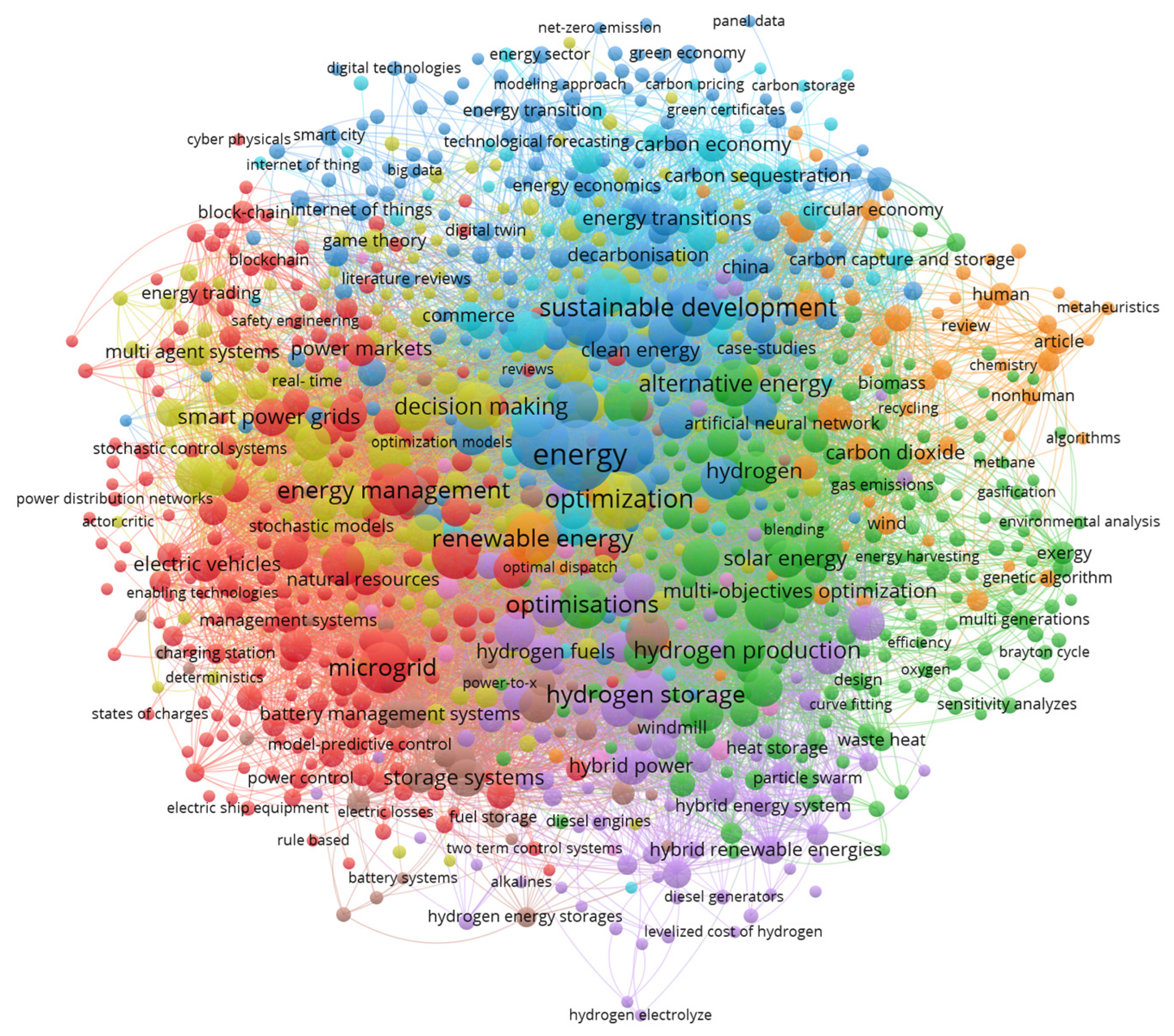
To examine the thematic structure of the research field, a bibliometric keyword co-occurrence analysis was performed. The Scopus database was searched using the terms “Green Hydrogen,” “Artificial Intelligence,” “Multi-Energy Systems,” and “Electrolyzer.” The search was limited to peer-reviewed journal articles published between 2016 and 2026. Within this time span, a total of 1964 articles were retrieved. The bibliographic records were exported from Scopus in CSV format and imported into VOS viewer for further analysis. In VOS viewer, the type of analysis was set to co-occurrence, and the unit of analysis was selected as index keywords. To ensure that only sufficiently recurrent and meaningful terms were included in the network, the minimum number of occurrences of a keyword was set to 5. The number of keywords to be selected was set to 1000. The resulting keyword co-occurrence network is presented in Figure 1. In this network, each node represents a keyword. The size of each node indicates the frequency of occurrence of that keyword, while the thickness of the links represents the strength of co-occurrence between keywords. The colors indicate clusters identified by the VOSviewer version 1.6.20. clustering algorithm. As shown in Figure 1, the network reveals several thematic groups within the literature. One cluster is associated with hydrogen production, electrolyzers, hydrogen storage, and techno-economic analysis. Another cluster is related to energy storage systems, microgrids, and energy management. A further group includes sustainability-oriented topics such as carbon emissions, life cycle assessment, and energy policy. Keywords related to AI, including ML and reinforcement learning, form an additional cluster connected to optimization and system operation themes. Overall, the structure of the network reflects the relationships among hydrogen production technologies, system integration, sustainability considerations, and data-driven optimization methods. Therefore, Figure 1 provides a bibliometric basis for organizing the subsequent sections of this review.
Despite the growing number of recent review papers on green hydrogen, the existing literature is still largely divided into separate areas. One group of studies focuses mainly on hydrogen production, storage, and conversion technologies, with limited discussion of how hydrogen interacts with other energy carriers in multi-energy systems. A second group examines integrated electricity, gas, and heat systems, but often treats hydrogen as one element within a broader system rather than analyzing its policy and market context in detail. A third group discusses AI and machine-learning applications for specific hydrogen-related tasks, such as catalyst discovery, electrolyzer control, or demand forecasting, but these studies rarely connect such methods to system-level coordination across energy sectors. As a result, there remains a need for a review that connects three related dimensions in a clear and systematic way: first, the hydrogen supply chain and its role in multi-energy architectures; second, policy frameworks and market deployment patterns; and third, AI applications across the hydrogen value chain, from forecasting to techno-economic assessment. This paper addresses that need by bringing these dimensions together in a single framework. In doing so, it provides a structured view of green hydrogen that is not limited to production technologies, individual AI applications, or sector-specific policy discussions.
The remainder of this paper is organized as follows:
Section 2 analyzes the structural, policy, and market dimensions of hydrogen-based integrated energy systems. It presents the hydrogen supply chain configuration, the architecture of an integrated electricity–gas–heat–hydrogen system, comparative policy instruments across major economies (European Union, United States, China, Japan, and India), key challenges associated with scaling hydrogen production, the current market structure, and selected large-scale projects in the United States. Section 3 focuses on the role of AI in green hydrogen systems. It categorizes AI applications across the hydrogen value chain, including renewable energy forecasting, electrolyzer design and operation, storage and distribution optimization, and system-level techno-economic assessment. A structured comparison of recent ML studies is also provided. Section 4 concludes the paper by synthesizing the main observations of the review and outlining directions for future research at the intersection of green hydrogen and data-driven approaches within multi-energy systems.

2. Structural, Technological, Policy, and Market Dimensions of Hydrogen-Based Integrated Energy Systems

2.1. Hydrogen Supply Chain and Multi-Energy System Architecture

The transition toward low-carbon energy systems has increased attention to hydrogen as an energy carrier capable of connecting different energy sectors [27]. Hydrogen is not a primary energy source; rather, it functions as a secondary carrier that can store, transport, and convert energy in various forms [28]. This characteristic enables its use across electricity, gas, heat, and transportation systems. The integration of renewable energy sources such as wind and solar introduces variability into power systems. Hydrogen production through electrolysis provides a means to convert electrical energy into a chemical form that can be stored and later utilized [29]. The stored hydrogen can be reconverted into electricity or heat, or supplied to end-use sectors such as industry and mobility. To clarify the structural role of hydrogen within the energy system, it is necessary to first describe the general configuration of the hydrogen supply chain. This provides a conceptual basis before examining its integration into a multi-energy system framework.
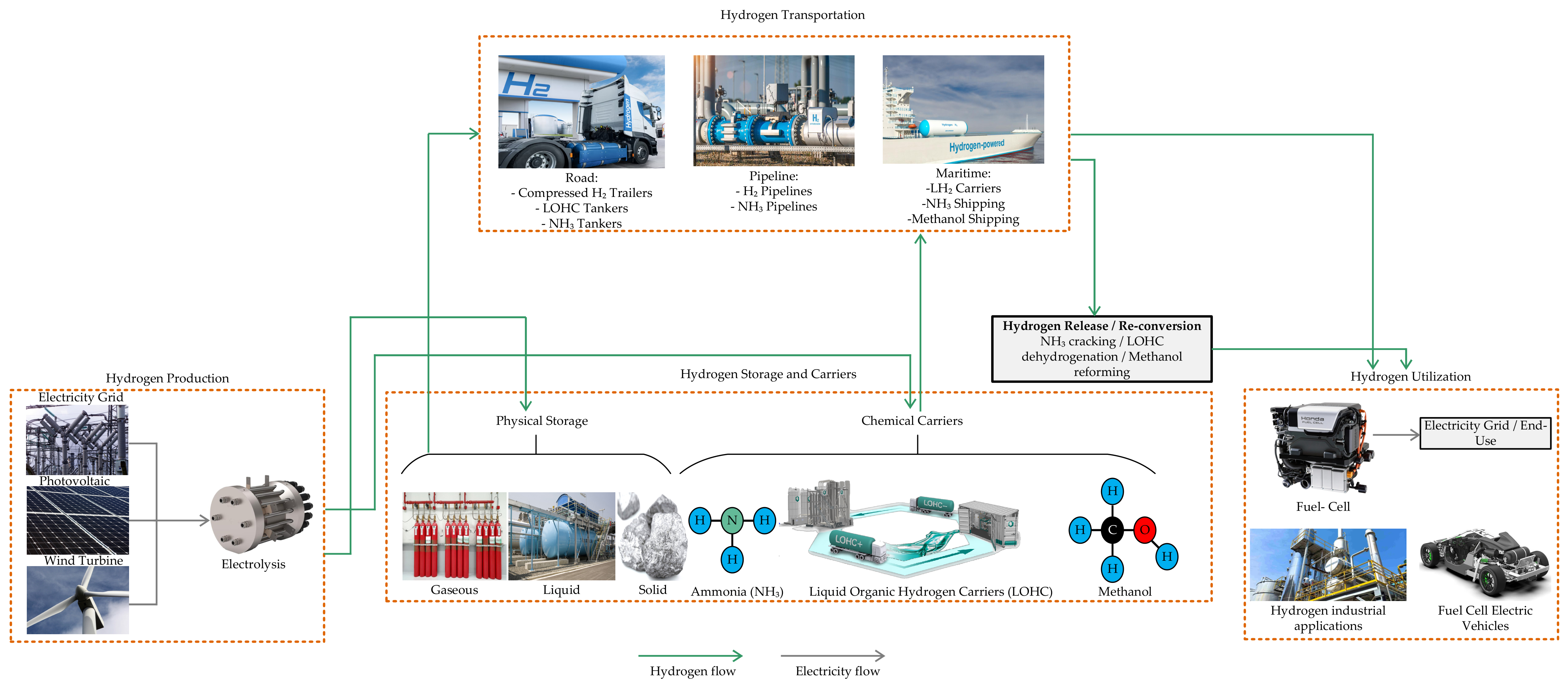
Figure 2 illustrates the main stages of the hydrogen supply chain, including hydrogen production, storage, transportation, re-conversion, and utilization [30]. The figure considers both direct hydrogen storage methods and chemical hydrogen carriers within hydrogen logistics systems. In the production stage, hydrogen is generated through electrolysis using electricity supplied from the grid and renewable energy sources such as photovoltaic systems and wind turbines. After production, hydrogen can be handled through two different pathways: physical storage and chemical carrier-based storage. The physical storage section includes gaseous, liquid, and solid hydrogen storage approaches. These methods represent the primary forms of direct hydrogen storage currently used in hydrogen energy systems. The figure also includes chemical hydrogen carriers, namely ammonia (NH3), liquid organic hydrogen carriers (LOHCs), and methanol [31]. These carriers are commonly considered for hydrogen transportation and long-distance energy delivery due to their storage and transport characteristics. The transportation section includes road, pipeline, and maritime transport options. Depending on the storage medium and hydrogen form, different transportation approaches can be used, including compressed hydrogen trailers, hydrogen and ammonia pipelines, LOHC tankers, and maritime transport of LH2, ammonia, and methanol. For chemical carrier-based pathways, hydrogen release or re-conversion processes are required before utilization. These processes include ammonia cracking, LOHC dehydrogenation, and methanol reforming. Finally, hydrogen can be utilized in several applications such as fuel cells, industrial systems, power supply, and fuel cell electric vehicles [32]. It can also be delivered to end users or connected to the electricity grid. This figure provides a conceptual overview of hydrogen as an energy carrier. It illustrates the main stages of the hydrogen chain but does not represent detailed energy interactions or system-level integration among multiple energy vectors.
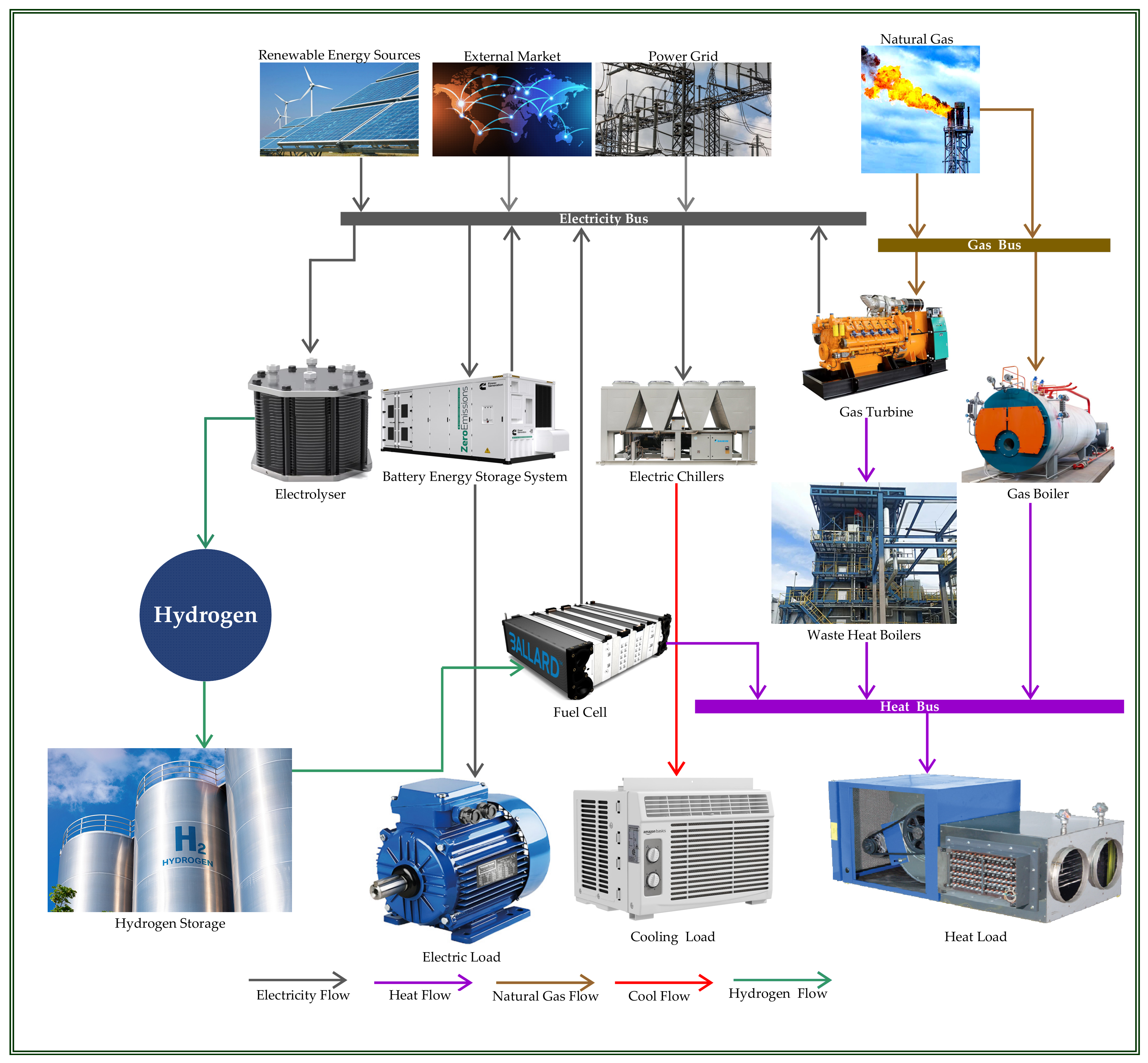
Figure 3 shows the configuration of the proposed integrated multi-energy system. In contrast to Figure 2, this structure includes the interaction of multiple energy carriers: electricity, natural gas, hydrogen, heat, and cooling. The system is organized around four energy buses:
  • Electricity bus;
  • Gas bus;
  • Hydrogen bus;
  • Heat bus.
Electrical energy can be supplied to electric loads, stored in Battery Energy Storage Systems (BESSs), or used by the electrolyzer to produce hydrogen, mainly when surplus renewable electricity is available. The produced hydrogen is delivered to the hydrogen bus and can be stored in the hydrogen storage system for later use. When required, particularly during periods of electricity shortage, high electricity prices, or islanded operation, stored hydrogen can be supplied to the fuel cell to generate electricity and recoverable heat.
The electrical output is connected to the electricity bus, while the recovered heat is delivered to the heat bus. Natural gas is supplied through the gas bus to the gas turbine and the gas boiler [33]. The gas turbine produces electricity and exhaust heat. The thermal energy is recovered through a waste heat boiler and transferred to the heat bus. The gas boiler also supplies thermal energy to the heat bus. The heat bus then meets the heating demand. Cooling demand is satisfied by electric chillers connected to the electricity bus.
The integrated architectures presented in Figure 2 and Figure 3 should be viewed not only as physical links between different energy carriers, but also as frameworks that involve several operational decisions and trade-offs. In Figure 2, hydrogen can help absorb surplus renewable electricity through electrolysis, store energy for longer periods, and supply different end-use sectors through direct use, transport, storage, or reconversion. However, these benefits are accompanied by conversion losses, infrastructure needs, and storage limitations. Therefore, the practical value of hydrogen integration depends on how the electrolyzer is scheduled, how much hydrogen storage is available, and whether the stored hydrogen is used directly in end-use sectors or converted back into electricity when required. In the multi-energy architecture shown in Figure 3, the electrolyzer can operate as a flexible electrical load. This allows the system to reduce renewable energy curtailment and transfer part of the surplus electricity to the hydrogen network. However, electrolyzer operation needs to be coordinated with electricity prices, renewable generation, hydrogen demand, and storage capacity. Hydrogen storage size is also an important planning factor. If the storage capacity is too small, electrolyzer operation may be limited and the system may lose part of its ability to use surplus renewable energy. If the storage capacity is too large, the investment cost may increase while part of the storage remains unused. For this reason, the fuel cell should be operated selectively, such as during electricity shortages, high electricity price periods, islanded operation, or when recovered heat can be used locally. If the fuel cell is operated continuously or without proper coordination, hydrogen reserves may be depleted quickly, reducing the system’s ability to respond to future operating needs. These interactions indicate that the main value of the integrated system is not only the presence of electricity, gas, heat, cooling, and hydrogen networks in one structure. Rather, its value depends on coordinated operation across these energy carriers. At the same time, such coordination creates coupling constraints between different parts of the system. The operation of one subsystem can affect the available operating range of another. For example, electrolyzer loading influences both the electricity balance and hydrogen availability. Fuel-cell dispatch affects hydrogen storage as well as electricity and heat supply. Electric chillers connect cooling demand to the electricity network, while gas turbines and boilers link natural gas consumption to electricity and heat production. As a result, the overall performance of the system depends on the joint management of conversion efficiencies, equipment capacities, storage levels, demand patterns, and carrier-specific constraints. This means that hydrogen can improve system flexibility only when these interactions are properly coordinated; otherwise, additional conversion stages may increase costs, losses, or operational limitations.

2.2. Technological Implementational Challenges in Integrated Hydrogen Energy Systems

The challenges associated with scaling hydrogen production have been comprehensively outlined by Montel Energy in their industry analysis titled “What Are the Challenges in Scaling Hydrogen Production?” [34]. The analysis identifies economic, technological, infrastructural, regulatory, and supply-chain barriers that currently constrain large-scale deployment, particularly of green hydrogen. To systematically synthesise these findings without altering their substantive content, Table 1 summarizes the key barriers and their specific dimensions as presented in the source. The table reorganises the discussion into thematic categories suitable for review literature while preserving the original analytical scope.
The practical deployment of green hydrogen still faces several economic and infrastructure-related barriers [35]. One important challenge is the high capital cost of electrolyzers, especially PEM and solid oxide technologies, which often depend on costly materials and components. This increases the investment cost of green hydrogen production and makes it less competitive than fossil-based routes such as steam methane reforming [35]. In addition, the variable output of renewable energy sources creates a need for reliable large-scale storage solutions to support more stable hydrogen production and manage supply–demand fluctuations. Infrastructure limitations also remain a key barrier, as the limited availability of dedicated hydrogen pipelines, storage facilities, and refueling stations makes it difficult to connect production sites with end-use sectors. Therefore, reducing electrolyzer costs, improving hydrogen storage systems, and coordinating investment in hydrogen transport infrastructure are necessary to support the wider integration of green hydrogen into future energy systems [35].

2.3. Policy, Regulatory, and Market Barriers for Hydrogen Sector Coupling

The implementation of green hydrogen in integrated energy systems depends not only on production targets, but also on how policy, regulation, infrastructure planning, and market design are coordinated across different energy sectors. Since hydrogen can link electricity, gas, heat, transport, and industrial demand, policy measures should support both hydrogen production and its practical use across sectors. In this regard, comparing policy frameworks helps identify regulatory and market barriers that may affect hydrogen-based sector coupling.
Table 2 provides a comparative analysis of hydrogen policy approaches adopted across major global markets, including the European Union, the United States, China, Japan, and India. The comparison is structured across six analytical dimensions: quantitative targets, supply-side policy instruments, infrastructure development, demand-side measures, certification frameworks, and research and development initiatives.
The table is adapted and synthesized from data published by the International Energy Agency (IEA) under the Creative Commons Attribution 4.0 International (CC BY 4.0) license. The structure, wording, and categorization have been modified for analytical clarity and academic presentation.
Table 2 indicates that green hydrogen policies in the selected economies differ not only in their numerical targets, but also in how they combine production incentives, infrastructure support, demand-side measures, certification, and research funding. These differences can influence both the speed of market development and the level of investment risk. The European Union presents a relatively comprehensive policy framework by combining a 2030 renewable hydrogen target with financing mechanisms, infrastructure regulation, demand-side measures, and delegated acts for renewable and low-carbon hydrogen. This combination can help connect production targets with demand signals and certification requirements, while also increasing confidence in cross-border hydrogen trade. In the United States, there is no single national volume target, but this is partly balanced by production tax credits, refuelling infrastructure support, loan guarantees, and the Clean Hydrogen Production Standard. This approach can encourage private investment and support early projects. However, market growth may still depend on the consistent implementation of incentives, infrastructure plans, and demand-side measures across different sectors. China and India follow a more production- and infrastructure-focused approach, with production targets, financial incentives, hydrogen pipelines or valley clusters, and national standards. These measures can reduce early investment barriers and support domestic industrial development. However, deployment risks may remain if demand creation, certification systems, and offtake mechanisms do not develop at the same pace as production capacity. Japan has a more demand-oriented policy profile, with a hydrogen consumption target, contract-for-difference support, hydrogen hubs, fuel-cell vehicle subsidies, and the Hydrogen Society Promotion Act. This approach can reduce market uncertainty by supporting end-use demand and helping to close the cost gap. However, its effectiveness also depends on import infrastructure, storage capacity, and stable long-term supply arrangements. Overall, the comparison suggests that green hydrogen deployment is more likely to move forward when production incentives are supported by credible certification, dedicated infrastructure investment, and stable demand-side policies. When one of these elements is weak, the market may face higher risks, such as underused infrastructure, delayed private investment, uncertain offtake, or limited confidence in the environmental value of hydrogen products.
Despite the increasing number of national and regional hydrogen strategies, the policy framework for green hydrogen remains uneven and only partly coordinated. This situation creates uncertainty for investors and can slow the development of stable hydrogen markets. From the perspective of integrated energy systems, the main regulatory gaps include the lack of widely accepted definitions and certification procedures for green hydrogen, limited policy continuity beyond pilot and demonstration projects, weak demand-creation mechanisms in hard-to-abate sectors such as steel, chemicals, and aviation, and unclear rules for hydrogen blending, transportation, and storage. These gaps make it more difficult to align hydrogen deployment with electricity market operation, gas network planning, industrial demand growth, and long-term infrastructure investment [37].
However, from the viewpoint of integrated energy system implementation, several policy and market barriers remain. Many existing policy instruments still focus on hydrogen production capacity or specific end-use sectors, while fewer measures directly address the coordination of electricity, hydrogen, gas, and heat systems. For example, flexible electrolyzer operation requires electricity market rules that allow participation in demand response, ancillary services, and the use of surplus renewable electricity. Hydrogen blending and dedicated hydrogen pipelines also require consistent gas-quality standards, safety rules, certification procedures, and clear arrangements for infrastructure ownership and cost recovery. Similarly, industrial and transport applications need long-term offtake mechanisms, carbon pricing, and demand-side measures to reduce investment uncertainty. Therefore, future policy design should move beyond production-focused support and provide more coordinated regulatory frameworks for hydrogen-based sector coupling.

2.4. Future Sectoral Interactions of Hydrogen in Integrated Energy Systems

Hydrogen is increasingly considered as a connecting energy carrier in integrated energy systems, rather than only as a separate fuel or storage option [38]. Its main value in this context comes from its ability to link energy production, storage, transportation, and final use within a coordinated system [38]. This role becomes particularly important when different energy sectors, such as electricity, gas, heat, industry, and transport, need to operate in a more connected way. From this perspective, hydrogen can support renewable energy integration, provide long-duration storage, and help reduce emissions in sectors where direct electrification may be difficult or costly [38]. One of the main future interactions of hydrogen is with the electricity sector. Renewable-based electrolysis allows for surplus electricity from wind, solar, or hydropower to be converted into hydrogen. This pathway can reduce renewable curtailment and provide a form of chemical storage for periods when electricity generation is low or demand is high. In an integrated energy system, electrolyzers can also operate as flexible electrical loads. Their operation can be adjusted according to renewable generation, electricity prices, and system needs. Therefore, hydrogen production is not only a supply process, but also a means of improving flexibility in the electricity network. Different electrolysis technologies may serve different roles: alkaline electrolysis is more suitable for mature and large-scale production, PEM electrolysis can respond more quickly to variable renewable power, and solid oxide electrolysis can benefit from high-temperature heat when such heat is available in industrial or thermal systems. According to the reference report [39], PEM and AEM electrolysis show high compatibility with renewable energy sources. Hydrogen storage also has an important role in future sectoral integration. Stored hydrogen can shift energy from periods of high renewable generation to periods of high demand or limited supply. This can support both short-term balancing and longer-term energy management. For example, hydrogen produced from excess renewable electricity can be stored and later converted back into electricity through fuel cells when needed. It may also be used directly in industrial heating, mobility applications, or other end-use sectors. In this way, hydrogen storage helps connect electricity, heat, transport, and industrial demand. The choice of storage method depends on system scale, storage duration, safety requirements, cost, and the distance between production and consumption points. Compressed hydrogen, liquid hydrogen, underground storage, metal hydrides, and chemical carriers each have different advantages and limitations, and their suitability depends on the specific role expected from hydrogen within the integrated system. The future role of hydrogen in integrated energy systems depends not only on technological progress and supportive policy frameworks, but also on the availability of suitable transportation routes and infrastructure that can connect production sites with end-use sectors [40]. Hydrogen production may take place near renewable resources or industrial hubs, while demand may be located in cities, transport corridors, heating systems, or industrial clusters. Therefore, suitable transportation pathways are needed to connect production sites with end users. Pipelines, tube trailers, liquid hydrogen transport, ammonia, and liquid organic hydrogen carriers are among the main options discussed for this purpose. Hydrogen blending in natural gas networks may provide a near-term route for using part of the existing gas infrastructure, while dedicated hydrogen pipelines or retrofitted gas pipelines may be needed for larger-scale deployment. However, these options also raise practical challenges, including leakage control, material compatibility, compressor and valve limitations, safety requirements, and clear standards for blending limits and pipeline certification. From a system perspective, hydrogen can also support stronger links between the gas, heat, transport, and industrial sectors. In the gas sector, hydrogen may be blended with natural gas or transported through dedicated networks, depending on infrastructure readiness and regulatory limits.

2.5. Green Hydrogen Cost, Market Structure, and Deployment Trends

2.5.1. Production Pathways and Cost Ranges

The main hydrogen production pathways and their associated cost ranges, as reported in the referenced source, are summarized in Table 3. The table presents the production method, cost range, and description strictly based on the provided source text.
In 2024, incremental cost reductions were observed, particularly in green hydrogen, due to advancements in electrolysis technology and increased renewable energy capacity. However, further cost declines remain necessary for hydrogen to become a mainstream energy solution.

2.5.2. Market Structure and Regional Distribution of the Green Hydrogen Sector (2026)

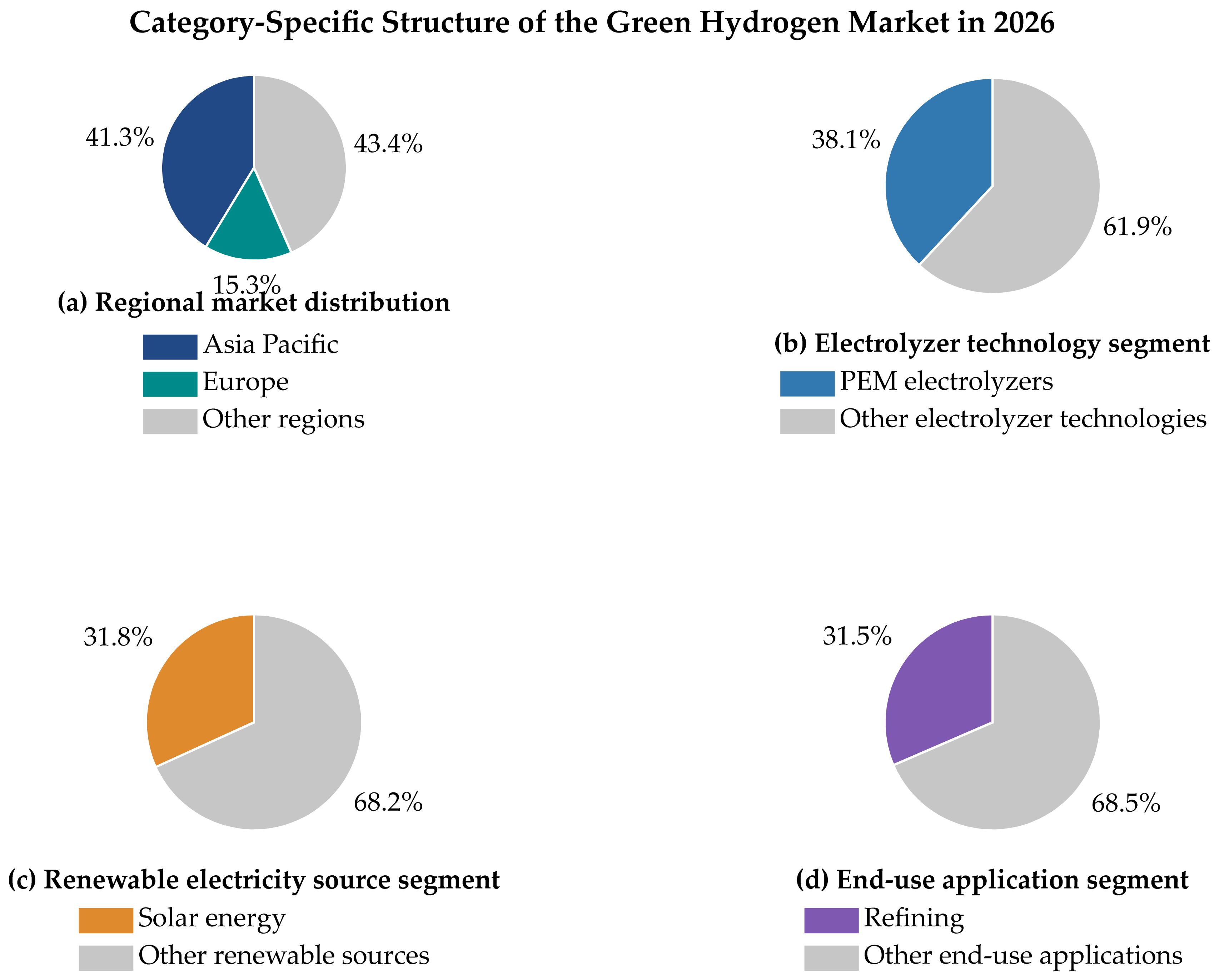
The green hydrogen market can be interpreted through multiple independent distribution dimensions, including regional allocation, electrolyzer technology composition, renewable electricity source, and end-use application sectors. Figure 4 presents a category-specific overview of the green hydrogen market structure in 2026. To avoid mixing different market dimensions, the figure separates the information into four independent panels. Figure 4a shows the regional market distribution, where Asia Pacific accounts for the largest share, followed by Europe and other regions. Figure 4b illustrates the electrolyzer technology segment and highlights the share of PEM electrolyzers relative to other electrolyzer technologies. Figure 4c focuses on the renewable electricity source used for green hydrogen production, with solar energy shown as a distinct contributor within this category. Finally, Figure 4d presents the end-use application segment, where refining is reported as one of the main hydrogen utilization sectors.
It should be noted that the percentages in Figure 4 are category-specific. Therefore, the values are not intended to be added across panels. Each panel represents a separate market dimension and sums to 100% only within its own category. This structure provides a clearer interpretation of the market data and prevents the regional, technological, energy-source, and end-use indicators from being treated as components of a single cumulative total.
The distribution shown in Figure 4 indicates that the green hydrogen market is developing differently across regions, technologies, renewable electricity sources, and end-use sectors. From the perspective of integrated energy systems, this means that green hydrogen deployment should not be viewed only as a production-side issue. Regional differences in market share show the role of policy support, infrastructure readiness, and investment capacity. The share of PEM electrolyzers also points to the importance of technology selection for system flexibility and operational response. In addition, the contributions of solar-based production and refining applications suggest that near-term green hydrogen integration is still closely linked to specific renewable resources and industrial demand sectors. Therefore, future energy system planning should consider regional conditions, electrolyzer technology options, renewable electricity availability, and end-use requirements together, rather than treating green hydrogen as a uniform market segment.

2.5.3. Planned Large-Scale Green Hydrogen Projects in the United States (2026–2030)

The rapid expansion of green hydrogen infrastructure in the United States reflects a broader strategic shift toward decarbonizing transport, industrial production, and energy-intensive sectors. A number of large-scale projects are scheduled to become operational between 2026 and 2030, demonstrating significant variation in technology configuration, installed capacity, renewable energy integration, and end-use applications [43]. These developments indicate a transition from pilot-scale initiatives toward industrial and utility-scale hydrogen production systems.
Table 4 presents a comparative synthesis of selected planned green hydrogen projects, highlighting their location, technological approach, production capacity, primary energy source, target sector, and planned year of operation.

3. AI Role in Green Hydrogen

The integration of AI into green hydrogen systems has emerged as a response to the increasing technical complexity, variability of renewable energy inputs, and the need for cost reduction across the hydrogen value chain [44]. Green hydrogen production involves interconnected subsystems, renewable power generation, electrochemical conversion, storage, distribution, and economic planning, each characterized by high-dimensional data, nonlinear dynamics, and operational uncertainty. AI-based methods provide data-driven modeling, prediction, optimization, and control capabilities that complement conventional physics-based approaches [45]. As a result, AI supports improved system coordination, operational efficiency, reliability, and informed decision-making at both technical and strategic levels.
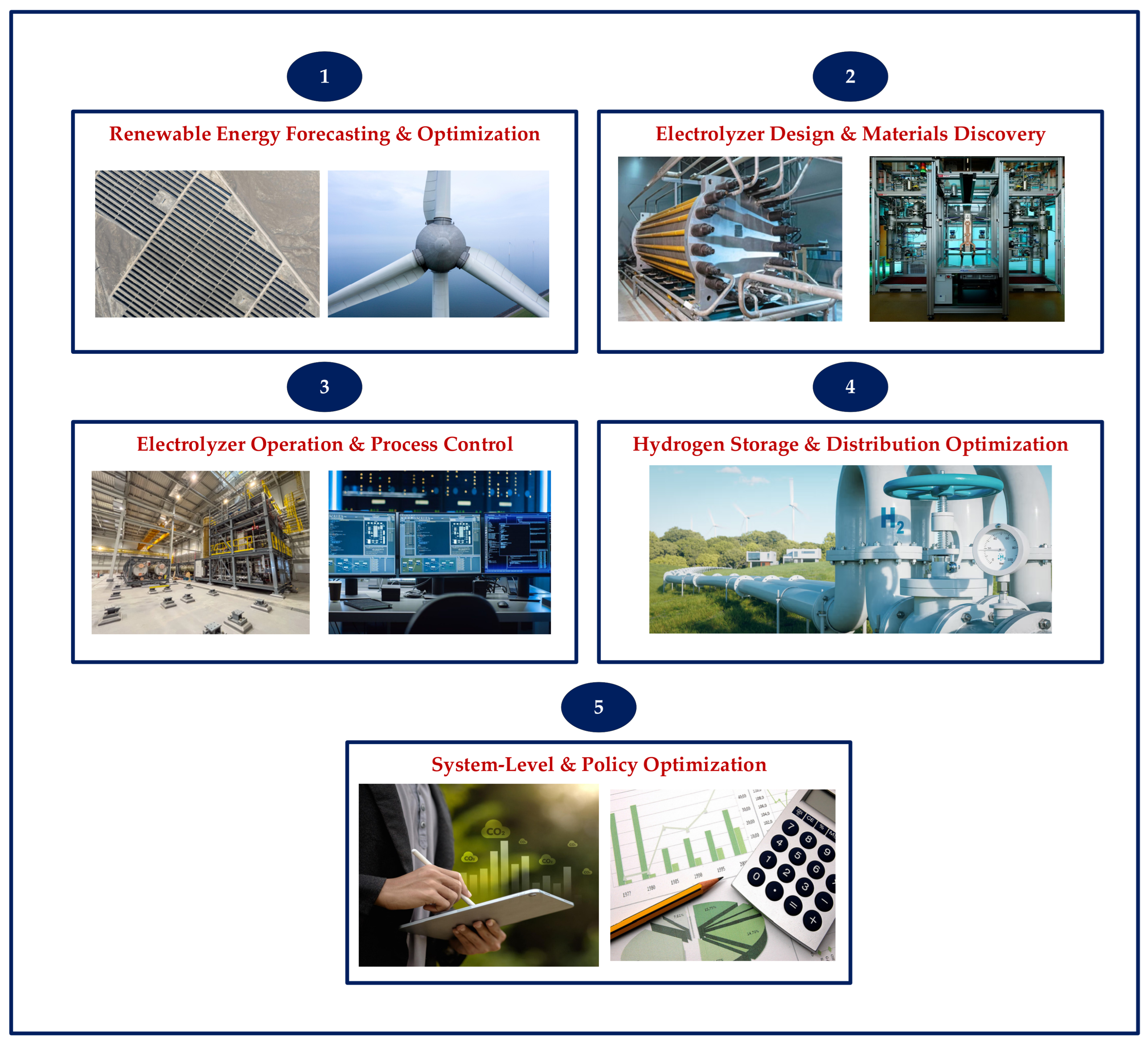
As shown in Figure 5, the role of AI in green hydrogen production is structured into five interconnected layers across the value chain. The framework covers stages from renewable energy input to system-level and policy optimization, illustrating how AI supports technical performance, operational stability, and economic planning.
  • Section (1) represents Renewable Energy Forecasting and Optimization. At this stage, ML models are used to predict solar and wind power generation and to manage variability [46,47]. Accurate forecasting enables improved scheduling of electrolyzers and better alignment between electricity availability and hydrogen production.
  • Section (2) focuses on Electrolyzer Design and Materials Discovery. AI methods assist in identifying suitable catalyst materials, optimizing membrane properties, and developing digital simulation models. These applications contribute to improved efficiency, reduced material costs, and shorter development cycles.
  • Section (3) addresses Electrolyzer Operation and Process Control. In this layer, AI-based control systems regulate operational parameters such as voltage, temperature, and pressure [48]. Predictive maintenance and anomaly detection techniques are applied to reduce unplanned downtime and maintain stable performance under fluctuating energy inputs.
  • Section (4) covers Hydrogen Storage and Distribution Optimization. AI models are used for monitoring storage conditions, detecting potential faults, optimizing transport routes, and forecasting demand [49,50]. These functions support safer operation and improved supply chain coordination.
  • Section (5) presents System-Level and Policy Optimization. At this level, AI supports techno-economic analysis, carbon footprint assessment, and scenario modeling. These tools assist in evaluating investment strategies, estimating production costs, and analyzing the impact of regulatory measures.
Table 5 presents a structured comparative summary of recent studies that apply ML and AI techniques in green hydrogen production systems. It outlines the specific ML algorithms used in each study and highlights their main contributions, such as performance prediction, process optimization, catalyst design, techno-economic evaluation, energy management, and system-level optimization. Overall, the table demonstrates how different data-driven approaches are being utilized to enhance efficiency, reduce cost, and improve the sustainability of hydrogen production technologies.
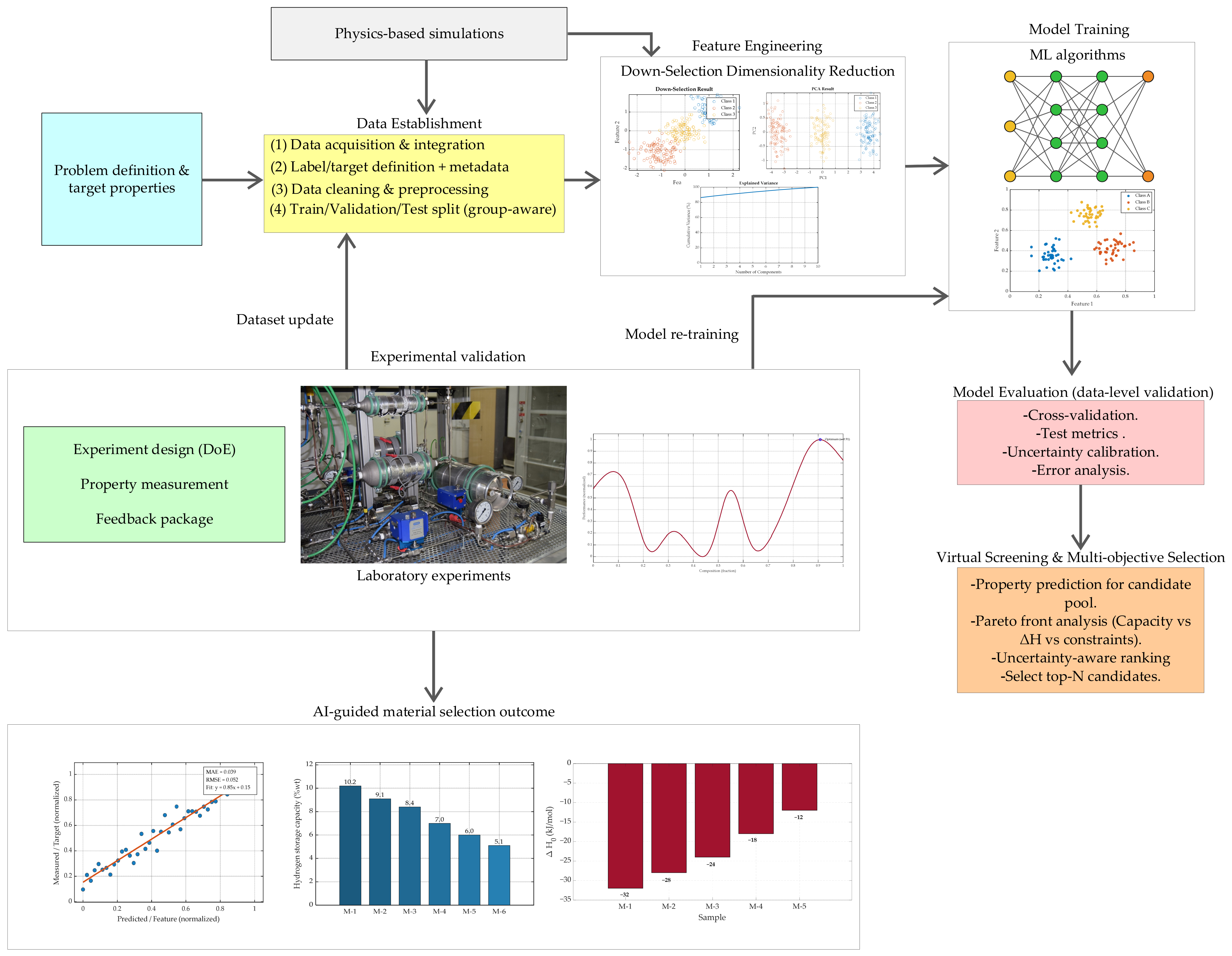
Figure 6 presents the AI-driven workflow used in this study for the evaluation and selection of materials in the hydrogen transition. The process starts with defining the target properties and design constraints, followed by data establishment, including data acquisition, metadata integration, cleaning, and group-aware splitting into training, validation, and test sets. Physics-based simulations are incorporated to support data generation and descriptor construction. The processed data are used in feature engineering and dimensionality reduction, after which ML models are trained and evaluated using cross-validation, test metrics, and uncertainty calibration. The validated models are then applied to virtual screening and multi-objective selection, where candidate materials are ranked based on predicted hydrogen storage capacity, ΔH, and related constraints. Selected candidates are experimentally validated, and the measured results are fed back into the dataset to enable model re-training in an iterative loop. It should be noted that the general structure of this figure was previously presented in [66,67], and in the present work it has been updated and adapted based on those references.
AI can help with prediction, optimization, monitoring, and control in green hydrogen systems, but its practical use still has some clear limitations [68,69]. One important issue is data availability and quality. Many AI models need large and reliable datasets, while data from hydrogen production, storage, transport, and end-use processes are often limited, incomplete, or collected under different conditions. This can reduce the accuracy of the models and make their predictions less reliable, especially when the operating conditions change. Another limitation is the complexity of green hydrogen systems. Processes such as electrolysis, hydrogen storage, fuel-cell operation, and renewable-based hydrogen production depend on many technical and environmental factors, including renewable power fluctuations, temperature, pressure, material properties, and load variations. It is difficult for purely data-driven models to represent all these interactions accurately, particularly in new or unseen situations. In addition, some AI methods, especially deep learning models, are difficult to interpret. This can make it harder for system operators and decision-makers to understand why a model gives a certain result. The use of AI also raises practical concerns related to integration with existing control systems, cybersecurity, data privacy, and the need to show clear operational or economic benefits. Therefore, the wider use of AI in green hydrogen systems requires better datasets, more transparent models, validation under real operating conditions, and closer integration of data-driven methods with physical and engineering knowledge.
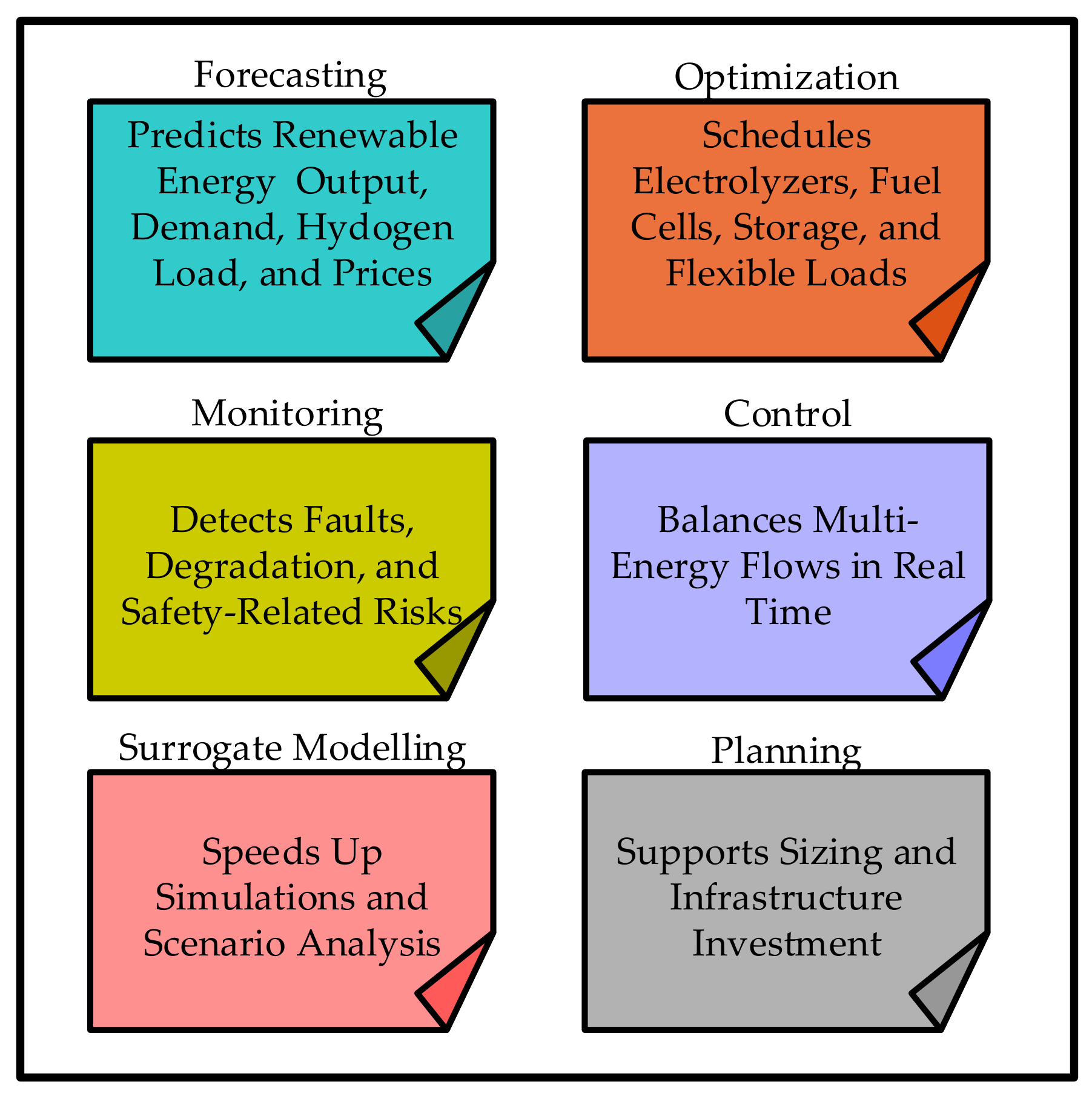
Figure 7 summarizes the main functional categories through which AI can support hydrogen-enabled integrated energy systems. As shown in the figure, forecasting methods contribute by predicting renewable energy output, demand, hydrogen load, and price variations, which are important inputs for operational scheduling. Optimization techniques support the coordinated dispatch of electrolyzers, fuel cells, storage units, and flexible loads, while monitoring methods help detect faults, degradation patterns, and safety-related risks in hydrogen-related components. Control applications are mainly associated with real-time balancing of multi-energy flows across coupled electricity, hydrogen, heat, and other energy vectors. In addition, surrogate modelling can reduce the computational burden of complex simulations and scenario-based studies, whereas planning tools support sizing decisions and infrastructure investment. Therefore, AI applications can contribute to hydrogen-enabled integrated energy systems not as a single solution, but through a set of complementary functions across prediction, operation, monitoring, control, modelling, and planning.

4. Conclusions

This review paper discussed the role of green hydrogen in integrated multi-energy systems by considering four main aspects: system structure, policy, market development, and AI. Instead of focusing only on hydrogen production technologies or single-sector applications, the review considered green hydrogen from a system-level perspective and explained how it can interact with electricity, gas, heat, and cooling networks. The structural part of the review explained the main stages of the hydrogen supply chain, including production, storage, transportation, and use. It also showed how hydrogen can act as a connecting energy carrier in a multi-bus integrated energy system. By comparing a standalone hydrogen supply chain with an integrated multi-energy configuration, the review highlighted the importance of interactions among different energy carriers and technologies, such as electrolyzers, fuel cells, gas turbines, boilers, and storage units. From the policy and market perspective, the review compared five major economies and showed that each follows a different approach. The European Union mainly relies on regulation and certification, the United States places strong emphasis on financial incentives, China follows a more state-supported industrial pathway, Japan focuses on demand creation, and India uses mission-based programs to support deployment. These different policy choices can affect how quickly hydrogen markets grow and how infrastructure investments are directed. In relation to AI, the review grouped AI applications into four parts of the hydrogen value chain: renewable energy forecasting, electrolyzer design and operation, storage and distribution planning, and system-level techno-economic assessment. The review of recent ML studies helped clarify the main methods used in the literature and the types of operational support they can provide. As a review paper, this study also has some clear limitations. It does not present quantitative benchmarking, meta-analysis, or numerical simulation of an integrated hydrogen energy system. The policy and market comparisons are based on publicly available reports, so they may not fully reflect all regional differences or later changes. Also, although the AI applications are categorized in a systematic way, this review does not test different ML models on a shared dataset or compare their performance directly. These points should be understood as the boundaries of the review, rather than weaknesses of the approach.

4.1. Limitations

Despite its comprehensive scope, this review has several limitations:
  • The bibliometric analysis was limited to Scopus-indexed journal publications and selected keywords, which may not capture all emerging research directions.
  • Market and cost data were derived from referenced industry and institutional sources and reflect reported ranges rather than independent recalculations.
  • The AI applications reviewed were primarily literature-based; quantitative benchmarking or meta-analysis of algorithmic performance was not conducted.
  • The integrated multi-energy configuration was presented conceptually rather than evaluated through numerical simulation.

4.2. Future Research Directions

Based on the findings, several research priorities emerge:
  • Development of unified modeling frameworks that integrate hydrogen system dynamics with electricity–gas–heat operational optimization.
  • Improved techno-economic and environmental co-optimization models incorporating uncertainty and risk-sensitive decision-making.
  • Standardized datasets and benchmarking protocols for AI-driven hydrogen system applications.
  • Integration of physics-informed ML to enhance interpretability and robustness.
  • Long-term assessment of hydrogen infrastructure scalability under resource and supply-chain constraints.
  • Expanded cross-country comparative policy modeling linking incentives, certification mechanisms, and investment risk.
In conclusion, green hydrogen represents not only a production technology but a system-level integration mechanism within future energy networks. Its successful deployment depends on coordinated advances in technology, infrastructure, policy design, and intelligent optimization. The convergence of integrated energy system modeling and AI-driven decision support will play a decisive role in shaping the next phase of hydrogen development.

Author Contributions

Conceptualization, H.N. and K.T.-T.; methodology, A.E.N. and A.C.; software, (not applicable); validation, H.N., K.T.-T., M.T.H. and P.P.; formal analysis, A.E.N. and A.C.; investigation, H.N., K.T.-T., M.T.H. and P.P.; writing—original draft preparation, H.N., K.T.-T., A.E.N. and A.C.; writing—review and editing, A.E.N., A.C., M.T.H. and P.P. All authors have read and agreed to the published version of the manuscript.

Funding

This research received no external funding. The APC was covered by discount vouchers.

Data Availability Statement

No new data were created or analyzed in this study. Data sharing is not applicable to this article.

Acknowledgments

The authors acknowledge the use of ChatGPT-5.5 (OpenAI) for language editing, grammatical correction, and improving the readability and fluency of the manuscript. The AI tool was not used to generate scientific content, develop the methodology, perform data analysis, interpret the results, or draw conclusions. The authors have carefully reviewed and edited the final manuscript and take full responsibility for its originality, validity, and integrity.

Conflicts of Interest

The authors declare no conflict of interest.

References

  1. Taghizad-Tavana, K.; Tarafdar-Hagh, M.; Nojavan, S.; Yasinzadeh, M.; Ghanbari-Ghalehjoughi, M. Operation of smart distribution networks by considering the spatial–temporal flexibility of data centers and battery energy storage systems. Sustain. Cities Soc. 2024, 114, 105746. [Google Scholar] [CrossRef]
  2. Angelico, R.; Giametta, F.; Bianchi, B.; Catalano, P. Green hydrogen for energy transition: A critical perspective. Energies 2025, 18, 404. [Google Scholar] [CrossRef]
  3. Franco, A. Green Hydrogen and the Energy Transition: Hopes, Challenges, and Realistic Opportunities. Hydrogen 2025, 6, 28. [Google Scholar] [CrossRef]
  4. Ullah, I.; Amin, M.; Zhao, P.; Qin, N.; Xu, A.-W. Recent advances in inorganic oxide semiconductor-based S-scheme heterojunctions for photocatalytic hydrogen evolution. Inorg. Chem. Front. 2025, 12, 1329–1348. [Google Scholar] [CrossRef]
  5. Jia, W.; Ding, T.; He, Y. Synergistic integration of green hydrogen in renewable power systems: A comprehensive review of key technologies, research landscape, and future perspectives. Renew. Sustain. Energy Rev. 2026, 226, 116375. [Google Scholar] [CrossRef]
  6. Danish, M.; Kanwal, S.; Perwez, U.; Iftikhar, S.H.; Ahmed, B.A.; Hakeem, A.S.; Askar, K. A comprehensive review of green hydrogen-based hybrid energy systems: Technologies, evaluation, and process safety. Energy Rev. 2025, 4, 100154. [Google Scholar] [CrossRef]
  7. Alexandros, A.; Fanourios, K.; Andreas, V.O.; Charalampos, K.; Georgios, Y.; Panos, P.; Aravind Purushothaman, V.; Soteris, K.; George, E.G. Green Hydrogen Energy Systems. In Chapter 10—Modeling and Control of Integrated Green Hydrogen Energy Systems; Elsevier: Amsterdam, The Netherlands, 2026; pp. 321–362. [Google Scholar]
  8. Kawrani, S.; Abi Almona, O.; Ibrahim, M.; Ibrahim, M.; Obeid, E. A comprehensive review of green hydrogen production via electrolysis and thermolysis, and the prediction of potential natural hydrogen (aka gold hydrogen) presence using machine learning. Renew. Sustain. Energy Rev. 2026, 230, 116685. [Google Scholar] [CrossRef]
  9. Mohsen, F.M.; Mjbel, H.M.; Challoob, A.F.; Alkhazaleh, R.; Alahmer, A. Advancements in green hydrogen production: A comprehensive review of prospects, challenges, and innovations in electrolyzer technologies. Fuel 2026, 404, 136251. [Google Scholar] [CrossRef]
  10. Kourougianni, F.; Arsalis, A.; Olympios, A.V.; Yiasoumas, G.; Konstantinou, C.; Papanastasiou, P.; Georghiou, G.E. A comprehensive review of green hydrogen energy systems. Renew. Energy 2024, 231, 120911. [Google Scholar] [CrossRef]
  11. Dong, H.; Deng, Q.; Li, C.; Liu, N.; Zhang, W.; Hu, M.; Xu, C. A comprehensive review on renewable power-to-green hydrogen-to-power systems: Green hydrogen production, transportation, storage, re-electrification and safety. Appl. Energy 2025, 390, 125821. [Google Scholar]
  12. Mansilha, C.; Barbosa-Póvoa, A.; Tarelho, L.; Fonseca, A. A comprehensive review of green hydrogen production technologies: Current status, challenges, research trends and future directions. Renew. Sustain. Energy Rev. 2026, 225, 116119. [Google Scholar] [CrossRef]
  13. Xavier, T.P.; Rathore, D.; Piraviperumal, M. A focused review on emerging trends in antimony chalcogenide based photocathodes for green hydrogen production. Sol. Energy 2026, 307, 114368. [Google Scholar] [CrossRef]
  14. Oussmou, B.; Sigue, S.; Abderafi, S. Review of green hydrogen production technologies, to choose the optimal process of electrolysis-renewable energy. Renew. Sustain. Energy Rev. 2026, 225, 116205. [Google Scholar] [CrossRef]
  15. Oni, B.A.; Sanni, S.E.; Misiani, A.N. Green hydrogen production in offshore environments: A comprehensive review, current challenges, economics and future-prospects. Int. J. Hydrogen Energy 2025, 125, 277–309. [Google Scholar] [CrossRef]
  16. Evro, S.; Tomomewo, O.S. Green hydrogen integration in distributed energy systems: A comprehensive techno-economic and policy analysis. Int. J. Hydrogen Energy 2025, 148, 149895. [Google Scholar] [CrossRef]
  17. Chavez, D.L.; Azzaro-Pantel, C.; Montignac, F.; Ruby, A. Integrating life cycle assessment in multi-objective optimization of green hydrogen systems: A review of literature and methodological challenges. Renew. Sustain. Energy Rev. 2025, 217, 115689. [Google Scholar] [CrossRef]
  18. Herdem, M.S.; Adams II, T.A. Green hydrogen production systems with insights from green Ammonia: A review and Data-Driven Techno-Economic and environmental Meta-Analysis. Energy Convers. Manag. 2026, 349, 120859. [Google Scholar] [CrossRef]
  19. Zighed, M.; Mekki, B.S.; Boutaghriout, B.; Ferkous, H.; Benguerba, Y. Algerian green hydrogen production: A review of potential, main challenges and valorization routes. Int. J. Hydrogen Energy 2026, 207, 153546. [Google Scholar] [CrossRef]
  20. Konovalov, D.; Adams, T.A., II. Hydrogen power development: A comparative review of national strategies and the role of energy in scaling green hydrogen. Renew. Sustain. Energy Rev. 2026, 226, 116378. [Google Scholar] [CrossRef]
  21. Aditiya, H.; Mahlia, T.; Huang, Z. Scaling green hydrogen: Production, storage, techno-economics and global perspectives. Renew. Sustain. Energy Rev. 2026, 226, 116444. [Google Scholar] [CrossRef]
  22. Mittal, P.; Gupta, P. The role of artificial intelligence in advancing green hydrogen technologies for smart cities. Int. J. Hydrogen Energy 2026, 235, 155191. [Google Scholar] [CrossRef]
  23. Taghizad-Tavana, K.; Ghanbari-Ghalehjoughi, M.; Safari, A.; Hagh, M.T.; Nezhad, A.E. From green hydrogen production to artificial intelligence–driven energy management in hydrogen fuel cell electric vehicles: A comprehensive review of technologies, optimization techniques, international standards, and investment programs. Appl. Energy 2025, 399, 126534. [Google Scholar] [CrossRef]
  24. Motiramani, M.; Solanki, P.; Patel, V.; Talreja, T.; Patel, N.; Chauhan, D.; Singh, A.K. AI-ML techniques for green hydrogen: A comprehensive review. Next Energy 2025, 8, 100252. [Google Scholar] [CrossRef]
  25. Raghuvanshi, S.; Singh, K.; Chaudhary, M.; Verma, P.; Singhal, S.; Ali, S.; Agarwal, H.; Chauhan, R.; Basniwal, R.K.; Joshi, N.C.; et al. Hydrogen revolution: Artificial intelligence and machine learning driven policies, feasibility, challenges and opportunities: Insights from Asian countries. Energy Strategy Rev. 2025, 61, 101838. [Google Scholar] [CrossRef]
  26. Safari, A.; Tavana, K.T.; Hagh, M.T.; Rahimi, A.; Nezhad, A.E. A surrogate framework for green Hydrogen plants using Conditional Wasserstein GANs with gradient penalty. Energy Convers. Manag. X 2026, 30, 101774. [Google Scholar] [CrossRef]
  27. Khan, B.; Faheem, M.B.; Peramaiah, K.; Cheng, Y.T.; Khan, B.; Qiao, Q.; Huang, K.W.; He, J.H. Photoelectrochemical CO2-to-Formic Acid Conversions: Advances in Photoelectrode Designs and Scale-Up Strategies. Adv. Energy Mater. 2026, 16, e04018. [Google Scholar] [CrossRef]
  28. Premakumara, A.; Kristombu Baduge, S.; Gunarathne, U.; Costa, S.; Thilakarathna, S.; Mendis, P.; Swanger, A.; Al Ghafri, S.; Notardonato, W.; Li, G. A Global Perspective on Decarbonising Economies Through Clean Hydrogen: Adaptation, Supply Chain, Utilisation, National Hydrogen Initiatives, and Challenges. Energies 2026, 19, 524. [Google Scholar] [CrossRef]
  29. Zhou, Z.-Y.; Sun, Y.-T.; Liu, Z.-B.; Wang, C.-Z.; Zhou, Y.-N.; Luo, X.; Zhou, T.-C.; Qiao, J.-L. Development Status and Existing Problems of Ion-Solvation Membranes for Electrolysis of Water. J. Electrochem. 2026, 32, 2515006. [Google Scholar] [CrossRef]
  30. Yang, J.; Lam, T.Y.; Luo, Z.; Cheng, Q.; Wang, G.; Yao, H. Renewable energy driven electrolysis of water for hydrogen production, storage, and transportation. Renew. Sustain. Energy Rev. 2025, 218, 115804. [Google Scholar] [CrossRef]
  31. Sarikhan Kheljani, H.; Aghakhanlou, P.; Sabahi, M.; Taghizad-Tavana, K.; Tarafdar-Hagh, M. Optimizing the smart cites: Energy management approaches, technologies, data analytic and security challenges. J. Energy Manag. Technol. 2024, 8, 321–339. [Google Scholar]
  32. Moholkar, V.S. Comparative life cycle analysis of hydrogen fuel cell electric vehicles and battery electric vehicles: An Indian perspective. Int. J. Hydrogen Energy 2025, 103, 729–739. [Google Scholar] [CrossRef]
  33. Taghizad-Tavana, K.; Ghanbari-Ghalehjoughi, M.; Niazi, H.; Hagh, M.T.; Nezhad, A.E. Robust operation of electricity–gas–heat energy hubs with behind-the-meter PV–battery and integrated demand response under uncertainty. Energy Convers. Manag. X 2025, 30, 101505. [Google Scholar] [CrossRef]
  34. Available online: https://montel.energy/resources/blog/what-are-the-challenges-in-scaling-hydrogen-production (accessed on 28 May 2026).
  35. Brahim, T.; Jemni, A. Green hydrogen production: A review of technologies, challenges, and hybrid system optimization. Renew. Sustain. Energy Rev. 2026, 225, 116194. [Google Scholar] [CrossRef]
  36. International Energy Agency. Global Hydrogen Review 2023; International Energy Agency: Paris, France, 2023.
  37. Israr, A.; Saadat, M.; Israr, A.; Rehman, A.; Junaid, M. Green hydrogen energy, current trends, challenges and future developments. Sustain. Energy Technol. Assess. 2026, 86, 104886. [Google Scholar] [CrossRef]
  38. Taghavi, A.; Niknam, T.; Shojaeiyan, S.; Rodriguez, J. The future of hydrogen as a strategic enabler in integrated energy systems: Technological developments, barriers, and policy implications. Energy Strategy Rev. 2026, 63, 101999. [Google Scholar] [CrossRef]
  39. Mamat, R.; Ghazali, M.F.; Basrawi, F.; Rosdi, S.M. Green hydrogen production and renewable energy storage integration: A review of technologies and system pathways. Energy Convers. Manag. X 2026, 30, 101904. [Google Scholar] [CrossRef]
  40. Wallington, T.J.; Woody, M.; Lewis, G.M.; Keoleian, G.A.; Adler, E.J.; Martins, J.R.R.A.; Collette, M.D. Hydrogen as a sustainable transportation fuel. Renew. Sustain. Energy Rev. 2025, 217, 115725. [Google Scholar] [CrossRef]
  41. Grogan, A. Hydrogen Production Cost Trends 2025. Available online: https://montel.energy/resources/blog/hydrogen-production-cost-trends-2025 (accessed on 28 May 2026).
  42. Coherent Market Insights. Green Hydrogen Market—Global Industry Analysis, Size, Share, Growth, Trends, and Forecast; Coherent Market Insights: Seattle, WA, USA, 2025. [Google Scholar]
  43. Available online: https://www.airswift.com/blog/green-hydrogen-projects-usa (accessed on 28 May 2026).
  44. Askr, H.; Basha, S.H.; Abdelnapi, N.M.; Elgeldawi, E.; Darwish, A.; Hassanien, A.E. Artificial intelligence for sustainable green hydrogen production: A systematic literature review. Renew. Sustain. Energy Rev. 2025, 224, 116071. [Google Scholar] [CrossRef]
  45. da Cunha, A.P. An integrated computational platform for AI-driven forecasting, dynamic simulation and techno-economic optimization of green hydrogen production in Brazil. Cad. Pedagógico 2026, 23, e22795. [Google Scholar] [CrossRef]
  46. Kumari, P.; Veluri, R.K.; Nirgude, M.A.; Pandit, P.; Sonawane, A.D.; Hariram, V.; Bangare, S.L.; Padma, S. Artificial Intelligence Techniques for Optimizing Solar and Wind Energy Production Based on Weather Patterns. J. Mines Met. Fuels 2026, 74, 39. [Google Scholar] [CrossRef]
  47. Li, M.; Wan, J.; Shi, J.; Yao, K.; Ren, G. A Wind Power Prediction Method Fusing Deep Learning with Rolling Adaptive Successive Variational Mode Decomposition. Renew. Energy 2026, 261, 125223. [Google Scholar] [CrossRef]
  48. Pandey, A.K.; Tiwari, P.; Nishad, D.K. Adaptive AI-based Voltage Regulation in DC Microgrids Using Novel Power Optimization with Learning for Load Operations Algorithm. Res. Sq. 2026. preprint. [Google Scholar] [CrossRef] [PubMed]
  49. Mediavilla, M.A.; Dietrich, F.; Palm, D. Review and analysis of artificial intelligence methods for demand forecasting in supply chain management. Procedia CIRP 2022, 107, 1126–1131. [Google Scholar] [CrossRef]
  50. Thakfan, A.; Bin Salamah, Y. Artificial-intelligence-based detection of defects and faults in photovoltaic systems: A survey. Energies 2024, 17, 4807. [Google Scholar] [CrossRef]
  51. Li, J.; Wu, N.; Zhang, J.; Wu, H.-H.; Pan, K.; Wang, Y.; Liu, G.; Liu, X.; Yao, Z.; Zhang, Q. Machine learning-assisted low-dimensional electrocatalysts design for hydrogen evolution reaction. Nano-Micro Lett. 2023, 15, 227. [Google Scholar] [CrossRef]
  52. Kabir, M.M.; Roy, S.K.; Alam, F.; Nam, S.Y.; Im, K.S.; Tijing, L.; Shon, H.K. Machine learning-based prediction and optimization of green hydrogen production technologies from water industries for a circular economy. Desalination 2023, 567, 116992. [Google Scholar] [CrossRef]
  53. Mashhadimoslem, H.; Khosrowshahi, M.S.; Delpisheh, M.; Convery, C.; Rezakazemi, M.; Aminabhavi, T.M.; Kamkar, M.; Elkamel, A. Green ammonia to Hydrogen: Reduction and oxidation catalytic processes. Chem. Eng. J. 2023, 474, 145661. [Google Scholar] [CrossRef]
  54. Aminaho, N.S.; Aminaho, E.N.; Aminaho, F. Review of machine learning application in porous transport layers for the design of fuel cells and electrolyzers. Next Res. 2025, 2, 100825. [Google Scholar] [CrossRef]
  55. Lim, J.Y.; Sarjuni, C.A.; Lim, B.H.; Chan, S.N.; Foo, D.C.; Loy, A.C.M.; Wong, W.Y.; Yoo, C. Prototyping with Generative AI Design to Debottleneck Conventional Design: Incorporation on Proton Exchange Membrane Electrolyzer. Sustain. Energy Technol. Assess. 2025, 82, 104502. [Google Scholar] [CrossRef]
  56. Maghfuri, A.; Kuku, M. Optimized hydrogen production through machine learning: Comparative analysis of electrolyzer technologies using hybrid renewable energy. Appl. Therm. Eng. 2025, 276, 126923. [Google Scholar] [CrossRef]
  57. Salari, A.; Shakibi, H.; Habibi, A.; Hakkaki-Fard, A. Optimization of a solar-based PEM methanol/water electrolyzer using machine learning and animal-inspired algorithms. Energy Convers. Manag. 2023, 283, 116876. [Google Scholar] [CrossRef]
  58. Erbay, C. Machine learning models for solar forecasting and impact on green hydrogen production costs. Int. J. Hydrogen Energy 2025, 132, 225–238. [Google Scholar] [CrossRef]
  59. Sareen, K.; Panigrahi, B.K.; Shikhola, T.; Sharma, R.; Tripathi, R.N. A noise resilient multi-step ahead deep learning forecasting technique for solar energy centered generation of green hydrogen. Int. J. Hydrogen Energy 2024, 90, 666–679. [Google Scholar] [CrossRef]
  60. Yang, D.; Shim, J.; Lee, J.; Choi, S. Optimal Management of Green Hydrogen Production in Renewable Energy System Using Deep Reinforcement Learning Methods. Sustain. Energy Grids Netw. 2026, 45, 102075. [Google Scholar] [CrossRef]
  61. Urhan, B.B.; Erdoğmuş, A.; Dokuz, A.Ş.; Gökçek, M. Predicting green hydrogen production using electrolyzers driven by photovoltaic panels and wind turbines based on machine learning techniques: A pathway to on-site hydrogen refuelling stations. Int. J. Hydrogen Energy 2025, 101, 1421–1438. [Google Scholar] [CrossRef]
  62. Mehrenjani, J.R.; Gharehghani, A. A machine learning-optimized multi-generation system for sustainable electricity, water, hydrogen, and CO2 utilization. Int. J. Hydrogen Energy 2025, 170, 151264. [Google Scholar] [CrossRef]
  63. Mojtahed, A.; Basso, G.L.; Pastore, L.M.; Sgaramella, A.; De Santoli, L. Application of machine learning to model waste energy recovery for green hydrogen production: A techno-economic analysis. Energy 2025, 315, 134337. [Google Scholar] [CrossRef]
  64. Mahanta, B.K.; Kumar, S.; Pathak, S.K.; Singh, S.K. Machine learning-based prediction of high-entropy alloys for hydrogen storage with optimized thermodynamic and kinetic parameters. J. Energy Storage 2025, 139, 118865. [Google Scholar] [CrossRef]
  65. Starreveld, J.; Frowijn, L.; Travaglini, R.; van’t Veer, R.; Bianchini, A.; Bruninx, K.; den Hertog, D.; Lukszo, Z. Assessing green hydrogen production via offshore wind in the Dutch North Sea: Complementing techno-economic simulation with machine learning and optimization. Int. J. Hydrogen Energy 2026, 224, 154324. [Google Scholar] [CrossRef]
  66. Arsad, A.; Hannan, M.; Ong, H.; Ker, P.J.; Wong, R.T.; Begum, R.; Jang, G.; Mahlia, T.I. Artificial intelligence in hydrogen energy transitions: A comprehensive survey and future directions. Renew. Sustain. Energy Rev. 2025, 224, 116121. [Google Scholar] [CrossRef]
  67. Quintanilla, P.; Elhalwagy, A.; Duan, L.; Soltani, S.M.; Lai, C.S.; Foroudi, P.; Huda, M.N.; Nandy, M. Artificial intelligence and robotics in the hydrogen lifecycle: A systematic review. Int. J. Hydrogen Energy 2025, 113, 801–817. [Google Scholar] [CrossRef]
  68. Manoj, V.; Sasidhar, R.; Swathi, A.; Maram, B.; Kumar, N.R.; Pradeep, N. Green Hydrogen Generation Using AI-Based Predictive Control of Electrolyzers. In Proceedings of the 2025 IEEE 3rd International Symposium on Sustainable Energy, Signal Processing and Cybersecurity; IEEE: New York, NY, USA, 2025; pp. 1–6. [Google Scholar]
  69. Bhuiyan, S.M.Y.; Chowdhury, A.; Hossain, M.S.; Mobin, S.M.; Parvez, I. Ai-driven optimization in renewable hydrogen production: A review. Am. J. Interdiscip. Stud. 2025, 6, 76–94. [Google Scholar] [CrossRef]
Figure 1. Keyword co-occurrence network based on Scopus-indexed publications analyzed using VOS viewer.
Fuels 07 00037 g001
Figure 2. Main stages of hydrogen production, storage, transportation, re-conversion, and utilization pathways in hydrogen energy systems.
Fuels 07 00037 g002
Figure 3. Configuration of the Integrated Multi-Energy System.
Fuels 07 00037 g003
Figure 4. Category-specific structure of the green hydrogen market in 2026: (a) regional market distribution, (b) electrolyzer technology segment, (c) renewable electricity source segment, and (d) end-use application segment. Each panel represents an independent market category and sums to 100% within its own category; therefore, the reported percentages should not be interpreted as additive components of a single overall market total [42]. Data presented here are time-sensitive, subject to source uncertainty, and may not be directly comparable across reports.
Fuels 07 00037 g004
Figure 5. AI applications across the green hydrogen value chain.
Fuels 07 00037 g005
Figure 6. The overall closed-loop workflow structure is adapted from References [66,67], with novel contributions including physics-based descriptor generation, group-aware splitting, uncertainty calibration, and multi-objective virtual screening specific to hydrogen storage materials.
Fuels 07 00037 g006
Figure 7. Functional categories of AI applications in hydrogen-enabled integrated energy systems.
Fuels 07 00037 g007
Table 1. Key Challenges in Scaling Hydrogen Production [34].
Challenge CategorySpecific Issues IdentifiedImplications for Scaling
High Production Costs and Limited Commercial Viability
  • High capital cost of electrolysers
  • High cost of renewable electricity
  • Electrolysis efficiency limited to ~60–70%
  • Green hydrogen more expensive than fossil fuels on a per-kWh basis
  • Long payback periods and weak demand signals
Limits competitiveness against fossil fuels; increases investor risk and slows private-sector participation
Infrastructure and Storage Limitations
  • Lack of dedicated hydrogen pipelines
  • Limited refuelling stations and storage terminals
  • Fragmented supply chains
  • Storage requires high pressure (350–700 bar), liquefaction at −253 °C, or chemical carriers
  • Leakage risks and metal embrittlement
Requires large upfront capital investment and long-term coordination between public and private sectors
Technological and Efficiency Bottlenecks
  • Electrolysis efficiency below optimal levels
  • Scalability and durability challenges in PEM and alkaline electrolysers
  • Innovation gaps in reforming and storage technologies
  • Need for advances in materials science, system integration, and modular designs
  • Historically lower R&D funding compared to other clean technologies
Slows cost reductions and large-scale deployment; necessitates sustained innovation investment
Regulatory and Policy Uncertainty
  • Fragmented national hydrogen policies
  • Limited binding targets and financial incentives
  • Lack of standardised certification frameworks
  • Permitting delays and non-harmonised safety codes
  • Uneven regional government support
Creates market uncertainty; discourages investment and cross-border trade
Supply Chain and Resource Constraints
  • Dependence on scarce metals (e.g., platinum, iridium)
  • Geopolitical and supply volatility risks
  • Limited manufacturing capacity for electrolysers and storage equipment
  • Shortage of skilled labour
  • Competition for resources with other clean technologies
Constrains manufacturing scale-up and increases vulnerability to market disruptions
Table 2. Comparative hydrogen policy instruments across selected economies [36]. Data presented here are time-sensitive, subject to source uncertainty, and may not be directly comparable across reports.
CountryQuantitative TargetsSupply-Side InstrumentsInfrastructure DevelopmentDe2mand-Side PoliciesCertification FrameworkResearch and Development
European UnionThe target is to produce 10 million tonnes of renewable hydrogen by 2030.European Hydrogen Bank; Important Projects of Common European Interest; Innovation FundAlternative Fuels Infrastructure Regulation; Connecting Europe FacilityRenewable Energy Directive; Sustainable aviation and maritime fuel regulations; Clean Industrial State Aid FrameworkDelegated Acts defining renewable and low-carbon hydrogenClean Hydrogen Partnership
United StatesNo unified national volume target; strong production incentivesInflation Reduction Act production tax credits for clean hydrogenSupport for hydrogen refuelling station deploymentLoan guarantees; tax credits; zero-emission vehicle mandatesClean Hydrogen Production StandardDepartment of Energy programs in energy efficiency, renewable energy, and carbon management
China100–200 thousand tons of green hydrogen production by 2025Provincial subsidies; implementation through state-owned enterprisesDevelopment of dedicated hydrogen pipelinesIndustrial implementation plans; tax exemptions and subsidiesClean and Low-Carbon Hydrogen Energy Evaluation StandardsDemonstration programs across the hydrogen value chain
Japan3 million tons of hydrogen consumption annually by 2030Contract-for-difference mechanism to bridge cost gapsIndustrial cluster support; capital subsidies for hydrogen storageHydrogen hubs; fuel cell vehicle subsidies; industrial tax creditsHydrogen Society Promotion ActGreen Innovation Fund
India5 million tons of green hydrogen production by 2030Financial incentives for electrolyser and green ammonia productionHydrogen Valley Innovation ClustersGuaranteed offtake mechanisms via the Solar Energy Corporation of IndiaGreen Hydrogen StandardNational Green Hydrogen Mission research and development scheme
Table 3. Hydrogen Production Pathways and Cost Ranges [41].
Hydrogen TypeProduction MethodCost Range (€/kg)Description (as Reported)
Grey HydrogenProduced from natural gas through steam methane reforming (SMR) without capturing the resulting carbon emissions€1–2Currently the cheapest form of hydrogen
Blue HydrogenSteam methane reforming (SMR) combined with carbon capture and storage (CCS)€1.50–3Incorporates CCS to reduce emissions; more expensive than grey hydrogen
Green HydrogenProduced through electrolysis using renewable energy to split water into hydrogen and oxygen€3–7Most sustainable pathway; cost depends on renewable energy prices and electrolyser efficiency
Table 4. Comparative overview of selected planned large-scale green hydrogen projects in the United States (2026–2030) [43].
Project/DeveloperLocationTechnology/ProcessCapacity (MW)Hydrogen OutputEnergy SourceEnd-Use SectorStart Year
Casa Grande (Air Products)ArizonaElectrolysis (Thyssenkrupp Nucera); liquefaction10 t/dayRenewable electricityMobility (California market)2026
Southern California (Avina Clean Hydrogen)CaliforniaIntegrated electrolysis + refueling facility1460 t/yearRenewable electricityFuel cell trucks and buses2026
Richmond (Raven SR and Chevron)CaliforniaWaste-to-hydrogen (steam/CO2 reforming)6 MW2000 t/yearOrganic waste + energy inputRegional fueling2026
Genesee County (Plug Power)New YorkElectrolysis (liquid hydrogen production)120 MW74 t/dayHydroelectric powerLiquid hydrogen supply2026
Graham County (Plug Power)Texas150 MW PEM electrolysis150 MW16,425 t/yearWind powerLogistics and warehousing2027
Donaldsonville (CF Industries)Louisiana20 MW alkaline electrolysis integrated with ammonia synthesis20 MW (300 MW site planned)20,000 t/year ammonia equivalentGrid-connected renewablesGreen ammonia production2029
AES Hydrogen Facility (AES Corporation)TexasUtility-scale electrolysis(~1.4 GW renewable supply)>200 t/dayWind + Solar (1.4 GW)Transportation2030
Table 5. Summary of ML algorithms and their key contributions in green hydrogen production research.
Ref.ML AlgorithmMain Contribution
[51]Supervised ML regression models trained on experimental and density functional theory datasets, using carefully engineered physicochemical descriptors (such as hydrogen adsorption free energy, electronic structure parameters, and geometric features), implemented through algorithms including random forest, support vector machine, artificial neural networks, and gradient boosting for performance prediction and high-throughput electrocatalyst screening.Development of a comprehensive and structured analytical review framework for applying ML techniques in the discovery and screening of low-dimensional electrocatalysts for hydrogen evolution reaction, with a specific emphasis on the critical role of physicochemical descriptors in determining prediction accuracy and guiding catalyst design strategies.
[52]Application of K-nearest neighbor regression model for dark fermentation and random forest regression model for proton exchange membrane systems, combined with permutation variable importance analysis and partial dependence analysis for process optimization and parameter sensitivity evaluation.Development of an ML-based predictive and optimization framework to address scaling-up challenges in green hydrogen production technologies, specifically dark fermentation and proton exchange membrane systems, including identification of the most influential operational parameters and determination of their optimal operating ranges based on techno-economic and environmental feasibility analysis.
[53]Application of AI and ML models for reaction mechanism simulation and catalyst discovery, involving data-driven modeling of ammonia decomposition pathways, predictive modeling of catalytic performance using supervised learning algorithms, and computational optimization frameworks to design and screen novel high-activity catalysts for low-temperature atmospheric ammonia decomposition.Comprehensive analytical review of green ammonia decomposition pathways for hydrogen production under ambient and low-temperature conditions, with systematic evaluation of catalytic and non-thermochemical technologies, identification of technical challenges, and integration of AI as a strategic tool to design high-performance catalysts and reduce experimental trial-and-error approaches in ammonia-based hydrogen systems.
[54]Comprehensive synthesis and critical evaluation of ML applications for modeling, optimization, and microstructure reconstruction of gas diffusion layers in fuel cells and porous transport layers in electrolyzers, including bibliometric analysis, identification of research gaps such as limited datasets and lack of uncertainty quantification, and strategic roadmap for integrating physics-based modeling with ML to accelerate porous material design.Application of convolutional neural networks, artificial neural networks, physics-informed neural networks, and generative models for microstructure reconstruction and prediction of multiscale transport properties, combined with hybrid physics–ML frameworks and data-driven optimization techniques for modeling nonlinear mass and heat transport in porous electrochemical materials.
[55]Development of an AI-driven generative design framework for optimizing flow field channel geometries in proton exchange membrane water electrolyzers, demonstrating that deep generative models can produce non-intuitive geometrical configurations that significantly reduce pressure drop and improve fluid distribution compared to conventional designs, validated through computational fluid dynamics simulations.Training of generative adversarial network and deep convolutional generative adversarial network models on existing flow field geometries to generate novel channel designs, followed by computational fluid dynamics-based performance evaluation to assess velocity distribution and pressure drop, enabling data-driven geometry optimization beyond traditional rule-based design approaches.
[56]Development of a comparative ML-based predictive framework for optimizing hydrogen production performance of electrolyzer systems powered by renewable energy sources, particularly wind and solar energy, demonstrating that ensemble tree-based models provide superior generalization capability under nonlinear and fluctuating operational conditions and are suitable for real-time operational strategy development.Supervised ensemble learning approach employing Random Forest, Extra Trees, and Decision Tree regression models trained on multidimensional operational datasets including voltage, current, ambient temperature, and electrolyte concentration, with model evaluation based on multiple statistical error metrics to capture nonlinear dynamics and enable real-time hydrogen production performance prediction under variable renewable energy inputs.
[57]Development of an integrated AI-based modeling and multi-objective optimization framework for photovoltaic thermal systems coupled with proton exchange membrane water electrolyzer and proton exchange membrane methanol electrolyzer, enabling comparative performance assessment and global optimization of hydrogen production rate and electrical efficiency under varying environmental and operational conditions.Implementation of multiple artificial neural network architectures including radial basis function network, extreme learning machine, long short-term memory network, and gated recurrent unit network for nonlinear performance prediction, followed by integration with multi-objective whale optimization algorithm and multi-objective bat algorithm to simultaneously optimize hydrogen production rate and electrical efficiency of the coupled photovoltaic thermal–electrolyzer systems.
[58]Development of an integrated techno-economic evaluation framework to quantify how different solar power forecasting ML models influence the levelized cost of energy and the levelized cost of hydrogen, demonstrating that forecasting model selection directly affects the economic performance and cost optimization of green hydrogen production systems.Implementation of ML forecasting models including Extreme Gradient Boosting, Support Vector Regression, and Long Short-Term Memory networks to predict solar power generation, followed by coupling the forecasting outputs with a techno-economic model to compute levelized cost of energy and levelized cost of hydrogen, enabling comparative evaluation of accuracy–cost trade-offs across models.
[59]Development of a hybrid noise-filtering and deep learning forecasting framework to improve the reliability and accuracy of green hydrogen production prediction based on stochastic global horizontal irradiance, addressing the impact of photovoltaic power intermittency and signal noise on continuous electrolysis-driven hydrogen generation.Application of Fast Fourier Transform for preliminary noise removal from global horizontal irradiance data, followed by decomposition using Singular Spectrum Analysis and integration with a Gated Recurrent Unit deep learning model for multi-step time series forecasting of solar-driven green hydrogen production.
[60]Development of a deep reinforcement learning-based energy management framework for real-time optimization of green hydrogen production systems, enabling dynamic coordination between photovoltaic power generation, energy storage systems, grid electricity, and electrolyzer operation under fluctuating renewable output and market price conditions.Implementation and comparative evaluation of deep reinforcement learning algorithms including Proximal Policy Optimization, Soft Actor–Critic, and Advantage Actor–Critic, where an agent interacts with the renewable energy–electrolyzer environment, learns optimal control policies through reward maximization, and dynamically balances energy supply, storage, and hydrogen production to optimize operational efficiency.
[61]Development of a comprehensive multi-location predictive framework for estimating green hydrogen production from proton exchange membrane electrolyzers integrated with photovoltaic, wind, and hybrid renewable energy systems, using ten years of meteorological data, combined with comparative evaluation of multiple ML models and assessment of environmental benefits such as carbon dioxide emission reduction and fuel cell vehicle fueling potential.Implementation and comparative analysis of ML algorithms including K-Nearest Neighbors, Extreme Gradient Boosting, Least Absolute Shrinkage and Selection Operator regression, Artificial Neural Networks, Long Short-Term Memory networks, and Random Forest models trained on long-term meteorological datasets, with model selection based on statistical performance metrics to optimize location-specific green hydrogen production forecasting and sustainability impact assessment.
[62]This study proposes an integrated energy–water–carbon multi-generation system that simultaneously produces electricity, potable water, and hydrogen while capturing and reutilizing carbon dioxide within a localized circular carbon economy framework, and demonstrates how data-driven optimization enhances thermodynamic efficiency, economic viability, and environmental performance under uncertain market conditions.An ML-based operational optimization model was incorporated into a comprehensive thermodynamic, economic, and environmental simulation framework to learn input–output relationships of the integrated system and identify optimal operating conditions that maximize exergy efficiency while minimizing cost and carbon emissions, supported by sensitivity analysis under varying hydrogen, carbon dioxide, and energy price scenarios.
[63]Development of an integrated energy recovery framework for hydrogen production in landfill waste disposal plants by coupling water electrolysis, direct methane reforming at moderate temperature, and a supercritical carbon dioxide heat pump, combined with a data-driven landfill gas modeling approach to enhance prediction accuracy and support techno-economic optimization of hydrogen production costs.Application and comparative evaluation of multiple supervised ML regression algorithms to model landfill gas generation and energy recovery potential, selecting the highest-performing models based on coefficient of determination values, and integrating the trained landfill gas prediction model as input to a system-level energy and economic optimization model for hydrogen production performance assessment.
[64]Development of an ML-assisted compositional optimization framework for high-entropy alloys aimed at solid-state hydrogen storage, addressing the vast compositional search space through tri-objective optimization to simultaneously maximize hydrogen storage capacity, improve absorption and desorption kinetics, and minimize activation energy for hydrogen release under ambient conditions.Training of an ML-based Evolutionary Deep Neural Network on experimental hydrogen storage datasets, followed by multi-objective optimization using Non-dominated Sorting Genetic Algorithm II and constrained Reference Vector Guided Evolutionary Algorithm to explore the compositional design space and identify optimal high-entropy alloy candidates that balance storage capacity, kinetics, and thermodynamic stability.
[65]This study employs surrogate ML models trained on 4096 simulation runs. These models achieve a Mean Absolute Percentage Error (MAPE) of approximately 3% for physical flow-related outputs and about 10% for cost-related outputs (e.g., LCOH). The surrogates are embedded within a mixed-integer optimization framework with constraint learning. Once trained, they solve stakeholder-specific problem instances in sub-second solve times, dramatically reducing computational cost compared to direct simulation-based optimization approaches.The primary contribution is a data-driven framework that optimizes green hydrogen production system design from offshore wind while accounting for parameter uncertainty. By leveraging surrogate ML models, the framework reduces solution time from computationally infeasible scales to sub-second levels, enabling iterative, interactive, and dynamic analysis. Furthermore, it allows planners and policymakers to rapidly identify promising design choices, add or modify constraints, change objectives, and quantify trade-offs.
Disclaimer/Publisher’s Note: The statements, opinions and data contained in all publications are solely those of the individual author(s) and contributor(s) and not of MDPI and/or the editor(s). MDPI and/or the editor(s) disclaim responsibility for any injury to people or property resulting from any ideas, methods, instructions or products referred to in the content.