Continuous Increase in Both Waiting and Process Time in the Emergency Rooms of Abruzzo, Italy

Abstract
1. Introduction
2. Materials and Methods
2.1. Study Design and Data Sources
2.2. Outcomes
- − White (non-urgent access: not critical, no immediate risk for the patient; treatment can be deferred);
- − Green (minor urgency: not highly critical, low risk of condition worsening, treatment can be delayed);
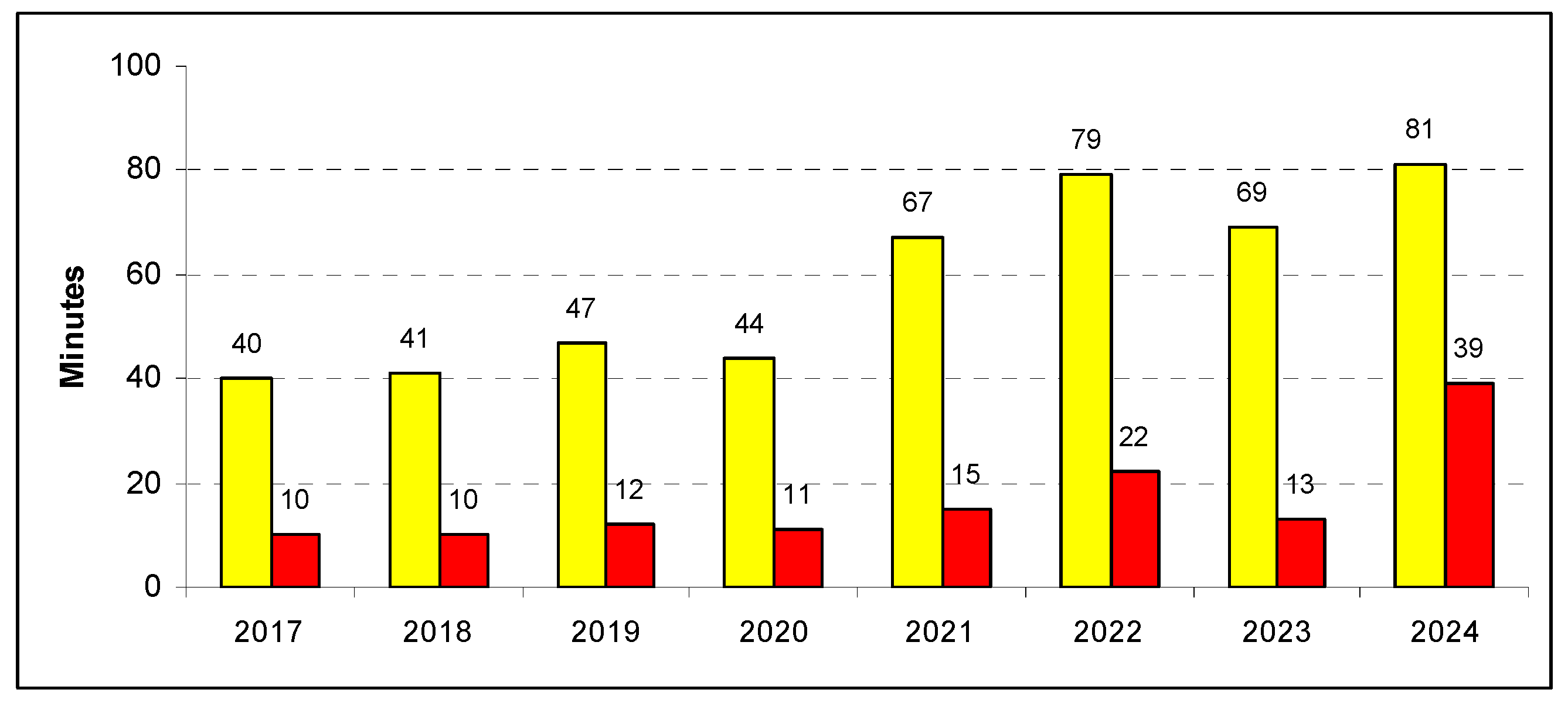
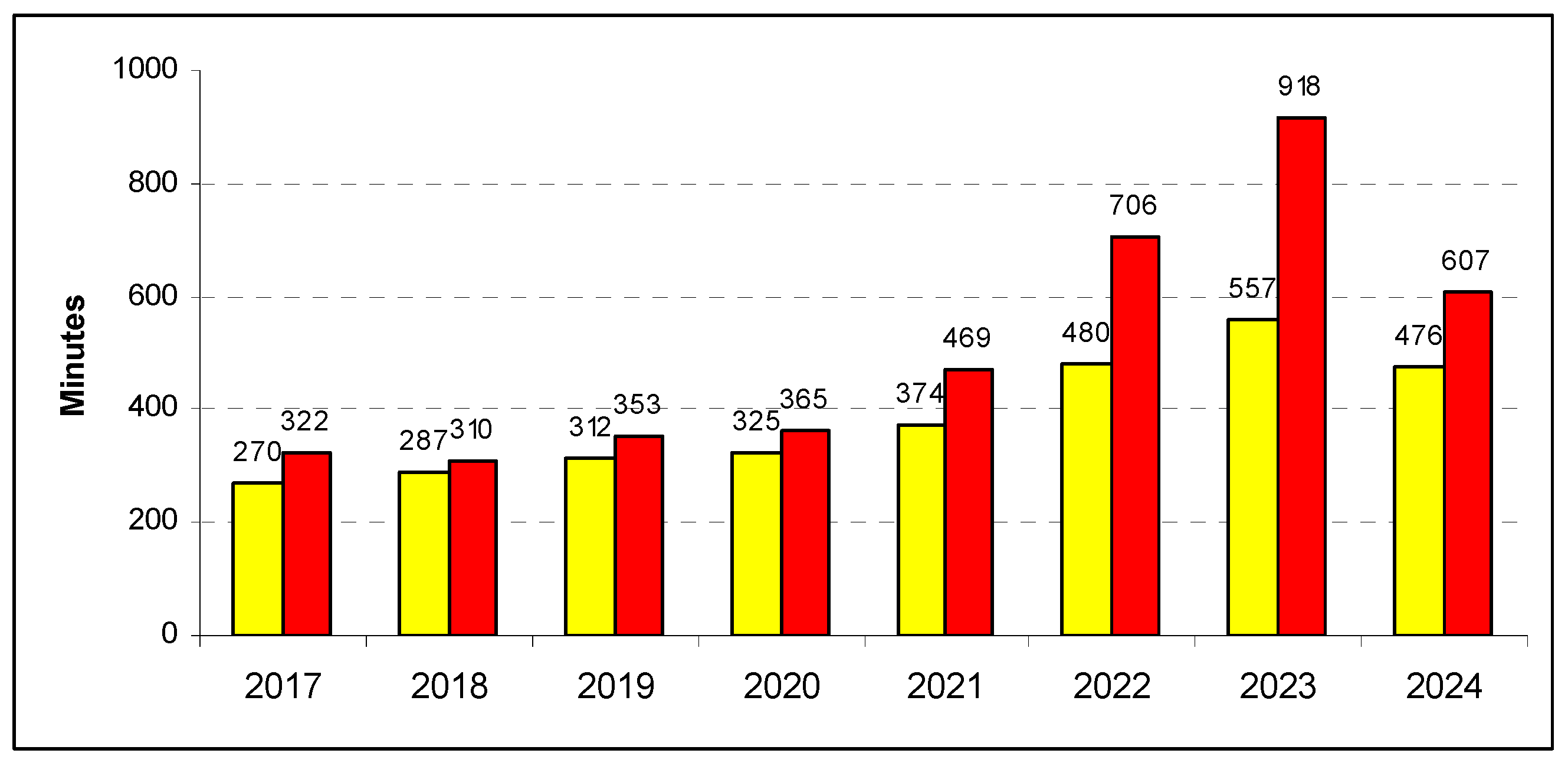
- − Yellow (urgency: moderately critical, increased risk of worsening, potential danger of death, and treatment cannot be delayed);
- − Red (emergency: life-threatening condition, maximum priority, requiring immediate intervention).
2.3. Data Analysis
3. Results
3.1. Overall Number of Accesses and Clinical Severity (Table 1)
| Triage Code | |||||
|---|---|---|---|---|---|
| Year | Overall | White | Green | Yellow | Red |
| Number (%) of ED accesses | |||||
| 2017 | 521,000 | 23,167 (4.4) | 277,380 (53.2) | 208,823 (40.1) | 11,105 (2.1) |
| 2018 | 524,609 | 26,111 (5.0) | 288,908 (55.1) | 198,340 (37.8) | 10,914 (2.1) |
| 2019 | 512,454 | 24,574 (4.8) | 285,091 (55.6) | 190,309 (37.1) | 12,146 (2.4) |
| 2020 | 335,642 | 16,060 (4.8) | 174,004 (51.8) | 134,485 (40.1) | 10,923 (3.3) |
| 2021 | 379,406 | 21,234 (5.6) | 193,889 (51.1) | 152,493 (40.2) | 11,585 (3.1) |
| 2022 | 420,116 | 22,568 (5.4) | 235,143 (56.0) | 149,097 (35.5) | 13,212 (3.1) |
| 2023 | 419,808 | 20,796 (5.0) | 248,334 (59.1) | 138,413 (33.0) | 12,235 (2.9) |
| 2024 | 450,530 | 15,120 (3.4) | 268,327 (59.6) | 145,328 (32.3) | 20,399 (4.5) |
| Waiting time, mean (SD) | |||||
| 2017 | 50/19 (53) | 42/10 (47) | 60/24 (67) | 40/17 (41) | 10/6 (7) |
| 2018 | 49/20 (55) | 40/8 (42) | 57/23 (68) | 41/19 (46) | 10/6 (8) |
| 2019 | 53/21 (62) | 40/6 (41) | 60/23 (72) | 47/22 (53) | 12/6 (9) |
| 2020 | 47/17 (50) | 31/4 (24) | 53/18 (59) | 44/19 (47) | 11/6 (9) |
| 2021 | 62/20 (60) | 30/4 (18) | 65/21 (67) | 67/24 (62) | 15/7 (9) |
| 2022 | 76/33 (81) | 39/4 (35) | 81/40 (90) | 79/32 (78) | 22/7 (11) |
| 2023 | 70/32 (82) | 38/2 (36) | 77/39 (90) | 69/31 (77) | 13/7 (10) |
| 2024 | 78/37 (90) | 48/13 (49) | 81/41 (94) | 81/39 (92) | 39/9 (40) |
| Process time, mean (SD) | |||||
| 2017 | 183/103 (148) | 73/53 (96) | 115/80 (121) | 270/145 (185) | 322/129 (168) |
| 2018 | 187/106 (152) | 73/51 (97) | 117/82 (122) | 287/156 (196) | 310/130 (172) |
| 2019 | 202/113 (160) | 78/56 (99) | 126/87 (127) | 312/166 (209) | 353/144 (198) |
| 2020 | 216/117 (176) | 84/58 (102) | 126/85 (127) | 325/178 (227) | 365/172 (211) |
| 2021 | 244/124 (185) | 98/69 (113) | 136/89 (128) | 374/190 (253) | 469/204 (313) |
| 2022 | 294/121 (197) | 104/63 (115) | 158/89 (142) | 480/196 (302) | 706/252 (555) |
| 2023 | 319/121 (191) | 97/65 (117) | 160/91 (138) | 557/199 (320) | 918/264 (812) |
| 2024 | 346/122 (198) | 267/37 (141) | 258/109 (164) | 476/160 (260) | 607/110 (320) |
3.2. Change in Waiting and Process Time During the Follow-Up
3.3. Predictors of ED Waiting/Process Time
4. Discussion
5. Conclusions
Supplementary Materials
Author Contributions
Funding
Institutional Review Board Statement
Informed Consent Statement
Data Availability Statement
Conflicts of Interest
References
- WHO. Delivering Quality Health Services. A Global Imperative for Universal Health Coverage. Available online: https://iris.who.int/server/api/core/bitstreams/fa844d45-886e-4e2e-aedd-48c404dfb9df/content (accessed on 22 February 2026).
- Stang, A.S.; Crotts, J.; Johnson, D.W.; Hartling, L.; Guttmann, A. Crowding measures associated with the quality of emergency department care: A systematic review. Acad. Emerg. Med. 2015, 22, 643–656. [Google Scholar] [CrossRef]
- Sonis, J.D.; Aaronson, E.L.; Lee, R.Y.; Philpotts, L.L.; White, B.A. Emergency Department Patient Experience: A Systematic Review of the Literature. J. Patient Exp. 2018, 5, 101–106. [Google Scholar] [CrossRef]
- Zoleo, M.; Della Rocca, F.; Tedeschi, F.; Zucchetto, M.; Maddalena, G.; Vettore, G. Violence against health workers: Findings from three emergency departments in the teaching hospital of Padua, Italy. Intern. Emerg. Med. 2020, 15, 1067–1074. [Google Scholar] [CrossRef]
- Pich, J.V.; Kable, A.; Hazelton, M. Antecedents and precipitants of patient-related violence in the emergency department: Results from the Australian VENT Study (Violence in Emergency Nursing and Triage). Australas. Emerg. Nurs. J. 2017, 20, 107–113. [Google Scholar] [CrossRef]
- Morley, C.; Unwin, M.; Peterson, G.M.; Stankovich, J.; Kinsman, L. Emergency department crowding: A systematic review of causes, consequences and solutions. PLoS ONE 2018, 13, e0203316. [Google Scholar] [CrossRef] [PubMed]
- Cortel-LeBlanc, M.A.; Lemay, K.; Chhabra, S.; Yang, Q.; Ji, J.; Woods, S.; Sherif, R.E.; Garber, G. Medico-legal risk in the emergency department. CJEM 2025. [Google Scholar] [CrossRef]
- Andersson, J.; Kurland, L.; Nordgren, L.; Gusdal, A.K.; Cheng, I. Length of stay in the emergency department and its associated input-, throughput-, and output factors at two hospitals in Sweden. BMC Emerg. Med. 2025, 25, 120. [Google Scholar] [CrossRef] [PubMed]
- Di Laura, D.; D’Angiolella, L.; Mantovani, L.; Squassabia, G.; Clemente, F.; Santalucia, I.; Improta, G.; Triassi, M. Efficiency measures of emergency departments: An Italian systematic literature review. BMJ Open Qual. 2021, 10, e001058. [Google Scholar] [CrossRef] [PubMed]
- Ma, K.J.; Hsu, Y.C.; Pan, W.W.; Chou, M.H.; Chung, W.S.; Wang, J.Y. Effects of emergency department length of stay on inpatient utilization and mortality. Health Econ. Rev. 2025, 15, 11. [Google Scholar] [CrossRef]
- Otto, R.; Blaschke, S.; Schirrmeister, W.; Drynda, S.; Walcher, F.; Greiner, F. Length of stay as quality indicator in emergency departments: Analysis of determinants in the German Emergency Department Data Registry (AKTIN registry). Intern. Emerg. Med. 2022, 17, 1199–1209. [Google Scholar] [CrossRef]
- AGENAS. Quarta Indagine Nazionale Sullo Stato di Attuazione Delle Reti Tempo-Dipendenti—Rapporto su Dati. 2023. Available online: https://www.agenas.gov.it/images/2025/Reti_tempo_dipendenti/Rapporto_RTD_web_completo.pdf (accessed on 15 March 2026).
- Italian Ministry of Health. Linee di Indirizzo Nazionali per lo Sviluppo del Piano di Gestione del Sovraffollamento in Pronto Soccorso. Available online: https://www.salute.gov.it/imgs/C_17_pubblicazioni_3143_allegato.pdf (accessed on 15 March 2026).
- Zaboli, A.; Brigo, F.; Cipriano, A.; Sibilio, S.; Magnarelli, G.; Pfeifer, N.; Fratti, M.; Malalan, F.; Massar, M.; Mian, M.; et al. Assessing triage efficiency in Italy: A comparative study using simulated cases among nurses. Intern. Emerg. Med. 2025, 20, 1167–1176. [Google Scholar] [CrossRef]
- Bambi, S.; Ruggeri, M.; Sansolino, S.; Gabellieri, M.; Tellini, S.; Giusti, M.; Ciulli, E.; Franchi, F.; Petrocchi, L.; Olivi, M.; et al. Emergency department triage performance timing. A regional multicenter descriptive study in Italy. Int. Emerg. Nurs. 2016, 29, 32–37. [Google Scholar] [CrossRef] [PubMed]
- SIMEU. La Situazione dei Pronto Soccorso Italiani. Available online: https://www.simeu.it/w/articoli/leggiArticolo/3238/leggi (accessed on 15 March 2026).
- ilCentro. Pronto Soccorso Sovraffollato: I Vertici Asl di Pescara Verso il Processo. Available online: https://www.ilcentro.it/pescara/pronto-soccorso-sovraffollato-i-vertici-asl-di-pescara-verso-il-processo-l3ad2fr8 (accessed on 15 March 2026).
- ASL-Lanciano-Vasto-Chieti. Soccorso in Emergenza Nell’alto Vastese, Prime Risposte Alla Carenza di Medici. Available online: https://www.asl2abruzzo.it/soccorso-in-emergenza-nellalto-vastese-prime-risposte-alla-carenza-di-medici/ (accessed on 15 March 2026).
- Conferenza Permanente per i Rapporti Tra lo Stato le Regioni e le Province Autonome di Trento e Bolzano. Linee D’indirizzo Nazionali sul Triage Intraospedaliero. Available online: https://www.statoregioni.it/media/1953/p-01-csr-atto-rep-n-143-01-agosto2019.pdf (accessed on 15 March 2026).
- Kutner, M.H.; Nachtsheim, C.J.; Neter, J. Applied Linear Regression Models, 4th ed.; McGraw-Hill Irwin: Columbus, OH, USA, 2004. [Google Scholar]
- Italian Ministry of Health. Linee di Indirizzo Nazionali sul Triage Intraospedaliero. Available online: https://www.salute.gov.it/imgs/C_17_notizie_3849_listaFile_itemName_1_file.pdf (accessed on 15 March 2026).
- Stirparo, G.; Kacerik, E.; Andreassi, A.; Pausilli, P.; Cortellaro, F.; Coppo, A.; Migliari, M.; Albonico, A.; Sechi, G.M.; Zoli, A.; et al. Emergency Department waiting-time in the post pandemic era: New organizational models, a challenge for the future. Acta Biomed. 2023, 94, e2023122. [Google Scholar] [CrossRef]
- Basso, I.; Vigliano, C.; Bassi, E.; Santomauro, I.; Chilin, G.; Zanelli, C.; Boido, P.; Scotti, L.; Mandirola, V.; Campagna, S.; et al. Changes in emergency department visits by nursing home residents before, during and after the COVID-19 pandemic: Retrospective study. Geriatr. Nurs. 2025, 66, 103707. [Google Scholar] [CrossRef]
- De la Rosa, M.J.; Duca, A.; Querci, L.; Cortellaro, F.; Calderaro, M.; Pausilli, P.; Bodina, A.; Albonico, A.; Perotti, G.; Signorelli, C.; et al. Does Calm Always Follow the Storm? A Comprehensive Temporal Analysis of Emergency Department Visits in Northern Italy Before and After the COVID-19 Pandemic. Epidemiologia 2025, 6, 10–24. [Google Scholar] [CrossRef]
- Lin, S.; Ge, S.; He, W.; Zeng, M. Association of delayed time in the emergency department with the clinical outcomes for critically ill patients. QJM 2021, 114, 311–317. [Google Scholar] [CrossRef]
- Jones, S.; Moulton, C.; Swift, S.; Molyneux, P.; Black, S.; Mason, N.; Oakley, R.; Mann, C. Association between delays to patient admission from the emergency department and all-cause 30-day mortality. Emerg. Med. J. 2022, 39, 168–173. [Google Scholar] [CrossRef] [PubMed]
- Pitrou, I.; Lecourt, A.C.; Bailly, L.; Brousse, B.; Dauchet, L.; Ladner, J. Waiting time and assessment of patient satisfaction in a large reference emergency department: A prospective cohort study, France. Eur. J. Emerg. Med. 2009, 16, 177–182. [Google Scholar] [CrossRef]
- Darraj, A.; Hudays, A.; Hazazi, A.; Hobani, A.; Alghamdi, A. The Association Between Emergency Department Overcrowding and Delay in Treatment: A Systematic Review. Healthcare 2023, 11, 385. [Google Scholar] [CrossRef]
- Carpenter, K.P.; Walker, L.; Lindor, R.A. Medical Malpractice in the Waiting Room: Who Is at Risk? Clin. Pract. Cases Emerg. Med. 2025, 9, 361–364. [Google Scholar] [CrossRef] [PubMed]
- Forster, A.J.; Stiell, I.; Wells, G.; Lee, A.J.; van Walraven, C. The effect of hospital occupancy on emergency department length of stay and patient disposition. Acad. Emerg. Med. 2003, 10, 127–133. [Google Scholar] [CrossRef] [PubMed]
- Sartini, M.; Carbone, A.; Demartini, A.; Giribone, L.; Oliva, M.; Spagnolo, A.M.; Cremonesi, P.; Canale, F.; Cristina, M.L. Overcrowding in Emergency Department: Causes, Consequences, and Solutions-A Narrative Review. Healthcare 2022, 10, 1625. [Google Scholar] [CrossRef]
- Mattiuzzi, C.; Lippi, G.; Paolillo, C. Emergency department visits in Italy: 2017–2023 trends, decline and recovery. Emerg. Care J. 2025, 21, 13785–13789. [Google Scholar] [CrossRef]
- AGENAS. Portale Statistico. Available online: https://stat.agenas.it/web/index.php?r=public%2Findex&report=30 (accessed on 15 March 2026).
- AGENAS. Il Personale del Servizio Sanitario Nazionale. Dati. 2023. Available online: https://www.agenas.gov.it/images/2025/personale_ssn/Rapporto_personale_ssn_2025.pdf (accessed on 15 March 2026).
- Joseph, J.W.; White, B.A. Emergency Department Operations: An Overview. Emerg. Med. Clin. N. Am. 2020, 38, 549–562. [Google Scholar] [CrossRef]
- Pennisi, F.; Minerva, M.; Dalla Valle, Z.; Odone, A.; Signorelli, C. Genesis and prospects of the shortage of specialist physicians in Italy and indicators of the 39 schools of hygiene and preventive medicine. Acta Biomed. 2023, 94, e2023159. [Google Scholar] [CrossRef] [PubMed]
- Local Health Agency of Pescara. Plan for the Management of the Emergency Room overcrowding. Agency Degree n. 1217. 2024. Available online: https://www.asl.pe.it/Sezione.jsp?titolo=comunicato-stampa---pronto-soccorso&idSezione=1676 (accessed on 15 March 2026).


| Variables | Waiting Time | Process Time | ||||
|---|---|---|---|---|---|---|
| β | (95% CI) | p-Value | β | (95% CI) | p-Value | |
| Male gender | 1 | (1; 1) | 0.002 | 6 | (5; 8) | <0.001 |
| Age (10-year increase) | 5 | (5; 5) | <0.001 | 41 | (41; 42) | <0.001 |
| Triage | ||||||
| White (reference category) | 0 | -- | -- | 0 | -- | -- |
| Green | 36 | (35; 37) | <0.001 | 97 | (93; 100) | <0.001 |
| Yellow | 14 | (13; 15) | <0.001 | 257 | (254; 261) | <0.001 |
| Red | −40 | (−42; −39) | <0.001 | 312 | (306; 317) | <0.001 |
| Year of ED access | ||||||
| 2017–2019 (reference category) | 0 | -- | -- | 0 | -- | -- |
| 2020 | −2 | (−3; −1) | <0.001 | 5 | (3; 8) | <0.001 |
| 2021 | 17 | (16; 17) | <0.001 | 40 | (37; 42) | <0.001 |
| 2022 | 31 | (30; 32) | <0.001 | 93 | (90; 96) | <0.001 |
| 2023 | 24 | (23; 25) | <0.001 | 99 | (95; 102) | <0.001 |
| 2024 | 31 | (30; 32) | <0.001 | 104 | (100; 107) | <0.001 |
| Hospital * | ||||||
| Small hospitals (reference category) | 0 | -- | -- | 0 | -- | -- |
| Large hospitals | 42 | (41; 42) | <0.001 | 61 | (59; 62) | <0.001 |
| Change in the Director | ||||||
| No (reference category) | 0 | -- | -- | 0 | -- | -- |
| Yes | 6 | (5; 7) | <0.001 | 49 | (46; 52) | <0.001 |
| Change/update in the facilities | ||||||
| No (reference category) | 0 | -- | -- | 0 | -- | -- |
| Yes | −9 | (−9; −8) | <0.001 | 14 | (11; 16) | <0.001 |
| Change in the organizational model | ||||||
| No (reference category) | 0 | -- | -- | 0 | -- | -- |
| Yes | 2 | (1; 2) | <0.001 | 54 | (51; 57) | <0.001 |
Disclaimer/Publisher’s Note: The statements, opinions and data contained in all publications are solely those of the individual author(s) and contributor(s) and not of MDPI and/or the editor(s). MDPI and/or the editor(s) disclaim responsibility for any injury to people or property resulting from any ideas, methods, instructions or products referred to in the content. |
© 2026 by the authors. Licensee MDPI, Basel, Switzerland. This article is an open access article distributed under the terms and conditions of the Creative Commons Attribution (CC BY) license.
Share and Cite
Antonazzo, I.C.; Odio, C.; Chesini, G.; Gregori, N.; Taormina, S.; Zauli, E.; Acuti Martellucci, C.; Flacco, M.E.; Manzoli, L. Continuous Increase in Both Waiting and Process Time in the Emergency Rooms of Abruzzo, Italy. Epidemiologia 2026, 7, 62. https://doi.org/10.3390/epidemiologia7030062
Antonazzo IC, Odio C, Chesini G, Gregori N, Taormina S, Zauli E, Acuti Martellucci C, Flacco ME, Manzoli L. Continuous Increase in Both Waiting and Process Time in the Emergency Rooms of Abruzzo, Italy. Epidemiologia. 2026; 7(3):62. https://doi.org/10.3390/epidemiologia7030062
Chicago/Turabian StyleAntonazzo, Ippazio Cosimo, Camillo Odio, Giulia Chesini, Natalia Gregori, Sara Taormina, Enrico Zauli, Cecilia Acuti Martellucci, Maria Elena Flacco, and Lamberto Manzoli. 2026. "Continuous Increase in Both Waiting and Process Time in the Emergency Rooms of Abruzzo, Italy" Epidemiologia 7, no. 3: 62. https://doi.org/10.3390/epidemiologia7030062
APA StyleAntonazzo, I. C., Odio, C., Chesini, G., Gregori, N., Taormina, S., Zauli, E., Acuti Martellucci, C., Flacco, M. E., & Manzoli, L. (2026). Continuous Increase in Both Waiting and Process Time in the Emergency Rooms of Abruzzo, Italy. Epidemiologia, 7(3), 62. https://doi.org/10.3390/epidemiologia7030062