Article

The Association Between Religiosity and Lifelong Cancer Incidence in an Israeli Male Cohort: A Competing Risk Survival Analysis


Department of Epidemiology and Preventive Medicine, School of Public Health, Gray Faculty of Medical and Health Sciences, Tel Aviv University, P.O. Box 39040, Ramat Aviv, Tel Aviv 6997801, Israel
*
Author to whom correspondence should be addressed.
Epidemiologia 2026, 7(2), 38; https://doi.org/10.3390/epidemiologia7020038
Submission received: 24 October 2025 / Revised: 19 December 2025 / Accepted: 30 January 2026 / Published: 3 March 2026

Abstract

Background: While religious involvement has been linked to better health outcomes, its specific association with cancer incidence remains uncertain. The potential for confounding by lifestyle factors, such as physical activity, body weight, and smoking, complicates the interpretation of this relationship, necessitating further research in large, well-defined cohorts. This study aims to investigate the association between religiosity and cancer incidence in a large Israeli cohort while controlling for a comprehensive set of confounders and the competing risk of mortality. Methods: We conducted a retrospective analysis of 8746 male city-hall employees from the Israeli Ischemic Heart Disease (IIHD) cohort, enrolled in 1963. Cancer and mortality follow-up lasted through 2019. Religiosity was self-reported at baseline and categorized as secular, traditional, or religious. We employed a cause-specific Cox proportional hazards model with age as the time scale to analyze the risk of cancer incidence, treating death as a competing risk. The model was adjusted for a comprehensive set of baseline confounders, including socioeconomic status, smoking, physical activity, body mass index, systolic blood pressure, cholesterol, and diabetes. Results: During the follow-up period, cancer was diagnosed in 2692 participants. We observed a significant inverse association between religiosity and cancer incidence. Compared to secular participants, the religious group had a significantly lower risk of cancer (multivariable-adjusted hazard ratio [HR] = 0.80, 95% CI: 0.73–0.87; p < 0.001); the traditional group had a nonsignificantly lower risk (HR = 0.91, 95% CI: 0.82–1.02; p = 0.10). This association was specific to cancer incidence, as religiosity was not significantly associated with the competing risk of mortality. Conclusions: In this cohort study, a higher level of religiosity was associated with a significantly lower risk of lifelong cancer incidence, independent of a wide range of lifestyle, social, and clinical factors. These findings suggest that psychosocial and biobehavioral pathways associated with a religious lifestyle may play a protective role in cancer etiology.

1. Introduction

The association between religiosity and cancer incidence has been explored in several epidemiological and psychosocial studies, with mixed findings [1,2,3,4,5]. Evidence from studies of Christian religious communities suggests that lower cancer incidence observed in these populations is primarily attributable to healthier lifestyle behaviors (e.g., lower rates of smoking and alcohol use, healthier diets) that are often promoted within these communities, rather than religiosity itself exerting a direct protective effect [6,7,8,9]. When analyses adjust for lifestyle factors, the association between religiosity and reduced cancer risk is no longer significant, indicating that lifestyle mediates the observed relationship [1].
Systematic reviews and meta-analyses indicate that while religiosity and spirituality are associated with improved physical health and well-being among cancer patients, there is no consistent evidence that religiosity reduces cancer incidence or cancer-specific mortality. Studies examining the prognostic role of religiosity on cancer progression or survival have yielded inconsistent results [1,2,3].
Religiosity may influence cancer screening behaviors, with some evidence suggesting that frequent attendance at religious services is associated with increased participation in cancer screening, which could indirectly affect cancer incidence through earlier detection [9,10]. However, this effect varies by religious group and is not universally observed. Psychosocial pathways, such as enhanced social support within religious communities, better coping mechanisms for life stressors, and a greater sense of purpose, may also play a role in the link between religiosity and cancer incidence [11,12,13,14].
Israel provides a unique societal context for studying this association. The Israeli Ischemic Heart Disease (IIHD) cohort, established in the 1960s, offers a valuable opportunity to examine this relationship over a long-term follow-up period of more than 50 years, with detailed baseline data on a wide range of potential confounders [15,16,17,18,19,20].
This study aims to investigate the association between self-defined religiosity and the long-term risk of cancer incidence in a cohort of Israeli males. Using a competing risk survival model, we sought to determine if such an association exists after comprehensively adjusting for socioeconomic, lifestyle, and clinical factors and accounting for death as a competing risk.

2. Materials and Methods

2.1. Study Population

This study utilizes data from the IIHD cohort, a prospective study established in 1963. The cohort, which includes an updated outcome dataset through 2019, has a follow-up period of 54 years. The original cohort included 10,059 male Israeli civil servants aged 40 and over. Participants were recruited from municipalities in Tel Aviv, Haifa, and Jerusalem. Upon enrollment in 1963, all participants underwent a comprehensive baseline examination, including a medical history, physical measurements, and detailed questionnaires on demographics, lifestyle, and health behaviors. For this analysis, we included participants with complete data on religiosity and all model covariates, resulting in a final analytical cohort of 8746 men. All participants provided oral consent to participate in the study upon recruitment, after receiving explanations about the study objectives and the planned long-term follow-up. This occurred prior to the establishment of Ethical Review Boards in Israel. In addition, the Tel Aviv University Ethical Review Board approved the linkage between the IIHD database, the Israel Population Registry, and the Israel National Cancer Registry to monitor participants’ vital status and cancer incidence [15,16,17,18,19,20].

2.2. Variables and Measurements

Exposure: The primary exposure was religiosity, assessed at study enrollment through a detailed, self-administered questionnaire. Participants were asked to rate their level of religious observance on a scale from 1 (most religious/orthodox) to 5 (least religious/secular). They also reported the type of educational system they attended (religious, secular, or combined). From these two variables, a three-category composite variable was constructed to classify participants as “secular,” “traditional,” or “religious.” For all subsequent analyses, the secular group was designated as the reference category (Table 1) [18].
Outcome: The primary outcome was incident cancer of any type. The secondary outcome, treated as a competing risk, was death from any cause with no prior cancer. Event data were obtained through linkage with the Israel National Cancer Registry (INCR), which is the national repository for cancer data in Israel. Linkage was performed using unique national identification numbers assigned to all Israeli citizens. The INCR has been operational since 1961, and reporting has been mandatory by law since 1982, ensuring comprehensive national coverage, with an estimated 94% completeness of ascertainment for solid tumors [21].
A comprehensive set of potential confounding variables was selected based on established risk factors for cancer in the scientific literature. All covariate data originated from self-administered questionnaires, laboratory tests, and anthropometric measures completed during the study’s recruitment phase in 1963.
Smoking Status: Given that tobacco use is a leading cause of cancer, smoking behavior was assessed [22,23,24,25,26]. Participants self-reported their smoking habits and were categorized into mutually exclusive groups: “Never smoked” (reference), “Ex-smoker,” “1–10 cigarettes/day,” “11–20 cigarettes/day,” “21+ cigarettes/day,” and a separate category for pipe or cigar users.
Socioeconomic Status: To account for the complex influence of social standing on health outcomes, a composite socioeconomic status (SES) index was constructed [27,28,29,30,31]. This index, ranging from 1 (lowest) to 5 (highest), was based on a combination of participants’ years of schooling, possession of a high school or university diploma, and their salary grade, which was categorized into professional, administrative, teaching, technician, or laborer roles. This multi-component approach, previously established in this cohort [32], offers a more nuanced measure of SES than any single indicator.
Physical Activity: work-related and leisure-time physical activities were assessed separately [33,34,35,36,37]. Work-related activity was classified based on occupational demands into five categories: “Mainly sitting at a desk” (reference), “Mainly sitting at the wheel of a car,” “Mainly standing,” “Mainly walking,” and “Mainly physical work.”
Leisure-time activity was self-reported and categorized into four levels of intensity and frequency: “Almost none” (reference), “Sporadic” (e.g., occasional walks), “Light” (e.g., regular walking or cycling for at least 30 min), and “Energetic” (e.g., sports or vigorous activity multiple times per week).
Clinical and Anthropometric Measures: A panel of objective clinical measurements was performed at the baseline examination during study recruitment:
Blood pressure was measured. For interpretability in regression models, systolic blood pressure (SBP) was treated as a continuous variable and rescaled to 10 mmHg units [38,39,40]. Total cholesterol was determined from nonfasting serum samples [41,42]. Body mass index (BMI) was calculated as weight in kilograms divided by the square of height in meters (kg/m2). Both height and weight were measured [43,44]. Diabetes was ascertained as a dichotomous variable (yes/no) based on either a self-reported history of physician-diagnosed diabetes for which the participant was receiving treatment, or a diagnosis confirmed via an oral glucose tolerance test (OGTT) conducted at the baseline examination [45,46,47].

2.3. Statistical Analysis

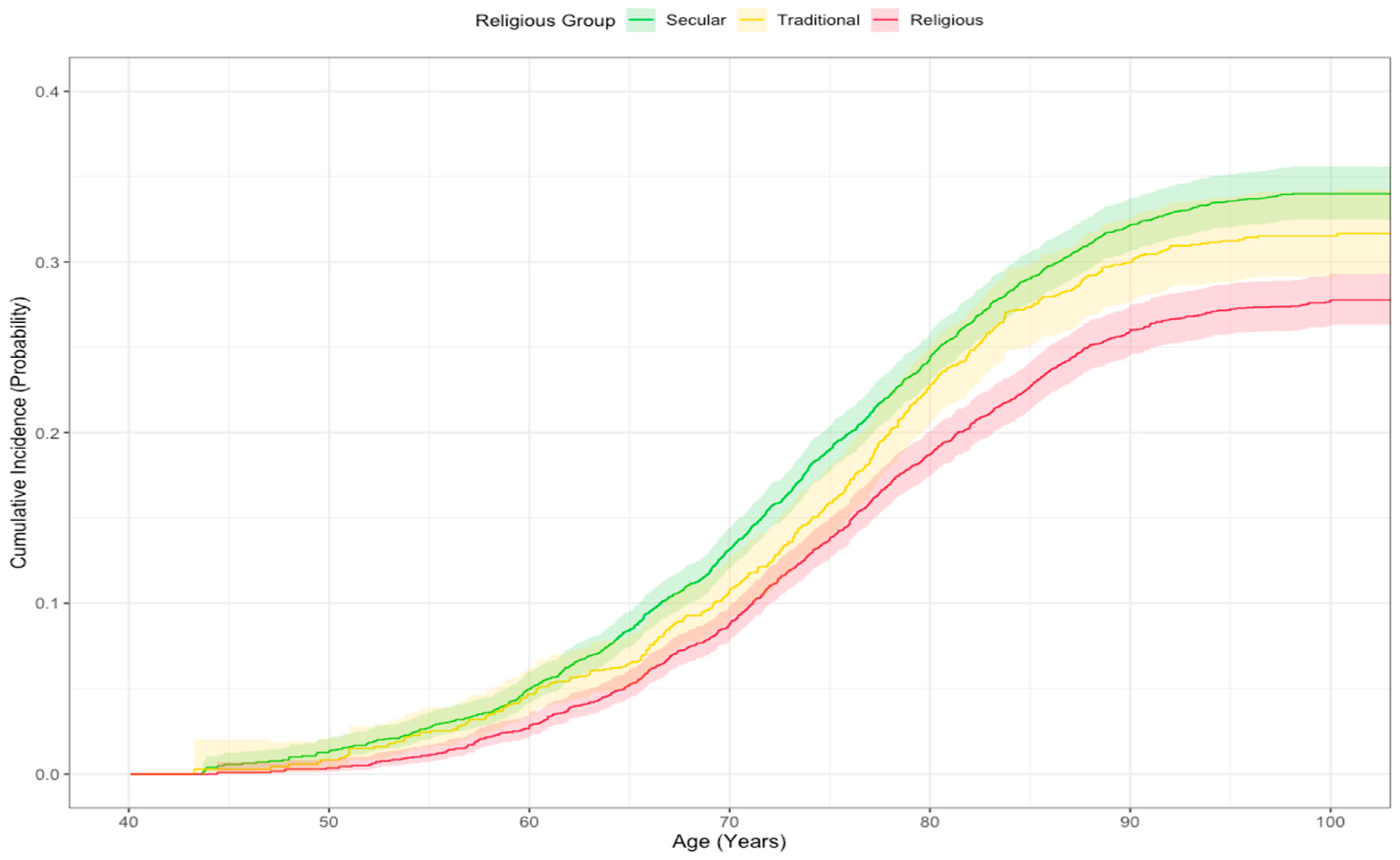
To visualize the unadjusted probability of a cancer diagnosis over time, we plotted the cumulative incidence function (CIF) across religiosity groups. This method was chosen over the standard Kaplan–Meier approach to properly account for death as a competing risk. Unlike the Kaplan–Meier method, which censors competing events and can overestimate the probability of the primary outcome, the CIF provides a more realistic estimate of incidence by calculating the probability of cancer occurring in the presence of competing events that can remove an individual from the at-risk population [48].
We used a cause-specific Cox proportional hazards model to estimate the hazard ratios (HRs) and 95% confidence intervals (CIs) for the association between religiosity and cancer incidence. This approach is suitable for handling competing risks, where an individual may experience a different event (in this case, death) that precludes the primary outcome from occurring.
Age was used as the time scale in the model. The starting point was defined as the age at study entry, and the end point was the age at which an event occurred or censoring took place. This method appropriately adjusts for the strong effect of age on cancer incidence. The final multivariable model was adjusted for the following confounders: smoking, SES, physical activity, and clinical measures, namely SBP, total cholesterol, and BMI. All data preparation and statistical analyses were performed using R version 4.5.1 with the survival and dplyr packages.
The proportional hazard (PH) assumption for the final cause-specific Cox model was formally tested for each covariate and globally with the cox.zph() function. The assumption was found to hold for our primary exposure variable, indicating that religiosity’s effect was reasonably constant over the follow-up period. While violations of the PH assumption were noted for several covariates (smoking status, work activity, and SES), the validity of the HRs for our primary exposure was not compromised. The HRs for covariates with violated assumptions were interpreted as the average effect over the entire follow-up period.

3. Results

The final analytical cohort included 8746 men. During the follow-up period, 8629 events occurred: 2692 incident cancers and 5937 deaths among participants with no prior cancer.
The baseline characteristics of the study population are presented by religiosity groups, distributed as 3753 secular, 1395 traditional, and 3598 religious (Table 2). There were some notable differences among the groups. Religious participants exhibited a higher proportion of never smokers (38.0%) compared with secular (27.7%) and traditional (30.5%) participants, and a lower proportion of 21+ cigs/day smokers (9.8% vs. 16.0% and 14.6%, respectively). In terms of work activity, a smaller percentage of religious participants reported mainly sitting at a desk (36.2%) compared with secular (49.7%) and traditional (44.3%), with a higher proportion engaged in physical work (17.1% vs. 8.7% and 10.3%). Regarding SES, a substantial difference was observed. The religious group had a considerably higher proportion in SES Level 1 (lowest SES) at 35.2%, compared with 14.2% in the secular group and 18.6% in the traditional group. Conversely, the secular group had higher proportions in the top two SES levels (15.1% in Level 4 and 14.3% in Level 5) compared with the religious group (6.5% and 6.4%, respectively) and the traditional group (10.0% and 7.2%, respectively).
Mean age at study entry, SBP, and BMI were similar among the groups, with small standardized mean differences. The proportion of participants with diabetes was slightly higher in the religious and traditional groups compared to the secular group (7.4% and 7.0% vs. 5.3%, respectively). Cholesterol levels were slightly lower in the religious group (203.1 mg/dL) compared to the secular (212.5 mg/dL) and traditional (206.6 mg/dL) groups. Leisure activity patterns also showed some differences, with the religious group having the highest proportion reporting almost no leisure activity (63.2%).

3.1. Association Between Religiosity and Cancer Incidence

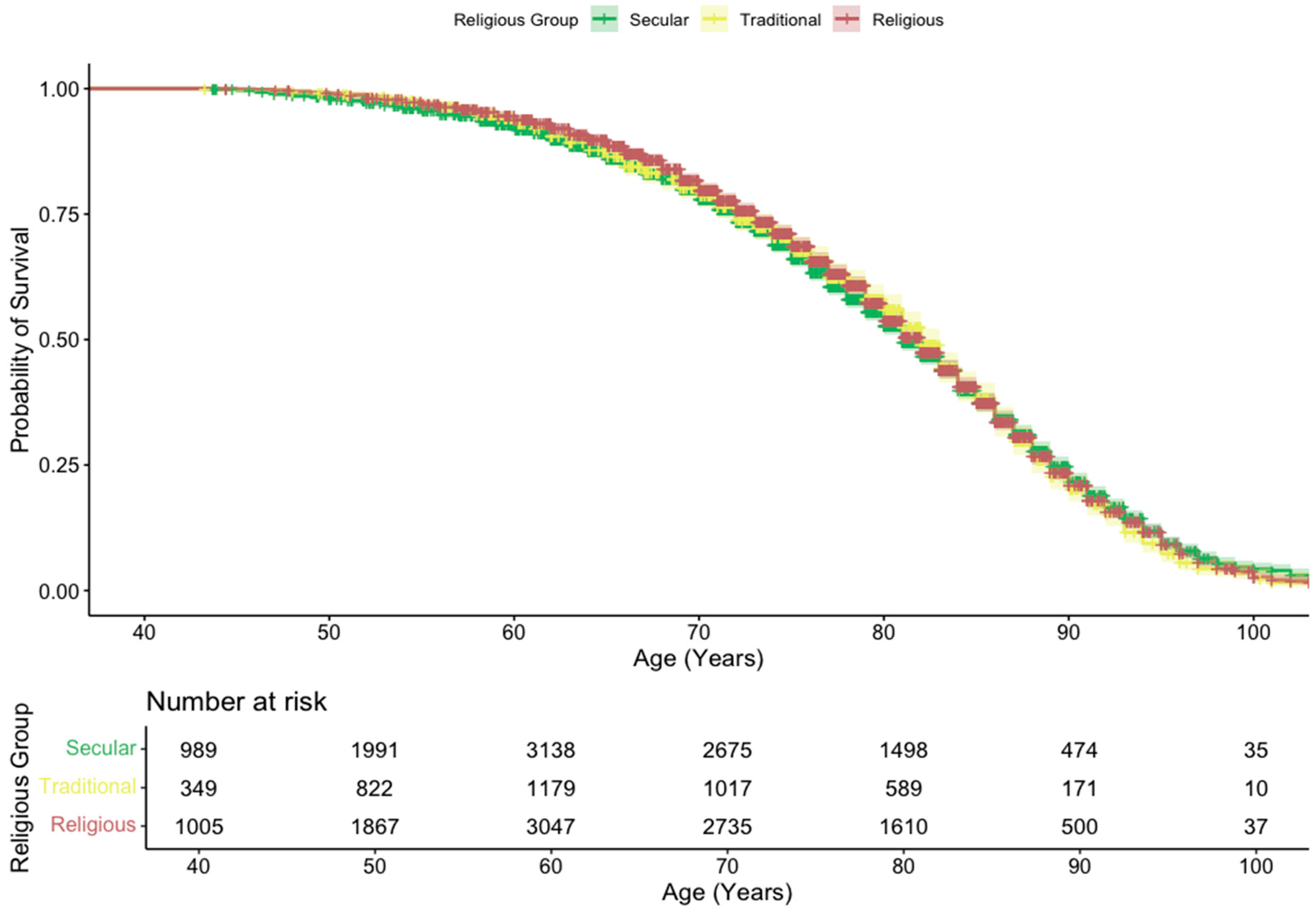
The unadjusted cancer incidence rates per 100,000 person-years were 1269 (CI: 1201–1340) for secular participants, 1127 (CI: 1026–1238) for traditional participants, and 997 (CI: 937–1061) for religious participants. A CIF was used to visualize the unadjusted probability of cancer diagnosis by age, accounting for death as a competing risk. The resulting CIF curves showed a clear separation between the groups (Figure 1). The religious group demonstrated a consistently lower cumulative incidence of cancer, while the secular group showed the highest. In contrast, the survival curves for the competing event of death were nearly identical across all three religious groups, indicating no significant difference in mortality (Figure 2).
In a Cox PH model, after covariate adjustment, we found a statistically significant inverse association between religiosity and the risk of cancer incidence (Table 3). Compared to the secular group, participants who identified as religious had a 20% lower risk of being diagnosed with cancer (HR = 0.80; 95% CI: 0.73–0.87; p < 0.001). The association for the traditional group was not statistically significant (HR = 0.91; 95% CI: 0.82–1.02; p = 0.10).

3.2. Association with Mortality

In the analysis of the competing event, religiosity was not significantly associated with the risk of death. This suggests that the protective association observed was specific to cancer etiology rather than overall mortality. In contrast, several conventional risk factors, including smoking, diabetes, and SES, were strongly and significantly associated with death (Table 4).

3.3. Heterogeneity of Cancer Types

To formally test whether the association of religiosity with cancer risk was consistent across different cancer types, a meta-analytic approach was employed. The HRs for the religious versus secular groups were extracted from separate models for the most frequent cancer types in the cohort: prostate, lung, colon, and bladder cancer (Table 5). The formal test for heterogeneity was not statistically significant (Cochran’s Q = 3.17, p = 0.37), with a very low proportion of variation attributable to heterogeneity (I2 = 5.3%). Analyses of less frequent cancer types were not performed due to the limited number of events, which precluded reliable statistical estimation. This suggests that the protective association of religiosity did not differ significantly across the major cancer types studied.

4. Discussion

In this large, long-term cohort study of Israeli men, we found a significant inverse association between a high level of religiosity and the incidence of cancer. This relationship remained robust after adjusting for a comprehensive set of socioeconomic, lifestyle, and clinical confounders. The association also persisted after properly accounting for death as a competing risk.
Our findings are consistent with several large-scale studies that have identified an inverse association between religiosity and cancer risk. Studies of specific religious groups with prescribed healthy lifestyles have been particularly informative. For instance, the Adventist Health Studies have followed cohorts of Seventh-day Adventists for decades, consistently reporting lower rates of various cancers, including colorectal and lung cancer, compared to the general population. These benefits are largely attributed to their lifestyle, which often includes a vegetarian diet, regular physical activity, and abstinence from smoking and alcohol [4,6,7]. Similarly, a landmark study of California Mormons demonstrated significantly lower cancer mortality rates among active members who adhered to the “Word of Wisdom” health code, which prohibits tobacco and alcohol use [5,49,50,51].
A central debate in this field is the degree to which these associations are simply a product of confounding by healthier behaviors common in religious groups [7,8,51]. Indeed, some systematic reviews have concluded that after adjusting for healthy habits, the reduced risk for cancer is no longer observed, suggesting that lifestyle is the most important explanatory factor [1].
A notable feature of the present cohort is the distinct pattern of baseline characteristics observed across the three religious groups. The groups presented a complex mixture of protective and risk-associated factors at study entry. For instance, the religious group exhibited a healthier profile regarding certain key behaviors, with a significantly higher proportion of never-smokers (38.0%) and a lower average cholesterol level (mean of 203.1 mg/dL) compared with the secular group (mean of 212.5 mg/dL). However, this group also presented with factors typically associated with higher risk, including a much lower SES (35.2% in the lowest quintile vs. 14.2% of seculars) and lower levels of leisure-time physical activity. The secular group, conversely, had a higher socioeconomic profile but also a greater prevalence of heavy smoking. This complex interplay of lifestyle and sociodemographic differences underscores the critical importance of the multivariable adjustment performed in our analysis.
Our study makes a significant contribution by demonstrating that the inverse association between religiosity and cancer incidence persisted even after extensive adjustment for such lifestyle factors. This suggests that while health behaviors are undoubtedly important, they may not fully account for the observed protective association.
A potential limitation of our study is the possibility of detection bias, wherein differences in cancer screening behaviors between religious groups could influence incidence rates. While some international studies associate religious attendance with higher participation in preventive health services [9,10,52], research within Israel has indicated an inverse relationship. Studies have reported that more religious Israeli populations, particularly in ultra-Orthodox communities, exhibit lower adherence to cancer screening for malignancies such as colorectal cancer and breast cancer [53,54,55]. However, our site-specific analysis of colon cancer (Table 5) provides evidence against detection bias. In Israel, national guidelines recommend colorectal cancer screening for the average-risk population starting at age 50, making its detection rate particularly sensitive to screening behaviors. In our analysis, we found no significant difference in colon cancer incidence between the religious groups (HR for religious vs. secular = 0.98, 95% CI: 0.76–1.27). If underscreening were the primary driver of our overall findings, we would have expected to see a significant and artificially protective effect for a widely screened malignancy like colon cancer. The absence of such an association suggests that detection bias is unlikely to be the sole explanation for the lower risk observed.
The mechanisms linking religiosity to lower cancer risk are likely multifactorial. One of the most well-supported pathways is the provision of social support [12,56]. Religious communities often provide dense social networks that can buffer against stress and isolation, factors which have been linked to poorer health outcomes [57]. This support is a key mediator in the broader relationship between religious involvement and health.
Furthermore, religion can provide a framework of meaning, hope, and purpose that helps individuals manage life stressors more effectively [13]. This “stress-buffering” effect may translate into healthier physiological responses [58].
Observational and interventional studies have demonstrated that religious/spiritual activities—such as prayer, meditation, and communal worship—are associated with changes in neuroendocrine and immune parameters, including reductions in stress hormones (cortisol, epinephrine, norepinephrine) and pro-inflammatory cytokines, as well as improvements in immune function [14,59,60,61].
By mitigating stress, religious involvement may promote more favorable physiological profiles, such as lower levels of stress hormones (e.g., cortisol) or reduced inflammation, which in turn could influence cancer development [36,62,63,64].
The primary strengths of this study include its large cohort size, prospective design, and long-term follow-up, which allowed for the accumulation of a substantial number of incident cancer cases and provided the statistical power to detect meaningful associations. Furthermore, the availability of detailed baseline data on a wide range of covariates allowed for robust statistical adjustment, and the use of a competing risks model represents a significant methodological strength.
Our study utilized a competing risks model to accurately estimate cancer incidence. This approach accounts for deaths from other causes, preventing overestimation and providing a more precise association between religiosity and cancer risk.
Our study has several limitations. First, the observational design precludes any inference of causality. Second, while our analysis adjusted for a comprehensive set of major confounders, the possibility of residual confounding from unmeasured factors still remains. For instance, our analysis did not include data on nutrition and alcohol consumption. These factors are strongly associated with both religiosity and cancer risk; therefore, residual confounding cannot be ruled out. However, it is worth noting that, per the literature, alcohol consumption in the Israeli population, particularly during the decades relevant to this cohort, is expected to be modest [65,66,67]. Factors specific to this population, such as adherence to a Kosher diet or the weekly day of rest (Sabbath), may also contribute to health outcomes and represent important avenues for future research. Additionally, information on participation in cancer screening during follow-up was not available. Furthermore, the study lacked validated measures of psychological distress, such as depression or anxiety; the absence of these variables prevents a full disentanglement of the effects of religiosity from general psychological well-being, as both are linked to health outcomes. Regarding marital status, a preliminary analysis indicated that the vast majority of participants (>93%) across all religiosity groups were married, rendering it unlikely to be a significant confounder. Third, the generalizability of our findings may be limited, as the cohort consisted exclusively of Israeli men. In this context, although approximately 13% of the original cohort were excluded due to missing baseline data, a comparison of key sociodemographic, clinical, and behavioral characteristics revealed that the excluded group was slightly older and had a somewhat less favorable cardiovascular risk profile.
Finally, religiosity and other lifestyle and health behaviors were assessed only at baseline, and this single-time-point measurement does not account for potential changes in participants’ religious beliefs or lifestyle over the nearly 50-year follow-up period.
Future research should aim to replicate these findings in more diverse populations, particularly among women and in various cultural contexts. Prospective studies that repeatedly measure religiosity would help to clarify how changes in belief and practice affect health outcomes. Most importantly, future investigations should incorporate the measurement of biological markers to directly test the hypothesized mediating pathways. Examining the interplay between religiosity, psychosocial factors, stress hormones, and markers of immune function and inflammation could provide crucial insights into the specific mechanisms underlying the religion–cancer link.

5. Conclusions

In conclusion, findings from this cohort of Jewish men in Israel provide evidence that a religious lifestyle is associated with a significantly lower risk of cancer incidence. This association is independent of many major confounders. The findings underscore the importance of considering psychosocial and biobehavioral pathways in cancer epidemiology, suggesting that the resources provided by a religious framework may have tangible, protective health benefits.

Author Contributions

Conceptualization, Y.G. and U.G.; methodology, Y.G., U.G. and L.V.; software, L.V.; validation, U.G. and Y.G.; formal analysis, L.V. and Y.G.; investigation, U.G.; resources, Y.G. and U.G.; data curation, Y.G. and U.G.; writing—original draft preparation, L.V.; writing—review and editing, U.G. and Y.G.; visualization, L.V.; supervision, U.G. and Y.G.; funding acquisition, L.V. All authors have read and agreed to the published version of the manuscript.

Funding

This work was supported in part by a student scholarship from the Stanley Steyer Institute for Cancer Epidemiology and Research at the School of Public Health, Tel Aviv University.

Institutional Review Board Statement

The study was initiated in 1963, prior to the establishment of formal ethical review boards and the implementation of standardized requirements for written informed consent in Israel. Accordingly, no IRB approval was required at the time of participant recruitment. The linkage between the Israeli Ischemic Heart Disease (IIHD) database, the Israel Population Registry, and the Israel National Cancer Registry was subsequently reviewed and approved by the Tel Aviv University Ethics Committee (approved on 2 August 2012).

Informed Consent Statement

Oral informed consent was obtained from all participants at the time of recruitment in 1963. Written informed consent was not collected because the study was conducted before the implementation of formal ethical review boards and before written consent became standard practice. The study was observational, with no interventions involved, and participants were informed of the study’s purpose, the voluntary nature of participation, and the follow-up procedures.

Data Availability Statement

The data presented in this study are available upon request from the corresponding author. The data are not publicly available due to privacy restrictions regarding medical records and registry linkage.

Conflicts of Interest

The authors declare no conflicts of interest.

References

  1. Hoff, A.; Johannessen-Henry, C.T.; Ross, L.; Hvidt, N.C.; Johansen, C. Religion and reduced cancer risk: What is the explanation? A review. Eur. J. Cancer 2008, 44, 2573–2579. [Google Scholar] [CrossRef]
  2. Chida, Y.; Steptoe, A.; Powell, L.H. Religiosity/Spirituality and Mortality: A Systematic Quantitative Review. Psychother. Psychosom. 2009, 78, 81–90. [Google Scholar] [CrossRef] [PubMed]
  3. Stefanek, M.; McDonald, P.G.; Hess, S.A. Religion, spirituality and cancer: Current status and methodological challenges. Psycho-Oncol. 2005, 14, 450–463. [Google Scholar] [CrossRef] [PubMed]
  4. Fraser, G.E.; Cosgrove, C.M.; Mashchak, A.D.; Orlich, M.J.; Altekruse, S.F. Lower rates of cancer and all-cause mortality in an Adventist cohort compared with a US Census population. Cancer 2020, 126, 1102–1111. [Google Scholar] [CrossRef] [PubMed]
  5. Lyon, J.L.; Gardner, J.W.; West, D.W. Cancer incidence in Mormons and non-Mormons in Utah during 1967–75. J. Natl. Cancer Inst. 1980, 65, 1055–1061. [Google Scholar]
  6. Phillips, R.L. Role of life-style and dietary habits in risk of cancer among seventh-day adventists. Cancer Res. 1975, 35, 3513–3522. [Google Scholar]
  7. Fraser, G.E. Diet as primordial prevention in Seventh-Day Adventists. Prev. Med. 1999, 29, S18–S23. [Google Scholar] [CrossRef]
  8. Svensson, N.H.; Hvidt, N.C.; Nissen, S.P.; Storsveen, M.M.; Hvidt, E.A.; Søndergaard, J.; Thilsing, T. Religiosity and Health-Related Risk Behaviours in a Secular Culture—Is there a Correlation? J. Relig. Health 2020, 59, 2381–2396. [Google Scholar] [CrossRef]
  9. Kretzler, B.; König, H.-H.; Hajek, A. Religious Attendance and Cancer Screening Behavior. Front. Oncol. 2020, 10, 583925. [Google Scholar] [CrossRef]
  10. Li, S.; Stampfer, M.J.; Williams, D.R.; VanderWeele, T.J. Association of Religious Service Attendance With Mortality Among Women. JAMA Intern. Med. 2016, 176, 777–785. [Google Scholar] [CrossRef]
  11. Holt-Lunstad, J.; Smith, T.B.; Layton, J.B. Social relationships and mortality risk: A meta-analytic review. PLoS Med. 2010, 7, e1000316. [Google Scholar] [CrossRef]
  12. Harvey, I.S.; Story, C.R.; Knutson, D.; Whitt-Glover, M.C. Exploring the Relationship of Religiosity, Religious Support, and Social Support Among African American Women in a Physical Activity Intervention Program. J. Relig. Health 2016, 55, 495–509. [Google Scholar] [CrossRef] [PubMed]
  13. Aukst-Margeti, B.; Margeti, B. Religiosity and Health Outcomes: Review of Literature. Coll. Antropol. 2005, 29, 365–371. [Google Scholar]
  14. Seeman, T.E.; Dubin, L.F.; Seeman, M. Religiosity/spirituality and health. A critical review of the evidence for biological pathways. Am. Psychol. 2003, 58, 53–63. [Google Scholar] [CrossRef] [PubMed]
  15. Goldbourt, U.; Yaari, S.; Medalie, J.H. Factors predictive of long-term coronary heart disease mortality among 10,059 male Israeli civil servants and municipal employees: A 23-year mortality follow-up in the Israeli Ischemic Heart Disease Study. Cardiology 1993, 82, 100–121. [Google Scholar] [CrossRef]
  16. Goldbourt, U.; Cohen, L.; Neufeld, H.N. High density lipoprotein cholesterol: Prognosis after myocardial infarction: The Israeli Ischemic Heart Disease Study. Int. J. Epidemiol. 1986, 15, 51–55. [Google Scholar] [CrossRef]
  17. Tanne, D.; Yaari, S.; Goldbourt, U. Risk Profile and Prediction of Long-Term Ischemic Stroke Mortality: A 21-Year Follow-up in the Israeli Ischemic Heart Disease (IIHD) Project. Circulation 1998, 98, 1365–1371. [Google Scholar] [CrossRef]
  18. Beeri, M.S.; Davidson, M.; Silverman, J.M.; Schmeidler, J.; Springer, R.R.; Noy, S.; Goldbourt, U. Religious education and midlife observance are associated with dementia three decades later in Israeli men. J. Clin. Epidemiol. 2008, 61, 1161–1168. [Google Scholar] [CrossRef]
  19. Gonen, T.; Katz-Talmor, D.; Amital, H.; Comaneshter, D.; Cohen, A.D.; Tiosano, S. The association between sarcoidosis and ischemic heart disease—A healthcare analysis of a large israeli population. J. Clin. Med. 2021, 10, 5067. [Google Scholar] [CrossRef]
  20. Weitzman, D.; Goldbourt, U. The significance of various blood pressure indices for long-term stroke, coronary heart disease, and all-cause mortality in men: The Israeli Ischemic Heart Disease study. Stroke 2006, 37, 358–363. [Google Scholar] [CrossRef]
  21. Fishler, Y.; Keinan-Boker, L.; Ifrah, A. The Israel National Cancer Registry: Completeness and Timeliness of Data; Israel Center for Disease Control, Israel Ministry of Health: Ramat Gan, Israel, 2017.
  22. Weber, M.F.; Sarich, P.E.A.; Vaneckova, P.; Wade, S.; Egger, S.; Ngo, P.; Joshy, G.; Goldsbury, D.E.; Yap, S.; Feletto, E.; et al. Cancer incidence and cancer death in relation to tobacco smoking in a population-based Australian cohort study. Int. J. Cancer 2021, 149, 1076–1088. [Google Scholar] [CrossRef] [PubMed]
  23. Ray, G.; Henson, D.E.; Schwartz, A.M. Cigarette smoking as a cause of cancers other than lung cancer: An exploratory study using the Surveillance, Epidemiology, and End Results Program. Chest 2010, 138, 491–499. [Google Scholar] [CrossRef] [PubMed]
  24. Mezzoiuso, A.G.; Odone, A.; Signorelli, C.; Russo, A.G. Association Between Smoking And Cancers Among Women: Results From The FRiCaM Multisite Cohort Study. J. Cancer 2021, 12, 3136–3144. [Google Scholar] [CrossRef] [PubMed]
  25. Korhonen, T.; Hjelmborg, J.; Harris, J.R.; Clemmensen, S.; Adami, H.; Kaprio, J.; Nordic Twin Study of Cancer (NorTwinCan) Collaboration. Cancer in twin pairs discordant for smoking: The Nordic Twin Study of Cancer. Int. J. Cancer 2022, 151, 33–43. [Google Scholar] [CrossRef]
  26. Alexandrov, L.B.; Ju, Y.S.; Haase, K.; Van Loo, P.; Martincorena, I.; Nik-Zainal, S.; Totoki, Y.; Fujimoto, A.; Nakagawa, H.; Shibata, T.; et al. Mutational signatures associated with tobacco smoking in human cancer. Science 2016, 354, 618–622. [Google Scholar] [CrossRef]
  27. Fidler, M.M.; Soerjomataram, I.; Bray, F. A global view on cancer incidence and national levels of the human development index. Int. J. Cancer 2016, 139, 2436–2446. [Google Scholar] [CrossRef]
  28. Hiatt, R.A.; Xun, W.; Santiago-Rodríguez, E.J.; Pikhartova, J.; Shelton, N. Socio-economic position, area-level deprivation and gradients in cancer incidence: England and Wales, 1971–2016. BMC Public Health 2025, 25, 741. [Google Scholar] [CrossRef]
  29. Li, S.; He, Y.; Liu, J.; Chen, K.; Yang, Y.; Tao, K.; Yang, J.; Luo, K.; Ma, X. An umbrella review of socioeconomic status and cancer. Nat. Commun. 2024, 15, 9993. [Google Scholar] [CrossRef]
  30. Tetzlaff, F.; Barnes, B.; Jansen, L.; Peters, F.; Schultz, A.; Katalinic, A.; Kraywinkel, K.; Michalski, N.; Nowossadeck, E.; Hoebel, J. Widening socioeconomic inequalities in cancer incidence and related potential to reduce cancer between 2008 and 2019 in Germany. Sci. Rep. 2025, 15, 32232. [Google Scholar] [CrossRef]
  31. Jansen, L.; Schwettmann, L.; Behr, C.; Eberle, A.; Holleczek, B.; Justenhoven, C.; Kajüter, H.; Manz, K.; Peters, F.; Pritzkuleit, R.; et al. Trends in cancer incidence by socioeconomic deprivation in Germany in 2007 to 2018: An ecological registry-based study. Int. J. Cancer 2023, 153, 1784–1796. [Google Scholar] [CrossRef]
  32. Goldbourt, U.; Schnaider-Beeri, M.; Davidson, M. Socioeconomic status in relationship to death of vascular disease and late-life dementia. J. Neurol. Sci. 2007, 257, 177–181. [Google Scholar] [CrossRef] [PubMed]
  33. Mctiernan, A.; Friedenreich, C.M.; Katzmarzyk, P.T.; Powell, K.E.; Macko, R.; Buchner, D.; Pescatello, L.S.; Bloodgood, B.; Tennant, B.; Vaux-Bjerke, A.; et al. Physical Activity in Cancer Prevention and Survival: A Systematic Review. Med. Sci. Sports Exerc. 2019, 51, 1252–1261. [Google Scholar] [CrossRef] [PubMed]
  34. Lynch, B.M.; Bassett, J.K.; Milne, R.L.; Patel, A.V.; Rees-Punia, E.; Lee, I.; Moore, S.C.; Matthews, C.E. Estimating cancer incidence attributable to physical inactivity in the United States. Cancer 2025, 131, e35725. [Google Scholar] [CrossRef] [PubMed]
  35. Moore, S.C.; Lee, I.M.; Weiderpass, E.; Campbell, P.T.; Sampson, J.N.; Kitahara, C.M.; Keadle, S.K.; Arem, H.; de Gonzalez, A.B.; Hartge, P.; et al. Association of Leisure-Time Physical Activity With Risk of 26 Types of Cancer in 1.44 Million Adults. JAMA Intern. Med. 2016, 176, 816–825. [Google Scholar] [CrossRef]
  36. Kruk, J.; Aboul-Enein, B.H.; Bernstein, J.; Gronostaj, M. Psychological Stress and Cellular Aging in Cancer: A Meta-Analysis. Oxidative Med. Cell. Longev. 2019, 2019, 1270397. [Google Scholar] [CrossRef]
  37. de Rezende, L.F.M.; De Sá, T.H.; Markozannes, G.; Rey-López, J.P.; Lee, I.-M.; Tsilidis, K.K.; Ioannidis, J.P.A.; Eluf-Neto, J. Physical activity and cancer: An umbrella review of the literature including 22 major anatomical sites and 770 000 cancer cases. Br. J. Sports Med. 2018, 52, 826–833. [Google Scholar] [CrossRef]
  38. Seretis, A.; Cividini, S.; Markozannes, G.; Tseretopoulou, X.; Lopez, D.S.; Ntzani, E.E.; Tsilidis, K.K. Association between blood pressure and risk of cancer development: A systematic review and meta-analysis of observational studies. Sci. Rep. 2019, 9, 8565. [Google Scholar] [CrossRef]
  39. Christakoudi, S.; Kakourou, A.; Markozannes, G.; Tzoulaki, I.; Weiderpass, E.; Brennan, P.; Gunter, M.; Dahm, C.C.; Overvad, K.; Olsen, A.; et al. Blood pressure and risk of cancer in the European Prospective Investigation into Cancer and Nutrition. Int. J. Cancer 2019, 146, 2680–2693. [Google Scholar] [CrossRef]
  40. Kaneko, H.; Yano, Y.; Lee, H.-H.; Lee, H.; Okada, A.; Itoh, H.; Morita, K.; Fukui, A.; Fujiu, K.; Suzuki, Y.; et al. Medication-Naïve Blood Pressure and Incident Cancers: Analysis of 2 Nationwide Population-Based Databases. Am. J. Hypertens. 2022, 35, 731–739. [Google Scholar] [CrossRef]
  41. Kitahara, C.M.; de González, A.B.; Freedman, N.D.; Huxley, R.; Mok, Y.; Jee, S.H.; Samet, J.M. Total cholesterol and cancer risk in a large prospective study in Korea. J. Clin. Oncol. 2011, 29, 1592–1598. [Google Scholar] [CrossRef]
  42. Wu, B.; Teng, L.; He, D.; Yu, D.-D.; Jiang, F. Dose-response relation between serum total cholesterol levels and overall cancer risk: Evidence from 12 prospective studies involving 1,926,275 participants. Int. J. Food Sci. Nutr. 2019, 70, 432–441. [Google Scholar] [CrossRef]
  43. Fang, X.; Wei, J.; He, X.; Lian, J.; Han, D.; An, P.; Zhou, T.; Liu, S.; Wang, F.; Min, J. Quantitative association between body mass index and the risk of cancer: A global Meta-analysis of prospective cohort studies. Int. J. Cancer 2018, 143, 1595–1603. [Google Scholar] [CrossRef] [PubMed]
  44. Choi, E.; Park, H.; Lee, K.; Park, J.; Eisenhut, M.; van der Vliet, H.; Kim, G.; Shin, J. Body mass index and 20 specific cancers: Re-analyses of dose-response meta-analyses of observational studies. Ann. Oncol. 2018, 29, 749–757. [Google Scholar] [CrossRef] [PubMed]
  45. Liu, B.; Floud, S.; Yang, L.; Yang, T.O.; Du, H.; Yao, P.; Gaitskell, K.; Chen, Y.; Lv, J.; Yu, C.; et al. Prospective associations of diabetes with 15 cancers in 2.2 million UK and Chinese adults. J. Natl. Cancer Inst. 2025, 117, djaf154. [Google Scholar] [CrossRef] [PubMed]
  46. Bjornsdottir, H.H.; Rawshani, A.; Rawshani, A.; Franzén, S.; Svensson, A.-M.; Sattar, N.; Gudbjörnsdottir, S. A national observation study of cancer incidence and mortality risks in type 2 diabetes compared to the background population over time. Sci. Rep. 2020, 10, 17376. [Google Scholar] [CrossRef]
  47. Mili, N.; Paschou, S.A.; Goulis, D.G.; Dimopoulos, M.-A.; Lambrinoudaki, I.; Psaltopoulou, T. Obesity, metabolic syndrome, and cancer: Pathophysiological and therapeutic associations. Endocrine 2021, 74, 478–497. [Google Scholar] [CrossRef]
  48. Austin, P.C.; Lee, D.S.; Fine, J.P. Introduction to the Analysis of Survival Data in the Presence of Competing Risks. Circulation 2016, 133, 601–609. [Google Scholar] [CrossRef]
  49. Enstrom, J.E. Cancer mortality among Mormons. Cancer 1975, 36, 825–841. [Google Scholar] [CrossRef]
  50. Merrill, R.M.; Lyon, J.L. Cancer incidence among Mormons and non-Mormons in Utah (United States) 1995–1999. Prev. Med. 2005, 40, 535–541. [Google Scholar] [CrossRef]
  51. Enstrom, J.E.; Breslow, L. Lifestyle and reduced mortality among active California Mormons, 1980–2004. Prev. Med. 2008, 46, 133–136. [Google Scholar] [CrossRef]
  52. Benjamins, M.R.; Brown, C. Religion and preventative health care utilization among the elderly. Soc. Sci. Med. 2004, 58, 109–118. [Google Scholar] [CrossRef] [PubMed]
  53. Tkatch, R.; Hudson, J.; Katz, A.; Berry-Bobovski, L.; Vichich, J.; Eggly, S.; Penner, L.A.; Albrecht, T.L. Barriers to Cancer Screening among Orthodox Jewish Women. J. Community Health 2014, 39, 1200–1208. [Google Scholar] [CrossRef] [PubMed][Green Version]
  54. Freund, A.; Cohen, M.; Azaiza, F. Factors associated with routine screening for the early detection of breast cancer in cultural-ethnic and faith-based communities. Ethn. Health 2019, 24, 527–543. [Google Scholar] [CrossRef] [PubMed]
  55. Azaiza, F.; Cohen, M. Colorectal cancer screening, intentions, and predictors in Jewish and Arab Israelis: A population-based study. Health Educ. Behav. 2008, 35, 478–493. [Google Scholar] [CrossRef]
  56. Chatters, L.M.; Nguyen, A.W.; Taylor, R.J.; Hope, M.O. Church and Family Support Networks and Depressive Symptoms among African Americans: Findings from the National Survey of American Life. J. Community Psychol. 2018, 46, 403–417. [Google Scholar] [CrossRef]
  57. George, L.K.; Ellison, C.G.; Larson, D.B. Explaining the Relationships Between Religious Involvement and Health. Psychol. Inq. 2002, 13, 190–200. [Google Scholar] [CrossRef]
  58. Shin, K.J.; Lee, Y.J.; Yang, Y.R.; Park, S.; Suh, P.-G.; Follo, M.Y.; Cocco, L.; Ryu, S.H. Molecular Mechanisms Underlying Psychological Stress and Cancer. Curr. Pharm. Des. 2016, 22, 2389–2402. [Google Scholar] [CrossRef]
  59. Moraes, L.J.; Miranda, M.B.; Loures, L.F.; Mainieri, A.G.; Mármora, C.H.C. A systematic review of psychoneuroimmunology-based interventions. Psychol. Health Med. 2018, 23, 635–652. [Google Scholar] [CrossRef]
  60. Rim, J.I.; Ojeda, J.C.; Svob, C.; Kayser, J.; Drews, E.M.; Kim, Y.B.; Tenke, C.E.; Skipper, J.M.; Weissman, M.M. Current Understanding of Religion, Spirituality, and Their Neurobiological Correlates. Harv. Rev. Psychiatry 2019, 27, 303–316. [Google Scholar] [CrossRef]
  61. Lissoni, P.; Cangemi, P.; Pirato, D.; Roselli, M.G.; Rovelli, F.; Brivio, F.; Malugani, F.; Maestroni, G.J.; Conti, A.; Laudon, M.; et al. A review on cancer—psychospiritual status interactions. Neuro Endocrinol. Lett. 2001, 22, 175–180. [Google Scholar]
  62. Powell, N.D.; Tarr, A.J.; Sheridan, J.F. Psychosocial stress and inflammation in cancer. Brain. Behav. Immun. 2013, 30, S41–S47. [Google Scholar] [CrossRef]
  63. Eckerling, A.; Ricon-Becker, I.; Sorski, L.; Sandbank, E.; Ben-Eliyahu, S. Stress and cancer: Mechanisms, significance and future directions. Nat. Rev. Cancer 2021, 21, 767–785. [Google Scholar] [CrossRef]
  64. Wang, C.; Shen, Y.; Ni, J.; Hu, W.; Yang, Y. Effect of chronic stress on tumorigenesis and development. Cell. Mol. Life Sci. CMLS 2022, 79, 485. [Google Scholar] [CrossRef]
  65. Unkovic, C.M.; Adler, R.J.; E Miller, S. The Contemporary State of Jewish Alcoholism. Contemp. Jew. 1976, 3, 19–26. [Google Scholar] [CrossRef]
  66. Bar, H.; Eldar, P.; Weiss, S. Alcohol drinking habits and attitudes of the adult Jewish population in Israel 1987. Drug Alcohol Depend. 1989, 23, 237–245. [Google Scholar] [CrossRef]
  67. Lopez-Quintero, C.; Grinshpoon, A.; Levinson, D. Alcohol drinking patterns and prevalence of alcohol-abuse and dependence in the Israel National Health Survey. Isr. J. Psychiatry Relat. Sci. 2007, 44, 126–135. [Google Scholar]
Figure 1. Cumulative incidence function (CIF) for cancer diagnosis by religious group.
Epidemiologia 07 00038 g001
Figure 2. Kaplan–Meier survival curve by religious group.
Epidemiologia 07 00038 g002
Table 1. Classification matrix for the religious group variable based on religious practice as rows and religious education as columns. Secular (Green): Predominantly individuals with a secular education and lower levels of religious practice. Traditional (Yellow): Individuals with mixed educational backgrounds or moderate levels of religious practice. Religious (Red): Predominantly individuals with a religious education or the highest levels of religious practice.
1. Religious Only2. Secular & Religious3. Secular Only4. Did Not Learn or Category Was Unchecked
1 (Most religious)ReligiousReligiousReligiousReligious
2ReligiousReligiousTraditionalReligious
3ReligiousTraditionalSecularTraditional
4TraditionalSecularSecularSecular
5 (Least religious)SecularSecularSecularSecular
Table 2. Baseline characteristics of the study population by religiosity group.
VariableSecularReligiousTraditionalStandardized Mean Difference
n375335981395
Age at study entry (mean (SD))49.64 (6.73)50.02 (6.76)48.90 (6.57)0.11
Smoking (%) 0.22
Never smoked1041 (27.7)1369 (38.0)426 (30.5)
1–10 cigs/day479 (12.8)507 (14.1)214 (15.3)
11–20 cigs/day760 (20.3)647 (18.0)291 (20.9)
21+ cigs/day600 (16.0)351 (9.8)203 (14.6)
5+ cigar/pipe/day59 (1.6)27 (0.8)8 (0.6)
<5 cigar/pipe/day50 (1.3)33 (0.9)21 (1.5)
Ex-smoker764 (20.4)664 (18.5)232 (16.6)
Work activity (%) 0.24
Mainly sitting at desk1867 (49.7)1301 (36.2)618 (44.3)
Mainly sitting at wheel181 (4.8)110 (3.1)69 (4.9)
Mainly standing484 (12.9)516 (14.3)179 (12.8)
Mainly walking864 (23.0)1006 (28.0)370 (26.5)
Physical work (mainly)325 (8.7)616 (17.1)144 (10.3)
Does not work28 (0.7)47 (1.3)13 (0.9)
Other types of activity4 (0.1)2 (0.1)2 (0.1)
Systolic blood pressure (mean (SD))137.61 (21.02)138.58 (21.71)137.42 (22.56)0.03
Diabetes (%)199 (5.3)268 (7.4)98 (7.0)0.06
Cholesterol (mean (SD))212.53 (38.25)203.08 (38.99)206.62 (36.58)0.16
Leisure activity (%) 0.12
Almost none2053 (54.7)2275 (63.2)797 (57.1)
Sporadic617 (16.4)444 (12.3)226 (16.2)
Light758 (20.2)622 (17.3)261 (18.7)
Energetic325 (8.7)257 (7.1)111 (8.0)
Body mass index (mean (SD))25.75 (3.06)25.96 (3.48)26.06 (3.20)0.06
Socioeconomic status (%) 0.43
1534 (14.2)1266 (35.2)260 (18.6)
2813 (21.7)865 (24.0)384 (27.5)
31303 (34.7)1000 (27.8)510 (36.6)
4565 (15.1)235 (6.5)140 (10.0)
5 (highest)538 (14.3)232 (6.4)101 (7.2)
Table 3. Hazard ratios for cancer incidence (primary outcome) from the multivariable cause-specific Cox model.
VariableHazard Ratio (HR)95% Confidence Intervalp-Value
Religious Group
Secular1 (ref.)1 (ref.)
Traditional0.910.82–1.020.1
Religious0.800.73–0.87<0.001
Smoking
Never Smoked1 (ref.)1 (ref.)
1–10 cigs/day1.010.89–1.150.84
11–20 cigs/day1.501.34–1.67<0.001
21+ cigs/day1.761.56–1.99<0.001
5+ cigar/pipe/day1.481.03–2.130.03
<5 cigar/pipe/day1.080.79–1.480.64
Ex-smoker1.050.93–1.170.49
Work Activity
Sitting at Desk1 (ref.)1 (ref.)
Sitting at Wheel1.261.04–1.520.02
Mainly Standing1.020.91–1.150.72
Mainly Walking1.050.95–1.170.33
Physical Work1.060.91–1.240.44
Does Not Work0.960.65–1.430.84
Other1.630.62–4.330.32
Socioeconomic Status
SES Level 11 (ref.)1 (ref.)
SES Level 21.020.90–1.150.78
SES Level 31.020.90–1.160.73
SES Level 41.130.96–1.330.14
SES Level 5 (highest)1.090.93–1.270.29
Leisure Activity
Almost None1 (ref.)1 (ref.)
Sporadic1.050.94–1.170.42
Light0.990.89–1.100.86
Energetic0.990.86–1.140.85
Systolic Blood Pressure (per 10 mmHg increase)1.021.00–1.040.03
Diabetes (yes vs. no)0.870.71–1.070.19
Cholesterol (per 40 mg/dL increase)0.990.95–1.030.54
Body Mass Index (per 1 kg/m2 increase)1.000.99–1.020.67
Table 4. Hazard ratios for death incidence (competing risk) from the multivariable cause-specific Cox model.
VariableHazard Ratio (HR)95% Confidence Intervalp-Value
Religious Group
Secular1 (ref.)1 (ref.)
Traditional1.020.94–1.100.65
Religious0.970.91–1.030.30
Smoking
Never Smoked1 (ref.)1 (ref.)
1–10 cigs/day1.091.00–1.180.04
11–20 cigs/day1.291.20–1.40<0.001
21+ cigs/day1.721.57–1.87<0.001
5+ cigar/pipe/day1.381.06–1.810.02
<5 cigar/pipe/day0.920.71–1.180.50
Ex-smoker1.101.03–1.180.01
Work Activity
Sitting at Desk1 (ref.)1 (ref.)
Sitting at Wheel1.010.87–1.170.90
Mainly Standing1.040.96–1.130.38
Mainly Walking1.060.99–1.130.12
Physical Work1.131.03–1.250.01
Does Not Work1.301.00–1.690.05
Other0.840.44–1.630.61
Socioeconomic Status
SES Level 11 (ref.)1 (ref.)
SES Level 20.950.88–1.030.20
SES Level 30.900.83–0.970.01
SES Level 40.830.75–0.930.01
SES Level 5 (highest)0.770.69–0.87<0.001
Leisure Activity
Almost None1 (ref.)1 (ref.)
Sporadic0.930.86–0.990.04
Light0.940.88–1.010.09
Energetic0.950.87–1.040.25
Systolic Blood Pressure (per 10 mmHg increase)1.141.12–1.15<0.001
Diabetes (yes vs. no)1.891.70–2.10<0.001
Cholesterol (per 40 mg/dL increase)1.111.08–1.14<0.001
Body Mass Index (per 1 kg/m2 increase)1.011.00–1.020.03
Table 5. Hazard ratios for specific cancer types.
Cancer Type (Percentage in Cohort)Traditional HR (95% CI)Traditional p-ValueReligious HR (95% CI)Religious p-Value
Prostate (16.1%)0.92 (0.70–1.21)0.560.76 (0.61–0.94)0.01
Lung (11.4%)0.81 (0.58–1.14)0.220.72 (0.55–0.95)0.02
Colon (10.9%)0.91 (0.65–1.28)0.590.98 (0.76–1.27)0.88
Bladder (8.8%)0.82 (0.56–1.20)0.300.82 (0.61–1.10)0.19
The models are adjusted for age, smoking, systolic blood pressure, diabetes, serum cholesterol, leisure-time physical activity, body mass index, and socioeconomic status. Hazard ratios are reported using the secular group as the reference. HR: Hazard Ratio.
Disclaimer/Publisher’s Note: The statements, opinions and data contained in all publications are solely those of the individual author(s) and contributor(s) and not of MDPI and/or the editor(s). MDPI and/or the editor(s) disclaim responsibility for any injury to people or property resulting from any ideas, methods, instructions or products referred to in the content.