
Mortality Trends in Cancer of Unknown Primary Site in Serbia, 1990–2024: A Joinpoint Regression and Age–Period–Cohort Analysis


Abstract
1. Introduction
2. Materials and Methods
2.1. Study Design
2.2. Data Sources
2.3. Study Variables
2.4. Statistical Analysis, Study Measures
2.4.1. Statistical Analysis
2.4.2. Study Measures
2.5. Ethical Considerations
3. Results
4. Discussion
Strengths and Limitations of the Research
5. Conclusions
Supplementary Materials
Author Contributions
Funding
Institutional Review Board Statement
Informed Consent Statement
Data Availability Statement
Acknowledgments
Conflicts of Interest
References
- Krämer, A.; Bochtler, T.; Pauli, C.; Baciarello, G.; Delorme, S.; Hemminki, K.; Mileshkin, L.; Moch, H.; Oien, K.; Olivier, T.; et al. Cancer of unknown primary: ESMO Clinical Practice Guideline for diagnosis, treatment and follow-up. Ann. Oncol. 2023, 34, 228–246. [Google Scholar] [CrossRef]
- Krementz, E.T.; Cerise, E.J.; Foster, D.S.; Morgan, L.R., Jr. Metastases of undetermined source. Curr. Probl. Cancer 1979, 4, 4–37. [Google Scholar] [CrossRef]
- Pavlidis, N.; Pentheroudakis, G. Cancer of unknown primary site. Lancet 2012, 379, 1428–1435. [Google Scholar] [CrossRef] [PubMed]
- Shu, X.; Sundquist, K.; Sundquist, J.; Hemminki, K. Time trends in incidence, causes of death, and survival of cancer of unknown primary in Sweden. Eur. J. Cancer Prev. 2012, 21, 281–288. [Google Scholar] [CrossRef] [PubMed]
- Hemminki, K.; Bevier, M.; Hemminki, A.; Sundquist, J. Survival in cancer of unknown primary site: Population-based analysis by site and histology. Ann. Oncol. 2012, 23, 1854–1863. [Google Scholar] [CrossRef]
- Binder, C.; Matthes, K.L.; Korol, D.; Rohrmann, S.; Moch, H. Cancer of unknown primary-Epidemiological trends and relevance of comprehensive genomic profiling. Cancer Med. 2018, 7, 4814–4824. [Google Scholar] [CrossRef]
- Hedley, D.W.; Leary, J.A.; Kirsten, F. Metastatic adenocarcinoma of unknown primary site: Abnormalities of cellular DNA content and survival. Eur. J. Cancer Clin. Oncol. 1985, 21, 185–189. [Google Scholar] [CrossRef]
- Massard, C.; Loriot, Y.; Fizazi, K. Carcinomas of an unknown primary origin--diagnosis and treatment. Nat. Rev. Clin. Oncol. 2011, 8, 701–710. [Google Scholar] [CrossRef]
- Simões Padilla, C.; Ho, V.K.Y.; van der Strate, I.H.; Leenders, W.P.J.; de Vos, F.Y.F.L.; Veldhuijzen van Zanten, S.E.M.; Loef, C. Prognostic factors among patients with brain metastases from cancer of unknown primary site. J. Neurooncol. 2022, 159, 647–655. [Google Scholar] [CrossRef] [PubMed]
- Raghav, K.; Mhadgut, H.; McQuade, J.L.; Lei, X.; Ross, A.; Matamoros, A.; Wang, H.; Overman, M.J.; Varadhachary, G.R. Cancer of Unknown Primary in Adolescents and Young Adults: Clinicopathological Features, Prognostic Factors and Survival Outcomes. PLoS ONE 2016, 11, e0154985. [Google Scholar] [CrossRef][Green Version]
- Bardakçi, M.; Algin, E.; Düğeroğlu, B.; Bal, Ö.; Köş, F.T.; Uncu, D. Management and prognosis of patients with cancer of unknown primary: 20 years of experience. Turk. J. Med. Sci. 2023, 53, 1722–1731. [Google Scholar] [CrossRef]
- Löffler, H.; Puthenparambil, J.; Hielscher, T.; Neben, K.; Krämer, A. Patients with cancer of unknown primary: A retrospective analysis of 223 patients with adenocarcinoma or undifferentiated carcinoma. Dtsch. Arztebl. Int. 2014, 111, 481–487. [Google Scholar] [CrossRef]
- Liu, X.; Zhang, X.; Jiang, S.; Mo, M.; Wang, Q.; Wang, Y.; Zhou, L.; Hu, S.; Yang, H.; Hou, Y.; et al. Site-specific therapy guided by a 90-gene expression assay versus empirical chemotherapy in patients with cancer of unknown primary (Fudan CUP-001): A randomised controlled trial. Lancet Oncol. 2024, 25, 1092–1102. [Google Scholar] [CrossRef] [PubMed]
- Zhao, T.; Zhang, X.; Liu, X.; Wang, Q.; Hu, X.; Luo, Z. Advancements in Diagnostics and Therapeutics for Cancer of Unknown Primary in the Era of Precision Medicine. MedComm 2025, 6, e70161. [Google Scholar] [CrossRef]
- Urban, D.; Rao, A.; Bressel, M.; Lawrence, Y.R.; Mileshkin, L. Cancer of unknown primary: A population-based analysis of temporal change and socioeconomic disparities. Br. J. Cancer 2013, 109, 1318–1324. [Google Scholar] [CrossRef] [PubMed]
- Rassy, E.; Pavlidis, N. Progress in refining the clinical management of cancer of unknown primary in the molecular era. Nat. Rev. Clin. Oncol. 2020, 17, 541–554. [Google Scholar] [CrossRef]
- van Mourik, A.; Tonkin-Hill, G.; O’Farrell, J.; Waller, S.; Tan, L.; Tothill, R.W.; Bowtell, D.; Fox, S.; Fellowes, A.; Fedele, C.; et al. Six-year experience of Australia’s first dedicated cancer of unknown primary clinic. Br. J. Cancer 2023, 129, 301–308. [Google Scholar] [CrossRef]
- Jones, W.; Allardice, G.; Scott, I.; Oien, K.; Brewster, D.; Morrison, D.S. Cancers of unknown primary diagnosed during hospitalization: A population-based study. BMC Cancer 2017, 17, 85. [Google Scholar] [CrossRef]
- Bytnar, J.A.; Lin, J.; Moncur, J.T.; Shriver, C.D.; Zhu, K. Cancers of unknown primary: Survival by histologic type, demographic features, and treatment in the U.S. Military Health System. Cancer Epidemiol. 2023, 82, 102316. [Google Scholar] [CrossRef]
- Hermans, K.E.P.E.; Kazemzadeh, F.; Loef, C.; Jansen, R.L.H.; Nagtegaal, I.D.; van den Brandt, P.A.; Schouten, L.J. Risk factors for cancer of unknown primary: A literature review. BMC Cancer 2023, 23, 314. [Google Scholar] [CrossRef]
- Grewcock, A.L.R.; Hermans, K.E.P.E.; Weijenberg, M.P.; van den Brandt, P.A.; Loef, C.; Jansen, R.L.H.; Schouten, L.J. Family history of cancer in first degree relatives and risk of cancer of unknown primary. Eur. J. Cancer Care (Engl.) 2021, 30, e13485. [Google Scholar] [CrossRef]
- Hemminki, K.; Sundquist, K.; Sundquist, J.; Ji, J. Risk of cancer of unknown primary after hospitalization for autoimmune diseases. Int. J. Cancer 2015, 137, 2885–2895. [Google Scholar] [CrossRef]
- Vajdic, C.M.; Perez-Concha, O.; Dobbins, T.; Ward, R.L.; Schaffer, A.L.; van Leeuwen, M.T.; Rhee, J.J.; Laaksonen, M.A.; Craigen, G.; Pearson, S.A. Demographic, social and lifestyle risk factors for cancer registry-notified cancer of unknown primary site (CUP). Cancer Epidemiol. 2019, 60, 156–161. [Google Scholar] [CrossRef]
- Pavlidis, N.; Rassy, E.; Smith-Gagen, J. Cancer of unknown primary: Incidence rates, risk factors and survival among adolescents and young adults. Int. J. Cancer 2020, 146, 1490–1498. [Google Scholar] [CrossRef]
- Luke, C.; Koczwara, B.; Karapetis, C.; Pittman, K.; Price, T.; Kotasek, D.; Beckmann, K.; Brown, M.P.; Roder, D. Exploring the epidemiological characteristics of cancers of unknown primary site in an Australian population: Implications for research and clinical care. Aust. N. Z. J. Public Health 2008, 32, 383–389. [Google Scholar] [CrossRef] [PubMed]
- Cancer Research UK. Cancer of Unknown Primary Mortality Statistics. Available online: https://www.cancerresearchuk.org/health-professional/cancer-statistics/statistics-by-cancer-type/cancer-of-unknown-primary/mortality (accessed on 13 November 2025).
- Mnatsakanyan, E.; Tung, W.C.; Caine, B.; Smith-Gagen, J. Cancer of unknown primary: Time trends in incidence, United States. Cancer Causes Control 2014, 25, 747–757. [Google Scholar] [CrossRef] [PubMed]
- Northern Ireland Cancer Registry 2025. Unknown primary cancer: 1993–2022. Available online: www.qub.ac.uk/research-centres/nicr (accessed on 13 November 2025).
- Ignjatović, A.; Stojanović, M.; Milošević, Z.; Anđelković Apostolović, M.; Filipović, T.; Rančić, N.; Marković, R.; Topalović, M.; Stojanović, D.; Otašević, S. Cancer of unknown primary—Incidence, mortality trend, and mortality-to-incidence ratio is associated with human development index in Central Serbia, 1999–2018: Evidence from the national cancer registry. Eur. J. Cancer Care (Engl.) 2022, 31, e13526. [Google Scholar] [CrossRef]
- Labani, S.; Asthana, S.; Vohra, P.; Kailash, U.; Srivastava, A. Incidence of cancers of unknown primary origin in India and their trends during 1986–2014: A joinpoint regression analysis. Indian J. Cancer 2022, 59, 337–344. [Google Scholar] [CrossRef]
- Benchimol, E.I.; Smeeth, L.; Guttmann, A.; Harron, K.; Moher, D.; Petersen, I.; Sørensen, H.T.; von Elm, E.; Langan, S.M. The REporting of studies Conducted using Observational Routinely-collected health Data (RECORD) Statement. PLoS Med. 2015, 12, e1001885. [Google Scholar] [CrossRef]
- World Health Organization. International Classification of Disease: 9th Revision; World Health Organization [Internet]: Geneva, Switzerland, 1979; Available online: https://www.who.int/standards/classifications/classification-of-diseases (accessed on 13 November 2025).
- World Health Organization. International Classification of Disease and Related Health Problems: 10th Revision; World Health Organization [Internet]: Geneva, Switzerland, 2019; Available online: https://icd.who.int/browse10/2019/en (accessed on 13 November 2025).
- Statistical Office of the Republic of Serbia. Demographic Yearbook in the Republic of Serbia (1990–2024). Available online: https://www.stat.gov.rs/publikacije/ (accessed on 13 November 2025).
- Mathers, C.D.; Fat, D.M.; Inoue, M.; Rao, C.; Lopez, A.D. Counting the dead and what they died from: An assessment of the global status of cause of death data. Bull. World Health Organ. 2005, 83, 171–177. [Google Scholar] [PubMed]
- United Nations (UN). National Accounts Main Aggregates Database. Available online: https://unstats.un.org/unsd/snaama (accessed on 13 November 2025).
- Institute for Health Metrics and Evaluation (IHME). GBD Results; IHME, University of Washington: Seattle, WA, USA, 2025; Available online: https://vizhub.healthdata.org/gbd-results/ (accessed on 27 November 2025).
- Kim, H.J.; Fay, M.P.; Feuer, E.J.; Midthune, D.N. Permutation tests for joinpoint regression with applications to cancer rates. Stat. Med. 2000, 19, 335–351. [Google Scholar] [CrossRef]
- Lerman, P.M. Fitting segmented regression models by grid search. Appl. Stat. 1980, 29, 77–84. [Google Scholar] [CrossRef]
- Clegg, L.X.; Hankey, B.F.; Tiwari, R.; Feuer, E.J.; Edwards, B.K. Estimating average annual per cent change in trend analysis. Stat. Med. 2009, 28, 3670–3682. [Google Scholar] [CrossRef] [PubMed]
- Kim, H.J.; Fay, M.P.; Yu, B.; Barrett, M.J.; Feuer, E.J. Comparability of segmented line regression models. Biometrics 2004, 60, 1005–1014. [Google Scholar] [CrossRef] [PubMed]
- Rosenberg, P.S.; Check, D.P.; Anderson, W.F. A web tool for age-period-cohort analysis of cancer incidence and mortality rates. Cancer Epidemiol. Biomark. Prev. 2014, 23, 2296–2302. [Google Scholar] [CrossRef]
- Chicco, D.; Warrens, M.J.; Jurman, G. The coefficient of determination R-squared is more informative than SMAPE, MAE, MAPE, MSE and RMSE in regression analysis evaluation. PeerJ Comput. Sci. 2021, 7, e623. [Google Scholar] [CrossRef]
- National Cancer Registry Ireland. Cancer Trends 36—Cancer of Unknown Primary; National Cancer Registry Ireland: Cork, Ireland, 2019; Available online: https://www.ncri.ie/en/reports-publications/reports/cancer-trends-36-cancer-of-unknown-primary (accessed on 27 November 2025).
- The Australian Government, Cancer Australia. Cancer Unknown Primary Site, Australia-Statistics. Available online: https://www.canceraustralia.gov.au/cancer-types/unknown-primary/cancer-unknown-primary-site-australia-statistics (accessed on 13 November 2025).
- Crawford, S.M.; Skinner, J.; Coombes, E.; Jones, A.P. Cancer of Unknown Primary: A Cancer Registry Study of Factors Affecting Access to Diagnosis. Clin. Oncol. 2017, 29, e39–e46. [Google Scholar] [CrossRef]
- Statistical Office of the Republic of Serbia. Educational Attainment, Literacy and Computer Literacy. Available online: https://www.stat.gov.rs/en-us/vesti/20230731-skolska-sprema-pismenost/ (accessed on 13 November 2025).
- McMaughan, D.J.; Oloruntoba, O.; Smith, M.L. Socioeconomic Status and Access to Healthcare: Interrelated Drivers for Healthy Aging. Front. Public Health 2020, 8, 231. [Google Scholar] [CrossRef]
- Boo, Y.K.; Park, D.; Lim, J.; Lim, H.S.; Won, Y.J. Descriptive epidemiology of cancer of unknown primary in South Korea, 1999–2017. Cancer Epidemiol. 2021, 74, 102000. [Google Scholar] [CrossRef]
- Kaaks, R.; Sookthai, D.; Hemminki, K.; Krämer, A.; Boeing, H.; Wirfält, E.; Weiderpass, E.; Overvad, K.; Tjønneland, A.; Olsen, A.; et al. Risk factors for cancers of unknown primary site: Results from the prospective EPIC cohort. Int. J. Cancer 2014, 135, 2475–2481. [Google Scholar] [CrossRef]
- Thompson, A.E.; Anisimowicz, Y.; Miedema, B.; Hogg, W.; Wodchis, W.P.; Aubrey-Bassler, K. The influence of gender and other patient characteristics on health care-seeking behaviour: A QUALICOPC study. BMC Fam. Pract. 2016, 17, 38. [Google Scholar] [CrossRef]
- Bray, F.; Laversanne, M.; Sung, H.; Ferlay, J.; Siegel, R.L.; Soerjomataram, I.; Jemal, A. Global cancer statistics 2022: GLOBOCAN estimates of incidence and mortality worldwide for 36 cancers in 185 countries. CA Cancer J. Clin. 2024, 74, 229–263. [Google Scholar] [CrossRef]
- Kunitz, S.J. The making and breaking of Yugoslavia and its impact on health. Am. J. Public Health 2004, 94, 1894–1904. [Google Scholar] [CrossRef]
- Black, M.E. Collapsing health care in Serbia and Montenegro. BMJ 1993, 307, 1135–1137. [Google Scholar] [CrossRef] [PubMed][Green Version]
- Djikanovic, B.; Marinkovic, J.; Jankovic, J.; Vujanac, V.; Simic, S. Gender differences in smoking experience and cessation: Do wealth and education matter equally for women and men in Serbia? J. Public Health 2011, 33, 31–38. [Google Scholar] [CrossRef]
- Radenković, M.B.; Cupać, S.A.; Joksić, J.D.; Todorović, D.J. Depleted uranium mobility and fractionation in contaminated soil (Southern Serbia). Environ. Sci. Pollut. Res. Int. 2008, 15, 61–67. [Google Scholar] [CrossRef] [PubMed]
- Klánová, J.; Kohoutek, J.; Kostrhounová, R.; Holoubek, I. Are the residents of former Yugoslavia still exposed to elevated PCB levels due to the Balkan wars? Part 1: Air sampling in Croatia, Serbia, Bosnia and Herzegovina. Environ. Int. 2007, 33, 719–726. [Google Scholar] [CrossRef]
- Caglevic, C.; Rolfo, C.; Gil-Bazo, I.; Cardona, A.; Sapunar, J.; Hirsch, F.R.; Gandara, D.R.; Morgan, G.; Novello, S.; Garassino, M.C.; et al. The Armed Conflict and the Impact on Patients With Cancer in Ukraine: Urgent Considerations. JCO Glob. Oncol. 2022, 8, e2200123. [Google Scholar] [CrossRef]
- Jawad, M.; Hone, T.; Vamos, E.P.; Roderick, P.; Sullivan, R.; Millett, C. Estimating indirect mortality impacts of armed conflict in civilian populations: Panel regression analyses of 193 countries, 1990–2017. BMC Med. 2020, 18, 266. [Google Scholar] [CrossRef] [PubMed]
- Watanabe, K.K.; Kang, H.K. Military service in Vietnam and the risk of death from trauma and selected cancers. Ann. Epidemiol. 1995, 5, 407–412. [Google Scholar] [CrossRef]
- Ilić, M.; Vlajinac, H.; Marinković, J.; Kocev, N. Pancreatic cancer mortality in Serbia from 1991–2010—A joinpoint analysis. Croat. Med. J. 2013, 54, 369–375. [Google Scholar] [CrossRef]
- Institute of Public Health of Serbia “Dr Milan Jovanović Batut”. Malignant Tumours in Republic of Serbia 2022. Available online: https://www.batut.org.rs/download/publikacije/MaligniTumoriURepubliciSrbiji2022.pdf (accessed on 13 January 2026).
- Riihimäki, M.; Hemminki, A.; Sundquist, K.; Hemminki, K. Time trends in survival from cancer of unknown primary: Small steps forward. Eur. J. Cancer 2013, 49, 2403–2410. [Google Scholar] [CrossRef] [PubMed]
- Laprovitera, N.; Riefolo, M.; Ambrosini, E.; Klec, C.; Pichler, M.; Ferracin, M. Cancer of Unknown Primary: Challenges and Progress in Clinical Management. Cancers 2021, 13, 451. [Google Scholar] [CrossRef]
- van de Wouw, A.J.; Janssen-Heijnen, M.L.; Coebergh, J.W.; Hillen, H.F. Epidemiology of unknown primary tumours; incidence and population-based survival of 1285 patients in Southeast Netherlands, 1984–1992. Eur. J. Cancer 2002, 38, 409–413. [Google Scholar] [CrossRef]
- Rayati, M.; Ahmadi, H.; Heidarpour, M.; Najafizade, N.; Zeinalian, M. Epidemiologic, histopathological, and prognostic analysis of cancer of unknown primary in an Iranian population. J. Res. Med. Sci. 2025, 30, 46. [Google Scholar] [CrossRef]
- Jerjes, W.; Harding, D. Breaking barriers: Enhancing cancer detection in younger patients by overcoming diagnostic bias in primary care. Front. Med. 2025, 11, 1438402. [Google Scholar] [CrossRef]
- Ory, M.G.; Anderson, L.A.; Friedman, D.B.; Pulczinski, J.C.; Eugene, N.; Satariano, W.A. Cancer prevention among adults aged 45–64 years: Setting the stage. Am. J. Prev. Med. 2014, 46, S1–S6. [Google Scholar] [CrossRef] [PubMed]
- Khong, T.M.T.; Bui, T.T.; Kang, H.Y.; Park, E.; Ki, M.; Choi, Y.J.; Kim, B.; Oh, J.K. Cancer risk according to lifestyle risk score trajectories: A population-based cohort study. BJC Rep. 2025, 3, 28. [Google Scholar] [CrossRef] [PubMed]



| Both Sexes | Males | Females | ||||
|---|---|---|---|---|---|---|
| Time Period | No. of Deaths | Average ASR | No. of Deaths | Average ASR | No. of Deaths | Average ASR |
| 1990–1994 | 2425 | 3.99 | 1395 | 5.09 | 1030 | 3.08 |
| 1995–1999 | 3415 | 5.22 | 1949 | 6.62 | 1466 | 4.07 |
| 2000–2004 | 4493 | 6.37 | 2598 | 8.32 | 1855 | 4.72 |
| 2005–2009 | 3800 | 5.06 | 2123 | 6.45 | 1677 | 3.90 |
| 2010–2014 | 3658 | 4.57 | 2036 | 5.80 | 1622 | 3.62 |
| 2015–2019 | 4534 | 5.55 | 2547 | 6.83 | 1987 | 4.13 |
| 2020–2024 | 4272 | 4.93 | 2296 | 6.03 | 1976 | 4.03 |
| Total | 26,597 | 5.10 | 14,944 | 6.45 | 11,613 | 3.94 |
| Mortality Rates (95% CI) | ||||
|---|---|---|---|---|
| Age Group, Years | Males | Females | ||
| 0–44 | 0.65 | (0.54–0.76) | 0.51 | (0.43–0.60) |
| 45–54 | 8.65 | (7.69–9.61) | 5.62 | (5.06–6.17) |
| 55–64 | 22.85 | (22.55–24.15) | 12.91 | (12.00–13.83) |
| 65–74 | 43.94 | (40.80–47.07) | 25.45 | (23.84–27.03) |
| 75–84 | 58.32 | (52.97–63.66) | 39.93 | (36.26–43.59) |
| 85+ | 57.56 | (51.22–63.90) | 38.38 | (34.82–41.96) |
| Males | Females | ||||
|---|---|---|---|---|---|
| Effect | 95% CI | Effect | 95% CI | ||
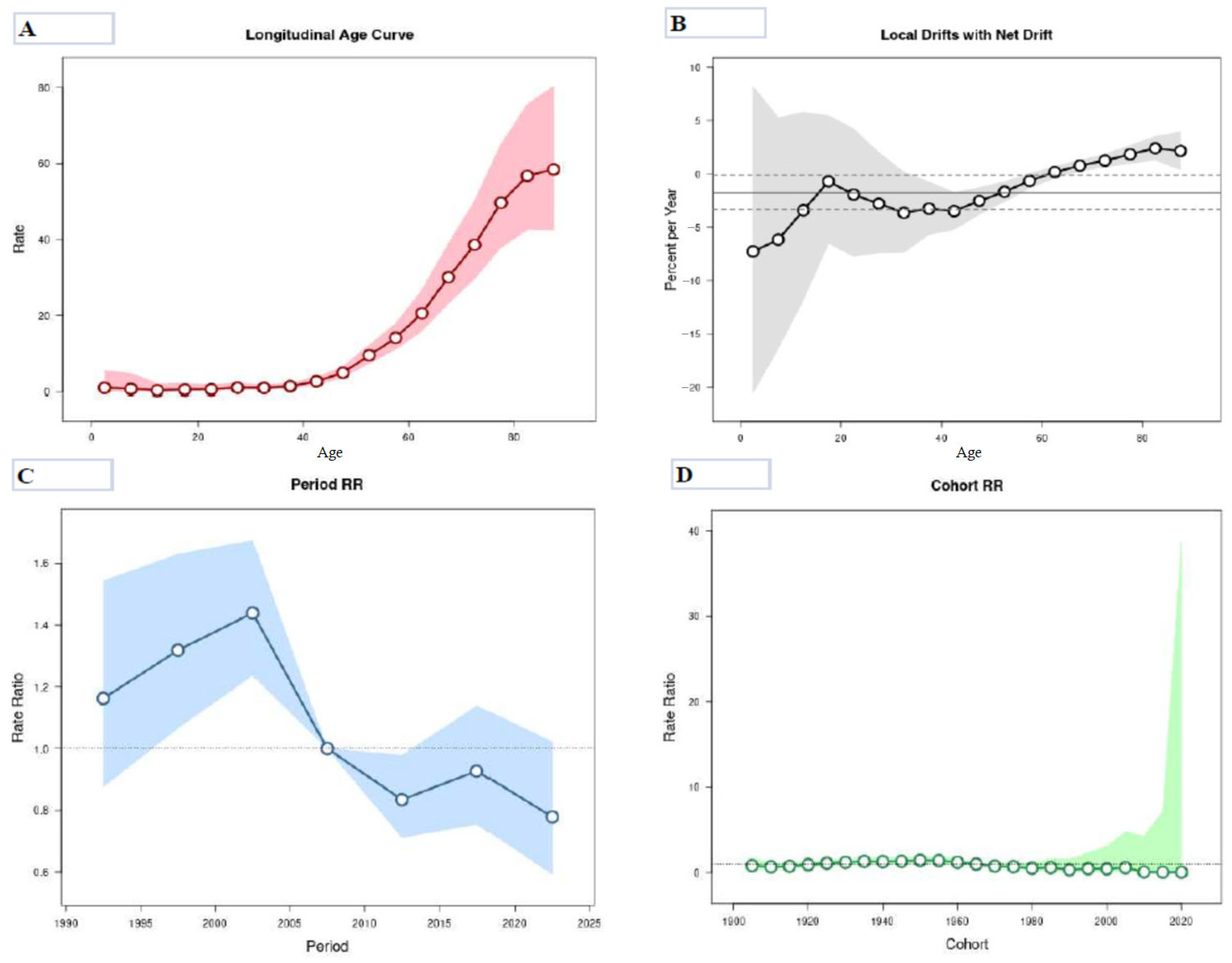
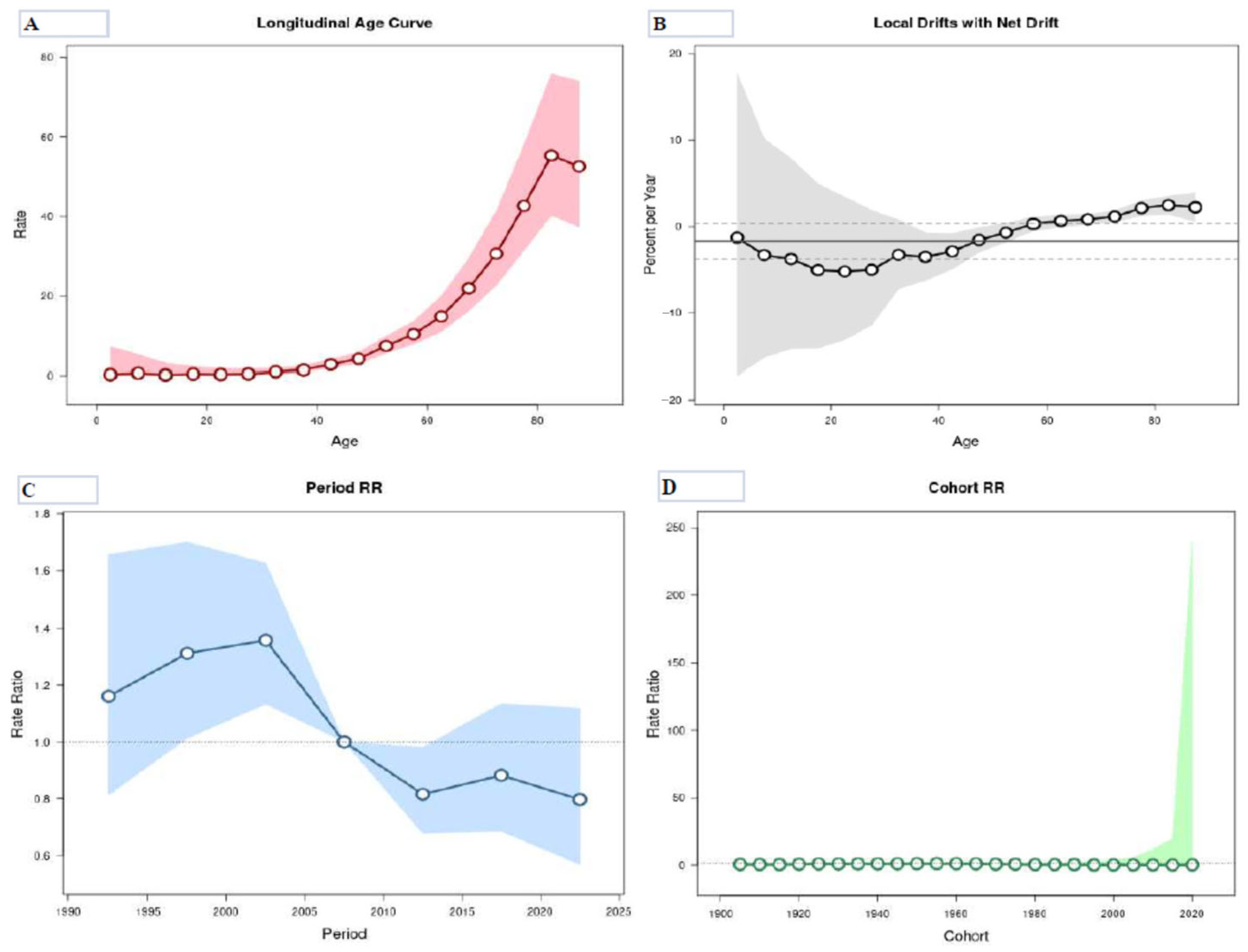
| Age | 0–4 | 1.01 | 0.19–5.52 | 0.29 | 0.01–7.16 |
| 5–9 | 0.73 | 0.11–4.79 | 0.62 | 0.07–5.22 | |
| 10–14 | 0.36 | 0.06–2.13 | 0.20 | 0.01–3.04 | |
| 15–19 | 0.55 | 0.14–2.14 | 0.42 | 0.08–2.24 | |
| 20–24 | 0.61 | 0.20–1.19 | 0.33 | 0.06–1.72 | |
| 25–29 | 1.06 | 0.50–2.24 | 0.45 | 0.12–1.66 | |
| 30–34 | 0.98 | 0.51–1.89 | 0.97 | 0.50–1.88 | |
| 35–39 | 1.41 | 0.88–2.25 | 1.41 | 0.85–2.34 | |
| 40–44 | 2.69 | 1.90–3.82 | 2.72 | 1.84–4.03 | |
| 45–49 | 4.92 | 3.67–6.58 | 4.10 | 2.94–5.71 | |
| 50–54 | 9.53 | 7.41–12.25 | 7.32 | 5.49–9.76 | |
| 55–59 | 14.11 | 11.08–17.97 | 10.30 | 7.83–13.53 | |
| 60–64 | 20.59 | 15.89–26.69 | 14.74 | 10.94–19.88 | |
| 65–69 | 30.06 | 23.20–38.95 | 21.82 | 16.19–29.41 | |
| 70–74 | 38.61 | 29.69–50.21 | 30.55 | 22.61–41.29 | |
| 75–79 | 49.68 | 37.91–65.11 | 42.63 | 31.39–57.89 | |
| 80–84 | 56.75 | 42.58–75.63 | 55.29 | 40.27–75.90 | |
| 85+ | 58.44 | 42.48–80.40 | 52.55 | 37.31–74.01 | |
| Period | |||||
| 1990–1994 | 1.16 | 0.88–1.54 | 1.16 | 0.81–1.66 | |
| 1995–1999 | 1.32 | 1.07–1.63 | 1.31 | 1.01–1.70 | |
| 2000–2004 | 1.44 | 1.24–1.67 | 1.36 | 1.13–1.63 | |
| 2005–2009 | 1.00 | 1.00–1.00 | 1.00 | 1.00–1.00 | |
| 2010–2014 | 0.83 | 0.71–0.98 | 0.82 | 0.68–0.98 | |
| 2015–2019 | 0.93 | 0.76–1.14 | 0.88 | 0.69–1.14 | |
| 2020–2024 | 0.78 | 0.59–1.02 | 0.80 | 0.57–1.12 | |
| Cohort | |||||
| 1905–1909 | 0.82 | 0.38–1.75 | 0.60 | 0.29–1.26 | |
| 1910–1914 | 0.68 | 0.41–1.11 | 0.54 | 0.34–0.88 | |
| 1915–1919 | 0.75 | 0.50–1.13 | 0.49 | 0.31–0.76 | |
| 1920–1924 | 0.94 | 0.68–1.29 | 0.70 | 0.49–0.99 | |
| 1925–1929 | 1.11 | 0.83–1.47 | 0.88 | 0.64–1.21 | |
| 1930–1934 | 1.21 | 0.92–1.59 | 0.92 | 0.67–1.26 | |
| 1935–1939 | 1.33 | 1.02–1.73 | 0.97 | 0.72–1.32 | |
| 1940–1944 | 1.29 | 0.99–1.68 | 0.97 | 0.72–1.31 | |
| 1945–1949 | 1.33 | 1.03–1.74 | 1.01 | 0.75–1.37 | |
| 1950–1954 | 1.45 | 1.12–1.87 | 1.07 | 0.80–1.44 | |
| 1955–1959 | 1.41 | 1.09–1.83 | 1.15 | 0.86–1.55 | |
| 1960–1964 | 1.22 | 0.92–1.61 | 1.07 | 0.78–1.46 | |
| 1965–1969 | 1.00 | 1.00–1.00 | 1.00 | 1.00–1.00 | |
| 1970–1974 | 0.76 | 0.51–1.15 | 0.70 | 0.44–1.10 | |
| 1975–1979 | 0.70 | 0.41–1.17 | 0.67 | 0.37–1.21 | |
| 1980–1984 | 0.52 | 0.25–1.07 | 0.45 | 0.19–1.07 | |
| 1985–1989 | 0.60 | 0.22–1.64 | 0.44 | 0.14–1.36 | |
| 1990–1994 | 0.34 | 0.07–1.57 | 0.45 | 0.09–2.31 | |
| 1995–1999 | 0.48 | 0.10–2.34 | 0.14 | 0.01–2.31 | |
| 2000–2004 | 0.45 | 0.07–3.13 | 0.16 | 0.01–3.64 | |
| 2005–2009 | 0.59 | 0.07–4.78 | 0.17 | 0.01–5.66 | |
| 2010–2014 | 0.09 | 0.00–4.31 | 0.19 | 0.00–11.60 | |
| 2015–2019 | 0.07 | 0.00–7.19 | 0.15 | 0.00–19.87 | |
| 2020–2024 | 0.06 | 0.00–38.77 | 0.22 | 0.00–38.77 | |
| Wald Chi-square tests for estimable functions, p-value | |||||
| Net drift | 0.0351 | 0.1032 | |||
| All period rate ratios | <0.0001 | <0.0001 | |||
| All cohort rate ratios | <0.0001 | <0.0001 | |||
| All local drifts | <0.0001 | 0.0074 | |||
Disclaimer/Publisher’s Note: The statements, opinions and data contained in all publications are solely those of the individual author(s) and contributor(s) and not of MDPI and/or the editor(s). MDPI and/or the editor(s) disclaim responsibility for any injury to people or property resulting from any ideas, methods, instructions or products referred to in the content. |
© 2026 by the authors. Licensee MDPI, Basel, Switzerland. This article is an open access article distributed under the terms and conditions of the Creative Commons Attribution (CC BY) license.
Share and Cite
Ilic, I.; Jakovljevic, V.; Ilic, M. Mortality Trends in Cancer of Unknown Primary Site in Serbia, 1990–2024: A Joinpoint Regression and Age–Period–Cohort Analysis. Epidemiologia 2026, 7, 37. https://doi.org/10.3390/epidemiologia7020037
Ilic I, Jakovljevic V, Ilic M. Mortality Trends in Cancer of Unknown Primary Site in Serbia, 1990–2024: A Joinpoint Regression and Age–Period–Cohort Analysis. Epidemiologia. 2026; 7(2):37. https://doi.org/10.3390/epidemiologia7020037
Chicago/Turabian StyleIlic, Irena, Vladimir Jakovljevic, and Milena Ilic. 2026. "Mortality Trends in Cancer of Unknown Primary Site in Serbia, 1990–2024: A Joinpoint Regression and Age–Period–Cohort Analysis" Epidemiologia 7, no. 2: 37. https://doi.org/10.3390/epidemiologia7020037
APA StyleIlic, I., Jakovljevic, V., & Ilic, M. (2026). Mortality Trends in Cancer of Unknown Primary Site in Serbia, 1990–2024: A Joinpoint Regression and Age–Period–Cohort Analysis. Epidemiologia, 7(2), 37. https://doi.org/10.3390/epidemiologia7020037