
Artificial Intelligence in Non-Insulin-Treated Type 2 Diabetes: From Reactive Management to Anticipatory Care

 ,
, 
Abstract
1. Introduction
2. Methods: Literature Search Strategy and Article Selection
3. Why Non-Insulin-Treated Type 2 Diabetes Is a Key Scenario for Artificial Intelligence
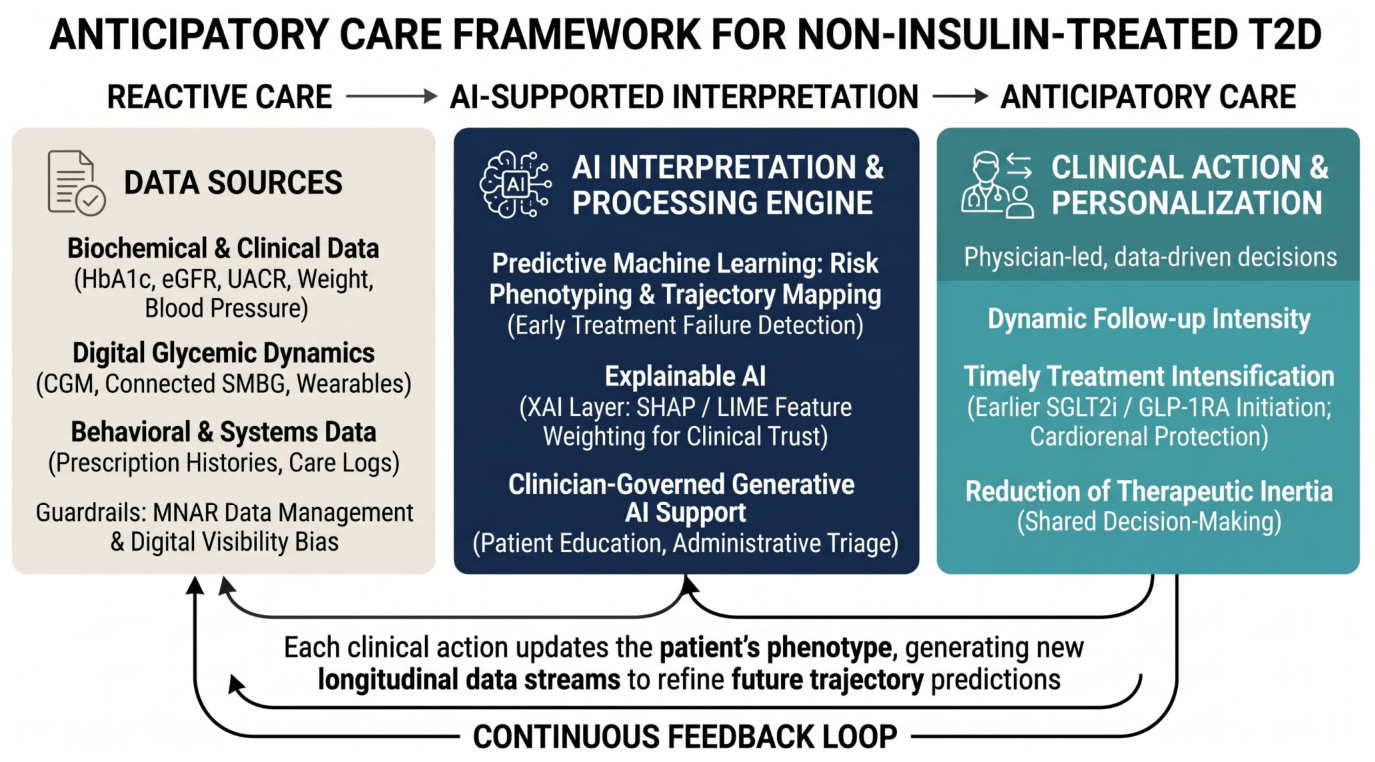
4. From Reactive Management to Anticipatory Care
5. Current Applications of Artificial Intelligence in Non-Insulin-Treated Type 2 Diabetes
Current Strength of the Evidence Base

| Clinical Area | Evidence Maturity | Data Sources | AI Function | Potential Clinical Benefit | Main Limitations/Implementation Risks |
|---|---|---|---|---|---|
| Glycemic interpretation | Routine practice for standardised CGM metric interpretation [9,10]; AI-driven pattern detection remains emerging | HbA1c, SMBG, CGM, meal/activity records | Pattern recognition, variability analysis, discordance detection | Better identification of hidden instability and early drift | Poor data quality, missing values, uncertain thresholds, limited access to CGM, digital visibility bias |
| Therapeutic personalization | Emerging evidence; retrospective observational support only [19,20] | Clinical history, labs, medications, comorbidities, adherence | Risk phenotyping, response prediction, scenario support | Earlier and more individualized intensification | Confounding by indication, limited external validation, black-box outputs requiring XAI approaches such as SHAP/LIME for clinical trust, unclear action thresholds |
| Remote follow-up | Emerging evidence for CGM-based follow-up; AI-based alert prioritisation investigational | Glucose, weight, BP, activity, symptoms, prescription data | Trend detection, alert prioritization, adaptive monitoring | Earlier contact for patients who are deteriorating | Alert fatigue, workflow burden, unclear responsibility, lack of interoperability, unequal digital access |
| Progression prediction | Investigational; no prospective validation in this population | Longitudinal clinical, biochemical, renal and behavioral data | Dynamic risk models | Prediction of loss of control, treatment failure, and complications | Bias, MNAR data, digital visibility bias, model drift, poor transportability, uncertain clinical actionability |
| Generative AI support | Investigational; no clinical outcome data | Clinical notes, education material, patient-reported information | Summarization, communication support, visit preparation | Reduced administrative burden and improved education | Hallucinations, plausible but incorrect outputs, need for human supervision, medico-legal uncertainty, risk of unsupervised therapeutic advice |
| Study | Population, Setting and Sample Size | AI Approach | Clinical Endpoint | Validation Strategy and Reported Performance | Direct Relevance to Non-Insulin-Treated T2D | Main Limitations |
|---|---|---|---|---|---|---|
| Musacchio et al., 2024 Int J Med Inform [19] | Adults with T2D on metformin monotherapy and two consecutive mean HbA1c > 7.0% (>53 mmol/mol). AMD Annals database, 271 Italian diabetes clinics, 2005–2019, drawn from ~1.5 million records. Inertia-NO n = 20,067; inertia-YES n = 13,029. | Logic Learning Machine (Rulex), a rule-based “clear box” model generating explicit if-then rules and variable thresholds without a post hoc explainability layer. | Presence versus absence of therapeutic inertia (failure to intensify despite persistent above-target HbA1c). | Internal split (70% learning/30% test). No external validation. ROC-AUC 0.81; accuracy 0.71; precision 0.80; recall 0.71; F1 0.75. Calibration not reported. Identified two distinct HbA1c patterns: a modest rise with high variability (SD > +0.57%) was more strongly associated with inertia than a large rise. | Direct. The only study identified that is restricted to non-insulin-treated T2D on oral monotherapy. | Internal validation only; calibration not reported. Classifies inertia that has already occurred rather than predicting future deterioration. Italian specialist clinics only, limiting transportability to primary care. Data window (2005–2019) precedes widespread SGLT2i and GLP-1RA use. |
| Ravizza et al., 2019 Nat Med [18] | Adults with diabetes and no CKD at baseline. Two US real-world EHR sources: IBM Explorys (n = 417,912, feature selection) and Indiana Network for Patient Care (n = 82,912, model development). | Random forest using seven data-driven selected routine variables (age, BMI, eGFR, creatinine, glucose, albumin, HbA1c), compared with logistic regression. | Incident chronic kidney disease. | Model derived and tested across two independent real-world databases; no prospective validation. AUC 0.833 (random forest) versus 0.827 (logistic regression). Reported to outperform published trial-derived algorithms on case-by-case comparison. Calibration not reported. | Indirect. Mixed diabetes population, not restricted by treatment modality. Renal endpoint, not therapeutic failure. | Real-world data completeness and coding heterogeneity. Calibration not reported. Marginal gain over logistic regression (delta-AUC 0.006). Predicts complication onset rather than treatment response or timing of intensification. |
| Musacchio et al., 2024 Mach Learn Knowl Extr [20] | Adults with T2D on dual or triple therapy with HbA1c above threshold at two consecutive visits. AMD Annals (1,186,247 patients, 2005–2019); analysed cohort n = 85,239 (20,015 modelling; 65,224 simulation). | Logic Learning Machine combined with a counterfactual “what-if” scenario simulation of timely insulin initiation. | Attainment of HbA1c target at 12 months following (simulated) timely insulin initiation. | Internal split. No external validation. Simulated outcomes are model-projected, not observed. AUC 0.704, described by the authors as modest; accuracy 0.64; specificity 0.65; recall 0.61. Simulation projected a 17% relative increase in patients reaching target. | Marginal. The modelled decision is insulin initiation, i.e., the exit point from the non-insulin-treated population. | Modest discrimination, acknowledged by the authors as reflecting reliance on baseline variables alone. Counterfactual projections are not prospectively verified. Industry-funded. Data window precedes current pharmacological options. |
| Fan et al., 2021 Front Pharmacol [17] | 165 adults with medication-nonadherent T2D (of 800 screened), single-centre inpatient records, Sichuan, China, 2010–2015. 129 (78%) had HbA1c ≥ 7%. | Seven algorithm families used to build 18 prediction models; the best-performing model was selected for each outcome. | Onset of diabetic nephropathy, peripheral neuropathy, angiopathy and eye disease; glycaemic control status. | Internal test set only. No external validation. Best test-set AUC: nephropathy 0.902 +/− 0.040; angiopathy 0.889 +/− 0.059; neuropathy 0.859 +/− 0.050; eye disease 0.832 +/− 0.086; HbA1c 0.825 +/− 0.092. Calibration not reported. | Indirect. Nonadherent T2D overlaps conceptually, but the setting is single-centre and inpatient. | Sample size (n = 165) is small relative to the number of models fitted and to the high reported AUCs, making overfitting likely. Selecting the best-performing model per outcome further inflates apparent performance. No external validation; no calibration; single centre. |
| Kopitar et al., 2020 Sci Rep [27] | 3723 adults with no prior diagnosis of diabetes attending preventive health examinations, 10 Slovenian primary care centres, 2014–2017. | Glmnet, random forest, XGBoost and LightGBM compared against a regression baseline. Reported against TRIPOD. | Fasting plasma glucose level and detection of impaired fasting glucose/undiagnosed T2D. | 100 bootstrap iterations (internal). Calibration explicitly assessed. Best AUC 0.859 (Glmnet) versus 0.854 (regression baseline). R2 0.26–0.36 across models, indicating weak calibration. The authors conclude that machine learning conferred no clinically relevant advantage over regression. | None. Screening for undiagnosed diabetes in a population without diabetes; outside the target population of this review. Cited for methodological context only (Section 7). | Single database; high proportion of missing values. Working-age screening population underrepresents older adults, in whom T2D is most prevalent. Findings concern case-finding, not longitudinal management. |
6. Near-Future Applications and Plausible Clinical Scenarios
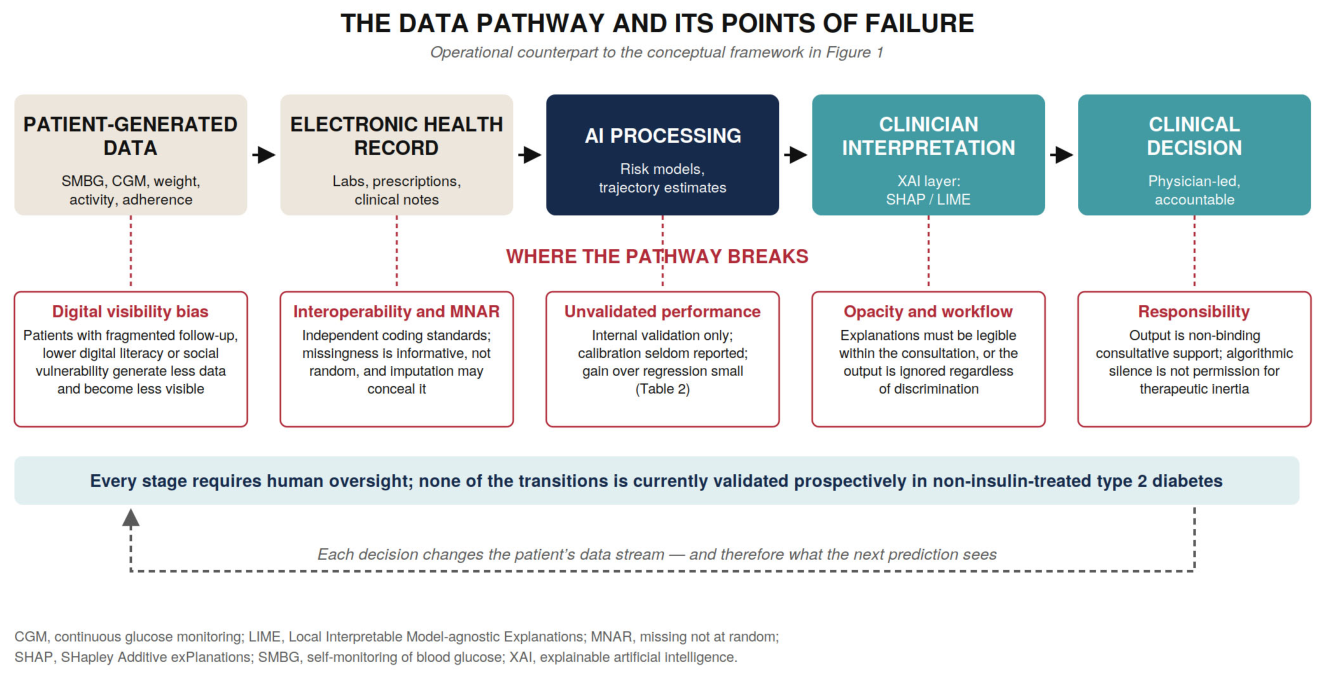
7. Limitations, Risks, and Barriers to Implementation
Practical Barriers to Implementation
8. Practical Implications for Diabetologists
9. Conclusions
Author Contributions
Funding
Institutional Review Board Statement
Informed Consent Statement
Data Availability Statement
Acknowledgments
Conflicts of Interest
Abbreviations
| Abbreviation | Definition |
| AI | Artificial intelligence |
| CGM | Continuous glucose monitoring |
| eGFR | Estimated glomerular filtration rate |
| GLP-1RA | Glucagon-like peptide-1 receptor agonist |
| LIME | Local Interpretable Model-agnostic Explanations |
| MNAR | Missing not at random |
| SHAP | SHapley Additive exPlanations |
| SGLT2i | Sodium-glucose cotransporter-2 inhibitor |
| SMBG | Self-monitoring of blood glucose |
| T2D | Type 2 diabetes |
| UACR | Urinary albumin-to-creatinine ratio |
| XAI | Explainable artificial intelligence |
References
- International Diabetes Federation. IDF Diabetes Atlas, 11th ed.; International Diabetes Federation: Brussels, Belgium, 2025. [Google Scholar]
- American Diabetes Association Professional Practice Committee. 2. Diagnosis and Classification of Diabetes: Standards of Care in Diabetes—2026. Diabetes Care 2026, 49, S27–S49. [Google Scholar] [PubMed]
- American Diabetes Association Professional Practice Committee. 7. Diabetes Technology: Standards of Care in Diabetes—2026. Diabetes Care 2026, 49, S150–S165. [Google Scholar] [PubMed]
- American Diabetes Association Professional Practice Committee. 9. Pharmacologic Approaches to Glycemic Treatment: Standards of Care in Diabetes—2026. Diabetes Care 2026, 49, S183–S215. [Google Scholar] [PubMed]
- Davies, M.J.; Aroda, V.R.; Collins, B.S.; Gabbay, R.A.; Green, J.; Maruthur, N.M.; Rosas, S.E.; Del Prato, S.; Mathieu, C.; Mingrone, G.; et al. Management of Hyperglycemia in Type 2 Diabetes, 2022. A Consensus Report by the American Diabetes Association and the European Association for the Study of Diabetes. Diabetes Care 2022, 45, 2753–2786. [Google Scholar] [CrossRef] [Scilit] [PubMed]
- Chung, W.K.; Erion, K.; Florez, J.C.; Hattersley, A.T.; Hivert, M.F.; Lee, C.G.; McCarthy, M.I.; Nolan, J.J.; Norris, J.M.; Pearson, E.R.; et al. Precision medicine in diabetes: A Consensus Report from the American Diabetes Association and the European Association for the Study of Diabetes. Diabetologia 2020, 63, 1671–1693. [Google Scholar] [CrossRef] [Scilit] [PubMed]
- Khunti, K.; Gomes, M.B.; Pocock, S.; Shestakova, M.V.; Pintat, S.; Fenici, P.; Hammar, N.; Medina, J. Therapeutic inertia in the treatment of hyperglycaemia in patients with type 2 diabetes: A systematic review. Diabetes Obes. Metab. 2018, 20, 427–437. [Google Scholar] [CrossRef] [Scilit] [PubMed]
- Khunti, S.; Khunti, K.; Seidu, S. Therapeutic inertia in type 2 diabetes: Prevalence, causes, consequences and methods to overcome inertia. Ther. Adv. Endocrinol. Metab. 2019, 10, 2042018819844694. [Google Scholar] [CrossRef] [Scilit] [PubMed]
- Danne, T.; Nimri, R.; Battelino, T.; Bergenstal, R.M.; Close, K.L.; DeVries, J.H.; Garg, S.; Heinemann, L.; Hirsch, I.; Amiel, S.A.; et al. International Consensus on Use of Continuous Glucose Monitoring. Diabetes Care 2017, 40, 1631–1640. [Google Scholar] [CrossRef] [Scilit] [PubMed]
- Battelino, T.; Danne, T.; Bergenstal, R.M.; Amiel, S.A.; Beck, R.; Biester, T.; Bosi, E.; Buckingham, B.A.; Cefalu, W.T.; Close, K.L.; et al. Clinical Targets for Continuous Glucose Monitoring Data Interpretation: Recommendations From the International Consensus on Time in Range. Diabetes Care 2019, 42, 1593–1603. [Google Scholar] [CrossRef] [Scilit] [PubMed]
- Young, L.A.; Buse, J.B.; Weaver, M.A.; Vu, M.B.; Mitchell, C.M.; Blakeney, T.; Grimm, K.; Rees, J.; Niblock, F.; Donahue, K.E.; et al. Glucose self-monitoring in non-insulin-treated patients with type 2 diabetes in primary care settings: A randomized trial. JAMA Intern. Med. 2017, 177, 920–929. [Google Scholar] [CrossRef] [Scilit] [PubMed]
- Shields, S.; Thomas, R.; Durham, J.; Moran, J.; Clary, J.; Ciemins, E.L. Continuous glucose monitoring among adults with type 2 diabetes receiving noninsulin or basal insulin therapy in primary care. Sci. Rep. 2024, 14, 31990. [Google Scholar] [CrossRef] [Scilit] [PubMed]
- Aronson, R.; Abitbol, A.; Bajaj, H.S.; Cheng, A.Y.Y.; Christopoulos, S.; Harris, S.B.; Jain, A.B.; Goldenberg, R.M. Continuous glucose monitoring in noninsulin-treated type 2 diabetes: A critical review of reported trials with an updated systematic review and meta-analysis of randomised controlled trials. Diabetes Obes. Metab. 2025, 27, 6220–6242. [Google Scholar] [CrossRef] [Scilit] [PubMed]
- Contreras, I.; Vehí, J. Artificial Intelligence for Diabetes Management and Decision Support: Literature Review. J. Med. Internet Res. 2018, 20, e10775. [Google Scholar] [CrossRef] [Scilit]
- Dankwa-Mullan, I.; Rivo, M.; Sepulveda, M.; Park, Y.; Snowdon, J.; Rhee, K. Transforming Diabetes Care Through Artificial Intelligence: The Future Is Here. Popul. Health Manag. 2019, 22, 229–242. [Google Scholar] [CrossRef] [Scilit]
- Mackenzie, S.C.; Sainsbury, C.A.R.; Wake, D.J. Diabetes and artificial intelligence beyond the closed loop: A review of the landscape, promise and challenges. Diabetologia 2024, 67, 223–235. [Google Scholar]
- Fan, Y.; Long, E.; Cai, L.; Cao, Q.; Wu, X.; Tong, R. Machine Learning Approaches to Predict Risks of Diabetic Complications and Poor Glycemic Control in Nonadherent Type 2 Diabetes. Front. Pharmacol. 2021, 12, 665951. [Google Scholar] [CrossRef] [Scilit] [PubMed]
- Ravizza, S.; Huschto, T.; Adamov, A.; Boehm, L.; Buesser, A.; Floether, F.F.; Hinzmann, R.; König, H.; McAhren, S.M.; Robertson, D.H.; et al. Predicting the early risk of chronic kidney disease in patients with diabetes using real-world data. Nat. Med. 2019, 25, 57–59. [Google Scholar] [CrossRef] [Scilit] [PubMed]
- Musacchio, N.; Zilich, R.; Masi, D.; Baccetti, F.; Nreu, B.; Giorda, C.B.; Guaita, G.; Morviducci, L.; Muselli, M.; Ozzello, A.; et al. A transparent machine learning algorithm uncovers HbA1c patterns associated with therapeutic inertia in patients with type 2 diabetes and failure of metformin monotherapy. Int. J. Med. Inform. 2024, 190, 105550. [Google Scholar] [CrossRef] [Scilit] [PubMed]
- Musacchio, N.; Zilich, R.; Masi, D.; Baccetti, F.; Nreu, B.; Giorda, C.B.; Guaita, G.; Morviducci, L.; Muselli, M.; Ozzello, A.; et al. Overcoming Therapeutic Inertia in Type 2 Diabetes: Exploring Machine Learning-Based Scenario Simulation for Improving Short-Term Glycemic Control. Mach. Learn. Knowl. Extr. 2024, 6, 420–434. [Google Scholar] [CrossRef] [Scilit]
- Baethge, C.; Goldbeck-Wood, S.; Mertens, S. SANRA—A scale for the quality assessment of narrative review articles. Res. Integr. Peer Rev. 2019, 4, 5. [Google Scholar] [CrossRef] [Scilit] [PubMed]
- Rajkomar, A.; Dean, J.; Kohane, I. Machine Learning in Medicine. N. Engl. J. Med. 2019, 380, 1347–1358. [Google Scholar] [CrossRef] [Scilit] [PubMed]
- Topol, E.J. High-performance medicine: The convergence of human and artificial intelligence. Nat. Med. 2019, 25, 44–56. [Google Scholar] [CrossRef] [Scilit] [PubMed]
- Kelly, C.J.; Karthikesalingam, A.; Suleyman, M.; Corrado, G.; King, D. Key challenges for delivering clinical impact with artificial intelligence. BMC Med. 2019, 17, 195. [Google Scholar] [CrossRef] [Scilit] [PubMed]
- Matheny, M.E.; Whicher, D.; Thadaney Israni, S. Artificial Intelligence in Health Care: A Report From the National Academy of Medicine. JAMA 2020, 323, 509–510. [Google Scholar] [PubMed]
- Wiens, J.; Saria, S.; Sendak, M.; Ghassemi, M.; Liu, V.X.; Doshi-Velez, F.; Jung, K.; Heller, K.; Kale, D.; Saeed, M.; et al. Do no harm: A roadmap for responsible machine learning for health care. Nat. Med. 2019, 25, 1337–1340. [Google Scholar] [CrossRef] [Scilit] [PubMed]
- Kopitar, L.; Kocbek, P.; Cilar, L.; Sheikh, A.; Stiglic, G. Early detection of type 2 diabetes mellitus using machine learning-based prediction models. Sci. Rep. 2020, 10, 11981. [Google Scholar] [CrossRef] [Scilit] [PubMed]
- World Health Organization. Ethics and Governance of Artificial Intelligence for Health; World Health Organization: Geneva, Switzerland, 2021. [Google Scholar]
- Wang, M.; Sushil, M.; Williams, C.Y.K.; Miao, B.Y.; Kim, S.; Masharani, U.; Ku, G.; Hsiao, V.; Shah, A.; Koliwad, S.K.; et al. Assessment of Large Language Models for Enhancing Diabetologist-Developed Personalized Treatment Plans in Complex Type 2 Diabetes. Clin. Diabetes 2025, 43, 545–553. [Google Scholar] [CrossRef] [Scilit] [PubMed]
- European Parliament and Council of the European Union. Regulation (EU) 2024/1689 of 13 June 2024 Laying Down Harmonised Rules on Artificial Intelligence (Artificial Intelligence Act). 12 July 2024. Available online: http://data.europa.eu/eli/reg/2024/1689/oj (accessed on 23 July 2026).
- Liu, X.; Cruz Rivera, S.; Moher, D.; Calvert, M.J.; Denniston, A.K. Reporting guidelines for clinical trial reports for interventions involving artificial intelligence: The CONSORT-AI extension. Nat. Med. 2020, 26, 1364–1374. [Google Scholar] [CrossRef] [Scilit] [PubMed]
- Cruz Rivera, S.; Liu, X.; Chan, A.W.; Denniston, A.K.; Calvert, M.J. Guidelines for clinical trial protocols for interventions involving artificial intelligence: The SPIRIT-AI extension. Nat. Med. 2020, 26, 1351–1363. [Google Scholar] [CrossRef] [Scilit] [PubMed]
- Ribeiro, M.T.; Singh, S.; Guestrin, C. “Why Should I Trust You?”: Explaining the Predictions of Any Classifier. In Proceedings of the 22nd ACM SIGKDD International Conference on Knowledge Discovery and Data Mining, San Francisco, CA, USA, 13–17 August 2016; pp. 1135–1144. [Google Scholar]
- Lundberg, S.M.; Lee, S.I. A unified approach to interpreting model predictions. Adv. Neural Inf. Process. Syst. 2017, 30, 4765–4774. [Google Scholar]


Disclaimer/Publisher’s Note: The statements, opinions and data contained in all publications are solely those of the individual author(s) and contributor(s) and not of MDPI and/or the editor(s). MDPI and/or the editor(s) disclaim responsibility for any injury to people or property resulting from any ideas, methods, instructions or products referred to in the content. |
© 2026 by the authors. Licensee MDPI, Basel, Switzerland. This article is an open access article distributed under the terms and conditions of the Creative Commons Attribution (CC BY) license.
Share and Cite
Labate, A.M.; Cimino, E.; Giacomelli, L.; Ettori, S.; Oladeji, O.A.; Agosti, B. Artificial Intelligence in Non-Insulin-Treated Type 2 Diabetes: From Reactive Management to Anticipatory Care. Endocrines 2026, 7, 40. https://doi.org/10.3390/endocrines7030040
Labate AM, Cimino E, Giacomelli L, Ettori S, Oladeji OA, Agosti B. Artificial Intelligence in Non-Insulin-Treated Type 2 Diabetes: From Reactive Management to Anticipatory Care. Endocrines. 2026; 7(3):40. https://doi.org/10.3390/endocrines7030040
Chicago/Turabian StyleLabate, Antonio Maria, Elena Cimino, Laura Giacomelli, Stefano Ettori, Oladayo Adigun Oladeji, and Barbara Agosti. 2026. "Artificial Intelligence in Non-Insulin-Treated Type 2 Diabetes: From Reactive Management to Anticipatory Care" Endocrines 7, no. 3: 40. https://doi.org/10.3390/endocrines7030040
APA StyleLabate, A. M., Cimino, E., Giacomelli, L., Ettori, S., Oladeji, O. A., & Agosti, B. (2026). Artificial Intelligence in Non-Insulin-Treated Type 2 Diabetes: From Reactive Management to Anticipatory Care. Endocrines, 7(3), 40. https://doi.org/10.3390/endocrines7030040