
Article

Effectiveness of Injectable Semaglutide 1 mg/Week in Hepatic Markers, Fibrosis and Systemic Inflammation in Obese Type 2 Diabetes Patients: A 6-Month Retrospective Real-World Study

by
Rosa Natalia García-Pérez
1,†,
Víctor Siles-Guerrero
1,†,
Aida Elhadri-Egea
1,
Gonzalo Piedrola-Maroto
1,
Juan Manuel Guardia-Baena
1,
María Hayón-Ponce
1,
Martín López-de-la-Torre-Casares
1,2,‡,
Araceli Muñoz-Garach
1,2,3,*,‡ and
Jose M. Romero-Márquez
1,4,5,*
1
Department of Endocrinology and Nutrition, Virgen de las Nieves University Hospital, 18014 Granada, Spain
2
Granada Biosanitary Research Institute (ibs.GRANADA), 18012 Granada, Spain
3
Physiopathology of Obesity and Nutrition Networking Biomedical Research Centre (CIBEROBN), Carlos III Health Institute, 28029 Madrid, Spain
4
Foundation for Biosanitary Research of Eastern Andalusia—Alejandro Otero (FIBAO), 18012 Granada, Spain
5
Faculty of Health Sciences, Department of Nutrition and Sports Sciences, International University of La Rioja, 26006 La Rioja, Spain
*
Authors to whom correspondence should be addressed.
These authors contributed equally to this work.
These authors share senior position.
Endocrines 2026, 7(3), 39; https://doi.org/10.3390/endocrines7030039
Submission received: 5 May 2026 / Revised: 2 July 2026 / Accepted: 9 July 2026 / Published: 27 July 2026

Abstract

Background: Type 2 diabetes mellitus is commonly associated with obesity, metabolic liver disease, and chronic low-grade inflammation. Semaglutide is known to improve glycaemic control and body weight, but its real-world associations with hepatic markers, fibrosis-related indices, and systemic inflammatory parameters remain incompletely characterized. This study evaluated changes in metabolic, hepatic, and inflammatory parameters during injectable semaglutide treatment and explored whether these changes differed according to baseline disease status. Methods: A retrospective observational study was conducted in patients with type 2 diabetes treated with injectable semaglutide 1 mg/week and followed for six months. Anthropometric, metabolic, hepatic, and inflammatory variables were collected at baseline and follow-up, including liver enzymes, the Fibrosis-4 (FIB-4) index, and the systemic immune–inflammation (SII) index. Analyses included correlation analyses and exploratory stratification according to baseline fibrosis risk and inflammatory status. Results: Semaglutide treatment was associated with significant reductions in body weight, body mass index, fasting glucose, HbA1c, and triglyceride levels. Alanine and aspartate aminotransferase levels decreased significantly, consistent with a reduction in liver enzyme abnormalities during follow-up. No significant overall changes were observed in FIB-4, an indirect fibrosis-related index, or in SII, an indirect hematological inflammatory index. However, exploratory stratified analyses suggested that patients with higher baseline FIB-4-estimated fibrosis risk or elevated SII values showed greater reductions in these indices, whereas those with low baseline risk showed no relevant changes. Conclusions: In routine clinical practice, six months of injectable semaglutide treatment was associated with favorable metabolic changes and reductions in liver transaminases in patients with type 2 diabetes mellitus. Findings related to FIB-4 and SII should be interpreted cautiously, as these are indirect indices and the baseline-dependent patterns observed were exploratory and hypothesis-generating.

1. Introduction

Type 2 diabetes mellitus is recognized as a major global health challenge due to its high prevalence and its strong association with metabolic comorbidities, including obesity, dyslipidemia, and liver disease related to metabolic dysfunction [1,2]. In this context, the liver plays a central role in the pathophysiology of metabolic syndrome, acting as a key organ in the regulation of lipid and glucose metabolism. The accumulation of hepatic fat, together with chronic low-grade inflammation and insulin resistance, promotes the progression from simple steatosis to more advanced forms of liver injury, including fibrosis, cirrhosis, and an increased risk of cardiovascular disease [3,4]. Therefore, identifying therapeutic strategies capable of improving glycemic control, excess weight, and liver dysfunction in an integrated manner represents a clinical priority.
Glucagon-like peptide-1 (GLP-1) receptor agonists have emerged in recent years as a major therapeutic option for the management of obesity and type 2 diabetes. These agents improve glycemic control by enhancing glucose-dependent insulin secretion and suppressing glucagon release, while also inducing clinically meaningful weight loss, largely through reduced appetite and caloric intake [5]. Semaglutide has demonstrated high efficacy in both randomized clinical trials and real-world clinical practice and is now established as a key therapeutic tool for patients at elevated cardiometabolic risk [2,5,6,7,8,9].
Beyond its well-recognized metabolic effects, increasing attention has been directed toward the potential impact of semaglutide on systemic inflammation and liver function. Individuals with obesity and type 2 diabetes exhibit a high prevalence of metabolic dysfunction–associated liver disease, the development of which is closely linked to metabolic derangements and chronic low-grade inflammation [3,10]. In this context, reductions in liver transaminase levels are considered indirect indicators of decreased hepatocellular injury [4,7,11]. In routine clinical practice, non-invasive indices such as FIB-4 allow for a simple estimation of liver fibrosis risk [12,13]. In addition, parameters derived from the complete blood count, including the systemic immune–inflammation index (SII), reflect the overall inflammatory status of the patient and have been associated with an increased risk of both cardiovascular and hepatic disease [14].
However, despite the growing body of evidence, results regarding the effects of semaglutide on systemic inflammatory markers and liver fibrosis remain heterogeneous, particularly in studies with short follow-up periods and in populations with a low baseline risk. Moreover, extrapolation to routine clinical practice is often limited, as much of the available evidence derives from randomized clinical trials with strict inclusion criteria. In this context, real-world observational studies offer valuable insights into treatment effectiveness in more diverse and representative patient populations, allowing assessment not only of average treatment effects but also of how baseline patient characteristics influence the magnitude of therapeutic response [1,2].
Furthermore, accumulating evidence indicates that the benefits of pharmacological interventions are not uniform across all patients, but instead vary according to the baseline severity of hepatic, inflammatory, or metabolic dysfunction [6]. Examining the response to semaglutide as a function of baseline liver fibrosis risk or the degree of systemic inflammation may therefore contribute to a more personalized therapeutic approach, enabling the identification of patient subgroups that derive the greatest clinical benefit and in whom the intervention may have the most meaningful prognostic impact.
In this context, the aim of this study is to evaluate the effectiveness of injectable semaglutide in patients with type 2 diabetes mellitus under real-world clinical practice conditions over a six-month period. The effects of treatment on metabolic parameters, liver markers, fibrosis indices, and systemic inflammatory indicators are assessed. In addition, the study explores whether baseline patient characteristics modulate the therapeutic response, thereby providing further evidence on the role of semaglutide in the integrated management of the diabetes–obesity–liver disease axis and supporting its potential application within a personalized treatment framework.

2. Materials and Methods

2.1. Study Design and Participants

A retrospective, single-center observational study without a concurrent control group, based on the review of medical records, was conducted at the Department of Endocrinology and Nutrition of the Virgen de las Nieves University Hospital in Granada, Spain. A total of 231 patients with type 2 diabetes mellitus who had been treated with injectable semaglutide 1 mg/week between May 2019 and November 2024 were retrospectively analyzed and had a minimum available follow-up of six months during treatment. According to the treating physicians’ judgment, semaglutide was primarily prescribed for body weight management or in the context of inadequate glycemic control.

2.2. Clinical and Biochemical Analyses

Relevant data on medication use, blood analyses, and anthropometric measurements were obtained from medical records. Baseline values, collected prior to the initiation of semaglutide therapy, were compared with those recorded after 6 months of follow-up (20–28 weeks). Anthropometric assessments, including body mass index, height, and body weight, were performed according to standard clinical procedures. Blood analyses were conducted on fasting samples and included the measurement of liver enzymes, specifically alanine aminotransferase (ALT) and aspartate aminotransferase (AST).
In addition, the indirect noninvasive hepatic fibrosis index Fibrosis-4 (FIB-4) was calculated using the established formula: (age [years] × AST [U/L])/(platelet count [109/L] × √ALT [U/L]). Other laboratory parameters evaluated included glycated hemoglobin, the triglyceride-to-glucose ratio, triglycerides, plasma glucose, total cholesterol, high-density lipoprotein cholesterol (HDL-C), and low-density lipoprotein cholesterol (LDL-C). Furthermore, several inflammatory and immune markers were assessed, including lymphocyte, platelet, and neutrophil counts, the neutrophil-to-lymphocyte (NLR) and platelet-to-lymphocyte (PLR) ratios, and the systemic immune–inflammation (SII) index, which was calculated as (platelet count × neutrophil count)/lymphocyte count.

2.3. Efficacy Assessment

Changes from baseline in liver enzyme levels and in immune cell counts and their corresponding ratios were considered the primary evaluation criteria. Secondary outcome measures included changes in the FIB-4 index, interpreted as an indirect non-invasive fibrosis marker; the SII index, interpreted as an indirect hematological inflammatory index; and metabolic parameters such as BMI, HbA1c, lipid profile, and body weight. In addition, clinical factors associated with variations in liver enzyme levels compared with baseline values were explored.

2.4. Statistical Analysis

Statistical analyses were performed using Jamovi software (version 2.3.28.0; University of Newcastle, Newcastle, Australia). Continuous variables were expressed as mean ± standard deviation, while categorical variables were presented as valid percentages. Depending on data distribution, baseline and six-month follow-up values were compared using paired t-tests or Wilcoxon signed-rank tests. To quantify the magnitude of changes in clinical and biochemical parameters, effect sizes (Cohen’s d) and 95% confidence intervals (CIs) were calculated. Spearman correlation analyses were conducted to explore associations between baseline or longitudinal clinical variables and changes in hepatic and indirect immune–inflammatory markers. Two-tailed p-values < 0.05 were considered statistically significant; however, given the exploratory nature of the analyses and the number of outcomes assessed, these results should be interpreted cautiously. Statistical analyses were performed using an available-case approach, including only participants with complete data for each specific variable; therefore, the effective sample size varied across analyses and may have affected the interpretability and generalizability of some findings (Table S1). The effective sample size (n) is indicated for each analysis. Changes (Δ) were calculated as six-month follow-up values minus baseline values; therefore, negative values indicate reductions during follow-up. Missing values were not imputed to avoid potential bias, particularly for biochemical and clinical parameters.
For the stratified risk subanalysis, patients were categorized according to their baseline FIB-4 and SII values. Cut-off points were selected based on the available literature, defining low risk as a FIB-4 < 1.36 and moderate-to-high risk as a FIB-4 ≥ 1.36. This threshold was used as an interpretative framework based on prior studies showing the utility of FIB-4 for excluding advanced fibrosis in patients with non-alcoholic fatty liver disease and for assessing fibrosis risk in populations with diabetes [15,16]. Similarly, SII values < 381 × 103/µL were considered indicative of low inflammatory risk, whereas values ≥ 381 × 103/µL defined moderate-to-high inflammatory risk [17]. These stratified analyses were conducted post hoc and should be interpreted as exploratory and hypothesis-generating.
Between-group comparisons at baseline and at 6-month follow-up were performed using independent-samples mean comparison tests. Within each baseline stratum, pre–post changes from baseline to 6 months were assessed using paired-samples tests. In addition, Δ values were compared between baseline strata to assess whether the magnitude of longitudinal change differed according to baseline FIB-4 or SII status. Independent-samples Student’s t-test or the Mann–Whitney U test were used for between-group comparisons of baseline, 6-month follow-up, and Δ values, whereas paired Student’s t-test or Wilcoxon signed-rank test was used for within-group pre–post comparisons, as appropriate according to variable distribution.

3. Results

3.1. Baseline Clinical and Biochemical Characteristics

Table 1 summarizes the baseline clinical and biochemical characteristics of the study population. The sample predominantly comprised middle-aged individuals, with a mean age of approximately 58 years, and included a substantial proportion of women. Anthropometric measurements revealed elevated body weight and a mean BMI within the obese range, indicating excess adiposity. Regarding metabolic markers, hypertriglyceridemia was observed in 42% of patients, along with an elevated triglyceride-to-glucose ratio. In addition, total cholesterol and LDL-C levels were moderately increased, whereas low HDL-C status was observed in 45.8% of patients. Overall, approximately two-thirds of the study population met the criteria for metabolic syndrome. Hepatic markers showed mildly increased ALT and AST values, along with a low-to-moderate FIB-4 index, suggesting a low-to-moderate estimated fibrosis risk based on this indirect non-invasive marker.
Similarly, immune and inflammatory markers showed platelet and leukocyte counts that were generally within conventional clinical ranges; however, derived indices such as the NLR, PLR, and SII provided indirect evidence of a higher inflammatory burden in a subset of participants. Overall, the table describes a population characterized by an unfavorable cardiometabolic and indirect inflammatory profile at study entry.

3.2. Effect of Semaglutide on Metabolic Parameters

The biochemical and clinical changes observed after six months of semaglutide treatment are summarized in Table 2. Among participants with available follow-up data, statistically significant favorable changes were noted in anthropometric parameters, with a mean weight reduction of −6.07 kg (p < 0.001; d = −0.91) and a decrease in BMI of −2.12 kg/m2 (p < 0.001; d = −0.93), suggesting a potentially clinically relevant reduction in adiposity in this observational cohort.
With respect to metabolic markers, blood glucose levels decreased by −28.88 mg/dL (p < 0.001), HbA1c by −1.22% (p < 0.001), and triglyceride concentrations by −51.83 mg/dL (p < 0.001). In addition, the triglyceride-to-glucose ratio and total cholesterol were reduced by −0.18 (p < 0.001) and by −9.95 mg/dL (p = 0.004), respectively. In contrast, no significant changes were observed in LDL-C or HDL-C. Regarding hepatic markers, significant reductions were detected in liver transaminases (Table 2), whereas the FIB-4 index remained stable. Finally, indirect immune–inflammatory markers did not show significant variations, with consistently small effect sizes, suggesting no clear overall change in these exploratory hematological indices during the follow-up period.

3.3. The Association Between Changes in Liver Enzymes and Baseline Clinical Parameters

The associations between changes in hepatic, glycemic, and indirect inflammatory outcomes and baseline clinical variables are presented in Table 3. Changes in HbA1c were significantly associated with baseline metabolic status, showing inverse correlations with baseline HbA1c (ρ = −0.668; p < 0.001), fasting glucose (ρ = −0.442; p < 0.001), and the triglyceride-to-glucose ratio (ρ = −0.339; p < 0.001).
With respect to liver function, changes in transaminases were mainly associated with baseline hepatic markers. Changes in ALT were inversely correlated with baseline ALT (ρ = −0.365; p = 0.004), AST (ρ = −0.514; p < 0.001), and FIB-4 (ρ = −0.349; p = 0.007), whereas changes in AST were inversely correlated with baseline ALT (ρ = −0.598; p < 0.001) and AST (ρ = −0.591; p < 0.001). Additionally, changes in the FIB-4 index were inversely correlated with baseline FIB-4 values (ρ = −0.359; p = 0.006), although this finding should be interpreted cautiously because FIB-4 is an indirect marker and baseline-dependent changes may partly reflect regression to the mean or short-term variations in transaminase levels.
Finally, changes in the SII index were significantly associated with several baseline hematological and inflammatory variables, including platelet count (ρ = −0.188; p = 0.027), neutrophil count (ρ = −0.356; p < 0.001), lymphocyte count (ρ = 0.233; p = 0.006), neutrophil-to-lymphocyte ratio (ρ = −0.418; p < 0.001), platelet-to-lymphocyte ratio (ρ = −0.344; p < 0.001), and baseline SII index (ρ = −0.473; p < 0.001). These associations should be considered exploratory, particularly because SII is an indirect hematological index whose changes are mathematically dependent on its cellular components and may also be influenced by baseline values. Overall, these findings suggest that baseline metabolic, hepatic, and hematological profiles were associated with the magnitude of longitudinal changes observed during follow-up, without implying causal or predictive effects.

3.4. The Association Between Changes in Liver Enzymes and Changes in Clinical Parameters

Table 4 summarizes the associations between changes in clinical variables and concurrent variations in glycemic, hepatic, and indirect inflammatory parameters. Reductions in body weight and BMI were significantly associated with favorable changes in metabolic and liver-related outcomes, with statistically significant correlations observed between weight loss and AST reduction (ρ = 0.284; p = 0.023) and between BMI reduction and changes in AST (ρ = 0.390; p = 0.003).
Changes in metabolic markers also showed significant associations with glycemic and hepatic changes. Notably, decreases in glucose levels were correlated with reductions in HbA1c (ρ = 0.684; p < 0.001) and AST (ρ = 0.264; p = 0.001). Similarly, reductions in triglyceride concentrations were associated with concomitant decreases in HbA1c (ρ = 0.274; p = 0.003), AST (ρ = 0.301; p = 0.001), and FIB-4 (ρ = 0.312; p = 0.019), although the association involving FIB-4 should be interpreted cautiously because this index is an indirect marker and short-term changes may partly reflect variations in transaminase levels rather than true fibrosis regression. A notable association was observed between the reduction in the triglyceride-to-glucose ratio and the decrease in HbA1c (ρ = 0.558; p < 0.001) and AST (ρ = 0.385; p < 0.001).
Within the hepatic domain, changes in transaminases were significantly interrelated, as reflected by the correlations between ΔAST and ΔALT (ρ = 0.638; p < 0.001), as well as between ΔALT and ΔFIB-4 (ρ = 0.556; p < 0.001), the latter requiring cautious interpretation because FIB-4 is an indirect index partly derived from transaminase values. Finally, changes in the SII index were significantly associated with variations in its hematological components and related indirect inflammatory indices, particularly lymphocytes (ρ = −0.423; p < 0.001), neutrophils (ρ = 0.676; p < 0.001), and the platelet-to-lymphocyte ratio (ρ = 0.606; p < 0.001), as well as ΔFIB-4 (ρ = −0.314; p = 0.020). Overall, these findings suggest that longitudinal metabolic and hepatic changes co-occurred with weight reduction and variations in indirect hematological inflammatory markers; however, given the observational design and the number of correlations assessed, these associations should be considered exploratory and should not be interpreted as evidence of causal effects induced by intervention.

3.5. Differential Effect of Semaglutide According to Baseline Status of Hepatic Fibrosis and Systemic Inflammation

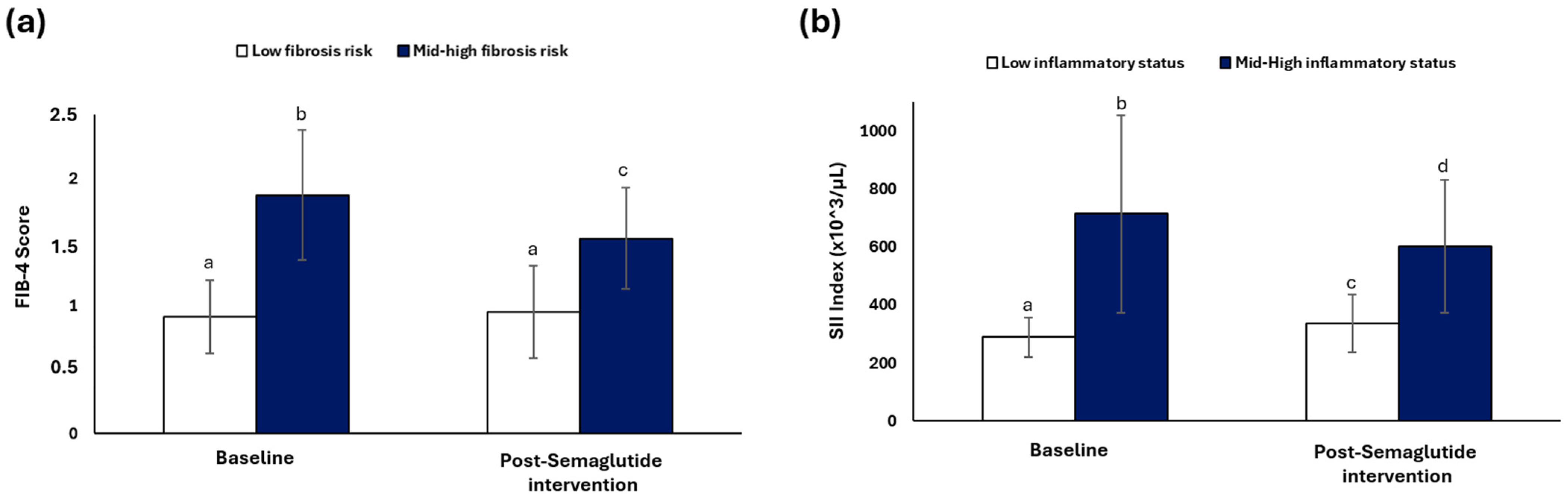
After identifying inverse trends between changes observed during follow-up and baseline values in FIB-4 and SII, a stratified post hoc analysis was conducted as an exploratory, hypothesis-generating approach to assess whether these longitudinal changes differed according to baseline patient status. The cohort was stratified according to hepatic fibrosis risk (low FIB-4 < 1.36 vs. moderate-to-high FIB-4 ≥ 1.36, Figure 1a) and indirect systemic inflammatory status (low SII < 381 × 103/µL vs. moderate-to-high SII ≥ 381 × 103/µL, Figure 1b). These threshold-based analyses should be interpreted as exploratory, as the results depend on the selected cut-off points and were not prespecified to test confirmatory hypotheses.
The results showed that participants with a low baseline risk of fibrosis or low SII values did not exhibit significant post-treatment changes in FIB-4 or SII. In contrast, larger changes were observed among patients with a higher baseline burden. Specifically, individuals classified as having a moderate-to-high baseline fibrosis risk experienced a significantly greater reduction in FIB-4, while those with moderate-to-high baseline SII values demonstrated a more pronounced decrease in the SII following semaglutide treatment (Table S2).
Collectively, these post hoc and hypothesis-generating findings suggest that changes in fibrosis-related and indirect inflammatory indices during semaglutide treatment may be influenced by baseline status, with the greatest reductions observed in patients presenting with elevated SII values or increased risk of liver fibrosis at treatment initiation. However, these post hoc findings should not be interpreted as confirmatory and should be considered hypothesis-generating, particularly because FIB-4 and SII are indirect indices and baseline-dependent changes may partly reflect regression to the mean.

4. Discussion

The present results showed that, in this retrospective real-world cohort, six months of semaglutide therapy was associated with favorable changes in metabolic and hepatic parameters in individuals with type 2 diabetes and early metabolic liver disease. Specifically, modest but statistically significant reductions in liver transaminases (ALT and AST) were detected, occurring in parallel with substantial weight loss (approximately 5% of baseline body weight) and improved glycemic control (HbA1c reduction of approximately −1.2%). As expected, semaglutide treatment was associated with significant improvements in the metabolic profile. Beyond the previously described reductions in body weight and HbA1c, a marked decrease in plasma triglyceride levels and a modest reduction in total cholesterol were observed, whereas no significant changes were detected in LDL-C or HDL-C concentrations. These findings are in line with previous reports. For example, Sato et al. reported that the addition of semaglutide led to an average weight loss of approximately 3.6 kg and a 0.5% reduction in HbA1c over a six-month period [6]. Nevertheless, substantially greater reductions in both body weight and glycated hemoglobin have been documented in larger-scale studies. Similarly, Armstrong et al. evaluated trials involving patients with MASLD and reported weight losses exceeding 10% after approximately one year of semaglutide treatment, regardless of diabetes status, accompanied by improvements in glycemic and lipid parameters. The beneficial effect of semaglutide on metabolic control is clinically relevant, as it simultaneously targets multiple risk factors implicated in the development and progression of metabolic dysfunction–associated steatotic liver disease [9]. Given the close interrelationship between visceral obesity, chronic inflammation, insulin resistance, and dyslipidemia, the correction of these abnormalities is expected to reduce hepatic metabolic burden. In the present analysis, this coincided with a more favorable metabolic milieu, which may have contributed to the observed improvements in liver function indices. Several authors have highlighted that metabolic dysfunction–associated steatotic liver disease constitutes both a cardiovascular risk factor and a precursor to cirrhosis. Consequently, therapeutic strategies such as semaglutide, which simultaneously improve glucose homeostasis, promote weight loss, and reduce hepatic steatosis, may offer a dual clinical benefit [18,19]. In line with this concept, the present findings are consistent with the role of semaglutide as a therapeutic option that may support the integrated management of the diabetes–obesity–metabolic liver disease axis in routine clinical practice, although the observational design prevents attributing these changes exclusively to semaglutide.
Regarding the liver profile, the observed reductions in ALT and AST are consistent with a decrease in hepatocellular injury during follow-up, although hepatic inflammation was not directly assessed in the present study. Similar improvements have been reported in previous studies. For instance, Arai et al. described significant reductions in liver enzyme levels after 48 weeks of oral semaglutide therapy in patients with type 2 diabetes and MASLD, with median ALT values decreasing by nearly 50% (from 62 to 35 U/L), alongside concurrent improvements in other hepatic biomarkers [20]. Consistent with these observations, Sato et al. reported reductions in ALT (−7 U/L) and AST (−4 U/L) six months after the initiation of semaglutide in patients with mildly elevated baseline transaminase levels. The reductions observed in the present study (ALT −5.4 U/L; AST −4.0 U/L) fall within this range, and are broadly consistent with previous real-world evidence showing attenuation of mild transaminase elevations during semaglutide treatment [3,4,5,6,7]. Furthermore, Golub et al. demonstrated a mean ALT reduction of approximately 4 U/L with semaglutide compared with placebo in a randomized controlled trial (STOP trial), further reinforcing these findings [8]. The consistency of these results across different study designs supports a potential favorable effect of semaglutide on liver enzyme profiles, as also reported by Petta et al., who demonstrated a reduction in ALT of more than 17 U/L in 52% of the population treated with 2.4 mg/week semaglutide [5]. From a pathophysiological perspective, reductions in ALT and AST are commonly interpreted as indirect markers of reduced hepatocellular injury and may accompany decreases in hepatic fat accumulation and inflammatory activity. Indeed, weight loss induced by GLP-1 receptor agonists is frequently accompanied by a reduction in hepatic fat content [10]. In this regard, Armstrong (2025) reported that patients with MASLD treated with high-dose semaglutide for one year achieved a mean body weight reduction of approximately 11%, together with concomitant improvements in metabolic parameters [9]. Similarly, Arai et al. demonstrated that semaglutide reduced the controlled attenuation parameter (CAP), a non-invasive FibroScan-derived marker of hepatic steatosis, after 48 weeks of treatment. Accordingly, in the present study, the observed reductions in ALT and AST may reflect a decrease in hepatocellular injury, potentially related to improvements in hepatic steatosis and metabolic status; however, this interpretation should remain cautious because no imaging- or histology-based assessment of hepatic fat or inflammation was available [20].
The relationship between changes in liver enzyme levels and concomitant metabolic changes represents a relevant aspect of these findings. In the present analysis, the magnitude of AST reduction was associated with the extent of weight loss, with a modest but significant correlation observed between greater decreases in BMI and larger reductions in AST (ρ ≈ 0.3; p < 0.05). This interdependence is consistent with previously published evidence. For instance, Arai et al. reported a meaningful correlation between reductions in ALT and body weight loss (r = 0.37), supporting the notion that part of the favorable hepatic response observed during semaglutide treatment is mediated through weight reduction.
Similarly, Sato et al. reported that reductions in ALT were strongly correlated with weight loss, decreases in BMI, and concurrent improvements in triglyceride levels and HbA1c [6]. Collectively, these observations support the concept that improvements in liver enzyme profiles achieved with GLP-1 receptor agonists are partly mediated by the correction of underlying metabolic disturbances, such as insulin resistance and visceral adiposity, which contribute to ongoing hepatic injury. Nevertheless, it should be noted that semaglutide may also exert weight-independent hepatic effects that extend beyond its impact on body weight reduction. Arai et al. suggested that weight loss alone does not fully explain the observed improvements in hepatic inflammation and steatosis, as experimental evidence indicates that GLP-1 receptor agonists exert direct beneficial effects on the pathophysiology of fatty liver disease. These effects may include enhanced hepatic insulin sensitivity, reduced de novo lipogenesis, and local anti-inflammatory modulation, thereby reinforcing the impact of negative energy balance [20]. Nevertheless, the available evidence consistently shows that greater metabolic improvement, reflected by larger reductions in body weight and better glycemic control, is associated with a more pronounced decrease in liver enzyme levels, in line with the established pathophysiology of fatty liver disease.
Furthermore, in the present investigation, no relevant changes in the FIB-4 index, an indirect marker of liver fibrosis, were observed after six months of follow-up. This finding should be interpreted in the context of both the existing literature and the characteristics of the study population. Baseline FIB-4 values in the cohort were low (approximately 1.1 on average), indicating a low estimated fibrosis risk based on this non-invasive index; under these conditions, a substantial reduction in the index over a relatively short period would not be expected. Accordingly, these results are consistent with those reported by Sato et al., who also found no significant improvement in FIB-4 after six months of semaglutide treatment in patients with type 2 diabetes and MASLD [6]. Similarly, Kakegawa et al. reported that, after six months of semaglutide treatment, advanced serum fibrosis markers such as type IV collagen and Mac-2 binding protein glycosylation isomer (M2BPGi) were not significantly modified, despite marked reductions in ALT and AST and the absence of clear changes in liver stiffness assessed by magnetic resonance elastography [21]. Taken together, these findings suggest that a six-month treatment period, particularly in patients with minimal baseline fibrosis, may be insufficient to induce measurable improvements in liver fibrosis. In contrast, longer-term studies have yielded more favorable results. Notably, Arai et al. reported that one year of oral semaglutide therapy led to significant reductions in several fibrosis-related markers, including the FIB-4 index, together with improvements in liver elastography parameters in the early stages of the disease [20]. This contrasts with findings in patients with more advanced fibrosis. In a phase 2 trial involving individuals with cirrhotic NASH, semaglutide did not differ significantly from placebo with respect to the proportion of patients showing fibrosis improvement after 48 weeks (29% vs. 11%; p = 0.087), although resolution of steatohepatitis was achieved in a subset of cases [22]. The absence of a clearly demonstrated effect on fibrosis improvement in established cirrhosis suggests that longer treatment durations and/or combined therapeutic strategies may be required to achieve meaningful reversal of advanced liver damage. Indeed, it has been suggested that the effects of GLP-1 receptor agonists on liver fibrosis require further confirmation in large-scale clinical studies [21,22]. Conversely, in patients with mild to moderate fibrosis accompanied by pronounced inflammatory activity, semaglutide has been proposed to contribute to preventing or slowing fibrotic progression over time through the sustained reduction of metabolic injury to the liver [20]. Nevertheless, although semaglutide has been consistently associated with improvements in liver biochemical parameters, meaningful reductions in fibrosis-related indices are a more challenging short-term outcome and appear to depend on treatment duration and baseline disease severity. In the present retrospective cohort, the stability of FIB-4 should therefore be interpreted cautiously, particularly because FIB-4 is an indirect index and short-term changes may be influenced by variations in AST and ALT rather than true changes in liver fibrosis. In addition, the absence of a control group and the potential contributions of weight loss, glycemic improvement, concomitant treatments, lifestyle changes, and other unmeasured factors prevent attribution of fibrosis-related findings exclusively to semaglutide.
With respect to indirect hematological inflammatory indices, no statistically significant changes were observed in indices such as NLR, PLR, and SII during follow-up. At baseline, a proportion of participants exhibited a mildly pro-inflammatory profile, reflected by values above the proposed reference thresholds for these indices. This finding is consistent with the concept of “diabesity,” in which the coexistence of type 2 diabetes and obesity is characterized by chronic low-grade inflammation [23,24]. Accordingly, it could be expected that metabolic improvement and weight reduction might contribute to a partial attenuation of systemic inflammation. Nevertheless, the magnitude of weight loss achieved (approximately 6 kg) and the degree of glycemic improvement at six months may have been insufficient to elicit measurable reductions in NLR, PLR, or SII. It should be noted that the evidence regarding the effects of GLP-1 receptor agonists on inflammatory markers remains inconsistent. On the one hand, James et al. reported anti-inflammatory effects of semaglutide in experimental models and in selected clinical contexts. However, in their recent clinical trial assessing arterial inflammation by PET imaging, no significant differences in inflammatory tracer uptake were observed between semaglutide and placebo, likely due to low baseline inflammatory activity in the study population [25]. A similar explanation may apply to the present findings, as baseline inflammatory burden estimated by hematological indices was modest and the approximately 5% weight reduction achieved over six months may have been insufficient to induce detectable changes in circulating inflammatory indices. It is also possible that a longer treatment duration or a greater magnitude of weight loss, for example, exceeding 10% of baseline body weight, may be required to observe consistent reductions in NLR, PLR, or SII. Alternatively, threshold effects may exist, whereby clinically meaningful anti-inflammatory responses are only triggered once a certain level of baseline inflammation or metabolic improvement is reached; in individuals with very mild inflammatory activity at baseline, changes may therefore fail to reach statistical significance. Nevertheless, the absence of measurable changes in these indices does not necessarily preclude the presence of inflammatory changes not captured by these indirect hematological markers.
Interestingly, correlation analyses revealed an inverse relationship between FIB-4 and SII (ρ = −0.314; p = 0.020), suggesting an association between two indirect indices related to liver fibrosis risk and systemic inflammatory burden. Similar findings were reported by Duan et al. in a large cohort of 21,833 individuals, in which SII was negatively associated with liver fibrosis (FIB-4; r = −0.25; p < 0.001) and positively associated with hepatic steatosis (liver fat score; r = 0.11; p < 0.001) [14]. This pattern aligns with the pathophysiological sequence of metabolic liver disease, whereby steatosis typically precedes the development of inflammation and fibrosis [26]. SII, which integrates neutrophils, lymphocytes, and platelets as markers of systemic inflammation, may therefore be more sensitive to the early stages of disease, characterized by hepatic fat accumulation and active inflammatory processes. In contrast, FIB-4 provides an indirect estimate of hepatic fibrosis, reflecting a more advanced and structural stage of liver damage. As fibrosis progresses, the association between these two indices may attenuate or even reverse, partly due to hematological alterations commonly observed in advanced liver disease, such as thrombocytopenia, lymphopenia, and hypersplenism, which directly affect the components of SII [27,28]. In the present study, however, this association should be interpreted cautiously because both FIB-4 and SII are indirect indices and the analysis was exploratory.
Finally, a stratified subanalysis of the cohort suggested that longitudinal changes differed according to baseline fibrosis risk and inflammatory status. The changes in hepatic and inflammatory indices observed during semaglutide treatment appeared to be influenced by the initial disease burden. Among patients at low risk of hepatic fibrosis (FIB-4 < 1.36) or with low levels of systemic inflammation (SII < 381 × 103/µL), six months of semaglutide therapy did not result in significant changes in either the FIB-4 index or SII. Conversely, individuals with a greater baseline disease burden exhibited significant reductions in these parameters. Patients classified as moderate-to-high risk of fibrosis (FIB-4 ≥ 1.36) showed a marked reduction in FIB-4 values, whereas those with moderate-to-high systemic inflammation (SII ≥ 381 × 103/µL) experienced a significant decrease in the SII index following treatment. These findings suggest that changes in fibrosis-related and indirect inflammatory markers may be baseline-dependent, with more pronounced reductions observed in patients presenting with higher baseline systemic inflammation or higher estimated liver fibrosis risk [7]. From a clinical standpoint, these stratified findings raise the hypothesis that the hepatic changes associated with semaglutide treatment may be more evident in patients with intermediate-stage MASLD/MASH, characterized by significant yet compensated fibrosis and active metabolic inflammation. In this subgroup, the intervention may coincide with meaningful improvements in prognostically relevant hepatic markers (ALT, AST, and FIB-4) as well as inflammatory indices (NLR, PLR, and SII) [3,7]. Conversely, in individuals with less advanced fatty liver disease, marked by minimal fibrosis and low-grade inflammation, semaglutide may primarily be associated with metabolic optimization, without producing significant changes in indices that are already within low or near-normal ranges. It should be noted that this does not imply an absence of benefit in low-risk patients. Rather, in these individuals, the benefits of semaglutide are reflected in the maintenance of normal liver parameters alongside meaningful metabolic improvements, such as weight reduction, improved glycemic control, and a more favorable lipid profile [10]. These effects remain clinically relevant for preventing disease progression, even if they are not accompanied by further reductions in FIB-4 or SII values. However, the stratified findings should be considered exploratory and hypothesis-generating, as they were based on predefined thresholds, involved smaller subgroups, and may have been influenced by regression to the mean.

5. Strengths and Limitations

Several limitations should be acknowledged. The retrospective, single-center observational design limits causal inference and does not allow the exclusion of residual confounding, although it reflects routine clinical practice and provides real-world clinical data. In addition, the absence of a control group prevents attributing all observed effects exclusively to semaglutide, and the pre–post design only allows within-patient comparisons without fully accounting for temporal trends, concomitant treatments, or other unmeasured clinical factors. Concomitant antidiabetic therapies, statins, SGLT2 inhibitors, insulin use, other pharmacological interventions, and lifestyle changes may have contributed to the observed metabolic, hepatic, or hematological changes. A proportion of patients lacked complete follow-up data, particularly for fibrosis- and inflammation-related markers, as well as for some key clinical variables, which may have reduced statistical power and introduced selection bias in the available-case analyses. Moreover, liver fibrosis and systemic inflammation were assessed using indirect, non-invasive indices such as FIB-4 and SII, which are practical for clinical use but cannot replace imaging- or histology-based assessments, especially over a six-month period; short-term changes in FIB-4 may also partly reflect variations in transaminase levels rather than true changes in liver fibrosis. The stratified analyses based on FIB-4 and SII thresholds were exploratory and dependent on the selected cut-off points, and regression to the mean may have influenced the baseline-dependent changes observed in higher-risk subgroups. In addition, multiple outcomes and correlations were assessed without formal correction for multiple comparisons, which increases the possibility of false-positive findings. Despite these limitations, this study also has notable strengths. It includes a well-characterized cohort of patients with type 2 diabetes managed in routine clinical practice, supporting the relevance of the findings to similar real-world clinical settings. The comprehensive evaluation of metabolic, hepatic, and indirect inflammatory parameters allows an integrated assessment of the diabetes–obesity–liver disease axis. Moreover, the analysis of baseline-dependent responses provides hypothesis-generating insights into potential differences across patient subgroups, without establishing predictive value or demonstrated clinical utility for individualized treatment selection.

6. Conclusions

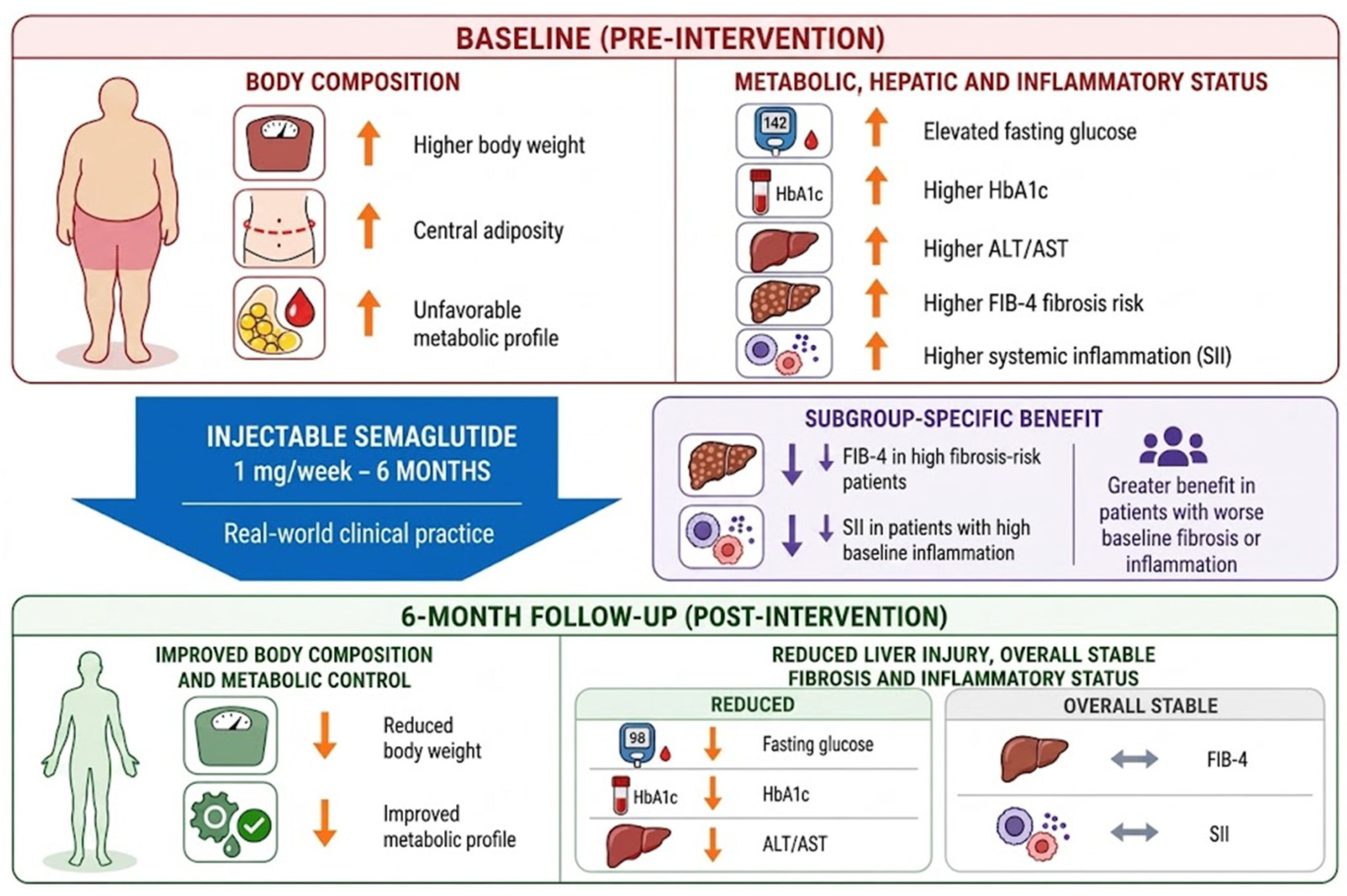
In this retrospective real-world study, six months of treatment with injectable semaglutide was associated with favorable changes in the metabolic profile of individuals with type 2 diabetes mellitus (Figure 2). Significant reductions were observed in body weight, body mass index, fasting glucose, HbA1c, and triglyceride levels. These metabolic improvements were accompanied by a marked decrease in liver transaminases (AST and ALT), consistent with a reduction in hepatocellular injury in the setting of early metabolic liver disease, although hepatic inflammatory activity was not directly assessed. Overall, these findings support the relevance of semaglutide as a therapeutic option within the integrated management of the diabetes–obesity–metabolic liver disease axis in routine clinical practice, while acknowledging that the observational design precludes causal attribution.
Although no significant overall changes were detected in FIB-4, an indirect index of liver fibrosis risk, or in indirect hematological inflammatory indices, stratified analyses suggested baseline-dependent patterns. The most pronounced reductions in SII and FIB-4 were observed in individuals with higher baseline SII values or higher FIB-4-estimated fibrosis risk, suggesting that these exploratory changes may be more evident in patients with a greater baseline metabolic and inflammatory burden. Collectively, these findings generate hypotheses regarding potential differences in response according to baseline status, and underscore the need for longer-term, controlled studies with more robust liver and inflammatory assessments to clarify the potential role of semaglutide in the longitudinal course of chronic metabolic liver disease.

Supplementary Materials

The following supporting information can be downloaded at: https://www.mdpi.com/article/10.3390/endocrines7030039/s1; Table S1: Availability of baseline and 6-month follow-up data by parameter; Table S2: Post hoc comparison of within-group pre–post changes and between-group delta values for FIB-4 and SII.

Author Contributions

Conceptualization, R.N.G.-P., V.S.-G., A.M.-G. and J.M.R.-M.; methodology, R.N.G.-P., V.S.-G. and A.E.-E.; formal analysis, R.N.G.-P., V.S.-G. and J.M.R.-M.; investigation, R.N.G.-P., V.S.-G., G.P.-M., J.M.G.-B. and M.H.-P.; resources, A.M.-G. and M.L.-d.-l.-T.-C.; data curation, R.N.G.-P. and V.S.-G.; writing—original draft preparation, R.N.G.-P. and V.S.-G.; writing—review and editing, A.M.-G. and J.M.R.-M.; visualization, R.N.G.-P., V.S.-G. and A.E.-E.; supervision, A.M.-G. and J.M.R.-M.; project administration, A.M.-G. All authors have read and agreed to the published version of the manuscript.

Funding

This research received no external funding.

Institutional Review Board Statement

The study was conducted in accordance with the Declaration of Helsinki and approved by the Provincial Research Ethics Committee of Granada (SICEIA-2026-000700, approval date: 8 April 2026).

Informed Consent Statement

Patient consent was waived due to the retrospective observational design of the study, which involved the analysis of previously collected anonymized clinical data from electronic health records. No direct patient contact or additional interventions were performed, and data confidentiality was ensured in accordance with applicable data protection regulations.

Data Availability Statement

The original contributions presented in the study are included in the article; further inquiries can be directed to the corresponding authors.

Acknowledgments

Rosa N. García-Pérez and Víctor Siles-Guerrero are PhD candidates in the Biomedicine Program at the University of Granada. Rosa N. García-Pérez, Victor Siles-Guerrero, and Aída Elhadri-Egea are supported by a contract for health specialist training (MIR program) funded by the Ministry of Health of Spain. Jose M. Romero-Márquez is supported by a contract from the Foundation for Biosanitary Research of Eastern Andalusia—Alejandro Otero (FIBAO). During the preparation of this manuscript, the authors used ChatGPT (GPT-5) for language refinement and NotebookLM Plus for generating Figure 2. The authors have reviewed and edited the output and take full responsibility for the content of this publication.

Conflicts of Interest

The authors declare no conflicts of interest.

References

  1. Li, R.; Ye, Z.; She, D.; Fang, P.; Zong, G.; Hu, K.; Kong, D.; Xu, W.; Li, L.; Zhou, Y.; et al. Semaglutide May Alleviate Hepatic Steatosis in T2DM Combined with NFALD Mice via miR-5120/ABHD6. Drug Des. Dev. Ther. 2022, 16, 3557–3572. [Google Scholar] [CrossRef] [Scilit] [PubMed]
  2. Kitsunai, H.; Shinozaki, Y.; Furusawa, S.; Kitao, N.; Ito, M.; Kurihara, H.; Oba-Yamamoto, C.; Takeuchi, J.; Nakamura, A.; Takiyama, Y.; et al. The Effects of Oral Semaglutide on Hepatic Fibrosis in Subjects with Type 2 Diabetes in Real-World Clinical Practice: A Post Hoc Analysis of the Sapporo-Oral SEMA Study. Pharmaceuticals 2025, 18, 129. [Google Scholar] [CrossRef] [Scilit] [PubMed]
  3. Ren, R.; Pei, Y.; Kong, L.; Shi, Y. The Effect of Semaglutide Combined with Metformin on Liver Inflammation and Pancreatic Beta-Cell Function in Patients with Type 2 Diabetes and Non-Alcoholic Fatty Liver Disease. J. Diabetes Complicat. 2025, 39, 108932. [Google Scholar] [CrossRef] [Scilit] [PubMed]
  4. Newsome, P.; Francque, S.; Harrison, S.; Ratziu, V.; Van Gaal, L.; Calanna, S.; Hansen, M.; Linder, M.; Sanyal, A. Effect of Semaglutide on Liver Enzymes and Markers of Inflammation in Subjects with Type 2 Diabetes and/or Obesity. Aliment. Pharmacol. Ther. 2019, 50, 193–203. [Google Scholar] [CrossRef] [Scilit] [PubMed]
  5. Petta, S.; Kim, K.; Targher, G.; Romeo, S.; Sookoian, S.; Zheng, M.; Aghemo, A.; Valenti, L. Focus on Semaglutide 2.4 mg/Week for the Treatment of Metabolic Dysfunction-Associated Steatohepatitis. Liver Int. 2025, 45, e70407. [Google Scholar] [CrossRef] [Scilit] [PubMed]
  6. Sato, K.; Irie, Y.; Asai, H.; Yoshioka, S.; Murakawa, K.; Sho, H.; Inui, R.; Kosugi, M.; Hazama, Y.; Yasuda, T. Adding Semaglutide to SGLT2 Inhibitors Reduces Liver Enzymes in Patients with Type 2 Diabetes Complicated by Metabolic Dysfunction Associated Steatotic Liver Disease: A Retrospective Observational Study. Intern. Med. 2025, 65, 1334–1341. [Google Scholar] [CrossRef] [Scilit] [PubMed]
  7. Carretero-Gómez, J.; Carrasco-Sánchez, F.J.; Fernández-Rodríguez, J.M.; Casado-Escribano, P.; Miramontes-González, J.P.; Seguí-Ripoll, J.M.; Ena, J.; Arévalo-Lorido, J.C.; Diabetes, Obesity, and Nutrition Working Group of the Spanish Society of Internal Medicine (SEMI). Effect of Semaglutide on Fatty Liver Disease Biomarkers in Patients with Diabetes and Obesity. Rev. Clin. Esp. 2023, 223, 134–143. [Google Scholar] [CrossRef] [PubMed]
  8. Golub, I.S.; Manubolu, V.S.; Aldana-Bitar, J.; Dahal, S.; Verghese, D.; Alalawi, L.; Krishnan, S.; Kianoush, S.; Benzing, T.; Ichikawa, K.; et al. The Impact of Semaglutide on Liver Fat Assessed by Serial Cardiac CT Scans in Patients with Type 2 Diabetes: Results from STOP Trial. Nutr. Metab. Cardiovasc. Dis. 2025, 35, 104036. [Google Scholar] [CrossRef] [Scilit] [PubMed]
  9. Armstrong, M.J.; Okanoue, T.; Sundby Palle, M.; Sejling, A.-S.; Tawfik, M.; Roden, M. Similar Weight Loss with Semaglutide Regardless of Diabetes and Cardiometabolic Risk Parameters in Individuals with Metabolic Dysfunction-Associated Steatotic Liver Disease: Post Hoc Analysis of Three Randomised Controlled Trials. Diabetes Obes. Metab. 2025, 27, 710–718. [Google Scholar] [CrossRef] [Scilit] [PubMed]
  10. Zacharia, G.S.; Gongati, S.R.; Kharel, A.; Jacob, A. Semaglutide in Metabolic Dysfunction-Associated Steatohepatitis: A Narrative Review. Cureus 2025, 17, e95632. [Google Scholar] [CrossRef] [Scilit] [PubMed]
  11. Gad, A.I.; Ibrahim, N.F.; Almadani, N.; Mahfouz, R.; Nofal, H.A.; El-Rafey, D.S.; Ali, H.T.; EL-Hawary, A.T.; Sadek, A.M.E.M. Therapeutic Effects of Semaglutide on Nonalcoholic Fatty Liver Disease with Type 2 Diabetes Mellitus and Obesity: An Open-Label Controlled Trial. Diseases 2024, 12, 186. [Google Scholar] [CrossRef] [Scilit] [PubMed]
  12. Vallet-Pichard, A.; Mallet, V.; Nalpas, B.; Verkarre, V.; Nalpas, A.; Dhalluin-Venier, V.; Fontaine, H.; Pol, S. FIB-4: An Inexpensive and Accurate Marker of Fibrosis in HCV Infection. Comparison with Liver Biopsy and Fibrotest. Hepatology 2007, 46, 32–36. [Google Scholar] [CrossRef] [Scilit] [PubMed]
  13. Blanco-Grau, A.; Gabriel-Medina, P.; Rodriguez-Algarra, F.; Villena, Y.; Lopez-Martínez, R.; Augustín, S.; Pons, M.; Cruz, L.-M.; Rando-Segura, A.; Enfedaque, B.; et al. Assessing Liver Fibrosis Using the FIB4 Index in the Community Setting. Diagnostics 2021, 11, 2236. [Google Scholar] [CrossRef] [Scilit] [PubMed]
  14. Duan, S.; Tu, Z.; Duan, L.; Tu, R. Differential Effects of Systemic Immune Inflammation Indices on Hepatic Steatosis and Hepatic Fibrosis: Evidence from NHANES 1999–2018. BMC Gastroenterol. 2024, 24, 463. [Google Scholar] [CrossRef] [Scilit] [PubMed]
  15. McPherson, S.; Stewart, S.F.; Henderson, E.; Burt, A.D.; Day, C.P. Simple Non-Invasive Fibrosis Scoring Systems Can Reliably Exclude Advanced Fibrosis in Patients with Non-Alcoholic Fatty Liver Disease. Gut 2010, 59, 1265–1269. [Google Scholar] [CrossRef] [Scilit] [PubMed]
  16. Singh, A.; Le, P.; Lopez, R.; Alkhouri, N. The Utility of Noninvasive Scores in Assessing the Prevalence of Nonalcoholic Fatty Liver Disease and Advanced Fibrosis in Type 1 Diabetic Patients. Hepatol. Int. 2018, 12, 37–43. [Google Scholar] [CrossRef] [Scilit] [PubMed]
  17. Zhao, Y.; Shao, W.; Zhu, Q.; Zhang, R.; Sun, T.; Wang, B.; Hu, X. Association between Systemic Immune-Inflammation Index and Metabolic Syndrome and Its Components: Results from the National Health and Nutrition Examination Survey 2011–2016. J. Transl. Med. 2023, 21, 691. [Google Scholar] [CrossRef] [Scilit] [PubMed]
  18. Bandyopadhyay, S.; Das, S.; Samajdar, S.S.; Joshi, S.R. Role of Semaglutide in the Treatment of Nonalcoholic Fatty Liver Disease or Non-Alcoholic Steatohepatitis: A Systematic Review and Meta-Analysis. Diabetes Metab. Syndr. 2023, 17, 102849. [Google Scholar] [CrossRef] [Scilit] [PubMed]
  19. Sanyal, A.J.; Newsome, P.N.; Kliers, I.; Østergaard, L.H.; Long, M.T.; Kjær, M.S.; Cali, A.M.G.; Bugianesi, E.; Rinella, M.E.; Roden, M.; et al. Phase 3 Trial of Semaglutide in Metabolic Dysfunction-Associated Steatohepatitis. N. Engl. J. Med. 2025, 392, 2089–2099. [Google Scholar] [CrossRef] [Scilit] [PubMed]
  20. Arai, T.; Atsukawa, M.; Tsubota, A.; Oikawa, T.; Tada, T.; Matsuura, K.; Ishikawa, T.; Abe, H.; Kato, K.; Morishita, A.; et al. Beneficial Effect of Oral Semaglutide for Type 2 Diabetes Mellitus in Patients with Metabolic Dysfunction-Associated Steatotic Liver Disease: A Prospective, Multicentre, Observational Study. Diabetes Obes. Metab. 2024, 26, 4958–4965. [Google Scholar] [CrossRef] [Scilit] [PubMed]
  21. Kakegawa, T.; Sugimoto, K.; Saito, K.; Yunaiyama, D.; Araki, Y.; Wada, T.; Takahashi, H.; Yoshimasu, Y.; Takeuchi, H.; Itoi, T. Favorable Liver and Skeletal Muscle Changes in Patients with MASLD and T2DM Receiving Glucagon-like Peptide-1 Receptor Agonist: A Prospective Cohort Study. Medicine 2024, 103, e38444. [Google Scholar] [CrossRef] [Scilit] [PubMed]
  22. Loomba, R.; Abdelmalek, M.F.; Armstrong, M.J.; Jara, M.; Kjær, M.S.; Krarup, N.; Lawitz, E.; Ratziu, V.; Sanyal, A.J.; Schattenberg, J.M.; et al. Semaglutide 2·4 mg Once Weekly in Patients with Non-Alcoholic Steatohepatitis-Related Cirrhosis: A Randomised, Placebo-Controlled Phase 2 Trial. Lancet Gastroenterol. Hepatol. 2023, 8, 511–522. [Google Scholar] [CrossRef] [Scilit] [PubMed]
  23. Michaelidou, M.; Pappachan, J.M.; Jeeyavudeen, M.S. Management of Diabesity: Current Concepts. World J. Diabetes 2023, 14, 396–411. [Google Scholar] [CrossRef] [Scilit] [PubMed]
  24. Chadt, A.; Scherneck, S.; Joost, H.-G.; Al-Hasani, H. Molecular Links between Obesity and Diabetes: “Diabesity”. In Endotext; Feingold, K.R., Adler, R.A., Ahmed, S.F., Anawalt, B., Blackman, M.R., Chrousos, G., Corpas, E., de Herder, W.W., Dhatariya, K., Dungan, K., et al., Eds.; MDText.com, Inc.: South Dartmouth, MA, USA, 2000. [Google Scholar]
  25. James, S.; Christoffersen, A.D.; David, J.-P.; Hacker, M.; Jensen, M.D.R.J.; Mellbin, L.; Pieber, T.R.; Ripa, R.S.; Rossing, P.; Svehlikova, E.; et al. Effect of Once-Weekly Subcutaneous Semaglutide on Arterial Inflammation in People with Type 2 Diabetes and Cardiovascular Disease Using PET-MRI: Primary Results of a Randomized, Double-Blind, Placebo-Controlled Trial. Am. Heart J. 2025, 289, 17–27. [Google Scholar] [CrossRef] [Scilit] [PubMed]
  26. Singh, S.; Allen, A.M.; Wang, Z.; Prokop, L.J.; Murad, M.H.; Loomba, R. Fibrosis Progression in Nonalcoholic Fatty Liver versus Nonalcoholic Steatohepatitis: A Systematic Review and Meta-Analysis of Paired-Biopsy Studies. Clin. Gastroenterol. Hepatol. 2015, 13, 643–654.e9. [Google Scholar] [CrossRef] [Scilit] [PubMed]
  27. Chen, S.-H.; Tsai, S.-C.; Lu, H.-C. Platelets as a Gauge of Liver Disease Kinetics? Int. J. Mol. Sci. 2022, 23, 11460. [Google Scholar] [CrossRef] [Scilit] [PubMed]
  28. Mitchell, O.; Feldman, D.M.; Diakow, M.; Sigal, S.H. The Pathophysiology of Thrombocytopenia in Chronic Liver Disease. Hepat. Med. 2016, 8, 39–50. [Google Scholar] [CrossRef] [Scilit] [PubMed]
Figure 1. Baseline status-dependent effect of semaglutide on the risk of (a) FIB-4 and (b) SII. Statistical comparisons between groups were performed using the independent samples t-test. Different letters indicate statistically significant differences between groups (p < 0.001). Sample sizes were as follows: for FIB-4 at baseline, low fibrosis risk (n = 74) and mid-high fibrosis risk (n = 29); for FIB-4 at 6 months, low fibrosis risk (n = 45) and mid-high fibrosis risk (n = 16). For SII at baseline, low inflammatory status (n = 66) and mid-high inflammatory status (n = 116); for SII at 6 months, low inflammatory status (n = 48) and mid-high inflammatory status (n = 95).
Endocrines 07 00039 g001
Figure 2. Pre–post effects of injectable semaglutide (1 mg/week) over 6 months in patients with type 2 diabetes. Figure generated using NotebookLM Plus.
Endocrines 07 00039 g002
Table 1. Baseline clinical and biochemical characteristics.
ParametersNMean (SD)95% CI Lower95% CI Upper
Anthropometric measurements
Age (years)23157.90 (11.65)56.3959.41
Women, n (%)105 (45.5%)
Weight (kg)198107.18 (24.95)103.69110.68
Height (m)1971.66 (0.10)1.651.67
BMI (kg/m2)19538.34 (7.25)37.3239.37
Metabolic markers
HbA1c (%)1778.17 (1.55)7.948.40
Glucose (mg/dL)197157.69 (62.14)148.95166.42
Triglycerides (mg/dL)179222.51 (192.08)194.18250.84
Triglycerides/Glucose Ratio1785.10 (0.41)5.045.16
Total cholesterol (mg/dL)180175.18 (47.90)168.13182.22
LDL-C (mg/dL)16796.93 (38.50)91.05102.81
HDL-C (mg/dL)16843.08 (13.32)41.0545.11
Hepatic markers
ALT (U/L)16828.90 (16.88)26.3231.47
AST (U/L)10826.25 (11.92)23.9728.52
FIB-4 score1031.22 (0.72)1.081.36
Immune and inflammatory markers
Platelets (×103/µL)189249.68 (61.49)240.85258.50
Neutrophils (×103/µL)1884.80 (1.62)4.575.04
Lymphocytes (×103/µL)1892.38 (0.81)2.262.49
Neutrophil/Lymphocyte Ratio1842.26 (1.27)2.082.45
Platelet/Lymphocyte Ratio186116.44 (49.84)109.23123.65
SII Index (×103/µL)182557.25 (330.17)508.96605.54
Clinical outcomes
Central adiposity, n (%)198 (100%)
Hypertriglyceridemia, n (%)75 (41.9%)
Low-HDL status, n (%)77 (45.8%)
Altered fasting glucose levels, n (%)168 (85.3%)
Metabolic syndrome, n (%)107 (63.3%)
Abbreviations: ALT: alanine aminotransferase, AST: aspartate aminotransferase, BMI: body mass index, CI: confidence interval, FIB-4: fibrosis-4 score, HbA1c: hemoglobin A1c, HDL-c: high-density lipoprotein cholesterol, SII: systemic immune–inflammation index, SD: standard deviation, LDL-c: low-density lipoprotein cholesterol.
Table 2. Changes in clinical and biochemical characteristics after semaglutide initiation.
ParametersNLoss of Follow-UpMean (SD) at 6 MonthsMD vs. Baselinep-ValueCohen’s dCohen’s d 95% CI LowerCohen’s d 95% CI Upper
Anthropometric measurements
Weight (kg)93105104.42 (25.52)−6.07<0.001−0.9108−1.16−0.66
BMI (kg/m2)9110436.82 (7.35)−2.12<0.001−0.9333−1.18−0.68
Metabolic markers
HbA1c (%)123547.04 (1.20)−1.22<0.001−0.829−1.48−0.96
Glucose (mg/dL)17423127.74 (50.14)−28.88<0.001−0.4329−0.60−0.27
Triglycerides (mg/dL)16019168.94 (98.68)−51.83<0.001−0.3046−0.48−0.13
Triglycerides/Glucose Ratio160184.90 (0.35)−0.18<0.001−0.4955−0.68−0.31
Total cholesterol (mg/dL)16119164.40 (46.43)−9.950.004−0.2524−0.42−0.08
LDL-C (mg/dL)1432492.17 (40.47)−4.130.232−0.1125−0.300.07
HDL-C (mg/dL)1442443.41 (12.06)−0.990.352−0.0872−0.270.10
Hepatic markers
ALT (U/L)1234523.22 (9.21)−5.43<0.001−0.389−7.917−2.933
AST (U/L)614722.28 (6.34)−4.030.007−0.357−6.915−1.141
FIB-4 score58451.09 (0.06)−0.050.253−0.151−0.1290.035
Immune and inflammatory markers
Platelets (×103/µL)14940248.93 (66.14)−0.100.971−0.003−5.585.39
Neutrophils (×103/µL)148404.74 (1.29)−0.150.167−0.114−0.360.06
Lymphocytes (×103/µL)149402.42 (0.82)0.060.2080.104−0.030.15
Neutrophil/Lymphocyte Ratio143412.19 (1.10)−0.090.315−0.084−0.270.09
Platelet/Lymphocyte Ratio14541113.33 (47.86)−2.030.545−0.051−8.624.57
SII Index (×103/µL)13943529.48 (278.13)−32.800.161−0.120−78.7713.18
Abbreviations: ALT: alanine aminotransferase, AST: aspartate aminotransferase, BMI: body mass index, CI: confidence interval, FIB-4: fibrosis-4 score, HbA1c: hemoglobin A1c, HDL-c: high-density lipoprotein cholesterol, MD: mean difference, SII: systemic immune–inflammation index, SD: standard deviation, LDL-c: low-density lipoprotein cholesterol.
Table 3. Association between changes in liver function and inflammatory parameters and baseline clinical measurements.
Δ HbA1cΔ ALTΔ ASTΔ FIB-4 ScoreΔ SII Index
ρpρpρpρpρp
Anthropometric measurements
Age (years)0.302<0.0010.0290.8240.0740.417−0.1190.3750.0420.625
Weight (kg)−0.0220.817−0.1930.176−0.0800.414−0.0490.7430.0280.759
BMI (kg/m2)0.0030.976−0.1500.2980.0710.476−0.1120.4540.0280.766
Metabolic markers
HbA1c (%)−0.668<0.0010.1300.321−0.0260.7880.0200.883−0.0360.687
Glucose (mg/dL)−0.442<0.001−0.0390.764−0.0880.334−0.1770.183−0.0840.329
Triglycerides (mg/dL)−0.1820.0500.0030.979−0.0780.401−0.1840.1720.0840.335
Triglycerides/Glucose Ratio−0.339<0.001−0.0250.850−0.0620.507−0.2530.0580.0250.778
Total cholesterol (mg/dL)−0.1510.105−0.0770.558−0.0390.6770.0010.9920.0280.752
LDL-C (mg/dL)−0.1550.102−0.0940.484−0.1080.2700.1140.405−0.0110.908
HDL-C (mg/dL)0.0620.513−0.0930.487−0.0610.533−0.0930.502−0.0470.605
Hepatic markers
ALT (U/L)−0.2370.016−0.3650.004−0.598<0.001−0.0350.7930.0550.548
AST (U/L)−0.2100.086−0.514<0.001−0.591<0.001−0.2390.0710.0830.462
FIB-4 score0.0600.634−0.3490.007−0.1480.198−0.3590.0060.1540.178
Immune and inflammatory markers
Platelets (×103/µL)0.0320.7350.2670.0390.0360.6930.2330.079−0.1880.027
Neutrophils (×103/µL)−0.0660.4800.0180.891−0.0400.6590.0170.898−0.356<0.001
Lymphocytes (×103/µL)−0.0560.5520.1060.425−0.0550.550−0.1000.4570.2330.006
Neutrophil/Lymphocyte Ratio0.0150.875−0.0320.8090.0790.3960.1120.405−0.418<0.001
Platelet/Lymphocyte Ratio0.1050.2660.0160.9040.0660.4790.1720.199−0.344<0.001
SII Index (×103/µL)0.0630.5080.0740.5760.0750.4240.1910.155−0.473<0.001
Abbreviations: ALT: alanine aminotransferase, AST: aspartate aminotransferase, BMI: body mass index, FIB-4: fibrosis-4 score, HBA1c: hemoglobin A1c, HDL-c: high-density lipoprotein cholesterol, SII: systemic immune–inflammation index, LDL-c: low-density lipoprotein cholesterol. Δ: pre-post changes, ρ: Spearman’s coefficient (rho), p: p-value.
Table 4. Association between changes in liver function and inflammatory parameters and changes in clinical measurements.

Δ HbA1cΔ ALTΔ ASTΔ FIB-4 ScoreΔ SII Index
ρpρpρpρpρp
Anthropometric measurements
Δ Weight (kg)0.2840.0230.2100.2120.3900.0030.1400.421−0.0740.560
Δ BMI (kg/m2)0.2790.0250.1560.3570.3650.0060.0810.643−0.0550.664
Metabolic markers
Δ HbA1c (%)0.1050.4440.3200.0010.0580.682−0.0270.781
Δ Glucose (mg/dL)0.684<0.0010.0690.5960.2640.003−0.0190.8860.1380.109
Δ Triglycerides (mg/dL)0.2740.0030.1420.2820.3010.0010.3120.019−0.1350.139
Δ Triglycerides/Glucose Ratio0.558<0.0010.0930.4560.385<0.0010.1420.295−0.0140.876
Δ Total cholesterol (mg/dL)0.2660.0040.1960.1370.2360.0130.1140.404−0.0070.935
Δ LDL-C (mg/dL)0.1560.1100.2310.0340.1600.1250.1370.337−0.0210.830
Δ HDL-C (mg/dL)0.0170.8650.1890.1710.1390.1830.0050.9730.0390.314
Hepatic markers
Δ ALT (U/L)0.1050.4440.638<0.0010.556<0.001−0.1230.363
Δ AST (U/L)0.3200.0010.638<0.0010.0680.6130.0030.978
Immune and inflammatory markers
Δ Platelets (×103/µL)−0.1900.042−0.0490.711−0.0130.842−0.495<0.0010.305<0.001
Δ Neutrophils (×103/µL)−0.1940.036−0.0670.613−0.0410.661−0.0430.7180.676<0.001
Δ Lymphocytes (×103/µL)−0.2430.003−0.0810.545−0.0840.3630.0190.883−0.423<0.001
Δ Neutrophil/Lymphocyte Ratio0.0440.643−0.0970.4750.0160.867−0.0850.5370.886<0.001
Δ Platelet/Lymphocyte Ratio0.1500.110−0.0430.7110.0770.402−0.308<0.0010.606<0.001
Δ SII Index (×103/µL)−0.0270.781−0.1230.3630.0030.978−0.3140.020
Abbreviations: ALT: alanine aminotransferase, AST: aspartate aminotransferase, BMI: body mass index, FIB-4: fibrosis-4 score, HbA1c: hemoglobin A1c, HDL-c: high-density lipoprotein cholesterol, SII: systemic immune–inflammation index, LDL-c: low-density lipoprotein cholesterol. Δ: pre-post changes, ρ: Spearman’s coefficient (rho), p: p-value.
Disclaimer/Publisher’s Note: The statements, opinions and data contained in all publications are solely those of the individual author(s) and contributor(s) and not of MDPI and/or the editor(s). MDPI and/or the editor(s) disclaim responsibility for any injury to people or property resulting from any ideas, methods, instructions or products referred to in the content.