3.1. Skyhook-Parameter Self-Tuning Fuzzy Control Strategy
In practical operations, the ideal skyhook control cannot be implemented directly, as the damping force can only be provided by a damper placed between the carbody and the bogie. Hence, an actual variable damping coefficient is introduced to approximate the skyhook damping behavior, as expressed in Equation (5):
where
ẏc denotes the lateral velocity of the carbody and (
ẏc −
ẏt) is the relative velocity between the carbody and the bogie frame. When (
ẏc − ẏt)→0, the resulting damping coefficient tends toward ∞. Since the damping force output by physical dampers is limited, the actual damper can only approximate the ideal skyhook behavior to some extent. Therefore, in engineering applications, the continuous control logic is typically simplified into a binary switching control strategy, formulated in Equation (6):
As shown in Equation (6), when the carbody velocity ẏc and the relative velocity ẏc − ẏt have the same direction, the controller applies the maximum damping value; when their directions are opposite, the minimum damping is applied. This binary switching behavior leads to frequent transitions between damper states, and the resulting abrupt changes in damping force may induce chattering in the suspension system, severely limiting control performance.
To address this limitation, fuzzy control principles are introduced to smooth the damping variation. When
ẏc(
ẏc −
ẏt) > 0, i.e., the carbody velocity and relative velocity are directionally consistent, a fuzzy logic system is employed to divide the activated damping output into multiple graded levels rather than applying a single fixed value. This approach enables the formation of a skyhook fuzzy hybrid control scheme, which mitigates the impact caused by instantaneous damping jumps from minimum to maximum levels. As a result, it significantly improves the damping smoothness and overall vibration suppression performance of the semi-active suspension system. The fuzzy control law based on the skyhook damping principle is formulated in Equation (7):
where the fuzzy subsets (PA|PB|PC|PD|PE|PF|PG) denote seven discrete levels of damping force, into which the damper output is classified through fuzzy inference.
In the aforementioned fuzzy control strategy, the quantization factors and proportional factors are typically preset and remain constant throughout operation. These parameters are usually tuned offline to ensure overall system performance under nominal conditions, which limits the controller’s adaptability to real-time variations. To address this limitation, the present work proposes an enhancement to the skyhook fuzzy control by introducing a parameter self-tuning mechanism. Based on two real-time input variables—the carbody velocity
ẏc and the relative velocity between the carbody and bogie
ẏc −
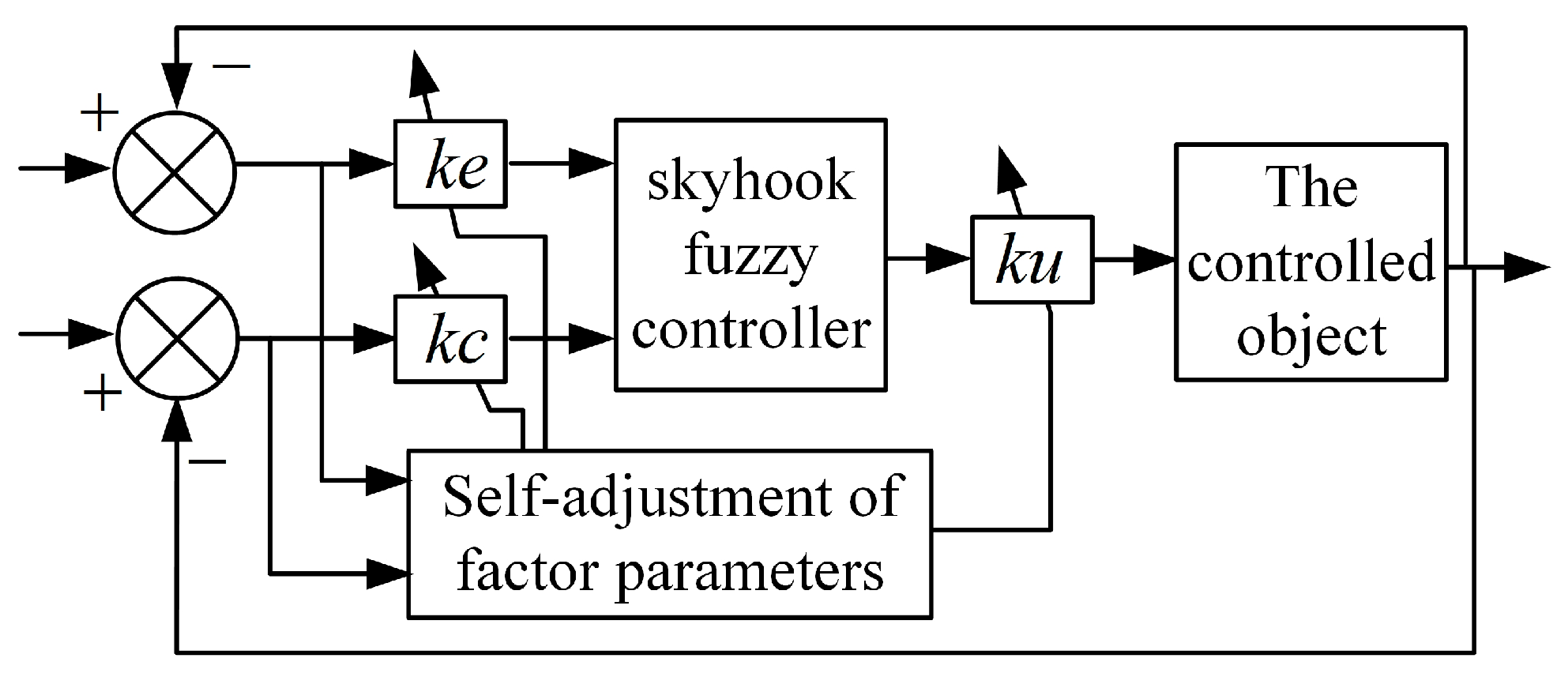
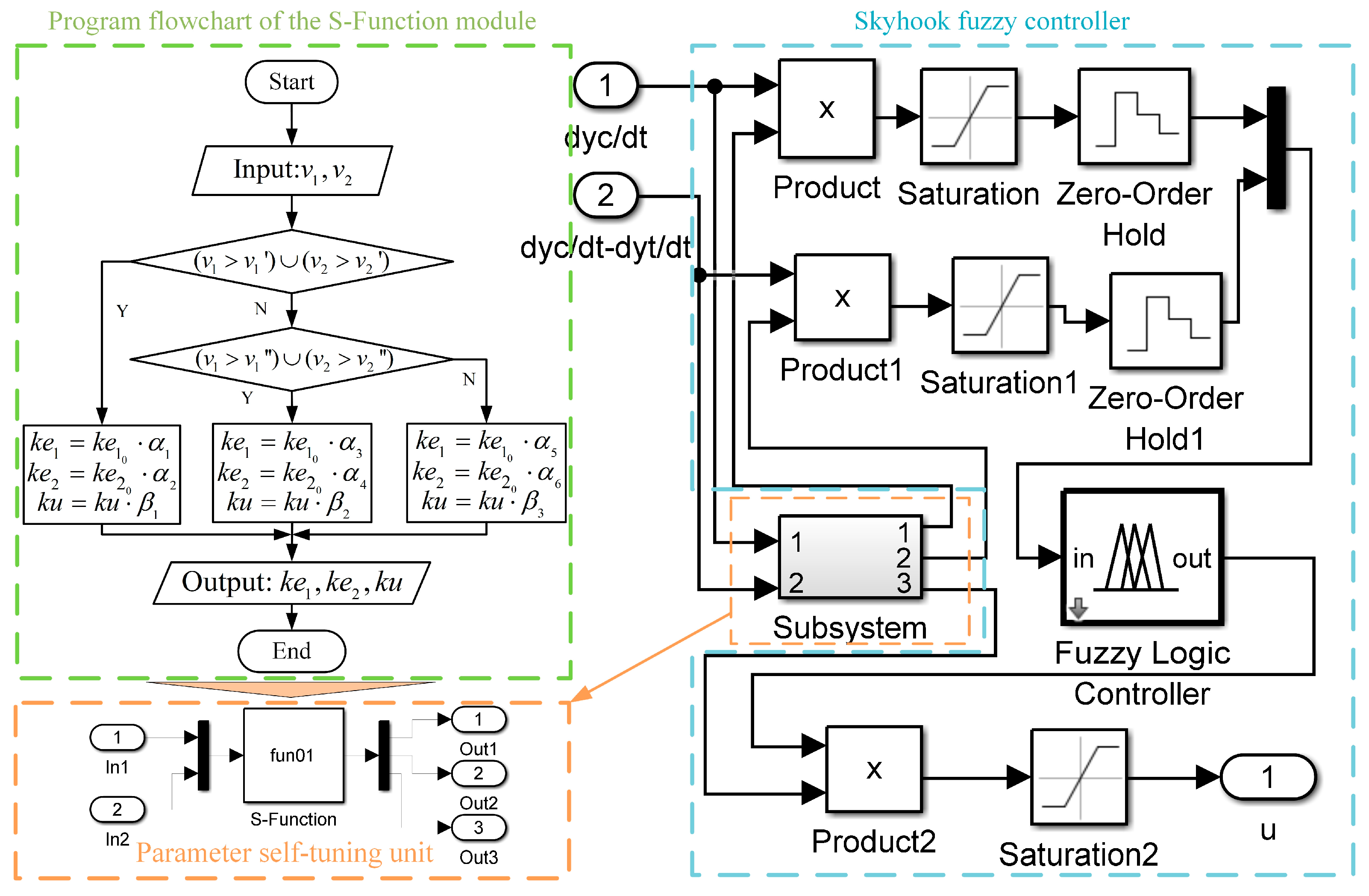
ẏt —the control system dynamically adjusts both the quantization and proportional factors to improve responsiveness and adaptability. The complete structure of the skyhook-PSTFC Strategy is illustrated in
Figure 8.
As illustrated in
Figure 8, conventional skyhook fuzzy controllers generally employ fixed input quantization factors and output scaling factors, which remain unchanged once they have been tuned offline. When the carbody vibration state, excitation intensity, or suspension operating condition deviates from the nominal design condition, such fixed scaling may lead to insufficient utilization or excessive amplification of the fuzzy input domains, thereby limiting the controller’s capability to accommodate non-stationary vibration responses. To overcome this limitation, a state-dependent online parameter-tuning mechanism is incorporated into the conventional skyhook fuzzy control framework. Specifically, two input quantization factors,
and
, together with the output scaling factor
, are adjusted online according to the instantaneous vibration state of the carbody, thereby enabling state-dependent rescaling of the fuzzy controller.
The lateral carbody velocity and the relative lateral velocity between the carbody and bogie frame are selected as the state variables for parameter scheduling and are defined as
and
respectively. Here,
v1 characterizes the absolute lateral vibration state of the carbody, whereas
v2 reflects the relative motion across the secondary suspension. These two variables therefore provide complementary information regarding the carbody response and the dynamic state of the secondary lateral suspension. It should be emphasized that
v1 denotes the lateral vibration velocity of the carbody rather than the vehicle operating speed along the track.
Following quantization, the normalized inputs to the fuzzy inference system are expressed as
After fuzzy inference, the normalized output is mapped to the physical control command through the output scaling factor:
where
and
determine the mapping scales from the physical state variables to the fuzzy input domains, whereas
determines the scaling from the normalized fuzzy output to the physical control command. Consequently, the effective input resolution and output intensity of the controller can be modified online by adjusting these three scaling parameters without altering the membership-function structure or the fuzzy rule base. Compared with adaptive fuzzy schemes that require online reconstruction of membership functions or modification of fuzzy rules, the proposed strategy preserves the interpretability and structural simplicity of the conventional fuzzy controller while introducing only a limited number of comparison and multiplication operations, which is advantageous for real-time implementation.
Because lateral vehicle vibration is inherently bidirectional, directly using the signed values of
and
for state classification could incorrectly assign a large negative velocity to a low-response region. Therefore, the magnitudes
and
are adopted as the scheduling variables. For each state variable, a lower threshold
and an upper threshold
are introduced, satisfying
Accordingly, the instantaneous lateral dynamic state of the vehicle is classified into three operating regions: low-, intermediate-, and high-response regions.
When either or exceeds its corresponding upper threshold, the absolute carbody motion or the relative suspension motion has entered a relatively high-response regime. Under this condition, increasing and expands the effective mapping of the physical inputs within the fuzzy domains, allowing the fuzzy inference system to respond more distinctly to changes in the vibration state. Meanwhile, because the increased input quantization factors already enhance the controller’s sensitivity to state variations, the output scaling factor is moderately reduced to prevent excessive amplification of the control command and to reduce the risk of abrupt damping-force variations or actuator saturation. This coordinated adjustment provides a balance between state sensitivity and control-output smoothness. Conversely, when both and remain below their respective lower thresholds, the vehicle is regarded as operating in a low-response regime. In this case, reducing the input quantization factors suppresses excessive amplification of small state fluctuations and measurement noise within the fuzzy input domains. At the same time, a moderately larger output scaling factor is employed to compensate for the reduced input scaling and to retain sufficient control authority under weak vibration conditions. For dynamic states between these two regimes, an intermediate parameter set is adopted, thereby establishing a three-region state-dependent gain-scheduling mechanism.
Based on the above considerations,
,
and
are defined as the baseline input quantization factors and output scaling factor of the fixed-parameter skyhook fuzzy controller. The adjustment coefficients are then introduced to rescale the baseline parameters online. The proposed parameter self-tuning law is formulated as
The first, second, and third branches of Equation (13) correspond to the high-, intermediate-, and low-response regions, respectively. An OR logic is deliberately employed for activation of the high-response region: once either the absolute carbody velocity or the carbody–bogie relative velocity exceeds its upper threshold, the controller switches to the high-response parameter set. This design prevents a pronounced response in one state variable from being underestimated simply because the other variable remains relatively small. By contrast, the low-response parameter set is activated only when both state variables remain below their respective lower thresholds. The mutually exclusive conditions in Equation (13) ensure that only one parameter set is active at each sampling instant, thereby providing an unambiguous and reproducible mapping between the instantaneous vibration state and the controller parameters.
To maintain consistency between the parameter-scheduling direction and the control rationale described above, the adjustment coefficients satisfy
Accordingly, as the lateral vibration state evolves from the low-response to the high-response region, the two input quantization factors increase progressively, whereas the output scaling factor decreases accordingly. Therefore, the proposed PSTFC does not modify the fuzzy rules online; rather, it performs state-dependent online rescaling of the input and output domains while retaining the original membership functions and rule base. This formulation preserves the structural simplicity and interpretability of conventional skyhook fuzzy control while improving its ability to accommodate variations in the instantaneous vibration intensity.
It should also be noted that the thresholds and adjustment coefficients in Equation (13) are not prescribed solely on the basis of control performance under a single nominal operating condition. To improve the reproducibility of parameter determination and reduce the subjectivity associated with empirical tuning, a parameter-calibration procedure based on state-response statistics and constrained performance optimization is introduced. Specifically, the statistical distributions of and are first used to establish candidate threshold ranges. The thresholds and adjustment coefficients are then jointly calibrated using the lateral accelerations at the front, middle, and rear sections of the carbody, the Sperling ride index, the PSD characteristics within the dominant flexible-mode frequency bands, and the variation in control force as performance criteria. Finally, parameter perturbation tests are performed to quantify the sensitivity of the controller to the selected parameters.
3.2. Parameter Calibration and Sensitivity Analysis of the PSTFC
The velocity thresholds and gain-adjustment coefficients in Equation (13) directly determine the scaling behavior of the controller under different vibration states. An entirely empirical selection of these parameters may not only make the resulting control performance dependent on a particular operating condition but also compromise the reproducibility of the controller design. To address this issue, a systematic parameter-calibration procedure consisting of statistical initialization, constrained performance optimization, and parameter-sensitivity evaluation is adopted. The calibration procedure is conducted using a predefined calibration dataset, whereas the final assessment of the controller is performed under independent validation conditions to reduce potential overfitting resulting from parameter tuning and performance evaluation using the same data.
The parameters to be calibrated in the PSTFC are collectively expressed as
where
,
,
, and
define the boundaries between different lateral-vibration response regions, while
and
regulate the two input quantization factors and the output scaling factor, respectively.
The baseline scaling parameters of the fixed-parameter skyhook fuzzy controller are determined first. According to the fuzzy-controller configuration, the universes of discourse of the two normalized inputs are both defined as [−4, 4], whereas the normalized output domain is defined as [−2, 2]. Direct use of the absolute maximum values of the state variables may result in excessive compression of the effective fuzzy input domains because of isolated transient peaks. Therefore, the 99th percentiles of the state-variable magnitudes in the calibration dataset are adopted as the reference values:
where
denotes the 99th percentile of the corresponding sample distribution. The baseline input quantization factors are subsequently determined as
where
are the upper bounds of the corresponding fuzzy input domains. For the calibration dataset considered here,
and
are 0.080 m/s and 0.120 m/s, respectively, yielding
and
.
For the controller output, let
denote the upper bound of the normalized fuzzy output and
the reference magnitude of the physical control command. The baseline output scaling factor is then determined by
With
and
= 12,000 N, the baseline scaling factor is
.= 6000 N.
These baseline values define the fixed-parameter skyhook fuzzy controller and serve as the reference scales for the subsequent online parameter scheduling of the PSTFC. The initial state thresholds are determined from the statistical distributions of
and
. Rather than directly prescribing the boundaries of the three response regions, the 33.3rd and 66.7th percentiles of the corresponding state magnitudes are employed as the initial estimates of the lower and upper thresholds:
Finite search intervals are subsequently constructed around these initial estimates. Specifically, each lower threshold is restricted to the 25th–45th percentile range of the corresponding state-variable magnitude, whereas each upper threshold is restricted to the 60th–85th percentile range. In this manner, the initial partition of the response regions is directly related to the statistical characteristics of the actual vehicle response rather than being prescribed solely from engineering experience.
To further determine the thresholds and gain-adjustment coefficients, a normalized multi-criteria objective function is introduced. Because the objective of the present controller encompasses global lateral vibration suppression, attenuation of flexible-carbody modes, ride-quality improvement, and smooth control-force generation, the overall performance index is formulated as
where the individual dimensionless performance terms are defined as
Here,
,
, and
denote the lateral accelerations at the front, middle, and rear sections of the carbody, respectively;
W is the Sperling ride index;
represents the peak PSD amplitude within the dominant flexible-mode frequency band at carbody location
j;
denotes the variation in damping force between two consecutive control instants; and
is the maximum allowable control force of the variable-damping actuator. All performance terms are normalized with respect to their corresponding reference quantities to eliminate the influence of different physical dimensions and numerical scales.
The weighting coefficients satisfy
Because the primary objective of the present study is to suppress lateral carbody vibration, with particular emphasis on flexible-mode responses, the weighting coefficients are specified as
. Accordingly, the carbody acceleration and flexible-mode PSD terms receive the largest combined contribution to the optimization objective, while the ride index and control-force variation are retained to prevent improvements in vibration attenuation from being achieved at the expense of degraded ride quality or excessive control activity. Because parameter calibration based on a single realization of stochastic track irregularity may lead to realization-dependent results, each candidate parameter set is evaluated using
statistically independent realizations of the prescribed track-irregularity spectrum. The averaged performance objective is therefore expressed as
where
represents the objective value obtained from the
n-th track-irregularity realization. The optimal PSTFC parameters are subsequently determined by
where
denotes the admissible parameter space. During parameter optimization, the following ordering constraints are imposed:
,
,
and
. Additional constraints are imposed on the magnitude of the control output and the operating envelope of the semi-active actuator to ensure that the resulting parameter combinations remain physically realizable.
Considering the relatively high dimensionality of
, exhaustive enumeration of the admissible parameter space would result in a prohibitively large number of ADAMS/Rail–MATLAB co-simulations. Latin hypercube sampling is therefore first employed to generate candidate parameter combinations over
, providing efficient coverage of the admissible parameter space. Promising parameter regions identified during this initial screening are subsequently subjected to a refined local search. This two-stage procedure reduces the calibration cost while maintaining adequate exploration of the parameter space. The resulting PSTFC parameters are summarized in
Table 3.
In addition to identifying a nominally optimal parameter set, it is necessary to quantify the extent to which controller performance depends on the selected parameter values. A one-at-a-time sensitivity analysis is therefore conducted by perturbing the velocity thresholds, baseline scaling parameters, and gain-adjustment coefficients by −20%, −10%, +10%, and +20% relative to their calibrated values. During each test, only one parameter is perturbed, while all remaining parameters are maintained at their calibrated values. The normalized sensitivity index of parameter
p is defined as
where
denotes the relative perturbation applied to parameter
p. A larger
indicates a stronger dependence of the overall control performance on the corresponding parameter.
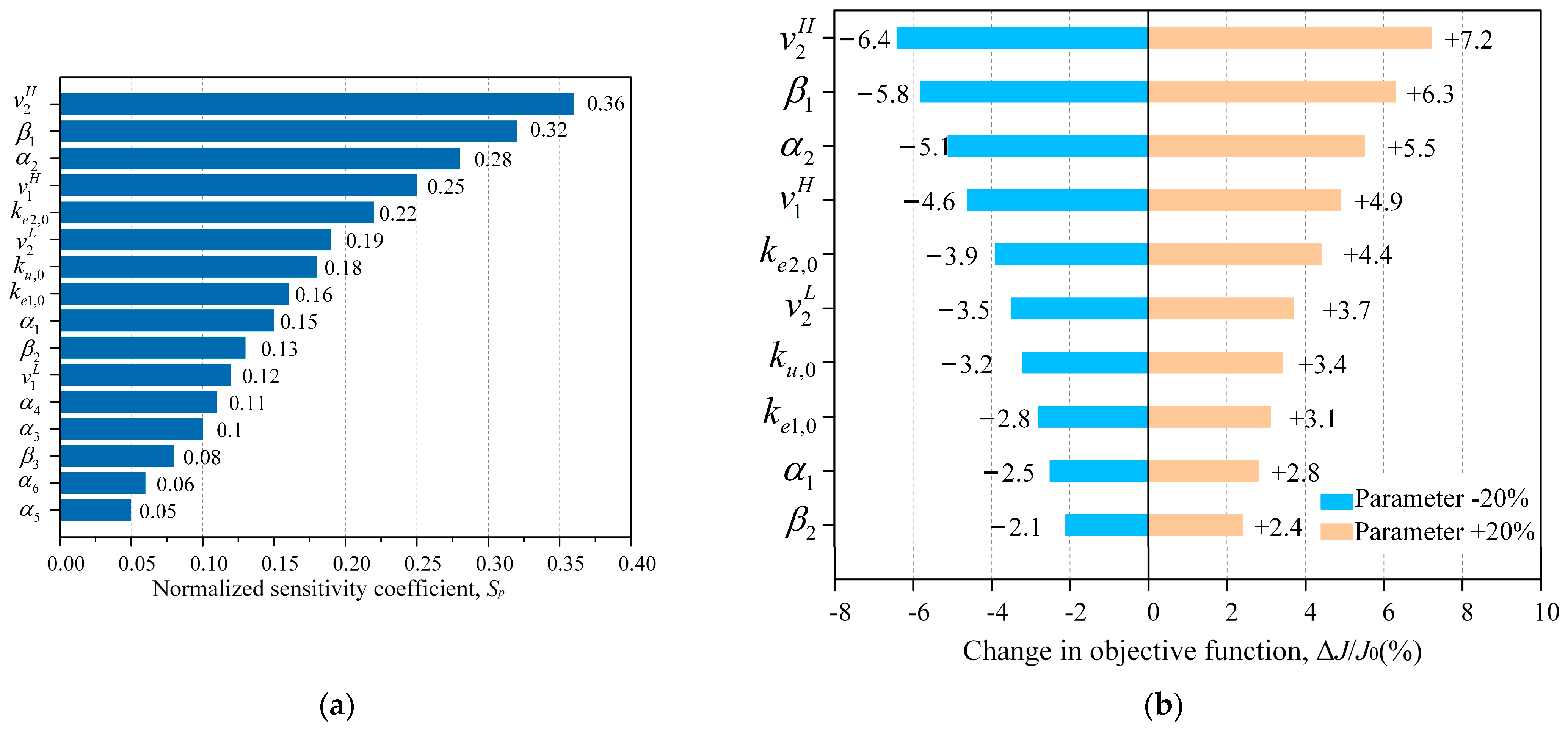
The results of the local sensitivity analysis are presented in
Figure 9.
As shown in
Figure 9a, the upper threshold of the relative lateral velocity,
, exhibits the highest sensitivity, with
Sp = 0.36, followed by the high-response output-scaling coefficient
and input-quantization coefficient
, with sensitivity indices of 0.32 and 0.28, respectively. By contrast, the low-response coefficients
,
,
exhibit relatively small sensitivity indices, indicating that moderate variations in the low-response parameter set have a comparatively limited influence on the overall performance index.
The corresponding ± 20% perturbation results are further summarized using the tornado plot in
Figure 9b. A ± 20% perturbation of
results in relative variations of approximately −6.4% and 7.2%, respectively, in the overall objective function, representing the largest response among the investigated parameters. The maximum variations associated with
and
are approximately 6.3% and 5.5%, respectively, whereas the effects of the remaining parameters are comparatively smaller over the same perturbation range.
These results indicate that the performance of the PSTFC does not exhibit excessive local dependence on most individual parameters within the investigated perturbation range, although the upper state thresholds and the corresponding high-response scaling coefficients require comparatively careful calibration. In particular , , and should receive greater attention when transferring the controller to vehicle configurations with different suspension or carbody characteristics. The sensitivity analysis therefore not only quantifies the dependence of the PSTFC on its tuning parameters but also provides a systematic basis for subsequent recalibration under varying vehicle and operating conditions.
3.3. Design of the Skyhook-Parameter Self-Tuning Fuzzy Controller
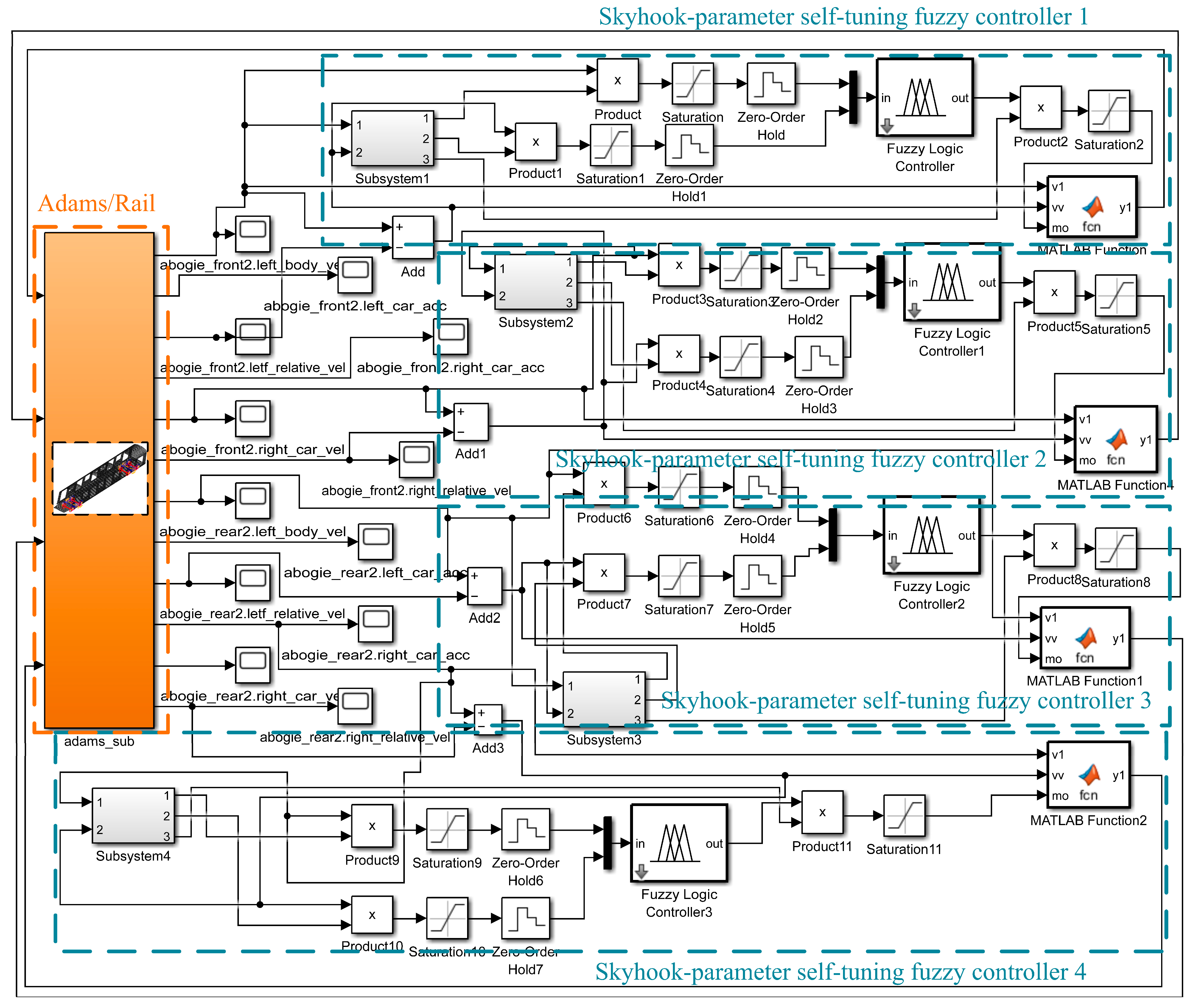
In this study, independent dual-input fuzzy controllers are employed to control the lateral dampers of the secondary suspension systems on both the front and rear bogies. The damping forces output by these controllers are used as inputs to the flexible carbody dynamic model of the metro vehicle developed in ADAMS/Rail. A total of four input channels are defined, corresponding to the number of lateral dampers in a single vehicle unit. In the MATLAB/Simulink-based skyhook-PSTFC Model, two variables are selected as inputs: the carbody lateral velocity and the relative lateral velocity between the carbody and bogie frame. The output variable is the lateral damping force applied by the secondary suspension.
One of the essential components of the fuzzy control system is the membership function, which defines how crisp numerical inputs are mapped to fuzzy linguistic variables. Considering the trade-off between control effectiveness and computational efficiency, the output variable (damping force) is divided into seven fuzzy subsets: (PA|PB|PC|PD|PE|PF|PG). Considering the characteristics of different membership function types, Gaussian functions are selected for the two input variables to ensure smooth and stable control performance. For the output variable, triangular membership functions are employed to enable faster response, which is essential for meeting the real-time requirements of vibration suppression.
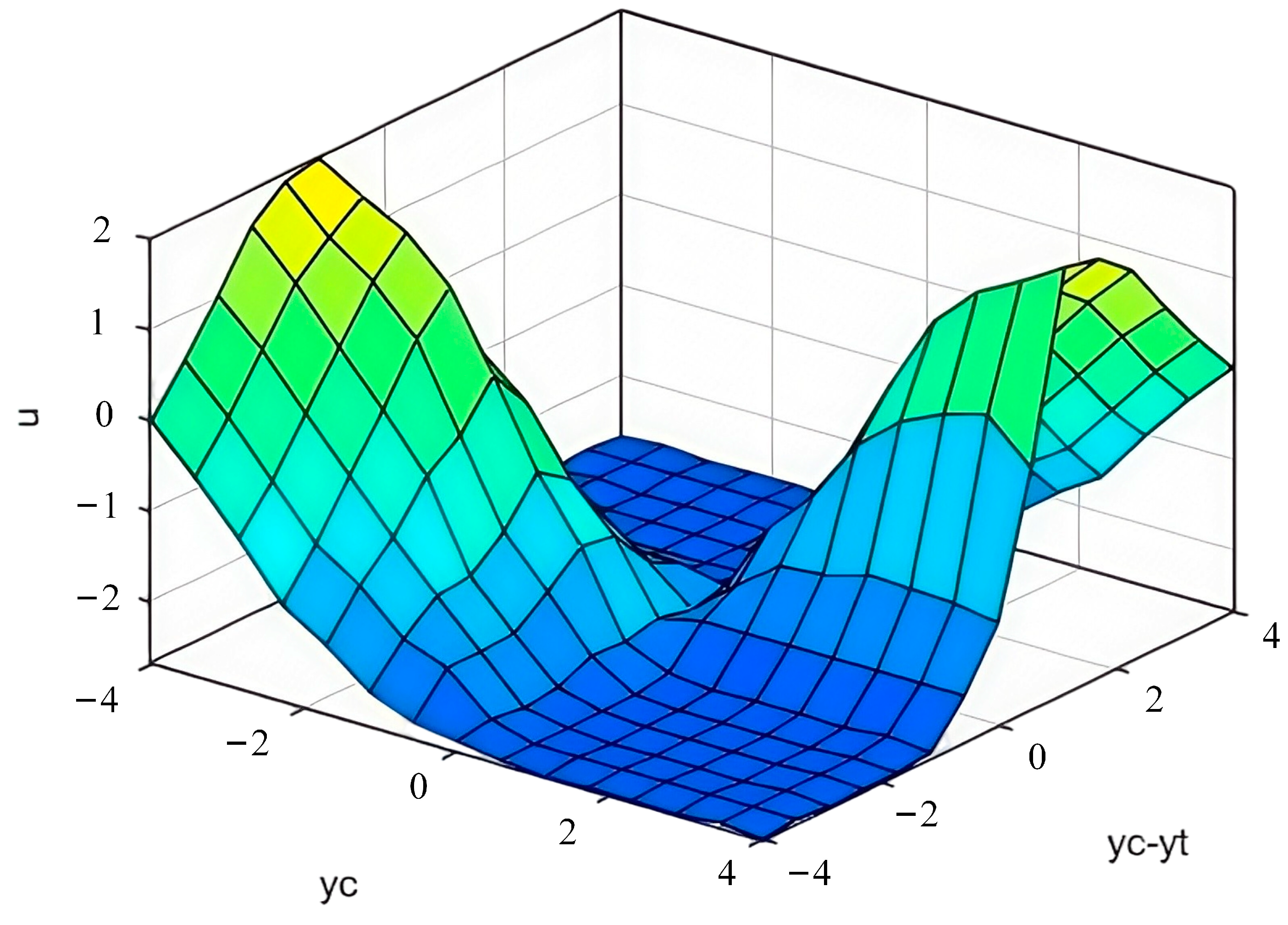
Fuzzy control rules, established through linguistic variables, are a fundamental component of fuzzy logic controllers, enabling the mapping between input and output variables. In this study, the rule base was initially constructed by referencing established fuzzy control schemes used in high-speed trains. To adapt it to metro vehicle applications, the differences in operational velocity, damper characteristics, and track irregularity spectra between metro and high-speed railway systems were carefully analyzed. Accordingly, the fuzzy sets of key input variables (e.g., vehicle speed and relative velocity) were redefined, and the associated linguistic term weights were adjusted to avoid oversensitivity or sluggish response under varying dynamic conditions. Moreover, the control rules were further optimized based on the vibration characteristics of the flexible carbody. Specifically, the relationship between the excitation of flexible structural modes and the control output (i.e., damping force) was analyzed to reverse-engineer the mapping between input combinations and output linguistic terms. A systematic rule selection procedure was performed using a co-simulation platform that integrates MATLAB/Simulink with ADAMS/Rail. Multiple rule set configurations were evaluated using dynamic performance indicators, and the optimal rule base was selected based on control accuracy and robustness. The resulting input–output relationship surface derived from the optimized fuzzy rule base is illustrated in
Figure 10.
Based on the aforementioned procedure, a fuzzy controller incorporating the skyhook damping principle was developed. Building upon this foundation, a skyhook parameter self-tuning fuzzy controller was designed by integrating the proposed self-adjustment mechanism. This enables real-time tuning of the fuzzy controller’s quantization and scaling factors. The adaptive mechanism is implemented using an S-Function module, which dynamically adjusts control parameters in response to changes in system state variables. The architecture of the designed skyhook parameter self-tuning fuzzy controller and the internal logic flow of its self-tuning S-Function module are illustrated in
Figure 11.
As shown in
Figure 11, the subsystem block represents the parameter self-tuning module within the fuzzy controller. The parameter self-adjustment process implemented in the S-Function module is detailed in the embedded flowchart.