
Discrete Element Method in Agricultural Machinery Design: A Critical Review of Applications, Validation Practices, and Implementation Challenges


Abstract
1. Introduction
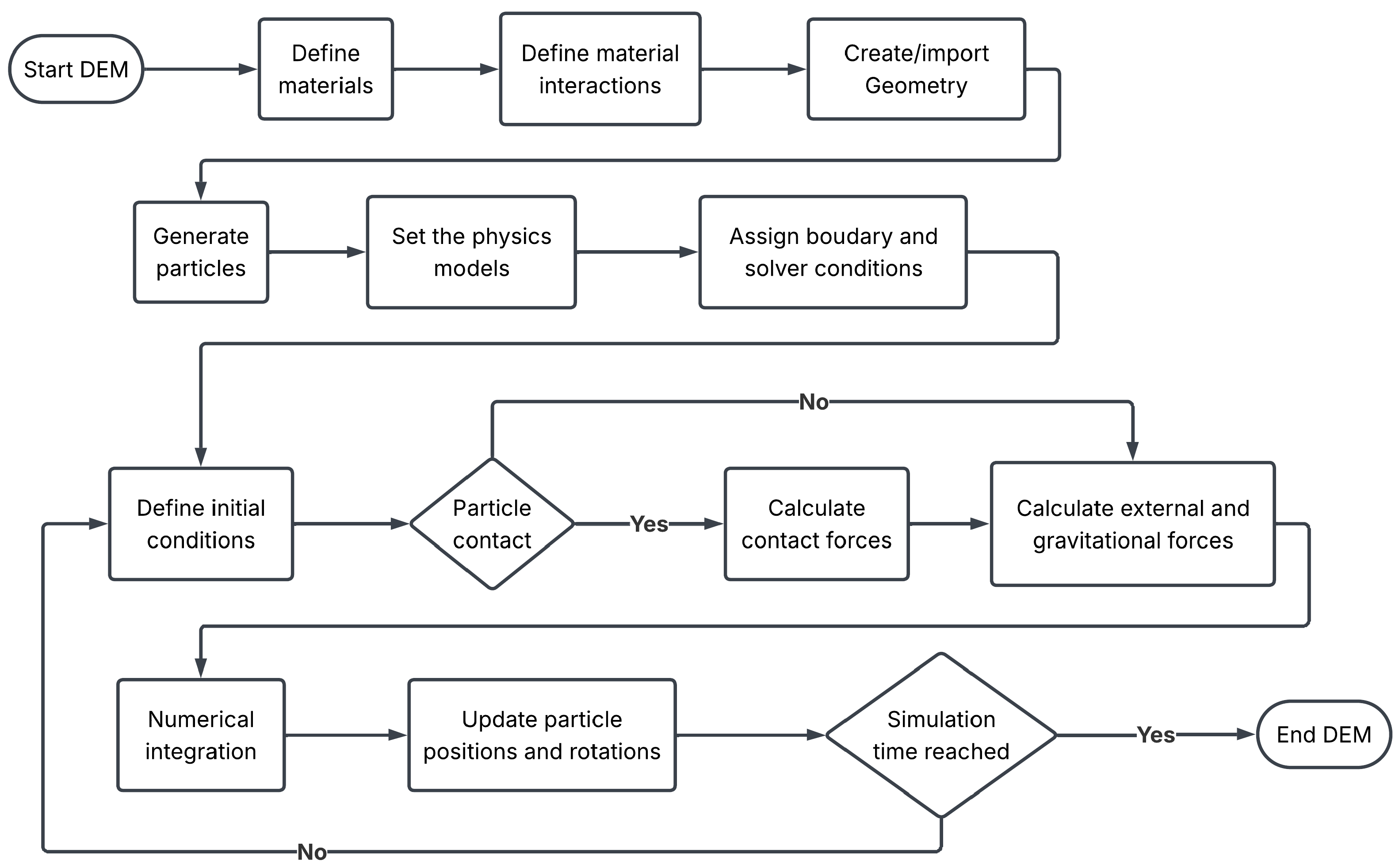
2. DEM Fundamentals
3. Contact Models for DEM Simulations in Agricultural Applications
3.1. Elastic Contact Models
3.2. Elastic–Plastic Contact Models
3.3. Viscoelastic Contact Models
3.4. Adhesion Contact Models
3.5. Tangent Stiffness Contact Models
3.6. Comparison of Contact Models in Agricultural Applications
3.7. Practical Mapping of Contact Models to Common DEM Packages
- EDEM (Altair)—Implements linear spring–dashpot (LSCM) and Hertz–Mindlin viscoelastic models with cohesive extensions (JKR-based adhesion, bonded particle frameworks), enabling users to balance computational efficiency and physical realism for dry grains, moist materials, and agglomerates [43].
- PFC (Itasca)—Provides linear and Hertzian models integrated with bonded particle models, including parallel bonds for mechanically cohesive assemblies and agglomerates, emphasizing micro-mechanical parameter control and detailed calibration [44].
- Rocky DEM—Offers linear and Hertz-type viscoelastic contacts with adhesion/cohesion models and rolling resistance, supporting non-spherical and scanned geometries, suited for simulations where particle shape and rotational dynamics significantly influence bulk behavior [45].
- LIGGGHTS (open-source)—Implements linear spring–dashpot and Hertz–Mindlin models through granular contact styles with community-developed cohesive/bonded extensions. Open architecture supports large-scale parametric studies and reproducible research workflows [46].
- Mercury DPM and other research codes—Research platforms implement fundamental linear, Hertzian, adhesive, and bonded contact families with flexible customization for methodological studies and new contact model development [47].
4. Geometry, Distribution, and Properties for Agricultural Particles
4.1. Particle Size and Shape
4.2. Particle Size Distribution (PSD)
4.3. Particle Properties
4.3.1. Intrinsic Characteristics
4.3.2. Interaction Parameters
4.4. Boundary Conditions
- Distinguish external (domain limits) versus internal (machine components) boundary conditions; describe internal boundary implementation (rigid CAD surfaces, moving boundary conditions, co-simulation with MBD/FEM).
- Specify kinematic prescription (prescribed motion vs. dynamic coupling); report the main surface parameters (elasticity, friction, roughness, adhesion) with calibration sources.
- Document numerical settings affecting moving boundary stability/accuracy: time step selection, contact detection tolerances, damping parameters.
- Validate tool–soil interactions against experimental measurements where possible or reference established soil bin/bench testing protocols.
5. Applications of DEM in Agricultural Engineering: From Soil Preparation to Post-Harvest Operations
5.1. DEM in Tillage Tools: Predictive Capacity and Calibration Challenges
5.2. DEM in Seed and Fertilizer Handling: From Laboratory Validation to Field-Scale Uncertainty
5.3. DEM in Harvesting and Threshing Systems: Modeling Biological Materials and Validation Complexity
5.4. Critical Synthesis: Accuracy, Validation Paradigms, and Implementation Challenges
6. Calibration of DEM Models: Methods, Strategies, Challenges, and Solutions in Agricultural Applications
6.1. Experimental Calibration Methods
6.2. Systematic Calibration Strategies
6.2.1. Trial-And-Error Calibration
6.2.2. Optimization-Based Calibration Methods
6.2.3. Inverse Modeling and Bayesian Calibration
6.2.4. Machine Learning-Assisted Calibration
6.2.5. Design of Experiments (DOE) Approaches
6.3. Key Challenges in DEM Calibration and Application
6.3.1. Computational Cost and Hardware Requirements
6.3.2. Parameter Uncertainty and Standardization
6.3.3. Scale-Up Challenges from Laboratory to Field
6.3.4. Challenges Specific to Agricultural Applications
6.4. Emerging Solutions: Hybrid Modeling Approaches
6.4.1. CFD-DEM Coupling for Fluid–Particle Systems
6.4.2. DEM-FEM Coupling for Deformable Structures
6.4.3. Multi-Body Dynamics Coupling
6.4.4. Coarse Graining and Multi-Scale Techniques
6.4.5. Machine Learning Integration
6.4.6. High-Performance Computing Strategies
7. DEM in Specialty Crops
8. Conclusions and Future Perspectives
8.1. Current State: What the DEM Can Realistically Achieve Today
- -
- Comparative design evaluation and parametric optimization. Across tillage, material handling, and harvesting systems, the DEM consistently demonstrates 8–20% prediction accuracy for bulk performance metrics (draft forces, flow rates, separation efficiency) under controlled conditions. This suffices for comparing design alternatives, identifying optimal operating parameters, and conducting virtual prototyping significantly reducing the physical prototypes required. Recent studies have successfully used the DEM to reduce draft forces by 15–22% in biomimetic tillage tools and improve distribution uniformity by 12–18% in fertilizer applicators.
- -
- Mechanistic insight into particle-scale phenomena. The DEM provides unique capabilities to visualize and quantify particle-level interactions that are experimentally inaccessible or prohibitively expensive to measure: stress chain formation in granular flows, particle trajectory analysis during separation, and contact force distribution at soil–tool interfaces. These insights enable a fundamental understanding of clogging mechanisms in seed meters, segregation patterns in grain handling, and soil failure modes during tillage, informing design principles that are difficult to establish through experimentation alone.
- -
- Rapid exploration of design space. The DEM enables the systematic investigation of geometric variations, operational parameters, and material properties at a computational cost far lower than that of physical experimentation. Multi-body dynamics coupling (DEM-MBD) has accelerated harvester component optimization, enabling rapid design iteration. CFD-DEM coupling has facilitated pneumatic system design, revealing complex fluid–particle interactions governing separation efficiency [107].
- -
- Limited absolute predictive accuracy for complex biological materials. While the DEM achieves 8–15% accuracy for free-flowing granular materials and cohesive soils, the prediction accuracy degrades to 25–30% for damage rates and failure events in biological materials (fruits, grains) [108,109]. This stems from the simplified representations of complex failure mechanisms (cutting, tearing, bruising) and substantial property variability within and between crops. DEM predictions for specialty crop handling require extensive experimental validation, and it cannot yet replace field testing for absolute performance guarantees.
- -
- Calibration parameter transferability remains constrained. Contact model parameters calibrated for specific material batches, moisture conditions, and temperature regimes often fail to maintain accuracy when applied to different field conditions. This reveals that, despite their physically based foundations, DEM models frequently function as semi-empirical tools requiring case-specific calibration, rather than universally applicable predictive instruments. Developing standardized parameter databases and physics-based estimation methods remains an active research frontier.
- -
- Computational cost limits temporal and spatial scale. Typical agricultural DEM simulations involve to particles with microsecond time steps, constraining the physical simulation time to seconds or minutes on conventional hardware. This necessitates a compromise between particle resolution, geometric fidelity, and simulation duration. While GPU acceleration and adaptive time-stepping provide 5–10× speedup, fundamental scaling limitations persist, particularly for large-scale field operations and long-duration processes.
8.2. Critical Gaps and Persistent Challenges
- -
- Validation methodology inconsistency. Fewer than 35% of the reviewed studies implemented comprehensive multi-scale, multi-observable validation strategies testing both macroscopic predictions and microscopic mechanisms. Single-metric validation (e.g., force comparison alone) risks the apparent accuracy masking fundamental mechanistic errors, limiting model reliability for extrapolation beyond the validation conditions. Standardized validation protocols and benchmark problems would enhance comparability and accelerate methodological advances.
- -
- Scale-dependent model fidelity. Computational constraints often force particle coarsening, representing materials with particle orders of magnitude that are larger than in reality. While coarse graining attempts to preserve bulk behavior, systematic errors emerge in phenomena that are sensitive to the particle size distribution, packing density, and contact network topology. Bridging laboratory-scale calibration to field-scale prediction remains problematic, particularly for heterogeneous materials (soil, aggregated biological products).
- -
- Environmental variability integration. Real agricultural operations involve moisture gradients, temperature fluctuations, material aging, and crop maturity variations, dramatically affecting mechanical properties. Current DEM frameworks poorly accommodate such dynamic property evolution, typically assuming constant parameters throughout the simulation [102]. Integrating real-time sensor data and adaptive parameter updating represents a critical but underexplored research direction.
- -
- Interdisciplinary knowledge barriers. Effective DEM application requires expertise spanning granular mechanics, agricultural engineering, numerical methods, and experimental characterization. However, parameter measurement protocols remain poorly standardized across agricultural materials, and fundamental material property data (elastic moduli, friction coefficients, cohesion parameters) are often unavailable for agricultural crops, particularly specialty varieties. Creating comprehensive, open-access databases of calibrated parameters would significantly lower the barriers to DEM adoption.
8.3. Future Research Directions: A Multi-Domain Perspective
8.3.1. Advanced Calibration Methodologies Spanning the Production Chain
- -
- Automated multi-objective calibration frameworks. Machine learning-assisted calibration, particularly Bayesian optimization and genetic algorithms, shows promise for efficiently navigating high-dimensional parameter spaces. However, current implementations focus narrowly on single materials or applications. Future work should develop comprehensive frameworks applicable across soil preparation, seeding, fertilizer handling, harvesting, and post-harvest processing. The integration of image-based characterization using computer vision and deep learning can automate shape quantification for irregular particles (seeds, grains, plant residues), reducing the manual measurement effort.
- -
- Physics-informed machine learning for parameter prediction. Hybrid approaches embedding physical constraints within neural network architectures could enable parameter estimation from readily measured properties (density, moisture content, geometric dimensions), facilitating rapid model deployment for new crops and varieties without extensive experimental campaigns.
- -
- In situ calibration using embedded sensors. Integrating load cells, strain gauges, and accelerometers directly into agricultural machinery enables real-time calibration during field operations. Coupling sensor data with inverse modeling could help to continuously update DEM parameters, adapting to changing field conditions and material properties. This paradigm shift from static laboratory calibration to dynamic field-based calibration warrants systematic investigation.
8.3.2. Integration with Precision Agriculture and Industry 4.0 Ecosystems
- -
- Real-time DEM for closed-loop control. Emerging computational advances, particularly GPU-based DEM solvers and reduced-order modeling, suggest the feasibility of real-time or near-real-time simulations [168,169]. Coupling real-time DEM with machine control systems could enable predictive control strategies that anticipate and mitigate clogging, segregation, or damage events before they occur. For example, DEM-informed control could dynamically adjust the harvester ground speed based on the predicted grain loss or optimize the tillage tool depth based on real-time soil resistance predictions.
- -
- Digital twin frameworks for agricultural machinery. Building comprehensive digital twins combining the DEM with complementary simulation tools (CFD, FEM, multi-body dynamics) and integrating real-time sensor data represents a transformative opportunity. Such frameworks would enable continuous performance monitoring, predictive maintenance, and adaptive optimization throughout machinery lifetimes. For instance, digital twins of combine harvesters could predict wear patterns, optimize separation settings for varying crop conditions, and provide operators with real-time guidance, maximizing efficiency while minimizing grain losses.
- -
- Integration with variable rate technology (VRT). Precision agriculture relies on spatially varying management based on within-field heterogeneity detected via remote sensing and yield mapping. DEM simulations coupled with VRT could optimize seeding rates, fertilizer application patterns, and tillage intensities based on predicted soil–tool interactions and material flow behavior specific to local conditions. This requires the development of rapid DEM workflows that are responsive to field-scale spatial data.
8.3.3. Expanding Applications to Underexplored Agricultural Domains
- -
- Specialty crops and high-value commodities. DEM applications to fruits, vegetables, nuts, and specialty crops remain limited despite substantial economic value. Coffee and orange production alone represent markets exceeding USD 500 billion globally, yet DEM studies addressing mechanical harvesting, damage prediction, and post-harvest handling for these crops are scarce [112,160]. Priority research directions include (1) characterizing mechanical properties and failure modes for diverse fruit varieties, maturity stages, and moisture content levels; (2) developing validated DEM models for selective harvesting, minimizing plant damage while maximizing fruit recovery; (3) simulating transport and storage systems to reduce bruising and quality loss; and (4) optimizing processing equipment for specialty crop handling (e.g., coffee pulping, citrus juice extraction).
- -
- Controlled-environment agriculture (CEA). Indoor farming, vertical agriculture, and greenhouse production increasingly employ automated material handling for seedlings, transplants, and harvested produce. The DEM can optimize robotic handling systems, conveying equipment, and automated sorting/grading lines specific to CEA operations [158]. Unique challenges include handling delicate seedlings, managing diverse tray configurations, and accommodating rapid crop turnover, requiring frequent equipment reconfiguration.
- -
- Organic matter management and circular agriculture. Composting, biochar production, and organic fertilizer handling involve complex granular materials with time-varying properties and broad size distributions. The DEM can optimize mixing equipment, predict segregation during storage and transport, and design application systems for organic amendments. Integration with biochemical degradation models would enable the simulation of property evolution during composting and storage.
8.3.4. Multi-Physics Coupling and Multi-Scale Modeling
- -
- Advanced CFD-DEM integration for pneumatic and hydraulic systems. While CFD-DEM coupling has demonstrated value for grain cleaning and pneumatic conveying [107], current implementations primarily employ Reynolds-averaged Navier–Stokes (RANS) turbulence models, inadequately capturing turbulent fluctuations affecting particle dispersion. Large eddy simulation (LES) and direct numerical simulation (DNS) coupled with the DEM would improve the accuracy but require the substantial computational cost to be addressed. Hybrid approaches using RANS for bulk flow and LES for critical regions warrant investigation.
- -
- DEM-FEM coupling for deformable structures. Agricultural materials including soils, plant stems, and biological tissues exhibit substantial deformation under loading. While bonded particle models approximate flexibility, coupling the DEM with the finite element method (FEM) enables the more accurate representation of structural mechanics. Applications include simulating root–soil interactions during harvesting, modeling flexible crop residues in tillage, and predicting fruit deformation during handling.
- -
- Adaptive multi-scale frameworks. Hybrid models dynamically adjusting the particle resolution based on local phenomena could address computational limitations while maintaining accuracy. Coarse-grained representations for bulk regions, transitioning to a fine-scale resolution in critical zones (tool–soil interface, separation regions, impact zones), would enable larger-scale simulations without sacrificing local fidelity. Machine learning techniques for identifying regions requiring a high resolution could automate adaptive refinement strategies.
8.3.5. Establishing Community Resources and Cross-Disciplinary Collaboration
- -
- Open-source material property databases. Creating comprehensive, community-curated databases of calibrated DEM parameters for agricultural materials would dramatically accelerate research and reduce redundant characterization efforts. Such databases should include metadata on measurement conditions, calibration procedures, uncertainty quantification, and validation results to enable informed parameter selection [111]. Integration with existing agricultural databases (soil surveys, crop variety registries) would enhance accessibility.
- -
- Benchmark problems and validation datasets. Standardized test cases with experimental validation data would enable the systematic comparison of contact models, calibration methods, and solution algorithms. Benchmark suites spanning tillage, material handling, and harvesting applications would facilitate method development and provide training resources for new practitioners.
- -
- Interdisciplinary training and knowledge exchange. Bridging the granular mechanics, agricultural engineering, and computational methods communities requires targeted educational initiatives. Summer schools, workshops, and online courses combining theoretical foundations with practical implementation would broaden DEM accessibility. Establishing cross-disciplinary research networks linking DEM developers, agricultural engineers, and industry practitioners would accelerate technology transfer and identify high-impact applications.
8.4. Practical Implications for Designers and Researchers
8.5. Concluding Remarks
Author Contributions
Funding
Data Availability Statement
Acknowledgments
Conflicts of Interest
References
- OECD-FAO Agricultural Outlook 2023–2032: Maps Key Output, Consumption and Trade Trends. 2023. Available online: https://www.fao.org/newsroom/detail/oecd-fao-agricultural-outlook-2023-32-maps-key-output--consumption-and-trade-trends/en (accessed on 16 October 2024).
- Jones, D.L.; Cooledge, E.; Chadwick, D.R. Is one year enough? A commentary on field experiment duration in agricultural research. Agric. Syst. 2025, 228, 104393. [Google Scholar] [CrossRef]
- Cundall, P.A.; Strack, O.D.L. Discussion: A discrete numerical model for granular assemblies. Géotechnique 1980, 30, 331–336. [Google Scholar] [CrossRef]
- Zhao, H.; Huang, Y.; Liu, Z.; Liu, W.; Zheng, Z. Applications of discrete element method in the research of agricultural machinery: A review. Agriculture 2021, 11, 425. [Google Scholar] [CrossRef]
- Shmulevich, I. State of the art modeling of soil–tillage interaction using discrete element method. Soil Tillage Res. 2010, 111, 41–53. [Google Scholar] [CrossRef]
- Wang, T.; Zhang, F.; Furtney, J.; Damjanac, B. A review of methods, applications and limitations for incorporating fluid flow in the discrete element method. J. Rock Mech. Geotech. Eng. 2022, 14, 1005–1024. [Google Scholar] [CrossRef]
- Du, X.; Dang, S.; Yang, Y.; Chai, Y. The finite element method with high-order enrichment functions for elastodynamic analysis. Mathematics 2022, 10, 4595. [Google Scholar] [CrossRef]
- Coetzee, C.; Scheffler, O.C. Comparing particle shape representations and contact models for DEM simulation of bulk cohesive behaviour. Comput. Geosci. 2023, 159, 105449. [Google Scholar] [CrossRef]
- Mousaviraad, M.; Tekeste, M.Z. Systematic calibration and validation approach for DEM modeling of corn under varying moisture contents. J. ASABE 2024, 67, 259–274. [Google Scholar] [CrossRef]
- Coetzee, C.J.; Scheffler, O.C. Review: The Calibration of DEM Parameters for the Bulk Modelling of Cohesive Materials. Processes 2023, 11, 5. [Google Scholar] [CrossRef]
- Zhang, Y.; Li, L. Optimization of discrete element method model to obtain stable and reliable numerical results of mechanical response of granular materials. Minerals 2024, 14, 758. [Google Scholar] [CrossRef]
- Wriggers, P.; Avci, B. Discrete Element Methods: Basics and Applications in Engineering. In Modeling in Engineering Using Innovative Numerical Methods for Solids and Fluids; De Lorenzis, L., Düster, A., Eds.; Springer International Publishing: Cham, Switzerland, 2020; pp. 1–30. [Google Scholar] [CrossRef]
- Liu, D.; O’Sullivan, C.; Carraro, J.A.H. The influence of particle size distribution on the stress distribution in granular materials. Géotechnique 2023, 73, 250–264. [Google Scholar] [CrossRef]
- Fang, Y.; Liu, G.; Zhang, Y.; Zhu, Z.; Li, S. A generalized coarse-graining discrete-element method with variable scaling ratios based on non-dimensional contact equation. Powder Technol. 2025, 452, 120569. [Google Scholar] [CrossRef]
- Malone, K.F.; Xu, B.H. Determination of contact parameters for discrete element method simulations of granular systems. Particuology 2008, 6, 521–528. [Google Scholar] [CrossRef]
- Hertz, H. On the contact of elastic solids. J. Reine Angew. Math. 1882, 92, 156–171. [Google Scholar] [CrossRef]
- Wang, G.; Nie, J.; Cui, Y.; Guo, J. Incorporating particle roughness and hardness into contact model to reproduce elastic behaviors of granular soils in DEM. Comput. Geotech. 2025, 179, 107054. [Google Scholar] [CrossRef]
- Moya, M.; Sánchez, D.; Romero, J.Á.; Villar-García, J.R. Influence of moisture content on some mechanical properties of wheat. Agronomy 2024, 14, 347. [Google Scholar] [CrossRef]
- Zhao, J.; Yu, J.; Sun, K.; Wang, Y.; Liang, L.; Sun, Y.; Zhou, L.; Yu, Y. A discrete element method model and experimental verification for wheat root systems. Biosyst. Eng. 2024, 244, 146–165. [Google Scholar] [CrossRef]
- Thornton, C.; Ning, Z. A theoretical model for the stick/bounce behaviour of adhesive, elastic–plastic spheres. Powder Technol. 1998, 99, 154–162. [Google Scholar] [CrossRef]
- Parafiniuk, P.; Molenda, M.; Horabik, J. Discharge of rapeseeds from a model silo: Physical testing and discrete element method simulations. Comput. Electron. Agric. 2013, 97, 40–46. [Google Scholar] [CrossRef]
- Ghaednia, H.; Wang, X.; Saha, S.; Xu, Y.; Sharma, A.; Jackson, R.L. A review of elastic–plastic contact mechanics. Appl. Mech. Rev. 2017, 69, 060804. [Google Scholar] [CrossRef]
- Ding, S.; Hu, Y.; Jian, B.; Zhang, Y.; Xia, R.; Hu, G. A review and comparative analysis of normal contact force models for viscoelastic particles. Int. J. Impact Eng. 2024, 189, 104968. [Google Scholar] [CrossRef]
- Liang, Z.; Huang, Y.; Li, D.; Wada, M.E. Parameter determination of a viscoelastic–plastic contact model for potatoes during transient collisions. Biosyst. Eng. 2023, 234, 156–171. [Google Scholar] [CrossRef]
- Horabik, J.; Beczek, M.; Mazur, R.; Parafiniuk, P.; Ryżak, M.; Molenda, M. Determination of the restitution coefficient of seeds and coefficients of visco-elastic Hertz contact models for DEM simulations. Biosyst. Eng. 2017, 161, 106–119. [Google Scholar] [CrossRef]
- Kuwabara, G.; Kono, K. Restitution coefficient in a collision between two spheres. Jpn. J. Appl. Phys. 1987, 26, 1230. [Google Scholar] [CrossRef]
- Tsuji, Y.; Tanaka, T.; Ishida, T. Lagrangian numerical simulation of plug flow of cohesionless particles in a horizontal pipe. Powder Technol. 1992, 71, 239–250. [Google Scholar] [CrossRef]
- Kruggel-Emden, H.; Simsek, E.; Rickelt, S.; Wirtz, S.; Scherer, V. Review and extension of normal force models for the discrete element method. Powder Technol. 2007, 171, 157–173. [Google Scholar] [CrossRef]
- Alizadeh, E.; Bertrand, F.; Chaouki, J. Development of a granular normal contact force model based on a non-Newtonian liquid filled dashpot. Powder Technol. 2013, 237, 202–212. [Google Scholar] [CrossRef]
- Israelachvili, J.N. Intermolecular and Surface Forces, 3rd ed.; Academic Press: Cambridge, MA, USA, 2011. [Google Scholar] [CrossRef]
- Peng, F.; Zhang, L.; Li, Z.; Chen, J. Calibration and verification of DEM parameters of wet-sticky feed raw materials. Sci. Rep. 2023, 13, 9246. [Google Scholar] [CrossRef] [PubMed]
- Wang, X.; Zhang, Q.; Huang, Y.; Ji, J. An efficient method for determining DEM parameters of a loose cohesive soil modelled using hysteretic spring and linear cohesion contact models. Biosyst. Eng. 2022, 215, 283–294. [Google Scholar] [CrossRef]
- Gauthier, A.; Ovarlez, G.; Colin, A. Shear thickening in presence of adhesive contact forces: The singularity of cornstarch. J. Colloid Interface Sci. 2023, 650, 1105–1112. [Google Scholar] [CrossRef] [PubMed]
- Thakur, S.C.; Ooi, J.Y.; Ahmadian, H. Scaling of discrete element model parameters for cohesionless and cohesive solid. Powder Technol. 2016, 293, 130–137. [Google Scholar] [CrossRef]
- Johnson, K.L. Contact Mechanics; Cambridge University Press: Cambridge, UK, 1987. [Google Scholar] [CrossRef]
- Timoshenko, S.P.; Goodier, J.N. Theory of Elasticity; McGraw-Hill: New York, NY, USA, 1970. [Google Scholar] [CrossRef]
- Mindlin, R.D.; Deresiewicz, H. Elastic spheres in contact under varying oblique forces. J. Appl. Mech. 1953, 20, 327–344. [Google Scholar] [CrossRef]
- Horabik, J.; Molenda, M. Parameters and contact models for DEM simulations of agricultural granular materials: A review. Biosyst. Eng. 2016, 147, 206–225. [Google Scholar] [CrossRef]
- Vu-Quoc, L.; Zhang, X. An accurate and efficient tangential force–displacement model for elastic frictional contact in particle-flow simulations. Mech. Mater. 1999, 31, 235–269. [Google Scholar] [CrossRef]
- Zhang, X.; Vu-Quoc, L. Simulation of chute flow of soybeans using an improved tangential force–displacement model. Mech. Mater. 2000, 32, 115–129. [Google Scholar] [CrossRef]
- Balevičius, R.; Mróz, Z. The combined slip and finite sliding models in a frictional contact interaction of two spherical particles. Procedia Eng. 2013, 57, 167–174. [Google Scholar] [CrossRef]
- Łukaszuk, J.; Molenda, M.; Horabik, J.; Wiącek, J. Method of measurement of coefficient of friction between pairs of metallic and organic objects. Acta Agrophysica 2009, 13, 407–418. [Google Scholar] [CrossRef]
- Altair Engineering. EDEM Base Contact Models Documentation. 2024. Available online: https://help.altair.com/edem/topics/creator_tree_physics/understanding_base_contact_models_r.htm (accessed on 27 February 2026).
- Itasca Consulting Group. PFC Built-in Contact Models Documentation. 2024. Available online: https://docs.itascasoftware.com/itasca960/pfc/docproject/source/manual/pfc_model_components/contacts/contact_built-in.html (accessed on 27 February 2026).
- ANSYS, Inc. Rocky Technical Manual. Rocky DEM Software Documentation. 2025. Available online: https://ansyshelp.ansys.com/public/account/secured?returnurl=/Views/Secured/corp/v242/en/dem_tec/dem_tec.html (accessed on 27 February 2026).
- CFDEM Project. LIGGGHTS Contact Models Documentation. LIGGGHTS Software Documentation. 2024. Available online: https://www.cfdem.com/media/DEM/docu/Section_gran_models.html (accessed on 27 February 2026).
- Weinhart, T.; Orefice, L.; Post, M.; van Schrojenstein Lantman, M.P.; Denissen, I.F.C.; Tunuguntla, D.R.; Tsang, J.M.F.; Barbosa, J.; Shi, H.; Cheng, H.; et al. Fast, flexible particle simulations—An introduction to MercuryDPM. Comput. Phys. Commun. 2020, 249, 107129. [Google Scholar] [CrossRef]
- Wang, Z.Y.; Fang, Y.F.; Feng, W.Q.; Tian, X.J.; Lin, J.F. Comparative study on particle size effect of crushable granular soils through DEM simulations. Lithosphere 2022, 2021, 1608454. [Google Scholar] [CrossRef]
- Plassiard, J.P.; Belheine, N.; Donzé, F.V. A spherical discrete element model: Calibration procedure and incremental response. Granul. Matter 2009, 11, 293–306. [Google Scholar] [CrossRef]
- Gong, H.; Chen, Y.; Wu, S.; Tang, Z.; Liu, C.; Wang, Z.; Fu, D.; Zhou, Y.; Qi, L. Simulation of canola seedling emergence dynamics under different soil compaction levels using the discrete element method. Soil Tillage Res. 2022, 223, 105461. [Google Scholar] [CrossRef]
- Fan, J.; Wang, H.; Sun, K.; Zhang, L.; Wang, L.; Zhao, J.; Yu, J. Experimental verification and simulation analysis of a multi-sphere modelling approach for wheat seed particles based on the discrete element method. Biosyst. Eng. 2024, 245, 135–151. [Google Scholar] [CrossRef]
- Berry, N.; Zhang, Y.; Haeri, S. Contact models for the multi-sphere discrete element method. Powder Technol. 2023, 416, 118209. [Google Scholar] [CrossRef]
- Lu, G.; Third, J.R.; Müller, C.R. Discrete element models for non-spherical particle systems: From theoretical developments to applications. Chem. Eng. Sci. 2015, 127, 425–465. [Google Scholar] [CrossRef]
- Liu, G.Y.; Xu, W.J.; Zhou, Q. DEM contact model for spherical and polyhedral particles based on energy conservation. Comput. Geotech. 2023, 153, 105072. [Google Scholar] [CrossRef]
- Mittal, A.; Mangadoddy, N.; Banerjee, R. GPU based discrete element modeling for convex polyhedral shape particles: Development and validation. Powder Technol. 2025, 449, 120407. [Google Scholar] [CrossRef]
- Du, C.; Han, D.; Song, Z.; Chen, Y.; Chen, X.; Wang, X. Calibration of contact parameters for complex shaped fruits based on discrete element method: The case of pod pepper (Capsicum annuum). Biosyst. Eng. 2023, 226, 43–54. [Google Scholar] [CrossRef]
- Kootahi, K.; Leung, A.K.; Jiang, Z.; Liu, J.; Qi, R.; Lourenço, S.D.N.; Lai, Z.; Gao, Z. Evaluation of the methods of particle morphology characterization: CT scanning, digital imaging and light microscopy. Comput. Geotech. 2024, 174, 106648. [Google Scholar] [CrossRef]
- Gilbert, E.G.; Johnson, D.W.; Keerthi, S.S. A fast procedure for computing the distance between complex objects in three-dimensional space. IEEE J. Robot. Autom. 1988, 4, 193–203. [Google Scholar] [CrossRef] [PubMed]
- Deshpande, R.; Mahiques, E.; Wirtz, S.; Scherer, V. Resolving particle shape in DEM simulations from tabulated geometry information. Powder Technol. 2022, 407, 117700. [Google Scholar] [CrossRef]
- Lai, Z.; Zhao, S.; Zhao, J.; Huang, L. Signed distance field framework for unified DEM modeling of granular media with arbitrary particle shapes. Comput. Mech. 2022, 70, 763–783. [Google Scholar] [CrossRef]
- Lu, L.; Gao, X.; Dietiker, J.F.; Shahnam, M.; Rogers, W.A. Machine learning accelerated discrete element modeling of granular flows. Chem. Eng. Sci. 2021, 245, 116832. [Google Scholar] [CrossRef]
- Hadi, A.; Moradi, M.; Pang, Y.; Schott, D. Adaptive AI-based surrogate modelling via transfer learning for DEM simulation of multi-component segregation. Sci. Rep. 2024, 14, 27003. [Google Scholar] [CrossRef] [PubMed]
- Xu, J.; Wang, X.; Zhang, Z.; Wu, W. Discrete element modeling and simulation of soybean seed using multi-spheres and super-ellipsoids. IEEE Access 2020, 8, 222672–222683. [Google Scholar] [CrossRef]
- Wang, L.; Yang, H.; Wang, Z.; Wang, Q.; Lu, C.; Wang, C.; He, J. Calibration of DEM polyhedron model for wheat seed based on angle of repose test and semi-resolved CFD-DEM coupling simulation. Agriculture 2025, 15, 506. [Google Scholar] [CrossRef]
- Xia, Y.; Chen, F.; Klinger, J.L.; Kane, J.J.; Bhattacharjee, T.; Seifert, R.; Ajayi, O.O.; Chen, Q. Assessment of a tomography-informed polyhedral discrete element modelling approach for complex-shaped granular woody biomass in stress consolidation. Biosyst. Eng. 2021, 205, 187–211. [Google Scholar] [CrossRef]
- Huang, J.; Safranyik, F.; Tóth, J.; Keppler, I. Shear Test as Calibration Experiment for DEM Simulations: Sphero-polygonal Particle Model. FME Trans. 2024, 52, 659–670. [Google Scholar] [CrossRef]
- Wiącek, J.; Molenda, M. Effect of particle size distribution on micro- and macromechanical response of granular packings under compression. Int. J. Solids Struct. 2014, 51, 4189–4195. [Google Scholar] [CrossRef]
- Olsson, E.; Larsson, P.L. Effect of particle size distribution at powder compaction. In Proceedings of the European PM 2011, Poznan, Poland, 27 June–1 July 2011; pp. 265–270. [Google Scholar]
- Chou, H.T.; Chou, S.H.; Hsiau, S.S. The effects of particle density and interstitial fluid viscosity on the dynamic properties of granular slurries in a rotating drum. Powder Technol. 2014, 252, 42–50. [Google Scholar] [CrossRef]
- Wiącek, J.; Molenda, M.; Horabik, J.; Ooi, J.Y. Influence of grain shape and intergranular friction on material behavior in uniaxial compression: Experimental and DEM modeling. Powder Technol. 2012, 217, 435–442. [Google Scholar] [CrossRef]
- Ramaj, I.; Romuli, S.; Schock, S.; Müller, J. Discrete element modelling of bulk behaviour of wheat (Triticum aestivum L.) cv. Pionier during compressive loading. Biosyst. Eng. 2024, 242, 123–139. [Google Scholar] [CrossRef]
- Ghods, N.; Poorsolhjouy, P.; Gonzalez, M.; Radl, S. Discrete element modeling of strongly deformed particles in dense shear flows. Powder Technol. 2022, 401, 117288. [Google Scholar] [CrossRef]
- Moya, M.; Guaita, M.; Aguado, P.; Ayuga, F. Mechanical properties of granular agricultural materials, part 2. Trans. ASABE 2006, 49, 479–489. [Google Scholar] [CrossRef]
- Molenda, M.; Horabik, J. Characterization of Mechanical Properties of Particulate Solids for Storage and Handling; Institute of Agrophysics, Polish Academy of Sciences: Lublin, Poland, 2005; ISBN 83-89969-35-1. [Google Scholar]
- Moya, M.; Ayuga, F.; Guaita, M.; Aguado, P. Mechanical properties of granular agricultural materials. Trans. ASAE 2002, 45, 1569–1577. [Google Scholar] [CrossRef]
- Aryaei, A.; Hashemnia, K.; Jafarpur, K. Experimental and numerical study of ball size effect on restitution coefficient in low velocity impacts. Int. J. Impact Eng. 2010, 37, 1037–1044. [Google Scholar] [CrossRef]
- Wang, L.; Zheng, Z.; Yu, Y.; Liu, T.; Zhang, Z. Determination of the energetic coefficient of restitution of maize grain based on laboratory experiments and DEM simulations. Powder Technol. 2020, 362, 645–658. [Google Scholar] [CrossRef]
- González-Montellano, C.; Fuentes, J.M.; Ayuga-Téllez, E.; Ayuga, F. Determination of the mechanical properties of maize grains and olives required for use in DEM simulations. J. Food Eng. 2012, 111, 553–562. [Google Scholar] [CrossRef]
- Vu-Quoc, L.; Lesburg, L.; Zhang, X. An accurate tangential force–displacement model for granular-flow simulations: Contacting spheres with plastic deformation, force-driven formulation. J. Comput. Phys. 2004, 196, 298–326. [Google Scholar] [CrossRef]
- Bertrand, D.; Trad, A.; Limam, A.; Silvani, C. Full-scale dynamic analysis of an innovative rockfall fence under impact using the discrete element method: From the local scale to the structure scale. Rock Mech. Rock Eng. 2012, 45, 885–900. [Google Scholar] [CrossRef]
- Chen, J.; Krengel, D.; Nishiura, D.; Furuichi, M.; Matuttis, H.G. A force–displacement relation based on the JKR theory for DEM simulations of adhesive particles. Powder Technol. 2023, 427, 118742. [Google Scholar] [CrossRef]
- Hærvig, J.; Kleinhans, U.; Wieland, C.; Spliethoff, H.; Jensen, A.L.; Sørensen, K.; Condra, T.J. On the adhesive JKR contact and rolling models for reduced particle stiffness discrete element simulations. Powder Technol. 2017, 319, 472–482. [Google Scholar] [CrossRef]
- Li, X.; Luo, Z.; Hao, Z.; Zheng, E.; Yao, H.; Zhu, Y.; Wang, X. Investigation on tillage resistance and soil disturbance in wet adhesive soil using discrete element method with three-layer soil-plough coupling model. Powder Technol. 2024, 436, 119463. [Google Scholar] [CrossRef]
- Hu, Y.; Chan, E.L.; Watanabe, J.I.; Takezawa, M.; Tsuji, T.; Tanaka, T.; Washino, K. Inter-particle torque scaling in coarse grained DEM with rolling resistance and particle size distributions. Powder Technol. 2024, 438, 119612. [Google Scholar] [CrossRef]
- Markauskas, D.; Ramírez-Gómez, Á.; Kačianauskas, R.; Zdancevičius, E. Maize grain shape approaches for DEM modelling. Comput. Electron. Agric. 2015, 118, 247–258. [Google Scholar] [CrossRef]
- Balevičius, R.; Sielamowicz, I.; Mróz, Z.; Kačianauskas, R. Effect of rolling friction on wall pressure, discharge velocity and outflow of granular material from a flat-bottomed bin. Particuology 2012, 10, 672–682. [Google Scholar] [CrossRef]
- Markauskas, D.; Kačianauskas, R. Investigation of rice grain flow by multi-sphere particle model with rolling resistance. Granul. Matter 2011, 13, 143–148. [Google Scholar] [CrossRef]
- Aikins, K.A.; Ucgul, M.; Barr, J.B.; Awuah, E.; Antille, D.L.; Jensen, T.A.; Desbiolles, J.M.A. Review of discrete element method simulations of soil tillage and furrow opening. Agriculture 2023, 13, 541. [Google Scholar] [CrossRef]
- Yuan, Y.; Wang, J.; Zhang, X.; Zhao, S. Effect of rotary speed on soil and straw throwing process. Agriculture 2023, 13, 877. [Google Scholar] [CrossRef]
- Kim, Y.S.; Lee, S.D.; Baek, S.M.; Baek, S.Y.; Jeon, H.H.; Lee, J.H.; Siddique, M.A.A.; Kim, Y.J.; Kim, W.S.; Sim, T.; et al. Development of DEM-MBD coupling model for draft force prediction of agricultural tractor with plowing depth. Comput. Electron. Agric. 2022, 202, 107405. [Google Scholar] [CrossRef]
- Pásthy, L.; Farkas, Z.J.; Haba, T.; Tamás, K. Development of a multi-way coupled discrete-finite element method simulation procedure for modelling soil-passive vibration tool interaction. Comput. Electron. Agric. 2024, 216, 108459. [Google Scholar] [CrossRef]
- Barr, J.B.; Ucgul, M.; Desbiolles, J.M.; Fielke, J.M. Simulating the effect of rake angle on narrow opener performance with the discrete element method. Biosyst. Eng. 2018, 171, 1–15. [Google Scholar] [CrossRef]
- Du, J.; Heng, Y.; Zheng, K.; Luo, C.; Zhu, Y.; Zhang, J.; Xia, J. Investigation of the burial and mixing performance of a rotary tiller using discrete element method. Soil Tillage Res. 2022, 220, 105349. [Google Scholar] [CrossRef]
- Ma, Z.; Wu, Z.; Li, Y.; Song, Z.; Yu, J.; Li, Y.; Xu, L. Study of the grain particle-conveying performance of a bionic non-smooth-structure screw conveyor. Biosyst. Eng. 2024, 238, 94–104. [Google Scholar] [CrossRef]
- Wang, X.; Li, P.; He, J.; Wei, W.; Huang, Y. Discrete element simulations and experiments of soil-winged subsoiler interaction. Int. J. Agric. Biol. Eng. 2021, 14, 50–62. [Google Scholar] [CrossRef]
- Wang, X.; Du, R.; Geng, L.; Zhou, H.; Ji, J. Performance evaluation of a cicada-inspired subsoiling tool using DEM simulations. Biomimetics 2024, 9, 25. [Google Scholar] [CrossRef] [PubMed]
- Ucgul, M.; Fielke, J.M.; Saunders, C. 3D DEM tillage simulation: Validation of a hysteretic spring (plastic) contact model for a sweep tool operating in a cohesionless soil. Soil Tillage Res. 2014, 144, 220–227. [Google Scholar] [CrossRef]
- Nalawade, R.D.; Singh, K.P.; Roul, A.K.; Patel, A. Parametric study and calibration of hysteretic spring and linear cohesion contact models for cohesive soils using definitive screening design. Comput. Part. Mech. 2023, 10, 707–728. [Google Scholar] [CrossRef]
- Song, X.; Dai, F.; Zhang, F.; Wang, D.; Liu, Y. Calibration of DEM models for fertilizer particles based on numerical simulations and granular experiments. Comput. Electron. Agric. 2023, 204, 107507. [Google Scholar] [CrossRef]
- Xiao, W.; Chen, H.; Wan, X.; Li, M.; Liao, Q. Influence of shape and particle size distribution on discrete element simulation flow characteristics of granular compound fertilizers. Appl. Eng. Agric. 2021, 37, 1169–1179. [Google Scholar] [CrossRef]
- Ma, D.; Shi, S.; Hou, J.; Zhou, J.; Li, H.; Li, J. Calibration and Experimentation of Discrete Elemental Model Parameters for Wheat Seeds with Different Filled Particle Radii. Appl. Sci. 2024, 14, 2075. [Google Scholar] [CrossRef]
- Sun, X.; Niu, L.; Zhang, H.; Wang, Q.; Zhou, W.; Tang, H.; Wang, J. Exploring sustainable agriculture: Investigating the impact of controlled release fertilizer damage through bonded particle modeling. J. Clean. Prod. 2024, 468, 143095. [Google Scholar] [CrossRef]
- Kong, Y.; Pei, Y.; Tong, Z.; Zhou, P.; Chen, Y.; Zhang, X. A DEM-PSO-Kriging framework for minimizing mechanical damage and nutrient pollution from controlled release fertilizers. Ind. Crops Prod. 2026, 240, 122557. [Google Scholar] [CrossRef]
- Wang, Q.; Mao, H.; Li, Q. Modelling and simulation of the grain threshing process based on the discrete element method. Comput. Electron. Agric. 2020, 178, 105790. [Google Scholar] [CrossRef]
- Xia, Y.; Klinger, J.; Bhattacharjee, T.; Thompson, V. The elastoplastic flexural behaviour of corn stalks. Biosyst. Eng. 2022, 216, 218–228. [Google Scholar] [CrossRef]
- Li, J.; Shen, X.; Yu, Y.; Liang, J.; Zhou, P. Multi-Scale Analysis of Sand Behavior Under Rigid and Flexible Membrane Boundaries in DEM Triaxial Compression. Symmetry 2025, 17, 1499. [Google Scholar] [CrossRef]
- Kang, Y.; Song, X.; Luo, R.; Huang, T.; Xiao, F.; Deng, Z.; Chen, H. CFD-DEM simulation and parameter optimization of pneumatic conveying of threshed corn residual products in a vertical elbow. Ind. Crops Prod. 2026, 243, 123012. [Google Scholar] [CrossRef]
- Chen, M.; Liu, X.; Hu, P.; Zhai, X.; Han, Z.; Shi, Y.; Zhu, W.; Wang, D.; He, X.; Shang, S. Study on rotor vibration potato-soil separation device for potato harvester using DEM-MBD coupling simulation. Comput. Electron. Agric. 2024, 218, 108638. [Google Scholar] [CrossRef]
- Chen, Z.; Wassgren, C.; Ambrose, R.K. Development and validation of a DEM model for predicting impact damage of maize kernels. Biosyst. Eng. 2022, 224, 16–33. [Google Scholar] [CrossRef]
- Li, Y.; Hu, Z.; Gu, F.; Wang, B.; Fan, J.; Yang, H.; Wu, F. DEM-MBD Coupling Simulation and Analysis of the Working Process of Soil and Tuber Separation of a Potato Combine Harvester. Agronomy 2022, 12, 1734. [Google Scholar] [CrossRef]
- Coetzee, C.J. Review: Calibration of the discrete element method. Powder Technol. 2017, 310, 104–142. [Google Scholar] [CrossRef]
- Zu, H.; He, K.; Liu, W.; Liu, J.; Song, Z.; Su, Y. Interaction properties of wine grapes: DEM analysis and experimental investigation. J. Food Eng. 2025, 387, 112347. [Google Scholar] [CrossRef]
- Li, L.; Hu, C.; Yuan, Y.; Wang, X.; Liu, Z. Efficient optimization parameter calibration method-based DEM simulation for compacted loess slope under dry–wet cycling. Sci. Rep. 2024, 14, 17418. [Google Scholar] [CrossRef] [PubMed]
- Ding, X.; Wang, B.; He, Z.; Shi, Y.; Li, K.; Cui, Y.; Yang, Q. Fast and precise DEM parameter calibration for Cucurbita ficifolia seeds. Biosyst. Eng. 2023, 236, 258–276. [Google Scholar] [CrossRef]
- Cheng, H.; Shuku, T.; Thoeni, K.; Tempone, P.; Luding, S.; Magnanimo, V. Probabilistic calibration of discrete element simulations using the sequential quasi-Monte Carlo filter. Granul. Matter 2018, 20, 11. [Google Scholar] [CrossRef]
- Wang, C.; Zhang, H.; Zhou, Z.; Feng, F. Calibration and intelligent optimization for DEM numerical parameters in heterogeneous rock mass. Comput. Geotech. 2024, 177, 106863. [Google Scholar] [CrossRef]
- Zeng, F.; Liu, L.; Liu, Y.; Bai, H.; Li, C.; Zhao, Z. Experimental study on DEM parameters calibration for organic fertilizer by the particle swarm optimization-backpropagation neural networks. Sci. Rep. 2025, 15, 2386. [Google Scholar] [CrossRef] [PubMed]
- Carr, M.J.; Roessler, T.; Robinson, P.W.; Otto, H.; Richter, C.; Katterfeld, A.; Wheeler, C.A. Calibration procedure of discrete element method (DEM) parameters for wet and sticky bulk materials. Powder Technol. 2023, 429, 118919. [Google Scholar] [CrossRef]
- Irazábal, J.; Salazar, F.; Vicente, D.J. A methodology for calibrating parameters in discrete element models based on machine learning surrogates. Comput. Part. Mech. 2023, 10, 1031–1047. [Google Scholar] [CrossRef]
- Long, S.; Xu, S.; Zhang, Y.; Li, B.; Sun, L.; Wang, Y.; Wang, J. Method of soil-elastoplastic DEM parameter calibration based on recurrent neural network. Powder Technol. 2023, 416, 118222. [Google Scholar] [CrossRef]
- Wang, X.; Gao, P.; Hu, H.; Hu, Q.; Xu, H.; Kang, J. DEM parameters of slope cultivated purple soil in Southwest China and interaction mechanism between very narrow tine. Sci. Rep. 2024, 14, 18177. [Google Scholar] [CrossRef] [PubMed]
- Do, H.Q.; Aragón, A.M.; Schott, D.L. A calibration framework for discrete element model parameters using genetic algorithms. Adv. Powder Technol. 2018, 29, 1393–1403. [Google Scholar] [CrossRef]
- Chen, X.; Elliott, J.A. Review of calibration strategies for discrete element model in quasi-static elastic deformation. Sci. Rep. 2023, 13, 12481. [Google Scholar] [CrossRef] [PubMed]
- Kuang, S.B.; Zhou, M.M.; Yu, A.B. CFD-DEM modelling and simulation of pneumatic conveying: A review. Powder Technol. 2020, 365, 186–207. [Google Scholar] [CrossRef]
- Zhang, R.; Vanden Heuvel, C.; Schepelmann, A.; Rogg, A.; Apostolopoulos, D.; Chandler, S.; Serban, R.; Negrut, D. A GPU-accelerated simulator for the DEM analysis of granular systems composed of clump-shaped elements. Eng. Comput. 2024, 40, 2559–2579. [Google Scholar] [CrossRef]
- Liu, H.; Lu, Q.; Wang, J.; Zhou, W.; Wang, N. Rapid calibration method for discrete element simulation parameters of columnar granular organic fertilizer with variable moisture content. Powder Technol. 2024, 449, 120354. [Google Scholar] [CrossRef]
- Prüfer, A.; Englisch, J.; Schultze, M.; Meinel, T. ADALS—A database for agricultural materials and a new approach in parameterization of DEM simulations. Landtechnik 2014, 69, 4–11. [Google Scholar]
- Saruwatari, M.; Nakamura, H. Coarse-grained discrete element method of particle behavior and heat transfer in a rotary kiln. Chem. Eng. J. 2022, 428, 130969. [Google Scholar] [CrossRef]
- Larijani, R.S.; Magnanimo, V.; Luding, S. A coarse-grained discrete element model (CG-DEM) based on parameter scaling for dense wet granular system. Powder Technol. 2025, 453, 120581. [Google Scholar] [CrossRef]
- Queteschiner, D.; Lichtenegger, T.; Pirker, S.; Schneiderbauer, S. Adaptive coarse-graining for large-scale DEM simulations. In Proceedings of the 12th International Conference on CFD in Oil & Gas, Metallurgical and Process Industries, Trondheim, Norway, 30 May–1 June 2017; pp. 1–5. [Google Scholar] [CrossRef]
- Richter, C.; Rößler, T.; Kunze, G.; Katterfeld, A.; Will, F. Development of a standard calibration procedure for the DEM parameters of cohesionless bulk materials–part II: Efficient optimization-based calibration. Powder Technol. 2020, 360, 967–976. [Google Scholar] [CrossRef]
- Mahto, L.; De, T.; Chakraborty, J.; Ketterhagen, W. Accelerated DEM simulation of the hopper-screw feeder and tablet-press feeder using the multi-level coarse-graining technique. Powder Technol. 2024, 436, 119466. [Google Scholar] [CrossRef]
- Hu, Y.; Lu, Y. A novel framework for calibrating DEM parameters: A case study of sand and soil-rock mixture. Comput. Geotech. 2024, 174, 106619. [Google Scholar] [CrossRef]
- Zhou, Y.; Shahin, M.A.; Xu, C.; Zhu, H.; Ding, Z.; Sun, S. Development and calibration of discrete element model for layered gravel soils in forested areas. Powder Technol. 2025, 449, 120405. [Google Scholar] [CrossRef]
- Obermayr, M.; Vrettos, C.; Eberhard, P.; Däuwel, T. A discrete element model and its experimental validation for the prediction of draft forces in cohesive soil. J. Terramechanics 2014, 53, 93–104. [Google Scholar] [CrossRef]
- Zhang, P.; Yuan, J.; Wang, D.; Liu, X.; Zheng, X. Development of a novel pull-cutting end-effector for ex-situ robotic harvesting of white asparagus based on MBD–DEM coupling simulation. Comput. Electron. Agric. 2023, 205, 107641. [Google Scholar] [CrossRef]
- Zhao, J.; Zhao, H.; Tang, H.; Wang, X.; Yu, Y. Bionic threshing component optimized based on MBD-DEM coupling simulation significantly improves corn kernel harvesting rate. Comput. Electron. Agric. 2023, 212, 108075. [Google Scholar] [CrossRef]
- Wang, J.; Xu, C.; Xu, W.; Fu, Z.; Wang, Q.; Tang, H. Discrete element method simulation of rice grain motion during discharge with an auger operated at various inclinations. Biosyst. Eng. 2022, 223, 97–115. [Google Scholar] [CrossRef]
- Guzman, L.; Chen, Y.; Landry, H. Coupled CFD-DEM simulation of seed flow in horizontal-vertical tube transition. Processes 2023, 11, 909. [Google Scholar] [CrossRef]
- Ei-Emam, M.A.; Zhou, L.; Shi, W.; Han, C.; Bai, L.; Agarwal, R. Theories and applications of CFD-DEM coupling approach for granular flow: A review. Arch. Comput. Methods Eng. 2021, 28, 4979–5020. [Google Scholar] [CrossRef]
- Zhou, L.; Elemam, M.A.; Agarwal, R.K.; Shi, W. CFD-DEM coupling. In Discrete Element Method for Multiphase Flows with Biogenic Particles; Springer Nature: Washington, DC, USA, 2024; pp. 153–188. [Google Scholar] [CrossRef]
- Han, D.; Li, W.; Wang, Y.; Wang, Q.; Wu, Z.; Wang, Y.; Xu, Y.; Xu, L. CFD-DEM coupling analysis of the negative pressure inlet structural parameters on the performance of integrated positive-negative pressure seed-metering device. Front. Plant Sci. 2025, 16, 1485710. [Google Scholar] [CrossRef] [PubMed]
- Han, D.; He, B.; Wang, Q.; Zhang, R.; Tang, C.; Li, W. Optimization and experiment of seed-filling performance of the air-suction densely planted seed-metering device based on DEM. Comput. Part. Mech. 2024, 12, 17–30. [Google Scholar] [CrossRef]
- Boset, L.D.; Wako, A.; Zewdie, B. Determination of terminal velocity of some agricultural grain using Ansys Rocky DEM-CFD coupling simulation. Sci. Dev. 2023, 4, 28–35. [Google Scholar] [CrossRef]
- Fu, M.; Zhang, H.; Wang, Y.; Fu, W.; Zhang, B.; Fu, Y.; Zeng, T. Parameter optimization and experiment of air-fed rubber tree pesticide application device based on CFD–DEM coupling method. Comput. Electron. Agric. 2024, 225, 109247. [Google Scholar] [CrossRef]
- Li, R.; Li, H.; Yang, S.; Lu, C.; Wu, Z.; Wang, Z. DEM simulation of straw-soil-cutting system interactions for performance assessment of a spin-descent straw cutter. Comput. Electron. Agric. 2025, 239, 111022. [Google Scholar] [CrossRef]
- Zhang, X.; Zhang, L.; Hu, X.; Wang, H.; Shi, X.; Ma, S. Calibrating contact parameters of typical rotary tillage components cutting soil based on different simulation methods. Sci. Rep. 2023, 13, 5757. [Google Scholar] [CrossRef] [PubMed]
- Wang, L.; Yu, Y.; Zhang, S.; Feng, X.; Song, L. Bionic Design and Performance Test of Maize Grain Cleaning Screen Through Earthworm Motion Characteristics. Int. J. Agric. Biol. Eng. 2021, 14, 12–21. Available online: https://ijabe.org/index.php/ijabe/article/view/6534 (accessed on 27 February 2026). [CrossRef]
- Liu, J.; Chen, Y. Soil cutting simulation and parameter optimization of handheld tiller’s rotary blade by smoothed particle hydrodynamics modelling and Taguchi method. J. Clean. Prod. 2018, 179, 55–62. [Google Scholar] [CrossRef]
- Yang, W.; Zhao, W.J.; Liu, Y.D.; Chen, Y.Q.; Yang, J. Simulation of forces acting on the cutter blade surfaces and root system of sugarcane using FEM and SPH coupled method. Comput. Electron. Agric. 2021, 180, 105893. [Google Scholar] [CrossRef]
- Tang, H.; Xu, C.; Zhao, J.; Wang, J. Stripping mechanism and loss characteristics of a stripping-prior-to-cutting header for rice harvesting based on CFD–DEM simulations and bench experiments. Biosyst. Eng. 2023, 229, 116–136. [Google Scholar] [CrossRef]
- Kjaer Jepsen, P.; De Juan, L.M.; Boje, A.; Sarangi, S.; von Corswant, C.; Sasic, S. Wurster fluidised-bed coating: Coarse-graining technique within CFD-DEM in conjunction with heat and mass transfer. Powder Technol. 2024, 443, 119901. [Google Scholar] [CrossRef]
- Jahnke, J.; Steidel, S.; Burger, M.; Simeon, B. Efficient particle simulation using a two-phase DEM-Lookup approach. Comput. Methods Appl. Sci. 2019, 53, 135–150. [Google Scholar] [CrossRef]
- U.S. Department of Agriculture. Specialty Crop Competitiveness Act. Public Law 108-465, 7 U.S.C. 1621 Note. 2004. Available online: https://share.google/5VrjMrO4YSHkaESzB (accessed on 27 February 2026).
- Niederhauser, N.; Oberthür, T.; Kattnig, S.; Cock, J. Information and its management for differentiation of agricultural products: The example of specialty coffee. Comput. Electron. Agric. 2008, 61, 241–253. [Google Scholar] [CrossRef]
- Market Research Future. Coffee Market Research Report. 2024. Available online: https://www.marketresearchfuture.com/reports/coffee-market-6889 (accessed on 1 February 2025).
- Data Bridge Market Research. Global Orange Juices Market. 2024. Available online: https://www.databridgemarketresearch.com/reports/global-orange-juices-market (accessed on 13 October 2024).
- Karunathilake, E.M.B.M.; Le, A.T.; Heo, S.; Chung, Y.S.; Mansoor, S. The path to smart farming: Innovations and opportunities in precision agriculture. Agriculture 2023, 13, 1593. [Google Scholar] [CrossRef]
- Tavares, T.d.O.; de Oliveira, B.R.; Silva, V.d.A.; Pereira da Silva, R.; Dos Santos, A.F.; Okida, E.S. The times, movements and operational efficiency of mechanized coffee harvesting in sloped areas. PLoS ONE 2019, 14, e0217286. [Google Scholar] [CrossRef] [PubMed]
- Pereira, J.S.; Magalhães, R.R.; Santos, F.L.; De Andrade, E.T.; Marques, L.S. Modeling of coffee fruit: An approach to simulate the effects of compression. AgriEngineering 2023, 5, 2303–2313. [Google Scholar] [CrossRef]
- Santinato, F.; da Silva, C.D.; da Silva, R.P.; Ormond, A.T.S.; Gonçalves, V.A.R.; Santinato, R. Operational cost of mechanized harvesting of first-crop coffee. Aust. J. Crop Sci. 2019, 13, 1450–1456. [Google Scholar] [CrossRef]
- Sanders, K.F. Orange harvesting systems review. Biosyst. Eng. 2005, 90, 115–125. [Google Scholar] [CrossRef]
- Florida Citrus Industry Faces Challenges Amidst Rebounding Demand; Tampa Free Press: Apollo Beach, FL, USA, 2024; Available online: https://www.tampafp.com/florida-citrus-industry-faces-challenges-amidst-rebounding-demand/ (accessed on 15 October 2024).
- Zhao, Z.; He, X.; Shang, S.; Hou, J.; Zhu, H.; Wang, H.; Wang, Y.; Li, D.; Chang, Z.; Xia, C. Design and testing of discrete element-based counter-rotating excavation device for Cyperus esculentus. Agriculture 2022, 12, 1608. [Google Scholar] [CrossRef]
- Castro-García, S.; Blanco-Roldán, G.L.; Gil-Ribes, J.A. Vibration analysis of the fruit detachment process in late-season ‘Valencia’ orange with canopy shaker technology. Biosyst. Eng. 2018, 170, 130–137. [Google Scholar] [CrossRef]
- Millan, B.; Aquino, A.; Diago, M.P.; Tardaguila, J. Image analysis-based modelling for flower number estimation in grapevine. J. Sci. Food Agric. 2019, 99, 5329–5336. [Google Scholar] [CrossRef] [PubMed]
- Polat, R.; Guner, M.; Dursun, E.; Erdogan, D.; Gezer, I.; Cem Bilim, H.I. Mechanical Harvesting of Almond with an Inertia Type Limb Shaker. Asian J. Plant Sci. 2007, 6, 528–532. [Google Scholar] [CrossRef]
- Xu, J.; Zhang, S.; Zhang, Y.; Zhang, H.; Xu, J.; Ge, W. Large-scale multiple-GPU DEM simulation of polyhedral particle systems. Powder Technol. 2026, 472, 122132. [Google Scholar] [CrossRef]
- Su, X.; Liang, Q.; Xia, X. A new GPU-accelerated coupled discrete element and depth-averaged model for simulation of flow-like landslides. Environ. Model. Softw. 2022, 153, 105412. [Google Scholar] [CrossRef]




| Database | Records Identified (1998–2025) | Duplicate Records Removed | Records Excluded During Title/ Abstract Screening | Full-Text Reports Excluded | Studies Included in Final Synthesis |
|---|---|---|---|---|---|
| Scopus | 198 | 0 | 88 | 58 | 52 |
| Web of Science | 176 | 82 | 44 | 4 | 46 |
| ScienceDirect | 142 | 96 | 6 | 3 | 37 |
| SpringerLink | 115 | 81 | 8 | 3 | 23 |
| IEEE Xplore | 85 | 33 | 37 | 2 | 13 |
| TOTAL | 714 | 294 | 183 | 70 | 171 |
| Contact Model | Description | Advantages | Limitations | Typical Applications |
|---|---|---|---|---|
| Elastic (Hertzian) | Purely elastic deformations. | Simple, low computational cost. | Does not consider energy loss. | Grain storage, seed handling. |
| Elastic–Plastic (Thornton–Ning) | Includes permanent deformations. | Better representation of materials under high loads. | Requires precise calibration. | Soil compaction, high-load grain handling. |
| Viscoelastic (Kuwabara–Kono) | Deformations + energy dissipation. | More accurate for dynamic interactions. | Requires careful calibration. | Harvesting processes, transport of fragile materials. |
| Adhesion (JKR, DMT) | Models attractive forces. | Essential for cohesive materials. | Requires detailed parameterization. | Wet grain handling, fruit harvesting, soil–tool interactions. |
| Tangent Stiffness (Mindlin–Deresiewicz) | Combines Hertz and Mindlin theories. | Enables precise friction modeling, useful for irregular particles. | More complex equations. | Handling irregular particles, processing of non-spherical grains. |
| Contact Model Family | Typical Software Naming | Representative Packages |
|---|---|---|
| Linear spring–dashpot | Linear contact, LSCM | EDEM, Rocky, LIGGGHTS |
| Hertz–Mindlin viscoelastic | Hertz–Mindlin contact | EDEM, PFC, Rocky, LIGGGHTS |
| Adhesive/cohesive | JKR or cohesive contact | EDEM, Rocky, LIGGGHTS |
| Bonded particle | Bonded/parallel bond model | PFC, EDEM, Rocky |
| Rolling resistance | Rolling torque models | Rocky, EDEM |
| Grain | Bulk Density (kg/m3) | Moisture (%) | Porosity (%) | Specific Gravity (kN/m3) | Reference |
|---|---|---|---|---|---|
| Barley | 618 | 9.7–10.7 | 39.5–57.6 | 12.1–13.3 | [70] |
| Rape | 669 | 6.5–6.7 | 38.4–38.9 | 11.0–11.5 | |
| Maize | 721 | 9–15 | 40.0–44.0 | 11.9–13.0 | |
| Linseed | 721 | 5.8 | 34.6 | 11.0 | |
| Oat | 412 | 9.4–10.3 | 47.6–55.5 | 9.5–10.6 | |
| Rice | 579 | 11.9–12.4 | 46.5–50.4 | 11.1–11.2 | |
| Rye | 721 | 9.7 | 41.2 | 12.3 | |
| Soy | 772 | 6.9–7.0 | 33.8–36.1 | 11.3–11.8 | |
| Wheat | 772 | 9.8 | 39.6–42.6 | 12.9–13.2 |
| Material (Moisture Content %) | Elastic Modulus E (MPa) | Poisson’s Ratio | Reference |
|---|---|---|---|
| Apple | 4.02 | 0.22 | [73] |
| Maize (14.4) | 2030 | 0.40 | |
| Peach | 0.52–0.97 | 0.49 | |
| Potato | 1.04–5.76 | 0.48 | |
| Soybean (13) | 126 | 0.40 | |
| Wheat (11.5–13) | 930–3380 | 0.42 | |
| Amaranth (8) | 30.8 ± 1.8 | 0.27 ± 0.02 | [74] |
| Barley (10) | 14.2 ± 1.6 | 0.19 ± 0.01 | |
| Buckwheat (10) | 20.6 ± 2.3 | 0.20 ± 0.02 | |
| Maize (10) | 26.2 ± 3.2 | 0.20 ± 0.01 | |
| Lentil (8) | 16.3 ± 0.7 | 0.24 ± 0.01 | |
| Oat (10) | 17.8 ± 2.8 | 0.18 ± 0.01 | |
| Pea (10) | 16.8 ± 2.1 | 0.26 ± 0.03 | |
| Rapeseed (9) | 8.7 ± 0.8 | 0.17 ± 0.02 | |
| Rye (10) | 23.6 ± 2.3 | 0.19 ± 0.01 | |
| Soybean (8) | 32.6 ± 1.4 | 0.15 ± 0.02 | |
| Triticale (10) | 20.4 ± 2.6 | 0.20 ± 0.02 | |
| Wheat (10) | 22.4 ± 4.6 | 0.22 ± 0.01 | |
| White mustard (9) | 13.1 ± 0.5 | 0.24 ± 0.01 | |
| Barley | 13.4 | – | [75] |
| Chickpea | 31.0–43.6 | – | |
| Flaxseed | 6.2 | – | |
| Lentil | 14.3 | – | |
| Rapeseed | 12.2 | – | |
| Rice | 10.6 | – | |
| Rye | 17.1 | – | |
| Triticale | 15.6 | – | |
| Vetch | 23.8–28.9 | – | |
| Wheat | 29.2 | – |
| Material | Modeled Process | Restitution Coefficient | Reference |
|---|---|---|---|
| Maize | Particle–particle | 0.254 | [78] |
| Maize | Particle–steel | 0.612 | |
| Maize | Particle–methacrylate | 0.595 | |
| Olives | Particle–particle | 0.325 | |
| Olives | Particle–steel | 0.567 | |
| Olives | Particle–methacrylate | 0.548 |
| Material (Moisture Content %) | Experimental Mode/Modeled Process | Particle–Particle Coefficient of Friction | Reference |
|---|---|---|---|
| Chickpea (9.9) | Jenike shear test | 0.80–0.85 | [75] |
| Flaxseed (7.4) | 0.32–0.37 | ||
| Lentil (12.4) | 0.27–0.32 | ||
| Rice (13.1) | 0.64–0.66 | ||
| Rye (13.2) | 0.39–0.41 | ||
| Wheat (11) | 0.38–0.47 | ||
| Amaranth (8) | Direct shear test | 0.39 ± 0.01 | [74] |
| Barley (12.5) | 0.54 ± 0.01 | ||
| Buckwheat (10) | 0.40 ± 0.01 | ||
| Maize (12.5) | 0.62 ± 0.01 | ||
| Lentil (8) | 0.25 ± 0.01 | ||
| Oat (12.5) | 0.41 ± 0.02 | ||
| Pea (10) | 0.52 ± 0.01 | ||
| Rapeseed (9) | 0.59 ± 0.01 | ||
| Rye (12.5) | 0.45 ± 0.02 | ||
| Soybean (8) | 0.58 ± 0.02 | ||
| Triticale (12.5) | 0.42 ± 0.02 | ||
| Wheat (12.5) | 0.49 ± 0.01 | ||
| White mustard (9) | 0.46 ± 0.01 |
| Material (Moisture Content %) | Particle–Wall Coefficient of Friction (Wall Material: Stainless Steel/Galvanized Steel/Concrete B30) | Reference |
|---|---|---|
| Amaranth (8) | 0.107/0.120/0.371 | [74] |
| Buckwheat (10) | 0.157/0.149/0.369 | |
| Barley (12.5) | 0.157/0.139/0.496 | |
| Maize (12.5) | 0.138/0.137/0.549 | |
| Lentil (8) | 0.140/0.131/0.259 | |
| Oat (12.5) | 0.150/0.182/0.342 | |
| Pea (10) | 0.153/0.123/0.331 | |
| Rapeseed (9) | 0.163/0.148/0.349 | |
| Rye (12.5) | 0.284/0.195/0.358 | |
| Soybean (8) | 0.170/0.198/0.434 | |
| Triticale (12.5) | 0.247/0.184/0.413 | |
| Wheat (12.5) | 0.170/0.173/0.480 | |
| White mustard (9) | 0.125/0.097/0.340 |
| Material | Modeled Process | Non-Dimensional Rolling Friction Coefficient | Reference |
|---|---|---|---|
| Maize | Silo discharge | 0.235 | [85] |
| Grape | Harvesting | 0.70 | [78] |
| Pea | Silo discharge | 0.0167 | [86] |
| Rice | Silo discharge | 0.30 | [87] |
| Application Domain | Primary Materials | Validation Methodology | Key Limitations Identified |
|---|---|---|---|
| Tillage tools | Cohesive soil | Draft force measurement; soil profile imaging; particle tracking. | Moisture sensitivity; scale effects; cohesion model simplification. |
| Seed/fertilizer distribution | Free-flowing granular materials | Flow rate measurement; distribution pattern analysis; high-speed imaging. | Particle shape effects; humidity-induced cohesion; property variability. |
| Harvesting and threshing | Crops Grains Biological tissues | Efficiency measurement; damage rate assessment; power consumption. | Biological variability; complex failure modes; coupled multi-physics. |
| Post-harvest pneumatic systems | Grains Chaff | Separation efficiency; CFD-DEM coupled validation; particle imaging. | Turbulence modeling; computational cost of coupling. |
| Root crop harvesting | Tubers Soil | Field trial efficiency; laboratory impact tests; separator performance; | Tuber property variability; bruising mechanism complexity. |
| Study | Ref. | Calibration Strategy |
|---|---|---|
| Probabilistic calibration using SQMC filter | [115] | Bayesian sequential data assimilation with posterior PDF approximation |
| Efficient optimization for compacted loess slope | [113] | Chaotic PSO with sigmoid-based acceleration coefficients (CPSOS) |
| Intelligent optimization for heterogeneous rock mass | [116] | Improved DBO with GP-LHS initialization and hybrid iteration strategies |
| Adaptive AI-based surrogate modeling | [62] | Transfer learning with neural networks and Bayesian optimization |
| PSO-BP calibration for organic fertilizer | [117] | Particle swarm optimization coupled with backpropagation neural networks |
| Multi-objective GA framework | [122] | NSGA-II for balancing model accuracy and simulation time |
| Review of calibration strategies | [123] | Comparative analysis of DOE, optimization methods, and inverse modeling |
| Crop | DEM Application Opportunities |
|---|---|
| Coffee | Simulation of coffee grain flow in storage silos using DEM to analyze compaction and segregation patterns |
| Analysis of mechanical damage in coffee grains during transport, simulating impacts and compressions on conveyors | |
| Study of mechanized harvesting impact forces, assessing forces exerted on grains and branches during vibration | |
| Modeling granular behavior during roasting to optimize grain movement and heat transfer in rotary roasters | |
| Orange/Citrus | Simulation of fruit impact during transport in bins and boxes to minimize bruising damage |
| Study of mechanized harvester–tree interactions, optimizing shaking mechanisms to reduce fruit and plant damage | |
| Analysis of fruit flow on inclined conveyors to optimize distribution in packing and processing facilities | |
| Simulation of ground-harvest collection systems to reduce soil contamination and mechanical damage | |
| Apples | DEM modeling of impact damage during sorting and packing operations to optimize handling equipment |
| Simulation of mechanical harvester shaking mechanisms to minimize tree damage and fruit bruising | |
| Analysis of controlled-atmosphere storage bin filling to prevent compression damage and optimize space utilization | |
| Wine Grapes | Optimization of mechanical harvester beater rod geometry and speed to minimize skin damage and MOG content |
| Simulation of destemming processes to reduce stem fragments while preserving berry integrity | |
| DEM analysis of crusher–destemmer interactions to optimize juice extraction and skin contact | |
| Almonds | Modeling of mechanical shaking and catching systems to minimize impact damage during harvest |
| Simulation of hulling and shelling processes to optimize kernel recovery and reduce breakage rates | |
| Analysis of pneumatic conveying systems to minimize kernel damage during processing and handling | |
| Walnuts | DEM optimization of mechanical harvesting impact forces to reduce shell fracture and kernel damage |
| Simulation of hulling equipment to maximize hull removal while preserving in-shell walnut quality | |
| Hazelnuts | Modeling soil–nut separation in mechanical harvesting sweepers to reduce contamination |
| Optimization of pneumatic cleaning and grading systems to improve harvesting efficiency | |
| Potatoes | Coupled DEM-MBD simulation of harvester separation mechanisms (see Section 5.3) |
| Analysis of soil–tuber separation on chain and roller conveyors to minimize damage | |
| Optimization of storage bin filling patterns to reduce bruising and pressure damage | |
| Tomatoes | DEM simulation of mechanical harvester fruit–plant separation forces to reduce damage |
| Modeling of gentle-handling conveyors and sorting systems for fresh market tomatoes | |
| Carrots/Onions | Simulation of root crop harvesting equipment to optimize soil separation and minimize breakage |
| DEM analysis of topping and cleaning mechanisms to reduce product damage during harvest |
Disclaimer/Publisher’s Note: The statements, opinions and data contained in all publications are solely those of the individual author(s) and contributor(s) and not of MDPI and/or the editor(s). MDPI and/or the editor(s) disclaim responsibility for any injury to people or property resulting from any ideas, methods, instructions or products referred to in the content. |
© 2026 by the authors. Licensee MDPI, Basel, Switzerland. This article is an open access article distributed under the terms and conditions of the Creative Commons Attribution (CC BY) license.
Share and Cite
de Mello, G.; Magalhães, R.R.; Borges, F.E.d.M. Discrete Element Method in Agricultural Machinery Design: A Critical Review of Applications, Validation Practices, and Implementation Challenges. Modelling 2026, 7, 153. https://doi.org/10.3390/modelling7040153
de Mello G, Magalhães RR, Borges FEdM. Discrete Element Method in Agricultural Machinery Design: A Critical Review of Applications, Validation Practices, and Implementation Challenges. Modelling. 2026; 7(4):153. https://doi.org/10.3390/modelling7040153
Chicago/Turabian Stylede Mello, Gustavo, Ricardo Rodrigues Magalhães, and Fernando Elias de Melo Borges. 2026. "Discrete Element Method in Agricultural Machinery Design: A Critical Review of Applications, Validation Practices, and Implementation Challenges" Modelling 7, no. 4: 153. https://doi.org/10.3390/modelling7040153
APA Stylede Mello, G., Magalhães, R. R., & Borges, F. E. d. M. (2026). Discrete Element Method in Agricultural Machinery Design: A Critical Review of Applications, Validation Practices, and Implementation Challenges. Modelling, 7(4), 153. https://doi.org/10.3390/modelling7040153