Review

Discrete Element Method in Agricultural Machinery Design: A Critical Review of Applications, Validation Practices, and Implementation Challenges


by
Gustavo de Mello
,
Ricardo Rodrigues Magalhães
* and
Fernando Elias de Melo Borges
School of Engineering, Federal University of Lavras, Lavras 37203-202, MG, Brazil
*
Author to whom correspondence should be addressed.
Modelling 2026, 7(4), 153; https://doi.org/10.3390/modelling7040153
Submission received: 26 May 2026 / Revised: 3 July 2026 / Accepted: 17 July 2026 / Published: 31 July 2026

Abstract

The discrete element method (DEM) has become an important numerical tool for investigating the interactions between agricultural machinery and granular agricultural materials. By enabling the analysis of particle-scale dynamics and macroscopic system behavior, the DEM provides valuable support for the design, optimization, and performance evaluation of agricultural equipment. This paper presents a comprehensive review of advances in the application of the DEM in agricultural machinery, with particular emphasis on material modeling, parameter calibration strategies, and the simulation of machine operational processes. First, the establishment of DEM models for major agricultural materials, including soil, seeds, and plant residues, is analyzed, highlighting commonly adopted contact models and calibration methodologies. Second, the application of the DEM in the simulation of key agricultural operations, such as soil tillage, material conveying, and harvesting processes, is examined to identify current capabilities and limitations. Finally, the main technical challenges and future research directions are discussed, focusing on improving model accuracy, validation practices, and integration with experimental and industrial workflows. Among the studies analyzed, the results showed varying performance when comparing experimental and simulated values, with the best results exhibiting a relative difference of less than 1%. However, persistent challenges regarding transferability and computational cost limit industrial-scale adoption. This review aims to provide an organized framework to guide future developments and promote the effective use of the DEM in the design and optimization of agricultural machinery.

1. Introduction

Modern agriculture must increase food production to meet the growing global demand [1] while reducing environmental impacts and improving machinery efficiency. Traditional experimental approaches, such as field trials and laboratory tests, remain essential but are constrained by high costs, long cycles, seasonal limitations, and poor repeatability [2], restricting design iterations and the mechanistic understanding of particle–machine interactions.
Numerical modeling provides faster iteration, controlled conditions, and improved repeatability. Continuum methods like the finite element method (FEM) excel in structural analysis but struggle with discontinuous particulate materials (soil, seeds, crop residues) [3]. Empirical models are computationally efficient yet problem-specific and lack predictive capabilities under changing conditions. The discrete element method (DEM) explicitly represents materials as particle assemblies, directly simulating contact forces, kinematics, segregation, compaction, and impact [4,5], making it particularly suitable for granular flows and particle–machine interactions in agriculture.
The FEM and DEM are numerical simulation methods used concurrently to solve complex problems. However, they possess distinct characteristics. The FEM treats media as continuous, even when discretized into finite particles, accounting for discontinuities and deformations; this makes it prone to significant numerical errors. The DEM treats elements as discontinuous media and calculates all forces acting on a particle. This characteristic makes it more effective in handling large deformations, such as those occurring in fluid flow; however, engineering-scale simulations require substantial computational resources, which can make their execution challenging [6]. Another difference is that the FEM is widely used for structural analysis, evaluating displacements, stresses, and strains, whereas the DEM is applied to simulate the motion of discrete particles, particularly in the context of granular material flows [6,7].
Despite growing DEM adoption in agricultural machinery for soil tillage, material conveying, seed handling, and harvesting [4], critical gaps persist: (i) the focus on isolated components rather than full systems; (ii) inconsistent calibration and validation, reducing reproducibility; (iii) oversimplified particle shapes, moisture effects, and material heterogeneity; and (iv) a lack of standardized workflows for technology transfer from research to industry [8,9,10].
This review systematically examines DEM applications in agricultural machinery published between 2010 and 2025, focusing on peer-reviewed journal articles and high-quality conference papers that (i) present original DEM simulations of agricultural equipment (tillage tools, seeders, fertilizer spreaders, harvesters, post-harvest systems); (ii) include experimental validation or calibration procedures; and (iii) report quantitative performance metrics, enabling a comparative assessment. The literature was identified through Web of Science, Scopus, and Google Scholar using the keywords “discrete element method”, “DEM”, “agricultural machinery”, “tillage”, “harvesting”, “seed handling”, “fertilizer application”, and “granular flow”. From an initial pool of over 450 articles, approximately 180 studies meeting the inclusion criteria were analyzed in depth, with priority given to recent works (2020–2025) demonstrating methodological advances, rigorous validation, or successful industrial implementation.
This review adopts an engineering perspective focused on machinery design, optimization, and validation. It synthesizes modeling strategies, contact laws, calibration methods, and validation practices while explicitly contrasting the DEM with alternative approaches to clarify when the DEM provides unique value. While the previous review by Zhao et al. [4] provided broad coverage of DEM applications across agricultural domains, and Shmulevich [5] focused specifically on soil–tillage interactions using a continuum-based DEM approach, the present work distinguishes itself through (i) the systematic comparison of the DEM with alternative modeling techniques (FEM, empirical methods, analytical solutions) to establish clear criteria for method selection; (ii) a critical evaluation of validation methodologies and quantitative prediction accuracies across application domains, rather than the descriptive cataloging of studies; (iii) the comprehensive treatment of industrial implementation challenges, including parameter calibration transferability, computational constraints, hardware requirements, and scale-up from laboratory to field conditions; (iv) the synthesis of emerging hybrid approaches (CFD-DEM, DEM-FEM, DEM-MBD coupling) and advanced calibration strategies (machine learning, Bayesian optimization); and (v) explicit research directions and standardized practices to enhance the reproducibility, reliability, and industrial adoption of the DEM in agricultural engineering.
To ensure structural reproducibility and eliminate selection bias, the literature retrieval process was strictly guided by the PRISMA 2020 (Table 1) framework across six digital repositories (Google Scholar, Scopus, Web of Science, ScienceDirect, SpringerLink, and IEEE Xplore), covering the chronological window from 1998 to 2025. Tailored, database-specific search strings were deployed, using Boolean operators to unify core thematic vectors, including soil mechanics, discrete element method (DEM) particles, crop–machine interactions, and parameter calibration protocols. The initial raw pool underwent a multi-stage selection process governed by rigorous eligibility benchmarks: inclusion required peer-reviewed studies detailing explicit numerical-to-laboratory micro-parameter calibration (e.g., angle of repose or direct shear optimization) within an active soil–tool–plant dynamic interface. Conversely, studies utilizing non-DEM approaches (such as uncoupled FEM or SPH), or those restricted to post-harvest grain handling in storage structures without an interactive agricultural medium, were systematically excluded. To mitigate the risk of specification bias, all final syntheses were cross-evaluated via a specialized five-dimension methodological rigor index. This custom tool quantitatively audited each study’s contact mechanics selection (e.g., Hertz–Mindlin with JKR cohesion), numerical optimization techniques (such as the response surface methodology or genetic algorithms), physical characterization, independent macromechanical validation (e.g., draft force verification), and particle geometry scaling thresholds, categorizing records by their structural data reliability.
The objectives are to (i) analyze DEM models for agricultural materials and calibration procedures; (ii) synthesize applications in key machinery operations with a quantitative assessment of prediction accuracy; (iii) evaluate validation practices and methodological limitations; and (iv) propose guidelines and research directions aimed at enhancing the DEM’s reliability and industrial applicability. This framework supports more effective DEM integration into agricultural machinery design and optimization.

2. DEM Fundamentals

The DEM simulates particle assemblies by solving equations of motion for individual particles, accounting for contact forces, gravity, and boundary conditions. Using explicit time-stepping with small intervals ( Δ t ), the DEM computes contact forces through spring-based models in the normal and tangential directions, representing deformations via particle overlap. Newton’s second law yields accelerations from aggregated forces, and numerical integration updates particle positions and rotations iteratively [3]. This framework enables the analysis of nonlinear interactions in large particle systems, as demonstrated by [11], with simulations of 150 million particles, making the DEM indispensable for agricultural equipment design, soil–tool interaction research, and post-harvest material handling optimization.
Figure 1 illustrates the DEM computational workflow, focusing on the core iterative loop. In practice, initial setup elements must also be defined.
Initial and boundary conditions, particle insertion strategies, inlet/outlet definitions, initial velocities and positions, gravity, and operational conditions, strongly influence transient behavior, flow patterns, and numerical stability in continuous agricultural processes (harvesting, conveying, soil–tool interaction).
Each workflow step in Figure 1 involves practical decisions affecting accuracy, stability, and computational costs. Particle generation defines representative size distributions, shapes, and material properties; geometry creation establishes machine components (conveyors, blades, silos, soil tools), as discussed in Section 4, defining particle introduction/removal and system interactions. Contact model selection (e.g., linear spring–dashpot, Hertz–Mindlin) governs particle–particle and particle–boundary interactions, balancing computational efficiency and physical realism (Section 3). Time integration requires small explicit steps for numerical stability, particularly with stiff contacts or large populations. Finally, parameter calibration using experimental data (Section 6) is critical given agricultural materials’ variability and heterogeneity.

3. Contact Models for DEM Simulations in Agricultural Applications

In DEM simulations, the main calculation is to obtain the linear and angular movements based on Newton’s second law, applied for translation and rotation. Starting with this definition, particle motion modeling is defined by the Newton–Euler equations [12] for each i-th particle, defined as P i . As a consequence of this deduction, the linear velocity vector ( u i = x i ˙ ) and the angular velocity vector ( ω i = d Ψ i d t ) have to satisfy the motion formulations presented in Equations (1) and (2):
M i d 2 x i d t 2 = ρ i V i g + F i
Θ i d ω i d t + ω i × ( Θ i ω i ) = T i
where M i is the particle mass; x i is the position vector for the time t of the center mass of the particle P i , defined as M i ; ρ is the particle density; g is gravity acceleration; V i is the particle volume; and Θ i denotes the inertia tensor. Additionally, the sum of the the contact forces over the particle is denoted by F i , and the moments generated by F i in the point M i are defined as T i [12].
The total force can be defined as the sum of the normal and tangential forces. Each is modeled according to the design specifications to achieve the best fit for the simulated force curve. For the normal force, this can be modeled by a constitutive viscoelastic model, where the total normal force ( F n ) is denoted by the sum of the elastic force ( F e n ) and dissipative force ( F d n ). If the attractive force ( F a n ) is considered, in cases of the action of an adhesive force, the normal force acting on a particle can be modeled according to Equation (3) [12]:
F n = F e n F a n + F d n
Therefore, the modeled contact force is observed as the sum of the elastic and dissipative forces discounted by the adhesion force. The elastic normal force is modeled by the Hertzian contact law, which associates the Young’s modulus of each particle in the contact and their deformations, being a variation of Hooke’s law [12].
Regarding the tangential force ( F t ), the tangential contact model can use Coulomb’s law, which establishes a linear relationship between the normal and tangential forces using the friction coefficient. Equation (4) represents this relation:
F t = μ G F n
where the parameter μ G denotes the sliding friction coefficient [12]. It is important to highlight that the tangential force described by Equation (4) has to be less than or equal to the maximum friction force ( F t μ H F n ), where μ H is the static friction coefficient. Additionally, it is important to highlight that there exist other contact models that can be implemented in the DEM software, and the choice of a specific one requires a calibration process to ensure the best simulation fit.
Explicit time integration imposes strict stability constraints on the time step, typically limited by the contact duration or Rayleigh time step; excessive steps cause instability and inaccurate forces [13]. Time steps are chosen as small fractions of characteristic contact time for stable collision integration. Agricultural materials, often soft and heterogeneous, require careful time step selection, balancing accuracy and efficiency.
Despite its advantages for granular materials, the DEM remains computationally intensive for large particle counts or complex geometries. Strategies including particle scaling, coarse graining, and GPU acceleration mitigate costs while preserving the essential physics [14].

3.1. Elastic Contact Models

Elastic models describe purely elastic particle deformation at contacts, with complete energy storage during compression and full recovery upon unloading without dissipation [15]. Hertzian contact theory establishes nonlinear force–deformation relationships [16], being effective for uniform, isotropic, elastic granular materials.
However, ref. [17] highlights that particle roughness and hardness critically influence elastic behavior, complicating purely elastic assumptions, especially for irregular shapes or complex surfaces. These models fail to capture plasticity, irregular shapes, or anisotropy. In agricultural engineering, particle geometry variability and moisture influence cause substantial deviations from elastic theory [18]. While providing a theoretical basis for advanced models, practical application is restricted to idealized scenarios or early rock mechanics studies [19].

3.2. Elastic–Plastic Contact Models

Elastic–plastic models extend the elastic framework by incorporating permanent contact deformations [20], particularly relevant for cereal grains and seeds exhibiting plastic behavior under specific conditions and high loads. Accounting for energy dissipation during loading/unloading provides a more realistic representation than in purely elastic models.
A key advantage is capturing nonlinear stress–strain behavior. Ref. [21] applied this model to simulate rapeseed filling and discharge in containers, integrating Hertzian elastic theory with plasticity models to represent granular flow, compaction, and deformation under high pressures, such as in silo systems.
Despite its strengths, this model is only suited to elastic-dominated scenarios; its applicability diminishes for complex viscoelastic or time-dependent deformation [22]. Precise material parameter calibration is required for accurate predictions, which is challenging for heterogeneous agricultural materials. The model offers an accurate framework for dry seeds under high pressures but its effectiveness depends on the material properties and elastic–plastic deformation dominance over other behaviors, being most applicable to controlled agricultural handling conditions.

3.3. Viscoelastic Contact Models

Viscoelastic models integrate elastic and viscous components, simulating deformation and energy dissipation during collisions, being suitable for systems with damping from viscous media [23]. This is common in granular materials (grains, seeds, fruits, vegetables), where both behaviors influence dynamics [24,25].
The model combines Hooke’s law regarding elastic deformation with damping, accounting for frictional and viscous energy loss. The restitution coefficient quantifies the kinetic energy loss during collision, determined by the elastic deformation and dissipation balance [26]; this is crucial for modeling granular materials in high-frequency impacts or under varying elasticity/viscosity.
Regarding granular flows in confined environments (pipes, silos), ref. [27] proposed the Lagrangian simulation of a plug flow for cohesionless particles in horizontal pipes, using viscoelastic models to capture particle–particle interactions including friction and damping. Ref. [28] reviewed normal force models, focusing on viscous damping, providing insights for systems where damping dominates. Ref. [29] developed granular contact force models based on non-Newtonian liquid-filled dashpots for environments where medium viscosity dominates, such as agricultural handling systems.
Despite its advantages, this model suits elastic/viscous-dominated systems. For complex, time-dependent, highly nonlinear viscoelastic behavior or very high viscosity, it may not fully capture interactions. It does not account for nonlinearities or anisotropies in materials with intricate microstructures, potentially reducing its accuracy [6]. While crucial for agricultural systems requiring accurate collision and damping modeling, limitations must be considered for complex behaviors.

3.4. Adhesion Contact Models

Adhesion models simulate attractive forces between particles, which are pronounced in high-cohesion or small-sized materials. The Johnson–Kendall–Roberts (JKR) theory adapts van der Waals, capillary, and electrostatic interactions to the DEM [30], being critical for cohesive behaviors under varying environmental conditions, particularly high moisture.
The work reported in [31] utilized JKR for sticky material parameter calibration based on previous physical tests. The relative error between the experimental and simulated angles of repose was 0.57%, and, for the single-pellet press compression test, the reported relative errors between the compression displacement and compression ratio were 1.01% and 0.95%, respectively.
In the research published in [32], the authors employed a hysteretic spring and linear cohesion for cohesive soils, underscoring their relevance for realistic agricultural simulations in the DEM. They varied the moisture content of the soil (0.27 to 22%) and evaluated it in angle of repose tests. They achieved relative errors of less than 2.8%. This achievement shows the potential of the DEM model to simulate cohesive soils.
Key limitations include accurately determining adhesive forces in complex microstructures. Ref. [33] highlighted measurement intricacies in materials like cornstarch suspensions with unique microstructural behaviors. While enhancing cohesive representation, adhesion models may not fully account for plastic deformation, chemical bonding, or material-specific effects, introducing complexities beyond standard models.
Computational complexity presents another limitation. Large-scale systems (bulk handling, storage) with millions of particles over extended periods are intensive, requiring hours to days depending on the complexity and resources [34]. This necessitates careful model efficiency and resource allocation for practical agricultural application. While indispensable for efficient agricultural machinery development, these limitations must be addressed for complex behaviors or large-scale simulations.

3.5. Tangent Stiffness Contact Models

The tangent stiffness model describes frictional contact, combining Hertz’s theory for normal stiffness with Mindlin’s for tangential stiffness. Interactions are divided into stick (particles maintain contact without sliding) and slip (tangential displacement at contact edges) regimes. Frictional traction is limited when the entire contact transitions to sliding [35,36].
The traditional theory described in [37] is limited by simple loading history assumptions and small tangential displacements [38]. Agricultural materials (grains, seeds, soil) exhibit complex loading histories with varying forces and larger displacements. Ref. [39] improved the tangential force–displacement model by extending it to complex loadings and larger displacements, enabling accurate friction simulations in granular materials.
In the work presented in [40], the authors applied a bilinear force–displacement model for the simulation of soybean flow down inclined chutes and compared the simulation model with experimental results. The reported results showed agreement between the numerical and experimental findings; therefore, the model could be applied to grain flow scenarios.
In [41], the simplified analytical modeling of tangential contact interactions was proposed, which can be applied in tangential contact force modeling between two particles. This achievement is important because analytical calculations can improve the simulation time and provide an exact solution. Applying this model, the work reported in [42] used it to experimentally validate the coefficient of friction between metal and organic materials such as pea, wheat, and rapeseed. The results presented demonstrated the method’s potential for application; however, high variability was observed in the values obtained. This indicates the need for a more detailed study of the contact model and careful consideration regarding tests involving biological materials, which exhibit inherent variability.
In agricultural simulations, these advancements provide precise particle interaction representation for complex behaviors (high-moisture grains/seeds, sticky soils), improving granular flow, material handling, and transportation predictions in agricultural machinery.

3.6. Comparison of Contact Models in Agricultural Applications

Table 2 summarizes key DEM contact models, highlighting their benefits, challenges, and typical agricultural applications.

3.7. Practical Mapping of Contact Models to Common DEM Packages

While the previous subsections describe the theoretical foundations and practical characteristics of contact model families, their usefulness in applied agricultural simulations depends on implementation in commonly used DEM software. Although the underlying physics is largely consistent, platforms adopt distinct nomenclature, parameter definitions, and numerical extensions. Identifying these correspondences guides model selection and ensures reproducibility.
The correspondences between contact model families and their implementation in widely used DEM software are described in the following:
  • EDEM (Altair)—Implements linear spring–dashpot (LSCM) and Hertz–Mindlin viscoelastic models with cohesive extensions (JKR-based adhesion, bonded particle frameworks), enabling users to balance computational efficiency and physical realism for dry grains, moist materials, and agglomerates [43].
  • PFC (Itasca)—Provides linear and Hertzian models integrated with bonded particle models, including parallel bonds for mechanically cohesive assemblies and agglomerates, emphasizing micro-mechanical parameter control and detailed calibration [44].
  • Rocky DEM—Offers linear and Hertz-type viscoelastic contacts with adhesion/cohesion models and rolling resistance, supporting non-spherical and scanned geometries, suited for simulations where particle shape and rotational dynamics significantly influence bulk behavior [45].
  • LIGGGHTS (open-source)—Implements linear spring–dashpot and Hertz–Mindlin models through granular contact styles with community-developed cohesive/bonded extensions. Open architecture supports large-scale parametric studies and reproducible research workflows [46].
  • Mercury DPM and other research codes—Research platforms implement fundamental linear, Hertzian, adhesive, and bonded contact families with flexible customization for methodological studies and new contact model development [47].
Table 3 summarizes the relationships between the principal contact model families and representative implementations. Differences between platforms typically arise from parameter conventions and numerical details rather than fundamentally different physics.
Because each software adopts specific parameter definitions and numerical defaults, studies should explicitly report the selected DEM software, exact contact model name as implemented, and calibrated parameter set for transparency, reproducibility, and comparability across agricultural DEM investigations.

4. Geometry, Distribution, and Properties for Agricultural Particles

Accurate particle modeling is essential for reliable DEM results. Model inputs comprise (i) intrinsic material properties (true density, Young’s modulus, Poisson’s ratio), physical constants characterizing mechanical behavior; (ii) geometric descriptors (particle size, shape, PSD), primarily modeling choices representing the material microstructure, but sometimes comprising physical attributes (e.g., natural grain size distribution); and (iii) numerical parameters (damping coefficients, contact time-step controls), dependent on the contact model and numerical scheme. Geometric descriptors represent discretization decisions (single-sphere vs. clumped-sphere vs. polyhedral), strongly influencing the contact topology, force transmission, and computational cost.

4.1. Particle Size and Shape

Particle size and shape represent the physical dimensions and geometry of discrete elements in the DEM. Agricultural particles span millimeter-scale grains (rice) to centimeter-scale fruits (oranges); mechanical behavior depends strongly on these features [38,48]. The complexity of particle shape representation directly affects both the computational cost and simulation accuracy.
Realistic particle shapes pose technical challenges in terms of balancing geometric fidelity against the computational cost. Simple spherical particles are the least expensive and widely used for bulk flow or approximately spherical particles, but they can exaggerate rolling and underestimate shear resistance [49,50].
Multi-sphere (clumped-sphere) representations aggregate overlapping spheres into rigid clusters approximating particle envelopes, providing improved realism for moderately irregular grains with reasonable efficiency, being effective for wheat and sunflower modeling [51,52]. Polyhedral models (convex/non-convex solids) reproduce complex geometries with the greatest accuracy but incur substantially higher costs; GPU implementations are progressively closing this gap [53,54,55].
High-resolution imaging provides modeling geometries. X-ray CT captures volumetric scans including internal features, being valuable for irregular/hollow particles. Laser scanning and structured light rapidly capture external surfaces for larger seeds/fruits but may miss internal cavities [56,57]. Post-processing extracts meshes, which are converted to the desired DEM representation (sphere, clump, polyhedron).
Shape models imply specific contact algorithms. For polyhedra, Gilbert–Johnson–Keerthi (GJK) efficiently computes minimum distances, supporting robust collision handling [58,59]. For irregular geometries, signed distance function (SDF) approaches determine penetration using precomputed distance fields [60]. Emerging techniques explore machine learning accelerators: surrogate models estimate forces from shape descriptors and kinematics, which is promising for large complex systems [61,62].
Modelers must balance fidelity, validation data, and computational resources. Multi-sphere approximations often provide the best compromise, while polyhedral/scanned geometries suit studies where shape-dependent effects (interlocking, orientation-dependent behavior, non-spherical packing) control the macroscopic response. Advances in imaging, GPU acceleration, and data-driven models continue to expand the options for accurate particle representation.
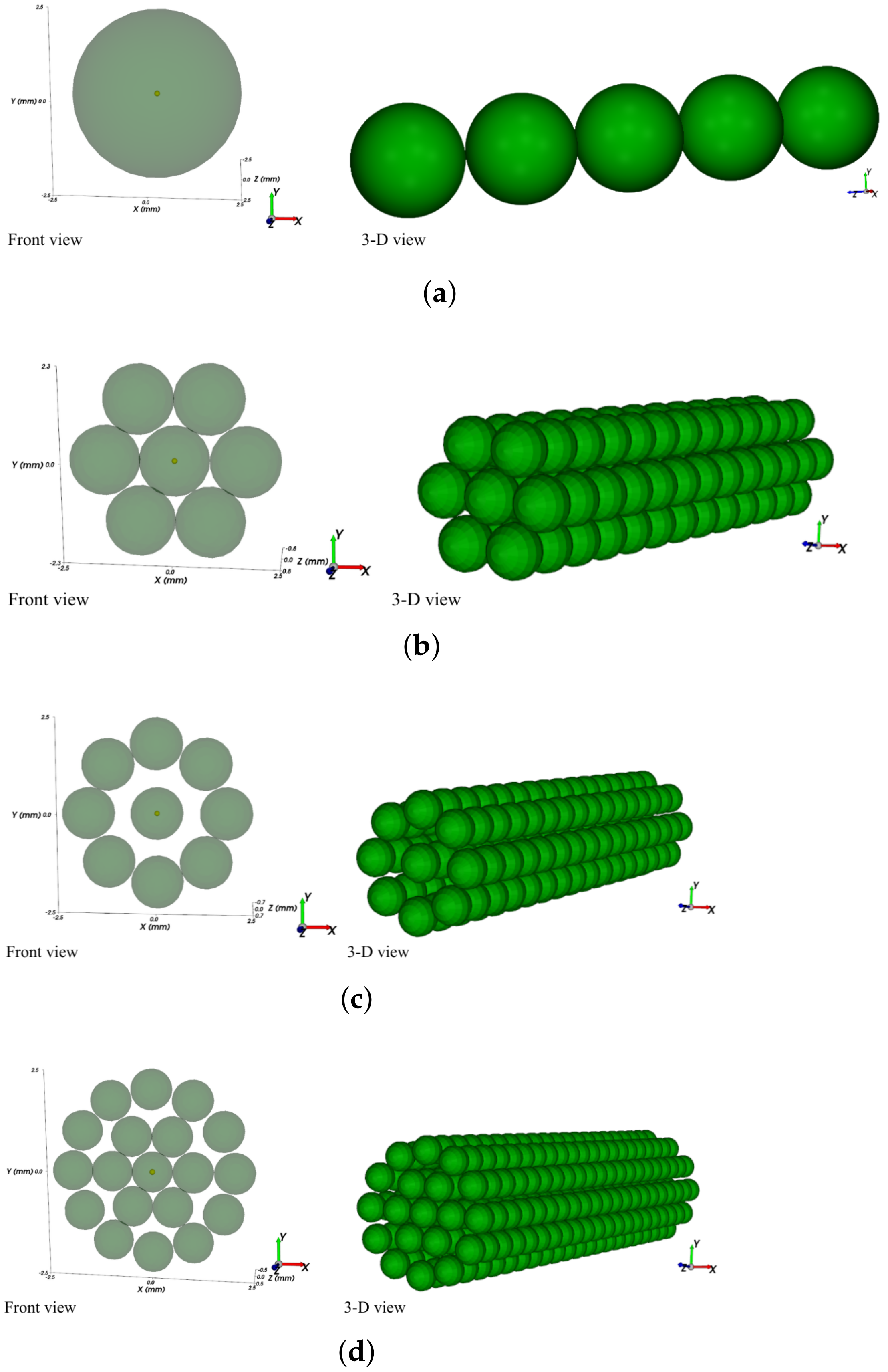
In order to illustrate particle shape modeling, progressive refinement using multi-sphere approximations was used to model a cylindrical branch with a 5 mm diameter and 20 mm length, as shown in Figure 2. A higher number of sub-spheres improves the geometric fidelity; on the other hand, the computational complexity and the simulation time will increase as well.
In general, the use of spherical or sphere-clustering models can yield simulations consistent with the physical event being simulated. However, there are cases where the use of spheres can entail high computational costs and/or fail to provide an adequate model. In order to resolve these problems, researchers apply different particle shapes.
In the work developed in [63], different particle shapes were evaluated to model soybean seeds, comparing multi-spheres with a different number of spheres and super-ellipsoids. Their results showed that the best simulation outcome was obtained using the super-ellipsoid particle shape. Additionally, the simulation time for this particle shape was close to that of the fastest one (the simpler multi-sphere shape).
In [64], the authors applied a polyhedral particle format to model wheat seeds, with points based on a 3D scan. In order to validate the simulations, they utilized angle of repose and velocity ejection tests. The results showed a relative error of 2.3% for the angle of repose and 4.1% for the ejection velocity.
Moreover, the work reported in [65] employed a 3D scan to generate polyhedral particle shapes, aiming to model granular woody biomass. They validated this model through a compression test in order to evaluate biomass compression. Their results showed agreement between the simulated and experimental behavior during the tests, showing the potential of this model in simulating woody biomass.
Ref. [66] employed the sphero-polygonal particle shape, aiming to model wheat seeds and apply the result in shear test calibration. They demonstrated robust relationships for determining the Young’s modulus and Poisson’s ratio, contributing to improving the analysis of non-spherical particle shapes.
To summarize the discussion of the choice of particle shape, model selection must ensure a balance between the computational cost and simulation accuracy. The chosen configuration, whether sphere-clustering or another type, should be the one that offers the best cost–performance ratio.

4.2. Particle Size Distribution (PSD)

The PSD is categorized as monodisperse (similar size/shape) or polydisperse (varying sizes/shapes). Real systems rarely exhibit perfect uniformity; polydisperse distributions are necessary for realistic simulations.
Ref. [67] demonstrated that broader distributions lead to denser, more stable packings; narrower distributions form less dense, less stable structures. The PSD critically determines the contact force distribution: polydisperse systems exhibit more uniform redistribution, enhancing compaction, improving stress distribution, and increasing stability.
The PSD impacts various behaviors. Ref. [68] highlights that a wider PSD enhances compaction by allowing smaller particles to fill voids, increasing the density and packing efficiency. Ref. [13] emphasizes that the PSD affects stress distribution; broader distributions facilitate uniform redistribution, reducing localized concentration and minimizing the structural failure likelihood.
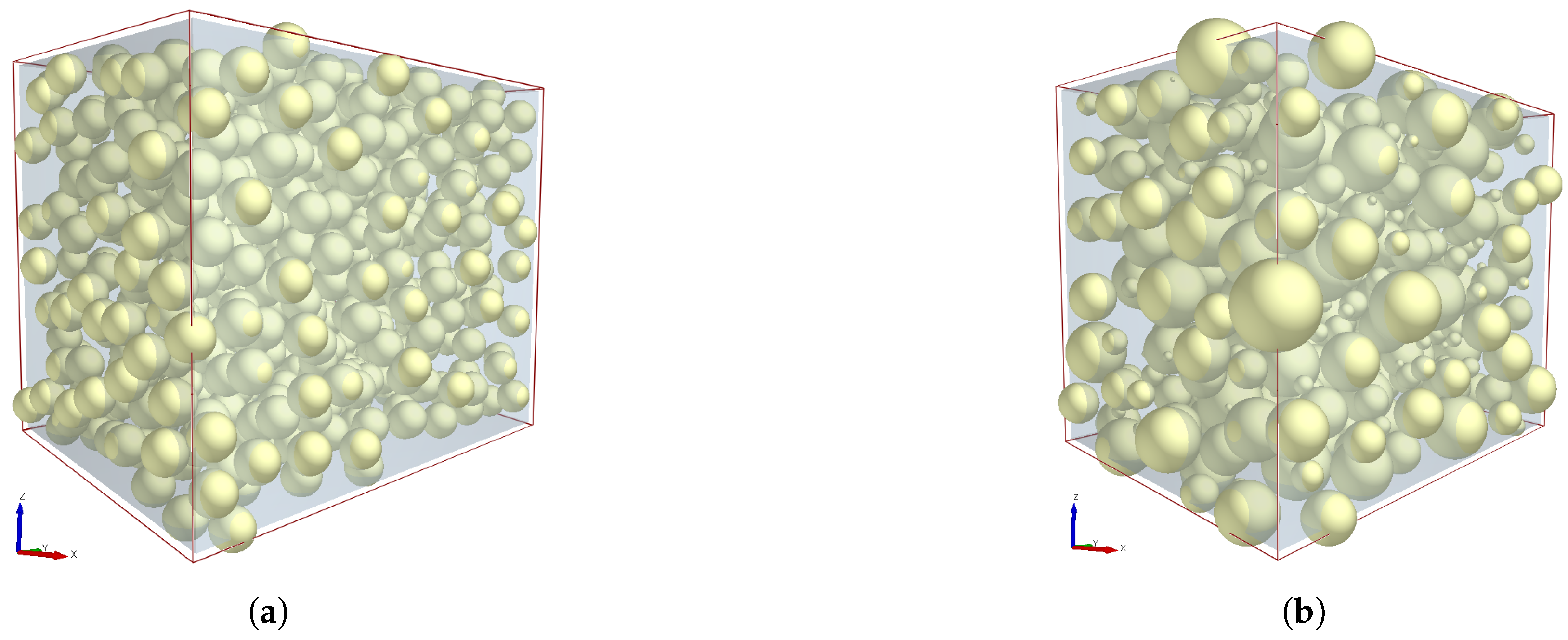
Careful PSD selection and calibration are essential for complex granular processes in agricultural and industrial applications, enhancing the simulation accuracy and providing insights into material behavior under varying conditions. To illustrate the differences between monodisperse and polydisperse configurations, a comparison is presented in Figure 3.

4.3. Particle Properties

Particle properties directly influence interactions and behavior under external forces; they are divided into intrinsic characteristics and interaction parameters.

4.3.1. Intrinsic Characteristics

The density significantly affects inertia and dynamic behavior. Higher-density particles resist rapid velocity changes, impacting the collision behavior and gravity response [69]. Table 4 summarizes the density properties across agricultural materials.
Elastic properties (Young’s modulus, Poisson’s ratio) characterize particle deformation. The Young’s modulus measures stiffness and deformation resistance, influencing energy dissipation during collisions; higher values indicate stiffer particles [71]. The Poisson ratio provides lateral deformation information during compression, critical for granular flow interactions [72]. The moisture content significantly affects these properties (Table 5).

4.3.2. Interaction Parameters

Interaction parameters govern forces and energy exchange during particle interactions, defining contact behavior, including tangential and adhesive forces. Proper calibration is essential for realistic results. The parameters depend on the material properties, particle size/shape, and contact model.
The coefficient of restitution quantifies energy dissipation during collisions, the ratio of the post to pre-collision relative velocity, measuring collision elasticity [76]. Values near 1 indicate elastic collisions; those near 0 indicate highly dissipative types. The choice and calibration depend on the contact model (LSCM and Hertzian produce different values). Ref. [77] showed that parameter adjustment significantly influenced maize grain simulations; ref. [25] demonstrated similar impacts for seeds when using viscoelastic Hertz models. Table 6 presents some experimental restitution coefficients.
The tangential force characterizes frictional interactions governing sliding and rotation, being essential for collision and contact surface modeling [79]. It comprises static friction (resistance to initiating movement) and dynamic friction (resistance during sliding). The DEM models the tangential force using springs and dampers [80], with spring stiffness capturing the frictional response. Table 7 and Table 8 present some experimental friction coefficients.
For fine or cohesive particles, adhesive forces define material behavior, representing particle–particle or particle–surface attraction, being significant for moist soils or powders [81]. Adhesion is relevant where particles stick together or adhere to boundaries, altering the flow dynamics. The DEM implements adhesive forces as additional contact forces, preventing/delaying separation. Refs. [82,83] demonstrated that adhesion in wet soils increases tillage resistance and modifies disturbance patterns, increasing the plowing energy demands; this highlights the necessity of calibration for cohesive materials.
Where particle torque and rolling affect global behavior, rolling resistance models become essential, describing rolling movement resistance. These are determining factors in packing, transport, and systems where shape/texture influence friction [84]. Table 9 presents some rolling resistance coefficients.

4.4. Boundary Conditions

The boundary geometry (walls, silos, conveyor belts) is crucial in the DEM. Surfaces are modeled as rigid bodies; particle–boundary interactions involve mechanisms similar to particle–particle contacts (normal/frictional forces). The geometry is imported from CAD; the mechanical properties (elastic modulus, friction, roughness) must be defined as they influence particle–boundary interactions and system responses.
Agricultural DEM applications involve internal boundary conditions, where tools and machine components (blades, shanks, rotors, tyres) act as moving/stationary bodies, dynamically interacting with granular media. Soil–tool studies demonstrate that explicit tool representation as boundary objects, rigid bodies or dynamically coupled components is essential to capture cutting, shear, and plug formation in tillage and furrow opening [88,89].
Internal boundary conditions are implemented via several approaches. Most commonly, they represent tools as rigid CAD-derived bodies, participating in contact detection with prescribed motion (constant velocity/rotational speed), or couple with multi-body dynamics (MBD) solvers. Co-simulation strategies (DEM-MBD, DEM-FEM) enable realistic machine kinematics and structural compliance while preserving the particle-scale resolution [90,91].
Additional techniques include immersed boundary/embedded surface methods for complex moving geometries and specialized moving boundary algorithms for high-speed rotating components (rotors, augers, conveyor flights). For soil cutting/tillage, explicit surface roughness, rake angle, tool geometry, and local compaction representation is often critical. DEM studies validated against soil bin experiments incorporate such details for realistic force predictions [92,93,94].
Practical modeling recommendations are as follows:
  • Distinguish external (domain limits) versus internal (machine components) boundary conditions; describe internal boundary implementation (rigid CAD surfaces, moving boundary conditions, co-simulation with MBD/FEM).
  • Specify kinematic prescription (prescribed motion vs. dynamic coupling); report the main surface parameters (elasticity, friction, roughness, adhesion) with calibration sources.
  • Document numerical settings affecting moving boundary stability/accuracy: time step selection, contact detection tolerances, damping parameters.
  • Validate tool–soil interactions against experimental measurements where possible or reference established soil bin/bench testing protocols.

5. Applications of DEM in Agricultural Engineering: From Soil Preparation to Post-Harvest Operations

The DEM has emerged as an indispensable computational framework in agricultural engineering for the analysis of granular and particulate material behavior across the entire agricultural value chain. Unlike continuum-based approaches, the DEM’s capacity to resolve individual particle–particle and particle–machine interactions enables unprecedented insight into soil–tool mechanics, material flow dynamics, and crop handling processes. However, the translation of the DEM from a research tool to a practical design instrument depends critically on three interconnected factors: the robustness of validation strategies, the quantitative accuracy of predictions, and the feasibility of addressing real-world implementation constraints. This section provides a critical synthesis of DEM applications across major agricultural domains, systematically evaluating modeling approaches, validation methodologies, predictive performance, and persistent challenges that shape the current state of the art.

5.1. DEM in Tillage Tools: Predictive Capacity and Calibration Challenges

Tillage operations represent one of the most computationally demanding yet agriculturally significant applications of the DEM, with simulations aimed at predicting draft forces, quantifying soil disturbance patterns, and optimizing energy consumption. The fundamental modeling challenge lies in representing soil as a cohesive, heterogeneous medium using discrete particle assemblies that can simultaneously capture elastic deformation, plastic flow, and structural failure.
Recent investigations have demonstrated both the potential and limitations of the DEM for tillage tool design. Wang et al. [95] applied the DEM to investigate the interaction between soil and winged a subsoiler. The researchers obtained results that provide important information for further optimization in the winged subsoiler design. The difference between the obtained experimental and simulated measurements ranged from 0.24% to 41.64%. Based on this result, the authors highlighted limitations regarding the particle position, which can affect the accuracy of the simulation. Based on this study, Wang et al. [96] proposed cicada-inspired subsoiling. The authors used the DEM to simulate the behavior of the soil–subsoiler interaction and the impact of this new tool on the simulation error and subsoiler efficiency. As a result, they obtained relative errors of less than 6.1%, and the efficiency of the proposed tool increased by 17.37% in comparison to the conventional subsoiling tool.
An important advancement came from the work reported by Ucgul et al. [97], which combined the DEM and image processing to evaluate the mixing performance of a rotary spader. The authors applied the DEM simulation under different operation setups and achieved results with deviations between 4.8% and 13.68%. However, they highlight the impact of the particle length, which necessitates a tradeoff between the simulation accuracy and computational cost. Large particles can provide a smaller computational cost in exchange for poor accuracy and/or less detailed analysis, while smaller particles can provide more information about the simulated process but require more computational power, making the simulation unfeasible. To find the proper particle length, it is important to understand this situation and, if necessary, test different particle lengths and/or particle arrangements to achieve accurate results and a feasible processing time. In addition to the particle size, parameters such as the friction coefficient and stiffness are important to keep in mind during the DEM calibration process. In accordance with Nalawade et al. [98], these parameters require attention during the optimization phase of the simulation in order to generate accurate results.
The collective evidence from tillage applications indicates that the DEM excels in comparative tool design and parametric optimization, reliably predicting relative performance differences between competing designs. Validation studies consistently report relative errors in the force simulation of 5–15% for well-calibrated models under controlled conditions, positioning the DEM as a robust tool for virtual prototyping. Nevertheless, three critical limitations constrain the simulation performance: first, simplified cohesion models fail to capture the moisture-dependent bonding and strain rate effects observed in real soils; second, computational constraints necessitate particle sizes that are orders of magnitude larger than actual soil particles, introducing scale effects; third, calibration parameters often lack physical interpretability, limiting model transferability across soil types and field conditions [88]. These challenges do not diminish the DEM’s value for design optimization but underscore the necessity of experimental validation before field implementation.

5.2. DEM in Seed and Fertilizer Handling: From Laboratory Validation to Field-Scale Uncertainty

Seed and fertilizer handling systems represent a contrasting application domain where the DEM has achieved notable success in predicting granular flow behavior, distribution uniformity, and discharge dynamics. Unlike tillage, these applications involve free-flowing granular materials with well-defined particle properties, enabling more reliable calibration and validation.
Song et al. [99] established a rigorous calibration framework for fertilizer particles, using the angle of repose and the bulk weight to calibrate the static and rolling friction coefficients and the coefficient of restitution. These parameters were used to train a radial basis function neural network. To optimize the parameters, the authors used a genetic algorithm to minimize the error between experimental and simulated results. Their results revealed errors of less than 5% after data validation. Additionally, they noted the importance of DEM calibration for the macroscopic behavior of the bulk particles. Extending this discussion, Xiao et al. [100] evaluated the influence of the shape particle size on DEM simulations of the angle of repose. The authors tested two approaches: firstly, using particles from 3D scanning models; secondly, approximation via spherical modeling. They achieved the best results when using scanning modeling; however, the simulation time was longer than that for spherical approximation. This analysis highlights the importance of observation during the modeling phase, including the particle shape, accuracy, and computational cost.
The influence of particle shape representation has emerged as a central theme in recent seed handling studies. Ma et al. [101] compared different particle sizes to fill wheat seeds. Small particles had the best seed filling effect; on the other hand, large seeds required less simulation time. The particle size was varied from 0.2 mm to 0.4 mm, and the optimal results were achieved when the filling particle size was 0.32 mm. This particle size balanced less simulation time and high simulation accuracy. This finding suggests that model complexity requirements are application, specific and should be guided by the phenomena of interest rather than uniformly pursuing the maximum geometric fidelity.
Controlled-release fertilizer systems introduce additional modeling complexities related to particle breakage and coating degradation. Sun et al. [102] implemented a bonded particle model to simulate the process of a controlled-release fertilizer in order to investigate coating damage. The authors identified two main factors affecting coating damage during release, namely the formation of accumulated particles and the fertilizer load within the container. The authors described the advantages and drawbacks of the bonded particle model and limitations regarding bond calibration. Extending this research, Kong et al. [103] proposed a framework to prescribe fertilizer applicators. The authors reported a damage rate of 1.109% with a relative error of 3.757%. This finding shows the potential use of the DEM in applications related to fertilizer system design, reducing coating degradation and improving the fertilization process.
Comparative analysis across seed and fertilizer handling studies reveals consistent values regarding the relative errors between experimental and simulation processes for flow rate and distribution uniformity metrics under laboratory conditions. The DEM demonstrates particular strength in predicting the effects of design modifications on relative performance, with multiple studies reporting the successful optimization of the spreader geometry, discharge orifice configuration, and conveying parameters. However, three persistent challenges limit field-scale predictive accuracy: first, particle property variability within production batches introduces uncertainty not captured in deterministic simulations; second, environmental factors such as humidity-induced cohesion and electrostatic effects remain difficult to model accurately; third, the computational cost limits the particle count in simulations, often requiring a compromise between the geometric domain size and particle resolution. Despite these limitations, the DEM provides quantitative guidance for design optimization and significantly outperforms traditional empirical approaches in both accuracy and generality.

5.3. DEM in Harvesting and Threshing Systems: Modeling Biological Materials and Validation Complexity

Harvesting and post-harvest processing systems represent perhaps the most challenging domain for DEM application due to the mechanical complexity of biological materials, the geometric irregularity of crops, and the multi-physics nature of separation processes. Recent advances in coupled DEM-MBD and DEM-CFD simulations have expanded the modeling capabilities, but validation remains fundamentally more difficult than in tillage or material handling applications.
Wang et al. [104] developed a comprehensive DEM model of rice grain–straw interactions during threshing, calibrating material properties through tensile testing and impact experiments. Their validation approach compared the simulated and experimental threshing efficiency, grain damage rate, and power consumption, achieving relative errors of 5–12% when comparing the simulated and experimental results.
The representation of plant stems and structural components introduces additional modeling complexities. Xia et al. [105] implemented flexible fiber models using bonded particle chains to simulate corn stalk–threshing cylinder interactions, validating the predictions through high-speed video analysis and material breakage patterns. Their results demonstrated that flexible models were essential in predicting wrapping and clogging phenomena, which rigid particle models failed to capture entirely. However, the computational cost increased by 8–15 times compared to rigid particle simulations, severely limiting the scale of feasible analyses. Li et al. [106] circumvented this limitation by developing reduced-order models that approximated flexible behavior using modified contact laws, achieving computational efficiency gains while maintaining the good fit of the simulated curve to the behavior observed in the physical experiment.
Pneumatic separation systems benefit significantly from DEM-CFD coupling, enabling the simultaneous modeling of grain transport and aerodynamic separation. Kang et al. [107] validated coupled simulations against experimental measurements of the separation efficiency and grain loss rate in a pneumatic cleaning system, achieving relative errors between the simulated and experimental pressure drop of less than 8%. Their systematic sensitivity analysis revealed that the aerodynamic drag force was the dominant parameter governing separation performance, while interparticle friction had a minimal impact. This finding enabled targeted calibration strategies that reduced parameter uncertainty. However, they acknowledged that turbulent fluctuations in the air flow, which significantly affected grain trajectories, were inadequately captured by Reynolds-averaged Navier–Stokes turbulence models, introducing systematic errors in particle dispersion predictions.
Potato and root crop harvesting introduce unique challenges related to soil–tuber separation and impact damage prediction. Chen et al. [108] developed coupled DEM models of soil and potato tubers, validating their separation efficiency predictions through field harvesting trials. Their model successfully simulated the potato harvesting process, achieving relative errors of less than 1%. Additionally, the simulation model helps researchers in the optimization of the harvester, reaching a potato damage rate of less than 1.5%.
Chen et al. [109] employed DEM modeling to predict the damage of maize kernels caused by impact during stem breakage. The authors employed a polyhedron particle shape, achieving good performance metrics. The root mean square deviation between the simulated and experimental damage fractions reported in their study was 0.05, illustrating the DEM as a good simulation method to represent this physical process and to propose future improvements.
Another important study in the harvesting domain is the work presented by Li et al. [110]. Their study combined multi-body dynamics to generate harvester movement and the DEM to model the soil and potato crop. The simulation was validated by field tests, achieving relative errors of approximately 3.81%. This achievement reveals another application combining the DEM with other simulation models, aiming to simulate the complete harvesting process.
Despite the mentioned challenges, the DEM provides valuable insights into mechanisms driving harvesting performance and enables systematic design exploration that would be prohibitively expensive when using experimental methods alone. The key to effective application lies in recognizing that the DEM is best suited for comparative analysis, parametric optimization, and understanding qualitative trends, rather than providing absolute performance predictions. Validation strategies must go beyond simple metric comparison to include the mechanistic validation of key phenomena, ensuring that models capture relevant physics even when the quantitative accuracy is limited.

5.4. Critical Synthesis: Accuracy, Validation Paradigms, and Implementation Challenges

A systematic comparison across tillage, material handling, and harvesting applications reveals both consistent strengths and persistent limitations of the DEM in agricultural engineering. Table 10 synthesizes the key findings from representative recent studies, enabling a direct comparison of validation approaches and identified challenges across application domains.
The performance of DEM simulations in agricultural scenarios can vary depending on several factors, as analyzed in the reported studies. However, in general, certain factors are widely present. Firstly, it must be considered that, especially in harvesting scenarios, the material to be tested is biological and, naturally, will have variations, including within the plant itself. Therefore, field trial validation can lead to discrepancies between simulated and experimental data, as the field environment may exhibit greater variability than in laboratory tests and simulations, which assess a limited scenario.
Second, the validation methodology significantly influences the reported accuracy. Studies employing multi-scale, multi-observable validation strategies consistently demonstrate higher reliability than those relying on single-metric comparisons. The most robust validation approaches combine global observables (forces, flow rates, efficiency) with local measurements (particle trajectories, stress distributions, breakage patterns) and the mechanistic validation of key phenomena. However, fewer than 35% of the reviewed studies implemented comprehensive multi-scale validation, potentially leading to the overestimation of model accuracy.
Third, calibration remains a critical bottleneck limiting model transferability. Parameters calibrated for specific material batches and environmental conditions often fail to maintain accuracy when applied to different soils, crops, or operating conditions. This sensitivity suggests that DEM models, despite their physically based foundation, often function as semi-empirical tools requiring case-specific calibration, rather than universally applicable predictive instruments. The development of physics-based parameter estimation methods and uncertainty quantification frameworks represents a crucial direction for future research.
Fourth, the computational cost continues to constrain practical applications despite advances in parallelization and algorithmic efficiency. Typical agricultural simulations involve particle counts ranging from 10 4 to 10 6 , with time steps on the order of microseconds required to ensure numerical stability. This combination limits the simulation duration to seconds or minutes of physical time on conventional computing infrastructure, necessitating compromises between geometric fidelity, particle resolution, and temporal extent. Recent advances in GPU acceleration and adaptive time-stepping have provided 5–10 times speedup, but fundamental scaling limitations persist.
Fifth, real-world implementation faces challenges beyond simulation accuracy. Field conditions introduce variability in soil moisture, material properties, and environmental factors, which is difficult to predict and incorporate into simulations. Machine wear, component deflection, and dynamic coupling between subsystems introduce phenomena not captured in isolated component simulations. Successful implementation requires iterative refinement combining simulation-guided design with experimental validation and field testing, rather than the direct deployment of simulation-optimized designs.
Despite these challenges, the DEM provides demonstrable value for agricultural engineering applications when applied within appropriate constraints. Its primary strengths lie in comparative design evaluation, parametric optimization, and mechanism investigation. Studies that position the DEM as a tool for relative performance prediction and design space exploration consistently achieve practical utility, while those expecting absolute performance prediction encounter limitations. The optimal application paradigm treats the DEM as complementary to rather than replacing experimental methods, using simulations to reduce design iterations and focus experimental efforts on promising configurations.
Looking forward, several research directions offer promise for enhancing DEM utility in agricultural applications. The development of adaptive multi-scale modeling frameworks that dynamically adjust the particle resolution based on local phenomena could address computational limitations while maintaining accuracy. The integration of machine learning techniques for parameter calibration and uncertainty quantification may improve model transferability and reliability. The systematic development of standardized validation protocols and open-source benchmark problems could enhance comparability across studies and accelerate methodological advances. Finally, coupling the DEM with reduced-order models and surrogate modeling techniques may enable real-time optimization and control applications, currently precluded by the computational cost.
In conclusion, the DEM has matured into a valuable tool for agricultural engineering research and development, demonstrating consistent utility for comparative design evaluation across diverse applications. However, its effective application requires a clear understanding of the inherent limitations, rigorous validation practices, and realistic expectations regarding predictive accuracy. The most successful implementations recognize the DEM as one element within a comprehensive design methodology that integrates simulation, experimentation, and field validation, rather than as a standalone predictive tool.

6. Calibration of DEM Models: Methods, Strategies, Challenges, and Solutions in Agricultural Applications

Calibration involves comprehensively defining material properties, particle interactions, and contact parameters to replicate physical behavior. This step ensures that simulated outcomes accurately reflect actual material behavior, although it becomes especially challenging for agricultural applications. Agricultural materials, characterized by variable moisture content, irregular shapes, and particle cohesion, present significant challenges in achieving accurate results [111]. This section reviews experimental calibration methods, systematic strategies, challenges including computational constraints, and emerging hybrid solutions.

6.1. Experimental Calibration Methods

Experimental methods provide empirical data for adjusting simulation parameters. These measure critical physical properties, serving as calibration targets for interparticle and particle–wall interaction parameters. Four primary methods are employed: angle of repose tests, compression tests, friction measurements, and drop tests.
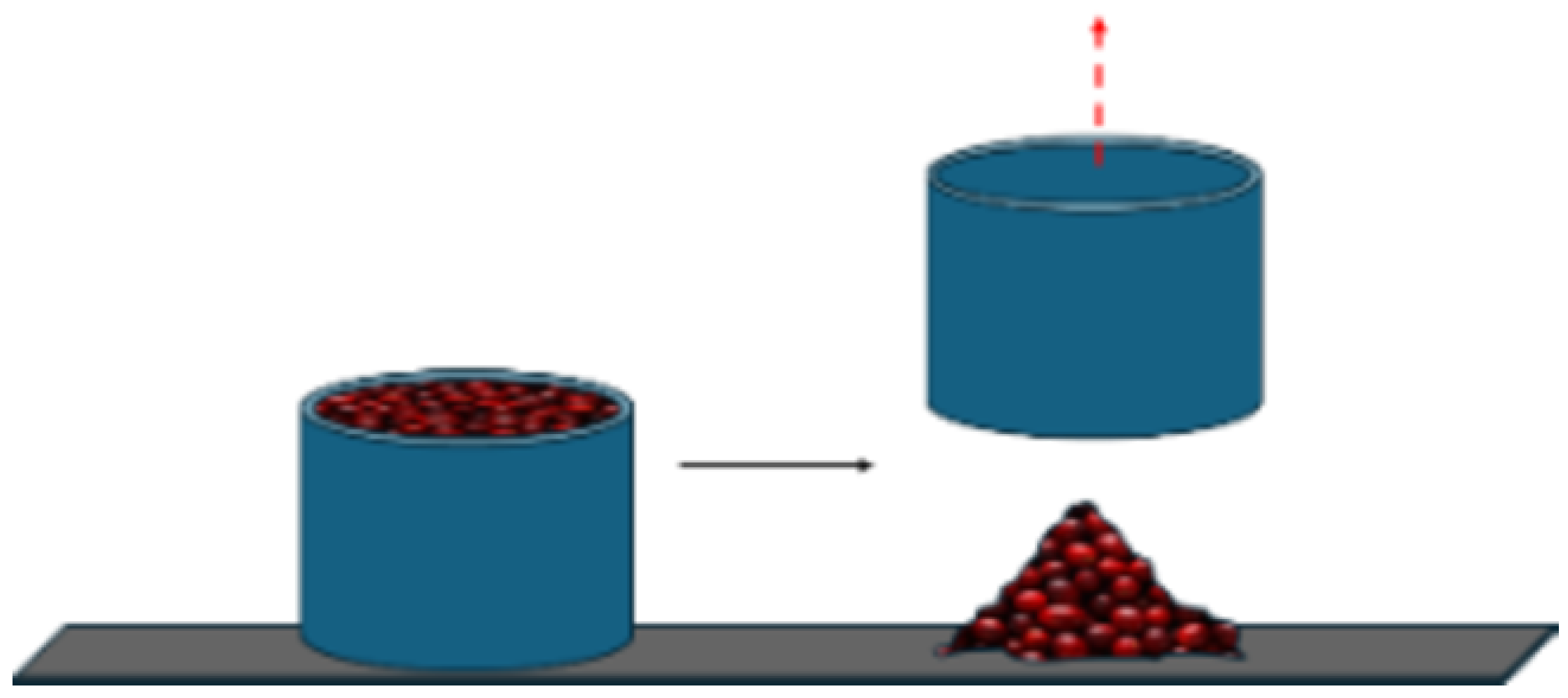
The angle of repose represents a fundamental parameter (Figure 4), referring to the maximum angle at which a granular pile remains stable without particle sliding. This provides insight into static friction between particles and can be used to calibrate friction coefficients [112]. It fine-tunes interparticle friction and cohesion parameters. For granular materials (sand, soil, powders), matching the simulated angle of repose to the experimental results is critical for accurate material flow, hopper discharge, and soil–tool interaction simulations [113]. The particle shape, size, and moisture variations influence this angle, making calibration challenging, particularly when using coarse graining.
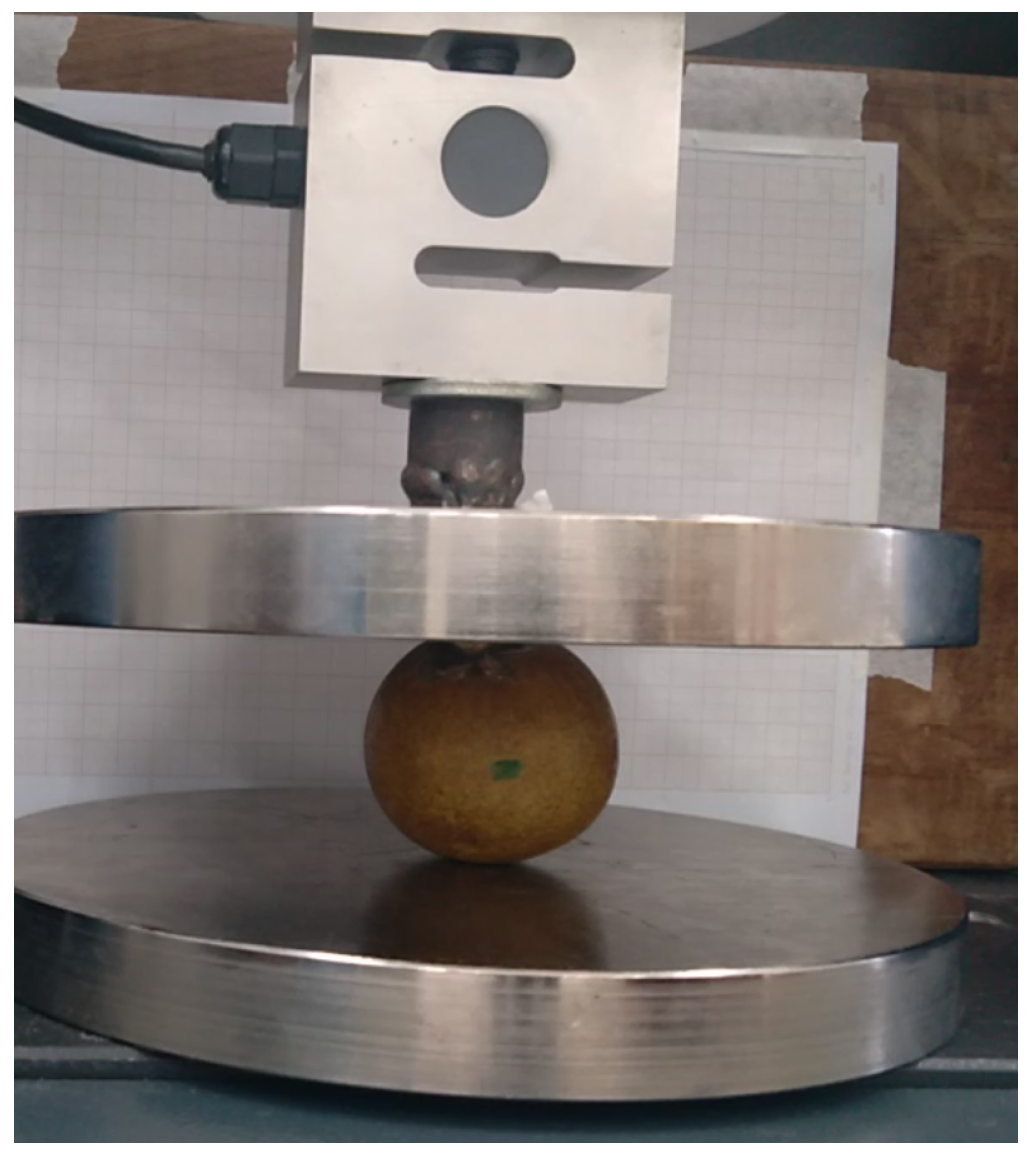
Compression tests measure material resistance to compressive deformation (Figure 5), providing data for calibrating elasticity and cohesion properties [114]. A granular material is placed between rigid plates; the force required versus displacement is measured. The compressive modulus, defining compression resistance, is adjusted based on experimental data. Accurate calibration ensures realistic simulations of compaction, deformation under pressure, and soil compaction. Tests help to determine the particle stiffness and normal contact force, which are critical for bulk material handling and soil–tool interactions.
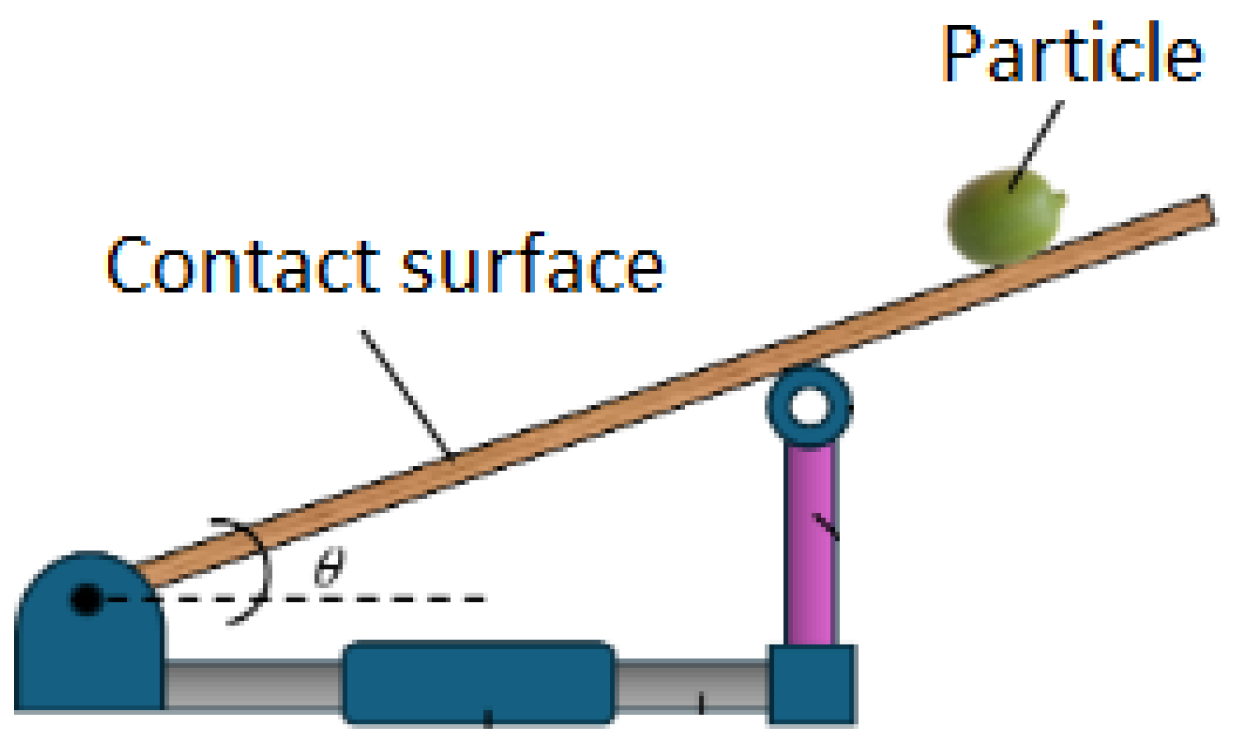
Friction between particles is crucial for simulating material behavior. Static friction (resistance to initiate relative motion) and rolling friction (resistance to rotation) are critical for granular flow, soil mechanics, and material transport [56]. Static friction is tested by applying increasing force until sliding begins (Figure 6); the coefficient is calculated as the applied-to-normal-force ratio. Rolling friction is measured by applying torque to rotate particles and calculating the torque-to-force ratio. These can be used calibrate rolling resistance and frictional interactions, ensuring accurate material flow, packing, and interactions in mixing, grinding, and soil–tool processes. Both are influenced by the surface roughness, material properties, and particle shape. Calibrating these parameters is challenging as frictional properties vary with environmental conditions (humidity, temperature).
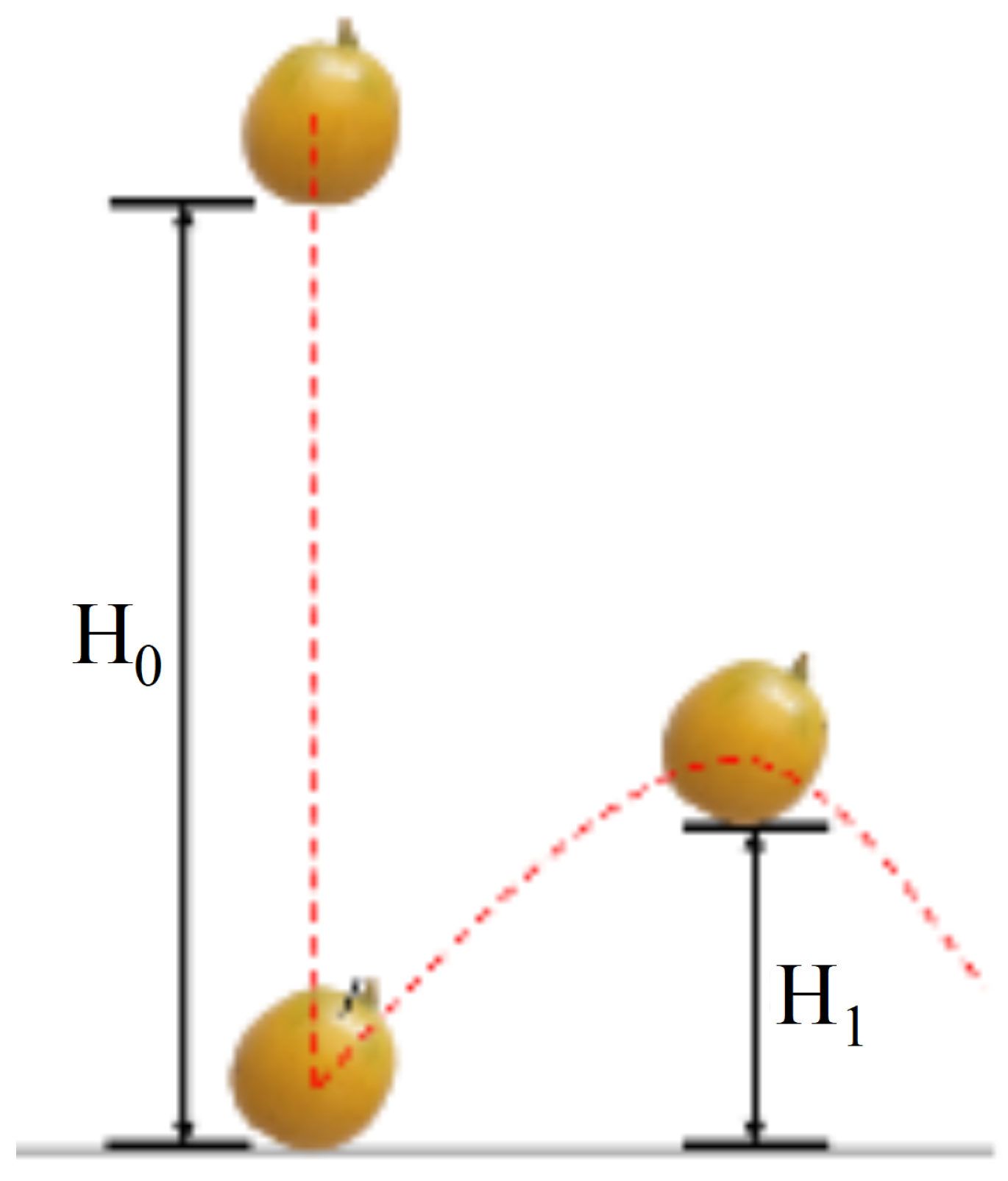
Drop tests (Figure 7) are straightforward methods for calibrating the restitution coefficient and particle–particle contact properties. Particles are dropped from a specified height onto rigid surfaces; the rebound height is measured. The restitution coefficient is determined by comparing the rebound and drop heights, representing the kinetic energy fraction retained after impact. The coefficient is adjusted until the simulated rebound matches experimental observations; this is critical for granular flows, impacts, and collisions in material handling, hopper discharge, or soil–tool interactions. Drop tests provide insights into particle stiffness and damping, essential for accurate particle dynamics. They are useful for calibrating energy dissipation in highly dynamic processes, but care is needed for heterogeneous materials, as the particle shape, size distribution, and properties influence the results.

6.2. Systematic Calibration Strategies

While experimental methods provide calibration targets, systematic strategies determine how parameters are adjusted to match these targets. The traditional trial-and-error approach is time-consuming and subjective and fails to explore the full parameter space [115]. Recent advances introduce more rigorous systematic approaches.

6.2.1. Trial-And-Error Calibration

Traditional trial-and-error calibration manually adjusts DEM parameters, comparing the simulation results with experimental data iteratively. While intuitive and widely practised, it suffers from limitations: it is highly dependent on operator experience, introducing subjectivity; it is time-consuming for multi-parameter systems with complex interactions; it fails to identify global optima, settling for local solutions; and it lacks systematic documentation, making reproduction difficult [115]. Despite these limitations, it remains common for simple systems with few parameters, where the computational cost of sophisticated methods may not be justified.

6.2.2. Optimization-Based Calibration Methods

Optimization-based calibration employs mathematical algorithms to systematically search the parameter space and minimize discrepancies between the simulated and experimental responses.
Genetic algorithms (GAs) represent population-based metaheuristic methods inspired by natural selection, widely applied to DEM calibration for handling multi-parameter optimization and avoiding local minima [116]. Multi-objective GAs balance model accuracy with computational efficiency. These maintain candidate solution populations evolved through selection, crossover, and mutation, enabling parameter space exploration without requiring gradients.
Particle swarm optimization (PSO) simulates bird flocking/fish schooling to search the parameter space efficiently, often achieving faster convergence than GAs [113,117]. Enhanced variants like chaotic PSO with sigmoid-based acceleration (CPSOS) show promise for complex agricultural calibration. PSO balances exploration and exploitation through velocity/position updates, incorporating individual and global best solutions.
Differential evolution (DE) uses differential mutation and crossover to evolve parameters toward optimal solutions, demonstrating improved robustness for non-smooth objective functions where derivatives are difficult/unreliable [118]. Mutation creates trial solutions by combining random population members, providing natural diversity maintenance.
Advanced metaheuristic algorithms like the Improved Dung Beetle Optimizer (IDBO) with Latin Hypercube Sampling and Gaussian Processes (GP-LHS) achieve superior performance versus the traditional PSO-DEM and GA-DEM for heterogeneous parameter calibration [116]. Surrogate modeling integration reduces the need for expensive DEM simulations by building predictive models of the objective function landscape.

6.2.3. Inverse Modeling and Bayesian Calibration

Inverse modeling formulates calibration as an inverse problem, inferring material properties from macroscopic observations. Bayesian methods provide probabilistic frameworks accounting for uncertainty and enabling rigorous confidence interval quantification, advancing beyond deterministic optimization.
Sequential Quasi-Monte Carlo (SQMC) filters implement sequential Bayesian estimation, calibrating DEM parameters from experimental loading histories by recursively updating posterior probability density functions (PDFs) in multi-dimensional parameter spaces, accounting for loading history effects on elastoplastic behavior [115]. Unlike traditional methods targeting final properties, SQMC calibrates against transient behavior, improving the predictive capacity for complex loading. Its sequential nature allows for progressive data assimilation, updating the estimates as new experimental information becomes available.
Transitional Markov Chain Monte Carlo (TMCMC) provides a framework for Bayesian model selection and parameter uncertainty quantification, handling uniform priors and providing posterior PDFs for assessing contact law robustness and identifying parameter correlations [115]. TMCMC efficiently samples complex, multi-modal posterior distributions through carefully designed intermediate distribution sequences.

6.2.4. Machine Learning-Assisted Calibration

Machine learning techniques accelerate and improve DEM calibration by leveraging patterns in simulation data for predictive models and parameter optimization guidance.
Surrogate modeling represents a successful ML application in DEM calibration. Surrogates (Kriging metamodels, ANNs, Gaussian processes) approximate relationships between DEM parameters and macroscopic responses. Once trained on simulation databases, surrogates enable rapid parameter optimization without additional DEM simulations [62,119]. Adaptive AI-based surrogate modeling with transfer learning enables models trained on simple configurations to adapt to complex scenarios with minimal additional training.
The integration of optimization algorithms with neural networks proves particularly effective for agriculture. Particle swarm optimization–backpropagation (PSO-BP) and GA-BP combinations achieved superior regression (R2 > 0.94) versus the traditional response surface methodology in organic fertilizer calibration [117]. These hybrids combine metaheuristic global search with neural network function approximation, enabling accurate macroscopic response prediction.
Recurrent neural networks (RNNs) refine DEM parameter calibration for complex materials exhibiting nonlinear elastic–plastic behavior under dynamic loading [120]. The temporal dependencies captured by RNN architectures suit path-dependent material behavior, where the current state depends on the loading history.

6.2.5. Design of Experiments (DOE) Approaches

DOE methodologies provide structured frameworks for identifying parameter sensitivities and optimizing calibration efficiency by strategically selecting simulation parameter combinations.
The Plackett–Burman design efficiently screens the most influential parameters from large candidate sets, reducing the subsequent optimization dimensionality [117]. This two-level fractional factorial design requires only N + 1 runs to screen N parameters, being valuable for initial high-dimensional parameter space exploration.
The Central Composite Design (CCD) systematically explores parameter interactions and constructs response surface models, being particularly effective when combined with metaheuristic optimization, as response surfaces provide initial objective function approximations guiding optimization. The CCD extends factorial designs by adding center and axial points, enabling quadratic effect and curvature estimation.
The Box–Behnken design represents a three-level factorial design, enabling efficient parameter space exploration while minimizing the required simulations for multi-parameter calibration [121]. Unlike the CCD, Box–Behnken excludes combinations where all factors are simultaneously extreme, which is advantageous when such combinations are infeasible.
Recent advanced calibration strategy studies are summarized in Table 11.

6.3. Key Challenges in DEM Calibration and Application

Despite calibration methodology advances, DEM applications in agricultural systems face critical challenges that limit model accuracy, computational efficiency, and scalability across technical, computational, and methodological domains.

6.3.1. Computational Cost and Hardware Requirements

The computational expense remains the primary bottleneck for industrial-scale DEM. The time complexity scales as approximately O(N2) for simple contact detection and O(N log N) for optimized spatial decomposition, where N is the particle number [124]. For agricultural applications with millions of particles, even optimized algorithms result in prohibitive simulation times on conventional hardware.
Effective agricultural DEM application requires substantial computational resources. High-performance multi-core CPUs with 16+ cores are essential for parallel domain decomposition (Intel Xeon or AMD EPYC, >3.0 GHz base clock optimal). GPUs accelerate the DEM by 10–100× versus CPU-only strategies through the massive parallelization of contact detection and force calculation [125]. NVIDIA A100/H100 GPUs have been successfully employed for large-scale agricultural DEM work. Memory scales with the particle count and contact complexity: typical agricultural simulations require 64–256 GB RAM for CPU implementations, with 40–80 GB GPU memory for GPU-accelerated codes. Large-scale simulations generate hundreds of gigabytes to terabytes in output, necessitating high-speed SSD storage and efficient I/O strategies.
The simulation versus physical time illustrates the computational challenge. Recent benchmarks indicate that simulating 1 s of physical time for 1 million particles requires approximately 2–8 h on modern hardware, depending on the contact model complexity and time step [125]. This severely limits real-time applications’ feasibility and parameter space exploration during calibration, requiring hundreds/thousands of simulations to identify optimal parameter sets.

6.3.2. Parameter Uncertainty and Standardization

Agricultural materials exhibit significant property variability, complicating calibration and limiting calibrated parameter transferability. Moisture content variation represents one of the most challenging aspects, as water content dramatically affects cohesion, friction, and elastic properties. Parameters that are valid at one moisture level may produce significant errors at different values, requiring recalibration or moisture-dependent parameter relationships [99,126].
Morphological heterogeneity introduces additional uncertainty: irregular shapes, size distributions, and surface roughness affect contact mechanics in ways that are difficult to capture with simplified geometric representations. Simplified spherical or super-ellipsoidal representations may fail in capturing critical behaviors, particularly for highly irregular shapes (plant stems, irregularly shaped seeds). The lack of standardized databases compounds these challenges; unlike industrial materials (steel, concrete), agricultural materials lack comprehensive parameter databases documenting mechanical properties across varieties, processing conditions, and environmental states. Each crop variety, soil type, or processing condition requires independent calibration [127].
The non-uniqueness of DEM parameters further complicates calibration. Multiple parameter combinations can produce similar macroscopic responses, making physically meaningful parameter identification difficult and raising questions about calibrated values’ physical interpretation [118]. This equifinality suggests that calibration should focus on reproducing macroscopic behavior rather than identifying “true” microscopic parameters.

6.3.3. Scale-Up Challenges from Laboratory to Field

Scaling the DEM from laboratory validation to the field scale introduces critical challenges, fundamentally limiting direct laboratory-calibrated model applicability to industrial operations.
Particle number limitations represent a fundamental constraint. Laboratory experiments typically involve 10 3 10 6 particles, enabling detailed contact model validation and calibration. Field-scale applications may require 10 9 10 12 particles for realistic spatial domains and material volumes. Direct field-scale simulation exceeds the current computational capabilities by several orders of magnitude.
Coarse graining (CG) techniques offer potential solutions, replacing multiple physical particles with larger computational particles to reduce counts and improve efficiency [128,129]. However, CG introduces challenges, limiting its effectiveness. Different phenomena require different scaling relationships, complicating universally applicable coarse graining rule development. Weber number-based scaling preserves rheological behavior in wet granular systems but may not accurately reproduce granular temperatures or energy dissipation [129]. Size-dependent effects (segregation, percolation, particle-scale mixing) may not be captured regardless of the scaling approach [130]. Coarse-grained models require separate calibration at each scale factor, as simple geometric scaling fails in preserving material behavior [131].
Field conditions exhibit spatial variability in soil properties, moisture distribution, and compaction state that is difficult to capture in a uniform DEM. Agricultural fields show substantial heterogeneity in composition, structure, and mechanical properties over meters to kilometers. Multi-level coarse graining, which involves varying the resolution spatially, shows promise but adds significant calibration complexity, as each spatial zone may require different parameter sets [132].
Boundary condition effects further complicate scale-up. Laboratory tests impose well-defined boundary conditions with controlled confinement, loading rates, and environmental conditions. Field conditions involve complex, time-varying boundary conditions with uncontrolled environmental factors. Wall effects, confinement stress, and loading rates differ significantly between controlled experiments and agricultural operations, substantially affecting material behavior and calibration requirements.

6.3.4. Challenges Specific to Agricultural Applications

Agricultural applications present unique calibration challenges distinguishing them from industrial or geotechnical DEM.
Soil–tool interactions require the precise calibration of soil properties (cohesion, internal friction angle, rolling resistance). Critical challenges include accurately representing cohesive forces between soil particles, varying significantly with moisture, particle size, and compaction. Cohesive property calibration is particularly challenging as soil cohesion spans multiple orders of magnitude depending on saturation [133]. Layered soil structures add complexity; forested areas and agricultural fields contain layered gravel soils with varying structural properties. Simulating these heterogeneous systems requires the calibration of multiple soil layers with different contact parameters; interfaces introduce additional complications [134]. Traditional DEM calibration struggles in capturing nonlinear elastic–plastic soil responses under dynamic loading. Advanced calibration using RNNs shows promise but adds computational complexity and requires extensive training data [120]. Replicating cohesive soil behavior under dynamic tillage/harvesting operations remains problematic, with significant experimental–simulated discrepancies even with well-calibrated models, particularly for high-speed soil–tool interactions [135].
Crop production systems present distinct challenges for granular fertilizer and seed handling. Granular fertilizers exhibit highly variable behavior based on moisture and the particle morphology; traditional calibration often fails in accounting for dynamic property changes during simulation/storage [99,126]. Accurate particle adhesion force representation and fine particle coating influences require sophisticated contact models incorporating van der Waals forces, liquid bridges, or electrostatic effects, all difficult to calibrate from macroscopic experiments [136].
Harvesting and post-harvest systems face unique challenges related to crop material properties and equipment interactions. Crop materials (stems, grains, tubers) exhibit significant variations in elasticity, brittleness, and moisture; small property changes lead to substantial simulated cutting, threshing, and separation behavior differences [136,137]. Calibrating friction and restitution coefficients for grain–equipment interactions is critical for accurate harvesting simulations but challenging to perform systematically, as parameters vary with moisture, surface conditions, and contact velocity [138]. Coupling MBD and DEM for operations like potato harvesting reveals calibration challenges, such as modeling interaction forces between soil and irregularly shaped tubers, particularly in accounting for the varying soil compositions and moisture affecting soil–tuber adhesion and friction [110].

6.4. Emerging Solutions: Hybrid Modeling Approaches

To address the computational and scaling challenges inherent in the DEM, hybrid modeling, coupling the DEM with other numerical methods, has emerged as a promising solution. These multi-physics frameworks leverage different simulation techniques’ strengths, achieving better accuracy, efficiency, and scalability than the standalone DEM.

6.4.1. CFD-DEM Coupling for Fluid–Particle Systems

CFD coupled with the DEM enables the simulation of fluid–particle systems in agricultural processing: pneumatic conveying, cleaning, separation, and spraying. Coupling between continuous fluid and discrete particle phases allows accurate momentum and energy transfer prediction, where both phases significantly affect behavior.
Three primary coupling methodologies exist. One-way coupling assumes that fluid forces act on particles, but particle effects on fluids are neglected. This is computationally efficient for dilute flows with low solid loading (<1%), where particle–fluid momentum coupling is weak [139]. Two-way coupling resolves both fluid-to-particle and particle-to-fluid interactions, typically using coarse-grid approaches where the CFD cell size exceeds the particle diameter by 3–10×. This balances accuracy with computational efficiency for most industrial applications with moderate solid loadings [140,141]. Fully resolved coupling employs direct numerical simulation around individual particles using body-fitted or immersed boundary methods. While highly accurate, the extreme computational cost limits this to systems with relatively few particles, primarily for fundamental studies or the validation of coarser coupling.
Recent agricultural CFD-DEM applications demonstrate practical value. Seed metering devices have been extensively studied using CFD-DEM to optimize negative pressure inlet structures and seed-filling performance in precision planters, with structural parameters significantly affecting differential pressure, airflow patterns, and seed drag forces [142,143]. The pneumatic conveying of seeds/grains through horizontal–vertical elbows has been simulated to understand particle–wall collisions and flow patterns, demonstrating that two-way coupling is essential for accurate velocity prediction [139]. Terminal velocity determination for agricultural grains (teff, wheat, maize, sorghum, barley) has been validated using Rocky DEM-CFD, with the results matching the experimental values within 5–10%, providing a computational alternative to expensive wind tunnel testing [144]. Pesticide application systems using air-fed devices have been optimized through CFD-DEM, improving spray distribution uniformity and reducing chemical waste through better air droplet–particle interaction understanding [145].
CFD-DEM simulations are substantially more expensive than DEM-only strategies due to solving both particle dynamics and fluid flow equations on potentially different spatial/temporal scales. Recent GPU-accelerated CFD-DEM codes have achieved 10–50× speedup versus CPU implementations, enabling the quasi-real-time simulation of industrial-scale equipment with millions of particles [125].

6.4.2. DEM-FEM Coupling for Deformable Structures

Coupling the DEM with the finite element method (FEM) enables the simulation of interactions between granular materials and deformable structures, which is critical for agricultural machinery design and soil–tool interaction analysis, where both material flow and structural deformation significantly affect performance.
Two primary coupling frameworks exist. Sequential coupling exports DEM forces to the FEM for structural deformation calculation and then updates the DEM boundary conditions in subsequent time steps. This is computationally efficient but may miss transient coupling effects or become unstable for strongly coupled problems where structural deformation significantly affects particle flow within single time steps. Iterative coupling exchanges information between DEM and FEM solvers multiple times per time step until convergence. This captures strong coupling effects, ensuring particle force and structural deformation consistency, but substantially increases the computational cost versus sequential coupling.
Agricultural applications demonstrate significant engineering design value. Tillage tool design benefits from coupled soil–tool interaction analysis, demonstrating capabilities in predicting draft forces, soil displacement patterns, and tool wear with improved accuracy versus DEM-only models, which assume rigid tools [146,147]. Blade optimization through coupled approaches enables cutting blade stress distribution and fatigue life analysis considering interactions with soil and crop residues, achieving cutting resistance reductions and durability improvements by identifying stress concentration and optimizing material distribution [148]. Flexible plant material modeling using DEM-FEM coupling with bonded particle models for plant stems, combined with the continuum FEM for blades, accurately captures complex crop cutting and threshing mechanics, where both material fracture and blade deformation affect performance.
Alternative coupled approaches address specific DEM-FEM limitations. Smoothed particle hydrodynamics (SPH) coupled with the DEM and FEM simulates soil cutting operations, providing advantages in handling large deformations without the mesh distortion typical of the pure FEM [149,150]. SPH represents continuum materials as particle collections, enabling natural material separation and fragmentation handling. Coupled Eulerian–Lagrangian (CEL) methods combine continuum soil representation using Eulerian grids with discrete tool modeling in Lagrangian frames, showing promise for tire–soil interaction simulations, where soil experiences large deformations and material advection.

6.4.3. Multi-Body Dynamics Coupling

Coupling the DEM with multi-body dynamics enables the realistic modeling of complete agricultural machinery systems interacting with granular materials, capturing both machine component mechanical behavior and bulk material interactions.
Harvesting equipment represents a major MBD-DEM coupling application. Simulations of corn threshing mechanisms, potato harvesting separators, and rice stripping systems have enabled the optimization of component geometries and operating parameters, improving grain quality and reducing losses [110,137,151]. These coupled simulations capture the dynamic motion of rotating/oscillating components while simultaneously modeling grain flows and damage, providing insights that are difficult to obtain from standalone MBD or DEM strategies. Soil compaction analysis benefits from MBD vehicle model integration with DEM soil representation, enabling stress distribution prediction beneath agricultural tires and soil structure degradation assessment, optimizing tire design and operating practices and minimizing soil compaction while maintaining traction.
Commercial co-simulation platforms (ADAMS-EDEM, RecurDyn-EDEM) provide automated workflows for MBD-DEM coupling, handling data exchange and synchronization. However, calibrating coupling parameters (contact stiffness, damping, time step synchronization) remains challenging and significantly affects the simulation accuracy and stability. Coupling time steps must typically be smaller than standalone MBD or DEM time steps to ensure stability, further increasing the computational cost.

6.4.4. Coarse Graining and Multi-Scale Techniques

Advanced coarse graining strategies represent critical pathways toward enabling industrial scale DEM application by reducing the particle count while attempting to preserve macroscopic material behavior.
Adaptive multi-level coarse graining represents one of the most promising recent developments, enabling the spatial variation of the coarse-grain ratio within single simulations: high-resolution regions employ fine particles near cutting edges or mixing zones where particle-scale phenomena dominate, while bulk regions use coarse-grained representations [130,132]. This reduces the computational time by more than one order of magnitude versus uniform fine-scale simulation, while maintaining accuracy in critical regions. However, careful transition zone definition between resolution levels is required to avoid artifacts, and load balancing becomes complex when different spatial regions have vastly different particle counts.
Proper coarse graining requires physically based scaling relationships for contact parameters to ensure similar macroscopic behavior across resolution levels. Recent research identified specific scaling laws for different contact models and material systems. Weber number-based scaling for wet granular systems preserves the bulk rheology, maintaining inertial to capillary force ratios and enabling accurate cohesive behavior simulation in agglomeration and granulation [129]. Bond number-based scaling for cohesive powders maintains adhesive to gravitational force balance, which is critical for fine particle handling operations. Dimensionless group analysis provides a systematic framework ensuring equivalent coordination numbers across scales, preserving force chain networks and stress transmission.
Advanced coarse graining implementations have achieved substantial computational speedup in industrial applications. Logarithmic simulation speedup has been demonstrated, aggregating up to 64 particles per coarse grain in fluidized bed systems, with maintained accuracy in macroscopic flow properties, phase temperatures, and mixing patterns [152]. These approaches have been successfully applied to three-phase systems involving solid–gas–liquid interactions in industrial coating processes, demonstrating the coarse graining concept’s generality beyond simple dry granular flows.

6.4.5. Machine Learning Integration

Machine learning is increasingly integrated into DEM frameworks to address computational and calibration challenges through surrogate modeling, parameter prediction, and adaptive resolution control.
Reduced-order models based on neural networks trained on full DEM simulations enable real-time soil–tool interaction force prediction for operator training simulators and control system development [153]. Once trained, these surrogates predict forces and torques on implements without requiring online DEM simulations, enabling real-time applications that are impossible with the direct DEM. Deep learning models predict optimal DEM parameters directly from experimental images or sensor data, bypassing traditional calibration workflows [117]. These data-driven approaches learn mappings from observable quantities to calibrated parameters, potentially enabling rapid field calibration based on sensor measurements. Reinforcement learning algorithms are being explored to dynamically adjust the spatial resolution and coarse-grain ratio based on local flow conditions, optimizing the accuracy, computational cost tradeoff automatically rather than requiring manual resolution zone specification.

6.4.6. High-Performance Computing Strategies

Effective modern HPC infrastructure exploitation is essential for agricultural DEM application at an industrial scale. Modern GPU-accelerated DEM codes achieve 50–100× speedup for contact-rich agricultural simulations versus CPU-only implementations. Open-source platforms (LIGGGHTS) and commercial packages (Rocky DEM) now support GPU execution, making GPU acceleration accessible to the broader agricultural engineering community [125]. Domain decomposition enables scaling to thousands of CPU cores for billion particle simulations by partitioning the spatial domain among multiple processors. However, the communication overhead becomes significant for fine-grained decomposition, requiring careful load balancing to ensure that all processors have similar computational work. Heterogeneous computing platforms simultaneously utilizing CPUs for global operations (contact detection, load balancing) while employing GPUs for local contact force calculations show promise in maximizing hardware utilization, achieving better performance than either CPU-only or GPU-only implementations.
Despite these advances, significant challenges remain in hybrid modeling. Hybrid modeling increases the implementation complexity and requires careful coupling algorithm validation to ensure that coupled systems accurately represent physical systems. Parameter calibration for multi-physics systems is more challenging than in the standalone DEM, as errors can propagate between coupled solvers and calibration must account for coupling parameters beyond material properties. Standardized validation protocols and open-source coupling frameworks are needed to facilitate the broader adoption of these advanced techniques in agricultural engineering. The development of community-maintained coupling libraries and validation databases would accelerate progress and enable more rigorous comparisons of different coupling approaches.

7. DEM in Specialty Crops

Unlike traditional grain crops, specialty crops require a more refined approach due to their heterogeneity and high quality standards. These crops, including fruits, vegetables, nuts, dried fruits, and horticulture, including floriculture, are characterized by their diversity and significant added market value [154,155].
The specialty crop market, encompassing coffee and oranges, presents notable opportunities for DEM application. The value of coffee, a high-value commodity, is projected to reach USD 495 billion by 2032 [156]. Similarly, orange production, particularly in Brazil and the US, contributed to a USD 16.5 billion orange juice market in 2022 [157]. These figures highlight not only the economic significance of specialty crops but also the necessity of precise simulations to optimize every stage of the production process.
However, there is a lack of studies utilizing the DEM for specialty crops, mainly due to the challenges in obtaining specific parameters for simulations, such as the friction coefficient, density, elastic modulus, and restitution coefficient. These parameters are vital for accurate models but are often not available in the literature. Moreover, these parameters can vary significantly between different varieties of fruits and vegetables. For instance, moisture content and fruit maturity can dramatically influence mechanical properties, which complicates the acquisition of consistent and reliable data for simulations [112]. This variability presents challenges in standardizing parameters and necessitates additional experimental calibration efforts, such as image-based calibration techniques or machine learning approaches. This gap in research offers significant opportunities for innovation, especially in optimizing agricultural machinery designed for the production and processing of specialty crops. The DEM can enhance operational efficiency, promote sustainability, and boost productivity, contributing to the continuous expansion of the agricultural sector [158].
A prime example of the benefits of applying the DEM is in coffee harvesting. During mechanized harvesting, a significant portion of the removed beans often falls to the ground, resulting in productivity losses and increased costs [159]. These fallen beans can suffer damage from impact or compression [160] as they become exposed to moisture and dirt, compromising their quality and market value. Additionally, collecting these beans manually or mechanically increases the operational costs, accounting for 37% to 50% of the total harvesting expenses [161], while also prolonging the work time and requiring the separation of damaged from intact beans.
In this context, the DEM stands out as an innovative solution to improve the operational efficiency in agriculture. By simulating the granular behavior of coffee beans and their dynamic interaction with machinery, the DEM can help to optimize harvester designs, enhancing field performance and reducing the time required for validation compared to traditional field validation methods. This approach minimizes losses during harvesting, reduces operational costs, and increases profitability. Furthermore, the DEM supports more sustainable production by optimizing resource use and minimizing waste, making it an essential tool for the future of agriculture.
The application of the DEM in orange harvesting presents significant opportunities to revolutionize a process that is still heavily reliant on manual labor, which can account for 35% to 45% of the total production costs [162]. During peak demand periods, labor shortages exacerbate this issue, leading to substantial fruit losses in the field. Challenges such as a lack of skilled labor, rising labor costs, and increasing pressure to meet the demand are constant obstacles in this sector [163]. In this context, the DEM provides a powerful solution by enabling detailed simulations of fruit behavior during harvesting. This facilitates the development of mechanized machinery that not only reduces fruit and plant damage but also maximizes operational efficiency. This technology can mitigate labor dependency, lower operational costs, and improve productivity, creating a more efficient and resilient agricultural sector.
A notable example of successful agricultural mechanization using the DEM is the work in [164], where a counter-rotating digging device was developed for harvesting Cyperus esculentus. In this study, the DEM was employed to model the interaction between soil, tubers, and machinery, optimizing the design of rotary blades. DEM simulations reduced the excavation resistance by 11.25% and tool shaft torque by 16.11%, leading to more efficient harvesting. Additionally, the rate of buried tubers decreased by 11.6%, and root damage rates fell by 6.1%, demonstrating how DEM simulations can enhance the precision and efficiency of mechanized harvesters.
Beyond coffee and citrus, numerous other high-value specialty crops present promising opportunities for DEM application. Tree fruits such as apples face significant post-harvest losses due to bruising and impact damage during handling, sorting, and packing operations [165]. Wine grapes require careful mechanical harvesting to minimize skin damage and preserve juice quality, while also optimizing destemming and crushing processes [166]. Among nut crops, almonds and walnuts experience substantial quality losses from impact damage during mechanical shaking, collection, and hulling operations [167], while hazelnuts present unique challenges in mechanical harvesting due to their small size and tendency to become embedded in the soil. Root and vegetable crops, including potatoes (discussed in Section 5), onions, carrots, and tomatoes, involve complex soil–tuber or soil–fruit separation processes, where the DEM can optimize equipment design to reduce mechanical damage while improving harvesting efficiency.
These advancements promise significant improvements in the efficiency of the entire production chain and the economic sustainability of the sector. Table 12 summarizes the key research opportunities in terms of applying the DEM to major specialty crop systems, spanning harvesting, processing, and post-harvest handling operations.

8. Conclusions and Future Perspectives

This review systematically examines DEM applications across the agricultural value chain, from fundamental contact model formulations to practical implementation in tillage, seeding, fertilization, harvesting, and post-harvest operations. Rather than cataloging existing applications, this synthesis critically evaluates the DEM’s current capabilities, persistent limitations, and transformative potential for agricultural engineering.

8.1. Current State: What the DEM Can Realistically Achieve Today

The DEM has matured into a reliable tool for specific, well-defined agricultural machinery design and optimization applications. Based on the evidence reviewed, the DEM currently excels in three domains.
-
Comparative design evaluation and parametric optimization. Across tillage, material handling, and harvesting systems, the DEM consistently demonstrates 8–20% prediction accuracy for bulk performance metrics (draft forces, flow rates, separation efficiency) under controlled conditions. This suffices for comparing design alternatives, identifying optimal operating parameters, and conducting virtual prototyping significantly reducing the physical prototypes required. Recent studies have successfully used the DEM to reduce draft forces by 15–22% in biomimetic tillage tools and improve distribution uniformity by 12–18% in fertilizer applicators.
-
Mechanistic insight into particle-scale phenomena. The DEM provides unique capabilities to visualize and quantify particle-level interactions that are experimentally inaccessible or prohibitively expensive to measure: stress chain formation in granular flows, particle trajectory analysis during separation, and contact force distribution at soil–tool interfaces. These insights enable a fundamental understanding of clogging mechanisms in seed meters, segregation patterns in grain handling, and soil failure modes during tillage, informing design principles that are difficult to establish through experimentation alone.
-
Rapid exploration of design space. The DEM enables the systematic investigation of geometric variations, operational parameters, and material properties at a computational cost far lower than that of physical experimentation. Multi-body dynamics coupling (DEM-MBD) has accelerated harvester component optimization, enabling rapid design iteration. CFD-DEM coupling has facilitated pneumatic system design, revealing complex fluid–particle interactions governing separation efficiency [107].
However, practitioners must recognize the DEM’s current limitations to avoid misapplication and unrealistic expectations.
-
Limited absolute predictive accuracy for complex biological materials. While the DEM achieves 8–15% accuracy for free-flowing granular materials and cohesive soils, the prediction accuracy degrades to 25–30% for damage rates and failure events in biological materials (fruits, grains) [108,109]. This stems from the simplified representations of complex failure mechanisms (cutting, tearing, bruising) and substantial property variability within and between crops. DEM predictions for specialty crop handling require extensive experimental validation, and it cannot yet replace field testing for absolute performance guarantees.
-
Calibration parameter transferability remains constrained. Contact model parameters calibrated for specific material batches, moisture conditions, and temperature regimes often fail to maintain accuracy when applied to different field conditions. This reveals that, despite their physically based foundations, DEM models frequently function as semi-empirical tools requiring case-specific calibration, rather than universally applicable predictive instruments. Developing standardized parameter databases and physics-based estimation methods remains an active research frontier.
-
Computational cost limits temporal and spatial scale. Typical agricultural DEM simulations involve 10 4 to 10 6 particles with microsecond time steps, constraining the physical simulation time to seconds or minutes on conventional hardware. This necessitates a compromise between particle resolution, geometric fidelity, and simulation duration. While GPU acceleration and adaptive time-stepping provide 5–10× speedup, fundamental scaling limitations persist, particularly for large-scale field operations and long-duration processes.

8.2. Critical Gaps and Persistent Challenges

Despite the substantial progress, several cross-cutting challenges constrain the DEM’s practical impact.
-
Validation methodology inconsistency. Fewer than 35% of the reviewed studies implemented comprehensive multi-scale, multi-observable validation strategies testing both macroscopic predictions and microscopic mechanisms. Single-metric validation (e.g., force comparison alone) risks the apparent accuracy masking fundamental mechanistic errors, limiting model reliability for extrapolation beyond the validation conditions. Standardized validation protocols and benchmark problems would enhance comparability and accelerate methodological advances.
-
Scale-dependent model fidelity. Computational constraints often force particle coarsening, representing materials with particle orders of magnitude that are larger than in reality. While coarse graining attempts to preserve bulk behavior, systematic errors emerge in phenomena that are sensitive to the particle size distribution, packing density, and contact network topology. Bridging laboratory-scale calibration to field-scale prediction remains problematic, particularly for heterogeneous materials (soil, aggregated biological products).
-
Environmental variability integration. Real agricultural operations involve moisture gradients, temperature fluctuations, material aging, and crop maturity variations, dramatically affecting mechanical properties. Current DEM frameworks poorly accommodate such dynamic property evolution, typically assuming constant parameters throughout the simulation [102]. Integrating real-time sensor data and adaptive parameter updating represents a critical but underexplored research direction.
-
Interdisciplinary knowledge barriers. Effective DEM application requires expertise spanning granular mechanics, agricultural engineering, numerical methods, and experimental characterization. However, parameter measurement protocols remain poorly standardized across agricultural materials, and fundamental material property data (elastic moduli, friction coefficients, cohesion parameters) are often unavailable for agricultural crops, particularly specialty varieties. Creating comprehensive, open-access databases of calibrated parameters would significantly lower the barriers to DEM adoption.

8.3. Future Research Directions: A Multi-Domain Perspective

To maximize the DEM’s transformative potential, future research must pursue parallel advances across five interconnected dimensions.

8.3.1. Advanced Calibration Methodologies Spanning the Production Chain

-
Automated multi-objective calibration frameworks. Machine learning-assisted calibration, particularly Bayesian optimization and genetic algorithms, shows promise for efficiently navigating high-dimensional parameter spaces. However, current implementations focus narrowly on single materials or applications. Future work should develop comprehensive frameworks applicable across soil preparation, seeding, fertilizer handling, harvesting, and post-harvest processing. The integration of image-based characterization using computer vision and deep learning can automate shape quantification for irregular particles (seeds, grains, plant residues), reducing the manual measurement effort.
-
Physics-informed machine learning for parameter prediction. Hybrid approaches embedding physical constraints within neural network architectures could enable parameter estimation from readily measured properties (density, moisture content, geometric dimensions), facilitating rapid model deployment for new crops and varieties without extensive experimental campaigns.
-
In situ calibration using embedded sensors. Integrating load cells, strain gauges, and accelerometers directly into agricultural machinery enables real-time calibration during field operations. Coupling sensor data with inverse modeling could help to continuously update DEM parameters, adapting to changing field conditions and material properties. This paradigm shift from static laboratory calibration to dynamic field-based calibration warrants systematic investigation.

8.3.2. Integration with Precision Agriculture and Industry 4.0 Ecosystems

-
Real-time DEM for closed-loop control. Emerging computational advances, particularly GPU-based DEM solvers and reduced-order modeling, suggest the feasibility of real-time or near-real-time simulations [168,169]. Coupling real-time DEM with machine control systems could enable predictive control strategies that anticipate and mitigate clogging, segregation, or damage events before they occur. For example, DEM-informed control could dynamically adjust the harvester ground speed based on the predicted grain loss or optimize the tillage tool depth based on real-time soil resistance predictions.
-
Digital twin frameworks for agricultural machinery. Building comprehensive digital twins combining the DEM with complementary simulation tools (CFD, FEM, multi-body dynamics) and integrating real-time sensor data represents a transformative opportunity. Such frameworks would enable continuous performance monitoring, predictive maintenance, and adaptive optimization throughout machinery lifetimes. For instance, digital twins of combine harvesters could predict wear patterns, optimize separation settings for varying crop conditions, and provide operators with real-time guidance, maximizing efficiency while minimizing grain losses.
-
Integration with variable rate technology (VRT). Precision agriculture relies on spatially varying management based on within-field heterogeneity detected via remote sensing and yield mapping. DEM simulations coupled with VRT could optimize seeding rates, fertilizer application patterns, and tillage intensities based on predicted soil–tool interactions and material flow behavior specific to local conditions. This requires the development of rapid DEM workflows that are responsive to field-scale spatial data.

8.3.3. Expanding Applications to Underexplored Agricultural Domains

-
Specialty crops and high-value commodities. DEM applications to fruits, vegetables, nuts, and specialty crops remain limited despite substantial economic value. Coffee and orange production alone represent markets exceeding USD 500 billion globally, yet DEM studies addressing mechanical harvesting, damage prediction, and post-harvest handling for these crops are scarce [112,160]. Priority research directions include (1) characterizing mechanical properties and failure modes for diverse fruit varieties, maturity stages, and moisture content levels; (2) developing validated DEM models for selective harvesting, minimizing plant damage while maximizing fruit recovery; (3) simulating transport and storage systems to reduce bruising and quality loss; and (4) optimizing processing equipment for specialty crop handling (e.g., coffee pulping, citrus juice extraction).
-
Controlled-environment agriculture (CEA). Indoor farming, vertical agriculture, and greenhouse production increasingly employ automated material handling for seedlings, transplants, and harvested produce. The DEM can optimize robotic handling systems, conveying equipment, and automated sorting/grading lines specific to CEA operations [158]. Unique challenges include handling delicate seedlings, managing diverse tray configurations, and accommodating rapid crop turnover, requiring frequent equipment reconfiguration.
-
Organic matter management and circular agriculture. Composting, biochar production, and organic fertilizer handling involve complex granular materials with time-varying properties and broad size distributions. The DEM can optimize mixing equipment, predict segregation during storage and transport, and design application systems for organic amendments. Integration with biochemical degradation models would enable the simulation of property evolution during composting and storage.

8.3.4. Multi-Physics Coupling and Multi-Scale Modeling

-
Advanced CFD-DEM integration for pneumatic and hydraulic systems. While CFD-DEM coupling has demonstrated value for grain cleaning and pneumatic conveying [107], current implementations primarily employ Reynolds-averaged Navier–Stokes (RANS) turbulence models, inadequately capturing turbulent fluctuations affecting particle dispersion. Large eddy simulation (LES) and direct numerical simulation (DNS) coupled with the DEM would improve the accuracy but require the substantial computational cost to be addressed. Hybrid approaches using RANS for bulk flow and LES for critical regions warrant investigation.
-
DEM-FEM coupling for deformable structures. Agricultural materials including soils, plant stems, and biological tissues exhibit substantial deformation under loading. While bonded particle models approximate flexibility, coupling the DEM with the finite element method (FEM) enables the more accurate representation of structural mechanics. Applications include simulating root–soil interactions during harvesting, modeling flexible crop residues in tillage, and predicting fruit deformation during handling.
-
Adaptive multi-scale frameworks. Hybrid models dynamically adjusting the particle resolution based on local phenomena could address computational limitations while maintaining accuracy. Coarse-grained representations for bulk regions, transitioning to a fine-scale resolution in critical zones (tool–soil interface, separation regions, impact zones), would enable larger-scale simulations without sacrificing local fidelity. Machine learning techniques for identifying regions requiring a high resolution could automate adaptive refinement strategies.

8.3.5. Establishing Community Resources and Cross-Disciplinary Collaboration

-
Open-source material property databases. Creating comprehensive, community-curated databases of calibrated DEM parameters for agricultural materials would dramatically accelerate research and reduce redundant characterization efforts. Such databases should include metadata on measurement conditions, calibration procedures, uncertainty quantification, and validation results to enable informed parameter selection [111]. Integration with existing agricultural databases (soil surveys, crop variety registries) would enhance accessibility.
-
Benchmark problems and validation datasets. Standardized test cases with experimental validation data would enable the systematic comparison of contact models, calibration methods, and solution algorithms. Benchmark suites spanning tillage, material handling, and harvesting applications would facilitate method development and provide training resources for new practitioners.
-
Interdisciplinary training and knowledge exchange. Bridging the granular mechanics, agricultural engineering, and computational methods communities requires targeted educational initiatives. Summer schools, workshops, and online courses combining theoretical foundations with practical implementation would broaden DEM accessibility. Establishing cross-disciplinary research networks linking DEM developers, agricultural engineers, and industry practitioners would accelerate technology transfer and identify high-impact applications.

8.4. Practical Implications for Designers and Researchers

For agricultural machinery designers, the DEM offers immediate value as a virtual prototyping tool, complementing rather than replacing experimental validation. Optimal design workflows employ the DEM for initial concept screening and parametric optimization, followed by targeted physical testing of promising configurations. Key success factors include (1) rigorous parameter calibration using multi-observable validation; (2) focusing on comparative rather than absolute performance predictions; (3) validating models against independent test cases beyond calibration conditions; and (4) maintaining realistic expectations regarding prediction accuracy, particularly for complex biological materials.
For researchers focused on advancing DEM methodologies, priority should focus on addressing fundamental limitations constraining its practical impact: (1) developing transferable calibration approaches to reduce case-specific parameter tuning; (2) establishing validation protocols testing both macroscopic predictions and microscopic mechanisms; (3) creating computationally efficient multi-scale and multi-physics coupling strategies; and (4) integrating uncertainty quantification throughout simulation workflows to provide confidence bounds on predictions.
For industry stakeholders evaluating DEM adoption, strategic implementation should begin with well-defined applications with clear success metrics (e.g., draft force reduction, distribution uniformity improvement) and strong experimental validation capabilities. Building internal expertise through collaboration with academic research groups and investing in calibration infrastructure (testing equipment, computational resources, trained personnel) would establish a foundation for sustained DEM utilization.

8.5. Concluding Remarks

The discrete element method has evolved from a specialized research tool to a practical engineering instrument with demonstrated value across agricultural machinery design and optimization. This review reveals that the DEM’s greatest current strength lies in comparative design evaluation and mechanistic insight rather than absolute performance prediction. While prediction accuracies of 8–20% for bulk metrics represent substantial progress, persistent challenges in calibration transferability, validation rigor, and computational efficiency constrain broader adoption.
The future trajectory of the DEM in agricultural engineering depends critically on parallel advances across calibration methodologies, multi-physics coupling, real-time integration with precision agriculture systems, and expansion to underexplored domains including specialty crops and controlled-environment agriculture. Establishing community resources such as open-access parameter databases and standardized validation benchmarks would accelerate progress by reducing redundant efforts and lowering entry barriers.
Ultimately, realizing the DEM’s transformative potential requires recognizing it as one component within a comprehensive design methodology integrating simulation, experimentation, and field validation. By embracing this complementary paradigm and pursuing the research directions outlined above, the agricultural engineering community can leverage the DEM to address pressing challenges such as food security, environmental sustainability, and global competitiveness. The path forward demands sustained investment in fundamental research, cross-disciplinary collaboration, and technology transfer bridging academic innovation and industrial implementation. With such commitment, the DEM will play an increasingly central role in shaping the future of agricultural machinery and farming systems worldwide.

Author Contributions

Conceptualization, R.R.M. and G.d.M.; methodology, G.d.M.; software, R.R.M.; validation, F.E.d.M.B. and G.d.M.; formal analysis, G.d.M.; investigation, G.d.M.; resources, R.R.M.; data curation, G.d.M.; writing—original draft preparation, G.d.M.; writing—review and editing, R.R.M. and F.E.d.M.B.; visualization, G.d.M.; supervision, R.R.M.; project administration, R.R.M.; funding acquisition, R.R.M. All authors have read and agreed to the published version of the manuscript.

Funding

This research was funded by CNH Industrial, CAPES and CNPq.

Data Availability Statement

No new data were created or analyzed in this study. Data sharing is not applicable to this article.

Acknowledgments

The authors used ChatGPT (v5.2) for English language refinement and the Prism LaTeX editor (v5.2). After using these AI tools (v5.2), the authors reviewed and edited the content as needed; the authors are fully responsible for the content of the submitted paper.

Conflicts of Interest

The authors declare no conflict of interest. The authors declare that this study received funding from CNH Industrial. The funder was not involved in the study design, collection, analysis, interpretation of data, the writing of this article or the decision to submit it for publication.

References

  1. OECD-FAO Agricultural Outlook 2023–2032: Maps Key Output, Consumption and Trade Trends. 2023. Available online: https://www.fao.org/newsroom/detail/oecd-fao-agricultural-outlook-2023-32-maps-key-output--consumption-and-trade-trends/en (accessed on 16 October 2024).
  2. Jones, D.L.; Cooledge, E.; Chadwick, D.R. Is one year enough? A commentary on field experiment duration in agricultural research. Agric. Syst. 2025, 228, 104393. [Google Scholar] [CrossRef]
  3. Cundall, P.A.; Strack, O.D.L. Discussion: A discrete numerical model for granular assemblies. Géotechnique 1980, 30, 331–336. [Google Scholar] [CrossRef]
  4. Zhao, H.; Huang, Y.; Liu, Z.; Liu, W.; Zheng, Z. Applications of discrete element method in the research of agricultural machinery: A review. Agriculture 2021, 11, 425. [Google Scholar] [CrossRef]
  5. Shmulevich, I. State of the art modeling of soil–tillage interaction using discrete element method. Soil Tillage Res. 2010, 111, 41–53. [Google Scholar] [CrossRef]
  6. Wang, T.; Zhang, F.; Furtney, J.; Damjanac, B. A review of methods, applications and limitations for incorporating fluid flow in the discrete element method. J. Rock Mech. Geotech. Eng. 2022, 14, 1005–1024. [Google Scholar] [CrossRef]
  7. Du, X.; Dang, S.; Yang, Y.; Chai, Y. The finite element method with high-order enrichment functions for elastodynamic analysis. Mathematics 2022, 10, 4595. [Google Scholar] [CrossRef]
  8. Coetzee, C.; Scheffler, O.C. Comparing particle shape representations and contact models for DEM simulation of bulk cohesive behaviour. Comput. Geosci. 2023, 159, 105449. [Google Scholar] [CrossRef]
  9. Mousaviraad, M.; Tekeste, M.Z. Systematic calibration and validation approach for DEM modeling of corn under varying moisture contents. J. ASABE 2024, 67, 259–274. [Google Scholar] [CrossRef]
  10. Coetzee, C.J.; Scheffler, O.C. Review: The Calibration of DEM Parameters for the Bulk Modelling of Cohesive Materials. Processes 2023, 11, 5. [Google Scholar] [CrossRef]
  11. Zhang, Y.; Li, L. Optimization of discrete element method model to obtain stable and reliable numerical results of mechanical response of granular materials. Minerals 2024, 14, 758. [Google Scholar] [CrossRef]
  12. Wriggers, P.; Avci, B. Discrete Element Methods: Basics and Applications in Engineering. In Modeling in Engineering Using Innovative Numerical Methods for Solids and Fluids; De Lorenzis, L., Düster, A., Eds.; Springer International Publishing: Cham, Switzerland, 2020; pp. 1–30. [Google Scholar] [CrossRef]
  13. Liu, D.; O’Sullivan, C.; Carraro, J.A.H. The influence of particle size distribution on the stress distribution in granular materials. Géotechnique 2023, 73, 250–264. [Google Scholar] [CrossRef]
  14. Fang, Y.; Liu, G.; Zhang, Y.; Zhu, Z.; Li, S. A generalized coarse-graining discrete-element method with variable scaling ratios based on non-dimensional contact equation. Powder Technol. 2025, 452, 120569. [Google Scholar] [CrossRef]
  15. Malone, K.F.; Xu, B.H. Determination of contact parameters for discrete element method simulations of granular systems. Particuology 2008, 6, 521–528. [Google Scholar] [CrossRef]
  16. Hertz, H. On the contact of elastic solids. J. Reine Angew. Math. 1882, 92, 156–171. [Google Scholar] [CrossRef]
  17. Wang, G.; Nie, J.; Cui, Y.; Guo, J. Incorporating particle roughness and hardness into contact model to reproduce elastic behaviors of granular soils in DEM. Comput. Geotech. 2025, 179, 107054. [Google Scholar] [CrossRef]
  18. Moya, M.; Sánchez, D.; Romero, J.Á.; Villar-García, J.R. Influence of moisture content on some mechanical properties of wheat. Agronomy 2024, 14, 347. [Google Scholar] [CrossRef]
  19. Zhao, J.; Yu, J.; Sun, K.; Wang, Y.; Liang, L.; Sun, Y.; Zhou, L.; Yu, Y. A discrete element method model and experimental verification for wheat root systems. Biosyst. Eng. 2024, 244, 146–165. [Google Scholar] [CrossRef]
  20. Thornton, C.; Ning, Z. A theoretical model for the stick/bounce behaviour of adhesive, elastic–plastic spheres. Powder Technol. 1998, 99, 154–162. [Google Scholar] [CrossRef]
  21. Parafiniuk, P.; Molenda, M.; Horabik, J. Discharge of rapeseeds from a model silo: Physical testing and discrete element method simulations. Comput. Electron. Agric. 2013, 97, 40–46. [Google Scholar] [CrossRef]
  22. Ghaednia, H.; Wang, X.; Saha, S.; Xu, Y.; Sharma, A.; Jackson, R.L. A review of elastic–plastic contact mechanics. Appl. Mech. Rev. 2017, 69, 060804. [Google Scholar] [CrossRef]
  23. Ding, S.; Hu, Y.; Jian, B.; Zhang, Y.; Xia, R.; Hu, G. A review and comparative analysis of normal contact force models for viscoelastic particles. Int. J. Impact Eng. 2024, 189, 104968. [Google Scholar] [CrossRef]
  24. Liang, Z.; Huang, Y.; Li, D.; Wada, M.E. Parameter determination of a viscoelastic–plastic contact model for potatoes during transient collisions. Biosyst. Eng. 2023, 234, 156–171. [Google Scholar] [CrossRef]
  25. Horabik, J.; Beczek, M.; Mazur, R.; Parafiniuk, P.; Ryżak, M.; Molenda, M. Determination of the restitution coefficient of seeds and coefficients of visco-elastic Hertz contact models for DEM simulations. Biosyst. Eng. 2017, 161, 106–119. [Google Scholar] [CrossRef]
  26. Kuwabara, G.; Kono, K. Restitution coefficient in a collision between two spheres. Jpn. J. Appl. Phys. 1987, 26, 1230. [Google Scholar] [CrossRef]
  27. Tsuji, Y.; Tanaka, T.; Ishida, T. Lagrangian numerical simulation of plug flow of cohesionless particles in a horizontal pipe. Powder Technol. 1992, 71, 239–250. [Google Scholar] [CrossRef]
  28. Kruggel-Emden, H.; Simsek, E.; Rickelt, S.; Wirtz, S.; Scherer, V. Review and extension of normal force models for the discrete element method. Powder Technol. 2007, 171, 157–173. [Google Scholar] [CrossRef]
  29. Alizadeh, E.; Bertrand, F.; Chaouki, J. Development of a granular normal contact force model based on a non-Newtonian liquid filled dashpot. Powder Technol. 2013, 237, 202–212. [Google Scholar] [CrossRef]
  30. Israelachvili, J.N. Intermolecular and Surface Forces, 3rd ed.; Academic Press: Cambridge, MA, USA, 2011. [Google Scholar] [CrossRef]
  31. Peng, F.; Zhang, L.; Li, Z.; Chen, J. Calibration and verification of DEM parameters of wet-sticky feed raw materials. Sci. Rep. 2023, 13, 9246. [Google Scholar] [CrossRef] [PubMed]
  32. Wang, X.; Zhang, Q.; Huang, Y.; Ji, J. An efficient method for determining DEM parameters of a loose cohesive soil modelled using hysteretic spring and linear cohesion contact models. Biosyst. Eng. 2022, 215, 283–294. [Google Scholar] [CrossRef]
  33. Gauthier, A.; Ovarlez, G.; Colin, A. Shear thickening in presence of adhesive contact forces: The singularity of cornstarch. J. Colloid Interface Sci. 2023, 650, 1105–1112. [Google Scholar] [CrossRef] [PubMed]
  34. Thakur, S.C.; Ooi, J.Y.; Ahmadian, H. Scaling of discrete element model parameters for cohesionless and cohesive solid. Powder Technol. 2016, 293, 130–137. [Google Scholar] [CrossRef]
  35. Johnson, K.L. Contact Mechanics; Cambridge University Press: Cambridge, UK, 1987. [Google Scholar] [CrossRef]
  36. Timoshenko, S.P.; Goodier, J.N. Theory of Elasticity; McGraw-Hill: New York, NY, USA, 1970. [Google Scholar] [CrossRef]
  37. Mindlin, R.D.; Deresiewicz, H. Elastic spheres in contact under varying oblique forces. J. Appl. Mech. 1953, 20, 327–344. [Google Scholar] [CrossRef]
  38. Horabik, J.; Molenda, M. Parameters and contact models for DEM simulations of agricultural granular materials: A review. Biosyst. Eng. 2016, 147, 206–225. [Google Scholar] [CrossRef]
  39. Vu-Quoc, L.; Zhang, X. An accurate and efficient tangential force–displacement model for elastic frictional contact in particle-flow simulations. Mech. Mater. 1999, 31, 235–269. [Google Scholar] [CrossRef]
  40. Zhang, X.; Vu-Quoc, L. Simulation of chute flow of soybeans using an improved tangential force–displacement model. Mech. Mater. 2000, 32, 115–129. [Google Scholar] [CrossRef]
  41. Balevičius, R.; Mróz, Z. The combined slip and finite sliding models in a frictional contact interaction of two spherical particles. Procedia Eng. 2013, 57, 167–174. [Google Scholar] [CrossRef]
  42. Łukaszuk, J.; Molenda, M.; Horabik, J.; Wiącek, J. Method of measurement of coefficient of friction between pairs of metallic and organic objects. Acta Agrophysica 2009, 13, 407–418. [Google Scholar] [CrossRef]
  43. Altair Engineering. EDEM Base Contact Models Documentation. 2024. Available online: https://help.altair.com/edem/topics/creator_tree_physics/understanding_base_contact_models_r.htm (accessed on 27 February 2026).
  44. Itasca Consulting Group. PFC Built-in Contact Models Documentation. 2024. Available online: https://docs.itascasoftware.com/itasca960/pfc/docproject/source/manual/pfc_model_components/contacts/contact_built-in.html (accessed on 27 February 2026).
  45. ANSYS, Inc. Rocky Technical Manual. Rocky DEM Software Documentation. 2025. Available online: https://ansyshelp.ansys.com/public/account/secured?returnurl=/Views/Secured/corp/v242/en/dem_tec/dem_tec.html (accessed on 27 February 2026).
  46. CFDEM Project. LIGGGHTS Contact Models Documentation. LIGGGHTS Software Documentation. 2024. Available online: https://www.cfdem.com/media/DEM/docu/Section_gran_models.html (accessed on 27 February 2026).
  47. Weinhart, T.; Orefice, L.; Post, M.; van Schrojenstein Lantman, M.P.; Denissen, I.F.C.; Tunuguntla, D.R.; Tsang, J.M.F.; Barbosa, J.; Shi, H.; Cheng, H.; et al. Fast, flexible particle simulations—An introduction to MercuryDPM. Comput. Phys. Commun. 2020, 249, 107129. [Google Scholar] [CrossRef]
  48. Wang, Z.Y.; Fang, Y.F.; Feng, W.Q.; Tian, X.J.; Lin, J.F. Comparative study on particle size effect of crushable granular soils through DEM simulations. Lithosphere 2022, 2021, 1608454. [Google Scholar] [CrossRef]
  49. Plassiard, J.P.; Belheine, N.; Donzé, F.V. A spherical discrete element model: Calibration procedure and incremental response. Granul. Matter 2009, 11, 293–306. [Google Scholar] [CrossRef]
  50. Gong, H.; Chen, Y.; Wu, S.; Tang, Z.; Liu, C.; Wang, Z.; Fu, D.; Zhou, Y.; Qi, L. Simulation of canola seedling emergence dynamics under different soil compaction levels using the discrete element method. Soil Tillage Res. 2022, 223, 105461. [Google Scholar] [CrossRef]
  51. Fan, J.; Wang, H.; Sun, K.; Zhang, L.; Wang, L.; Zhao, J.; Yu, J. Experimental verification and simulation analysis of a multi-sphere modelling approach for wheat seed particles based on the discrete element method. Biosyst. Eng. 2024, 245, 135–151. [Google Scholar] [CrossRef]
  52. Berry, N.; Zhang, Y.; Haeri, S. Contact models for the multi-sphere discrete element method. Powder Technol. 2023, 416, 118209. [Google Scholar] [CrossRef]
  53. Lu, G.; Third, J.R.; Müller, C.R. Discrete element models for non-spherical particle systems: From theoretical developments to applications. Chem. Eng. Sci. 2015, 127, 425–465. [Google Scholar] [CrossRef]
  54. Liu, G.Y.; Xu, W.J.; Zhou, Q. DEM contact model for spherical and polyhedral particles based on energy conservation. Comput. Geotech. 2023, 153, 105072. [Google Scholar] [CrossRef]
  55. Mittal, A.; Mangadoddy, N.; Banerjee, R. GPU based discrete element modeling for convex polyhedral shape particles: Development and validation. Powder Technol. 2025, 449, 120407. [Google Scholar] [CrossRef]
  56. Du, C.; Han, D.; Song, Z.; Chen, Y.; Chen, X.; Wang, X. Calibration of contact parameters for complex shaped fruits based on discrete element method: The case of pod pepper (Capsicum annuum). Biosyst. Eng. 2023, 226, 43–54. [Google Scholar] [CrossRef]
  57. Kootahi, K.; Leung, A.K.; Jiang, Z.; Liu, J.; Qi, R.; Lourenço, S.D.N.; Lai, Z.; Gao, Z. Evaluation of the methods of particle morphology characterization: CT scanning, digital imaging and light microscopy. Comput. Geotech. 2024, 174, 106648. [Google Scholar] [CrossRef]
  58. Gilbert, E.G.; Johnson, D.W.; Keerthi, S.S. A fast procedure for computing the distance between complex objects in three-dimensional space. IEEE J. Robot. Autom. 1988, 4, 193–203. [Google Scholar] [CrossRef] [PubMed]
  59. Deshpande, R.; Mahiques, E.; Wirtz, S.; Scherer, V. Resolving particle shape in DEM simulations from tabulated geometry information. Powder Technol. 2022, 407, 117700. [Google Scholar] [CrossRef]
  60. Lai, Z.; Zhao, S.; Zhao, J.; Huang, L. Signed distance field framework for unified DEM modeling of granular media with arbitrary particle shapes. Comput. Mech. 2022, 70, 763–783. [Google Scholar] [CrossRef]
  61. Lu, L.; Gao, X.; Dietiker, J.F.; Shahnam, M.; Rogers, W.A. Machine learning accelerated discrete element modeling of granular flows. Chem. Eng. Sci. 2021, 245, 116832. [Google Scholar] [CrossRef]
  62. Hadi, A.; Moradi, M.; Pang, Y.; Schott, D. Adaptive AI-based surrogate modelling via transfer learning for DEM simulation of multi-component segregation. Sci. Rep. 2024, 14, 27003. [Google Scholar] [CrossRef] [PubMed]
  63. Xu, J.; Wang, X.; Zhang, Z.; Wu, W. Discrete element modeling and simulation of soybean seed using multi-spheres and super-ellipsoids. IEEE Access 2020, 8, 222672–222683. [Google Scholar] [CrossRef]
  64. Wang, L.; Yang, H.; Wang, Z.; Wang, Q.; Lu, C.; Wang, C.; He, J. Calibration of DEM polyhedron model for wheat seed based on angle of repose test and semi-resolved CFD-DEM coupling simulation. Agriculture 2025, 15, 506. [Google Scholar] [CrossRef]
  65. Xia, Y.; Chen, F.; Klinger, J.L.; Kane, J.J.; Bhattacharjee, T.; Seifert, R.; Ajayi, O.O.; Chen, Q. Assessment of a tomography-informed polyhedral discrete element modelling approach for complex-shaped granular woody biomass in stress consolidation. Biosyst. Eng. 2021, 205, 187–211. [Google Scholar] [CrossRef]
  66. Huang, J.; Safranyik, F.; Tóth, J.; Keppler, I. Shear Test as Calibration Experiment for DEM Simulations: Sphero-polygonal Particle Model. FME Trans. 2024, 52, 659–670. [Google Scholar] [CrossRef]
  67. Wiącek, J.; Molenda, M. Effect of particle size distribution on micro- and macromechanical response of granular packings under compression. Int. J. Solids Struct. 2014, 51, 4189–4195. [Google Scholar] [CrossRef]
  68. Olsson, E.; Larsson, P.L. Effect of particle size distribution at powder compaction. In Proceedings of the European PM 2011, Poznan, Poland, 27 June–1 July 2011; pp. 265–270. [Google Scholar]
  69. Chou, H.T.; Chou, S.H.; Hsiau, S.S. The effects of particle density and interstitial fluid viscosity on the dynamic properties of granular slurries in a rotating drum. Powder Technol. 2014, 252, 42–50. [Google Scholar] [CrossRef]
  70. Wiącek, J.; Molenda, M.; Horabik, J.; Ooi, J.Y. Influence of grain shape and intergranular friction on material behavior in uniaxial compression: Experimental and DEM modeling. Powder Technol. 2012, 217, 435–442. [Google Scholar] [CrossRef]
  71. Ramaj, I.; Romuli, S.; Schock, S.; Müller, J. Discrete element modelling of bulk behaviour of wheat (Triticum aestivum L.) cv. Pionier during compressive loading. Biosyst. Eng. 2024, 242, 123–139. [Google Scholar] [CrossRef]
  72. Ghods, N.; Poorsolhjouy, P.; Gonzalez, M.; Radl, S. Discrete element modeling of strongly deformed particles in dense shear flows. Powder Technol. 2022, 401, 117288. [Google Scholar] [CrossRef]
  73. Moya, M.; Guaita, M.; Aguado, P.; Ayuga, F. Mechanical properties of granular agricultural materials, part 2. Trans. ASABE 2006, 49, 479–489. [Google Scholar] [CrossRef]
  74. Molenda, M.; Horabik, J. Characterization of Mechanical Properties of Particulate Solids for Storage and Handling; Institute of Agrophysics, Polish Academy of Sciences: Lublin, Poland, 2005; ISBN 83-89969-35-1. [Google Scholar]
  75. Moya, M.; Ayuga, F.; Guaita, M.; Aguado, P. Mechanical properties of granular agricultural materials. Trans. ASAE 2002, 45, 1569–1577. [Google Scholar] [CrossRef]
  76. Aryaei, A.; Hashemnia, K.; Jafarpur, K. Experimental and numerical study of ball size effect on restitution coefficient in low velocity impacts. Int. J. Impact Eng. 2010, 37, 1037–1044. [Google Scholar] [CrossRef]
  77. Wang, L.; Zheng, Z.; Yu, Y.; Liu, T.; Zhang, Z. Determination of the energetic coefficient of restitution of maize grain based on laboratory experiments and DEM simulations. Powder Technol. 2020, 362, 645–658. [Google Scholar] [CrossRef]
  78. González-Montellano, C.; Fuentes, J.M.; Ayuga-Téllez, E.; Ayuga, F. Determination of the mechanical properties of maize grains and olives required for use in DEM simulations. J. Food Eng. 2012, 111, 553–562. [Google Scholar] [CrossRef]
  79. Vu-Quoc, L.; Lesburg, L.; Zhang, X. An accurate tangential force–displacement model for granular-flow simulations: Contacting spheres with plastic deformation, force-driven formulation. J. Comput. Phys. 2004, 196, 298–326. [Google Scholar] [CrossRef]
  80. Bertrand, D.; Trad, A.; Limam, A.; Silvani, C. Full-scale dynamic analysis of an innovative rockfall fence under impact using the discrete element method: From the local scale to the structure scale. Rock Mech. Rock Eng. 2012, 45, 885–900. [Google Scholar] [CrossRef]
  81. Chen, J.; Krengel, D.; Nishiura, D.; Furuichi, M.; Matuttis, H.G. A force–displacement relation based on the JKR theory for DEM simulations of adhesive particles. Powder Technol. 2023, 427, 118742. [Google Scholar] [CrossRef]
  82. Hærvig, J.; Kleinhans, U.; Wieland, C.; Spliethoff, H.; Jensen, A.L.; Sørensen, K.; Condra, T.J. On the adhesive JKR contact and rolling models for reduced particle stiffness discrete element simulations. Powder Technol. 2017, 319, 472–482. [Google Scholar] [CrossRef]
  83. Li, X.; Luo, Z.; Hao, Z.; Zheng, E.; Yao, H.; Zhu, Y.; Wang, X. Investigation on tillage resistance and soil disturbance in wet adhesive soil using discrete element method with three-layer soil-plough coupling model. Powder Technol. 2024, 436, 119463. [Google Scholar] [CrossRef]
  84. Hu, Y.; Chan, E.L.; Watanabe, J.I.; Takezawa, M.; Tsuji, T.; Tanaka, T.; Washino, K. Inter-particle torque scaling in coarse grained DEM with rolling resistance and particle size distributions. Powder Technol. 2024, 438, 119612. [Google Scholar] [CrossRef]
  85. Markauskas, D.; Ramírez-Gómez, Á.; Kačianauskas, R.; Zdancevičius, E. Maize grain shape approaches for DEM modelling. Comput. Electron. Agric. 2015, 118, 247–258. [Google Scholar] [CrossRef]
  86. Balevičius, R.; Sielamowicz, I.; Mróz, Z.; Kačianauskas, R. Effect of rolling friction on wall pressure, discharge velocity and outflow of granular material from a flat-bottomed bin. Particuology 2012, 10, 672–682. [Google Scholar] [CrossRef]
  87. Markauskas, D.; Kačianauskas, R. Investigation of rice grain flow by multi-sphere particle model with rolling resistance. Granul. Matter 2011, 13, 143–148. [Google Scholar] [CrossRef]
  88. Aikins, K.A.; Ucgul, M.; Barr, J.B.; Awuah, E.; Antille, D.L.; Jensen, T.A.; Desbiolles, J.M.A. Review of discrete element method simulations of soil tillage and furrow opening. Agriculture 2023, 13, 541. [Google Scholar] [CrossRef]
  89. Yuan, Y.; Wang, J.; Zhang, X.; Zhao, S. Effect of rotary speed on soil and straw throwing process. Agriculture 2023, 13, 877. [Google Scholar] [CrossRef]
  90. Kim, Y.S.; Lee, S.D.; Baek, S.M.; Baek, S.Y.; Jeon, H.H.; Lee, J.H.; Siddique, M.A.A.; Kim, Y.J.; Kim, W.S.; Sim, T.; et al. Development of DEM-MBD coupling model for draft force prediction of agricultural tractor with plowing depth. Comput. Electron. Agric. 2022, 202, 107405. [Google Scholar] [CrossRef]
  91. Pásthy, L.; Farkas, Z.J.; Haba, T.; Tamás, K. Development of a multi-way coupled discrete-finite element method simulation procedure for modelling soil-passive vibration tool interaction. Comput. Electron. Agric. 2024, 216, 108459. [Google Scholar] [CrossRef]
  92. Barr, J.B.; Ucgul, M.; Desbiolles, J.M.; Fielke, J.M. Simulating the effect of rake angle on narrow opener performance with the discrete element method. Biosyst. Eng. 2018, 171, 1–15. [Google Scholar] [CrossRef]
  93. Du, J.; Heng, Y.; Zheng, K.; Luo, C.; Zhu, Y.; Zhang, J.; Xia, J. Investigation of the burial and mixing performance of a rotary tiller using discrete element method. Soil Tillage Res. 2022, 220, 105349. [Google Scholar] [CrossRef]
  94. Ma, Z.; Wu, Z.; Li, Y.; Song, Z.; Yu, J.; Li, Y.; Xu, L. Study of the grain particle-conveying performance of a bionic non-smooth-structure screw conveyor. Biosyst. Eng. 2024, 238, 94–104. [Google Scholar] [CrossRef]
  95. Wang, X.; Li, P.; He, J.; Wei, W.; Huang, Y. Discrete element simulations and experiments of soil-winged subsoiler interaction. Int. J. Agric. Biol. Eng. 2021, 14, 50–62. [Google Scholar] [CrossRef]
  96. Wang, X.; Du, R.; Geng, L.; Zhou, H.; Ji, J. Performance evaluation of a cicada-inspired subsoiling tool using DEM simulations. Biomimetics 2024, 9, 25. [Google Scholar] [CrossRef] [PubMed]
  97. Ucgul, M.; Fielke, J.M.; Saunders, C. 3D DEM tillage simulation: Validation of a hysteretic spring (plastic) contact model for a sweep tool operating in a cohesionless soil. Soil Tillage Res. 2014, 144, 220–227. [Google Scholar] [CrossRef]
  98. Nalawade, R.D.; Singh, K.P.; Roul, A.K.; Patel, A. Parametric study and calibration of hysteretic spring and linear cohesion contact models for cohesive soils using definitive screening design. Comput. Part. Mech. 2023, 10, 707–728. [Google Scholar] [CrossRef]
  99. Song, X.; Dai, F.; Zhang, F.; Wang, D.; Liu, Y. Calibration of DEM models for fertilizer particles based on numerical simulations and granular experiments. Comput. Electron. Agric. 2023, 204, 107507. [Google Scholar] [CrossRef]
  100. Xiao, W.; Chen, H.; Wan, X.; Li, M.; Liao, Q. Influence of shape and particle size distribution on discrete element simulation flow characteristics of granular compound fertilizers. Appl. Eng. Agric. 2021, 37, 1169–1179. [Google Scholar] [CrossRef]
  101. Ma, D.; Shi, S.; Hou, J.; Zhou, J.; Li, H.; Li, J. Calibration and Experimentation of Discrete Elemental Model Parameters for Wheat Seeds with Different Filled Particle Radii. Appl. Sci. 2024, 14, 2075. [Google Scholar] [CrossRef]
  102. Sun, X.; Niu, L.; Zhang, H.; Wang, Q.; Zhou, W.; Tang, H.; Wang, J. Exploring sustainable agriculture: Investigating the impact of controlled release fertilizer damage through bonded particle modeling. J. Clean. Prod. 2024, 468, 143095. [Google Scholar] [CrossRef]
  103. Kong, Y.; Pei, Y.; Tong, Z.; Zhou, P.; Chen, Y.; Zhang, X. A DEM-PSO-Kriging framework for minimizing mechanical damage and nutrient pollution from controlled release fertilizers. Ind. Crops Prod. 2026, 240, 122557. [Google Scholar] [CrossRef]
  104. Wang, Q.; Mao, H.; Li, Q. Modelling and simulation of the grain threshing process based on the discrete element method. Comput. Electron. Agric. 2020, 178, 105790. [Google Scholar] [CrossRef]
  105. Xia, Y.; Klinger, J.; Bhattacharjee, T.; Thompson, V. The elastoplastic flexural behaviour of corn stalks. Biosyst. Eng. 2022, 216, 218–228. [Google Scholar] [CrossRef]
  106. Li, J.; Shen, X.; Yu, Y.; Liang, J.; Zhou, P. Multi-Scale Analysis of Sand Behavior Under Rigid and Flexible Membrane Boundaries in DEM Triaxial Compression. Symmetry 2025, 17, 1499. [Google Scholar] [CrossRef]
  107. Kang, Y.; Song, X.; Luo, R.; Huang, T.; Xiao, F.; Deng, Z.; Chen, H. CFD-DEM simulation and parameter optimization of pneumatic conveying of threshed corn residual products in a vertical elbow. Ind. Crops Prod. 2026, 243, 123012. [Google Scholar] [CrossRef]
  108. Chen, M.; Liu, X.; Hu, P.; Zhai, X.; Han, Z.; Shi, Y.; Zhu, W.; Wang, D.; He, X.; Shang, S. Study on rotor vibration potato-soil separation device for potato harvester using DEM-MBD coupling simulation. Comput. Electron. Agric. 2024, 218, 108638. [Google Scholar] [CrossRef]
  109. Chen, Z.; Wassgren, C.; Ambrose, R.K. Development and validation of a DEM model for predicting impact damage of maize kernels. Biosyst. Eng. 2022, 224, 16–33. [Google Scholar] [CrossRef]
  110. Li, Y.; Hu, Z.; Gu, F.; Wang, B.; Fan, J.; Yang, H.; Wu, F. DEM-MBD Coupling Simulation and Analysis of the Working Process of Soil and Tuber Separation of a Potato Combine Harvester. Agronomy 2022, 12, 1734. [Google Scholar] [CrossRef]
  111. Coetzee, C.J. Review: Calibration of the discrete element method. Powder Technol. 2017, 310, 104–142. [Google Scholar] [CrossRef]
  112. Zu, H.; He, K.; Liu, W.; Liu, J.; Song, Z.; Su, Y. Interaction properties of wine grapes: DEM analysis and experimental investigation. J. Food Eng. 2025, 387, 112347. [Google Scholar] [CrossRef]
  113. Li, L.; Hu, C.; Yuan, Y.; Wang, X.; Liu, Z. Efficient optimization parameter calibration method-based DEM simulation for compacted loess slope under dry–wet cycling. Sci. Rep. 2024, 14, 17418. [Google Scholar] [CrossRef] [PubMed]
  114. Ding, X.; Wang, B.; He, Z.; Shi, Y.; Li, K.; Cui, Y.; Yang, Q. Fast and precise DEM parameter calibration for Cucurbita ficifolia seeds. Biosyst. Eng. 2023, 236, 258–276. [Google Scholar] [CrossRef]
  115. Cheng, H.; Shuku, T.; Thoeni, K.; Tempone, P.; Luding, S.; Magnanimo, V. Probabilistic calibration of discrete element simulations using the sequential quasi-Monte Carlo filter. Granul. Matter 2018, 20, 11. [Google Scholar] [CrossRef]
  116. Wang, C.; Zhang, H.; Zhou, Z.; Feng, F. Calibration and intelligent optimization for DEM numerical parameters in heterogeneous rock mass. Comput. Geotech. 2024, 177, 106863. [Google Scholar] [CrossRef]
  117. Zeng, F.; Liu, L.; Liu, Y.; Bai, H.; Li, C.; Zhao, Z. Experimental study on DEM parameters calibration for organic fertilizer by the particle swarm optimization-backpropagation neural networks. Sci. Rep. 2025, 15, 2386. [Google Scholar] [CrossRef] [PubMed]
  118. Carr, M.J.; Roessler, T.; Robinson, P.W.; Otto, H.; Richter, C.; Katterfeld, A.; Wheeler, C.A. Calibration procedure of discrete element method (DEM) parameters for wet and sticky bulk materials. Powder Technol. 2023, 429, 118919. [Google Scholar] [CrossRef]
  119. Irazábal, J.; Salazar, F.; Vicente, D.J. A methodology for calibrating parameters in discrete element models based on machine learning surrogates. Comput. Part. Mech. 2023, 10, 1031–1047. [Google Scholar] [CrossRef]
  120. Long, S.; Xu, S.; Zhang, Y.; Li, B.; Sun, L.; Wang, Y.; Wang, J. Method of soil-elastoplastic DEM parameter calibration based on recurrent neural network. Powder Technol. 2023, 416, 118222. [Google Scholar] [CrossRef]
  121. Wang, X.; Gao, P.; Hu, H.; Hu, Q.; Xu, H.; Kang, J. DEM parameters of slope cultivated purple soil in Southwest China and interaction mechanism between very narrow tine. Sci. Rep. 2024, 14, 18177. [Google Scholar] [CrossRef] [PubMed]
  122. Do, H.Q.; Aragón, A.M.; Schott, D.L. A calibration framework for discrete element model parameters using genetic algorithms. Adv. Powder Technol. 2018, 29, 1393–1403. [Google Scholar] [CrossRef]
  123. Chen, X.; Elliott, J.A. Review of calibration strategies for discrete element model in quasi-static elastic deformation. Sci. Rep. 2023, 13, 12481. [Google Scholar] [CrossRef] [PubMed]
  124. Kuang, S.B.; Zhou, M.M.; Yu, A.B. CFD-DEM modelling and simulation of pneumatic conveying: A review. Powder Technol. 2020, 365, 186–207. [Google Scholar] [CrossRef]
  125. Zhang, R.; Vanden Heuvel, C.; Schepelmann, A.; Rogg, A.; Apostolopoulos, D.; Chandler, S.; Serban, R.; Negrut, D. A GPU-accelerated simulator for the DEM analysis of granular systems composed of clump-shaped elements. Eng. Comput. 2024, 40, 2559–2579. [Google Scholar] [CrossRef]
  126. Liu, H.; Lu, Q.; Wang, J.; Zhou, W.; Wang, N. Rapid calibration method for discrete element simulation parameters of columnar granular organic fertilizer with variable moisture content. Powder Technol. 2024, 449, 120354. [Google Scholar] [CrossRef]
  127. Prüfer, A.; Englisch, J.; Schultze, M.; Meinel, T. ADALS—A database for agricultural materials and a new approach in parameterization of DEM simulations. Landtechnik 2014, 69, 4–11. [Google Scholar]
  128. Saruwatari, M.; Nakamura, H. Coarse-grained discrete element method of particle behavior and heat transfer in a rotary kiln. Chem. Eng. J. 2022, 428, 130969. [Google Scholar] [CrossRef]
  129. Larijani, R.S.; Magnanimo, V.; Luding, S. A coarse-grained discrete element model (CG-DEM) based on parameter scaling for dense wet granular system. Powder Technol. 2025, 453, 120581. [Google Scholar] [CrossRef]
  130. Queteschiner, D.; Lichtenegger, T.; Pirker, S.; Schneiderbauer, S. Adaptive coarse-graining for large-scale DEM simulations. In Proceedings of the 12th International Conference on CFD in Oil & Gas, Metallurgical and Process Industries, Trondheim, Norway, 30 May–1 June 2017; pp. 1–5. [Google Scholar] [CrossRef]
  131. Richter, C.; Rößler, T.; Kunze, G.; Katterfeld, A.; Will, F. Development of a standard calibration procedure for the DEM parameters of cohesionless bulk materials–part II: Efficient optimization-based calibration. Powder Technol. 2020, 360, 967–976. [Google Scholar] [CrossRef]
  132. Mahto, L.; De, T.; Chakraborty, J.; Ketterhagen, W. Accelerated DEM simulation of the hopper-screw feeder and tablet-press feeder using the multi-level coarse-graining technique. Powder Technol. 2024, 436, 119466. [Google Scholar] [CrossRef]
  133. Hu, Y.; Lu, Y. A novel framework for calibrating DEM parameters: A case study of sand and soil-rock mixture. Comput. Geotech. 2024, 174, 106619. [Google Scholar] [CrossRef]
  134. Zhou, Y.; Shahin, M.A.; Xu, C.; Zhu, H.; Ding, Z.; Sun, S. Development and calibration of discrete element model for layered gravel soils in forested areas. Powder Technol. 2025, 449, 120405. [Google Scholar] [CrossRef]
  135. Obermayr, M.; Vrettos, C.; Eberhard, P.; Däuwel, T. A discrete element model and its experimental validation for the prediction of draft forces in cohesive soil. J. Terramechanics 2014, 53, 93–104. [Google Scholar] [CrossRef]
  136. Zhang, P.; Yuan, J.; Wang, D.; Liu, X.; Zheng, X. Development of a novel pull-cutting end-effector for ex-situ robotic harvesting of white asparagus based on MBD–DEM coupling simulation. Comput. Electron. Agric. 2023, 205, 107641. [Google Scholar] [CrossRef]
  137. Zhao, J.; Zhao, H.; Tang, H.; Wang, X.; Yu, Y. Bionic threshing component optimized based on MBD-DEM coupling simulation significantly improves corn kernel harvesting rate. Comput. Electron. Agric. 2023, 212, 108075. [Google Scholar] [CrossRef]
  138. Wang, J.; Xu, C.; Xu, W.; Fu, Z.; Wang, Q.; Tang, H. Discrete element method simulation of rice grain motion during discharge with an auger operated at various inclinations. Biosyst. Eng. 2022, 223, 97–115. [Google Scholar] [CrossRef]
  139. Guzman, L.; Chen, Y.; Landry, H. Coupled CFD-DEM simulation of seed flow in horizontal-vertical tube transition. Processes 2023, 11, 909. [Google Scholar] [CrossRef]
  140. Ei-Emam, M.A.; Zhou, L.; Shi, W.; Han, C.; Bai, L.; Agarwal, R. Theories and applications of CFD-DEM coupling approach for granular flow: A review. Arch. Comput. Methods Eng. 2021, 28, 4979–5020. [Google Scholar] [CrossRef]
  141. Zhou, L.; Elemam, M.A.; Agarwal, R.K.; Shi, W. CFD-DEM coupling. In Discrete Element Method for Multiphase Flows with Biogenic Particles; Springer Nature: Washington, DC, USA, 2024; pp. 153–188. [Google Scholar] [CrossRef]
  142. Han, D.; Li, W.; Wang, Y.; Wang, Q.; Wu, Z.; Wang, Y.; Xu, Y.; Xu, L. CFD-DEM coupling analysis of the negative pressure inlet structural parameters on the performance of integrated positive-negative pressure seed-metering device. Front. Plant Sci. 2025, 16, 1485710. [Google Scholar] [CrossRef] [PubMed]
  143. Han, D.; He, B.; Wang, Q.; Zhang, R.; Tang, C.; Li, W. Optimization and experiment of seed-filling performance of the air-suction densely planted seed-metering device based on DEM. Comput. Part. Mech. 2024, 12, 17–30. [Google Scholar] [CrossRef]
  144. Boset, L.D.; Wako, A.; Zewdie, B. Determination of terminal velocity of some agricultural grain using Ansys Rocky DEM-CFD coupling simulation. Sci. Dev. 2023, 4, 28–35. [Google Scholar] [CrossRef]
  145. Fu, M.; Zhang, H.; Wang, Y.; Fu, W.; Zhang, B.; Fu, Y.; Zeng, T. Parameter optimization and experiment of air-fed rubber tree pesticide application device based on CFD–DEM coupling method. Comput. Electron. Agric. 2024, 225, 109247. [Google Scholar] [CrossRef]
  146. Li, R.; Li, H.; Yang, S.; Lu, C.; Wu, Z.; Wang, Z. DEM simulation of straw-soil-cutting system interactions for performance assessment of a spin-descent straw cutter. Comput. Electron. Agric. 2025, 239, 111022. [Google Scholar] [CrossRef]
  147. Zhang, X.; Zhang, L.; Hu, X.; Wang, H.; Shi, X.; Ma, S. Calibrating contact parameters of typical rotary tillage components cutting soil based on different simulation methods. Sci. Rep. 2023, 13, 5757. [Google Scholar] [CrossRef] [PubMed]
  148. Wang, L.; Yu, Y.; Zhang, S.; Feng, X.; Song, L. Bionic Design and Performance Test of Maize Grain Cleaning Screen Through Earthworm Motion Characteristics. Int. J. Agric. Biol. Eng. 2021, 14, 12–21. Available online: https://ijabe.org/index.php/ijabe/article/view/6534 (accessed on 27 February 2026). [CrossRef]
  149. Liu, J.; Chen, Y. Soil cutting simulation and parameter optimization of handheld tiller’s rotary blade by smoothed particle hydrodynamics modelling and Taguchi method. J. Clean. Prod. 2018, 179, 55–62. [Google Scholar] [CrossRef]
  150. Yang, W.; Zhao, W.J.; Liu, Y.D.; Chen, Y.Q.; Yang, J. Simulation of forces acting on the cutter blade surfaces and root system of sugarcane using FEM and SPH coupled method. Comput. Electron. Agric. 2021, 180, 105893. [Google Scholar] [CrossRef]
  151. Tang, H.; Xu, C.; Zhao, J.; Wang, J. Stripping mechanism and loss characteristics of a stripping-prior-to-cutting header for rice harvesting based on CFD–DEM simulations and bench experiments. Biosyst. Eng. 2023, 229, 116–136. [Google Scholar] [CrossRef]
  152. Kjaer Jepsen, P.; De Juan, L.M.; Boje, A.; Sarangi, S.; von Corswant, C.; Sasic, S. Wurster fluidised-bed coating: Coarse-graining technique within CFD-DEM in conjunction with heat and mass transfer. Powder Technol. 2024, 443, 119901. [Google Scholar] [CrossRef]
  153. Jahnke, J.; Steidel, S.; Burger, M.; Simeon, B. Efficient particle simulation using a two-phase DEM-Lookup approach. Comput. Methods Appl. Sci. 2019, 53, 135–150. [Google Scholar] [CrossRef]
  154. U.S. Department of Agriculture. Specialty Crop Competitiveness Act. Public Law 108-465, 7 U.S.C. 1621 Note. 2004. Available online: https://share.google/5VrjMrO4YSHkaESzB (accessed on 27 February 2026).
  155. Niederhauser, N.; Oberthür, T.; Kattnig, S.; Cock, J. Information and its management for differentiation of agricultural products: The example of specialty coffee. Comput. Electron. Agric. 2008, 61, 241–253. [Google Scholar] [CrossRef]
  156. Market Research Future. Coffee Market Research Report. 2024. Available online: https://www.marketresearchfuture.com/reports/coffee-market-6889 (accessed on 1 February 2025).
  157. Data Bridge Market Research. Global Orange Juices Market. 2024. Available online: https://www.databridgemarketresearch.com/reports/global-orange-juices-market (accessed on 13 October 2024).
  158. Karunathilake, E.M.B.M.; Le, A.T.; Heo, S.; Chung, Y.S.; Mansoor, S. The path to smart farming: Innovations and opportunities in precision agriculture. Agriculture 2023, 13, 1593. [Google Scholar] [CrossRef]
  159. Tavares, T.d.O.; de Oliveira, B.R.; Silva, V.d.A.; Pereira da Silva, R.; Dos Santos, A.F.; Okida, E.S. The times, movements and operational efficiency of mechanized coffee harvesting in sloped areas. PLoS ONE 2019, 14, e0217286. [Google Scholar] [CrossRef] [PubMed]
  160. Pereira, J.S.; Magalhães, R.R.; Santos, F.L.; De Andrade, E.T.; Marques, L.S. Modeling of coffee fruit: An approach to simulate the effects of compression. AgriEngineering 2023, 5, 2303–2313. [Google Scholar] [CrossRef]
  161. Santinato, F.; da Silva, C.D.; da Silva, R.P.; Ormond, A.T.S.; Gonçalves, V.A.R.; Santinato, R. Operational cost of mechanized harvesting of first-crop coffee. Aust. J. Crop Sci. 2019, 13, 1450–1456. [Google Scholar] [CrossRef]
  162. Sanders, K.F. Orange harvesting systems review. Biosyst. Eng. 2005, 90, 115–125. [Google Scholar] [CrossRef]
  163. Florida Citrus Industry Faces Challenges Amidst Rebounding Demand; Tampa Free Press: Apollo Beach, FL, USA, 2024; Available online: https://www.tampafp.com/florida-citrus-industry-faces-challenges-amidst-rebounding-demand/ (accessed on 15 October 2024).
  164. Zhao, Z.; He, X.; Shang, S.; Hou, J.; Zhu, H.; Wang, H.; Wang, Y.; Li, D.; Chang, Z.; Xia, C. Design and testing of discrete element-based counter-rotating excavation device for Cyperus esculentus. Agriculture 2022, 12, 1608. [Google Scholar] [CrossRef]
  165. Castro-García, S.; Blanco-Roldán, G.L.; Gil-Ribes, J.A. Vibration analysis of the fruit detachment process in late-season ‘Valencia’ orange with canopy shaker technology. Biosyst. Eng. 2018, 170, 130–137. [Google Scholar] [CrossRef]
  166. Millan, B.; Aquino, A.; Diago, M.P.; Tardaguila, J. Image analysis-based modelling for flower number estimation in grapevine. J. Sci. Food Agric. 2019, 99, 5329–5336. [Google Scholar] [CrossRef] [PubMed]
  167. Polat, R.; Guner, M.; Dursun, E.; Erdogan, D.; Gezer, I.; Cem Bilim, H.I. Mechanical Harvesting of Almond with an Inertia Type Limb Shaker. Asian J. Plant Sci. 2007, 6, 528–532. [Google Scholar] [CrossRef]
  168. Xu, J.; Zhang, S.; Zhang, Y.; Zhang, H.; Xu, J.; Ge, W. Large-scale multiple-GPU DEM simulation of polyhedral particle systems. Powder Technol. 2026, 472, 122132. [Google Scholar] [CrossRef]
  169. Su, X.; Liang, Q.; Xia, X. A new GPU-accelerated coupled discrete element and depth-averaged model for simulation of flow-like landslides. Environ. Model. Softw. 2022, 153, 105412. [Google Scholar] [CrossRef]
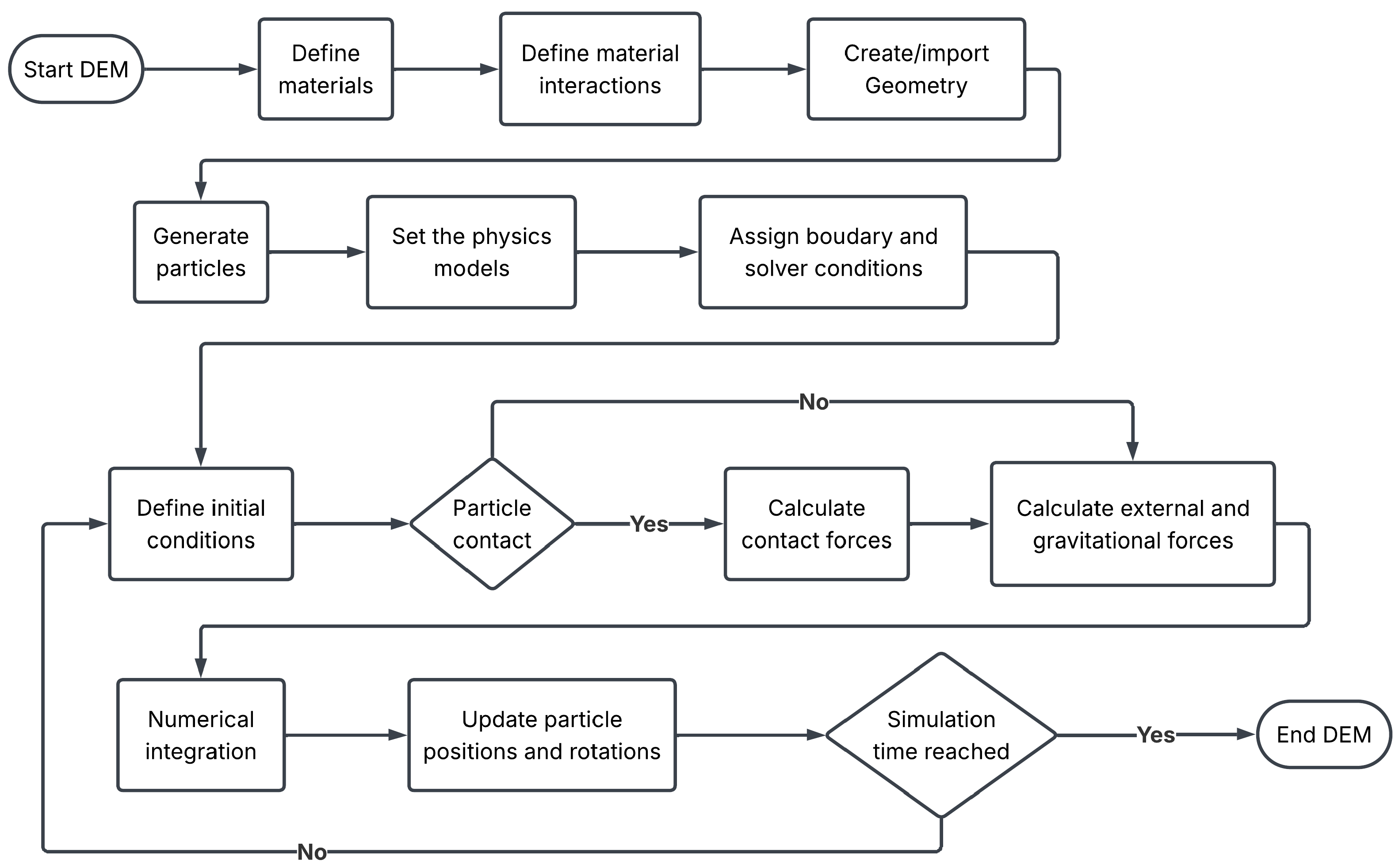
Figure 1. Flowchart illustrating the DEM computational cycle.
Modelling 07 00153 g001
Figure 2. Cylindrical branch modelled with different number of sub-spheres on its cross-section: (a) 1, (b) 7, (c) 9, (d) 19.
Modelling 07 00153 g002
Figure 3. Initial configurations: (a) monodisperse sample and (b) polydisperse sample with standard deviation of particle mean diameter of 75%.
Modelling 07 00153 g003
Figure 4. Angle of repose test scheme.
Modelling 07 00153 g004
Figure 5. Uniaxial compression test example.
Modelling 07 00153 g005
Figure 6. Measurement of the static friction coefficient.
Modelling 07 00153 g006
Figure 7. Drop test experimental setup.
Modelling 07 00153 g007
Table 1. PRISMA 2020 data extraction.
DatabaseRecords Identified
(1998–2025)
Duplicate Records RemovedRecords
Excluded
During Title/
Abstract
Screening
Full-Text Reports ExcludedStudies Included in Final Synthesis
Scopus1980885852
Web of Science1768244446
ScienceDirect142966337
SpringerLink115818323
IEEE Xplore853337213
TOTAL71429418370171
Table 2. Comparison of contact models used in DEM for agricultural applications.
Contact ModelDescriptionAdvantagesLimitationsTypical Applications
Elastic (Hertzian)Purely elastic deformations.Simple, low computational cost.Does not consider energy loss.Grain storage, seed handling.
Elastic–Plastic (Thornton–Ning)Includes permanent deformations.Better representation of materials under high loads.Requires precise calibration.Soil compaction, high-load grain handling.
Viscoelastic (Kuwabara–Kono)Deformations + energy dissipation.More accurate for dynamic interactions.Requires careful calibration.Harvesting processes, transport of fragile materials.
Adhesion (JKR, DMT)Models attractive forces.Essential for cohesive materials.Requires detailed parameterization.Wet grain handling, fruit harvesting, soil–tool interactions.
Tangent Stiffness (Mindlin–Deresiewicz)Combines Hertz and Mindlin theories.Enables precise friction modeling, useful for irregular particles.More complex equations.Handling irregular particles, processing of non-spherical grains.
Table 3. Correspondences between contact model families and representative implementations in common DEM software.
Contact Model FamilyTypical Software NamingRepresentative Packages
Linear spring–dashpotLinear contact, LSCMEDEM, Rocky, LIGGGHTS
Hertz–Mindlin viscoelasticHertz–Mindlin contactEDEM, PFC, Rocky, LIGGGHTS
Adhesive/cohesiveJKR or cohesive contactEDEM, Rocky, LIGGGHTS
Bonded particleBonded/parallel bond modelPFC, EDEM, Rocky
Rolling resistanceRolling torque modelsRocky, EDEM
Table 4. Bulk density, porosity, and specific gravity of materials.
GrainBulk Density (kg/m3)Moisture (%)Porosity (%)Specific Gravity (kN/m3)Reference
Barley6189.7–10.739.5–57.612.1–13.3[70]
Rape6696.5–6.738.4–38.911.0–11.5
Maize7219–1540.0–44.011.9–13.0
Linseed7215.834.611.0
Oat4129.4–10.347.6–55.59.5–10.6
Rice57911.9–12.446.5–50.411.1–11.2
Rye7219.741.212.3
Soy7726.9–7.033.8–36.111.3–11.8
Wheat7729.839.6–42.612.9–13.2
Table 5. Elastic properties of agricultural particles.
Material (Moisture Content %)Elastic Modulus E (MPa)Poisson’s RatioReference
Apple4.020.22[73]
Maize (14.4)20300.40
Peach0.52–0.970.49
Potato1.04–5.760.48
Soybean (13)1260.40
Wheat (11.5–13)930–33800.42
Amaranth (8)30.8 ± 1.80.27 ± 0.02[74]
Barley (10)14.2 ± 1.60.19 ± 0.01
Buckwheat (10)20.6 ± 2.30.20 ± 0.02
Maize (10)26.2 ± 3.20.20 ± 0.01
Lentil (8)16.3 ± 0.70.24 ± 0.01
Oat (10)17.8 ± 2.80.18 ± 0.01
Pea (10)16.8 ± 2.10.26 ± 0.03
Rapeseed (9)8.7 ± 0.80.17 ± 0.02
Rye (10)23.6 ± 2.30.19 ± 0.01
Soybean (8)32.6 ± 1.40.15 ± 0.02
Triticale (10)20.4 ± 2.60.20 ± 0.02
Wheat (10)22.4 ± 4.60.22 ± 0.01
White mustard (9)13.1 ± 0.50.24 ± 0.01
Barley13.4[75]
Chickpea31.0–43.6
Flaxseed6.2
Lentil14.3
Rapeseed12.2
Rice10.6
Rye17.1
Triticale15.6
Vetch23.8–28.9
Wheat29.2
Table 6. Coefficients of restitution.
MaterialModeled ProcessRestitution CoefficientReference
MaizeParticle–particle0.254[78]
MaizeParticle–steel0.612
MaizeParticle–methacrylate0.595
OlivesParticle–particle0.325
OlivesParticle–steel0.567
OlivesParticle–methacrylate0.548
Table 7. Particle–particle coefficients of friction.
Material (Moisture Content %)Experimental Mode/Modeled ProcessParticle–Particle Coefficient of FrictionReference
Chickpea (9.9)Jenike shear test0.80–0.85[75]
Flaxseed (7.4)0.32–0.37
Lentil (12.4)0.27–0.32
Rice (13.1)0.64–0.66
Rye (13.2)0.39–0.41
Wheat (11)0.38–0.47
Amaranth (8)Direct shear test0.39 ± 0.01[74]
Barley (12.5)0.54 ± 0.01
Buckwheat (10)0.40 ± 0.01
Maize (12.5)0.62 ± 0.01
Lentil (8)0.25 ± 0.01
Oat (12.5)0.41 ± 0.02
Pea (10)0.52 ± 0.01
Rapeseed (9)0.59 ± 0.01
Rye (12.5)0.45 ± 0.02
Soybean (8)0.58 ± 0.02
Triticale (12.5)0.42 ± 0.02
Wheat (12.5)0.49 ± 0.01
White mustard (9)0.46 ± 0.01
Table 8. Particle–wall coefficients of friction.
Material (Moisture Content %)Particle–Wall Coefficient of Friction (Wall Material: Stainless Steel/Galvanized Steel/Concrete B30)Reference
Amaranth (8)0.107/0.120/0.371[74]
Buckwheat (10)0.157/0.149/0.369
Barley (12.5)0.157/0.139/0.496
Maize (12.5)0.138/0.137/0.549
Lentil (8)0.140/0.131/0.259
Oat (12.5)0.150/0.182/0.342
Pea (10)0.153/0.123/0.331
Rapeseed (9)0.163/0.148/0.349
Rye (12.5)0.284/0.195/0.358
Soybean (8)0.170/0.198/0.434
Triticale (12.5)0.247/0.184/0.413
Wheat (12.5)0.170/0.173/0.480
White mustard (9)0.125/0.097/0.340
Table 9. Rolling friction coefficients.
MaterialModeled ProcessNon-Dimensional Rolling Friction CoefficientReference
MaizeSilo discharge0.235[85]
GrapeHarvesting0.70[78]
PeaSilo discharge0.0167[86]
RiceSilo discharge0.30[87]
Table 10. Comparative analysis of recent DEM applications in agricultural engineering (2022–2024).
Application DomainPrimary MaterialsValidation MethodologyKey Limitations Identified
Tillage toolsCohesive soilDraft force measurement; soil profile imaging; particle tracking.Moisture sensitivity; scale effects; cohesion model simplification.
Seed/fertilizer distributionFree-flowing granular materialsFlow rate measurement; distribution pattern analysis; high-speed imaging.Particle shape effects; humidity-induced cohesion; property variability.
Harvesting and threshingCrops Grains Biological tissuesEfficiency measurement; damage rate assessment; power consumption.Biological variability; complex failure modes; coupled multi-physics.
Post-harvest pneumatic systemsGrains ChaffSeparation efficiency; CFD-DEM coupled validation; particle imaging.Turbulence modeling; computational cost of coupling.
Root crop harvestingTubers SoilField trial efficiency; laboratory impact tests; separator performance;Tuber property variability; bruising mechanism complexity.
Table 11. Summary of advanced calibration strategies for agricultural materials in DEM studies.
StudyRef.Calibration Strategy
Probabilistic calibration using SQMC filter[115]Bayesian sequential data assimilation with posterior PDF approximation
Efficient optimization for compacted loess slope[113]Chaotic PSO with sigmoid-based acceleration coefficients (CPSOS)
Intelligent optimization for heterogeneous rock mass[116]Improved DBO with GP-LHS initialization and hybrid iteration strategies
Adaptive AI-based surrogate modeling[62]Transfer learning with neural networks and Bayesian optimization
PSO-BP calibration for organic fertilizer[117]Particle swarm optimization coupled with backpropagation neural networks
Multi-objective GA framework[122]NSGA-II for balancing model accuracy and simulation time
Review of calibration strategies[123]Comparative analysis of DOE, optimization methods, and inverse modeling
Table 12. Research opportunities for DEM application in specialty crop systems.
CropDEM Application Opportunities
CoffeeSimulation of coffee grain flow in storage silos using DEM to analyze compaction and segregation patterns
Analysis of mechanical damage in coffee grains during transport, simulating impacts and compressions on conveyors
Study of mechanized harvesting impact forces, assessing forces exerted on grains and branches during vibration
Modeling granular behavior during roasting to optimize grain movement and heat transfer in rotary roasters
Orange/CitrusSimulation of fruit impact during transport in bins and boxes to minimize bruising damage
Study of mechanized harvester–tree interactions, optimizing shaking mechanisms to reduce fruit and plant damage
Analysis of fruit flow on inclined conveyors to optimize distribution in packing and processing facilities
Simulation of ground-harvest collection systems to reduce soil contamination and mechanical damage
ApplesDEM modeling of impact damage during sorting and packing operations to optimize handling equipment
Simulation of mechanical harvester shaking mechanisms to minimize tree damage and fruit bruising
Analysis of controlled-atmosphere storage bin filling to prevent compression damage and optimize space utilization
Wine GrapesOptimization of mechanical harvester beater rod geometry and speed to minimize skin damage and MOG content
Simulation of destemming processes to reduce stem fragments while preserving berry integrity
DEM analysis of crusher–destemmer interactions to optimize juice extraction and skin contact
AlmondsModeling of mechanical shaking and catching systems to minimize impact damage during harvest
Simulation of hulling and shelling processes to optimize kernel recovery and reduce breakage rates
Analysis of pneumatic conveying systems to minimize kernel damage during processing and handling
WalnutsDEM optimization of mechanical harvesting impact forces to reduce shell fracture and kernel damage
Simulation of hulling equipment to maximize hull removal while preserving in-shell walnut quality
HazelnutsModeling soil–nut separation in mechanical harvesting sweepers to reduce contamination
Optimization of pneumatic cleaning and grading systems to improve harvesting efficiency
PotatoesCoupled DEM-MBD simulation of harvester separation mechanisms (see Section 5.3)
Analysis of soil–tuber separation on chain and roller conveyors to minimize damage
Optimization of storage bin filling patterns to reduce bruising and pressure damage
TomatoesDEM simulation of mechanical harvester fruit–plant separation forces to reduce damage
Modeling of gentle-handling conveyors and sorting systems for fresh market tomatoes
Carrots/OnionsSimulation of root crop harvesting equipment to optimize soil separation and minimize breakage
DEM analysis of topping and cleaning mechanisms to reduce product damage during harvest
Disclaimer/Publisher’s Note: The statements, opinions and data contained in all publications are solely those of the individual author(s) and contributor(s) and not of MDPI and/or the editor(s). MDPI and/or the editor(s) disclaim responsibility for any injury to people or property resulting from any ideas, methods, instructions or products referred to in the content.