Article

Fractional Zener Modeling of the Viscoelastic Behavior of PET/rGO Composites

by
Paloma B. Jimenez-Vara
1,
Flor Y. Rentería-Baltiérrez
2,
Luis E. Jasso-Ramos
1 and
Jesús G. Puente-Córdova
3,*
1
Departamento de Mantenimiento Industrial, Universidad Tecnológica General Mariano Escobedo, General Escobedo 66050, Mexico
2
Facultad de Ciencias Químicas, Universidad Autónoma de Nuevo León, San Nicolás 66455, Mexico
3
Facultad de Ingeniería Mecánica y Eléctrica, Universidad Autónoma de Nuevo León, San Nicolás 66455, Mexico
*
Author to whom correspondence should be addressed.
Modelling 2026, 7(3), 86; https://doi.org/10.3390/modelling7030086
Submission received: 21 March 2026 / Revised: 17 April 2026 / Accepted: 25 April 2026 / Published: 29 April 2026

Abstract

Poly(ethylene terephthalate) (PET) composites reinforced with reduced graphene oxide (rGO) were investigated in order to elucidate the influence of nanofiller concentration and compatibilization on the viscoelastic relaxation behavior across the glass transition. Composites containing 0.1 and 0.5 wt% rGO were prepared by melt blending, and selected systems incorporated 5 wt% of an ionomeric polyester (PETi) as compatibilizer to enhance interfacial adhesion. The thermomechanical response was characterized using dynamic mechanical analysis (DMA) as a function of temperature. Experimental results revealed a strong dependence of stiffness, damping, and glass transition behavior on filler concentration and interfacial interactions. While low rGO loading produced minor changes, the incorporation of 0.5 wt% rGO significantly increased the glassy modulus and shifted the glass transition temperature, indicating restricted segmental mobility. Compatibilized systems exhibited further stiffness enhancement and modified relaxation dynamics due to improved stress transfer and interphase development. To capture the distributed nature of the relaxation processes, the glass transition region was modeled using a fractional Zener model (FZM) with two spring-pot elements within a cooperative relaxation framework. The model successfully reproduced the experimental E and tan δ curves and revealed systematic variations in the fractional exponents and cooperative parameters. The results demonstrate that the introduction of rGO and compatibilizer progressively transforms the relaxation spectrum of PET from a relatively uniform segmental process into a heterogeneous, interfacially mediated viscoelastic response that is naturally described by fractional rheology.

1. Introduction

Poly(ethylene terephthalate) (PET) is a widely used semi-crystalline polymer due to its excellent processability, dimensional stability, mechanical performance, and dielectric properties [1,2,3,4]. These characteristics have enabled its extensive use in industries such as automotive, electronics, packaging, and engineering applications. During service, PET-based materials are often subjected to mechanical and thermal loads that induce stress, deformation, and complex molecular rearrangements, leading to characteristic viscoelastic relaxation phenomena.
To enhance the performance of PET for advanced applications, the incorporation of nanoscale fillers has been widely explored [5,6,7]. In particular, graphene-based materials have attracted considerable attention due to their exceptional mechanical strength, high electrical conductivity, and thermal stability. Among these fillers, reduced graphene oxide (rGO) has proven to be an effective reinforcing agent capable of improving stiffness, thermal stability, and functional properties of polymer matrices [8,9].
When incorporated into a semi-crystalline polymer such as PET, rGO nanosheets can significantly modify the relaxation dynamics of the polymer chains by restricting molecular mobility and altering energy dissipation mechanisms [10]. However, the effectiveness of these nanocomposites strongly depends on the interfacial interactions between the filler and the polymer matrix [11]. Poor interfacial adhesion often leads to agglomeration of the nanosheets and inefficient stress transfer, which can limit the reinforcement efficiency. Therefore, the use of compatibilizing agents is commonly employed to improve dispersion and promote stronger interfacial bonding.
The heterogeneous microstructure and complex interfacial interactions in PET/rGO composites lead to broad and non-exponential relaxation behavior, typically observed in dynamic mechanical analysis (DMA) [12,13]. Classical viscoelastic models such as the Maxwell or Kelvin–Voigt models can describe relaxation processes using discrete mechanical elements; however, they often require a large number of parameters to represent the wide distribution of relaxation times characteristic of polymer nanocomposites. In contrast, fractional viscoelastic models provide a compact mathematical framework capable of describing distributed relaxation processes with a reduced number of parameters [14,15].
In this work, the fractional Zener model (FZM) is employed to describe the memory effects and power-law relaxation behavior observed in PET/rGO composites. The objective of this study is to evaluate the synergistic influence of rGO and compatibilizer content on the viscoelastic response of the polymer matrix. In particular, we analyze how these components affect the fractional-order parameters and characteristic relaxation times of the FZM, providing deeper insight into the relationship between molecular mobility, interfacial interactions, and the structural reinforcement of the composites.
In this context, the present work provides a comprehensive analysis of the viscoelastic behavior of PET/rGO composites by combining dynamic mechanical analysis with a fractional viscoelastic framework. The study systematically evaluates the coupled influence of nanofiller concentration and compatibilization on the relaxation dynamics of the polymer matrix. By integrating the fractional Zener model with a cooperative relaxation framework based on Matsuoka’s theory, the combined framework enables the extraction of physically meaningful parameters—including the cooperative temperature T , Vogel temperature T 0 , and activation energies—associated with segmental mobility and interfacial constraints. Furthermore, the simultaneous fitting of the storage modulus ( E ) and damping factor ( tan δ ) ensures internal consistency between elastic and dissipative contributions. This allows a direct correlation between fractional exponents (a, b) and the evolution of relaxation heterogeneity induced by interfacial interactions.

2. Mechanical Relaxation of PET

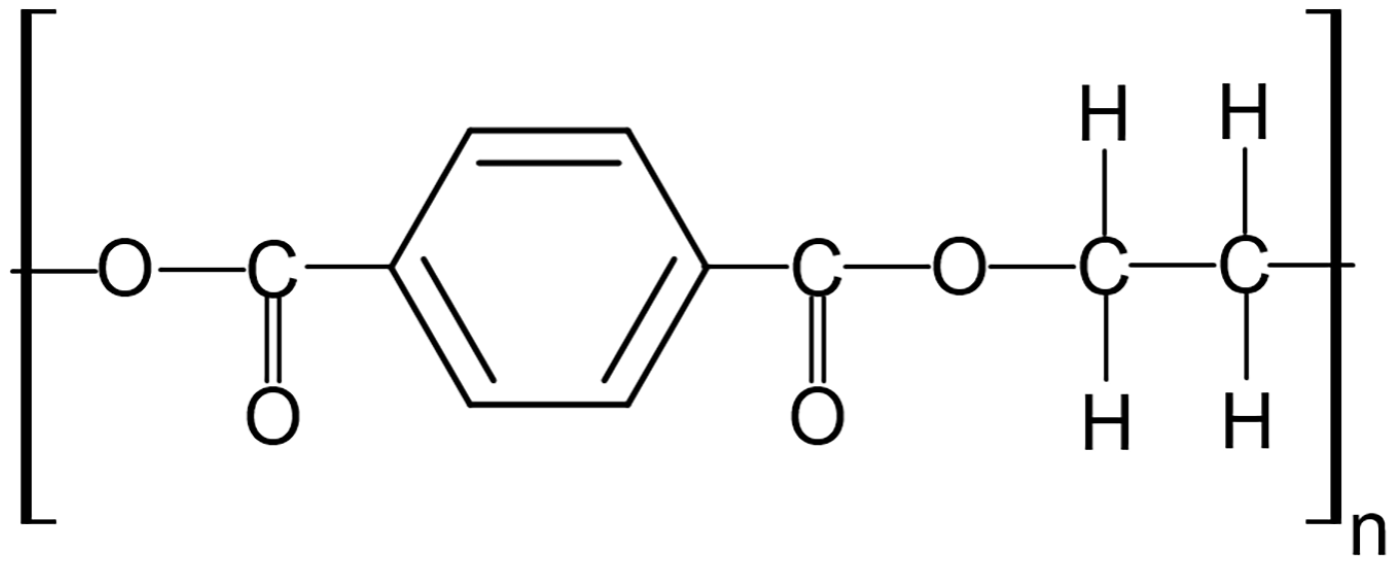
In this work, we study poly(ethylene terephthalate) (PET), a polymer synthesized through the polycondensation of terephthalic acid and ethylene glycol. Figure 1 illustrates the repeating unit within the PET chains.
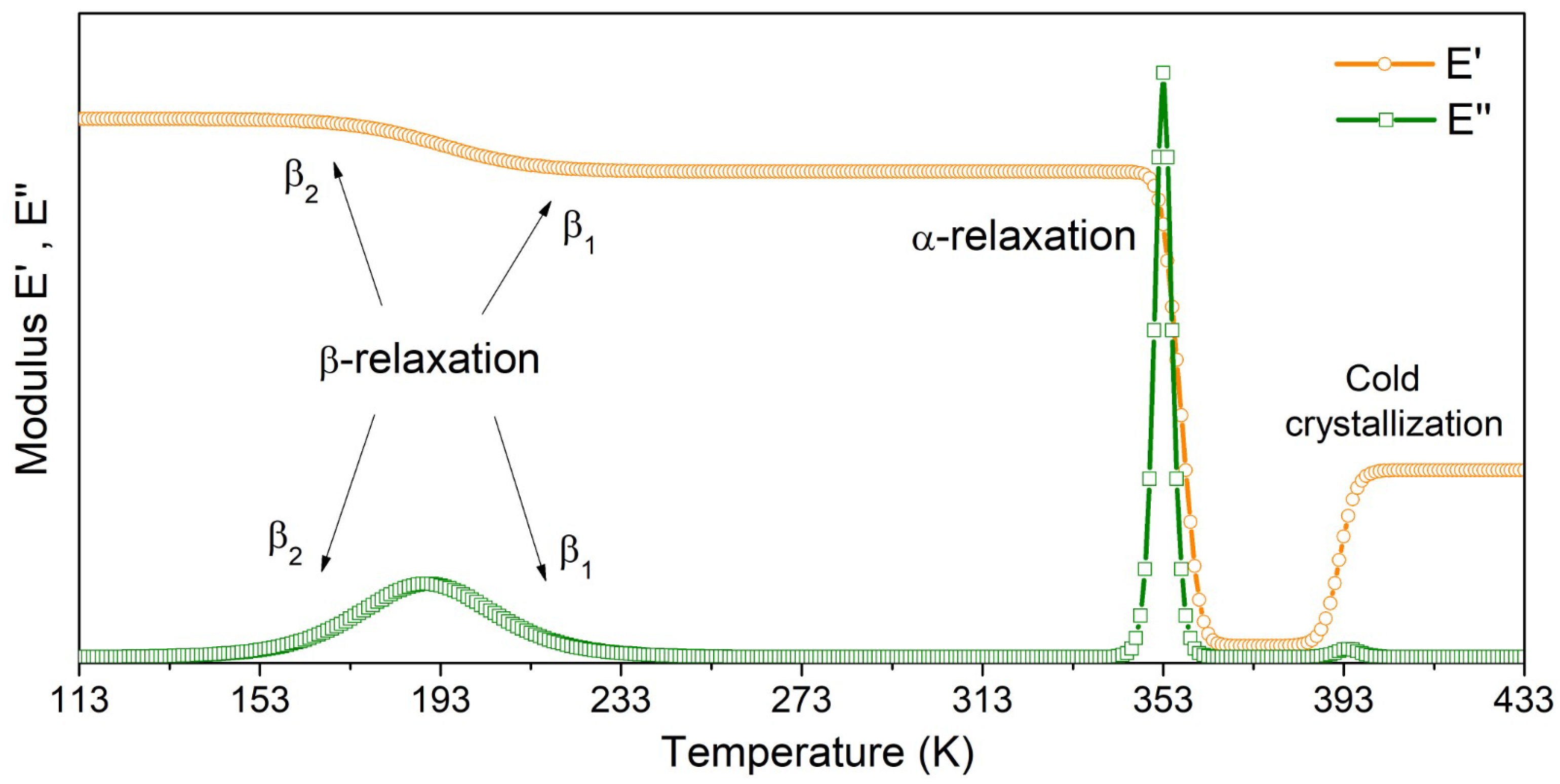
This polymer typically exhibits three relaxation phenomena in dynamic mechanical analysis (DMA): secondary relaxations, α -relaxation, and cold crystallization (Figure 2). At low temperatures ( T 193 K), the loss modulus E displays a broad secondary transition known as the β relaxation [16]. This process is accompanied by a moderate decrease in the storage modulus E as the temperature increases. The β peak extends over a wide temperature range and is generally attributed to two distinct types of molecular mobility: β 1 (on the high-temperature side), associated with the flipping and rotational motions of the phenyl rings within the PET backbone, and β 2 (on the low-temperature side), related to local motions of the carbonyl groups [17]. At approximately T 353 K, a sharp peak appears in E , corresponding to the α -relaxation. This peak is significantly less dispersed than the β transition and exhibits a higher maximum intensity. The α peak represents the mechanical manifestation of the glass transition ( T g ). In contrast to the localized β motions, the molecular movements involved in α -relaxation are cooperative and involve long-range segmental rearrangements driven by coordinated motion of substantial portions of the polymer backbone [18].
An additional feature is observed in the E spectrum above T g . Notably, this process is accompanied by an increase in the storage modulus E as the temperature rises. This behavior corresponds to the mechanical manifestation of cold crystallization in the amorphous phase of PET [17]. At this temperature range, the enhanced segmental mobility enables previously disordered chains to reorganize into crystalline domains, resulting in an increase in the overall stiffness of the polymer matrix [19,20]. At higher temperatures, well above the cold crystallization region and depending on the degree of crystallinity developed during heating, PET eventually reaches the terminal flow regime. In this region, the storage modulus E decreases markedly, and the material progressively loses its elastic character, while viscous behavior becomes dominant. Under these conditions, long-range molecular motion is no longer restricted to cooperative segmental rearrangements but extends to translational chain mobility, enabling macroscopic flow [12,21]. This behavior corresponds to the rubbery-to-viscous transition and defines the processing window of PET, where the material can undergo deformation under sustained stress [22,23]. The complex viscoelastic nature of these transitions, particularly the broadening of the α and β peaks, suggests that the relaxation processes in PET and their composites do not follow a single Debye-type behavior. Instead, they exhibit a distribution of relaxation times that can be captured using fractional viscoelastic models.

3. Fractional Zener Models

Elasticity and viscosity are fundamental material properties in rheology and continuum mechanics, as they are directly associated with reversible energy storage and irreversible energy dissipation, respectively [24,25]. Elasticity describes the ability of a material to store mechanical energy through reversible deformation, which at the microscopic scale arises from interatomic and intermolecular interactions and the resistance of molecular networks to configurational changes. In contrast, viscosity quantifies the resistance to flow and is associated with energy dissipation through internal friction during molecular rearrangements. From these concepts, idealized limiting cases are defined: the perfectly elastic solid governed by Hooke’s law and the purely viscous fluid described by Newton’s law. However, many materials exhibit viscoelastic behavior, an intermediate state between these two extremes. The mechanical response of certain materials, particularly polymers, below the glass transition temperature ( T g ) or melting temperature ( T m ) is solid-like; however, above these temperatures, the polymers begin to flow significantly, exhibiting liquid-like characteristics. This transition depends on both the temperature and the observation time window. In the time domain, viscoelastic behavior manifests through creep and stress relaxation. In the frequency domain, it is characterized by complex moduli, phase lag, and hysteresis between stress and strain. Experimentally, these phenomena are investigated using techniques such as dynamic mechanical analysis (DMA), as well as creep and stress relaxation tests. This behavior is modeled using constitutive equations that phenomenologically consider the responses offered during these processes [14,26,27]. Traditionally, viscoelastic models are constructed as mechanical analogs using springs and dashpots, representing elastic and viscous behaviors, respectively. An ideal elastic solid is described by Hooke’s law, utilizing a spring as the mechanical analog with the following constitutive Equation (1):
σ = E ε = E D t 0 ε
where σ is the stress, ε is the strain, and E is the elastic modulus. On the other hand, a pure viscous liquid is represented by a viscous dashpot governed by Newton’s law (Equation (2)):
σ = η d ε d t = η D t 1 ε
Here η is the viscosity, and d ε / d t (or ε ˙ ) is the strain rate. While these equations are considered linear, experimental responses depend on the applied stimuli; if E and η become dependent on these stimuli, the response becomes non-linear. In literature, combinations of springs and dashpots lead to differential equations that attempt to explain viscoelasticity [28,29,30]. However, classical models such as Maxwell, Voigt–Kelvin, and Zener are often only first approximations for polymeric materials. Since viscoelasticity is inherently intermediate behavior between elasticity and viscosity, Scott-Blair proposed a constitutive element capable of bridging this gap, which Koeller later termed the “spring-pot” [31,32]. The constitutive equation of the spring-pot utilizes a fractional derivative D t ν of order ν , which takes values between 0 and 1 (Equation (3)).
σ = E τ ν D t ν ε
When ν = 0 , the equation recovers Hooke’s law, and when ν = 1 , it recovers Newton’s law. In this work, the Riemann–Liouville fractional derivative is employed (Equation (4)):
D t ν f ( t ) = 1 Γ ( 1 ν ) d d t 0 t ( t t ) ν f ( t ) d t
where ν is a generic fractional order ( 0 < ν < 1 ) and Γ ( x ) represents the Gamma function. A single spring-pot is generally insufficient to represent the complex viscoelastic behavior of polymers. Therefore, a robust alternative is to substitute the traditional dashpot in classical models with a spring-pot, resulting in fractional models whose differential equations yield solutions capable of accurately representing experimental viscoelastic data over broad scales of times and frequencies.
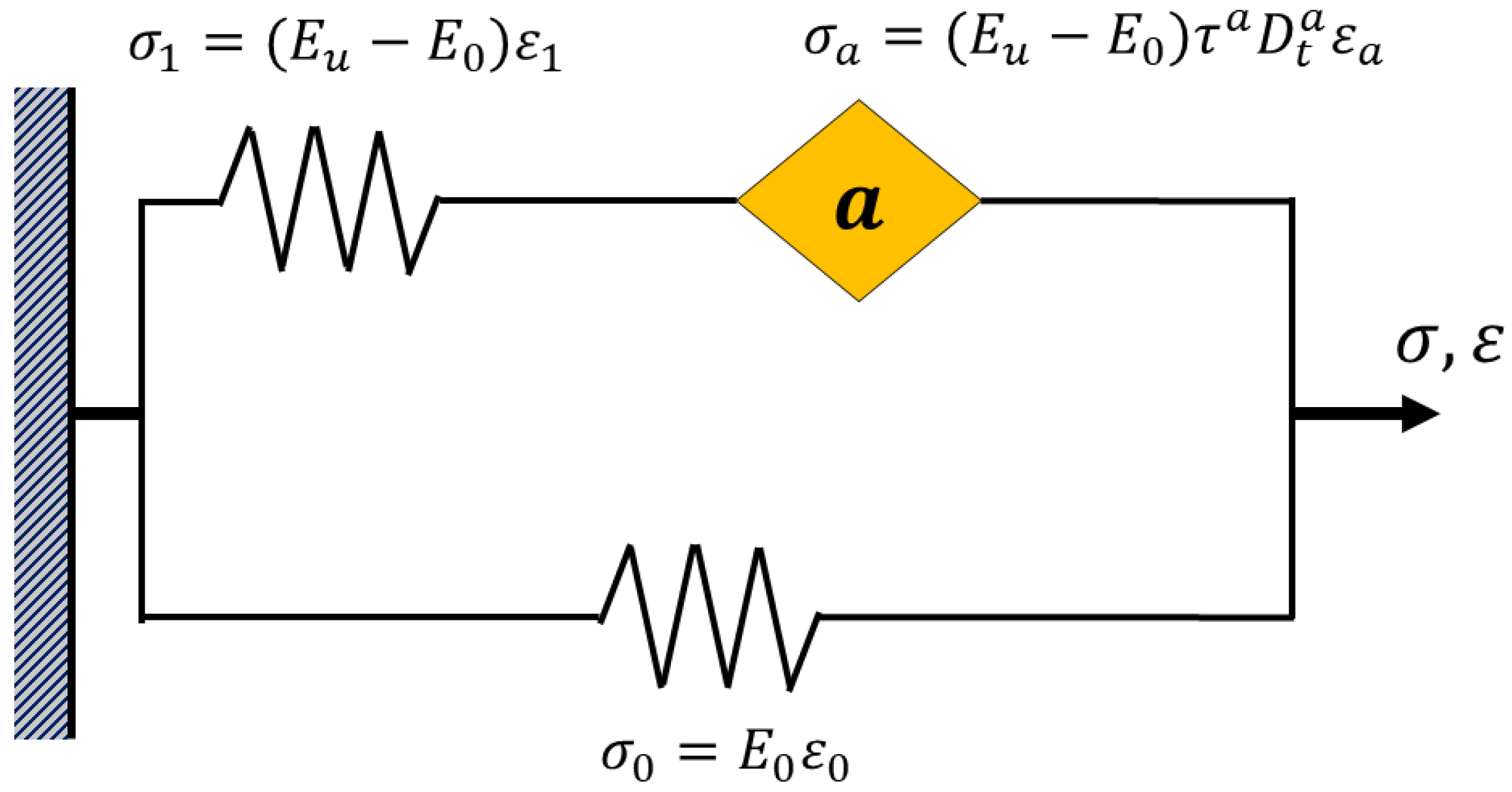
The fractional Zener model (FZM) in Figure 3 has been used by several researchers for the description of the viscoelastic mechanical relaxation in amorphous and semi-crystalline polymers [33,34].
This model consists of a parallel arrangement of the fractional Maxwell model with a spring E 0 . The constitutive equation of the FZM is the following Equation (5):
σ + τ a D t a σ = E 0 ε + E u τ a D t a ε
where E 0 is the modulus at low frequencies and high temperatures, and E u is the modulus at high frequencies and low temperatures. The Fourier transform F for a differential operator of fractional order a ( 0 < a < 1 ) is given by Equation (6):
F [ D t a f ( t ) ] = ( i ω ) a F ( ω )
Utilizing the Fourier transform on Equation (5), and considering E ( ω ) = σ ( ω ) / ε ( ω ) yields the following Equation (7):
E ( ω ) = E + i E = E 0 + E u ( i ω τ ) a 1 + ( i ω τ ) a
Considering i a = cos ( π 2 a ) + i sin ( π 2 a ) , with i as the imaginary unit, the individual components of E ( ω ) can consequently be expressed by separating the equation into its real E and imaginary E parts, yielding Equations (8) and (9), respectively:
E ( ω ) = E u ( E u E 0 ) 1 + ( ω τ a cos π 2 a ] 1 + 2 ω τ a cos π 2 a + ω τ 2 a
E ( ω ) = ( E u E 0 ) [ ω τ a sin π 2 a ] 1 + 2 ω τ a cos π 2 a + ω τ 2 a
The loss factor, tan δ , represents a key rheological parameter in the analysis of the viscoelastic response of materials. It is calculated as the ratio between the loss modulus ( E ) and the storage modulus ( E ). This parameter is directly associated with the internal friction and the energy dissipation or damping capacity within the viscoelastic material.
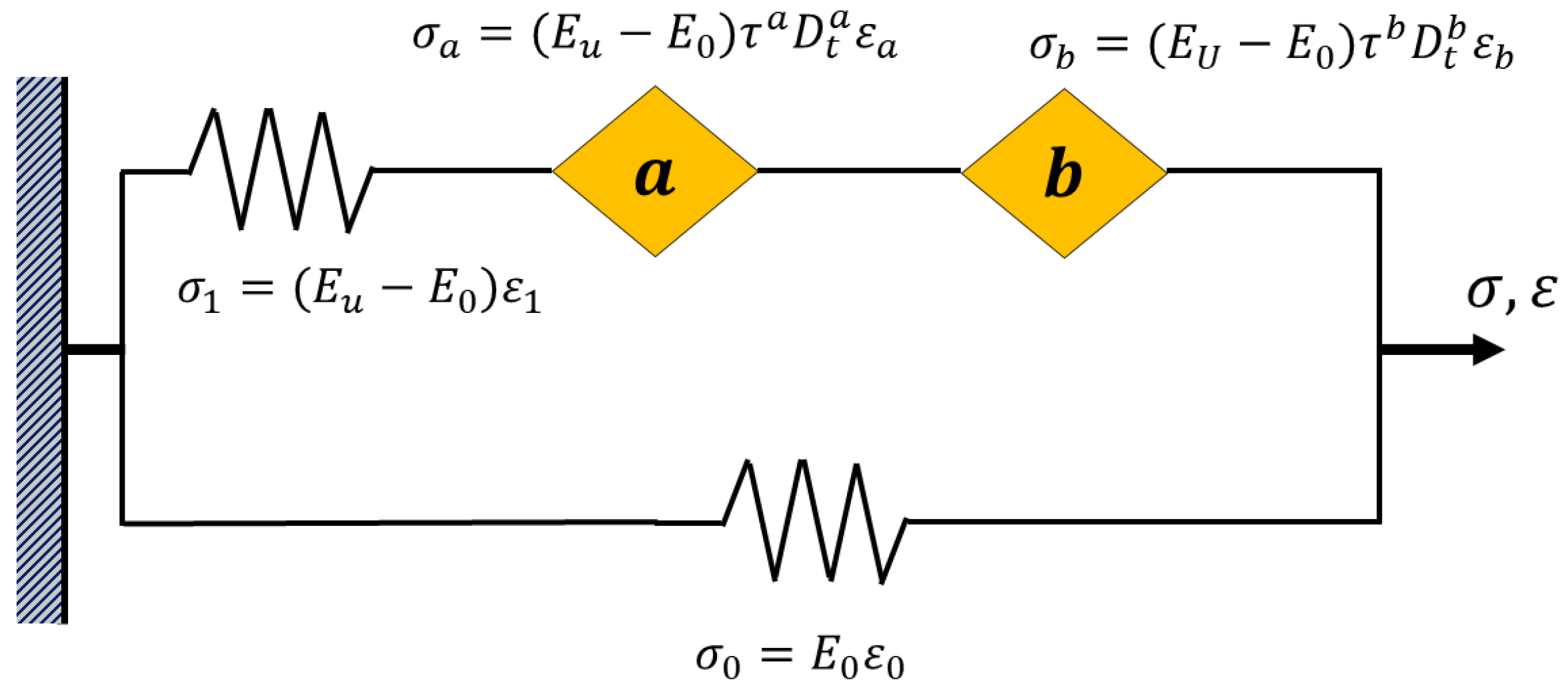
Alcoutlabi and Martinez-Vega proposed a modified fractional Zener model, considering two spring-pots to model the mechanical relaxation of polymers [35,36]. In Figure 4, the FZM modified with two spring-pot elements is presented. This model is characterized by three physical mechanisms: the first corresponds to the spring-pot a associated with the viscoelastic behavior at high frequencies or low temperatures, the second corresponds to the spring-pot b associated with the viscoelastic behavior at low frequencies or high temperatures, and the third corresponds to the polymer’s elastic response.
Using laws of mechanics and considering stress and strain distributions, the constitutive equation is obtained, which is a fractional differential Equation (10):
( E u E 0 ) ε = ( σ E 0 ε ) + τ b b D t b ( σ E 0 ε ) + τ a a D t a ( σ E 0 ε )
The operators D t a and D t b are defined using the fractional integral of Riemann–Liouville, where fractional orders satisfy the condition 0 < a , b < 1 . The mathematical definition for a generic order ν (where ν represents a or b) is expressed as Equation (11):
D t ν f ( t ) = 1 Γ ( ν ) 0 t ( t t ) ν 1 f ( t ) d t
Applying the Fourier transform to Equation (10), we obtain the complex elastic modulus for FZM modified with two spring-pots:
E ( ω ) = E u + E 0 [ ( i ω τ a ) a + ( i ω τ b ) b ] 1 + ( i ω τ a ) a + ( i ω τ b ) b
Furthermore, by separating the real and imaginary components of Equation (12), the storage modulus E and the loss modulus E were derived, as presented in Equations (13) and (14), respectively.
E ( ω ) = E 0 + ( E u E 0 ) 1 + ( ω τ a ) a cos a π 2 + ( ω τ b ) b cos b π 2 1 + ( ω τ a ) a cos a π 2 + ( ω τ b ) b cos b π 2 2 + ( ω τ a ) a sin a π 2 + ( ω τ b ) b sin b π 2 2
E ( ω ) = ( E u E 0 ) ( ω τ a ) a sin a π 2 + ( ω τ b ) b sin b π 2 1 + ( ω τ a ) a cos a π 2 + ( ω τ b ) b cos b π 2 2 + ( ω τ a ) a sin a π 2 + ( ω τ b ) b sin b π 2 2
From a physical perspective, the fractional exponents a and b in the two-spring-pot model carry direct significance related to the nature of molecular relaxation processes. These parameters quantify the deviation from ideal elastic ( ν = 0 ) or viscous ( ν = 1 ) behavior, effectively capturing the intermediate viscoelastic character of polymer systems.
From a molecular perspective, the fractional exponents can be interpreted as follows:
  • Values approaching 0 indicate predominantly elastic behavior with minimal energy dissipation, characteristic of highly constrained chain segments with restricted molecular mobility.
  • Values approaching 1 indicate predominantly viscous behavior with significant energy dissipation, characteristic of mobile chain segments undergoing flow-like relaxation.
  • Intermediate values reflect the coexistence of elastic storage and viscous dissipation mechanisms, typical of polymeric materials in the glass transition region.
The difference | a b | can be interpreted as a measure of the asymmetry and breadth of the relaxation spectrum. Larger differences indicate a wider distribution of relaxation mechanisms and increased dynamic heterogeneity, which is commonly observed in filled polymer systems where interfacial regions introduce additional relaxation populations [14,37].
It is important to clarify the physical relationship between the characteristic relaxation time τ and the two independent fractional exponents. In the present formulation, τ defines the central time scale of the main ( α ) relaxation associated with the glass transition, while the exponents a and b control the breadth and asymmetry of the relaxation spectrum around this central time. This approach is analogous to empirical functions such as the Havriliak–Negami model, where shape parameters modulate the spectral distribution without introducing additional discrete relaxation times. The single τ reflects the cooperative nature of segmental relaxation, while distinct a and b values capture the heterogeneous dynamics arising from local free volume variations, interfacial constraints, and cooperative rearrangements at different length scales.
To extend this framework toward a temperature-dependent description of the viscoelastic response, it is necessary to relate the characteristic relaxation time ( τ ) to the temperature (T). In this work, we employ the molecular theory of cooperative movements developed by Matsuoka [38,39]. According to this approach, the relaxation process near the glass transition is not governed by independent molecular motions but by the coordinated rearrangement of domains. The relationship between the relaxation time and temperature is expressed as Equation (15):
τ = τ 0 exp Z E a k B T = τ 0 exp E a ( T T 0 ) k B T ( T T 0 )
where Z represents the number of molecular units performing a cooperative rearrangement, E a is the activation energy for a single non-cooperative unit, k B is the Boltzmann constant, and τ 0 is a pre-exponential factor with values ranging between 10 16 and 10 13 s. Values of τ 0 around 10 13 s correspond to the relaxation times of atomic vibrations, while values near 10 16 s are associated with the system’s entropy contribution. When Z 1 (typically near T = T ), the equation reduces to the Arrhenius form, describing non-cooperative motions. As T approaches the Vogel temperature T 0 , Z increases significantly, capturing the characteristic non-Arrhenius behavior of glass-forming polymers [28,40].

4. Materials and Methods

4.1. Materials

Poly(ethylene terephthalate) (PET, Laser 7000 bottle grade) was supplied by DAK Americas, USA in pellet form. Reduced graphene oxide (rGO) was synthesized from graphite powder (<20 μ m particle size). All reagents required for the modified Hummers method were purchased from Sigma-Aldrich, St. Louis, MO, USA. An ionomeric polyester (PETi, Eastman AQ, Eastman Chemical Company, Kingsport, TN, USA) was used as a compatibilizer during composite preparation.

4.2. Preparation of rGO

Reduced graphene oxide (rGO) was prepared through a three-step process. First, graphite was oxidized using a modified Hummers method. The oxidation step was followed by exfoliation via mechanical stirring and ultrasonication. In the final step, the resulting graphene oxide (GO) was chemically reduced using sodium hydrosulfite. The obtained rGO was dried, pulverized, and subsequently used for composite fabrication. When PETi was incorporated, it was added to the graphene oxide dispersion prior to the chemical reduction step.

4.3. Preparation of Composites

The composites were prepared using a Brabender internal mixer (C.W. Brabender Instruments, South Hackensack, NJ, USA). Melt blending was carried out at 260 °C with a rotor speed of 100 rpm under a nitrogen atmosphere. The resulting melt was compression-molded using a Carver hydraulic press (Carver, Inc., Wabash, IN, USA) to obtain discs with a diameter of 25 mm for subsequent characterization. The analyzed formulations are summarized in Table 1.

4.4. Viscoelastic Characterization

The viscoelastic behavior of the composites was characterized using a Perkin Elmer DMA8000 analyzer (PerkinElmer, Waltham, MA, USA). The storage modulus ( E ), representing the elastic response; the loss modulus ( E ), associated with the viscous response; and the loss factor ( tan δ ), defined as the ratio E / E , were recorded as a function of temperature. The glass transition temperature ( T g ) was determined from the peak of the tan δ curve. Measurements were conducted in tension mode under a heating rate of 2 K/min at a fixed oscillation frequency of 1 Hz. Dynamic mechanical analysis (DMA) enables the identification of thermomechanical transitions and the characterization of molecular relaxation processes in polymeric composites.
To provide additional insight into the microstructural and rheological factors influencing the viscoelastic response, complementary morphological and melt-state characterization techniques were employed.

4.5. Morphological Characterization

Transmission electron microscopy (TEM) was used to characterize the morphology of rGO prior to composite fabrication. Samples were dispersed in ethanol, deposited onto carbon-coated copper grids, and observed using a JEOL JEM-2100F operating (JEOL Ltd., Tokyo, Japan) at 200 kV. Optical microscopy was employed to evaluate the dispersion and distribution of rGO particles within the polymer matrix. Thin films obtained after compression molding were examined without additional sample preparation using a Nikon OPTIPHOT-2 (Nikon Corporation, Tokyo, Japan) at various magnifications. This analysis provides qualitative insight into particle distribution, agglomeration, and the influence of the compatibilizer on filler dispersion.

4.6. Melt Rheology Characterization

For the rheological characterization of the material in the melt state, a Bohlin Gemini 2 (Malvern Instruments Ltd., Malvern, UK) parallel-plate rotational rheometer was used, which applies controlled shear strain to the sample to measure flow properties. Tests were conducted at a temperature of 533 K using 25 mm diameter parallel plates with a 1 mm gap. The measurements were performed in oscillatory mode, specifically through frequency sweeps ranging from 0.1 to 100 rad/s. To prevent oxidative degradation and ensure purity, the rheometer chamber was maintained under a nitrogen atmosphere throughout the testing process. These measurements provide complementary insight to the solid-state DMA analysis, enabling a correlation between melt-state chain dynamics and the viscoelastic parameters obtained from the fractional model.

4.7. Fractional Model Fitting Procedure

The model parameters were obtained through a nonlinear least-squares fitting procedure implemented in Python 3.13.1 (Python Software Foundation, Wilmington, DE, USA), where the objective function minimizes the sum of squared residuals between experimental data and model predictions. The fitting was performed simultaneously on the storage modulus ( E ) and the damping factor (tan δ ), ensuring internal consistency between elastic and dissipative contributions. The parameter estimation was guided by physically meaningful constraints. Initial values and admissible ranges were defined based on characteristic features of the experimental curves, such as modulus levels and transition regions, as well as the expected physical behavior of the system. To reduce sensitivity to local minima, multiple initial parameter estimates were tested within these physically consistent bounds. The optimal parameter set was selected as the one that minimizes the residual error. The fitting procedure consistently converged toward stable and physically meaningful parameter values. The quality of the fit was quantitatively evaluated using the coefficient of determination ( R 2 ) and the root mean square error (RMSE), based on the agreement between experimental and predicted curves over the entire temperature range, ensuring a reliable representation of the viscoelastic response.

5. Results and Discussion

5.1. Morphological Analysis

5.1.1. rGO Morphology

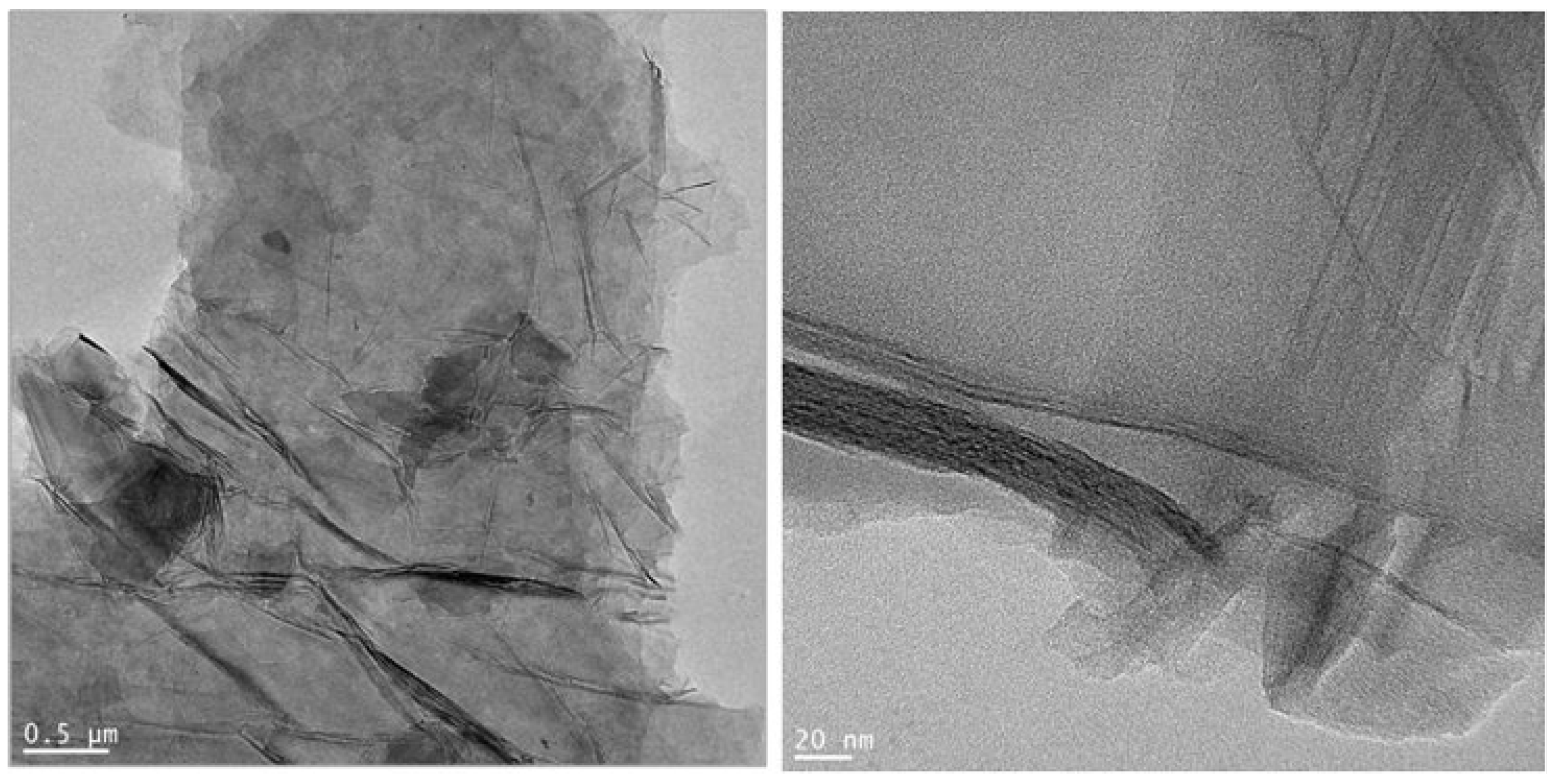
Figure 5 presents TEM micrographs of the rGO at different magnifications. The images reveal the characteristic wrinkled morphology of rGO sheets, consistent with the thermodynamic stabilization process of exfoliated graphene oxide layers. The darker regions correspond to areas of higher material density, likely representing overlapping or folded sheets. This wrinkled morphology, with its high specific surface area, is expected to promote enhanced interfacial contact with the polymer matrix upon composite fabrication.

5.1.2. Dispersion in PET Matrix

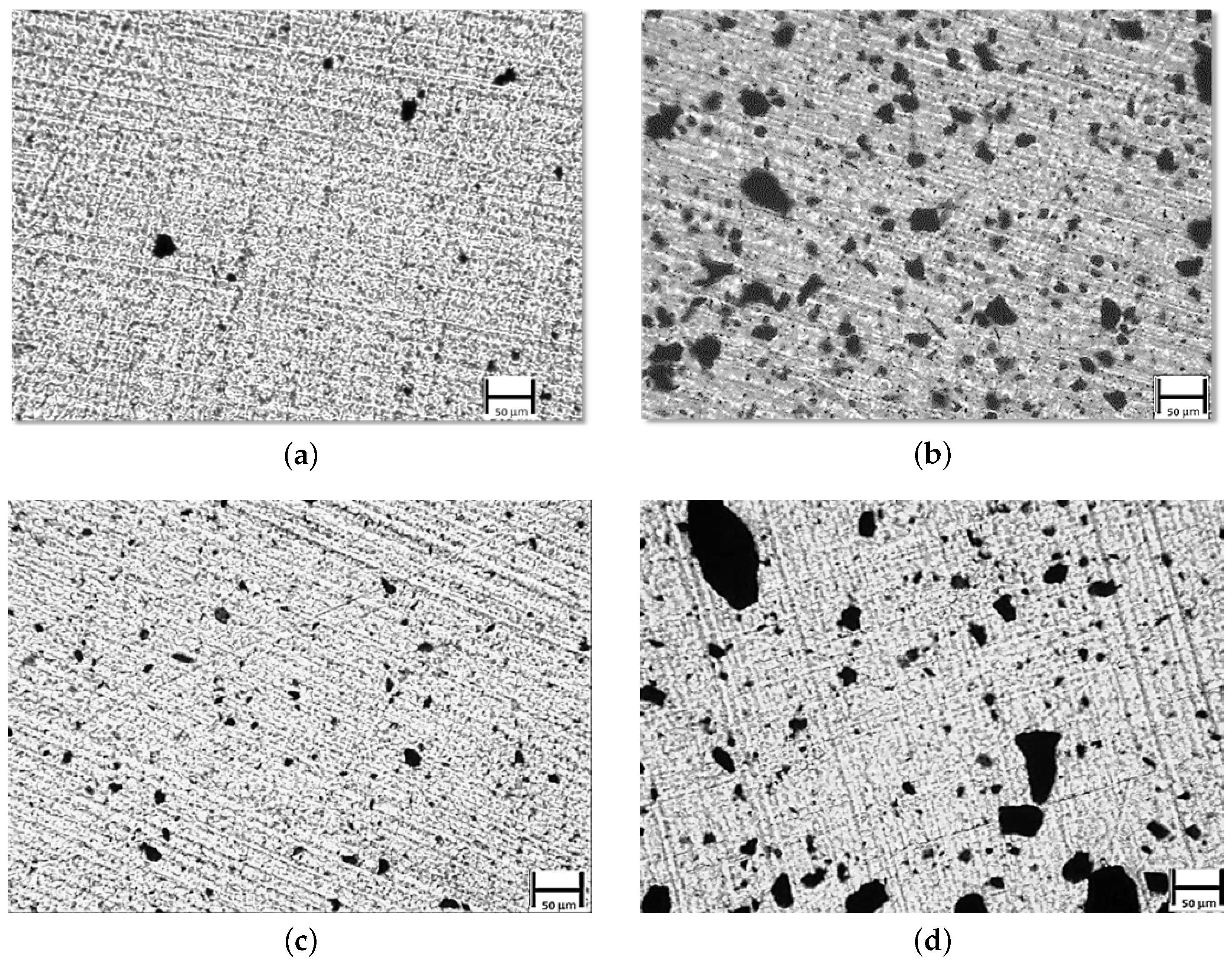
Optical microscopy images of the PET/rGO composites are presented in Figure 6. For the binary systems without compatibilizer (Figure 6a,b), the rGO particles appear as dark features distributed non-uniformly within the polymer matrix. At 0.5 wt% rGO loading, significant particle agglomeration is evident, with a broad distribution of aggregate sizes. The 0.1 wt% system shows fewer particles, also with non-uniform distribution.
The introduction of the PETi compatibilizer substantially improves the dispersion quality (Figure 6c,d). The system containing 5 wt% PETi with 0.1 wt% rGO exhibits the most homogeneous particle distribution, suggesting that the compatibilizer effectively promotes improved dispersion and distribution of rGO within the PET matrix. For the higher rGO loading (0.5 wt%) with compatibilizer, improved dispersion is observed compared to the uncompatibilized counterpart, although some size heterogeneity remains.
These morphological observations provide direct physical support for the interpretation of the DMA and fractional model results. The improved dispersion in compatibilized systems correlates with broader relaxation spectra, reflected in the variation of the fractional exponents, and enhanced cooperative dynamics, consistent with the formation of an extended interphase region with modified chain mobility.

5.2. Melt Rheology

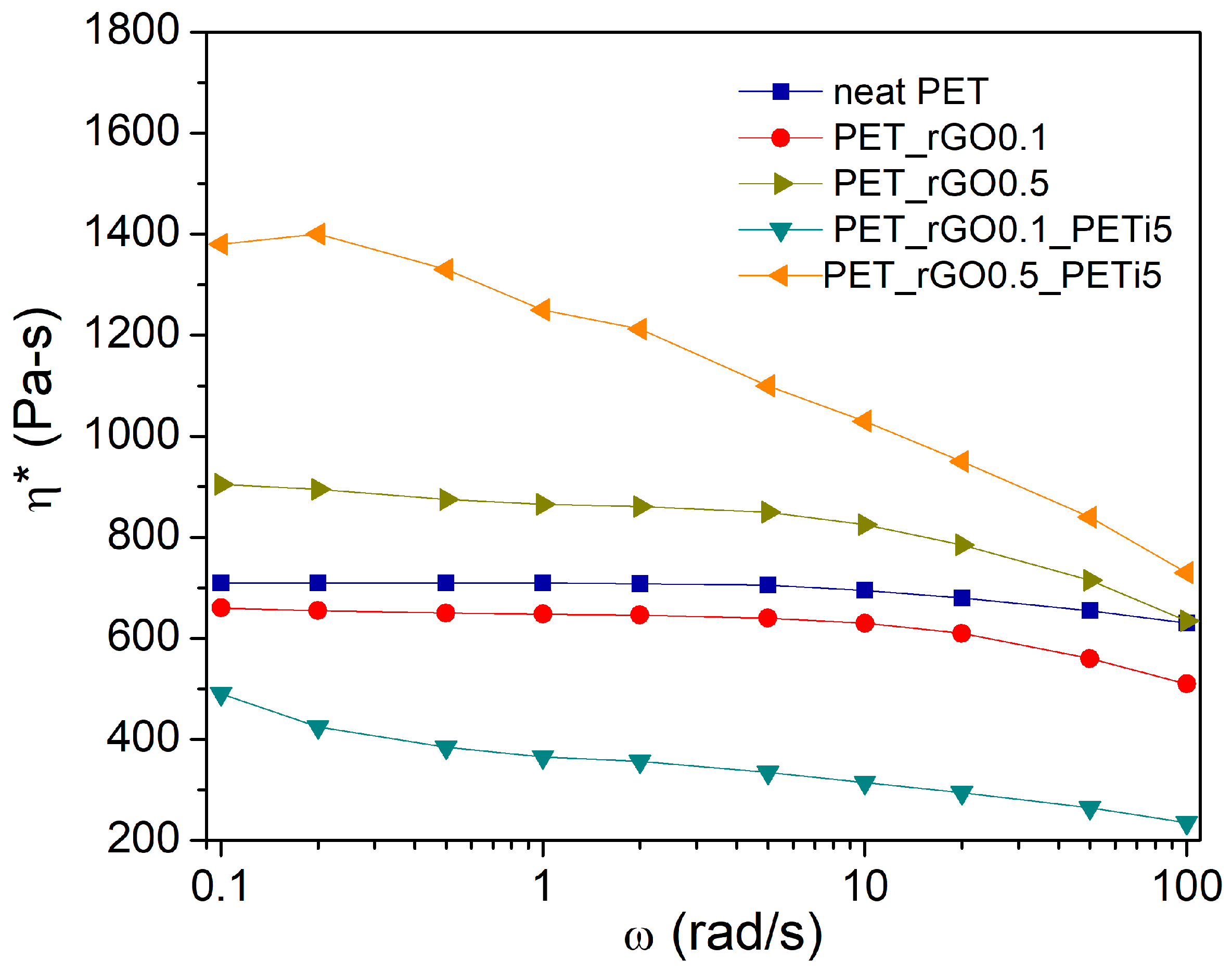
Figure 7 presents the melt rheological behavior of the investigated systems, providing essential insights into their processability and structural integrity. The complex viscosity ( η ) as a function of angular frequency is shown for the binary PET/rGO systems at 533 K. Neat PET exhibits a Newtonian plateau at low frequencies with η 710 Pa·s, followed by moderate shear-thinning behavior. The incorporation of rGO leads to a significant viscosity enhancement, reaching approximately 900 Pa·s at 0.1 rad/s. A synergistic increase in complex viscosity is observed when the PETi compatibilizer is combined with rGO; specifically, the PE_rGO0.5_PETi5 system reaches η 1400 Pa·s, nearly doubling the viscosity of neat PET. This substantial enhancement is consistent with the improved filler dispersion and supports the formation of an extended interphase region that effectively restricts chain mobility in the melt.
These rheological findings in the melt state correlate directly with the solid-state dynamics observed in DMA. The increased resistance to flow and the shift in the shear-thinning behavior provide the physical basis for the subsequent application of the FZM. As discussed in the modeling section, the fractional exponents derived from the FZM quantify this increased dynamic heterogeneity and the chain restriction introduced by the rGO/compatibilizer interface, thereby validating the engineering relevance of the fractional approach for predicting both processing behavior and structural performance.

5.3. Dynamic Mechanical Analysis

5.3.1. Storage Modulus

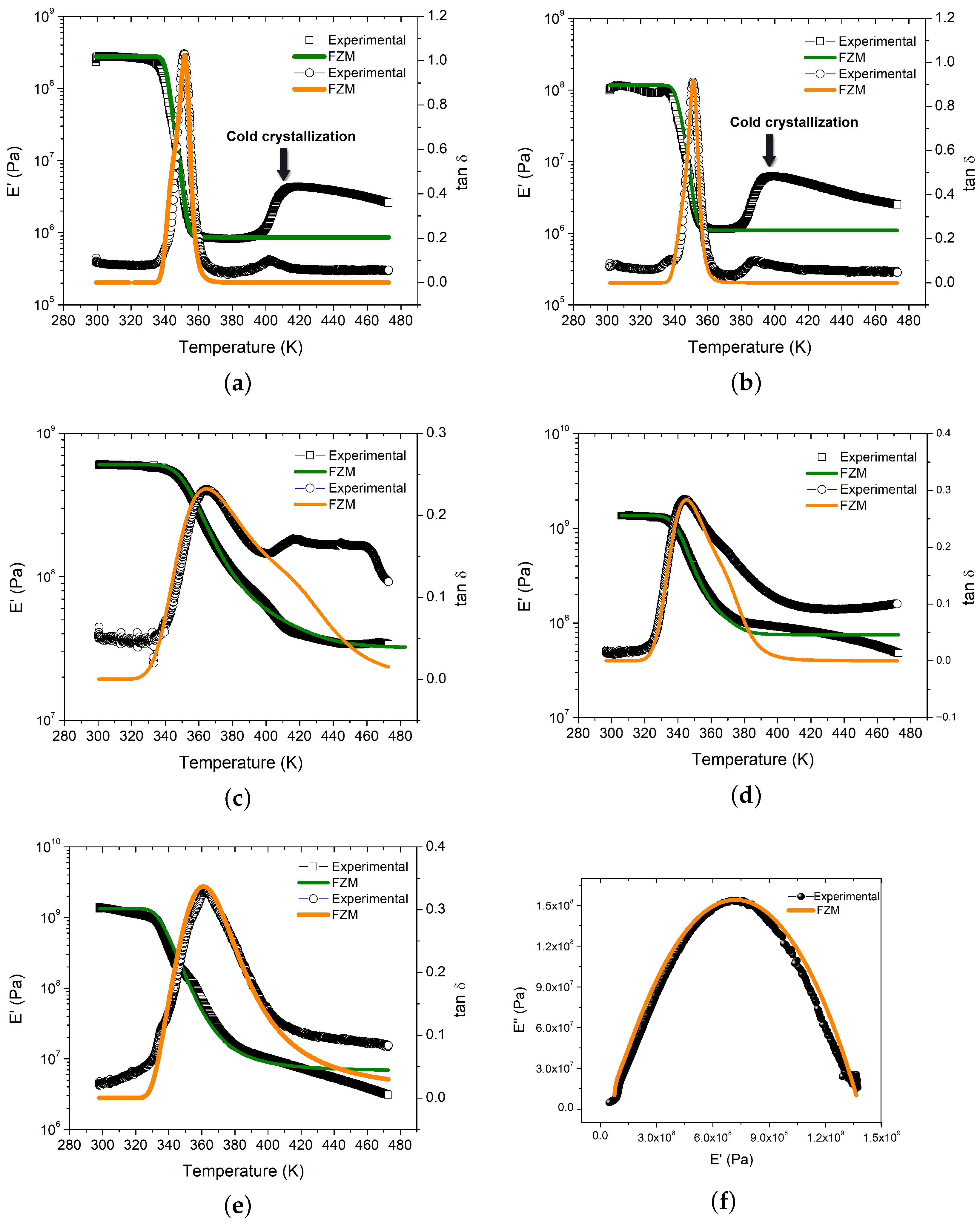
The temperature dependence of the storage modulus ( E ) reveals significant differences among the investigated systems (Figure 8). Neat PET exhibits a glassy modulus of 2.75 × 10 8 Pa at 298 K, followed by the characteristic drop associated with the α -relaxation and a rubbery plateau near 10 6 Pa. The incorporation of 0.1 wt% rGO leads to a reduction in the glassy modulus ( 1.47 × 10 8 Pa), suggesting that at low filler concentration the reinforcing effect is not fully developed, consistent with the non-uniform dispersion observed in optical microscopy [13].
In contrast, the PET_rGO0.5 system exhibits a pronounced increase in stiffness, reaching 6.03 × 10 8 Pa at 298 K. This substantial enhancement indicates the formation of an effective reinforcing network and significant restriction of segmental mobility [41,42]. An even more pronounced increase is observed in the compatibilized systems. PET_rGO0.1_PETi5 and PET_rGO0.5_PETi5 exhibit glassy moduli of the order of 10 9 Pa, demonstrating significantly enhanced interfacial interactions and improved stress transfer efficiency promoted by the relatively high PETi content (5 wt%). The marked increase in stiffness suggests the formation of a more interconnected interphase region that effectively restricts polymer chain mobility [43,44]. At 473 K, the modulus values remain higher for rGO-containing systems compared to neat PET, confirming improved thermomechanical stability at elevated temperatures.

5.3.2. Glass Transition and Damping Behavior

The glass transition temperature ( T g ), determined from the maximum of the tan δ curve, shows a concentration-dependent behavior. Neat PET presents a T g of 350.5 K. The addition of 0.1 wt% rGO does not significantly alter this value (350.0 K), whereas 0.5 wt% rGO shifts T g to 363.7 K, indicating substantial restriction of segmental mobility [45].
The damping factor decreases markedly with increasing rGO content. While neat PET exhibits a peak tan δ of 1.02, PET_rGO0.5 shows a significantly reduced value of 0.23. This reduction in damping reflects decreased molecular mobility and enhanced elastic response due to strong polymer–filler interactions [46,47].
The compatibilized systems (5 wt% PETi) present intermediate tan δ values (0.28–0.32), indicating that PETi modifies the relaxation dynamics by enhancing interfacial adhesion while simultaneously introducing localized mobility variations within the amorphous phase. The relatively high compatibilizer content likely contributes to the development of an extended interphase, balancing stiffness enhancement with controlled energy dissipation [48,49,50].

5.3.3. Cold Crystallization Behavior

Neat PET exhibits a cold crystallization peak near 411.2 K, as evidenced by a recovery in storage modulus at elevated temperatures. The PET_rGO0.1 system shows a shift of this peak toward a lower temperature (397.2 K), suggesting a mild nucleating effect of rGO at low concentrations. In contrast, for the PET_rGO0.5 system, the cold crystallization feature becomes significantly less pronounced and is not clearly distinguishable as a defined peak. This behavior indicates that the increased filler content restricts polymer chain mobility, hindering the ability of the system to reorganize into crystalline domains during heating [51,52].
Interestingly, the cold crystallization peak is not clearly observed in the PETi-containing systems, suggesting that the incorporation of 5 wt% PETi modifies the crystallization kinetics and suppresses the thermally induced structural reorganization observed in the binary systems [53]. This behavior is consistent with enhanced interfacial interactions and altered chain packing constraints introduced by the compatibilizer [54].
For clarity, the main thermomechanical parameters extracted from the DMA curves, including the storage modulus at 298 K and 473 K, the glass transition temperature ( T g ), the maximum tan δ value, and the temperature of the cold crystallization peak, are summarized in Table 2. These values allow a direct quantitative comparison of the influence of rGO concentration and PETi incorporation on stiffness, damping behavior, and thermally activated structural transitions.
Overall, the results demonstrate that the viscoelastic response of PET is strongly governed by filler concentration and interfacial interactions, with the incorporation of 5 wt% PETi significantly amplifying interphase development and stress transfer efficiency, leading to marked modifications in stiffness, relaxation dynamics, and thermally activated structural transitions.

5.4. Fractional Zener Modeling of the Glass Transition

In this work, the fractional Zener formulation is employed not only as a fitting tool, but as a framework to analyze the evolution of relaxation processes in relation to interfacial interactions and cooperative molecular dynamics governing the system in PET/rGO systems.
It is important to note that the fractional Zener model with two spring-pot elements is formulated to describe the main ( α ) relaxation associated with the glass transition, which dominates the viscoelastic response of the amorphous phase. In this sense, the model provides an accurate representation of the elastic region and the glass transition behavior. The recrystallization phenomenon, on the other hand, involves structural rearrangements such as nucleation and growth processes, which are not inherently included in the present viscoelastic framework. As a result, deviations observed in this region are associated with additional physical mechanisms beyond the scope of the current model. Capturing these effects would require the incorporation of additional elements, such as secondary relaxation processes or coupling with crystallization kinetics, which could be considered in future developments. This distinction highlights the capability of the fractional framework to isolate and describe specific relaxation mechanisms with physically interpretable parameters.
To capture the distributed and non-Debye nature of the viscoelastic response across the glass transition, a fractional Zener model incorporating two spring-pot elements was employed (Figure 4). The formulation was implemented within a cooperative relaxation framework, allowing the temperature dependence of the characteristic relaxation time to be described through thermally activated processes. The complex modulus E ( T ) was obtained by simultaneously fitting the experimental storage modulus ( E ) and damping factor ( tan δ ) at a fixed angular frequency (1 Hz), ensuring internal consistency between elastic and dissipative contributions.
It is worth noting that the deviations observed in the tan δ curves at low temperatures are associated with additional relaxation mechanisms not explicitly considered in the present model. While the fractional Zener formulation captures the main ( α ) relaxation governing the glass transition, the experimental response in the elastic region may include contributions from secondary ( β ) relaxations related to localized molecular motions. As these processes are not incorporated into the current framework, minor discrepancies in this region are expected. A more complete description would require the inclusion of additional relaxation elements to account for these secondary dynamics. This behavior further supports the interpretation of the viscoelastic response as a superposition of multiple relaxation processes with different characteristic time scales.
Additionally, the loss modulus ( E ) was calculated from the fitted storage modulus ( E ) and damping factor ( tan δ ), providing an additional consistency check of the fitting procedure.
As shown in Figure 8f, the Cole–Cole representation provides an additional validation of the model consistency. The loss modulus ( E ) was derived from the fitted storage modulus ( E ) and damping factor ( tan δ ). A Cole–Cole type representation ( E vs. E ) is shown for a representative sample, allowing a direct comparison between experimental and predicted responses in terms of both elastic and dissipative contributions. The good agreement observed between experimental and predicted responses confirms that the model provides a coherent description of the viscoelastic behavior across the studied temperature range. This representation also reflects the distribution of relaxation processes captured by the fractional formulation.
To quantitatively assess the quality of the fitting procedure, the coefficient of determination ( R 2 ) and the root mean square error (RMSE) were calculated for both the storage modulus ( E ) and the damping factor ( tan δ ), as summarized in Table 3. The results indicate a generally high level of agreement between experimental data and model predictions, particularly for the storage modulus, where R 2 values remain above 0.95 for most systems, with a slight decrease observed for PET_rGO0.5, which can be attributed to increased heterogeneity at higher filler content. For the damping factor, R 2 values range between 0.83 and 0.91, reflecting the higher sensitivity of tan δ to subtle variations in relaxation mechanisms. The RMSE values are consistent with the magnitude of the measured responses and remain within acceptable ranges across all compositions. Overall, these metrics, together with the Cole–Cole representation, confirm that the fractional Zener framework provides a reliable and internally consistent description of both elastic and dissipative contributions to the viscoelastic response.

5.4.1. Cooperative Relaxation Parameters

The cooperative temperature T exhibits a clear dependence on filler concentration (Table 4). While neat PET presents T of 356 K, a substantial increase is observed for PET_rGO0.5 (390 K) and PET_rGO0.5_PETi5 (392 K), indicating enhanced collective molecular dynamics and increased segmental constraints induced by the filler network [55]. In contrast, PET_rGO0.1 shows only a marginal variation (358 K), suggesting that low filler loading does not significantly modify cooperative motions [56].
This increase in T reflects a higher degree of cooperative motion, indicating that larger molecular domains must rearrange collectively as the filler concentration increases. This behavior is consistent with the formation of interfacial constraints that limit local mobility while promoting correlated segmental dynamics across the polymer matrix.
The activation energy associated with the main relaxation ( E a ) follows a related trend. An increase from 0.56 eV (neat PET) to 0.60 eV (PET_rGO0.5) reflects the higher energetic barrier required for segmental rearrangement in the presence of a rigid nanofiller. Interestingly, the compatibilized PET_rGO0.5_PETi5 system exhibits a reduced E a (0.35 eV). Considering the relatively high PETi content (5 wt%), this reduction suggests that the compatibilizer promotes localized molecular rearrangements within the amorphous phase, partially compensating for the global constraints imposed by the rGO network [45,48].

5.4.2. Elastic Moduli and Interfacial Reinforcement

The unrelaxed modulus E u obtained from the model is in good agreement with the experimentally measured glassy modulus, confirming the robustness of the fitting procedure. A pronounced increase in E u is observed for PET_rGO0.5 and for both PETi-containing systems, evidencing efficient stress transfer and the development of an extended interphase region resulting from strong filler–matrix interactions [57].
It should be noted that the glassy modulus values discussed here correspond to experimental observations, whereas the parameter E u obtained from the model fitting represents an effective modulus within the fractional framework.
The equilibrium modulus E 0 increases notably for PET_rGO0.5 and PET_rGO0.1_PETi5, indicating that the residual stiffness within the transition region is strongly influenced by interfacial constraints and restricted chain mobility [12]. The elevated compatibilizer content further contributes to stabilizing this constrained network, particularly in the presence of higher rGO loading [58].

5.4.3. Fractional Exponents and Relaxation Heterogeneity

The fractional exponents a and b provide direct insight into the breadth and asymmetry of the relaxation spectrum. Neat PET exhibits a = 0.37 and b = 0.90 , values characteristic of a relatively broad yet moderately asymmetric distribution of relaxation times [14].
A systematic decrease in a with increasing rGO content is observed, reaching 0.23 for PET_rGO0.5 and 0.16 for PET_rGO0.5_PETi5. This reduction indicates an increasingly heterogeneous relaxation landscape, consistent with the coexistence of highly constrained interfacial regions and comparatively more mobile bulk-like domains. The presence of 5 wt% PETi likely intensifies this heterogeneity by expanding the interphase volume fraction [53].
From a quantitative perspective, the reduction of a from 0.37 (neat PET) to 0.16 (PET_rGO0.5_PETi5) represents a significant broadening of the relaxation spectrum, indicating the coexistence of multiple relaxation environments. Similarly, the decrease in b reflects an increasing asymmetry in the distribution of relaxation times, which is typically associated with the presence of dynamically distinct interfacial regions.
Similarly, the marked decrease in b (from 0.90 in neat PET to 0.60 in PET_rGO0.5 and 0.30 in PET_rGO0.5_PETi5) suggests enhanced spectral asymmetry, reflecting the emergence of multiple relaxation populations induced by strong filler–matrix coupling and compatibilizer-mediated interfacial structuring [49].
Overall, the evolution of cooperative parameters and fractional exponents demonstrates that the mechanical manifestation of the glass transition in PET/rGO-based systems cannot be described by a single characteristic relaxation time. Instead, the response emerges from a distributed, interfacially mediated spectrum of relaxation processes, inherently fractional in nature [1].
The combined experimental and modeling results provide a coherent picture of the glass transition in PET/rGO systems. While DMA measurements reveal concentration-dependent shifts in T g , strong damping reduction, and pronounced stiffness enhancement, the fractional Zener analysis demonstrates that these macroscopic changes originate from an increasingly heterogeneous and cooperatively constrained relaxation spectrum [38]. The progressive decrease in the fractional exponents, together with the increase in cooperative temperature, confirms that the introduction of rGO—particularly at 0.5 wt%—transforms the glass transition from a relatively uniform segmental process into a distributed, interfacially mediated relaxation phenomenon [28,39]. The additional incorporation of 5 wt% PETi further amplifies interphase development and spectral broadening. This intrinsic heterogeneity justifies the adoption of a fractional viscoelastic framework for accurately describing the thermomechanical response of these composites.
In addition to describing the degree of viscoelasticity, the fractional parameters a and b can be directly related to the molecular mobility in PET and its composites. In fractional viscoelastic models, the difference between these parameters, | a b | , has been associated with the breadth and asymmetry of the relaxation spectrum, where larger values indicate a wider distribution of relaxation mechanisms and increased dynamic heterogeneity [40,59,60].
For the systems studied, the values of | a b | remained within a relatively narrow range, suggesting that the overall breadth of the relaxation spectrum is primarily governed by the intrinsic viscoelastic response of the PET matrix, with additional contributions from interfacial effects introduced by rGO and compatibilizer incorporation. The evolution of a and b reflects modifications in segmental mobility, particularly in the glass transition region, where cooperative dynamics dominate the mechanical response.
This behavior is consistent with the tan δ response, which is directly related to molecular friction and energy dissipation. The broad and asymmetric peaks observed in tan δ support the presence of a continuous distribution of relaxation times, in agreement with the fractional modeling framework. The incorporation of rGO and compatibilizer promotes interfacial constraints and heterogeneity, which are captured by variations in a and b, without drastically altering the global viscoelastic character of the system.
Furthermore, the fractional parameters provide a compact and physically meaningful description of the relaxation processes, enabling the quantification of molecular heterogeneity and cooperativity using a reduced set of material constants. This approach is particularly advantageous for complex polymer nanocomposites, where multiple relaxation mechanisms coexist and overlap, rendering conventional discrete and classical models insufficient.
A direct correlation can be established between the evolution of the fractional exponents and the fitting quality metrics. Systems exhibiting lower values of a and b, associated with increased relaxation heterogeneity and broader spectra, tend to show slightly reduced R 2 values, particularly in the case of PET_rGO0.5. This behavior does not indicate a limitation of the model, but rather reflects the increasing complexity of the viscoelastic response as interfacial interactions and spatial heterogeneity become more pronounced. Despite this, the fractional Zener model maintains a high level of predictive accuracy, demonstrating its capability to capture the essential physics of distributed relaxation processes even in highly heterogeneous systems.
These trends suggest that the incorporation of rGO and compatibilizer does not simply shift the relaxation process, but fundamentally alters its nature by introducing spatial heterogeneity in molecular mobility. Regions in close proximity to the filler experience strong restrictions, while bulk-like domains retain comparatively higher mobility. The fractional parameters thus provide a quantitative measure of this heterogeneity, linking macroscopic viscoelastic behavior with the underlying microstructural organization.

5.4.4. Fragility and Cooperative Dynamics

The Vogel temperature T 0 obtained from the cooperative relaxation framework decreases systematically from approximately 320 K for neat PET to 290 K for the PET_rGO0.5 system (Table 4). This trend can be interpreted in the context of glass-forming dynamics, where T 0 is commonly associated with the limiting temperature for cooperative molecular motion.
In glass-forming systems, the relative difference between T g and T 0 is often used as an indicator of fragility, reflecting the degree of deviation from Arrhenius behavior near the glass transition. For neat PET, with T g 353 K and T 0 320 K, the ratio ( T g T 0 ) / T g 0.09 suggests a relatively fragile behavior, typical of polymers with constrained backbone dynamics. In contrast, the decrease in T 0 for the nanocomposites, while T g remaining relatively stable, increases this ratio to approximately 0.13–0.17 for the compatibilized systems, indicating a tendency toward a less fragile (stronger) glass-forming character. This apparent reduction in fragility can be attributed to the combined effects of interfacial constraints and dynamic heterogeneity. The presence of rGO nanosheets restricts cooperative segmental motions, while the introduction of a compatibilizer promotes the formation of an extended interphase region with spatially varying mobility. These effects lead to a broader distribution of relaxation environments and a more gradual transition from glassy to rubbery behavior.
The width of the glass transition, reflected in the broadening of tan δ peaks and the reduction of fractional exponents, is consistent with increased dynamic heterogeneity and a wider distribution of relaxation times. This behavior aligns with the observed shift in T 0 , suggesting that both phenomena originate from the same underlying modification of cooperative dynamics. Overall, these results indicate that the incorporation of rGO and compatibilizer not only modifies the thermomechanical properties but also alters the cooperative nature of the glass transition in PET-based systems, leading to a more heterogeneous and gradually evolving relaxation process.

6. Conclusions

The viscoelastic response of PET/rGO composites was systematically investigated through dynamic mechanical analysis and interpreted using a fractional Zener framework. The experimental results demonstrate that the incorporation of rGO strongly modifies the thermomechanical behavior of PET, particularly when the filler concentration reaches 0.5 wt%. At this concentration, a substantial increase in the glassy modulus and a noticeable shift of the glass transition temperature were observed, indicating restricted segmental mobility and the development of reinforcement mechanisms within the polymer matrix.
The addition of the PETi compatibilizer further enhanced the stiffness of the composites and promoted stress transfer at the polymer–filler interface. The high compatibilizer content likely contributed to the formation of an extended interphase region, which altered both the damping behavior and the crystallization dynamics of the material. In particular, the suppression of the cold crystallization peak in compatibilized systems suggests that interfacial interactions significantly modify chain packing and structural rearrangement processes during heating.
From a modeling perspective, the fractional Zener model with two spring-pot elements successfully reproduced the experimental storage modulus and damping curves across the glass transition. The extracted parameters revealed systematic changes in cooperative relaxation temperature, activation energies, and fractional exponents as the filler concentration increased. In particular, the progressive decrease of the fractional exponents indicates a broadening and increasing asymmetry of the relaxation spectrum, reflecting the coexistence of constrained interfacial regions and more mobile bulk-like domains.
Overall, the results demonstrate that the glass transition in PET/rGO composites is governed by a distributed relaxation spectrum strongly influenced by interfacial phenomena. The combination of dynamic mechanical analysis with fractional viscoelastic modeling provides a powerful framework for linking macroscopic thermomechanical behavior with the underlying molecular dynamics in polymer nanocomposites.
The proposed methodology, combining fractional calculus with cooperative relaxation theory, offers a consistent and physically grounded approach to relate macroscopic thermomechanical behavior with underlying molecular and interfacial mechanisms. This framework demonstrates the capability of fractional modeling to quantitatively capture the progressive development of relaxation heterogeneity in polymer nanocomposites, and may be extended to other filled polymer systems where interfacial effects play a dominant role.

Author Contributions

Conceptualization, J.G.P.-C. and F.Y.R.-B.; methodology, P.B.J.-V. and F.Y.R.-B.; software, F.Y.R.-B.; validation, P.B.J.-V., F.Y.R.-B. and L.E.J.-R.; formal analysis, F.Y.R.-B.; investigation, P.B.J.-V.; resources, J.G.P.-C.; data curation, P.B.J.-V.; writing—original draft preparation, F.Y.R.-B. and P.B.J.-V.; writing—review and editing, F.Y.R.-B., L.E.J.-R. and J.G.P.-C.; visualization, F.Y.R.-B. and L.E.J.-R.; supervision, J.G.P.-C.; project administration, J.G.P.-C. All authors have read and agreed to the published version of the manuscript.

Funding

The authors acknowledge the financial support from SNII-SECIHTI, Mexico.

Institutional Review Board Statement

Not applicable.

Informed Consent Statement

Not applicable.

Data Availability Statement

The raw data supporting the conclusions of this article will be made available by the authors on request.

Conflicts of Interest

The authors declare no conflicts of interest.

References

  1. Reyes-Melo, M.E.; Guerrero-Salazar, C.A.; Ortiz-Méndez, U.; Martínez-Vega, J.J. Aplicación del cálculo fraccional en el modelado de la viscoelasticidad en polímeros: Parte 1. Manifestación mecánica de la viscoelasticidad. Ingenierías 2005, 8, 7–15. [Google Scholar]
  2. Weyhe, A.T.; Andersen, E.; Mikkelsen, R.; Yu, D. Accelerated physical aging of four PET copolyesters: Enthalpy relaxation and yield behaviour. Polymer 2023, 278, 125987. [Google Scholar] [CrossRef]
  3. Umdagas, L.; Orozco, R.; Heeley, K.; Thom, W.; Al-Duri, B. Advances in chemical recycling of polyethylene terephthalate (PET) via hydrolysis: A comprehensive review. Polym. Degrad. Stab. 2025, 234, 111246. [Google Scholar] [CrossRef]
  4. Hornak, J.; Kadlec, P.; Kopřiva, J.; Polanský, R. Dielectric, structural and mechanical properties of thermally aged biaxially oriented polymeric substrates for flexible electronics. Polym. Degrad. Stab. 2022, 199, 109906. [Google Scholar] [CrossRef]
  5. Sarangi, R.; Swain, A.; Sahoo, S. A Review on Formulation of Polyester Resin From Recycled PET and Its Composite With the Incorporation of Metallic Fillers: Utilization of Recycled PET Products. Polym. Adv. Technol. 2025, 36, e70138. [Google Scholar] [CrossRef]
  6. Staniszewski, Z.; Sobolewski, P.; Piegat, A.; El Fray, M. The effects of nano-sized carbon fillers on the physico-chemical, mechanical, and biological properties of polyester nanocomposites. Eur. Polym. J. 2018, 107, 189–201. [Google Scholar] [CrossRef]
  7. Alshammari, B.A.; Wilkinson, A.N.; AlOtaibi, B.M.; Alotibi, M.F. Influence of Carbon Micro- and Nano-Fillers on the Viscoelastic Properties of Polyethylene Terephthalate. Polymers 2022, 14, 2440. [Google Scholar] [CrossRef]
  8. Mahmood, Q.A.; Abdulmajeed, B.A. Reduced graphene oxide from polyethylene terephthalate (PET) waste synthesis and characterization. J. Teknol. (Sci. Eng.) 2023, 85, 37–43. [Google Scholar] [CrossRef]
  9. Milig, O.; Sert, Ş. Efficient thermal approach for producing reduced graphene oxide from ethylene glycol derived from PET waste. Mater. Manuf. Process. 2025, 40, 1996–2003. [Google Scholar] [CrossRef]
  10. Weir, M.P.; Johnson, D.W.; Boothroyd, S.C.; Savage, R.C.; Thompson, R.L.; King, S.M.; Rogers, S.E.; Coleman, K.S.; Clarke, N. Distortion of Chain Conformation and Reduced Entanglement in Polymer–Graphene Oxide Nanocomposites. ACS Macro Lett. 2016, 5, 430–434. [Google Scholar] [CrossRef] [PubMed]
  11. Tran, B.N.; Thickett, S.C.; Agarwal, V.; Zetterlund, P.B. Influence of Polymer Matrix on Polymer/Graphene Oxide Nanocomposite Intrinsic Properties. ACS Appl. Polym. Mater. 2021, 3, 5145–5154. [Google Scholar] [CrossRef]
  12. Pricop, B.; Sava, Ș.D.; Lohan, N.M.; Bujoreanu, L.G. DMA Investigation of the Factors Influencing the Glass Transition in 3D Printed Specimens of Shape Memory Recycled PET. Polymers 2022, 14, 2248. [Google Scholar] [CrossRef] [PubMed]
  13. Bashir, M.A. Use of Dynamic Mechanical Analysis (DMA) for Characterizing Interfacial Interactions in Filled Polymers. Solids 2021, 2, 108–120. [Google Scholar] [CrossRef]
  14. Bonfanti, A.; Kaplan, J.L.; Charras, G.; Kabla, A. Fractional viscoelastic models for power-law materials. Soft Matter. 2020, 16, 6002–6020. [Google Scholar] [CrossRef]
  15. Stankiewicz, A. On Applicability of the Relaxation Spectrum of Fractional Maxwell Model to Description of Unimodal Relaxation Spectra of Polymers. Polymers 2023, 15, 3552. [Google Scholar] [CrossRef]
  16. Zekriardehani, S.; Joshi, A.S.; Jabarin, S.A.; Gidley, D.W.; Coleman, M.R. Effect of Dimethyl Terephthalate and Dimethyl Isophthalate on the Free Volume and Barrier Properties of Poly(ethylene terephthalate) (PET): Amorphous PET. Macromolecules 2018, 51, 456–467. [Google Scholar] [CrossRef]
  17. Panowicz, R.; Konarzewski, M.; Durejko, T.; Szala, M.; Łazińska, M.; Czerwinska, M.; Prasuła, P. Properties of Polyethylene Terephthalate (PET) after Thermo-Oxidative Aging. Materials 2021, 14, 3833. [Google Scholar] [CrossRef]
  18. Zhang, J.; Peijs, T. Self-reinforced poly(ethylene terephthalate) composites by hot consolidation of Bi-component PET yarns. Compos. Part A Appl. Sci. Manuf. 2010, 41, 964–972. [Google Scholar] [CrossRef]
  19. Shieh, Y.T.; Lin, Y.S.; Twu, Y.K.; Tsai, H.B.; Lin, R.H. Effect of crystallinity on enthalpy recovery peaks and cold-crystallization peaks in PET via TMDSC and DMA studies. J. Appl. Polym. Sci. 2010, 116, 1334–1341. [Google Scholar] [CrossRef]
  20. Tsai, T.Y.; Hussain, B.; Bunekar, N. A Sustainable Circular Route for PET LDH Nanocomposites: Catalyst-Driven Polymerization and Depolymerization for a BHET-to-BHET Cycle. Sustain. Chem. 2026, 7, 6. [Google Scholar] [CrossRef]
  21. Ge, Y.; Yao, S.; Xu, M.; Gao, L.; Fang, Z.; Zhao, L.; Liu, T. Improvement of Poly(ethylene terephthalate) Melt-Foamability by Long-Chain Branching with the Combination of Pyromellitic Dianhydride and Triglycidyl Isocyanurate. Ind. Eng. Chem. Res. 2019, 58, 3666–3678. [Google Scholar] [CrossRef]
  22. Kharghanian, M.; Perchicot, R.; Irusta, S.; Argon, C.Y.; Leonardi, F.; Dagreou, S. Manufacture and rheological behavior of all recycled PET/PP microfibrillar blends. Polym. Eng. Sci. 2023, 63, 1702–1715. [Google Scholar] [CrossRef]
  23. Mir, H.; Thibault, F.; DiRaddo, R. Modelling Behaviour of PET for Stretch and Micro-Blow Moulding Applications Using an Elasto-Visco-Plastic Material Model. Int. Polym. Process. 2011, 26, 173–181. [Google Scholar] [CrossRef]
  24. Ricarte, R.G.; Shanbhag, S. A tutorial review of linear rheology for polymer chemists: Basics and best practices for covalent adaptable networks. Polym. Chem. 2024, 15, 815–846. [Google Scholar] [CrossRef]
  25. Guo, F.; Du, C.b.; Li, R.p. Viscoelastic parameter model of magnetorheological elastomers based on abel dashpot. Adv. Mech. Eng. 2014, 6, 629386. [Google Scholar] [CrossRef]
  26. Jaishankar, A.; Mckinley, G.H. Power-law rheology in the bulk and at the interface: Quasi-properties and fractional constitutive equations. Proc. R. Soc. A 2013, 469, 20120284. [Google Scholar] [CrossRef]
  27. Song, J.; Holten-Andersen, N.; Mckinley, G.H. Non-Maxwellian viscoelastic stress relaxations in soft matter. Soft Matter 2023, 19, 7885–7906. [Google Scholar] [CrossRef] [PubMed]
  28. Reyes-Melo, M.E.; González-González, V.A.; Guerrero-Salazar, C.A.; García-Cavazos, F.; Ortiz-Méndez, U. Application of fractional calculus to the modeling of the complex rheological behavior of polymers: From the glass transition to flow behavior. I. The theoretical model. J. Appl. Poly. Sci. 2008, 108, 731–737. [Google Scholar] [CrossRef]
  29. Rentería-Baltiérrez, F.; Reyes-Melo, M.; Puente-Córdova, J.; López-Walle, B. Application of fractional calculus in the mechanical and dielectric correlation model of hybrid polymer films with different average molecular weight matrices. Polym. Bull. 2023, 80, 6327–6347. [Google Scholar] [CrossRef]
  30. Puente-Córdova, J.G.; Rentería-Baltiérrez, F.Y.; Villalobos-Luna, J.d.J.; López-Cruz, P. Fractional Viscoelastic Modeling of Multi-Step Creep and Relaxation in an Aerospace Epoxy Adhesive. Symmetry 2026, 18, 130. [Google Scholar] [CrossRef]
  31. Scott Blair, G.; Veinoglou, B.; Caffyn, J. Limitations of the Newtonian time scale in relation to non-equilibrium rheological states and a theory of quasi-properties. Proc. R. Soc. A 1947, 189, 69–87. [Google Scholar]
  32. Koeller, R.C. Applications of fractional calculus to the theory of viscoelasticity. J. Appl. Mech. 1984, 51, 299–307. [Google Scholar] [CrossRef]
  33. Reyes-Melo, E.; Martinez-Vega, J.; Guerrero-Salazar, C.; Ortiz-Mendez, U. Application of fractional calculus to the modeling of dielectric relaxation phenomena in polymeric materials. J. Appl. Polym. Sci. 2005, 98, 923–935. [Google Scholar] [CrossRef]
  34. Reyes-Melo, M.E.; Martínez-Vega, J.J.; Guerrero-Salazar, C.A.; Ortiz-Méndez, U. Mechanical and dielectric relaxation phenomena of poly(ethylene-2,6-napthalene dicarboxylate) by fractional calculus approach. J. Appl. Polym. Sci. 2006, 102, 3354–3368. [Google Scholar] [CrossRef]
  35. Alcoutlabi, M.; Martinez-vega, J.J. A modified fractional model to describe the viscoelastic behavior of solid amorphous polymers: The effect of physical aging. J. Macromol. Sci. Part B 1999, 38, 991–1007. [Google Scholar] [CrossRef]
  36. Alcoutlabi, M.; Martinez-Vega, J. Modeling of the viscoelastic behavior of amorphous polymers by the differential and integration fractional method: The relaxation spectrum H(τ). Polymer 2003, 44, 7199–7208. [Google Scholar] [CrossRef]
  37. Miranda-Valdez, I.Y.; Sourroubille, M.; Mäkinen, T.; Puente-Córdova, J.G.; Puisto, A.; Koivisto, J.; Alava, M.J. Fractional rheology of colloidal hydrogels with cellulose nanofibers. Cellulose 2024, 31, 1545–1558. [Google Scholar] [CrossRef]
  38. Matsuoka, S. Entropy, Free Volume, and Cooperative Relaxation. J. Res. Natl. Inst. Stan. 1997, 102, 213–228. [Google Scholar] [CrossRef] [PubMed]
  39. Matsuoka, S. Relaxation Phenomena in Polymers; Hanser Gardner Publications: Cincinnati, OH, USA, 1992. [Google Scholar]
  40. Rentería-Baltiérrez, F.Y.; Puente-Córdova, J.G.; Mohamed-Noriega, N.; Luna-Martínez, J. Fractional Calculus as a Tool for Modeling Electrical Relaxation Phenomena in Polymers. Polymers 2025, 17, 1726. [Google Scholar] [CrossRef]
  41. Lee, M.; Kim, K.; Chung, C.W.; Kim, W.; Jeong, Y.; Lee, J. Mechanical characterization of recycled-PET fiber reinforced mortar composites treated with nano-SiO2 and mixed with seawater. Constr. Build. Mater. 2023, 392, 131882. [Google Scholar] [CrossRef]
  42. Nkomo, N.; Masu, L.; Nziu, P. Effects of Polyethylene Terephthalate Fibre Reinforcement on Mechanical Properties of Concrete. Adv. Mater. Sci. Eng. 2022, 2022, 4899298. [Google Scholar] [CrossRef]
  43. Noyel, J.P.; Hajjar, A.; Debastiani, R.; Antouly, K.; Atli, A. Impact of viscoelasticity on the stiffness of polymer nanocomposites: Insights from experimental and micromechanical model approaches. Polymer 2024, 309, 127443. [Google Scholar] [CrossRef]
  44. Huang, J.; Zhou, J.; Liu, M. Interphase in Polymer Nanocomposites. JACS Au 2022, 2, 280–291. [Google Scholar] [CrossRef] [PubMed]
  45. Aoyama, S.; Ismail, I.; Park, Y.T.; Macosko, C.W.; Ougizawa, T. PET/Graphene Compatibilization for Different Aspect Ratio Graphenes via Trimellitic Anhydride Functionalization. ACS Omega 2020, 5, 3228–3239. [Google Scholar] [CrossRef] [PubMed]
  46. Katsiropoulos, C.; Pappas, P.; Koutroumanis, N.; Kokkinos, A.; Galiotis, C. Enhancement of damping response in polymers and composites by the addition of graphene nanoplatelets. Compos. Sci. Technol. 2022, 227, 109562. [Google Scholar] [CrossRef]
  47. Li, T.; Du, J.; Xu, M.; Song, Z.; Ren, M. Lightweight and Flexible Graphene Foam Composite with Improved Damping Properties. Nanomaterials 2022, 12, 1260. [Google Scholar] [CrossRef]
  48. Papadopoulou, C.; Kalfoglou, N. Comparison of compatibilizer effectiveness for PET/PP blends: Their mechanical, thermal and morphology characterization. Polymer 2000, 41, 2543–2555. [Google Scholar] [CrossRef]
  49. Inuwa, I.; Hassan, A.; Samsudin, S. Effect of Compatibilizer Content on the Mechanical and Morphological Properties of PET/PP (70/30) Blends. Appl. Mech. Mater. 2015, 735, 70–74. [Google Scholar] [CrossRef]
  50. Habib, U.; Mohsin, M.E.A.; Khan, Z.I.; Mohamad, Z.; Othman, N.; Mousa, S.; Hossain, S.K.S.; Ali, S.S. Mechanical, Thermal, and Flammability Properties of Eco-Friendly Nanocomposites from Recycled PET/PA-11 Blends Reinforced with Graphene Nanoplatelets. Polymers 2025, 17, 1038. [Google Scholar] [CrossRef]
  51. Xing, L.; Wang, Y.; Wang, S.; Zhang, Y.; Mao, S.; Wang, G.; Liu, J.; Huang, L.; Li, H.; Belfiore, L.A.; et al. Effects of Modified Graphene Oxide on Thermal and Crystallization Properties of PET. Polymers 2018, 10, 613. [Google Scholar] [CrossRef]
  52. Gao, W.; Li, Y.; Zhao, J.; Tang, W.; Zhang, Z.; Wang, J.; Wu, Z.; Li, M. Nucleation and thermal stability enhancements in poly(ethylene terephthalate) composites influenced by graphene oxide. J. Therm. Anal. Calorim. 2023, 148, 2401–2415. [Google Scholar] [CrossRef]
  53. Ucpinar Durmaz, B.; Atılgan, M.G.; Aytac, A. Evaluation of the morphological, rheological, dynamic mechanical and mechanical characteristics of compatibilized graphene oxide/poly(ethylene terephthalate)/poly(butylene terephthalate) nanocomposites. Polym. Compos. 2021, 42, 6941–6951. [Google Scholar] [CrossRef]
  54. Forestier, E.; Combeaud, C.; Guigo, N.; Sbirrazzuoli, N.; Billon, N. Understanding of strain-induced crystallization developments scenarios for polyesters: Comparison of poly(ethylene furanoate), PEF, and poly(ethylene terephthalate), PET. Polymer 2020, 203, 122755. [Google Scholar] [CrossRef]
  55. Vickery, W.M.; Lee, K.; Lee, S.M.; Orlando, J.D.; Sydlik, S.A. Plastic Composites from Repurposed Poly(ethylene terephthalate) Wasted Functionalized Graphene Oxide through Dynamic Depolymerization. ACS Appl. Nano Mater. 2024, 7, 3691–3701. [Google Scholar] [CrossRef]
  56. Sabet, M. The impact of graphene oxide on the mechanical and thermal strength properties of polycarbonate. J. Elastomers Plast. 2023, 55, 511–525. [Google Scholar] [CrossRef]
  57. Sughanthy, S.; Ansari, M.; Atiqah, A. Dynamic mechanical analysis of polyethylene terephthalate/hydroxyapatite biocomposites for tissue engineering applications. J. Mater. Res. Technol. 2020, 9, 2350–2356. [Google Scholar] [CrossRef]
  58. Barbosa, M.C.; Razzino, C.d.A.; Stocco, T.D.; Santana, M.d.V.; Ghosh, A.; Pereira, L.F.; Tierra-Criollo, C.J.; Lobo, A.O. Production of rGO-Based Electrospinning Nanocomposites Incorporated in Recycled PET as an Alternative Dry Electrode. Polymers 2022, 14, 4288. [Google Scholar] [CrossRef]
  59. Miranda-Valdez, I.Y.; Puente-Córdova, J.G.; Rentería-Baltiérrez, F.Y.; Fliri, L.; Hummel, M.; Puisto, A.; Koivisto, J.; Alava, M.J. Viscoelastic phenomena in methylcellulose aqueous systems: Application of fractional calculus. Food Hydrocoll. 2024, 147, 109334. [Google Scholar] [CrossRef]
  60. Rentería-Baltiérrez, F.; Puente-Córdova, J.; López-Walle, B.; Miranda-Valdez, I. Distribution of retardation times in polymer films: Insights from a dielectric fractional model. Polym. Bull. 2026, 83, 10. [Google Scholar] [CrossRef]
Figure 1. Chemical structure of the repeating unit of poly(ethylene terephthalate).
Modelling 07 00086 g001
Figure 2. Temperature dependence of the storage modulus ( E ) and loss modulus ( E ) for PET. The β -relaxation appears at low temperatures and is associated with localized molecular motions, exhibiting asymmetric broadening characterized by β 1 and β 2 contributions. The α -relaxation, observed near the glass transition region, corresponds to cooperative segmental dynamics and is marked by a pronounced peak in E and a sharp drop in E . At higher temperatures, cold crystallization leads to a recovery in stiffness, reflected by the increase in E .
Modelling 07 00086 g002
Figure 3. The fractional Zener model with a spring-pot.
Modelling 07 00086 g003
Figure 4. The fractional Zener model modified with two spring-pots.
Modelling 07 00086 g004
Figure 5. TEM of rGO.
Modelling 07 00086 g005
Figure 6. Optical microscopy images of PET/rGO composites showing the effect of filler content and compatibilizer on particle dispersion. (a) PET_rGO0.1, (b) PET_rGO0.5, (c) PET_rGO0.1_PETi5, and (d) PET_rGO0.5_PETi5.
Modelling 07 00086 g006
Figure 7. Complex viscosity ( η ) as a function of angular frequency for neat PET and PET-rGO composites at 533 K.
Modelling 07 00086 g007
Figure 8. Fractional Zener modeling of the glass transition for the investigated systems. Experimental and fitted curves of the storage modulus ( E ) and damping factor ( tan δ ) obtained at 1 Hz are shown for (a) neat PET, (b) PET_rGO0.1, (c) PET_rGO0.5, (d) PET_rGO0.1_PETi5, (e) PET_rGO0.5_PETi5 and (f) Cole–Cole of PET_rGO0.5_PETi5. The solid lines represent the predictions of the two-spring-pot fractional Zener model within the cooperative relaxation framework.
Modelling 07 00086 g008
Table 1. Formulations of PET/rGO/PETi composites.
SamplePET (g)rGO (wt%)PETi (wt%)
Neat PET28.00
PET_rGO0.127.860.1
PET_rGO0.527.860.5
PET_rGO0.1_PETi526.570.15
PET_rGO0.5_PETi526.460.55
Table 2. Summary of thermomechanical parameters obtained from DMA measurements.
Material E at 298 K (Pa) E at 473 K (Pa) T g (K)Max tan δ Cold Cryst. (K)
Neat PET 2.75 × 10 8 2.60 × 10 6 350.51.02411.2
PET_rGO0.1 1.47 × 10 8 1.95 × 10 6 350.00.93397.2
PET_rGO0.5 6.03 × 10 8 3.38 × 10 7 363.70.23
PET_rGO0.1_PETi5 1.36 × 10 9 4.81 × 10 7 345.30.28
PET_rGO0.5_PETi5 1.37 × 10 9 3.10 × 10 7 361.30.32
Table 3. Fitting metrics for the fractional model.
Sample E tan δ
R 2 RMSE R 2 RMSE
Neat PET0.985415536133.820.83850.0803
PET_rGO0.10.95289731796.240.91270.0623
PET_rGO0.50.882274026468.590.83330.0321
PET_rGO0.1_PETi50.998321621041.700.87770.0538
PET_rGO0.5_PETi50.973188237904.490.90260.0313
Table 4. Fractional Zener model parameters obtained from simultaneous fitting of E and tan δ within the cooperative relaxation framework.
ParameterNeat PETPET_rGO0.1PET_rGO0.5PET_rGO0.1_PETi5PET_rGO0.5_PETi5
T (K)356358390380392
T 0 (K)320321290300310
E a (eV)0.560.560.600.550.35
E b (eV)0.600.580.900.700.45
τ 0 a (s) 5.0 × 10 15 5.0 × 10 15 1.0 × 10 14 5.0 × 10 15 1.0 × 10 15
τ 0 b (s) 5.0 × 10 13 5.0 × 10 13 1.0 × 10 12 5.0 × 10 13 3.0 × 10 15
E u (Pa) 2.76 × 10 8 1.17 × 10 8 6.05 × 10 8 1.36 × 10 9 1.33 × 10 9
E 0 (Pa) 8.61 × 10 5 1.10 × 10 6 3.19 × 10 7 7.51 × 10 7 6.51 × 10 6
a0.370.300.230.280.16
b0.900.850.600.750.30
Disclaimer/Publisher’s Note: The statements, opinions and data contained in all publications are solely those of the individual author(s) and contributor(s) and not of MDPI and/or the editor(s). MDPI and/or the editor(s) disclaim responsibility for any injury to people or property resulting from any ideas, methods, instructions or products referred to in the content.