
A Traffic Diversion Approach for Expressway Reconstruction and Expansion Considering Highway Toll and Heterogeneity Between Cars and Trucks



Abstract
1. Introduction
2. Preliminaries
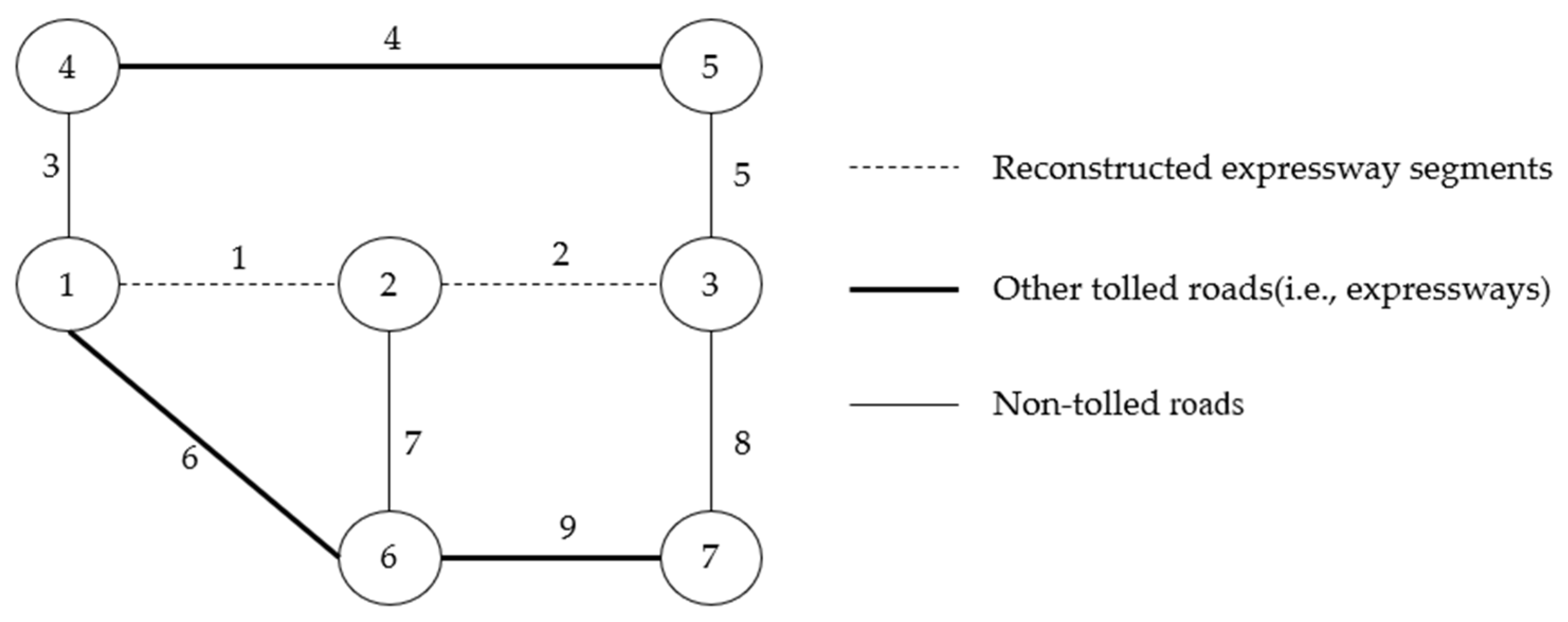
2.1. Description of Traffic Diversion Network
2.2. Generalized Link Impedance Functions for Cars and Trucks
3. Traffic Diversion Model with Car–Truck Heterogeneity and Its Solution Algorithm
3.1. Traffic Diversion Model Considering Car–Truck Heterogeneity
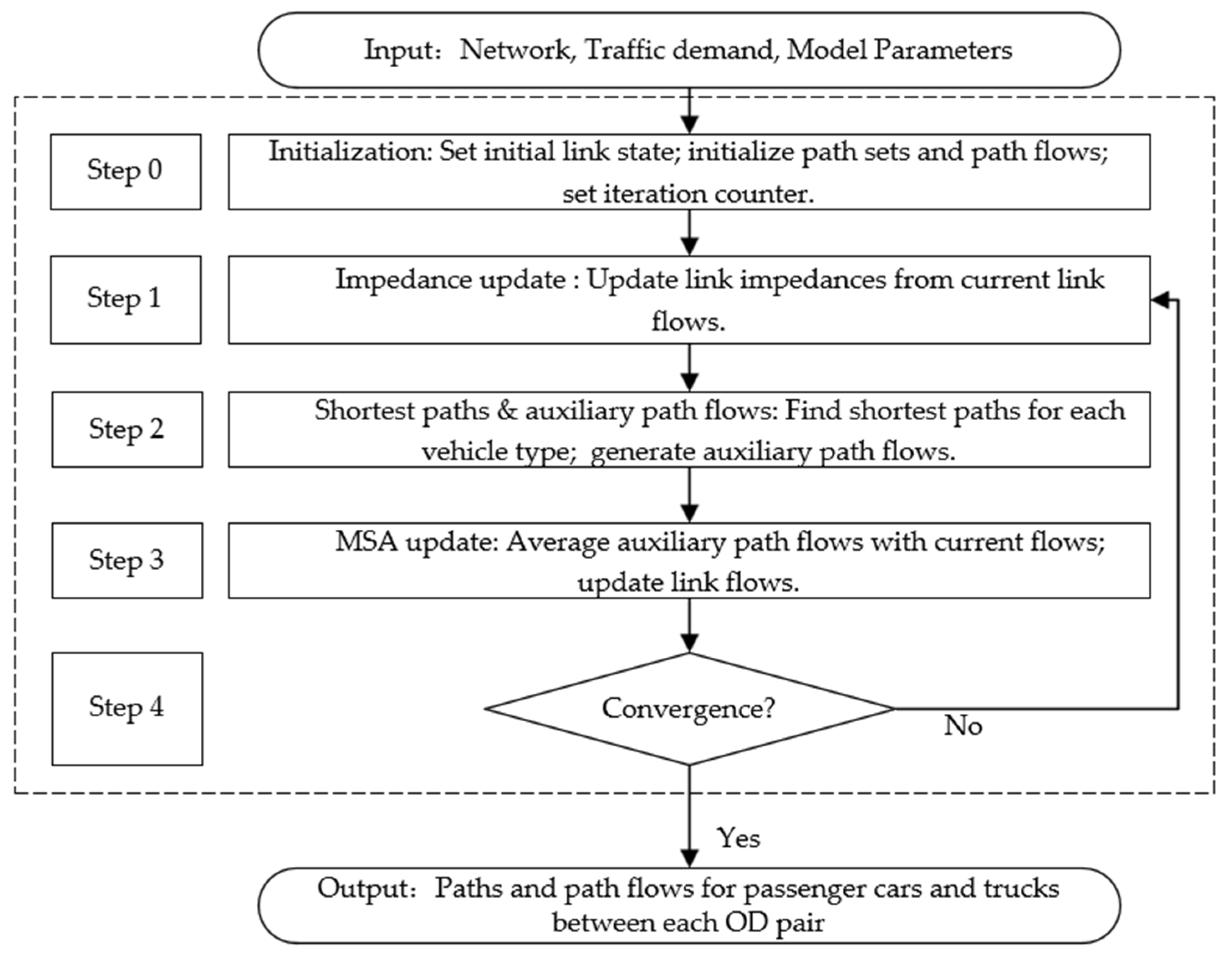
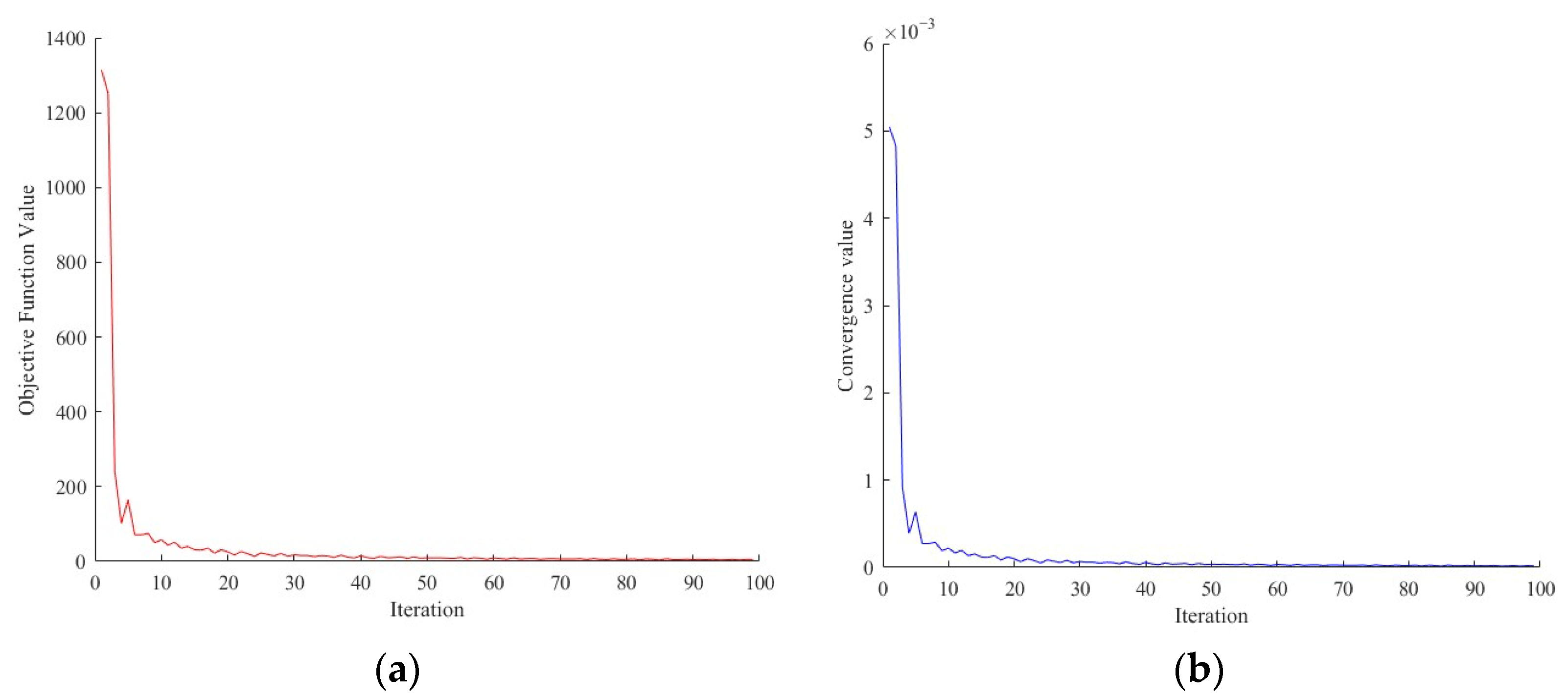
3.2. Algorithm for Solving the Traffic Diversion Model
| Algorithm 1: Path-Based Algorithm Using MSA |
| Input: Diversion network ; free-flow time on links for cars ; free-flow time on links for trucks ; car traffic demand ; truck traffic demand ; BPR function parameters , , , ; car equivalents , ; link capacities , ; toll rates , ; link lengths ; values of time , ; convergence accuracy ; maximum number of iterations . Output: Diversion path sets , ; path flows , . Step 0: Initialization. For all , set . For all , set , . Initialize for and for . Set . Step 1: Update link impedances. Given and , update the link impedances and according to Equation (5) and Equation (6), respectively. Step 2: Perform an all-or-nothing assignment and update generated path sets. For each , solve the shortest paths under and by Dijkstra’s algorithm; denote the shortest paths and their impedances as , and , . For each if , then . For each if , then . For each and , compute using Equation (7). For each and , compute using Equation (8). For each , generate the auxiliary path flows: for cars, set if , and otherwise; for trucks, set if , and otherwise. Step 3: Update path flows using MSA. For each and , update . For each and , update . For all , update link flows and using Equations (3) and (4). Step 4: Convergence check. If or , then stop the iteration; otherwise, let , and return to Step 1. |
4. Calculation Method for Vehicle Exhaust Emissions in Traffic Diversion Network
5. Numerical Examples
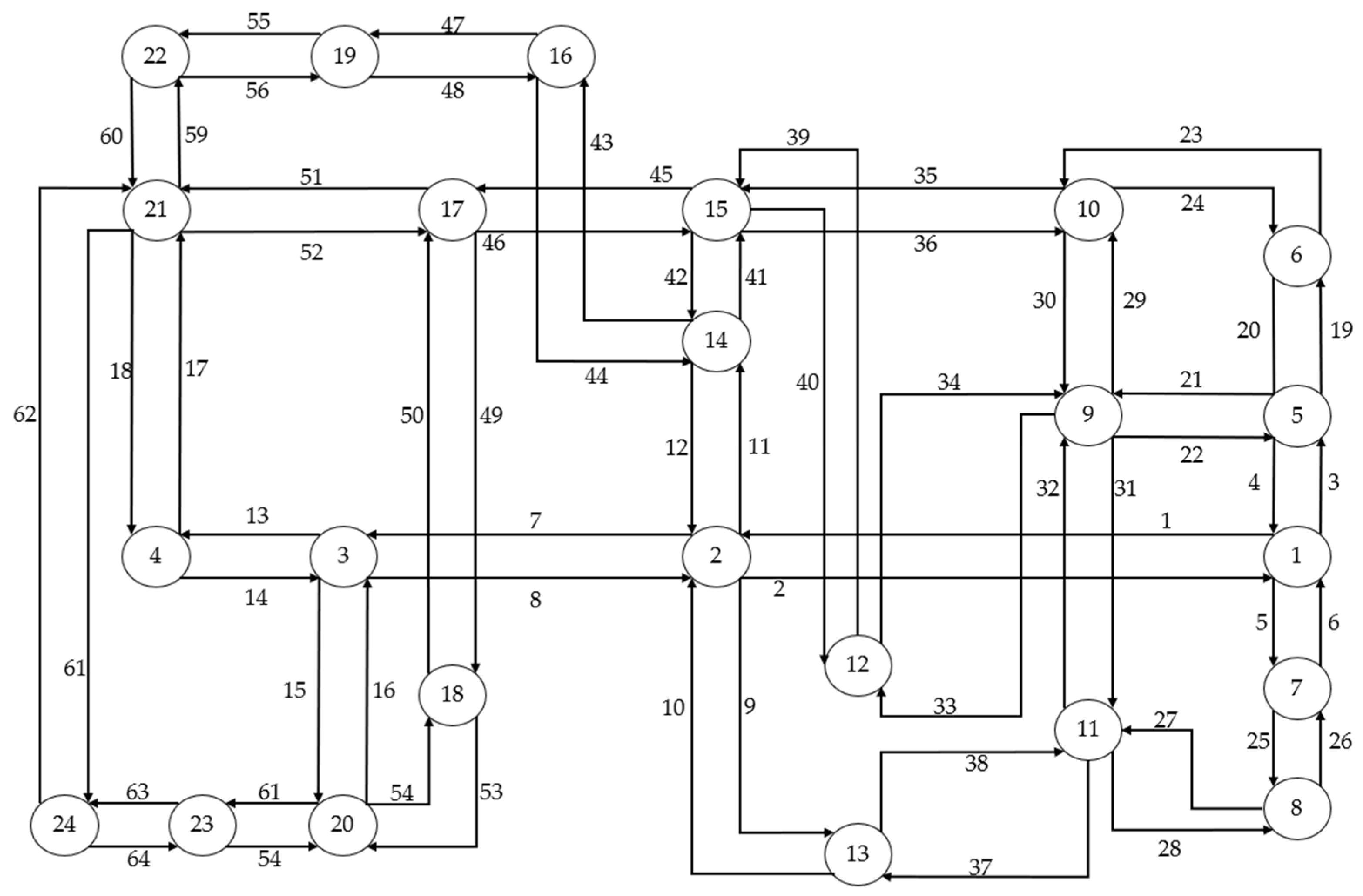
5.1. Diversion Network
5.2. Evaluation of Traffic Efficiency and Exhaust Emissions in Traffic Diversion Network
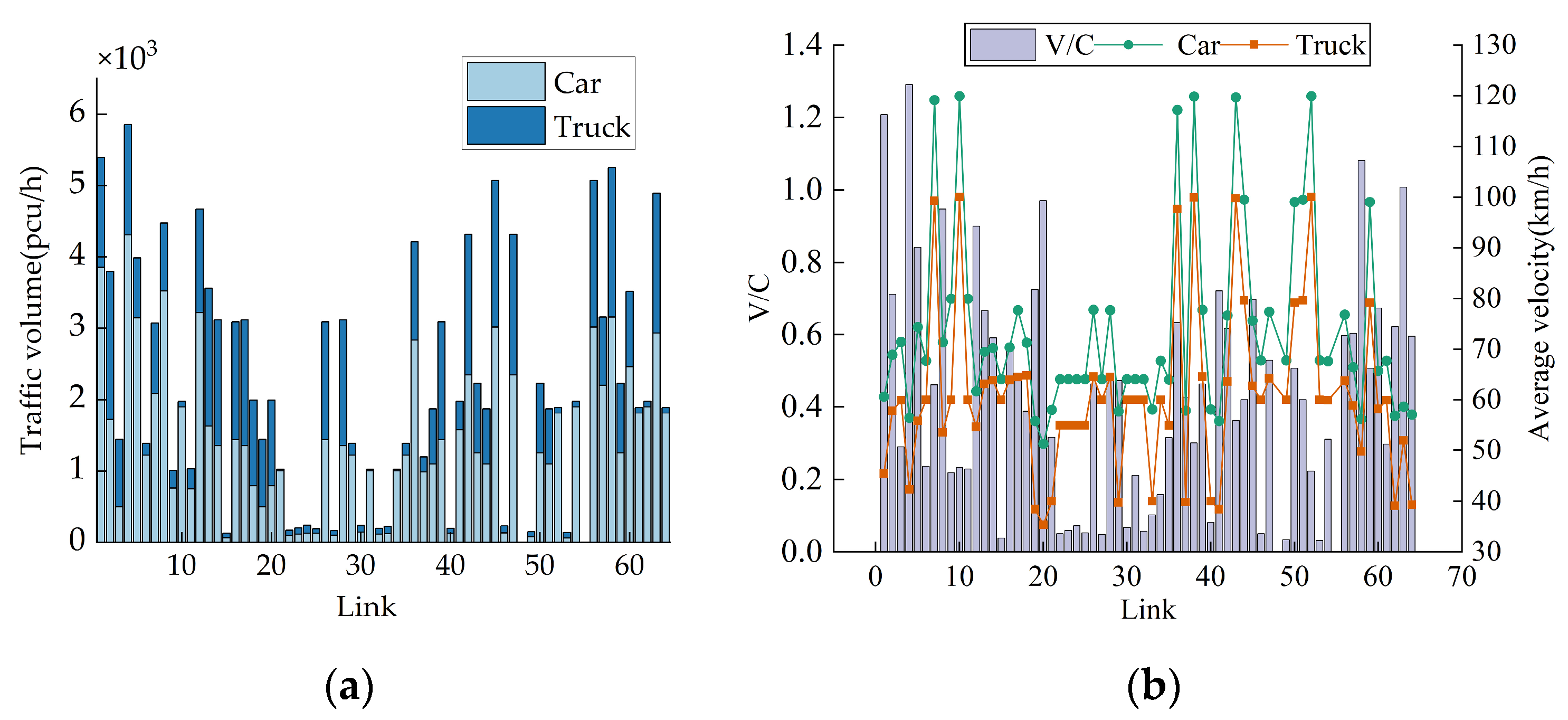
5.2.1. Traffic Conditions Before Reconstruction and Expansion
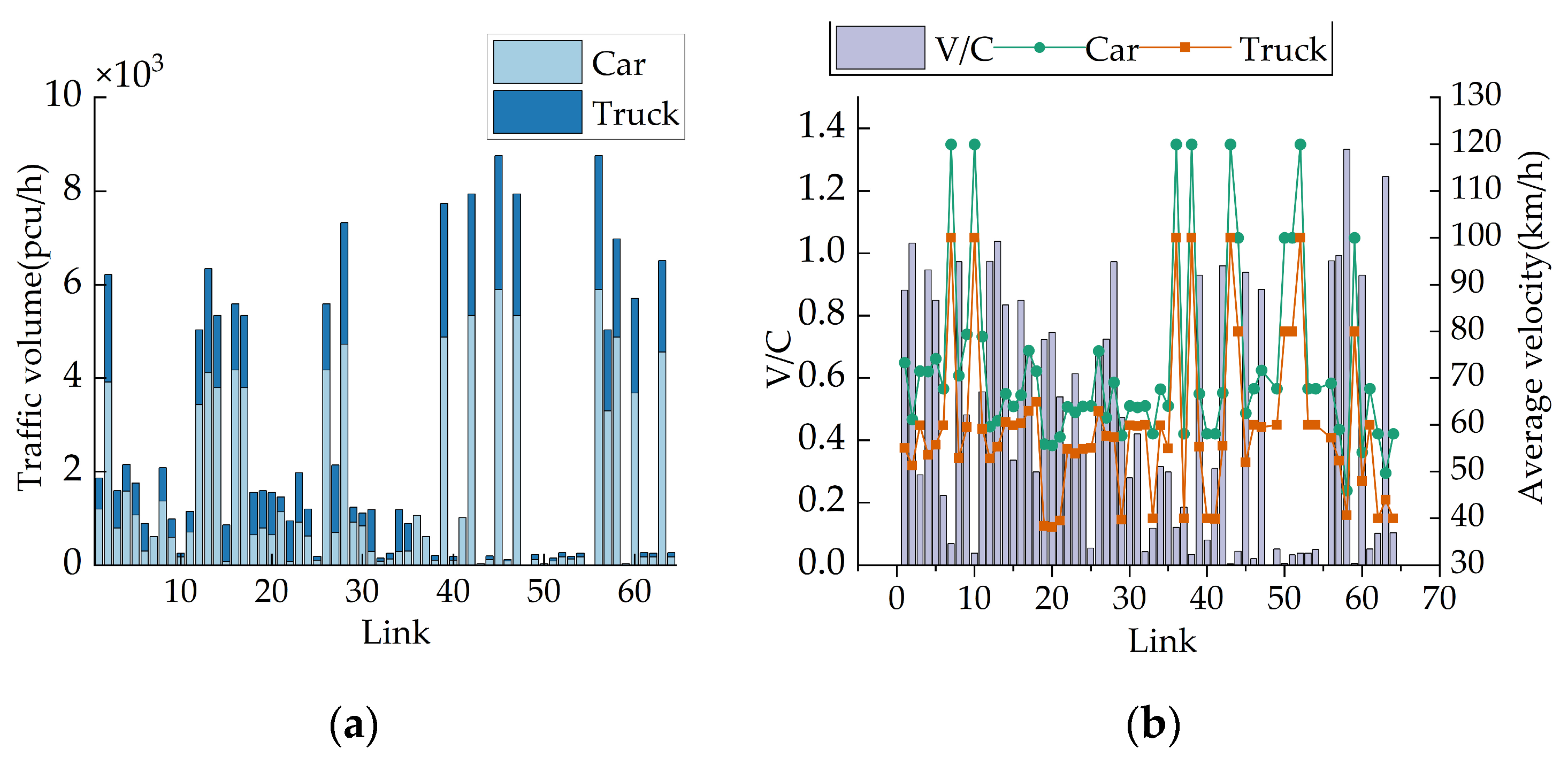
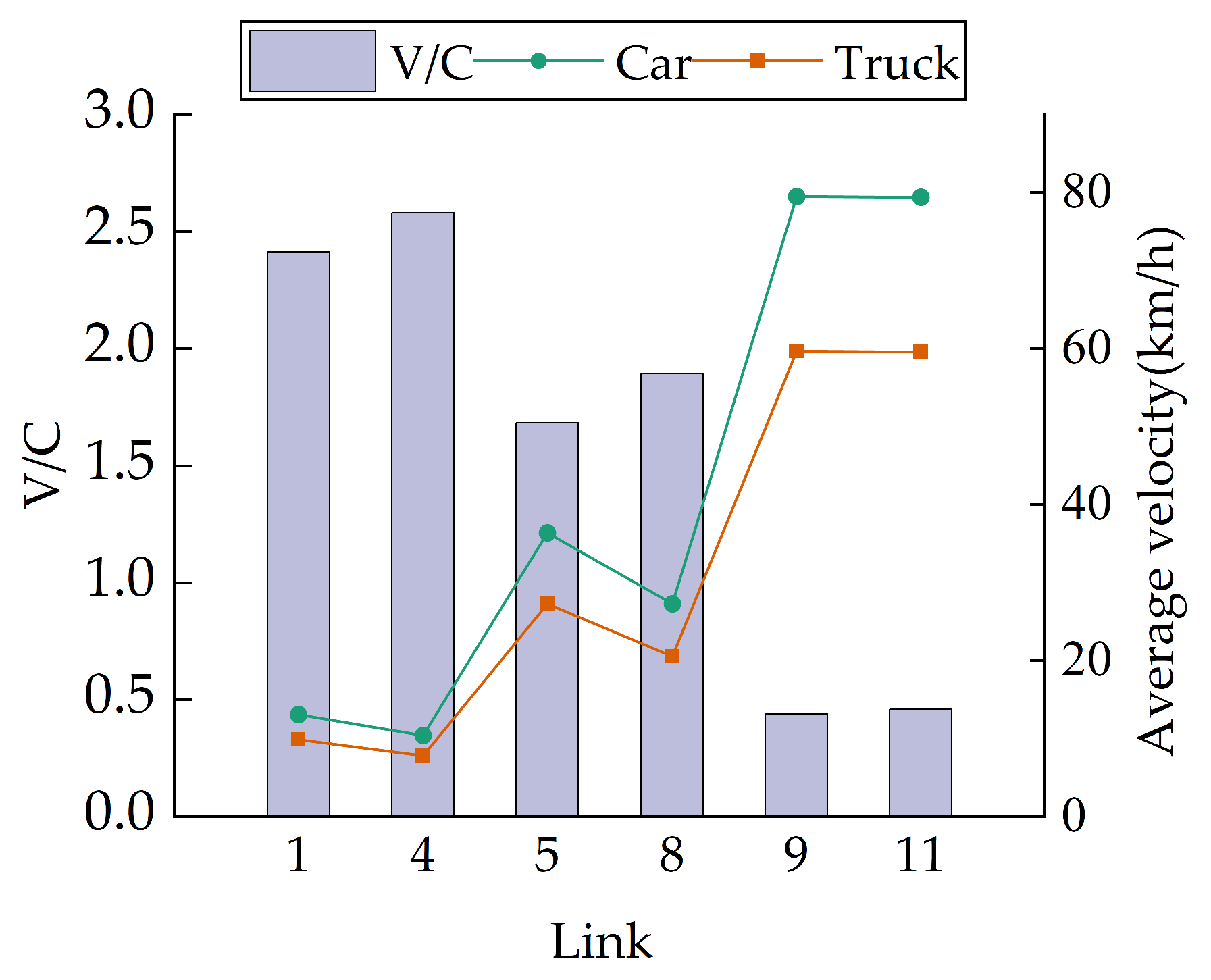
5.2.2. Traffic Conditions During Reconstruction Without Diversion
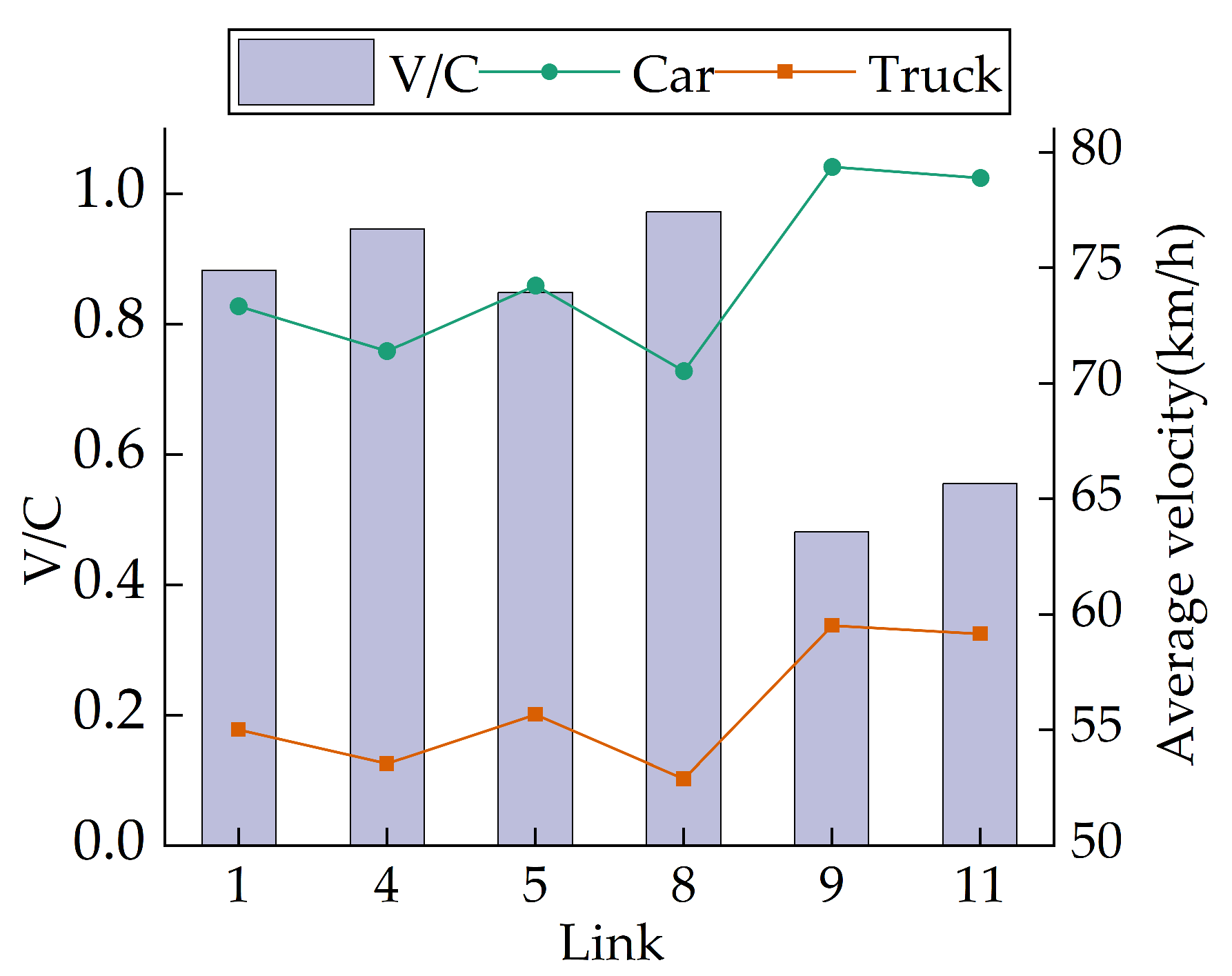
5.2.3. Traffic Conditions During Reconstruction with Diversion
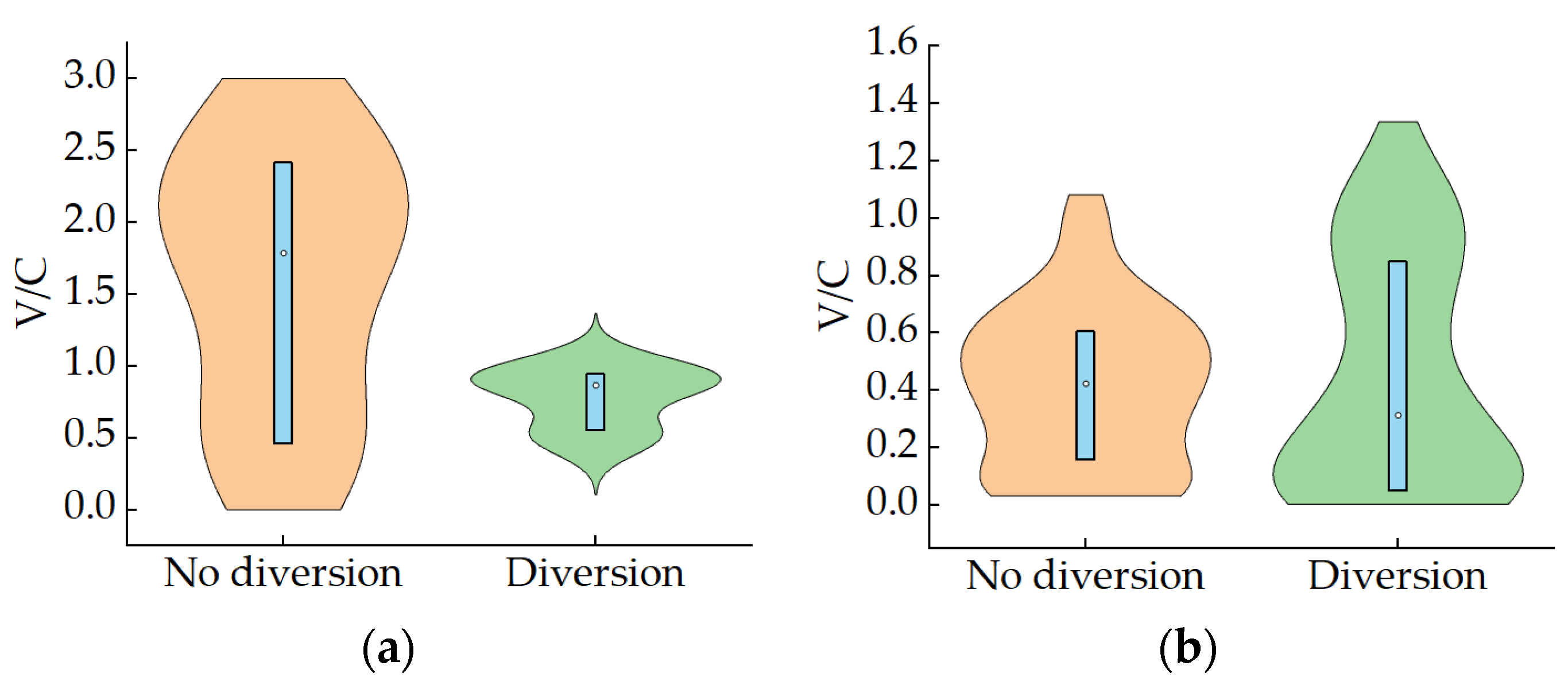
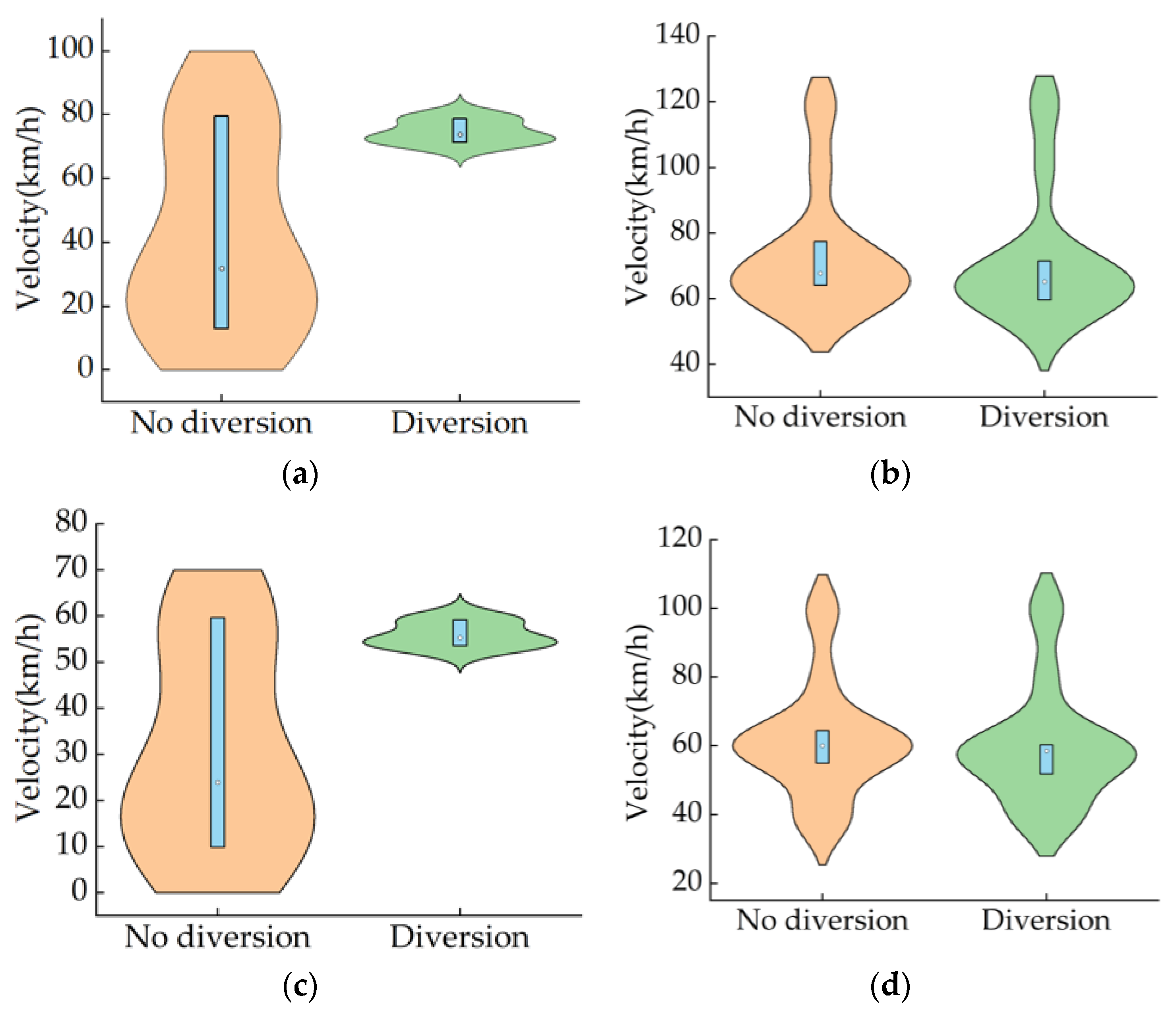
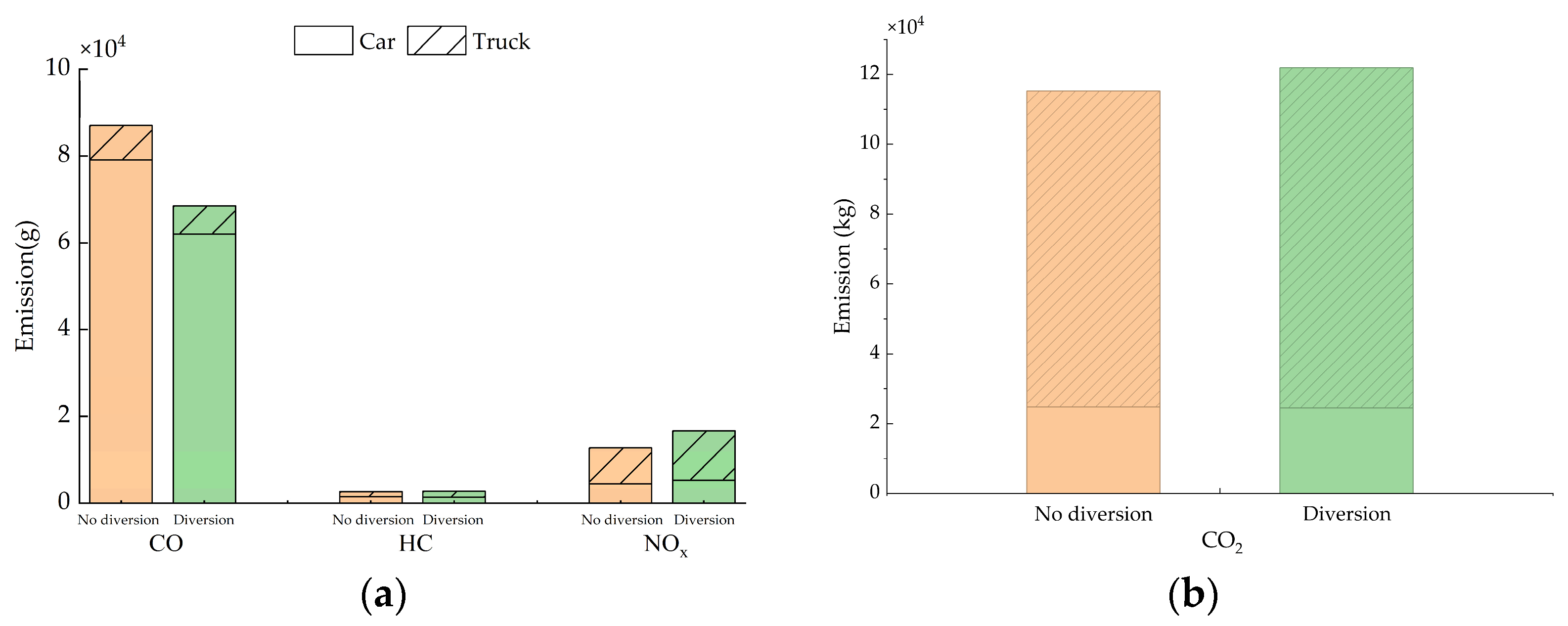
5.2.4. Comparison of Traffic Efficiency and Exhaust Emissions with and Without Traffic Diversion
6. Conclusions
Author Contributions
Funding
Data Availability Statement
Conflicts of Interest
Appendix A

| Link | Free Flow Time/h | Capacity/(pcu/h) | Length/km | Toll Rate/(Yuan/km) | ||
|---|---|---|---|---|---|---|
| Car | Truck | Car | Truck | |||
| 1, 2 | 0.0125 | 0.0167 | 5738 | 1 | 0.45 | 0.6 |
| 3, 4 | 0.0112 | 0.0133 | 3300 | 0.8 | — | — |
| 5, 6 | 0.0112 | 0.0133 | 3300 | 0.8 | — | — |
| 7, 8 | 0.05 | 0.0667 | 5738 | 4 | 0.45 | 0.6 |
| 9, 10 | 0.0015 | 0.0017 | 5738 | 0.1 | — | — |
| 11, 12 | 0.0167 | 0.02 | 4400 | 2 | 0.6 | 0.7 |
| 13, 14 | 0.0954 | 0.1272 | 5738 | 7.63 | 0.45 | 0.6 |
| 15, 16 | 0.035 | 0.042 | 5738 | 4.2 | 0.6 | 0.7 |
| 17, 18 | 0.0037 | 0.0042 | 3400 | 0.25 | — | — |
| 19, 20 | 0.0196 | 0.0215 | 3300 | 1.4 | — | — |
| 21, 22 | 0.0156 | 0.0167 | 3300 | 1 | — | — |
| 23, 24 | 0.0128 | 0.0154 | 3300 | 1 | — | — |
| 25, 26 | 0.0017 | 0.0025 | 3300 | 0.1 | — | — |
| 27, 28 | 0.0172 | 0.025 | 3300 | 1 | — | — |
| 29, 30 | 0.0187 | 0.0218 | 3300 | 1.2 | — | — |
| 31, 32 | 0.0234 | 0.0273 | 3300 | 1.5 | — | — |
| 33, 34 | 0.0187 | 0.0218 | 3300 | 1.2 | — | — |
| 35, 36 | 0.0128 | 0.0154 | 3400 | 1 | — | — |
| 37, 38 | 0.0109 | 0.0117 | 3300 | 0.7 | — | — |
| 39, 40 | 0.0172 | 0.025 | 3300 | 1 | — | — |
| 41, 42 | 0.0206 | 0.03 | 4400 | 1.2 | — | — |
| 43, 44 | 0.0333 | 0.04 | 3300 | 4 | 0.6 | 0.7 |
| 45, 46 | 0.0421 | 0.0508 | 6800 | 3.3 | — | — |
| 47, 48 | 0.034 | 0.0425 | 4400 | 3.4 | 0.6 | 0.7 |
| 49, 50 | 0.0103 | 0.0117 | 3300 | 0.7 | — | — |
| 51, 52 | 0.0639 | 0.0769 | 3400 | 5 | — | — |
| 53, 54 | 0.0812 | 0.0917 | 3300 | 5.5 | — | — |
| 55, 56 | 0.03 | 0.0375 | 4200 | 3 | 0.6 | 0.7 |
| 57, 58 | 0.0148 | 0.0167 | 3300 | 1 | — | — |
| 59, 60 | 0.0738 | 0.0833 | 3400 | 5 | — | — |
| 61, 62 | 0.0753 | 0.085 | 3400 | 5.1 | — | — |
| 63, 64 | 0.1101 | 0.16 | 3300 | 6.4 | — | — |
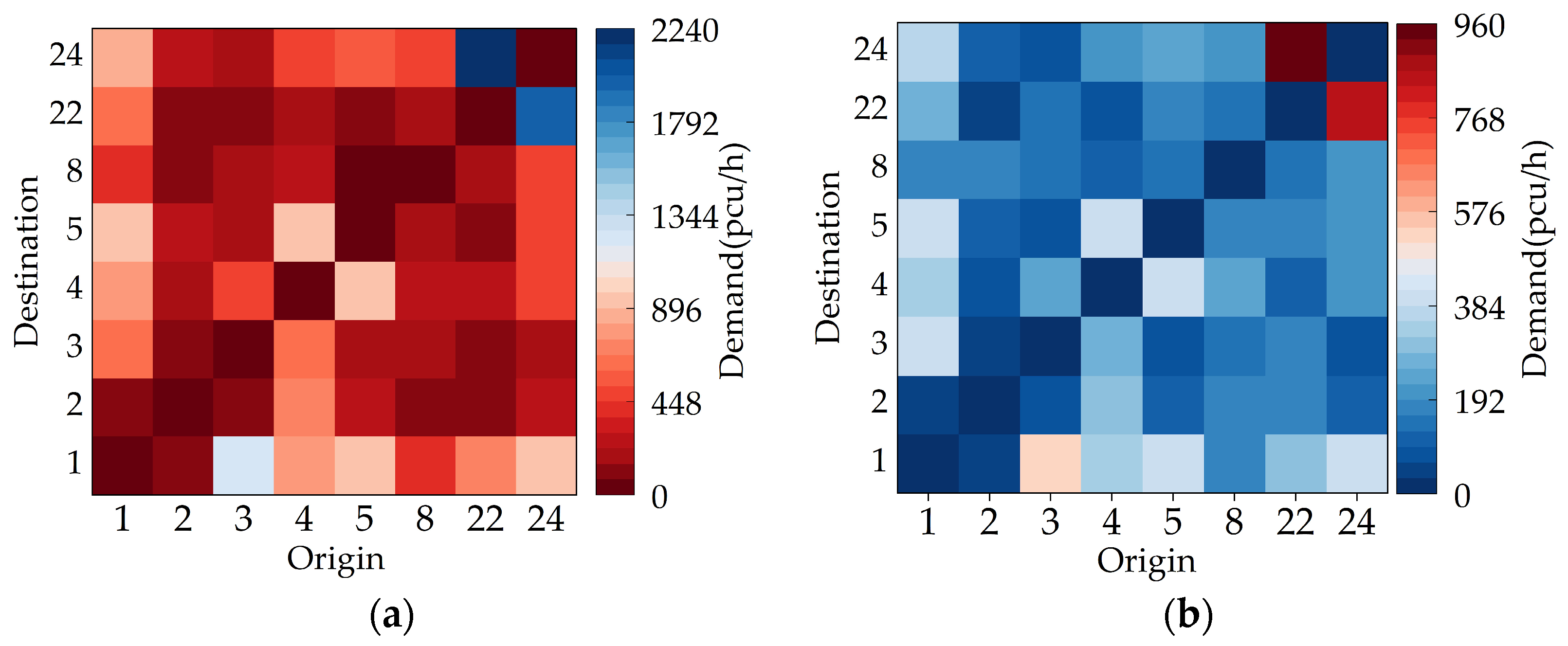
| OD/(pcu/h) | 1 | 2 | 3 | 4 | 5 | 8 | 22 | 24 |
|---|---|---|---|---|---|---|---|---|
| 1 | 0 | 143 | 610 | 767 | 925 | 402 | 625 | 886 |
| 2 | 124 | 0 | 100 | 211 | 280 | 119 | 128 | 277 |
| 3 | 1224 | 109 | 0 | 515 | 160 | 186 | 82 | 181 |
| 4 | 757 | 704 | 613 | 0 | 940 | 270 | 218 | 469 |
| 5 | 906 | 266 | 181 | 898 | 0 | 74 | 110 | 534 |
| 8 | 382 | 113 | 187 | 260 | 222 | 0 | 157 | 484 |
| 22 | 714 | 125 | 97 | 234 | 134 | 188 | 0 | 2231 |
| 24 | 904 | 235 | 186 | 466 | 487 | 486 | 1985 | 0 |
| OD/(pcu/h) | 1 | 2 | 3 | 4 | 5 | 8 | 22 | 24 |
|---|---|---|---|---|---|---|---|---|
| 1 | 0 | 59 | 415 | 329 | 397 | 172 | 268 | 379 |
| 2 | 56 | 0 | 37 | 91 | 120 | 170 | 55 | 119 |
| 3 | 524 | 66 | 0 | 238 | 68 | 148 | 155 | 78 |
| 4 | 324 | 301 | 280 | 0 | 403 | 115 | 94 | 202 |
| 5 | 389 | 114 | 78 | 385 | 0 | 152 | 167 | 229 |
| 8 | 163 | 168 | 149 | 232 | 163 | 0 | 137 | 208 |
| 22 | 306 | 174 | 162 | 100 | 178 | 149 | 0 | 956 |
| 24 | 388 | 101 | 79 | 199 | 209 | 208 | 851 | 0 |
| OD | Type | Path Number | Path | Path Flow |
|---|---|---|---|---|
| (1, 2) | Car | — | 1—2 | 143 |
| Truck | — | 1—7—8—11—13—2 | 59 | |
| (1, 3) | Car | — | 1—2—3 | 610 |
| Truck | — | 1—7—8—11—13—2—3 | 415 | |
| (1, 4) | Car | 1 | 1—5—6—10—15—17—21—4 | 583 |
| 2 | 1—5—9—12—15—17—21—4 | 184 | ||
| Truck | 1 | 1—5—9—10—15—17—21—4 | 105 | |
| 2 | 1—5—9—12—15—17—21—4 | 4 | ||
| 3 | 1—5—6—10—15—17—21—4 | 220 | ||
| (2, 1) | Car | — | 2—1 | 124 |
| Truck | — | 2—13—11—8—7—1 | 56 | |
| (2, 3) | Car | — | 2—3 | 100 |
| Truck | — | 2—3 | 37 | |
| (2, 4) | Car | — | 2—14—15—17—21—4 | 211 |
| Truck | 1 | 2—13—11—9—10—15—17—21—4 | 63 | |
| 2 | 2—13—11—9—12—15—17—21—4 | 27 | ||
| (3, 1) | Car | — | 3—2—1 | 1224 |
| Truck | — | 3—2—13—11—8—7—1 | 524 | |
| (3, 2) | Car | — | 3—2 | 109 |
| Truck | — | 3—2 | 66 | |
| (3, 4) | Car | — | 3—4 | 515 |
| Truck | 1 | 3—2—13—11—9—10—15—17—21—4 | 235 | |
| 2 | 3—2—13—11—9—12—15—17—21—4 | 3 | ||
| (4, 1) | Car | 1 | 4—21—17—15—10—6—5—1 | 401 |
| 2 | 4—21—17—15—12—9—5—1 | 356 | ||
| Truck | 1 | 4—21—17—15—10—9—5—1 | 71 | |
| 2 | 4—21—17—15—12—9—5—1 | 4 | ||
| 3 | 4—21—17—15—10—6—5—1 | 249 | ||
| (4, 2) | Car | — | 4—21—17—15—14—2 | 704 |
| Truck | 1 | 4—21—17—15—10—9—11—13—2 | 297 | |
| 2 | 4—21—17—15—12—9—11—13—2 | 4 | ||
| (4, 3) | Car | — | 4—3 | 613 |
| Truck | 1 | 4—21—17—15—10—9—11—13—2—3 | 247 | |
| 2 | 4—21—17—15—12—9—11—13—2—3 | 33 |
References
- Ryu, S.; Chen, A.; Choi, K. Solving the combined modal split and traffic assignment problem with two types of transit impedance function. Eur. J. Oper. Res. 2017, 257, 870–880. [Google Scholar] [CrossRef]
- Wang, J.; Zhang, S.R.; Li, H. Traffic divergence model of freeway during reconstruction based on system optimization. J. Chang’an Univ. Nat. Sci. Ed. 2008, 5, 95–98. [Google Scholar]
- Memarian, A.; Rosenberger, J.M.; Mattingly, S.P.; Williams, J.C.; Hashemi, H. An optimization-based traffic diversion model during construction closures. Comput.-Aided Civ. Infrastruct. Eng. 2019, 34, 1087–1099. [Google Scholar] [CrossRef]
- Jiang, L.; Lang, Y.Q. The application of stochastic user equilibrium model to traffic diverging during highway expanding construction. Appl. Mech. Mater. 2011, 97, 391–396. [Google Scholar] [CrossRef]
- Kong, D.; Sun, L.; Li, J.; Xu, Y. Modeling cars and trucks in the heterogeneous traffic based on car–truck combination effect using cellular automata. Phys. A Stat. Mech. Appl. 2021, 562, 125329. [Google Scholar] [CrossRef]
- de Andrade, G.R.; Chen, Z.; Elefteriadou, L.; Yin, Y. Multiclass traffic assignment problem with flow-dependent passenger car equivalent value of trucks. Transp. Res. Rec. 2017, 2667, 131–141. [Google Scholar] [CrossRef]
- Thomas, J.; Srinivasan, K.K.; Arasan, V.T. Vehicle class wise speed-volume models for heterogeneous traffic. Transport 2012, 27, 206–217. [Google Scholar] [CrossRef]
- Andrych-Zalewska, M.; Chłopek, Z.; Lasocki, J.; Merkisz, J.; Pielecha, J. A stochastic approach to the analysis of pollutant emissions and fuel consumption of motor vehicles driven in real traffic. Appl. Sci. 2024, 14, 11346. [Google Scholar] [CrossRef]
- Chen, S.; Du, Z.; Shi, X.; Liu, Y.; Li, S.; Shao, C.; Steve-Harold, K. MOVES-Beijing-based high spatial and temporal resolution ammonia emissions from road traffic in Beijing. Atmos. Environ. 2021, 256, 118443. [Google Scholar] [CrossRef]
- Zhang, K.; Batterman, S.; Dion, F. Vehicle emissions in congestion: Comparison of work zone, rush hour and free-flow conditions. Atmos. Environ. 2011, 45, 1929–1939. [Google Scholar] [CrossRef]
- Sun, Z.; Hao, P.; Ban, X.; Yang, D. Trajectory-based vehicle energy/emissions estimation for signalized arterials using mobile sensing data. Transp. Res. Part D Transp. Environ. 2015, 34, 27–40. [Google Scholar] [CrossRef]
- Song, X.; Hao, Y.; Zhang, C.; Peng, J.; Zhu, X. Vehicular emission trends in the Pan-Yangtze River Delta in China between 1999 and 2013. J. Clean. Prod. 2016, 137, 1045–1054. [Google Scholar] [CrossRef]
- Jia, T.; Qi, J. Vehicle emission models and their applications in China: A comprehensive review. J. Traffic Transp. Eng. (Engl. Ed.) 2025, 12, 1855–1877. [Google Scholar] [CrossRef]
- Gong, L.; Fan, W. Optimizing scheduling of long-term highway work zone projects. Int. J. Transp. Sci. Technol. 2016, 5, 17–27. [Google Scholar] [CrossRef]
- Liu, Z.; Wang, S.; Meng, Q. Optimal joint distance and time toll for cordon-based congestion pricing. Transp. Res. Part B Methodol. 2014, 69, 81–97. [Google Scholar] [CrossRef]
- Wardrop, J.G. Some theoretical aspects of road traffic research. Proc. Inst. Civ. Eng. 1952, 1, 325–362. [Google Scholar] [CrossRef]
- Yao, J.; Shi, F.; Zhou, Z.; Qin, J. Combinatorial optimization of exclusive bus lanes and bus frequencies in multi-modal transportation network. J. Transp. Eng. 2012, 138, 1422–1429. [Google Scholar] [CrossRef]
- Huang, W.; Xu, G.; Lo, H.K. Pareto-optimal sustainable transportation network design under spatial queuing. Netw. Spat. Econ. 2020, 20, 637–673. [Google Scholar] [CrossRef]
- Zhang, X.; Zhang, S.; Luo, W.; Tang, J. Analysis of cascading failures and recovery in freeway network under the impact of incidents. Appl. Sci. 2025, 15, 7276. [Google Scholar] [CrossRef]
- Kuang, A.W.; Huang, Z.X. A research on mixed stochastic user equilibrium model based on generalized travel disutility under ATIS. In Proceedings of the 2010 International Conference on Intelligent Computation Technology and Automation, Changsha, China, 11–12 May 2010. [Google Scholar]
- Aga, A.G.; Arsedi, A.N.; Huluka, A.W. Predictive analysis of passenger vehicle emissions and fuel consumption in Addis Ababa, Ethiopia using COPERT based on vehicle growth forecasting. Atmos. Environ. X 2025, 28, 100385. [Google Scholar] [CrossRef]
- European Environment Agency. EMEP/EEA Air Pollutant Emission Inventory Guidebook 2023: Technical Guidance to Prepare National Emission Inventories; Publications Office of the European Union: Luxembourg, 2023. [Google Scholar]
- Federal Highway Administration. Traffic Data Computation Method Pocket Guide; Publication No. FHWA-PL-18-027; Federal Highway Administration: Washington, DC, USA, 2018.
- Guangdong Provincial Bureau of Statistics. Guangdong Statistical Yearbook 2025. Available online: https://stats.gd.gov.cn/gdtjnj/content/post_4810393.html (accessed on 19 March 2026).
- Kłos, M.J.; Sierpiński, G. The Optimization of Intelligent Transport Systems: Planning, Energy Efficiency and Environmental Responsibility. Energies 2025, 18, 4518. [Google Scholar] [CrossRef]




| Parameter | Value | Parameter | Value |
|---|---|---|---|
| 0.15 | 2 | ||
| 4 | 33.76 | ||
| 0.15 | 1.08 | ||
| 4 | 1 × 10⁻⁶ | ||
| 1/2 | 100 |
Disclaimer/Publisher’s Note: The statements, opinions and data contained in all publications are solely those of the individual author(s) and contributor(s) and not of MDPI and/or the editor(s). MDPI and/or the editor(s) disclaim responsibility for any injury to people or property resulting from any ideas, methods, instructions or products referred to in the content. |
© 2026 by the authors. Licensee MDPI, Basel, Switzerland. This article is an open access article distributed under the terms and conditions of the Creative Commons Attribution (CC BY) license.
Share and Cite
Zeng, Q.; Liang, F.; Liu, X.; Wang, X. A Traffic Diversion Approach for Expressway Reconstruction and Expansion Considering Highway Toll and Heterogeneity Between Cars and Trucks. Modelling 2026, 7, 71. https://doi.org/10.3390/modelling7020071
Zeng Q, Liang F, Liu X, Wang X. A Traffic Diversion Approach for Expressway Reconstruction and Expansion Considering Highway Toll and Heterogeneity Between Cars and Trucks. Modelling. 2026; 7(2):71. https://doi.org/10.3390/modelling7020071
Chicago/Turabian StyleZeng, Qiang, Feilong Liang, Xiang Liu, and Xiaofei Wang. 2026. "A Traffic Diversion Approach for Expressway Reconstruction and Expansion Considering Highway Toll and Heterogeneity Between Cars and Trucks" Modelling 7, no. 2: 71. https://doi.org/10.3390/modelling7020071
APA StyleZeng, Q., Liang, F., Liu, X., & Wang, X. (2026). A Traffic Diversion Approach for Expressway Reconstruction and Expansion Considering Highway Toll and Heterogeneity Between Cars and Trucks. Modelling, 7(2), 71. https://doi.org/10.3390/modelling7020071