


Abstract
Traffic accidents at urban intersections represent a major road safety concern, particularly those caused by traffic signal violations. To analyze accident mechanisms and develop effective prevention strategies, this study employs a cellular automata model to investigate the relationship between accident probability and traffic parameters at signalized intersections. Simulation results reveal a nonlinear relationship between Pac and traffic demand. The accident probability reaches a maximum under free-flow conditions and subsequently decreases as congestion increases, eventually stabilizing at a nearly constant level under highly congested traffic. Additionally, collision risk increases with lane-changing probability , especially upstream of the intersection. High traffic speeds significantly elevate both accident probability and severity. Finally, the results indicate that extending traffic signal cycle durations is not an effective strategy for reducing accident risk. Overall, the proposed model provides a useful framework for estimating accident risk under different traffic conditions and supporting traffic management, including control decisions aimed at improving road safety.
1. Introduction
In recent decades, many countries have experienced rapid urbanization and sustained growth in mobility demand. The expansion of urban areas, the continuous increase in the number of vehicles on the road, and the concentration of economic activities in large urban agglomerations have placed increasing pressure on road transport infrastructure. As a result, urban road networks are increasingly operating at or near their maximum capacity, leading to recurrent traffic congestion. Traffic congestion has become one of the main challenges facing urban transport systems, with significant economic [1], environmental [2], and social impacts [3]. Chronic congestion results in substantial time losses for users, reduced productivity, and increased transportation and fuel costs [4,5]. In addition, congested traffic contributes to increased pollutant emissions and air quality degradation [6], thereby exacerbating environmental problems [7].
Besides the problems associated with congestion, road safety is a key factor in road transport. It is estimated that a significant segment of road accidents happens in urban areas, especially at intersections, traffic lights, and busy road stretches [8]. These places are characterized by highly complex traffic patterns and constant interactions among cars, motorcycles, pedestrians, and cyclists which significantly increases the risk of accidents.
As exemplified by statistics communicated officially by the National Road Safety Agency (NARSA) [9] regarding the gravity of this problem in Morocco, its severity is indisputable. In 2024, over 143,000 traffic accidents resulting in personal injury were reported, causing a total of 4024 fatalities qnd more than 14,700 serious injuries. Preliminary data for 2025 indicate an even more alarming trend, with 1624 deaths and over 4000 serious injuries recorded between January and May, corresponding to an increase of approximately compared to the same period in 2024. These statistics reveal a generally increasing trend in traffic accidents compared to past years. This situation underscores the urgent need to develop of effective approaches to improve road safety in Morocco.
Driver behaviour is a critical factor in the analysis of road safety [10,11]. Failure to comply with traffic regulations, including speeding, running red lights, failing to maintain a safe distance, and performing dangerous manoeuvres, is frequently cited as one of the main causes of accidents [12,13]. Such behaviour disrupts traffic flow and creates unpredictable situations, which are particularly critical in urban environments where safety margins are reduced. Thus, even with adequate infrastructure in place, user behaviour can greatly compromise the effectiveness of traffic management strategies. The interaction between traffic management and driver behaviour is therefore central to road safety issues [14]. Clear and consistent traffic organisation can help reduce risky behaviour by improving network clarity and reducing driver stress [15]. Conversely, excessive waiting times at traffic lights, poor synchronisation or poorly designed intersections can encourage aggression and non-compliance with traffic rules, thus increasing the probability of accidents. However, analyzing these interactions remains complex due to the dynamic and non-linear nature of road traffic [16]. Urban traffic in Morocco, as in many countries, is characterized by local interactions between a large number of vehicles and highly heterogeneous driving behaviour. Small perturbations, such as sudden braking or an unexpected lane change, can spread across the network and cause macroscopic phenomena such as traffic jams or accidents.
Numerous studies have shown that traffic models can be used to assess the impact of management strategies before they are actually implemented [17,18], thereby reducing the costs and risks associated with field trials. Microscopic models, which explicitly describe the individual behaviour of vehicles and their interactions, are particularly well suited to the study of urban traffic and road safety [19,20]. Among these models, approaches based on cellular automata are important because of their simplicity and computational efficiency [21,22]. The Nagel–Schreckenberg (NaSch) model is one of the most widely used microscopic models for road traffic simulation [23,24,25]. It reproduces the fundamental dynamics of traffic based on simple local rules that incorporate acceleration, braking and a stochastic component representing imperfect driver behaviour [26].
Previous studies have been devoted to simulating traffic flows at intersections [27]. De Almeida et al. assessed the influence of road traffic heterogeneity, due to different driver profiles, on traffic dynamics at an unmarked junction, highlighting the importance of accounting for driver diversity [27]. Ez-Zahar et al. evaluated the impact of incoming vehicles failing to maintain safe intervals on roundabout capacity, comparing priority-based and traffic-light controlled systems [28]. Małecki et al. analyzed how different driver behaviors affect urban traffic flow and emphasized the positive effect of traffic light countdown timers [29].
More recent studies have explored traffic safety and conflict risk at signalized intersections using advanced modeling and simulation. Wang et al. examined conflict risks associated with shockwave propagation in signalized intersection traffic through simulation, demonstrating how dynamic traffic states influence safety outcomes under varying flow conditions [30]. Ba and Tordeux provided a comprehensive comparison of signalized and unsignalized intersection models, highlighting the importance of model structure in representing conflict mechanisms [31]. Zhang et al. developed a real-time crash risk forecasting framework using extreme value models and video analytics, showing how traffic flow metrics can be linked to crash likelihood in operational settings [32]. Additionally, Feng et al. investigated vehicle–pedestrian conflict mechanisms at signalized intersections, demonstrating the influence of geometric and operational factors on safety risk [33].
However, these studies primarily focus on general traffic dynamics and conflict patterns, without providing a detailed quantitative analysis of accident probability under specific traffic conditions, nor examining the combined effects of speed, lane-changing behavior, and traffic signal compliance on both accident probability and severity.
In contrast, the present work extends these approaches by systematically quantifying accident probability at signalized intersections, identifying counter-intuitive high-risk scenarios under free-flow conditions, and deriving practical predictive relationships between vehicle entrance probability and accident risk. The study also incorporates stochastic driver behavior, lane-changing maneuvers, speed heterogeneity, and traffic signal timing within a cellular automata framework.
2. Materials and Methods
2.1. Model
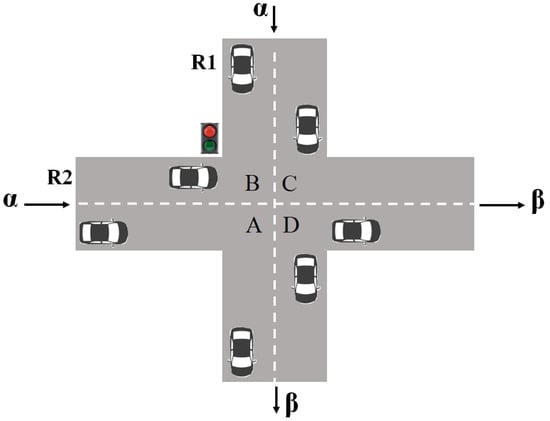
We consider a signalized intersection of two roads, R1 and R2, which cross at the center. On the first road (R1), vehicles move from north to south, while on the second road (R2), vehicles move from east to west. Vehicles enter the first site of each road with an entry (injection) probability and leave the system (extraction) with a probability , as illustrated in Figure 1.
Figure 1.
Intersection layout.
Each road is modeled as a one-dimensional lattice divided into L identical sites (cells). Each site can be either empty or occupied by a single vehicle. Each vehicle can have an integer velocity
Time is discretized, and at each iteration the i-th vehicle is characterized by its position and velocity . For example, a velocity of 3 corresponds to a displacement of three sites per time step, where each site represents in real space.
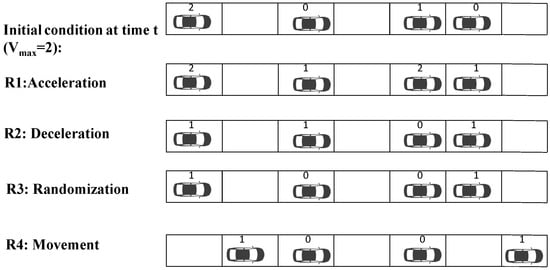
The dynamics follow the Nagel–Schreckenberg (NaSch) model [34] (horizontal dynamic), governed by the following rules:
- R1: Acceleration
- R2: Decelerationwhere is the number of empty sites in front of vehicle i.
- R3: Randomizationif .
- R4: Movement
The position of vehicle i at time is obtained by adding the velocity computed from the three previous rules to its position at time t, , as illustrated in Figure 2.
Figure 2.
Schematic representation of NaSch model.
2.2. Heterogeneous Traffic and Intersection Accidents
Traffic is considered heterogeneous, with two types of vehicles distinguished by their maximum velocities: slow vehicles () and fast vehicles (). The fraction of fast and slow vehicles is denoted by and , respectively, with .
In addition, the road is assumed to have two lanes. Vehicles can change lanes (vertical dynamic) while respecting safety distances with the vehicles in front and behind them (on both lanes) to avoid collisions [35].
At the intersection, traffic lights are used to control the traffic flow. R1 receives a green light (priority) for a period , while R2 simultaneously has a red light (). After this period, the light turns red for R1 (and green for R2) for a period .
In practice, due to poor driving behaviors such as red-light violations, drivers put themselves and others at risk of accidents. In this work, it is assumed that drivers may violate the red light with a probability , and the probability of accidents () at the intersection due to non-compliance with traffic signals is studied.
When two vehicles, one with priority and the other violating the red light, arrive at the same intersection site at the same time, an accident occurs at site A, B, C, or D. The probability is defined as:
where:
- T is the simulation time,
- N is the number of vehicles,
- is the time from which the calculation starts,
Joksch [36] demonstrated that the relationship between the fatality risk (P) and the change in vehicle velocity during the collision is:
where
and are the velocities of the vehicles involved in the accident. This relationship is employed in the present study to assess accident severity at the intersection by explicitly accounting for vehicle speeds at the moment of collision.
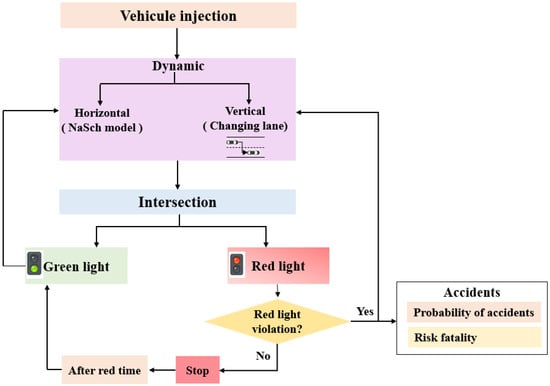
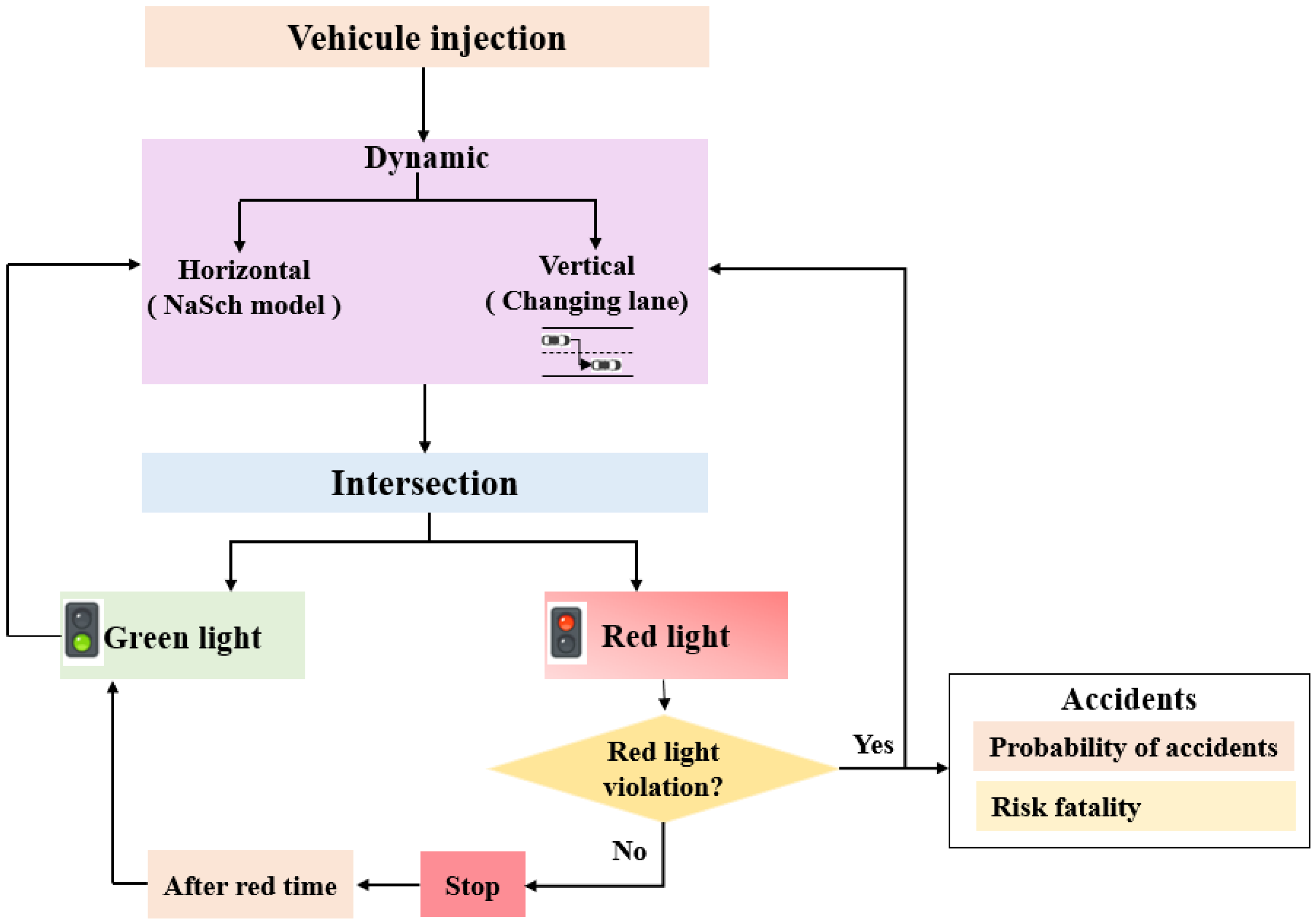
Figure 3 illustrates the process of traffic simulation and accident analysis at a signalized intersection. The simulation follows these main steps:
Figure 3.
Flow chart of simulation method.
- Vehicle injection: Vehicles are introduced into the system from the intersection entrances and , as shown in Figure 1. This phase initializes the traffic and defines the flow of vehicles entering the model.
- Dynamic traffic module: Vehicle movement is simulated in two directions:
- –
- Horizontal (NaSch model): Vehicle progression in the same lane is simulated using the Nagel–Schreckenberg stochastic model, which takes into account the maximum speed, randomization probability, and driver behavior.
- –
- Vertical (changing lane): Lane changes are simulated to capture the effect of vehicle maneuvers on traffic dynamics and accident risks.
- Intersection and traffic light control: Vehicles reach an intersection where traffic is regulated by a traffic light system (green or red).
- –
- When the light is green, vehicles pass normally.
- –
- When the light is red, the model checks for red-light violations:
- ∗
- Yes: An accident may occur, and the simulation calculates the accident probability and fatality risk.
- ∗
- No: Vehicles stop and resume traffic after the red phase.
- Feedback loop: After traversing the intersection (or stopping at the stop signal), vehicles are fed back into the dynamic module to continue the simulation.
3. Results and Discussion
3.1. Results
The simulation was performed based on the following parameters:
- The length of each road is sites, which is equivalent to (each site represents in reality).
- The random deceleration probability is (10%) [34].
- The probability of red-light violation is [37].
- [37].
- The extraction probability and the fraction of fast vehicles are
- The system is run for 100,000 iterations, and the results are computed over the last 50,000 iterations.
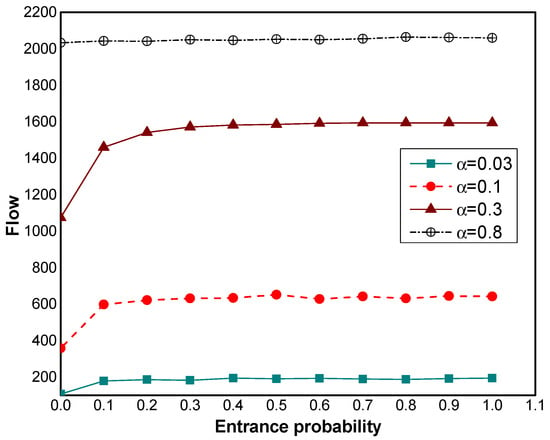
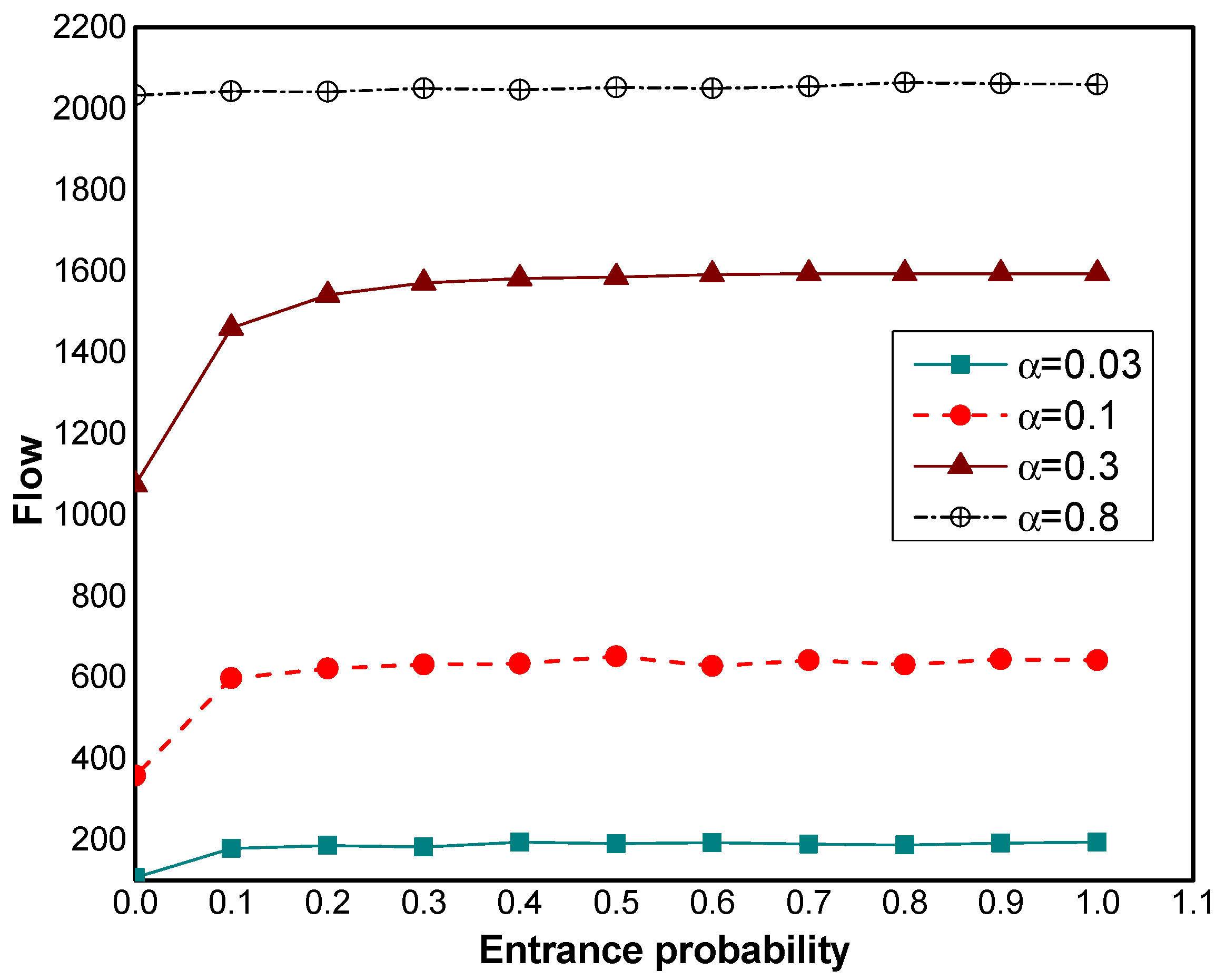
To examine the effect of lane changing on intersection performance, the vehicle flow is analyzed for different values of as a function of the lane-changing probability , as shown in Figure 4. It can be observed that for very low values of , the flow is small because only a few vehicles enter the system. As increases, the flow increases, reaching more than in the case of . On the other hand, it can be seen that the lane-changing probability can significantly improve the flow for intermediate values of (30% in this case). For very high values of , however, has no impact on vehicle flow. In these conditions, there is severe congestion, and not enough space exists between vehicles to allow lane changes. For very low values of , has a very small effect, noticeable only when increasing . In this scenario, there are very few vehicles on the roads, leaving ample space ahead. Consequently, whether vehicles change lanes or not has almost no effect on the flow.
Figure 4.
Traffic flow at the intersection as a function of the lane-changing probability for different entrance probability values.
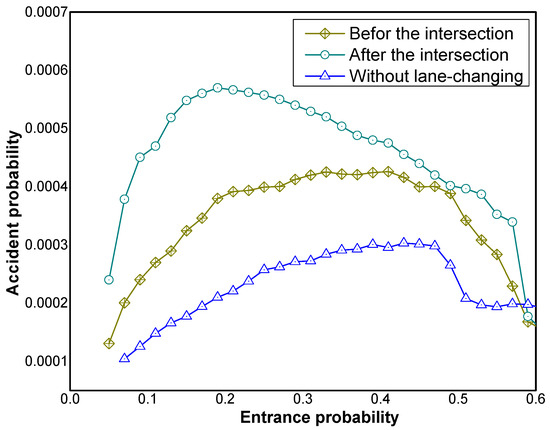
To investigate the impact of lane-changing behavior on accident occurrence, the accident probability , is plotted as a function of the entrance probability for three different scenarios, as shown in Figure 5: as a function of the entrance probability in three scenarios:
Figure 5.
Accident probability () as a function of entrance probability.
- 1.
- Intersection without lane changing,
- 2.
- Lane changing allowed only before (upstream) the intersection,
- 3.
- Lane changing allowed only after (downstream) the intersection.
In all three cases, increases with the number of vehicles, reaches a maximum, and then starts to decrease. Moreover, has the lowest values in the case without lane-changing. However, when lane-changing is allowed upstream of the intersection, the accident probability exhibits the highest values over a wide range of entrance probabilities. In contrast, allowing lane changes only after the intersection results in a comparatively lower accident probability, although still higher than the scenario without lane-changing. After crossing the intersection, traffic streams tend to disperse and vehicle speeds become more homogeneous, which mitigates, to some extent, the risk associated with lane-changing maneuvers.
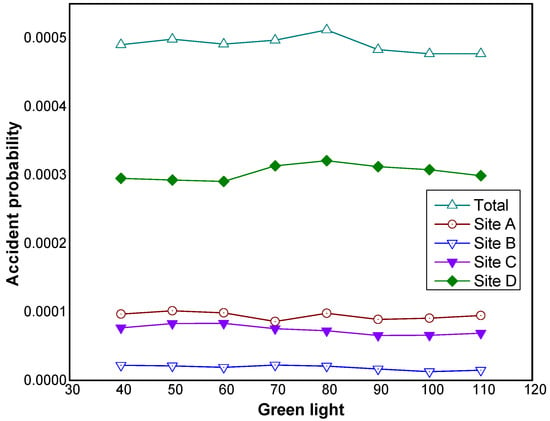
Moreover, the impact of green light duration on accident probability is shown in Figure 6. The observed behavior reveals markedly differentiated patterns among the various intersection sites. Sites A, B, and C exhibit a notably stable behavior, with the accident probability remaining practically constant at very low values, regardless of the green signal duration. This suggests that, at these locations, extending the green light duration does not have a significant impact on safety. In contrast, site D displays a distinct and particularly interesting pattern. For values of green light equal to or greater than 70 s, a gradual increase in accident probability is observed, a result that, although counterintuitive, is statistically significant. The overall curve reflects this behavior, showing a slight increase in the accident probability when the green signal duration is excessively extended.
Figure 6.
as a function of green signal time at the four intersection sites.
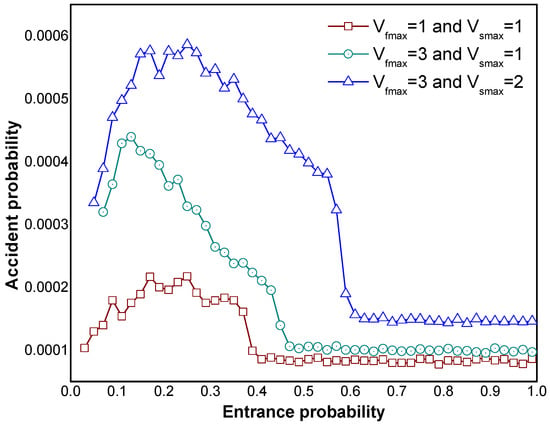
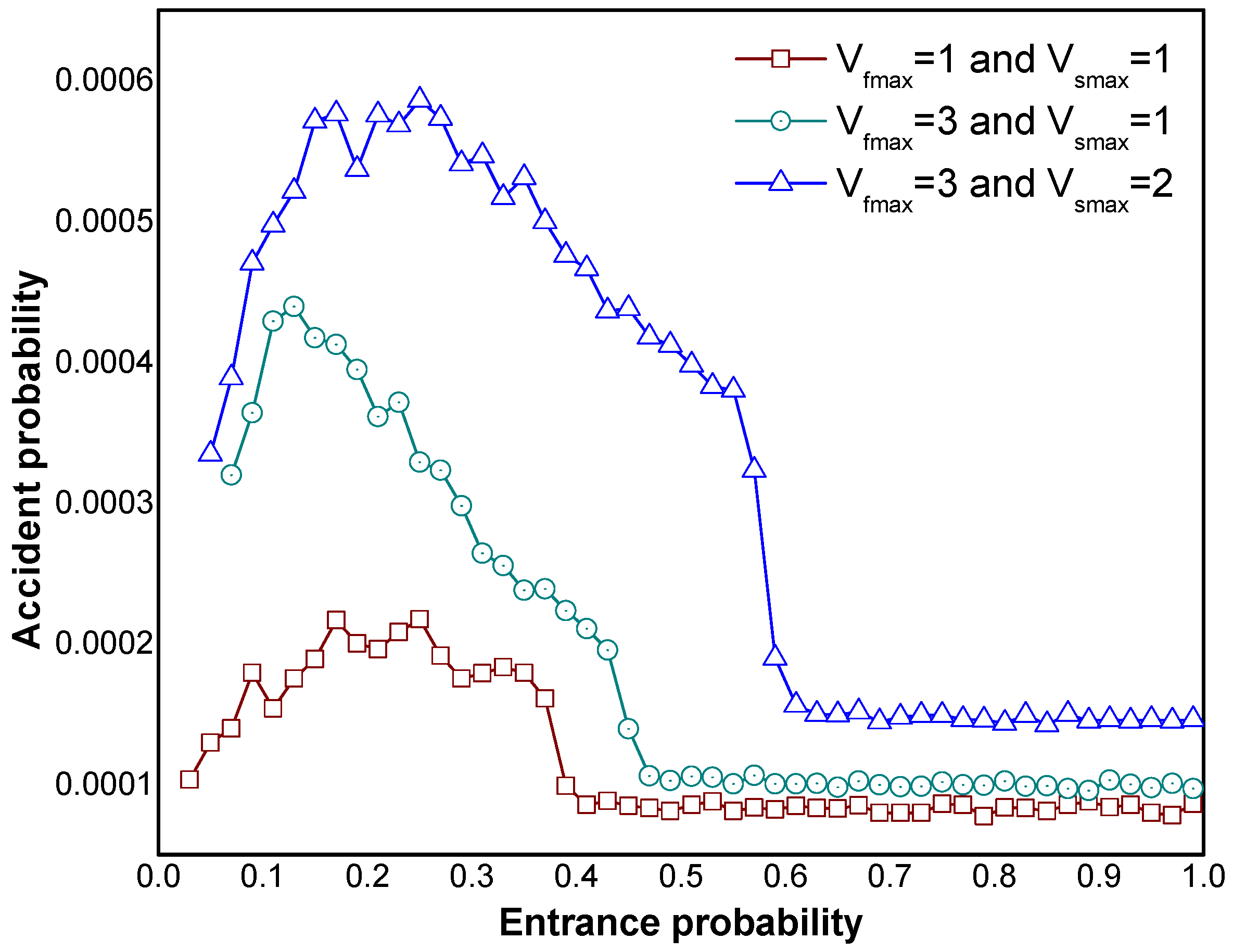
Another important parameter influencing accident probability is the maximum vehicle speed. Figure 7 presents the variation of the accident probability as a function of the entrance probability for different values of the maximum speeds assigned to slow and fast vehicles. The results reveal a characteristic nonlinear pattern that challenges conventional intuitions about road safety. During the initial growth phase, when lies approximately between 0 and 0.3–0.4, the accident probability increases as the number of vehicles entering the system rises. This behavior is expected, since higher vehicle density naturally creates more opportunities for conflicts and potentially dangerous interactions. However, the most interesting behavior emerges when the maximum is reached, typically for values between 0.3 and 0.5. In this range, the accident probability attains its peak, corresponding to the free-flow traffic regime, which paradoxically represents the most dangerous operating condition of the system. This situation is critical because there are enough vehicles to generate interactions and conflicts, while there is still sufficient available space for drivers to reach high, potentially dangerous speeds. The decreasing phase observed when exceeds 0.5 is an interesting finding of the study. Paradoxically, the accident probability decreases under severe congestion because vehicles cannot reach high speeds and risky maneuvers, such as lane changes, are limited. Congestion thus acts as a “natural regulator” of safety. However, this does not imply that congestion is desirable, as it increases travel time, fuel consumption, and emissions. Sustainable traffic management strategies, such as adaptive signal control, speed harmonization, and upstream flow regulation, can reduce accident risk without causing severe congestion, achieving both safer and more environmentally friendly mobility patterns.
Figure 7.
Accident probability () as a function of for various maximum speed values.
From a practical perspective, these results indicate that traffic operating under intermediate density conditions combined with high speeds represents the most hazardous regime. Such conditions are commonly observed on urban roads outside peak hours or at signalized intersections during periods of moderate demand. Consequently, speed reduction measures appear to be more effective in improving road safety than strategies focused exclusively on traffic flow regulation. Furthermore, speed heterogeneity, resulting from the coexistence of fast and slow vehicles within the same traffic stream, significantly amplifies accident risk by increasing speed differentials between vehicles sharing the roadway.
As previously shown (see Figure 7), the accident probability exhibits a characteristic three-phase behavior. In the first phase, increases with the number of vehicles entering the system, reaching a maximum value as traffic demand grows (increasing phase). Beyond this point, the accident probability begins to decrease as vehicle density continues to rise (decreasing phase), eventually reaching a minimum. In the third phase, remains nearly constant, even as the vehicle entrance probability continues to increase, indicating a saturation regime.
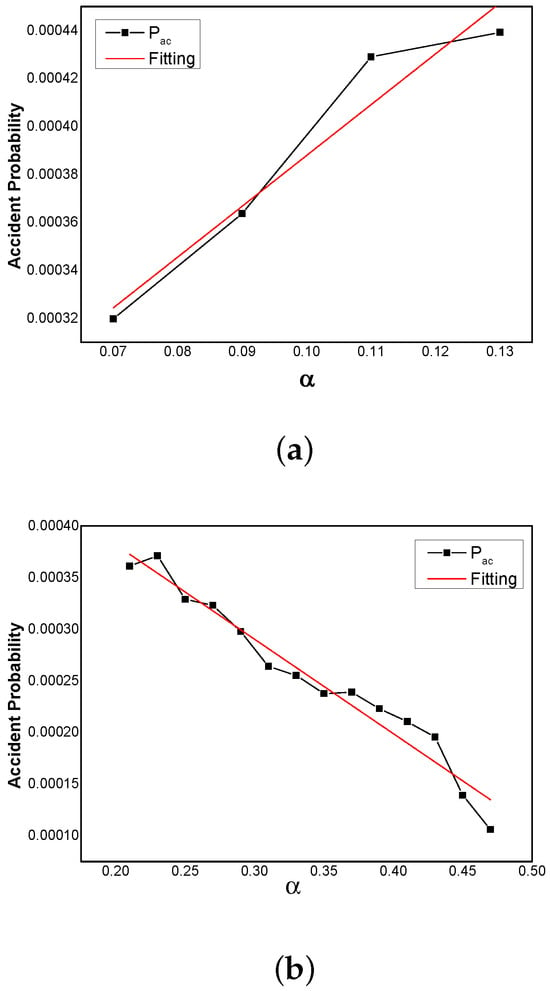
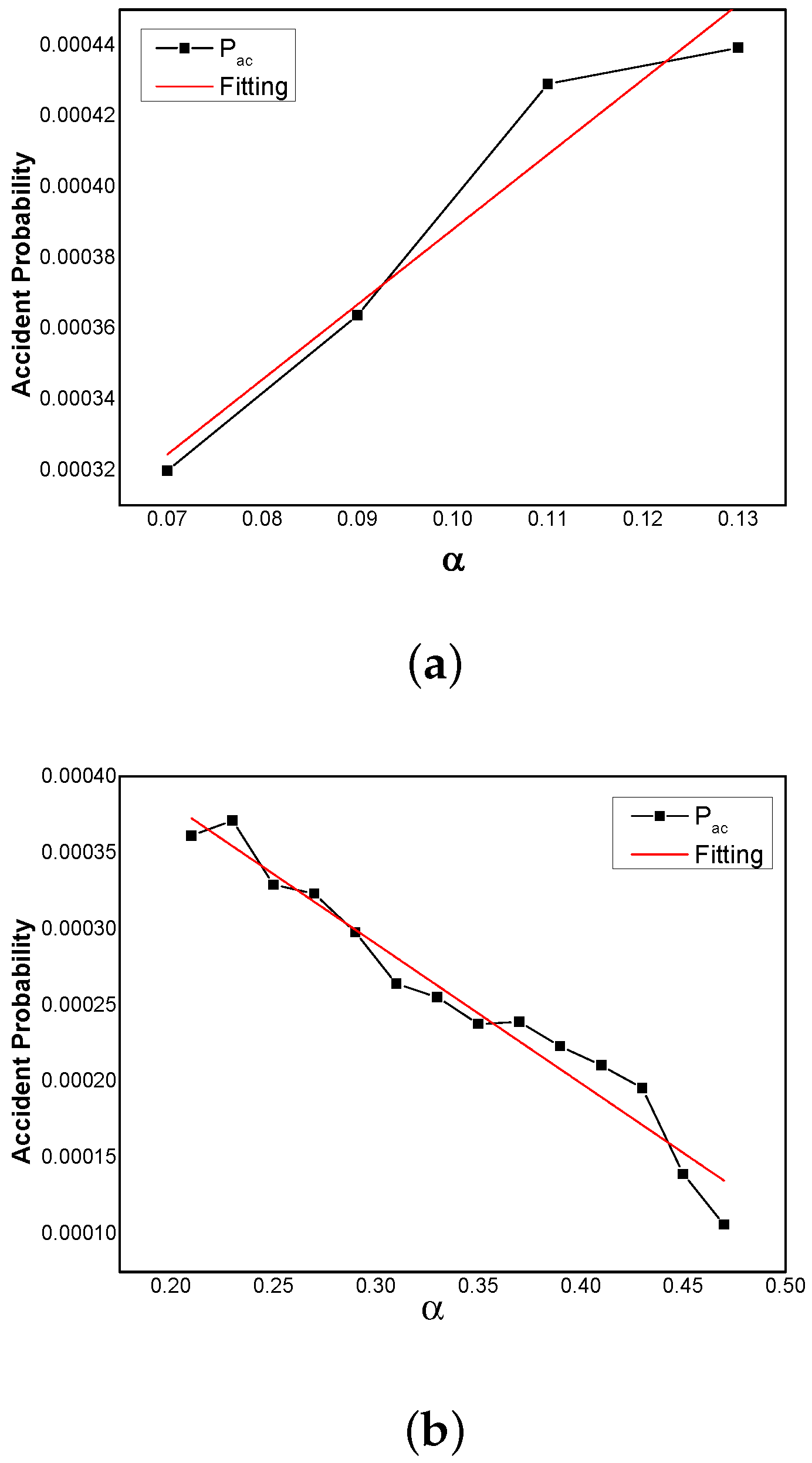
To better characterize the increasing and decreasing phases, linear fittings were applied to each region, as illustrated in Figure 8. The results indicate that both phases are well described by a linear relationship of the form
where denotes the vehicle entrance probability. The corresponding values of the fitting parameters a and b are reported in Table 1. The coefficients of determination satisfy , indicating a high quality of fit.
Figure 8.
Fitting of accident probability (a) increasing phase and (b) decreasing phase for and .
Table 1.
Values of a and b for increase and decrease phases.
This simple relationship allows the accident probability to be directly estimated from the vehicle entrance probability, providing a practical and interpretable tool for assessing accident risk under varying traffic demand levels. Moreover, these results are in good agreement with previous empirical findings reported in [38], where a linear dependence between accident probability and traffic volume was observed. The consistency between the present simulation results and empirical studies further supports the validity of the proposed modeling approach.
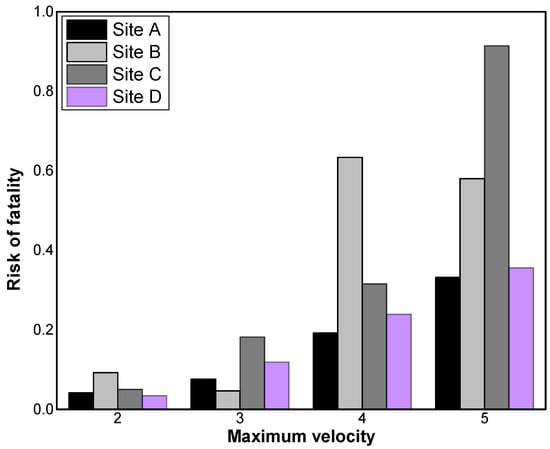
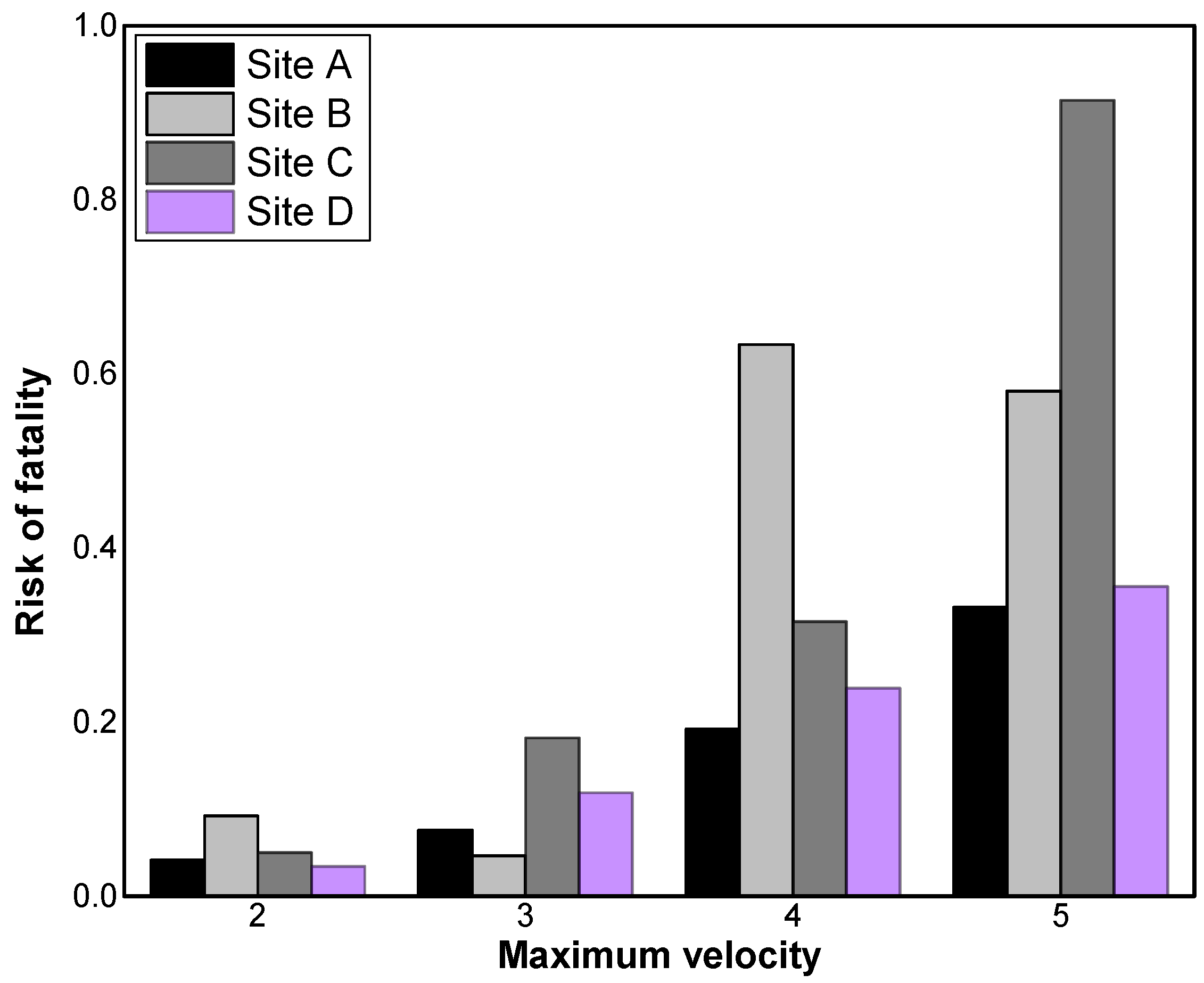
Beyond its effect on accident probability, vehicle speed also plays a critical role in determining accident severity, as illustrated in Figure 9. This latter demonstrates the dramatic impact of vehicle speed on the risk of fatality at all four intersection sites. The fatality risk increases sharply with , reflecting the highly nonlinear relationship between collision severity and impact velocity. These results are consistent with the trends observed in accident probability, confirming that speed acts as a dominant factor affecting both the likelihood and severity of accidents. Although some variability is observed among the different intersection sites, the overall trend remains consistent, indicating that speed is the primary determinant of accident severity. These findings demonstrate that reducing vehicle speeds in the vicinity of intersections is not only effective for reducing accident probability, but also essential for mitigating the severity of collisions when accidents do occur. From a road safety perspective, these results support the implementation of speed-limiting measures and traffic-calming strategies at signalized intersections.
Figure 9.
Fatality risk at the four intersection sites as a function of maximum speed.
3.2. Discussion
The simulation results show that there is a nonlinear relationship between traffic demand and the probability of accidents at signalized intersections, with a characteristic three-phase behavior. In the ascending phase of low to medium vehicle density, there is an increase in the probability of accidents as the number of vehicles entering the system increases, as shown in Figure 5 and Figure 7. Even if vehicle density is moderate, high speeds and speed differences, as well as driver reaction times and exposure in conflict zones, contribute to an increased risk of collision, particularly when changing lanes on the arterial road before the intersection, as shown in Figure 5. This finding is aligned with recent research showing that integrated car-following and lane-changing behaviors significantly influence collision risk in mixed traffic environments [32].
Building on this, the peak under free-flow conditions is counter-intuitive but can be explained by traffic flow theory: there are enough vehicles to interact and generate conflicts, while ample space allows high-speed maneuvers and lane changes, increasing both conflict exposure and relative speeds (see Figure 5).
Similar nonlinear and conflict sensitive behavior has been reported in the context of dynamic crash risk prediction at signalized intersections, where nonstationary models capture the evolving interplay between traffic parameters and crash risk [39]. In contrast, under high-density congestion, vehicles travel slowly and have limited maneuverability, which reduces both collision probability and severity. This explains the decreasing phase observed in the simulations, where accident probability declines and eventually stabilizes (Figure 7).
Lane-changing maneuvers upstream of the intersection significantly raise accident probability by creating additional conflict points. Lane changes downstream have a lower impact because traffic streams disperse and speeds homogenize after the intersection. Controlling lane-changing behavior near intersections is therefore crucial for safety. Speed heterogeneity between fast and slow vehicles amplifies risk, and higher maximum vehicle speeds increase both accident probability and severity (Figure 7 and Figure 9). This finding is consistent with the literature on traffic safety, which suggests that surrogate risk measures based on mixed-flow dynamics can accurately capture the impact of speed variance on conflict levels [40]. Extending green signal durations has site-specific effects, with excessively long cycles slightly increasing accidents by allowing higher speeds and longer conflict exposure (see Figure 6).
This mirrors broader insights from intersection safety research, where signal timing is found to interact with driver behavior and traffic flow characteristics in complex ways, influencing collision exposure patterns in real-world data [41]. These findings indicate that intermediate-density, high-speed traffic is the most hazardous, highlighting the importance of speed management, lane-change control, and flow homogenization for improving urban intersection safety.
4. Conclusions
This paper investigates the relationship between qccident probalitity qnd traffic parameters at signalized intersection using cellular automata model. The results indicate that accident probability at signalized intersections exhibits a pronounced nonlinear dependence on traffic demand. Accident probability increases with vehicle inflow, reaching a maximum under intermediate entrance probability values (–), and then decreases as congestion builds, eventually stabilizing under high-density conditions.
Linear fitting of the increasing and decreasing phases shows that accident probability can be estimated from entrance probability. The increasing phase is characterized by a positive slope of with an intercept of , whereas the decreasing phase exhibits a negative slope of with an intercept of ().
This relationship does not replace the probabilistic nature of the model but provides a deterministic approximation of the expected accident probability derived from the underlying stochastic dynamics, offering a practical tool for risk estimation.
The findings also highlight the critical role of driver behavior. Lane-changing maneuvers, particularly upstream of the intersection, significantly increase accident risk, while higher maximum vehicle speeds lead to a marked increase in both accident probability and fatality risk. In contrast, extending signal cycle durations does not appear to effectively improve safety.
From a practical perspective, these results suggest that traffic conditions combining moderate density and high speeds represent the most hazardous regime. Therefore, speed management and regulation of lane-changing behavior near intersections may constitute more effective safety strategies than modifying signal timings alone.
The study is limited to two lane one-way intersections and has not yet been calibrated using real-world data. Future work will focus on extending the model to two-way configurations and multi-intersection networks, as well as incorporating empirical data for validation, enhancing its applicability as a decision-support tool for improving safety and sustainability in urban traffic systems.
Author Contributions
Conceptualization, R.M.; methodology, R.M., O.B., L.T. and A.K.; software, R.M.; validation, R.M., O.B., L.T. and A.K.; formal analysis, R.M., L.T., O.B. and A.K.; investigation, R.M., L.T., O.B. and A.K.; resources, R.M., L.T., O.B. and A.K.; data curation, R.M., L.T., O.B. and A.K.; writing original draft preparation, R.M., L.T., O.B. and A.K.; writing review and editing, R.M., L.T., O.B. and A.K.; visualization, R.M., L.T., O.B. and A.K.; supervision, R.M., L.T., O.B. and A.K.; project administration, R.M. All authors have read and agreed to the published version of the manuscript.
Funding
This research received no external funding.
Data Availability Statement
We do not analyze any datasets as our work is based on a theoretical and computational approach.
Conflicts of Interest
The authors declare no conflicts of interest.
References
- Rodrigue, J.P. The Geography of Transport Systems; Routledge: London, UK, 2020. [Google Scholar]
- Attioui, M.; Lahby, M. Forecasting Traffic Congestion Using Air Pollution Data: A Case Study of Casablanca, Morocco. In International Conference on Applied Intelligence and Informatics; Springer: Cham, Switzerland, 2024; pp. 476–488. [Google Scholar]
- Chamseddine, Z.; Ait Boubkr, A. Exploring the place of social impacts in urban transport planning: The case of Casablanca City. Urban Plan. Transp. Res. 2020, 8, 138–157. [Google Scholar] [CrossRef] [Scilit]
- Jayasooriya, S.; Bandara, Y. Measuring the Economic costs of traffic congestion. In 2017 Moratuwa Engineering Research Conference (MERCon); IEEE: Piscataway, NJ, USA, 2017; pp. 141–146. [Google Scholar]
- Greenwood, I.; Dunn, R.; Raine, R. Estimating the effects of traffic congestion on fuel consumption and vehicle emissions based on acceleration noise. J. Transp. Eng. 2007, 133, 96–104. [Google Scholar] [CrossRef] [Scilit]
- Inchaouh, M.; Tahiri, M. Air pollution due to road transportation in Morocco: Evolution and impacts. J. Multidiscip. Eng. Sci. Technol. 2017, 4, 7547–7552. [Google Scholar]
- El Ghazi, I.; Berni, I.; Menouni, A.; Amane, M.; Kestemont, M.P.; El Jaafari, S. Exposure to air pollution from road traffic and incidence of respiratory diseases in the city of Meknes, Morocco. Pollutants 2022, 2, 306–327. [Google Scholar] [CrossRef] [Scilit]
- Hakkert, A.S.; Mahalel, D. Estimating the number of accidents at intersections from a knowledge of the traffic flows on the approaches. Accid. Anal. Prev. 1978, 10, 69–79. [Google Scholar] [CrossRef] [Scilit]
- Agence Nationale de la Sécurité Routière (NARSA). Accueil|Agence Nationale de la Sécurité Routière. 2025. Available online: https://www.narsa.ma/fr (accessed on 7 January 2026).
- Habiba, U.; Talukdar, S. The impact of traffic congestion, aggression and driving anger on driver stress: A structural equation modelling approach. J. Transp. Saf. Secur. 2025, 17, 901–922. [Google Scholar] [CrossRef] [Scilit]
- Bifulco, G.N.; Galante, F.; Pariota, L.; Spena, M.R.; Del Gais, P. Data collection for traffic and drivers’ behaviour studies: A large-scale survey. Procedia-Soc. Behav. Sci. 2014, 111, 721–730. [Google Scholar] [CrossRef] [Scilit]
- Factor, R. The effect of traffic tickets on road traffic crashes. Accid. Anal. Prev. 2014, 64, 86–91. [Google Scholar] [CrossRef] [Scilit]
- Chu, W.; Wu, C.; Atombo, C.; Zhang, H.; Özkan, T. Traffic climate, driver behaviour, and accidents involvement in China. Accid. Anal. Prev. 2019, 122, 119–126. [Google Scholar] [CrossRef] [Scilit]
- Björklund, G.M.; Åberg, L. Driver behaviour in intersections: Formal and informal traffic rules. Transp. Res. Part F Traffic Psychol. Behav. 2005, 8, 239–253. [Google Scholar] [CrossRef] [Scilit]
- Sagberg, F.; Selpi; Bianchi Piccinini, G.F.; Engström, J. A review of research on driving styles and road safety. Hum. Factors 2015, 57, 1248–1275. [Google Scholar] [CrossRef] [Scilit] [PubMed]
- Xu, M.; Gao, Z. Nonlinear Analysis of Road Traffic Flows in Discrete Dynamical System. J. Comput. Nonlinear Dyn. 2008, 3, 021206. [Google Scholar] [CrossRef] [Scilit]
- Hammoumi, L.; Farah, S.; Benayad, M.; Maanan, M.; Rhinane, H. Leveraging machine learning to predict traffic jams: Case study of Casablanca, Morocco. J. Urban Manag. 2025, 14, 813–826. [Google Scholar] [CrossRef] [Scilit]
- Jiber, M.; Mbarek, A.; Yahyaouy, A.; Sabri, M.A.; Boumhidi, J. Road traffic prediction model using extreme learning machine: The case study of Tangier, Morocco. Information 2020, 11, 542. [Google Scholar] [CrossRef] [Scilit]
- Tang, D.; Li, X.; Jiang, Y. Microscopic traffic simulation oriented road network data model. In 2010 2nd International Conference on Future Computer and Communication; IEEE: Piscataway, NJ, USA, 2010; Volume 2, pp. 87–91. [Google Scholar]
- Sahraoui, A.E.K.; Jayakrishnan, R. Microscopic-macroscopic models systems integration: A simulation case study for ATMIS. Simulation 2005, 81, 353–363. [Google Scholar] [CrossRef] [Scilit]
- Santé, I.; García, A.M.; Miranda, D.; Crecente, R. Cellular automata models for the simulation of real-world urban processes: A review and analysis. Landsc. Urban Plan. 2010, 96, 108–122. [Google Scholar] [CrossRef] [Scilit]
- Pinto, N.; Antunes, A.P.; Roca, J. A cellular automata model for integrated simulation of land use and transport interactions. ISPRS Int. J. Geo-Inf. 2021, 10, 149. [Google Scholar] [CrossRef] [Scilit]
- Schreckenberg, M.; Barlović, R.; Knospe, W.; Klüpfel, H. Statistical physics of cellular automata models for traffic flow. In Computational Statistical Physics: From Billiards to Monte Carlo; Springer: Cham, Switzerland, 2001; pp. 113–126. [Google Scholar]
- Marzoug, R.; Lakouari, N.; Pérez Cruz, J.R.; Vega Gómez, C.J. Cellular automata model for analysis and optimization of traffic emission at signalized intersection. Sustainability 2022, 14, 14048. [Google Scholar] [CrossRef] [Scilit]
- Marzoug, R.; Lakouari, N.; Pérez Cruz, J.R.; Castillo-Téllez, B.; Mejía-Pérez, G.A.; Bamaarouf, O. Cellular Automata for Optimization of Traffic Emission and Flow Dynamics in Two-Route Systems Using Feedback Information. Infrastructures 2025, 10, 120. [Google Scholar] [CrossRef] [Scilit]
- Marzoug, R.; Echab, H.; Ez-Zahraouy, H. Car accidents induced by a bottleneck. Eur. Phys. J. B 2017, 90, 240. [Google Scholar] [CrossRef] [Scilit]
- de Almeida, I.M.; Leal-Toledo, R.C.P.; Toledo, E.M.; Cacau, D.C.; de Lima, R.C.N.; Malta, S. Influence of Drivers’ Behavior on Traffic Flow at Two Roads Intersection. In International Conference on Computational Science and Its Applications; Springer: Cham, Switzerland, 2019; pp. 129–141. [Google Scholar]
- Ez-zahar, A.; Lakouari, N.; Oubram, O.; Aguilar, J.G.V.; Ez-zahraouy, H. Simulation Analysis of Traffic Management in Roundabout Systems. In 2024 4th International Conference on Innovative Research in Applied Science, Engineering and Technology (IRASET); IEEE: Piscataway, NJ, USA, 2024; pp. 1–7. [Google Scholar]
- Małecki, K.; Iwan, S. Modeling traffic flow on two-lane roads with traffic lights and countdown timer. Transp. Res. Procedia 2019, 39, 300–308. [Google Scholar] [CrossRef] [Scilit]
- Wang, J.; Yang, H.; Zhu, Y.; Xie, K.; Yan, Z.; Pu, Q. A simulation study on traffic conflict risk under shockwave propagation at signalized intersections. Accid. Anal. Prev. 2025, 218, 108081. [Google Scholar] [CrossRef] [Scilit] [PubMed]
- Ba, I.; Tordeux, A. Signalized and unsignalized road traffic intersection models: A comprehensive benchmark analysis. Collect. Dyn. 2023, 8, 1–21. [Google Scholar] [CrossRef] [Scilit]
- Zhang, M.; Yang, J.; Yang, X.; Duan, X. Measuring collision risk in mixed traffic flow under the car-following and lane-changing behavior. Appl. Sci. 2024, 14, 11400. [Google Scholar] [CrossRef] [Scilit]
- Feng, M.; Zhao, J.; Hou, C.; Nie, C.; Hou, J. Investigating the safety influence path of right-turn configurations on vehicle–pedestrian conflict risk at signalized intersections. Accid. Anal. Prev. 2025, 211, 107910. [Google Scholar] [CrossRef] [Scilit]
- Nagel, K.; Schreckenberg, M. A cellular automaton model for freeway traffic. J. Phys. I 1992, 2, 2221–2229. [Google Scholar] [CrossRef] [Scilit]
- Chowdhury, D.; Wolf, D.E.; Schreckenberg, M. Particle hopping models for two-lane traffic with two kinds of vehicles: Effects of lane-changing rules. Phys. A Stat. Mech. Its Appl. 1997, 235, 417–439. [Google Scholar] [CrossRef] [Scilit]
- Joksch, H.C. Velocity change and fatality risk in a crash–a rule of thumb. Accid. Anal. Prev. 1993, 25, 103–104. [Google Scholar] [CrossRef] [Scilit]
- Marzoug, R.; Lakouari, N.; Ez-Zahraouy, H.; Téllez, B.C.; Téllez, M.C.; Villalobos, L.C. Modeling and simulation of car accidents at a signalized intersection using cellular automata. Phys. A Stat. Mech. Its Appl. 2022, 589, 126599. [Google Scholar] [CrossRef] [Scilit]
- Retallack, A.E.; Ostendorf, B. Relationship between traffic volume and accident frequency at intersections. Int. J. Environ. Res. Public Health 2020, 17, 1393. [Google Scholar] [CrossRef] [Scilit]
- Fu, C.; Lu, Z.; Liu, H.; Wumaierjiang, A. Dynamic short-term crash risk prediction from traffic conflicts at signalized intersections with emerging mixed traffic flow: A novel conflict indicator. Accid. Anal. Prev. 2025, 217, 108065. [Google Scholar] [CrossRef] [Scilit]
- Yang, Q.; Li, P.; Yang, F.; Lu, W. Lane-Changing Risk Prediction on Urban Expressways: A Mixed Bayesian Approach for Sustainable Traffic Management. Sustainability 2025, 17, 7061. [Google Scholar] [CrossRef] [Scilit]
- Ding, S.; Abdel-Aty, M.; Wang, Z.; Wang, D. Insights into vehicle conflicts based on traffic flow dynamics. Sci. Rep. 2024, 14, 1536. [Google Scholar] [CrossRef] [Scilit]

Disclaimer/Publisher’s Note: The statements, opinions and data contained in all publications are solely those of the individual author(s) and contributor(s) and not of MDPI and/or the editor(s). MDPI and/or the editor(s) disclaim responsibility for any injury to people or property resulting from any ideas, methods, instructions or products referred to in the content. |
© 2026 by the authors. Licensee MDPI, Basel, Switzerland. This article is an open access article distributed under the terms and conditions of the Creative Commons Attribution (CC BY) license.