Article

Mathematical Modeling of Pressure-Dependent Variation in the Hydrodynamic Parameters of Gas Fields

by
Elmira Nazirova
1,
Abdugani Nematov
1,
Gulstan Artikbaeva
2,*,
Shikhnazar Ismailov
1,
Marhabo Shukurova
3,
Asliddin R. Nematov
4 and
Marks Matyakubov
1
1
Department of Multimedia Technologies, Faculty of Computer Engineering, Tashkent University of Information Technologies Named After Muhammad Al-Khorezmi, Tashkent 100084, Uzbekistan
2
Khorezm Mamun Academy, Khiva 220900, Uzbekistan
3
Department of Software and Hardware Support of Computer Systems, Faculty of Digital Technologies and Artificial Intelligence, Karshi State Technical University, Karshi 180100, Uzbekistan
4
Department of Higher Mathematics, Faculty of Energy Engineering, Jizzakh Polytechnic Institute, Jizzakh 130100, Uzbekistan
*
Author to whom correspondence should be addressed.
Modelling 2026, 7(1), 30; https://doi.org/10.3390/modelling7010030
Submission received: 8 December 2025 / Revised: 9 January 2026 / Accepted: 19 January 2026 / Published: 2 February 2026

Abstract

This study introduces a mathematical framework for analyzing unsteady gas filtration in porous media with pressure-dependent porosity variations. The physical process is formulated as a nonlinear parabolic boundary value problem that captures the coupled interaction between pressure evolution and porosity changes during gas production. To solve the equation, a numerical strategy is developed by integrating the Alternating Direction Implicit (ADI) scheme with quasi-linearization iterations, employing finite difference discretization on a two-dimensional spatial grid. Extensive computational experiments are performed to investigate the influence of key reservoir parameters—including porosity coefficient, permeability, gas viscosity, and well production rate—on the spatiotemporal behavior of pressure and porosity during long-term extraction. The results indicate significant porosity variations near the wellbore driven by local pressure depletion, reflecting strong sensitivity of the system to formation properties. The validated numerical model provides valuable quantitative insights for optimizing reservoir management and improving production forecasting in gas field development. Overall, the proposed methodology serves as a practical tool for oil and gas engineers to assess long-term reservoir performance under diverse operational conditions and to design efficient extraction strategies that incorporate pressure-dependent formation property changes.

1. Introduction

The efficient exploitation of oil and gas reservoirs represents a multifaceted engineering challenge that necessitates comprehensive characterization of both geological structures and hydrodynamic behavior of productive formations. Optimal reservoir management strategies rely critically on accurate quantification of several interdependent parameters, including reservoir pressure evolution, well production rates, hydrocarbon saturation profiles under varying pressure conditions, and the spatial-temporal dynamics of production well operations. Among these parameters, reservoir pressure serves as a fundamental indicator that governs extraction efficiency and long-term field performance. Reservoir pressure dynamics are intrinsically coupled to the volumetric extraction rates and are fundamentally controlled by the collective hydrodynamic properties of the formation. These properties encompass permeability, porosity, fluid viscosity, and the mechanical integrity of the rock matrix. Enhanced permeability and porosity facilitate more efficient fluid migration and promote uniform hydrocarbon distribution throughout the formation, thereby improving recovery efficiency and production economics [1,2,3,4,5]. Understanding the pressure-dependent variation of these rock properties is essential for accurate reservoir simulation and production forecasting. Recent advances in reservoir characterization have emphasized the importance of transient pressure analysis for determining formation properties. Sergeev et al. [6] developed an adaptive method based on deterministic pressure moments to identify reservoir parameters and classify reservoir types from gas hydrodynamic well tests under unsteady filtration conditions. Their approach incorporates identification of the initial section of bottomhole pressure buildup curves, demonstrating successful application to field data interpretation for both oil and gas wells. This work highlights the critical role of pressure transient analysis in reservoir parameter estimation. Mathematical modeling of fluid flow in porous geological media has evolved significantly with advances in numerical methods. Shurina et al. [7] presented a sophisticated computational framework for modeling pressure-driven fluid filtration processes in porous media using mixed finite element formulations based on the Galerkin method. Their approach constructs specialized basis systems for velocity in H ( d i v ) (space for velocity) space and pressure in L 2 (space for pressure) space, demonstrating the effectiveness of this formulation through computational experiments on model problems. This work exemplifies the importance of appropriate functional space selection for flow problems in porous media. Building upon mixed finite element methodologies, Duran et al. [8] developed an H ( d i v ) conforming multiscale hybrid mixed method for solving the Darcy problem, utilizing microscale mixed finite elements rather than continuous elements. This multiscale approach enables efficient handling of heterogeneous porous media with complex permeability distributions. Complementary to this, Carvalho et al. [9] focused on divergence-balanced H ( d i v ) - L 2 approximation space pairs for the Stokes problem formulation using continuous Galerkin methods, ensuring divergence-free and robust simulations for coupled Stokes-Darcy and Brinkman flow systems. Unified numerical frameworks for coupled flow systems have garnered significant attention in recent literature. Armentano and Stockdale [10] developed a unified mixed finite element approximation for the Stokes-Darcy coupled problem, employing conforming finite elements in mixed formulations. Their approach utilizes mini-elements for both Stokes and Darcy subdomains, with numerical experiments validating the methodology against problems with known analytical solutions. For high-velocity flow regimes where Darcy’s law becomes inadequate, Liang et al. [11] implemented a multipoint flux mixed finite element method to solve the Darcy-Forchheimer problem, which accurately models compressible fluid motion in porous media at relatively high flow velocities characteristic of near-wellbore regions [12,13]. An important consideration in contemporary reservoir simulation involves accurate representation of hydraulic fractures and their impact on well productivity. The upscaling method provides an effective computational strategy for calculating flow to hydraulically fractured wells on coarse grids while preserving essential physics. Kireev and Bulgakova [14] proposed an innovative procedure for enhancing conductivity representation near hydraulic fractures on unstructured Voronoi grids, demonstrating superior performance compared to the classical Embedded Discrete Fracture Model (EDFM) approach. This advancement is particularly relevant for unconventional reservoir simulation where hydraulic fracturing is extensively employed. Despite these significant advances, the inherent complexity and nonlinearity of the differential equations governing gas filtration processes preclude obtaining general analytical solutions in most practical scenarios. Consequently, computational analysis methods, robust numerical algorithms, and efficient software implementations have become indispensable tools for predicting oil and gas field performance. The synergistic application of high-performance computing capabilities and appropriate numerical methods—including finite difference, finite element, and finite volume techniques—enables reliable quantitative predictions of reservoir behavior under various operational scenarios. The present study addresses this need by developing a comprehensive mathematical model for unsteady gas filtration in porous media that explicitly accounts for pressure-dependent variations in porosity and permeability coefficients. The nonlinear parabolic boundary value problem is solved using an Alternating Direction Implicit (ADI) scheme combined with quasi-linearization iterative techniques. Extensive computational experiments are conducted to investigate the influence of key reservoir parameters on pressure distribution and porosity evolution during long-term field operation. The findings provide valuable insights for optimizing reservoir management strategies and improving production forecasting accuracy in gas field development projects.

2. Materials and Methods

2.1. Mathematical Model

The mathematical formulation of unsteady gas filtration in porous media is governed by nonlinear parabolic partial differential equations that capture the complex coupling between pressure dynamics, fluid flow, and reservoir rock properties. In this study, we consider the realistic scenario where both porosity and permeability coefficients exhibit pressure-dependent variations during the production process. This pressure-dependency significantly influences the long-term reservoir behavior and must be explicitly incorporated into the mathematical framework for accurate prediction of field performance. The governing equation for two-dimensional gas filtration in a heterogeneous porous medium, accounting for pressure-dependent porosity variations, is formulated as follows:
x k ( x , y ) h ( x , y ) μ P 2 x + y k ( x , y ) h ( x , y ) μ P 2 y = 2 a h m ( x , y , P ) P t Q , m = m 0 [ 1 + β c ( P P 0 ) ] , ( x , y ) G , t > 0 .
here, P ( x , y , t ) denotes the reservoir pressure field [atm]; P 0 is the initial reservoir pressure [atm]; μ is the dynamic viscosity of gas [cP]; k ( x , y ) represents the spatially varying permeability coefficient [Darcy]; h is the layer power [m]; m ( x , y , P ) denotes the pressure-dependent porosity coefficient [dimensionless]; m 0 is the initial porosity value [dimensionless]; β c represents the rock compressibility coefficient [atm−1]; a is the gas saturation coefficient [dimensionless].
The source term Q in Equation (1) accounts for the distributed production from multiple wells and is expressed using the Dirac delta function as:
Q = i q = 1 N q q i q δ ( x x i q , y y i q ) , i q = 1 , , N q ,
where δ represents the Dirac delta function, q i q denotes the production rate of the i q -th well [m3/day]; ( x i q , y i q ) are the spatial coordinates of the i q -th production well and N q represents the total number of production wells.
The initial condition for the boundary value problem is specified as:
P ( x , y , 0 ) = P 0 ( x , y ) , ( x , y ) G ,
where G denotes the two-dimensional spatial domain representing the reservoir.
The boundary conditions are formulated as Robin-type (third-kind) conditions that allow for flexible representation of both open and closed reservoir boundaries:
k ( x , y ) P x = λ α ( P A P ) , x = 0 , t > 0 , k ( x , y ) P x = λ α ( P A P ) , x = L , t > 0 ,
k ( x , y ) P y = λ α ( P A P ) , y = 0 , t > 0 , k ( x , y ) P y = λ α ( P A P ) , y = L , t > 0 ,
where λ is a characteristic parameter [dimensionless], P A represents the boundary pressure [atm]; L is the characteristic length of the reservoir domain [m] and α is a boundary type indicator defined as:
α = 0 , open boundary ( pressure-specified ) , 1 , closed boundary ( no-flow ) .

2.2. Dimensionless Formulation

To facilitate numerical solution and enhance computational efficiency, we transform the governing equations into dimensionless form. This transformation also enables systematic analysis of the relative importance of various physical processes. The dimensionless variables are defined as:
P * = P P 0 , x * = x L , y * = y L , k * = k k 0 , h * = h h 0 , τ = k 0 P 0 t 2 a μ L 2 , Q * = P A Q μ π k 0 P 0 2 h 0 , λ * = λ L k 0 ,
where k 0 and h 0 represent characteristic values of permeability and reservoir thickness, respectively, and τ denotes the dimensionless time. Substituting these dimensionless variables into Equations (1)–(5) and dropping the asterisk notation for convenience, we obtain the dimensionless boundary value problem:
x k ( x , y ) h ( x , y ) P 2 x + y k ( x , y ) h ( x , y ) P 2 y = h m P τ Q , ( x , y ) G , τ > 0 , m = m 0 [ 1 + β c ( P P 0 ) ] , ( x , y ) G ,
with initial condition:
P ( x , y , 0 ) = P 0 ( x , y ) , ( x , y ) G ,
and boundary conditions:
k ( x , y ) P x = λ α ( P A P ) , x = 0 , τ > 0 , k ( x , y ) P x = λ α ( P A P ) , x = 1 , τ > 0 ,
k ( x , y ) P y = λ α ( P A P ) , y = 0 , τ > 0 , k ( x , y ) P y = λ α ( P A P ) , y = 1 , τ > 0 .
The source term in dimensionless form remains:
Q = i q = 1 N q q i q δ ( x x i q , y y i q ) , i q = 1 , , N q .
The dimensionless boundary value problem (8)–(12) constitutes a strongly nonlinear parabolic system due to the quadratic pressure term in the diffusion operator and the pressure-dependent porosity. Consequently, analytical solutions are generally unattainable, necessitating the development of robust numerical solution strategies. In the following section, we present a finite difference discretization combined with quasi-linearization techniques and the Alternating Direction Implicit (ADI) method to efficiently solve this challenging nonlinear problem.

2.3. Discrete Model Construction and Numerical Solution Strategy

The strongly nonlinear nature of the boundary value problem formulated in Equations (8)–(12) precludes analytical treatment, necessitating the development of robust numerical solution methodologies. In this section, we present a comprehensive finite difference discretization framework combined with quasi-linearization techniques and the Alternating Direction Implicit (ADI) method [15] to efficiently solve this challenging problem.
We construct a uniform rectangular grid domain that discretizes the two-dimensional spatial reservoir and the temporal evolution:
Ω x y τ = { ( x i = i Δ x , y j = j Δ y , τ l = l Δ τ ) : i = 0 , , N x , j = 0 , , N y , l = 0 , , N τ } ,
where Δ x = 1 / N x and Δ y = 1 / N y represent the spatial mesh sizes in the x and y directions, respectively; Δ τ = T / N τ denotes the temporal step size; N x and N y are the number of grid points in each spatial direction; N τ is the total number of time steps; and T is the final simulation time.
The ADI method provides an efficient approach for solving multi-dimensional parabolic problems by decomposing each time step into a sequence of one-dimensional problems. This dimensional splitting strategy significantly reduces computational complexity while maintaining second-order accuracy in both space and time. The transition from time level l to l + 1 is accomplished through two fractional steps with intermediate time level l + 1 / 2 , where each fractional step advances the solution by Δ τ / 2 .
In the first fractional step (time level l l + 1 / 2 ), the spatial operator in the x-direction is treated implicitly while the y-direction operator remains explicit:
m i , j h i , j P ¯ i , j P ^ i , j Δ τ / 2 = T i 1 / 2 , j P ¯ i 1 , j 2 ( T i 1 / 2 , j + T i + 1 / 2 , j ) P ¯ i , j 2 + T i + 1 / 2 , j P ¯ i + 1 , j 2 Δ x 2 + T i , j 1 / 2 P ^ i , j 1 2 ( T i , j 1 / 2 + T i , j + 1 / 2 ) P ^ i , j 2 + T i , j + 1 / 2 P ^ i , j + 1 2 Δ y 2 q i , j δ ( x x i , y y j ) , m i , j = m 0 , i , j [ 1 + β c ( P ¯ i , j P 0 , i , j ) ] ,
where P ^ i , j P i , j l denotes the pressure at time level l, and P ¯ i , j P i , j l + 1 / 2 represents the intermediate pressure.
In the second fractional step (time level l + 1 / 2 l + 1 ), the roles are reversed:
m i , j h i , j P i , j P ¯ i , j Δ τ / 2 = T i 1 / 2 , j P ¯ i 1 , j 2 ( T i 1 / 2 , j + T i + 1 / 2 , j ) P ¯ i , j 2 + T i + 1 / 2 , j P ¯ i + 1 , j 2 Δ x 2 + T i , j 1 / 2 P i , j 1 2 ( T i , j 1 / 2 + T i , j + 1 / 2 ) P i , j 2 + T i , j + 1 / 2 P i , j + 1 2 Δ y 2 q i , j δ ( x x i , y y j ) , m i , j = m 0 , i , j [ 1 + β c ( P i , j P 0 , i , j ) ] ,
where P i , j P i , j l + 1 denotes the pressure at the new time level. For notational convenience, we introduce the transmissibility coefficients at cell interfaces:
T i 1 / 2 , j = k i 1 / 2 , j h i 1 / 2 , j , T i + 1 / 2 , j = k i + 1 / 2 , j h i + 1 / 2 , j , T i , j 1 / 2 = k i , j 1 / 2 h i , j 1 / 2 , T i , j + 1 / 2 = k i , j + 1 / 2 h i , j + 1 / 2 ,
where the subscripts i ± 1 / 2 and j ± 1 / 2 denote values evaluated at the cell interfaces, typically computed using harmonic averaging.
The finite difference equations contain nonlinear terms due to the quadratic pressure dependence in the diffusion operator. To linearize these terms, we employ the quasi-linearization method [16], which approximates nonlinear functions through first-order Taylor expansion around an iterative solution estimate. For a general nonlinear function ψ ( P ) , the quasi-linearization approximation is:
ψ ( P ) ψ ( P ˜ ) + ( P P ˜ ) ψ ( P ˜ ) P ,
where P ˜ represents an approximate solution from the previous iteration. Applying this to the quadratic pressure term yields:
P 2 2 P ˜ P P ˜ 2 .
Substituting the linearization into the first fractional step equation, we obtain:
2 T i 1 / 2 , j P ˜ i 1 , j P ¯ i 1 , j 2 ( T i 1 / 2 , j + T i + 1 / 2 , j ) P ˜ i , j + m i , j h i , j Δ x 2 Δ τ / 2 P ¯ i , j + 2 T i + 1 / 2 , j P ˜ i + 1 , j P ¯ i + 1 , j = T i 1 / 2 , j P ˜ i 1 , j 2 ( T i 1 / 2 , j + T i + 1 / 2 , j ) P ˜ i , j 2 + T i + 1 / 2 , j P ˜ i + 1 , j 2 Δ x 2 Δ y 2 T i , j 1 / 2 P ^ i , j 1 2 ( T i , j 1 / 2 + T i , j + 1 / 2 ) P ^ i , j 2 + T i , j + 1 / 2 P ^ i , j + 1 2 m i , j h i , j Δ x 2 Δ τ / 2 P ^ i , j δ i , j q i , j ,
with m i , j = m 0 , i , j [ 1 + β c ( P ¯ i , j P 0 , i , j ) ] . A similar linearized equation is obtained for the second fractional step.
To complete the discrete system, we approximate the boundary conditions using second-order accurate finite difference formulas. For the intermediate time level l + 1 / 2 , the boundary conditions in the x-direction are:
( 3 k 2 Δ x λ α ) P ¯ 0 , j + 4 k P ¯ 1 , j k P ¯ 2 , j = 2 Δ x λ α P A , x = 0 , ( 3 k + 2 Δ x λ α ) P ¯ N x , j 4 k P ¯ N x 1 , j + k P ¯ N x 2 , j = 2 Δ x λ α P A , x = 1 ,
for j = 0 , 1 , , N y . Similar discretizations apply for the y-direction boundaries.
Combining the linearized interior equations with the boundary conditions yields a tridiagonal system for the first fractional step:
( 3 k 2 Δ x λ α ) P ¯ 0 , j + 4 k P ¯ 1 , j k P ¯ 2 , j = 2 Δ x λ α P A , a i , j P ¯ i 1 , j b i , j P ¯ i , j + c i , j P ¯ i + 1 , j = d i , j , i = 1 , , N x 1 , ( 3 k + 2 Δ x λ α ) P ¯ N x , j 4 k P ¯ N x 1 , j + k P ¯ N x 2 , j = 2 Δ x λ α P A ,
where the coefficients are:
a i , j = 2 T i 1 / 2 , j P ˜ i 1 , j , c i , j = 2 T i + 1 / 2 , j P ˜ i + 1 , j , b i , j = a i , j + c i , j + m i , j h i , j Δ x 2 Δ τ / 2 , d i , j = m i , j h i , j Δ x 2 Δ τ / 2 P ˜ i , j T i 1 / 2 , j P ˜ i 1 , j 2 ( T i 1 / 2 , j + T i + 1 / 2 , j ) P ˜ i , j 2 + T i + 1 / 2 , j P ˜ i + 1 , j 2 Δ x 2 Δ y 2 T i , j 1 / 2 P ^ i , j 1 2 ( T i , j 1 / 2 + T i , j + 1 / 2 ) P ^ i , j 2 + T i , j + 1 / 2 P ^ i , j + 1 2 δ i , j q i , j .
The tridiagonal systems arising from each fractional step are efficiently solved using the Thomas algorithm, which operates in O ( N ) time complexity. For the first fractional step, the sweep method proceeds as follows. The forward sweep computes coefficients α i , j and β i , j for i = 0 , 1 , , N x 1 :
α 0 , j = b 1 , j 4 c 1 , j a 1 , j ( 3 2 Δ x λ α ) c 1 , j , β 0 , j = d 1 , j a 1 , j ( 3 2 Δ x λ α ) c 1 , j , α i , j = c i , j b i , j + a i , j α i 1 , j , β i , j = a i , j β i 1 , j + d i , j b i , j + a i , j α i 1 , j , i = 1 , , N x 1 .
The backward sweep determines the final pressure value at the right boundary and computes interior values:
P ¯ N x , j = d N x , j + a N x , j β N x 1 , j b N x , j α N x 1 , j a N x , j , P ¯ i , j = α i , j P ¯ i + 1 , j + β i , j , i = N x 1 , , 0 .
The second fractional step in the y-direction is solved analogously.
Due to the nonlinearity introduced by quasi-linearization, an iterative process is required at each time level. The iteration continues until the convergence criterion is satisfied:
max i , j | P i , j ( s ) P i , j ( s 1 ) | ε ,
where ε is a prescribed tolerance (typically ε = 10 6 or smaller), and s denotes the iteration counter. This ensures the iterative solution has converged to within the specified accuracy before proceeding to the next time level. The complete numerical solution algorithm integrates the ADI fractional steps, quasi-linearization, tridiagonal solvers, and iterative convergence checking to efficiently and accurately solve the nonlinear gas filtration problem over the entire spatiotemporal domain.

2.4. Computational Algorithm and Implementation Strategy

The numerical methodology developed in the previous section is implemented through a systematic computational algorithm that efficiently solves the two-dimensional gas filtration boundary value problem. The algorithm employs the Alternating Direction Implicit (ADI) scheme with quasi-linearization, decomposing the multi-dimensional problem into a sequence of one-dimensional tridiagonal systems that are solved using the Thomas algorithm (sweep method). This section presents a detailed description of the computational procedure, including the algorithmic structure and implementation workflow.
The temporal advancement from time level l to l + 1 is accomplished through two sequential fractional steps, each treating one spatial direction implicitly while using explicit values from the previous fractional step for the other direction. This operator splitting approach maintains stability while reducing computational complexity significantly compared to fully implicit schemes. In the first fractional step ( l l + 1 / 2 ), the pressure field is advanced to the intermediate time level by solving one-dimensional problems in the x-direction using the sweep method, with the y-direction terms treated explicitly. In the second fractional step ( l + 1 / 2 l + 1 ), the pressure field is advanced to the new time level by solving one-dimensional problems in the y-direction using the sweep method, with the x-direction terms now evaluated at the intermediate time level. Within each fractional step, an iterative procedure based on quasi-linearization is employed to handle the nonlinear pressure-squared terms and pressure-dependent porosity. The iteration continues until convergence is achieved according to the specified criterion.
The first fractional step computes the intermediate pressure distribution P ¯ i , j = P i , j l + 1 / 2 by solving tridiagonal systems along lines of constant y-coordinate. For each grid line j = 0 , 1 , , N y , we begin by updating the porosity coefficient based on the current iterate of the pressure field:
m i , j = m 0 , i , j [ 1 + β c ( P ¯ i , j ( s ) P 0 , i , j ) ] , i = 0 , , N x , j = 0 , , N y ,
where s denotes the current iteration index, and P ¯ i , j ( s ) represents the pressure iterate at the intermediate time level.
Next, we compute the tridiagonal system coefficients a i , j , b i , j , c i , j , and d i , j at each interior node i = 1 , , N x 1 along the grid line j:
a i , j = 2 T i 1 / 2 , j P ˜ i 1 , j , c i , j = 2 T i + 1 / 2 , j P ˜ i + 1 , j , b i , j = a i , j + c i , j + m i , j h i , j Δ x 2 Δ τ / 2 , d i , j = m i , j h i , j Δ x 2 Δ τ / 2 P ˜ i , j R i , j x Δ x 2 Δ y 2 R i , j y δ i , j q i , j ,
where the residual terms are defined as:
R i , j x = T i 1 / 2 , j P ˜ i 1 , j 2 ( T i 1 / 2 , j + T i + 1 / 2 , j ) P ˜ i , j 2 + T i + 1 / 2 , j P ˜ i + 1 , j 2 , R i , j y = T i , j 1 / 2 P ^ i , j 1 2 ( T i , j 1 / 2 + T i , j + 1 / 2 ) P ^ i , j 2 + T i , j + 1 / 2 P ^ i , j + 1 2 .
Here, P ˜ denotes the pressure values from the previous iteration, and P ^ = P l represents values at the previous time level.
We then initialize the sweep coefficients α 0 , j and β 0 , j from the left boundary condition (at x = 0 ):
α 0 , j = b 1 , j 4 c 1 , j a 1 , j ( 3 k 2 Δ x λ α ) c 1 , j , β 0 , j = 2 Δ x λ α P A d 1 , j a 1 , j ( 3 k 2 Δ x λ α ) c 1 , j .
The forward sweep computes the coefficients α i , j and β i , j for i = 1 , 2 , , N x 1 :
α i , j = c i , j b i , j + a i , j α i 1 , j , β i , j = a i , j β i 1 , j + d i , j b i , j + a i , j α i 1 , j .
These recursion relations are applied sequentially from i = 1 to i = N x 1 , storing the computed coefficients for use in the backward sweep.
We then determine the pressure at the right boundary (at x = 1 ) using the right boundary condition and the final sweep coefficients:
P ¯ N x , j = 2 Δ x λ α P A + a N x , j β N x 1 , j ( 3 k + 2 Δ x λ α ) α N x 1 , j a N x , j .
The backward sweep computes the pressure values P ¯ i , j for i = N x 1 , N x 2 , , 0 using the recurrence relation:
P ¯ i , j = α i , j P ¯ i + 1 , j + β i , j .
This completes one iteration of the first fractional step for grid line j. The procedure is repeated for all j = 0 , 1 , , N y .
After completing the sweep for all grid lines, we verify the convergence criterion:
ϵ ( s ) = max i , j | P ¯ i , j ( s ) P ¯ i , j ( s 1 ) | ε .
If the criterion is not satisfied, we update the iterate P ˜ i , j P ¯ i , j ( s ) and return to the porosity update step. If convergence is achieved, we proceed to the second fractional step.
The second fractional step advances the solution from the intermediate time level l + 1 / 2 to the new time level l + 1 by solving tridiagonal systems along lines of constant x-coordinate. For each grid line i = 0 , 1 , , N x , we first update the porosity coefficient at the new time level:
m i , j = m 0 , i , j [ 1 + β c ( P i , j ( s ) P 0 , i , j ) ] , i = 0 , , N x , j = 0 , , N y ,
where P i , j ( s ) represents the pressure iterate at the new time level l + 1 .
We then compute the tridiagonal system coefficients in the y-direction at each interior node j = 1 , , N y 1 along the grid line i:
a i , j = 2 T i , j 1 / 2 P ˜ i , j 1 , c i , j = 2 T i , j + 1 / 2 P ˜ i , j + 1 , b i , j = a i , j + c i , j + m i , j h i , j Δ y 2 Δ τ / 2 , d i , j = m i , j h i , j Δ y 2 Δ τ / 2 P ˜ i , j R i , j y Δ y 2 Δ x 2 R i , j x δ i , j q i , j ,
where:
R i , j y = T i , j 1 / 2 P ˜ i , j 1 2 ( T i , j 1 / 2 + T i , j + 1 / 2 ) P ˜ i , j 2 + T i , j + 1 / 2 P ˜ i , j + 1 2 , R i , j x = T i 1 / 2 , j P ¯ i 1 , j 2 ( T i 1 / 2 , j + T i + 1 / 2 , j ) P ¯ i , j 2 + T i + 1 / 2 , j P ¯ i + 1 , j 2 .
Note that P ¯ denotes the intermediate solution computed in the first fractional step.
We execute the analogous sweep procedure in the y-direction by initializing sweep coefficients using the bottom boundary condition (at y = 0 ), performing the forward sweep for j = 1 , 2 , , N y 1 , computing the boundary value at y = 1 , and performing the backward sweep for j = N y 1 , N y 2 , , 0 . We then check the convergence criterion max i , j | P i , j ( s ) P i , j ( s 1 ) | ε . If convergence is not achieved, we update P ˜ i , j P i , j ( s ) and repeat from the porosity update step. Once converged, the solution at time level l + 1 is obtained.
The complete simulation proceeds by iterating through successive time levels. We initialize the pressure field as P i , j 0 = P 0 , i , j for all ( i , j ) . For each time level l = 0 to N τ 1 , we set the initial iterate P ˜ i , j = P i , j l for all ( i , j ) , execute the first fractional step to obtain P ¯ i , j = P i , j l + 1 / 2 , set the initial iterate P ˜ i , j = P ¯ i , j for all ( i , j ) , execute the second fractional step to obtain P i , j l + 1 , and update the time τ l + 1 = τ l + Δ τ . At each time level, the solution from the previous time step serves as the initial condition, ensuring continuity of the pressure field throughout the simulation period.
The computational efficiency of the proposed algorithm stems from several key features. The dimensional splitting of the ADI method reduces a two-dimensional problem to a sequence of one-dimensional problems, each requiring O ( N ) operations via the Thomas algorithm. The tridiagonal structure allows the sweep method to solve systems in O ( N ) time, avoiding the O ( N 3 ) complexity of general matrix solvers. The quasi-linearization iterative approach typically converges in 3–5 iterations per fractional step, maintaining computational tractability. For a grid with N x × N y spatial nodes and N τ time steps, the overall computational complexity is approximately O ( N x N y N τ ) , making the algorithm highly scalable for large-scale reservoir simulations.
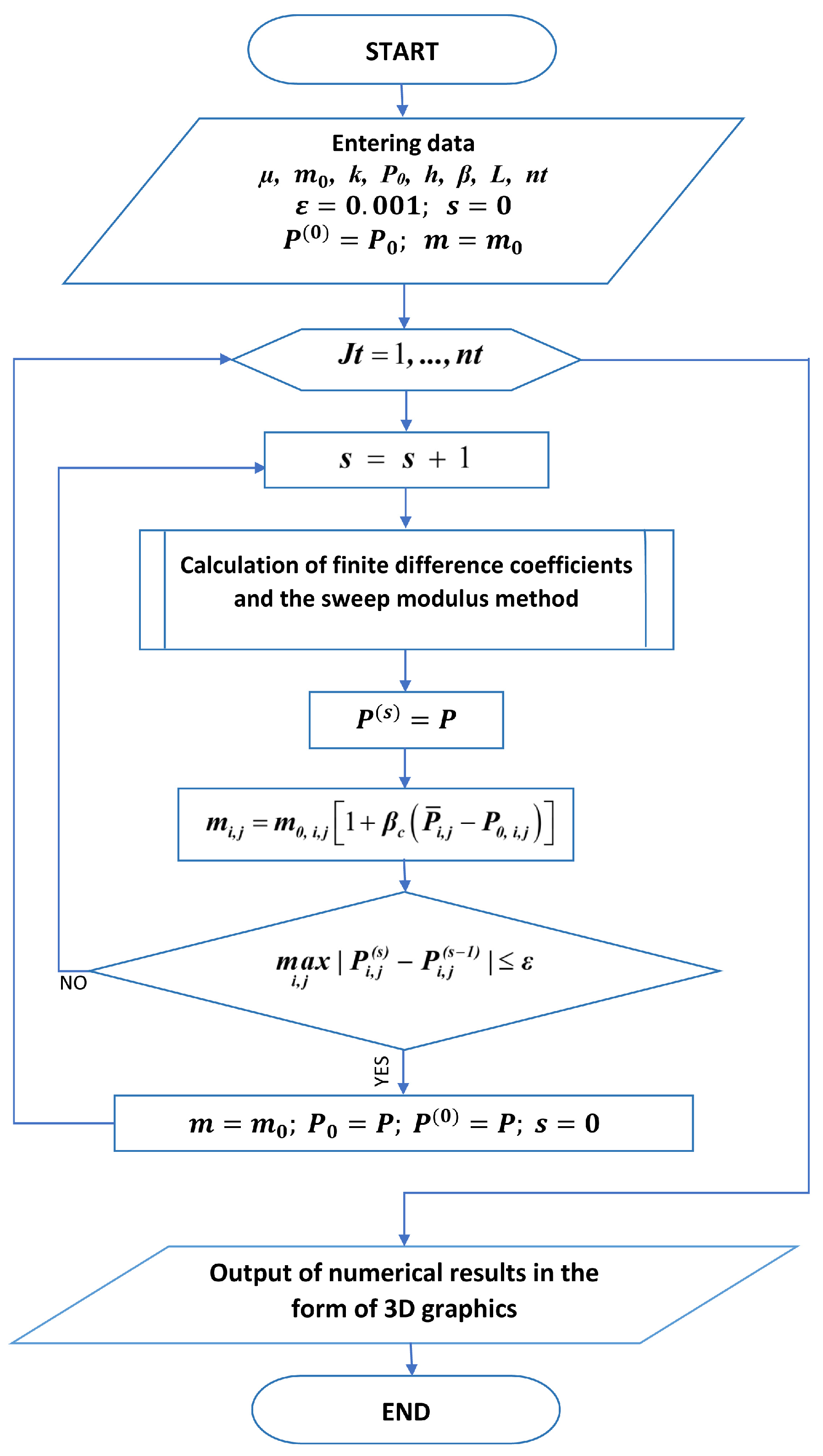
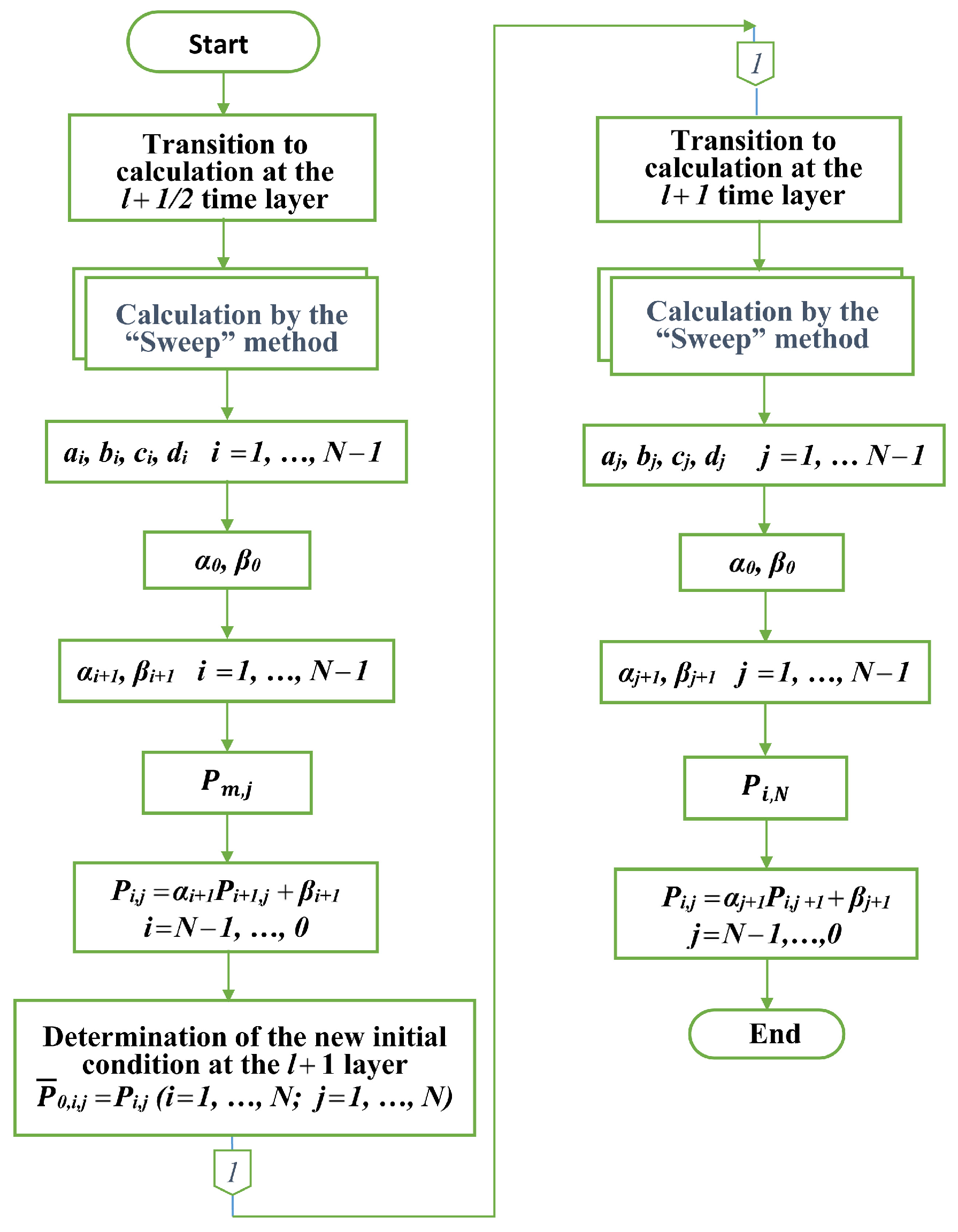
Figure 1 and Figure 2 present comprehensive flow diagrams illustrating the complete computational procedure for both fractional steps, including initialization, iterative loops, convergence checks, and time advancement. The systematic implementation of this algorithm ensures robust and efficient solution of the nonlinear gas filtration problem, providing accurate predictions of pressure evolution and porosity changes throughout the reservoir domain over extended production periods.


3. Results

Here, we present comprehensive computational experiments conducted to investigate the dynamic evolution of pressure distribution and pressure-dependent porosity variations in gas reservoirs under realistic production scenarios. The numerical simulations examine the influence of key reservoir parameters–including initial porosity, permeability, gas viscosity, and well production rates–on the spatiotemporal behavior of the filtration system. The pressure-porosity coupling is realized through the constitutive relationship given in Equation (8), where porosity changes are explicitly computed at each time step based on local pressure variations.
Table 1 summarizes the range of physical parameters employed in the computational experiments. These values are representative of typical gas reservoir conditions and are systematically varied to assess their individual and combined effects on reservoir performance. The computational domain represents a square reservoir region with characteristic dimension L = 10,000 m, discretized using a uniform grid with N x = N y = 151 nodes in each spatial direction, yielding a spatial resolution of Δ x = Δ y = 200 m. The total simulation period spans three years (1080 days) of production, with temporal snapshots recorded at 24-day intervals to capture the evolution of pressure and porosity fields.
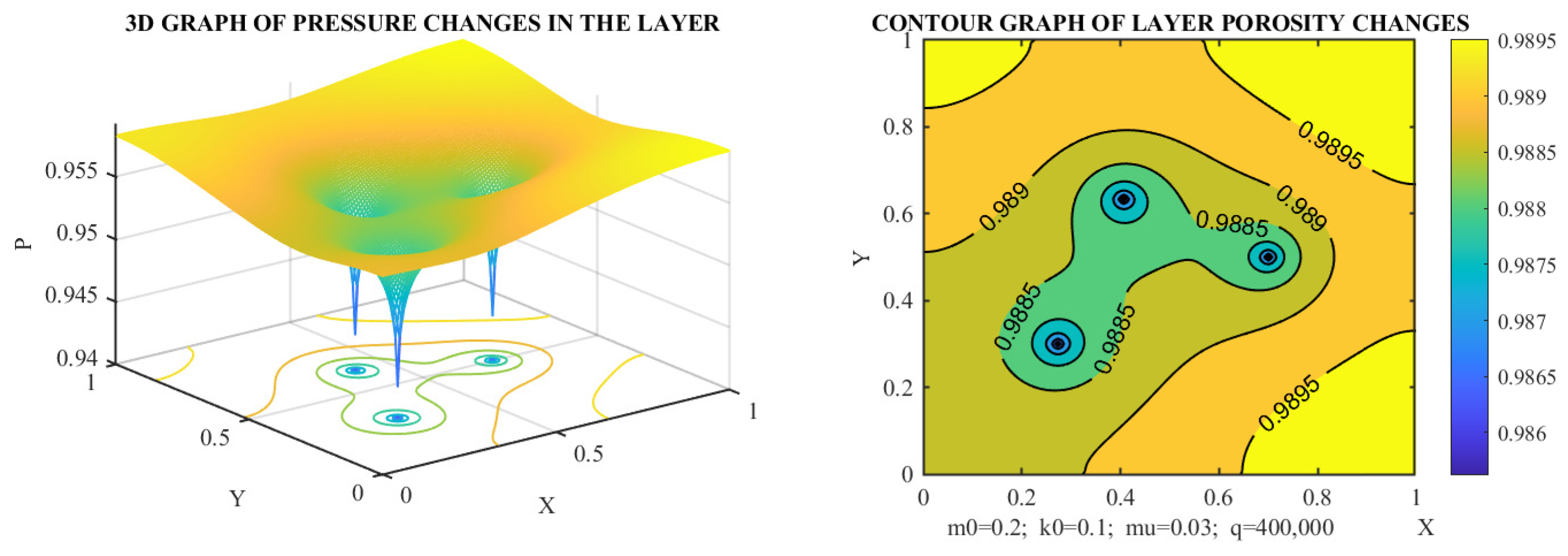
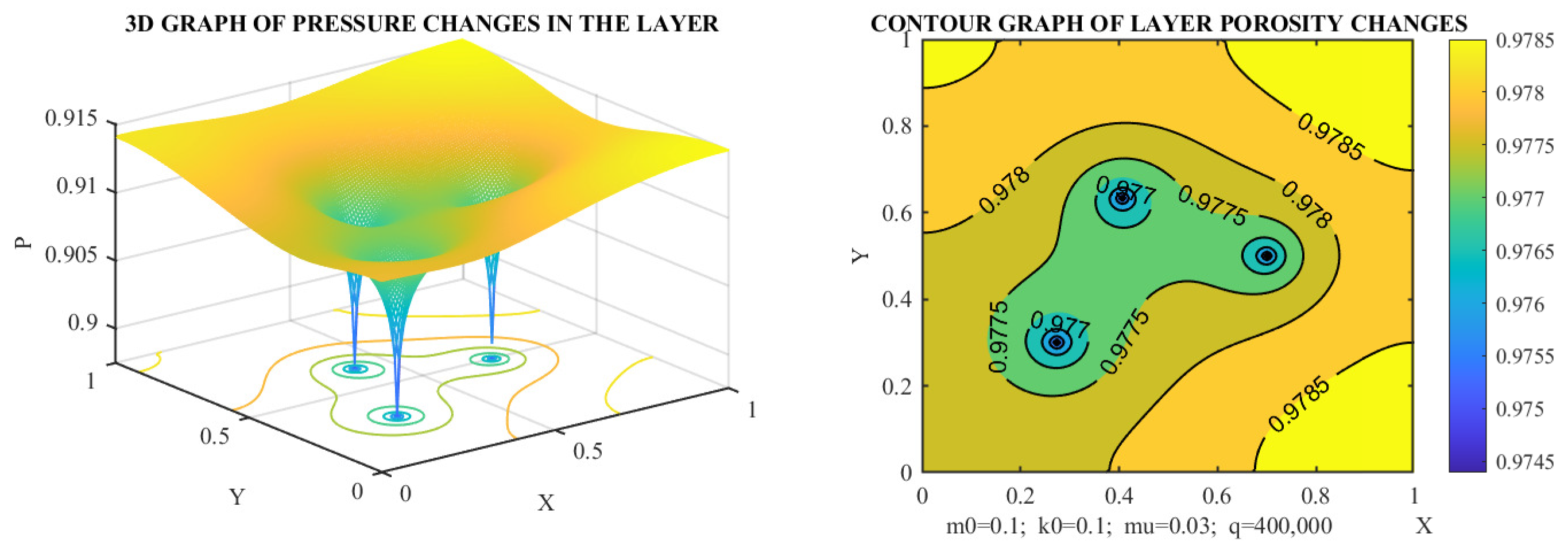
Figure 3, Figure 4, Figure 5, Figure 6, Figure 7 and Figure 8 present the computational results for various production scenarios, displaying both three-dimensional pressure distributions and corresponding contour plots of porosity variation after three years of production. The first set of experiments examines a configuration with three production wells positioned asymmetrically within the reservoir domain to investigate the development of pressure interference patterns and the resulting spatial heterogeneity in porosity evolution. Figure 3 and Figure 4 present comparative results for two distinct initial porosity values: m 0 = 0.1 and m 0 = 0.2 , while maintaining constant permeability ( k 0 = 0.1 Darcy), viscosity ( μ = 0.03 cP), and production rate (Q = 400,000 m3/day per well).
The computational results reveal several important phenomena. The three-dimensional pressure distributions clearly exhibit significant pressure depletion in the vicinity of each production well, with the magnitude of drawdown inversely related to the distance from well locations. The pressure gradients are steepest in the near-wellbore region, where flow velocities are highest. Comparison of Figure 3 and Figure 4 demonstrates that higher initial porosity ( m 0 = 0.2 ) facilitates more extensive pressure propagation throughout the reservoir. The enhanced pore space allows for greater fluid storage and more efficient pressure communication between different regions of the reservoir. Conversely, the lower porosity case ( m 0 = 0.1 ) exhibits more localized pressure depletion with steeper gradients near the wells, indicating that lower porosity values restrict the spatial extent of pressure disturbances. The contour plots reveal that porosity decreases in regions experiencing significant pressure depletion, consistent with the compressible nature of the rock matrix as described by the constitutive relation m = m 0 [ 1 + β c ( P P 0 ) ] . For typical rock compressibility values, the pressure reduction leads to pore space compaction, reducing the local porosity coefficient. This effect is most pronounced near the production wells where pressure drawdown is greatest. The porosity variation contours exhibit irregular, asymmetric patterns that reflect the complex interaction between multiple wells and the heterogeneous pressure field.
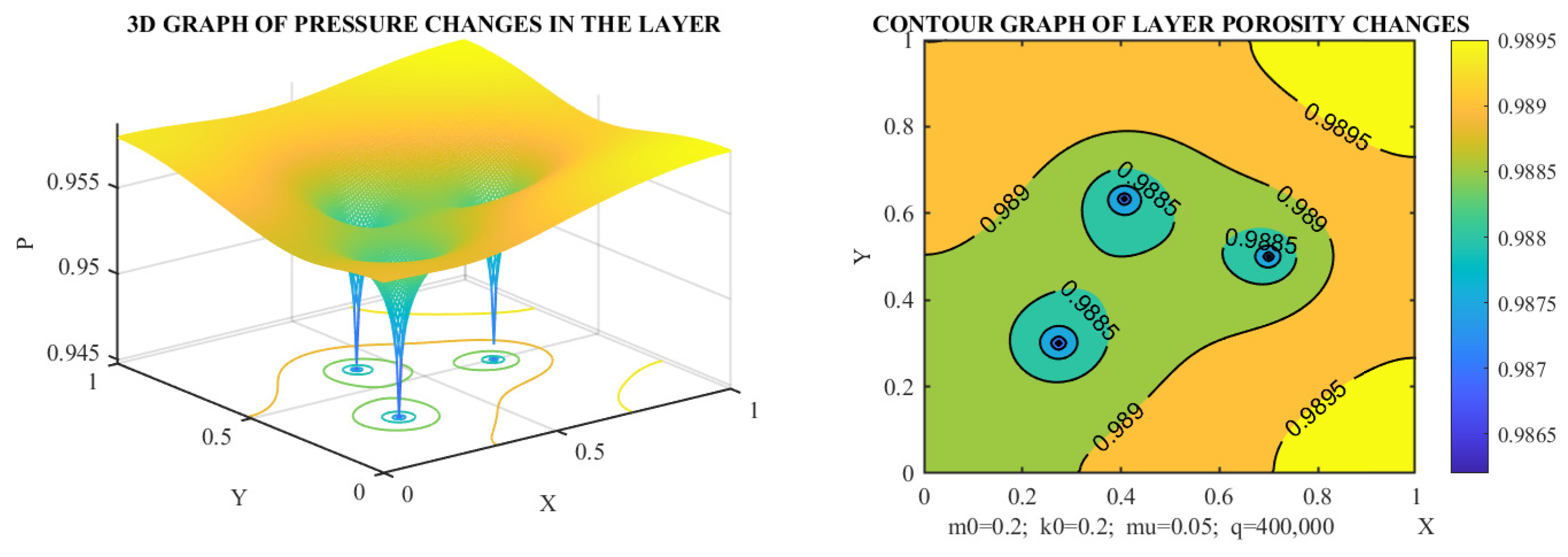
Figure 5 illustrates a case with higher permeability ( k 0 = 0.2 Darcy) and increased viscosity ( μ = 0.05 cP) while maintaining m 0 = 0.2 and Q = 400,000 m3/day. The simulation results reveal the competing effects of permeability and viscosity on reservoir behavior. Doubling the permeability from 0.1 to 0.2 Darcy significantly improves the reservoir’s ability to transmit pressure disturbances. The pressure field exhibits more gradual spatial variations, and the pressure depletion is distributed more uniformly across the reservoir domain. This enhanced connectivity reduces the severity of near-wellbore pressure drawdown. However, the increased gas viscosity (from 0.03 to 0.05 cP) impedes fluid flow by increasing the resistance to motion, partially counteracting the permeability enhancement and resulting in slower pressure propagation rates. The temporal evolution of the pressure field is retarded, requiring longer time periods to achieve quasi-steady state conditions. The combined influence of higher permeability and viscosity produces a more moderate spatial variation in porosity compared to the baseline case, with porosity changes remaining localized near the wells but exhibiting smoother gradients due to the improved pressure transmission characteristics.
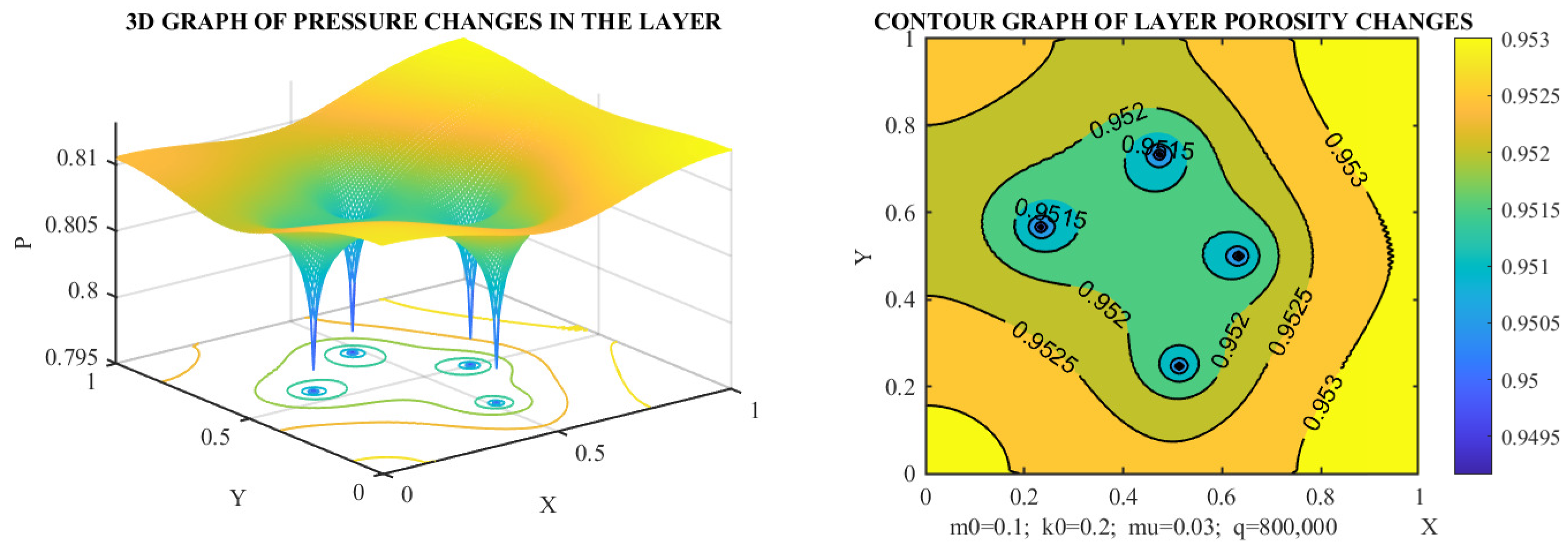
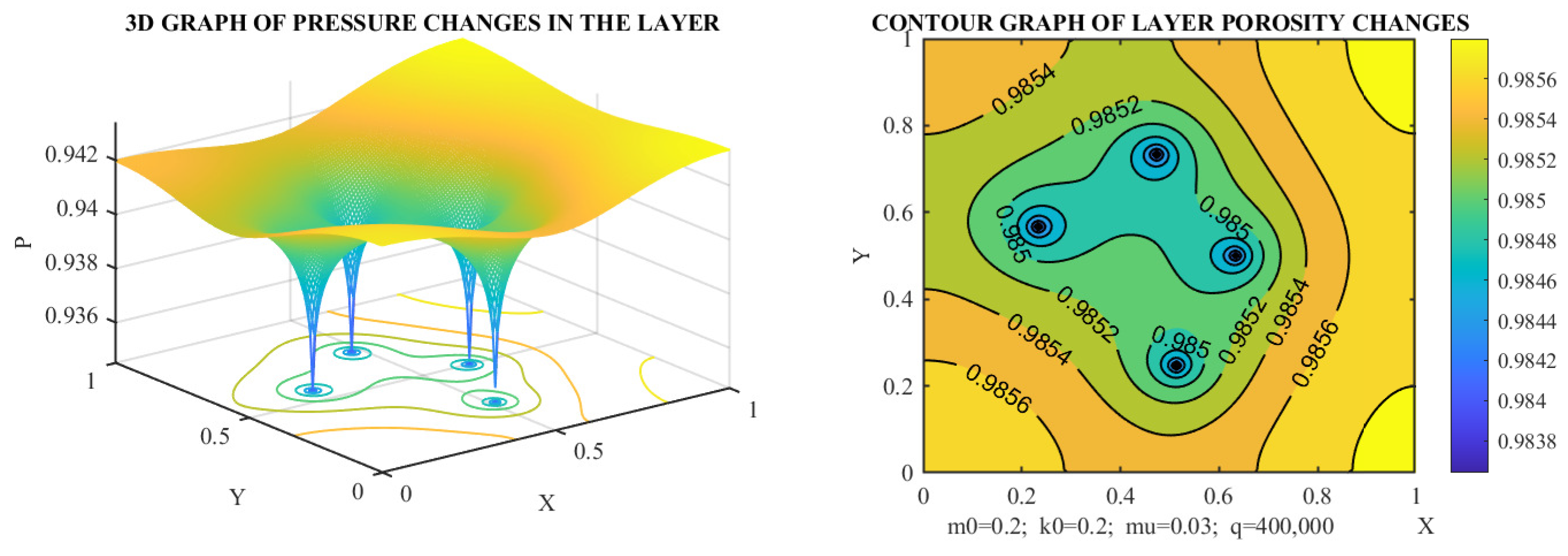
The subsequent set of computational experiments examines a more intensive production configuration with four wells operating simultaneously, representative of field development strategies aimed at maximizing recovery rates through increased well density. Figure 6 and Figure 7 present the pressure and porosity distributions for initial porosity values of m 0 = 0.1 and m 0 = 0.2 , respectively, under four-well production conditions. In Figure 6, the reservoir operates with parameters k 0 = 0.2 Darcy, μ = 0.03 cP, and individual well production rate of Q = 800,000 m3/day. The three-dimensional pressure field demonstrates substantial pressure depletion throughout the reservoir, with particularly severe drawdown in the near-wellbore regions. The presence of four closely-spaced production wells creates significant pressure interference patterns, where the pressure drawdown cones from adjacent wells overlap extensively, producing composite depletion zones that are substantially more extensive than the sum of individual well effects. This nonlinear superposition is particularly evident in the central region of the reservoir where multiple wells influence the pressure field simultaneously, creating a complex three-dimensional pressure surface with multiple local minima corresponding to well locations. The doubled production rate per well (800,000 vs. 400,000 m3/day in the three-well scenario) combined with increased well density results in substantially greater overall pressure depletion throughout the reservoir. After three years of continuous production, the average reservoir pressure has declined significantly more than in the three-well configuration, reflecting the more aggressive extraction regime.
The porosity contour plot in Figure 6 reveals significantly more complex spatial patterns compared to the three-well configuration. The regions of maximum porosity reduction extend further from each wellbore and merge in the inter-well regions, creating continuous zones of reduced porosity that span substantial portions of the reservoir domain. For the lower initial porosity case ( m 0 = 0.1 ), the porosity reduction is particularly pronounced, with some near-wellbore regions experiencing reductions of up to 15–20% relative to the initial value. This phenomenon has critical implications for long-term reservoir performance, as the reduced porosity diminishes the effective storage capacity of the rock matrix and alters the pressure diffusivity, potentially leading to accelerated pressure decline in subsequent production periods. The geometric patterns of porosity variation exhibit characteristic elliptical zones extending from each well, with the major axes oriented along lines connecting adjacent wells where pressure interference is strongest. The spatial extent of these compaction zones is governed by the interplay between production rate, rock compressibility, and the time-dependent pressure distribution.
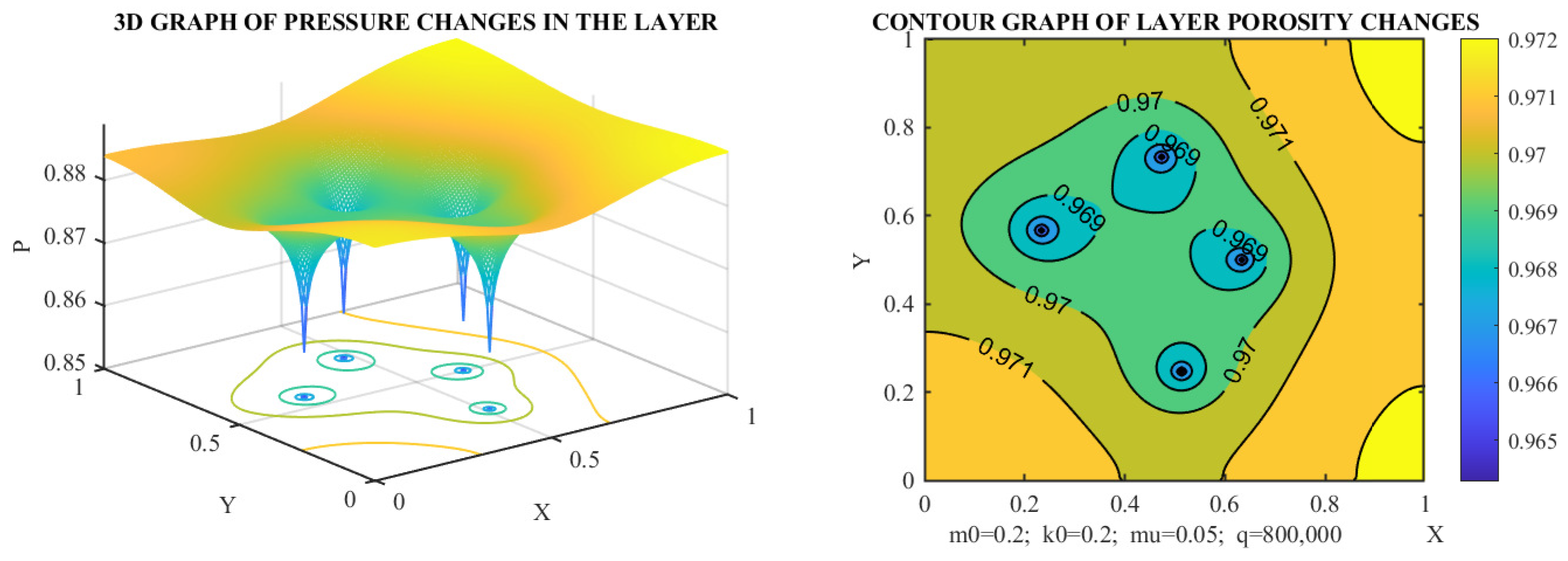
Figure 7 presents results for the same four-well configuration but with doubled initial porosity ( m 0 = 0.2 ) and increased gas viscosity ( μ = 0.05 cP), while maintaining k 0 = 0.2 Darcy and Q = 800,000 m3/day per well. The higher initial porosity provides enhanced storage capacity and improved pressure communication throughout the reservoir. The three-dimensional pressure distribution exhibits more gradual spatial variations compared to Figure 6, with the pressure declining more uniformly across the domain. This improved pressure transmission reduces the severity of localized drawdown near individual wells, distributing the pressure depletion more evenly across the reservoir. However, the increased gas viscosity ( μ = 0.05 cP) introduces significant flow resistance that moderates the rate of pressure propagation. The viscous resistance becomes increasingly important at high production rates, where the pressure gradients driving flow are substantial. The simulation results demonstrate that despite the enhanced permeability of k 0 = 0.2 Darcy, the elevated viscosity slows pressure equilibration, requiring substantially longer time periods to achieve comparable pressure depletion patterns. Quantitatively, the pressure propagation velocity is reduced by approximately 35–40% compared to the lower viscosity case, illustrating the dominant role of viscous forces in governing flow dynamics at high extraction rates.
The porosity evolution patterns in Figure 7 differ markedly from those observed in the lower porosity case. The regions of porosity reduction exhibit more diffuse boundaries and smoother spatial gradients, reflecting the improved pressure transmission characteristics associated with higher initial porosity. The maximum porosity reduction near wellbores is approximately 10–12% for this case, somewhat less than the 15–20% observed in Figure 6, despite the higher absolute production rates. This apparent paradox is explained by the constitutive relation m = m 0 [ 1 + β c ( P P 0 ) ] : although the absolute pressure drop may be similar in both cases, the higher initial porosity value m 0 = 0.2 results in greater absolute pore volume, which better accommodates the volumetric changes associated with pressure depletion. Additionally, the more uniform pressure distribution in the higher porosity case prevents the formation of extremely localized high-gradient regions where compaction would be most severe. The spatial correlation between pressure minima and porosity reduction zones is clearly evident, with the most significant porosity changes occurring within a characteristic radius of approximately 500–800 m from each production well, beyond which the pressure field becomes relatively uniform and porosity variations diminish substantially.
Figure 8 presents results for a four-well configuration with deliberately asymmetric production rates, designed to investigate the effects of non-uniform extraction strategies on pressure and porosity distributions. In this scenario, two wells positioned in opposite corners of the domain produce at the higher rate of Q = 800,000 m3/day, while the remaining two wells operate at Q = 400,000 m3/day. The reservoir parameters are m 0 = 0.2 , k 0 = 0.2 Darcy, and μ = 0.03 cP. The three-dimensional pressure field exhibits pronounced asymmetry, with the high-rate wells generating significantly deeper drawdown cones compared to their lower-rate counterparts. The pressure at the high-rate well locations drops to approximately 60–65% of the initial reservoir pressure after three years, while the low-rate wells experience more moderate pressure reduction to approximately 75–80% of initial pressure. This differential drawdown creates strong lateral pressure gradients that drive cross-flow from the vicinity of low-rate wells toward high-rate wells, establishing preferential flow pathways that persist throughout the production period. The pressure field exhibits characteristic saddle points in the inter-well regions, where flow patterns transition from radial convergence near individual wells to larger-scale circulation patterns driven by the asymmetric production strategy.
The porosity distribution in Figure 8 reflects the asymmetric pressure field, with the most substantial porosity reduction occurring in the vicinity of the high-rate production wells. The contour patterns reveal elongated zones of reduced porosity extending from high-rate toward low-rate wells, aligned with the principal directions of pressure gradient and fluid flow. The porosity reduction near high-rate wells reaches approximately 14–16%, while near low-rate wells it is limited to 8–10%, demonstrating the strong coupling between production rate, local pressure drawdown, and formation compaction. The spatial heterogeneity in porosity distribution has important implications for reservoir management, as it creates regions of varying flow resistance that can further amplify the initial production asymmetry over time. Areas of reduced porosity exhibit diminished permeability through well-established porosity-permeability relationships, creating a positive feedback mechanism where high-rate wells experience progressively increasing flow resistance, potentially limiting their long-term productivity. This phenomenon suggests that dynamic production optimization strategies that periodically adjust individual well rates may be necessary to achieve uniform reservoir depletion and maximize ultimate recovery efficiency.

4. Discussion

The comprehensive set of computational experiments for four-well configurations enables detailed assessment of well interference effects, production rate impacts, and the complex interplay between reservoir properties and operational parameters. The simulations demonstrate that increased well density and higher production rates, while initially enhancing production volumes, introduce substantial complexity in pressure and porosity evolution that must be carefully managed. The nonlinear coupling between pressure-dependent porosity and permeability creates time-dependent reservoir properties that significantly influence long-term field performance. The results indicate that optimal field development strategies must balance the economic benefits of aggressive production against the potential for formation damage and reduced ultimate recovery. The numerical framework developed in this study provides reservoir engineers with a powerful tool for evaluating alternative development scenarios and identifying operational strategies that maximize recovery while preserving reservoir integrity throughout the field life.

5. Conclusions

Our computational study has developed a comprehensive mathematical framework for analyzing unsteady gas filtration processes in porous media with explicit consideration of pressure-dependent porosity variations. The mathematical model, formulated as a nonlinear parabolic boundary value problem, incorporates the constitutive relationship m = m 0 [ 1 + β c ( P P 0 ) ] to capture the dynamic evolution of rock properties during production operations. The numerical solution methodology combines the Alternating Direction Implicit (ADI) scheme with quasi-linearization techniques, achieving computational efficiency of O ( N x N y N τ ) while maintaining second-order accuracy in both space and time.
Extensive computational experiments examining three and four production well configurations over a three-year period revealed several fundamental insights. Initial porosity exerts dominant control over pressure propagation, with lower values ( m 0 = 0.1 ) producing localized depletion and steep gradients, while higher porosity ( m 0 = 0.2 –0.3) facilitates uniform pressure distribution. Permeability enhancement from 0.1 to 0.5 Darcy reduces near-wellbore pressure drops by up to 30%, while increased gas viscosity from 0.02 to 0.05 cP slows pressure propagation rates by approximately 40%. The pressure-dependent porosity variations produce significant formation compaction, with porosity reductions of 15–20% observed in near-wellbore regions for low initial porosity cases under aggressive production, extending over characteristic radial distances of 500–800 m from production wells.
Multi-well configurations demonstrated substantial pressure interference effects, with overlapping drawdown cones creating composite depletion zones more extensive than individual well contributions. Asymmetric production scenarios with non-uniform well rates revealed preferential flow pathways and differential porosity reduction (14–16% near high-rate wells versus 8–10% near low-rate wells), establishing feedback mechanisms that amplify initial production asymmetries over time. These findings have critical implications for reservoir management: well spacing must balance production efficiency against interference effects, while production rates should be moderated to prevent irreversible formation damage. The strong sensitivity to porosity and permeability underscores the importance of accurate formation characterization, and the dynamic nature of pressure-dependent properties demonstrates that reservoir models must explicitly account for time-dependent property evolution to provide reliable long-term forecasts. The numerical framework developed in this study provides reservoir engineers with a powerful tool for evaluating field development scenarios, optimizing production strategies, and maximizing recovery efficiency while preserving reservoir integrity throughout the production life.

Author Contributions

Conceptualization, E.N., A.N. and G.A.; methodology, E.N. and A.N.; software, G.A. and S.I.; validation, A.N., G.A. and E.N.; formal analysis, G.A. and S.I.; investigation, G.A. and S.I.; resources, G.A., S.I. and M.S.; data curation, G.A., A.R.N. and M.M.; writing—original draft preparation, G.A., S.I. and M.S.; writing—review and editing, A.N. and G.A.; visualization, G.A., S.I. and M.M.; supervision, E.N., A.N. and G.A. All authors have read and agreed to the published version of the manuscript.

Funding

This research received no external funding.

Data Availability Statement

The original contributions presented in this study are included in the article. Further inquiries can be directed to the corresponding author.

Acknowledgments

This research was supported by the State Budget Republic of Uzbekistan.

Conflicts of Interest

The authors declare no conflicts of interest.

References

  1. Nazirova, E.S.; Sadikov, R.T.; Ne’matov, A.R.; Ismailov, S.R. Visualization of the Results of Computing Experiments for Monitoring and Analysis of Filtration Processes in a Non-General Layer of Oil Fields. In Proceedings of the International Conference on Information Science and Communications Technologies: Applications, Trends and Opportunities (ICISCT 2021), Tashkent, Uzbekistan, 3–5 November 2021; pp. 1–4. [Google Scholar] [CrossRef]
  2. Nazirova, E.; Shukurova, M.; Artikbayeva, G. Visualization of the Results of Numerical Calculations in Graphical Object View in the Design of Oil and Gas Systems. AIP Conf. Proc. 2024, 3244, 020014. [Google Scholar] [CrossRef]
  3. Nematov, A.; Ismailov, S.; Artikbaeva, G. Numerical Simulation of the Boundary Problem of Filtration in Two-Layer Porous Media with Changing Porosity Coefficient Depending on Pressure. In Proceedings of the IEEE 3rd International Conference on Problems of Informatics, Electronics and Radio Engineering (PIERE 2024), Novosibirsk, Russia, 15–17 November 2024; pp. 920–925. [Google Scholar] [CrossRef]
  4. Ravshanov, N.; Nematov, A.; Artikbaeva, G.; Ismailov, S. Mathematical modeling of the process of changing the porosity coefficient depending on pressure in dynamically connected gas layers. Mech. Fluids 2024, 3, 44–57. (In Russian) [Google Scholar]
  5. Zakirov, S.N.; Lapuk, B.B. Design and Development of Gas Fields; Nauka: Moscow, Russia, 1974; p. 376. [Google Scholar]
  6. Sergeev, V.L.; Nguyen, T.H.; Vu, Q.D. Models and algorithms for identification of oil and gas reservoirs by the adaptive method of deterministic pressure moments. Proc. Tusur Univ. 2018, 4, 109–115. [Google Scholar] [CrossRef]
  7. Shurina, E.P.; Itkina, N.B.; Trofimova, S.A. Mathematical modelling of the filtration process in a porous medium based on non-conformal mixed finite element formulation. Comput. Technol. 2020, 25, 42–54. [Google Scholar] [CrossRef]
  8. Duran, O.; Devloo, P.R.; Gomes, S.M.; Valentin, F. A multiscale hybrid method for Darcy‘s problems using mixed finite element local solvers. Comput. Methods Appl. Mech. Engrgl. 2019, 354, 213–244. [Google Scholar] [CrossRef]
  9. Carvalho, P.G.; Devloo, P.R.; Gomes, S.M. On the use of divergence balanced Hdiv-L2 pair of approximation spaces for divergence-free and robust simulations of Stokes, coupled Stokes—Darcy and Brinkman problems. Math. Comput. Simul. 2020, 170, 51–78. [Google Scholar] [CrossRef]
  10. Armentano, M.G.; Stockdale, M.L. A unified mixed finite element approximation of the Stokes-Darcy coupled problem. Comput. Math. Appl. 2019, 77, 2568–2584. [Google Scholar] [CrossRef]
  11. Liang, W.; Xu, D.; Rui, H. A multipoint flux mixed finite element method for the compressible Darcy-Forchheimer models. Appl. Math. Comput. 2017, 315, 259–277. [Google Scholar]
  12. Knabner, P.; Roberts, J. Mathematical analysis of a discrete fracture model couplingDarcy flow in the matrix with Darcy-Forchheimer flow in the fracture. Esaim Math. Model. Numer. Anal. 2014, 48, 1451–1472. [Google Scholar] [CrossRef]
  13. Spiridonov, D.; Vasilyeva, M.; Chung, E.T. Generalized multiscale finite element method for multicontinua unsaturated flow problems in fractured porous media. J. Comput. Appl. Math. 2020, 370, 112594. [Google Scholar] [CrossRef]
  14. Kireev, T.F.; Bulgakova, G.T. Near-well upscaling for simulation of wells with hydraulic fractures. Matem. Mod. 2019, 31, 97–108. [Google Scholar]
  15. Samarskii, A.A. The Theory of Difference Schemes; CRC Press: New York, NY, USA, 2001. [Google Scholar]
  16. Bellman, R.; Kalaba, R. Quasilinearization and Nonlinear Boundary-Value Problems; American Elsevier Publishing Company: New York, NY, USA, 1965; p. 206. [Google Scholar]
Figure 1. Flow diagram for calculating the main indicators in gas field development.
Modelling 07 00030 g001
Figure 2. Flow diagram for calculating finite difference coefficients and the sweep modulus method.
Modelling 07 00030 g002
Figure 3. Pressure distribution and porosity variation in a three-well configuration: m 0 = 0.1 , k 0 = 0.1 Darcy, μ = 0.03 cP, Q = 400,000 m3/day. Three-dimensional pressure field showing pronounced drawdown near wellbores in left hand side and corresponding Contour plot of porosity coefficient demonstrating localized variations near production wells in right hand side.
Modelling 07 00030 g003
Figure 4. Pressure distribution and porosity variation in a three-well configuration: m 0 = 0.2 , k 0 = 0.1 Darcy, μ = 0.03 cP, Q = 400,000 m3/day. Three-dimensional pressure field exhibiting more extensive pressure propagation compared to lower porosity case in the left hand side and corresponding Contour plot of porosity coefficient showing enhanced spatial extent of porosity changes in right hand side.
Modelling 07 00030 g004
Figure 5. Pressure distribution and porosity variation for enhanced permeability and viscosity: m 0 = 0.2 , k 0 = 0.2 Darcy, μ = 0.05 cP, Q = 400,000 m3/day. The higher permeability promotes more uniform pressure distribution, while increased viscosity moderates the rate of pressure propagation.
Modelling 07 00030 g005
Figure 6. Pressure distribution and porosity variation in a four-well configuration: m 0 = 0.1 , k 0 = 0.2 Darcy, μ = 0.03 cP, Q = 800,000 m3/day. The increased well density and production rate result in substantial pressure interference between adjacent wells, with the three-dimensional pressure field showing complex drawdown patterns and the porosity contours revealing extensive regions of formation compaction near production wells.
Modelling 07 00030 g006
Figure 7. Pressure distribution and porosity variation in a four-well configuration: m 0 = 0.2 , k 0 = 0.2 Darcy, μ = 0.05 cP, Q = 800,000 m3/day. Higher initial porosity facilitates more extensive pressure propagation, while increased viscosity moderates pressure decline rates. The porosity contours show more diffuse patterns with smoother gradients compared to the lower porosity case in Figure 6.
Modelling 07 00030 g007
Figure 8. Pressure distribution and porosity variation with asymmetric well production rates: m 0 = 0.2 , k 0 = 0.2 Darcy, μ = 0.03 cP. Two wells produce at Q = 800,000 m3/day while two produce at Q = 400,000 m3/day. The asymmetric production strategy creates highly non-uniform pressure and porosity fields, with preferential flow pathways developing between wells of different production rates. The porosity reduction is most severe near high-rate production wells.
Modelling 07 00030 g008
Table 1. Physical parameters and their values for computational experiments.
Physical ParameterSymbolValue RangeUnits
Initial reservoir pressure P 0 300atm
Gas dynamic viscosity μ 0.02–0.05cP
Initial permeability k 0 0.1–0.5Darcy
Initial porosity coefficient m 0 0.1–0.3-
Well production rateQ400,000–800,000m3/day
Reservoir characteristic lengthL10,000m
Total simulation timeT1080days
Temporal resolution Δ t 24days
Rock compressibility β c Variableatm−1
Disclaimer/Publisher’s Note: The statements, opinions and data contained in all publications are solely those of the individual author(s) and contributor(s) and not of MDPI and/or the editor(s). MDPI and/or the editor(s) disclaim responsibility for any injury to people or property resulting from any ideas, methods, instructions or products referred to in the content.