Article

Comparative Evaluation of Event-Based Forecasting Models for Thai Airport Passenger Traffic

by
Thanrada Chaikajonwat
* and
Autcha Araveeporn
Department of Statistics, School of Science, King Mongkut’s Institute of Technology Ladkrabang, Bangkok 10520, Thailand
*
Author to whom correspondence should be addressed.
Modelling 2026, 7(1), 26; https://doi.org/10.3390/modelling7010026
Submission received: 4 December 2025 / Revised: 15 January 2026 / Accepted: 19 January 2026 / Published: 20 January 2026

Abstract

Accurate passenger traffic forecasting is vital for strategic planning in Thailand’s aviation industry. This study forecasts the monthly total number of passengers at Suvarnabhumi (BKK), Don Mueang (DMK), Chiang Mai (CNX), and Phuket (HKT) airports using data from 2017 to 2024. The dataset was partitioned into training (January 2017–December 2023) and testing (January–December 2024) sets. Six methods were compared: Single Exponential Smoothing, Holt’s, Holt’s with Events Adjustment, Holt–Winters Multiplicative, TBATS model, and Box–Jenkins. Performance was evaluated using Mean Absolute Percentage Error (MAPE) and Mean Absolute Error (MAE). The results indicate that the optimal forecasting method varies by airport characteristics. Holt’s Method with Events Adjustment, which incorporates major disruptions such as the COVID-19 pandemic, produced the most accurate forecasts for BKK and DMK by effectively capturing external shocks. In contrast, the Holt–Winters Multiplicative method performed best for CNX and HKT, reflecting strong seasonal patterns typically driven by tourism activities in these destinations.

1. Introduction

As a cornerstone of modern economic infrastructure, the aviation industry is crucial for sustaining national economic growth, particularly in economies that heavily rely on international tourism and trade [1]. Accurate forecasting of passenger traffic is therefore fundamental to strategic planning, enabling airport authorities to anticipate demand fluctuations, allocate resources efficiently, and ensure service reliability. It also supports policymakers in designing adaptive strategies for tourism recovery and transport sustainability. Inaccurate forecasts can lead to serious consequences: overestimation results in unnecessary costs and idle capacity, while underestimation causes congestion, delays, and reduced service quality. Consequently, developing robust and adaptive forecasting models has become an essential task for managing the aviation sector.
The aviation industry serves as a crucial infrastructure underpinning national economic development, particularly for a nation like Thailand, which relies heavily on international tourism and trade [2]. The country’s primary airports—Suvarnabhumi (BKK), Chiang Mai (CNX), Don Mueang (DMK), and Phuket (HKT)—managed by the Airports of Thailand Public Company Limited (AOT) function as vital gateways, accommodating tens of millions of passengers annually [3]. Thailand’s aviation sector plays a pivotal role in facilitating the movement of people and goods to and from domestic and international destinations, serving as a cornerstone of the nation’s tourism-driven economy. The tourism industry contributes approximately 18–20% of Thailand’s GDP [4], and air transport accounts for the majority of international tourist arrivals. In addition to its economic importance, the aviation network supports regional connectivity, investment attraction, and trade logistics, linking Thailand to major financial hubs in Asia and beyond [3].
However, Thailand’s aviation sector was profoundly disrupted in 2019 by the COVID-19 pandemic, which triggered unprecedented global travel restrictions and a sharp decline in passenger mobility. International border closures, mandatory quarantine measures, and nationwide lockdowns led to passenger volumes at all major Thai airports falling to historic lows. This abrupt and prolonged shock not only affected airline operations and airport revenues but also posed substantial challenges for Thailand’s tourism-dependent economy. Several studies have shown that the COVID-19 crisis created severe structural breaks in global and regional air travel demand [5,6], disrupting traditional forecasting patterns and invalidating the assumptions underlying classical time-series models. For instance, Suau-Sanchez et al. [7] demonstrated a dramatic collapse in international air traffic, with long-term implications for network connectivity and route viability. Similarly, Gudmundsson et al. [8] highlighted that aviation demand during the pandemic exhibited extreme volatility, nonlinearity, and abrupt shifts that conventional ARIMA and exponential smoothing models failed to capture. In the Asian context, studies such as Maneenop and Kotcharin [9] emphasized that countries heavily reliant on tourism, such as Thailand, experienced disproportionately severe losses, reinforcing the need for forecasting models that can adjust to external shocks. The pandemic highlighted the aviation industry’s vulnerability to sudden disruptions. It underscored the need for more adaptive forecasting models that can capture structural breaks and irregular fluctuations in air passenger demand.
Traditional time series models, such as the Box–Jenkins Method to create Autoregressive Integrated Moving Average (ARIMA) models and Exponential Smoothing methods, have long been employed in aviation forecasting due to their interpretability and adaptability to trend and seasonal patterns [10,11]. Among these, Holt’s Method, also known as Double Exponential Smoothing, is particularly effective for data exhibiting long-term growth trends, as it accounts for both level and trend components of a time series [12]. The Holt–Winters method further extends this framework by incorporating a seasonal component, making it well-suited for forecasting data characterized by both trend and seasonality, such as monthly or quarterly air passenger volumes [13].
However, both Holt’s and Holt–Winters methods assume a relatively smooth temporal evolution. They may not adequately capture abrupt structural changes or irregular patterns caused by unexpected events such as pandemics, natural disasters, or sudden policy interventions. Recent studies have emphasized that such “event shocks” can substantially distort passenger volume forecasts, particularly during the COVID-19 pandemic period, when travel restrictions and behavioral changes disrupted standard travel patterns [14,15].
To overcome these limitations, more advanced models such as the TBATS (Trigonometric, Box–Cox transformation, ARMA errors, Trend, and Seasonal components) have been developed. The TBAT model enhances the traditional exponential smoothing approach by allowing for multiple and complex seasonality, long-term nonlinear trends, and the inclusion of ARMA error structures [16]. Its flexibility enables the effective modeling of high-frequency, nonstationary aviation data, providing greater adaptability to structural breaks and irregular fluctuations.
Although ARIMA and exponential smoothing approaches, including Holt’s and Holt–Winters, are well-established and widely applied, their ability to account for abrupt external events remains limited. Several studies have highlighted these limitations. For example, Ghasemi et al. [17] reported that classical linear time series models fail to adequately capture the nonstationary and irregular behavior observed during the COVID-19 period, while Nižetić [18] demonstrated that the severe disruption to air travel patterns rendered traditional forecasting assumptions unreliable. In the Asian context, Sun, Wandelt, and Zhang [5] emphasized that aviation markets experienced heightened volatility and nonlinear structural changes throughout the pandemic, necessitating more flexible modeling frameworks. In contrast, the TBATS model provides a more adaptable structure that can accommodate complex multi-seasonal patterns and sudden shifts in aviation demand, thereby enhancing the accuracy and robustness of passenger traffic forecasts, an advantage supported by the findings of De Livera et al. [16].
An empirical evaluation is conducted using monthly data on total passenger volumes from the four major Thai airports (BKK, DMK, CNX, and HKT) spanning from January 2017 to December 2024. The dataset is divided into a training set (2017–2024) for model estimation and a testing set (2024) for validation. Four models, namely Holt’s Method, Holt–Winters Method, TBAT, and Holt–Winters Method with Events, are compared using the Mean Squared Error (MSE) and Mean Absolute Percentage Error (MAPE) as performance indicators. The results are expected to provide insights into the relative efficiency of event-based forecasting approaches for transportation systems.
The main contributions of this study are threefold. First, it extends the double exponential smoothing, also known as Holt’s, by incorporating an event-adjustment component that explicitly models external disruptions. Second, it provides a comparative performance analysis of three forecasting methods using real-world passenger traffic data from Thailand’s major airports. Third, it offers practical guidance for airport authorities and policymakers in developing more resilient forecasting systems to support operational and strategic planning under uncertainty.
The remainder of this paper is organized as follows: Section 2 reviews related studies on air passenger forecasting and event modeling. Section 3 outlines the research methodology. The experimental results are presented in Section 4, followed by a discussion in Section 5. Finally, Section 6 provides the conclusion and suggestions for future research.

2. Related Work

Previous work on forecasting methods for airport passenger volume and on incorporating the event component is surveyed and presented as follows.
Rattanametawee, Leenawong, and Netisopakul [19] proposed a multiple linear regression model that integrates seasonality and special-event effects to forecast sales of subcompact cars in Thailand. Using monthly data from January 2005 to September 2015, their model included Thailand’s GDP and loan interest rates as explanatory variables, 11 seasonal dummy variables, and four special-event dummy variables to represent the 2011 flood and the 2011–2012 tax-incentive program. The study compared this proposed model (Model 3) with a base model (Model 1) and a seasonal-only model (Model 2). The results proved that Model 3 was the most effective and accurate, achieving the highest Adjusted R 2 (85.89%) and the lowest MAPE (15.80%), significantly outperforming Model 1 (MAPE: 29.82%) and Model 2 (MAPE: 22.04%).
Himakireeti and Vishnu [20] focused on forecasting airline passenger occupancy using the Autoregressive Integrated Moving Average (ARIMA) model, a classical statistical approach to time-series analysis. The research aims to predict passenger counts per trip, a crucial factor for airline operations and business optimization. The optimal ARIMA(2,1,2) model was identified based on diagnostic checks and information criteria (AIC and BIC). The model’s predictive performance demonstrated a strong capability to capture the underlying trends and seasonal fluctuations in air traffic data. The results indicate that ARIMA models provide reliable and accurate forecasts, making them a competitive tool for practical airline demand prediction compared to more complex modern forecasting methods.
Rattanametawee and Leenawong [21] examined the impact of special events on sales data. They found that conventional time-series decomposition (TSD) forecasting models cannot adequately capture these effects, even when seasonality and trends are included. To address this, their research proposed a new method for computing “event indices” that represent unusual fluctuations in the time series. These indices are designed to be incorporated into the TSD model alongside the conventional trend, seasonal, and cyclical components. The authors examined a case study of monthly subcompact car sales in Thailand from 2011 to 2018, a period that included the negative impact of the 2011 nationwide flood and the positive impact of the government’s tax-incentive first-car buyer scheme. The study used the Mean Absolute Percentage Error (MAPE) to assess the proposed model’s accuracy, yielding promising results.
Persadanta [22] investigated passenger traffic forecasting at Sultan Hasanuddin International Airport (UPG), a central hub connecting eastern and western Indonesia. Using historical data from 1995 to 2015, the research aims to identify factors influencing air traffic patterns and to develop accurate short-term and long-term forecasting models. Time series methods, including the Holt–Winters and Decomposition techniques, were applied for short-term forecasts. At the same time, an econometric model incorporating GDP per capita and exchange rate variables was used for long-term projections. The Decomposition method outperformed the others, providing the best fit with the lowest MAPE. Back testing showed that the econometric model had an average deviation of only 0.5% between predicted and actual passenger movements.
Leenawong and Chaikajonwat [23] proposed a modified Holt’s forecasting method to account for the impact of significant events, using Thai monthly car sales during the COVID-19 pandemic as a case study. By introducing a dedicated “event component” with a new smoothing constant and “flagging” different pandemic stages (e.g., lockdowns, relief periods), their model was compared with the standard Holt’s method. The proposed method, which also included a seasonality adjustment, proved most accurate, lowering the Mean Absolute Percentage Error (MAPE) to 8.64% from the standard Holt’s 16.27%. The study concluded that explicitly modeling for such irregular events greatly enhances forecasting performance.
Kamoljitprapa et al. [24] analyzed Thailand’s import and export data from 2010 to 2022 using Holt–Winters and seasonal ARIMA models to identify the best forecasting approach. Results showed that the multiplicative Holt–Winters model achieved the highest accuracy, with the lowest MAE and RMSE, effectively capturing seasonal fluctuations and trade variations. The findings highlight its suitability for forecasting Thailand’s trade trends and supporting economic planning and policy decisions.
Furthermore, Drop and Bohman [25] applied the Holt–Winters exponential smoothing method to forecast passenger traffic at Szczecin–Goleniów Airport in Poland, using quarterly data from 2010 to 2024. Both additive and multiplicative models were tested, and the additive model provided more accurate results, capturing seasonal patterns and post-pandemic recovery with a lower MAPE of 43.7%. The forecast predicts a 3.75% increase in passenger numbers to approximately 497,000 in 2025, with peak traffic expected in the summer. The results offer practical insights for airport capacity planning and sustainable management, supporting data-driven decisions for future infrastructure and operational strategies.
Patel et al. [26] introduced a hybrid TBATS-Boosting model that combines the statistical strengths of TBATS with the predictive power of LightGBM to enhance hourly passenger flow forecasting in urban transit systems. Using five years of real-world data from Thane Municipal Transport in India, the model captures complex seasonal patterns, nonlinear relationships, and external influences, such as holidays and the impact of COVID-19. Experimental results show that TBATS Boosting outperforms SARIMA, TBATS, XGBoost, and LightGBM in forecasting accuracy, achieving the lowest MAE, RMSE, and MAPE across various passenger demand levels. The proposed model provides a robust, adaptive tool for enhancing operational planning and decision-making in public transportation.

3. Methodology

This section outlines the theoretical frameworks of the six forecasting methods employed in this study. The methodologies applied include Single Exponential Smoothing, Holt’s Method with Event Adjustment, Holt–Winters multiplicative, the TBATS model, and the Box–Jenkins method. The mathematical formulation and principles of each technique are described in the following subsections.

3.1. Single Exponential Smoothing Method (SES)

The single exponential smoothing method is another forecasting method in the smoothing methods group, similar to moving averages. This exponential smoothing method is based on the concept that the current error should adjust the current forecast, but this error is weighted by a smoothing constant α for the data level (Level smoothing constant), where 0 α 1 . Therefore, the forecast for the time t + 1 is equal to [27]:
F t + 1 =   α A t + 1 α F t
where A t refers to the actual value for the period t , and F t refers to the SES forecasted value for the period t .

3.2. Holt’s Method

The Holt’s method, also known as the double exponential smoothing method, is an extension of the single exponential smoothing method. While the basic method uses only one smoothing constant (α) for the level and is suitable for data without a clear trend, Holt’s method adds a second smoothing constant, β. The purpose of this second constant (β) is to specifically manage and forecast data that exhibits a trend [27].
  • Let α represents the smoothing constant for the level estimate; 0 α 1 ,
  • and β represents the smoothing constant for the trend estimate; 0 β 1 .
The Holt’s method can be performed in the following three steps.
  • Step 1: Computing the Level Estimate
  • Let A t represents the actual value for the period t ;
  • L t represents the level estimate for the period t ;
  • and T t represents the trend estimate for the period t .
The level estimate is obtained using the formula:
L t =   α A t + 1 α L t 1 +   T t 1
where the initial value for L t is L 2 = A 2 .
  • Step 2: Computing the Trend Estimate
The trend estimate is obtained using the formula:
T t = β L t L t 1 +   1   β T t 1
where the initial value for T t is T 2 = A 2 A 1 .
  • Step 3: Computing Holt’s Estimate
Let H t + m represents Holt’s forecasted value for period t + m .
The Holt’s estimate is obtained using the formula:
H t + m =   L t +   m T t
where m refers to the future period m t h ; m 1 .

3.3. Holt’s Method with Event Adjustment

To account for the significant impact of external shocks, such as the global COVID-19 pandemic, this study employs Holt’s Method with Event Adjustment. This approach extends the traditional Holt’s method, modifying its forecasting steps to incorporate an event component [23].
The modified method consists of four steps. While the first two steps for computing the level L t and trend T t estimates remain identical to the standard Holt’s method, a new step is introduced to calculate an event estimate, and the final forecasting formula is adjusted accordingly.
A key addition is the introduction of a third smoothing constant, δ, for the event component, where 0   δ   1 .
The Holt’s method with event adjustment can be performed in the following four steps.
  • Step 1: Computing the Level Estimate
  • Let A t represents the actual value for period t ;
  • L t represents the level estimate for period t ;
  • and T t represents the trend estimate for period t .
The level estimate is obtained using the formula:
L t =   α A t + 1 α L t 1 +   T t 1
where the initial value for L t is L 2 = A 2 .
  • Step 2: Computing the Trend Estimate
The trend estimate is obtained using the formula:
T t = β L t L t 1 + 1 β T t 1
where the initial value for T t is T 2 = A 2 A 1 .
  • Step 3: Computing the Event Estimate
The event estimate, E t k , is calculated using the following recursive formula:
E t k = 1 ;   k = 0 , E t k = δ A t L t + ( 1 δ ) E t k ;   k = 1 , 2 , 3 ,
where the flag k refers to the type of period, flag k = 0 for a normal period, k = 1 for the panic-state, lockdown, COVID-19 superspreading wave-1 period, k = 2 for the COVID-19 relief period after any wave, and k = 3 for the period in which any later COVID-19 superspreading wave occurs, and E t k refers to the event factor from the last occurrence of the same event flag k prior to period t.
This Formula (5) essentially updates the event estimate as a weighted average of the most recent event factor A t L t and the previous estimate for the same type of event.
The initialization of the event factor, E t k , for event types k 1 ,   2 ,   3 is defined by two distinct cases. For the first period t = 1 , the initial value is set to unity: E 1 k = 1 . For all subsequent periods t > 1 , the initial value is carried over from the event factor of the immediately preceding period, such that E t k = E t 1 .
  • Step 4: Computing Holt’s Forecast with Events Estimate
The final forecast, H E t + m , is then computed by multiplying the event component by the standard Holt’s forecast. The formula for a forecast m period into the future is:
H E t + m =   L t + m T t E t + m k
where m refers to the future period m t h ; m 1 .
Pandemic phase labels in the event-adjusted Holt model were assigned monthly using a deterministic, reproducible procedure. The labeling was conducted by the authors based solely on publicly available policy announcements issued by the Royal Thai Government, including nationwide lockdown measures, border closures and reopenings, and aviation-related regulations released by the Civil Aviation Authority of Thailand and the Ministry of Public Health. Each month was classified into one of four predefined categories: normal period, panic/lockdown period, relief period, or subsequent wave period, depending on whether that month overlapped with the corresponding policy regime. The classification relies exclusively on official policy dates and involves no subjective judgment, ensuring full reproducibility. A complete month-by-month event calendar is provided in Appendix A Table A1.

3.4. Holt–Winters Multiplicative Method

Triple Exponential Smoothing, also known as Winters’ method or Holt–Winters method, is a forecasting method that adds one more parameter to Holt’s method and is effective with time series data that comprises both trend and seasonality. Therefore, in addition to the smoothing constant α for the level and the smoothing constant β for the trend, a smoothing constant γ for seasonality (Seasonality Smoothing Constant) is added, where 0   γ   1 , similar to α and β [27].
The Holt–Winters Method can be performed in the following four steps.
  • Step 1: Computing the Level Estimate
  • Let A t represents the actual value for period t ;
  • L t represents the level estimate for period t ;
  • T t represents the trend estimate for period t ;
  • and S t represents the seasonal estimate for period t .
The level estimate is obtained using the formula:
L t = α A t S t p + ( 1 α ) L t 1 + T t 1
where p refers to the seasonal period; p 1 and the initial value for the level estimate is L p + 1 = A p + 1 S 1 .
  • Step 2: Computing the Trend Estimate
The trend estimate is obtained using the formula:
T t = β L t L t 1 +   1 β T t 1
where the initial value for the trend estimate is T p + 1 = L p + 1 A p S p .
  • Step 3: Computing the Seasonal Estimate
The seasonal estimate is obtained using the formula:
S t = γ A t L t + ( 1 γ ) S t p
The initialization of the first p seasonal factors ( S 1 , S 2 ,   , S p ) is performed by first computing the average of the actual values over the first seasonal cycle, A ¯ p = A 1 + A 2 + + A p p . Each initial seasonal factor S t (for t = 1 , , p ) is then calculated by dividing the corresponding actual value A t by this average, using the formula S t = A t A ¯ p .
  • Step 4: Computing the Holt–Winters Estimate
The Holt–Winters estimate is obtained using the formula:
W t + m =   L t + m T t S t + m p
where m refers to the future period m t h ; m 1 .

3.5. Box–Jenkins Method

The Box–Jenkins Method [10], primarily applied to ARIMA models, is a widely used approach for analyzing and forecasting time series data. The theory underlying the method is rooted in time-series analysis. It combines elements of autoregressive (AR) and moving-average (MA) models, along with differencing, to create a flexible and powerful statistical tool. The Box–Jenkins Method focuses on the ARIMA model, which stands for Autoregressive Integrated Moving Average. ARIMA models can handle different types of time series, especially non-stationary ones, by applying differencing and fitting a combination of AR and MA terms. The steps for the Box–Jenkins Method are defined below.
  • Step 1: Identification
This step aims to identify the values of p, d, and q by transforming the data into a stationary form and analyzing the autocorrelation and partial autocorrelation functions.
Check for stationarity using Autocorrelation Function (ACF) and Partial Autocorrelation Function (PACF) plots. The Augmented Dickey–Fuller (ADF) test is used to determine whether a time series is stationary.
If the series is not stationary, apply differencing to remove trends and seasonal components until it becomes stationary.
  • Step 2: Estimation
Once the p, d, and q values are tentatively identified, the model parameters will be estimated using methods like maximum likelihood estimation (MLE) [11]. The MLE approach estimates the parameters by maximizing the likelihood of the observed data. The estimated parameters must satisfy the invertibility and stationarity conditions:
  • Step 3: Diagnostic Checking
After estimating the model, check whether the residuals (forecast errors) are white noise. This ensures that the model has captured the underlying structure of the time series. The ACF of residuals is used to assess the residual analysis. If no significant autocorrelations are present, the model is a good fit. The Ljung–Box Q Test [10] is a statistical test that checks for autocorrelation in the residuals. If the test statistic is insignificant, the residuals are white noise, suggesting a good model fit.
  • Step 4: Forecasting
After diagnostic checks, use the model to forecast future time-series values. Compute forecasts based on the fitted ARIMA model using the following formula:
The AR model:
Y t = c + ϕ 1 Y t 1 + ϕ 2 Y t 2 + + ϕ P Y t P + ϵ t
where Y t is the value of the series at time t, c is a constant, ϕ 1 , ϕ 2 , , ϕ P are autoregressive parameters, ϵ t is white noise (random errors with mean zero and constant variance).
The MA model:
Y t = c + ϵ t + θ 1 ϵ t 1 + θ 2 ϵ t 2 + + θ Q ϵ t Q
where ϵ t is the white noise at time t , θ 1 , θ 2 , , θ Q are moving average parameters.
The ARIMA(p,d,q) Model:
Y t = 1 p = 1 P ϕ p L p ( 1 L ) d Y t = 1 + q = 1 Q θ q L q ϵ t c + ϵ t + θ 1 ϵ t 1 + θ 2 ϵ t 2 + + θ Q ϵ t Q
where L is the lag operator, ϕ p are the AR parameters, θ q are the MA parameters, d is the differencing order.

3.6. TBATS Method

The TBATS (Trigonometric, Box–Cox transformation, ARMA errors, Trend, and Seasonal components) model [16] extends the exponential smoothing state-space framework to accommodate complex time series exhibiting multiple seasonality, nonlinearity, and long-term trends. This model is particularly effective for series with both low- and high-frequency seasonal patterns, such as those observed in hourly, daily, and weekly periodicities in environmental, financial, and energy demand data [11]. The following procedure outlines the primary steps involved in fitting and forecasting using the TBATS method.
  • Step 1: Data Preparation
Before modeling, the time series y t t = 1 T must be preprocessed to ensure data quality. Missing observations are handled naturally within the state-space formulation using the Kalman filter. Outliers may be detected and corrected using robust filtering or median-based smoothing. The data should be equally spaced in time, and any irregularities should be documented.
  • Step 2: Variance Stabilization (Box–Cox Transformation)
To stabilize variance and improve normality, the Box–Cox transformation [28] is applied to the original series:
y t ( λ ) = y t λ 1 λ , λ 0 ln ( y t ) , λ = 0   ,
where λ is a transformation parameter estimated by maximizing the profile likelihood [29]. This transformation enhances the model’s ability to capture multiplicative seasonality and heteroscedasticity.
  • Step 3: Identification of Seasonal Periods
If the seasonal frequencies are not known a priori, they can be determined using spectral density analysis or autocorrelation diagnostics. The identified seasonal periods m j j = 1 J may represent weekly, monthly, or yearly cycles, or multiple overlapping seasonality, such as daily, weekly, and annual effects.
  • Step 4: Specification of the Trigonometric Seasonal Structure
For each seasonal period m j , the seasonal pattern is represented by K j trigonometric harmonics:
s j , t = k = 1 K γ j , k , t ,
where the states γ j , k , t and γ j , k , t * evolve according to
γ j , k , t = γ j , k , t 1   cos ( ω j , k ) + γ j , k , t 1 *   sin   ( ω j , k ) + ϕ 3 , j   ε t , γ j , k , t 1 * = γ j , k , t 1 sin   ( ω j , k ) + γ j , k , t 1 * cos ( ω j , k ) + ϕ 4 , j   ε t ,
and ω j , k = 2 π k / m j is the angular frequency. The number of harmonics K j is chosen to minimize the corrected Akaike Information Criterion (AIC).
  • Step 5: Trend and Level Equations
The non-seasonal part of the series is modeled through local level and growth components:
l t   =   l t 1 +   b t 1   +   α ε t ,
b t = ϕ b b t 1 + β ε t ,
  • Step 6: ARMA Error Specification
An ARMA model (p,q) captures the autocorrelation not explained by the deterministic components:
ε t = p = 1 P ϕ p ε t p + q = 1 Q θ q η t q + η t ,
where η t N ( 0 , σ 2 ) denotes white noise. The orders (p,q) are typically small and selected based on AIC.
  • Step 7: State-Space Representation
Combining the above equations, the TBATS model is formulated as a state-space system with the observation equation:
This allows estimation and forecasting using the Kalman filter and smoother.
  • Step 8: Initialization of States
Initial values for the level, trend, and seasonal states are obtained using diffuse priors or back-casting methods. Significant initial variances are assigned to allow the model to learn from the early observations.
  • Step 9: Parameter Estimation via Maximum Likelihood
The model parameters Θ = { λ , α , β , ϕ b   , { ϕ 3 , j , ϕ 4 , j   } , ( p , q ) , { ϕ p   , θ q   } , σ 2 } are estimated by maximizing the log-likelihood computed via the Kalman filter:
l ( Θ ) = 1 2 t = 1 T [ log | F t | ] + v t   F t 1 ν t   + log ( 2 π ) ] ,
where ν t and F t are the one-step-ahead prediction error and its variance, respectively. Optimization is performed numerically using algorithms such as BFGS or Nelder–Mead.
  • Step 10: Model Selection
Candidate models with different ( K j , p , q ) combinations are compared using AIC. The model with the lowest value is selected as the optimal specification, provided that residual diagnostics indicate no remaining autocorrelation.
  • Step 11: Diagnostic Checking
Residuals ε ^ t are analyzed to verify model adequacy. A valid TBATS model should yield residuals that are consistent with white noise, i.e., uncorrelated, homoscedastic, and approximately normally distributed. The Ljung–Box Q-statistic and residual ACF plots are typically used for validation. If diagnostics fail, the model structure or parameters are revised.
  • Step 12: Forecasting
Future values are obtained recursively from the estimated state-space system:
y ^ t + h ( λ )   = l t   + h b t   + j = 1 J s j , t + h ,
for the forecast horizon h = 1 , 2 , , H . The forecasts are then back-transformed using the inverse Box–Cox function:
y ^ t + h = ( λ y ^ t + h ( λ ) + 1 ) 1 / λ ,   λ 0 exp ( y ^ t + h ( λ ) ) , λ = 0 .
Prediction intervals are computed using the variance of forecast errors derived from the Kalman filter and ARMA residual variance.
  • Step 13: Model Updating
For streaming or continuously updated time series, the Kalman filter can update the state estimates in real time as new observations arrive. Parameters may be re-optimized periodically using a rolling- or expanding-window approach to maintain predictive accuracy.
The forecasting models in this study were implemented in Microsoft Excel and R using clearly defined, method-specific estimation procedures. For the exponential smoothing–based models, including SES, Holt, Holt–Winters, and Holt–Event, parameter estimation was performed in Microsoft Excel. The smoothing parameters (e.g., α , β , γ and δ ) were constrained to the interval [0, 1] and optimized by minimizing the in-sample mean squared error (MSE) using the Excel Solver tool. In contrast, the TBATS and ARIMA models were estimated in R. The TBATS model was estimated within a state-space framework using maximum likelihood, with model components and the number of seasonal harmonics selected by minimizing the Akaike Information Criterion (AIC). For ARIMA models, the orders (p, d, q) were identified through an automated AIC-based search, subject to standard stationarity conditions and residual diagnostics. The documented event calendar and sensitivity analyses further enhance the transparency, robustness, and full reproducibility of the modeling framework.

4. Results

This study employed secondary monthly time-series data on the total number of passengers at Suvarnabhumi (BKK), Don Mueang (DMK), Chiang Mai (CNX), and Phuket (HKT) airports, sourced from the Airports of Thailand Public Company Limited (AOT). The dataset, spanning from January 2017 to December 2024, was partitioned into a training set (2017–2023) and a testing set (2024). This dataset was obtained from the Airports of Thailand Public Company Limited (AOT) via the official website: https://investor-th.airportthai.co.th/transport.html (accessed on 1 December 2025). The training set was used to construct the model, and the optimal model was selected based on the lowest Mean Squared Error (MSE). The model’s performance was evaluated on the test set using the Mean Absolute Percentage Error (MAPE) and the Mean Absolute Error (MAE).
The formulas are shown as follows:
MSE = 1 n t = 1 n A t F t 2
MAPE = 1 n t = 1 n A t F t A t × 100
MAE = 1 n t = 1 n A t F t
where At denotes the actual value at period t, Ft denotes the forecasted value for the same period, and n is the total number of observations.
In this study, the model selection process utilized a nested approach to ensure both mathematical robustness and operational relevance. For the parameter estimation phase (in-sample), the Mean Squared Error (MSE) was employed as the objective function to optimize the model parameters. MSE was selected for its differentiability and strict convexity, which ensure stable convergence and unique solutions during the optimization process.
However, for the comparative evaluation of forecasting performance (out-of- sample), the Mean Absolute Percentage Error (MAPE) and Mean Absolute Error (MAE) were reported as the primary criteria. Unlike MSE, which is scale-dependent and less intuitive for business stakeholders, MAPE and MAE provide interpretable insights into percentage deviations and passenger count errors, which are critical for practical airport capacity planning.
Air transport plays a vital role in supporting Thailand’s economic growth, tourism, and regional connectivity. As one of Southeast Asia’s major aviation hubs, Thailand relies heavily on its primary international airports to facilitate both domestic and international passenger movement. Monthly passenger volumes at Thailand’s major international airports—Suvarnabhumi (BKK), Don Mueang (DMK), Chiang Mai (CNX), and Phuket (HKT)—from 2017 to 2024 are shown in Figure 1.
Figure 1 illustrates the temporal dynamics of air passenger traffic across four key airports in Thailand. All airports experienced a pronounced and simultaneous decline in passenger numbers starting in early 2020, coinciding with the onset of the COVID-19 pandemic and subsequent travel restrictions. Suvarnabhumi (BKK) and Don Mueang (DMK), the two primary airports serving Bangkok, have shown a substantial recovery since mid-2022, with passenger volumes steadily approaching pre-pandemic levels by 2025. In contrast, Chiang Mai (CNX) and Phuket (HKT) display slower, more moderate rebounds, reflecting the gradual restoration of regional and international tourism flows. Overall, the figure captures the severe disruption caused by the pandemic and the ensuing recovery phase across Thailand’s air transport network.
Table 1 presents descriptive statistics for monthly passenger traffic at the four major airports in Thailand: Suvarnabhumi (BKK), Don Mueang (DMK), Chiang Mai (CNX), and Phuket (HKT). The statistics include the minimum, maximum, mean, median, first quartile (Q1), third quartile (Q3), interquartile range (IQR), standard deviation (SD), and coefficient of variation (CV).
Among the four airports, BKK records the highest average passenger traffic volume (3,695,045.1), reflecting its dominant role as the country’s primary international hub. DMK follows with a mean of 2,237,477.1 passengers, consistent with its status as a major domestic and low-cost carrier airport. CNX and HKT report lower mean passenger volumes (645,146.1 and 1,035,668.3, respectively), reflecting regional tourism and domestic routes. Regarding variability, BKK exhibits the largest dispersion (SD = 2,023,340.3; CV = 54.758), indicating substantial fluctuations in passenger volume over time, possibly influenced by international travel cycles and external events. In contrast, CNX exhibits the lowest variability (CV = 46.940), indicating a more consistent passenger flow relative to its size. The IQR values also highlight wide ranges across airports, with BKK and DMK showing broader distributions, signifying higher variability in passenger movement.
In the observed time series data, T t represents the trend component, S t denotes the seasonal component, and R t is the residual term. The additive decomposition model, which separates the trend and seasonality of air traffic volume, is expressed as
y t = T t + S t + R t .
The strength of the trend and seasonality components, both bounded between 0 and 1, are defined by Equations (28) and (29), respectively. A time series exhibits no seasonality when the seasonal strength approaches zero.
F t = max 0 , 1 Var ( R t ) Var ( T t + R t ) ,
F t = max 0 , 1 Var ( R t ) Var ( S t + R t ) .
Table 2 presents the strength of the seasonal and trend components in the air passenger volumes of the four major Thai airports: Suvarnabhumi (BKK), Don Mueang (DMK), Chiang Mai (CNX), and Phuket (HKT).
The results reveal that all airports exhibit strong trend components, with trend strengths ranging from 0.847 to 0.892, indicating a clear long-term growth pattern in passenger traffic. In contrast, the seasonal components vary considerably across airports. The lowest seasonal strength is observed at DMK (0.080), suggesting that its passenger flow remains relatively stable throughout the year, likely due to consistent domestic flight operations. BKK also shows weak seasonality (0.211), reflecting its role as a central international hub with steady demand. Conversely, CNX (0.527) and HKT (0.413) demonstrate moderate seasonal strength, implying that these airports are more sensitive to tourism-related fluctuations, with passenger numbers peaking during high-travel periods.

4.1. Model Parameter Estimation Results

The time series data from four major Thai airports—BKK, DMK, CNX, and HKT—were analyzed using various forecasting methods, including Single Exponential Smoothing (SES), Holt’s (Holt), Holt’s Method with Events Adjustment (Holt–Event), Holt–Winters Multiplicative (Holt–Winters), the TBATS model (TBATS), and the Box–Jenkins method. The optimal parameter estimates for each model, determined through model fitting and error minimization, are summarized in Table 3.
The estimated model parameters presented in Table 3 highlight the structural differences in passenger traffic between the central and regional airports. The Box–Jenkins method identified ARIMA(1,1,1) as the optimal model for Suvarnabhumi (BKK) and Don Mueang (DMK), capturing both autoregressive and moving-average dynamics, suitable for high-volume, complex traffic flows. In contrast, the tourism-centric airports of Chiang Mai (CNX) and Phuket (HKT) were best modeled with an ARIMA(0,1,1) model. Additionally, the exponential smoothing models (Holt and Holt–Winters) yielded high smoothing constants for all datasets, implying a high responsiveness to recent changes in passenger volume. Notably, the Holt–Event model assigned a maximum event smoothing parameter δ = 1 for BKK, DMK, and HKT, demonstrating the necessity of immediate adjustments to forecast trajectories in response to significant external events.
For the level smoothing parameter ( α ), estimates often converge to values close to or equal to one because the passenger time series exhibits abrupt structural breaks and rapid regime shifts during the COVID-19 period. In such circumstances, a high α is theoretically consistent with exponential smoothing models, as it allows the level component to respond immediately to large shocks rather than smoothing their effects gradually. Similarly, boundary estimates of the event smoothing parameter ( δ ) in the Holt–Event model reflect the role of the event component as a multiplicative shock adjustment; values of α close to one assigns full weight to the most recent occurrence of a given event type, which is appropriate when event impacts are persistent and well defined, such as during prolonged lockdowns or extended reopening phases. Importantly, sensitivity analyses under alternative event-labeling schemes and parameter constraints yield similar model rankings, indicating that these boundary solutions are data-driven rather than the result of overreactive modeling or degenerate optimization.
The following section presents a comparison of actual passenger volumes with forecast values generated by the six forecasting methods. The performance of each model was evaluated using a test set spanning the 12 months from January to December 2024. To assess forecasting accuracy, the Mean Absolute Percentage Error (MAPE) and Mean Absolute Error (MAE) were employed as the primary performance metrics, as detailed in Table 4, Table 5, Table 6 and Table 7.
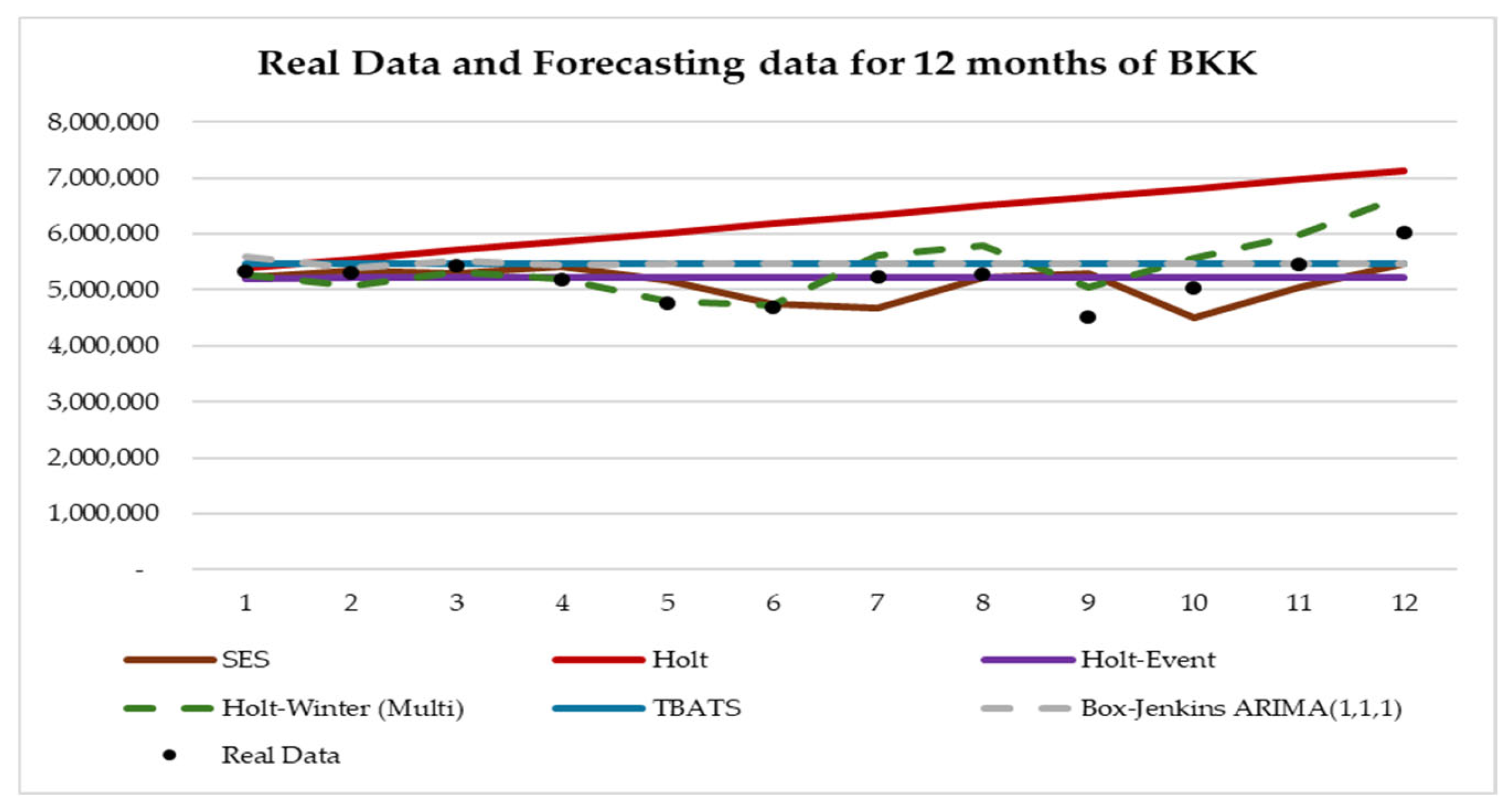
Table 4 presents the real and forecasted passenger data for Suvarnabhumi Airport (BKK) over the 12-month testing period. Among the six methods evaluated, Holt’s Method with Event Adjustment (Holt–Event) demonstrated superior performance, achieving the lowest MAPE of 5.6275% and the lowest MAE of 285,433.55. This indicates that the event-adjustment component effectively captured the structural changes in passenger traffic. In contrast, the Single Exponential Smoothing (SES) method yielded the highest error, with a MAPE of 21.2592%. These results are illustrated in Figure 2, which compares the forecasted values with the real passenger data during the testing period.
As illustrated in Figure 2 (based on data from Table 4), the Holt–Event model (purple line) closely follows the actual data trend (black dots) compared to other methods. This visual observation is supported by the statistical results in Table 4, where Holt–Event recorded the lowest MAPE (5.6275%) and MAE (285,433.55). Moreover, both the actual and forecasted values exhibit an upward trend toward the end of the year.
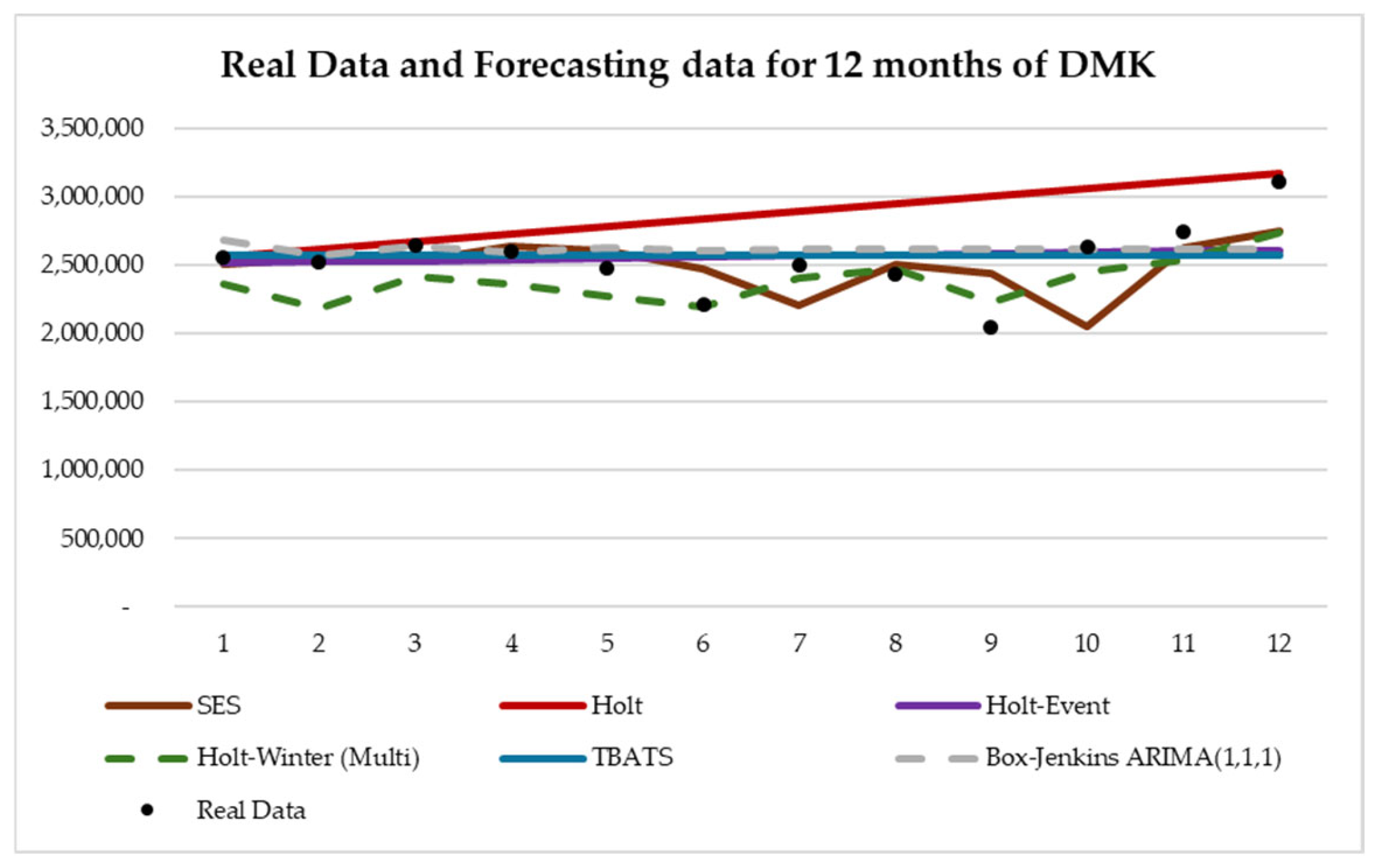
Table 5 displays the comparative results for Don Mueang Airport (DMK). Consistent with the findings for BKK, the Holt–Event model proved to be the most accurate forecasting method, with the lowest MAPE of 6.9823% and an MAE of 170,770.59. These results suggest that, for Thailand’s primary aviation hubs, which experienced significant fluctuations due to external disruptions, the inclusion of an event component is essential to minimize forecasting errors during the recovery phase, as shown in Figure 3.
As illustrated in Figure 3 (based on data from Table 5), the Holt–Event model (purple line) closely follows the actual data trend (black dots) more than other methods. This visual observation is supported by the statistical results in Table 5, where Holt–Event recorded the lowest MAPE (6.9823%) and MAE (170,770.59). The results also indicate an upward trend in passenger volume toward the end of the year.
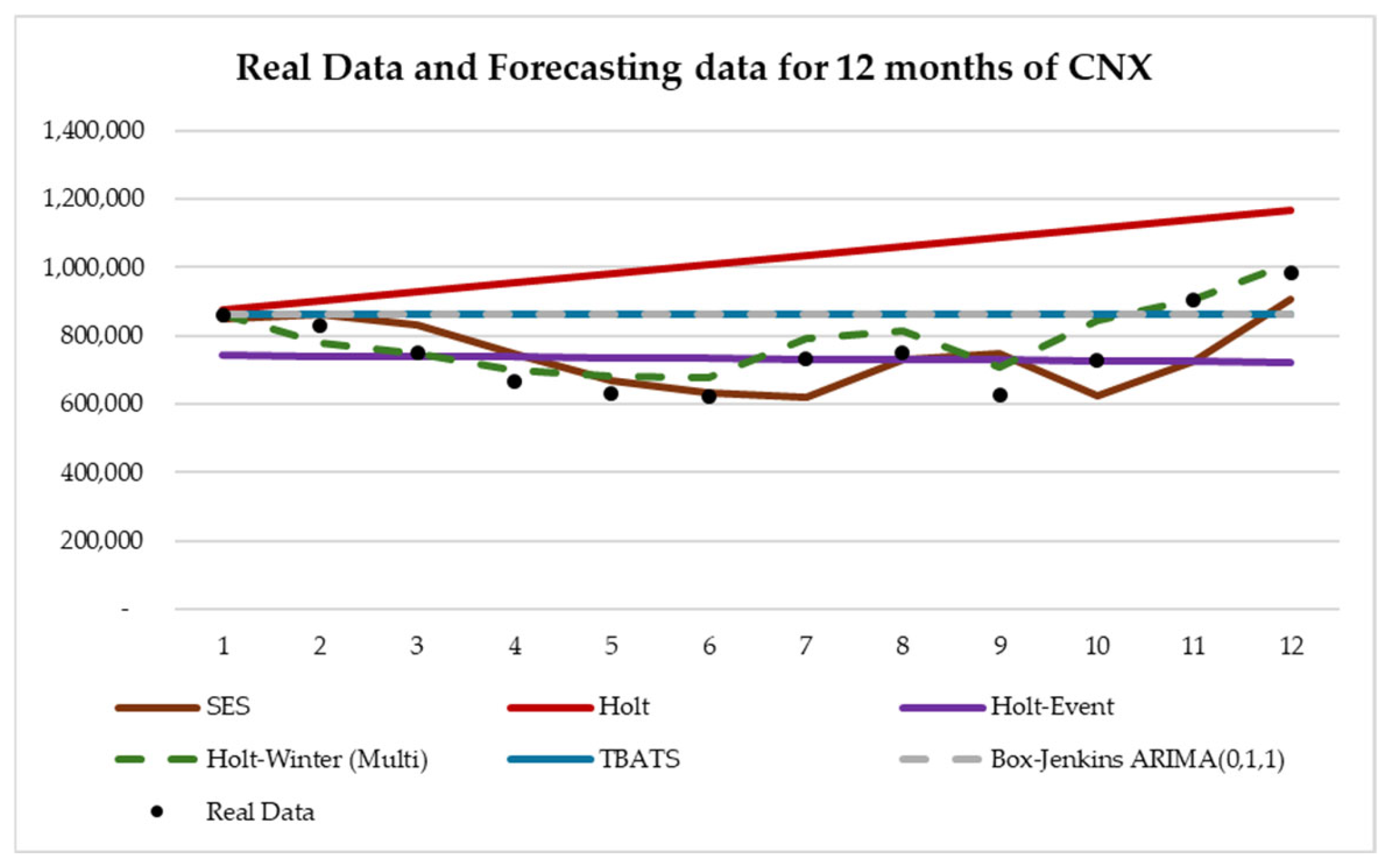
For Chiang Mai Airport (CNX), Table 6 reveals a different optimal model. The Holt–Winters Multiplicative method outperformed other approaches, achieving the lowest MAPE of 6.4973% and an MAE of 45,960.35. This superior performance reflects the model’s ability to account for the strong seasonal patterns inherent in a tourism-driven destination like Chiang Mai, which standard event-based models may not fully capture.
As illustrated in Figure 4 (based on data from Table 6), the Holt–Winters Multiplicative model (green dashed line) closely follows the actual data trend (black dots) compared to other methods. This visual observation is supported by the statistical results in Table 6, where Holt–Winters Multiplicative recorded the lowest MAPE (6.4973%) and MAE (45,960.35).
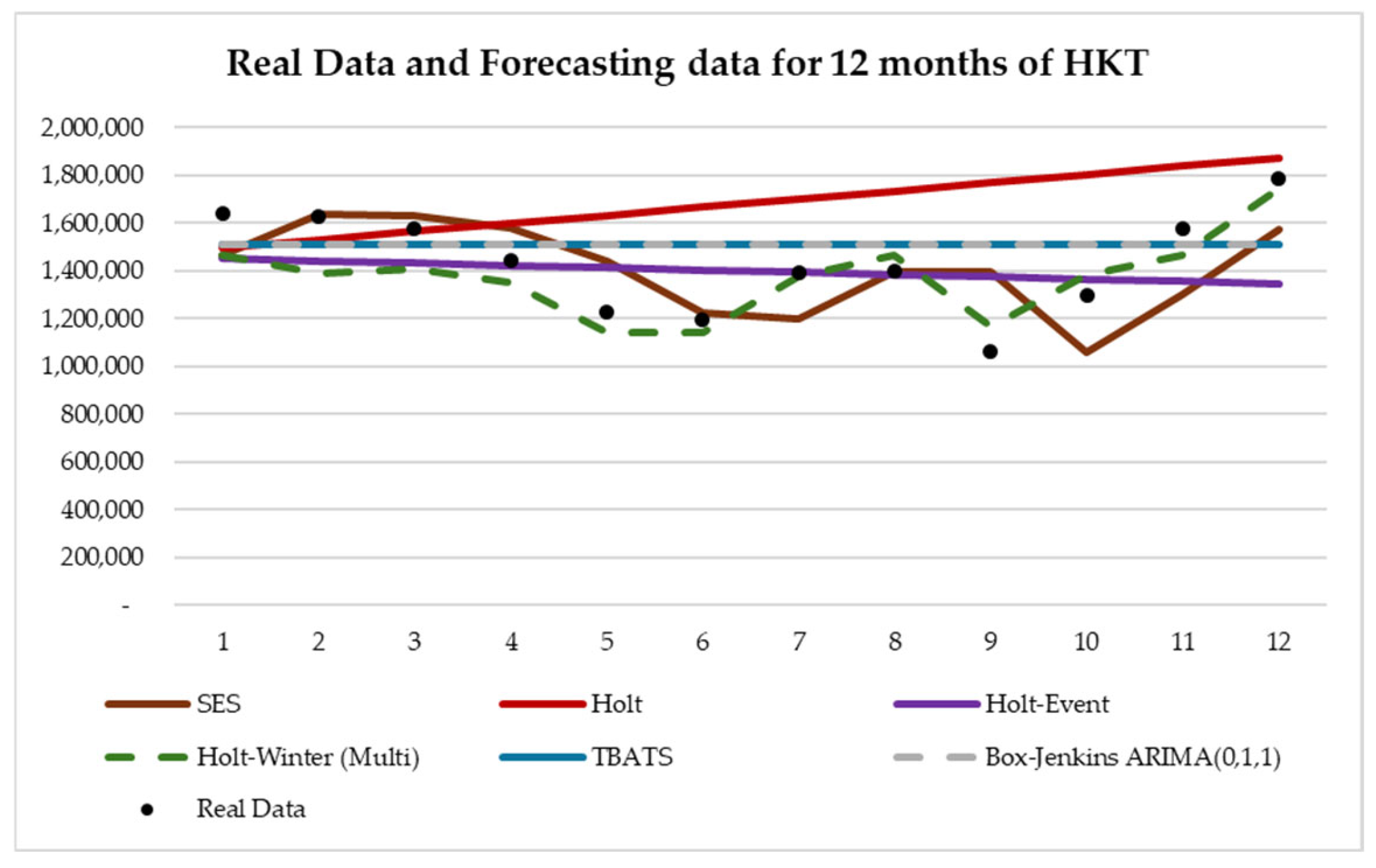
Similarly, Table 7 illustrates the forecasting performance for Phuket Airport (HKT). The Holt–Winters Multiplicative model was identified as the most effective method, yielding the lowest MAPE of 7.1693% and an MAE of 103,534.33. Compared with the HKT dataset, other methods, such as SES and Box–Jenkins (ARIMA), yielded significantly higher error rates, with MAPEs exceeding 11%. These results suggest that for regional airports like HKT, which are heavily reliant on international tourism, multiplicative seasonal adjustments are critical for accurate traffic prediction.
As illustrated in Figure 5 (based on data from Table 7), the Holt–Winters Multiplicative model (green dashed line) closely follows the actual data trend (black dots) compared to other methods. This visual observation is supported by the statistical results in Table 7, where Holt–Winters Multiplicative recorded the lowest MAPE (7.1693%) and MAE (103,534.33).
While point forecasts, such as those evaluated by MAPE and MAE, provide a baseline for expected traffic, they do not account for the uncertainty inherent in the post-pandemic recovery. To support robust capacity planning and operational decision-making, it is essential to quantify this uncertainty. Therefore, Table 8 presents a comparison between the actual passenger volumes and the constructed 95% Prediction Intervals for the 12-month testing period (January–December 2024).
In Table 8, the data for each month is presented in two rows: the upper row displays the actual passenger volume (Real Data), while the lower row (in brackets) represents the 95% Prediction Interval.
The results indicate that the actual passenger numbers for all four airports largely fall within the predicted intervals. This demonstrates the reliability of the selected models in capturing demand variability. From an operational perspective, these intervals provide a critical range for resource allocation; airport authorities can use the upper bound to plan for peak-capacity needs (e.g., staffing, security checkpoints) and the lower bound to manage baseline operational costs, thereby mitigating risks associated with demand volatility in the post-shock period.
To assess robustness, the event-adjusted Holt model was re-estimated under alternative event-labeling schemes, including one-month forward and backward shifts in all phase boundaries and a merged disruption phase. Across all scenarios, the relative ranking of forecasting methods remained unchanged. The Holt–Event model consistently outperformed the standard Holt method and achieved accuracy comparable to other benchmarks, with only minor variations in MAPE and MAE. These results, reported in Appendix A Table A2, indicate that the performance advantage of the event-adjusted approach is robust and not sensitive to specific labeling choices.

4.2. ARIMA Model Identification and Diagnostic Checking

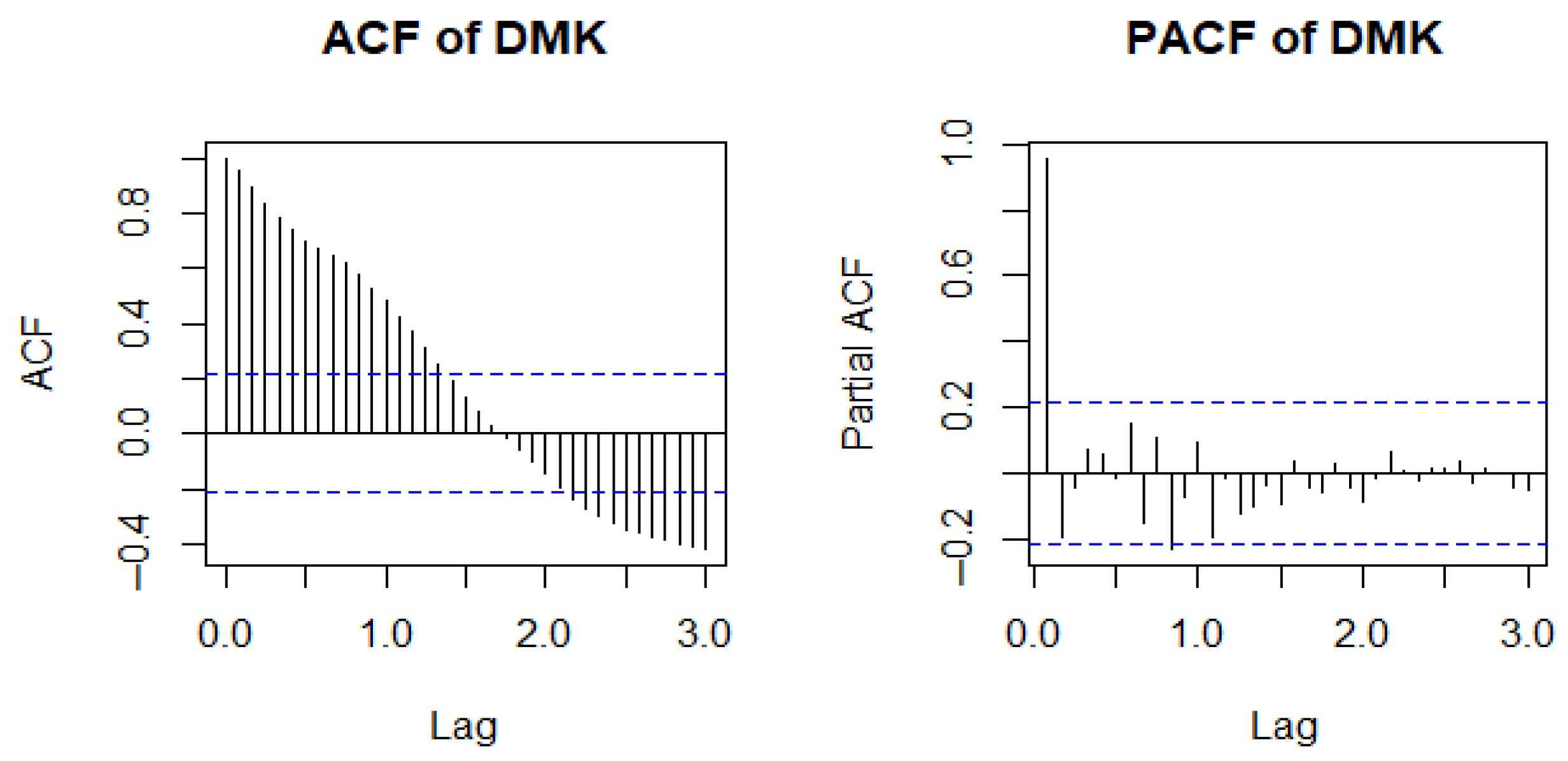
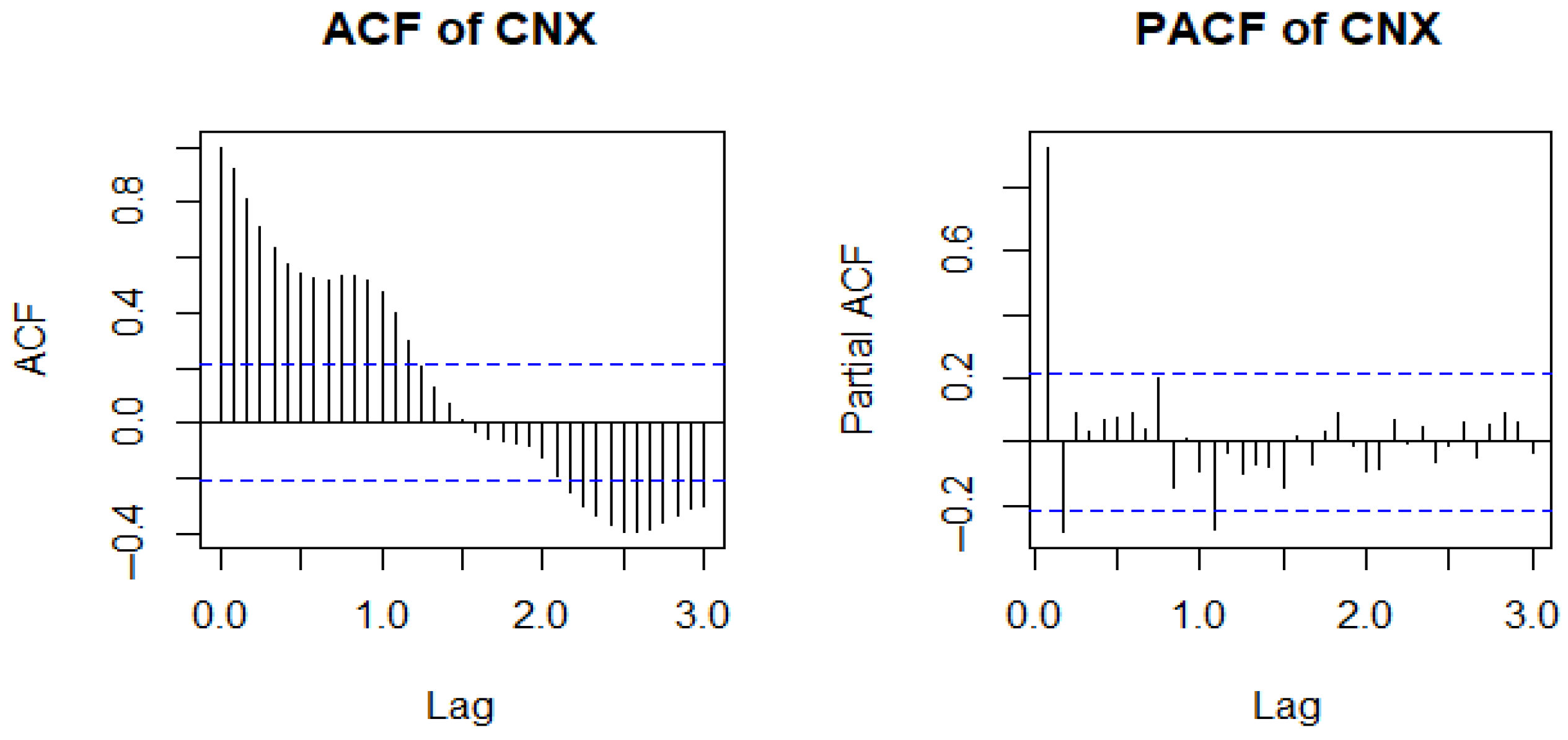
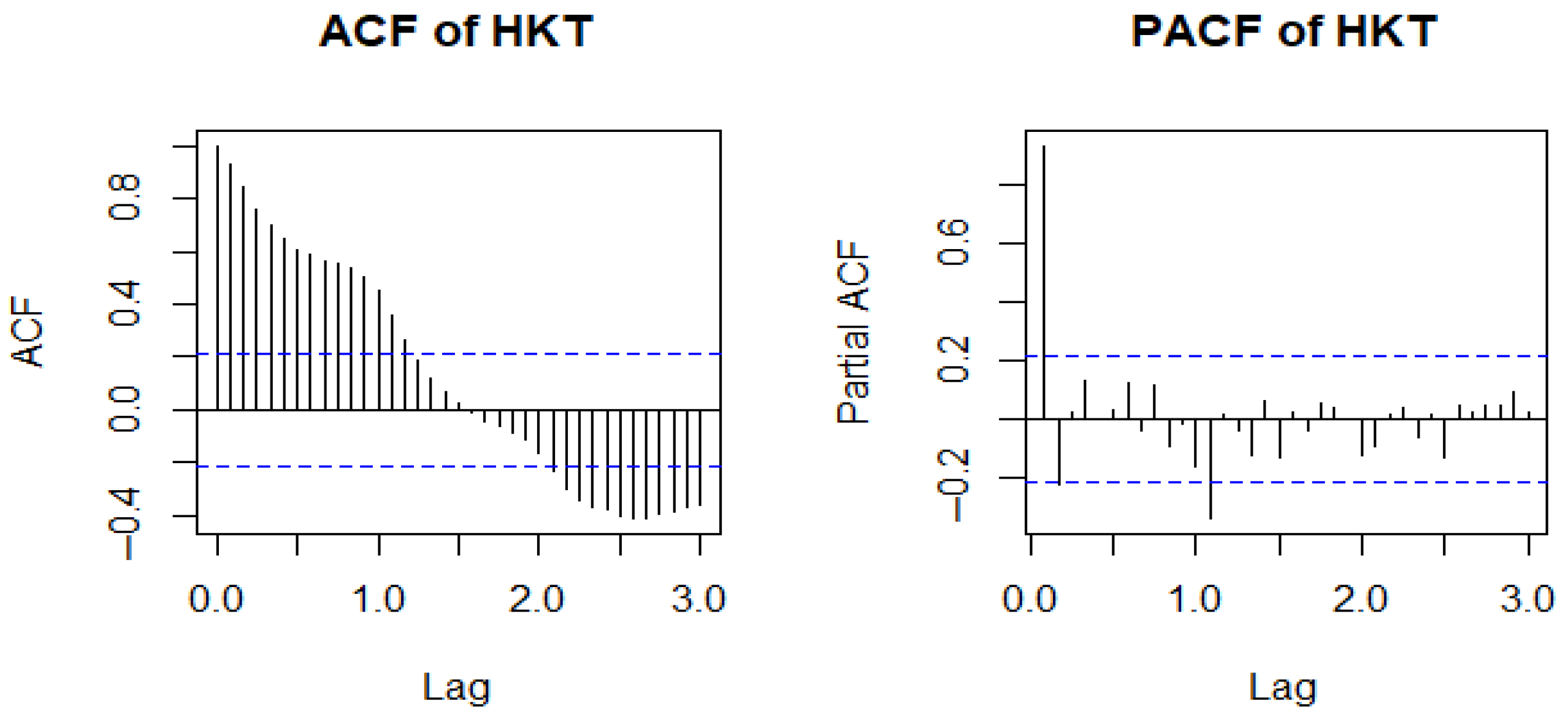
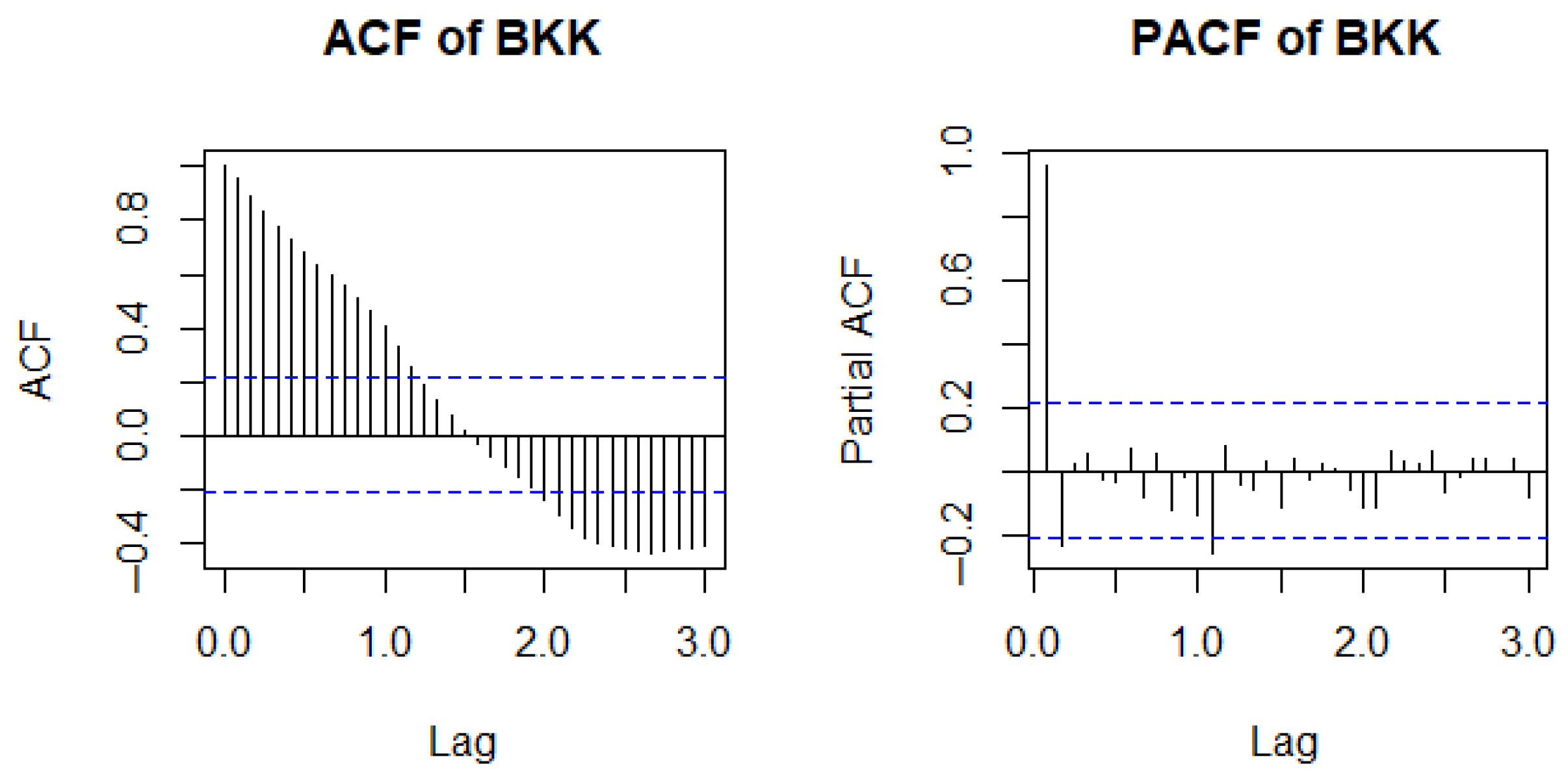
Although the Box–Jenkins methodology for ARIMA modeling was outlined in Section 3.5, this subsection presents the empirical evidence supporting the selected ARIMA specifications for each airport. In accordance with the standard identification–estimation–diagnostic framework, the analysis proceeds in three stages. First, the stationarity properties of the passenger time series are examined using the Augmented Dickey–Fuller (ADF) test to determine the appropriate order of differencing. The ADF test results for both the original and first-differenced series are summarized in Table 9. Second, the autoregressive and moving-average orders are identified based on the autocorrelation function (ACF) and partial autocorrelation function (PACF) of the differenced series. The corresponding ACF and PACF plots for each airport—Suvarnabhumi (BKK), Don Mueang (DMK), Chiang Mai (CNX), and Phuket (HKT)—are presented in Figure 6, Figure 7, Figure 8 and Figure 9, respectively. Finally, the adequacy of the fitted ARIMA models is evaluated using residual diagnostics, including residual ACF plots and the Ljung–Box Q-test, with the Ljung–Box test results reported in Table 9 to verify the white-noise assumption. Together, these diagnostics provide formal statistical justification for the ARIMA models reported in Table 9 and ensure that the Box–Jenkins benchmarks used in the comparative analysis are both statistically sound and empirically well-supported.
Table 9 summarizes the results of the Augmented Dickey–Fuller (ADF) tests applied to the monthly passenger series for all four airports. For the original series, the ADF test fails to reject the null hypothesis of a unit root in all cases, as indicated by large p-values, implying that the original passenger series are non-stationary. After applying first differencing, the null hypothesis is rejected for every airport, with p-values below the conventional significance levels. This indicates that the differenced series are stationary. Consequently, a differencing order of d = 1 is appropriate for all airports, providing statistical justification for the ARIMA model specifications used in the subsequent analysis.
Figure 6, Figure 7, Figure 8 and Figure 9 present the ACF and PACF plots of the first-differenced passenger series for Suvarnabhumi (BKK), Don Mueang (DMK), Chiang Mai (CNX), and Phuket (HKT) airports. Across all airports, the ACF exhibits gradual decay rather than a sharp cutoff, indicating short-term dependence consistent with a moving-average component. In contrast, the PACF plots show a prominent and statistically significant spike at lag 1, while subsequent lags fall within the confidence bounds. This pattern suggests a low-order autoregressive structure combined with a moving-average effect after differencing. Overall, the ACF and PACF behaviors provide empirical support for parsimonious ARIMA specifications, specifically ARIMA(1,1,1) for BKK and DMK and ARIMA(0,1,1) for CNX and HKT, as adopted in the analysis.
Table 10 reports the ARIMA residual diagnostic results based on the Ljung–Box Q-test at lag 12 for all four airports. In every case, the p-values exceed the 5% significance level, indicating that the null hypothesis of no residual autocorrelation cannot be rejected. This suggests that the residuals from the fitted ARIMA models behave as white noise and that no significant serial dependence remains unmodeled. Consequently, the selected ARIMA(1,1,1) models for BKK and DMK and the ARIMA(0,1,1) models for CNX and HKT are statistically adequate. These results confirm that the ARIMA specifications provide a satisfactory fit and are suitable as benchmark models in the comparative forecasting analysis.

4.3. Pairwise Forecast Accuracy Comparisons

To formally assess whether differences in forecast accuracy between competing models are statistically significant, this study employs the Diebold–Mariano (DM) test [30] and the small-sample correction of Harvey et al. [31]. The DM test is a widely used statistical procedure for comparing the predictive performance of two forecasting models based on their out-of-sample forecast errors.
Let A t denote the observed value of the time series at time t , and let F 1 , t and F 2 , t represent the corresponding forecasts generated by models 1 and 2, respectively. The forecast errors are defined as
e i , t = A t F i , t ,    i = 1 , 2 .
Forecast accuracy is evaluated through a loss function L ( ) such as the squared-error or absolute-error loss. The loss differential between the two competing models at time t is then defined as
d t = L ( e 1 , t ) L ( e 2 , t ) .
The null hypothesis of the DM test states that the two models have equal expected predictive accuracy:
H 0 :   E ( d t ) =   0 ,
against the alternative hypothesis
H 0 :   E ( d t )     0 .
Let T denote the number of observations in the evaluation sample. The sample mean of the loss differentials is given by
d ¯ = 1 T t = 1 T d t .
The DM test statistic is defined as
D M = d ¯ V a r ^ ( d ¯ ) ,
where V a r ^ ( d ¯ ) is a heteroskedasticity- and autocorrelation-consistent estimator of the variance of d ¯ . For a forecast horizon of h , this variance is computed as
V a r ^ ( d ¯ ) = 1 T γ 0 + 2 k = 1 h 1 γ k ,
with γ k denoting the autocovariance of d t at lag k . In the case of one-step-ahead forecasts ( h 1 ) , the expression simplifies to V a r ^ ( d ¯ ) = γ 0 / T .
Under the null hypothesis and standard regularity conditions, the DM statistic asymptotically follows a standard normal distribution. Statistical significance can therefore be assessed using the corresponding critical values or p-values. A negative, statistically significant DM statistic indicates that the first forecasting model yields a lower expected loss and thus superior forecast accuracy relative to the second model.
In this study, pairwise DM tests were conducted by comparing the best-performing model for each airport with alternative forecasting approaches. One-step-ahead forecast errors over the 12-month evaluation period (January–December 2024) were used, with forecast horizon h = 1 and power = 2, corresponding to the squared-error loss function. Statistical significance is assessed at the 5% level as shown in Table 11.
From Table 11, the DM test results provide formal statistical evidence supporting the comparative forecasting conclusions. For the major hub airports (BKK and DMK), the Holt–Event model significantly outperforms the standard Holt method at the 5% significance level, confirming the importance of explicitly accounting for event-driven structural breaks. In contrast, differences between Holt–Event and more complex models such as TBATS and ARIMA are not statistically significant within the 12-month evaluation window. For the tourism-oriented airports (CNX and HKT), the Holt–Winters multiplicative model demonstrates statistically superior performance relative to several competing approaches, particularly the standard Holt and ARIMA models. Cases with marginal significance suggest comparable predictive accuracy and should be interpreted with caution, given the limited sample size.

5. Discussion

This study aimed to evaluate the effectiveness of six forecasting methods—Single Exponential Smoothing (SES), Holt’s, Holt’s Method with Event Adjustment, Holt–Winters Multiplicative, TBATS model, and ARIMA (Box–Jenkins)—in predicting passenger traffic at Thailand’s four major international airports. The findings provide significant insights into the behavior of air travel demand under the influence of both strong seasonality and external shocks, specifically the COVID-19 pandemic.
The empirical results revealed a distinct divergence in optimal forecasting methods across airports. For the primary hubs, Suvarnabhumi (BKK) and Don Mueang (DMK), Holt’s Method with Event Adjustment (Holt–Event) demonstrated superior performance, achieving the lowest MAPE of 5.63% and 6.98%, respectively. This suggests that, for high-volume airports serving as national gateways, the pandemic-induced structural break was the dominant factor shaping traffic patterns. Standard models like SES or basic Holt’s failed to react quickly enough to the drastic “lockdown” and “reopening” phases, whereas the Holt–Event model, with its explicit flag for panic and relief periods, successfully captured these irregularities. This aligns with the findings of Leenawong and Chaikajonwat [23], who argued that introducing a dedicated event component significantly enhances forecasting accuracy during volatile periods compared to traditional smoothing methods. In contrast, for Chiang Mai (CNX) and Phuket (HKT), the Holt–Winters Multiplicative model outperformed all other methods, yielding the lowest MAPE (6.50% for CNX and 7.17% for HKT) and the lowest MAE across the board. This distinction is crucial. While BKK and DMK handle a complex mix of business, transit, and leisure travel, CNX and HKT are driven almost entirely by tourism. Consequently, even amidst the pandemic recovery, the underlying seasonal patterns (high vs. low tourism seasons) remained a powerful predictor. The multiplicative nature of the Holt–Winters model allowed it to adjust the amplitude of seasonality relative to the trend, which is consistent with the work of Drop and Bohman [25], who found that Holt–Winters is particularly effective for airports with distinct seasonal variations.
Comparison with Advanced and Traditional Models. Interestingly, the more complex TBATS model and the standard ARIMA (Box–Jenkins) did not achieve the best accuracy in this specific context. Despite its theoretical flexibility, the TBATS model underperformed in this study for several data-driven reasons.
First, the monthly passenger series exhibits at most a single dominant seasonal cycle, whereas TBATS is specifically designed for multiple or complex seasonality, often in high-frequency data [16]. Second, the most prominent feature of the data is the abrupt structural break caused by the COVID-19 pandemic and the subsequent policy-driven recovery, which has been shown to challenge conventional smoothing-based forecasting frameworks [7,8]. TBATS handles such changes implicitly through state-space smoothing and ARMA errors, which may oversmooth sharp regime shifts. In contrast, event-based forecasting approaches explicitly modeling pandemic phases have been shown to provide more responsive and interpretable adjustments [19,23]. Third, the effective post-pandemic sample size is relatively limited, increasing the risk of over-parameterization in models with large parameter sets and consequently reducing out-of-sample accuracy [32,33]. Finally, for tourism-driven airports, multiplicative seasonality plays a critical role and has been shown to be more effectively captured by Holt–Winters-type models than by additive seasonal representations [24,25].
While Himakireeti and Vishnu [20] found ARIMA to be robust for general airline occupancy, our results suggest that, in the post-pandemic recovery phase (2024 testing set), exponential smoothing methods (specifically Holt–Event and Holt–Winters) were more adaptable. The ARIMA models, although statistically sound, may have struggled to capture the non-linear recovery trend without explicit event intervention or complex differencing that could strip away the recovery signal. Similarly, although Rattanametawee et al. [21] demonstrated the value of regression with event variables, our study confirms that smoothing methods adapted for events (Holt–Event) can achieve comparable or better precision, potentially with lower computational complexity, for time-series data.
Accurate forecasting, as demonstrated by the low MAPE values achieved in this study, directly supports the goals of efficient resource allocation and congestion management outlined in the introduction. By selecting the appropriate model for each airport profile, authorities can better navigate the uncertainties of the post-COVID aviation landscape. The observed improvements in forecast accuracy have clear practical implications for airport operations and planning. For example, at Suvarnabhumi Airport (BKK), reducing MAPE from approximately 7–8% under conventional models to about 5–6% using the Holt–Event approach corresponds to a reduction in forecast error of several hundred thousand passengers per month. Such improvements can support more accurate short-term capacity planning, including gate assignment, security staffing, and terminal resource allocation, thereby reducing the risks of congestion or underutilization. Similarly, for tourism-oriented airports such as CNX and HKT, improved seasonal forecasts from the Holt–Winters Multiplicative model can enhance planning for peak and off-peak seasons, thereby supporting better coordination with airlines and tourism stakeholders. Although this study does not conduct a formal economic cost–benefit analysis, the magnitude of the error reductions suggests that even modest gains in forecasting accuracy may yield substantial operational and managerial benefits.
Although this study focuses on four major airports in Thailand, the findings offer broader conceptual insights for airport passenger forecasting in other regions. The results suggest that forecasting performance depends less on model complexity and more on the alignment between model structure and demand characteristics, a conclusion consistent with recent large-scale forecasting evaluations. In particular, airports functioning as major international hubs and exposed to strong external shocks—such as pandemics, policy interventions, or geopolitical disruptions—may benefit from forecasting models that explicitly incorporate event effects [8]. Conversely, airports primarily driven by tourism demand and characterized by stable multiplicative seasonality may be better served by Holt–Winters-type models, as documented in studies on tourism-oriented and regional airports [24,25]. These principles are applicable to other airports and countries with similar structural features, although future studies using multi-country or cross-regional datasets are required to empirically validate their generalizability [29].
While recent forecasting research increasingly emphasizes machine-learning and hybrid models [33,34], this study demonstrates that classical time-series methods remain highly relevant when appropriately adapted to real-world constraints. In particular, the proposed event-adjusted Holt approach and the Holt–Winters Multiplicative model offer interpretable structures, low computational burden, and strong performance in the presence of structural breaks and limited post-event data, which aligns with prior findings in aviation and crisis-driven demand forecasting [17]. Rather than competing directly with data-intensive machine-learning models, this study’s contribution lies in providing a transparent and operationally feasible forecasting framework that complements recent advances, especially in contexts where data availability, explainability, and rapid deployment are critical considerations for decision-makers [35].

6. Conclusions

This study evaluated the comparative performance of six statistical forecasting models including Single Exponential Smoothing, Holt’s, Holt’s with Events Adjustment, Holt–Winters Multiplicative, TBATS model, and Box–Jenkins. to forecast monthly passenger traffic at Thailand’s four primary international airports (BKK, DMK, CNX, and HKT) from January 2017 to December 2024, explicitly addressing the volatility caused by the COVID-19 pandemic. The empirical results reveal that the optimal forecasting approach depends on specific airport characteristics. For the central aviation hubs, Suvarnabhumi (BKK) and Don Mueang (DMK), Holt’s Method with Event Adjustment demonstrated superior accuracy, achieving the lowest MAPE of 5.63% and 6.98%, respectively; this highlights the effectiveness of explicitly modeling “event components” to capture abrupt structural breaks and policy interventions. Conversely, for the tourism-centric airports of Chiang Mai (CNX) and Phuket (HKT), the Holt–Winters Multiplicative Method proved most accurate, yielding the lowest MAPE values of 6.50% and 7.17%, respectively. This suggests that, despite the pandemic’s impact, the underlying seasonal fluctuations driven by tourism cycles remain the dominant feature for regional airports, necessitating a multiplicative seasonal approach for optimal prediction.
Future research should consider extending this framework by incorporating high-frequency data (e.g., daily or weekly passenger flows) or by exploring hybrid models that integrate exogenous economic variables—such as GDP, exchange rates, or tourist arrival statistics—to further enhance predictive accuracy under economic uncertainty.

Author Contributions

Conceptualization, T.C. and A.A.; methodology, T.C. and A.A.; software, T.C. and A.A.; validation, T.C. and A.A.; formal analysis, T.C. and A.A.; investigation, T.C. and A.A.; resources, T.C. and A.A.; data curation, T.C.; writing—original draft preparation, T.C. and A.A.; writing—review and editing, T.C. and A.A.; visualization, T.C. and A.A.; supervision, A.A.; project administration, T.C.; funding acquisition, T.C. All authors have read and agreed to the published version of the manuscript.

Funding

This work was financially supported by King Mongkut’s Institute of Technology Ladkrabang Research Fund: KREF186715.

Data Availability Statement

Data are available at https://investor-th.airportthai.co.th/transport.html (accessed on 1 December 2025).

Conflicts of Interest

The authors declare no conflicts of interest.

Appendix A

Table A1. COVID-19 Event Calendar.
Event PhaseEvent
Label (k)
DescriptionStart MonthEnd
Month
Policy Basis
Normal period0No COVID-19-related travel restrictions; regular aviation operationsJan 2017Mar 2020Pre-pandemic period
Panic/Lockdown1Nationwide lockdowns, international border closures, suspension of commercial flightsApr 2020Jul 2020Emergency Decree; CAAT flight suspension orders
Relief period (post-wave)2Gradual reopening and relaxation of travel restrictionsAug 2020Mar 2021Phased reopening policies
Subsequent wave3Renewed COVID-19 outbreaks with reinstated mobility restrictionsApr 2021Sep 2021Delta variant wave; renewed emergency measures
Relief period (post-wave)2Vaccination-driven recovery and progressive reopeningOct 2021Dec 2024Test & Go scheme
Table A2. Sensitivity Analysis of Event Labeling Schemes.
Labeling SchemeDescriptionBKK (MAPE %)DMK (MAPE %)CNX (MAPE %)HKT (MAPE %)Relative Ranking
BaselineOriginal event calendar 5.636.986.507.17Unchanged
Shift +1 MonthAll phase boundaries shifted forward by one month5.717.056.587.26Unchanged
Shift −1 MonthAll phase boundaries shifted backward by one month5.687.016.557.22Unchanged
Merged PhasesPanic/lockdown and subsequent waves combined5.797.126.627.34Unchanged
Note: Forecast accuracy is evaluated using MAPE on the 12-month test period (2024). Minor variations across labeling schemes do not affect the relative performance of the Holt–Event model.

References

  1. Law, C.C.H. Exploring the Relationship between Air Travel Demand and Economic Growth: Evidence from Thailand. J. Air Transp. Manag. 2025, 124, 183–191. [Google Scholar]
  2. International Civil Aviation Organization (ICAO). Unlocking Prosperity: The Role of Air Transport in the Thai Economy; ICAO: Bangkok, Thailand, 2025. [Google Scholar]
  3. International Air Transport Association (IATA). The Value of Air Transport to Thailand; IATA: Montreal, QC, Canada, 2023. [Google Scholar]
  4. Sriwapee, K.; Kenaphoom, S.; Ruangchai, N.; Insumran, Y.; Pawala, T.; Jumroenpat, P.; Kaewlamai, S. Thailand as a World Top Tourism Destination: Balancing Growth with Environmental and Cultural Preservation. Int. J. Multidiscip. Manag. Tour. 2025, 9, 113–136. [Google Scholar]
  5. Sun, X.; Wandelt, S.; Zheng, C. COVID-19 Pandemic and Air Transportation: Impacts, Consequences, and Policy Responses. Transp. Policy 2021, 110, 1–13. [Google Scholar]
  6. Albers, S.; Rundshagen, V. European Airlines’ Strategic Responses to the COVID-19 Pandemic (January–May 2020). J. Air Transp. Manag. 2020, 87, 101863. [Google Scholar] [CrossRef]
  7. Suau-Sanchez, P.; Voltes-Dorta, A.; Cugueró-Escofet, N. An Early Assessment of the Impact of COVID-19 on Air Transport: Just Another Crisis or the End of Aviation as We Know It? J. Transp. Geogr. 2020, 86, 102749. [Google Scholar] [CrossRef]
  8. Gudmundsson, S.V.; Cattaneo, M.; Redondi, R. Forecasting the Impact of COVID-19 on Aviation: A Worldwide Analysis. Transp. Res. Part E Logist. Transp. Rev. 2021, 143, 102044. [Google Scholar]
  9. Maneenop, S.; Kotcharin, S. The Impacts of COVID-19 on the Global Airline Industry: An Event Study Approach. Transp. Policy 2020, 96, 35–45. [Google Scholar] [CrossRef]
  10. Box, G.E.P.; Jenkins, G.M.; Reinsel, G.C.; Ljung, G.M. Time Series Analysis: Forecasting and Control, 5th ed.; Wiley: Hoboken, NJ, USA, 2015; pp. 95–100. [Google Scholar]
  11. Hyndman, R.J.; Athanasopoulos, G. Forecasting: Principles and Practice, 2nd ed.; OTexts: Melbourne, Australia, 2018; pp. 20–24. [Google Scholar]
  12. Holt, C.C. Forecasting seasonals and trends by exponentially weighted moving averages. Off. Nav. Res. Mem. Carnegie Inst. Technol. 1957, 52, 10–14. [Google Scholar]
  13. Winters, P.R. Forecasting sales by exponentially weighted moving averages. Manag. Sci. 1960, 6, 324–342. [Google Scholar] [CrossRef]
  14. Ghosh, S.; Ghosh, A. Post-pandemic recovery analysis of air passenger demand using hybrid time series models. Transp. Res. Part E Logist. Transp. Rev. 2023, 180, 103214. [Google Scholar]
  15. Chen, Y.; Li, X.; Zhang, H. Modeling air passenger demand during COVID-19: A hybrid forecasting framework. J. Air Transp. Manag. 2024, 122, 102234. [Google Scholar]
  16. De Livera, A.M.; Hyndman, R.J.; Snyder, R.D. Forecasting time series with complex seasonal patterns using exponential smoothing. J. Am. Stat. Assoc. 2011, 106, 1513–1527. [Google Scholar] [CrossRef]
  17. Ghasemi, M.; Fadaki, M.; Owusu, G. Forecasting Air Travel Demand during COVID-19: Limitations of Classical Time Series Models. J. Air Transp. Manag. 2021, 95, 102099. [Google Scholar]
  18. Nižetić, S. Impact of Coronavirus (COVID-19) Pandemic on Air Transport Mobility: Analysis and Future Outlook. Sustainability 2020, 12, 7768. [Google Scholar]
  19. Rattanametawee, W.; Leenawong, C.; Netisopakul, P. The Effects of Special Events on Regression for Subcompact Car Sales in Thailand. J. Teknol. 2016, 78, 161–165. [Google Scholar] [CrossRef]
  20. Himakireeti, K.; Vishnu, T. Air Passengers Occupancy Prediction Using ARIMA Model. Int. J. Appl. Eng. Res. 2019, 14, 646–650. [Google Scholar]
  21. Rattanametawee, W.; Leenawong, C. Event Index Computation for Forecasting Case Study: Car Sales in Thailand. Thai J. Math. 2020, 18, 2079–2091. [Google Scholar]
  22. Persadanta, P. Airport Passenger Traffic Forecast: An Exploratory Study. J. Airpt. Eng. Technol. 2021, 1, 34–42. [Google Scholar] [CrossRef]
  23. Leenawong, C.; Chaikajonwat, T. Event Forecasting for Thailand’s Car Sales during the COVID-19 Pandemic. Data 2022, 7, 86. [Google Scholar] [CrossRef]
  24. Kamoljitprapa, P.; Polsen, O.; Abdullahi, U.K. Forecasting of Thai International Imports and Exports Using Holt–Winters’ and Autoregressive Integrated Moving Average Models. J. Appl. Sci. Emerg. Technol. 2023, 22, e252955. [Google Scholar] [CrossRef]
  25. Drop, N.; Bohdan, A. Application of the Holt–Winters Model in the Forecasting of Passenger Traffic at Szczecin–Goleniów Airport (Poland). Sustainability 2025, 17, 6407. [Google Scholar] [CrossRef]
  26. Patel, M.; Patel, S.B.; Swain, D.; Mallagundla, R. Enhancing Accuracy in Hourly Passenger Flow Forecasting for Urban Transit Using TBATS Boosting. Modelling 2025, 6, 32. [Google Scholar] [CrossRef]
  27. Leenawong, C. Logistics Intelligence and Forecasting with Excel 365; KMITL: Bangkok, Thailand, 2022; pp. 87–92. [Google Scholar]
  28. Sakia, R. The Box–Cox Transformation Technique: A Review. J. R. Stat. Soc. Ser. D Stat. 1992, 41, 169–178. [Google Scholar] [CrossRef]
  29. Hyndman, R.J.; Khandakar, Y. Automatic Time Series Forecasting: The Forecast Package for R. J. Stat. Softw. 2008, 27, 1–22. [Google Scholar]
  30. Diebold, F.X.; Mariano, R.S. Comparing Predictive Accuracy. J. Bus. Econ. Stat. 1995, 13, 253–263. [Google Scholar] [CrossRef]
  31. Harvey, D.; Leybourne, S.; Newbold, P. Testing the Equality of Prediction Mean Squared Errors. Int. J. Forecast. 1997, 13, 281–291. [Google Scholar] [CrossRef]
  32. Petropoulos, F.; Makridakis, S.; Hyndman, R.J.; Taleb, N.N. Forecasting: Theory and Practice. Int. J. Forecast. 2022, 38, 705–871. [Google Scholar] [CrossRef]
  33. Makridakis, S.; Spiliotis, E.; Assimakopoulos, V. Statistical and Machine Learning Forecasting Methods: Concerns and Ways Forward. PLoS ONE 2018, 13, e0194889. [Google Scholar] [CrossRef]
  34. Makridakis, S.; Spiliotis, E.; Assimakopoulos, V. The M5 Accuracy Competition: Results, Findings, and Conclusions. Int. J. Forecast. 2020, 36, 1–17. [Google Scholar] [CrossRef]
  35. Shmueli, G. To Explain or to Predict? Stat. Sci. 2010, 25, 289–310. [Google Scholar] [CrossRef]
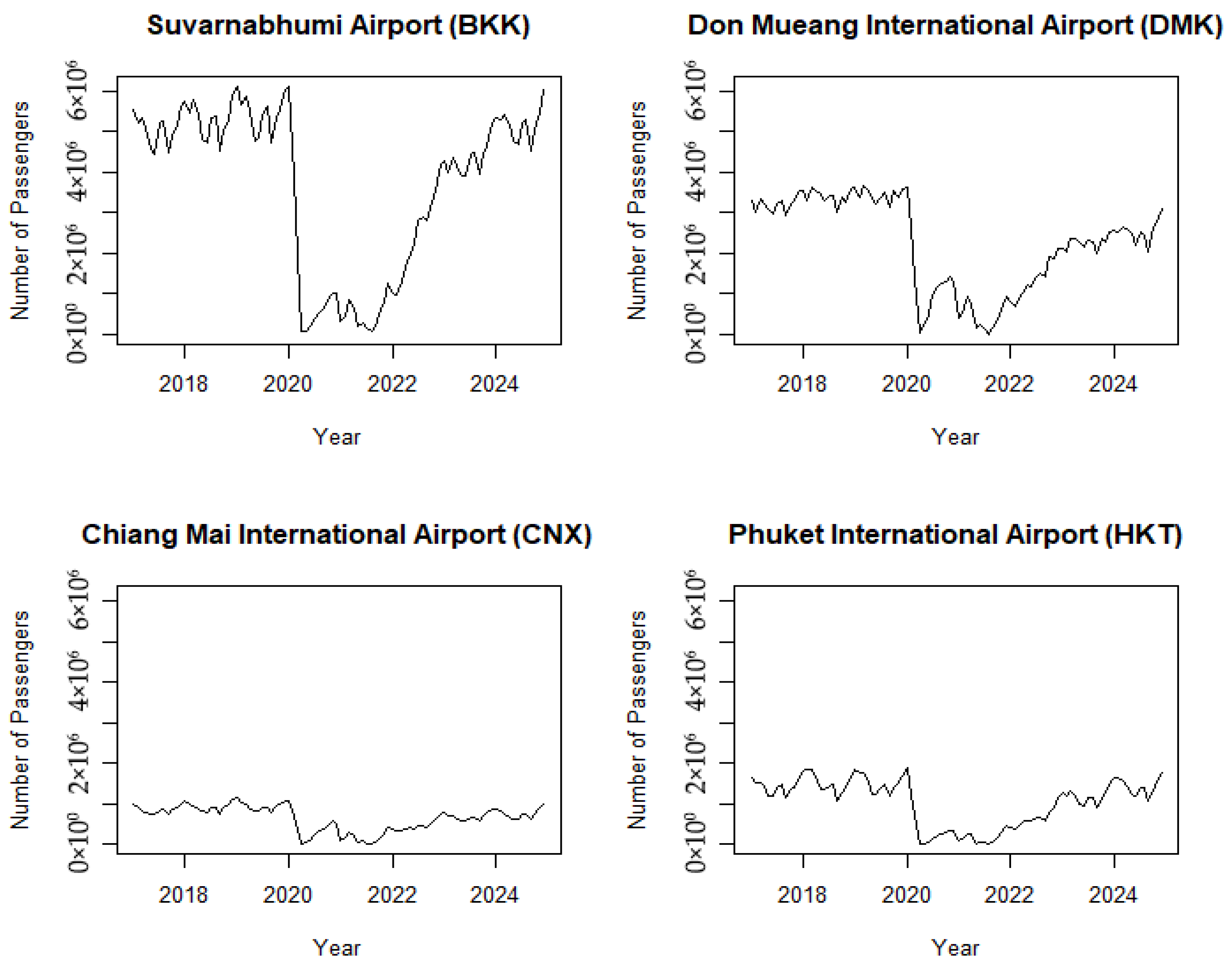
Figure 1. Monthly passenger volumes at Thailand’s major international airports.
Modelling 07 00026 g001
Figure 2. Comparison of actual and forecasted passenger volumes at Suvarnabhumi Airport (BKK).
Modelling 07 00026 g002
Figure 3. Comparison of actual and forecasted passenger volumes at Don Mueang Airport (DMK).
Modelling 07 00026 g003
Figure 4. Comparison of actual and forecasted passenger volumes at Chiang Mai Airport (CNX).
Modelling 07 00026 g004
Figure 5. Comparison of actual and forecasted passenger volumes at Phuket Airport (HKT).
Modelling 07 00026 g005
Figure 6. The ACF and PACF at Suvarnabhumi (BKK) Airport.
Modelling 07 00026 g006
Figure 7. The ACF and PACF at Don Mueang (DMK) Airport.
Modelling 07 00026 g007
Figure 8. The ACF and PACF at Chiang Mai (CNX) Airport.
Modelling 07 00026 g008
Figure 9. The ACF and PACF at Phuket (HKT) Airport.
Modelling 07 00026 g009
Table 1. Statistics on passenger traffic data of four airports in Thailand.
AirportMinMaxMeanMedianQ1Q3IQRSDCV
BKK55,2806,120,0513,695,045.14,513,1231,586,059.85,305,8793,718,8192,023,340.354.758
DMK4523,679,5062,237,477.12,456,7731,266,864.53,280,7282,013,863.51,129,055.450.461
CNX8771,167,743645,146.1728,660414,436875,120460,684302,83246.940
HKT6541,904,4581,035,668.31,203,768556,282.51,459,701903,418.2572,986.755.325
Table 2. Strength of seasonal and trend components in air passenger volumes across the four airports.
AirportSeasonalTrend
BKK0.2110.892
DMK0.0800.847
CNX0.5270.881
HKT0.4130.866
Table 3. Estimated model parameters for each forecasting method applied to passenger data from Thai airports.
AirportsSES
( α )
Holt
( α , β )
Holt–Event
( α , β , δ )
Holt–Winters
( α , β , γ )
TBATS
( λ , α , β )
Box–Jenkins
BKK(1.0000)(1,0.0985)(0.1200,0.4561,
1.0000)
(1,0.8033,0)(0.8175,1.3873,0)ARIMA(1,1,1)
DMK(1.0000)(1,0.0929)(0.2959,0.3174,
1.0000)
(1,0.1944,0)(0,1.2330,0)ARIMA(1,1,1)
CNX(1.0000)(1,0.1061)(0.1277,0.3208,
0.3228)
(1,0.1048,0)(0,1.3811,0)ARIMA(0,1,1)
HKT(1.0000)(1,0.0581)(0.1066,0.3918,1)(1,0.5806,0)(0.7621,1.2666,0)ARIMA(0,1,1)
Table 4. Real and forecasted passenger data for 12 months at Suvarnabhumi Airport (BKK) using six forecasting methods.
MonthsReal DataSESHoltHolt–EventHolt–WintersTBATSBox–Jenkins
ARIMA(1,1,1)
15,340,6355,228,4615,386,9225,228,6385,280,7455,476,4175,596,229
25,297,9115,340,6355,545,3825,228,8155,069,0645,476,4175,390,878
35,425,4475,297,9115,703,8435,228,9925,310,1945,476,4175,505,540
45,175,2625,425,4475,862,3045,229,1685,187,7875,476,4175,441,516
54,752,7155,175,2626,020,7645,229,3454,795,6045,476,4175,477,265
64,687,3834,752,7156,179,2255,229,5224,720,8725,476,4175,457,304
75,229,6994,687,3836,337,6865,229,6995,621,6945,476,4175,468,450
85,282,7455,229,6996,496,1475,229,8765,783,5175,476,4175,462,226
94,514,3195,282,7456,654,6075,230,0535,051,2775,476,4175,465,701
105,045,7214,514,3196,813,0685,230,2295,576,8875,476,4175,463,761
115,460,0645,045,7216,971,5295,230,4065,981,6055,476,4175,464,844
126,022,7925,460,0647,129,9895,230,5836,683,9895,476,4175,464,239
MAPE6.3530%21.2592%5.6275%5.7792%7.6945%7.6263%
MAE324,396.581,072,231.10285,433.55303,043.35381,255.08378,363.83
Table 5. Real and forecasted passenger data for 12 months at Don Mueang Airport (DMK) using six forecasting methods.
MonthsReal DataSESHoltHolt–EventHolt–WintersTBATSBox–Jenkins
ARIMA(1,1,1)
12,550,8122,508,5552,563,8352,516,9172,359,8632,571,7212,682,828
22,525,2792,550,8122,619,1152,525,2792,182,1592,571,7212,571,048
32,644,1052,525,2792,674,3952,533,6412,418,2402,571,7212,642,745
42,605,0172,644,1052,729,6752,542,0032,361,8652,571,7212,596,758
52,474,9702,605,0172,784,9552,550,3652,276,9542,571,7212,626,254
62,209,6242,474,9702,840,2352,558,7272,196,5942,571,7212,607,335
72,505,4732,209,6242,895,5152,567,0892,400,6242,571,7212,619,470
82,438,5752,505,4732,950,7952,575,4512,475,6122,571,7212,611,687
92,050,0492,438,5753,006,0752,583,8132,229,4772,571,7212,616,679
102,632,9222,050,0493,061,3552,592,1752,452,1102,571,7212,613,477
112,747,3012,632,9223,116,6352,600,5372,536,3642,571,7212,615,531
123,106,5082,747,3013,171,9152,608,8992,734,6462,571,7212,614,213
MAPE8.1078%13.8541%6.9823%7.3760%7.2044%7.6782%
MAE202,402.42326,988.79170,770.59191,588.09177,042.75186,137.33
Table 6. Real and forecasted passenger data for 12 months at Chiang Mai Airport (CNX) using six forecasting methods.
MonthsReal DataSESHoltHolt–EventHolt–WintersTBATSBox–Jenkins
ARIMA(0,1,1)
1861,383850,819877,015742,303863,095861,911863,756
2829,871861,383903,212740,519778,231861,911863,756
3749,623829,871929,408738,735747,731861,911863,756
4668,186749,623955,605736,951700,473861,911863,756
5632,980668,186981,801735,168680,426861,911863,756
6621,659632,9801,007,998733,384677,143861,911863,756
7731,071621,6591,034,194731,600792,489861,911863,756
8747,977731,0711,060,390729,816812,930861,911863,756
9625,480747,9771,086,587728,033707,735861,911863,756
10726,249625,4801,112,783726,249845,231861,911863,756
11904,753726,2491,138,980724,465906,883861,911863,756
12982,839904,7531,165,176722,6811,014,163861,911863,756
MAPE9.4717%37.4600%11.3120%6.4973%19.1130%19.2966%
MAE71,371.83264,256.4988,640.5345,960.35132,366.68133,596.55
Table 7. Real and forecasted passenger data for 12 months at Phuket Airport (HKT) using six forecasting methods.
MonthsReal DataSESHoltHolt–EventHolt–
Winters
TBATSBox–Jenkins
ARIMA(0,1,1)
11,637,8661,462,1841,496,2051,452,4251,463,0141,507,5801,507,001
21,628,3991,637,8661,530,2251,442,6671,386,1101,507,5801,507,001
31,577,6591,628,3991,564,2461,432,9081,409,3471,507,5801,507,001
41,442,5231,577,6591,598,2661,423,1501,350,1761,507,5801,507,001
51,225,2801,442,5231,632,2871,413,3911,138,8571,507,5801,507,001
61,196,3971,225,2801,666,3081,403,6331,140,1221,507,5801,507,001
71,393,8741,196,3971,700,3281,393,8741,373,9031,507,5801,507,001
81,398,2731,393,8741,734,3491,384,1151,464,8671,507,5801,507,001
91,059,2761,398,2731,768,3691,374,3571,168,1651,507,5801,507,001
101,299,9281,059,2761,802,3901,364,5981,380,3091,507,5801,507,001
111,573,1871,299,9281,836,4111,354,8401,466,5091,507,5801,507,001
121,782,6531,573,1871,870,4311,345,0811,743,2511,507,5801,507,001
MAPE11.5128%22.6742%11.67320%7.1693%13.9373%13.9255%
MAE156,783.42290,916.40165,039.27103,534.33183,281.08183,184.58
Table 8. Comparison of Real Data and 95% Prediction Intervals for Passenger Volumes across Four Airports (Jan–Dec 2024).
MonthsBKK
(Holt–Events)
DMK
(Holt–Events)
CNX
(Holt–Winters)
HKT
(Holt–Winters)
15,340,635
[3,972,154, 6,485,121]
2,550,812
[1,502,413, 3,531,421]
861,383
[672,731, 1,053,459]
1,637,866
[1,179,399, 1,746,628]
25,297,911
[3,972,331, 6,485,298]
2,525,279
[1,510,775, 3,539,783]
829,871
[587,867, 968,595]
1,628,399
[1,102,496, 1,669,725]
35,425,447
[3,972,508, 6,485,475]
2,644,105
[1,519,137, 3,548,145]
749,623
[557,368, 938,095]
1,577,659
[1,125,733, 1,692,962]
45,175,262
[3,972,685, 6,485,652]
2,605,017
[1,527,499, 3,556,507]
668,186
[510,109, 890,837]
1,442,523
[1,066,561, 1,633,790]
54,752,715
[3,972,862, 6,485,829]
2,474,970
[1,535,861, 3,564,869]
632,980
[490,062, 870,790]
1,225,280
[855,243, 1,422,471]
64,687,383
[3,973,038, 6,486,006]
2,209,624
[1,544,223, 3,573,231]
621,659
[486,779, 867,507]
1,196,397
[856,508, 1,423,737]
75,229,699
[3,973,215, 6,486,183]
2,505,473
[1,552,585, 3,581,593]
731,071
[602,125, 982,853]
1,393,874
[1,090,288, 1,657,517]
85,282,745
[3,973,392, 6,486,359]
2,438,575
[1,560,947, 3,589,955]
747,977
[622,566, 1,003,294]
1,398,273
[1,181,252, 1,748,481]
94,514,319
[3,973,569, 6,486,536]
2,050,049
[1,569,309, 3,598,317]
625,480
[517,371, 898,099]
1,059,276
[884,550, 1,451,779]
105,045,721
[3,973,746, 6,486,713]
2,632,922
[1,577,671, 3,606,679]
726,249
[654,867, 1,035,595]
1,299,928
[1,096,695, 1,663,924]
115,460,064
[3,973,923, 6,486,890]
2,747,301
[1,586,033, 3,615,041]
904,753
[716,519, 1,097,247]
1,573,187
[1,182,895, 1,750,124]
126,022,792
[3,974,100, 6,487,067]
3,106,508
[1,594,395, 3,623,403]
982,839
[823,799, 1,204,527]
1,782,653
[1,459,637, 2,026,866]
Table 9. Augmented Dickey–Fuller (ADF) test results for the monthly passenger series.
AirportOriginal Series: ADF Test (p-Value)First-Differenced Series:
ADF Test (p-Value)
Conclusion
BKKFail to reject unit root (0.405)Reject unit root (0.0274)Stationary after first differencing (d = 1)
DMKFail to reject unit root (0.9009)Reject unit root (p < 0.01)Stationary after first differencing (d = 1)
CNXFail to reject unit root (0.774)Reject unit root (p < 0.01)Stationary after first differencing (d = 1)
HKTFail to reject unit root (0.873)Reject unit root (p < 0.01)Stationary after first differencing (d = 1)
Table 10. ARIMA residual diagnostic results based on the Ljung–Box Q-test.
AirportARIMA ModelLjung–Box Q (Lag 12)p-ValueConclusion
BKKARIMA(1,1,1)5.6670.6845No residual autocorrelation
DMKARIMA(1,1,1)13.7430.0887No residual autocorrelation
CNXARIMA(0,1,1)11.7880.2255No residual autocorrelation
HKTARIMA(0,1,1)6.77870.6601No residual autocorrelation
Table 11. Diebold–Mariano test results for pairwise forecast accuracy comparisons.
AirportBest ModelComparison ModelDM Statisticp-ValueSignificance
BKKHolt–EventSES−0.2010.8408No
BKKHolt–EventHolt−3.7210.0002Yes
BKKHolt–EventHolt–Winters0.0780.9377No
BKKHolt–EventTBATS−1.4370.1507No
BKKHolt–EventARIMA−1.4360.1510No
DMKHolt–EventSES−0.2600.7948No
DMKHolt–EventHolt−1.9770.0480Yes
DMKHolt–EventHolt–Winters0.4580.6471No
DMKHolt–EventTBATS−0.9420.3464No
DMKHolt–EventARIMA−1.8550.0635Marginal
CNXHolt–WintersSES−1.5230.1278No
CNXHolt–WintersHolt−4.608<0.001Yes
CNXHolt–WintersHolt–Event−1.6680.0953Marginal
CNXHolt–WintersTBATS−3.3130.0009Yes
CNXHolt–WintersARIMA−3.3250.0009Yes
HKTHolt–WintersSES−1.7070.0878Marginal
HKTHolt–WintersHolt−2.4580.0140Yes
HKTHolt–WintersHolt–Event−1.6500.0990Marginal
HKTHolt–WintersTBATS−1.7430.0813Marginal
HKTHolt–WintersARIMA−1.7430.0813Marginal
Note: Significance is assessed at the 5% level (p < 0.05); values between 0.05 and 0.10 are labeled as marginally significant.
Disclaimer/Publisher’s Note: The statements, opinions and data contained in all publications are solely those of the individual author(s) and contributor(s) and not of MDPI and/or the editor(s). MDPI and/or the editor(s) disclaim responsibility for any injury to people or property resulting from any ideas, methods, instructions or products referred to in the content.