Article

Inaccuracy in Structural Mechanics Simulation as a Function of Material Models

by
Georgi Todorov
,
Konstantin Kamberov
* and
Konstantin Dimitrov
Department of Production Technology and Systems, Faculty of Industrial Technology, Technical University of Sofia, 1000 Sofia, Bulgaria
*
Author to whom correspondence should be addressed.
Modelling 2026, 7(1), 25; https://doi.org/10.3390/modelling7010025
Submission received: 22 November 2025 / Revised: 15 December 2025 / Accepted: 16 January 2026 / Published: 20 January 2026
(This article belongs to the Section Modelling in Mechanics)

Abstract

The study is dedicated to the accuracy of engineering analyses of virtual prototypes. In particular, it aims to quantify the importance of material models and data consistent with physical tests. The focus is set on the stress–strain material characteristic that is the basis for correct simulation results, and the deviations of its parameters—elasticity module and yield stress—that are assessed. This is performed in three main steps: laboratory measurement of the material properties of a sample material (aluminum alloy), followed by an engineering analysis of a component produced from the same material, using the determined mechanical characteristics. The third step involves physical tests used to validate the virtual prototyping results by comparing them with the physical test results. The material properties used in the virtual prototype are subjected to a sensitivity analysis to determine their influence on the design’s elastic and plastic behavior. The main conclusions of the study are the importance of these material characteristics for achieving an adequate result. A general recommendation is formed that shows the importance of laboratory testing of material properties before virtual prototyping to avoid any influence of factors as production technology or geometry (specimen thickness).

1. Introduction

The engineering analyses using a virtual prototype have become a constant component of the new product development process. Applying numerical methods, techniques, and tools enables modeling and virtually examining complex systems, enabling simulation and optimization to improve product performance. The virtual prototyping (VP; his term was used and interpreted in many different ways) [1,2,3] enables the assessment of product performance at an early stage of its development, reducing time and cost. It aims to reduce, or even fully eliminate, the need for physical prototypes [4]. Its application and combination with physical prototyping (PhP) have been tested across various scenarios [5,6], but it is not widely used in practice. PhP requires additional time and resources; sometimes, it is even impossible and usually avoided.
At the early design stage, results from virtual prototyping are used for decision-making, sometimes at a conceptual level, and their accuracy can be critical for a given project [7,8,9]. Most of the above-cited research studies avoid using physical prototyping, sometimes even for validation of the simulation model. Physical prototyping and testing is related to time and money spending, and virtual prototyping is accepted as their full alternative. The assessment of this accuracy has been the subject of various studies as an important feature of the simulation process [10,11,12,13,14]. Most of these studies examine the basics of the sources of inaccuracy, and few are directed toward a numerical assessment of the factors.
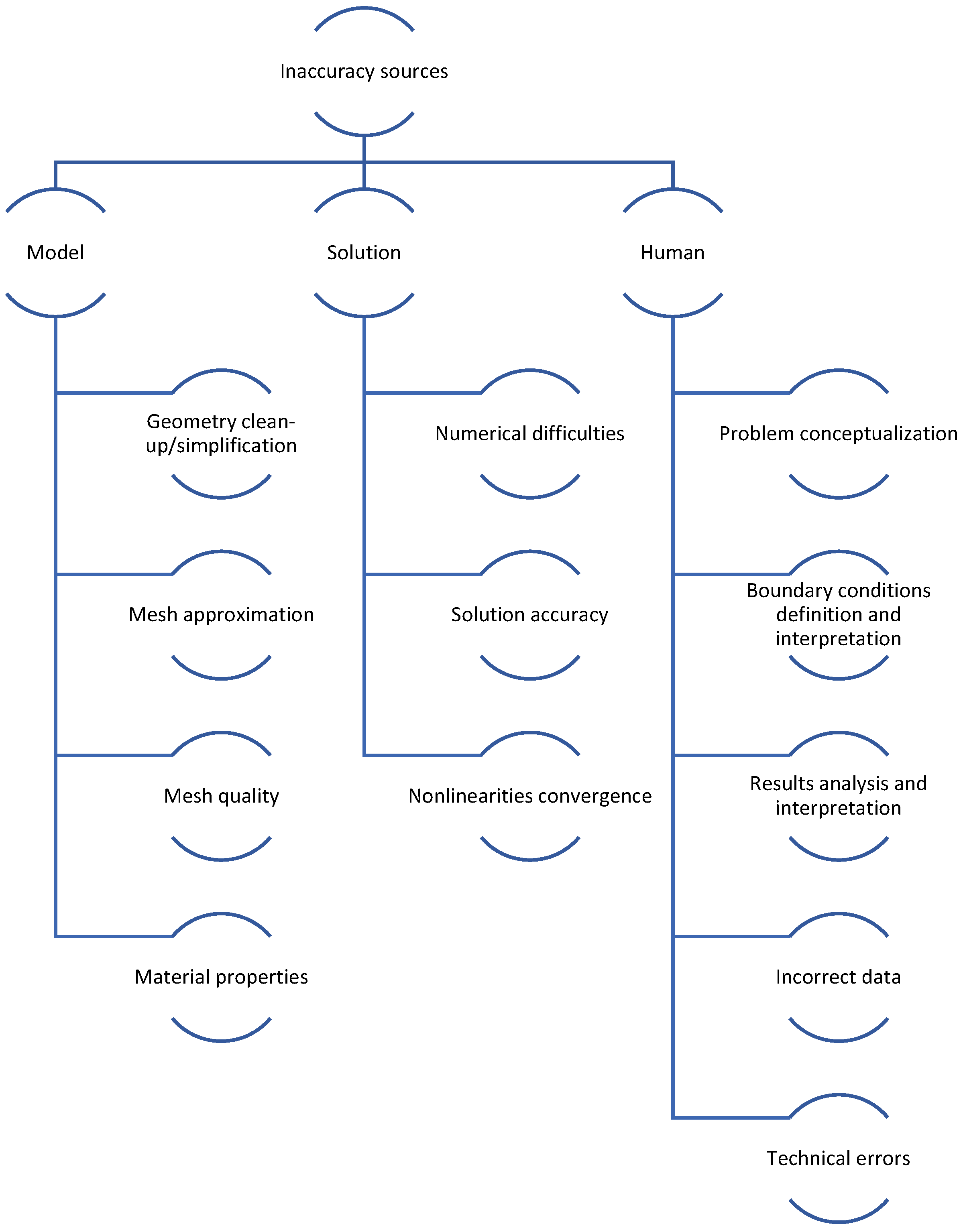
The sources of inaccuracy could be grouped as shown in Figure 1. They are divided into three main groups: model (related to the simulation model itself, as its geometry, mesh, and material properties), solution (numerical simulation procedure and related settings for its accuracy and convergence in nonlinear tasks), and human factors. Each group contains subcategories, and each subcategory could be critical to model accuracy. The most critical could be human errors, especially due to problem conceptualization. But these factors could be avoided/minimized through a combination of expertise and check procedures (which are already well defined and included in internal standards in organizations that use simulations extensively). Another source of issues is the interpretation of results, which depends almost entirely on the expert (analyst). “Fancy and colorful representations” can be produced by any simulation, and the analyst’s responsibility is to analyze the results and draw the correct conclusions [15,16]. The analysis author’s responsibility is to find the important simulation results, to interpret them, and to direct the audience to the correct conclusions.
The model’s inaccuracies are also an important contributor to overall accuracy. While the first three subcategories are relatively easy to quantify, check, and improve (as they are mainly related to geometry representation), the material properties depend on data availability. The usual scenario is to use available data from reliable sources as standards, or, on the best occasion, values that are supplied by the manufacturer of the material (measured in a certified laboratory). An option is to use any available worldwide data; thus, the material properties values could be a significant source of inaccuracy. Material data is influenced by many factors, such as the geometry of the object (thinner components may have higher structural mechanics properties than thicker ones, for instance) and production technology (the forming process influences surface treatment and overall mechanical strength). The optimal case is when the experimental measurements are performed on the material that will be used in the product under assessment, to assess its behavior in a specific work environment.
Many studies show that predictive virtual prototyping is highly dependent on the accuracy of material data [17,18]. Material characterization experiments are essential in obtaining accurate material data, used as input for finite element modeling simulations [19]. While obtaining accurate data is important, the next step is to interpret these values in the software tool used. The simplest model is a linear representation, which is possible for certain materials and types of behavior. For instance, the elastic behavior of many metals could be described simply by an elasticity module defined as a constant. Even in this case, there are some considerations to be made, such as the module definition (bending or tension), material condition, etc.
Generally, defining a material model is challenging, especially when it should represent material nonlinearity in terms of specific characteristics such as hyperelasticity, elastoplasticity, fracture, or other nonlinear behaviors. This has been subjected to another group of studies through the years [17,20,21,22] that have resulted in the development of a big variety of material models (Chaboche kinematic hardening, Anand viscoplasticity, Gurson model—for plasticity), as studied in [23,24,25,26,27,28,29] and others. For instance, more than 10 different material models are used to represent viscoelastic and viscoplastic creep, depending on the specific material type and the possibilities to represent its nonlinear creep behavior.
The above-discussed specifics for material presentation in virtual prototyping can be summarized into two general stages: acquiring accurate material data and presenting it correctly in the simulation model. This manuscript presents a research study that evaluates the contribution and influence of material data accuracy on the overall model results. The research uses laboratory tests for material data acquisition (using a testing laboratory equipment for mechanical properties characterization), virtual prototyping (using available commercial software for Finite Element Analysis—FEA), and physical testing of a simple structure built from the same material (using available stand for force-deflection testing). The target is not only to assess the influence of material data, but also to analyze the sources of its accuracy. This is evaluated using an important characteristic of material structural mechanics—stress–strain curve—that covers both elastic and plastic regions. It is especially important when plasticity is expected to occur and is a nonlinear characteristic, which can be defined using various approaches in a virtual prototype (through different material models that are available in the used software). Additionally, two parameters are assessed for their influence on simulation results accuracy—elastic modulus (referring to material behavior in the elasticity region) and yield point (yield stress and strain, that is, a reference point for the plasticity region). The sensitivity is evaluated through simulations of the sample model, using the built virtual prototype, and comparison of the obtained results (force-deflection characteristic that describes the rigidity of the examined structure).

2. Materials and Methods

2.1. The Method

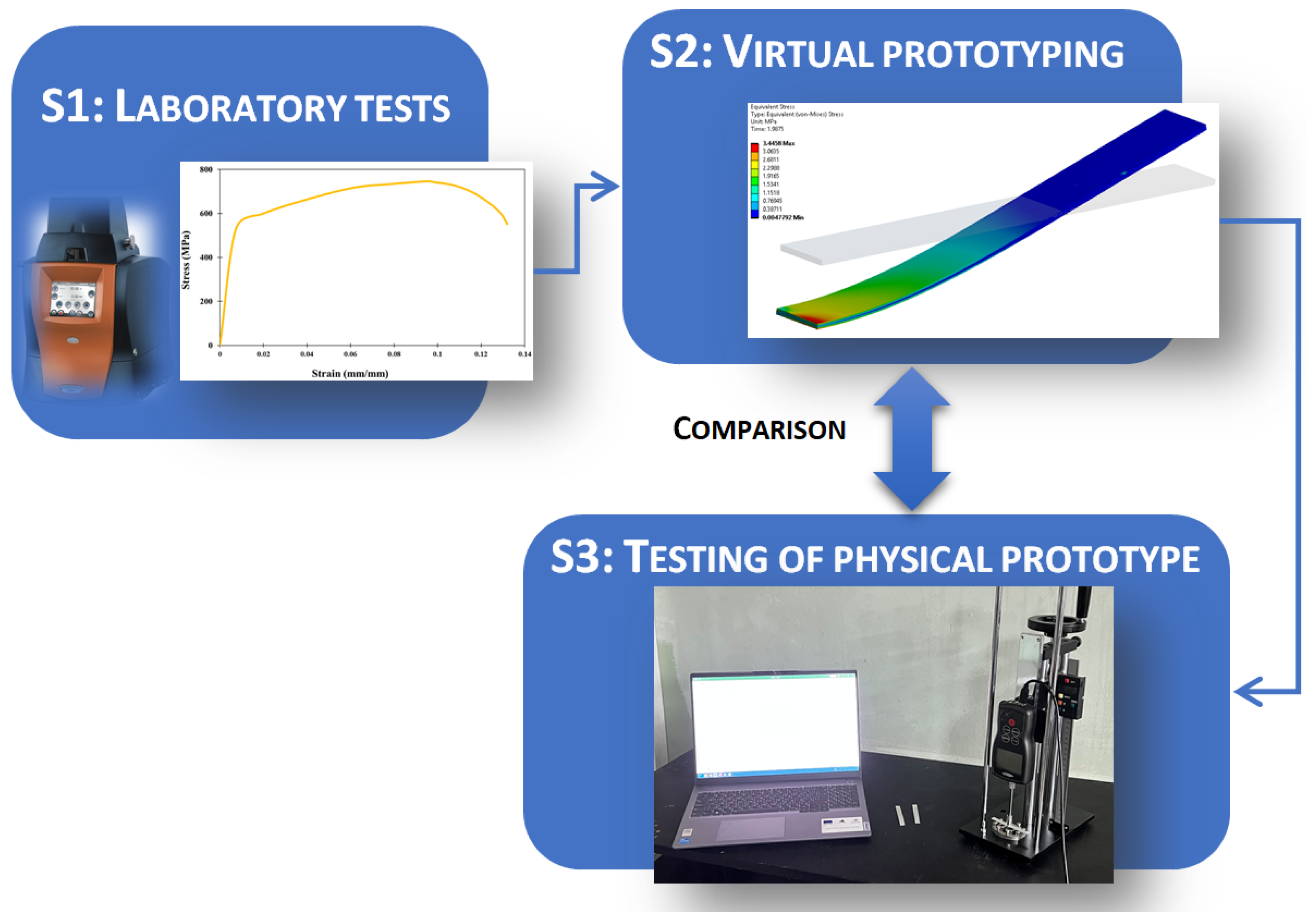
The defined target is reached through a sequence of experiments, both virtual and physical. This sequence is presented as a scheme in Figure 2, where the target is to provide data for the virtual prototype that is to be analyzed by FEA, where the specifics of the subjected test specimen are similar in all steps.
Planned virtual and physical experiments are grouped into three stages:
  • S1: Laboratory tests: Initially, the material property—stress–strain curve—is obtained using a Dynamic Material Analyzer (DMA) test machine, which is a conventional approach [30,31] for laboratory testing of material properties. Generally, DMA provides opportunities to measure stiffness, strength, and durability characteristics of test samples. It allows determining various mechanical material parameters as a function of time and temperature. This testing technology is common in the study of plastic materials, but it is also applicable to metal structures. Two important specifics are targeted:
    (1)
    The test is performed on a sample of a similar size and form to the physical prototype, or on the same material and workpiece used in further testing. The aim is to avoid, or at least reduce, the influence of factors such as geometry (thickness) and the material production process (e.g., possible hardening).
    (2)
    The three-point bending test is close to the testing of the physical prototype, thereby avoiding or at least reducing differences in boundary conditions across all stages of the current research study.
  • S2: Virtual prototyping: Next, a virtual prototype is developed using data from the laboratory tests conducted in S1. It represents the testing of the virtual prototype, and the major output is the force-deflection history for the geometry under the applied force. Virtual prototyping is performed using numerical simulation of a specific sample that is close but different from the sample used in the preliminary stage S1. Its dimensions differ, except for thickness, which aims to reduce the influence of geometric parameters on material properties. The simulation model represents both the elastic and the plastic behavior of the material through a nonlinear analysis. Multilinear isotropic hardening is used to represent the behavior of the modeled object in the plastic region [32].
  • S3: Testing of physical prototype: The last step is testing a physical prototype that corresponds to the virtual prototype. The test set-up includes a specially prepared fixture to reproduce different three-point bending tests, and a specimen with different widths and lengths, but with the same thickness as the one used in S1. The obtained force-deflection result is compared against that obtained in the S2 one. The differences are analyzed and discussed, and, if needed, the virtual prototype is corrected to achieve maximum accuracy.

2.2. The Materials and Used Tools

The material used for the performed experiment is an aluminum-based alloy of the Al 1000 series (pure)—1050 (WNr 3.0255, or EN AW-Al99.5).
It is a wrought alloy, usually formed by extrusion or rolling, used in the electrical and chemical industries. Its chemical composition is as follows: aluminum: 99.5% min; copper: 0.05% max; iron: 0.4% max; magnesium: 0.05% max; manganese: 0.05% max; silicon: 0.25% max; titanium: 0.03% max; vanadium: 0.05% max; and zinc: 0.05% max. It is important to note that its mechanical properties, and especially the stress–strain curve, could vary significantly depending on the production process [33]. The elastic modulus (elasticity region) varies from 68 GPa to 80 GPa, and it is typically assumed to be 70 GPa. Some studies report a yield strength range of 147–211 MPa, depending on the production process [34].
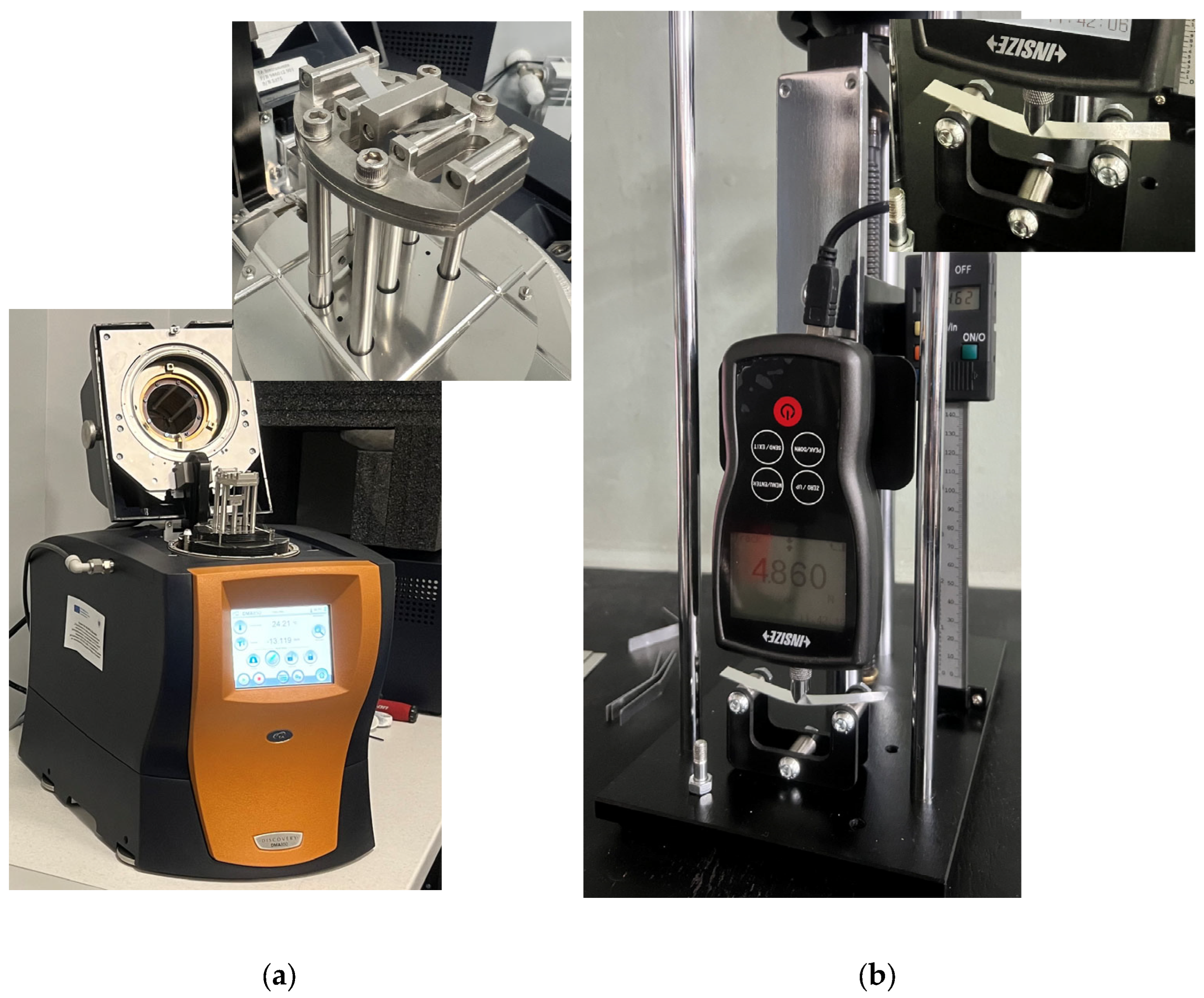
The first step—S1: Laboratory tests—is performed using a dynamic mechanical analyzer (Discovery DMA 850) equipped with a three-point bending test fixture, as shown in Figure 3a. The test is performed at 25 °C, as this is a typical environmental temperature. A sheet metal sample of aluminum-based alloy 1050 is used for DMA testing, with dimensions of length: 40 mm; width: 6 mm; and thickness: 0.5 mm. The distance between supports is 20 mm. Used ramp rate of 0.1 mm/min decreases its influence over measured stress–strain values. The same sheet of 1050 aluminum-based alloy is used further in S3: Testing of physical prototypes to eliminate any influences of geometry thickness or production technology. Using identical workpiece for manufacturing samples for S1 and S3 tests leads to definitive absence of any discrepancy, as the material has the same thickness—just different width and length.
A similar, but slightly different, sample is used for testing the virtual and physical prototypes, with dimensions of 80 mm in length, 9 mm in width, and 0.5 mm in thickness. Performed tests in step S3 using a simple movable table with a force measurement tool. Distance measurement has an accuracy of ±0.01 mm, while force measurement has an accuracy of ±0.001 N; both measurement tools provide sufficient accuracy for the current research. As mentioned above, a specially prepared fixture is used (refer to Figure 3b), which is similar to the three-point bending test performed in S1: Laboratory tests, but with different support spacing.

2.3. Used Virtual Prototype

A virtual prototype is used that fully corresponds to the physical prototype that is tested in S3.
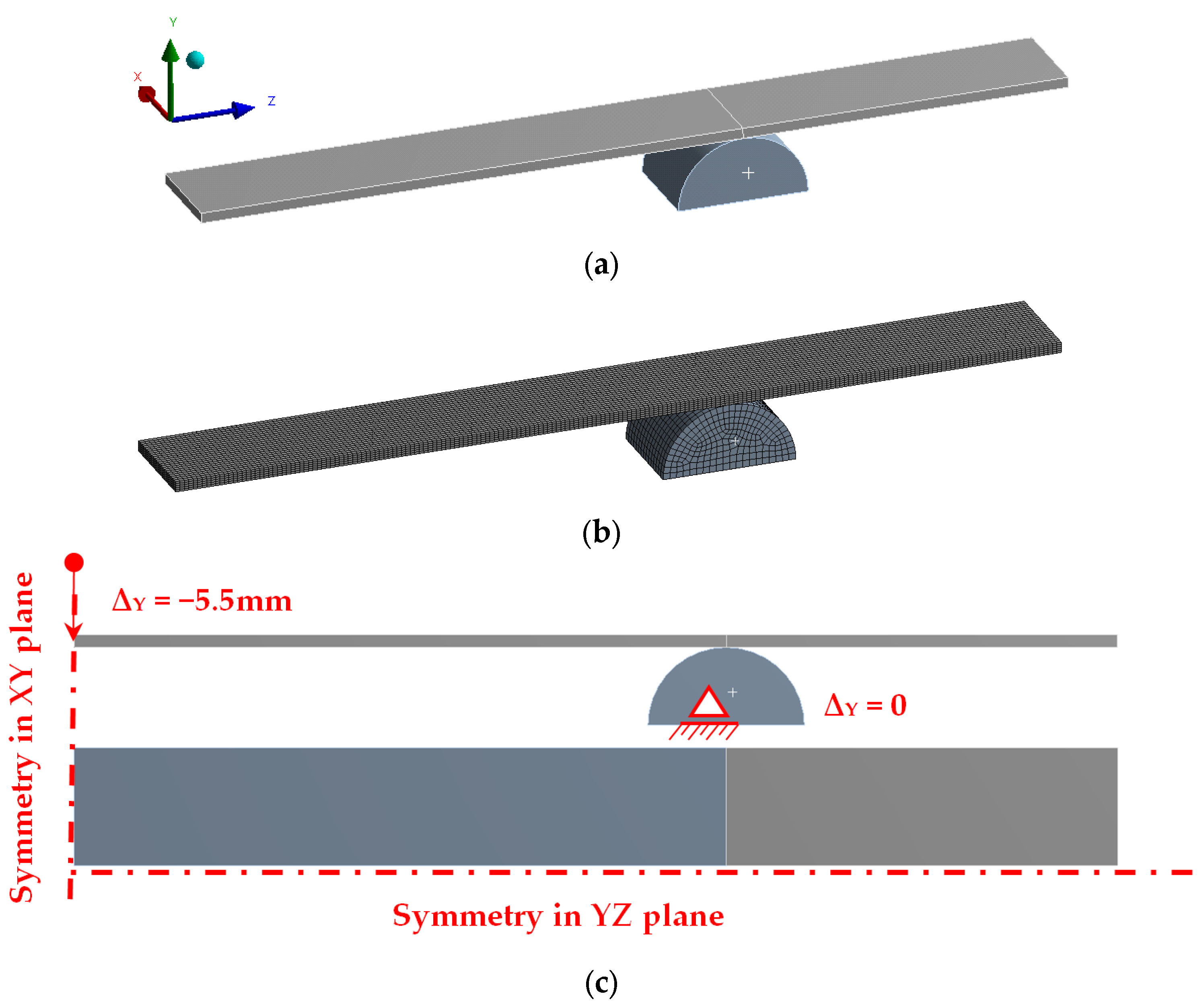
A quarter model is built because the geometry and applied boundary conditions are both symmetric with respect to two planes. Both the geometry and mesh models are shown in Figure 4. The simulation model comprises 32,560 nodes and 26,000 elements. The examined geometry is simple and allows for obtaining a mesh of sufficient quality (maximum aspect ratio of 2 and skewness less than 0.4) and detail (5 layers of elements through the plate thickness). The obtained mesh quality significantly reduces the potential estimation error caused by the elements’ geometry.
The applied boundary conditions are shown in Figure 4c. Applied symmetries correspond to the built quarter model, and the applied displacement of the upper edge in the XY plane is equal to the applied displacement in the test model. The support is only in the Y-direction and is applied to the bottom surface of the support cylinder body. The contact between the support cylinder body and the test plate is frictionless. This type of contact allows the rotation of the plate around the support cylinder to be represented. It is not expected that neglecting friction will cause significant differences in the results, since the friction coefficient is small.

3. Results

3.1. S1: Laboratory Tests

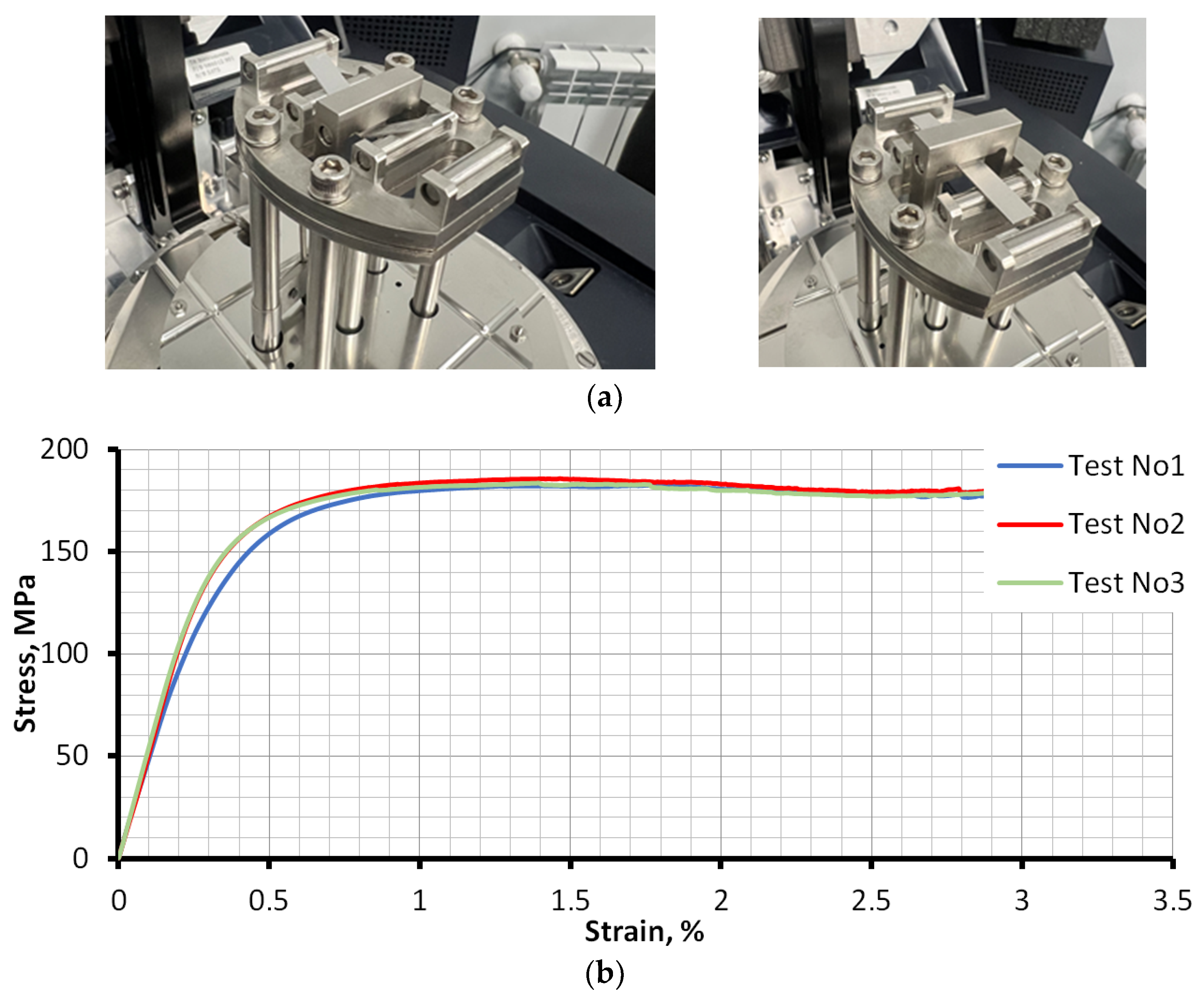
Three test procedures are performed, using different specimens, with dimensions as shown in Chapter 2.2, at 25 °C environmental temperature. The testing process is illustrated in Figure 5a, where a total displacement (deformation) of 6 mm is used for each test.
Three important sets of results are extracted to be used further for the planned tests in next stages:
(1)
Stress–strain curve—this is the major output, used for the simulation of plasticity. It is obtained directly from the laboratory test bench—DMA 850—using the available software. A curve for each tested specimen is shown in Figure 5b. The average curve is used further in the virtual prototyping step.
(2)
Yield point—it is evaluated through measurement of the residual deformation (plastic). The residual deformation is measured over the tested specimen using the laboratory test bench’s measurement system, DMA 850. The values are reported in Table 1, for each test case. The residual deformation value is used to determine both yield strain and yield stress from the listings in the DMA 850 output file. The averaged values of yield stress and strain across the three tests are reported in Table 1 and used in the subsequent virtual prototyping step.
(3)
Elastic module—the measured flexural modulus is equivalent to the tensile modulus for very small strains in isotropic materials. Its values are listed in the laboratory test bench DMA 850 output file for each loading step. Subsequently, these output values are averaged and listed in Table 1, as well.
Several notes could be stated, based on the obtained results:
  • The results for the three tested specimens are relatively close, with a deviation of less than 10% (+1%/−0.7% deviations in the yield stress, and +4.3%/−3.4% deviations in the averaged elasticity module). This shows a high level of confidence for this set of data, and it could be used for further application in the virtual prototyping stage.
  • The elastic zone is nonlinear, but close to linear. Generally, aluminum alloys exhibit a smooth, nonlinear stress–strain response in the elastic zone before reaching the yield point [35]. This could be included in simulations by applying the Ramberg–Osgood law [36], but this law is not planned to be applied in the next step. The elasticity module does not show a constant value; it decreases in the plastic region with increasing strain. Its initial values are in the expected range of about 70 GPa, but the average values are about 50 GPa.
  • The average yield stress is about 120 GPa, which is relatively low according to most studies [33], but it is mainly influenced by the material condition and production technology (specific production process details and heat treatment) [33]. This value will be used as a reference for further virtual prototyping and simulations, and as a reference point to examine its variations on results.
  • The plastic region shows a negative gradient after 1.5% strain, and this is usually problematic for some of the simpler material models in finite element method software. This negative value is relatively small (max 16 MPa), and the stress values are becoming constant after reaching 2.4% strain. The material model in the software used in this study does not allow negative gradients in the plastic region, and small differences will occur due to the near-to-zero gradient used in the next step of the virtual prototyping simulation. This is a specific limitation of the used material model that will result in some differences in the reaction force in the plastic region, after reaching 1.5% strain. This specific characteristic could be important in cases where the reaction force in plastic region is of importance, by reducing it by less than 10%.

3.2. S2: Virtual Prototyping

The simulation of the prepared virtual prototype uses the averaged values of the measured data for the material aluminum alloy 1050, listed in Table 1. ANSYS Workbench 2019 R3 is used for the simulation, particularly its static structural analysis module.
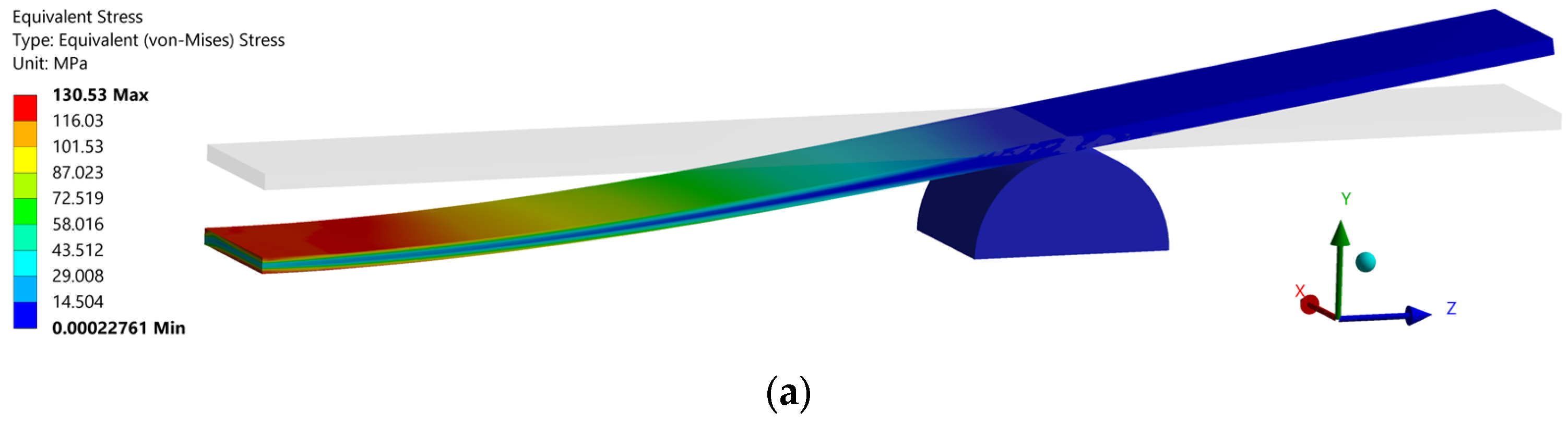
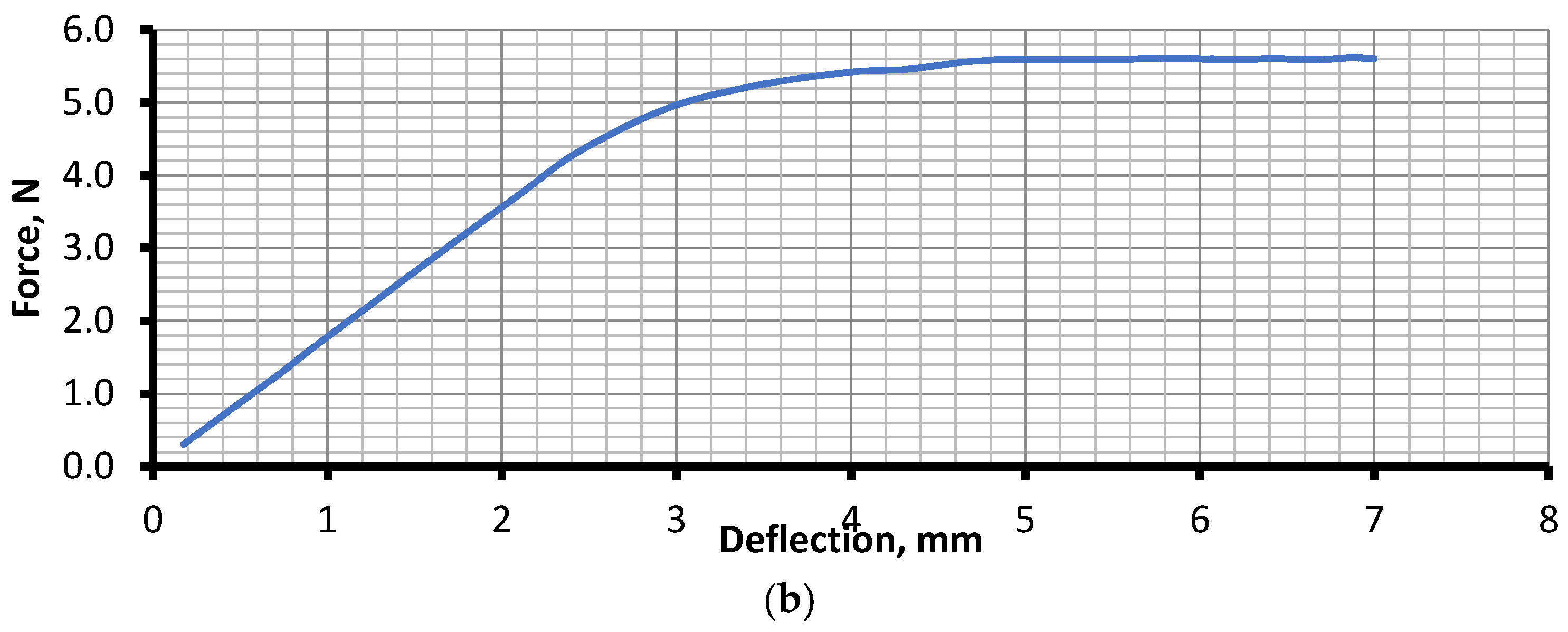
The results are presented as an equivalent stress distribution field and as a force-deflection curve in Figure 6. The curve in Figure 6b is the main characteristic that will be examined further and is composed of the applied displacement (corresponding to deflection) and the reaction force at the same edge. The force-deflection curve clearly shows the material’s elastic (linear) and plastic (nonlinear) zones. The linear elastic zone is due to the material model used in the simulation (a material model with multilinear plasticity and linear elasticity). The nonlinear part of the curve shows some deviations, mainly due to simulation convergence. Maximum force is reached after 4.6 mm displacement—about 5.6 N—but it does not decrease because of the specifics of the material model (a negative gradient in the stress–strain curve in plasticity is not allowed). This reaction force does not increase as the middle edge’s displacement increases, because the material’s stress–strain curve has a near-zero gradient in this region.
These results are to be compared further against testing results for the physical prototype.

3.3. S3: Testing of Physical Prototype

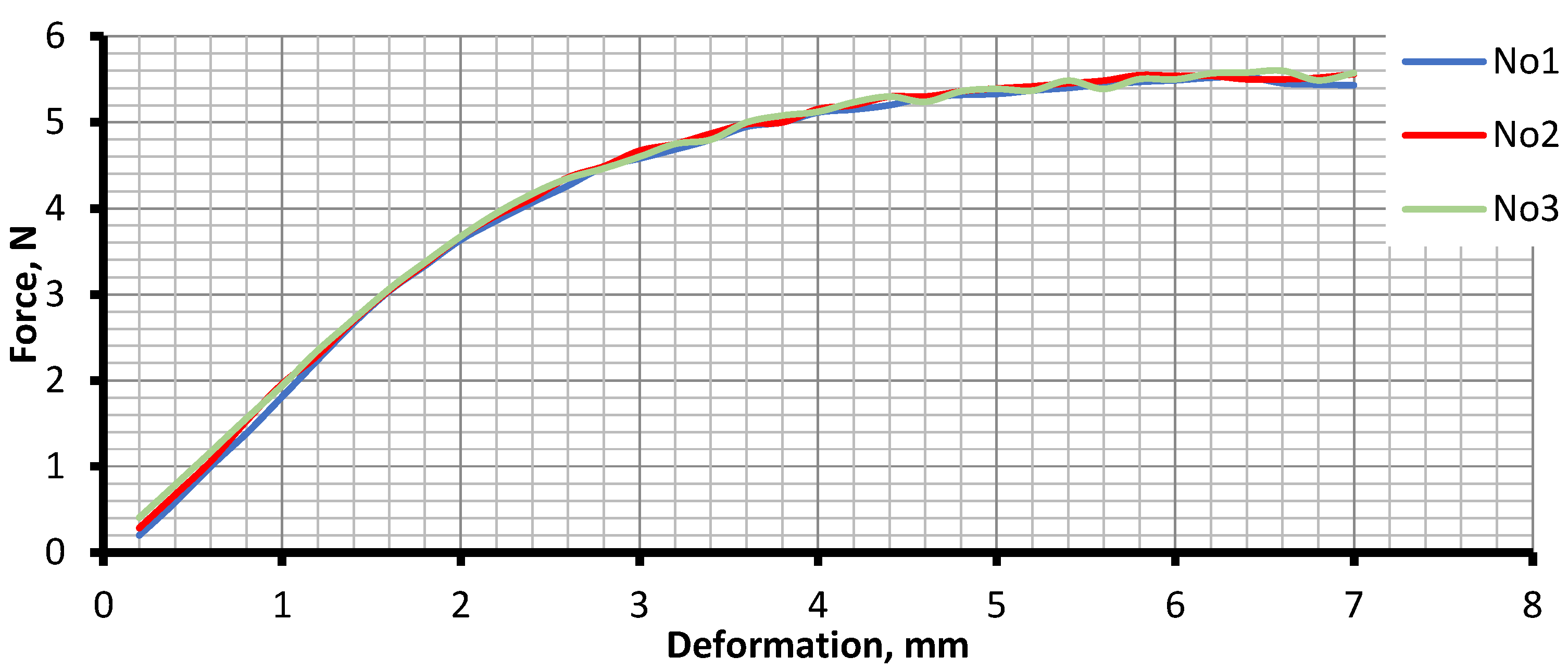
Three physical prototypes are tested using the test setup described above. Two parameters are measured in parallel: the displacement (deflection) of the applicator tip and the force acting on it. The results are presented in Figure 7.
The next comments could be formed for the obtained results:
  • The test results are highly coincident, with a relative standard deviation of maximum 5%. These deviations could be explained mainly by the accuracy of the values reading and of the specifics of the testing equipment (tolerances in screw drive, for instance). Nevertheless, the average error is insignificant, and these results and their averages could be used for further examination.
  • The elastic zone is slightly nonlinear, and that corresponds to the results obtained in S1: Laboratory tests. This is a definitive confirmation of the observed change in the elasticity module in the laboratory tests.
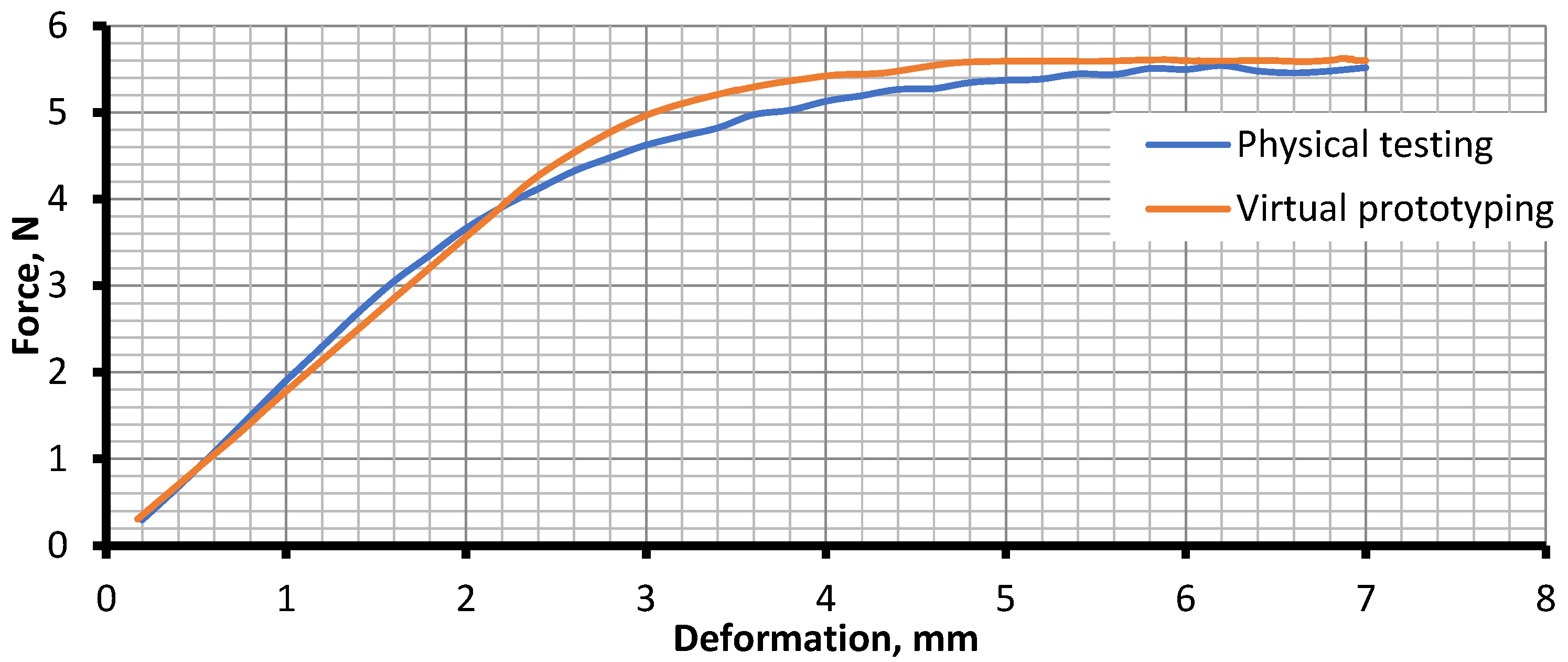
  • The reached maximum average force—5.5 N—is very close to the simulation results—5.6 N (less than 2%), even with the observed differences in elasticity region.

4. Discussion

A major check of the obtained results is performed by comparing, in detail, the simulation results with physical prototype testing results. Further, the sensitivity of the major parameters is examined.

4.1. Results Comparison

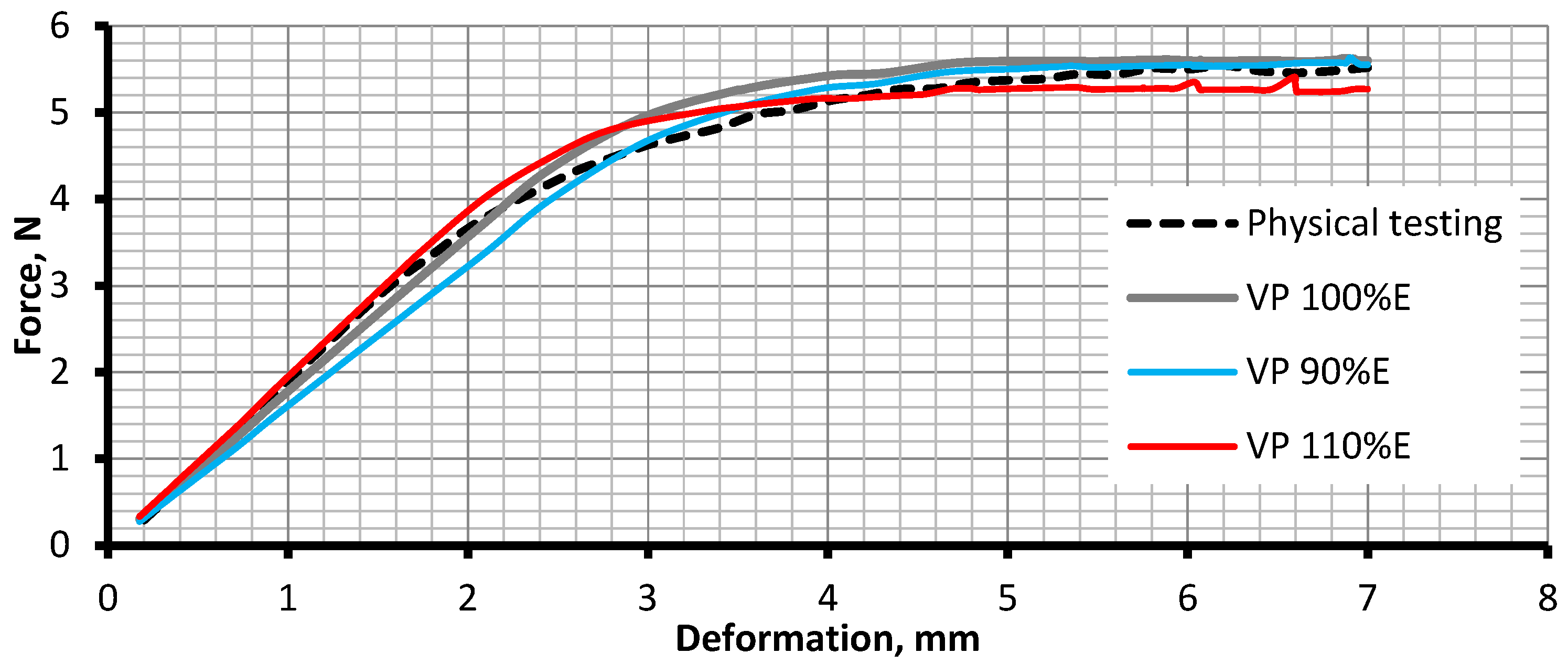
The comparison is performed using averaged results from physical testing in S3 (Figure 8) against those from the virtual prototyping simulation. Further major comments could be formed based on this comparison:
  • The elastic zone in the simulation results is linear, whereas the physical prototype testing results show a nonlinear elastic zone. This is due to the specifics of simulation, as discussed above.
  • The slope in the elastic zone—elasticity module—is very similar for both sets of results. Nevertheless, the elasticity module in physical tests varies (both in S1 results and in S3 results).
  • There are some differences in the plasticity zone results, but the final force is very close between the simulation results and the physical testing data. There is a certain misalignment between the measured characteristic of the material—the stress–strain curve, especially its negative gradient—and the measured force-deflection curve of the physical prototype (which has a small but constant positive gradient). It is mainly due to the specifics of the S3 test and its inaccuracies.
  • The yield point is a critical material characteristic, but it is not easily identified. Any shift in this point results in different results in the plastic region, easily expressed by the change in maximum reaction force. Further examinations are required to quantify in higher detail its influence on the material’s characteristics.

4.2. Evaluation of Material Parameters Sensitivity

The focus is on evaluating the influence of parameters on the results, which is important for the accuracy of virtual prototyping. This is performed for two important material model parameters: the elasticity modulus and the yield point (defined by the yield stress and by the yield strain).
The elasticity module is examined by varying the value used in the virtual prototype simulation by ±10%, and the results are shown in Figure 9. The variation range of 20% is selected because the elasticity module is listed to vary in similar range (68–80 GPa) in various studies [33,34]. Obtained results show that the deviations of all curves are near 10% in the plasticity region and lower than 15% in the elasticity region, compared with the physical testing data.
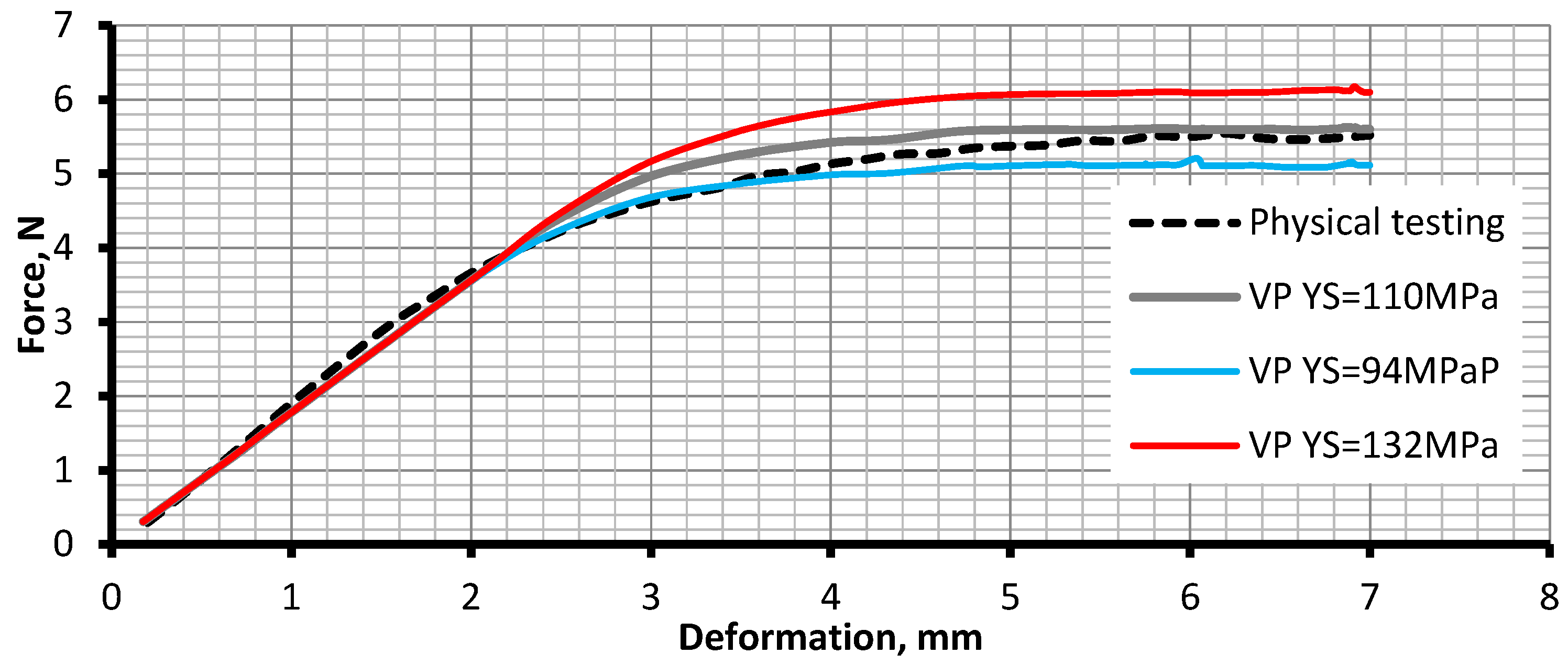
Next, the yield-point influence is evaluated through similar tests—two additional material characteristics are used—with decreased and increased yield stress. The obtained results are shown in Figure 10.
It is observed that when the yield stress decreases from 110 MPa to 94 MPa (by 15%), the maximum force decreases by 7%, and when the yield stress increases from 110 MPa to 132 MPa (by 20%), the maximum force increases by 10%. These comparisons give a general overview of the influence of yield stress. It is important to note that yield stress can vary significantly across different production and heat-treatment processes for the same material. Various studies show values that are even close to a 2× difference (some report a yield stress of close to 90 GPa, reaching 211 GPa in others).

5. Conclusions

The performed study leads to several major conclusions that could be formed, based on the obtained results:
  • The study of the correspondence between virtual prototyping results and physical testing shows sufficient agreement between the obtained data (force-displacement curves). This is achieved by preliminary testing of the used material to determine its exact stress–strain characteristics, which correspond to the material condition (production technology used). It clearly shows that an accurate extraction of material data through laboratory tests is a prerequisite for obtaining adequate simulation results for a virtual prototype, even across different designs, provided the material is used under identical conditions and with the same production technology.
  • The measured average elastic modulus of about 50 GPa differs from the typically used value for aluminum alloys, approximately 70 GPa [33,34,37]. This difference is confirmed by the tests in S3, which show very good correlation to the virtual prototype, especially in elasticity zone (elasticity module differs less than 5%). The data in S1 and S3 tests are obtained using different load application rates, and that factor could be neglected. Two main specifics should be pointed out: the material condition (production technology), causing material imperfections (defects), or the small characteristic dimension of the sample (thickness). Usually, the typical value of 70 GPa is correct for initial loading in the elastic zone. Further loads in the elasticity zone will result in a lower elastic modulus, which could proportionally influence the accuracy of simulation results. Deviations in the elasticity module could result in 15% differences in the obtained results, either in the elasticity or in the plasticity regions. Anyway, this specific should be accounted when high accuracy of the results in the elasticity region is required.
  • Plastic behavior is mainly dependent on the yield point (stress) of the material. This value can vary significantly for a given material and is also dependent on the production method [33,34].
A conclusion from the performed sensitivity tests is that the material characteristics used in the simulation material model may result in differences greater than 10% compared to physical prototype measurements. This inaccuracy could be important for certain simulations.
The recommendation is to perform material characterization using a specimen (produced using the same technology and with similar thickness parameters) for each simulation case if accurate results are needed. This will allow reducing the error to less than 5%. Material science state-of-the-art gives sufficient opportunities to do such tests.
Further examinations of steady-state solutions could be directed to evaluate the influence of material data accuracy on temperature-dependent use cases. Dynamics-related material properties—such as damping—are also of great interest; in addition, they are known to be challenging to determine without physical testing.

Author Contributions

Conceptualization, G.T. and K.K.; methodology, K.K., G.T. and K.D.; software, K.K. and K.D.; validation, K.D. and K.K.; formal analysis, G.T.; investigation, K.K. and K.D.; resources, K.D.; data curation, K.D.; writing—original draft preparation, K.K.; writing—review and editing, G.T. and K.K.; visualization, K.D.; supervision, G.T.; project administration, G.T.; funding acquisition, G.T. and K.K. All authors have read and agreed to the published version of the manuscript.

Funding

This work was supported by European Regional Development Fund under “Research Innovation and Digitization for Smart Transformation” program 2021–2027 under the Project BG16RFPR002-1.014-0006 “National Centre of Excellence Mechatronics and Clean Technologies”, and the used scientific equipment is supplied and funded by the European Union—NextGenerationEU, through the National Recovery and Resilience Plan of the Republic of Bulgaria, project № BG-RRP-2.004-0005.

Data Availability Statement

The data are contained within the article.

Conflicts of Interest

The authors declare no conflicts of interest.

Abbreviations

The following abbreviations are used in this manuscript:
VPVirtual prototyping
PhPPhysical prototyping
FEAFinite Element Analysis
DMADynamic Material Analyzer

References

  1. Wang, G. Definition and Review of Virtual Prototyping. J. Comput. Inf. Sci. Eng. 2002, 2, 232–236. [Google Scholar] [CrossRef]
  2. Chu, C.-H.; Kao, E.-T. A Comparative Study of Design Evaluation with Virtual Prototypes Versus a Physical Product. Appl. Sci. 2020, 10, 4723. [Google Scholar] [CrossRef]
  3. Kent, L.; Snider, C.; Gopsill, J.; Hicks, B. Mixed reality in design prototyping: A systematic review. Des. Stud. 2021, 77, 101046. [Google Scholar] [CrossRef]
  4. Gibson, I.; Gao, Z.; Campbell, I. A comparative study of virtual prototyping and physical prototyping. Int. J. Manuf. Technol. Manag. 2004, 6, 503–522. [Google Scholar] [CrossRef]
  5. Liu, B. Integration of Physical and Virtual Prototyping; Loughborough University: Loughborough, UK, 2011. [Google Scholar]
  6. Todorov, G.D.; Kamberov, K.H. Black box/white box hybrid method for virtual prototyping validation of multiphysics simulations and testing. IOP Conf. Ser. Mater. Sci. Eng. 2020, 878, 012051. [Google Scholar] [CrossRef]
  7. Kulkarni, A.; Kapoor, A.; Iyer, M.; Kosse, V. Virtual prototyping used as validation tool in automotive design. In Proceedings of the 19th International Congress on Modelling and Simulation, Perth, Australia, 15–17 May 2011. [Google Scholar]
  8. Coutts, E.R.; Pugsley, C. Physical versus Virtual Prototyping and Their Effect on Design Solutions. In Proceedings of the Fifth International Conference on Design Creativity—ICDC2018, Bath, UK, 20–24 April 2018. [Google Scholar]
  9. Malakov, I.; Zaharinov, V. Optimization of size ranges of technical products. Appl. Mech. Mater. 2016, 859, 194–203. [Google Scholar] [CrossRef]
  10. Fong, J.; Filliben, J.; Fields, R.; Bernstein, B.; Marcal, P. Uncertainty in Finite Element Modeling and Failure Analysis: A Metrology-Based Approach. J. Press. Vessel Technol.-Transact. ASME 2006, 128, 140–147. [Google Scholar] [CrossRef]
  11. Tekkaya, A.E.; Martins, P.F. Accuracy, Reliability and Validity of Finite Element Analysis in Metal Forming: A User’s Perspective. Eng. Comput. 2009, 26, 1026–1055. [Google Scholar] [CrossRef]
  12. Zohdi, T.I. Accuracy of the Finite Element Method. In A Finite Element Primer for Beginners; Briefs in Applied Sciences and Technology; Springer: Berlin/Heidelberg, Germany, 2015. [Google Scholar]
  13. Debney, P.; Hendry, S.; Kannan, R. Accuracy and precision in finite-element analysis. Struct. Eng. 2023, 101, 62–65. [Google Scholar] [CrossRef]
  14. Ali, M.H. Studied validation of finite element modeling for titanium alloy (Ti–6Al–4V) at face milling. Heliyon 2023, 9, e17670. [Google Scholar] [CrossRef]
  15. Cook, R.D. Finite Element Modeling for Stress Analysis; J. Wiley & Sons: New York, NY, USA, 1995. [Google Scholar]
  16. Hellen, T.K.; Becker, A.A. Finite Element Analysis for Engineers—A Primer, 1st ed.; NAFEMS: London, UK, 2013. [Google Scholar]
  17. Chen, B.; Starman, B.; Halilovič, M.; Berglund, L.; Coppieters, S. Finite Element Model Updating for Material Model Calibration: A Review and Guide to Practice. Arch. Comput. Meth. Eng. 2024, 32, 121–128. [Google Scholar] [CrossRef]
  18. Halamka, J.; Bartošák, M. Use of machine learning in determining the parameters of viscoplastic models. Eng. Comput. 2025, 42, 1927–1941. [Google Scholar] [CrossRef]
  19. Sarema, B.; Matope, S.; Nagel, M.; Sterzing, A. Material Characterization Experiments and Data Preparation for a Finite Element Analysis of the Deep Drawing Process Using AA 1050-O. J. Manuf. Mater. Proc. 2025, 9, 33. [Google Scholar]
  20. Yu, Y.; Liu, H.; Qian, K.; Yang, H.; McGehee, M.; Gu, J.; Luo, D.; Yao, L.; Zhang, Y.J. Material characterization and precise finite element analysis of fiber reinforced thermoplastic composites for 4D printing. Comput.-Aid. Des. 2020, 122, 102817. [Google Scholar] [CrossRef]
  21. Roylance, D. Mechanical Properties of Materials; MIT: Cambridge, MA, USA, 2008. [Google Scholar]
  22. Yang, Z. Material Modeling in Finite Element Analysis; CRC Press: New York, NY, USA, 2023. [Google Scholar]
  23. Chaboche, J.L.; Rousselier, G. On the plastic and viscoplastic constitutive equations—Part I: Rules developed with internal variable concept. J. Press. Vessel Technol. 1983, 103, 453–464. [Google Scholar] [CrossRef]
  24. Wang, J.D.; Ohno, N. Two equivalent forms of nonlinear kinematic hardening: Application to nonisothermal plasticity. Int. J. Plast. 1991, 7, 637–650. [Google Scholar] [CrossRef]
  25. Arruda, E.; Boyce, M. A three-dimensional constitutional model for the large stretch behavior of rubber elastic materials. J. Mech. Phys. Solids 1993, 42, 389–412. [Google Scholar] [CrossRef]
  26. Ogden, R.; Roxburgh, D. A pseudo-elastic model for the Mullins effect in filled rubber. Proc. R. Soc. Lond. Ser. A 1999, 455, 2861–2877. [Google Scholar] [CrossRef]
  27. Bergstrom, J. Mechanics of Solid Polymers; Elsevier: Amsterdam, The Netherlands, 2015. [Google Scholar]
  28. Seisenbacher, B.; Winter, G.; Grun, F. Improved approach to determine the material parameters for a combined hardening model. Mater. Sci. Appl. 2018, 9, 357–367. [Google Scholar] [CrossRef][Green Version]
  29. Xu, X.; Dai, Z. Numerical implementation of a modified Mohr-Coulomb model and its application. J. Mod. Transp. 2017, 25, 40–51. [Google Scholar]
  30. Chaudhary, B.; Li, H.; Matos, H. Long-term mechanical performance of 3D printed thermoplastics in seawater environments. Res. Mater. 2023, 17, 100381. [Google Scholar] [CrossRef]
  31. Phansalkar, S.P.; Mittakolu, R.; Han, B.; Kim, T. Enhanced DMA Test Procedure to Measure Viscoelastic Properties of Epoxy-Based Molding Compound: Multiple Oscillatory Strain Amplitudes and Monotonic Loading. Micromachines 2025, 16, 384. [Google Scholar] [CrossRef] [PubMed]
  32. Soffel, F.; Eisenbarth, D.; Hosseini, E.; Wegener, K. Interface strength and mechanical properties of Inconel 718 processed sequentially by casting, milling, and direct metal deposition. J. Mater. Proc. Technol. 2020, 291, 117021. [Google Scholar] [CrossRef]
  33. Elkholy, A.N.M.; Mohamed, H.K.; El-Abden, S.Z. Mechanical characteristics of AL-1050 and Al-6061 alloys deformed using equal channel angular rolling process. Zast. Mater. 2022, 63, 484–492. [Google Scholar]
  34. Hajizadeh, K.; Ejtemaei, S.; Kurzydłowski, K.J. Microstructure and Mechanical Properties of 1050 Aluminum after the Combined Processes of Constrained Groove Pressing and Cold Rolling. Phys. Met. Metallogr. 2020, 121, 79–85. [Google Scholar] [CrossRef]
  35. Szwed, A.; Gajewski, M. A Nonlinear Elastic Model for Compressible Aluminum Alloys with Finite Element Implementation. Materials 2021, 14, 7351. [Google Scholar] [CrossRef]
  36. Chen, L.; Yu, Y.; Song, W.; Wang, T.; Sun, W. Stability of geometrically imperfect struts with Ramberg–Osgood constitutive law. Thin-Walled Struct. 2022, 177, 109438. [Google Scholar] [CrossRef]
  37. Doty, H.W.; Hernandez-Sandoval, J.; Ammar, H.R.; Songmene, V.; Samuel, F.H. Determination of Young’s modulus in aluminum alloys: Role of precipitates, dispersoids, and intermetallics. J. Mater. Res. Technol. 2025, 37, 3549–3562. [Google Scholar] [CrossRef]
Figure 1. Sources of inaccuracy in engineering analyses, using virtual prototyping.
Modelling 07 00025 g001
Figure 2. Schematics of performed assessment of material data.
Modelling 07 00025 g002
Figure 3. Physical testing. (a) S1: Laboratory tests set up using DMA 850. (b) S3: Testing of physical prototype.
Modelling 07 00025 g003
Figure 4. Virtual prototype. (a) Geometry model and symmetry defined in XY and YZ planes. (b) Mesh model. (c) Applied boundary conditions.
Modelling 07 00025 g004
Figure 5. S1: Laboratory tests. Results. (a) Testing and residual deformation of the specimen. (b) Stress–strain curves for the performed tests.
Modelling 07 00025 g005
Figure 6. S2: Virtual prototyping. Results. (a) Equivalent (von Mises) stress distribution, MPa. (b) Force-deflection curve.
Modelling 07 00025 g006aModelling 07 00025 g006b
Figure 7. S3: Results from the testing of physical prototype.
Modelling 07 00025 g007
Figure 8. Comparison of obtained results for the virtual prototype simulation (S2) and physical testing (S3).
Modelling 07 00025 g008
Figure 9. Comparison of obtained results for the virtual prototype simulation (S2) and physical testing (S3), and virtual prototype simulation variations in elasticity module.
Modelling 07 00025 g009
Figure 10. Comparison of obtained results for the virtual prototype simulation (S2) and physical testing (S3).
Modelling 07 00025 g010
Table 1. S1: Laboratory tests. Results for yield point and elasticity modulus.
Test NoDeformation, mmYield Strain, mm/mmYield Stress, MPaAveraged Elasticity Module, MPa
TotalResidualElastic
15.9985.6100.3880.291120.849,153.5
25.9985.6640.3340.250122.450,369.9
35.9985.6760.3220.241120.253,051.1
Averaged5.9985.6500.3480.261121.150,858.2
Disclaimer/Publisher’s Note: The statements, opinions and data contained in all publications are solely those of the individual author(s) and contributor(s) and not of MDPI and/or the editor(s). MDPI and/or the editor(s) disclaim responsibility for any injury to people or property resulting from any ideas, methods, instructions or products referred to in the content.