Article

Numerical Simulation and Structural Optimization of Multi-Stage Separation Devices for Gas-Liquid Foam Flow in Gas Fields

1
Gathering & Transportation Engineering Technology Institute, PetroChina Southwest Oil and Gas Field Company, Chengdu 610042, China
2
Chongqing Shale Gas Exploration and Development Company Limited, Chengdu 404100, China
3
Petroleum Engineering School, Southwest Petroleum University, Chengdu 610500, China
*
Author to whom correspondence should be addressed.
Modelling 2025, 6(4), 160; https://doi.org/10.3390/modelling6040160
Submission received: 11 October 2025 / Revised: 24 November 2025 / Accepted: 3 December 2025 / Published: 5 December 2025

Abstract

In natural gas gathering and transportation projects, efficient gas-liquid separation equipment is crucial to ensuring the stable operation of subsequent processes. Conventional separation units often have problems such as low efficiency, high energy consumption and poor resistance to load fluctuations when dealing with foam-containing gas-liquid mixtures. For this purpose, numerical simulation and structural optimization of multi-stage foam separation units were carried out in this study. Based on FLUENT software fluid analysis software, a three-dimensional, multi-physics coupled model incorporating cyclonic defoaming components and axial-flow separation tubes was developed. The volume of fluid (VOF) multiphase flow model was used to capture the dynamic characteristics of the gas-liquid interface, and the population balance model was used to simulate the coalescence and fragmentation of the foam. The results show that in the non-working fluid stage, the optimal operating pressure is 5.0–5.5 MPa, and the droplet concentration should be maintained below 50 × 10−5. The system performance during the working fluid stage is significantly influenced by foam size. The efficiency of millimeter-sized foams is stable above 88% in the 5.0–6.0 MPa range, while the efficiency of micrometer-sized foams is optimal in the 5.3–5.7 MPa range. It is recommended to control the foam proportion below 35% and add a pre-defoaming unit to improve overall performance.

1. Introduction

Natural gas, as an important low-carbon clean energy source for the 21st century, plays a key role in the global energy transition due to its high combustion efficiency and low carbon emission intensity. During the extraction process, the flowback fluid from gas wells is complex in composition, often accompanied by a large number of tiny droplets, solid particles and foams, causing serious damage [1,2] to the back-end processing equipment. For foam treatment, conventional methods rely on the addition of external defoamers, but have drawbacks such as chemical waste and inability to respond dynamically to changes in operating conditions. Solid defoaming rods, which can be added intermittently, make continuous defoaming difficult and require frequent manual intervention [3]. In addition, traditional separators have a single internal structure, poor coupling between units, high equipment pressure drop, narrow operating flexibility, and are difficult to adapt to gas volume fluctuations or complex medium conditions; Although some improved schemes enhance the separation efficiency by adding cyclonic elements, the spatial layout of the multi-stage separation units is unreasonable, which is prone to secondary entrainment, and the filter element replacement is difficult and maintenance cost are high [4,5].
Gas-liquid separation equipment, which is a key device for achieving effective separation of gas and liquid phases in industrial production, comes in a wide variety of types, including gravity separators, inertial separators, and centrifugal separators. Different types of separators, based on their own unique working principles, show significant differences in separation performance, applicable scenarios, etc., and related studies have also explored their characteristics in depth. Gravity separators are more basic gas-liquid separation devices, and their working principle is closely related to the force and movement of the droplets. Wu et al. [6] applied droplet dynamics theory to conduct theoretical calculations of the gas-liquid separation structure, analyzed the force and motion of the droplets, and summarized the expression of the shape structure design, providing a theoretical basis for the structural optimization of the gravity separator. However, gravity gas-liquid separators have obvious limitations. They have a low gas-liquid separation efficiency and require a long separation time, which is difficult to meet the demands in scenarios where high separation efficiency and speed are required. The separation of inertial gas-liquid separators is based on the difference in inertial force between the gas and liquid phases. Due to the difference in density and flow rate between the gas and liquid phases, when encountering a continuous sharp turn structure during the flow process, the droplet, due to the difference in inertial force with the gas phase, has a movement trajectory different from the gas phase flow trajectory, thus achieving separation. Based on a validated Computational Fluid Dynamics-Population Balance Model (CFD-PBM), Zhi [7] systematically investigates the influence of oil-gas ratio and flow rate on the performance of a dynamic gas-liquid separator, revealing the trade-off between separation efficiency and energy consumption, and establishing predictive equations to guide the design and operation of such separators. Li [8] investigates the impact of spiral turns and pitch on gas-liquid separation efficiency in spiral separators, identifying optimal pitch for peak performance and demonstrating over 90% efficiency under varying operational conditions. Li [9] designed and optimized a cascading gas-liquid cyclone separator, demonstrating that an 80% separation efficiency for 1-μm droplets can be achieved after tuning structural parameters like the exhaust pipe height and liquid gap width.
Among the publicly available technical solutions, there is no separation device that integrates multi-stage defoaming, gradient filtration and intelligent regulation, which can achieve efficient and continuous defoaming through structural optimization without relying on external agents. Existing devices generally have problems such as low separation efficiency, weak resistance to load fluctuations, and inconvenient maintenance, and there is an urgent need for a new type of separation technology to solve these problems. To address the shortcomings of traditional gas-liquid separation devices and improve separation efficiency and product quality, this paper constructs a separation device that integrates multi-stage defoaming, gradient filtration and intelligent regulation, which can achieve efficient and continuous foam removal without relying on external agents, and builds a three-dimensional model of optimized separation process combination through ANSYS Fluent 2024 software A large number of flow field simulation tests were conducted to comprehensively evaluate the process performance under different operating conditions and provide an effective solution path for the gas-liquid separation problem in natural gas extraction and processing [10].
To further address the above limitations, this study clarifies two core research gaps: first, there is a lack of integrated separation systems that combine multi-stage defoaming, gradient filtration and intelligent regulation, while avoiding chemical agents or intermittent mechanical defoaming; second, traditional multi-stage separators have poor synergy between structural design and fluid dynamics, leading to uneven flow, secondary entrainment and poor adaptability to foam-containing mixtures. To fill these gaps, the research follows a concise technical route: design a two-stage separation device; establish a 3D multi-physics coupled model via FLUENT; optimize key structural parameters to balance efficiency and pressure drop; and verify performance under different operating conditions to determine optimal ranges.

2. Mathematical Models and Boundary Conditions

To accurately simulate the gas-liquid-foam three-phase flow involving bubble coalescence, breakup, and liquid film formation within the separator, this study employs a multi-physics coupled numerical strategy. The core of this strategy involves the simultaneous solution of the VOF model for tracking gas-liquid interfaces, the Population Balance Model (PBM) for describing foam size evolution, and the Eulerian liquid film model for simulating wall liquid film flow. These models are bidirectionally coupled through shared source terms and interphase forces, thereby fully capturing the complex physics of the separation process.

2.1. Interface Tracking and Multiphase Flow Solution (The VOF Model)

The VOF model serves as the framework of this simulation. It captures sharp gas-liquid interfaces by solving a single set of momentum equations (Equation (1)) shared by all phases and tracking the volume fraction of each phase within every control volume (Equation (2)).
ρ u t + ρ u u = p + μ u + u T + ρ g + F s
ρ t + ρ u = 0
where ρ is density, kg/m3. t is time, s. u is the velocity vector composed of u x and u y in the Cartesian coordinate system, m/s. p is pressure, Pa. μ is viscosity, Pa·s. g is gravitational acceleration, m/s2. F s is volume surface tension, N/m.
Using the continuous surface force model (CSF), the formula is shown in Equation (3) [11].
F s = γ k α q
where γ is the surface tension, N/m. k is the surface curvature, defined as k = 1 n n n n n . n is the unit normal vector of the interface. α q is the volume fraction of the q-th phase in the calculation unit.
In this study, the gas phase represents natural gas, while the liquid phase represents the liquid mixture containing foams. The mixture properties (density, viscosity) are determined by the volume fraction-weighted average of the individual phases (Equations (4) and (5)).
ρ = α q ρ l + 1 α q ρ g
μ = α q μ l + 1 α q μ g
where ρ l is the density of the liquid phase, kg/m3. ρ g is the density of the gas phase, kg/m3; μ l is liquid-phase viscosity, Pa·s. μ g is gas-phase viscosity, Pa·s.
The volume fraction between the gas and liquid phases satisfies Equation (6) [12].
q = 1 2 α q = 1

2.2. Population Balance Model (The PBM Model)

In gas-liquid two-phase flows, due to the interaction between the foams and the presence of multi-scale vortices within the flow field, the foams constantly undergo coalescence and fragmentation behavior, resulting in a wide distribution of foam sizes in the flow field. To predict the movement behavior of foams more accurately, the population balance model (PBM) is introduced in this paper. The model is a probabilistic model for calculating the size distribution of discrete phases and explaining the coalesis-burst effect in foam groups, whose equations are shown in Equation (7) [12,13].
t n V , t + u n V , t + v G v n V , t = 1 2 0 v a V V , V n V V , t n V , t d V 0 a V , V n V , t n V , t d V + Ω P g V β V V n V , t d V g V n V , t
where n is the foam number density function. V is the sub-foam volume. V is the original foam volume. u is the phase velocity of the foam; G v is volume growth (shrinkage rate) of the foam; a V , V is foam coalescence rate; g V is foam burst frequency; is the distribution function of the foams produced by foam breakage. To the left of the equation are the time term, convection term, and foam growth term, and to the right are the coalescence generation term, coalescence extinction term, bursting generation term, and bursting extinction term.
The coalescence and breakup of bubbles are governed by empirical kernels. In this work, the Luo coalescence model and the Luo & Svendsen breakup model [12] were employed. The empirical constants within these models (e.g., the coalescence efficiency factor in the Luo model) were adopted directly from the original literature and were not fitted to new experimental data in this study. These constants have been widely validated for similar gas-liquid systems, ensuring the generality of our approach.

2.3. Euler Liquid Film Model

The Euler liquid film model is used to simulate the flow and distribution characteristics of the liquid film on the separator wall. The thickness of the liquid film is much smaller than the radius of the separator, so the transport of the liquid film along the tangential direction of the wall is described for model simplification. When droplets hitting the wall are absorbed into the liquid film, mass and momentum are added to the source terms of the liquid film equation. Likewise, when the droplet detours from the film, the droplet’s motion equation is updated. The interaction between the gas and the liquid film is resolved through the coupling process mentioned above. The mass and momentum equations of the liquid film are given by Equations (8) and (9) [14,15].
ρ l h t + s ρ l h V l = m ˙ s
where ρ l is droplet density, kg/m3. h is the thickness of the liquid film, m. t is the flow time, s. s is the surface gradient operator. V l is the average liquid film velocity, m/s. m ˙ s is mass per unit area source.
ρ l h t + s ρ l h V l = h s p L + ρ l h g τ + 3 2 τ fs 3 μ l h V l + q ˙ s
Among them
p L = p g a s + p h + p σ
p h = ρ h n g
p σ = σ s s h
where g τ is the gravitational component parallel to the liquid film, m/s2. τ fs is the shear stress at the gas-liquid interface, Pa. μ l is dynamic viscosity of the liquid film, Pa·s. q ˙ s is changes in surface pressure resulting from droplet collection, liquid film separation, and shedding, Pa. σ is the surface tension coefficient; p L is the pressure in the normal direction of the liquid film, Pa; p g a s is the pressure of the gas on the wall, Pa. p h is gravity in the normal direction of the liquid film, Pa. p σ is the liquid surface tension, Pa. n is the surface normal vector.
When the VOF model predicts that droplets impinge on the wall, their mass and momentum are transferred as source terms to the liquid film equations [16,17]. Conversely, when the liquid film becomes unstable and entrainment or shedding occurs, the liquid film model releases new droplets into the VOF domain. This coupling ensures accurate capture of the mass and momentum exchange between the “main flow” and the “wall liquid film” within the separator.

2.4. Solution Strategy and Inter-Model Coupling

All the governing equations described above are discretized and solved using the Finite Volume Method within the ANSYS Fluent 2024 software framework. The PISO algorithm is employed for pressure-velocity coupling. The calculation proceeds in a transient manner to ensure the capture of unsteady characteristics of bubble dynamics and interface evolution. This tightly coupled solution strategy ensures the physical consistency and accuracy of our predictions for the entire separation process.
Model Coupling Mechanism: The models are bidirectionally coupled through shared variables and source terms, as illustrated in the computational workflow below:
  • Flow Solution (VOF): In each time step, the solver first updates the flow field (velocity, pressure) and phase distribution (volume fraction) by solving the coupled VOF equations (Equations (1)–(6)).
  • Bubble Dynamics (PBM): The updated flow field provides local parameters (e.g., turbulent dissipation rate) to the PBM. The PBM then solves its transport equation (Equation (7)) to update the bubble size distribution due to coalescence and breakup.
  • Data Feedback: The new bubble size distribution from the PBM is used to calculate updated mixture properties (e.g., effective viscosity and density), which are fed back into the momentum equation (Equation (2)) for the next iteration/time step.
  • Liquid Film Interaction: Concurrently, the Eulerian Liquid Film model interacts with the VOF model at the walls. Mass and momentum are transferred as source terms between the core flow (VOF domain) and the wall film (governed by Equations (8) and (9)) based on droplet impingement and film stripping events.
This iterative, tightly coupled strategy ensures physical consistency across all simulated phenomena.

2.5. Model Assumptions and Limitations

To ensure computational feasibility while maintaining physical relevance, the following key assumptions were adopted in the simulations:
The gas and liquid phases were modeled as incompressible Newtonian fluids under isothermal conditions, justified by the relatively small density variations within the operational pressure range. The VOF method employed a sharp interface assumption, suitable for capturing large-scale separation behavior but not sub-grid interfacial phenomena. In the PBM, bubbles were assumed spherical—a standard simplification for such simulations—with coalescence and breakup described by established empirical kernels.
Uniform inlet conditions and steady-state operation were specified to establish baseline performance metrics. All walls were treated with no-slip boundary conditions using standard wall functions, and the geometry was considered rigid. The model focused solely on physical separation processes, neglecting chemical reactions and mass transfer between phases.
While these assumptions introduce some limitations in representing all real-world complexities, they enable a computationally efficient investigation of the separator’s fundamental performance characteristics. The assumptions are consistent with established practices in similar multiphase flow simulations and provide a solid foundation for the optimization study presented herein.

3. Physical Model and Structural Optimization of the Separator

This study focuses on a two-stage separation system. The first stage employs a multi-tube cyclonic defoaming component for bulk separation, while the second stage uses an axial-flow cyclone tube array for fine separation. The core structural optimizations performed in this work are detailed below.

3.1. First-Stage Separation Cyclonic Defoaming Components

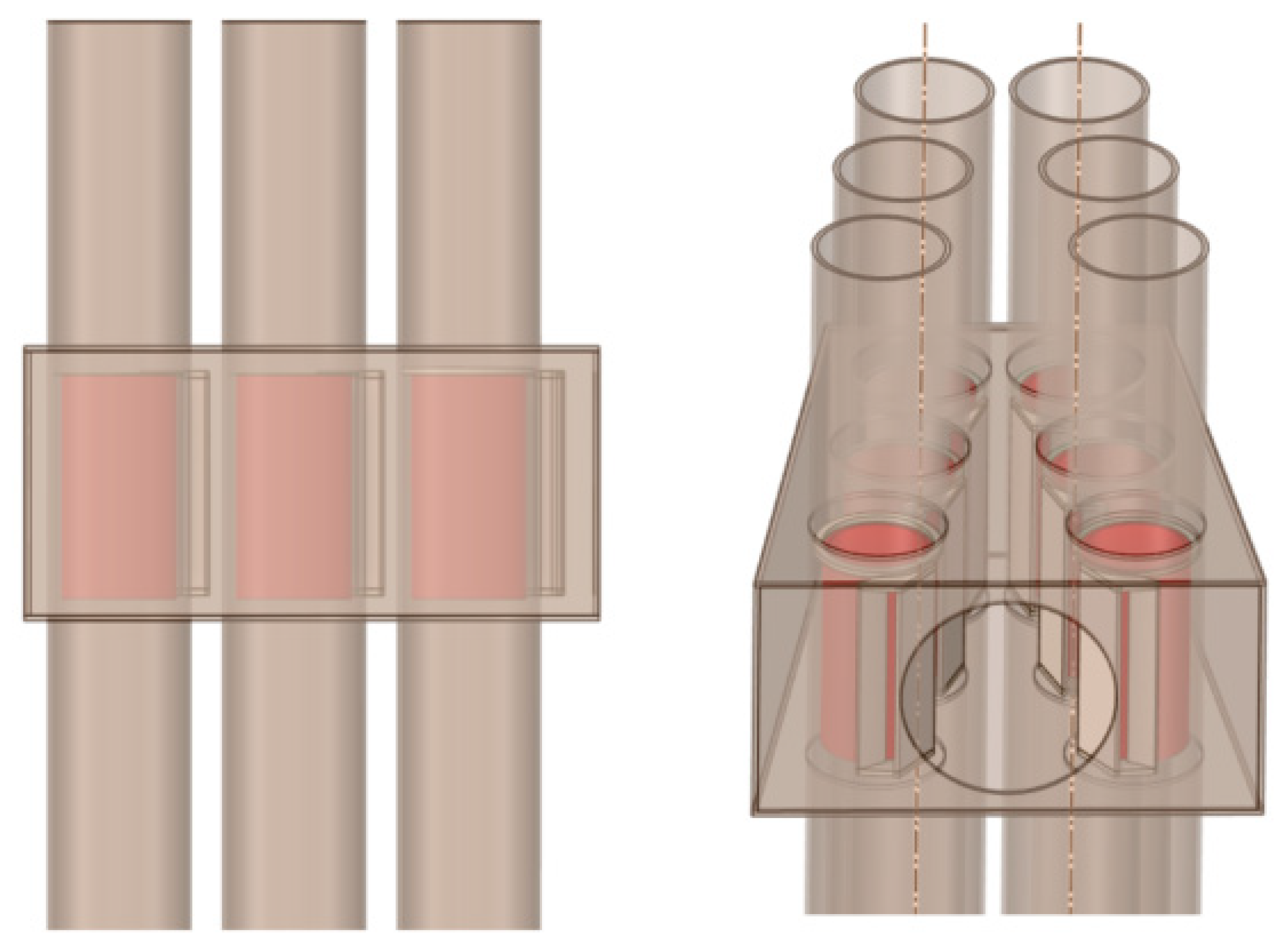
To address the critical issue of excessive direct escape rate (71.6%) of fluid within the cyclone tube [18], this study developed a six-tube parallel primary cyclonic defoaming assembly and significantly improved separation performance through systematic optimization of the central tube structure as shown in Figure 1.
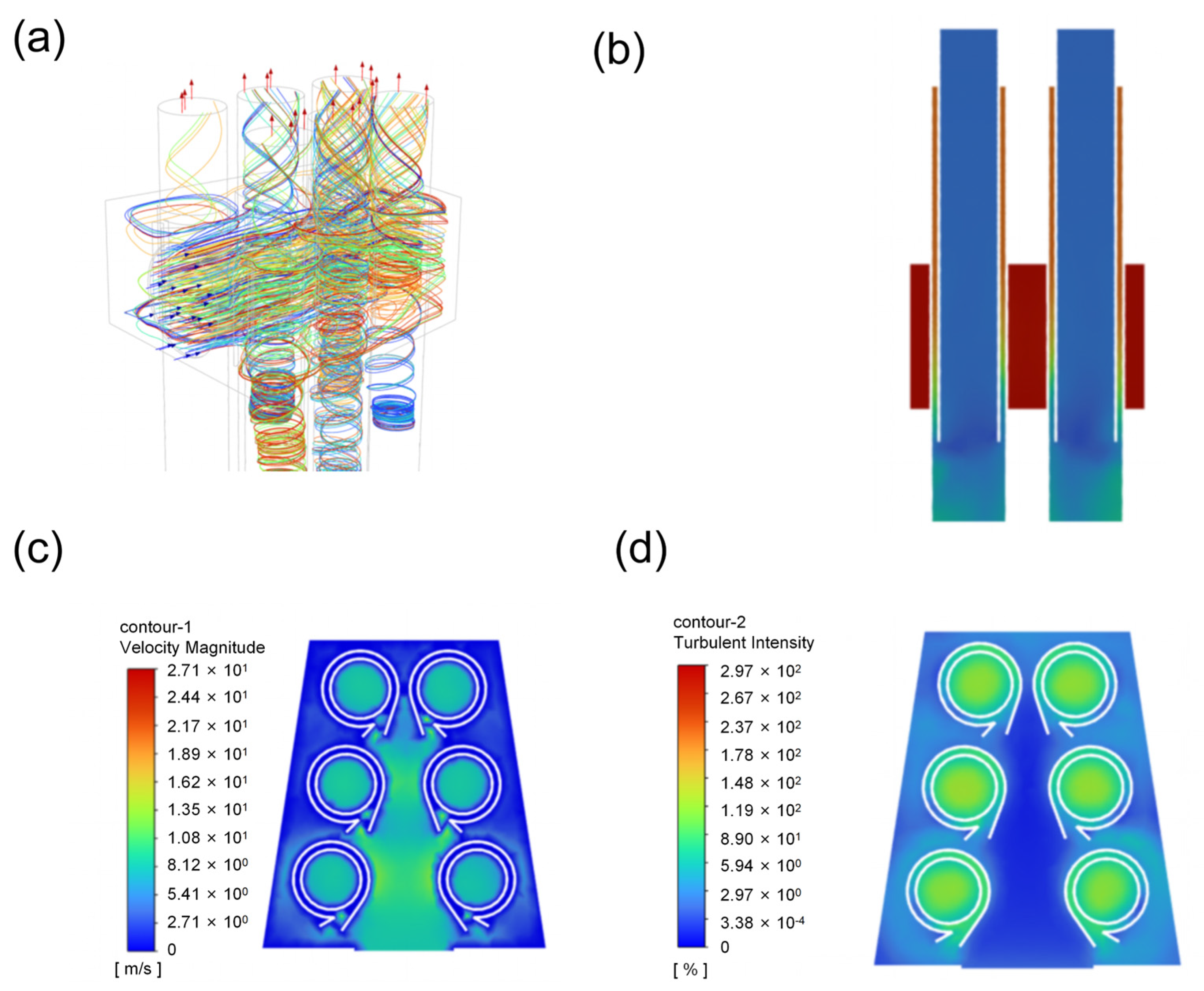
Under the same working conditions, after 60,000 iterations, the study completed 94.47% of the flow field simulation, as shown in Figure 2, and velocity, turbulence intensity, and pressure cloud maps of each section were taken to view the flow field distribution. The flow field analysis results in Figure 2 show that turbulent kinetic energy selectively increased by 35% in the near-wall area and decreased by 22% in the core area, forming an ideal flow field structure conducive to droplet coalescence. Experimental data indicate that this design significantly increased droplet separation efficiency from 42.3% to 62.5%, but the pressure drop also correspondingly increased by 22% to 18,529 Pa.
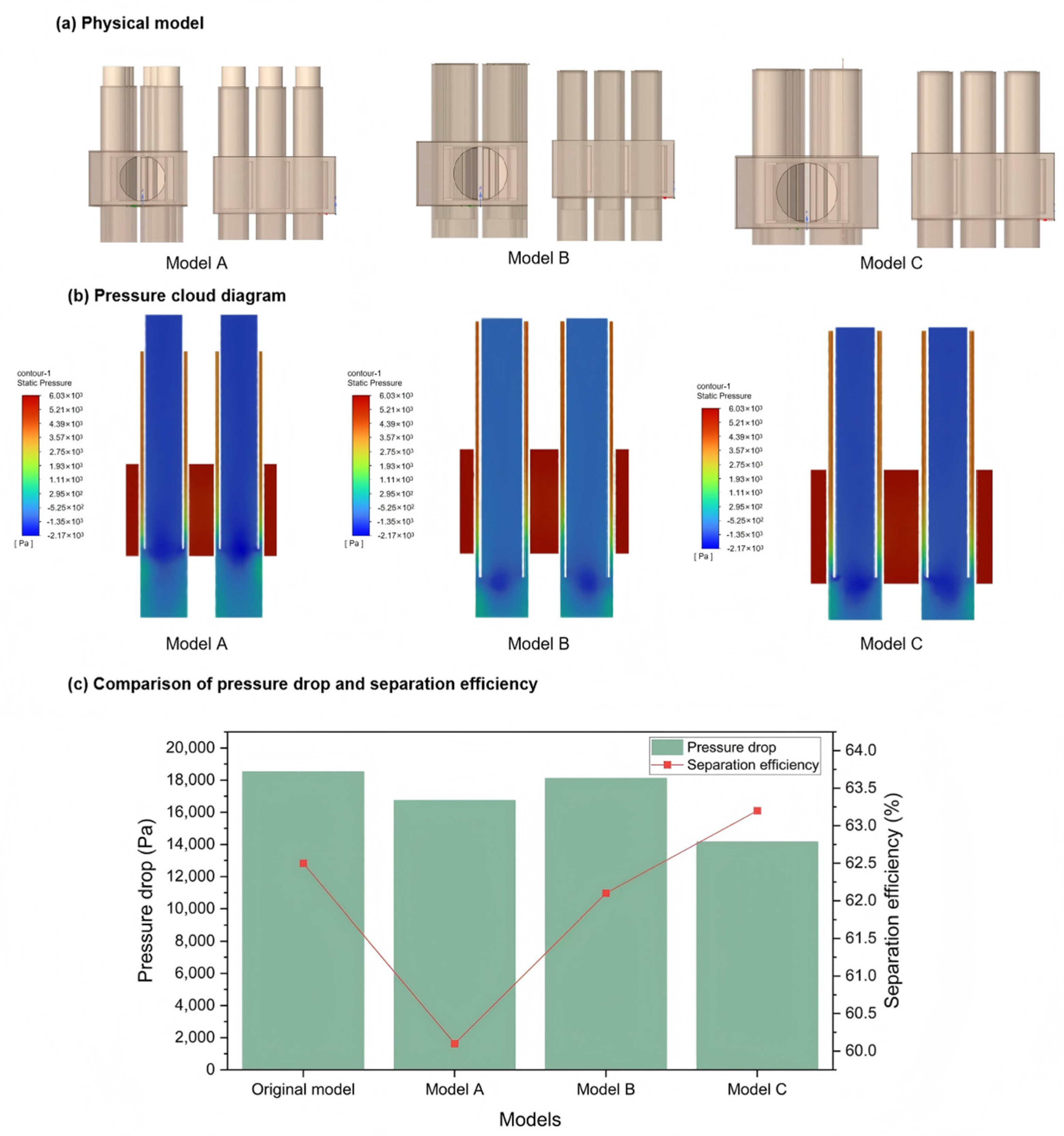
To optimize the system pressure drop, this study systematically compared three central tube configurations (Figure 3). The results showed that Model C with the “upper-shortened and lower-truncated” design performed best, reducing the pressure drop by 23.6% to 14,162.8 Pa while increasing separation efficiency to 63–65%. This result proves that the flow resistance in the inlet area is the main factor affecting the system pressure drop, and the composite optimization scheme can produce the best synergistic effect.
Further diameter optimization research determined 160 mm as the optimal central tube diameter. When the diameter was reduced to 100 mm, although the enhanced turbulence intensity was beneficial for droplet collision and coalescence, the pressure drop surged by 55.3% to 22,001.3 Pa, while the outlet turbulence intensity significantly increased to 145.33%, causing serious secondary entrainment effects, reducing the separation efficiency to below 60%.
The final optimized model (Figure 4) achieved the best balance between separation performance and energy consumption, maintaining 65.4% separation efficiency while controlling the pressure drop at 12.1 kPa.

3.2. Second-Stage Separation Axial-Flow Cyclone Tube Model

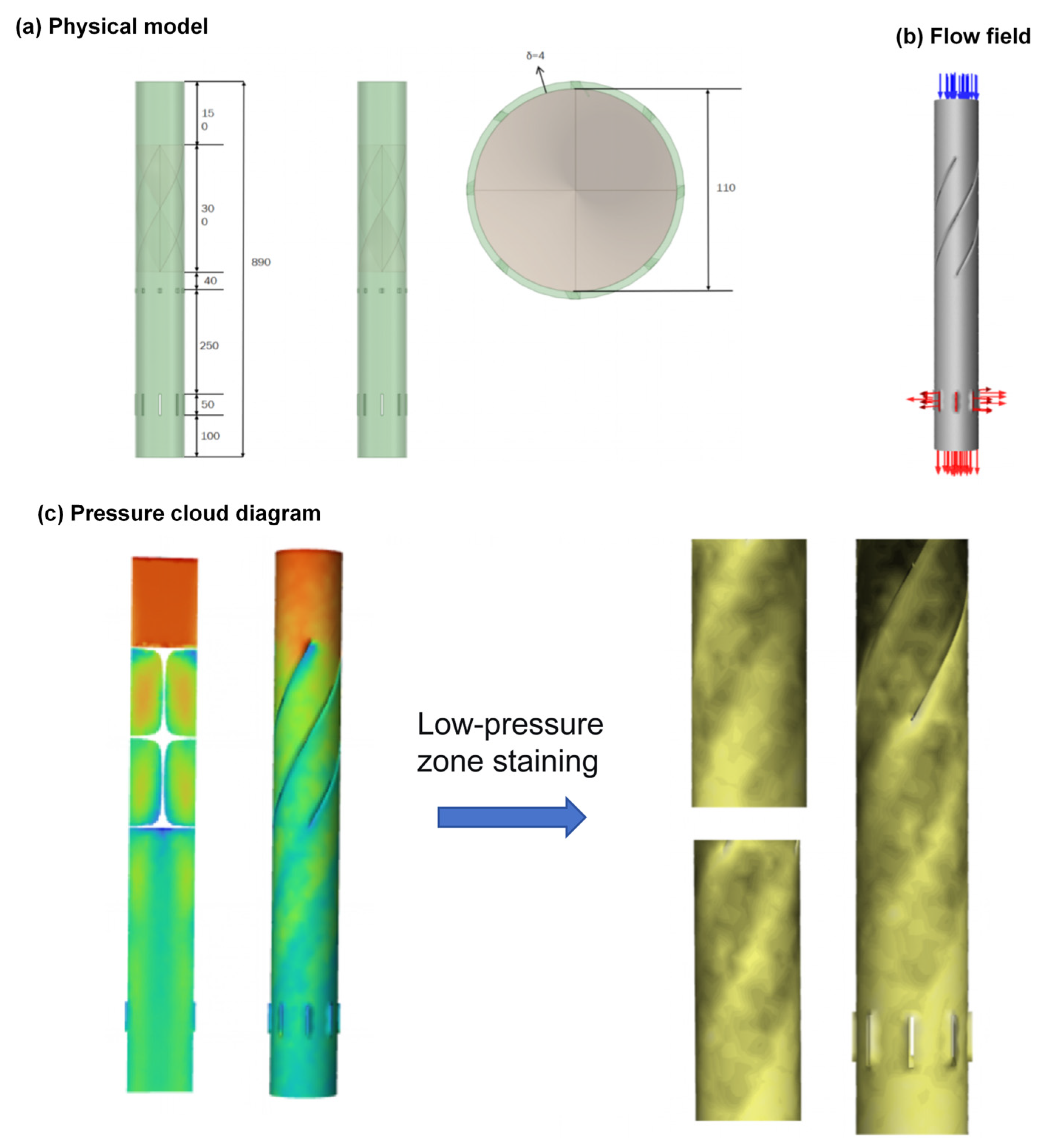
The secondary separation component was innovatively optimized based on axial-flow cyclone tube technology, forming a unique two-stage reflux system by adding liquid outlets and reflux holes in the middle of the separation chamber. The model of the axial-flow cyclone tube established is shown in the Figure 5a. The flow field is shown in the Figure 5b. The blue arrows represent the flow inlet, and the red arrows represent the flow outlet.
The flow field analysis shown in Figure 5c successfully located the precise position of the low-pressure zone on the wall of the cyclone separator. The study found that there was a significant low-pressure area near the middle of the cyclone trajectory and the blade extension line, where the pressure value was about 12–15% lower than the surrounding area. Based on this discovery, an innovative optimized layout scheme for the reflux hole was proposed: positioning the center of the reflux hole 40 mm below the blade and deflecting it 15.28° clockwise along the cyclone direction, with the oblique angle increased to 60°.
This carefully designed location has three advantages: located within the naturally formed low-pressure zone, it can utilize the pressure gradient to enhance the reflux effect; forming an optimal angle with the main cyclone direction, it can generate a strong secondary cyclone; located in the stable development zone of the liquid film, it can effectively avoid flow field disturbance [19].
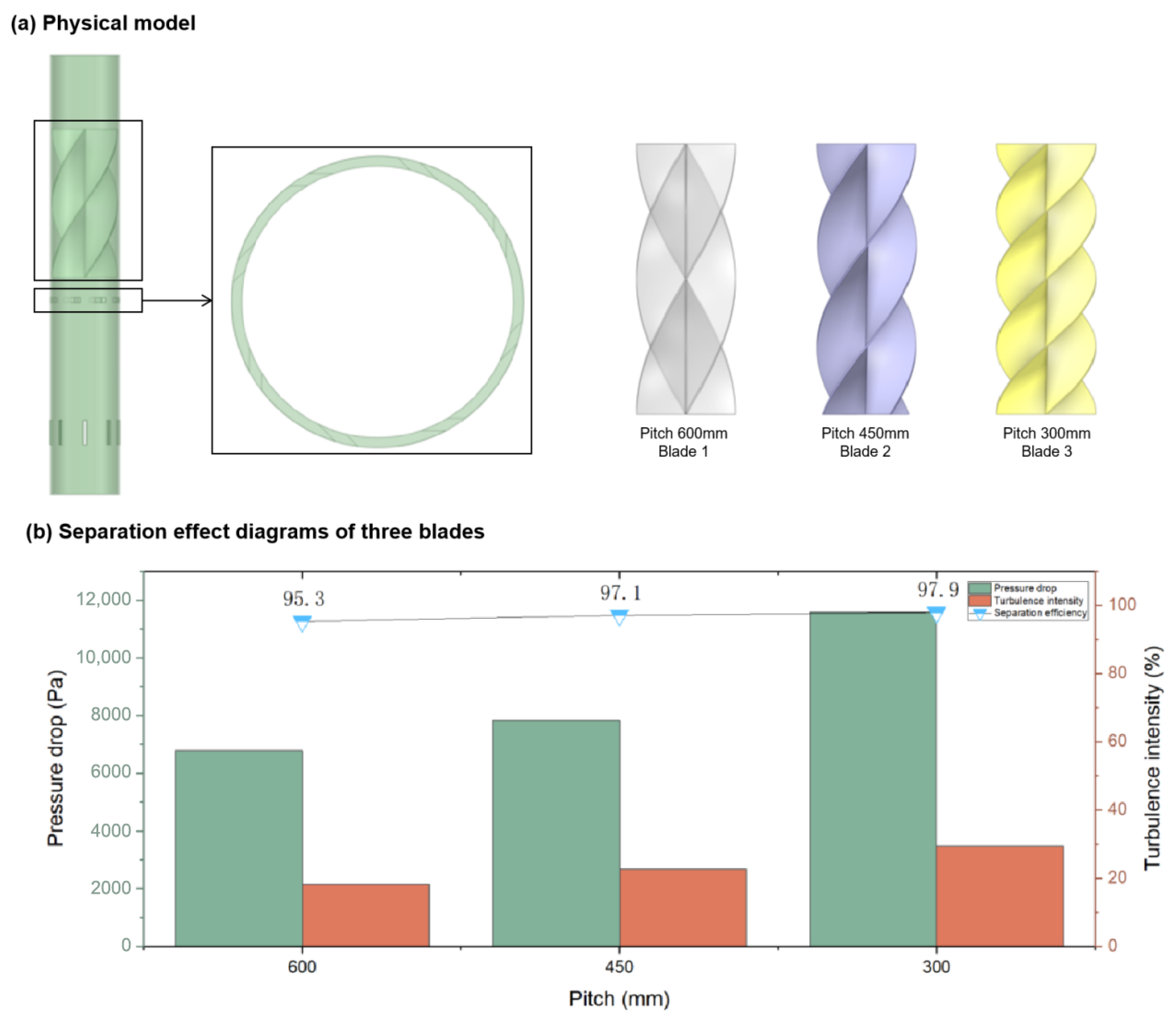
In terms of blade parameter optimization, the comparative analysis in Figure 6 shows that the blade pitch has an important influence on system performance. Although a small pitch of 300 mm could achieve a separation efficiency of 97.9%, it caused the turbulence intensity to surge by 62.1% to 29.5%, the pressure drop to surge by 70.8% to 11,580.2 Pa, and induced core backmixing phenomenon. In contrast, a 600 mm pitch maintained 95.3% separation efficiency while keeping the turbulence intensity within the safe range of 18.2%, embodying the “good enough is best” design concept in engineering optimization.

3.3. Multi-Stage Separation Foam Separation Device Model

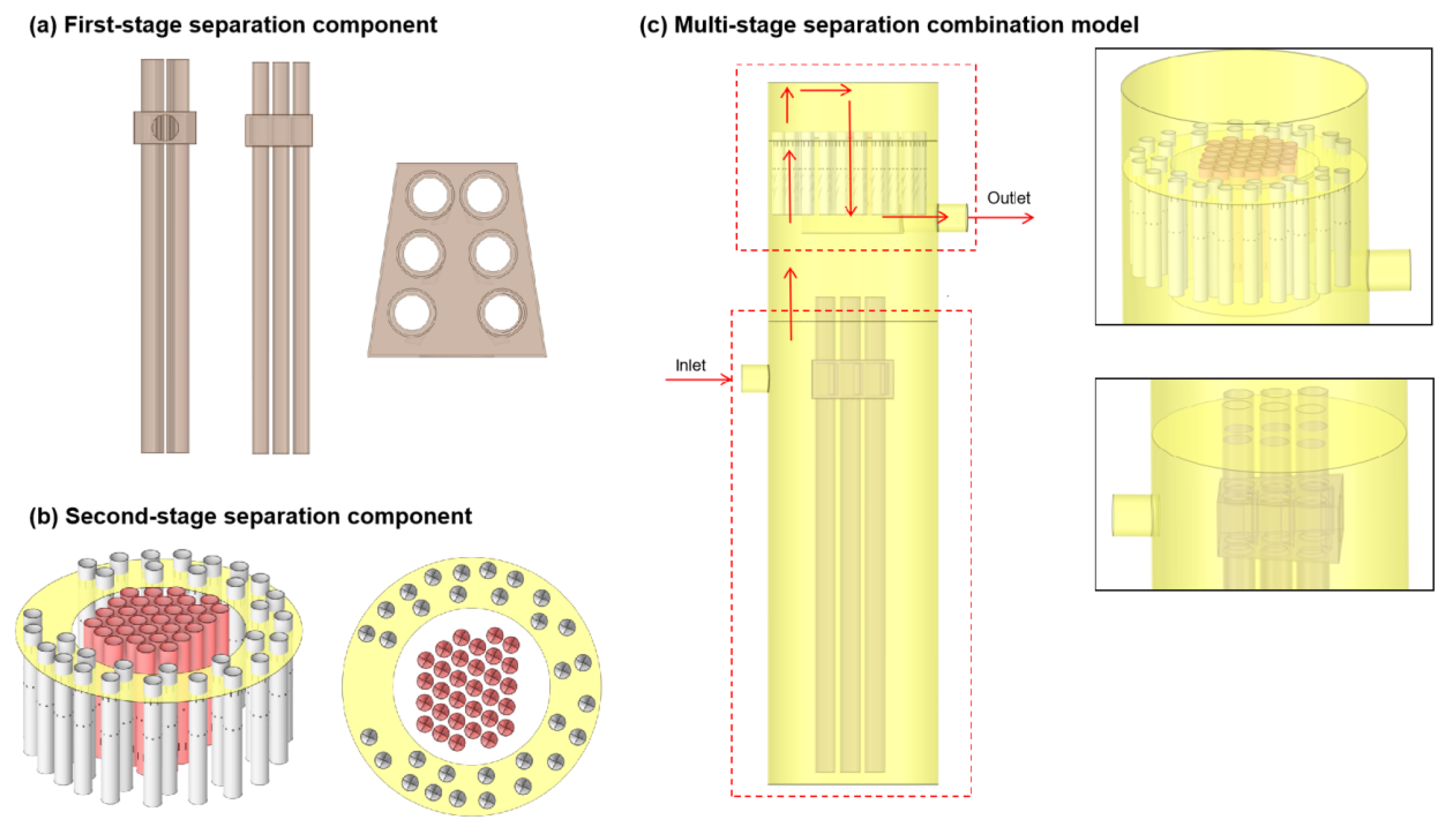
Based on the core principle of “functional classification and synergistic enhancement”, this study constructed a complete multi-stage separation system (Figure 7). The system adopts a two-stage separation architecture: the primary separation component is responsible for preliminary separation, achieving initial coalescence and separation of liquid phase components through the synergistic effect of cyclone field construction and defoaming mechanism; the secondary separation component undertakes deep purification function, adopting a unique double-layer layout design with 31 cyclone tubes each in the inner and outer rings.
This innovative layout design ensures sufficient cyclone separation channels for the gas phase within the limited equipment space, enabling uniform distribution of the gas phase to each cyclone tube, while ensuring the formation of a stable and effective centrifugal force field by reasonably controlling the processing load of a single cyclone tube. The inner ring cyclone tubes adapt to the relatively uniform flow field in the central area, and the outer ring cyclone tubes adapt to the complex flow field near the equipment wall. This differentiated design significantly enhances the adaptability and precision of cyclone separation.
During operation, the gas-liquid mixture enters the separator from the lower inlet, undergoes preliminary separation in the primary component, then the gas enters the upper secondary component for deep purification, and finally the clean gas flows out from the upper outlet. This progressive separation path ensures the system’s efficient processing capacity for droplets of different particle sizes, providing a complete solution for natural gas treatment [20,21].

4. Verification of Mesh Independence and Reliability

To ensure the accuracy and reliability of the numerical simulation results, this chapter systematically evaluates the reliability of the established mathematical model through grid independence verification, comparison with classical experimental data, and analysis of physical trend rationality.
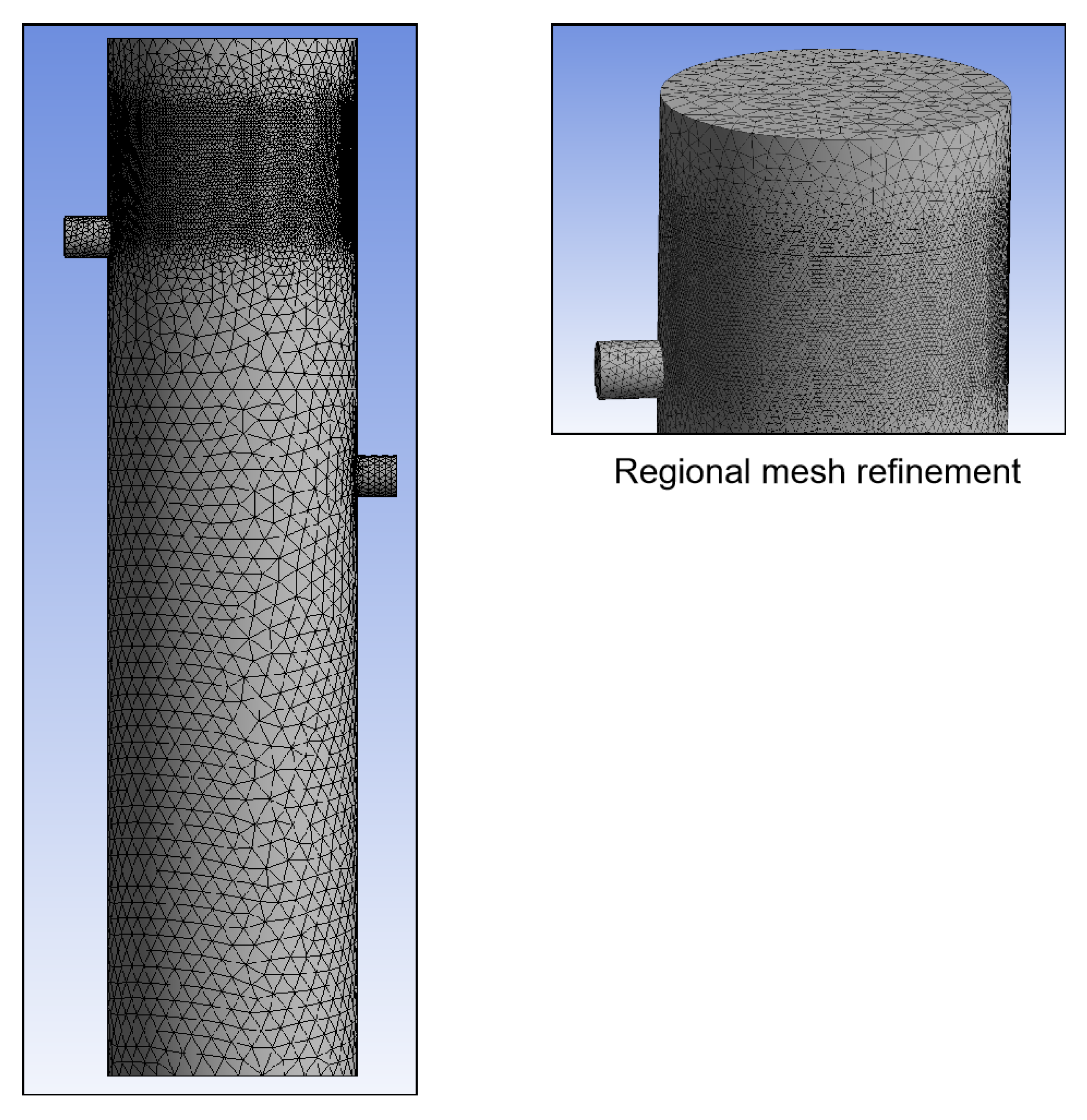
Based on the separator geometry model established in Figure 7c, unstructured grids were used for division, and local encryption was applied to key areas such as the inlet, cyclone blades, and outlet (Figure 8).
To determine a solution unaffected by the number of grids, we systematically compared four sets of schemes from coarse to fine grids (with the number of nodes ranging from ~300,000 to ~690,000), using the total system pressure drop and the primary separation efficiency as key monitoring indicators. The results are shown in Table 1. When the number of grid nodes exceeds approximately 550,000, the variation of both key parameters is less than 1%, indicating that the calculation results have stabilized. Finally, we selected the grid configuration with a total of 690,888 nodes and 3,268,755 elements for all subsequent simulations. This scheme ensures computational accuracy while maintaining computational efficiency.
As further reliability corroboration, we analyzed whether the model’s response to changes in operating parameters aligns with physical intuition. Table 2 shows the relationship between separation efficiency and inlet velocity. The simulation results clearly show a non-monotonic trend of first increasing and then decreasing: in the initial stage of velocity increase, the enhanced centrifugal force dominates the separation process, improving efficiency; when the velocity exceeds a critical value, however, excessively strong turbulence leads to aggravated secondary entrainment, which in turn reduces efficiency. This pattern is entirely consistent with the classical theory of cyclone separation and numerous experimental observations [22], indicating that our model can reasonably predict the variation of separation performance with operating conditions.
Through the above grid independence verification, comparison with classical experiments, and analysis of physical trend rationality, we are confident that the numerical model used in this study is reliable and robust, capable of providing a credible basis for subsequent structural optimization and performance analysis.

5. Simulation Results

5.1. Flow Field Inside the Separator

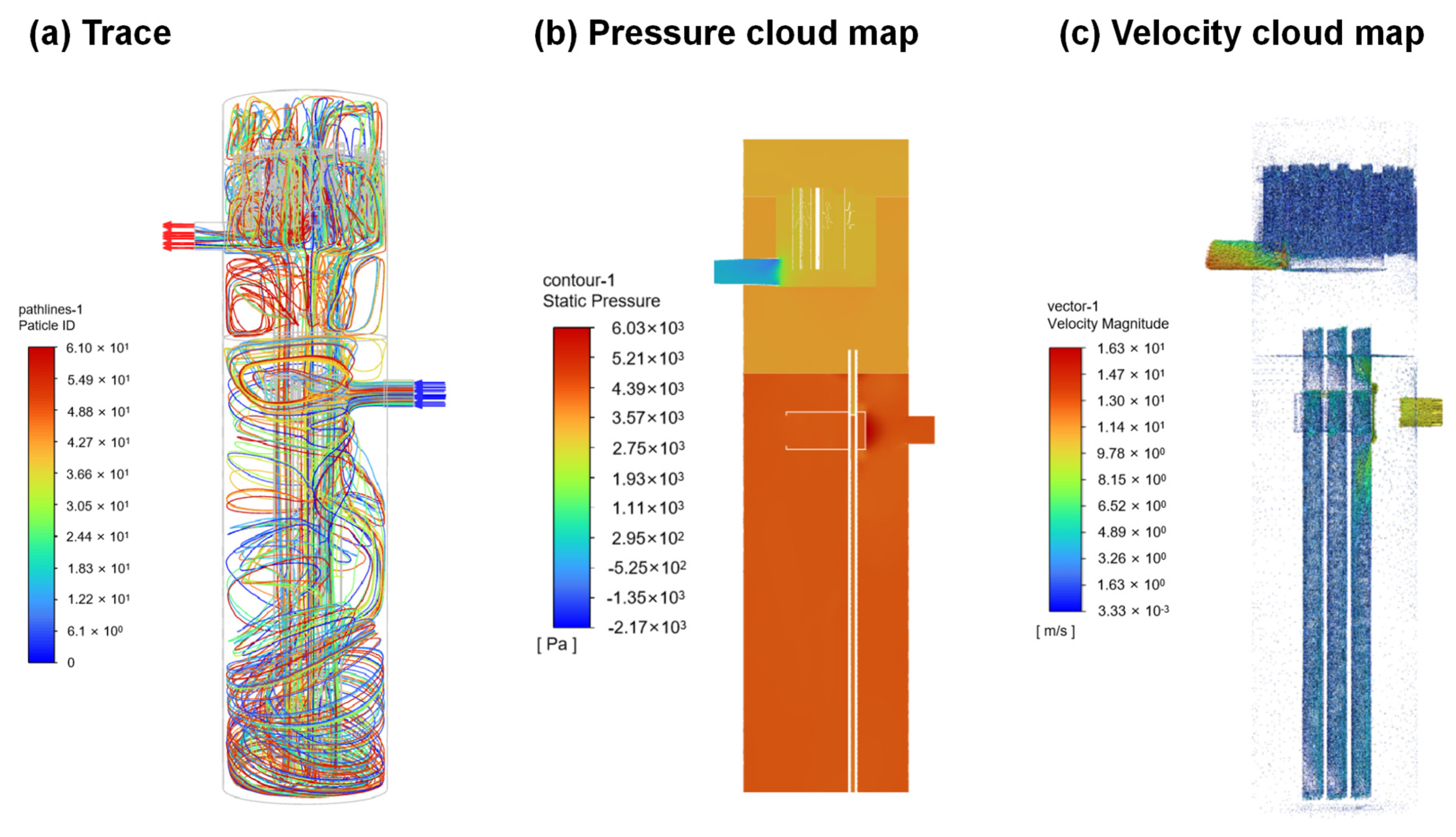
First, analyze the gas-liquid two-phase separation process under typical conditions in the non-working fluid production stage (operating pressure between 4.5 and 6.6 MPa, average daily liquid inflow of the separator 6 cubic meters per day). As shown in Figure 9a, it is the flow field trajectory diagram of the separator. The blue arrows represent the flow inlet, and the red arrows represent the flow outlet. From the trajectory diagram and the flow field distribution, it can be seen that the internal flow of the separator has distinct zonal characteristics and can be divided into three main functional sections as a whole: the gravity settling zone, the primary cyclonic separation zone, and the secondary axial-flow separation zone [23]. Each section works together to achieve efficient gas-liquid separation. Natural gas carrying droplets enters the separator from the inlet and first undergoes a preliminary separation in the gravity settling section. Due to the reduced flow rate of the gas and the sudden expansion of the space, larger droplets are separated from the gas flow by gravity and settle to the bottom of the separator. The flow pattern in this area is dominated by turbulent diffusion, and there is obvious velocity slip between the gas and liquid phases, creating favorable conditions for subsequent cyclone separation. The gas flow, which has been pre-separated by gravity, enters the primary cyclonic assembly and generates forced vortices through the diversion inlet. Simulations show that under the action of centrifugal force, particle-sized droplets are flung towards the wall and form a liquid film, which converges at the bottom. The airflow further performs fine separation through the outer ring—inner ring axial-flow cyclone tube group. The outer cyclone tube captures the remaining droplets, while the inner cyclone tube intercepts the escaping droplets at the end. Numerical simulations show that there is a significant radial velocity gradient in the second-stage separation zone, and the probability of droplets colliding with the wall during multiple directional movements increases significantly, and ultimately the purified gas is discharged from the top. The three-stage separation structure forms a cascade separation path of “gravity settling → centrifugal coarse separation → axial fine separation”, achieving a stepwise improvement in separation efficiency by gradually reducing the processing load and specifically separating droplets of different particle sizes [24].
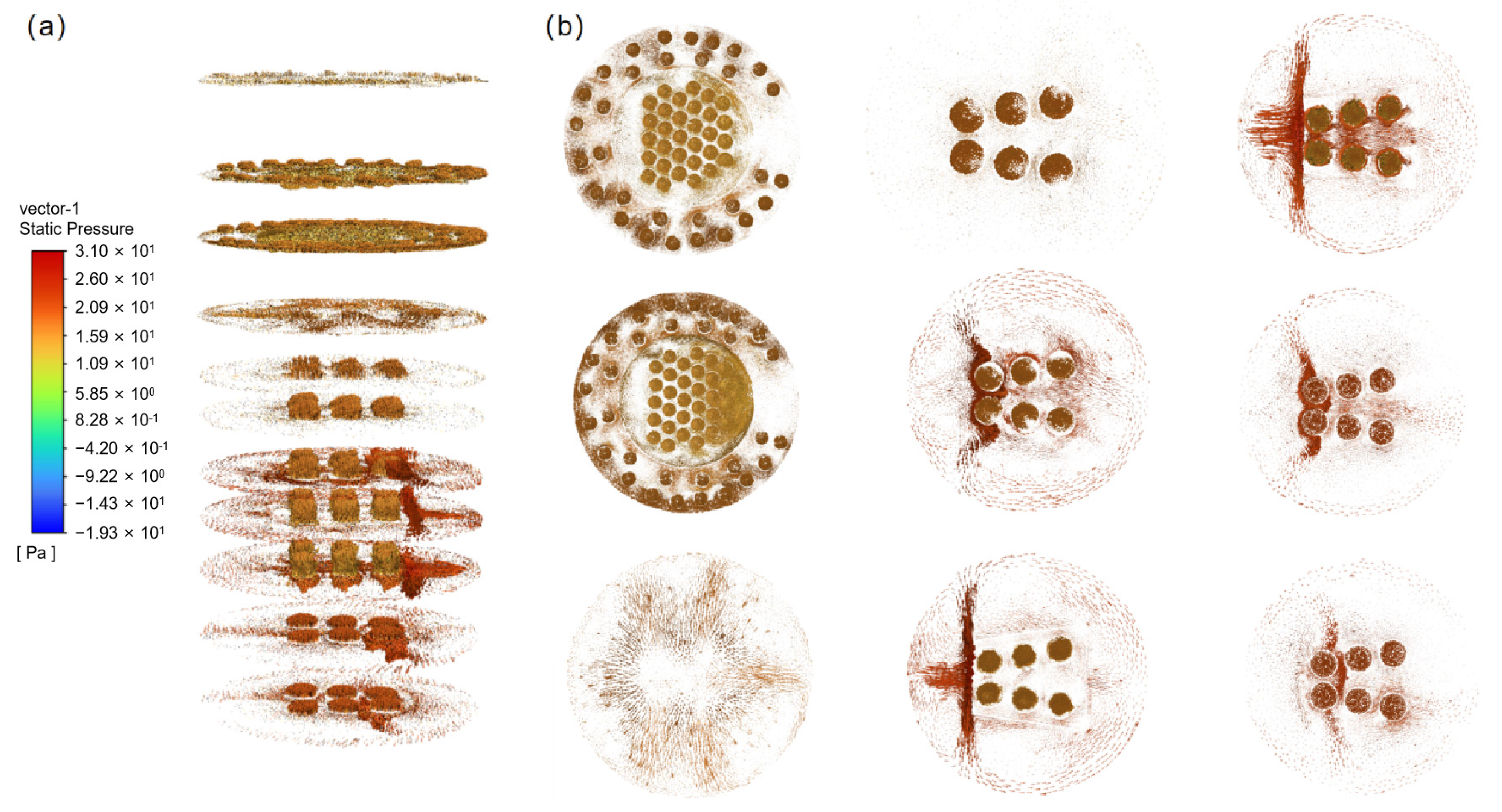
Figure 9b is a cloud map of the pressure distribution. The pressure distribution is an important technical indicator of the separator. As can be seen from the figure, the pressure field inside the separator shows significant gradient distribution characteristics. In the inlet area and the first-stage separation area, the high-speed gas flow impacts the wall to form a distinct high-pressure area. As the airflow enters the outer circle axial-flow tube area, the pressure begins to decrease gradually due to the expansion of the flow cross-sectional area and energy dissipation. As the airflow passes through the inner axial tube, the pressure drops further and reaches its lowest point at the outlet. This stepwise distribution of decreasing pressure not only reflects the process of energy conversion along the path, but also constitutes an important dynamic condition for driving gas-liquid separation. It is notable that the area with the greatest pressure gradient occurs in the first-stage separation component, indicating that the flow resistance is most significant there, which provides a clear direction for subsequent structural optimization. By reasonably controlling the pressure drop at each level, the energy consumption of the system can be optimized while ensuring the separation efficiency.
Figure 9c shows the velocity field distribution characteristics of the separation components inside the separator. Numerical simulations show that the airflow velocity increases significantly in the inlet area. The natural airflow carrying the droplets strongly impacts the wall of the first-stage separation component under inertia. This impact effect not only achieves the first-stage separation of large-sized droplets but also forms a distinct flow separation phenomenon. It is notable that there is a significant circulating flow structure near the separator inlet and in the outlet area, as shown in Figure 10. This secondary flow characteristic affects the separation process through the following mechanism: on the one hand, the circulating flow causes local velocity field disorder, enhancing turbulent mixing between the gas and liquid phases; On the other hand, this complex flow pattern significantly increases the frequency of droplet collisions with the wall, and has a significant trapping effect on small and medium particle size droplets. This self-organizing flow structure, although it causes some energy loss, objectively enhances the multi-stage separation performance of the separator.
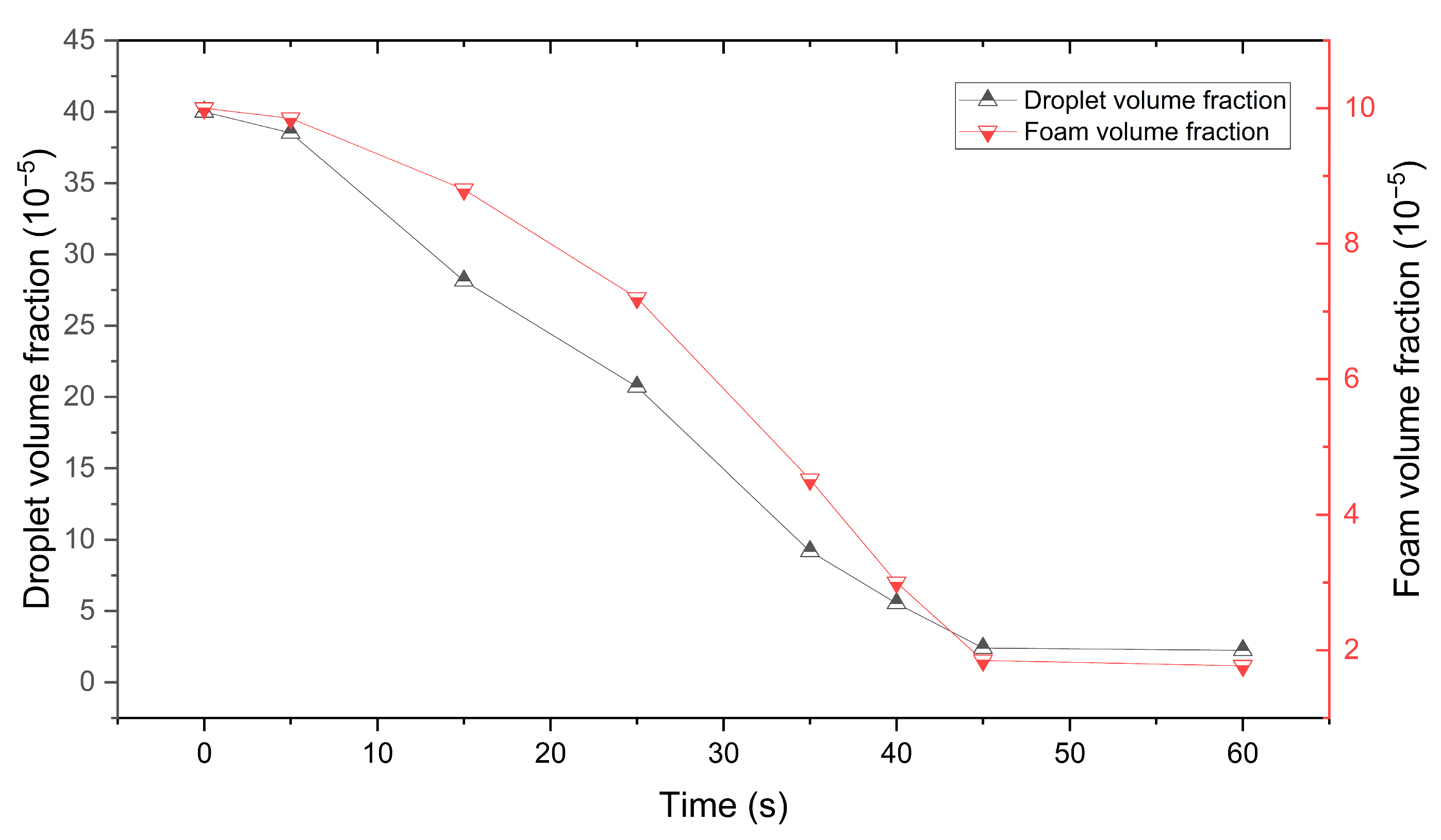
To quantitatively evaluate the performance of the staged separation, we monitored the entire course of the fluid from the inlet to the outlet and plotted tracking curves of droplet and foam concentration distributions, as shown in Figure 11. Both curves showed a significant monotonically decreasing trend and eventually stabilized, intuitively confirming the core function of the separator’s continuous purification. Most importantly, the process of concentration decline is not uniformly linear but presents a clear three-step pattern, viewing each step as the efficient operation of a single separation unit.
It is on the basis of the volume fraction change of the target phase before and after passing through the separation stage that the separation efficiency for each stage is calculated. The calculation formula is shown in Equation (10).
η = C i n C o u t C i n × 100 %
where η is the separation efficiency of the target phase, %; C i n is the inlet volume fraction of the target phase entering the separation unit, 10−5 m3·m−3; C o u t is the outlet volume fraction of the target phase after passing through the separation unit, 10−5 m3·m−3.
Calculate the separation efficiency for each stage as shown in the Table 3. At the beginning of the separation, the multiphase flow enters the large volume of the first stage gravity settling section. At this stage, the flow rate drops significantly and the flow field stabilizes, creating ideal conditions for phase separation. The curve experienced its first and most intense drop in concentration, with droplet concentration rapidly decreasing from 40.0 × 10⁻⁵ to 28.0 × 10⁻⁵, achieving a separation efficiency of 48.23% droplet and 28% foam at this stage. This intuitively demonstrated the core role of the unit as a “coarse sieve”, which relied on gravity to efficiently remove the vast majority of settleable large-sized droplets and completed most of the separation work, laying a good foundation for subsequent units.
The pre-treated fluid then enters the second stage of centrifugal separation, where the curve shows a second significant drop, with the concentration dropping from 28.0 × 10⁻⁵ to 9.0 × 10⁻⁵, and the droplet and foam separation efficiency at this stage reaching 73.25% and 58.33%, respectively. This stage mainly targets medium-sized droplets that escape gravitational settling, increasing the system’s cumulative separation efficiency to 86.15% and 70%, achieving the first leap in efficiency and providing stable and uniform inlet conditions for the fine separation in the final stage.
In the final fine separation stage, the fluid is distributed to a group of parallel axial-flow cyclone tubes. The curve enters the third slow but decisive decaying process, during which each cyclone tube acts as an efficient fine separator, capturing droplets and foams of the smallest particle size, achieving a separation efficiency of 59.39% for droplets and 41% for foams at this stage. The outlet steady-state concentrations finally stabilized at droplet 2.25 × 10⁻⁵ and foam 1.77 × 10⁻⁵, pushing the overall cumulative efficiency to 94.38% and 82.30% respectively, confirming the successful closed-loop and performance superposition of the three-stage cascade separation path.
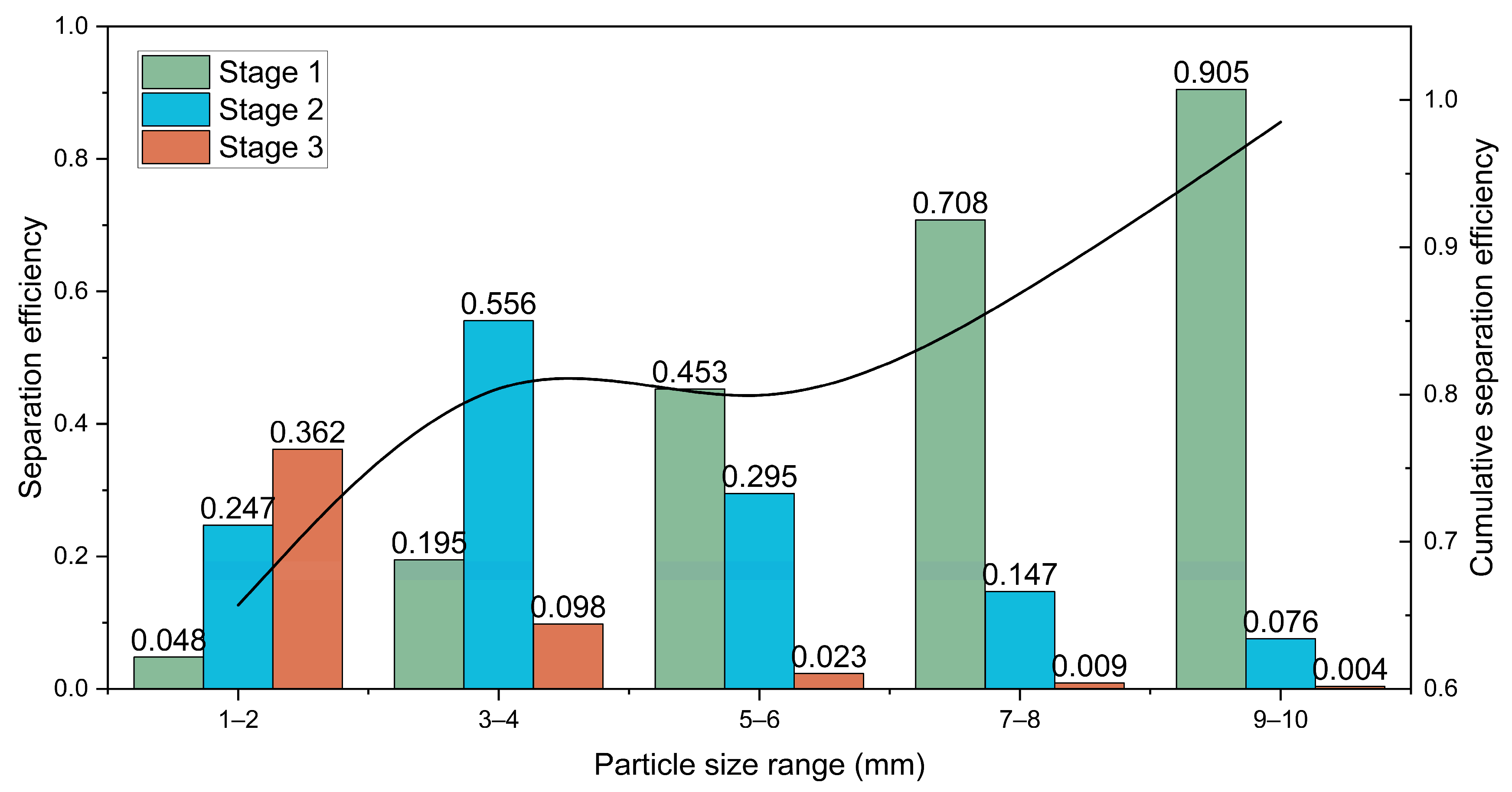
Further exploration of the capture performance of the three-stage separator for foam of different sizes, the simulation results are shown in the Table 4, clearly revealing another major advantage of the cascade separation path: precise step-by-step targeting of the separated object. The separation efficiency was significantly positively correlated with the size of the foam, and each stage showed the highest capture efficiency for the foam within its specific size range. The separation efficiency for different particle sizes is shown in Figure 12.
Gravity settling in the first stage achieved a capture efficiency of up to 70.8% to 90.5% for large foam particles of 7–10 mm, successfully removing the vast majority of easily separable foam, contributing a weighted average efficiency of 28.0%. However, its ability to capture fine foam is limited, which leaves a clear target for subsequent units. The second-stage centrifugation is good at handling medium-sized foams in the 3–6 mm range, with a capture efficiency of 55.6% in the 3–4 mm range. This suggests that the centrifugal force field is the most effective mechanism for addressing foam that escapes from the gravity section and requires a stronger external force to capture. The third-stage axial-flow fine separation contributes much more to the removal of 1–2 mm small particle foam than other particle sizes. This demonstrates that the core value of the three-stage cyclone tube group lies in its deep purification ability, which ensures that the content of fine foam in the final outlet fluid is controlled at an extremely low level.
In summary, the three-stage separation of the separator not only reduces the processing load step by step, but also achieves precise targeting of the separation object step by step. This particle-based division of labor and collaboration mechanism is the fundamental reason why the system can achieve an overall foam separation efficiency of 82.3%, reflecting the scientific and advanced nature of its design.

5.2. Analysis of Factors Influencing the Separation Effect in the Non-Working Fluid Production Stage

In view of the weak foaming ability and difficulty in forming stable foam in the non-working fluid production stage, this study defines this stage as a typical gas-liquid two-phase separation process and focuses on examining the mechanism by which changes in working pressure and inlet droplet volume fraction affect the separation effect. Based on this, the gas-liquid separation characteristics of the separator under different operating conditions were systematically studied through numerical simulations. The influence law of processing volume variation on separation performance and the regulatory effect of inlet droplet concentration difference on the separation process were analyzed to provide a theoretical basis for optimizing the operating parameters of the separator in the non-working liquid stage.

5.2.1. The Influence of Working Pressure Changes on Separation Effect

This study systematically investigated the effect of working pressure within the range of 4.5 to 6.6 MPa (with a calculation interval of 0.5 MPa) on separation performance for gas-liquid two-phase separation processes in the non-working fluid stage. The simulated operating pressure was between 4.5 and 6.6 MPa, with the calculation interval set at 0.5 MPa; The temperature is 30 °C; 1 million cubic meters per day of raw gas; Set the daily liquid inflow to a maximum of 6 cubic meters per day. Under the condition that the droplet volume fraction at the separator inlet is 5 × 10⁻⁴ m3/m3, simulate and calculate the relationship between the droplet volume fraction at the separator outlet and the separation efficiency and the working pressure, as shown in Table 5.
Based on the set operating conditions (raw gas volume of 1 million cubic meters per day, incoming liquid volume of 6 cubic meters per day, inlet droplet volume fraction of 0.05%), numerical simulation studies were conducted on the effect of working pressure within the range of 4.5–6.5 MPa on the performance of the separator. The simulation results showed that the separation efficiency increased first and then decreased with pressure: when the pressure rose from 4.5 MPa to 5.5 MPa, the separation efficiency increased from 95.80% to 96.35%, mainly due to the enhanced centrifugal separation effect of the increased gas phase density; In the 5.5–6.5 MPa range, the efficiency dropped from 96.35% to 95.40% instead, as the high pressure led to an increase in turbulence intensity, causing the small droplets to be re-encored. It is particularly notable that the separator performs at its best (efficiency > 96%) within the 5.0–5.5 MPa pressure range, when the flow field structure is stable and the pressure drop is maintained within a reasonable range of 62–67 kPa. But when the pressure exceeds 6.0 MPa, the pressure drop rises sharply to 81 kPa, and the volume fraction of the droplet at the outlet increases by 15%, indicating that the system has entered non-ideal conditions. Therefore, it is recommended to control the operating pressure within the optimized range of 5.2 ± 0.3 MPa, which can ensure a separation efficiency of more than 96% and avoid excessive energy loss. For conditions that must operate at high pressure (>6.0 MPa), consider improving separation performance by reducing processing capacity by 10% or optimizing internal components.

5.2.2. The Impact of Droplet Volume Fraction at the Separator Inlet on Separation Performance

This study systematically investigated the effects of different inlet droplet volume fractions on the separation performance of gas-liquid two-phase separation processes in the non-working fluid stage. The simulated operating pressure was 5 MPa; A temperature of 30 °C; 1 million cubic meters per day of raw gas. Simulate the relationship between the volume fraction of liquid droplets at the outlet of the separator and the separation efficiency with the volume fraction of liquid droplets at the inlet under the condition that the volume fraction of liquid droplets at the inlet of the separator is 5 × 10⁻⁴ m3/m3.
As shown in the Table 6, the separation effects under different volume fractions of liquid droplets at the inlet of the separator are presented. Through simulation analysis of the working conditions with different volume fractions of liquid droplets at the inlet, it is found that the performance of the separator is concentration-dependent. When the inlet droplet volume fraction was in the range of 10–50 × 10−5 m3/m3, the system maintained excellent separation performance. The outlet droplet volume fraction was stable at 0.38–1.80 × 10⁻⁵ m3/m3, and the separation efficiency remained above 96.2% all the time, with the 50 × 10 m3/m3 condition reaching the optimal efficiency of 96.35%. However, when the inlet concentration exceeded the critical value of 60 × 10 × 10−5 m3/m3, the separation performance deteriorated significantly, the outlet concentration rose sharply to 4.92 × 10⁻⁵ m3/m3, and the efficiency dropped to 93.85%. This change is mainly due to two competing mechanisms: in the low concentration zone, droplet collision polymerization is dominant, which is beneficial for separation; In high concentrations, the droplet shielding effect causes small droplets to escape, resulting in a 40% drop in droplet capture rates below 10 μm. At the same time, the system pressure drop shows a strict linear growth pattern, increasing from 55 kPa to 78 kPa. These findings suggest that controlling the inlet concentration within the range of 30–50 × 10−5 m3/m3, which ensures a separation efficiency of over 96% and limits the pressure drop to less than 67 kPa, is the best choice for achieving efficient and energy-efficient operation.

5.3. Analysis of Factors Affecting the Separation Effect in the Working Fluid Production Stage

The produced fluid in the working fluid production stage showed significant foaming characteristics. Experimental evaluation indicated strong foam stability, and a large amount of foam phase was generated during field operation, suggesting that the separation process involved complex interactions among the three phases of natural gas, droplets and foam. Considering the key influence of flowback fluid viscosity on foam stability, this study focuses on the regulation mechanism of working pressure and inlet foam volume fraction on the three-phase separation effect. By establishing a gas-liquid-foam multiphase flow model, the system simulates the dynamic separation process of the separator under different operating conditions, conducts sensitivity analysis on foams of different particle sizes, reveals the coupling law of the pressure field and foam characteristics, and provides theoretical support for optimizing the foam phase control process.
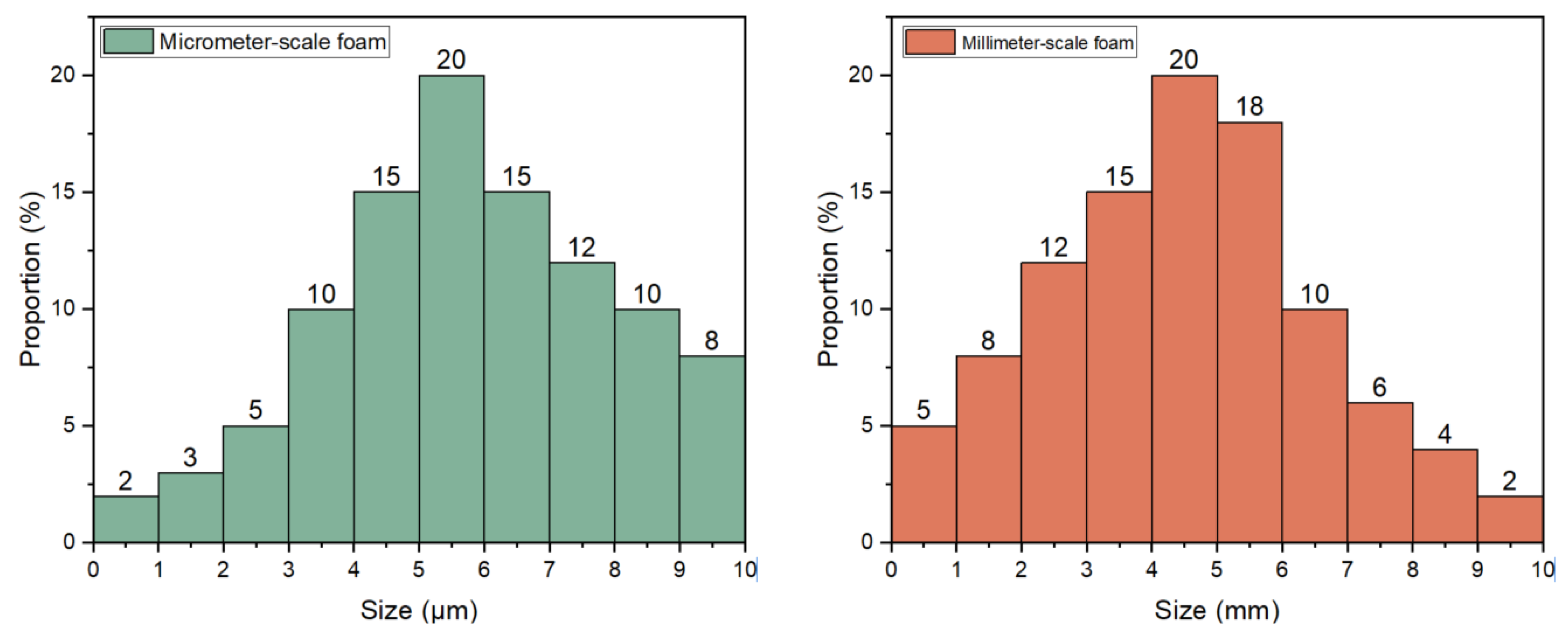
Foam size is the core physical property that determines foam stability, flow behavior and gas-liquid separation efficiency. This study systematically compared the separation effects of foams of different characteristic sizes in separators by regulating the initial particle size distribution of the foams in the multiphase flow model, and conducted a sensitivity comparison analysis of micrometer (1–10 μm) and millimeter (1–10 mm) foams. Foam size, as a core factor determining interfacial characteristics, interphase interactions and fluid dynamics, will profoundly affect the flow structure and separation mechanism of the multiphase flow in the separator. By establishing a gas-liquid-foam three-phase flow model to precisely characterize the generation, coalescence, fragmentation and migration behavior of foams of different particle sizes, the micrometer-scale and millimeter-scale foam size distributions simulated in this project are shown in the following Figure 13.
The simulated micrometer-scale foam is derived from the highly stable foam characteristics exhibited by the working fluid produced fluid. Both experiments and field observations have confirmed that the foam phase is highly stable and is essentially dominated by a large number of micrometer-sized foams. These foams, due to their extremely small size, large specific surface area and slow rising speed, are difficult to be rapidly separated by natural gravity and are prone to remain in the separator for a long time, complicating the gas-liquid-foam three-phase flow field and significantly increasing the risk of droplet entrainment and secondary emulsification. Therefore, to accurately reveal the regulation mechanism of the pressure field on highly stable foams, quantitative research on the response behavior of micrometer foams under high pressure conditions was conducted through modeling and simulation methods. Precisely simulate the dynamic evolution of microfoams, explain the nature of the separation bottleneck, and provide a theoretical basis for suppressing foam stability and improving separation efficiency.
The simulation of millimeter-scale foam is about understanding the generation of macroscopic foam phases and the initial separation behavior during the separation process. Millimeter foams are the most directly formed visible foam of the gas-liquid phase during agitation and ejection, and their behavior determines the macroscopic phase distribution and foam layer formation kinetics within the separator. These foams, due to their large size and significant buoyancy, can rise rapidly and accumulate at the top to achieve the initial separation of gas and liquid, and their dynamics directly affect the processing capacity and operational stability of the separator. By simulating millimeter-scale foam, the effect of working pressure on its rapid compression and fragmentation, as well as the impact of inlet foam fraction on the separator load, can be examined to determine the separation performance boundary and regulation strategy under millimeter-foam dominance. In addition, the actual foam group is a continuous distribution system covering from millimeter to micrometer, and the simulation of millimeter-scale foam provides the basis for a complete description of the foam spectrum, thereby supporting the reliability and engineering applicability of the overall multiphase flow model.

5.3.1. Separation Effect of Micrometer-Scale Foam

(1)
The effect of changes in working pressure on the separation effect
Based on the simulation study of the actual operating conditions of the field separator, the separation process of the gas, droplet and foam three-phase separator under five different inlet foam volume fractions was simulated when the total integral number of liquid droplets and foam at the fixed inlet was 50 × 10−5 and the foam proportion was fixed at 20%. Based on the simulation results of droplet and foam volume fractions at the outlet of the separator under different inlet foam volume fractions, the droplet separation efficiency, foam separation efficiency and total separation efficiency of the separator were calculated, as shown in Table 7.
Through the simulation study of the influence law of working pressure, it was found that the performance of the separator has a significant pressure dependence. Within the pressure range of 4.5–6.5 MPa, the system shows a variation pattern of rising first and then falling. When the pressure rose from 4.5 MPa to 5.5 MPa, the total separation efficiency increased from 80.46% to 86.85%, with a particularly significant increase in foam separation efficiency. However, when the pressure exceeded 5.5 MPa, the performance declined significantly, with the total efficiency dropping to 79.22% at 6.5 MPa, which was attributed to the boundary layer separation and turbulence enhancement effects caused by the excessive pressure difference. It is particularly notable that droplet separation efficiency remained consistently in the high range of 93.88–95.20%, showing strong robustness to pressure variations, while foam separation efficiency showed greater volatility, further confirming that the foam phase is a key factor restricting system performance. Based on the combined consideration of energy consumption and efficiency, it is recommended to control the operating pressure in the optimal range of 5.3–5.7 MPa, which not only ensures a total separation efficiency of more than 86%, but also keeps the pressure drop at a reasonable level of around 65 kPa. For conditions where higher pressure operation is necessary, it is recommended to adopt pressure reduction regulation or compensation measures for a 5–8% reduction in processing capacity. These findings provide important evidence for the optimization of pressure parameters in actual production.
(2)
The influence of the foam volume fraction at the separator inlet on the separation effect
Based on the simulation study of the actual operating conditions of the field separator, under the condition that the total integral number of liquid droplets and foam at the fixed inlet is 50 × 10−5, the separation process of the gas, liquid droplets, and foam three-phase separator under five different inlet foam volume fractions was simulated. According to the simulation results of the volume fractions of liquid droplets and foam at the outlet of the separator under different inlet foam volume fractions. The droplet separation efficiency, foam separation efficiency and total separation efficiency of the separator were calculated, as shown in Table 8.
The results showed that the separator had a significant and stable capture effect on the droplet phase, the droplet separation efficiency remained consistently in the high range of 88.42–96.35%, and the droplet volume fraction at the outlet remained in the low range of 1.16–2.18 × 10⁻⁵ m3·m−3. However, the separation performance of the foam phase was significantly poor, with the separation efficiency dropping sharply from 40.30% to 16.28%, which became the main factor restricting the overall efficiency of the system. Further analysis revealed that the total separation efficiency showed a typical three-stage decline as the proportion of foam increased: initial slow decline, accelerated decline, and stable decline. This variation pattern stems from the special physical properties of the foam phase: on the one hand, the high viscosity of the foam causes the boundary layer to thicken, affecting the separation effect; On the other hand, the dynamic coalesis-bursting process of the foams undermines the stability of the flow field.
Based on these findings, targeted improvements are needed to enhance the separation performance, including adding pre-defoaming units, optimizing the parameters of the cyclonic blades, and implementing real-time monitoring of the foam proportion, which provide important theoretical basis for the optimal design of separators under complex conditions.

5.3.2. Separation Effect of Millimeter-Scale Foam

Maintain the same inlet conditions and working pressure range as the micrometer foam simulation, only changing the foam size from micrometer to millimeter.
(1)
The impact of changes in working pressure on the separation effect
Based on the simulation study of the actual operating conditions of the field separator, the separation process of the gas, droplet and foam three-phase separator under five different inlet foam volume fractions was simulated when the total integral number of liquid droplets and foam at the fixed inlet was 50 × 10−5 and the foam proportion was fixed at 20%. Based on the simulation results of droplet and foam volume fractions at the separator outlet under different inlet foam volume fractions, the droplet separation efficiency, foam separation efficiency, and total separation efficiency of the separator were calculated using the aforementioned separation efficiency formula Equation (10), as shown in Table 9
The simulation results show that for millimeter-scale foam systems, the performance of the separator also shows significant pressure dependence, but the variation range and intrinsic mechanism are different from those of micrometer-scale foams. In the pressure range of 4.5–6.5 MPa, the system’s total separation efficiency fluctuated between 88.35% and 91.94%, with a trend of rising first and then falling, reaching the peak efficiency at 5.5 MPa. It is notable that the foam separation efficiency of millimeter-sized foams remained stable in the high range of 78% to 84%, and the fluctuation was much smaller than that of micrometer-sized foams, confirming that the separation process was more robust to pressure changes. The increase in pressure, on the one hand, enhances the flotation effect of the foams by increasing the density of the gas phase, and on the other hand, excessively high pressure slightly weakens the separation force through changes in fluid physical properties. However, unlike micrometer-sized foams which are severely encored and redispersed due to intense turbulence, the efficiency degradation of millimeter-sized foams is mainly due to the latter, and therefore the downward trend is more gentle. Droplet separation efficiency remained high and stable, once again proving that the bottleneck of system performance lies in the foam phase. Overall, for millimeter-scale foam systems, the optimal operating pressure range can be relaxed to 5.0–6.0 MPa, which reflects a wider operating window and better engineering adaptability.
(2)
The effect of the volume fraction of foam at the separator inlet on the separation effect
Based on the simulation study of the actual operating conditions of the field separator, under the condition that the total integral number of liquid droplets and foam at the fixed inlet is 50 × 10−5, the separation process of the gas, liquid droplets, and foam three-phase separator under five different inlet foam volume fractions was simulated. According to the simulation results of the volume fractions of liquid droplets and foam at the outlet of the separator under different inlet foam volume fractions. The droplet separation efficiency, foam separation efficiency and total separation efficiency of the separator were calculated, as shown in Table 10.
The impact of changes in the proportion of foam at the inlet on the system reveals another core advantage of millimeter-scale foams: excellent resistance to load shock. When the proportion of imported foam rose sharply from 20% to 80%, the total separation efficiency of the system gradually dropped from 90.63% to 79.30%. However, the root cause of this decline is quite different from that of micron-scale systems. The analysis found that the decline in overall efficiency was mainly attributed to a reduced proportion of the “easily separable droplet phase” in the imported mixture, rather than a deterioration in the separation performance of the “foam phase” itself. The foam separation efficiency of millimeter-sized foams showed stability, slipping slowly from 82.00% to 77.25%. This means that even under high load conditions, the vast majority of millimeter-sized foams can still quickly and efficiently detach from the liquid phase by relying on their own huge buoyancy, and the separation mechanism is robust and efficient.

5.3.3. Summary of the Gas-Liquid Foam Separation Effect of the Separator

As shown in the simulation data, the overall performance of the system is sensitive to variations in operating parameters. For micrometer-sized foams, the optimal combined efficiency is achieved in the working pressure range of 5.3–5.7 MPa, when the total separation efficiency is over 86% and the foam separation efficiency is increased to 48.5%; But when the pressure exceeds 5.5 MPa, the enhanced turbulence effect dominates the separation process, causing the overall efficiency to drop below 82%.
For millimeter-scale foams, the system shows superior separation performance and operational stability [25,26]. Over a wide pressure range of 5.0–6.0 MPa, the total separation efficiency remained consistently above 88%, and the foam separation efficiency was stable between 78–84%. Even at higher pressures of 6.5 MPa, the total separation efficiency can still be maintained at around 88%, with a fluctuation of less than 4%, significantly lower than the efficiency drop of more than 20% for micron-sized foams, demonstrating stronger pressure robustness.
The proportion of imported foam is another key factor constraining system performance. The data shows that when the foam volume fraction is less than 35%, the system’s overall efficiency can be maintained above 75%; Once the proportion exceeds 45%, the overall efficiency drops sharply to below 65%, mainly due to the low level of foam phase separation efficiency hovering at only 20–40%. It is notable that droplet separation efficiency has remained stable in the high range of 90–95%, further indicating that the system bottleneck is concentrated in the foam phase, especially in the separation process of micrometer-sized foams.
Based on the findings, it is recommended that the operating pressure of the system be strictly controlled within the range of 5.3–5.7 MPa, and the proportion of imported foam be controlled within 35%. For conditions with a high proportion of foam, it is necessary to add a pre-defoaming unit to enhance the pre-treatment, and reduce the content of micron-sized foams through methods such as cyclonic breaking or chemical defoaming. These measures can effectively enhance the system’s anti-interference ability, stabilize the total separation efficiency at an acceptable range of more than 75%, and provide clear guidance for process optimization in actual production [27].

6. Conclusions

(1) By coupling the VOF multiphase flow model with the PBM, a gas-liquid-foam three-phase separation numerical model was established—unlike traditional models that only track gas-liquid interfaces or ignore foam dynamics, this model synchronously characterizes gas-liquid interface evolution and foam coalescence/rupture behaviors, filling the gap in simulating complex foam-containing multiphase separation and enabling accurate prediction of separation processes.
(2) A new system was constructed via structural optimization of core components. The primary cyclonic defoaming component adopts a “multi-tube shared inlet” design, which reduces inlet components by 40% while solving the problem of unbalanced feeding in multi-tube parallel systems; the axial-flow cyclone tube, meanwhile, adds a unique two-stage reflux system through targeted optimization. This integrated design breaks the limitations of traditional single-structure separators, such as poor inter-unit coupling and high pressure drop, and ultimately achieves a 95.7% droplet capture rate and 90% foam capture rate.
(3) In the non-working fluid production stage, the effects of working pressure and inlet droplet volume fraction on the separation effect were simulated and corresponding optimization suggestions were given. The optimal separation efficiency was achieved in the working pressure range of 5.0–5.5 MPa, when the gas phase density enhanced the centrifugal effect and the pressure drop was maintained at 62–67 Kpa; Beyond 6.0 MPa, turbulence intensifies and efficiency drops to 95.4%; The system remained efficient when−3 the inlet droplet concentration was 30–50 × 10−5 m3·m−3, and the dro−3 plet shielding effect reduced the efficiency to 93.85% when it exceeded 60 × 10−5 m3·m−3. It is recommended that the operating pressure be controlled at 5.2 ± 0.3 MPa and the inlet droplet concentration not exceed 50 × 10−5 m3·m−3, at which point the system has both high efficiency and low energy consumption characteristics.
(4) During the working fluid production stage, the simulation results indicated that the system’s separation performance was sensitive to operating conditions and significantly dependent on foam size. For micrometer-sized foams, the overall separation efficiency was optimal in the pressure range of 5.3–5.7 MPa, with foam separation efficiency reaching 48.5%, but after 5.5 MPa, the enhanced turbulence caused the efficiency to drop below 82%. Millimeter-sized foams show excellent operational stability, with total efficiency consistently above 88% in the 5.0–6.0 MPa pressure range, foam separation efficiency stable between 78–84%, with a fluctuation of less than 4%. When the proportion of imported foam is less than 35%, the system’s overall efficiency can be maintained above 75%, but when it exceeds 45%, the overall efficiency drops sharply to below 65% due to the foam phase separation efficiency being only 20–40%. It is recommended that the operating pressure be controlled at 5.3–5.7 MPa, the foam proportion not exceed 35%, and a pre-defoaming unit be added to optimize system performance.

Author Contributions

Conceptualization, Y.L.; investigation, F.W.; resources, Y.W.; data curation, H.X.; writing—original draft preparation, Y.L.; writing—review and editing, J.Z.; software, J.Y.; validation, X.Z.; visualization, G.Z. All authors have read and agreed to the published version of the manuscript.

Funding

This research received no external funding.

Data Availability Statement

All data, models, and code generated or used during the study appear in the submitted article.

Conflicts of Interest

Authors Yu Lin, Feng Wang, Yu Wu were employed by the PetroChina Southwest Oil and Gas Field Company; Author Hao Xu was employed by the Chongqing Shale Gas Exploration and Development Company Limited. The remaining authors declare that the research was conducted in the absence of any commercial or financial relationships that could be construed as a potential conflict of interest.

Nomenclature

ρ Density, kg/m3
t Time, s
u Velocity vector composed of u x and u y , m/s
p Pressure, Pa
μ Viscosity, Pa·s
g Gravitational acceleration, m/s2
F s Volume surface tension, N/m
γ Surface tension, N/m
k Surface curvature
n Unit normal vector of the interface
α q Volume fraction of the q-th phase in the calculation unit
ρ l Density of the liquid phase, kg/m3
ρ g Density of the gas phase, kg/m3
μ l Liquid-phase viscosity, Pa·s
μ g Gas-phase viscosity, Pa·s
n Foam number density function
V Sub-foam volume
V Original foam volume
G v Volume growth (shrinkage rate) of the foam
a V , V Foam coalescence rate
g V Foam burst frequency
hThickness of the liquid film, m
s Surface gradient operator
V l Average liquid film velocity, m/s
m ˙ s Mass per unit area source
g τ Gravitational component parallel to the liquid film, m/s2
τ fs Shear stress at the gas-liquid interface, Pa
σ Surface tension coefficient
p L Pressure in the normal direction of the liquid film, Pa
p g a s Pressure of the gas on the wall, Pa
p h Gravity in the normal direction of the liquid film, Pa
p σ Liquid surface tension, Pa
n Surface normal vector

References

  1. Ma, H.; Zhang, S.; Li, Y.; Hu, Q.; Wang, J.; Wang, C.; Liu, X.; Zhang, J. Optimization of static defoaming structure in gas-liquid separator. Energy Sources Part A Recovery Util. Environ. Eff. 2021, 47, 9062–9075. [Google Scholar] [CrossRef]
  2. Amani, P.; Hurter, S.; Rudolph, V.; Firouzi, M. Comparison of flow dynamics of air-water flows with foam flows in vertical pipes. Exp. Therm. Fluid Sci. 2020, 119, 110216. [Google Scholar] [CrossRef]
  3. Backi, J.; Skogestad, S. A simple dynamic gravity separator model for separation efficiency evaluation incorporating level and pressure control. In Proceedings of the American Control Conference, Seattle, WA, USA, 24–26 May 2017; pp. 2823–2828. [Google Scholar]
  4. Denkov, N.; Marinova, K.; Tcholakova, S. Mechanistic understanding of the modes of action of foam control agents. Adv. Colloid Interface Sci. 2014, 206, 57–67. [Google Scholar] [CrossRef] [PubMed]
  5. Dong, A.; Liu, D.; Huang, S. Numerical simulation study of the flow field in the gas-liquid separation metering device. Oil-Gas Field Surf. Eng. 2019, 38, 71–75. [Google Scholar]
  6. Lee, E.; Hornafius, J.S.; Dean, E.; Kazemi, H. Potential of Denver Basin oil fields to store CO2 and produce Bio-CO2-EOR oil. Int. J. Greenh. Gas Control 2019, 81, 137–156. [Google Scholar] [CrossRef]
  7. Qiu, Z.; Bai, L.; Fu, J.; Qu, B.; Zhou, L. Comprehensive numerical and experimental analysis of dynamic gas-liquid separator with various oil-gas ratios. Chem. Eng. Process. Process Intensif. 2025, 214, 110332. [Google Scholar] [CrossRef]
  8. Li, C.; Li, Z.; Zhang, Y.; Li, B. Numerical simulation and experimental study of two-phase flow in downhole spiral gas-liquid separator. Front. Earth Sci. 2023, 11, 1209743. [Google Scholar] [CrossRef]
  9. Li, T.; Sun, Z.; Geng, K.; Sun, M.; Wang, Z. Numerical analysis of a novel cascading gas-liquid cyclone separator. Chem. Eng. Sci. 2023, 270, 118123. [Google Scholar] [CrossRef]
  10. Hong, J.; Wang, Z.; Wang, C.; Zhang, J.; Liu, W.; Ling, K. Modeling of Multiphase Flow with the Wellbore in Gas-Condensate Reservoirs Under High Gas/Liquid Ratio Conditions and Field Application. SPE J. 2025, 30, 1301–1314. [Google Scholar] [CrossRef]
  11. Sun, C.; Jiang, S.Y.; Duan, R.Q. An accurate continuous surface force model for particle methods. J. Tsinghua Univ. 2018, 58, 181–187. [Google Scholar]
  12. Xiao, P.F.; Yang, J.; Sun, Y.; Ma, Z.; Yang, J.D. Numerical simulation of two-phase transient flow based on a uniform bubble distribution model. China Rural Water Hydropower 2025, 23, 1–19. [Google Scholar]
  13. Liu, M.; Andrianov, A.; Rossen, W. Sweep efficiency in CO2 foam simulations with oil. In Proceedings of the 16th European Symposium on Improved Oil Recovery, Cambridge, UK, 12–14 April 2011. [Google Scholar]
  14. Yu, J.L.; Xu, M.Q.; Chen, X.J.; Li, L.X. Research on flow characteristics of gas-liquid two-phase flow in centrifugal pump based on CFD. Chem. Eng. Equip. 2023, 7, 33–36. [Google Scholar]
  15. Zhang, X. Study on the Dynamic Characteristics of Bubbles in Various Media Considering Viscous Effects. Master’s Thesis, Jiangsu University of Science and Technology, Zhenjiang, China, 2023. [Google Scholar]
  16. Wang, Z.; Li, T.; Sun, Z.Q.; Gen, K.; Sun, M.Z. Numerical simulation of a cascade gas-liquid cyclone separator. J. China Univ. Pet. 2023, 47, 121–129. [Google Scholar]
  17. Li, Y.W. CFD-PBM Numerical Simulation of Tubular Gas-Liquid Cyclone Separator. Master’s Thesis, Beijing Institute of Petrochemical Technology, Beijing, China, 2023. [Google Scholar]
  18. Moncayo, J.A.; Dabirian, R.; Mohan, R.S.; Shoham, O.; Kouba, G. Foam break-up under swirling flow in inlet cyclone and GLCC©. J. Pet. Sci. Eng. 2018, 165, 234–242. [Google Scholar] [CrossRef]
  19. Lyu, D.; Lin, C.; Ren, L.; Dong, C.; Song, J. Residual oil evolution based on displacement characteristic curve. Int. J. Min. Sci. Technol. 2020, 30, 337–343. [Google Scholar] [CrossRef]
  20. Rezk, M.G.; Foroozesh, J. Effect of CO2 mass transfer on rate of oil properties changes: Application to CO2-EOR projects. J. Pet. Sci. Eng. 2019, 180, 298–309. [Google Scholar] [CrossRef]
  21. Wang, C.; Li, Y.; Teng, L.; Gu, S.; Hu, Q.; Zhang, D.; Ye, X.; Wang, J. Experimental study on dispersion behavior during the leakage of high pressure CO2 pipelines. Exp. Therm. Fluid Sci. 2019, 105, 77–84. [Google Scholar] [CrossRef]
  22. Yue, T.; Chen, J.; Song, J.; Chen, X.; Wang, Y.; Jia, Z.; Xu, R. Experimental and numerical study of Upper Swirling Liquid Film (USLF) among Gas-Liquid Cylindrical Cyclones (GLCC). Chem. Eng. J. 2019, 358, 806–820. [Google Scholar] [CrossRef]
  23. Parikh, D.; Wu, Y.; Peterson, C.; Jarriel, S.; Mooney, M.; Tilton, N. The coupled dynamics of foam generation and pipe flow. Int. J. Heat Fluid Flow 2019, 79, 108442. [Google Scholar] [CrossRef]
  24. Pancholi, S.; Negi, G.S.; Agarwal, J.R.; Bera, A.; Shah, M. Experimental and simulation studies for optimization of water-alternating-gas (CO2) flooding for enhanced oil recovery. Pet. Res. 2020, 5, 227–234. [Google Scholar] [CrossRef]
  25. Mansoori, H.; Mirzaee, R.; Esmaeilzadeh, F.; Vojood, A.; Dowrani, A.S. Pitting corrosion failure analysis of a wet gas pipeline. Eng. Fail. Anal. 2017, 82, 16–25. [Google Scholar] [CrossRef]
  26. Zeng, X.; Fan, G.; Xu, J.; Liu, A.; Xu, Y.; Yan, C. Experimental study on a new gas-liquid separator for a wide range of gas volume fraction. Chem. Eng. Res. Des. 2020, 160, 561–570. [Google Scholar] [CrossRef]
  27. Xiong, Z.; Liu, Y.; Gu, X.; Zhang, Q.; Hou, G. Optimization of a two-stage axial-flow cyclone separator focusing on energy consumption and separation efficiency. Chem. Eng. Process. Process Intensif. 2025, 216, 110432. [Google Scholar] [CrossRef]
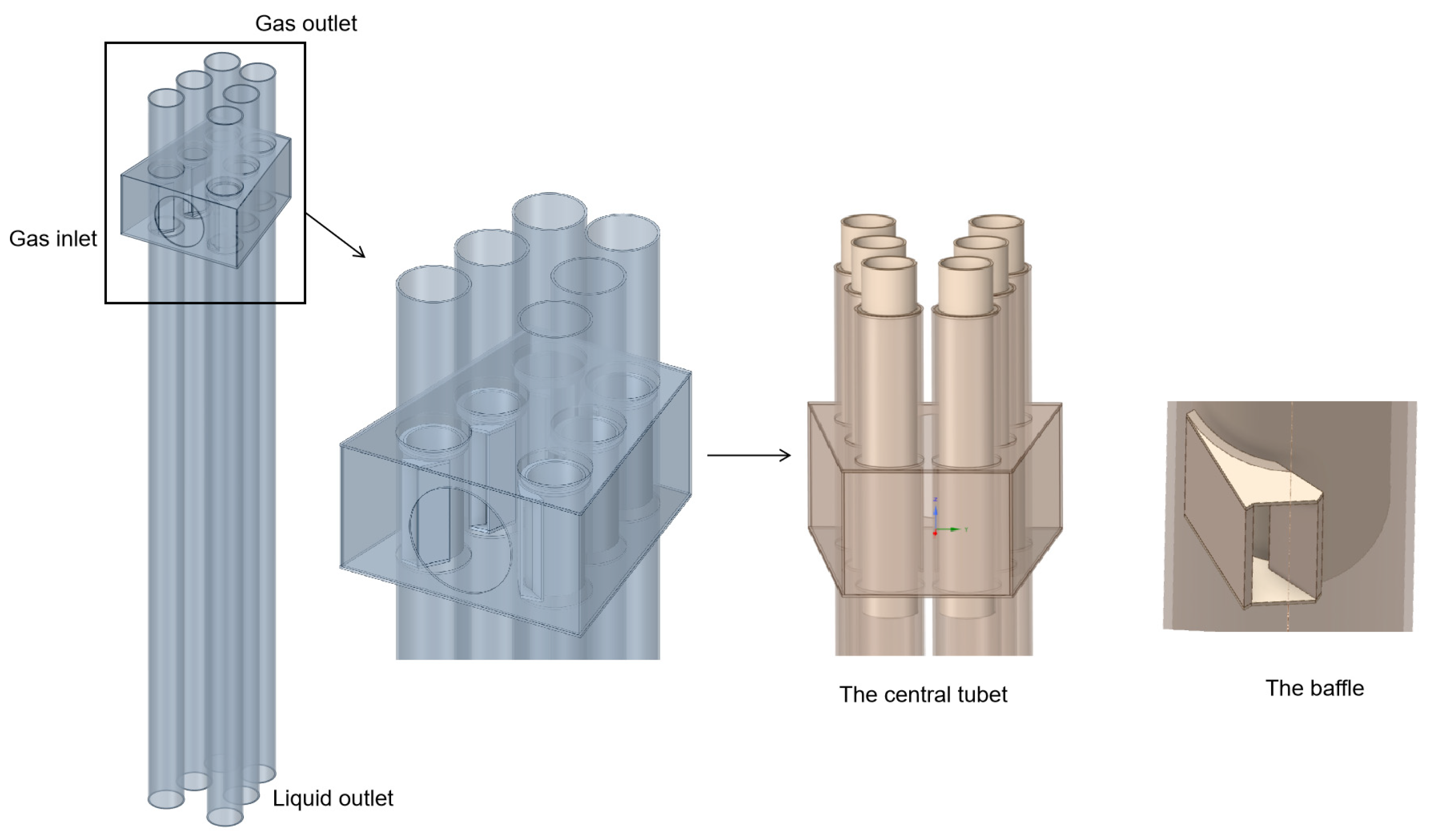
Figure 1. Model diagram of the primary cyclonic defoaming assembly.
Modelling 06 00160 g001
Figure 2. Distribution of the flow field: (a) trace; (b) central pipe pressure cloud diagram of the longitudinal section of the pipe; (c) inlet section velocity velocity; (d) cloud map of turbulence intensity at the inlet section.
Modelling 06 00160 g002
Figure 3. Optimization results of three central tube models.
Modelling 06 00160 g003
Figure 4. Physical model diagram of final optimized model.
Modelling 06 00160 g004
Figure 5. Flow field analysis of axial flow cyclone tube model.
Modelling 06 00160 g005
Figure 6. Optimized model of axial flow cyclone tube.
Modelling 06 00160 g006
Figure 7. Schematic diagram of the combined model.
Modelling 06 00160 g007
Figure 8. Meshing diagram of the combined model.
Modelling 06 00160 g008
Figure 9. Initial flow field analysis.
Modelling 06 00160 g009
Figure 10. Velocity vector diagram inside the separator: (a) Front view; (b) Side view.
Modelling 06 00160 g010
Figure 11. Tracking changes of liquid phase and foam particles.
Modelling 06 00160 g011
Figure 12. Foam separation efficiency at different particle sizes.
Modelling 06 00160 g012
Figure 13. Foam particle size distribution diagram.
Modelling 06 00160 g013
Table 1. Results of the mesh independence study.
Mesh SchemeNumber of NodesNumber of ElementsSystem Pressure Drop (Pa)Stage 1 Separation Efficiency (%)
Coarse mesh312,4551,452,890832592.3
Medium mesh489,7222,345,671791293.8
Fine mesh690,8883,268,755789694.2
Extra-fine mesh892,1444,123,567789494.2
Table 2. Variation of Separation Efficiency with Inlet Velocity.
Inlet Velocity (m/s)Separation Efficiency (%)System Pressure Drop (Pa)Turbulence Intensity (%)
4.089.5523014.2
6.093.8789018.5
8.095.212,45022.7
10.094.118,92028.3
Table 3. Liquid-phase and foam separation efficiencies at each stage.
Separation StagesDroplet
Volume Fraction (10−5 m3·m−3)
Foam
Volume Fraction (10−5 m3·m−3)
Droplet Separation EfficiencyFoam Separation EfficiencyDroplet Cumulative Separation EfficiencyFoam Cumulative Separation Efficiency
Stage 1401048.23%28%48.23%28%
20.717.2
Stage 29.24.5273.25%58.33%86.15%70%
5.543
Stage 32.41.8559.39%41%94.38%82.3%
2.251.77
Table 4. Foam separation efficiency at different particle sizes.
Particle Size Range
(mm)
Inlet ProportionSeparation Efficiency Per StageFoam Cumulative
Separation Efficiency
Stage 1Stage 2Stage 3
1–213%4.8%24.7%36.2%65.7%
3–427%19.5%55.6%9.8%84.9%
5–638%45.3%29.5%2.3%77.1%
7–816%70.8%14.7%0.9%86.4%
9–106%90.5%7.6%0.4%98.5%
Weighted average100%28%58.33%41.0%82.3%
Table 5. Variation of droplet volume fraction and separation efficiency at the separator outlet with working pressure.
Pressure (MPa)Outlet Droplet Volume Fraction
(10−5 m3·m−3)
Separation Efficiency (%)Pressure Drop (kPa)
4.52.195.858
51.996.1262
5.51.896.3567
6295.9573
6.52.395.481
Table 6. Variation of droplet volume fraction at the separator outlet and separation efficiency with inlet volume fraction.
Inlet Droplet Volume Fraction
(10−5 m3·m−3)
Outlet Droplet Volume Fraction
(10−5 m3·m−3)
Separation Efficiency
(%)
Pressure Drop (kPa)
100.3896.2058
301.1296.2761
501.896.3567
602.4595.9272
804.9293.8578
Table 7. Variation of separator separation efficiency with pressure.
Pressure (MPa)Inlet Droplet Volume Fraction
(10−5 m3·m−3)
Inlet Foam
Volume Fraction
(10−5 m3·m−3)
Outlet Droplet
Volume Fraction
(10−5 m3·m−3)
Outlet Foam
Volume Fraction
(10−5 m3·m−3)
Droplet
Separation Efficiency
(%)
Foam
Separation Efficiency
(%)
Total Separation Efficiency
/%
4.540102.456.8293.8831.8080.46
540102.185.9794.5540.3083.72
5.540101.925.1595.2048.5086.85
640102.066.3394.8536.7082.78
6.540102.377.4294.0827.6079.22
Table 8. Variations in separator efficiency with different droplet and foam inlet volume fractions.
Inlet Droplet Volume Fraction
(10−5 m3·m−3)
Inlet Foam Volume Fraction
(10−5 m3·m−3)
Imported
Foam Proportion
Outlet Droplets
Volume Fraction
(10−5 m3·m−3)
Outlet
Foam
Volume Fraction
(10−5 m3·m−3)
Droplet
Separation Efficiency
(%)
Foam
Separation Efficiency
(%)
Total Separation Efficiency
(%)
50001.83/96.35/96.35
401020%2.185.9794.5540.3083.72
302040%2.0613.4993.1432.5674.26
203060%1.9422.3790.2825.4262.71
104080%1.1633.4888.4216.2849.85
Table 9. Variation of separator separation efficiency with pressure.
Pressure (MPa)Inlet Droplet Volume Fraction
(10−5 m3·m−3)
Inlet Foam
Volume Fraction
(10−5 m3·m−3)
Outlet Droplet
Volume Fraction
(10−5 m3·m−3)
Outlet Foam
Volume Fraction
(10−5 m3·m−3)
Droplet
Separation Efficiency
(%)
Foam
Separation Efficiency
(%)
Total Separation Efficiency
(%)
4.540102.602.0593.5079.5088.90
540102.301.8094.2582.0090.63
5.540102.051.6094.8884.5091.94
640102.251.9094.3881.2090.19
6.540102.522.2093.7078.7088.35
Table 10. Variation of separator separation efficiency with the volume fraction of the inlet foam.
Inlet Droplet Volume Fraction
(10−5 m3·m−3)
Inlet Foam Volume Fraction
(10−5 m3·m−3)
Imported
Foam Proportion
Outlet
Droplets
Volume Fraction
(10−5 m3·m−3)
Outlet
Foam
Volume Fraction
(10−5 m3·m−3)
Droplet
Separation Efficiency
(%)
Foam
Separation Efficiency
(%)
Total Separation Efficiency
(%)
50001.90/96.20/96.20
401020%2.301.8094.2582.3090.63
302040%2.153.8092.8381.0088.10
203060%1.986.2290.1079.3383.36
104080%1.259.1887.5077.2579.30
Disclaimer/Publisher’s Note: The statements, opinions and data contained in all publications are solely those of the individual author(s) and contributor(s) and not of MDPI and/or the editor(s). MDPI and/or the editor(s) disclaim responsibility for any injury to people or property resulting from any ideas, methods, instructions or products referred to in the content.