Review

A Review of Risk Assessment in the Evolving Heart Transplant Landscape

1
Department of Medicine, Lewis Katz School of Medicine at Temple University, Temple University Hospital, Philadelphia, PA 19140, USA
2
Department of Medicine, Yale School of Medicine, New Haven, CT 06510, USA
*
Author to whom correspondence should be addressed.
Transplantology 2026, 7(2), 14; https://doi.org/10.3390/transplantology7020014
Submission received: 16 March 2026 / Revised: 26 May 2026 / Accepted: 27 May 2026 / Published: 4 June 2026
(This article belongs to the Special Issue New Horizons in Transplantation Research: A Review Series)

Abstract

Heart transplantation remains a vital therapy for patients with end-stage heart failure, yet organ scarcity and evolving allocation policies necessitate robust risk prediction models to optimize outcomes and equity. This narrative review explores the current landscape of risk assessment in heart transplantation, contextualized within the broader framework of solid organ allocation and the emerging continuous distribution (CD) model. While kidney, liver, and lung transplantation have integrated validated risk scores into allocation systems, heart transplantation continues to rely on therapy-based criteria without a unified, benefit-based approach. We examine existing pre- and post-transplant predictive models and highlight their strengths and limitations. Additionally, we discuss the multidimensional factors influencing transplant success, ranging from donor and recipient characteristics to psychosocial and system-level variables. As CD expands across organ types, the development and integration of validated heart-specific risk scores will be essential to ensure equitable and effective organ allocation.

1. Introduction

Solid organ transplantation serves as a therapy for patients with end-stage organ failure, yet the demand for organs generally surpasses the available supply. This situation has led to the development of risk assessment models in both the United States and internationally aimed at two main objectives: predicting post-transplant outcomes (such as patient and graft survival) and estimating waitlist mortality or survival to transplantation. These models are intended to support equity and utility in organ allocation, thereby distributing organs to candidates with the highest expected benefit. However, these tools are not systematically included in allocation policy. Furthermore, risk assessment tools have been focused on either pre-transplant risk or post-transplant risk, but we do not yet have a more comprehensive risk score incorporating both of these factors.
Despite the development of these risk assessment models, current heart allocation is still primarily therapy based, relying on clinical status and device use rather than quantitative prognostic modeling. This differs from “continuous distribution” (CD), which has been used for kidney, liver, and lung transplantation. Continuous distribution (CD) is a recently adopted allocation framework in US organ transplantation that replaces rigid, tier-based systems with a more flexible, points-based approach. Instead of assigning candidates to discrete urgency “statuses” or geographic zones, CD integrates multiple factors, including medical urgency, expected post-transplant survival, candidate access (e.g., sensitization and pediatric status), and placement efficiency (e.g., distance and logistics), into a composite allocation score (CAS). Each factor is assigned a weighted score, and candidates are ranked on a continuous scale rather than within categorical bins. This approach aims to improve equity, transparency, and efficiency by reducing abrupt differences between categories and incorporating both patient- and system-level considerations. CD was first implemented in lung transplantation in 2022, followed by kidney and pancreas in 2023–2024, and liver–intestine in 2024, with heart transplantation expected to follow in the future.
In this review, we will incorporate the most relevant risk assessment tools currently available in heart transplantation. Beyond established risk scores, we will examine the key variables that shape outcomes, including donor characteristics, recipient factors, and psychosocial factors. Importantly, we will also highlight system-level variables that are not typically incorporated into existing risk scores but may substantially influence outcomes, such as transplant program volume, the availability of ex vivo organ perfusion/storage devices, and the capacity to utilize donation after circulatory death (DCD) donors. Together, this multidimensional perspective underscores the need for comprehensive models that extend beyond individual patient and donor factors to incorporate programmatic and technological determinants of transplant success. While it remains unclear how these risk assessment tools might be incorporated into a future CD allocation policy, they will be important to consider as the heart transplant community works together to implement improvements in the allocation process.

2. Materials and Methods

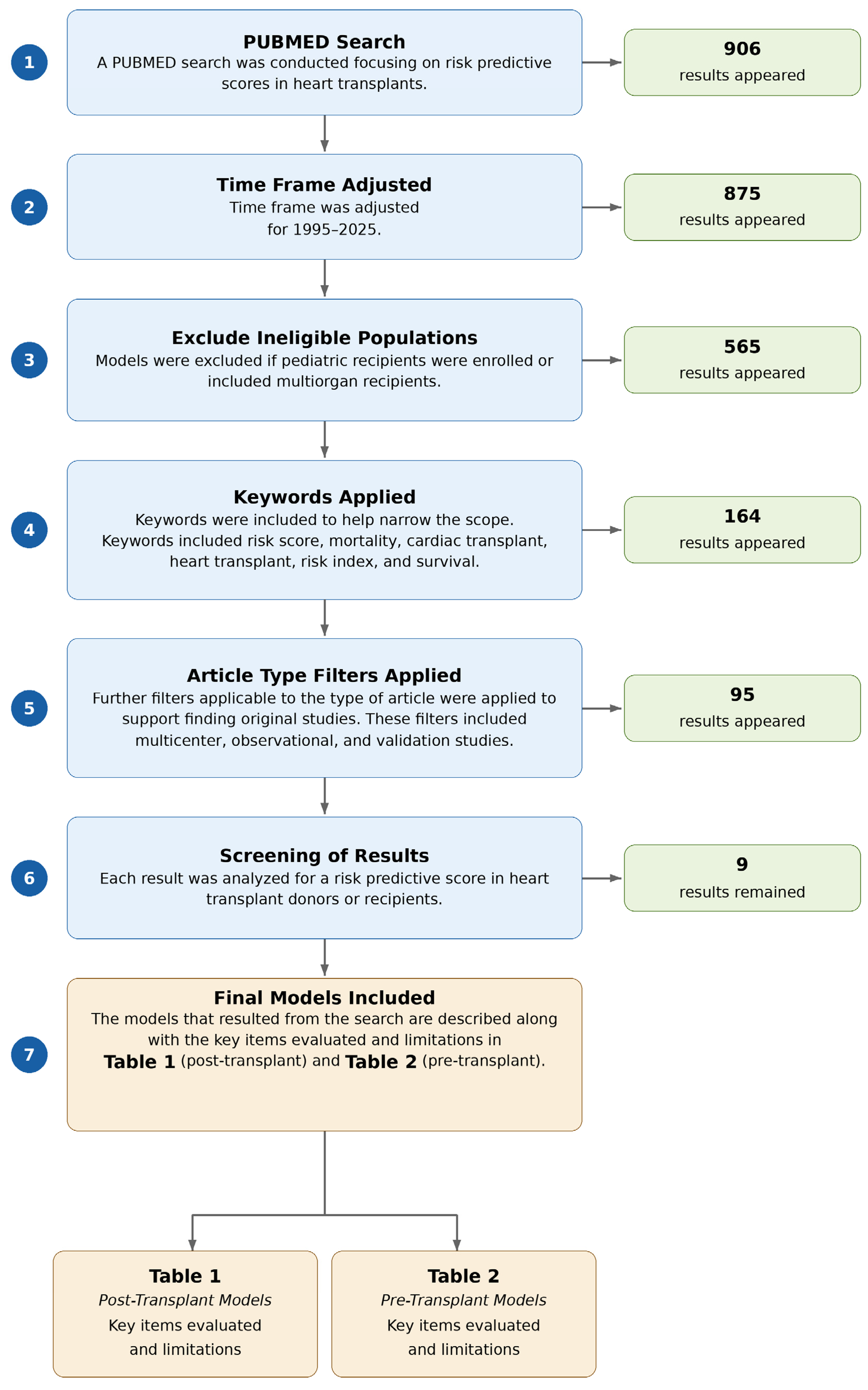
A PUBMED search was conducted focusing on risk predictive scores in heart transplants. In total, 906 results appeared (Figure 1). The time frame was adjusted for 1995–2025. With this adjustment, 875 results appeared. Models were excluded if pediatric recipients were enrolled or included multiorgan recipients. Following these considerations, 565 results appeared. Keywords were included to help narrow the scope. Keywords included risk score, mortality, cardiac transplant, heart transplant, risk index, and survival. Following this, 164 results appeared. Further filters applicable to the type of article were applied to support finding original studies. These filters included multicenter, observational, and validation studies. In total, 95 results appeared. Each result was analyzed for a risk predictive score in heart transplant donors or recipients. After going through each result, 9 remained. The models that resulted from the search are described along with the key items evaluated and limitations in Table 1 (post-transplant) and Table 2 (pre-transplant).

3. Predictive Modeling in Heart Transplantation: An Overview

There are two primary categories of risk assessment models relevant to transplantation. The first type predicts post-transplant outcomes, including patient and graft survival, by incorporating donor and recipient factors. The second type focuses on the pre-transplant period, aiming to project survival to transplant and the risk of death on the waitlist. These models have provided clinicians with objective data to best optimize outcomes. Quantifying the risk that was once interpreted through clinical intuition, risk predictive models can reduce bias and standardize practices for transplant recipients. Models have evolved over the years as the input of variables has increased and transplant registries have grown. Within heart transplantation, however, most models are currently used for research or program benchmarking rather than direct allocation. Addressing this gap involves considering waitlist mortality prediction with post-transplant outcome modeling in a single, validated benefit-based allocation system for heart transplantation.
Until the past decade, risk models predicted mortality in patients with advanced heart failure, but there were no tools for standardization among transplant candidates. France was the first to create a candidate risk score (French-CRS) that is used to predict 1-year waitlist mortality based on transplant recipient characteristics instead of focusing on the type of cardiac support a patient was receiving. This model allowed candidates to be prioritized according to medical urgency. The score was based on 2333 patients from the CRISTAL registry (2010–2014). Four variables were included: short-term mechanical circulatory support, bilirubin, glomerular filtration rate (GFR), and B-type natriuretic peptide (BNP). The score proved to be useful for predicting mortality, albeit with limitations. The model did not include patients with left ventricle assist devices (LVAD) and further did not include some other variable reflective of clinical stability that may have affected results [1].
The United States adopted this model with modifications to create the US CRS, evaluating 16,905 candidates between 2019 and 2022. The US CRS included seven variables: short-term mechanical circulatory support, durable LVAD, bilirubin, GFR, albumin, sodium, and BNP. Using these characteristics, a 50-point medical urgency score was created to predict 6-week mortality. This scoring system is significantly more sensitive and specific than the current 6-status system thresholds. Similar to the French-CRS, the score did not incorporate IABP and percutaneous VAD in the definition of short-term mechanical circulatory support. Hemodynamics, such as cardiac power output (CPO), aortic pulsatility index (API), and pulmonary artery pulsatility index (PAPi), were also excluded, which serve as important factors for patients supported by advanced therapies [2].
The IMPACT model was designed to develop a quantitative risk score to predict 1-year post-transplant mortality [3]. The Index for Mortality Prediction After Cardiac Transplantation (IMPACT) is a recipient-focused, pre-transplant risk score derived from 21,378 patients from the UNOS registry (1997–2008) that scores 12 clinical variables into a 50-point index to estimate 1-year mortality. The twelve variables are all recipient focused and include: age, bilirubin, creatinine clearance, need for dialysis, sex, heart failure etiology, recent infection, IABP, mechanical ventilation, race, temporary circulatory support, and VAD. A validating study applied the model to 29,242 orthotopic heart transplant (OHT) recipients in the ISHLT registry (2001–2010), which found similar results and validated the model [4]. A significant limitation of the model is that it only incorporates recipient factors and does not account for donor risk factors [3]. A 2020 systematic review found IMPACT to be the most widely validated model, with generally moderate discrimination and a particularly good 3-month performance [5].
The Donor Risk Index (DRI) is a donor-focused model that assessed 22,252 patients from the UNOS registry (1996–2007) to create a 15-point scoring system based on four variables: ischemic time, donor age, race, and BUN/creatinine ratio [6]. The four donor variables were found to be strong predictors of 1-year mortality. For every 1 point, an 11% increase in odds of 1-year mortality was found. Systematic reviews have found that it often underperforms compared with multivariable models incorporating both donor and recipient variables. Limitations include only having donor variables and not including recipient variables. The study also acknowledges a potential bias that poor organs may have been given to poorer candidates, thus falsely elevating mortality rate without evaluating for factors related to the recipient.
The International Heart Transplant Survival Algorithm (IHTSA) used machine learning to apply nonlinear relationships to 32 recipient and 11 donor variables from 56,625 patients from the ISHLT registry (1994–2010) [7]. Unlike earlier scores such as IMPACT or the DRI, which rely on additive or linear models, IHTSA integrates interactions between donor and recipient features to generate individualized predictions of survival at 1, 5, and 10 years. In validation studies, the model consistently exceeded outcomes of the IMPACT and DRI one-year survival predictions. Comparing the IHTSA model with the IMPACT model, it was found that IHTSA was significantly more accurate in predicting one-year mortality [8]. With an actual mortality rate of 10%, IHTSA predicted 12% while IMPACT overestimated at 22%. However, limitations include the size of the registry, and lack of standardization [7]. Another significant limitation includes that it is difficult to either more closely study the model or improve upon it, given that there is no exact method to study how the deep learning algorithm is making its connections [8].
The US transplant risk score (USTRS) is the newest model, using 9071 patients from the SRTR registry (2018–2022) and applying the mixed-effects Cox proportional hazards model using eight recipient and three donor variables to predict 1-year mortality. The variables include recipient age, bilirubin, estimated GFR, albumin, durable LVAD, diabetes, mechanical ventilation, congenital heart disease, donor age, donor sex, and donor–recipient size mismatch. The model is very new and designed to come up with a score that best serves patients in the new continuous distribution framework for donor hearts. There have not been any externally validating studies performed by another party to compare this model to other up to date models. This model does share an advantage having been shown to be valid on a subset of patients who have had access to new technology. Given the number of variables used in this model compared to the IHTSA, there is space for more comprehensive criteria. In comparison to alternative post-transplant mortality prediction models, the USTRS outperforms the IMPACT model’s ability to stratify risk. Limitations include the model’s inability to incorporate the changing hemodynamics and labs of the recipient [9].
The French transplant risk score (French TRS) is a model using 1776 patients from the CRISTAL registry (2010–2014), applying the mixed-effects Cox proportional hazards model using seven recipient and two donor variables to predict 1-year graft loss. The variables include recipient age > 50, valvular cardiomyopathy and congenital heart disease, previous cardiac surgery, diabetes, mechanical ventilation, GFR, bilirubin, donor age > 55, and donor sex. The model found that matching recipient and donors based on risk scores increased the donor pool without an increase in risk of graft loss. Interestingly, the model was unable to accurately predict individual survival during the first year post-transplant. This model has its limitations given it was applied to the French national registry, in which a higher percentage of the patient population is likely to be supported by ECMO. The model also notably excludes variables related to post-transplant survival such as infection or immunosuppression. Its generalizability outside of France is limited [10].
The Seattle Heart Failure Model (SHFM) was developed using data from 1125 patients in the PRAISE I trial and validated in five additional cohorts totaling 9942 patients [11,12,13,14]. The model used readily available clinical, laboratory, and therapeutic variables to predict 1-, 2-, and 3-year survival in heart failure patients in the outpatient setting. It demonstrated strong performance, with predicted and actual 1-year survival rates aligning closely across all validation cohorts. The SHFM provided a web-based calculator to estimate individual survival and quantify the potential benefit of adding medications or devices such as ACE inhibitors, β-blockers, aldosterone antagonists, or implantable defibrillators. Limitations include that the hazard ratios for some therapies were derived from the prior literature rather than the derivation cohort, the model may not generalize to hospitalized patients or those with major comorbidities, and the lack of patients on advanced heart failure therapies limits external validation.
The Heart Failure Survival Score (HFSS) was developed using data from 268 ambulatory patients with advanced heart failure referred for transplant evaluation and prospectively validated in 199 similar patients at a separate institution [15]. Seven variables including ischemic cardiomyopathy, resting heart rate, LVEF, intraventricular conduction delay, mean blood pressure, peak oxygen consumption (VO2), and serum sodium were used to create a noninvasive prognostic model known. The model effectively stratified risk into three categories: low, medium, and high risk, corresponding to 1-year event-free survival rates. Limitations include poor external validation and generalizability given the small sample size and the fact that the patients in this study were ambulatory and able to participate in a stress test. Given the time of study, beta-blocker therapy was not in the guidelines, and thus, many patients were not on medical therapy that patients today might be receiving.
Table 1. Post-transplant survival risk models.
Model (Year; Setting)Outcome PredictedKey Items EvaluatedLimitationsDataReference
IMPACT (2011; UNOS)30-day, 1-year mortalityRecipient only: age, bilirubin, CrCl, HD need, sex, HF etiology, recent infection, IABP, mechanical ventilation, race, temporary MCS, VADValidation not conducted on an external dataset.
VAD type not specified.
Only recipient factors were included.
The model had a c-index of 0.65. For low-risk recipients, 1-year survival was 86–92%, medium risk was 75%, and high risk was <50%.Weiss E, Annals of Thoracic Surgery, 2011 [3]
Donor Risk Index (2012; UNOS)30-day and long-term mortalityDonor only: age, ischemic time, race mismatch, BUN/CrValidation was not conducted on an external dataset.
Only includes donor variables.
Bias from poor organs being given to poorer candidates, thus falsely increasing the mortality rate.
The model had a c-index of 0.65. In the derivation cohort, the patients receiving donor hearts with scores of ≥9 had a 9% lower 5-year cumulative survival than those in the 0- to 2-point range (p < 0.001). The validation cohort showed a 13% lower 5-year cumulative survival for patients with high donor risk indices (p < 0.001).Weiss E, Heart and Lung Transplantation, 2012 [6]
IHTSA (2015; ISHLT)1-year mortality32 recipient variables, 11 donor variables; ANN modelLack of standardization between centers.
Missing data required imputation to fill in gaps.
Dataset is not readily available for replication.
Reproducibility only possible with the use of ANN.
C-index 0.600 [95% CI: 0.595–0.604]) with predicted versus actual 1-year, 5-year, and 10-year survival rates of 83.7% versus 82.6%, 71.4–70.8%, and 54.8–54.3% in the derivation cohort; 83.7% versus 82.8%, 71.5–71.1%, and 54.9–53.8% in the internal validation cohort; and 84.5% versus 84.4%, 72.9–75.6%, and 57.5–57.5% in the external validation cohort.Nilsson J, Public Library of Science, 2015 [7]
US-TRS (2025; UNOS)1-year post-HT survivalRecipient: age, bilirubin, GFR, albumin, LVAD, DM, mechanical ventilation, CHD;
donor: age, sex, size mismatch
Validation not carried out on an external dataset.
Inability to include evolving labs and hemodynamics.
The model had a c-index of 0.671. For low-risk recipients, 1-year survival was 92%, medium risk was 87%, and high risk was 78%.Lazenby K, Heart and Lung Transplantation, 2025 [9]
French-TRS (2019; France)1-year graft lossRecipient: age > 50, valvular cardiomyopathy and CHD, prior cardiac surgery, DM, mechanical ventilation, GFR, bilirubin;
donor: age > 55, sex
Scope limited to graft loss.
French population more likely to be supported by ECMO.
Variables such as infection or immunosuppression were excluded.
The model had a c-index of 0.70. For low-risk recipients, 1-year survival was 91%, medium risk was 78%, and high risk was 68%.Jasseron C, Transplantation, 2019 [10]
Table 2. Pre-transplant evaluation and waitlist mortality models.
Model (Year; Setting)Outcome PredictedKey Items EvaluatedLimitationsDataReference
French-CRS (2017; France)1-year waitlist mortality/delistingRecipient only: VA ECMO and IABP, bilirubin, GFR, BNPVariables were audited by government agency, introducing potential for recall or misclassification bias; validation was not carried out on an external dataset; patients with a VAD were excluded; potential key variables excluded as process of choosing variables involved univariate analyses excluding interactions seen in multivariate analyses; generalizability limited by country as France may have different approaches for medical management based on resources and style of practice compared to the United States.C-statistic of approximately 0.78, indicating strong predictive accuracy for waitlist mortality. The simplified model achieved a concordance probability of ~0.73 (derivation) and ~0.71 (validation) for one-year waitlist mortality and reported a correlation of r = 0.87 between observed and predicted mortality in the validation cohort. Internal validation reported sensitivity around 75% and specificity near 70% for high-risk thresholds.Jasseron C, Transplantation 2017 [1]
US-CRS (2024; UNOS)6-week waitlist mortalityRecipient only: ECMO and temp surg LVAD and BiVAD, durable LVAD, bilirubin, GFR, albumin, Na, BNPVariables were audited by government agency, introducing potential for recall or misclassification bias; validation was not carried out on an external dataset; definition of short-term MCS did not incorporate IABP and percutaneous VAD; hemodynamics such as CPO, API, and PAPi were excluded.The US-CRS model had a c-index of 0.76 (95% CI, 0.73–0.80). The AUC for 6-week mortality in the US-CRS was 0.79 (95% CI < 0.75–0.83).Zhang KC, JAMA 2024 [2]
Seattle Heart Failure Model (SHFM)1-,2-, or 3-year waitlist mortalityRecipient only: age, gender, NYHA class, statin, Na, allopurinol, uric acid, cholesterol, EF%, etiology of HF, Hgb, lymphocytes, SBP, diureticThe model was validated primarily in outpatient settings.
Patient characteristics could not be extrapolated directly but were instead gathered from published randomized trials.
Lack of patients with advanced therapies.
In transplant-eligible cohorts, SHFM’s discrimination for 1-year mortality ranged from C-statistics of 0.70 to 0.75, with sensitivity between 68 and 74% and specificity around 70%. Although not specifically designed for waitlist mortality, SHFM shows moderate correlation with actual survival outcomes and can distinguish patients with high pre-transplant risk. However, calibration often drifts in end-stage heart failure populations, where the model tends to underestimate absolute mortality risk.Levy W, AHA 2006 [11]
Heart Failure Survival Score (HFSS)1-year waitlist mortalityRecipient only: age, gender, race, NYHA class, EF%, peak VO2, resting HR, MAP, Na, ischemic etiology, medical therapy, IVCDDesigned for ambulatory patients with advanced HF.
Lack of beta-blocker therapy in patients.
Small sample size.
Early studies for predicting 1-year mortality have shown a C-statistic around 0.77, sensitivity near 80%, and specificity around 65%. The HFSS has demonstrated significant correlation with actual waitlist mortality and remains a benchmark for comparative evaluation of newer models. Nonetheless, its predictive performance may decline in contemporary cohorts due to advancements in mechanical circulatory support and heart failure therapies not represented in the original dataset.Aaronson K, AHA 1997 [15]

4. Donor and Recipient Characteristics

There are multiple characteristics of both the evaluation of heart transplant recipients and donor allograft evaluation that may contribute to survival outcomes after transplant and must be taken into consideration when assessing risk.

4.1. Recipient Characteristics

Heart transplant recipient characteristics can be organized into several components: demographics, comorbidities, and socioeconomic factors. Demographics of the heart transplant recipient, including age, race/ethnicity, and gender, contribute to survival outcomes. Heart transplant centers generally accept patients up to 65–70 years of age, but their functional status, co-morbidities, and frailty index are considered. Regarding survival, while there is no significant association between the age of the recipient and early post-transplant survival, there is an association between older age and 1-year mortality [16]. The etiology of racial disparities in OHT donors is likely multifactorial. African American patients experience a higher risk of transplant rejection and poor long-term outcomes likely due to a myriad of socioeconomic inequities, including lack of insurance, health literacy, and transportation access [17]. Some studies indicate specific immunological processes that may lead to an increased risk of acute and chronic rejection among various races. This has been attributed to possible human leukocyte antigen (HLA) mismatch as higher HLA haplotype diversity has been associated with African American and Hispanic/Latino ethnicities [18]. Due to the higher risk of acute cellular rejection, these patients have also been found to have a higher risk of cardiac allograft vasculopathy [18,19]. Studies have demonstrated notable sex differences in heart transplant outcomes as well. Per the ISHLT registry report, only 24.7% of transplant recipients were women globally between 1992 and 2024 [20]. Female recipients were more likely to develop allograft rejection and to have recurrent hospitalizations, possibly secondary to increased sensitization from pregnancy [20,21].
Comorbidities such as obesity, diabetes mellitus, chronic kidney disease (CKD), pulmonary hypertension, liver dysfunction, and active malignancy affect OHT survival. Obesity, specifically a BMI greater than 35, increases surgical and post-operative risk. In obese patients, size matching remains challenging given the importance of ensuring the donor heart size will meet the metabolic demands of the recipient. This may limit the appropriate donor pool and lead to increased waitlist times and decreased post-transplant survival [22]. Diabetes mellitus is a common comorbidity in patients with heart failure, and strict glycemic control with insulin is imperative to mitigate post-transplant complication risk. Specifically, diabetes has been identified as a risk factor for higher 10-year mortality [23]. Chronic kidney disease in OHT recipients can lead to an approximately 50% increase in 5- and 10-year post-transplant mortality. The outcomes may depend on the etiology of CKD and whether or not the patient would benefit from OHT or also with dual OHT-KT [24]. Pulmonary hypertension is an important factor to consider when assessing the risk of post-operative right ventricular failure, as elevated pulmonary vascular resistance (PVR) is a well-known contraindication for transplant. This stems from the risk of early right ventricle (RV) failure secondary to the inability to adapt to an acute increase in RV afterload, secondary to existing pulmonary vascular disease of the recipient [25]. The degree of pre-capillary pulmonary hypertension may be further evaluated via a nitroprusside reversibility study [26,27]. Hepatic dysfunction can be a contraindication depending on severity and whether combined heart–liver translation can be completed. Higher MELD scores are reliable in predicting higher risk of complication and low 30-day and 10-year transplant survival [28,29]. Active malignancy is a contraindication in heart transplantation unless the patient has been cancer-free for a period that ranges from 1 to 5 years depending on the type per ISHLT guidelines [30]. In patients who do undergo heart transplantation, those with hematologic pre-transplant malignancy were at a higher risk of mortality in the first year, but after 5 years, mortality was comparable [31]. There is also an increased risk of developing malignancy after transplantation in patients with pre-transplant malignancy, specifically those with a history of breast and lung cancer or melanoma [31]. Amiodarone use may be related to increased rates of primary graft dysfunction post-transplant and therefore should be used cautiously [32].
Socioeconomic factors, often linked to race/ethnicity, highly contribute to the risk of post-transplant mortality. Lack of reliable transportation causes difficulty in attending frequent follow-up appointments. Poor medical literacy and unstable housing can affect adherence to complex immunosuppressive treatment regimens and navigating the health system [17,33]. Patients with college-level education are found to have 11% reduced mortality risk [34]. Substance use disorders can also affect the ability of patients to adhere to medications or follow-up with medical care. Lack of social support for physical health as well as mental health needs also negatively impacts post-transplant survival [35].

4.2. Donor Characteristics

The “demographics” of the donor, including donor age and size, in addition to ischemic time are important considerations in donor evaluation. Advanced donor age is a common reason to decline an allograft and an important consideration for post-transplant outcomes. The age of an ideal OHT donor is recommended to be less than 45–50 years [36,37]. Older donors > 45 years need to be screened for CAD [37]. Some studies have demonstrated that a donor age greater than 40 years can increase the risk up to 44% for 1-year mortality or re-transplantation and carry reduced 30-day survival in the post-transplant period [38,39]. Studies based on cardiac MRI have shown that higher donor age is often associated with fibrotic/interstitial edematous changes and can contribute to increased diastolic dysfunction, which increases the risk of post-transplantation mortality [40]. In addition to age, donor and recipient size matching is an important consideration. Many factors contribute to assessment of acceptable donor size, including sex matching, weight, height, and BMI, as well as pulmonary hypertension [37]. In particular, the predicted heart mass (PHM) is considered a more optimal metric to predict 1-year graft dysfunction and post-transplant mortality [41]. A PHM < 0.86 is considered to have increased mortality and provide inadequate circulatory support to likely meet the metabolic demands of the recipient. Prolonged ischemic time alone is a risk factor for worse post-transplant survival but is dependent on donor age. Studies have found a higher tolerance for prolonged ischemic time from younger donor grafts [42].
Graft evaluation is important especially when evaluating donors with comorbid medical conditions. As long as there is preserved ejection fraction as well as absence of left ventricular hypertrophy, donors with a history of tobacco use disorder, alcohol use, or methamphetamine use may be accepted [37]. Left ventricular hypertrophy has historically been associated with increased 30-day mortality, but recent studies indicate that overall survival is very similar to those without left ventricular hypertrophy (LVH) [43,44]. However, the association of LVH with other variables such as old age or long ischemic time can predispose patients to higher mortality [43]. Comorbidities such as hypertension, diabetes mellitus, and tobacco use are often relative contraindications but may be acceptable if there is a definitive assessment for CAD with coronary angiogram [37]. Donors diagnosed with diabetes may be used if there is no evidence of CAD. Despite the risk of developing cardiac allograft vasculopathy, donor patients with CAD are still utilized. Evidence indicates that recipients of donor hearts with less than 50% stenosis exhibit comparable short-term and long-term outcomes to those receiving donor hearts with non-obstructive coronary artery disease [45]. Donor hearts with left ventricular systolic dysfunction make up nearly a fourth of unused hearts. However, studies suggest that one echocardiogram alone should not determine candidacy, as LV systolic dysfunction in a donor heart that improves with hemodynamic management can be utilized without increased risk of OHT mortality [46]. While there are concerns of cardiotoxic effects of some drug use such as cocaine, substance use disorder has not been associated with reduced post-transplant survival [47]. Donors are routinely screened for bloodborne viral infections such as HIV, HBV, HCV, syphilis, and CMV. These donors are often accepted after appropriate matching and prophylaxis/treatment. For example, given the advances in hepatitis C treatment via direct-acting antiviral medications, donors infected with HCV are now being accepted by more transplant centers [38].
Donors with malignancy are evaluated based on their risk of transmission. Donors with breast cancer, colon cancer, renal cell carcinoma, lung cancer, melanoma, metastatic cancer of any origin, leukemia, or lymphoma are not recommended due to the high risk of transmission [37]. Glioblastomas are an example of brain tumors that carry an intermediate risk of transmission and have been shown to recur in recipients [48].
The donor’s cause of death may affect post-transplantation outcomes as well. It is important to carefully screen donors for any evidence of a cardiac cause of death, including arrhythmias such as Brugada syndrome, long QT syndrome, or hypertrophic cardiomyopathy, specifically when the cause of death remains unknown. There are other circumstances that also require further screening, including death by carbon monoxide poisoning and explosive brain damage. In these settings, ischemic EKG findings and/or elevated troponin levels may indicate risk of early cardiac allograft failure [37].

5. Allosensitization and Immunologic Risk

Allosensitization is the presence of preformed antibodies to HLAs and is often the result of exposure to foreign HLA [49]. It is commonly measured by donor specific antibodies (DSAs) and/or panel reactive antibodies (PRAs), which are key predictors of early graft rejection and mortality, and therefore important in assessing risk and predicting post-transplant outcomes [50,51]. As a result, significant allosensitization may be a limitation for transplant through reducing the number of compatible donors and increasing the risk of poor patient outcomes and reduced survival [52]. Risk factors for sensitization include blood transfusion, prior transplantation, pregnancy, the use of mechanical circulatory support, and past surgical history involving the use of homografts or human tissue allografts [53].
Elevated PRA helps quantify the proportion of the donor pool to which a recipient is sensitized, with higher levels being consistently associated with increased risk of acute rejection and worse post-transplant outcomes and survival [54]. In patients undergoing heart transplant, a PRA value as low as >10% is linked to significantly reduced survival and heightened early rejection risk [54]. Patients with PRA > 25% and those with pre-transplantation HLA antibodies have shown the worst overall survival and higher early rejection rates [55,56,57,58]. These factors underscore the importance of assessing allosensitization, a significant risk factor for survival, prior to cardiac transplantation.

6. Pathophysiological Mechanisms and Molecular Predictors

In addition to known clinical risk factors described, there is emerging evidence for molecular, immunologic, and histopathologic factors that may contribute to cardiac rejection, graft dysfunction, and overall risk assessment for transplant patients. A deeper understanding of these pathophysiological processes may enhance future risk models by revealing subclinical processes not captured by current scoring. For example, there is growing evidence that the activity of matrix metalloproteinases (MMPs) may play a significant role in the pathogenesis of cardiac allograft rejection via the stimulation of fibroblasts and breakdown of extracellular matrix proteins in the myocardium [59,60]. In addition to cardiac rejection, MMPs are implicated in arterial plaque rupture due to proatherogenic effects, vascular complications due to degradation of the vascular wall, and reduced myocardial contractility due to reduced calcium affinity for contractile myofilaments [59,61,62]. Furthermore, interleukin-1 beta (IL-1β) has been shown to strongly associated with acute rejection and inflammation [63]. Understanding the role of immunohistochemical markers in cardiac remodeling and allograft rejection is vital to support future research into next-generation risk models in cardiac transplantation [64].

7. Level of Urgency

The Interagency Registry for Mechanically Assisted Circulatory Support (INTERMACS) was established in 2006 to collect, analyze, and report data on patients receiving durable mechanical circulatory support (MCS) devices, particularly left ventricular assist devices (LVADs), in the U.S [65]. The goal of the registry was to provide national-level outcomes, support guideline development, and refine risk stratification for advanced heart failure patients undergoing LVAD and heart transplant procedures [65,66].
One of its most important contributions is the INTERMACS clinical profile classification, which is a seven-level scale that stratifies patients based on severity, ranging from Profile I (“critical cardiogenic shock”) to Profile VII (“advanced but stable heart failure”). In an evaluation of the prognostic utility of the INTERMACS profile at the time of heart transplant assessment as a bridge to candidacy, patients classified as INTERMACS I–II demonstrated a significantly higher risk of waitlist mortality or delisting (HR ≈ 3.8), whereas those in INTERMACS III–IV had a greater likelihood of ultimately undergoing transplantation [65]. Interestingly, the INTERMACS profile was not independently associated with the composite outcome of overall mortality or delisting, suggesting that although it can guide transplant eligibility and waitlist timings, its predictive value for long-term survival may be limited.
Among ambulatory advanced heart failure patients, those with lower baseline INTERMACS profiles showed poor survival and significantly more complications post-LVAD implantation compared to those with higher profiles [67]. Similarly, another analysis reinforced that patients with INTERMACS I–II profiles had a greater 30-day mortality following LVAD transplantation compared to those with INTERMACS III–IV profiles (38% vs. 11%), whereas mortality beyond 30 days was significantly higher in the INTERMACS III–IV group (18% vs. 0%) [66]. These findings underscore that INTERMACS Profiles I-II are consistently linked to worse outcomes, even when optimized with temporary mechanical circulatory support, highlighting the value of early identification and intervention.

8. Time on the List

Time on the transplant waiting list reflects both disease severity and evolving risks. Extended wait times may lead to progressive end-organ damage, increasing frailty, and heightened sensitization, all of which can negatively influence post-transplant outcomes. A large cohort study found that doubling the waitlist time increased the odds of transplant failure by approximately 10, with the highest risk period occurring during the first 60 days on the waitlist [68]. Although patients with high urgency are often transplanted with a shorter time duration on the waitlist, they consistently exhibit worse outcomes due to their acute critical status, presenting a complex dynamic between wait time, urgency, and outcome risk [69].
Studies evaluating waitlist mortality, specifically following the revised US heart transplant allocation system in 2018, found higher post-transplant mortality in patients with LVADs and contributed it to likely longer ischemic times and patient acuity [70]. To address the dynamic change in clinical status for patients on the waitlist, a continuously updated mortality estimate has been proposed to inform status changes that could reduce mortality on the heart transplant waiting list [71]. Increased time on the waitlist has been shown to have greater odds of transplant failure [68].

9. Center Characteristics and Experience

9.1. Allocation Practices

There are multiple factors involved in allocation practices that affect survival disparities and should be considered in transplant risk assessment, including geographic variation in donor availability, the use of marginal donors, and the use of aggressive bridging strategies. While some of these factors remain outside of center control, such as regional variation in donor availability, factors such as donor selection and bridging often vary based on the culture and experience of each center.
Donor availability varies greatly throughout regions in the US. Furthermore, there has been shown to be significant state-level variation in waitlist mortality throughout the United States, speaking to the fact that there are factors at play affecting all programs in a specific region. For example, centers in less populated regions may be faced with accepting donors with longer ischemic times, which may ultimately pose an increased risk to recipients [72]. Centers in densely populated areas may be near others with listed donors, shifting the supply–demand balance. Although the exact mechanism behind this regional variation remains unclear, it is likely complex in nature and underlies the importance of further research to better understand these variations [69].
Given that there remains an increased demand for donor organs in relation to supply, there is a constant effort to expand the donor pool within the transplant world. One approach to expanding the donor pool is to more closely evaluate and consider marginal donors. Marginal donors may include donor hearts with LVH, advanced donor age (>50), CAD, left ventricular systolic dysfunction, inotropic use, CVA as the cause of death, or prolonged ischemic time [73]. Evidence for outcomes in marginal donors has been controversial. While there has been some evidence that recipients receiving marginal donors have had increased risk of PGD and decreased mortality [74], other studies have shown no difference in outcomes for transplants with marginal donors [75,76]. Overall, it remains difficult to evaluate the impact of these factors on recipient outcomes, as the rate of acceptance of marginal donors is lower in general [73]. A center’s use of marginal donors may vary based on several factors including culture, experience, and location.
Waitlist mortality and outcomes after transplant may also be affected by variations in bridging strategies. Since the change in allocation system in 2018, there has been a notable increase in the frequency of mechanical circulatory support as a bridge to advanced therapies. With the previous allocation system, temporary MCS was associated with worse survival post-transplant. However, this has not been observed with the new allocation system but has rather improved survival for heart transplant recipients on temporary MCS [77]. Bridging is not yet included in current risk assessment tools, but its growing use makes it important to consider.

9.2. Volume and Expertise

There is a known association between center volume and outcomes after surgical procedures in general. With increasing volume, a decreased mortality rate has been observed in various surgical procedures, including open-heart surgery and vascular surgery [78]. This phenomenon remains true for transplantation as well, with evidence for better outcomes for heart transplants alone in centers with higher volume, in addition to better outcomes in other organ transplants including kidney, lung, and multiorgan transplants [79,80,81]. Particularly, within heart transplants, centers with lower volume have been shown to have lower one-year graft survival and increased rates of primary graft dysfunction [82].
This may be due to the collective and rapidly growing expertise at high-volume centers, with experience in handling various complications, in addition to protocol standardization and multidisciplinary infrastructure. Patients treated at high-volume centers may experience reduced waitlist times and enhanced 30-day graft survival rates [82]. This relationship has been observed to be the strongest in the higher risk recipient and donor pairs [82].

10. Emerging Technologies

Developing technologies have contributed to ongoing efforts to expand the donor pool and may affect outcomes in transplant recipients. These technologies include a new approach to transplant with donation after circulatory death (DCD) and various modalities of ex vivo perfusion and preservation.

10.1. Donation After Circulatory Death

Heart transplantation using donation after brain death (DBD) donors has previously been standard of care in the US. DCD is defined as donation after circulation has irreversibly ceased. While heart transplantation using DCD donors has been practiced in Europe and Australia since 2014, it has only become more common throughout the US over the past several years. Efforts to increase its use is due in part to its ability to expand the donor pool and decrease waitlist times within a constant supply and demand mismatch for recipients and donors. There have been several retrospective studies over the past several years examining DCD vs. DBD donors in heart transplantation, which have demonstrated similar survival outcomes [83]. However, there have been differences in the amount of reported primary graft dysfunction (PGD). In the large retrospective study by Siddiqi et al. comparing DCD transplant outcomes with DBD donors, the outcomes of DCD donors were shown to be noninferior to those of DBD donors, with no significant difference in the incidence of primary graft dysfunction [84]. This contrasts with Schroder et al. demonstrating an increased risk of PGD among DCD donors [85]. However, in this study, the increased incidence of PGD in DCD donors did not ultimately affect patient or graft survival.
Currently, there remain limitations to the widespread use of DCD for organ donation. There is significant heterogeneity in practices among institutions and various methods for organ procurement, including direct procurement and perfusion versus normothermic regional perfusion. We currently lack standardized protocols for minimum stand-off time, and there are multiple ethical concerns to take into consideration when using DCD donation. Furthermore, cost and availability remain barriers, particularly for smaller and resource limited centers. Currently, there is also insufficient experience in the US to compare long-term outcomes. With more data on long-term outcomes, the use of DCD donation should certainly be included in risk assessment models.

10.2. Ex Vivo Perfusion

Conventional methods of organ preservation include a cardioplegic arrest followed by cold static storage. As prolonged ischemic time remains one of the biggest risks in transplant outcomes, there has been ongoing development of multiple technologies to improve organ preservation. This also coincides with efforts to expand the donor pool.
The organ care system (OCS) (TransMedics, Inc., Boston, MA, USA) was the first commercially available system for ex vivo perfusion and preservation, allowing for ex-vivo donor heart assessment. With the OCS, the donor heart is cannulated via the aorta and circulates a warm, nutrient-rich solution to maintain a near physiologic state [86]. By maintaining the donor heart in a perfused state during transport, it may effectively decrease cold ischemic time, which is a major independent risk factor for mortality. Additionally, it has the potential to allow for further assessment of marginal donors through ongoing metabolic assessment of perfusion parameters. In a prospective, randomized controlled trial by Ardehali et al., heart transplantation with the OCS storage system had similar short-term outcomes with cold static storage, including graft survival rates, cardiac-related serious adverse events, rejection, and ICU stay duration. After this study, the use of the OCS for organ preservation gained more popularity [87]. Similar outcomes have been replicated in a retrospective study by Isath et al. evaluating the use of the OCS for donors with predicted prolonged ischemic time compared to conventional strategies. In this study, there were similar short-term outcomes including survival and primary graft dysfunction between the two groups [88].
Another method of ex vivo perfusion includes hypothermic preservation. With conventional methods of cold static storage, donor hearts are cooled with ice during transport, which can lead to uneven cooling and subsequent tissue injury to the graft. In response to this risk, the Paragonix Sherpa Pak was developed as a hypothermic preservation system and has been shown to maintain the organ at a steady temperature between 4 and 8 degrees Celsius [89]. Controlled hypothermic preservation has been shown to decrease the risk of primary graft dysfunction, which may subsequently improve transplant outcomes [90].
Of note, both methods of preservation may not be accessible to all transplant programs, given the significant cost associated with its use and additional resources required. With further study of the effects of these various preservation methods on post-operative events such as primary graft dysfunction and survival, their use may be included in future risk prediction models.

11. Future Directions

While the variety of predictive models described in this review each offer their own individual advantages, there remain multiple limitations in widely accepting these risk models and comparing them given a lack of standardization throughout the models. This must be taken into consideration when developing risk models for widespread and standardized use in the future.
As heart transplantation moves toward integration within the continuous distribution framework, future efforts must focus on developing and validating comprehensive, benefit-based risk models tailored to the unique complexities of heart transplant candidates. These models should incorporate not only traditional donor and recipient clinical variables but also dynamic hemodynamic parameters, device-specific data, and psychosocial determinants of health (Table 3). We must take into consideration which pre-transplant factors are associated with increased risk of post-transplant outcomes such as primary graft dysfunction, rejection, survival, and quality of life. We propose that a future comprehensive risk assessment tool for continuous distribution within heart transplantation should include factors contributing to pre-transplant, peri-operative, and post-transplant risks.
The application of machine learning and artificial intelligence (AI) offers an unprecedented opportunity to enhance these predictive frameworks by uncovering nonlinear relationships, integrating multimodal data sources, and continuously recalibrating risk in response to evolving clinical and system-level inputs. Ultimately, the goal is to create a transparent machine learning-enabled, data-driven allocation system that maximizes survival benefit while promoting fairness and access for all heart transplant candidates.

12. Conclusions

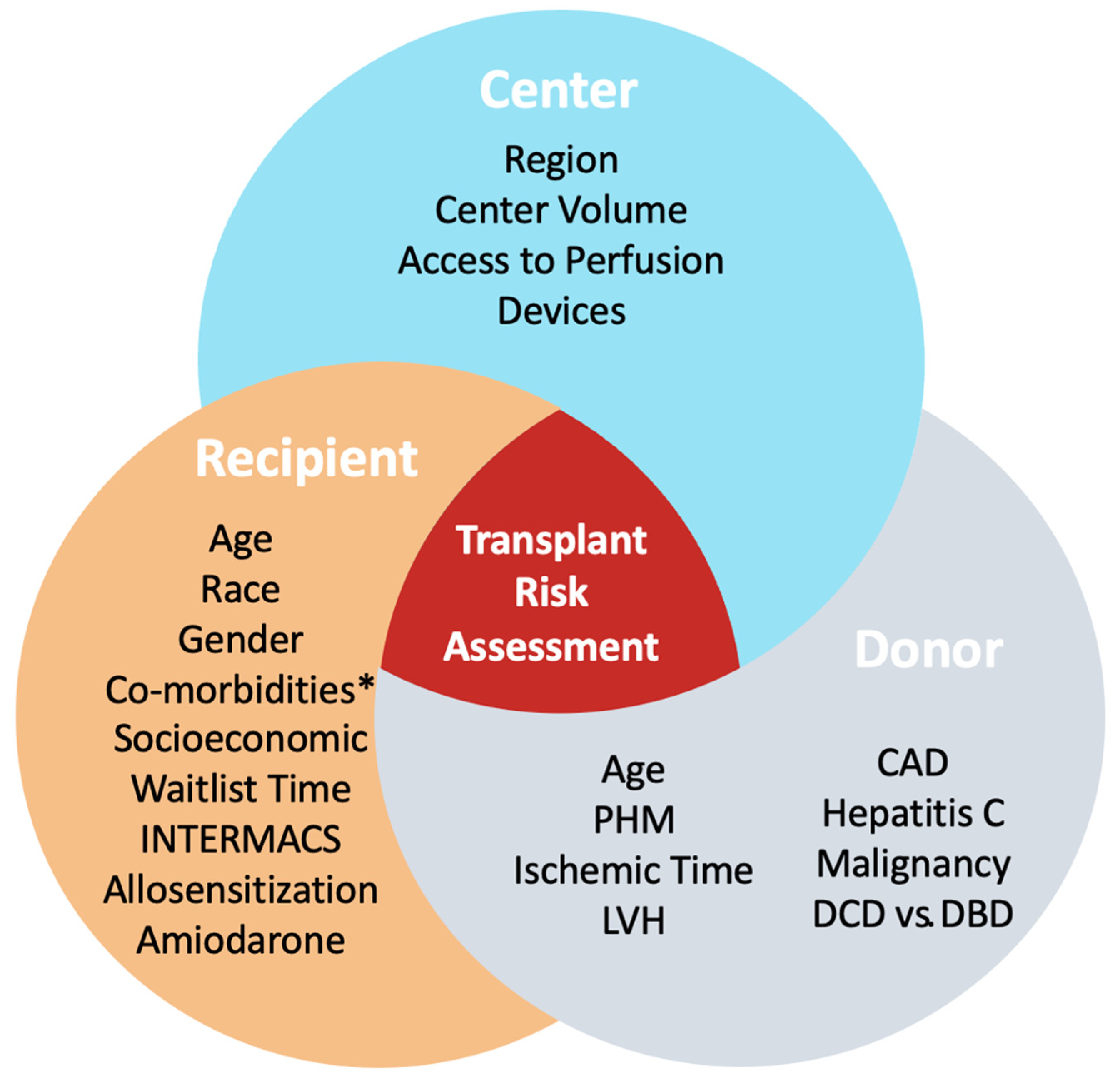
Risk prediction in heart transplantation stands at a pivotal juncture. While other organ systems such as the kidney, liver, and lung have successfully integrated validated risk models into allocation policy, heart transplantation continues to rely predominantly on clinical status, device use, and categorical urgency tiers. This reliance, though practical, fails to capture the full complexity of patient risk and potential benefit. The emergence of continuous distribution presents an unprecedented opportunity to transform heart allocation into a system guided by quantitative, data-driven, and equitable principles through the incorporation of a comprehensive risk score (Figure 2).
Advancing risk prediction in heart transplantation will require multicenter collaboration and a movement beyond isolated survival models to develop comprehensive frameworks to integrate the diverse factors shaping transplant outcomes. Ultimately, this evolution will not only enhance outcome prediction but also align heart transplantation with a modern paradigm of precision allocation, ensuring that every donated heart is utilized for maximal survival benefit and equity.

Author Contributions

Conceptualization—L.L. and E.H.; Methodology—M.S.; Writing—Original draft preparation—L.L., M.S., M.I., P.S. and E.H.; Review and editing—L.L. and E.H. All authors have read and agreed to the published version of the manuscript.

Funding

This research received no external funding.

Data Availability Statement

No new data were created or analyzed in this study.

Conflicts of Interest

The authors declare no conflicts of interest.

References

  1. Jasseron, C.; Legeai, C.; Jacquelinet, C.; Leprince, P.; Cantrelle, C.; Audry, B.; Porcher, R.; Bastien, O.; Dorent, R. Prediction of Waitlist Mortality in Adult Heart Transplant Candidates: The Candidate Risk Score. Transplantation 2017, 101, 2175–2182. [Google Scholar] [CrossRef] [Scilit]
  2. Zhang, K.C.; Narang, N.; Jasseron, C.; Dorent, R.; Lazenby, K.A.; Belkin, M.N.; Grinstein, J.; Mayampurath, A.; Churpek, M.M.; Khush, K.K.; et al. Development and Validation of a Risk Score Predicting Death Without Transplant in Adult Heart Transplant Candidates. JAMA 2024, 331, 500–509. [Google Scholar] [CrossRef] [Scilit]
  3. Weiss, E.S.; Allen, J.G.; Arnaoutakis, G.J.; George, T.J.; Russell, S.D.; Shah, A.S.; Conte, J. V Creation of a Quantitative Recipient Risk Index for Mortality Prediction after Cardiac Transplantation (IMPACT). Ann. Thorac. Surg. 2011, 92, 914–921; discussion 921–922. [Google Scholar] [CrossRef] [Scilit]
  4. Kilic, A.; Allen, J.G.; Weiss, E.S. Validation of the United States-Derived Index for Mortality Prediction After Cardiac Transplantation (IMPACT) Using International Registry Data. J. Heart Lung Transplant. 2013, 32, 492–498. [Google Scholar] [CrossRef] [Scilit] [PubMed]
  5. Aleksova, N.; Alba, A.C.; Molinero, V.M.; Connolly, K.; Orchanian-Cheff, A.; Badiwala, M.; Ross, H.J.; Duero Posada, J.G. Risk Prediction Models for Survival after Heart Transplantation: A Systematic Review. Am. J. Transplant. 2020, 20, 1137–1151. [Google Scholar] [CrossRef] [Scilit] [PubMed]
  6. Weiss, E.S.; Allen, J.G.; Kilic, A.; Russell, S.D.; Baumgartner, W.A.; Conte, J.V.; Shah, A.S. Development of a Quantitative Donor Risk Index to Predict Short-Term Mortality in Orthotopic Heart Transplantation. J. Heart Lung Transplant. 2012, 31, 266–273. [Google Scholar] [CrossRef] [Scilit]
  7. Nilsson, J.; Ohlsson, M.; Höglund, P.; Ekmehag, B.; Koul, B.; Andersson, B. The International Heart Transplant Survival Algorithm (IHTSA): A New Model to Improve Organ Sharing and Survival. PLoS ONE 2015, 10, e0118644. [Google Scholar] [CrossRef] [Scilit]
  8. Medved, D.; Ohlsson, M.; Höglund, P.; Andersson, B.; Nugues, P.; Nilsson, J. Improving Prediction of Heart Transplantation Outcome Using Deep Learning Techniques. Sci. Rep. 2018, 8, 3613. [Google Scholar] [CrossRef] [Scilit]
  9. Lazenby, K.A.; Tolmie, S.B.; Barrett, K.; White, M.H.; Zhang, K.C.; Narang, N.; Jasseron, C.; Dorent, R.; Khush, K.K.; Parker, W.F. Development of a Risk Score Predicting Survival After Adult Heart Transplantation in the United States. J. Heart Lung Transplant. 2025, 44, 1874–1882. [Google Scholar] [CrossRef] [Scilit]
  10. Jasseron, C.; Legeai, C.; Jacquelinet, C.; Nubret-Le Coniat, K.; Flécher, E.; Cantrelle, C.; Audry, B.; Bastien, O.; Dorent, R. Optimization of Heart Allocation: The Transplant Risk Score. Am. J. Transplant. 2019, 19, 1507–1517. [Google Scholar] [CrossRef] [Scilit]
  11. Levy, W.C.; Mozaffarian, D.; Linker, D.T.; Sutradhar, S.C.; Anker, S.D.; Cropp, A.B.; Anand, I.; Maggioni, A.; Burton, P.; Sullivan, M.D.; et al. The Seattle Heart Failure Model. Circulation 2006, 113, 1424–1433. [Google Scholar] [CrossRef] [Scilit] [PubMed]
  12. Alba, A.C.; Buchan, T.A.; Saha, S.; Fan, S.; Demers, C.; Poon, S.; Mak, S.; Al-Hesayen, A.; Toma, M.; Zieroth, S.; et al. Predicting 1-Year Mortality in Outpatients with Heart Failure with Reduced Left Ventricular Ejection Fraction: Do Empiric Models Outperform Physician Intuitive Estimates? A Multicenter Cohort Study. Circ. Heart Fail. 2023, 16, E010312. [Google Scholar] [CrossRef] [Scilit] [PubMed]
  13. Shiraishi, Y.; Kohsaka, S.; Nagai, T.; Goda, A.; Mizuno, A.; Nagatomo, Y.; Sujino, Y.; Fukuoka, R.; Sawano, M.; Kohno, T.; et al. Validation and Recalibration of Seattle Heart Failure Model in Japanese Acute Heart Failure Patients. J. Card. Fail. 2019, 25, 561–567. [Google Scholar] [CrossRef] [Scilit]
  14. Goda, A.; Williams, P.; Mancini, D.; Lund, L.H. Selecting Patients for Heart Transplantation: Comparison of the Heart Failure Survival Score (HFSS) and the Seattle Heart Failure Model (SHFM). J. Heart Lung Transplant. 2011, 30, 1236–1243. [Google Scholar] [CrossRef] [Scilit]
  15. Aaronson, K.D.; Schwartz, J.S.; Chen, T.M.; Wong, K.L.; Goin, J.E.; Mancini, D.M. Development and Prospective Validation of a Clinical Index to Predict Survival in Ambulatory Patients Referred for Cardiac Transplant Evaluation. Circulation 1997, 95, 2660–2667. [Google Scholar] [CrossRef] [Scilit]
  16. Lund, L.H.; Khush, K.K.; Cherikh, W.S.; Goldfarb, S.; Kucheryavaya, A.Y.; Levvey, B.J.; Meiser, B.; Rossano, J.W.; Chambers, D.C.; Yusen, R.D.; et al. The Registry of the International Society for Heart and Lung Transplantation: Thirty-Fourth Adult Heart Transplantation Report—2017; Focus Theme: Allograft Ischemic Time. J. Heart Lung Transplant. 2017, 36, 1037–1046. [Google Scholar] [CrossRef] [Scilit]
  17. Farmer, S.A.; Grady, K.L.; Wang, E.; McGee, E.C., Jr.; Cotts, W.G.; McCarthy, P.M. Demographic, Psychosocial, and Behavioral Factors Associated with Survival After Heart Transplantation. Ann. Thorac. Surg. 2013, 95, 876–883. [Google Scholar] [CrossRef] [Scilit] [PubMed]
  18. Morris, A.A.; Kransdorf, E.P.; Coleman, B.L.; Colvin, M. Racial and Ethnic Disparities in Outcomes after Heart Transplantation: A Systematic Review of Contributing Factors and Future Directions to Close the Outcomes Gap. J. Heart Lung Transplant. 2016, 35, 953–961. [Google Scholar] [CrossRef] [Scilit]
  19. Raichlin, E.; Edwards, B.S.; Kremers, W.K.; Clavell, A.L.; Rodeheffer, R.J.; Frantz, R.P.; Pereira, N.L.; Daly, R.C.; McGregor, C.G.; Lerman, A.; et al. Acute Cellular Rejection and the Subsequent Development of Allograft Vasculopathy after Cardiac Transplantation. J. Heart Lung Transplant. 2009, 28, 320–327. [Google Scholar] [CrossRef] [Scilit]
  20. Donald, E.M.; Lemos, C.; Hertz, A.; DeFilippis, E.M. Sex-Specific Considerations in Management and Outcomes of Heart Transplant Recipients. Can. J. Cardiol. 2025, 42, 356–367. [Google Scholar] [CrossRef] [Scilit]
  21. Hickey, K.T.; Doering, L.V.; Chen, B.; Carter, E.V.; Sciacca, R.R.; Pickham, D.; Castillo, C.; Hauser, N.R.; Drew, B.J. Clinical and Gender Differences in Heart Transplant Recipients in the NEW HEART Study. Eur. J. Cardiovasc. Nurs. 2017, 16, 222–229. [Google Scholar] [CrossRef] [Scilit]
  22. Chouairi, F.; Milner, A.; Sen, S.; Guha, A.; Stewart, J.; Jastreboff, A.M.; Mori, M.; Clark, K.A.; Miller, P.E.; Fuery, M.A.; et al. Impact of Obesity on Heart Transplantation Outcomes. J. Am. Heart Assoc. 2021, 10, e021346. [Google Scholar] [CrossRef] [Scilit]
  23. Ehrsam, J.P.; Schuurmans, M.M.; Laager, M.; Opitz, I.; Inci, I. Recipient Comorbidities for Prediction of Primary Graft Dysfunction, Chronic Allograft Dysfunction and Survival After Lung Transplantation. Transpl. Int. 2022, 35, 10451. [Google Scholar] [CrossRef] [Scilit] [PubMed]
  24. Kittleson, M.M.; Sharma, K.; Brennan, D.C.; Cheng, X.S.; Chow, S.L.; Colvin, M.; DeVore, A.D.; Dunlay, S.M.; Fraser, M.; Garonzik-Wang, J.; et al. Dual-Organ Transplantation: Indications, Evaluation, and Outcomes for Heart-Kidney and Heart-Liver Transplantation: A Scientific Statement From the American Heart Association. Circulation 2023, 148, 622–636. [Google Scholar] [CrossRef] [Scilit]
  25. Klotz, S.; Wenzelburger, F.; Stypmann, J.; Welp, H.; Drees, G.; Schmid, C.; Scheld, H.H. Reversible Pulmonary Hypertension in Heart Transplant Candidates: To Transplant or Not to Transplant. Ann. Thorac. Surg. 2006, 82, 1770–1773. [Google Scholar] [CrossRef] [Scilit]
  26. Costard-Jäckle, A.; Fowler, M.B. Influence of Preoperative Pulmonary Artery Pressure on Mortality after Heart Transplantation: Testing of Potential Reversibility of Pulmonary Hypertension with Nitroprusside Is Useful in Defining a High Risk Group. J. Am. Coll. Cardiol. 1992, 19, 48–54. [Google Scholar] [CrossRef] [Scilit] [PubMed]
  27. Naguib, M.; Aljwaid, A.; Marella, D.; Flores, R.J.; Singh, A. Nitroprusside Combined with Leg Raise at the Time of Right Heart Catheterization to Differentiate Precapillary from Other Hemodynamic Forms of Pulmonary Hypertension: A Single-Center Pilot Study. J. Cardiovasc. Dev. Dis. 2024, 11, 124. [Google Scholar] [CrossRef] [Scilit]
  28. Chokshi, A.; Cheema, F.H.; Schaefle, K.J.; Jiang, J.; Collado, E.; Shahzad, K.; Khawaja, T.; Farr, M.; Takayama, H.; Naka, Y.; et al. Hepatic Dysfunction and Survival after Orthotopic Heart Transplantation: Application of the MELD Scoring System for Outcome Prediction. J. Heart Lung Transplant. 2012, 31, 591–600. [Google Scholar] [CrossRef] [Scilit]
  29. Kim, H.H.; Youn, Y.N. Predictive Scoring Systems for Mortality in Heart Transplant Patients with Liver Cirrhosis. Sci. Rep. 2025, 15, 12663. [Google Scholar] [CrossRef] [Scilit] [PubMed]
  30. Peled, Y.; Ducharme, A.; Kittleson, M.; Bansal, N.; Stehlik, J.; Amdani, S.; Saeed, D.; Cheng, R.; Clarke, B.; Dobbels, F.; et al. International Society for Heart and Lung Transplantation Guidelines for the Evaluation and Care of Cardiac Transplant Candidates—2024. J. Heart Lung Transplant. 2024, 43, 1529–1628.e54. [Google Scholar] [CrossRef] [Scilit]
  31. Batra, J.; DeFilippis, E.M.; Golob, S.; Clerkin, K.; Topkara, V.K.; Habal, M.V.; Restaino, S.; Griffin, J.; Hi Lee, S.; Latif, F.; et al. Impact of Pretransplant Malignancy on Heart Transplantation Outcomes: Contemporary United Network for Organ Sharing Analysis Amidst Evolving Cancer Therapies. Circ. Heart Fail. 2022, 15, e008968. [Google Scholar] [CrossRef] [Scilit]
  32. Servais, A.; Lundgren, S.; Bowman, S.; Stoller, D.; Burdorf, A.; Hyden, M.; Lowes, B.; Zolty, R.; Klepser, D.; Brink, H. Preoperative Amiodarone and Primary Graft Dysfunction in Heart Transplantation. Ann. Pharmacother. 2024, 58, 1099–1104. [Google Scholar] [CrossRef] [Scilit] [PubMed]
  33. Kelty, C.E.; Dickinson, M.G.; Fogarty, K.J. The Effects of Demographic, Psychosocial, and Socioeconomic Characteristics on Access to Heart Transplantation and Left Ventricular Assist Device. Am. Heart J. Plus Cardiol. Res. Pract. 2022, 17, 100172. [Google Scholar] [CrossRef] [Scilit] [PubMed]
  34. DePasquale, E.C.; Kobashigawa, J.A. Socioeconomic Disparities in Heart Transplantation. Circ. Cardiovasc. Qual. Outcomes 2016, 9, 693–694. [Google Scholar] [CrossRef] [Scilit] [PubMed]
  35. Wayda, B.; Clemons, A.; Givens, R.C.; Takeda, K.; Takayama, H.; Latif, F.; Restaino, S.; Naka, Y.; Farr, M.A.; Colombo, P.C.; et al. Socioeconomic Disparities in Adherence and Outcomes After Heart Transplant. Circ. Heart Fail. 2018, 11, e004173. [Google Scholar] [CrossRef] [Scilit]
  36. Moayedi, Y.; Rodenas-Alesina, E.; Mueller, B.; Fan, C.S.; Cherikh, W.S.; Stehlik, J.; Teuteberg, J.J.; Ross, H.J.; Khush, K.K. Rethinking Donor and Recipient Risk Matching in Europe and North America: Using Heart Transplant Predictors of Donor and Recipient Risk. Circ. Heart Fail. 2023, 16, e009994. [Google Scholar] [CrossRef] [Scilit]
  37. Copeland, H.; Knezevic, I.; Baran, D.A.; Rao, V.; Pham, M.; Gustafsson, F.; Pinney, S.; Lima, B.; Masetti, M.; Ciarka, A.; et al. Donor Heart Selection: Evidence-Based Guidelines for Providers. J. Heart Lung Transplant. 2023, 42, 7–29. [Google Scholar] [CrossRef] [Scilit]
  38. DeFilippis, E.M.; Khush, K.K.; Farr, M.A.; Fiedler, A.; Kilic, A.; Givertz, M.M. Evolving Characteristics of Heart Transplantation Donors and Recipients. JACC 2022, 79, 1108–1123. [Google Scholar] [CrossRef] [Scilit]
  39. Sorabella, R.A.; Guglielmetti, L.; Kantor, A.; Castillero, E.; Takayama, H.; Schulze, P.C.; Mancini, D.; Naka, Y.; George, I. Cardiac Donor Risk Factors Predictive of Short-Term Heart Transplant Recipient Mortality: An Analysis of the United Network for Organ Sharing Database. Transplant. Proc. 2015, 47, 2944–2951. [Google Scholar] [CrossRef] [Scilit]
  40. Dolan, R.S.; Rahsepar, A.A.; Blaisdell, J.; Sarnari, R.; Ghafourian, K.; Wilcox, J.E.; Khan, S.S.; Vorovich, E.E.; Rich, J.D.; Yancy, C.W.; et al. Donor and Recipient Characteristics in Heart Transplantation Are Associated with Altered Myocardial Tissue Structure and Cardiac Function. Radiol. Cardiothorac. Imaging 2019, 1, e190009. [Google Scholar] [CrossRef] [Scilit]
  41. Kransdorf, E.P.; Kittleson, M.M.; Benck, L.R.; Patel, J.K.; Chung, J.S.; Esmailian, F.; Kearney, B.L.; Chang, D.H.; Ramzy, D.; Czer, L.S.C.; et al. Predicted Heart Mass Is the Optimal Metric for Size Match in Heart Transplantation. J. Heart Lung Transplant. 2019, 38, 156–165. [Google Scholar] [CrossRef] [Scilit]
  42. Russo, M.J.; Chen, J.M.; Sorabella, R.A.; Martens, T.P.; Garrido, M.; Davies, R.R.; George, I.; Cheema, F.H.; Mosca, R.S.; Mital, S.; et al. The Effect of Ischemic Time on Survival after Heart Transplantation Varies by Donor Age: An Analysis of the United Network for Organ Sharing Database. J. Thorac. Cardiovasc. Surg. 2007, 133, 554–559. [Google Scholar] [CrossRef] [Scilit]
  43. Wever Pinzon, O.; Stoddard, G.; Drakos, S.G.; Gilbert, E.M.; Nativi, J.N.; Budge, D.; Bader, F.; Alharethi, R.; Reid, B.; Selzman, C.H.; et al. Impact of Donor Left Ventricular Hypertrophy on Survival After Heart Transplant. Am. J. Transplant. 2011, 11, 2755–2761. [Google Scholar] [CrossRef] [Scilit] [PubMed]
  44. Kittleson, M.; Patel, J.; Chang, D.H.; Kransdorf, E.; Levine, R.; Dimbil, S.; Nishihara, K.; Kao, T.; Czer, L.; Hage, A.; et al. Donor Left Ventricular Hypertrophy: Over-Rated or Does Donor History of Hypertension Make a Difference for Post-Heart Transplant Outcome? J. Heart Lung Transplant. 2019, 38, S269. [Google Scholar] [CrossRef] [Scilit]
  45. Shah, A.; Robinson, J.; Goerlich, C.E.; Pasrija, C.; Griffith, B.P. Impact of Donor Coronary Artery Disease on Recipient Outcomes in Heart Transplantation. J. Card. Surg. 2024, 2024, 4957703. [Google Scholar] [CrossRef] [Scilit]
  46. Madan, S.; Saeed, O.; Vlismas, P.; Katsa, I.; Patel Snehal, R.; Shin Julia, J.; Jakobleff William, A.; Goldstein Daniel, J.; Sims Daniel, B.; Jorde Ulrich, P. Outcomes After Transplantation of Donor Hearts with Improving Left Ventricular Systolic Dysfunction. JACC 2017, 70, 1248–1258. [Google Scholar] [CrossRef] [Scilit] [PubMed]
  47. Baran, D.A.; Lansinger, J.; Long, A.; Herre, J.M.; Yehya, A.; Sawey, E.J.; Badiye, A.P.; Old, W.; Copeland, J.; Stelling, K.; et al. Intoxicated Donors and Heart Transplant Outcomes: Long-Term Safety. Circ. Heart Fail. 2021, 14, e007433. [Google Scholar] [CrossRef] [Scilit] [PubMed]
  48. Turra, V.; Manzi, J.; Rombach, S.; Zaragoza, S.; Ferreira, R.; Guerra, G.; Conzen, K.; Nydam, T.; Livingstone, A.; Vianna, R.; et al. Donors with Previous Malignancy: When Is It Safe to Proceed with Organ Transplantation? Transplant. Int. 2025, 38, 13716. [Google Scholar] [CrossRef] [Scilit]
  49. Rao, R.A.; Kransdorf, E.P.; Patel, J.K.; Kobashigawa, J.A.; Kittleson, M.M. How to Approach HLA Sensitization in Heart Transplant Candidates. JACC Heart Fail. 2023, 11, 469–475. [Google Scholar] [CrossRef] [Scilit]
  50. Colvin, M.M.; Cook, J.L.; Chang, P.P.; Hsu, D.T.; Kiernan, M.S.; Kobashigawa, J.A.; Lindenfeld, J.; Masri, S.C.; Miller, D.V.; Rodriguez, E.R.; et al. Sensitization in Heart Transplantation: Emerging Knowledge: A Scientific Statement From the American Heart Association. Circulation 2019, 139, e553–e578. [Google Scholar] [CrossRef] [Scilit]
  51. Webber, S.; Zeevi, A.; Mason, K.; Addonizio, L.; Blume, E.; Dipchand, A.; Shaddy, R.; Feingold, B.; Canter, C.; Hsu, D.; et al. Pediatric Heart Transplantation across a Positive Crossmatch: First Year Results from the CTOTC-04 Multi-Institutional Study. Am. J. Transplant. 2018, 18, 2148–2162. [Google Scholar] [CrossRef] [Scilit]
  52. Marco, I.; López-Azor García, J.C.; González Martín, J.; Severo Sánchez, A.; García-Cosío Carmena, M.D.; Mancebo Sierra, E.; de Juan Bagudá, J.; Castrodeza Calvo, J.; Hernández Pérez, F.J.; Delgado, J.F. De Novo Donor-Specific Antibodies after Heart Transplantation: A Comprehensive Guide for Clinicians. J. Clin. Med. 2023, 12, 7474. [Google Scholar] [CrossRef] [Scilit]
  53. Moris, D.; Cendales, L.C. Sensitization and Desensitization in Vascularized Composite Allotransplantation. Front. Immunol. 2021, 12, 682180. [Google Scholar] [CrossRef] [Scilit]
  54. Nunoda, S. Impact of Pretransplant Antibodies on Outcomes after Heart Transplantation. Curr. Opin. Organ Transplant. 2019, 24, 220–226. [Google Scholar] [CrossRef] [Scilit]
  55. Nwakanma, L.U.; Williams, J.A.; Weiss, E.S.; Russell, S.D.; Baumgartner, W.A.; Conte, J. V Influence of Pretransplant Panel-Reactive Antibody on Outcomes in 8,160 Heart Transplant Recipients in Recent Era. Ann. Thorac. Surg. 2007, 84, 1556–1563. [Google Scholar] [CrossRef] [Scilit]
  56. Potena, L.; Bontadini, A.; Iannelli, S.; Fruet, F.; Leone, O.; Barberini, F.; Borgese, L.; Manfredini, V.; Masetti, M.; Magnani, G.; et al. Occurrence of Fatal and Nonfatal Adverse Outcomes after Heart Transplantation in Patients with Pretransplant Noncytotoxic HLA Antibodies. J. Transplant. 2013, 2013, 519680. [Google Scholar] [CrossRef] [Scilit]
  57. Kransdorf, E.P.; Kittleson, M.M.; Patel, J.K.; Pando, M.J.; Steidley, D.E.; Kobashigawa, J.A. Calculated Panel-Reactive Antibody Predicts Outcomes on the Heart Transplant Waiting List. J. Heart Lung Transplant. 2017, 36, 787–796. [Google Scholar] [CrossRef] [Scilit]
  58. Sciaccaluga, C.; Natali, B.M.; Righini, F.M.; Sorini Dini, C.; Landra, F.; Mandoli, G.E.; Sisti, N.; Menci, D.; D’Errico, A.; D’Ascenzi, F.; et al. Heart Transplantation and Anti-HLA AntibodY: Myocardial Dysfunction and Prognosis—HeartLAy Study. ESC Heart Fail. 2023, 10, 2853–2864. [Google Scholar] [CrossRef] [Scilit]
  59. Patrichi, G.; Patrichi, A.; Satala, C.B.; Sin, A.I. Matrix Metalloproteinases and Heart Transplantation—A Pathophysiological and Clinical View. Medicina 2023, 59, 1295. [Google Scholar] [CrossRef] [Scilit]
  60. Spinale, F.G. Matrix Metalloproteinases: Regulation and Dysregulation in the Failing Heart. Circ. Res. 2002, 90, 520–530. [Google Scholar] [CrossRef] [Scilit]
  61. Lindsey, M.L.; Escobar, G.P.; Mukherjee, R.; Goshorn, D.K.; Sheats, N.J.; Bruce, J.A.; Mains, I.M.; Hendrick, J.K.; Hewett, K.W.; Gourdie, R.G.; et al. Matrix Metalloproteinase-7 Affects Connexin-43 Levels, Electrical Conduction, and Survival after Myocardial Infarction. Circulation 2006, 113, 2919–2928. [Google Scholar] [CrossRef] [Scilit]
  62. Chiao, Y.A.; Zamilpa, R.; Lopez, E.F.; Dai, Q.; Escobar, G.P.; Hakala, K.; Weintraub, S.T.; Lindsey, M.L. In Vivo Matrix Metalloproteinase-7 Substrates Identified in the Left Ventricle Post-Myocardial Infarction Using Proteomics. J. Proteome Res. 2010, 9, 2649–2657. [Google Scholar] [CrossRef] [Scilit]
  63. Patrichi, G.; Satala, C.B.; Patrichi, A.I.; Tomut, A.N.; Cotoi, O.S.; Suciu, H.; Sin, A.I. Prognostic Role of MMP2, MMP9, and IL-1β Markers in Cardiac Allograft Rejection After Transplantation. Int. J. Mol. Sci. 2025, 26, 9136. [Google Scholar] [CrossRef] [Scilit]
  64. Patrichi, G.; Satala, C.B.; Patrichi, A.I.; Voidăzan, T.S.; Tomuț, A.N.; Mihalache, D.; Sin, A.I. Cellular Rejection Post-Cardiac Transplantation: A 13-Year Single Unicentric Study. Medicina 2025, 61, 1317. [Google Scholar] [CrossRef] [Scilit]
  65. Friesen, E.L.; Foroutan, F.; Krakovsky, J.; Chih, S.; Ross, H.; Billia, F.; Rao, V.; Alba, A.C. Utility of the INTERMACS Profile at the Time of Assessment for Heart Transplant. Clin. Transplant. 2020, 34, e13796. [Google Scholar] [CrossRef] [Scilit]
  66. Alba, A.C.; Rao, V.; Ivanov, J.; Ross, H.J.; Delgado, D.H. Usefulness of the INTERMACS Scale to Predict Outcomes after Mechanical Assist Device Implantation. J. Heart Lung Transplant. 2009, 28, 827–833. [Google Scholar] [CrossRef] [Scilit]
  67. Stewart, G.C.; Kittleson, M.M.; Patel, P.C.; Cowger, J.A.; Patel, C.B.; Mountis, M.M.; Johnson, F.L.; Guglin, M.E.; Rame, J.E.; Teuteberg, J.J.; et al. INTERMACS (Interagency Registry for Mechanically Assisted Circulatory Support) Profiling Identifies Ambulatory Patients at High Risk on Medical Therapy After Hospitalizations for Heart Failure. Circ. Heart Fail. 2016, 9, e003032. [Google Scholar] [CrossRef] [Scilit]
  68. Goldstein, B.A.; Thomas, L.; Zaroff, J.G.; Nguyen, J.; Menza, R.; Khush, K.K. Assessment of Heart Transplant Waitlist Time and Pre- and Post-Transplant Failure: A Mixed Methods Approach. Epidemiology 2016, 27, 469–476. [Google Scholar] [CrossRef] [Scilit]
  69. Akintoye, E.; Shin, D.; Alvarez, P.; Briasoulis, A. State-Level Variation in Waitlist Mortality and Transplant Outcomes Among Patients Listed for Heart Transplantation in the US From 2011 to 2016. JAMA Netw. Open 2020, 3, e2028459. [Google Scholar] [CrossRef] [Scilit]
  70. Tibrewala, A.; Chuzi, S.; Wu, T.; Baldridge, A.S.; Harap, R.; Bryner, B.; Pham, D.T.; Wilcox, J.E. Impact of Heart Transplant Allocation Change on Waitlist Mortality and Posttransplant Mortality in Patients with Left Ventricular Assist Devices. Circ. Heart Fail. 2024, 17, e011621. [Google Scholar] [CrossRef] [Scilit]
  71. Blackstone, E.H.; Rajeswaran, J.; Cruz, V.B.; Hsich, E.M.; Koprivanac, M.; Smedira, N.G.; Hoercher, K.J.; Thuita, L.; Starling, R.C. Continuously Updated Estimation of Heart Transplant Waitlist Mortality. J. Am. Coll. Cardiol. 2018, 72, 650–659. [Google Scholar] [CrossRef] [Scilit]
  72. Critsinelis, A.C.; Patel, S.; Nordan, T.; Chen, F.Y.; Couper, G.S.; Kawabori, M. Geographic Variation in Heart Transplant Extended Criteria Donors in the United States. Ann. Thorac. Surg. 2022, 114, 1629–1635. [Google Scholar] [CrossRef] [Scilit]
  73. Khush, K.K.; Menza, R.; Nguyen, J.; Zaroff, J.G.; Goldstein, B.A. Donor Predictors of Allograft Use and Recipient Outcomes after Heart Transplantation. Circ. Heart Fail. 2013, 6, 300–309. [Google Scholar] [CrossRef] [Scilit]
  74. Bifulco, O.; Bottio, T.; Caraffa, R.; Carrozzini, M.; Guariento, A.; Bejko, J.; Fedrigo, M.; Castellani, C.; Toscano, G.; Lorenzoni, G.; et al. Marginal versus Standard Donors in Heart Transplantation: Proper Selection Means Heart Transplant Benefit. J. Clin. Med. 2022, 11, 2665. [Google Scholar] [CrossRef] [Scilit] [PubMed]
  75. Schumer, E.M.; Ising, M.S.; Trivedi, J.R.; Slaughter, M.S.; Cheng, A. Early Outcomes with Marginal Donor Hearts Compared with Left Ventricular Assist Device Support in Patients with Advanced Heart Failure. Ann. Thorac. Surg. 2015, 100, 522–527. [Google Scholar] [CrossRef] [Scilit]
  76. Emmanuel, S.; Jansz, P.; Hayward, C.S.; Macdonald, P. Marginal Cardiac Donors and Transplant Outcomes: An 11-Year Experience. J. Heart Lung Transplant. 2022, 41, S367. [Google Scholar] [CrossRef] [Scilit]
  77. Merlo, A.; Bensimhon, H.F.; Chang, P.P.; Yu, Z.; Watkins, R.; Li, Q.; Byku, M. Use of Mechanical Circulatory Support and Survival for Heart and Heart-Kidney Transplant Recipients in the New Allocation System. JHLT Open 2024, 4, 100071. [Google Scholar] [CrossRef] [Scilit] [PubMed]
  78. Luft, H.S.; Bunker, J.P.; Enthoven, A.C. Should Operations Be Regionalized? N. Engl. J. Med. 1979, 301, 1364–1369. [Google Scholar] [CrossRef] [Scilit]
  79. Pettit, S.J.; Jhund, P.S.; Hawkins, N.M.; Gardner, R.S.; Haj-Yahia, S.; McMurray, J.J.V.; Petrie, M.C. How Small Is Too Small? A Systematic Review of Center Volume and Outcome after Cardiac Transplantation. Circ. Cardiovasc. Qual. Outcomes 2012, 5, 783–790. [Google Scholar] [CrossRef] [Scilit]
  80. Azhar, A.; Defor, E.; Bandyopadhyay, D.; Kamal, L.; Tanriover, B.; Gupta, G. Long-Term Effects of Center Volume on Transplant Outcomes in Adult Kidney Transplant Recipients. PLoS ONE 2024, 19, e0301425. [Google Scholar] [CrossRef] [Scilit] [PubMed]
  81. Yang, Z.; Subramanian, M.P.; Yan, Y.; Meyers, B.F.; Kozower, B.D.; Patterson, G.A.; Nava, R.G.; Hachem, R.R.; Witt, C.A.; Pasque, M.K.; et al. The Impact of Center Volume on Outcomes in Lung Transplantation. Ann. Thorac. Surg. 2021, 113, 911. [Google Scholar] [CrossRef] [Scilit]
  82. Russo, M.J.; Iribarne, A.; Easterwood, R.; Ibrahimiye, A.N.; Davies, R.; Hong, K.N.; Ascheim, D.D.; Gelijns, A.C.; Naka, Y. Post-Heart Transplant Survival Is Inferior at Low-Volume Centers across All Risk Strata. Circulation 2010, 122, S85–S91. [Google Scholar] [CrossRef] [Scilit] [PubMed]
  83. Kharawala, A.; Nagraj, S.; Seo, J.; Pargaonkar, S.; Uehara, M.; Goldstein, D.J.; Patel, S.R.; Sims, D.B.; Jorde, U.P. Donation After Circulatory Death Heart Transplant: Current State and Future Directions. Circ. Heart Fail. 2024, 17, e011678. [Google Scholar] [CrossRef] [Scilit] [PubMed]
  84. Siddiqi, H.K.; Trahanas, J.; Xu, M.; Wells, Q.; Farber-Eger, E.; Pasrija, C.; Amancherla, K.; Debose-Scarlett, A.; Brinkley, D.M.; Lindenfeld, J.A.; et al. Outcomes of Heart Transplant Donation After Circulatory Death. J. Am. Coll. Cardiol. 2023, 82, 1512–1520. [Google Scholar] [CrossRef] [Scilit]
  85. Schroder, J.N.; Patel, C.B.; DeVore, A.D.; Bryner, B.S.; Casalinova, S.; Shah, A.; Smith, J.W.; Fiedler, A.G.; Daneshmand, M.; Silvestry, S.; et al. Transplantation Outcomes with Donor Hearts after Circulatory Death. N. Engl. J. Med. 2023, 388, 2121–2131. [Google Scholar] [CrossRef] [Scilit]
  86. Pinnelas, R.; Kobashigawa, J.A. Ex Vivo Normothermic Perfusion in Heart Transplantation: A Review of the TransMedics®Organ Care System. Future Cardiol. 2022, 18, 5–15. [Google Scholar] [CrossRef] [Scilit]
  87. Ardehali, A.; Esmailian, F.; Deng, M.; Soltesz, E.; Hsich, E.; Naka, Y.; Mancini, D.; Camacho, M.; Zucker, M.; Leprince, P.; et al. Ex-Vivo Perfusion of Donor Hearts for Human Heart Transplantation (PROCEED II): A Prospective, Open-Label, Multicentre, Randomised Non-Inferiority Trial. Lancet 2015, 385, 2577–2584. [Google Scholar] [CrossRef] [Scilit]
  88. Isath, A.; Ohira, S.; Levine, E.; Pan, S.; Lanier, G.; Gupta, C.; Wolfe, K.; Spielvogel, D.; Gass, A.; Kai, M. (501) Ex-Vivo Heart Perfusion for Cardiac Transplantation: An Initial Experience in the United States. J. Heart Lung Transplant. 2023, 42, S228. [Google Scholar] [CrossRef] [Scilit]
  89. Michel, S.G.; LaMuraglia Ii, G.M.; Madariaga, M.L.L.; Anderson, L.M. Innovative Cold Storage of Donor Organs Using the Paragonix Sherpa Pak TM Devices. Heart Lung Vessel. 2015, 7, 246. [Google Scholar] [PubMed]
  90. D’Alessandro, D.; Schroder, J.; Meyer, D.M.; Vidic, A.; Shudo, Y.; Silvestry, S.; Leacche, M.; Sciortino, C.M.; Rodrigo, M.E.; Pham, S.M.; et al. Impact of Controlled Hypothermic Preservation on Outcomes Following Heart Transplantation. J. Heart Lung Transplant. 2024, 43, 1153–1161. [Google Scholar] [CrossRef] [Scilit]
  91. Matkovic, M.; Milicevic, V.; Bilbija, I.; Aleksic, N.; Cubrilo, M.; Nestorovic, E.; Antic, A.; Zlatkovic, M.; Velinovic, M.; Putnik, S. Pulmonary Artery Hypertension as A Risk Factor for Long-Term Survival after Heart Transplantation. Heart Surg. Forum 2021, 24, E544–E549. [Google Scholar] [CrossRef] [Scilit] [PubMed]
  92. Song, C.; Weingarten, N.; Rekhtman, D.; Iyengar, A.; Patel, M.; Herbst, D.A.; Helmers, M.; Cevasco, M.; Atluri, P. Center Volume Predicts Improved Early Outcomes in Multiorgan Heart Transplantation. Transplant. Proc. 2024, 56, 135–144. [Google Scholar] [CrossRef] [Scilit] [PubMed]
Figure 1. Flow diagram outlining methods of inclusion and exclusion criteria.
Transplantology 07 00014 g001
Figure 2. Factors contributing to heart transplant risk stratification among recipients, donors, and transplant centers. There are many factors associated with risk stratification for heart transplantation, including center characteristics, and factors associated specifically with either the donor or recipient. These factors collectively contribute to risk stratification for heart transplantation. * Co-morbidities: diabetes, hypertension, hyperlipidemia, and obesity.
Transplantology 07 00014 g002
Table 3. Proposed characteristics for a predictive model.
DomainVariableRationale/Key Findings
Recipient FactorsAgeOlder age associated with increased 1-year mortality [16]
RaceAfrican American recipients have higher risk of rejection and CAV [17,18,19]
GenderFemale recipients are more likely to experience allograft rejection and recurrent hospitalizations [20,21]
Co-morbidities (DM, liver dysfunction, and obesity)Co-morbidities increase recipient complexity and mortality risk [22,23,24,28]
MalignancyPre-transplant hematologic malignancy increases 1-year mortality [31]
Socioeconomic FactorsMedicare/Medicaid coverage correlates with higher mortality, rejection, and CAV; college education reduces mortality risk [18,34,35]
Prolonged Waitlist TimeLonger waitlist duration increases risk of graft failure [68]
Pulmonary Vascular Resistance (PVR)Elevated PVR increases 10-year mortality due to early RV failure [25,26,91]
Allosensitization (PRA)Increased PRA correlates with higher mortality and early rejection [54,55,56]
INTERMACS ScoreLower INTERMACS scores are linked to worse post-transplant outcomes [65,66,67]
Amiodarone UsePre-operative amiodarone associated with increased primary graft dysfunction [32]
Donor FactorsAgeAdvanced donor age increases 1-year mortality [38,39]
Predicted Heart Mass (PHM)PHM < 0.86 associated with increased mortality and inadequate circulatory support [41]
Ischemic TimeProlonged ischemic time decreases post-transplant survival [42]
Left Ventricular Hypertrophy (LVH)LVH linked to increased 30-day mortality [43]
Coronary Artery Disease (CAD)Donors with ≤50% stenosis have comparable outcomes to those without CAD [45]
LV Systolic DysfunctionAccounts for ~25% of unused donor hearts but may be viable with optimal hemodynamic management [46]
Hepatitis C (HCV)HCV-positive donor hearts can be safely used with antiviral therapy [38]
MalignancyHigh transmission risk from breast, colon, lung, melanoma, or metastatic cancers: not routinely recommended [37]
Donation After Circulatory Death (DCD)Contrasting evidence on PGD risk in large studies [84,85]
Center FactorsCenter RegionPrograms in less populated regions may accept donors with longer ischemic times [72]
Center VolumeHigher annual transplant volumes are associated with improved survival [79,80,81,92]
Access to Perfusion DevicesPerfusion technologies permit use of donors with prolonged ischemic times and mitigate PGD risk [87,88,89,90]
Disclaimer/Publisher’s Note: The statements, opinions and data contained in all publications are solely those of the individual author(s) and contributor(s) and not of MDPI and/or the editor(s). MDPI and/or the editor(s) disclaim responsibility for any injury to people or property resulting from any ideas, methods, instructions or products referred to in the content.