1. Introduction
Allogeneic hematopoietic stem cell transplantation (allo-HSCT) is an established and potentially life-saving therapy for a wide array of both acquired and genetic disorders impacting the hematopoietic and immune systems [
1]. This process involves the intravenous infusion of hematopoietic stem and progenitor cells, which are obtained from sources such as bone marrow, peripheral blood, or umbilical cord blood, to restore normal blood cell production and provide a vital graft-versus-tumor effect against cancers [
1]. Originally developed after observing the severe myelosuppressive effects of radiation on nuclear bomb survivors, HSCT has become the standard treatment for blood cancers like acute myeloid leukemia, acute lymphoblastic leukemia, and chronic myeloid leukemia, as well as for non-malignant conditions such as severe aplastic anemia, thalassemia, and various metabolic disorders [
1].
The main biological obstacle to the success of allo-HSCT is the polymorphism found in classical human leukocyte antigen (HLA) genes [
2]. When the recipient’s immune system detects HLA mismatches, it can result in graft rejection, whereas donor T lymphocytes recognizing recipient antigens can trigger graft-versus-host disease (GvHD), a significant cause of illness and death after transplantation [
1,
2]. Therefore, an HLA-genotypically identical sibling donor is considered the ideal choice for transplantation, as it presents the lowest risk of rejection and GvHD [
2]. However, the likelihood of two siblings having the same haplotypes is only 1 in 4, and in Western countries, about 70% of patients lack an HLA-identical sibling [
2,
3,
4].
For patients who do not have a compatible sibling, one alternative is to find a matched unrelated donor through international registries, which now boast over 27 million volunteers [
2]. Although these registries have expanded, the likelihood of locating a fully matched (8/8 or 10/10) unrelated donor is significantly influenced by the patient’s racial and ethnic background [
4,
5]. White Europeans have about a 75% chance of securing an ideal donor, but this probability decreases considerably for ethnic minorities; for example, African American patients might only have a 16% to 19% chance [
4,
5]. Additionally, the average time to secure an unrelated donor can range from 2 to 3 months, which may be too lengthy for patients with rapidly advancing diseases [
1].
To address these constraints, alternative sources for grafts, such as umbilical cord blood and haploidentical hematopoietic stem cell transplantation (haplo-HSCT), have become more prominent [
2]. Haplo-HSCT involves using a related donor—usually a parent, child, or half-matched sibling—who shares one HLA haplotype with the recipient [
1]. The use of haploidentical donors has seen a substantial global rise, nearly doubling in some areas since 2010 [
6]. This increase is mainly due to improvements in conditioning regimens and GVHD prophylaxis, especially the application of post-transplant cyclophosphamide (PTCy), which has made haplo-HSCT a safe and effective alternative with results comparable to those of matched donor transplants [
6].
There is a notable deficiency in comprehensive documentation regarding the significant regional and ethnic disparities in donor availability for certain Asian groups, particularly in Vietnam. In the Middle East, the prevalence of consanguineous marriages and large family sizes results in a 60% to 70% likelihood of identifying a matched sibling donor. Conversely, some other Asian populations report a probability of less than 50% [
3]. In developing countries lacking extensive national unrelated donor registries, patients predominantly depend on related donors. Although there is increasing interest in utilizing extended family members, such as aunts, uncles, and cousins, as haploidentical donors to broaden the donor pool, there is currently a paucity of detailed research on the clinical outcomes of employing such extended relatives in the Vietnamese context.
Consequently, this study sought to assess the feasibility of identifying HLA-compatible related donors—both immediate and extended—for patients at a major transplantation center in Vietnam. By examining a cohort of 520 patients and 824 potential donors, we aim to quantify the likelihood of finding suitable matches and evaluate the five-year overall and event-free survival rates across different donor types. Through this analysis, we endeavor to determine whether the strategic inclusion of alternative related and extended family donors can effectively address the absence of an unrelated donor registry and provide viable transplant options for the Vietnamese population.
2. Materials and Methods
2.1. Study Design
An observational study with a retrospective design was carried out to assess the probability of finding appropriate stem cell donors for patients and to evaluate the results of using these stem cell sources in allogeneic hematopoietic stem cell transplantation (allo-HSCT). This study focused on the rates of different types of donors based on the relationship to the patient and the application of stem cell sources in clinical transplantation. All data were de-identified before analysis to ensure that no identifiable patient information was used. The study was approved by the Ethical Review Board of the National Institute of Hematology and Blood Transfusion, with approval certificate No. 916/HHTM, dated 16 July 2025. Due to its retrospective nature and minimal risk to participants, the requirement for informed consent was waived in accordance with institutional and national ethical guidelines.
2.2. Study Participants
A total of 520 patients were considered for allogeneic hematopoietic stem cell transplantation to treat various hematologic or immunologic diseases, leading to the evaluation of 824 related donors. From January 2019 to December 2024, 155 patients underwent transplants from 155 related donors at our institute. Eligible patients met the specific clinical and laboratory criteria for allo-HSCT and underwent HLA typing to identify matched related donors.
Related donors included healthy adult family members such as parents, full siblings, cousins, and parents’ siblings. They were biologically related to the patient, met the institutional eligibility standards for donors, and voluntarily consented to donate hematopoietic stem cells. Additionally, related umbilical cord blood donors were considered if the fetus or neonate was obtained from a pregnancy with no underlying maternal or fetal complications and met the criteria for cord blood collection and storage according to established medical and regulatory guidelines.
2.3. Sample Processing and HLA Genotyping
Whole blood was collected in ethylenediaminetetraacetic acid and stored at 5 °C for 24 h. Genomic DNA was extracted from peripheral blood leukocytes using a DNA isolation kit that was selected based on a chemical contractor approved by the government. The concentration and quality of the DNA samples were analyzed using an IMPLEN Nanophotometer® (Implen GmbH, Schatzbogen 52, 81829 Munich, Germany) with a recommended concentration range of 10–200 ng/μL.
2.4. HLA and Red Blood Cell Group Genotyping
HLA genotyping for HLA-A, -B, -C, -DRB1, -DQA1, and -DQB1 was conducted on patient blood samples using polymerase chain reaction with sequence-specific oligonucleotides (PCR-SSOs) based on Luminex technology. The reagents used were from Lifecodes (Immucor GTI Diagnostics Inc., Waukesha, WI 53186, USA). Data analysis was performed using the Lifecodes MATCH IT! DNA software v1.3 (Immucor GTI Diagnostics Inc., Waukesha, WI 53186, USA). The resolution of HLA typing results was accurate for the two-digit groups.
2.5. Stem Cell Transplantation Based on HLA Compatibility
From the matched results, suitable donors were selected for patients scheduled to undergo hematopoietic stem cell transplantation (HSCT). Donors were classified as fully HLA-matched related donors when their stem cells exhibited complete HLA compatibility across all major loci, indicating a 10/10 match at HLA-A, -B, -C, -DRB1, and -DQB1 loci. Alternatively, they were identified as alternative related donors (ARDs) if there was a 5/10 to 9/10 match, with at least one locus matched in each HLA gene group. In cases with 9/10 matched or haploidentical donors, we used the same conditioning regimen and GvHD prophylaxis protocols for patients receiving stem cells from both cases at our center.
All transplantation procedures utilized mobilized peripheral blood stem cells from related donors. For patients with malignancies who were under 45 years old and demonstrated good clinical performance, we employed a busulfan-based myeloablative conditioning regimen (busulfan/cyclophosphamide). In contrast, for patients with non-malignant diseases, those over 45, or those with poor clinical performance, we used a non-myeloablative or reduced-intensity conditioning regimen, such as cyclophosphamide/fludarabine/anti-thymocyte globulin or busulfan/fludarabine. The chemotherapy dosages and transplantation procedures in these cases followed established guidelines for both matched and haploidentical donors [
7,
8,
9]. GvHD prophylaxis for mismatched transplants was performed using post-transplant cyclophosphamide. We monitored survival rates, both overall and event-free, over a five-year period starting from the transplantation date. Events were defined as the first occurrence of rejection, relapse, or death following the transplant.
2.6. Statistical Analysis
Data analysis was conducted using SPSS software, version 20.0. Initially, the data were structured for descriptive analysis: categorical variables, such as patient gender, age category, diagnosis, and donor–recipient relationships, were presented as frequencies and percentages. Quantitative variables, primarily the ages of patients and donors, were expressed as means with standard deviations (SD). To evaluate transplantation outcomes, Kaplan-Meier survival curves were generated to estimate and depict the probability of overall survival (OS) and event-free survival (EFS) over time for various donor groups. The log-rank test was employed to determine the statistical significance of differences in survival distributions between groups, specifically comparing patients with matched sibling donors to those with different types of ARD (parents, children, non-fully matched siblings, and other relatives). This comparison offered a comprehensive assessment of whether transplantation outcomes using alternative sources were statistically comparable to those with matched sibling donors. All statistical tests were two-tailed, and results were considered to reflect survival trends over the five-year study period. A significant difference was noted if the p-value was less than 0.05.
3. Results
Our study encompassed an analysis of 520 patients and 824 donors, with both cohorts exhibiting a nearly equal distribution of males and females. Among the patient cohort, children constituted the largest segment, comprising 229 individuals or 44%, whereas the donor cohort predominantly consisted of individuals aged 30 to 45, as illustrated in
Table 1. In the category of malignant conditions, acute leukemia emerged as the most frequently diagnosed, with 138 cases of acute myeloid leukemia (26.5%) and 86 cases of acute lymphoblastic leukemia (16.5%). Other diagnoses included myelodysplastic syndromes, lymphoma, and chronic myeloid leukemia. Within the benign category, thalassemia was the most prevalent, affecting 128 patients or 24.6%, followed by aplastic anemia, which was diagnosed in 90 patients or 17.3%.
In total, 91.0% of patients were found to have suitable related donors. Among these patients, 31.5% had fully matched donors (
Table 2). Alternative stem cell donors were found in 64.4% of the cases (including 13 cases who were able to find a 9/10 matched donor), and all participants with four or more available donors were able to find at least one suitable donor. However, 9.0% of patients could not locate suitable related donors and needed alternative sources of hematopoietic stem cells.
Among the 824 potential related donors, siblings constituted the majority, representing 72.9% (601/824) of the group (
Table 2). They also accounted for the highest proportion of 10/10 HLA-matched donors, at 27.3% (
Table 3). Extended relatives accounted for 4.5% (37/824) of donors, but none of them were fully matched. However, 37.8% of donors in this group were able to be an ARD. For parents and children as donors, the rates of finding ARDs in these two donor groups were high, at 90.7% for parents and 91.7% for children (
Table 3).
Overall, 29.8% of the patients underwent stem cell transplants from related donors (
n = 155). The probability of receiving a transplant increased with the presence of more potential related donors (
Table 4). The selected numbers of fully matched (
n = 81) and ARD (
n = 74) for transplantation were almost equal (
Table 5). Siblings, whether matched or mismatched, were the most common donor types, accounting for 52.3% (
n = 81) and 25.8% (
n = 40) of all transplants, respectively. Parents and children served as ARD in 16 and 12 cases, respectively. In 3.9% of the cases (
n = 6), other relatives, such as cousins and aunts, were chosen as truly haploidentical donors (not 9/10 HLA-matched). Among 74 mismatched transplant cases, 3 cases involved 9/10 HLA-matched donors who were recipients’ siblings.
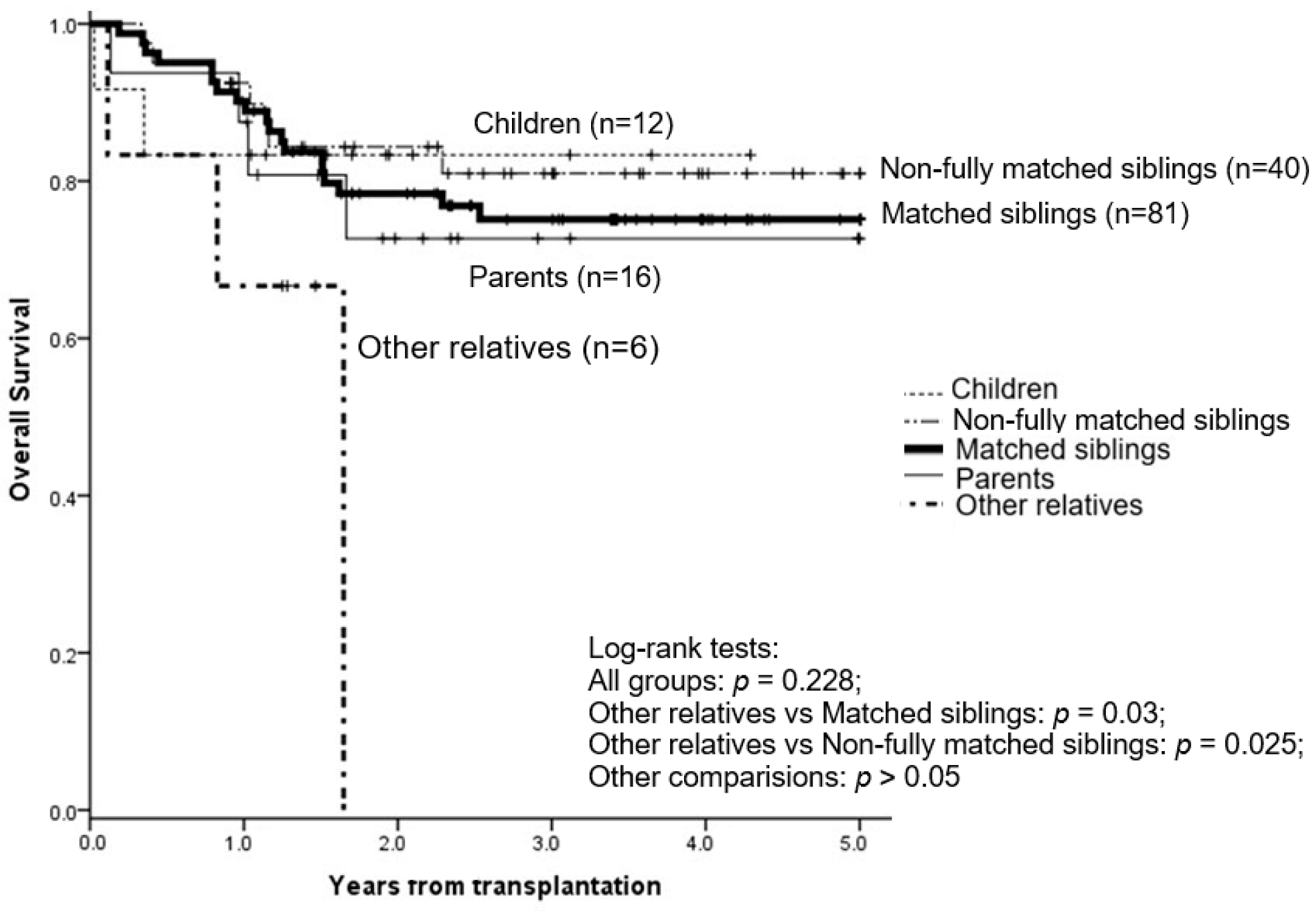
The 5-year overall survival (OS) rate for patients with matched sibling donors (75.1%) was comparable to that of certain ARDs, with rates of 83.3% for children, 72.7% for parents, and 81% for non-fully matched siblings (
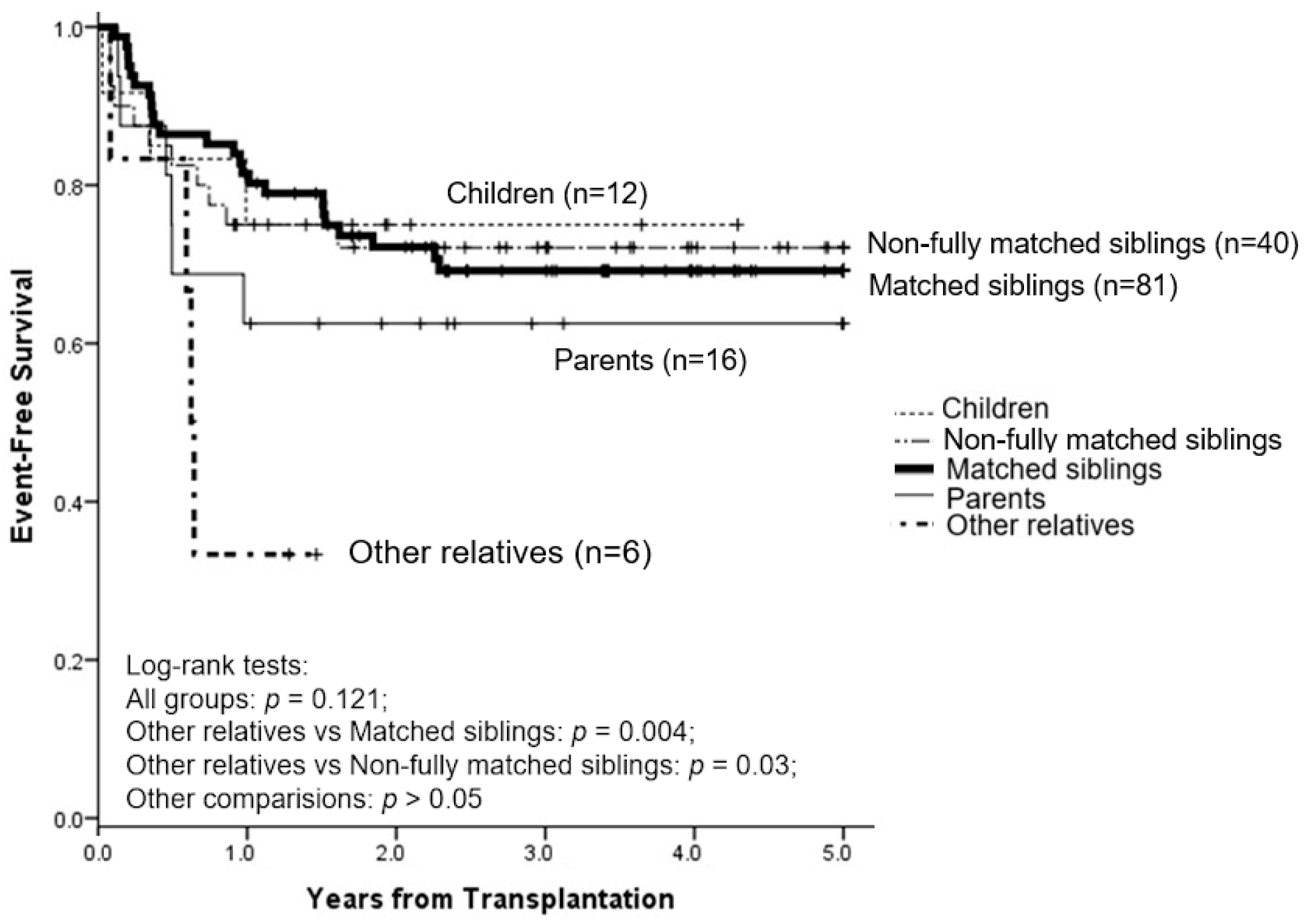
Figure 1). Similarly, the 5-year event-free survival (EFS) rate for patients with matched sibling donors (69.2%) was analogous to those with various ARDs, which were 75.0% for children, 62.5% for parents, and 72.1% for non-fully matched siblings (
Figure 2). Statistical analysis using the log-rank test to compare survival distributions between the groups revealed no significant differences between the matched sibling donors and the alternative immediate family sources. However, the transplantation outcomes for other relatives (such as cousins, aunts, and uncles) were notably poorer, with an estimated 5-year EFS of merely 33% (
Figure 2). Specifically, the EFS of other relatives was significantly lower than the EFS of matched sibling donors (
p = 0.004), and the OS of other relatives was also significantly lower than that of the matched sibling group (
p = 0.03).
4. Discussion
Historically, our center prioritized related donors for screening when considering candidates for allogeneic stem cell transplantation. Previously, only fully HLA-matched donors were deemed eligible for transplantation. However, the widespread adoption and success of haploidentical transplant protocols have shifted the approach to selecting related donors. We now consider a broader range of potential donors, which is not strictly limited to those with full HLA matches.
Out of the 520 patients evaluated for HLA compatibility, just 47 (9.0%) did not have a minimally matched related donor appropriate for haploidentical transplantation (
Table 2). The proportion of fully matched donors was 31.5%, which is consistent with the commonly reported 30% in prior studies [
2]. However, this percentage is lower than that documented in other international studies. In the Middle East, the reported likelihood of locating a fully matched donor is around 60–70% [
3,
10]. Research by Al Attas and Al Harbi (2016) in Bahrain suggested that the probability of identifying a fully matched donor could be as high as 59% when the average number of potential donors per patient is 5.8 [
11].
Alternative related donors, predominantly haploidentical donors, emerged as a viable source of stem cells, accounting for 64.4% of donor searches (
Table 2). This percentage is slightly higher than the 50.8% reported by Hellmann et al. (2018) in Germany, indicating a consistent trend in identifying haploidentical donors, which aligns with the general Mendelian inheritance patterns [
12].
Table 2 also highlights the positive correlation between the number of available potential donors and the likelihood of finding a suitable match. In most cases where no suitable donor was located, families typically had only one or two potentially related donors. Conversely, families with three or more potential donors were significantly more likely to have at least one ARD.
An analysis of donor–recipient relationships among the 824 potential related donors revealed that siblings represented the largest proportion of all related donors, accounting for 72.9% (
Table 3). They also contributed to the highest rate of fully HLA-matched donors (10/10), which was 27.3% (
Table 3). This finding aligns with Mendelian inheritance principles, which suggest that siblings have a 25% chance of being HLA-identical, as they inherit one haplotype from each parent through random combinations [
2].
There was a high likelihood, exceeding 90%, of identifying donors among the parents or children of the recipients, as shown in
Table 3. This result aligns with Mendelian principles, as first-degree relatives invariably share at least one HLA haplotype.
It is worth mentioning that donors included extended family members like cousins and uncles or aunts. Despite this, no fully matched donors were found within this group, although 37.8% met the criteria for being an ARD (
Table 3). This indicates a greater genetic variation due to the more distant familial connections.
These findings highlight the biological rationale for prioritizing immediate family members, particularly siblings, in donor searches for allogeneic stem cell transplantation, especially in populations that lack access to unrelated donor registries.
Among the 155 transplantation cases, the likelihood of patients proceeding with transplantation was linked to the number of potential donors they had (refer to
Table 4). The majority of transplant cases involved fully matched related donors (
Table 5). Nonetheless, a notable feature of this period was the significant role of ARDs, who constituted 47.7% of the sources for transplants. This trend highlights the critical role of utilizing stem cell sources from ARDs in clinical settings, especially in developing nations. Most donors were immediate family members, such as non-fully matched siblings, parents, or biological children (see
Table 5). Interestingly, six patients (3.9%) received transplants from other related family members, including cousins, uncles, and aunts. This suggests that extended family members can be viable stem cell sources when immediate relatives are not available. This observation is consistent with Balcı et al. (2011), who found that 1.9% of related donors were distant relatives [
13].
The outcomes from stem cell transplants using these donor types showed that ARDs, like the recipient’s parents, children, or non-fully matched siblings, yielded results comparable to those from matched sibling donors. The estimated 5-year overall survival and event-free survival rates for patients receiving transplants from these donors ranged from 72.7% to 83.3% and 62.5% to 75%, respectively, which are similar to the rates of 75.1% and 69.2% seen with matched sibling donors (
Figure 1 and
Figure 2). Conversely, the results for recipients with other relatives as donors were relatively poor, necessitating caution when considering such transplants. Further research suggests that transplants from more distant relatives might result in slightly lower survival and relapse-free rates, although these differences are generally not statistically significant [
14].
While this study provides valuable insights into the feasibility of identifying related donors in regions lacking a national unrelated donor registry, it is essential to acknowledge several limitations. Firstly, the retrospective observational design of this research may introduce inherent selection biases. As the study relies on existing medical records from a single center covering the period from 2019 to 2024, the findings are contingent upon the accuracy and completeness of the historical data available. Another limitation is the small sample size for certain donor subgroups, which constrained the depth of statistical analysis. Of the 155 patients who underwent transplantation, six cases (3.9%) involved donors who were other relatives, and three cases involved 9 out of 10 HLA-matched donors. This number is insufficient for a detailed discussion or to draw definitive conclusions regarding the clinical outcomes of using distant relatives. Furthermore, the absence of a larger cohort across all donor types impeded a comprehensive multivariate comparison, which would be necessary to adjust for potential confounding factors such as patient age, disease stage, and the intensity of conditioning regimens. Lastly, as a single-center study conducted at one institution in Vietnam, the findings may not fully represent the entire Vietnamese population or other developing countries with different demographic structures and fertility rates.
In summary, the availability of alternative related donors, especially haploidentical donors, has significantly increased the likelihood of locating a stem cell donor for transplantation. While matched sibling donors are ideal, close blood relatives like parents, children, and siblings make up a slightly smaller proportion but offer transplantation quality similar to that of matched sibling donors. More distant relatives, such as cousins, aunts, and uncles, should be considered only if closer relatives are unavailable. Further studies on outcomes with this group as haploidentical donors should be conducted to confirm this.




 ,
,