Case Report

Stage IIIa Lung Cancer Treatment by the Combined Tomotherapy and Infusion of Autologous Peripheral-Blood-Mononuclear-Derived Lymphocytes: A Case Report of Aged Patient


1
International Oncological Tomotherapy Center “YMIT”, 42/1 Abylay Khan ave., Astana 010000, Kazakhstan
2
JSC National Scientific Medical Center, 42 Abylay Khan ave., Astana 010009, Kazakhstan
*
Author to whom correspondence should be addressed.
Transplantology 2025, 6(4), 37; https://doi.org/10.3390/transplantology6040037
Submission received: 18 September 2025 / Revised: 20 November 2025 / Accepted: 2 December 2025 / Published: 5 December 2025
(This article belongs to the Section Transplant Immunology and Immunosuppressive Drugs)

Abstract

Background: Lung cancer is one of the leading cancers worldwide in mortality and incidence. Treating advanced stages of lung cancer is a great problem because of high metastatic potential and low adherence to common monotherapies such as radiation or chemotherapy. In addition, monotherapy in aged patients is not always sufficiently effective. Case Report: This study presents a clinical case of a 71-year-old man with an advanced stage of lung cancer. Computed tomography (CT) of the chest revealed central tumor of the left lung and moderate mediastinal lymphadenopathy. We found circulating tumor cells (CTC) in the peripheral blood of the patient at the level of approximately 19 cells per 1 mL above the referent detection limit. The patient was treated with combined tomotherapy (eight fractions, one fraction per day except weekends) and immune cell therapy using autologous activated lymphocytes (twice during the period, on tomotherapy day #1 and day #6). The lymphocytes were obtained from peripheral blood, purified, pre-activated in culture with a specific combination of cytokines, and infused back into the patient seven days post-culture. Two months post-therapy, the tumor was reduced by 42.5% in linear dimensions according to RECIST and by 78% of volume compared to the initial values, as confirmed by CT examination. Additionally, the level of CTC in the peripheral blood dropped to the referent detection limit. Conclusions: The combination of tomotherapy and immunotherapy with activated autologous lymphocytes may result in the positive dynamics of the malignant condition in selected patients, even in aged ones.

1. Introduction

Lung cancer remains not only the most frequently identified malignancy in humans [1] but also the deadliest cancer worldwide [2]. In 2022, 18.7% of all cancer-related deaths for both sexes was due to lung cancer [3]. In addition to the well-known reasons for lung cancer (smoking and genetic predisposition), increased lung cancer incidence and mortality are strongly associated with substantial air pollution [4]. This is a particularly salient issue in numerous countries of the Central and South Asian region (Pakistan, Bangladesh, India, Uzbekistan, Kyrgyzstan, China, and Kazakhstan rank among the first 40 most air-polluted countries). For instance, lung cancer (in patients of both sexes) was ranked at the second place in the Republic of Kazakhstan according to data collected in 2017–2021 [5]. Data based on the GLOBOCAN registry in 2022 show that lung cancer ranks first in males only; collectively for males and females, lung cancer was just 0.4% lower than breast cancer (12.2 vs. 12.6%) [6].
In addition, more than 50% of lung cancer patients die within the first year of diagnosis because most of them are diagnosed at late stages [7]. Advanced treatments like novel chemotherapies, targeted drugs, and immunotherapy may substantially decrease the mortality [8]. However, challenges exist because cancer cells may avoid cytotoxic therapy due to low presentation of antigens, instability of the antigens, as well as low expression of costimulatory molecules [9]. In this context, the combination of radiation therapy and other types of anticancer therapies may provide encouraging results. It is known that radiation causes massive disintegration of tumor cells, promoting the release of tumor antigens into the blood—this, in turn, facilitates the curative effect of immunotherapy, e.g., in advanced hepatocellular carcinoma and colorectal cancer [10,11]. Moreover, instrumental advancements in tomography allow for precise spatial delivery of the radiation to the lesion that minimizes the radiation-induced injury to nearby tissues. Finally, the radiation-induced death of cancer cells is further enhanced in the presence of activated T cells, either migrating directly to the tumor or accumulating in the lymphoid organs [12]. The combination of radiation therapy and immunotherapy in treating cancer may be a promising strategy, especially in patients who are resistant to monotherapies [13].
There is a lack of data on the efficacy and safety of immunotherapy by autologous lymphocytes, which are collected from peripheral blood mononuclear cells (PBMCs) of a patient, pre-treated by cytokines/factors, and infused back to the patient. In contrast to tumor-infiltrating lymphocytes (TILs), which have been found to be an effective treatment in various cancers including lung cancer according to several clinical trials [14,15,16,17], PBMCs are rarely used in this context. While cultured cytokine-activated autologous mononuclears can be effective in the treatment of non-cancer diseases like chronic non-healing skin ulcers [18], PBMC are commonly used as a diagnostic tool—by extensive immunophenotyping of the cells—for predicting cancer progression, adjusting personalized immunotherapy strategy, and revealing new immunotherapy biomarkers [19,20,21]. However, non-invasive ways for their collection represents a great advantage because of the lack of risk of tumor progression that may be triggered during tumor resection that is needed to collect TILs. In addition, PBMCs can be co-cultured with cancer cells to improve their anti-tumor secretory profile [22]. On the other hand, such a sophisticated approach requires the use of elaborated methods for co-cultivation, particularly if tumor organoids are used [23].
A more simplified (though less robust) approach is the use of PMBC cultured with a “cocktail” of certain cytokines, which may improve the immune reactivity of T cells against tumor cells. We utilized such an approach in our clinical case to demonstrate the effectiveness of combined use of tomotherapy and activated autologous lymphocytes in a patient with advanced lung cancer.

2. Case Presentation

A 71-year-old male of Asian descent complained of increasing weakness. According to the patient’s medical history, since Spring 2024 he has been experiencing a persistent cough, accompanied by difficulty in expectorating and shortness of breath during physical exertion. The chest was of regular shape; breath was smooth with clear pulmonary sounds and no additional respiratory sounds. During auscultation, vesicular breathing was detected that weakened in the lower sections of the lungs. The respiratory rate was 16 breaths per minute, oxygen saturation was 96%, heart rhythm was regular at 74 beats per minute, peak systolic/diastolic blood pressure was 122/80 mmHg. The abdomen was soft and painless when palpated. Liver and spleen were not enlarged; urination and stool were normal. The peripheral lymph nodes were not palpable. The patient has been observed by a cardiologist for ischemic heart disease, angina pectoris and arterial hypertension for 15 years. The patient regularly used antihypertensive drugs and was an active smoker for at least 50 years.
During the examination of the thorax by computed tomography (CT) in April 2024, a centrally located mass in the left lung was revealed, accompanied by moderate mediastinal lymphadenopathy; emphysema and chronic bronchitis were also noted. A bronchoscopy performed in April 2024 revealed the tumor in the upper lobe bronchus of the left lung. Histology of the biopsy (May 2024) revealed the signs of high-grade squamous cell intraepithelial neoplasia with fibrotic changes. Given the CT findings, tumor size, and histology, a multidisciplinary group concluded with central cancer of the upper lobe of the left lung, cT3N1M0St IIIA, clinical group 2. According to Eastern Cooperative Oncology Group (ECOG), the grade was 0–1. Several courses of neoadjuvant polychemotherapy (nPCT) were recommended as the first line of the treatment, with assessing its effectiveness. The patient received three courses of nPCT (paclitaxel + carboplatin regimen) in June–July 2024. Chest CT in July 2024 revealed positive dynamics in the tumor size. Chemotherapy was continued with a 4th course of nCPT according to the same regimen in the end of August 2024. However, chest CT in October 2024 revealed negative dynamics with an increase in the size of the tumor and single adenopathy of the tracheobronchial lymph nodes on the left side. Pulmonary emphysema and pneumofibrosis of the lower lobes of the lungs were also revealed. Our multidisciplinary group recommended combined tomotherapy and autologous activated lymphocyte therapy. The procedure was commenced after obtaining informed consent to participate in the treatment and approvals by the scientific and ethical committee. The detailed timeline of diagnostics procedures and treatments for this patient is shown in Table 1.

2.1. Preparation of Cytokine-Activated Autologous Lymphocytes

Briefly, mononuclear cells were collected from peripheral blood of the patient using hardware cytapheresis by the Terumo Optia device (Terumo Penpol Pvt Ltd., Thiruvananthapuram, India) for 3 to 4 h for further cultivation of autologous lymphocytes. The collection bag used for apheresis blood contained 63 mL of CDPA (Citrate Phosphate Dextrose Adenine). The apheresis procedure was performed twice, resulting in final collected volumes of 108 mL and 135 mL, respectively.
Before transferring to culture medium, the mononuclears were physically separated from other blood cell types by Ficoll density gradient centrifugation. At the stage of hardware-based cytapheresis, mononuclears were separated and collected while the rest of the blood was returned back to the systemic circulation. This cell material contained heterogeneous types of mononuclear cells. Next, at the stage of laboratory separation, we performed another Ficoll density gradient centrifugation to reduce the content of non-lymphocytic cells, thus the predominant cells were lymphocytes. These cells were then seeded into T-75 culture flasks (growth area 75 cm2) with an initial density of 1.0–1.5 × 10⁶ cells/cm2 that corresponded to 7.5–11 × 107 cells per flask, in 90–100 mL of DMEM F-12 medium + 5% Fetal bovine serum (FBS, Thermo Fisher Scientific Inc., Waltham, MA, USA) supplemented with cytokines. No HEPES and phenol red was used in DMEM. The medium was supplemented with human recombinant IL-7, IL-15, SCF, IL-2, and Flt3-L (all substances from Miltenyi Biotec, Bergisch Gladbach, Germany) each in a final concentration of 20 ng/mL. The cells were cultured at 37 ± 0.5 °C with 95% air +5% CO2 and 95% humidity in a CO2 incubator. The medium with the same concentration of cytokines was refreshed on the 3rd and 10th day in culture (4 days before each infusion). Finally, one day before infusion of the cells into the patient, IL-12 (Miltenyi Biotec, Germany) was added in final concentration of 5 ng/mL. Mycoplasma and endotoxin testing were also performed before the infusion. Viability was determined using a Countess II cell counter and ReadyCount™ Green/Red Viability Stain (Thermo Fisher Scientific Inc., Waltham, MA, USA), vial 7AAD was not used. The stages of the protocol are summarized in Table 2.
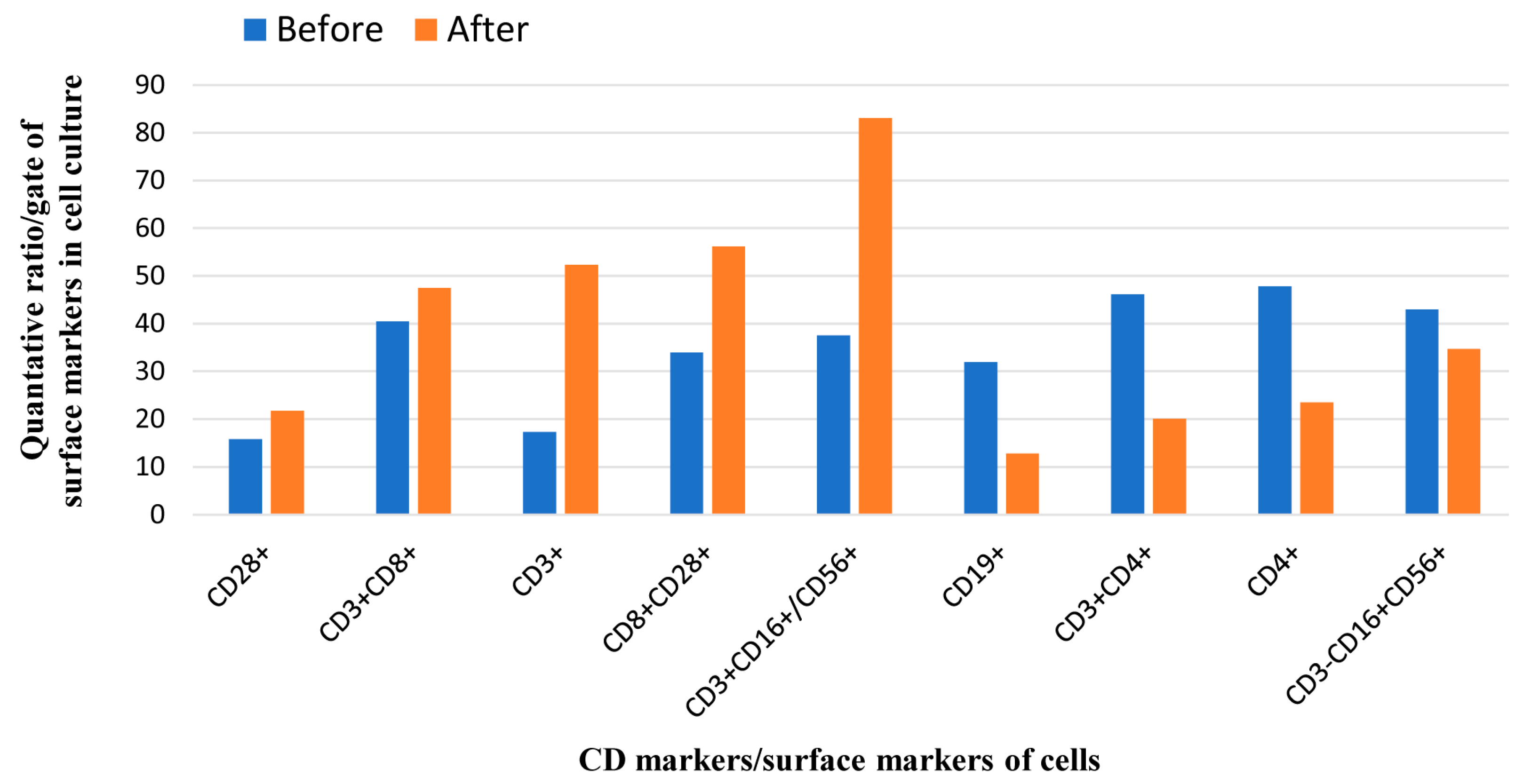
The lymphocytes were tested both before and after culturing in cytokine-containing medium for several differentiation clusters by flow cytofluorometry using FITC, PE, Per-CP fluorochromes (FACSCalibur, Becton Dickinson, Franklin Lakes, NJ, USA). The relative amount of the specific CD markers before and after culture is shown in Figure 1. Notably, the relative amount of CD3+, CD3+CD8+, CD28+, CD8+CD28+, and CD3+CD16+/CD56+ cells increased following activation with interleukins, indicating enhanced cytotoxic T lymphocyte (CTL) expansion and activation, which are key mediators of antitumor immunity. The upregulation of CD28 expression suggests improved co-stimulatory signaling essential for T-cell proliferation, survival, and effector function. The rise in CD3+CD16+/CD56+ cells, often referred to as natural killer (NK) T-like cells, reflects the generation of a population with both adaptive and innate cytotoxic properties, contributing to more effective tumor cell lysis. Conversely, the relative decrease in CD19+ B cells and CD4+ or CD3+CD4+ helper T cells may be attributed to selective cytokine-driven expansion of cytotoxic subsets (CD8+ T cells and NKT-like cells) under interleukin stimulation, which favors cell-mediated cytotoxicity over humoral responses. Similarly, the reduction in CD3-CD16+CD56+ NK cells could result from competition for growth factors or activation-induced differentiation toward NKT-like phenotypes in the culture environment. Overall, these phenotypic shifts reflect successful interleukin-induced activation and expansion of cytotoxic effector lymphocytes, which are critical for the efficacy of adoptive cell immunotherapy against solid tumors such as lung cancer.

2.2. Treatment

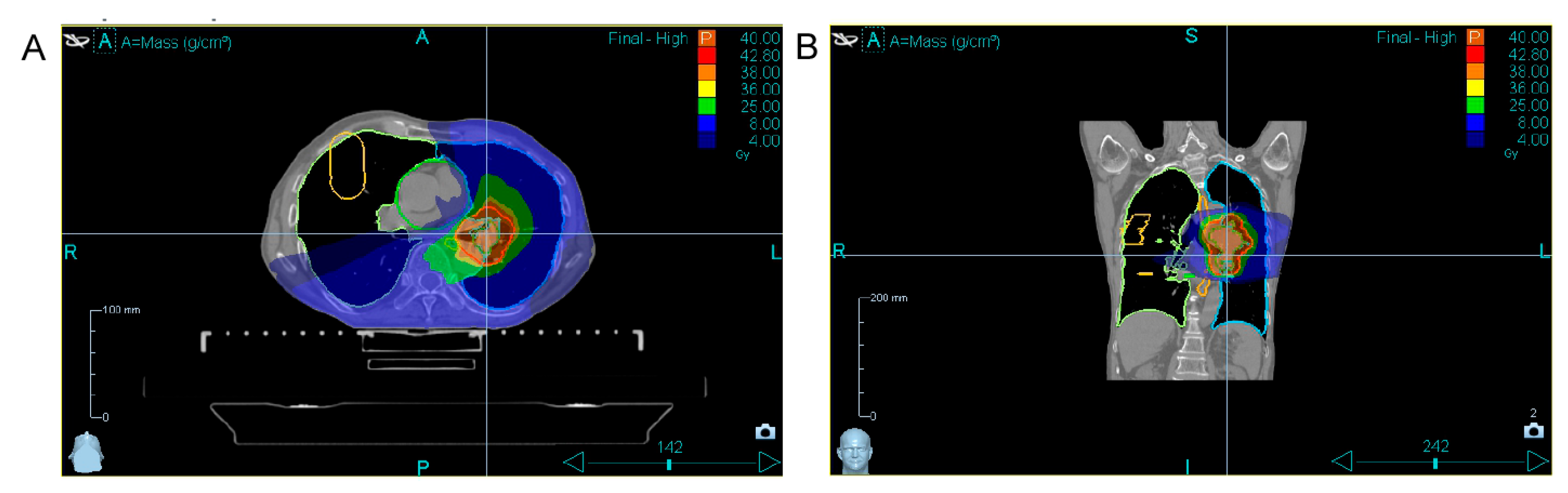
Pre-radiation topometric preparation by native CT simulation was performed using a 16-slice United Imaging CT with immobilization in the breast board. Next, selection of an individual regimen and radiotherapy volume were chosen together with individual dosimetric planning on TomoPlannnig. The actual course of tomotherapy was performed on a Radixact X9 device in TomoHelical mode using Synchrony systems on a tumor of the left lung with ROD-5Gy and SOD-40Gy. The patient was subjected to a series of eight fractions, one fraction per day excluding weekends, every single fraction with dose of 5Gy, total dose of 40Gy. The patient was in a head-first position during the radiation treatment. Target delineation parameters were as follows: GTV (Gross Tumor Volume) was 57.54 cm3, CTV (Clinical Target Volume) was equal to GTV plus microscopic spreading, PTV (Planning Target Volume) was equal to CTV plus a margin used for movement and setting up. Margins were set according to the following settings: Synchrony Lung with Respiratory Tracking was used meaning that internal margin (Internal Target Volume, ITV) is included into TTV (Total Tumor Volume), TTV is equal to GTV during respiratory cycle, PTV is equal to ITV + 5 mm (which is the standard setting for Synchrony Lung with Respiratory Tracking). All constraints were followed as well. The delivery mode was Helical IMRT, the planning was performed by VOLO Ultra. Plan Quality was with perfect homogeneity, good covering, low organ-at-risk dose, steep gradient of the dose. The plan was approved by an expertized radiologist. Figure 2 shows the transverse and coronal planes of a torso of the patient and corresponding dose distribution in dosimetric planning of tomotherapy course for the patient. Note that irradiation was focused predominantly on the localization of the tumor in the left lung, upper lobe (as shown by red color, which corresponds to the highest dose).
During the course of tomotherapy, the patient received two infusions of activated lymphocytes: 6.55 × 10⁶ cells per 10 μL of suspension on day #1 of tomotherapy and 8.99 × 10⁶ cells per 10 μL of suspension on day #6 of tomotherapy. Before the infusion, cell culture was collected (but adherent and non-adherent cells) and centrifuged, the supernatant was discarded, and the remaining sedimented cells were resuspended in Ringer saline. This step was repeated once more. The amount of viable lymphocytes was more than 80% after washing out of the initial culture medium and resuspension of the cell culture in a fresh saline. The administration of the cytokine-activated cells was performed in a hospital setting, where the patient was obliged to stay for at least 6 h. Premedication was carried out as follows: 8 mg dexamethasone +250 mL of 0.9% saline solution by intravenous drip for 20 min. The activated lymphocytes were administered for 15 min at 5 drops/minute, then for approximately 1 h and 45 min at 20 drops/minute. Upon completion of the intravenous infusion, the patient underwent monitoring for 2 h in the clinic.
In order to evaluate the efficacy of the therapeutic intervention, we used chest CT data (as the main criterion, see below) and the number of circulating tumor cells (CTCs) in the blood. The CTCs were read and counted by flow fluorescence cytometry using only markers for Epidermal Growth Factor Receptor (EGFR) and EpCAM (Epithelial Cell Ad hesion Molecule). We did not use specific markers for mesenchymal-like CTCs and phenotyping for lymphocyte (CD45-), so our measurements reflect epithelial-like subtype of CTCs and may be under-estimated in terms of actual amount of CTCs. Before making the measurement in the patient, we determined the baseline fluorescence reading in a group of healthy individuals (with no pathology detected and without cancer diagnosis, n = 5); mean age of the volunteers was 35.6 years (28–48 years) and all volunteers were women. The reference baseline reading was obtained as counts per 1 million of cells and this value was interpreted as a detection limit for epithelial-like CTCs. The compensation for non-specific staining was performed on CompBeads Single-Stain Controls using the built-in BD FACSLyric Compensation Wizard algorithm. The validation was performed using the EGFR and EpCAM FMO controls, and data analysis was performed in FlowJo v10.9.1 (BD Biosciences, San Jose, CA, USA).

2.3. Results

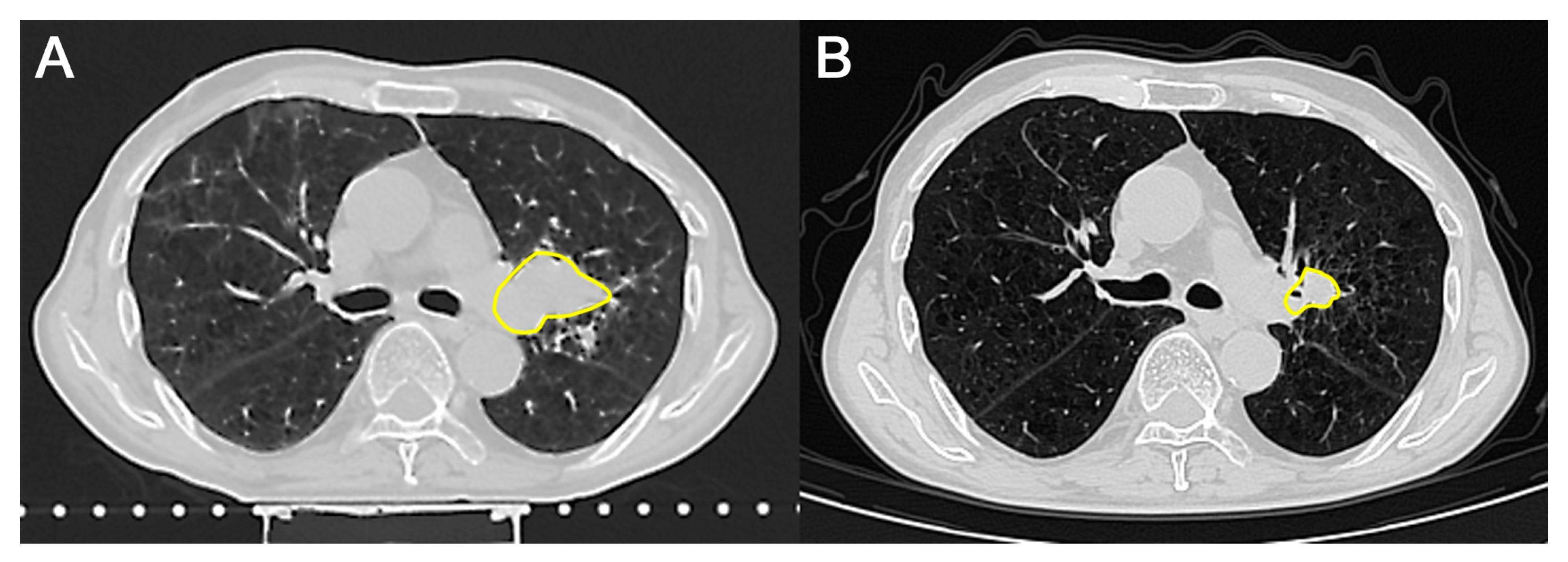
CT imaging of the thoracic segment was performed before the combined therapy and approximately two months after the end of therapy. The “pre-therapy” CT scans (Figure 3A) revealed a perihilar lesion in the upper (SI/II) lobe of the left lung, irregular in shape, with clear and uneven contours, measuring approximately 4.0 × 3.0 × 3.3 cm, and a density of up to +28+32HU. Calcifications, up to 0.9 cm in diameter, were noted in the upper lobe of the right lung. The intrathoracic lymph nodes were not enlarged: subcarinal lymph nodes were up to 1.0 cm, prevascular lymph nodes are up to 0.9 cm, and the lower paratracheal lymph nodes are up to 0.5 cm in diameter. The “post-therapy” CT scans (Figure 3B) showed a decrease in size of the mass to approximately 2.0 × 1.9 × 2.3 cm, with a density of up to +26 +33HU. This represents a 42.5% reduction in the linear size (partial response according to RECIST); the volumetric decrease was 78%.
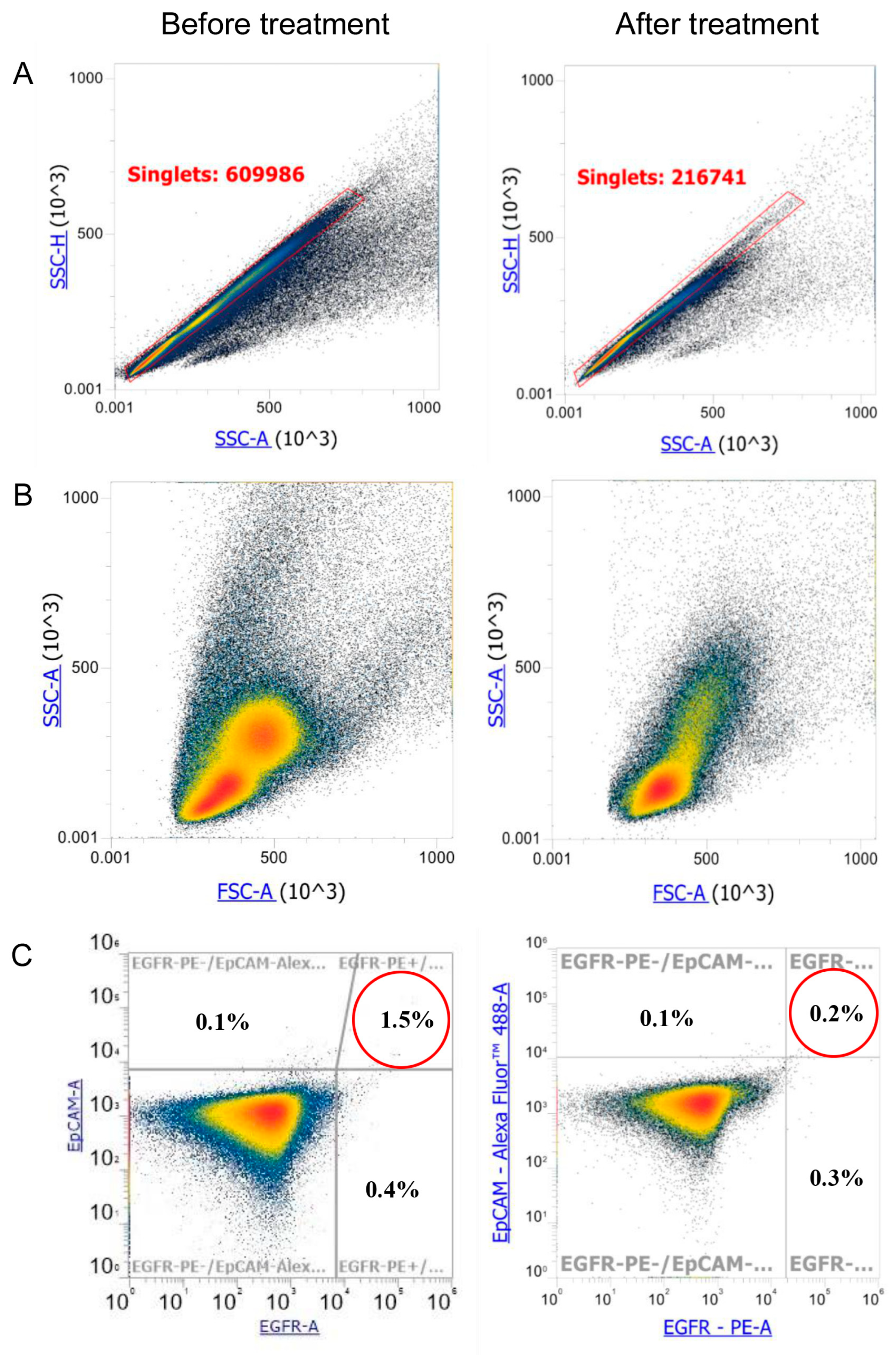
The flow cytometric image of cell distributions taken before and approximately two months after the therapy is shown in Figure 4. The gating process was performed with the exclusion of cellular debris based on FSC/SSC parameters and singlet analysis. The predominant clustering of events in the EGFR-/EpCAM- region in Figure 4, the plots in panel C, reflects the background population of cells that do not express these markers. Prior to the administration of the combined therapy, CTC count in the patient’s blood was 2.9 per million of cells above the detection limit for CTCs which was equivalent of ~19 CTC per 1 mL of peripheral blood. Two months after the treatment the measured level of EGFR+EpCAM+ fluorescence was on the detection limit for CTCs observed in healthy donors. The patient was alive as of 3 October 2025 (i.e., one year since the end of the combined treatment), with stable condition according to the severity of the underlying disease. According to this result, we concluded the positive effect of combined tomotherapy and immune cell therapy.

3. Discussion

We demonstrated here the clinical case of a patient with stage IIIa lung cancer who was treated with the combined tomotherapy and immunotherapy using activated autologous lymphocytes. Previous treatment with adjuvant polychemotherapy showed no positive outcome (the tumor has increased in size) but the combined therapy resulted in a significant decrease in the tumor size by 42.5% (by 78% in volume), which was also accompanied by a substantial decrease in circulating tumor cells in the blood of this patient. This case highlights the importance of the combined treatment for selected patients.
We should mention our results on CTC measurements in this patient. The level of CTC in the blood of our patient after the therapy (two months post-treatment) was measured at the reference detection limit, i.e., much lower compared to the pre-therapy state. However, in late-stage cancer patients the circulating tumor cells are rarely detected at a non-zero level [24]. Our results may reflect that we used markers specific only for epithelial-like CTCs, and therefore we could miss mesenchymal-like ones. On the other hand, the tumor substantially reduced its size/volume during the combined therapy, and it might be expected that the metastatic features were greatly suppressed too. In patients with substantial improvement after anticancer treatment, cell-free DNA concentration in the blood, which is used as an alternative for monitoring cancer progression, was shown to be reduced to zero [25]. Remarkable clinical changes in the tumor size of our patient, indicative of great improvement, may support our finding of zeroed post-therapy CTC as well.
Lung cancer is frequently detected at late stages, when clinical manifestations have already appeared and, as a rule, there are distant metastases. Immune-cell based therapy has the potential to affect tumor cells both directly and indirectly, with T cells playing a special role in this curative effect [26,27]. Concurrently, the employment of certain types of immunocellular therapy demonstrates both advantages and disadvantages of such treatment [28]. Moreover, not only cell transplantation itself but also the treatment by cellular secretome may potentially be effective. For example, it has been shown in regeneration studies that a damaged tissue, if subjected to a secretome obtained from cultured stem cells or PBMCs, regenerated and healed faster [29,30]. Moreover, a secretome-based therapy provides a more efficient utilization of cell culture. However, most of the applications for cancer treatment rely on the use of a transplantation of cultured cells. Our clinical case is essentially the example of cell therapy because we washed out cultured and pre-activated cells and resuspended them in a secretome-free media before infusion to the patient.
In certain instances, the optimal approach may involve a combination of diverse therapeutic modalities. For instance, promising outcomes of combined T cell-based therapy and radiation therapy in the complex treatment of advanced stages of cancer have been demonstrated [31]. Moreover, the concept has recently been proposed that combined immunotherapy (either drug or immune cell based) and radiotherapy may constitute a new standard for anticancer treatment [32]. As radiation interacts directly with immune cells, affecting their activity and number in the irradiated area, it is advisable to take radioprotective measures in terms of T cell activity in adoptive immune cell therapy [33]. The infusion of cultured T cells may partially provide this protective effect because the cells are not exposed to radiation.
It should be noted that most studies in anticancer immunotherapy use drug-based targeting of certain immune mechanisms, e.g., immune checkpoint inhibitors. Adoptive immune cell therapy is used much less frequently, due to the need for additional equipment, resources, and experience in cell isolation and culture. On the other hand, according to in vitro, preclinical, and clinical studies, it is now accepted that adoptive immune cell therapy in combination with radiation therapy has a promising potential for treating various cancers [33,34,35]. This combined approach is of special importance for solid tumors, which are typically more resistant to monotherapies and often bear high metastatic potential due to the protective effect of tumor capsule [36]. In any case, the personalized approach using multimodal anticancer treatment allows for taking into account all factors, such as cancer stage or genetic profile of the tumor, as well as the individual response of a patient to single treatments [37].
In our clinical case, we considered the possibility of combining activated T cells with tomotherapy (with respiratory synchronization) due to the lack of effect of polychemotherapy and confirmed the suitability of the combined approach in the treatment of IIIA stage lung cancer. Importantly, the age of our patient must be considered as a high-risk factor in complex anticancer treatment, especially regarding possible complications mediated by the immune system. However, the overall success of the treatment was notable, taking into account both the age of the patient and the stage of the cancer.
In addition, our unreported clinical experience in patients with breast cancer shows that it is sometimes advantageous to perform immunotherapy with autologous lymphocyte infusions at least once during one or two years after the end of combined therapy. However, in the present clinical case, we were unable to follow this design because the patient resided in a distant city and was unavailable after the main treatment.
Note that when determining upper normal limits for CTC, we used healthy volunteers of a younger age and different gender compared to our patient. There are somewhat controversial reports about the correlation between the number of CTC and the age of a patient, but this may reflect the influence of specific cancer types. One recent study reported that in older patients, the CTC is somewhat higher; however, the finding was related to breast cancer [38]. In another recent study, the CTC numbers were not different for patients with endometrial cancer and aged either under 70 years or above 70 years [39]. Similarly, age was not a factor in female patients with cervical cancer [40]. Finally, a relatively large cohort of 347 patients with NSCLC, Stage I-IIIA, was thoroughly studied to determine if age and/or sex statistically correspond to the number of CTC [41]. The answer was no, for both factors. We therefore used the averaged value for CTC, obtained from healthy younger female volunteers, as a detection limit in our clinical case describing an older male patient.

4. Conclusions

This case demonstrates that combined tomotherapy and immunotherapy with activated autologous lymphocytes can be a safe and effective strategy for elderly patients with late-stage lung cancer, preventing further tumor progression and inducing shrinkage. Our findings suggest that the cytokine composition and immune cell culture protocol may need to be personalized based on the patient’s individual immune status to maximize efficacy. Furthermore, monitoring circulating tumor cells proved to be a valuable tool for assessing the therapeutic response and disease progression. While promising, these results from a single case highlight the need for larger studies to validate this combined-modality approach and refine patient selection criteria.

Author Contributions

A.B., A.G. and L.K.: Writing—original draft; A.B., A.G., L.K., D.B. and Y.S.: investigation; A.B., A.G., L.K. and M.A.: formal analysis; A.G. and M.A.: project administration; A.B., A.G. and M.A.: conceptualization; M.A.: resources; A.G. and M.A.: supervision; A.B., A.G., L.K., D.B. and Y.S.: methodology; A.B., A.G. and L.K.: visualization; A.B., A.G. and M.A.: validation; A.B., A.G. and M.A.: writing—review and editing. All authors have agreed with the results and conclusions. All authors have read and agreed to the published version of the manuscript.

Funding

This research has been funded by the Science Committee of the Ministry of Science and Higher Education of the Republic of Kazakhstan (Grant No. AP19680098).

Institutional Review Board Statement

The study was conducted in accordance with the Declaration of Helsinki and approved by the Local Ethics Committee of JSC National Scientific Medical Center (protocol 083/KI-77 on 3 August 2022).

Informed Consent Statement

Informed consent was obtained from the patient involved in the study. Written informed consent has been obtained from the patient to publish this paper.

Data Availability Statement

The research data were not published in publicly available repositories because all relevant data are included to the manuscript.

Acknowledgments

Authors thank Oleg Lookin (JSC National Scientific Medical Center) for his contribution to scientific revision and editing of the manuscript.

Conflicts of Interest

The authors declare no conflicts of interest.

Abbreviations

The following abbreviations are used in this manuscript:
CTComputed Tomography
CTCCirculating Tumor Cells
CTLCytotoxic T Lymphocyte
CTVClinical Target Volume
ECOGEastern Cooperative Oncology Group
EGFREpithelial Growth Factor Receptor
EpCAMEpithelial cell adhesion molecule
GTVGross Tumor Volume
ITVInternal Target Volume
NKTNatural Killer T-like (cells)
nPCTNeoadjuvant PolyChemotherapy
NSCLCNon-Small-Cell Lung Cancer
PBMCPeripheral Blood Mononuclear Cells
PTVPlanning Target Volume
TILTumor-Infiltrating Lymphocyte
TTVTotal Tumor Volume

References

  1. Rodriguez Alvarez, A.A.R.; Yuming, S.; Kothari, J.; Digumarthy, S.R.; Byrne, N.M.; Li, Y.; Christiani, D.C. Sex disparities in lung cancer survival rates based on screening status. Lung Cancer 2022, 171, 115–120. [Google Scholar] [CrossRef]
  2. Siegel, R.L.; Miller, K.D.; Wagle, N.S.; Jemal, A. Cancer statistics, 2023. CA Cancer J. Clin. 2023, 73, 17–48. [Google Scholar] [CrossRef]
  3. Bray, F.; Laversanne, M.; Sung, H.; Ferlay, J.; Siegel, R.L.; Soerjomataram, I.; Jemal, A. Global cancer statistics 2022: GLOBOCAN estimates of incidence and mortality worldwide for 36 cancers in 185 countries. CA Cancer J. Clin. 2024, 74, 229–263. [Google Scholar] [CrossRef] [PubMed]
  4. Berg, C.D.; Schiller, J.H.; Boffetta, P.; Cai, J.; Connolly, C.; Kerpel-Fronius, A.; Kitts, A.B.; Lam, D.C.L.; Mohan, A.; Myers, R.; et al. International Association for the Study of Lung Cancer (IASLC) Early Detection and Screening Committee. Air pollution and lung cancer: A review by International Association for the Study of Lung Cancer Early Detection and Screening Committee. J. Thorac. Oncol. 2023, 18, 1277–1289. [Google Scholar] [CrossRef]
  5. Kassymbekova, F.; Glushkova, N.; Dunenova, G.; Kaidarova, D.; Kissimova-Skarbek, K.; Wengler, A.; Zhetpisbayeva, I.; Shatkovskaya, O.; Andreyeva, O.; Davletov, K.; et al. Burden of major cancer types in Almaty, Kazakhstan. Sci. Rep. 2024, 14, 20536. [Google Scholar] [CrossRef] [PubMed]
  6. Filho, A.M.; Laversanne, M.; Ferlay, J.; Colombet, M.; Piñeros, M.; Znaor, A.; Parkin, D.M.; Soerjomataram, I.; Bray, F. The GLOBOCAN 2022 cancer estimates: Data sources, methods, and a snapshot of the cancer burden worldwide. Int. J. Cancer 2025, 156, 1336–1346. [Google Scholar] [CrossRef] [PubMed]
  7. Gu, Z.; Wu, L.; Li, J.; Zheng, S.; Huang, M. A Visual Analysis of Patient-Reported Outcomes in Lung Cancer From 2013 to 2023. Cancer Control. 2024, 31, 10732748241266490. [Google Scholar] [CrossRef]
  8. Mo, Y.; Qin, Y.; Shangguan, J.; Wei, D.; Wu, M.; Chen, D.; Yu, J. Sex-specific Difference for Small Cell Lung Cancer from Immunotherapy Advancement. Arch. Bronconeumol. 2024, 60 (Suppl. 2), S13–S21. [Google Scholar] [CrossRef]
  9. Lahiri, A.; Maji, A.; Potdar, P.D.; Singh, N.; Parikh, P.; Bisht, B.; Mukherjee, A.; Paul, M.K. Lung cancer immunotherapy: Progress, pitfalls, and promises. Mol. Cancer 2023, 22, 40. [Google Scholar] [CrossRef]
  10. Liu, C.; Shao, J.; Dong, Y.; Xu, Q.; Zou, Z.; Chen, F.; Yan, J.; Liu, J.; Li, S.; Liu, B.; et al. Advanced HCC Patient Benefit From Neoantigen Reactive T Cells Based Immunotherapy: A Case Report. Front. Immunol. 2021, 12, 685126. [Google Scholar] [CrossRef]
  11. Jin, Y.; Jiang, J.; Mao, W.; Bai, M.; Chen, Q.; Zhu, J. Treatment strategies and molecular mechanism of radiotherapy combined with immunotherapy in colorectal cancer. Cancer Lett. 2024, 591, 216858. [Google Scholar] [CrossRef]
  12. Ganina, A.; Askarov, M.; Kozina, L.; Karimova, M.; Shayakhmetov, Y.; Mukhamedzhanova, P.; Brimova, A.; Berikbol, D.; Chuvakova, E.; Zaripova, L.; et al. Prospects for Treatment of Lung Cancer Using Activated Lymphocytes Combined with Other Anti-Cancer Modalities. Adv. Respir. Med. 2024, 92, 504–525. [Google Scholar] [CrossRef] [PubMed]
  13. Jiang, J.; Li, H.; Ma, Q.; Liu, J.; Ren, F.; Song, Y.; Wang, T.; Li, K.; Li, N. Synergies between radiother-apy and immunotherapy: A systematic review from mechanism to clinical application. Front. Immunol. 2025, 16, 1554499. [Google Scholar] [CrossRef]
  14. Sarnaik, A.A.; Hamid, O.; Khushalani, N.I.; Lewis, K.D.; Medina, T.; Kluger, H.M.; Thomas, S.S.; Domingo-Musibay, E.; Pavlick, A.C.; Whitman, E.D.; et al. Lifileucel, a Tumor-Infiltrating Lymphocyte Therapy, in Metastatic Melanoma. J. Clin. Oncol. 2021, 39, 2656–2666, Erratum in J. Clin. Oncol. 2021, 39, 2972. https://doi.org/10.1200/JCO.21.01866.. [Google Scholar] [CrossRef]
  15. Amaria, R.; Knisely, A.; Vining, D.; Kopetz, S.; Overman, M.J.; Javle, M.; Antonoff, M.B.; Tzeng, C.D.; Wolff, R.A.; Pant, S.; et al. Efficacy and safety of autologous tumor-infiltrating lymphocytes in recurrent or refractory ovarian cancer, colorectal cancer, and pancreatic ductal adenocarcinoma. J. Immunother. Cancer 2024, 12, e006822. [Google Scholar] [CrossRef]
  16. Schoenfeld, A.J.; Lee, S.M.; Doger de Spéville, B.; Gettinger, S.N.; Häfliger, S.; Sukari, A.; Papa, S.; Rodríguez-Moreno, J.F.; Graf Finckenstein, F.; Fiaz, R.; et al. Lifileucel, an Autologous Tumor-Infiltrating Lymphocyte Monotherapy, in Patients with Advanced Non-Small Cell Lung Cancer Resistant to Immune Checkpoint Inhibitors. Cancer Discov. 2024, 14, 1389–1402. [Google Scholar] [CrossRef]
  17. Ferris, R.L.; Leidner, R.S.; Chung, C.H.; Jimeno, A.; Lee, S.M.; Sukari, A.; Nieva, J.J.; E Grilley-Olson, J.; Redman, R.; Wong, S.J.; et al. Efficacy and safety of one-time autologous tumor-infiltrating lymphocyte cell therapy in patients with recurrent and/or metastatic head and neck squamous cell carcinoma. J. Immunother. Cancer 2025, 13, e011633. [Google Scholar] [CrossRef] [PubMed]
  18. Holzinger, C.; Zuckermann, A.; Kopp, C.; Schöllhammer, A.; Imhof, M.; Zwölfer, W.; Baumgartner, I.; Magometschnigg, H.; Weissinger, E.; Wolner, E. Treatment of non-healing skin ulcers with autologous activated mononuclear cells. Eur. J. Vasc. Surg. 1994, 8, 351–356. [Google Scholar] [CrossRef]
  19. Rogado, J.; Pozo, F.; Troule, K.; Sánchez-Torres, J.M.; Romero-Laorden, N.; Mondejar, R.; Donnay, O.; Ballesteros, A.; Pacheco-Barcia, V.; Aspa, J.; et al. Peripheral Blood Mononuclear Cells Predict Therapeutic Efficacy of Immunotherapy in NSCLC. Cancers 2022, 14, 2898. [Google Scholar] [CrossRef] [PubMed]
  20. De Rosa, C.; Iommelli, F.; De Rosa, V.; Ercolano, G.; Sodano, F.; Tuccillo, C.; Amato, L.; Tirino, V.; Ariano, A.; Cimmino, F.; et al. PBMCs as Tool for Identification of Novel Immunotherapy Biomarkers in Lung Cancer. Biomedicines 2024, 12, 809. [Google Scholar] [CrossRef]
  21. Dyikanov, D.; Zaitsev, A.; Vasileva, T.; Wang, I.; Sokolov, A.A.; Bolshakov, E.S.; Frank, A.; Turova, P.; Golubeva, O.; Gantseva, A.; et al. Comprehensive peripheral blood immunoprofiling reveals five immuno-types with immunotherapy response characteristics in patients with cancer. Cancer Cell 2024, 42, 759–779.e12. [Google Scholar] [CrossRef] [PubMed]
  22. Dijkstra, K.K.; Cattaneo, C.M.; Weeber, F.; Chalabi, M.; van de Haar, J.; Fanchi, L.F.; Slagter, M.; van der Velden, D.L.; Kaing, S.; Kelderman, S.; et al. Generation of Tumor-Reactive T Cells by Co-culture of Peripheral Blood Lymphocytes and Tumor Organoids. Cell 2018, 174, 1586–1598.e12. [Google Scholar] [CrossRef]
  23. Li, P.; Huang, M.; Ma, Y.; Zhang, Y.; Shi, C. Novel research model for in vitro immunotherapy: Co-culturing tumor organoids with peripheral blood mononuclear cells. Cancer Cell Int. 2024, 24, 438. [Google Scholar] [CrossRef]
  24. Hamilton, G.; Rath, B.; Stickler, S. Significance of circulating tumor cells in lung cancer: A narrative review. Transl. Lung Cancer Res. 2023, 12, 877–894. [Google Scholar] [CrossRef]
  25. Tan, A.C.; Lai, G.G.Y.; Saw, S.P.L.; Chua, K.L.M.; Takano, A.; Ong, B.H.; Koh, T.P.T.; Jain, A.; Tan, W.L.; Ng, Q.S.; et al. Detection of circulating tumor DNA with ultradeep sequencing of plasma cell-free DNA for monitoring minimal residual disease and early detection of recurrence in early-stage lung cancer. Cancer 2024, 130, 1758–1765. [Google Scholar] [CrossRef] [PubMed]
  26. Farhood, B.; Najafi, M.; Mortezaee, K. CD8+ cytotoxic T lymphocytes in cancer immunotherapy: A review. J. Cell. Physiol. 2019, 234, 8509–8521. [Google Scholar] [CrossRef]
  27. Oliveira, G.; Wu, C.J. Dynamics and specificities of T cells in cancer immunotherapy. Nat. Rev. Cancer. 2023, 23, 295–316. [Google Scholar] [CrossRef]
  28. Sequeira, T.; Almodovar, M.T. Immunotherapy in Non-small Cell Lung Cancer: A Review. Port. J. Card. Thorac. Vasc. Surg. 2023, 30, 55–65. [Google Scholar] [CrossRef]
  29. Da Silva, K.; Kumar, P.; Choonara, Y.E. The paradigm of stem cell secretome in tissue repair and regeneration: Present and future perspectives. Wound Repair Regen. 2025, 33, e13251. [Google Scholar] [CrossRef]
  30. Lichtenauer, M.; Mildner, M.; Hoetzenecker, K.; Zimmermann, M.; Podesser, B.K.; Sipos, W.; Berényi, E.; Dworschak, M.; Tschachler, E.; Gyöngyösi, M.; et al. Secretome of apoptotic peripheral blood cells (APOSEC) confers cytoprotection to cardiomyocytes and inhibits tissue remodelling after acute myocardial infarction: A preclinical study. Basic Res. Cardiol. 2011, 106, 1283–1297. [Google Scholar] [CrossRef] [PubMed]
  31. Hovhannisyan, L.; Riether, C.; Aebersold, D.M.; Medová, M.; Zimmer, Y. CAR T cell-based immunotherapy and radiation therapy: Potential, promises and risks. Mol. Cancer 2023, 22, 82. [Google Scholar] [CrossRef] [PubMed]
  32. Mireștean, C.C.; Iancu, R.I.; Iancu, D.T. Radiotherapy and Immunotherapy–A Future Partnership towards a New Standard. Appl. Sci. 2023, 13, 5643. [Google Scholar] [CrossRef]
  33. Groth, A.J.; Khasraw, M.; Byrne, J.D.; Reitman, Z.J. Enhancing adoptive cell therapy: Future strategies for immune cell radioprotection in neuro-oncology. NPJ Precis. Oncol. 2025, 9, 264. [Google Scholar] [CrossRef] [PubMed]
  34. Puebla-Osorio, N.; Fowlkes, N.W.; Barsoumian, H.B.; Xega, K.; Srivastava, G.; Kettlun-Leyton, C.; Nizzero, S.; Voss, T.; Riad, T.S.; Wong, C.; et al. Enhanced tumor control and survival in preclinical models with adoptive cell therapy preceded by low-dose radiotherapy. Front. Oncol. 2024, 14, 1407143. [Google Scholar] [CrossRef]
  35. Obertopp, N.; Bekker, R.A.; Grass, G.D.; Zelenka, T.; Thomas, A.; Potez, M.; Ali, J.; Blauvelt, J.; Hall, A.M.; Hall, M.S.; et al. Local Single-Dose Radiation Improves Adoptive Cell Therapy With Tumor-Infiltrating Lymphocytes. Int. J. Radiat. Oncol. Biol. Phys. 2025, 123, 1102–1115. [Google Scholar] [CrossRef]
  36. Zhong, L.; Li, Y.; Muluh, T.A.; Wang, Y. Combination of CAR-T cell therapy and radiotherapy: Opportunities and challenges in solid tumors (Review). Oncol. Lett. 2023, 26, 281. [Google Scholar] [CrossRef]
  37. Ji, X.; Jiang, W.; Wang, J.; Zhou, B.; Ding, W.; Liu, S.; Huang, H.; Chen, G.; Sun, X. Application of individualized multimodal radiotherapy combined with immunotherapy in metastatic tumors. Front. Immunol. 2023, 13, 1106644. [Google Scholar] [CrossRef]
  38. Lu, G.; Wu, H.; Ma, D. Characterization of Circulating Tumor Cells in Breast Cancer Patients. Clin. Lab. 2023, 69. [Google Scholar] [CrossRef]
  39. Francini, S.; Duraes, M.; Rathat, G.; Macioce, V.; Mollevi, C.; Pages, L.; Ferrer, C.; Cayrefourcq, L.; Alix-Panabières, C. Circulating Tumor Cell Detection by Liquid Biopsy during Early-Stage Endometrial Cancer Surgery: A Pilot Study. Biomolecules 2023, 13, 428. [Google Scholar] [CrossRef]
  40. Du, K.; Huang, Q.; Bu, J.; Zhou, J.; Huang, Z.; Li, J. Circulating Tumor Cells Counting Act as a Potential Prognostic Factor in Cervical Cancer. Technol. Cancer Res. Treat. 2020, 19, 1533033820957005. [Google Scholar] [CrossRef] [PubMed]
  41. Li, Z.; Xu, K.; Tartarone, A.; Santarpia, M.; Zhu, Y.; Jiang, G. Circulating tumor cells can predict the prognosis of patients with non-small cell lung cancer after resection: A retrospective study. Transl. Lung Cancer Res. 2021, 10, 995–1006. [Google Scholar] [CrossRef] [PubMed]
Figure 1. The expression of CD surface markers by lymphocytes before and after culturing in cytokine-containing media. Y-axis represents relative amount of cells, which are positive for the given CD marker(s) (each cell vial was tested for a maximum of two fluorescence channels simultaneously due to the technical characteristics of our flow cytometer). Note that first five markers show an increase in relative expression while the relative expression of next four markers markedly decreases.
Transplantology 06 00037 g001
Figure 2. The image showing dose distribution in dosimetric planning of tomotherapy course. Red-shifted colors indicate higher doses while blue-shifted colors correspond to the lower doses. (A) Transverse plane showing a torso of the patient, view from the top. (B) Coronal plane showing a torso of the patient, view from the front side.
Transplantology 06 00037 g002
Figure 3. CT scans of the chest organs before the commencing the combined tomotherapy + immune cell therapy (A) and approximately two months later after the completion of the treatment (B). Yellow contours show the size of the malignancy.
Transplantology 06 00037 g003
Figure 4. Flow cytometry results before (left plot of each panel) and approximately two months after the combined tomotherapy and immune cell therapy (right plot of each panel). Two-dimensional plots of cell distribution by EGFR-PE (x-axis) and EpCAM-Alexa Fluor 488 (y-axis) expression after sequential gating: singlets (panels (A)) → FSC/SSC (panels (B)) → EGFR-EpCAM distribution (panels (C)). Percentages in quadrants are indicated in each plot in panel (C); red circles show the quadrants for EpCAM+EGFR+ cells. Axis scales are consistent across all panels.
Transplantology 06 00037 g004
Table 1. The timeline of the diagnostics procedures and treatments for the patient.
DateAction
April–May 2024A central tumor of the left lung is revealed, with moderate mediastinal lymphadenopathy. Bronchoscopy. Histology: high-grade squamous cell intraepithelial carcinoma.
End of May 2024Multidisciplinary group concluded with diagnosis: Central cancer of the upper lobe of the left lung. T3N1M0 St IIIA. EGOC 0–1. Neoadjuvant polychemotherapy (nPCT) is recommended.
End of May–End of AugustFour courses of nPCT: paclitaxel 175 mg/m2 +AUC5 (carboplatin).
first course: 30.05–03.06.2024
second course: 20.06–24.06.2024
third course: 30.07–03.08.2024
fourth course: 20.08–24.08.2024
11 July 2024Chest CT scan shows positive dynamics after three courses of nPCT.
8 October 2024Chest CT scan shows negative dynamics due to an increase in the size of the mass. Single adenopathy of the tracheobronchial lymph nodes on the left. Consultation by radiologist. Circulating Tumor Cell (CTC) measurement (before combined treatment).
17 October 2024Taking of PMBC for lymphocyte isolation and culture (apheresis).
24 October–
4 November 2024
Combined tomotherapy + immunotherapy treatment.
Tomotherapy: ROD-5Gy, SOD-40Gy (8 fractions, 1 fraction per day except weekends).
Immune cell therapy:
24 October—first infusion of autologous activated T lymphocytes.
31 October—second infusion of autologous activated T lymphocytes.
19 December 2024Chest CT scan shows positive dynamics; the tumor decreased in size. CTC measurement (after combined treatment).
Table 2. Stages in the protocol of lymphocyte isolation, culture, and infusion to the patient.
StageWhat Was PerformedWhat Was Used
ApheresisCollection of mononuclear cellsThe device for apheresis Terumo Optia
Culture(1) Ficoll density gradient centrifugation, a layer with lymphocyte cells is separated
(2) Preparation of cytokine cocktail for addition to culture medium
(3) Cultivation of the lymphocytes in the cocktail in an incubator at 37 °C and 95% humidity, 95% air + 5% CO2
Ficoll solution, density 1.077
DMEM medium, FBS serum, Cef 3 antibiotic
Cytokines from day 0 in culture till infusion to the patient (also replenished at day 3 and day 10 in culture): IL-7 (20 ng/mL), IL-15 (20 ng/mL), SCF (20 ng/mL), Flt3 (20 ng/mL), IL-2 (20 ng/mL)
Cytokines added one day before infusion to the patients: IL-12 (5 ng/mL)
Infusion(1) Premedication: intravenous drip during ~20 min
(2) Infusion of activated lymphocytes to the patient during ~2 h
8 mg dexamethasone
200 mL 0.9% saline
Blood infusion system (with filter)
Disclaimer/Publisher’s Note: The statements, opinions and data contained in all publications are solely those of the individual author(s) and contributor(s) and not of MDPI and/or the editor(s). MDPI and/or the editor(s) disclaim responsibility for any injury to people or property resulting from any ideas, methods, instructions or products referred to in the content.