Article

Primary Prevention of Atherosclerotic Cardiovascular Disease Fails in Young Individuals According to Recent Data in The Netherlands


by
Juliette J. Crooijmans
1,*,
Kayleigh M. van de Wiel
2,
Kun He
2,
Max C. Keuken
2,
Viktor Wottschel
2,
Christine Widrich
2,
Koos A. H. Zwinderman
3 and
Sara-Joan Pinto-Sietsma
1,3
1
Department of Vascular Medicine, Amsterdam University Medical Center Location AMC, 1105 AZ Amsterdam, The Netherlands
2
IQVIA, Herikerbergweg 314, 1101 CT Amsterdam, The Netherlands
3
Department of Clinical Epidemiology, Biostatistics and Bio-Informatics, AMC; Meijbergdreef 9, 1105 AZ Amsterdam, The Netherlands
*
Author to whom correspondence should be addressed.
Submission received: 26 December 2025 / Revised: 4 February 2026 / Accepted: 3 March 2026 / Published: 6 March 2026

Abstract

Background: Atherosclerotic cardiovascular disease (ASCVD) is one of the most important causes of morbidity worldwide. Registries show an impressive decline in prevalent ASCVD morbidity over the last years. Whether this decline is due to the improvement in treatment options for ASCVD or whether we are also able to prevent first ASCVD events is still unknown. Methods: A nationally representative real-world data longitudinal prescription (LRx) database (IQVIA) was used over a period from 2008 to 2019. All patients ≥20 years were included from the moment they had been prescribed ASCVD medication. The primary outcome was the standardized incidence of first ASCVD events among men and women of different age groups. The secondary outcome of this study was to identify comorbidities in the year 2019. Results: The prescription data on 296.050 individuals were analyzed, and the results indicate the standardized cumulative incidence (%) among women of first ASCVD event prescriptions. This rise in incidence was most pronounced for young women (women 20–39 yr: + 109.46%). The comorbidity analysis indicated that, e.g., thyroid hormones were significantly more often prescribed in the young patients with a first ASCVD event than in those patients without ASCVD events. Conclusions: Prescriptions for the first ASCVD event increased over a period of 12 years among young women. This study suggests that although ASCVD as a whole has decreased over time, this does not seem to be the case for first ASCVD events and that young women are particularly affected.

1. Introduction

Atherosclerotic cardiovascular disease (ASCVD) is one of the most important causes of mortality and morbidity in the world [1,2]. Atherosclerosis could lead to cardiovascular disease (CVD), which includes ischemic heart disease, cerebral vascular disease, and peripheral artery disease [2]. Within the Netherlands, ASCVD was responsible for 23% of all deaths in 2022 [3]. Healthcare for ASCVD has made tremendous progress in recent years, and worldwide registries show an impressive decline in ASCVD morbidity and mortality over the last decades [4]. Also, when considering the Dutch situation, there is a more than 30% reduction in ASCVD mortality over the last 36 years [3,5]. That is why many consider that the care for ASCVD is a success, in terms of how well we can prevent it. Interestingly, most large worldwide registries, including the national Dutch registry, consider incidence measures per diagnosis and not per person. These measures may include recurrent events if they occur within the same year, as these registries do not contain patient-specific data. Therefore, it is questioned whether the reduction in ASCVD events over the years as observed in these registries is because we have made progress in preventing recurrent events, suggesting successful secondary prevention, or whether we are also able to prevent first ASCVD, primary prevention. The Framingham Heart Study attempted to answer this question by analyzing individual specific occurrences of a first ASCVD event over a time period of 70 years among 3 different cohorts: the original cohort, the offspring cohort, and the third-generation cohort [6]. They observed a decrease in the first ASCVD event, between cohorts, whereas within a cohort the number of first ASCVD events increased or at least remained stable over time [6]. Unfortunately, when comparing the amount of ASCVD events between cohorts, there was a 20-year age difference between the age of the previous cohort and the following cohort within the same decade that it was analyzed. It is therefore difficult to draw solid conclusions on. Concerning the Dutch situation, the clinical bureau of statistics (CBS) only registered first events in the years 1995–2008, and registered information on first ASCVD events is available from 2008 onwards. That means that information on primary prevention and the amount of first ASCVD events among different age groups is not at hand via registries. Therefore, the only way to get an insight into how well we are able to prevent first ASCVD events, is by means of another method, for instance, data from prescription registries, which register information on cardiovascular medication. By analyzing combinations of certain cardiovascular medications, we can get an impression of how first ASCVD events change over time.
We hypothesize that, first ASCVD events decrease or will remain stable over time, among different age and sex groups. To be able to investigate this, we used longitudinal (LRx) prescription database of most of the pharmacies in the Netherlands (IQVIA). IQVIA is a representative data base for this epidemiological study and covers prescription data for all inhabitants of the Netherlands. We analyzed the co-committed prescription of a first antiplatelet medication (aPM) and a cholesterol-lowering medication (CLM), only prescribed by a specialist, as a surrogate for first ASCVD events in the general population. In addition, we investigated the comorbid conditions of individuals with a first ASCVD event, by analyzing the co-prescribed medications among these individuals.

2. Materials and Methods

2.1. Study Design

A retrospective pharmaco-epidemiological study spanning a time period of 12 years (2008–2019) was conducted on patients suspected to have encountered a first ASCVD event, as indicated by a first-time prescription of aPM and the co-committed use of CLM only prescribed by a specialist.

2.2. Data Source—IQVIA

Data was used from a proprietary Dutch nationwide prescription database, the IQVIA Real-World Data Longitudinal Prescription database (LRx database). IQVIA is a global healthcare data science company that collects patient-level prescription data worldwide in a longitudinal database. The LRx database covers monthly prescription data, with a coverage of approximately 65% of all outpatient prescriptions dispensed in the Netherlands, meaning that the medication was collected by the patients at the pharmacy. This is a random selection of pharmacies, both rural and non-rural, and no selection bias was introduced by this. Apart from the data on the prescribed medication, the database also contains data on birth year, sex, prescriber, and region where it was prescribed. The LRx data from 2020 till 2022 was excluded from the analysis as the data is less representative due to the COVID-19 pandemic, and the data from 2022 was not complete at the time of the analysis [7].

2.3. Definition of a First ASCVD Event

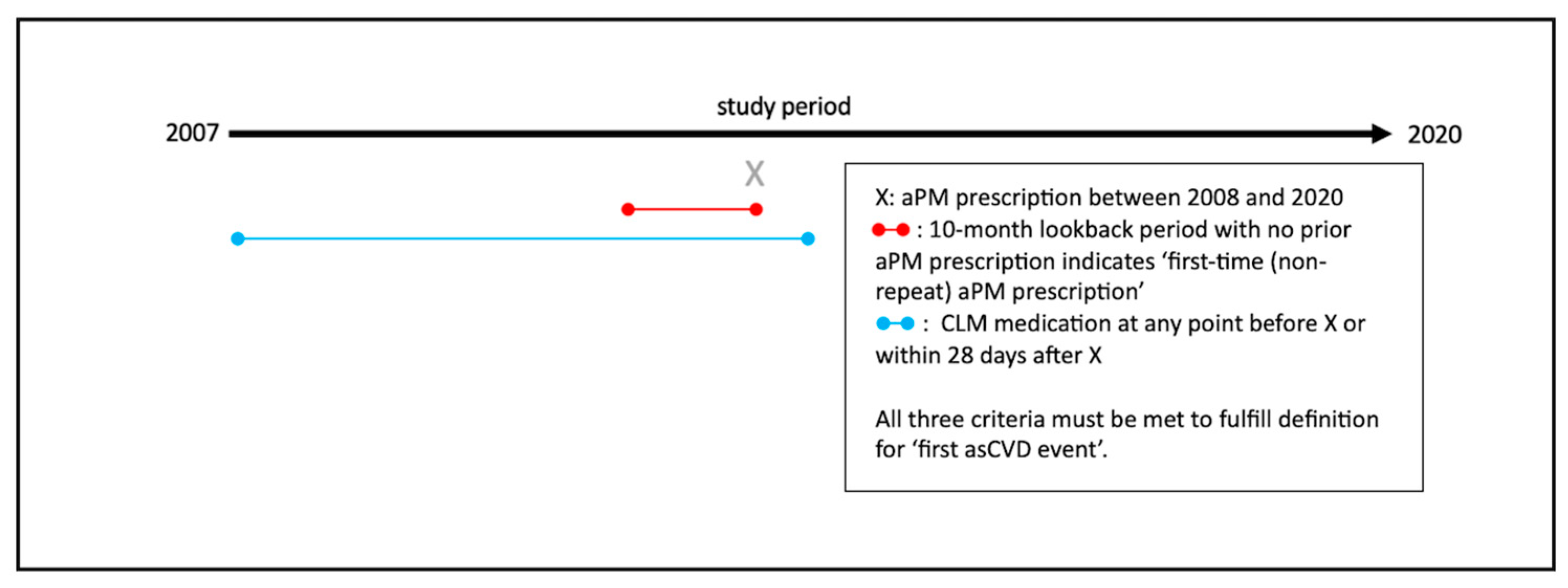
In this study, the incidence of a first ASCVD event was defined as the co-committed prescription of a first aPM (carbasalate calcium, acetylsalicylic acid, or clopidogrel), in combination with CLM (statins or ezetimibe). A detailed description of the definition of a first ASCVD event can be found in the Supplementary File. In brief, a first prescription of aPM within the period 2008–2019 was identified. Second, a 10-month lookback period ascertained that it was indeed the first prescription, and no previous prescription was dispensed. Finally, only if CLM was prescribed in addition to aPM, in a period between 10 months before the prescription of the first aPM and 28 days after the prescription of the first aPM, by a specialist, was it identified as a first ASCVD event (Figure 1). It was permissible for patients to have prior CLM prescriptions, since individuals without a history of ASCVD could have used CLM for many years, for the prevention of ASCVD (Figure 1). Both the aPM and CLM prescriptions had to be prescribed by a specialist and not by a general physician, to make sure they were not prescribed as preventive medication. Throughout the remainder of the text, we will refer to this group as first ASCVD event patients.
To ensure that the definition we used would indeed accurately identify patients with a first ASCVD event, we compared the number of individuals identified in our database with the number of individuals as identified in the CBS, StatLine registry of the year 2008, within the age group 20–39 years for both men and women. Historically, Statistics Netherlands collected first ASCVD events for a period between 1995 and 2008, but no recent data on first ASCVD events is registered. Therefore, we compared our 2008 prescription data with the registered first ASCVD of 2008 by CBS. The CBS data represents 100% of individuals in the Netherlands with an ASCVD diagnosis based on hospitalization, in the age group 20–39 years, both for men and women. The prescription data, for the year 2008, represents 65% of cases, since only a random amount of pharmacies was sampled. Extrapolating this to 100%, the amount of individuals with a first ASCVD event covering the whole of the Netherlands was similar to the CBS-registered amount (Netherlands statistics: men 537 and women 479; prescription data: men (65%: 261; 100%: 402) and women (65%: 249; 100%: 383)).

2.4. Study Population

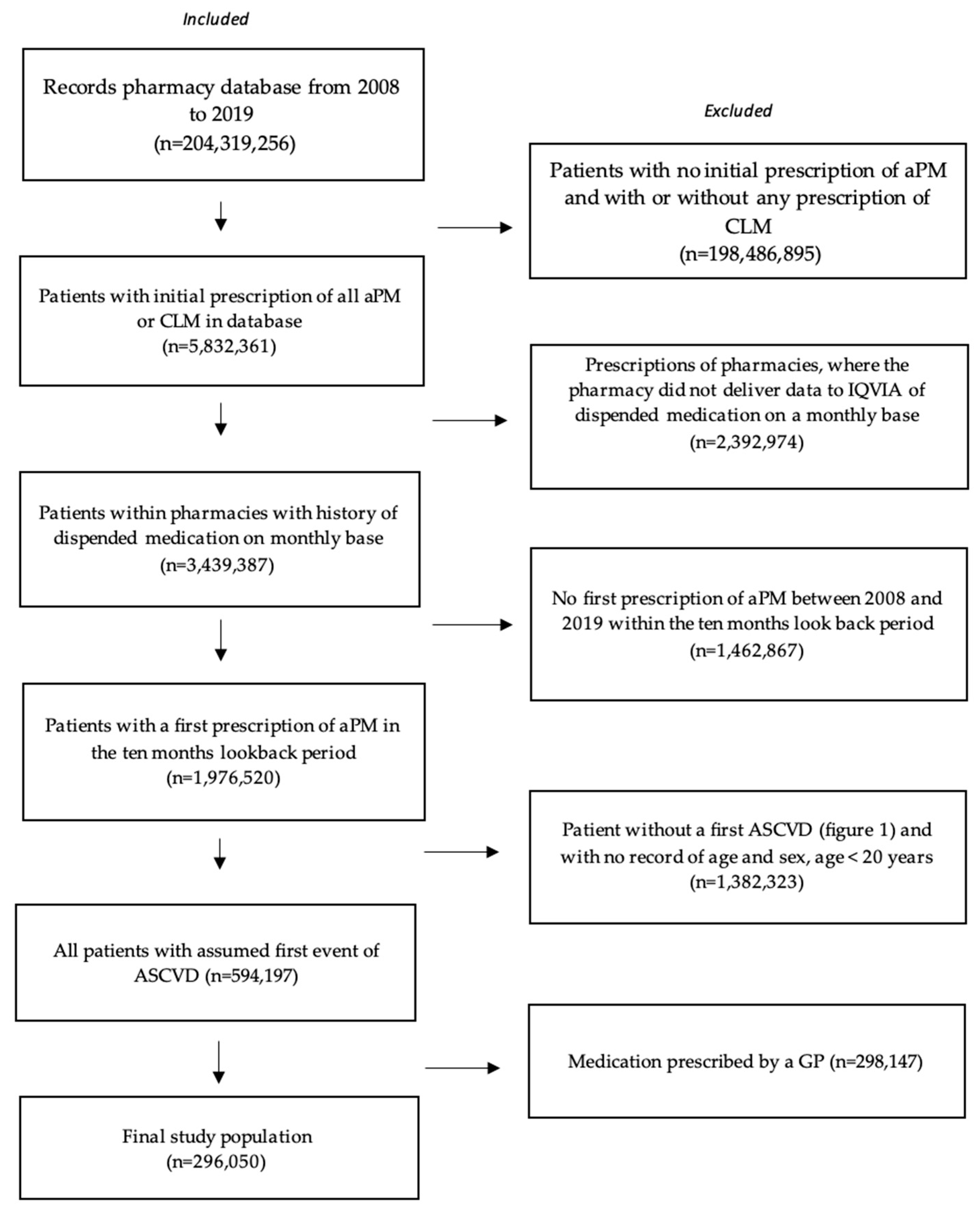
All patients with the following criteria were included: 20 years of age or older, with known sex, and a drug combination of aPM and CLM, concurrently prescribed by a specialist, from pharmacies that provided data on a monthly basis, between 2008 and 2019 (Figure 2). GP-prescribed medication was excluded since aPM has been prescribed in the past by the GP for primary prevention of cardiovascular disease. It was not until recently, namely 2019, that the guidelines were adapted to advise against this practice [8]. We divided individuals according to age and sex and defined the following age groups: 20–39 years, 40–59 years, 60–79 years, and ≥80 years. These age groups were chosen to facilitate the comparison with our previous study [5]. Data were standardized for all Dutch inhabitants per age group and year based on the demographics of the Central Bureau for Statistics (CBS), the Netherlands [9].

2.5. Comorbidity Analysis

Comorbidities were defined, based on anatomical therapeutic chemical (ATC) classification codes of specific treatments for diseases, by used co-medications (see Supplementary Methods); e.g., we identified all comorbid prescriptions among the patients that had a first ASCVD event and compared them to a random control group, that had never been prescribed an aPM between 2008 and 2019, matched for age, sex, and region. The definition of the first ASCVD group, was the same as described previously. The control group was matched 1:8 to increase power. Only the data from 2019 was analyzed, as the most recent data (2020 and 2021 were not representative due to the COVID-19 pandemic). The comedication is prescribed by all specialists (including GPs).

2.6. Outcome Measures

The primary outcome measure of this study is the incidence in standardized percentages of prescriptions for a first ASCVD event, among different age and sex groups over a period of 12 years. The second outcome measure is the identification and frequency of co-medications that were prescribed concomitant with the prescriptions for a first ASCVD event.

2.7. Statistical Analyses

All trend analyses were performed by using a linear regression method, after testing linearity. Assuming an underlying Poisson distribution, we tested whether the change in percentages over time was significant. The increase or decrease in percentage was calculated by using the beta coefficient of the linear regression. Differences between the percentages of co-medication among the different age and sex groups for patients with a first ASCVD event and control patients were analyzed using a chi-square test. All statistical analyses were performed using IBM SPSS version 28.0. A p-value of <0.05 was considered statistically significant.

3. Results

3.1. Incidence of a First ASCVD Event over Time

After applying the inclusion and exclusion criteria, our final study sample consisted of 296,050 patients who received a first prescription of an aPM together with CLM, suggestive of a first ASCVD event, in the period from 2008 until 2019. Our data consisted of 128,110 women (43.27%) and 167,939 (56.73%) men. Patient characteristics are shown in Table 1.
Only 2.7% of all individuals were young (20–39 years). Interestingly, this was the only age group that consisted of an equal portion of men and women. The age group of 40–59 years consisted of significantly more men than women (men 60.6% versus women 39.4%; p < 0.05). Most individuals were in the age group 60–79 years, which consisted of 53.4% of all individuals, with a significantly higher portion of men (men 57.4% versus women 42.6%; p < 0.05). This is in line with what we observed in our previous study, where the median age for ASCVD was around 70 years [5]. Only the oldest age group consisted of significantly more women than men (men 42.9% versus women 57.1%; p < 0.05). Which, given the life expectancy differences between sexes, was to be expected.
Most of the aPM and CLM was prescribed by a cardiologist (35.9% of all prescriptions), followed by the neurologist, internist, and other specialties (resp. 21.5%, 9.2%, and 33.4%; p < 0.001). See Table S1). The other specialist category included, e.g., surgeon. See Supplementary File for the entire list). There were no major differences in the incidence of first ASCVD between regions in which the medication was prescribed (Supplementary File Table S1).
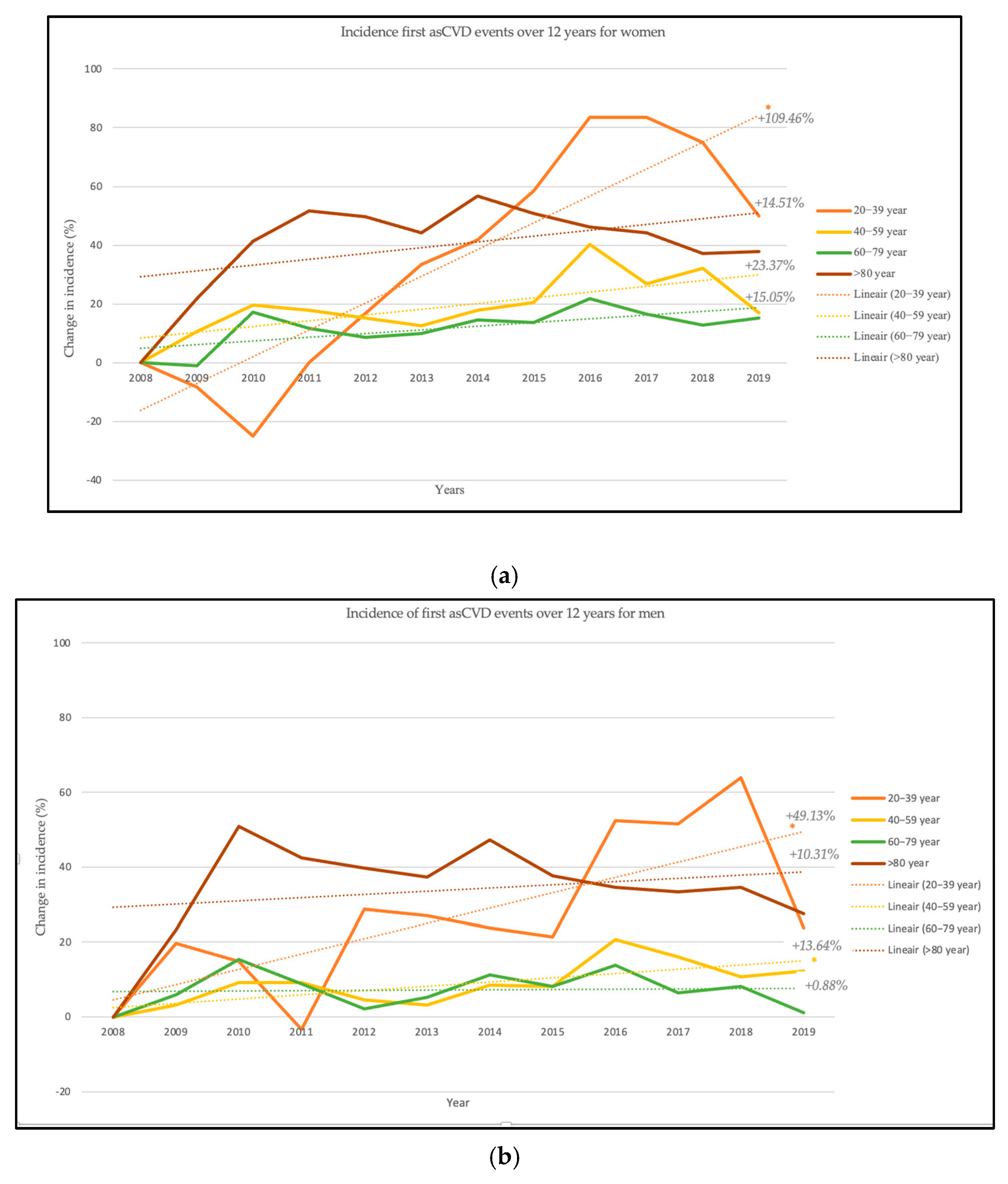
In line with our previous study [5], which analyzed registry data, we observed an impressive and significant increase in the incidence of a first ASCVD event among young women, age 20–39 years, (+109.46%; p < 0.001; Figure 3a). In Tables S2 and S3 are the rates per 100.000 inhabitants stratified by age and sex. Even so among young men we observed a significant increase in first ASCVD events over time, although less pronounced as for young women (+49.13%, p < 0.05; Figure 3a). In addition, although only for trend among women but significantly among men, we also observed an increase in the relatively young individuals (age 40–59 years: women: +23.37% and men: +13.64% p < 0.05 only for men, Figure 3a,b). When analyzing trend over the other older age groups, we observed only a slight increase, which was significant for women 60–79 years (age 60–79 years: women: +15.05% and men: +0.88%; p < 0.05 for women and for age ≥ 80 years: women: +14.51% and men: +10.31%). The interim conclusion is therefore that, overall first ASCVD events did not decrease in the past 12 years and there was even an increase in first ASCVD events among young and relatively young individuals as well as middle aged women.

3.2. Comorbid Condition Among Individuals with a First ASCVD Event

For this analysis, only 2019 data was included, which rendered a dataset of 38,255 individuals with a first ASCVD event and 298,730 control individuals. When comparing the dataset of the year 2019 with our total dataset, the percentages of individuals of each age group or sex category were similar (Supplementary File Table S4).
Surprisingly, in young individuals, 20–39 years, both men and women, and relatively young women, 40–59 years, diabetic medication was significantly more often prescribed in individuals with a first ASCVD event as compared to controls (20–39 years: men 35.3% vs. 7.1%; women 39.9% vs. 2.8%, respectively (Table 2), and 40–59 years women 18.1% vs. 15.2%; p < 0.001 (Table 3)). The high percentages of patients using diabetic medications among the young with a first ASCVD event, mainly consisted of oral diabetic medication, e.g., suggesting insulin-resistance-type diabetes but not for insulin use, e.g., type-1 diabetes (Table S4). Interestingly, this was not the case for patients with a first ASCVD event in any of the older age groups, in which controls often had a higher percentage of diabetic medication (Supplementary Files Table S4).
Concerning the other non-CVD co-medications, thyroid hormones were significantly more often prescribed in young individuals, for both men and women, with a first ASCVD event, compared to controls (men 5.8% vs. 1.0%; women 9.8% vs. 4.3%; p < 0.001, Table 2). Again, this trend was not observed in the older age groups, where thyroid hormones were more often prescribed in the control groups (Supplementary File Table S5).
Auto-immune medications and anti-depressants were significantly more often prescribed in young women with a first ASCVD event compared to controls (auto-immune medication 16.6% vs. 9.5%; anti-depressants 37.6% vs. 21.6%; p < 0.001 for both; Table 2). Within auto-immune medication, corticosteroids showed the most significant results (Table S5). This was not the case for young men with a first ASCVD event and the other age groups. Concerning oral contraceptives, surprisingly, individuals with a first ASCVD event did not use oral contraceptives more often as compared to cases, not even in the young.
Cardiovascular disease co-medications, differences between men and women.
Finally, we analyzed whether there was a difference in ASCVD medication between men and women. Interestingly, among individuals with a first ASCVD event, most antihypertensive medication was not significantly different between men and women. Suggesting that both are equally treated for secondary prevention for ASCVD (Supplementary File Table S6).

4. Discussion

This retrospective epidemiological study, using data from 12 years, investigated the incidence of a first ASCVD event over time. We were able to show that among all age groups, the expected decrease in first ASCVD events could not be observed, and interestingly, there was even an increase in the incidence of a first ASCVD event over time in the young and relatively young, and most pronounced among young women. In addition, comorbidities such as diabetes, thyroid disease, and the use of corticosteroids might be underlying diseases involved in the progression of ASCVD in the young.
Nowadays, it is considered that ASCVD has decreased tremendously over time [5]. Recently, we investigated the trends in ASCVD in the Netherlands by analyzing the admissions of myocardial infarctions (AMI) in a national registry (Statistics Netherlands (CBS)), over a period of 39 years and observed an increase of 62% among young women, while all other age groups showed a decline in AMI [5]. Amini et al. reported a steady decreasing trend of mortality of CVD for 1990–2017, stratified by age [4]. Unfortunately, these studies did not have data on first ASCVD events; therefore, we do not know whether we are equally able to prevent recurrent events as we are to prevent first ASCVD, that is, preventing them from happening in the first place. Arora et al. investigated premature atherosclerosis, that is, atherosclerosis in the young, and investigated all myocardial infarctions in a large American cohort of >28.000 individuals who were <55 years and followed them for 18 years. This study also shows an increase in the incidence of myocardial infarction of 48% among young women [10]. Besides this, Vikulova et al. showed not a decreasing trend for atherosclerotic cardiac diseases in young women and young men (age < 55, age < 50 years), with a higher mortality rate for young women, possibly related to unfavorable comorbidity risk profile [11]. Furthermore, the results of our study indicate that prevention of ASCVD as currently done in the Netherlands is failing across all age and sex groups and especially so among young women. Therefore, while healthcare changes have led to better treatment options for patients diagnosed with ASCVD, it seems that little to no progress has been made on the early diagnosis and prevention of ASCVD.
Recurrent events in CAD patients of all ages are estimated to be around 30% [12,13]. With continued smoking and a surprisingly early age at the first event being the major risk factors for recurrent disease. Several prospective cohort studies have shown recurrent event rates of 30–53% in individuals with premature atherosclerosis [14,15]. Collet et al. [16] showed, in a prospective cohort study, that 30% of 880 patients with coronary artery disease (CAD) <45 years of age had at least one recurrent event in 20 years. They also identified that continued smoking, inflammatory disease, sub-Saharan and Asian ethnicity, diabetes, and multivessel disease were risk factors for recurrent events. Similarly, Arora et al. [10] showed, in a prospective cohort study of 28,000 acute myocardial infarction patients, that 30% had a first myocardial event <55 years of age. In addition, 48% of young women had a recurrent event in 18 years, compared to only 10% for young men. In addition, Zeitouni et al. [17] showed in 3655 patients with a myocardial infarction <50 years of age, that 52.8% had at least one recurrent event in 10 years and 20.9% had died. The most important risk factors for recurrent events were female sex, diabetes, chronic kidney disease, multivessel disease, and inflammatory disease. Therefore, premature CAD is an aggressive disease despite the currently recommended preventive measures, with high rates of recurrent events and mortality.
When considering concomitant diseases among individuals with a first ASCVD event, we observed that diabetes, thyroid disease, and the use of corticosteroids, might contribute to the increased ASCVD burden among young individuals. This is supported by the recent observation of an increase in body weight over time among young individuals and especially young women [5]. Moreover, Vikulova et al. showed that obesity has a higher prevalence among young women with atherosclerotic cardiovascular diseases [11]. The increase in body weight among young individuals will for sure lead to a higher incidence of diabetes and thyroid disease and possibly also auto-immune disease [18,19,20,21]. Concerning the use of thyroid hormones, it has been suggested that subclinical hypothyroidism is linked to atherosclerosis, and the risk increases with increasing thyroid-stimulating hormone (TSH) levels [22,23]. However, these studies were performed in patients > 60 years, and no conclusion can be made for a younger population. Recent studies have demonstrated that elevated thyroid-stimulating hormone (TSH) levels, even within the subclinical range, are associated with an increased prevalence of metabolic syndrome, particularly among young women [24,25,26]. Metabolic syndrome is well established as a major risk factor for cardiovascular disease and accelerated atherosclerosis. [27,28] These findings suggest that elevated TSH levels may contribute to cardiovascular risk in young women indirectly through adverse metabolic pathways, including dyslipidemia, insulin resistance, and low-grade systemic inflammation. Consequently, thyroid dysfunction may represent an underrecognized, sex-specific risk factor for premature atherosclerotic cardiovascular disease in women, warranting greater attention in both research and clinical risk assessment.
Our observation of a higher amount of auto-immune medication among young individuals with a first ASCVD event is in line with the current guidelines that auto-immune disease is considered as a risk factor of ASCVD [5,29,30]. The fact that we only observe this in young individuals and more pronounced in women, is again in line with what is known in the literature, namely that auto-immune diseases preferably develop between 15 and 45 years of age and especially in women [31].
Alternative explanations, including increased screening, enhanced diagnostic sensitivity, or changes in clinical guidelines, are unlikely to have substantially influenced our findings. No screening initiatives specifically targeting young women were introduced during the study period, nor is there evidence of a meaningful increase in nonspecific thoracic or neurological presentations in this population. High-sensitivity troponin assays were already widely implemented in routine clinical practice prior to their formal inclusion in the 2011 guidelines, and as the majority of the study period falls within this era, improved detection alone is unlikely to account for the observed increase [32]. Furthermore, guideline modifications concerning antiplatelet and lipid-lowering therapies were applied uniformly across sexes, making sex-specific effects of prescribing behavior or coding practices improbable. Collectively, these considerations indicate that the observed rise most likely reflects a genuine epidemiological trend rather than diagnostic or administrative artifacts.

Strength and Limitations

The strength of this study lies in the fact that the results are in line with the results of several other observations. First, 2 studies [5,10] using prospective or registry data on hospital admissions for acute myocardial infarction report a similar increase in myocardial infarctions events among young women over the same time period. Second, an important strength of our study lies in the fact that we used IQVIA’s real world LRx database, which results in an impressive large sample size which renders a tremendous amount of power. It is often argued whether data on prescribed medication is a reasonably proxy for disease and could therefore be used if specific data on disease, for instance first ASCVD events, in registries is lacking. Several studies have shown similar or better identification of disease using prescription data as compared to registries, since registries notably underperform due to the fact that many different people assign ICD codes which are often not precise [33,34]. The LRx database has a coverage of approximately 65% of all dispensed prescriptions in the Netherlands, which makes the results of this study highly representative at a national level. The database covers prescribed medication, meaning that the medication is dispensed and picked up. Naturally, there is uncertainty on whether it was actually used, but that holds true for all age groups. Third, our observation on auto-immune medication among young women with a first ASCVD event is in line with the literature, stating that auto-immune disease is a risk factor for ASCVD and that auto-immune diseases have an increased prevalence in young women compared to older women [31,35,36,37,38].
Despite these strengths, there are several limitations that warrant careful consideration. First, one could argue whether we are able to correctly identify individuals with a first ASCVD event out of the prescription data. We believe this is the case, since the combination of both aPM and CLM prescribed by a specialist, is rather specific for an ASCVD event. In addition, almost 60% of the medical professionals in our database were specialized in cardiovascular disease, being a cardiologist or neurologist. Besides, aPM has a rather narrow indication and is preferably prescribed for ASCVD and is, in the Netherlands, not prescribed for atrial fibrillation or thrombosis. It could be argued that aPM might have been prescribed by the specialist for the prevention of ASCVD, and since we found a strikingly high amount of diabetes patients among the young, 20–39 years, aPM medication might indeed be prescribed along with the prescription of diabetes medication, for the prevention of ASCVD. This would mean, that our definition does not identify patients that encountered a first ASCVD event, but also harbors individuals that use aMP and CLM for the prevention of ASCVD. On the other hand, this would also hold true for the other age groups and especially the 40–59 age group, in whom we do not observe this striking difference in the amount of individuals with diabetes among cases and controls. Besides, when comparing our registry data with the data from the CBS, we find fewer cases instead of more, which would have been the case if our definition had also included primary prevention individuals. Second, it could be argued that patients could have been missed due to statin intolerance. We believe this is not the case, since cases cannot be missed due to statin intolerance if it concerns the first prescriptions of statins. On the other hand, this study allowed for patients to already use CLM prior to the first prescription of aPM therapy, which also included ezetimibe as an alternative to statin intolerance. Therefore, if patients are missed due to statin intolerance, this will only be a small amount of patients, and this will affect all age groups and is therefore not influencing our data.
Third, a few assumptions had to be made to combine the data from 2008 to 2015 with the data from 2016 to 2019. As stated in the Supplementary Method section, several steps were, however, taken to avoid or reduce any potential biases regarding overreporting. Fourth, aPM and CLM had to be prescribed at the same moment unless patients were already using CLM. Unfortunately, not all aPM and CLM prescriptions are collected from the pharmacies on the same day. Therefore, a reasonable time window between aPM and CLM dispensation had to be determined to indicate a first ASCVD event. Ultimately, we used a collection time window of 28 days between both medications for this study, which is considered a rather strict limit.
Although the results of this study are highly interesting and promising, further prospective cohort studies are needed to confirm the increase in first ASCVD events in all age groups and particularly among young women and which type of comorbidities might be causally related to the increase in ASCVD events. Our findings demonstrate that young women exhibit distinct and clinically relevant risk factors that contribute to cardiovascular disease risk. Risk assessment frameworks should therefore move beyond a one-size-fits-all approach and incorporate systematic stratification by sex and age to improve early identification and prevention. Robust evidence identifies pre-eclampsia as a major and independent cardiovascular risk factor in young women [39,40,41,42]. These female-specific and female-predominant risk factors must be prioritized in future research to clarify their mechanistic pathways and to inform sex-specific prevention strategies for premature cardiovascular disease.

5. Conclusions

To our knowledge, this is the first study using real-world prescription data to demonstrate that, contrary to the prevailing belief that ASCVD is decreasing, first ASCVD events have remained stable over the last 12 years. Surprisingly, among young and relatively young individuals, and especially young women first ASCVD events even increased. Among these young women with a first ASCVD event, a significantly higher amount of prescriptions of thyroid hormones, diabetic medication, and immunosuppressants (corticosteroids) was observed. In addition, all other age groups did not show the expected decrease in ASCVD over time, but rather remained stable. Moreover, these first events are even increasing among the young and relatively young individuals, particularly among young women in the Netherlands. We would like to stress the urgency to address current prevention strategies for ASCVD, since they might not be able to sufficiently prevent future ASCVD.

Supplementary Materials

The following supporting information can be downloaded at https://www.mdpi.com/article/10.3390/hearts7010009/s1, Supplementary–Methods. Table S1: Characteristics of prescribed medication; Table S2: Raters per 100.000 inhabitants stratified by age (women); Table S3: Raters per 100.000 inhabitants stratified by age (men); Table S4: Overview of the total number of patients in 2019 regarding co-medication; Table S5: Extended table with comedications; Table S6: Extended table with cardiovascular disease comedications.

Author Contributions

Conceptualization, J.J.C.; methodology, K.H. and M.C.K. and C.W.; software, K.H., M.C.K., and V.W.; formal analysis, K.M.v.d.W. and C.W.; writing—original draft preparation, J.J.C.; writing—review and editing, S.-J.P.-S. and K.A.H.Z. and C.W. supervision, S.-J.P.-S., K.A.H.Z. All authors have read and agreed to the published version of the manuscript.

Funding

This research received no external funding.

Institutional Review Board Statement

This study involved secondary analysis of routinely collected pharmacy dispensing data. According to Dutch law (Medical Research Involving Human Subjects Act—WMO, link: https://english.ccmo.nl/investigators/legal-framework-for-medical-scientific-research/laws/medical-research-involving-human-subjects-act-wmo, accessed on 2 March 2026), research that uses existing, anonymized healthcare data without intervening in patient care or imposing actions on individuals does not require review by a medical ethics committee. In line with published practice, ethics review was therefore not required for this retrospective data analysis. All data were handled in compliance with applicable data protection legislation (General Data Protection Regulation—GDPR link: https://gdpr-info.eu/, accessed on 2 March 2026).

Informed Consent Statement

Patient consent was waived due to the retrospective pharmaco-epidemiological nature of the study.

Data Availability Statement

The authors confirm that the aggregated data supporting the findings of this study are available within the article and its Supplementary Materials. The individual data cannot be shared openly but are available upon reasonable request from the authors. The data can be accessed under the supervision of an IQVIA data analyst.

Conflicts of Interest

Author J.J.C. was employed by the company Amsterdam UMC. The remaining authors declare that the research was conducted in the absence of any commercial or financial relationships that could be construed as a potential conflict of interest.

Abbreviations

The following abbreviations are used in this manuscript:
ASCVDAtherosclerotic cardiovascular disease
CVDCardiovascular disease
APMAntiplatelet medication
CLMCholesterol Lowering Medication
CBSClinical bureau of statistics

References

  1. Libby, P.; Buring, J.E.; Badimon, L.; Hansson, G.K.; Deanfield, J.; Bittencourt, M.S.; Tokgözoğlu, L.; Lewis, E.F. Atherosclerosis. Nat. Rev. Dis. Primers 2019, 5, 56. [Google Scholar] [CrossRef]
  2. World Health Organization. Cardiovascular Diseases (CVDs); World Health Organization: Geneva, Switzerland, 2021. [Google Scholar]
  3. Vaartjes, C.H.; van Dis, S.J.; Visseren, F.L.J.; Bots, M.L. Hart en Vaatziekten in Nederland; Nederlandse Hartstichting: Den Haag, The Netherlands, 2021. [Google Scholar]
  4. Amini, M.; Zayeri, F.; Salehi, M. Trend analysis of cardiovascular disease mortality, incidence, and mortality-to-incidence ratio: Results from global burden of disease study 2017. BMC Public Health 2021, 21, 401. [Google Scholar] [CrossRef]
  5. Crooijmans, J.; Singh, S.; Naqshband, M.; Bruikman, C.S.; Pinto-Sietsma, S.J. Premature atherosclerosis: An analysis over 39 years in the Netherlands. Implications for young individuals in high-risk families. Atherosclerosis 2023, 384, 117267. [Google Scholar] [CrossRef]
  6. Vasan, R.S.; Song, R.J.; van den Heuvel, E.R. Temporal Trends in Incidence of Premature Cardiovascular Disease Over the Past 7 Decades: The Framingham Heart Study. J. Am. Heart Assoc. 2022, 11, e026497. [Google Scholar] [CrossRef] [PubMed]
  7. Torabi, F.; Akbari, A.; Bedston, S.; Davies, G.; Abbasizanjani, H.; Gravenor, M.; Griffiths, R.; Harris, D.; Jenkins, N.; Lyons, J.; et al. Impact of COVID-19 pandemic on community medication dispensing: A national cohort analysis in Wales, UK. Int. J. Popul. Data Sci. 2020, 5, 1715. [Google Scholar] [CrossRef]
  8. Marx, N.; Federici, M.; Schütt, K.; Müller-Wieland, D.; Ajjan, R.A.; Antunes, M.J.; Christodorescu, R.M.; Crawford, C.; Di Angelantonio, E.; Eliasson, B.; et al. 2023 ESC Guidelines for the management of cardiovascular disease in patients with diabetes. Eur. Heart J. 2023, 44, 4043–4140. [Google Scholar] [CrossRef] [PubMed]
  9. CBS. Bevolking op 1 Januari en Gemiddeld; Geslacht, Leeftijd en Regio; Centraal Bureau voor de Statistiek: Den Haag, The Netherlands, 2024.
  10. Arora, S.; Stouffer, G.A.; Kucharska-Newton, A.M.; Qamar, A.; Vaduganathan, M.; Pandey, A.; Porterfield, D.; Blankstein, R.; Rosamond, W.D.; Bhatt, D.L.; et al. Twenty Year Trends and Sex Differences in Young Adults Hospitalized With Acute Myocardial Infarction. Circulation 2019, 139, 1047–1056. [Google Scholar] [CrossRef]
  11. Vikulova, D.N.; Grubisic, M.; Zhao, Y.; Lynch, K.; Humphries, K.H.; Pimstone, S.N.; Brunham, L.R. Premature Atherosclerotic Cardiovascular Disease: Trends in Incidence, Risk Factors, and Sex-Related Differences, 2000 to 2016. J. Am. Heart Assoc. 2019, 8, e012178. [Google Scholar] [CrossRef]
  12. Steen, D.L.; Khan, I.; Andrade, K.; Koumas, A.; Giugliano, R.P. Event Rates and Risk Factors for Recurrent Cardiovascular Events and Mortality in a Contemporary Post Acute Coronary Syndrome Population Representing 239 234 Patients During 2005 to 2018 in the United States. J. Am. Heart Assoc. 2022, 11, e022198. [Google Scholar] [CrossRef] [PubMed]
  13. Zdravkovic, S.; Wienke, A.; Pedersen, N.L.; Marenberg, M.E.; Yashin, A.I.; De Faire, U. Heritability of death from coronary heart disease: A 36-year follow-up of 20 966 Swedish twins. J. Intern. Med. 2002, 252, 247–254. [Google Scholar] [CrossRef] [PubMed]
  14. Toth, P.P. Identification and treatment of those most at risk for premature atherosclerotic cardiovascular disease: We just cannot seem to get it right. Am. J. Prev. Cardiol. 2020, 2, 100040. [Google Scholar] [CrossRef]
  15. An, J.; Zhang, Y.; Muntner, P.; Moran, A.E.; Hsu, J.W.; Reynolds, K. Recurrent Atherosclerotic Cardiovascular Event Rates Differ Among Patients Meeting the Very High Risk Definition According to Age, Sex, Race/Ethnicity, and Socioeconomic Status. J. Am. Heart Assoc. 2020, 9, e017310. [Google Scholar] [CrossRef] [PubMed]
  16. Collet, J.P.; Zeitouni, M.; Procopi, N.; Hulot, J.S.; Silvain, J.; Kerneis, M.; Thomas, D.; Lattuca, B.; Barthelemy, O.; Lavie-Badie, Y.; et al. Long-Term Evolution of Premature Coronary Artery Disease. J. Am. Coll. Cardiol. 2019, 74, 1868–1878. [Google Scholar] [CrossRef]
  17. Zeitouni, M.; Clare, R.M.; Chiswell, K.; Abdulrahim, J.; Shah, N.; Pagidipati, N.P.; Shah, S.H.; Roe, M.T.; Patel, M.R.; Jones, W.S. Risk Factor Burden and Long-Term Prognosis of Patients With Premature Coronary Artery Disease. J. Am. Heart Assoc. 2020, 9, e017712. [Google Scholar] [CrossRef] [PubMed]
  18. Rohm, T.V.; Meier, D.T.; Olefsky, J.M.; Donath, M.Y. Inflammation in obesity, diabetes, and related disorders. Immunity 2022, 55, 31–55. [Google Scholar] [CrossRef]
  19. Chikunguwo, S.; Brethauer, S.; Nirujogi, V.; Pitt, T.; Udomsawaengsup, S.; Chand, B.; Schauer, P. Influence of obesity and surgical weight loss on thyroid hormone levels. Surg. Obes. Relat. Dis. 2007, 3, 631–635; discussion 635–636. [Google Scholar] [CrossRef]
  20. Reinehr, T. Obesity and thyroid function. Mol. Cell. Endocrinol. 2010, 316, 165–171. [Google Scholar] [CrossRef]
  21. Song, R.H.; Wang, B.; Yao, Q.M.; Li, Q.; Jia, X.; Zhang, J.A. The Impact of Obesity on Thyroid Autoimmunity and Dysfunction: A Systematic Review and Meta-Analysis. Front. Immunol. 2019, 10, 2349. [Google Scholar] [CrossRef]
  22. Rodondi, N.; den Elzen, W.P.; Bauer, D.C.; Cappola, A.R.; Razvi, S.; Walsh, J.P.; Asvold, B.O.; Iervasi, G.; Imaizumi, M.; Collet, T.H.; et al. Subclinical hypothyroidism and the risk of coronary heart disease and mortality. JAMA 2010, 304, 1365–1374. [Google Scholar] [CrossRef]
  23. Delitala, A.P.; Fanciulli, G.; Maioli, M.; Delitala, G. Subclinical hypothyroidism, lipid metabolism and cardiovascular disease. Eur. J. Intern. Med. 2017, 38, 17–24. [Google Scholar] [CrossRef]
  24. Su, X.; Peng, H.; Chen, X.; Wu, X.; Wang, B. Hyperlipidemia and hypothyroidism. Clin. Chim. Acta 2022, 527, 61–70. [Google Scholar] [CrossRef] [PubMed]
  25. Gluvic, Z.M.; Zafirovic, S.S.; Obradovic, M.M.; Sudar-Milovanovic, E.M.; Rizzo, M.; Isenovic, E.R. Hypothyroidism and Risk of Cardiovascular Disease. Curr. Pharm. Des. 2022, 28, 2065–2072. [Google Scholar] [CrossRef] [PubMed]
  26. Oh, J.Y.; Sung, Y.A.; Lee, H.J. Elevated thyroid stimulating hormone levels are associated with metabolic syndrome in euthyroid young women. Korean J. Intern. Med. 2013, 28, 180–186. [Google Scholar] [CrossRef]
  27. Mottillo, S.; Filion, K.B.; Genest, J.; Joseph, L.; Pilote, L.; Poirier, P.; Rinfret, S.; Schiffrin, E.L.; Eisenberg, M.J. The metabolic syndrome and cardiovascular risk a systematic review and meta-analysis. J. Am. Coll. Cardiol. 2010, 56, 1113–1132. [Google Scholar] [CrossRef]
  28. Ding, X.; Zhao, Y.; Zhu, C.Y.; Wu, L.P.; Wang, Y.; Peng, Z.Y.; Deji, C.; Zhao, F.Y.; Shi, B.Y. The association between subclinical hypothyroidism and metabolic syndrome: An update meta-analysis of observational studies. Endocr. J. 2021, 68, 1043–1056. [Google Scholar] [CrossRef]
  29. Federatie Medisch Specialisten. Cardiovasculair Risicomanagement (CVRM); Federatie Medisch Specialisten: Utrecht, The Netherlands, 2019. [Google Scholar]
  30. Meyer, P.W.; Anderson, R.; Ker, J.A.; Ally, M.T. Rheumatoid arthritis and risk of cardiovascular disease. Cardiovasc. J. Afr. 2018, 29, 317–321. [Google Scholar] [CrossRef]
  31. Angum, F.; Khan, T.; Kaler, J.; Siddiqui, L.; Hussain, A. The Prevalence of Autoimmune Disorders in Women: A Narrative Review. Cureus 2020, 12, e8094. [Google Scholar] [CrossRef]
  32. Hamm, C.W.; Bassand, J.-P.; Agewall, S.; Bax, J.; Boersma, E.; Bueno, H.; Caso, P.; Dudek, D.; Gielen, S.; Huber, K.; et al. ESC Guidelines for the management of acute coronary syndromes in patients presenting without persistent ST-segment elevation: The Task Force for the management of acute coronary syndromes (ACS) in patients presenting without persistent ST-segment elevation of the European Society of Cardiology (ESC). Eur. Heart J. 2011, 32, 2999–3054. [Google Scholar]
  33. Richter, H.; Dombrowski, S.; Hamer, H.; Hadji, P.; Kostev, K. Use of a German longitudinal prescription database (LRx) in pharmacoepidemiology. Ger. Med. Sci. 2015, 13, Doc14. [Google Scholar] [CrossRef] [PubMed]
  34. Tran, Q.; Warren, J.L.; Barrett, M.J.; Annett, D.; Marth, M.; Cress, R.D.; Deapen, D.; Glaser, S.L.; Gomez, S.L.; Schwartz, S.M.; et al. An Evaluation of the Utility of Big Data to Supplement Cancer Treatment Information: Linkage Between IQVIA Pharmacy Database and the Surveillance, Epidemiology, and End Results Program. J. Natl. Cancer Inst. Monogr. 2020, 2020, 72–81. [Google Scholar] [CrossRef]
  35. England, B.R.; Thiele, G.M.; Anderson, D.R.; Mikuls, T.R. Increased cardiovascular risk in rheumatoid arthritis: Mechanisms and implications. BMJ 2018, 361, k1036. [Google Scholar] [CrossRef] [PubMed]
  36. Amaya-Amaya, J.; Montoya-Sánchez, L.; Rojas-Villarraga, A. Cardiovascular involvement in autoimmune diseases. BioMed Res. Int. 2014, 2014, 367359. [Google Scholar] [CrossRef]
  37. Mason, J.C.; Libby, P. Cardiovascular disease in patients with chronic inflammation: Mechanisms underlying premature cardiovascular events in rheumatologic conditions. Eur. Heart J. 2015, 36, 482–489. [Google Scholar] [CrossRef]
  38. Mann, D.L. The emerging role of innate immunity in the heart and vascular system: For whom the cell tolls. Circ. Res. 2011, 108, 1133–1145. [Google Scholar] [CrossRef]
  39. Stekkinger, E.; Zandstra, M.; Peeters, L.L.H.; Spaanderman, M.E.A. Early-onset preeclampsia and the prevalence of postpartum metabolic syndrome. Obstet. Gynecol. 2009, 114, 1076–1084. [Google Scholar] [CrossRef] [PubMed]
  40. Aslam, A.; Perera, S.; Watts, M.; Kaye, D.; Layland, J.; Nicholls, S.J.; Cameron, J.; Zaman, S. Previous Pre-Eclampsia, Gestational Diabetes and Hypertension Place Women at High Cardiovascular Risk: But Do We Ask? Heart Lung Circ. 2021, 30, 154–157. [Google Scholar] [CrossRef]
  41. Arnott, C.; Patel, S.; Hyett, J.; Jennings, G.; Woodward, M.; Celermajer, D.S. Women and Cardiovascular Disease: Pregnancy, the Forgotten Risk Factor. Heart Lung Circ. 2020, 29, 662–667. [Google Scholar] [CrossRef]
  42. Drost, J.T.; Arpaci, G.; Ottervanger, J.P.; de Boer, M.J.; van Eyck, J.; van der Schouw, Y.T.; Maas, A.H. Cardiovascular risk factors in women 10 years post early preeclampsia: The Preeclampsia Risk EValuation in FEMales study (PREVFEM). Eur. J. Prev. Cardiol. 2012, 19, 1138–1144. [Google Scholar] [CrossRef] [PubMed]
Figure 1. ‘Case’ definition for the inclusion of first ASCVD event patients.
Hearts 07 00009 g001
Figure 2. ‘Patients’ flowchart.
Hearts 07 00009 g002
Figure 3. (a) The incidence of first ASCVD events over time for women. (b) The incidence of first ASCVD events over time for men.
Hearts 07 00009 g003
Table 1. Patient characteristics of individuals with a first ASCVD event.
128Women
n = 128,109 (43.3%)
Men
n = 167,941 (56.7%)
Total
n = 296,050
Age Categories
20–39 years3999 (50.5%)3920 (49.5%)7919 (2.7%)
40–59 years38,685 (39.4%)59,591 (60.6%) *98,276 (33.2%)
60–79 years67,355 (42.6%)90,832 (57.4%) *158,187 (53.4%)
≥80 years18,071 (57.1%)13,597 (42.9%) *31,668 (10.7%)
* p < 0.05 men versus women.
Table 2. Comedication 20–39 years.
WomenMen
Comedication 20–39 YearsControlCasesControlCases
Total All Medicationn = 2614n = 457n = 2716n = 394
Diabetes medication—oral + insulin74 (2.8%)182 (39.8%) *195 (7.2%)139 (35.3%) *
Thyroid hormones111 (4.3%)45 (9.8%) *28 (1.0%)23 (5.8%) *
Anti-depressant medication564 (21.6%)172 (37.6%) *575 (21.2%)99 (25.1%)
Auto-immune medication (total)247 (9.5%)76 (16.6%) *250 (9.2%)52 (13.2%) *
* p < 0.001.
Table 3. Comedication 40–59 years.
WomenMen
Comedication 40–540ControlCasesControlCases
Total All Medicationn = 25,022n = 4057n = 49,741n = 6943
Diabetes medication—oral + insulin3804 (15.2%)736 (18.1%) *13,024 (27.2%)1394 (20.1%)
Thyroid hormones2678 (10.7%) *304 (7.5%)1455 (2.9%)128 (1.8%) *
Anti-depressant medication7894 (31.5%) *1029 (25.4%)12,080 (24.3%) *986 (14.2%)
Auto-immune medication (total)6086 (22.4%)1006 (24.8%) *9471 (19.2%) *999 (14.3%)
* p < 0.001.
Disclaimer/Publisher’s Note: The statements, opinions and data contained in all publications are solely those of the individual author(s) and contributor(s) and not of MDPI and/or the editor(s). MDPI and/or the editor(s) disclaim responsibility for any injury to people or property resulting from any ideas, methods, instructions or products referred to in the content.