Review

Tricuspid Atresia and Fontan Circulation: Anatomy, Physiology, and Perioperative Considerations

1
Department of Anesthesiology, Stony Brook University Health Science Center, Stony Brook, NY 11794-8480, USA
2
Division of Oral Health, Children’s National Hospital, Washington, DC 20010-2916, USA
*
Author to whom correspondence should be addressed.
Hearts 2025, 6(4), 30; https://doi.org/10.3390/hearts6040030
Submission received: 19 October 2025 / Revised: 16 November 2025 / Accepted: 26 November 2025 / Published: 28 November 2025

Abstract

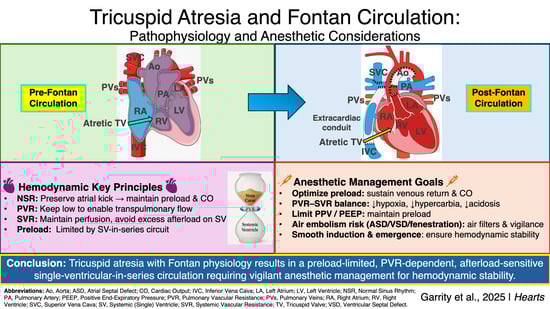
Tricuspid atresia (TA) is a cyanotic congenital heart defect defined by agenesis of the tricuspid valve and resultant right ventricular hypoplasia, representing 1.4–2.9% of congenital heart disease. Survival depends on interatrial and interventricular shunts that permit systemic and pulmonary blood flow, with staged surgical palliation culminating in the Fontan procedure. While surgical advances have improved long-term outcomes, Fontan circulation remains a delicate physiology characterized by preload dependence, elevated pulmonary vascular resistance, chronic venous hypertension, and a prothrombotic state. These features predispose patients to arrhythmias, lymphatic complications, hepatic congestion, and progressive circulatory failure. For anesthesiologists, perioperative management of TA and Fontan patients is uniquely complex. Anesthetic considerations include meticulous preload optimization, modulation of systemic and pulmonary vascular resistance, and ventilatory strategies that minimize adverse effects on venous return. Additional challenges include the high risk of air embolism, individualized anticoagulation needs, and hemodynamic sensitivity to patient positioning. Preoperative evaluation with echocardiography and electrocardiography provides critical insight into anatomy and physiology, while intraoperative planning must emphasize goal-directed fluid management, careful agent selection, and tailored ventilation. Postoperatively, vigilant monitoring, effective pain control, and prevention of complications are essential. This review synthesizes classification systems, pathophysiology, and the evolution of surgical palliation, while emphasizing anesthetic principles for the perioperative care of patients with TA and Fontan circulation. As survival improves and the population of Fontan patients expands, a nuanced understanding of this physiology is essential for optimizing outcomes across cardiac and non-cardiac surgical settings.

Graphical Abstract

1. Introduction

Tricuspid atresia (TA) is a cyanotic congenital heart defect (CHD) characterized by the congenital absence or agenesis of the tricuspid valve, resulting in an underdeveloped right ventricle (RV). This malformation constitutes approximately 1.4–2.9% of CHD cases [1,2]. Over time, various classification systems have emerged, each delineating TA based on distinct criteria, including tricuspid valve morphology, radiographic pulmonary vascular markings, and the relationship of the great arteries [3].

2. Classification

The classification of tricuspid atresia has evolved through several systems reflecting different anatomic and physiologic perspectives. Currently, the spatial relationship of the great arteries is the primary method for classifying tricuspid atresia. First introduced by Kuhne in 1907 [4], later revised by Edwards and Burchell [5], and subsequently refined by Keith et al. [6,7,8], Diehl et al. [9], Rosenthal and Dick [10], Cetta et al. [11], and Nasr and DiNardo [12], this system remains the most widely adopted framework for describing TA. As depicted in Table 1, this classification categorizes tricuspid atresia according to the spatial relationship of the great arteries: normally related great arteries (NRGA, type I, Figure 1), D-transposition of the great arteries (D-TGA, type II), and malposition of the great arteries other than D-TGA (type III). Further stratification of types I and II is based on pulmonary artery status: (a) pulmonary atresia, (b) pulmonary stenosis, and (c) absence of pulmonary stenosis. In type I, the ventricular septal defect (VSD) varies—absent in subgroup (a), restrictive in (b), and nonrestrictive in (c). In contrast, type II consistently includes a VSD across all subgroups (nonrestrictive in a/b, restrictive in c). Type III is subdivided into (a) pulmonary or subpulmonic stenosis and (b) aortic stenosis.
Hemodynamically, subtypes Ia, Ib, IIa, and IIIa demonstrate decreased pulmonary blood flow due to pulmonary atresia, restrictive VSD, or pulmonary/subpulmonary stenosis. Subtypes Ic and IIb typically maintain balanced flow, with nonrestrictive VSDs permitting adequate but not excessive pulmonary circulation. Flow is increased in IIc and IIIb; in IIc, absence of pulmonary stenosis allows the left ventricle to eject freely into the pulmonary artery; while in IIIb, obstruction of the subaortic pathway paradoxically diverts flow toward the pulmonary circulation. Patients with pulmonary atresia (e.g., Ia, IIa) rely on a patent ductus arteriosus (PDA) or major aortopulmonary collateral arteries (MAPCAs) for pulmonary circulation.

3. Genetic and Syndromic Associations

Tricuspid atresia typically results from abnormal cardiac development during embryogenesis but can also occur within syndromic or multisystem disorders, reflecting the interplay between cardiac morphogenesis and systemic developmental pathways. TA is often accompanied by other cardiac anomalies, including atrial and ventricular septal defects, Ebstein’s anomaly, tetralogy of Fallot, truncus arteriosus, and mitral valve prolapse [14]. TA may be associated with chromosomal and genetic syndromes, including:
  • 22q11.2 microdeletions (DiGeorge, velocardiofacial, and conotruncal anomaly face syndromes), characterized by cardiac abnormalities, craniofacial anomalies, thymic aplasia, hypocalcemia, and hypoparathyroidism [15,16,17,18].
  • Trisomies 13, 18, and 21 which commonly present with cardiac defects (atrial septal defect (ASD), ventricular septal defect (VSD), or PDA), craniofacial anomalies such as micrognathia, low-set ears, and cleft palate, failure to thrive, and renal malformations [19,20].
  • Alagille syndrome, distinguished by bile duct paucity, hepatic cholestasis, skeletal anomalies such as butterfly vertebrae, and characteristic facial features [21,22,23,24].
  • Ellis–van Creveld syndrome, characterized by skeletal dysplasia, polydactyly, dental anomalies, and short-limb dwarfism [14,25].
  • VACTERL association, defined by vertebral anomalies such as hemivertebrae, fused vertebrae, or scoliosis; anal atresia including imperforate anus or other anorectal malformations; cardiac defects such as ASD, VSD, TGA, or tetralogy of Fallot (ToF); tracheoesophageal fistula with or without esophageal atresia; renal anomalies including renal agenesis, dysplasia, horseshoe kidney, or vesicoureteral reflux; and limb abnormalities such as radial aplasia, hypoplastic thumb, or polydactyly [20].
Genes such as ZFPM2 [26], NKX2-5 [27], and HEY2 [26,28,29] have also been implicated in the pathogenesis of TA. Recognition of these syndromic and genetic associations is critical for thorough phenotypic characterization, accurate risk stratification, informed genetic counseling, anticipation of extracardiac manifestations, and optimization of perioperative management.

4. Pathophysiology

Survival in patients with tricuspid atresia typically requires an interatrial communication—such as a patent foramen ovale, primum ASD, or secundum ASD—to permit oxygenated blood to reach the systemic circulation [30]. This altered circulatory pathway underlies the characteristic pathophysiology of tricuspid atresia, including systemic desaturation and left ventricular volume overload [30]. Reduced arterial saturation arises from the obligatory mixing of systemic, coronary, and pulmonary venous blood by virtue of the interatrial communication [30]. Left ventricular volume overload occurs as the LV must now accommodate both pulmonary as well as systemic venous blood return [30].
A VSD—single or multiple, restrictive or nonrestrictive—provides the channel for interventricular shunting, thereby supporting pulmonary perfusion in NRGA or contributing to systemic outflow in d-TGA. VSDs can be perimembranous, muscular (trabecular), infundibular (outlet), or atrioventricular canal (inlet) [31], with each morphologic subtype demonstrating distinct degrees of restrictiveness that modulate pulmonary or systemic blood flow and varying propensities to become more restrictive over time. Moreover, extracardiac shunts, such as a PDA in type Ia infants [32] and MAPCAs in adults [33], can facilitate pulmonary blood flow. As infants grow, the effective diameter of many muscular or small perimembranous defects may become increasingly restrictive, creating a higher transseptal gradient and altering pulmonary blood flow [34]. Progressive restriction can worsen cyanosis in patients with normally related great arteries and coexistent pulmonary stenosis by limiting left-to-right shunting and thereby reducing pulmonary perfusion [11,12]. In contrast, in tricuspid atresia with transposition of the great arteries, increasing VSD restriction can mimic subaortic stenosis because the LV must eject across the narrowing defect to reach the systemic outflow tract [11,12].
In addition to intracardiac sources of pulmonary blood flow, extracardiac shunts—such as a patent ductus arteriosus in type Ia infants [32] or major aortopulmonary collateral arteries (MAPCAs) in older children and adults [33]—may further contribute to pulmonary perfusion. The relative contributions of these pathways strongly shape early clinical presentation, ductal dependency, timing of initial palliation, and the hemodynamic profile preceding palliative surgery.

5. Clinical Presentation and Surgical Management

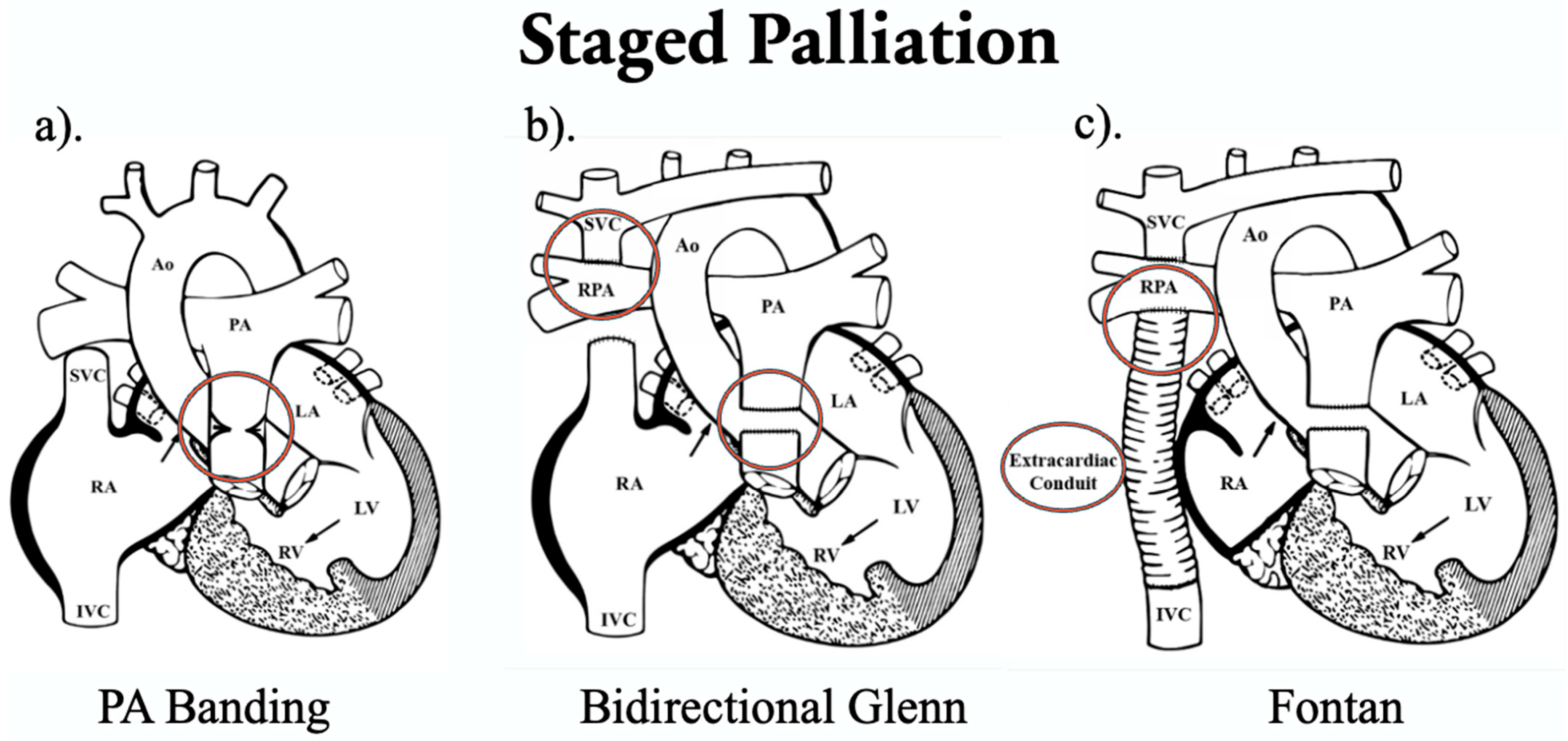
Clinical presentation in tricuspid atresia reflects the interplay between pulmonary and systemic blood flow. In patients with excessive pulmonary perfusion (types IIB and IIIC), unrestricted flow produces increased pulmonary venous return and left-sided volume overload, predisposing to congestive heart failure. Although systemic arterial oxygen saturation is relatively higher than in restrictive pulmonary perfusion types, the predominant issue is volume overload rather than cyanosis [30]. An optimal pulmonary-to-systemic flow ratio (Qp:Qs) of 1.5–2.5 ensures adequate oxygen delivery; however, when Qp:Qs exceeds 2–3:1, the left ventricle faces a substantial volume burden without meaningful improvement in oxygenation [35]. Infants with this physiology typically develop heart failure within weeks of birth, presenting with mild cyanosis, tachypnea, feeding intolerance, diaphoresis, recurrent respiratory infections, and failure to thrive [35]. The primary therapeutic intervention in this cohort involves pulmonary artery banding, a procedure in which a circumferential band is placed around the pulmonary artery to induce a controlled stenotic lesion, thereby reducing distal pulmonary pressures, mitigating left ventricular volume overload, and normalizing the Qp:Qs ratio (Figure 2) [36].
Conversely, neonates with diminished pulmonary blood flow (types Ia, Ib, IIa and IIIa) are at risk for profound systemic arterial hypoxemia. Pulmonary oligemia often results in early-onset central cyanosis, characterized by tachypnea, hyperpnea, irritability, lethargy, and, in severe cases, metabolic acidosis [35]. These infants typically exhibit a Qp:Qs ratio of <0.7:1, [37] with a majority falling under Type Ib, [35] defined by normally related great arteries, pulmonary stenosis, and a restrictive VSD. Additionally, neonates with pulmonary atresia—irrespective of great artery anatomy—are particularly vulnerable to precipitous cyanosis as the ductus arteriosus closes [38]. Initial management focuses on preserving ductal patency through prostaglandin E1 infusion to sustain pulmonary circulation until definitive surgical intervention [39,40]. In cases of severe cyanosis with ductal-dependent pulmonary perfusion, a modified Blalock–Thomas–Taussig shunt (mBTTS) is the preferred palliative strategy [40]. This procedure employs a interposition polytetrafluoroethylene (PTFE) graft between the subclavian or innominate artery and an ipsilateral pulmonary artery branch to establish a systemic-to-pulmonary shunt and enhance oxygenation [41,42]. Alternative palliative approaches—including central systemic-pulmonary shunts (e.g., ascending aorta-to-main pulmonary artery anastomosis) [43], right ventricular outflow tract obstruction resection and/or VSD enlargement [44], or ductal stenting [45,46,47]—may be considered in select cases, though the mBTTS remains the standard of care due to its superior efficacy and preservation of native anatomical structures for subsequent staged surgeries [35,48,49].
Following initial palliation with either pulmonary banding or mBTTS, the bidirectional Glenn (BDG) procedure is typically performed between 4 and 6 months of age [37]. This cavopulmonary connection reduces left ventricular volume overload and improves systemic oxygenation by directing SVC blood to the pulmonary arteries. However, as the child grows, the efficiency of the BDG shunt progressively declines due to the evolving ratio of superior vena cava (SVC) to inferior vena cava (IVC) venous return, which shifts from approximately 50:50 in early infancy to an adult proportion of 30:70 by 3–4 years of age [37]. Additionally, the onset of ambulation and increased lower extremity activity contribute to a greater volume of deoxygenated blood returning via the IVC, necessitating completion of the Fontan procedure by 2–3 years of age [37]. By this age, pulmonary vascular resistance has dropped to adult levels, allowing pulmonary blood flow and enabling effective Fontan circulation.

6. Surgical Palliation/Fontan Procedure
First described in 1971, the Fontan procedure is now the standard surgical palliation for congenital heart defects with a single functional ventricle or when biventricular repair is not feasible (i.e., hypoplastic left heart syndrome, tricuspid atresia). Advancements in surgical techniques, perioperative care, and long-term management have led to substantial improvements in survival rates, with over 70,000 patients worldwide currently living with Fontan circulation [50]. As this population is projected to double within the next two decades, it is essential to prioritize specialized care and the development of updated management guidelines to meet the evolving needs of these patients [50,51].
The Fontan procedure has undergone significant evolution since its inception, progressing from the atriopulmonary (AP) Fontan to total cavopulmonary connections (TCPC), including the lateral tunnel (LT) and extracardiac (EC) Fontan. The original AP Fontan, first described in the early 1970s [52], relied on right atrial contraction to propel blood into the pulmonary arteries but was later abandoned due to complications such as atrial dilation, energy dissipation, and thromboembolism [53,54]. In 1988, the LT Fontan was introduced, using a prosthetic patch and a small portion of atrial tissue to channel IVC flow to the pulmonary arteries, improving flow dynamics but retaining atrial involvement and thus continued risk for atrial dilation, pressure elevation, and arrhythmias [53]. Further refinement in 1990 led to the extracardiac (EC) Fontan, which entirely bypasses the right atrium using a synthetic graft, thereby avoiding atrial incisions and suture lines, preserving atrial compliance, and reducing atrial pressures while minimizing arrhythmias and optimizing flow dynamics [55]. Both LT and EC Fontan procedures are collectively referred to as TCPC, as they exclude most or all of the atrial cavity from the circuit, mitigating the risks associated with atrial dilation, blood stasis, and elevated atrial pressures. The EC Fontan has become the preferred approach in many contemporary centers due to its superior hemodynamic efficiency, lower incidence of arrhythmias, reduced thromboembolic risk, and improved survivability [56,57,58]. While the LT Fontan retains some potential benefits, such as allowing for growth adaptation [59], its requirement for atrial involvement introduces higher risks of atrial scarring, elevated atrial pressure, and postoperative arrhythmias [60,61]. With these advancements, the Fontan procedure continues to offer improved long-term outcomes for patients with single-ventricle physiology, though lifelong surveillance remains essential.
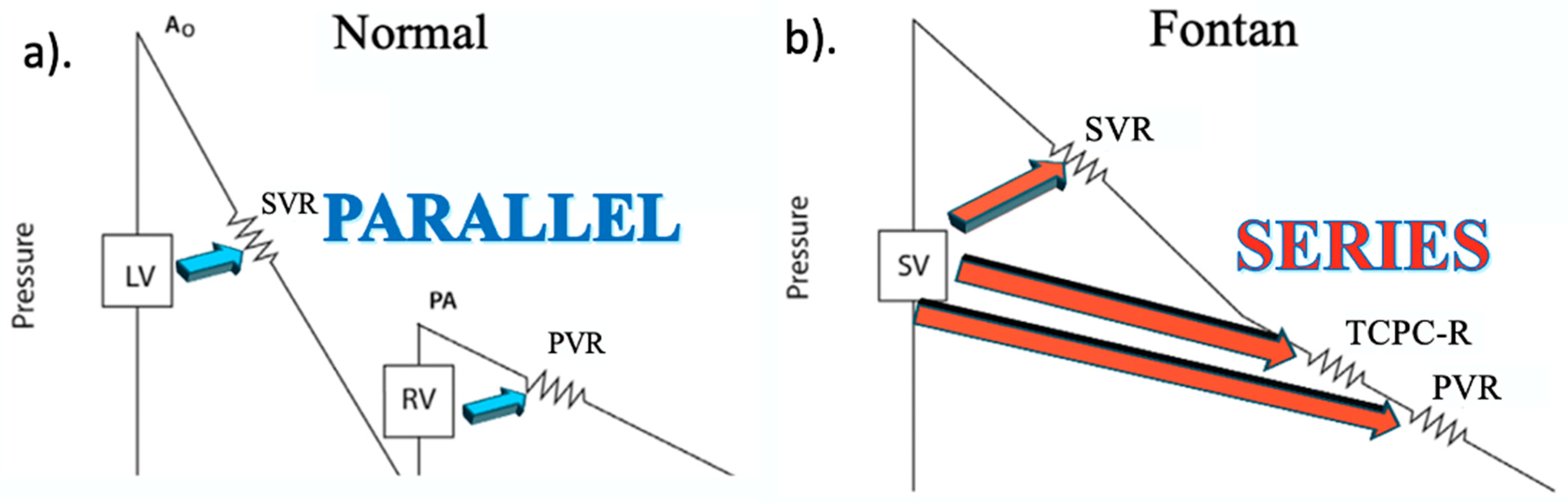
To understand Fontan physiology, it is useful to recall that in normal biventricular circulation the right and left ventricles pump in parallel, each opposing a distinct resistance—the right against PVR and the left against SVR—to maintain pulsatile pulmonary flow, balanced preload, and distributed afterload. (Figure 3a).
By contrast, the Fontan circulation functions as a series circuit (Figure 3b). Blood ejected from the single ventricle enters the systemic circulation against SVR. After delivering oxygen to the body, deoxygenated blood from the IVC and SVC is routed through surgically constructed Fontan conduits directly into the pulmonary arteries, bypassing a subpulmonary ventricle. As it flows through the conduits, the blood encounters resistance, commonly referred to in the literature as total cavopulmonary connection resistance (TCPC-R) [62]. It then traverses the pulmonary vasculature against PVR to reach the left atrium, from where it returns to the single ventricle, completing the circuit. In summary, Fontan physiology requires the single ventricle to generate output against three resistances in series—SVR → TCPC-R → PVR—to sustain effective circulation [62].
Figure 3. (a) Normal biventricular physiology and (b) Fontan physiology. (a) In normal biventricular physiology, the left ventricle (LV) pumps against the systemic vascular resistance (SVR) and the right ventricle (RV) pumps against the pulmonary vascular resistance (PVR) in parallel circuits, as depicted by the blue arrows. Ao = aorta; PA = pulmonary artery. (b) In Fontan physiology, a single ventricle (SV) must drive flow through three resistive elements in series—the SVR, the total cavopulmonary connection resistance (TCPC-R), and the PVR—illustrated by the red arrows, resulting in unique preload and afterload constraints. Modified from Rodefeld et al. [63] with permission from Elsevier.
Hearts 06 00030 g003
Although resistances in series are mathematically additive, the hemodynamic limitation to forward flow is governed predominantly by the segment with the highest resistance, as flow through the entire circuit is identical at steady state. In the Fontan circulation, PVR typically represents the dominant resistive load, meaning that even modest elevations in PVR disproportionately reduce cardiac output, despite contributions from SVR and TCPC-R.
In Fontan physiology, pulmonary blood flow is often characterized as “passive,” following the gradient central venous pressure (CVP) > mean pulmonary artery pressure (mPAP) > left atrial pressure (LAP) [12,64,65]. This, however, understates the critical dependence on the single ventricle, which must generate systemic output against SVR while maintaining a central venous pressure sufficient to drive blood through the TCPC and pulmonary vasculature.
As a result, Fontan circulation operates in a low-flow state due to limited ventricular power (single ventricle) and reduced preload [12,64], with a markedly elevated afterload imposed by the three serial resistances [62,66,67,68]. The physiology is highly sensitive to changes in CVP: even small reductions decrease the transpulmonary gradient, impair ventricular filling, and reduce cardiac output. Sustained systemic output therefore relies on preserved systolic and diastolic ventricular function and competent atrioventricular valve mechanics [12]. Any obstruction to aortic outflow or pulmonary venous return can further destabilize this already vulnerable circulation.

7. Perioperative Risk

The rates of perioperative complications are higher in patients with CHD. Therefore, meticulous preoperative assessment and optimization is critically important to mitigate this risk. A Closed Claims Project identified anesthetic management as the primary cause of patient injury (43%) in its investigation of factors contributing to adverse perioperative events in patients with CHD [69]. When comparing cardiac and noncardiac surgeries, adverse outcomes in noncardiac procedures were most commonly associated with postoperative care (50%) and preoperative assessment and optimization (40%) [69]. These findings underscore the critical importance of comprehensive perioperative management, beginning with a thorough preoperative evaluation to optimize patient outcomes. Maxwell et al. reported that anesthesiologists possess limited knowledge and comfort when managing patients with CHD presenting for noncardiac surgery [70]. Fewer than one-third (30%) of anesthesia providers demonstrated an understanding of Fontan circulation [70], a knowledge gap that likely contributes to adverse outcomes. Consistent with this, Brown et al. reported anesthesia-related events in 11.8% of high-risk palliated single-ventricle patients [71], while Rabbitts et al. observed perioperative complications in 31% of noncardiac surgeries following Fontan palliation [72]. These findings underscore the importance of continuity of care, comprehensive preoperative evaluation, and meticulous perioperative planning to optimize outcomes in this vulnerable population.

8. Preoperative Assessment

8.1. History

Patients with tricuspid atresia historically presented with cyanosis, congestive heart failure, or failure to thrive, reflecting the absence of right atrioventricular continuity and the resultant dependence on atrial and ventricular level shunts for systemic and pulmonary circulation. In practice, prenatal diagnosis is frequently made via fetal echocardiography [73,74]. A careful history should emphasize symptoms related to pulmonary blood flow; infants with pulmonary atresia or critical pulmonary stenosis (low pulmonary flow) typically present with profound early cyanosis, particularly if the patent ductus arteriosus closes, whereas those with unobstructed pulmonary blood flow (high pulmonary flow) may present with tachypnea, pulmonary congestion, poor feeding, and failure to thrive [49]. The timing, severity, and triggers of cyanotic episodes—such as crying or exertion—may provide important insight into the degree of pulmonary obstruction. History should also explore prior palliative procedures, including systemic-to-pulmonary artery shunts (e.g., Blalock–Taussig), pulmonary artery banding, or prior Fontan or Glenn procedures, as these significantly affect current hemodynamics and symptomatology [49]. Additional important historical questions include: episodes of hypercyanotic spells, exertional dyspnea, recurrent respiratory infections, neurologic events (stroke, seizure, brain abscess), arrhythmias, and prior hospitalizations for heart failure [75]. Secondary complications of chronic cyanosis and right-to-left shunting, including clubbing, polycythemia, and growth delay, should also be elicited [75]. The timing of cyanosis has prognostic implications: early neonatal cyanosis reflects severe pulmonary obstruction, whereas later-onset cyanosis suggests relatively preserved pulmonary blood flow [76]. Overall, a detailed history allows assessment of pulmonary flow status, prior interventions, and end-organ impact, all critical for guiding ongoing management.

8.2. Physical Examination

Central cyanosis is the most consistent clinical feature, reflecting systemic desaturation from obligatory right-to-left shunting at the atrial or ventricular level, and is especially pronounced in the more common subtypes with reduced pulmonary blood flow. Patients with restrictive atrial communications may also exhibit jugular venous distension with prominent “a” waves and hepatomegaly, as the right atrium cannot effectively empty into the hypoplastic right ventricle, leading to retrograde transmission of pressure into the systemic veins and liver [77,78]. In contrast, tachypnea and pulmonary congestion often times indicate the less frequent physiology of excessive pulmonary blood flow [77,78], in which elevated pulmonary venous return increases left atrial and pulmonary capillary pressures, producing interstitial and alveolar edema. Peripheral pulses are typically normal [77,78] unless coexistent aortic obstruction, such as coarctation, limits distal arterial flow [79]. Chronic hypoxemia results in digital clubbing, generally evident by two years of age [8] and characterized by bulbous enlargement of the distal phalanges, increased nail curvature, and soft tissue thickening [80]. Squatting, a rare finding, may serve as a compensatory maneuver by transiently increasing systemic vascular resistance, thereby enhancing pulmonary perfusion and oxygenation [8]. Collectively, these findings provide valuable insight into pulmonary blood flow, the severity of subpulmonary obstruction, and the balance between systemic and pulmonary circulation, guiding both diagnosis and management.

8.3. Auscultation

Auscultation may reveal a soft or absent tricuspid component of S1 due to the atretic tricuspid valve [81]. S2 may be single if pulmonary atresia is present, as the pulmonary valve does not close normally [82], whereas in cases with pulmonary stenosis (PS), S2 may be widely split with a soft or diminished P2 due to delayed pulmonary valve closure [83]. A holosystolic murmur at the left lower sternal border may be present, suggesting a VSD, sometimes accompanied by a palpable thrill if the VSD is restrictive or if severe PS exists, while a systolic ejection murmur at the left upper sternal border may indicate PS [49]. Additional possible findings include a continuous murmur from a PDA and increased or diminished pulmonary flow sounds [49]. The apical impulse may be displaced to the left of the midclavicular line, reflecting increased workload and potential volume overload of the morphologic left ventricle in response to systemic and pulmonary circulatory demands.

8.4. Electrocardiogram (ECG)

The electrocardiographic profile of tricuspid atresia is typically characterized by left axis deviation (mean QRS vector between −30° and −90°), left ventricular hypertrophy, and right atrial enlargement [84,85,86]. The leftward axis deviation is predominantly attributed to the unopposed dominance of left ventricular forces, a consequence of right ventricular hypoplasia [35,87]. Pathophysiological mechanisms—such as left bundle branch fibrosis [88], peri-infarction block [89,90], and conduction system anomalies [91]—have also been postulated. Notably, in approximately 50% of patients with type II anatomy (defined by transposition of the great arteries), the QRS axis may present as normal or even rightward [85,91]. Left ventricular hypertrophy manifests as high-amplitude R waves in leads V5 and V6 with deep S waves in V1 and V2 [92]. Right atrial enlargement (RAE), observed in nearly 75% of cases [93], is diagnosed based on P wave amplitude exceeding 2.5 mm in lead II (“peaked P wave”), a prominent initial positive deflection in the biphasic P wave of V1 or V2 greater than 1.5 mm, and, in some cases, a rightward P wave axis deviation [94]. A hallmark electrocardiographic feature of tricuspid atresia is the “P-tricuspidale” pattern, characterized by a bifid P wave [91]. The first, more pronounced peak corresponds to right atrial depolarization, while the second, smaller peak represents the left atrial depolarization. Left atrial enlargement (LAE) is more frequently observed in older individuals or those with increased pulmonary blood flow [85]. Additionally, ST-T wave abnormalities, indicative of secondary repolarization disturbances associated with ventricular hypertrophy, are identified in approximately 50% of cases [93].

8.5. Two-Dimensional Echocardiography (2DE)

Two-dimensional echocardiography plays a pivotal role in the diagnosis and management of tricuspid atresia, offering a comprehensive anatomical and hemodynamic assessment. It typically reveals an atretic tricuspid valve, a hypoplastic RV secondary to absent atrioventricular inflow, and the presence of an ASD or PFO, which serve as obligatory right-to-left shunts, facilitating systemic venous return to the left atrium (LA) [95]. It provides advanced insights into tricuspid atresia, particularly in assessing atrial septal patency and shunting, mitral valve integrity, left ventricular (LV) function, great artery orientation, ventriculo–arterial relationships, and outflow tract patency, including VSD or bulboventricular foramen (BVF) dimensions [95].
A comprehensive transthoracic echocardiographic (TTE) evaluation of tricuspid atresia requires the integration of multiple imaging windows to delineate anatomical abnormalities and assess hemodynamic intricacies of this congenital anomaly. The subcostal view serves as an initial window to establish atrial situs and confirm the absence of a tricuspid valve with an atretic right atrioventricular (AV) connection [96]. This view is instrumental in evaluating the presence and size of an ASD, which is crucial for systemic venous return, as well as in assessing the VSD that provides the only outlet for the diminutive RV. Furthermore, it facilitates an assessment of great artery orientation, allowing for differentiation between normally related great vessels and transposition of the great arteries (d-TGA or l-TGA) [97], while also identifying the presence of a PDA as a potential source of pulmonary blood flow via holodiastolic flow reversal in the abdominal aorta [98].
In the apical four-chamber view, the hallmark finding of tricuspid atresia—absence of the tricuspid valve—is readily visualized alongside a hypoplastic RV [95]. This perspective provides a detailed understanding of the atrial and ventricular connections, allowing for the characterization of systemic and pulmonary circulations. The size and shunting direction of the VSD become evident, playing a pivotal role in determining the degree of pulmonary blood flow and any restrictive physiology. Additionally, this view offers insight into LV function, which is particularly relevant as the LV commonly serves as the single ventricle. The degree of right atrial dilation can also be assessed, offering indirect clues about atrial pressures and potential restrictions in the interatrial communication.
The parasternal long-axis view further refines the understanding of ventricular morphology and outflow tract anatomy [95]. The hypoplastic RV and absent tricuspid inflow are reaffirmed, while the VSD is carefully evaluated for its size and hemodynamic significance, particularly in relation to its role in pulmonary circulation. This view is also critical for assessing left ventricular function and systemic output [99], ensuring that no additional outflow tract obstruction compromises perfusion.
Meanwhile, the parasternal short-axis view is invaluable in defining the relationship of the great arteries and determining whether they are normally related, transposed, or exhibit an anomalous origin [99]. This perspective also allows for meticulous evaluation of the pulmonary valve and main pulmonary artery (MPA) [99], particularly in cases where pulmonary stenosis or atresia is present, thereby influencing the need for systemic-to-pulmonary shunt placement. The branch pulmonary arteries are also examined for stenosis or hypoplasia [99], factors that could significantly impact surgical planning and long-term pulmonary vascular resistance.
The suprasternal view provides a broader context by delineating the aortic arch anatomy, identifying any coarctation or hypoplasia that may necessitate early intervention [30]. Additionally, this view is essential for confirming unobstructed pulmonary venous return and excluding anomalous pulmonary venous drainage [99], which, if present, can exacerbate cyanosis and pulmonary congestion. The PDA is also assessed, particularly if pulmonary blood flow is dependent on ductal patency. The PDA, however, is best accessed in the high left parasternal sagittal (ductal) view [98,99].
The evaluation of great vessel relationships in tricuspid atresia is dictated primarily by mitral-semilunar valve continuity [100]. In normal great artery (NRGA) arrangements, the aorta spirals posterior and to the right relative to the pulmonary artery, maintaining standard ventricular–arterial concordance. In d-transposition of the great arteries (d-TGA), mitral-pulmonic continuity is preserved, but the aorta lies anterior and rightward, coursing parallel to the pulmonary artery [101]. In contrast, in l-transposition (l-TGA), the aorta shifts anterior and leftward, reflecting ventricular inversion [101]. In patients with TGA, thorough assessment of the VSD and the possibility of subaortic stenosis is crucial, as restrictive VSDs or developing subaortic obstructions may require a Damus–Kaye–Stansel (DKS) procedure, in which the pulmonary trunk is anastomosed to the aorta [102]. Double outlet right ventricle (DORV) is marked by the emergence of both great arteries predominantly from the right ventricle, with the alignment of these vessels and the presence of a subaortic or subpulmonary VSD significantly influencing the physiological outcome [103]. In truncus arteriosus, a single arterial trunk supplies systemic, pulmonary, and coronary circulations, highlighting its embryologic failure in conotruncal septation [104].
Among the subtypes of tricuspid atresia, Type A is characterized by pulmonary atresia and complete RVOT obstruction, which inhibits pulmonary blood flow [3]. As a result, pulmonary circulation becomes entirely dependent on a PDA or MAPCAs, often requiring early prostaglandin administration until surgical correction can be performed [30,100]. On echocardiography, color Doppler imaging reveals an absence of flow across the pulmonary valve, with perfusion relying on ductal or collateral pathways. Type B features pulmonary stenosis, with a narrowed RVOT and reduced pulmonary blood flow [3]. Doppler imaging demonstrates a right-to-left atrial shunt and a left-to-right ventricular shunt. The examination of the interatrial septum, right ventricular aspect of the ventricular septum, and main pulmonary artery provides essential information on the restrictiveness of septal defects and quantifies the severity of pulmonary stenosis using the modified Bernoulli equation [100]. In contrast, Type C, which lacks pulmonary valve stenosis, is associated with unrestricted pulmonary blood flow, often leading to pulmonary overcirculation and volume overload [3]. Echocardiographic assessment typically reveals increased flow across the pulmonary valve, with resultant left atrial and ventricular dilation due to excessive pulmonary venous return [100]. This subtype is frequently associated with transposition of the great arteries (TGA) [100], emphasizing the importance of detailed imaging of the great vessels for precise surgical planning.
Beyond initial diagnosis, echocardiographic evaluation remains instrumental throughout the staged palliation process. It informs early interventions, such as aortopulmonary shunts and pulmonary artery banding, while also guiding postoperative surveillance following bidirectional Glenn and Fontan procedures. Post-surgical evaluation of bidirectional Glenn and Fontan circulation requires tailored imaging approaches. For the bidirectional Glenn shunt, the suprasternal notch view optimally visualizes the connection between the SVC and pulmonary arteries, allowing assessment of flow patency, stenosis, or thrombus formation with color Doppler [95]. In Fontan circulation, this view aids in evaluating SVC and brachiocephalic vein patency; however, it is less effective for direct conduit visualization [95]. In such cases, subcostal imaging, transesophageal echocardiography (TEE), and cardiac MRI/CT angiography provide superior assessment of extracardiac conduits, pulmonary artery anatomy, and systemic venous pathways, particularly when TTE windows are suboptimal [95]. By detecting residual shunting, conduit obstructions, fenestrations, and banding effects, echocardiography plays a pivotal role in optimizing long-term outcomes.
Color, pulsed-wave, and continuous-wave Doppler techniques delineate shunt directionality, quantify flow velocities, and estimate pressure gradients. Evaluation of the right ventricular outflow tract (RVOT) and pulmonary valve determines the severity of obstruction, while Doppler-derived gradients facilitate pulmonary artery pressure estimation via the Bernoulli equation [105]. Additionally, bubble contrast echocardiography, while not mandatory, can further characterize interatrial and interventricular shunting [106]. Given its utility in stratifying interstage mortality risk and identifying surgical complications, echocardiographic assessment must integrate prior interventions with current physiology to refine perioperative management and ensure individualized patient care.
Overall, two-dimensional TTE remains the frontline modality for initial cardiac assessment because it offers real-time, noninvasive evaluation of anatomy and hemodynamics with excellent temporal resolution, wide availability, and no radiation exposure. Its ability to rapidly characterize chamber size, valve function, shunts, and flow patterns makes it the indispensable first-line tool in suspected congenital or acquired cardiac disease.

8.6. Three-Dimensional Echocardiography (3DE)

Three-dimensional echocardiography enhances the evaluation of tricuspid atresia and Fontan circulation by providing volumetric, en-face visualization of atrioventricular and atrial–septal structures that are often incompletely characterized on 2D imaging. The European Association of Cardiovascular Imaging and the American Society of Echocardiography (ASE) strongly recommend 3DE for evaluating tricuspid valve abnormalities, emphasizing its utility in defining atrioventricular valve morphology and quantifying regurgitation, and its additional role in assessing left ventricular dyssynchrony in post-Fontan patients [107]. 3DE offers enhanced structural definition by improving delineation of the atretic tricuspid valve and the geometry of associated ASDs or surgically created atrial communications, while providing high-fidelity visualization of systemic atrioventricular valve leaflet coaptation [99,107]. Three-dimensional datasets also strengthen evaluation of systemic AV valve insufficiency by characterizing regurgitant mechanisms and complex jet morphology—particularly when jets are eccentric or multiple—and offer anatomically intuitive, surgeon-oriented renderings that support operative or interventional planning [99,107]. In Fontan patients, 3DE preserves real-time dynamic motion and improves visualization of fenestrations, atrial baffles, and the geometric relationships of inflow and outflow pathways, as well as systemic ventricular performance, in ways that complement CT and MRI [108,109]. Limitations—including dependence on acoustic windows, postoperative scarring, and lower spatial resolution compared with cross-sectional imaging [109,110]—reinforce its complementary contribution to CT and MRI in achieving a complete anatomical and physiological evaluation.

8.7. Computed Tomography (CT) Angiography

Cardiac CT angiography serves as a valuable complementary tool, offering superior spatial resolution and rapid acquisition for detailed mapping of systemic and pulmonary venous pathways, branch pulmonary arteries, aortopulmonary collateral vessels, coronary anatomy, and the aortic arch [111,112]. Computed tomography angiography (CTA) provides high-resolution definition of extracardiac cardiovascular anatomy in tricuspid atresia and Fontan circulation, serving as a key modality for evaluating conduit integrity, pathway patency, and the structural sequelae of chronically elevated venous pressures. CTA uniquely demonstrates the epicardial fat occupying the expected tricuspid valve location in tricuspid atresia and accurately defines right ventricular hypoplasia, associated ventricular septal defects, and aortic arch anomalies [113]. CTA is also effective in delineating the Fontan conduit, Glenn anastomoses, systemic venous return, and branch pulmonary arteries with excellent spatial resolution [111,114,115]. In Fontan patients, CTA serves as a cross-sectional tool for detecting pathway abnormalities and surveying the vascular, hepatic, and lymphatic consequences of long-standing venous hypertension [115]. These include pulmonary artery branch stenosis, venovenous or aortopulmonary collaterals, pulmonary arteriovenous malformations, pulmonary venous stenosis, and thromboembolic disease, as well as the full spectrum of Fontan-associated liver disease—from chronic hepatic congestion to regenerative nodules and hepatocellular carcinoma—and lymphatic sequelae such as pleural or pericardial effusions, chylothorax, and bronchial casts in plastic bronchitis [115]. Although CTA cannot quantify hemodynamic flow, its rapid acquisition, high spatial resolution, and excellent visualization of postoperative changes and calcified or stented structures make it an essential complementary modality when MRI is contraindicated or insufficient for comprehensive evaluation of tricuspid atresia and Fontan physiology.

8.8. Cardiac Magnetic Resonance (CMR) Imaging

Cardiac magnetic resonance (CMR) imaging is an important, widely utilized, and highly reliable modality for serial assessment of ventricular performance, valvular function, and cavopulmonary flow dynamics in patients with single-ventricle physiology following Fontan palliation [116,117,118]. In patients with tricuspid atresia, regardless of surgical stage or prior interventions, CMR examinations should consistently report systemic ventricular volumes and mass indexed to body surface area, ejection fraction, atrial size, myocardial tissue characteristics (native T1, extracellular volume (ECV), and late gadolinium enhancement (LGE) when obtained), systemic and pulmonary venous anatomy, cavopulmonary anastomoses, Fontan conduit patency including fenestrations or leaks, presence of thrombus, branch pulmonary artery size and mechanism of obstruction, aortic arch morphology and outflow tract dimensions, prior surgical shunts, and any visible aortopulmonary or venovenous collaterals, while phase-contrast imaging quantifies flows through the caval veins, azygos system, Fontan pathway, pulmonary arteries, aorta, pulmonary veins, and atrioventricular valves to derive Qp, Qs, systemic-to-pulmonary collateral burden, and valvular regurgitation, with qualitative assessment of lymphatic congestion and thoracic duct patency when visible [119]. Beyond these foundational elements, advanced CMR techniques—including 4D-flow mapping, energy-loss analysis, late gadolinium enhancement, T1/ECV mapping, and dedicated lymphatic or hepatic imaging—provide deeper insight into Fontan pathway efficiency, myocardial fibrosis, lymphatic dysfunction, and end-organ congestion, factors increasingly recognized as drivers of long-term morbidity in tricuspid atresia and Fontan survivors [120,121,122,123,124,125,126]. The multisociety CMR guidelines—endorsed by the American Heart Association along with SCMR, EACVI, ASE, SPR, and NASCI—provide comprehensive recommendations for standardized CMR acquisition and reporting in pediatric congenital and acquired heart disease. Reflecting the breadth of physiologic and anatomic information provided by CMR, these guidelines support its use across the entire single-ventricle pathway: it is reasonable when echocardiography is insufficient prior to determining univentricular versus biventricular repair (Class IIa, Level B), indicated before Glenn and Fontan operations in routine cases without evidence of elevated pressures (Class I, Level B), and recommended every 2–3 years after Fontan completion for routine surveillance of ventricular function, pathway patency, collateral burden, and end-organ sequelae (Class I, Level B) [127]. Collectively, these data position CMR as a cornerstone modality for standardized anatomic, functional, and hemodynamic assessment essential to operative planning and long-term management in tricuspid atresia.

8.9. Cardiac Catheterization

The AHA states that routine diagnostic catheterization is no longer required for single-ventricle lesions (Class IIa) because modern echocardiography, CT, and CMR provide sufficient anatomic and physiologic detail for most patients [128]. Catheterization is recommended when noninvasive imaging is inadequate or when precise hemodynamic data are needed for surgical planning—such as before the bidirectional Glenn or Fontan procedures (Class I) [128]. Catheter-based interventions—such as branch PA angioplasty/stenting, collateral embolization, or fenestration creation/dilation—are recommended when they provide physiologic benefit or facilitate staged palliation (Class I) [128].

9. Preoperative Optimization

9.1. Antibiotics

The AHA’s infective endocarditis prophylaxis guidelines—originally issued in 2007 and reaffirmed in 2021 [129]—maintain a selective, risk-based approach. For tricuspid atresia, prophylaxis is recommended only when the congenital heart disease criteria are met: unrepaired TA (as a cyanotic lesion), repaired TA with prosthetic material such as a Fontan conduit or patch during the first six months after surgery, or repaired TA with residual shunts or valvular regurgitation adjacent to prosthetic material [129]. Beyond six months, patients with completely repaired TA and no residual defects no longer require prophylaxis [129]. These recommendations apply specifically to dental procedures involving gingival or periapical manipulation [129]. Consistent with guideline updates, clindamycin is no longer recommended; cephalosporins, azithromycin, clarithromycin, or doxycycline are preferred alternatives for penicillin-allergic individuals [129]. Overall, this framework supports antibiotic stewardship while ensuring protection for TA patients at highest risk.

9.2. Anticoagulation

In the preoperative setting, appreciating the baseline thromboembolic risk inherent to Fontan physiology is essential, as it shapes anticoagulation strategies throughout the pre-, intra-, and postoperative periods. Thromboembolic events within the Fontan circulation constitute a significant contributor to early morbidity and mortality, with reported incidences of thrombosis ranging from 3% to 16% and stroke from 3% to 19% [130,131]. Fontan physiology creates a prothrombotic environment involving all components of Virchow’s triad: endothelial dysfunction, abnormal blood flow, and a hypercoagulable state. The construction of a Fontan circuit inherently disrupts the endothelial lining of the involved vessels, resulting in a thrombogenic surface, as evidenced by elevated markers of endothelial injury, such as von Willebrand factor (vWF) [132,133]. Abnormal blood flow can result from non-pulsatile, low-pressure venous blood flow, as well as fenestrations, pulmonary artery stumps, low cardiac output, and conduit stenosis [134]. Hypercoagulability due to coagulation factor abnormalities has been documented in several studies both before and after the Fontan procedure [132,135,136,137,138,139]. Specifically, reduced levels of circulating anticoagulants such as protein C, protein S, and antithrombin III have been observed [132,138] but, the absence of appropriate age-matched controls has hindered the accurate interpretation of these findings [136]. With age-matched controls, Cheung et al. demonstrated that pre-Fontan patients had lower levels of anticoagulants protein S, protein C, and antithrombin III compared to post-Fontan patients [135]. Furthermore, coagulation factors were positively correlated with systemic oxygen saturation, indicating that coagulation abnormalities present before the Fontan procedure likely normalize afterward, potentially due to improved oxygenation. Odegard et al. demonstrated that both procoagulant (factors II, V, VII, X) and anticoagulant (protein C, antithrombin III, plasminogen) factor levels were significantly lower in post-Fontan patients compared with age-matched controls [136]. Factor VIII was the only elevated procoagulant factor, found in 6 out of 20 post-Fontan patients, with the cause remaining unclear. It was suggested that elevated hepatic and central venous pressure might be responsible, though potential hepatic synthetic dysfunction and coagulation abnormalities were not explored. These abnormalities, compounded by liver dysfunction or protein-losing enteropathy post-surgery, further disrupt hemostasis [140,141].
Lifelong thromboprophylaxis is imperative in Fontan patients due to their heightened susceptibility to thromboembolic complications. The selection of an optimal anticoagulation strategy should be individualized, with aspirin, warfarin, and, more recently, direct oral anticoagulants (DOACs) serving as primary therapeutic agents. A comprehensive network meta-analysis encompassing 21 studies and 26,546 patient-years demonstrated that all three agents significantly mitigate thromboembolic risk, with DOACs emerging as the most efficacious [142]. Notably, major bleeding rates were comparable across treatment modalities, while aspirin exhibited the most favorable safety-efficacy balance [142]. Despite DOACs’ superior thromboprophylactic efficacy, aspirin remains a viable alternative due to its favorable risk profile [142]. The American College of Chest Physicians (ACCP) endorses aspirin at 1–5 mg/kg/day or a transition from unfractionated heparin (UFH) to vitamin K antagonists (VKAs), such as warfarin, with a target INR of 2.0–3.0 [143]. However, aspirin’s effectiveness in this population may vary, with studies indicating that up to 72% of patients show resistance, potentially heightening the risk of thrombosis [144]. Warfarin remains a mainstay by inhibiting the vitamin K-dependent clotting cascade, though its narrow therapeutic window, frequent monitoring requirements, and susceptibility to dietary and drug interactions pose significant clinical challenges [145]. Meanwhile, DOACs have gained prominence due to their predictable pharmacokinetics, minimal drug interactions, and elimination of routine INR monitoring. Trials such as UNIVERSE demonstrated that rivaroxaban is as safe as aspirin in pediatric Fontan patients, with low rates of major bleeding and thrombosis [146]. Similarly, the SAXOPHONE study showed that apixaban provides a safe alternative to standard anticoagulants in congenital heart disease patients [147]. From a preoperative standpoint, many Fontan patients will arrive for surgery on one of these agents, requiring planned interruption, bridging decisions, or continuation strategies depending on procedure risk and baseline thrombotic risk.
The American College of Cardiology (ACC) Anticoagulation Algorithm for Fontan Patients underscores the necessity of a personalized approach to thromboprophylaxis, stratifying patients based on individualized thromboembolic risk assessments [148]. High-risk individuals—those with a recent thromboembolic event, mechanical valve, recent stent placement, uncontrolled or newly controlled atrial arrhythmias, or recent Fontan pathway thrombosis—warrant anticoagulation with either warfarin or a DOAC [148]. For intermediate-risk individuals, including those with stable atrial arrhythmias for at least six months, remote stroke with an open fenestration, advanced heart failure, or Fontan circulatory failure, anticoagulation (warfarin or DOAC) or antiplatelet therapy (aspirin) may be appropriate [148]. Conversely, low-risk patients, devoid of these predisposing factors, require only aspirin for thromboprophylaxis [148]. Overall, it is essential to use a risk-stratified approach when tailoring anticoagulation in post-Fontan patients across the pre-, intra-, and postoperative periods.

9.3. Lymphatic Drainage

Lymphatic derangements are a hallmark of Fontan physiology and an important component of preoperative optimization. In normal circulation, the thoracic duct drains into the left internal jugular or subclavian vein, or their junction, and subsequently into the great veins, making it highly sensitive to fluctuations in central venous pressure (CVP). Prior to Fontan completion, SVC pressure typically averages around 12 mmHg, while atrial pressure is approximately 7 mmHg [149]. Following Fontan surgery, lower-body systemic venous pressure nearly doubles to match pulmonary artery pressure [150]. For Fontan circulation to function, systemic venous pressure must be elevated to sustain forward flow into the pulmonary vasculature, yet remain low enough to avoid lymphatic stasis and edema—the “Fontan paradox” [151]. Chronic venous hypertension disrupts the endothelial glycocalyx, increases capillary leak, and leads to dilated, dysfunctional lymphatics that contribute to multisystem complications [152]. Lymphatic congestion in the Fontan circulation most commonly manifests as protein-losing enteropathy and plastic bronchitis, and can also present with refractory pleural effusions, ascites, peripheral edema, and Fontan-associated liver disease (FALD)—all of which reflect advanced disease and a failing Fontan circulation [153,154].
Preoperative management focuses on identifying and correcting anatomic or physiologic contributors to elevated venous pressures. CT or MR angiography evaluates the SVC/IVC pathways, Fontan conduit stenosis, and venovenous collaterals, while cardiac catheterization provides direct pressure measurements, defines transpulmonary gradients, and identifies residual obstructions or collaterals that perpetuate lymphatic hypertension [155]. Dedicated lymphatic imaging—including T2-weighted MR lymphangiography for anatomic screening and dynamic-contrast MR lymphangiography to map leak or reflux pathways—can further characterize central and peripheral lymphatic anatomy [156].
Preoperative stabilization of intravascular volume and oncotic pressure—through nutritional rehabilitation, judicious diuretic therapy, and correction of hypoalbuminemia—reduces lymphatic congestion and prevents exaggerated changes in the free fraction of protein-bound anesthetic agents during induction and maintenance [152]. In patients with refractory protein-losing enteropathy, plastic bronchitis, or persistent effusions, targeted medical therapy (diuretics, somatostatin/octreotide, phosphodiesterase-5 inhibitors) should be optimized, and early referral for lymphatic interventions—such as thoracic duct decompression, stenting, embolization, or lymphovenous anastomosis—is warranted when medical management fails [152,157].

10. Intraoperative Management

10.1. Positioning

Intraoperative positioning can have significant hemodynamic effects on Fontan patients. It is important to communicate with the surgical team the implications of positioning. Positioning in the supine orientation is most advantageous for Fontan patients. Trendelenburg positioning may impair respiratory compliance, potentially resulting in hypoxia or hypercarbia, which in turn can elevate PVR [157]. Lateral positioning may induce ventilation/perfusion (V/Q) mismatch, also contributing to an increase in PVR [157]. Furthermore, reverse Trendelenburg positioning and laparoscopic surgery with CO2 insufflation may substantially reduce systemic venous return. Reduced venous return is poorly tolerated but can be mitigated with lower limb compression stockings, fluid resuscitation, and vasopressor support [157].

10.2. Hemodynamics

Preload is a key consideration in the perioperative management of Fontan patients. It is considered one of the primary determinants of cardiac output in the Fontan circuit [66,67,158,159,160,161]. Following Fontan completion, the single ventricle undergoes substantial structural remodeling. The single ventricle transitions from a state of volume overload, dilation, and eccentric hypertrophy—characteristic of the aorta-pulmonary shunting or banding phases of palliation—to an overgrown, underfilled, and hypertrophied state [162]. This dilated ventricle introduces significant volume unloading to the single ventricle under suboptimal preload conditions. The single ventricle’s preload is reduced to 25–70% of its size, resulting in both systolic and diastolic dysfunction, as well as myocardial dyssynchrony [163,164]. Through the Frank–Starling relationship, even modest decreases in preload proportionally reduce stroke volume and cardiac output [162].
Perioperative fluid management remains a topic of ongoing debate in anesthesiology, with increasing emphasis on goal-directed strategies to optimize hemodynamic stability. Rather than a fixed preoperative bolus, fluid administration should be individualized and guided by dynamic parameters such as central venous pressure, cardiac output, and stroke volume variation to maintain optimal preload while avoiding volume overload. Minimizing fasting times, establishing intravenous (IV) access preoperatively, and initiating controlled pre-induction hydration remain key components of preparation to mitigate hypovolemia and hemodynamic instability during anesthesia [165]. In Fontan patients, obtaining IV access before induction is particularly important given their heightened sensitivity to the myocardial depressant effects of volatile anesthetics; slow, titrated intravenous induction is therefore preferred to ensure a smooth and stable transition to anesthesia.
In Fontan physiology, ventricular preload is primarily determined by transpulmonary flow, which is influenced by the transpulmonary gradient (TPG) and PVR [166]. The TPG represents the pressure difference between the pulmonary artery and left atrial pressures [167], while PVR quantifies the resistance encountered by blood as it flows from the four pulmonary veins to the left atrium [168]. In Fontan patients, chronic hypoxia, associated with the presence of various shunts and conduits, induces hypoxic pulmonary vasoconstriction (HPV), leading to increased TPG and PVR. The European Pediatric Pulmonary Vascular Disease Network (EPPVDN) defines pulmonary hypertensive vascular disease in these patients as a TPG > 6 mmHg and a PVR index > 3 WU × m2 [169]. Elevated TPG and PVR subsequently increase central venous pressure (CVP) and decrease cardiac output by reducing preload to the left ventricle [170]. As noted by Gewillig and Boshoff, PVR is a primary modulator of cardiac output in Fontan patients [163]. Management therefore requires avoidance of physiologic perturbations—such as hypoxia, hypercarbia, acidosis, and hypothermia—that can acutely raise PVR and compromise cardiac output. Rapid airway control after induction is crucial for maintaining low PVR and ensuring hemodynamic stability [171]. PVR can be effectively reduced with mild hyperventilation (targeting a pCO2 of 30 mmHg or a pH of 7.45) and higher oxygen concentrations (pulmonary vasodilator) [171]. However, aggressive hyperventilation should be avoided, as severe hypocapnia may provoke cerebral vasoconstriction and reduce cerebral perfusion. In post-Fontan patients, nitric oxide and milrinone are particularly effective in lowering PVR [172].
Systemic vascular resistance (SVR) is also pivotal in the hemodynamic management of patients with Fontan physiology. When SVR increases, pulmonary blood flow rises while systemic blood flow falls (i.e., Qp:Qs > 1) [173]. While this may maintain normal systemic blood oxygen content, systemic perfusion and oxygen delivery remain inadequate due to reduced cardiac output. Acutely, excess pulmonary blood flow can result in clinical complications such as pulmonary edema, ventilation-perfusion (V/Q) mismatch, and cardiovascular collapse [174]. Chronically, elevated pulmonary blood flow and pressure lead to vascular remodeling, ultimately resulting in pulmonary vascular hypertrophy and the development of irreversible pulmonary hypertension [174]. Conversely, when SVR decreases, blood preferentially flows to the systemic circulation, reducing pulmonary perfusion and limiting oxygen loading in the lungs (Qp:Qs < 1). As a result, arterial oxygen content falls, compromising tissue oxygen delivery despite preserved systemic flow [175]. Additionally, when the Qp:Qs ratio falls to as low as 0.5–0.7:1, elevated SVC and intracranial pressures further reduce cerebral perfusion, clinically manifesting as confusion or irritability [12]. Interventions such as hyperventilation and resultant hypocarbia may reduce PVR but may simultaneously impair cerebral blood flow [12]. Thus, modulation of SVR through anesthetic depth, vasoactive support, temperature, volume status, and acid–base balance is essential to maintain balanced circulations [175].
In Fontan patients, contractility generally has minimal impact on cardiac output (CO) [166]. Because CO is primarily limited by preload and PVR, improvements in contractility rarely translate into substantial increases in forward flow. Post-Fontan patients often exhibit reduced indices of systolic function [176], though this does not necessarily reflect diminished myocardial contractility, as the metrics used to evaluate contractility are frequently influenced by load-dependent factors [177]. When vasopressors, inotropes, and pulmonary vasodilators are required, the choice of agents should be guided by the patient’s unique hemodynamic status. Vasopressin has been shown to be safe in the immediate postoperative period as it avoids pulmonary vasoconstriction, which could hinder pulmonary blood flow and CO [178]. Milrinone is frequently used as an inotropic agent in Fontan patients, with evidence supporting its safety [179]. A combination of milrinone with epinephrine or vasopressin may help counteract vasodilation [179,180].
Heart rate may also be subject to modification in post-Fontan patients. These individuals often exhibit “chronotropic incompetence,” characterized by a persistently lower heart rate compared to normal controls, typically attributed to impaired reflex control of heart rate or adrenergic dysfunction [181,182,183,184,185,186]. Atrial pacing, first introduced by Sowton et al. in 1967, has been utilized to examine the physiological responses of the circulatory system to controlled, incremental increases in heart rate [187]. In Fontan patients, Barber et al. demonstrated that pacing-induced tachycardia increases pulmonary vascular resistance, reduces stroke volume, and does not significantly affect cardiac output [188].
Preparedness to manage potential arrhythmias is essential in patients with Fontan physiology, as these arrhythmias can have significant clinical implications. Persistent arrhythmia complications following the extracardiac (EC) Fontan procedure may be attributed to various factors, including structural changes induced by hypoxemia, atrial remodeling, autonomic dysfunction, arrhythmogenic properties of the atrial tissue cuff at the IVC anastomosis, damage to the crista terminalis, and injury to adrenergic nerve endings [189,190,191,192,193,194,195,196,197]. Atrial arrhythmias are common in Fontan patients, with intra-atrial reentrant tachycardia (IART) being the most frequent, followed by nonautomatic focal atrial tachycardia (NAFAT) and atrial fibrillation [198]. The disruption of atrial-to-ventricular coordination impairs ventricular filling by eliminating the atrial kick, leading to a reduction in cardiac preload.
Newer iterations of the Fontan procedure often incorporate fenestrations, which play a crucial role in regulating pressure and maintaining cardiac output within the Fontan circulation. A fenestration is a small opening (typically ~4 mm) that connects the right atrium, lateral tunnel, or extracardiac conduit to the common atrium [199]. This allows systemic venous blood to “pop-off” into the common atrium and eventually into the left ventricle and aorta, reducing systemic venous pressure and maintaining preload and cardiac output during acute increases in PVR [200]. A fenestration has been shown to be the most effective adjunct in the Fontan circuit for enhancing cardiac output, as supported by multiple studies [201,202,203,204,205]. However, it carries the risk of a persistent right-to-left shunt, which can lead to hypoxia and allow paradoxical emboli, such as air or thrombus, to pass from right to left. Currently, no studies have conclusively demonstrated a higher stroke risk in fenestrated Fontan patients compared to those without fenestration [137]. In Fontan patients with fenestration, acute desaturation may suggest excessive flow through the fenestration and could indicate an early rise in PVR [199]. To mitigate the risk of paradoxical air embolism associated with the patient’s extracardiac conduit, ASD, and/or VSDs, air filters should be utilized to trap air bubbles and prevent their entry into the circulation.

10.3. Ventilation

Ventilatory strategies in Fontan patients depend on the interdependent relationship between the heart and lungs. Spontaneous ventilation is preferred for short procedures, as positive-pressure ventilation (PPV) can reduce pulmonary blood flow and cardiac output by elevating intrathoracic pressures [206]. When utilizing positive pressure ventilation (PPV), mean airway pressure should be kept at the minimum level required to ensure adequate minute ventilation, tidal volume, and gas exchange, while minimizing the risk of atelectasis [207]. Excessively high mean airway pressure can mechanically restrict venous return, pulmonary blood flow, and potentially cardiac output, with the extent of impact on cardiac output partially influenced by the presence and patency of fenestrations [207]. DiNardo et al. suggest achieving low mean airway pressures with larger tidal volumes (10–12 mL/kg), slower respiratory rates (10–15 breaths/min), and shorter inspiratory times (inspiratory-to-expiratory ratio of 1:3 or 1:4) [208]. Similarly, Bailey et al. recommend limiting peak inspiratory pressure (<20 cmH2O), using low respiratory rates (<20 bpm), shortening inspiratory times, avoiding excessive positive end-expiratory pressure (PEEP), moderately elevating tidal volumes (10–15 mL/kg), and ensuring adequate intravascular volume [157]. The choice of PEEP must strike a balance between reducing intrathoracic pressures and optimizing functional residual capacity, preventing atelectasis, and avoiding the compression or collapse of pulmonary blood vessels, as well as the pulmonary vasoconstriction that results from hypoxia and hypercarbia [209]. Notably, these patients often exhibit a significant PaCO2-ETCO2 gradient, attributable to an increased physiologic dead space. This arises because a larger portion of the lung is ventilated but not perfused, a consequence of the reduced pulmonary artery driving pressure (SVC pressure) [12]. Despite the possible negative effects of positive pressure ventilation (PPV), these may be outweighed by the harm caused by hypercarbia, hypoxemia, and decreased lung volumes, which can increase PVR and impair pulmonary blood flow during insufficient spontaneous ventilation. Determining the mode of ventilation should depend on the surgical procedure, duration, and the patient’s physiology.

11. Postoperative Management

Postoperative care for Fontan patients necessitates meticulous planning in the recovery setting. During the postanesthesia care unit (PACU) hand-off, it is crucial for nurses and anesthesiologists to fully comprehend the unique physiology and specific management goals for the patient. Hemodynamic objectives include minimizing PVR while maintaining adequate fluid balance, preload, and cardiac output. Effective pain management is vital to support normal breathing patterns and avoid significant respiratory depression. Ensuring adequate ventilation, with or without supplemental oxygen, is a critical component of care. Antiemetics should be administered intraoperatively to prevent dehydration and reduced venous return caused by vomiting, and sedating antiemetics should be avoided. Additionally, volume status management is particularly important, given the sensitivity of Fontan patients to preload reductions. Intravenous administration sets equipped with air filters should also be used postoperatively to mitigate the high risk of air embolism associated with multiple intracardiac shunts. Due to the frequent occurrence of prolonged ileus following noncardiac surgery in this patient population, it is advised that enteral nutrition be cautiously and gradually reintroduced [171].

12. Long-Term Outcomes

A contemporary meta-analysis of more than 7000 Fontan patients demonstrated excellent intermediate survival, with 5-, 10-, and 20-year survival rates of approximately 95%, 91%, and 82%, respectively [210]. Although long-term outcome data specific to tricuspid atresia remain limited, lesion-specific cohorts from the Fontan era report ~70–82% survival at 10 years and approximately 60% survival at 20 years, offering the best available estimates for this population [211]. The cohort described by Khairy et al. further underscores the relevance of these data to tricuspid atresia, as these patients accounted for 31% of the Fontan population overall and 92% of those undergoing an RA–RV connection—an older configuration strongly associated with late complications [212]. Late mortality after Fontan completion most often reflects circulatory failure, sudden cardiac death, or perioperative complications associated with subsequent interventions [213,214]. Risk is increased in patients with an atriopulmonary Fontan pathway, absence of fenestration, atrioventricular valve regurgitation, early surgical age, older Fontan age, and end-organ dysfunction such as acute or chronic kidney disease, protein-losing enteropathy, or Fontan-associated liver disease (FALD) with fibrosis or cirrhosis [50,210,213,215,216]. Additional physiologic markers—including heart failure, pulmonary hypertension, atrial or ventricular arrhythmias, cyanosis, and progressive ventricular dilation or dysfunction—further define a high-risk subgroup requiring closer surveillance [64,210,214,215,217]. Taken together, these findings indicate that while long-term survival after Fontan completion is broadly favorable, individuals with tricuspid atresia—particularly those repaired with older surgical connections or exhibiting early signs of multisystem involvement—represent a more vulnerable cohort that warrants vigilant lifelong follow-up and individualized management strategies.

13. Conclusions

The management of tricuspid atresia and Fontan physiology requires a comprehensive understanding of single-ventricle hemodynamics and the unique challenges of the Fontan circulation. Echocardiography remains the cornerstone of diagnosis and longitudinal assessment, providing essential insight into ventricular performance and overall circulatory efficiency. Although advances in surgical technique have improved survival, the Fontan circuit remains highly preload-dependent and vulnerable to even minor perturbations in volume status or vascular resistance.
Key priorities include preload optimization, modulation of systemic and pulmonary vascular resistance, and prevention of thromboembolic and lymphatic complications. Given the circulation’s preload dependence, perioperative care should emphasize goal-directed fluid and hemodynamic management, coupled with carefully titrated anesthetic techniques to preserve cardiac output and end-organ perfusion. Fenestrations can stabilize hemodynamics but pose risks of right-to-left shunting and paradoxical embolism, while the prothrombotic Fontan circuit necessitates lifelong anticoagulation tailored to individual risk. Despite surgical and medical advances, Fontan patients remain at risk of progressive circulatory failure driven by venous hypertension, elevated pulmonary resistance, and ventricular dysfunction. Long-term care should focus on early detection of complications such as protein-losing enteropathy, plastic bronchitis, hepatic congestion, and arrhythmias, while emerging pharmacologic, lymphatic-targeted, and mechanical support strategies hold promise for improved outcomes.
In conclusion, the management of Fontan circulation necessitates a vigilant, goal-directed approach focused on precise hemodynamic optimization, preservation of systemic output, and coordinated multidisciplinary care to sustain favorable long-term outcomes.

Author Contributions

Conceptualization, M.G.; investigation, M.G.; formal analysis, M.G.; visualization, M.G.; project administration, M.G.; writing—original draft preparation, M.G.; writing—review and editing, M.G., J.P., D.R. and J.B.; supervision, J.P., D.R. and J.B. All authors have read and agreed to the published version of the manuscript.

Funding

This research received no external funding.

Institutional Review Board Statement

Not applicable.

Informed Consent Statement

Not applicable.

Data Availability Statement

No new data were created or analyzed in this study. Data sharing is not applicable to this article.

Acknowledgments

The authors thank the Department of Anesthesiology at Stony Brook University Hospital for their collaboration and support during the preparation of this manuscript. They also acknowledge colleagues who provided valuable feedback on earlier drafts. During manuscript preparation, M.G. used Adobe Illustrator 2025® (Adobe Inc., San Jose, CA, USA) for graphical preparation of Figure 1, Figure 2 and Figure 3. The manuscript was carefully reviewed and refined by all authors prior to submission.

Conflicts of Interest

The authors declare no conflicts of interest.

Abbreviations

The following abbreviations are used in this manuscript:
ACCAmerican College of Cardiology
ACCPAmerican College of Chest Physicians
AHAAmerican Heart Association
AoAorta
ASDAtrial septal defect
ASEAmerican Society of Echocardiography
APAtriopulmonary
BDGBidirectional Glenn
CHDCongenital heart disease
CPAPContinuous positive airway pressure
CMRCardiac magnetic resonance
CTComputed tomography
CTAComputed tomography angiography
CVPCentral venous pressure
DKSDamus–Kaye–Stansel
DOACDirect oral anticoagulant
D-TGADextro-transposition of the great arteries
EACVIEuropean Association of Cardiovascular Imaging
ECExtracardiac
ECVExtracellular volume fraction
ECGElectrocardiogram
ETCO2End-tidal carbon dioxide
FALDFontan-associated liver disease
FiO2Fraction of inspired oxygen
IVCInferior vena cava
LALeft atrium
LAPLeft atrial pressure
LGELate gadolinium enhancement
LPALeft pulmonary artery
LTLateral tunnel (Fontan)
L-TGALevo-transposition of the great arteries
LVLeft ventricle
MAPMean arterial pressure
MAPCAsMajor aortopulmonary collateral arteries
mBTTSModified Blalock–Taussig–Thomas shunt
mPAPMean pulmonary artery pressure
MPAMain pulmonary artery
MRIMagnetic resonance imaging
MRLMagnetic resonance lymphangiography
NASCINorth American Society for Cardiovascular Imaging
NRGANormally related great arteries
PAPulmonary artery
PaCO2Arterial partial pressure of carbon dioxide
PAPPulmonary artery pressure
PDAPatent ductus arteriosus
PDE-5Phosphodiesterase-5 inhibitor
PFOPatent foramen ovale
PLEProtein-losing enteropathy
PPVPositive pressure ventilation
PVRPulmonary vascular resistance
Qp:QsPulmonary-to-systemic flow ratio
RARight atrium
RPARight pulmonary artery
RVRight ventricle
SCMRSociety for Cardiovascular Magnetic Resonance
SPRSociety for Pediatric Radiology
SVCSuperior vena cava
SVStroke volume
SVRSystemic vascular resistance
TATricuspid atresia
TCPCTotal cavopulmonary connection
TDEThoracic duct embolization
TEETransesophageal echocardiography
TGATransposition of the great arteries
TTETransthoracic echocardiography
VKAVitamin K antagonist (e.g., warfarin)
VSDVentricular septal defect
vWFvon Willebrand factor

References

  1. Rowe, R.D.; Freedom, R.M.; Mehrizi, A.; Bloom, K.R. The Neonate with Congenital Heart Disease. Second Edition. Major Probl. Clin. Pediatr. 1981, 5, 3–716. [Google Scholar]
  2. Rao, P.S. Demographic Features of Tricuspid Atresia. In Tricuspid Atresia; Rao, P.S., Ed.; Futura Publishing Co.: Mt. Kisco, NY, USA, 1992; pp. 23–37. [Google Scholar]
  3. Rao, P.S. A Unified Classification for Tricuspid Atresia. Am. Heart J. 1980, 99, 799–804. [Google Scholar] [CrossRef] [PubMed]
  4. Kuhne, M. Über Zwei Fälle Kongenitaler Atresie Des Ostium Venosum Dextrum. Jahresber. Kinderheilkd. 1906, 63, 225. [Google Scholar]
  5. Edwards, J.E.; Burchell, H.B. Congenital Tricuspid Atresia; a Classification. Med. Clin. N. Am. 1949, 33, 1177–1196. [Google Scholar] [CrossRef]
  6. Keith, J.D.; Rowe, R.D.; Vlad, P. Heart Disease in Infancy and Childhood. J. Med. Educ. 1958, 33, 608. [Google Scholar]
  7. Keith, J.D.; Rowe, R.D.; Vlad, P. Tricuspid Atresia. In Heart Disease in Infancy and Childhood; Macmillan: New York, NY, USA, 1967; pp. 518–541. [Google Scholar]
  8. Vlad, P. Tricuspid Atresia. In Heart Disease in Infancy and Childhood; Keith, J.D., Rowe, R.D., Vlad, P., Eds.; Macmillan Publishing Co., Inc.: New York, NY, USA, 1978; pp. 518–541. [Google Scholar]
  9. Diehl, A.M.; Lauer, R.M.; Shanker, K.R. Tricuspid Atresia. In Heart Disease in Infants, Children and Adolescents; Moss, A.J., Adams, F.H., Eds.; Williams and Wilkins: Baltimore, MD, USA, 1968; pp. 517–526. [Google Scholar]
  10. Rosenthal, A.; Dick, M. Tricuspid Atresia. In Moss’ Heart Disease in Infants, Children, and Adolescents; Adams, F., Emmanouilides, G., Riemenschneider, T., Eds.; Williams and Wilkins: Baltimore, MD, USA, 1977. [Google Scholar]
  11. Cetta, F.; Dearani, J.A.; O’Leary, P.W. Tricuspid Valve Disorders: Atresia, Dysplasia, and Ebstein Anomaly. In Moss & Adams’ Heart Disease in Infants, Children, and Adolescents: Including the Fetus and Young Adult; Shaddy, R.E., Penny, D.J., Feltes, T.F., Cetta, F., Mital, S., Eds.; Lippincott Williams & Wilkins: Philadelphia, PA, USA, 2022; pp. 1976–2026. ISBN 978-1-9751-1660-6. [Google Scholar]
  12. Nasr, V.G.; DiNardo, J.A. Single-Ventricle Lesions. In The Pediatric Cardiac Anesthesia Handbook; John Wiley & Sons, Ltd.: Oxford, UK, 2017; pp. 161–180. ISBN 978-1-119-09556-9. [Google Scholar]
  13. Park, I.S.; Kim, S.-J.; Goo, H.W. Tricuspid Atresia. In An Illustrated Guide to Congenital Heart Disease: From Diagnosis to Treatment –From Fetus to Adult; Park, I.S., Ed.; Springer: Singapore, 2019; pp. 253–267. ISBN 978-981-13-6978-0. [Google Scholar]
  14. Sleiman, A.-K.; Sadder, L.; Nemer, G. Human Genetics of Tricuspid Atresia and Univentricular Heart. In Congenital Heart Diseases: The Broken Heart: Clinical Features, Human Genetics and Molecular Pathways; Rickert-Sperling, S., Kelly, R.G., Haas, N., Eds.; Springer International Publishing: Cham, Switzerland, 2024; pp. 875–884. ISBN 978-3-031-44087-8. [Google Scholar]
  15. Hu, P.; Ji, X.; Yang, C.; Zhang, J.; Lin, Y.; Cheng, J.; Ma, D.; Cao, L.; Yi, L.; Xu, Z. 22q11.2 Microduplication in a Family with Recurrent Fetal Congenital Heart Disease. Eur. J. Med. Genet. 2011, 54, e433–e436. [Google Scholar] [CrossRef]
  16. Alva, C.; David, F.; Hernández, M.; Argüero, R.; Ortegón, J.; Martínez, A.; López, D.; Jiménez, S.; Sánchez, A. Tricuspid Atresia Associated with Common Arterial Trunk and 22q11 Chromosome Deletion. Arch. Cardiol. Mex. 2003, 73, 271–274. [Google Scholar] [PubMed]
  17. Miller, G.A.; Paneth, M.; Lennox, S.C. Surgical Management of Pulmonary Atresia with Intact Ventricular Septum in First Month of Life. Br. Heart J. 1973, 35, 554. [Google Scholar] [CrossRef][Green Version]
  18. Trost, D.; Engels, H.; Bauriedel, G.; Wiebe, W.; Schwanitz, G. Congenital cardiovascular malformations and chromosome microdeletions in 22q11.2. Dtsch. Med. Wochenschr. 1999, 124, 3–7. [Google Scholar] [CrossRef]
  19. Lizárraga, M.A.; Mintegui, S.; Sánchez Echániz, J.; Galdeano, J.M.; Pastor, E.; Cabrera, A. Heart malformations in trisomy 13 and trisomy 18. Rev. Esp. Cardiol. 1991, 44, 605–610. [Google Scholar]
  20. Wald, R.M.; Tham, E.B.; McCrindle, B.W.; Goff, D.A.; McAuliffe, F.M.; Golding, F.; Jaeggi, E.T.; Hornberger, L.K.; Tworetzky, W.; Nield, L.E. Outcome after Prenatal Diagnosis of Tricuspid Atresia: A Multicenter Experience. Am. Heart J. 2007, 153, 772–778. [Google Scholar] [CrossRef] [PubMed]
  21. Benson, D.W.; Basson, C.T.; MacRae, C.A. New Understandings in the Genetics of Congenital Heart Disease. Curr. Opin. Pediatr. 1996, 8, 505–511. [Google Scholar] [CrossRef]
  22. Fischer, A.; Klamt, B.; Schumacher, N.; Glaeser, C.; Hansmann, I.; Fenge, H.; Gessler, M. Phenotypic Variability in Hey2 -/- Mice and Absence of HEY2 Mutations in Patients with Congenital Heart Defects or Alagille Syndrome. Mamm. Genome 2004, 15, 711–716. [Google Scholar] [CrossRef]
  23. El-Rassy, I.; Bou-Abdallah, J.; Al-Ghadban, S.; Bitar, F.; Nemer, G. Absence of NOTCH2 and Hey2 Mutations in a Familial Alagille Syndrome Case with a Novel Frameshift Mutation in JAG1. Am. J. Med. Genet. Part. A 2008, 146A, 937–939. [Google Scholar] [CrossRef]
  24. Diaz-Frias, J.; Kondamudi, N.P. Alagille Syndrome. In StatPearls; StatPearls Publishing: Treasure Island, FL, USA, 2025. [Google Scholar]
  25. Da Silva, J.D.; Tkachenko, N.; Soares, A.R. Ellis-van Creveld Syndrome. In GeneReviews®; Adam, M.P., Feldman, J., Mirzaa, G.M., Pagon, R.A., Wallace, S.E., Amemiya, A., Eds.; University of Washington, Seattle: Seattle, WA, USA, 1993. [Google Scholar]
  26. Svensson, E.C.; Huggins, G.S.; Lin, H.; Clendenin, C.; Jiang, F.; Tufts, R.; Dardik, F.B.; Leiden, J.M. A Syndrome of Tricuspid Atresia in Mice with a Targeted Mutation of the Gene Encoding Fog-2. Nat. Genet. 2000, 25, 353–356. [Google Scholar] [CrossRef]
  27. Stallmeyer, B.; Fenge, H.; Nowak-Göttl, U.; Schulze-Bahr, E. Mutational Spectrum in the Cardiac Transcription Factor Gene NKX2.5 (CSX) Associated with Congenital Heart Disease. Clin. Genet. 2010, 78, 533–540. [Google Scholar] [CrossRef] [PubMed]
  28. Sarkozy, A.; Conti, E.; D’Agostino, R.; Digilio, M.C.; Formigari, R.; Picchio, F.; Marino, B.; Pizzuti, A.; Dallapiccola, B. ZFPM2/FOG2 and HEY2 Genes Analysis in Nonsyndromic Tricuspid Atresia. Am. J. Med. Genet. A 2005, 133A, 68–70. [Google Scholar] [CrossRef] [PubMed]
  29. Person, A.D.; Klewer, S.E.; Runyan, R.B. Cell Biology of Cardiac Cushion Development. Int. Rev. Cytol. 2005, 243, 287–335. [Google Scholar] [CrossRef]
  30. Rao, P.S. Congenital Malformations of the Tricuspid Valve: Diagnosis and Management—Part I. Ann. Vasc. Med. Res. 2022, 9, 1–15. [Google Scholar] [CrossRef]
  31. Dakkak, W.; Alahmadi, M.H.; Oliver, T.I. Ventricular Septal Defect. In StatPearls; StatPearls Publishing: Treasure Island, FL, USA, 2025. [Google Scholar]
  32. Gillam-Krakauer, M.; Mahajan, K. Patent Ductus Arteriosus. In StatPearls; StatPearls Publishing: Treasure Island, FL, USA, 2025. [Google Scholar]
  33. Alahmadi, M.H.; Sharma, S. Major Aortopulmonary Collateral Arteries. In StatPearls; StatPearls Publishing: Treasure Island, FL, USA, 2025. [Google Scholar]
  34. Spicer, D.E.; Hsu, H.H.; Co-Vu, J.; Anderson, R.H.; Fricker, F.J. Ventricular Septal Defect. Orphanet J. Rare Dis. 2014, 9, 144. [Google Scholar] [CrossRef]
  35. Rao, P.S.; Alapati, S. Tricuspid Atresia in the Neonate. Neonatol. Today 2012, 7, 1–12. [Google Scholar]
  36. Agasthi, P.; Graziano, J.N. Pulmonary Artery Banding. In StatPearls; StatPearls Publishing: Treasure Island, FL, USA, 2025. [Google Scholar]
  37. Nasr, V.G.; DiNardo, J.A. The Pediatric Cardiac Anesthesia Handbook; John Wiley & Sons: Hoboken, NJ, USA, 2024; ISBN 978-1-119-83541-7. [Google Scholar]
  38. Yun, S.W. Congenital Heart Disease in the Newborn Requiring Early Intervention. Korean J. Pediatr. 2011, 54, 183–191. [Google Scholar] [CrossRef]
  39. Bauser-Heaton, H.; Price, K.; Weber, R.; El-Said, H. Stenting of the Patent Ductus Arteriosus: A Meta-Analysis and Literature Review. J. Soc. Cardiovasc. Angiogr. Interv. 2023, 2, 101052. [Google Scholar] [CrossRef]
  40. Rao, P.S. Management of Congenital Heart Disease: State of the Art—Part II—Cyanotic Heart Defects. Children 2019, 6, 54. [Google Scholar] [CrossRef]
  41. de Leval, M.R.; McKay, R.; Jones, M.; Stark, J.; Macartney, F.J. Modified Blalock-Taussig Shunt. Use of Subclavian Artery Orifice as Flow Regulator in Prosthetic Systemic-Pulmonary Artery Shunts. J. Thorac. Cardiovasc. Surg. 1981, 81, 112–119. [Google Scholar] [CrossRef] [PubMed]
  42. Alahmadi, M.H.; Sharma, S.; Bishop, M.A. Modified Blalock-Taussig-Thomas Shunt. In StatPearls; StatPearls Publishing: Treasure Island, FL, USA, 2025. [Google Scholar]
  43. Crupi, G.; Alfieri, O.; Locatelli, G.; Villani, M.; Parenzan, L. Results of Systemic-to-Pulmonary Artery Anastomosis for Tricuspid Atresia with Reduced Pulmonary Blood Flow. Thorax 1979, 34, 290–293. [Google Scholar] [CrossRef]
  44. Annecchino, F.P.; Fontan, F.; Chauve, A.; Quaegebeur, J. Palliative Reconstruction of the Right Ventricular Outflow Tract in Tricuspid Atresia: A Report of 5 Patients. Ann. Thorac. Surg. 1980, 29, 317–321. [Google Scholar] [CrossRef] [PubMed]
  45. Gibbs, J.L.; Rothman, M.T.; Rees, M.R.; Parsons, J.M.; Blackburn, M.E.; Ruiz, C.E. Stenting of the Arterial Duct: A New Approach to Palliation for Pulmonary Atresia. Br. Heart J. 1992, 67, 240–245. [Google Scholar] [CrossRef] [PubMed]
  46. Siblini, G.; Rao, P.S.; Singh, G.K.; Tinker, K.; Balfour, I.C. Transcatheter Management of Neonates with Pulmonary Atresia and Intact Ventricular Septum. Catheter. Cardiovasc. Diagn. 1997, 42, 395–402. [Google Scholar] [CrossRef]
  47. Alwi, M.; Choo, K.K.; Latiff, H.A.; Kandavello, G.; Samion, H.; Mulyadi, M.D. Initial Results and Medium-Term Follow-up of Stent Implantation of Patent Ductus Arteriosus in Duct-Dependent Pulmonary Circulation. J. Am. Coll. Cardiol. 2004, 44, 438–445. [Google Scholar] [CrossRef]
  48. McMullan, D.M.; Permut, L.C.; Jones, T.K.; Johnston, T.A.; Rubio, A.E. Modified Blalock-Taussig Shunt versus Ductal Stenting for Palliation of Cardiac Lesions with Inadequate Pulmonary Blood Flow. J. Thorac. Cardiovasc. Surg. 2014, 147, 397–403. [Google Scholar] [CrossRef]
  49. Minocha, P.K.; Horenstein, M.S.; Phoon, C. Tricuspid Atresia. In StatPearls; StatPearls Publishing: Treasure Island, FL, USA, 2025. [Google Scholar]
  50. Rychik, J.; Atz, A.M.; Celermajer, D.S.; Deal, B.J.; Gatzoulis, M.A.; Gewillig, M.H.; Hsia, T.-Y.; Hsu, D.T.; Kovacs, A.H.; McCrindle, B.W.; et al. Evaluation and Management of the Child and Adult with Fontan Circulation: A Scientific Statement from the American Heart Association. Circulation 2019, 140, e234–e284. [Google Scholar] [CrossRef] [PubMed]
  51. Schilling, C.; Dalziel, K.; Nunn, R.; Du Plessis, K.; Shi, W.Y.; Celermajer, D.; Winlaw, D.; Weintraub, R.G.; Grigg, L.E.; Radford, D.J.; et al. The Fontan Epidemic: Population Projections from the Australia and New Zealand Fontan Registry. Int. J. Cardiol. 2016, 219, 14–19. [Google Scholar] [CrossRef] [PubMed]
  52. Fontan, F.; Baudet, E. Surgical Repair of Tricuspid Atresia. Thorax 1971, 26, 240–248. [Google Scholar] [CrossRef]
  53. de Leval, M.R.; Kilner, P.; Gewillig, M.; Bull, C. Total Cavopulmonary Connection: A Logical Alternative to Atriopulmonary Connection for Complex Fontan Operations. Exp. Stud. Early Clin. Experience. J. Thorac. Cardiovasc. Surg. 1988, 96, 682–695. [Google Scholar] [CrossRef]
  54. de Leval, M.R.; Deanfield, J.E. Four Decades of Fontan Palliation. Nat. Rev. Cardiol. 2010, 7, 520–527. [Google Scholar] [CrossRef]
  55. Marcelletti, C.; Como, A.; Giannico, S.; Marino, B. Inferior Vena Cava-Pulmonary Artery Extracardiac Conduit. J. Thorac. Cardiovasc. Surg. 1990, 100, 228–232. [Google Scholar] [CrossRef]
  56. d’Udekem, Y.; Iyengar, A.J.; Cochrane, A.D.; Grigg, L.E.; Ramsay, J.M.; Wheaton, G.R.; Penny, D.J.; Brizard, C.P. The Fontan Procedure Contemporary Techniques Have Improved Long-Term Outcomes. Circulation 2007, 116, I–157. [Google Scholar] [CrossRef]
  57. Kim, S.-J.; Kim, W.-H.; Lim, H.-G.; Lee, J.-Y. Outcome of 200 Patients after an Extracardiac Fontan Procedure. J. Thorac. Cardiovasc. Surg. 2008, 136, 108–116. [Google Scholar] [CrossRef]
  58. Deshaies, C.; Hamilton, R.M.; Shohoudi, A.; Trottier, H.; Poirier, N.; Aboulhosn, J.; Broberg, C.S.; Cohen, S.; Cook, S.; Dore, A.; et al. Thromboembolic Risk After Atriopulmonary, Lateral Tunnel, and Extracardiac Conduit Fontan Surgery. J. Am. Coll. Cardiol. 2019, 74, 1071–1081. [Google Scholar] [CrossRef]
  59. Rahm, A.L.; Razzouk, J.A.; Foster, C.S.; Voleti, S.L.; Razzouk, A.J.; Fortuna, R.S. Does the External Pericardial Lateral Tunnel Fontan Pathway Enlarge to Accommodate Somatic Growth? A Preliminary Analysis. World J. Pediatr. Congenit. Heart Surg. 2024, 15, 44–51. [Google Scholar] [CrossRef] [PubMed]
  60. van Doorn, C.A.; Leval, M.R. de The Lateral Tunnel Fontan. Oper. Tech. Thorac. Cardiovasc. Surg. 2006, 11, 105–122. [Google Scholar] [CrossRef]
  61. Nürnberg, J.H.; Ovroutski, S.; Alexi-Meskishvili, V.; Ewert, P.; Hetzer, R.; Lange, P.E. New Onset Arrhythmias After the Extracardiac Conduit Fontan Operation Compared with the Intraatrial Lateral Tunnel Procedure: Early and Midterm Results. Ann. Thorac. Surg. 2004, 78, 1979–1988. [Google Scholar] [CrossRef]
  62. Jolley, M.; Colan, S.D.; Rhodes, J.; DiNardo, J. Fontan Physiology Revisited. Anesth. Analg. 2015, 121, 172–182. [Google Scholar] [CrossRef]
  63. Rodefeld, M.D.; Boyd, J.H.; Myers, C.D.; Presson, R.G.; Wagner, W.W.; Brown, J.W. Cavopulmonary Assist in the Neonate: An Alternative Strategy for Single-Ventricle Palliation. J. Thorac. Cardiovasc. Surg. 2004, 127, 705–711. [Google Scholar] [CrossRef]
  64. Gewillig, M.; Brown, S.C. The Fontan Circulation after 45 Years: Update in Physiology. Heart 2016, 102, 1081–1086. [Google Scholar] [CrossRef] [PubMed]
  65. Miller-Hance, W.C. Anesthesia for Noncardiac Surgery in Children with Congenital Heart Disease. In A Practice of Anesthesia for Infants and Children, 6th ed.; Coté, C.J., Lerman, J., Anderson, B.J., Eds.; Elsevier: Philadelphia, PA, USA, 2019; pp. 534–559.e9. ISBN 978-0-323-42974-0. [Google Scholar]
  66. Sundareswaran, K.S.; Pekkan, K.; Dasi, L.P.; Whitehead, K.; Sharma, S.; Kanter, K.R.; Fogel, M.A.; Yoganathan, A.P. The Total Cavopulmonary Connection Resistance: A Significant Impact on Single Ventricle Hemodynamics at Rest and Exercise. Am. J. Physiol. Heart Circ. Physiol. 2008, 295, H2427–H2435. [Google Scholar] [CrossRef] [PubMed]
  67. Robbers-Visser, D.; Kapusta, L.; van Osch-Gevers, L.; Strengers, J.L.M.; Boersma, E.; de Rijke, Y.B.; Boomsma, F.; Bogers, A.J.J.C.; Helbing, W.A. Clinical Outcome 5 to 18 Years after the Fontan Operation Performed on Children Younger than 5 Years. J. Thorac. Cardiovasc. Surg. 2009, 138, 89–95. [Google Scholar] [CrossRef]
  68. Szabó, G.; Bährle, S. Contractility-Afterload Mismatch after the Fontan Operation. Cardiol. Young 2005, 15 (Suppl. 3), 35–38. [Google Scholar] [CrossRef]
  69. Maxwell, B.G.; Posner, K.L.; Wong, J.K.; Oakes, D.A.; Kelly, N.E.; Domino, K.B.; Ramamoorthy, C. Factors Contributing to Adverse Perioperative Events in Adults with Congenital Heart Disease: A Structured Analysis of Cases from the Closed Claims Project: Adverse Perioperative Events in ACHD. Congenit. Heart Dis. 2015, 10, 21–29. [Google Scholar] [CrossRef]
  70. Maxwell, B.G.; Williams, G.D.; Ramamoorthy, C. Knowledge and Attitudes of Anesthesia Providers about Noncardiac Surgery in Adults with Congenital Heart Disease. Congenit. Heart Dis. 2014, 9, 45–53. [Google Scholar] [CrossRef]
  71. Brown, M.L.; DiNardo, J.A.; Odegard, K.C. Patients with Single Ventricle Physiology Undergoing Noncardiac Surgery Are at High Risk for Adverse Events. Paediatr. Anaesth. 2015, 25, 846–851. [Google Scholar] [CrossRef] [PubMed]
  72. Rabbitts, J.A.; Groenewald, C.B.; Mauermann, W.J.; Barbara, D.W.; Burkhart, H.M.; Warnes, C.A.; Oliver, W.C.; Flick, R.P. Outcomes of General Anesthesia for Noncardiac Surgery in a Series of Patients with Fontan Palliation. Paediatr. Anaesth. 2013, 23, 180–187. [Google Scholar] [CrossRef] [PubMed]
  73. Berg, C.; Lachmann, R.; Kaiser, C.; Kozlowski, P.; Stressig, R.; Schneider, M.; Asfour, B.; Herberg, U.; Breuer, J.; Gembruch, U.; et al. Prenatal Diagnosis of Tricuspid Atresia: Intrauterine Course and Outcome. Ultrasound Obstet. Gynecol. 2010, 35, 183–190. [Google Scholar] [CrossRef]
  74. Bakker, M.K.; Bergman, J.E.H.; Krikov, S.; Amar, E.; Cocchi, G.; Cragan, J.; de Walle, H.E.K.; Gatt, M.; Groisman, B.; Liu, S.; et al. Prenatal Diagnosis and Prevalence of Critical Congenital Heart Defects: An International Retrospective Cohort Study. BMJ Open 2019, 9, e028139. [Google Scholar] [CrossRef]
  75. Dick, M.; Rosenthal, A.; Bove, E.; Rao, P.S. The Clinical Profile of Tricuspid Atresia. In Tricuspid Atresia; Futura Publishing Company: Mount Kisco, NY, USA, 1992; pp. 117–140. [Google Scholar]
  76. Steinhorn, R.H. Evaluation and Management of the Cyanotic Neonate. Clin. Pediatr. Emerg. Med. 2008, 9, 169–175. [Google Scholar] [CrossRef]
  77. Rao, P.S. Tricuspid Atresia. In A Comprehensive Approach to Congenital Heart Diseases; Jaypee Brothers Medical Pub: New Delhi, India, 2020; pp. 397–413. ISBN 978-93-5270-195-7. [Google Scholar]
  78. Balasubramanian, S.; Tacy, T. Tricuspid Valve Atresia; UpToDate Inc.: Treasure Island, FL, USA, 2025. [Google Scholar]
  79. Law, M.A.; Collier, S.A.; Sharma, S.; Tivakaran, V.S. Coarctation of the Aorta. In StatPearls; StatPearls Publishing: Treasure Island, FL, USA, 2025. [Google Scholar]
  80. McPhee, S.J. Clubbing. In Clinical Methods: The History, Physical, and Laboratory Examinations; Walker, H.K., Hall, W.D., Hurst, J.W., Eds.; Butterworths: Boston, MA, USA, 1990; ISBN 978-0-409-90077-4. [Google Scholar]
  81. Perloff, J.K. Cardiac Auscultation. Dis. A Mon. 1980, 26, 1–47. [Google Scholar] [CrossRef] [PubMed]
  82. Felner, J.M. The Second Heart Sound. In Clinical Methods: The History, Physical, and Laboratory Examinations; Walker, H.K., Hall, W.D., Hurst, J.W., Eds.; Butterworths: Boston, MA, USA, 1990; ISBN 978-0-409-90077-4. [Google Scholar]
  83. Heaton, J.; Horenstein, M.S.; Kyriakopoulos, C. Pulmonary Stenosis. In StatPearls; StatPearls Publishing: Treasure Island, FL, USA, 2025. [Google Scholar]
  84. Neill, C.A.; Brink, A.J. Left Axis Deviation in Tricuspid Atresia and Single Ventricle. Circulation 1955, 12, 612–619. [Google Scholar] [CrossRef]
  85. Davachi, F.; Lucas, R.V.; Moller, J.H. The Electrocardiogram and Vectorcardiogram in Tricuspid Atresia. Correlation with Pathologic Anatomy. Am. J. Cardiol. 1970, 25, 18–27. [Google Scholar] [CrossRef]
  86. Khairy, P.; Poirier, N.; Mercier, L.-A. Univentricular Heart. Circulation 2007, 115, 800–812. [Google Scholar] [CrossRef]
  87. Cabrera, E.; Gaxiola, A. Diagnostic Contribution of the Vectorcardiogram in Hemodynamic Overloading of the Heart. Am. Heart J. 1960, 60, 296–317. [Google Scholar] [CrossRef]
  88. Puri, P.; Neill, C. Vectorcardiographic Study in Ten Cases of Tricuspid Atresia. In Electrocardiography in Infants and Children; Cassels, D., Ziegler, R., Eds.; Grune and Stratton: New York, NY, USA, 1966; pp. 269–272. [Google Scholar]
  89. Grant, R.P. Left Axis Deviation; an Electrocardiographic-Pathologic Correlation Study. Circulation 1956, 14, 233–249. [Google Scholar] [CrossRef] [PubMed]
  90. Grant, R.P. Peri-Infarction Block. Prog. Cardiovasc. Dis. 1959, 2, 237–247. [Google Scholar] [CrossRef]
  91. Gamboa, R.; Gersony, W.M.; Nadas, A.S. The Electrocardiogram in Tricuspid Atresia and Pulmonary Atresia with Intact Ventricular Septum. Circulation 1966, 34, 24–37. [Google Scholar] [CrossRef] [PubMed]
  92. Peguero, J.G.; Lo Presti, S.; Perez, J.; Issa, O.; Brenes, J.C.; Tolentino, A. Electrocardiographic Criteria for the Diagnosis of Left Ventricular Hypertrophy. J. Am. Coll. Cardiol. 2017, 69, 1694–1703. [Google Scholar] [CrossRef]
  93. Rao, P.; Kulungara, R.; Boineau, J. Electrovectorcardiographic Features of Tricuspid Atresia. In Tricuspid Atresia; Rao, P., Ed.; Futura Publishing Co.: Mount Kisco, NY, USA, 1992; pp. 141–164. [Google Scholar]
  94. Hancock, E.W.; Deal, B.J.; Mirvis, D.M.; Okin, P.; Kligfield, P.; Gettes, L.S. AHA/ACCF/HRS Recommendations for the Standardization and Interpretation of the Electrocardiogram. Circulation 2009, 119, e251–e261. [Google Scholar] [CrossRef] [PubMed]
  95. Rao, P.S. Echocardiography in the Diagnosis and Management of Tricuspid Atresia. Appl. Sci. 2021, 11, 9472. [Google Scholar] [CrossRef]
  96. Corbett, L.; Forster, J.; Gamlin, W.; Duarte, N.; Burgess, O.; Harkness, A.; Li, W.; Simpson, J.; Bedair, R. A Practical Guideline for Performing a Comprehensive Transthoracic Echocardiogram in the Congenital Heart Disease Patient: Consensus Recommendations from the British Society of Echocardiography. Echo Res. Pract. 2022, 9, 10. [Google Scholar] [CrossRef]
  97. Martins, P.; Castela, E. Transposition of the Great Arteries. Orphanet J. Rare Dis. 2008, 3, 27. [Google Scholar] [CrossRef]
  98. Arlettaz, R. Echocardiographic Evaluation of Patent Ductus Arteriosus in Preterm Infants. Front. Pediatr. 2017, 5, 147. [Google Scholar] [CrossRef]
  99. Lopez, L.; Saurers, D.L.; Barker, P.C.A.; Cohen, M.S.; Colan, S.D.; Dwyer, J.; Forsha, D.; Friedberg, M.K.; Lai, W.W.; Printz, B.F.; et al. Guidelines for Performing a Comprehensive Pediatric Transthoracic Echocardiogram: Recommendations from the American Society of Echocardiography. J. Am. Soc. Echocardiogr. 2024, 37, 119–170. [Google Scholar] [CrossRef]
  100. Rao, P.S. Noninvasive Evaluation of Patients with Tricuspid Atresia (Roentgenography, Echocardiography, and Nuclear Angiography). In Tricuspid Atresia; Futura Publishing Co.: Mt. Kisco, NY, USA, 1992; pp. 165–182. [Google Scholar]
  101. Szymanski, M.W.; Moore, S.M.; Kritzmire, S.M.; Thomas, A.; Goyal, A. Transposition of the Great Arteries. In StatPearls; StatPearls Publishing: Treasure Island, FL, USA, 2025. [Google Scholar]
  102. Rao, P.S. Natural History of Ventricular Septal Defects in Tricuspid Atresia. In Tricuspid Atresia; Futura Publishing Co.: Mt. Kisco, NY, USA, 1992; pp. 261–293. [Google Scholar]
  103. Goo, H.W. Double Outlet Right Ventricle: In-Depth Anatomic Review Using Three-Dimensional Cardiac CT Data. Korean J. Radiol. 2021, 22, 1894–1908. [Google Scholar] [CrossRef]
  104. Bhansali, S.; Horenstein, M.S.; Phoon, C. Truncus Arteriosus. In StatPearls; StatPearls Publishing: Treasure Island, FL, USA, 2025. [Google Scholar]
  105. Parasuraman, S.; Walker, S.; Loudon, B.L.; Gollop, N.D.; Wilson, A.M.; Lowery, C.; Frenneaux, M.P. Assessment of Pulmonary Artery Pressure by Echocardiography—A Comprehensive Review. Int. J. Cardiol. Heart Vasc. 2016, 12, 45–51. [Google Scholar] [CrossRef]
  106. Lee, M.; Oh, J.H. Echocardiographic Diagnosis of Right-to-Left Shunt Using Transoesophageal and Transthoracic Echocardiography. Open Heart 2020, 7, e001150. [Google Scholar] [CrossRef] [PubMed]
  107. Simpson, J.; Lopez, L.; Acar, P.; Friedberg, M.K.; Khoo, N.S.; Ko, H.H.; Marek, J.; Marx, G.; McGhie, J.S.; Meijboom, F.; et al. Three-Dimensional Echocardiography in Congenital Heart Disease: An Expert Consensus Document from the European Association of Cardiovascular Imaging and the American Society of Echocardiography. J. Am. Soc. Echocardiogr. 2017, 30, 1–27. [Google Scholar] [CrossRef] [PubMed]
  108. Shirali, G.S. Three Dimensional Echocardiography in Congenital Heart Defects. Ann. Pediatr. Cardiol. 2008, 1, 8–17. [Google Scholar] [CrossRef] [PubMed]
  109. Spanaki, A.; Kabir, S.; Stephenson, N.; van Poppel, M.P.M.; Benetti, V.; Simpson, J. 3D Approaches in Complex CHD: Where Are We? Funny Printing and Beautiful Images, or a Useful Tool? J. Cardiovasc. Dev. Dis. 2022, 9, 269. [Google Scholar] [CrossRef]
  110. Turton, E.W.; Ender, J. Role of 3D Echocardiography in Cardiac Surgery: Strengths and Limitations. Curr. Anesthesiol. Rep. 2017, 7, 291–298. [Google Scholar] [CrossRef]
  111. Saremi, F.; Hassani, C.; Millan-Nunez, V.; Sánchez-Quintana, D. Imaging Evaluation of Tricuspid Valve: Analysis of Morphology and Function with CT and MRI. AJR Am. J. Roentgenol. 2015, 204, W531–W542. [Google Scholar] [CrossRef]
  112. Han, B.K.; Lesser, J.R. CT Imaging in Congenital Heart Disease: An Approach to Imaging and Interpreting Complex Lesions after Surgical Intervention for Tetralogy of Fallot, Transposition of the Great Arteries, and Single Ventricle Heart Disease. J. Cardiovasc. Comput. Tomogr. 2013, 7, 338–353. [Google Scholar] [CrossRef]
  113. White, C.S.; Haramati, L.B.; Chen, J.J.-S.; Levsky, J.M. Cardiac Imaging; Oxford University Press: Oxford, UK, 2014; ISBN 978-0-19-982947-7. [Google Scholar]
  114. Dillman, J.R.; Hernandez, R.J. Role of CT in the Evaluation of Congenital Cardiovascular Disease in Children. Am. J. Roentgenol. 2009, 192, 1219–1231. [Google Scholar] [CrossRef] [PubMed]
  115. Kumar, P.; Bhatia, M. Computed Tomography in the Evaluation of Fontan Circulation. J. Cardiovasc. Imaging 2021, 29, 108–122. [Google Scholar] [CrossRef]
  116. Leiner, T.; Bogaert, J.; Friedrich, M.G.; Mohiaddin, R.; Muthurangu, V.; Myerson, S.; Powell, A.J.; Raman, S.V.; Pennell, D.J. SCMR Position Paper (2020) on Clinical Indications for Cardiovascular Magnetic Resonance. J. Cardiovasc. Magn. Reson. 2020, 22, 76. [Google Scholar] [CrossRef]
  117. Puricelli, F.; Voges, I.; Gatehouse, P.; Rigby, M.; Izgi, C.; Pennell, D.J.; Krupickova, S. Performance of Cardiac MRI in Pediatric and Adult Patients with Fontan Circulation. Radiol. Cardiothorac. Imaging 2022, 4, e210235. [Google Scholar] [CrossRef] [PubMed]
  118. Detterich, J.; Taylor, M.D.; Slesnick, T.C.; DiLorenzo, M.; Hlavacek, A.; Lam, C.Z.; Sachdeva, S.; Lang, S.M.; Campbell, M.J.; Gerardin, J.; et al. Cardiac Magnetic Resonance Imaging to Determine Single Ventricle Function in a Pediatric Population Is Feasible in a Large Trial Setting: Experience from the Single Ventricle Reconstruction Trial Longitudinal Follow Up. Pediatr. Cardiol. 2023, 44, 1454–1461. [Google Scholar] [CrossRef]
  119. Grosse-Wortmann, L.; Wald, R.M.; Valverde, I.; Valsangiacomo-Buechel, E.; Ordovas, K.; Raimondi, F.; Browne, L.; Babu-Narayan, S.V.; Krishnamurthy, R.; Yim, D.; et al. Society for Cardiovascular Magnetic Resonance Guidelines for Reporting Cardiovascular Magnetic Resonance Examinations in Patients with Congenital Heart Disease. J. Cardiovasc. Magn. Reson. 2024, 26, 101062. [Google Scholar] [CrossRef]
  120. Callegari, A.; Marcora, S.; Burkhardt, B.; Voutat, M.; Kellenberger, C.J.; Geiger, J.; Valsangiacomo Buechel, E.R. Myocardial Deformation in Fontan Patients Assessed by Cardiac Magnetic Resonance Feature Tracking: Correlation with Function, Clinical Course, and Biomarkers. Pediatr. Cardiol. 2021, 42, 1625–1634. [Google Scholar] [CrossRef]
  121. Rijnberg, F.M.; Westenberg, J.J.M.; van Assen, H.C.; Juffermans, J.F.; Kroft, L.J.M.; van den Boogaard, P.J.; Terol Espinosa de Los Monteros, C.; Warmerdam, E.G.; Leiner, T.; Grotenhuis, H.B.; et al. 4D Flow Cardiovascular Magnetic Resonance Derived Energetics in the Fontan Circulation Correlate with Exercise Capacity and CMR-Derived Liver Fibrosis/Congestion. J. Cardiovasc. Magn. Reson. 2022, 24, 21. [Google Scholar] [CrossRef]
  122. Rijnberg, F.M.; Hazekamp, M.G.; Wentzel, J.J.; de Koning, P.J.H.; Westenberg, J.J.M.; Jongbloed, M.R.M.; Blom, N.A.; Roest, A.A.W. Energetics of Blood Flow in Cardiovascular Disease. Circulation 2018, 137, 2393–2407. [Google Scholar] [CrossRef]
  123. Kato, A.; Riesenkampff, E.; Yim, D.; Yoo, S.-J.; Seed, M.; Grosse-Wortmann, L. Pediatric Fontan Patients Are at Risk for Myocardial Fibrotic Remodeling and Dysfunction. Int. J. Cardiol. 2017, 240, 172–177. [Google Scholar] [CrossRef] [PubMed]
  124. Iwaki, M.; Kobayashi, T.; Wada, N.; Saiki, Y.; Nagai, K.; Nogami, A.; Kawai, S.; Koyama, S.; Utsunomiya, D.; Nakajima, A.; et al. Efficacy of Magnetic Resonance Elastography in Fontan-Associated Liver Disease. JGH Open 2025, 9, e70274. [Google Scholar] [CrossRef] [PubMed]
  125. Shiina, Y.; Inai, K.; Shimada, E.; Sakai, R.; Tokushige, K.; Niwa, K.; Nagao, M. Abdominal Lymphatic Pathway in Fontan Circulation Using Non-Invasive Magnetic Resonance Lymphangiography. Heart Vessel. 2023, 38, 581–587. [Google Scholar] [CrossRef]
  126. Everett, R.J.; Stirrat, C.G.; Semple, S.I.R.; Newby, D.E.; Dweck, M.R.; Mirsadraee, S. Assessment of Myocardial Fibrosis with T1 Mapping MRI. Clin. Radiol. 2016, 71, 768–778. [Google Scholar] [CrossRef]
  127. Fogel, M.A.; Anwar, S.; Broberg, C.; Browne, L.; Chung, T.; Johnson, T.; Muthurangu, V.; Taylor, M.; Valsangiacomo-Buechel, E.; Wilhelm, C. Society for Cardiovascular Magnetic Resonance/European Society of Cardiovascular Imaging/American Society of Echocardiography/Society for Pediatric Radiology/North American Society for Cardiovascular Imaging Guidelines for the Use of Cardiovascular Magnetic Resonance in Pediatric Congenital and Acquired Heart Disease. J. Cardiovasc. Magn. Reson. 2022, 24, 37. [Google Scholar] [CrossRef]
  128. Feltes, T.F.; Bacha, E.; Beekman, R.H.; Cheatham, J.P.; Feinstein, J.A.; Gomes, A.S.; Hijazi, Z.M.; Ing, F.F.; de Moor, M.; Morrow, W.R.; et al. Indications for Cardiac Catheterization and Intervention in Pediatric Cardiac Disease. Circulation 2011, 123, 2607–2652. [Google Scholar] [CrossRef] [PubMed]
  129. Wilson, W.R.; Gewitz, M.; Lockhart, P.B.; Bolger, A.F.; DeSimone, D.C.; Kazi, D.S.; Couper, D.J.; Beaton, A.; Kilmartin, C.; Miro, J.M.; et al. Prevention of Viridans Group Streptococcal Infective Endocarditis: A Scientific Statement from the American Heart Association. Circulation 2021, 143, e963–e978. [Google Scholar] [CrossRef] [PubMed]
  130. Monagle, P.; Cochrane, A.; McCrindle, B.; Benson, L.; Williams, W.; Andrew, M. Thromboembolic Complications after Fontan Procedures--the Role of Prophylactic Anticoagulation. J. Thorac. Cardiovasc. Surg. 1998, 115, 493–498. [Google Scholar] [CrossRef]
  131. Monagle, P.; Karl, T.R. Thromboembolic Problems after the Fontan Operation. Semin. Thorac. Cardiovasc. Surg. Pediatr. Card. Surg. Annu. 2002, 5, 36–47. [Google Scholar] [CrossRef]
  132. Tomkiewicz-Pajak, L.; Hoffman, P.; Trojnarska, O.; Lipczyńska, M.; Podolec, P.; Undas, A. Abnormalities in Blood Coagulation, Fibrinolysis, and Platelet Activation in Adult Patients after the Fontan Procedure. J. Thorac. Cardiovasc. Surg. 2014, 147, 1284–1290. [Google Scholar] [CrossRef] [PubMed]
  133. Kelly, J.M.; Mirhaidari, G.J.M.; Chang, Y.-C.; Shinoka, T.; Breuer, C.K.; Yates, A.R.; Hor, K.N. Evaluating the Longevity of the Fontan Pathway. Pediatr. Cardiol. 2020, 41, 1539–1547. [Google Scholar] [CrossRef]
  134. Van Den Helm, S.; Sparks, C.N.; Ignjatovic, V.; Monagle, P.; Attard, C. Increased Risk for Thromboembolism After Fontan Surgery: Considerations for Thromboprophylaxis. Front. Pediatr. 2022, 10, 803408. [Google Scholar] [CrossRef]
  135. Cheung, E.W.Y.; Chay, G.W.; Ma, E.S.K.; Cheung, Y. Systemic Oxygen Saturation and Coagulation Factor Abnormalities before and after the Fontan Procedure. Am. J. Cardiol. 2005, 96, 1571–1575. [Google Scholar] [CrossRef]
  136. Odegard, K.C.; McGowan, F.X.; Zurakowski, D.; DiNardo, J.A.; Castro, R.A.; del Nido, P.J.; Laussen, P.C. Procoagulant and Anticoagulant Factor Abnormalities Following the Fontan Procedure: Increased Factor VIII May Predispose to Thrombosis. J. Thorac. Cardiovasc. Surg. 2003, 125, 1260–1267. [Google Scholar] [CrossRef]
  137. Attard, C.; Huang, J.; Monagle, P.; Ignjatovic, V. Pathophysiology of Thrombosis and Anticoagulation Post Fontan Surgery. Thromb. Res. 2018, 172, 204–213. [Google Scholar] [CrossRef]
  138. Jahangiri, M.; Kreutzer, J.; Zurakowski, D.; Bacha, E.; Jonas, R.A. Evaluation of Hemostatic and Coagulation Factor Abnormalities in Patients Undergoing the Fontan Operation. J. Thorac. Cardiovasc. Surg. 2000, 120, 778–782. [Google Scholar] [CrossRef] [PubMed]
  139. Odegard, K.C.; McGowan, F.X.; Zurakowski, D.; DiNardo, J.A.; Castro, R.A.; del Nido, P.J.; Laussen, P.C. Coagulation Factor Abnormalities in Patients with Single-Ventricle Physiology Immediately Prior to the Fontan Procedure. Ann. Thorac. Surg. 2002, 73, 1770–1777. [Google Scholar] [CrossRef] [PubMed]
  140. Rychik, J.; Dodds, K.M.; Goldberg, D.; Glatz, A.C.; Fogel, M.; Rossano, J.; Chen, J.; Pinto, E.; Ravishankar, C.; Rand, E.; et al. Protein Losing Enteropathy After Fontan Operation: Glimpses of Clarity Through the Lifting Fog. World J. Pediatr. Congenit. Heart Surg. 2020, 11, 92–96. [Google Scholar] [CrossRef]
  141. Al Balushi, A.; Mackie, A.S. Protein-Losing Enteropathy Following Fontan Palliation. Can. J. Cardiol. 2019, 35, 1857–1860. [Google Scholar] [CrossRef]
  142. Van den Eynde, J.; Possner, M.; Alahdab, F.; Veldtman, G.; Goldstein, B.H.; Rathod, R.H.; Hoskoppal, A.K.; Saraf, A.; Feingold, B.; Alsaied, T. Thromboprophylaxis in Patients with Fontan Circulation. J. Am. Coll. Cardiol. 2023, 81, 374–389. [Google Scholar] [CrossRef] [PubMed]
  143. Monagle, P.; Chan, A.K.C.; Goldenberg, N.A.; Ichord, R.N.; Journeycake, J.M.; Nowak-Göttl, U.; Vesely, S.K. Antithrombotic Therapy in Neonates and Children: Antithrombotic Therapy and Prevention of Thrombosis, 9th Ed: American College of Chest Physicians Evidence-Based Clinical Practice Guidelines. CHEST 2012, 141, e737S–e801S. [Google Scholar] [CrossRef]
  144. Berganza, F.M.; Alba, C.G.; de Egbe, A.C.; Bartakian, S.; Brownlee, J. Prevalence of Aspirin Resistance by Thromboelastography plus Platelet Mapping in Children with CHD: A Single-Centre Experience. Cardiol. Young 2019, 29, 24–29. [Google Scholar] [CrossRef]
  145. Patel, S.; Singh, R.; Preuss, C.V.; Patel, N. Warfarin. In StatPearls; StatPearls Publishing: Treasure Island, FL, USA, 2024. [Google Scholar]
  146. McCrindle, B.W.; Michelson, A.D.; Van Bergen, A.H.; Suzana Horowitz, E.; Pablo Sandoval, J.; Justino, H.; Harris, K.C.; Jefferies, J.L.; Miriam Pina, L.; Peluso, C.; et al. Thromboprophylaxis for Children Post-Fontan Procedure: Insights from the UNIVERSE Study. J. Am. Heart Assoc. 2021, 10, e021765. [Google Scholar] [CrossRef]
  147. Payne, R.M.; Burns, K.M.; Glatz, A.C.; Li, D.; Li, X.; Monagle, P.; Newburger, J.W.; Swan, E.A.; Wheaton, O.; Male, C. A Multi-National Trial of a Direct Oral Anticoagulant in Children with Cardiac Disease: Design and Rationale of the SAXOPHONE Study. Am. Heart J. 2019, 217, 52–63. [Google Scholar] [CrossRef]
  148. Alsaied, T.; Possner, M.; Van den Eynde, J.; Kreutzer, J. Anticoagulation Algorithm for Fontan Patients. 2023. Available online: https://www.acc.org/Latest-in-Cardiology/Articles/2023/04/05/14/10/Anticoagulation-Algorithm-For-Fontan-Patients (accessed on 25 November 2025).
  149. d’Udekem, Y.; Iyengar, A.J.; Galati, J.C.; Forsdick, V.; Weintraub, R.G.; Wheaton, G.R.; Bullock, A.; Justo, R.N.; Grigg, L.E.; Sholler, G.F.; et al. Redefining Expectations of Long-Term Survival After the Fontan Procedure. Circulation 2014, 130, S32–S38. [Google Scholar] [CrossRef]
  150. Menon, S.; Chennapragada, M.; Ugaki, S.; Sholler, G.F.; Ayer, J.; Winlaw, D.S. The Lymphatic Circulation in Adaptations to the Fontan Circulation. Pediatr. Cardiol. 2017, 38, 886–892. [Google Scholar] [CrossRef]
  151. de Leval, M.R. The Fontan Circulation: A Challenge to William Harvey? Nat. Clin. Pract. Cardiovasc. Med. 2005, 2, 202–208. [Google Scholar] [CrossRef]
  152. RochéRodríguez, M.; DiNardo, J.A. The Lymphatic System in the Fontan Patient—Pathophysiology, Imaging, and Interventions: What the Anesthesiologist Should Know. J. Cardiothorac. Vasc. Anesth. 2022, 36, 2669–2678. [Google Scholar] [CrossRef]
  153. Mazza, G.A.; Gribaudo, E.; Agnoletti, G. The Pathophysiology and Complications of Fontan Circulation. Acta Biomed. 2021, 92, e2021260. [Google Scholar] [CrossRef]
  154. Mackie, A.S.; Veldtman, G.R.; Thorup, L.; Hjortdal, V.E.; Dori, Y. Plastic Bronchitis and Protein-Losing Enteropathy in the Fontan Patient: Evolving Understanding and Emerging Therapies. Can. J. Cardiol. 2022, 38, 988–1001. [Google Scholar] [CrossRef] [PubMed]
  155. Ciliberti, P.; Ciancarella, P.; Bruno, P.; Curione, D.; Bordonaro, V.; Lisignoli, V.; Panebianco, M.; Chinali, M.; Secinaro, A.; Galletti, L.; et al. Cardiac Imaging in Patients After Fontan Palliation: Which Test and When? Front. Pediatr. 2022, 10, 876742. [Google Scholar] [CrossRef] [PubMed]
  156. Tomasulo, C.E.; Chen, J.M.; Smith, C.L.; Maeda, K.; Rome, J.J.; Dori, Y. Lymphatic Disorders and Management in Patients with Congenital Heart Disease. Ann. Thorac. Surg. 2022, 113, 1101–1111. [Google Scholar] [CrossRef]
  157. Bailey, P.D.; Jobes, D.R. The Fontan Patient. Anesthesiol. Clin. 2009, 27, 285–300. [Google Scholar] [CrossRef]
  158. Redington, A. The Physiology of the Fontan Circulation. Progress. Pediatr. Cardiol. 2006, 22, 179–186. [Google Scholar] [CrossRef]
  159. Senzaki, H.; Masutani, S.; Ishido, H.; Taketazu, M.; Kobayashi, T.; Sasaki, N.; Asano, H.; Katogi, T.; Kyo, S.; Yokote, Y. Cardiac Rest and Reserve Function in Patients with Fontan Circulation. J. Am. Coll. Cardiol. 2006, 47, 2528–2535. [Google Scholar] [CrossRef] [PubMed]
  160. Klimes, K.; Abdul-Khaliq, H.; Ovroutski, S.; Hui, W.; Alexi-Meskishvili, V.; Spors, B.; Hetzer, R.; Felix, R.; Lange, P.E.; Berger, F.; et al. Pulmonary and Caval Blood Flow Patterns in Patients with Intracardiac and Extracardiac Fontan: A Magnetic Resonance Study. Clin. Res. Cardiol. 2007, 96, 160–167. [Google Scholar] [CrossRef]
  161. Robbers-Visser, D.; Helderman, F.; Strengers, J.L.; van Osch-Gevers, L.; Kapusta, L.; Pattynama, P.M.; Bogers, A.J.; Krams, R.; Helbing, W.A. Pulmonary Artery Size and Function after Fontan Operation at a Young Age. J. Magn. Reson. Imaging 2008, 28, 1101–1107. [Google Scholar] [CrossRef] [PubMed]
  162. Gewillig, M. THE FONTAN CIRCULATION. Heart 2005, 91, 839–846. [Google Scholar] [CrossRef]
  163. Gewillig, M.; Boshoff, D.E. Missing a Sub-Pulmonary Ventricle: The Fontan Circulation. In The Right Ventricle in Health and Disease; Voelkel, N.F., Schranz, D., Eds.; Springer: New York, NY, USA, 2015; pp. 135–157. ISBN 978-1-4939-1065-6. [Google Scholar]
  164. Khambadkone, S. The Fontan Pathway: What’s the down Road? Ann. Pediatr. Cardiol. 2008, 1, 83–92. [Google Scholar] [CrossRef] [PubMed]
  165. Rodriguez, M.R.; Nasr, V.G. Failing Fontan. In Congenital Cardiac Anesthesia: A Case-based Approach; Spaeth, J.P., Berenstain, L.K., Eds.; Cambridge University Press: Cambridge, UK, 2021; pp. 226–238. ISBN 978-1-108-49416-8. [Google Scholar]
  166. Gewillig, M.; Brown, S.C.; Eyskens, B.; Heying, R.; Ganame, J.; Budts, W.; La Gerche, A.; Gorenflo, M. The Fontan Circulation: Who Controls Cardiac Output? Interact. Cardiovasc. Thorac. Surg. 2010, 10, 428–433. [Google Scholar] [CrossRef]
  167. Naeije, R.; Vachiery, J.-L.; Yerly, P.; Vanderpool, R. The Transpulmonary Pressure Gradient for the Diagnosis of Pulmonary Vascular Disease. Eur. Respir. J. 2012, 41, 217–223. [Google Scholar] [CrossRef]
  168. Widrich, J.; Shetty, M. Physiology, Pulmonary Vascular Resistance. In StatPearls; StatPearls Publishing: Treasure Island, FL, USA, 2025. [Google Scholar]
  169. Hansmann, G.; Koestenberger, M.; Alastalo, T.-P.; Apitz, C.; Austin, E.D.; Bonnet, D.; Budts, W.; D’Alto, M.; Gatzoulis, M.A.; Hasan, B.S.; et al. 2019 Updated Consensus Statement on the Diagnosis and Treatment of Pediatric Pulmonary Hypertension: The European Pediatric Pulmonary Vascular Disease Network (EPPVDN), Endorsed by AEPC, ESPR and ISHLT. J. Heart Lung Transpl. 2019, 38, 879–901. [Google Scholar] [CrossRef]
  170. Handler, S.S.; Feinstein, J.A. Pulmonary Vascular Disease in the Single-Ventricle Patient: Is It Really Pulmonary Hypertension and If So, How and When Should We Treat It? Adv. Pulm. Hypertens. 2019, 18, 14–18. [Google Scholar] [CrossRef]
  171. Eagle, S.S.; Daves, S.M. The Adult with Fontan Physiology: Systematic Approach to Perioperative Management for Noncardiac Surgery. J. Cardiothorac. Vasc. Anesth. 2011, 25, 320–334. [Google Scholar] [CrossRef] [PubMed]
  172. Cai, J.; Su, Z.; Shi, Z.; Zhou, Y.; Xu, Z.; Xu, Z.; Yang, Y. Nitric Oxide and Milrinone: Combined Effect on Pulmonary Circulation after Fontan-Type Procedure: A Prospective, Randomized Study. Ann. Thorac. Surg. 2008, 86, 882–888; discussion 882–888. [Google Scholar] [CrossRef]
  173. Magoon, R.; Makhija, N.; Jangid, S.K. Balancing a Single-Ventricle Circulation: ‘Physiology to Therapy’. Indian. J. Thorac. Cardiovasc. Surg. 2020, 36, 159–162. [Google Scholar] [CrossRef]
  174. Becker, K.; Uebing, A.; Hansen, J.H. Pulmonary Vascular Disease in Fontan Circulation—Is There a Rationale for Pulmonary Vasodilator Therapies? Cardiovasc. Diagn. Ther. 2021, 11, 1111–1121. [Google Scholar] [CrossRef] [PubMed]
  175. Greaney, D.; Honjo, O.; O’Leary, J.D. The Single Ventricle Pathway in Paediatrics for Anaesthetists. BJA Educ. 2019, 19, 144–150. [Google Scholar] [CrossRef] [PubMed]
  176. Parikh, S.R.; Hurwitz, R.A.; Caldwell, R.L.; Girod, D.A. Ventricular Function in the Single Ventricle before and after Fontan Surgery. Am. J. Cardiol. 1991, 67, 1390–1395. [Google Scholar] [CrossRef]
  177. Akagi, T.; Benson, L.N.; Green, M.; Ash, J.; Gilday, D.L.; Williams, W.G.; Freedom, R.M. Ventricular Performance before and after Fontan Repair for Univentricular Atrioventricular Connection: Angiographic and Radionuclide Assessment. J. Am. Coll. Cardiol. 1992, 20, 920–926. [Google Scholar] [CrossRef][Green Version]
  178. Bigelow, A.M.; Ghanayem, N.S.; Thompson, N.E.; Scott, J.P.; Cassidy, L.D.; Woods, K.J.; Woods, R.K.; Mitchell, M.E.; Hraŝka, V.; Hoffman, G.M. Safety and Efficacy of Vasopressin After Fontan Completion: A Randomized Pilot Study. Ann. Thorac. Surg. 2019, 108, 1865–1874. [Google Scholar] [CrossRef]
  179. Windsor, J.; Townsley, M.M.; Briston, D.; Villablanca, P.A.; Alegria, J.R.; Ramakrishna, H. Fontan Palliation for Single-Ventricle Physiology: Perioperative Management for Noncardiac Surgery and Analysis of Outcomes. J. Cardiothorac. Vasc. Anesth. 2017, 31, 2296–2303. [Google Scholar] [CrossRef]
  180. Leyvi, G.; Wasnick, J.D. Single-Ventricle Patient: Pathophysiology and Anesthetic Management. J. Cardiothorac. Vasc. Anesth. 2010, 24, 121–130. [Google Scholar] [CrossRef]
  181. Zajac, A.; Tomkiewicz, L.; Podolec, P.; Tracz, W.; Malec, E. Cardiorespiratory Response to Exercise in Children after Modified Fontan Operation. Scand. Cardiovasc. J. 2002, 36, 80–85. [Google Scholar] [CrossRef]
  182. Zellers, T.M.; Driscoll, D.J.; Mottram, C.D.; Puga, F.J.; Schaff, H.V.; Danielson, G.K. Exercise Tolerance and Cardiorespiratory Response to Exercise before and after the Fontan Operation. Mayo Clin. Proc. 1989, 64, 1489–1497. [Google Scholar] [CrossRef]
  183. Gewillig, M.H.; Lundström, U.R.; Bull, C.; Wyse, R.K.; Deanfield, J.E. Exercise Responses in Patients with Congenital Heart Disease after Fontan Repair: Patterns and Determinants of Performance. J. Am. Coll. Cardiol. 1990, 15, 1424–1432. [Google Scholar] [CrossRef]
  184. Cortes, R.G.; Satomi, G.; Yoshigi, M.; Momma, K. Maximal Hemodynamic Response after the Fontan Procedure: Doppler Evaluation during the Treadmill Test. Pediatr. Cardiol. 1994, 15, 170–177. [Google Scholar] [CrossRef]
  185. Takken, T.; Tacken, M.H.; Blank, A.C.; Hulzebos, E.H.; Strengers, J.L.; Helders, P.J. Exercise Limitation in Patients with Fontan Circulation: A Review. J. Cardiovasc. Med. 2007, 8, 775. [Google Scholar] [CrossRef] [PubMed]
  186. Blaufox, A.D.; Sleeper, L.A.; Bradley, D.J.; Breitbart, R.E.; Hordof, A.; Kanter, R.J.; Stephenson, E.A.; Stylianou, M.; Vetter, V.L.; Saul, J.P.; et al. Functional Status, Heart Rate, and Rhythm Abnormalities in 521 Fontan Patients 6 to 18 Years of Age. J. Thorac. Cardiovasc. Surg. 2008, 136, 100–107. [Google Scholar] [CrossRef] [PubMed]
  187. Sowton, G.E.; Balcon, R.; Cross, D.; Frick, M.H. Measurement of the Angina Threshold Using Atrial Pacing. A New Technique for the Study of Angina Pectoris. Cardiovasc. Res. 1967, 1, 301–307. [Google Scholar] [CrossRef]
  188. Barber, G.; Di Sessa, T.; Child, J.S.; Perloff, J.K.; Laks, H.; George, B.L.; Williams, R.G. Hemodynamic Responses to Isolated Increments in Heart Rate by Atrial Pacing after a Fontan Procedure. Am. Heart J. 1988, 115, 837–841. [Google Scholar] [CrossRef] [PubMed]
  189. van der Linde, D.; Konings, E.E.M.; Slager, M.A.; Witsenburg, M.; Helbing, W.A.; Takkenberg, J.J.M.; Roos-Hesselink, J.W. Birth Prevalence of Congenital Heart Disease Worldwide: A Systematic Review and Meta-Analysis. J. Am. Coll. Cardiol. 2011, 58, 2241–2247. [Google Scholar] [CrossRef]
  190. Del Duca, D.; Tadevosyan, A.; Karbassi, F.; Akhavein, F.; Vaniotis, G.; Rodaros, D.; Villeneuve, L.R.; Allen, B.G.; Nattel, S.; Rohlicek, C.V.; et al. Hypoxia in Early Life Is Associated with Lasting Changes in Left Ventricular Structure and Function at Maturity in the Rat. Int. J. Cardiol. 2012, 156, 165–173. [Google Scholar] [CrossRef]
  191. Wolf, C.M.; Seslar, S.P.; den Boer, K.; Juraszek, A.L.; McGowan, F.X.; Cowan, D.B.; Nido, P.D.; Triedman, J.K.; Berul, C.I.; Walsh, E.P. Atrial Remodeling After the Fontan Operation. Am. J. Cardiol. 2009, 104, 1737–1742. [Google Scholar] [CrossRef]
  192. Dahlqvist, J.A.; Karlsson, M.; Wiklund, U.; Hörnsten, R.; Strömvall-Larsson, E.; Berggren, H.; Hanseus, K.; Johansson, S.; Rydberg, A. Heart Rate Variability in Children with Fontan Circulation: Lateral Tunnel and Extracardiac Conduit. Pediatr. Cardiol. 2012, 33, 307–315. [Google Scholar] [CrossRef]
  193. Van Stee, E.W. Autonomic Innervation of the Heart. Environ. Health Perspect. 1978, 26, 151–158. [Google Scholar] [CrossRef]
  194. Zhao, Q.-Y.; Huang, H.; Tang, Y.-H.; Wang, X.; Okello, E.; Liang, J.-J.; Jiang, H.; Huang, C.-X. Relationship between Autonomic Innervation in Crista Terminalis and Atrial Arrhythmia. J. Cardiovasc. Electrophysiol. 2009, 20, 551–557. [Google Scholar] [CrossRef] [PubMed]
  195. Jonas, R.A. The Intra/Extracardiac Conduit Fenestrated Fontan. Semin. Thorac. Cardiovasc. Surg. Pediatr. Card. Surg. Annu. 2011, 14, 11–18. [Google Scholar] [CrossRef] [PubMed]
  196. Rodefeld, M.D.; Bromberg, B.I.; Schuessler, R.B.; Boineau, J.P.; Cox, J.L.; Huddleston, C.B. Atrial Flutter after Lateral Tunnel Construction in the Modified Fontan Operation: A Canine Model. J. Thorac. Cardiovasc. Surg. 1996, 111, 514–526. [Google Scholar] [CrossRef] [PubMed][Green Version]
  197. Khairy, P.; Poirier, N. Is the Extracardiac Conduit the Preferred Fontan Approach for Patients with Univentricular Hearts? The Extracardiac Conduit Is Not the Preferred Fontan Approach for Patients with Univentricular Hearts. Circulation 2012, 126, 2516–2525; discussion 2525. [Google Scholar] [CrossRef]
  198. Kamp, A.N.; Nair, K.; Fish, F.A.; Khairy, P. Catheter Ablation of Atrial Arrhythmias in Patients Post-Fontan. Can. J. Cardiol. 2022, 38, 1036–1047. [Google Scholar] [CrossRef]
  199. McNamara, J.R.; McMahon, A.; Griffin, M. Perioperative Management of the Fontan Patient for Cardiac and Noncardiac Surgery. J Cardiothorac Vasc Anesth 2022, 36, 275–285. [Google Scholar] [CrossRef] [PubMed]
  200. Unegbu, C.; Deutsch, N. Extracardiac Fontan. In Congenital Cardiac Anesthesia: A Case-based Approach; Spaeth, J.P., Berenstain, L.K., Eds.; Cambridge University Press: Cambridge, UK, 2021; pp. 217–225. ISBN 978-1-108-49416-8. [Google Scholar]
  201. Bridges, N.D.; Lock, J.E.; Castaneda, A.R. Baffle Fenestration with Subsequent Transcatheter Closure. Modification of the Fontan Operation for Patients at Increased Risk. Circulation 1990, 82, 1681–1689. [Google Scholar] [CrossRef] [PubMed]
  202. Mertens, L.; Hagler, D.J.; Sauer, U.; Somerville, J.; Gewillig, M. Protein-Losing Enteropathy after the Fontan Operation: An International Multicenter Study. PLE Study Group. J. Thorac. Cardiovasc. Surg. 1998, 115, 1063–1073. [Google Scholar] [CrossRef]
  203. Kreutzer, J.; Lock, J.E.; Jonas, R.A.; Keane, J.F. Transcatheter Fenestration Dilation and/or Creation in Postoperative Fontan Patients. Am. J. Cardiol. 1997, 79, 228–232. [Google Scholar] [CrossRef]
  204. Lemler, M.S.; Scott, W.A.; Leonard, S.R.; Stromberg, D.; Ramaciotti, C. Fenestration Improves Clinical Outcome of the Fontan Procedure: A Prospective, Randomized Study. Circulation 2002, 105, 207–212. [Google Scholar] [CrossRef]
  205. Bridges, N.D.; Castaneda, A.R. The Fenestrated Fontan Procedure. Herz 1992, 17, 242–245. [Google Scholar] [PubMed]
  206. Nayak, S.; Booker, P.D. The Fontan Circulation. Contin. Educ. Anaesth. Crit. Care Pain. 2008, 8, 26–30. [Google Scholar] [CrossRef]
  207. Nasr, V.G.; Markham, L.W.; Clay, M.; DiNardo, J.A.; Faraoni, D.; Gottlieb-Sen, D.; Miller-Hance, W.C.; Pike, N.A.; Rotman, C.; on behalf of the American Heart Association Council on Lifelong Congenital Heart Disease and Heart Health in the Young and Council on Cardiovascular Radiology and Intervention. Perioperative Considerations for Pediatric Patients with Congenital Heart Disease Presenting for Noncardiac Procedures: A Scientific Statement from the American Heart Association. Circ. Cardiovasc. Qual. Outcomes 2023, 16, e000113. [Google Scholar] [CrossRef]
  208. DiNardo, J.A.; Shukla, A.C.; McGowan, F.X. Anesthesia for Congenital Heart Surgery. In Smith’s Anesthesia for Infants and Children; Mosby: St. Louis, Mo, USA, 2011; pp. 605–673. ISBN 978-0-323-06612-9. [Google Scholar]
  209. Baum, V.C. The Adult Patient with Congenital Heart Disease. J. Cardiothorac. Vasc. Anesth. 1996, 10, 261–282. [Google Scholar] [CrossRef]
  210. Poh, C.L.; d’Udekem, Y. Life After Surviving Fontan Surgery: A Meta-Analysis of the Incidence and Predictors of Late Death. Heart Lung Circ. 2018, 27, 552–559. [Google Scholar] [CrossRef]
  211. Sittiwangkul, R.; Azakie, A.; Van Arsdell, G.S.; Williams, W.G.; McCrindle, B.W. Outcomes of Tricuspid Atresia in the Fontan Era. Ann. Thorac. Surg. 2004, 77, 889–894. [Google Scholar] [CrossRef]
  212. Khairy, P.; Fernandes, S.M.; Mayer, J.E.; Triedman, J.K.; Walsh, E.P.; Lock, J.E.; Landzberg, M.J. Long-Term Survival, Modes of Death, and Predictors of Mortality in Patients with Fontan Surgery. Circulation 2008, 117, 85–92. [Google Scholar] [CrossRef]
  213. Poh, C.; Hornung, T.; Celermajer, D.S.; Radford, D.J.; Justo, R.N.; Andrews, D.; du Plessis, K.; Iyengar, A.J.; Winlaw, D.; d’Udekem, Y. Modes of Late Mortality in Patients with a Fontan Circulation. Heart 2020, 106, 1427–1431. [Google Scholar] [CrossRef] [PubMed]
  214. Constantine, A.; Ferrero, P.; Gribaudo, E.; Mitropoulou, P.; Krishnathasan, K.; Costola, G.; Lwin, M.T.; Fitzsimmons, S.; Brida, M.; Montanaro, C.; et al. Morbidity and Mortality in Adults with a Fontan Circulation beyond the Fourth Decade of Life. Eur. J. Prev. Cardiol. 2024, 31, 1316–1323. [Google Scholar] [CrossRef]
  215. Lee, S.-Y.; Kim, S.-J.; Lee, C.-H.; Park, C.S.; Choi, E.S.; Ko, H.; An, H.S.; Kang, I.S.; Yoon, J.K.; Baek, J.S.; et al. The Long-Term Outcomes and Risk Factors of Complications After Fontan Surgery: From the Korean Fontan Registry (KFR). Korean Circ. J. 2024, 54, 653–668. [Google Scholar] [CrossRef] [PubMed]
  216. Alsaied, T.; Bokma, J.P.; Engel, M.E.; Kuijpers, J.M.; Hanke, S.P.; Zuhlke, L.; Zhang, B.; Veldtman, G.R. Predicting Long-Term Mortality after Fontan Procedures: A Risk Score Based on 6707 Patients from 28 Studies. Congenit Heart Dis 2017, 12, 393–398. [Google Scholar] [CrossRef] [PubMed]
  217. Schafstedde, M.; Nordmeyer, S.; Schleiger, A.; Nordmeyer, J.; Berger, F.; Kramer, P.; Ovroutski, S. Persisting and Reoccurring Cyanosis after Fontan Operation Is Associated with Increased Late Mortality. Eur. J. Cardiothorac. Surg. 2021, 61, 54–61. [Google Scholar] [CrossRef]
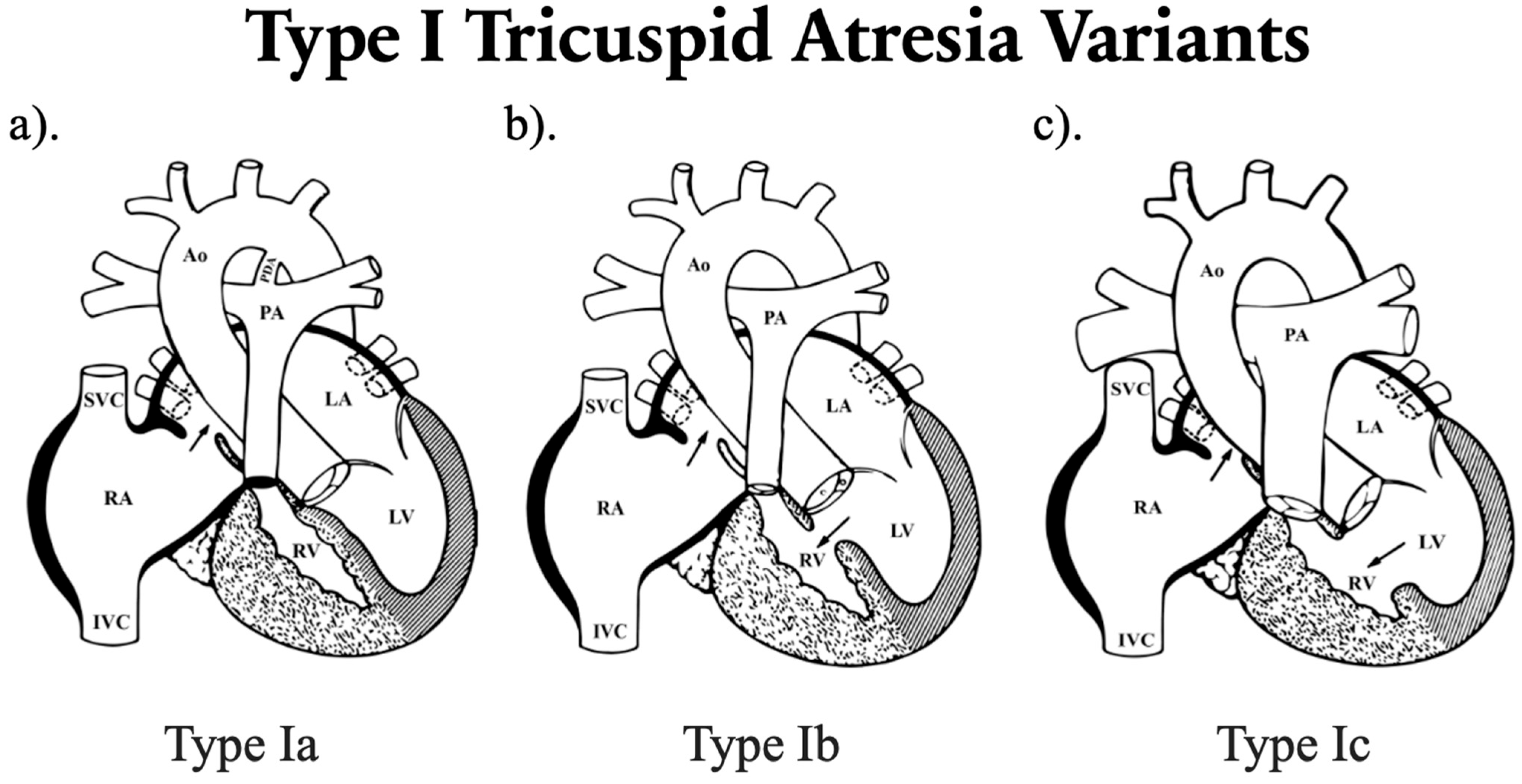
Figure 1. Variants of Tricuspid Atresia with Normally Related Great Arteries. (a) Type Ia: TA with absent VSD and pulmonary atresia. (b) Type Ib: TA with a restrictive VSD and pulmonary stenosis. (c) Type Ic: TA with a nonrestrictive VSD and normally developed pulmonary arteries. Arrows indicate blood flow across the ASD in all Type I variants (Ia, Ib, Ic) and across the VSD in Type Ia and Ib variants, but not Ic. Labeled structures: Ao, aorta; PDA, patent ductus arteriosus; PA, pulmonary artery; SVC, superior vena cava; IVC, inferior vena cava; RA, right atrium; RV, right ventricle; LA, left atrium; LV, left ventricle. Modified from Park et al. [13] with permission from Springer Nature.
Hearts 06 00030 g001
Figure 2. Example of staged palliation for tricuspid atresia with increased PA blood flow: (a) PA banding to limit pulmonary overcirculation, (b) Bidirectional Glenn connecting the SVC to the right pulmonary artery (RPA), (c) Fontan completion, allowing both SVC and IVC return to drain directly into the RPA. Red circles indicate surgical interventions or additions. Labeled structures: Ao, aorta; IVC, inferior vena cava; LA, left atrium; LV, left ventricle; PA, pulmonary artery; RA, right atrium; RPA, right pulmonary artery; RV, right ventricle; SVC, superior vena cava. Modified from Park et al. [13] with permission from Springer Nature.
Hearts 06 00030 g002
Table 1. Tricuspid Atresia Classification, Frequency, and Blood Flow Patterns.
Type of TAFrequency (%)Pulmonary FlowAortic Blood Flow PathwayPulmonary Blood Flow Pathway
Type I: Normally related great arteries (NRGA)70%
Ia: No VSD with PA10%LV → AoAo → PDA/MAPCAs → PA
Ib: Restrictive VSD with PS50%LV → AoLV → VSD → RV → PA
Ic: Nonrestrictive VSD with no PS10%LV → AoLV → VSD → RV → PA
Type II: D-transposition of the great arteries (D-TGA)30%
IIa: Nonrestrictive VSD with PA2%LV → VSD → RV → AoAo → PDA/MAPCAs → PA
IIb: Nonrestrictive VSD with PS8%LV → VSD → RV → AoLV → PA
IIc: Restrictive VSD with no PS20%LV → VSD → RV → AoLV → PA
Type III: Malposition of the great arteries other than D-TGA<1%
IIIa: D-loop
ventricles, L-TGA,
subpulmonic stenosis
LV → AoLV → VSD → RV → PA
IIIb: L-loop ventricles,
L-MGA, subaortic
stenosis
LV → VSD → RV → AoLV → PA
Blue shading is for the header row. Colors denote tricuspid atresia classification (pink = Type I, green = Type II, orange = Type III). Symbols indicate blood flow trend (↓ = decreased, ↔ = minimal or no change, ↑ = increased). Abbreviations: Ao, Aorta; D-TGA, D-Transposition of the Great Arteries; L-MGA, L-Malposition of the Great Arteries; L-TGA, L-Transposition of the Great Arteries; LV, Left Ventricle; MAPCAs, Major Aortopulmonary Collateral Arteries; NRGA, Normally Related Great Arteries; PA, Pulmonary Artery; PDA, Patent Ductus Arteriosus; PS, Pulmonary Stenosis; RV, Right Ventricle; TA, Tricuspid Atresia; VSD, Ventricular Septal Defect. Modified from Nasr and DiNardo [12] with permission from John Wiley and Sons.
Disclaimer/Publisher’s Note: The statements, opinions and data contained in all publications are solely those of the individual author(s) and contributor(s) and not of MDPI and/or the editor(s). MDPI and/or the editor(s) disclaim responsibility for any injury to people or property resulting from any ideas, methods, instructions or products referred to in the content.