


Abstract
Background/Objectives: Cardiovascular disease (CVD) and cerebrovascular disease (CeVD) remain leading causes of death in the United States, with Mississippi consistently reporting some of the nation’s highest mortality rates. Despite earlier national declines, recent evidence suggests stagnation or increases, particularly in high-burden regions. This study examined short-term trends in CVD and CeVD mortality in Mississippi between 2018 and 2022, stratified by age, sex, and race. Methods: Mortality data for adults aged ≥45 years were obtained from the Mississippi Statistically Automated Health Resource System (MSTAHRS). Age-adjusted mortality rates were calculated per 100,000 population and standardized to the 2000 U.S. population. Joinpoint regression was used to estimate annual percent change (APC) and average annual percent change (AAPC) with 95% confidence intervals (CIs). Analyses were stratified by sex, and within each racial group (White, Black, Other), mortality trends were further examined across age categories (45–54, 55–64, 65–74, 75–84, ≥85 years). Results: Cardiovascular mortality increased significantly among White women in midlife (ages 45–74), while “Other race” men in early midlife and “Other race” women in the oldest age group showed steep increases. Although Black adults did not experience significant changes over time, their mortality rates remained consistently higher than those of White adults. Conclusions: Progress in reducing cardiovascular and cerebrovascular mortality in Mississippi has reversed in several subgroups, particularly midlife White women and smaller racial populations. These findings mirror national stagnation and pandemic-related disruptions, highlighting the urgent need for equity-focused prevention, improved healthcare access, and targeted interventions addressing structural determinants of health.
1. Introduction
Cardiovascular disease (CVD) and cerebrovascular disease (CeVD) remain the leading causes of death in the United States, together accounting for more than 843,000 deaths in 2023. Heart disease ranked first (680,981 deaths), and stroke ranked fourth (162,639 deaths) among all causes of mortality [1]. Although mortality rates declined steadily through the early 2000s, national studies show that this progress slowed around 2011 for CVD and 2013 for stroke. In some demographic groups, rates have even started to rise again [2,3]. Despite continued advances in prevention and treatment, both conditions still carry a heavy burden due to their chronic nature, high fatality, and potential for long-term disability.
Mississippi has some of the highest rates of cardiovascular and cerebrovascular disease in the United States (Figures S1 and S2). It is part of the “Stroke Belt,” a region with historically elevated mortality from heart disease and stroke [4,5]. This burden is shaped by widespread risk factors such as hypertension, diabetes, obesity, and tobacco use, along with socioeconomic challenges and limited access to healthcare [6,7]. A recent CDC analysis reported that from 2009 to 2018, overall cardiovascular mortality in Mississippi plateaued, while national rates continued to decline [8]. Adults aged 55–64 were especially affected, experiencing a significant increase in death rates between 2011 and 2018, with an average annual rise of 1.7%, which likely contributed to the groundwork for the stagnation and increases observed in more recent years [8].
The COVID-19 pandemic further strained cardiovascular health across the country. During 2020 and 2021, national data revealed increases in deaths from both heart disease and stroke, reversing years of progress in some populations [9]. These increases were especially evident among midlife adults, racial and ethnic minorities, and underserved communities [8]. Mississippi, already burdened by high CVD and CeVD mortality, experienced similar or worse trends, likely due to delayed emergency care and interrupted management of chronic conditions [10]. Since our study period (2018–2022) overlaps with the pandemic years, it provides a timely opportunity to observe how these disruptions may have influenced recent mortality trends.
This study examines trends in cardiovascular and cerebrovascular mortality in Mississippi from 2018 to 2022. We used Joinpoint regression to calculate annual percent change (APC) and average annual percent change (AAPC), stratified by race, sex, and age group. This statistical approach helps identify significant shifts in mortality over time. By focusing on a high-burden state like Mississippi, this research contributes to current understanding of evolving mortality patterns and highlights areas for public health action.
2. Materials and Methods
2.1. Data Source and Study Population
Mortality data from 2018 to 2022 were obtained from the Mississippi Statistically Automated Health Resource System (MSTAHRS), a publicly available database maintained by the Mississippi State Department of Health. The study population included individuals aged 45 years or older, as this demographic accounts for the majority of deaths due to cardiovascular and cerebrovascular conditions. Mortality counts and age-adjusted mortality rates were extracted separately for each subgroup stratified by age group (45–54, 55–64, 65–74, 75–84, and ≥85 years), sex (male or female), and race (White, Black, or Other). The MSTAHRS dataset provides aggregated mortality counts and age-adjusted rates by age, sex, and race. Individual-level or patient-specific data are not included; therefore, subgroup differences reflect Mississippi’s demographic distribution rather than equal sample sizes.
2.2. Disease Classification and Mortality Rates
Deaths were classified into cardiovascular disease (CVD) and cerebrovascular disease (CeVD) categories based on predefined cause-of-death groupings within the MSTAHRS. Mortality rates were expressed as age-adjusted rates per 100,000 population, standardized to the 2000 U.S. Standard Population to control for differences in age distribution across groups and over time. Mortality rates were calculated separately by sex, race, and age group to enable subgroup-specific trend evaluation. Although MSTAHRS allows stratification by specific cardiovascular and cerebrovascular causes of death, this study focused on aggregated categories to maintain stable and comparable trend estimates across sex, race, and age groups. Future analyses could incorporate cause-specific breakdowns, such as myocardial infarction, arrhythmias, or ischemic versus hemorrhagic stroke, to further identify the conditions contributing most to recent mortality changes.
2.3. Trend Analysis Approach
Trends in age-adjusted mortality were evaluated using Joinpoint Regression Software (version 5.4.0.0; National Cancer Institute). Grouped data analysis was conducted separately according to sex, race, and age categories. The Joinpoint model fits segmented log-linear regressions to the log-transformed mortality rates and estimates annual percent change (APC) and average annual percent change (AAPC) with corresponding 95% confidence intervals (CIs). Statistical significance was determined based on whether the 95% CI excluded zero. A maximum of zero joinpoints was allowed due to the limited five-year study period. Analyses assumed constant variance because standard errors for rates were not available.
Analyses were stratified by sex, and within each racial group (White, Black, Other), mortality trends were further examined across five age categories (45–54, 55–64, 65–74, 75–84, and ≥85 years).
The mathematical foundations underlying the calculation of APC and AAPC are detailed in Section 2.4.
2.4. Calculating APC and AAPC
2.4.1. Annual Percentage Change (APC)
APC assumes the change at a constant percentage of the rate of the previous year to predict outcomes. Therefore, the following regression model is used to estimate the APC for a series of data:
, where is the natural log of the rate in year “y”.
The APC from year “y” to year “y+1”
=
=
=
2.4.2. Average Annual Percentage Change (AAPC)
The AAPC is a weighted average of the slope coefficients of the underlying Joinpoint regression model with the weights equal to the length of each segment over the interval. If we denote bi as the slope coefficient for the ith segment with i indexing the segments in the desired range of years, and wi as the length of each segment in the range of years, then:
3. Results
3.1. Cardiovascular Disease Mortality in Females
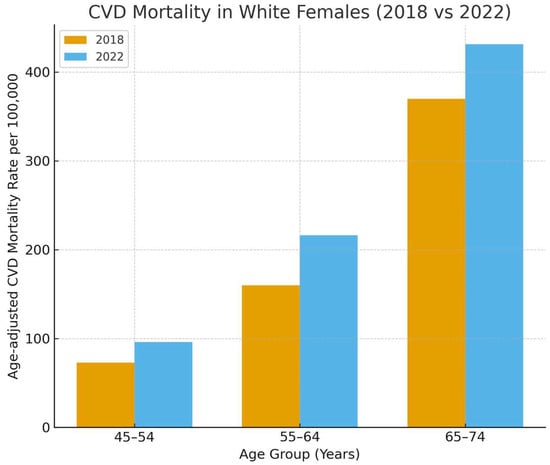
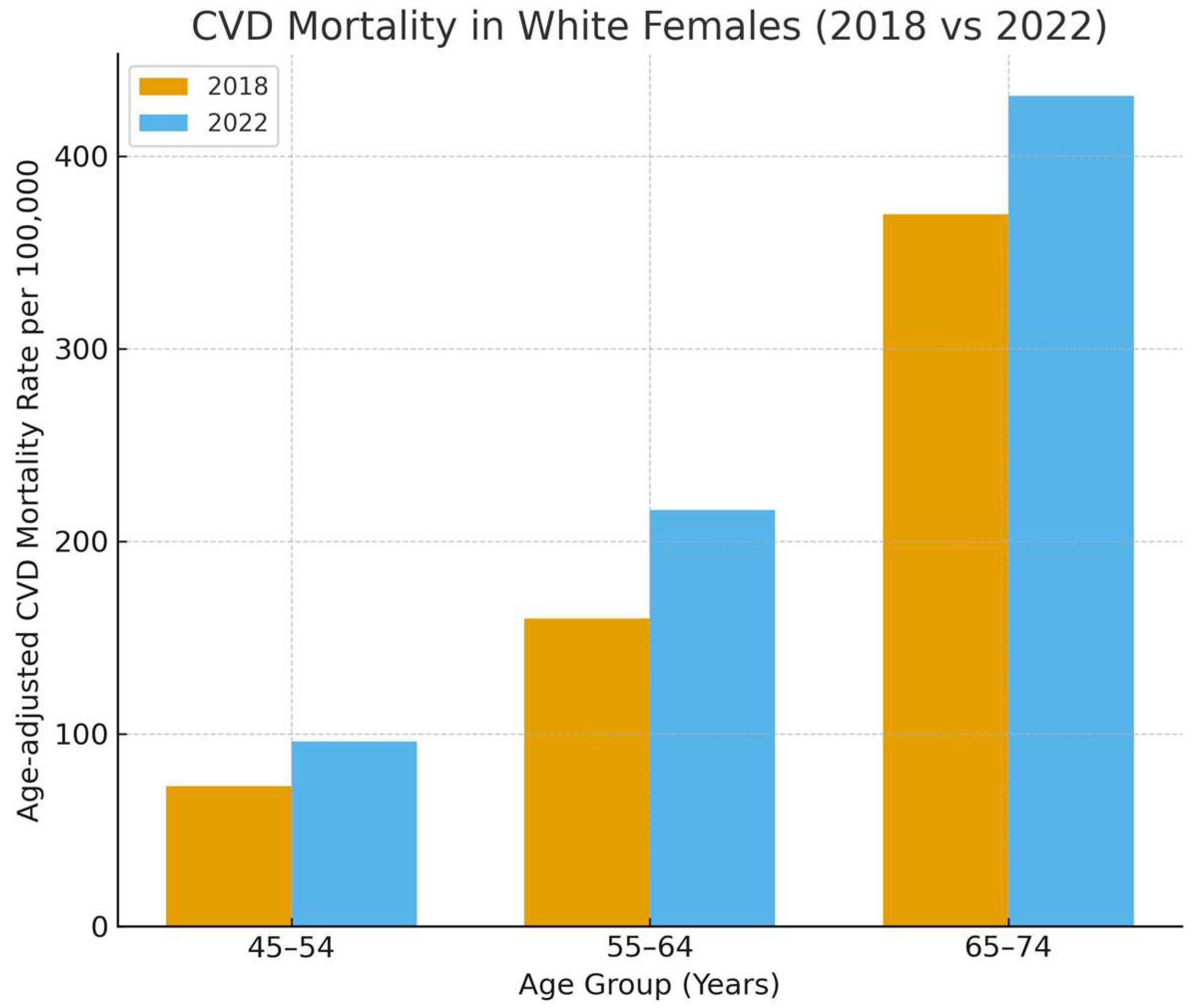
Between 2018 and 2022, trends in cardiovascular disease (CVD) mortality among females in Mississippi varied considerably by race and age group (Table 1). Among White females, statistically significant increases were observed across several age categories. In the 45–54 age group, the mortality rate rose from 72.9 to 95.9 deaths per 100,000 population, representing an annual percent change (APC) of 7.25% (95% CI: 0.32, 15.51). Similarly, females aged 55–64 experienced an increase from 159.9 to 216.1 per 100,000 (APC 7.46%; 95% CI: 2.85, 12.94), and the rate among those aged 65–74 rose from 369.7 to 431.3 per 100,000 (APC 4.12%; 95% CI: 1.23, 7.30). Figure 1 displays these changes across the three midlife age groups. Trends in older White females (aged 75–84 and ≥85 years) demonstrated modest increases, although these did not achieve statistical significance.
Table 1.
Trends in Cardiovascular Disease Mortality in Females by Race and Age Group in Mississippi, (2018–2022).
Figure 1.
CVD Mortality Rates in White Females (2018 vs. 2022) Across Midlife Age Groups.
Among Black females, mortality rates showed consistent but statistically nonsignificant upward trends. Notable increases included the 45–54 age group, which increased from 117.7 to 142.0 per 100,000 (APC 4.49%; 95% CI: −7.20, 18.34), and the 55–64 age group, rising from 287.7 to 328.5 per 100,000 (APC 5.51%; 95% CI: −1.40, 13.88). Older Black females exhibited smaller and similarly nonsignificant increases.
Conversely, females categorized as Other race experienced notable declines in mortality rates, especially among older age groups. For example, mortality in females aged 75–84 significantly declined from 793.7 to 368.1 per 100,000, with an APC of −21.95% (95% CI: −42.22, −9.88). Other age groups in this racial category exhibited decreases or minimal changes, though these were statistically nonsignificant.
These data collectively indicate increasing cardiovascular mortality burdens, particularly among midlife White females, whereas females categorized as Other race showed potentially improving trends, especially in older age cohorts.
3.2. Cardiovascular Disease Mortality in Males
Trends in cardiovascular disease mortality among males in Mississippi from 2018 to 2022 also showed variation across racial and age groups (Table 2). White males exhibited increases in mortality rates across several age groups, notably in the 55–64 age category, where mortality rose from 369.1 to 458.7 per 100,000, reflecting an APC of 5.59% (95% CI: −1.19, 13.54). Modest, statistically nonsignificant increases were also observed in White males aged 45–54 and 65–74 years. Conversely, White males aged 75–84 years showed a slight decline, although not statistically significant.
Table 2.
Trends in Cardiovascular Disease Mortality in Males by Race and Age Group in Mississippi, 2018–2022.
Among Black males, upward trends were observed primarily in younger age groups, though none reached statistical significance. The most notable increase occurred in the 55–64 age group, with mortality rising from 542.7 to 649.8 per 100,000 (APC 6.03%; 95% CI: −5.50, 20.74). Mortality rates among older Black males, specifically those aged 75–84, demonstrated minor declines.
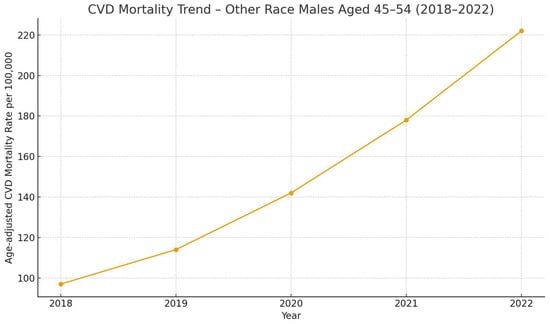
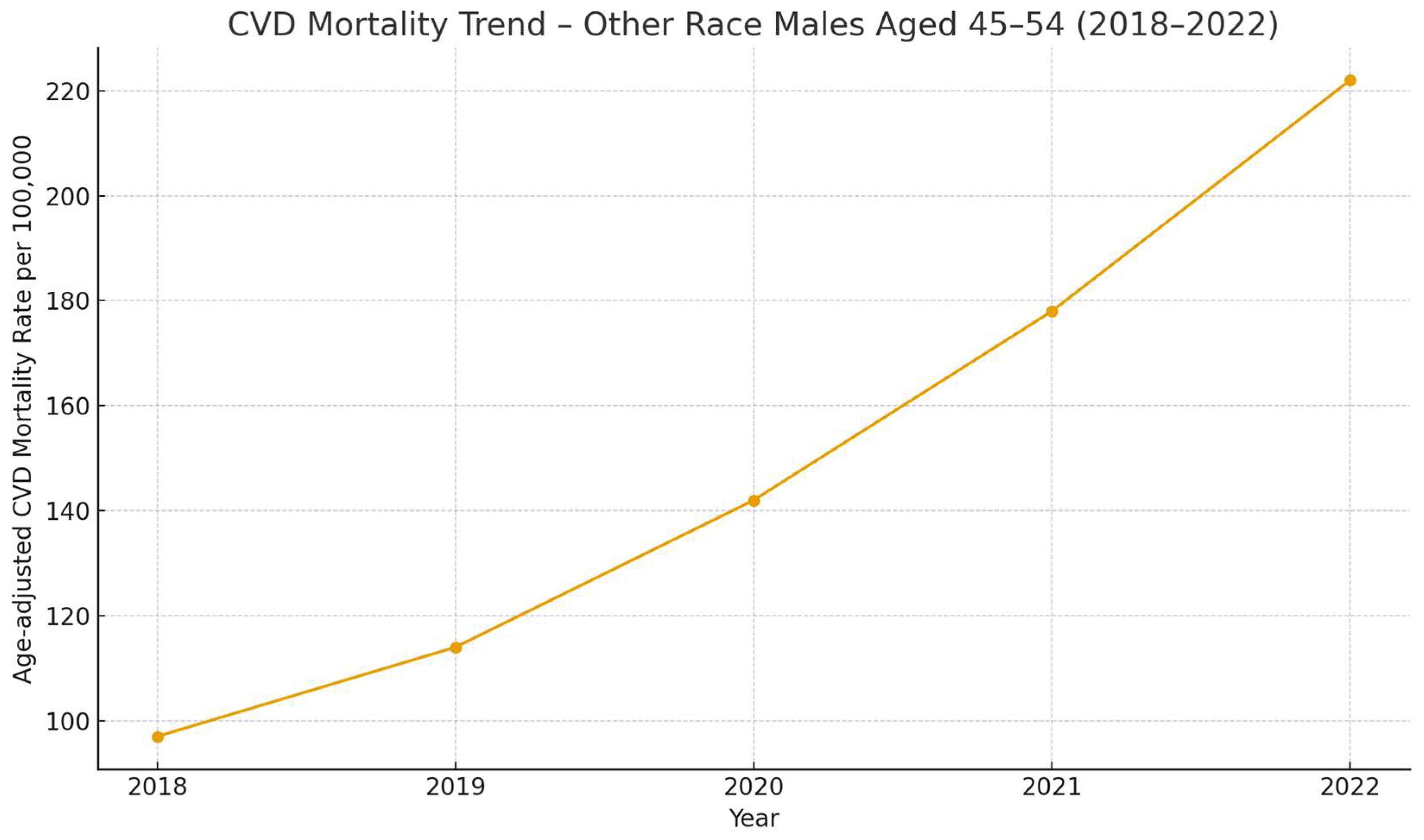
Males classified as Other race exhibited significant increases, particularly in the youngest age group (45–54 years), where mortality rates rose dramatically from 96.6 to 221.9 per 100,000 (APC 18.14%; 95% CI: 1.78, 43.97) (Figure 2). Other age groups in this racial category showed varied trends with smaller, statistically nonsignificant changes.
Figure 2.
CVD Mortality Trend: “Other Race” Males 45–54 (2018–2022).
3.3. Cerebrovascular Disease Mortality in Females
Trends in cerebrovascular disease (CeVD) mortality among females in Mississippi from 2018 to 2022 displayed varied patterns across race and age groups (Table 3). Among White females, mortality rates exhibited minor fluctuations without statistical significance. For instance, mortality rates slightly increased in the 55–64 age group from 39.4 to 45.4 per 100,000 (APC 5.72%; 95% CI: −6.52, 21.84). Conversely, rates decreased among White females aged 45–54 and ≥85 years, but these trends did not reach statistical significance.
Table 3.
Trends in Cerebrovascular Disease Mortality in Females by Race and Age Group in Mississippi (2018–2022).
Black females demonstrated generally increasing CeVD mortality trends across all age groups, although none were statistically significant. Notably, females aged 45–54 experienced an increase from 35.2 to 46.4 per 100,000, reflecting an APC of 7.90% (95% CI: −7.64, 28.96).
Females classified as Other race exhibited substantial variations, with a statistically significant increase among the oldest age group (≥85 years), where mortality surged from 216.9 to 891.5 per 100,000 (APC 48.39%; 95% CI: 22.00, 153.01). In contrast, significant decreases occurred in the 65–74 age group, declining from 189.3 to 60.2 per 100,000 (APC −30.93%; 95% CI: −72.34, 16.72).
3.4. Cerebrovascular Disease Mortality in Males
Trends in cerebrovascular disease mortality among males in Mississippi from 2018 to 2022 varied notably across racial and age groups (Table 4). White males experienced minor fluctuations with no statistically significant trends, although there was a modest increase in the 45–54 age group from 22.9 to 27.8 per 100,000 (APC 6.00%; 95% CI: −2.47, 16.29).
Table 4.
Trends in Cerebrovascular Disease Mortality in Males by Race and Age Group in Mississippi (2018–2022).
Black males showed mixed trends, with a notable increase among the oldest age group (≥85 years), rising from 608.7 to 1082.9 per 100,000 (APC 8.80%; 95% CI: −19.00, 51.97), although this did not reach statistical significance. Younger Black males (45–54 years) saw a decrease in mortality rates, also nonsignificant.
Males classified as Other race demonstrated significant increases, especially among the 55–64 age group, where rates surged from 27.5 to 99.1 per 100,000 (APC 30.00%; 95% CI: 8.00, 85.66). Other age groups in this racial category showed nonsignificant decreases or minimal changes.
Collectively, these findings underscore varying cerebrovascular mortality trends among males, particularly highlighting substantial increases among males classified as Other race and older Black males.
4. Discussion
Our joinpoint regression analysis of Mississippi adults aged ≥45 years found that cardiovascular mortality is rising in several key subgroups: white women aged 45–74 showed significant annual percent increases across all midlife age bands—with approximate APCs of 7.25% for ages 45–54, 7.46% for 55–64 and 4.12% for 65–74, while “other race” men aged 45–54 experienced steep gains (APC ≈ 18.14%). Cerebrovascular mortality rose dramatically among “other race” women aged ≥85 (APC ≈ 48.39%). Although mortality trends for Black adults did not change significantly, their baseline rates remained much higher than those of white adults. Overall, these patterns suggest that progress in reducing cardiovascular and cerebrovascular mortality has stalled or reversed for certain groups, despite earlier declines.
Our findings align with national patterns. Heart disease remains the leading cause of death for both men and women in the United States; in 2023, an estimated 919,000 people died from cardiovascular disease, which translates to roughly one death every 34 s [11]. Although vital statistics from recent years show modest declines in age-adjusted death rates for heart disease and stroke, national data indicate that these declines have slowed considerably over recent decades [6], and overall cardiovascular deaths remain near record highs. The American Heart Association’s 2025 update reports about 941,652 CVD-related deaths in 2022 and notes that the age-adjusted rate has plateaued at roughly 224 deaths per 100,000 population [12]. These national data contextualize our observation that Mississippi’s mortality declines have similarly plateaued.
The COVID-19 pandemic further illuminates these trends. A population-based cohort study of Massachusetts decedents found that annual observed cardiac mortality exceeded expected levels by 16% in 2020, 17% in 2021, 17% in 2022, and 6% in 2023, with increases observed both at home and in hospitals [13]. Such excess deaths are attributed to care disruptions and hospital avoidance during the pandemic [13]. Because our analysis covers 2020–2022, similar factors likely contributed to the mortality increases we observed in midlife women and “other race” subgroups. These findings highlight the need to strengthen health-care resiliency during crises.
Several modifiable risk factors underpin Mississippi’s adverse mortality patterns. Obesity is highly prevalent: in 2023, more than 40% of Mississippi adults were obese [14]. Hypertension is similarly widespread; a 2021 report estimated that nearly one million adults (43.9%) in Mississippi had high blood pressure [15]. By 2023, 46.0% of adults reported that a health professional had told them they had high blood pressure [16]. Diabetes also contributes to the burden: in 2022, about one in seven adults (15.3 percent) reported having been told they had diabetes [17]. These overlapping epidemics, along with poverty, limited health-insurance coverage, closures of rural hospitals, and restricted access to preventive and acute care in Mississippi. Pandemic-driven lifestyle changes such as reduced physical activity, increased stress and weight gain may have further exacerbated these risk factors, particularly among midlife adults.
Recent national research supports these patterns, showing that cardiovascular mortality has begun rising among younger adults and women after decades of decline. Studies indicate that risk factors such as obesity, hypertension, diabetes, and dyslipidemia are increasingly common at earlier ages, leading to prolonged lifetime exposure to vascular injury and earlier disease onset [18,19]. This trend has been especially evident in rural and socioeconomically disadvantaged regions, where younger adults have experienced about a 21% relative increase in cardiovascular deaths since 2010 [20]. In women, emerging evidence highlights additional vulnerabilities such as under-recognition of symptoms, depression, autoimmune disorders, and complications of pregnancy and menopause, which contribute to delayed diagnosis and undertreatment [21,22]. Collectively, these biological, behavioral, and structural influences likely underlie the rising cardiovascular mortality observed among midlife white women and younger adults in Mississippi.
Our results underscore persistent sex- and race-based disparities. Nationally, more than 60 million U.S. women (≈44%) live with heart disease; heart disease caused around 304,970 female deaths in 2023 (about one in five female deaths) [21]. These statistics contextualize the rising cardiovascular mortality we observed among midlife white women. In Mississippi, Black residents suffer the highest heart-disease and stroke mortality—278.7 and 74.9 per 100,000, respectively—compared with 255.3 and 57.8 per 100,000 overall [23]. The American Heart Association’s 2024 policy statement attributes such disparities to structural racism, generational socioeconomic adversity, unequal health-care access, and other social determinants, and argues that these structural factors must be addressed to reverse growing inequities.
Steep increases in “other race” men and women must be interpreted cautiously. These groups are small and heterogeneous, and misclassification of race or ethnicity on death certificates is common. Even a few misclassified deaths can significantly distort mortality statistics for small populations [24]. Researchers note that race information on death certificates is less accurate for non-white groups, with smaller and multiracial identities often misidentified. American Indian/Alaska Native people and other small racial groups are frequently aggregated into an “other” category and undercounted [24]. Despite these data limitations, the observed patterns suggest that smaller racial groups may face unique health-care barriers that warrant targeted investigation and culturally tailored interventions.
Our findings have important public-health implications. Rising cardiovascular mortality among midlife women underscores the need for sex-specific awareness campaigns and aggressive risk-factor control. Given Mississippi’s high prevalence of obesity and hypertension, statewide initiatives to promote healthy diets, physical activity, smoking cessation, and weight management are essential. Interventions should prioritize Black communities and other underserved populations by addressing financial barriers, improving transportation, and expanding Medicaid coverage. At a policy level, dismantling structural inequities, particularly those related to education, housing, and economic opportunity, is critical to closing mortality gaps. Moreover, strengthening data systems to reduce racial misclassification and better monitor small populations will enhance program evaluation.
5. Conclusions
Cardiovascular and cerebrovascular mortality in Mississippi has stalled and even reversed for several population subgroups. These concerning patterns mirror national trends, where heart disease remains the leading cause of death and pandemic-related disruptions have slowed public-health progress. Recent national analyses have also documented increasing obesity, diabetes, and hypertension among young adults, with significant racial and ethnic disparities. Our findings complement these prevalence studies by showing corresponding rises in cardiovascular mortality among Mississippi adults, particularly midlife women and younger age groups. This alignment suggests that the worsening cardiovascular risk profile observed nationally is already translating into excess deaths in high-burden states such as Mississippi.
To reverse these trajectories, Mississippi must adopt comprehensive, equity-focused strategies that integrate risk-factor control, expanded healthcare access, and targeted interventions addressing the social determinants of health. These efforts are essential to ensuring that future improvements in cardiovascular and cerebrovascular health are both substantial and equitably distributed.
Supplementary Materials
The following supporting information can be downloaded at https://www.mdpi.com/article/10.3390/hearts6040031/s1, Figure S1: Age-adjusted stroke mortality by U.S. state in 2022 [5]. Source: Centers for Disease Control and Prevention (CDC), National Center for Health Statistics (NCHS). Available at: Stroke Mortality|Stats of the States|CDC; Figure S2: Age-adjusted cardiovascular disease mortality by U.S. state in 2022 [4]. Source: Centers for Disease Control and Prevention (CDC), National Center for Health Statistics (NCHS). Available at: Heart Disease Mortality|Stats of the States|CDC.
Author Contributions
Conceptualization, E.J.; methodology, E.J.; validation, E.J.; formal analysis, E.J.; data curation, E.J.; writing—original draft preparation, A.E.; writing—review and editing, A.E.; visualization, A.E.; supervision, E.J. All authors have read and agreed to the published version of the manuscript.
Funding
This research received no external funding.
Institutional Review Board Statement
Not applicable.
Informed Consent Statement
Not applicable.
Data Availability Statement
The data used in this study are publicly available from the Mississippi State Department of Health (MSTAHRS). Specific datasets and links can be provided upon request.
Acknowledgments
We thank the Mississippi State Department of Health for providing access to mortality datasets. We also acknowledge administrative guidance from the Jackson State University Department of Public Health.
Conflicts of Interest
The authors declare no conflicts of interest.
References
- FastStats. Available online: https://www.cdc.gov/nchs/fastats/leading-causes-of-death.htm (accessed on 15 July 2025).
- Sidney, S.; Quesenberry, C.P., Jr.; Jaffe, M.G.; Sorel, M.; Nguyen-Huynh, M.N.; Kushi, L.H.; Go, A.S.; Rana, J.S. Recent Trends in Cardiovascular Mortality in the United States and Public Health Goals. JAMA Cardiol. 2016, 1, 594–599. [Google Scholar] [CrossRef] [Scilit] [PubMed]
- Yang, Q.; Tong, X.; Schieb, L.; Vaughan, A.; Gillespie, C.; Wiltz, J.L.; King, S.C.; Odom, E.; Merritt, R.; Hong, Y.; et al. Vital Signs: Recent Trends in Stroke Death Rates—United States, 2000–2015. MMWR Morb. Mortal. Wkly. Rep. 2017, 66, 933–939. [Google Scholar] [CrossRef] [Scilit]
- Stats of the States—Heart Disease Mortality. Available online: https://www.cdc.gov/nchs/pressroom/sosmap/heart_disease_mortality/heart_disease.htm (accessed on 15 July 2025).
- Stats of the States—Stroke Mortality. Available online: https://www.cdc.gov/nchs/pressroom/sosmap/stroke_mortality/stroke.htm (accessed on 15 July 2025).
- Benjamin, E.J.; Muntner, P.; Alonso, A.; Bittencourt, M.S.; Callaway, C.W.; Carson, A.P.; Chamberlain, A.M.; Chang, A.R.; Cheng, S.; Das, S.R.; et al. Heart Disease and Stroke Statistics—2019 Update: A Report From the American Heart Association. Circulation 2019, 139, 10. [Google Scholar] [CrossRef] [Scilit] [PubMed]
- Mississippi State Department of Health. Mississippi Behavioral Risk Factor Report; Mississippi State Department of Health: Jackson, MS, USA, 2023.
- Mendy, V.L.; Rowell-Cunsolo, T.; Bellerose, M.; Vargas, R.; Enkhmaa, B.; Zhang, L. Cardiovascular Disease Mortality in Mississippi, 2000–2018. Prev. Chronic. Dis. 2022, 19, E09. [Google Scholar] [CrossRef] [Scilit] [PubMed]
- Wadhera, R.K.; Shen, C.; Gondi, S.; Chen, S.; Kazi, D.S.; Yeh, R.W. Cardiovascular Deaths During the COVID-19 Pandemic in the United States. J. Am. Coll. Cardiol. 2021, 77, 159–169. [Google Scholar] [CrossRef] [Scilit] [PubMed]
- Mississippi State Department of Health. COVID-19 Provisional Mississippi Death Counts; Mississippi State Department of Health: Jackson, MS, USA, 2023; p. 19.
- CDC Heart Disease Facts. Available online: https://www.cdc.gov/heart-disease/data-research/facts-stats/index.html (accessed on 2 October 2025).
- Heart Disease Remains Leading Cause of Death as Key Health Risk Factors Continue to Rise. Available online: https://newsroom.heart.org/news/heart-disease-remains-leading-cause-of-death-as-key-health-risk-factors-continue-to-rise (accessed on 1 October 2025).
- Wasfy, J.H.; Lin, Y.; Price, M.; Newhouse, J.P.; Blacker, D.; Hsu, J. Postpandemic Cardiac Mortality Rates. JAMA Netw. Open 2025, 8, e2512919. [Google Scholar] [CrossRef] [Scilit] [PubMed]
- Obesity—Mississippi State Department of Health. Available online: https://msdh.ms.gov/page/43,0,289.html (accessed on 1 October 2025).
- Office of Health Surveillance and Research; Office of Preventive Health and Health Equity. Hypertension Prevalence, Mississippi—2021; Mississippi State Department of Health: Jackson, MS, USA, 2023.
- Explore High Blood Pressure in Mississippi|AHR. Available online: https://www.americashealthrankings.org/explore/measures/Hypertension/MS (accessed on 1 October 2025).
- Mississippi State Department of Health. Diabetes Among Adults in Mississippi: Analysis of 2022 Mississippi Behavioral Risk Factor Surveillance System (BRFSS) Data; Mississippi State Department of Health: Jackson, MS, USA, 2024. Available online: https://msdh.ms.gov/page/resources/20496.pdf (accessed on 25 November 2025).
- Jain, V.; Minhas, A.M.K.; Morris, A.A.; Greene, S.J.; Pandey, A.; Khan, S.S.; Fonarow, G.C.; Mentz, R.J.; Butler, J.; Khan, M.S. Demographic and Regional Trends of Heart Failure–Related Mortality in Young Adults in the US, 1999-2019. JAMA Cardiol. 2022, 7, 900–904. [Google Scholar] [CrossRef] [Scilit] [PubMed]
- Heart Disease Risk Factors Rise in Young Adults|Harvard Medical School. Available online: https://hms.harvard.edu/news/heart-disease-risk-factors-rise-young-adults (accessed on 12 November 2025).
- More Adults in Rural America Are Dying from Cardiovascular Diseases. Available online: https://www.heart.org/en/news/2024/11/15/more-adults-in-rural-america-are-dying-from-cardiovascular-diseases (accessed on 11 November 2025).
- CDC About Women and Heart Disease. Available online: https://www.cdc.gov/heart-disease/about/women-and-heart-disease.html (accessed on 2 October 2025).
- Emerging Risk Factors for Cardiovascular Disease in Women. Available online: https://www.medscape.com/viewarticle/996577 (accessed on 11 November 2025).
- Mississippi State Department of Health, Office of Health Data and Research. Annual Mississippi Health Disparities & Inequities Report; Mississippi State Department of Health: Jackson, MS, USA, 2023.
- McClure, E.S.; Gartner, D.R.; Bell, R.A.; Cruz, T.H.; Nocera, M.; Marshall, S.W.; Richardson, D.B. Challenges with Misclassification of American Indian/Alaska Native Race and Hispanic Ethnicity on Death Records in North Carolina Occupational Fatalities Surveillance. Front. Epidemiol. 2022, 2, 878309. [Google Scholar] [CrossRef] [Scilit] [PubMed]

Disclaimer/Publisher’s Note: The statements, opinions and data contained in all publications are solely those of the individual author(s) and contributor(s) and not of MDPI and/or the editor(s). MDPI and/or the editor(s) disclaim responsibility for any injury to people or property resulting from any ideas, methods, instructions or products referred to in the content. |
© 2025 by the authors. Licensee MDPI, Basel, Switzerland. This article is an open access article distributed under the terms and conditions of the Creative Commons Attribution (CC BY) license (https://creativecommons.org/licenses/by/4.0/).