1. Introduction
Inverted papillomata (IP) are rare and benign sinonasal tumours that account for 0.4–7% of sinonasal tumours excised, with an estimated annual incidence of 0.2–1.5 cases per 100,000. In patients, the highest incidence is seen in the fifth and sixth decades of life, with a 2–5:1 male-to-female ratio [
1,
2]. Despite being benign tumours, IPs are locally aggressive and have high recurrence rates of up to 78% [
1]. There is also a known association with malignancy, with a synchronous and metachronous carcinomatous rate estimated at 7.1% and 3.6%, respectively [
2]. The aetiology of IP remains unknown, but evidence demonstrates an association with Human Papilloma Virus (HPV), p53 and p21 oncogenes in malignant transformation of IP [
1].
Patients with IP can present with a variety of symptoms, including unilateral nasal obstruction, rhinorrhoea, epistaxis, facial pain, or hyposmia/anosmia [
1,
2]. Conversely, IP can also present asymptomatically in 4–23% of cases with the IPs being an incidental finding [
1]. On endoscopy, IPs appear as a reddish-grey, friable lobulated mass that is firmer than an inflammatory polyp. IPs are predominantly unilateral, with bilateral lesions accounting for 1–9% of cases [
2]. Histopathological diagnosis is essential for diagnosis and to rule out associated malignancy. Characteristic features on microscopy include the invagination of the superficial IP epithelium into the underlying stroma, hence the ‘inverted’ descriptor. The epithelium may be of the stratified squamous, ciliated pseudostratified columnar epithelium, or transitional types [
1,
3]. Radiological assessment is essential to determine the tumour location and extension for surgical planning. Computed Tomography (CT) of the sinuses is widely used to evaluate sinonasal masses and assess for underlying bony changes. Unlike malignant tumours that cause bony destruction, IP causes hyperostosis or sclerosis [
1,
2]. Magnetic resonance imaging (MRI) can be useful in addition to CT scans to determine the lesion’s exact location and decide upon the best surgical approach [
2].
The optimal management of IP involves the complete surgical excision of the diseased mucosa and mucoperiosteum [
2]. Historically, gold-standard management techniques involved external approaches such as a lateral rhinotomy with medial maxillectomy [
1]. With the progression of minimally invasive techniques and high-quality imaging, endoscopic management techniques have become the gold standard for IP resection. Compared to external approaches, they result in lower recurrence rates and reduce surgical morbidity [
1,
4]. Due to the high recurrence rates associated with IP, a minimum follow-up period of five years is recommended [
4]. As many cases managed in our centre had already undergone a previous procedure, the objective of this retrospective case series was to evaluate the outcomes for primary and secondary cases of sinonasal IP, including recurrence rates and complication rates.
2. Materials and Methods
We retrospectively reviewed clinical records for all patients with histologically confirmed inverted papilloma who received surgical management under the care of the senior author (CMP) at a tertiary rhinology referral centre. Records were reviewed between 1 January 2011 and 31 December 2022.
Cases were identified from the operation logbooks of the Otorhinolaryngology Department operating theatres. The following cases were excluded:
Pre-operative intracranial involvement, which was referred externally to the local neurosurgical unit.
Features of alternative sinus neoplasia, such as squamous cell carcinoma, osteoma, or malignant melanoma.
Conservative or palliative management as the sole treatment modality.
The practice at our centre is primarily endoscopic resection of inverted papillomata with the use of intra-operative Medtronic computer-assisted navigation Stealth system.
Anonymised data were collected from patients’ electronic clinic letters and operation notes for age, histological diagnosis, site of tumour, date of operation, details of surgical management, post-operative complications, need for revision surgery, and outcome at five years post-operatively (or most recent follow-up if below five years). Surgical procedures were classified as primary if surgery was conducted at our centre for the first time and secondary if a prior attempted resection had been undertaken elsewhere. This study was a local service evaluation and did not require ethical approval, based on the NHS Research Ethics Committee Tool provided by the Health Research Authority. The STROBE guidelines were adhered to for reporting. Lastly, statistical analysis was performed using a Chi-squared calculation with a significance level of p < 0.05. The confidence intervals were set at the 95% level.
3. Results
Between 2010 and 2022, there were 40 cases of inverted papilloma—22 were primary and 18 were secondary. Primary cases were managed by a consultant rhinologist, whereas secondary cases were operated on by a general ENT surgeon at the first procedure. Our cohort included 26 males and 14 females. The average age at surgery was 62.8, ranging from 22.4 to 89.
The most common area for IP in our cohort was the maxillary sinus (35%), which is displayed in
Table 1. Recurrence was most common in the ethmoidal, frontal, and maxillary sinuses (
Table 1). The most common procedure performed was medial maxillectomy (30%) followed by DrafIIb/III (15%). Cross-sectional CT and MRI helped localise the pedicle and burr any bony sites of attachments to reduce the risk of recurrence. The sinus origin was reamed where possible. However, where the site was deemed at risk of adjacent injury, topical mitomycin or 5-fluorouracil was used.
After 5 years of follow-up, a total of 21 cases had a recurrence. Out of the primary cases, 6 out of 22 (27%) had a recurrence, whereas out of secondary cases, 15 out of 18 had a recurrence (83%). The difference between the two groups was statistically significant, c2(1) = 12.48 and p = 0.0004. This highlights that the recurrence rate was significantly higher in secondary cases. The odds ratio was 13.33 (CI 95%: 2.82 to 63.12), highlighting that the odds of recurrence in secondary cases are 13 times higher than in primary cases. Furthermore, a relative risk of 3.06 (CI 95%: 1.50–6.24) suggests that the secondary cases were three times more likely to recur than primary cases. The number of times a recurrence occurred ranged from one to two in primary cases and from one to seven in each secondary case. Recurrence was detected within 20 and 31 months on average in primary and secondary cases, respectively.
All recurrent cases were treated surgically, with two (10%) recurrent cases receiving additional topical intranasal mitomycin. However, in recent years, topical 5-fluoracil has been used instead of mitomycin as an adjunct on selected cases where removing the bony attachment poses a risk due to adjacent attachments [
5,
6].
In terms of complications, there was one case of intra-operative CSF leak (repaired intra-operatively) and one case of temporary post-operative facial numbness.
Sinonasal IPs were staged using the Krouse system. Most patients (58.5%) in our cohort presented with Krouse stage 3, which is when the tumour invades the lateral, inferior, superior, anterior, or posterior walls of the maxillary sinus and/or frontal sinus [
1,
2].
Table 2 summarises the rate of recurrences according to different Krouse stages. The highest rates of recurrence were seen in stage 3, reflecting the more advanced presentation of the cases, especially in secondary cases (
Table 2).
4. Discussion
Our patient cohort’s demographics were similar to those in other studies, with an observed 2:1 male-to-female ratio and average age of presentation of 62.8 years. As in previous research, the maxillary sinus was the most common site for primary IP [
7]. In the literature, recurrence rates range between 10% and 29% [
7,
8]. In our paper, 52% (21/40) of total cases had a recurrence. However, the recurrence in primary cases—27% (6/22)—seems to be more in line with what is reported in the literature. However, our sample size was smaller, which can potentially explain the inflated numbers.
The mean time of recurrence was 20 and 39 months for primary and secondary cases, which is different to what has been found in the previous literature where the mean time of recurrence was 12 months in primary cases and 8.5 in secondary cases [
7]. This difference could be explained by the faster detection rate. As in the previous literature, patients with Krouse stage 3 cases and IPs located in the frontal and maxillary sinuses had the highest rates of recurrences [
9,
10]. This may be explained by the technical difficulty of accessing the frontal sinus with limited visualisation of the tumour endoscopically, and the challenge of obtaining a margin when up against critical structures; in the maxillary sinus the floor of the antrum and medial maxillary wall can be difficult to visualise [
10]. Previous research highlights the importance of the radical excision of both primary and recurrent IP cases to prevent future recurrence. Thus, worse outcomes in secondary cases may be explained by the absence of landmarks due to previous dissection, scarring or distorted anatomy [
11]. Our cohort highlights that primary recurrent cases had lower rates and times of recurrence. These findings suggest that one of the possible explanations of better outcomes in primary cases is that IPs have a lower rate of recurrence when managed by a fellowship-trained rhinologist [
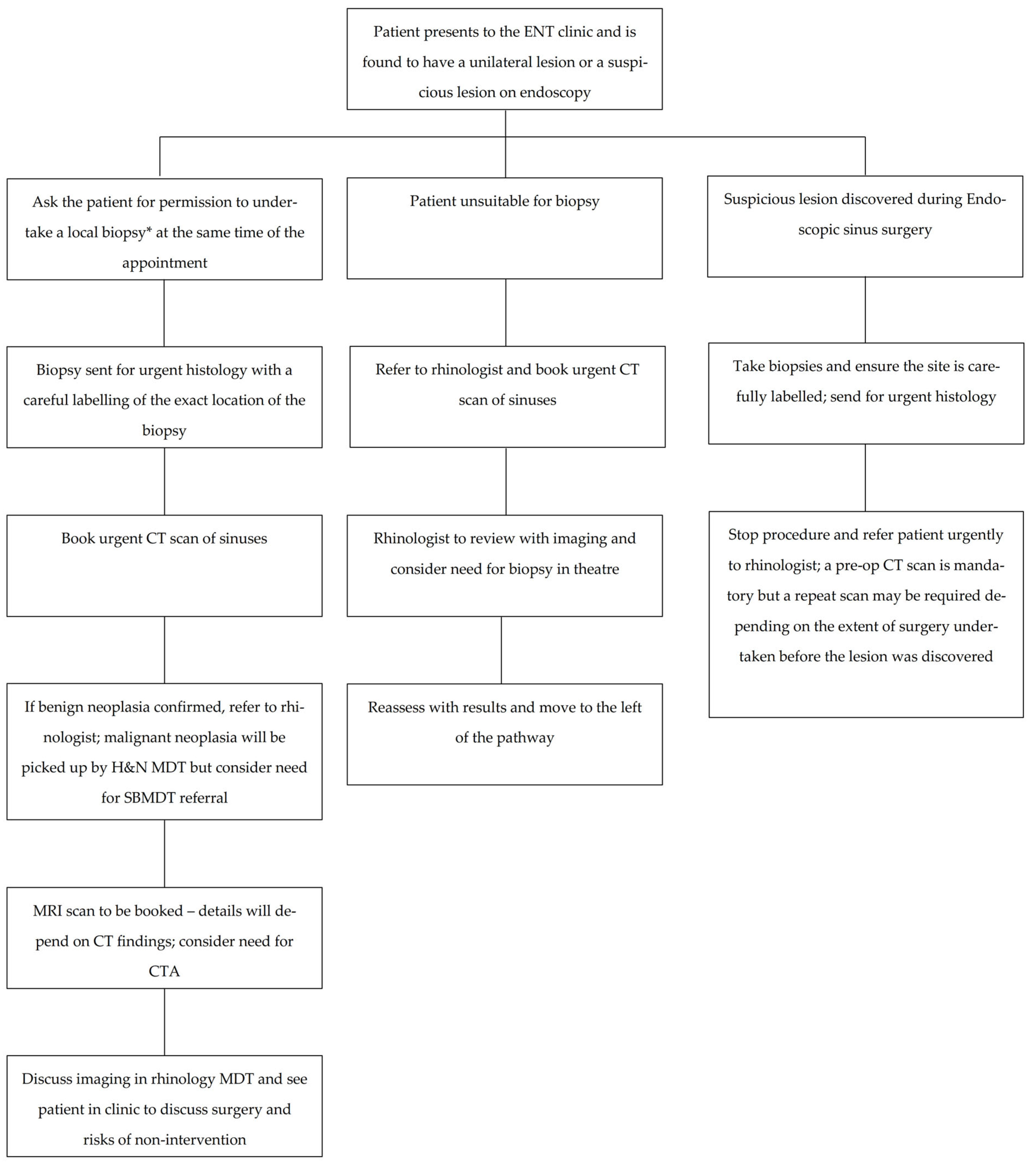
2]. Thus, we suggest a gold-standard treatment pathway for all sinonasal tumours, as highlighted in
Figure 1.
Potential limitations of the data include small numbers of primary recurrent cases. In addition, there is a lack of information on patient characteristics such as smoking, HPV, and inflammatory disease status since these were not well recorded in the electronic records. Furthermore, no tumour biology analysis was undertaken. As cases of IPs were rare, our population sample size was small and from a single centre; therefore, the results and calculations should be interpreted with caution.
5. Conclusions
This retrospective cohort suggests that recurrence rates of IPs may be higher in cases operated on initially by a non-specialist surgeon. Our results indicate that the treatment of IPs may have superior outcomes if managed by a fellowship-trained rhinologist. Our study highlights that cases that were not operated on by a rhinologist at first presentation have higher recurrence rates even once a rhinologist has managed them. Therefore, we suggest using the gold-standard management flow chart (
Figure 1) for all sinonasal tumours. Our study further demonstrates that endoscopic approaches remain a beneficial technique in managing IPs [
2,
5] by reducing morbidity, post-operative complications, and the duration of inpatient stays [
4,
6]. Lastly, our study sample size was relatively small due to IP being a rare tumour; thus, larger primary and secondary recurrence cases are needed for more meaningful comparisons.
Author Contributions
Conceptualization, G.K. and C.P.; methodology, G.K., S.G. and C.P.; formal analysis, G.K.; data curation, G.K., C.P. and J.J.W.; writing—original draft preparation, G.K., S.G., L.L., J.J.W. and L.J.; writing—review and editing, G.K., C.P., J.J.W., S.G., L.L. and L.J.; supervision, C.P. All authors have read and agreed to the publication of the final manuscript.
Funding
This research received no funding.
Institutional Review Board Statement
This study was a local service evaluation and did not require ethical approval based on the NHS Research Ethics Committee Tool provided by the Health Research Authority.
Informed Consent Statement
Patient consent was waived due to the randomised nature of the study.
Data Availability Statement
An anonymised dataset can be provided on written request to the corresponding author.
Conflicts of Interest
The authors declare no conflicts of interest.
Abbreviations
The following abbreviations are used in this manuscript:
| IP | Inverted papillomata; |
| CI | Confidence interval; |
| ENT | Ears, Nose, and Throat; |
| HPV | Human Papilloma Virus; |
| CT | Computed Topography; |
| MRI | Magnetic resonance imaging; |
| H&N | Head and Neck; |
| MDT | Multidisciplinary team; |
| SBMDT | Skull Base Multidisciplinary team; |
| CTA | Computer Tomography Angiography. |
References
- Lisan, Q.; Laccourreye, O.; Bonfils, P. Sinonasal inverted papilloma: From diagnosis to treatment. Eur. Ann. Otorhinolaryngol. Head Neck Dis. 2016, 133, 337–341. [Google Scholar] [CrossRef] [PubMed]
- Lund, V.J.; Stammberger, H.; Nicolai, P.; Castelnuovo, P.; Beal, T.; Beham, A.; Bernal-Sprekelsen, M.; Braun, H.; Cappabianca, P.; Carrau, R.; et al. European position paper on endoscopic management of tumours of the nose and paranasal sinuses and skull base. Rhinol. Suppl. 2010, 22, 1–143. [Google Scholar] [PubMed]
- Wang, M.J.; Noel, J.E. Etiology of sinonasal inverted papilloma: A narrative review. World J. Otorhinolaryngol. Head Neck Surg. 2017, 3, 54–58. [Google Scholar] [CrossRef] [PubMed]
- Goudakos, J.K.; Blioskas, S.; Nikolaou, A.; Vlachtsis, K.; Karkos, P.; Markou, K.D. Endoscopic Resection of Sinonasal Inverted Papillomas: Systematic Review and Meta-Analysis. Am. J. Rhinol. Allergy 2018, 32, 455–462. [Google Scholar] [CrossRef] [PubMed]
- Revercomb, L.; Patel, A.M.; Filimonov, I.; Lerner, D.; Filimonov, A. Topical Application of 5-Fluorouracil for the Treatment of Sinonasal Adenocarcinoma and Inverted Papilloma. Am. J. Rhinol. Allergy 2024, 38, 354–360. [Google Scholar] [CrossRef] [PubMed]
- Adriaensen, G.F.; van der Hout, M.W.; Reinartz, S.M.; Georgalas, C.; Fokkens, W.J. Endoscopic treatment of inverted papilloma attached in the frontal sinus/recess. Rhinology 2015, 53, 317–324. [Google Scholar] [CrossRef] [PubMed]
- Philpott, C.M.; Dharamsi, A.; Witheford, M.; Javer, A.R. Endoscopic management of inverted papillomas: Long-term results—The St. Paul’s sinus centre experience. Rhinology 2010, 48, 358–363. [Google Scholar] [CrossRef] [PubMed]
- Kim, D.Y.; Hong, S.L.; Lee, C.H.; Jin, H.R.; Kang, J.M.; Lee, B.J.; Moon, I.J.; Chung, S.K.; Rha, K.S.; Cho, S.H.; et al. Inverted papilloma of the nasal cavity and paranasal sinuses: A Korean multicenter study. Laryngoscope 2012, 122, 487–494. [Google Scholar] [CrossRef] [PubMed]
- Walgama, E.; Ahn, C.; Batra, P.S. Surgical management of frontal sinus inverted papilloma: A systematic review. Laryngoscope 2012, 122, 1205–1209. [Google Scholar] [CrossRef] [PubMed]
- Philpott, C.; Sama, A. Endonasal Approaches to Maxillary Sinus. Int. J. Head Neck Surg. 2018, 9, 26–31. [Google Scholar] [CrossRef]
- Sciarretta, V.; Fernandez, I.J.; Farneti, P.; Pasquini, E. Endoscopic and combined external-transnasal endoscopic approach for the treatment of inverted papilloma: Analysis of 110 cases. Eur. Arch. Oto-Rhino-Laryngol. 2014, 271, 1953–1959. [Google Scholar] [CrossRef] [PubMed]
| Disclaimer/Publisher’s Note: The statements, opinions and data contained in all publications are solely those of the individual author(s) and contributor(s) and not of MDPI and/or the editor(s). MDPI and/or the editor(s) disclaim responsibility for any injury to people or property resulting from any ideas, methods, instructions or products referred to in the content. |
© 2025 by the authors. Licensee MDPI, Basel, Switzerland. This article is an open access article distributed under the terms and conditions of the Creative Commons Attribution (CC BY) license (https://creativecommons.org/licenses/by/4.0/).




 ,
,