

Hydrothermally Synthesized Metal Oxide Nanostructures for H2O2 Sensing and Oxidative Stress Management in Plants

 ,
,  , , , , and
Abstract
1. Introduction
2. Materials and Methods
3. Electrochemical Detection of H2O2
3.1. Enzymatic vs. Non-Enzymatic Electrochemical Sensors
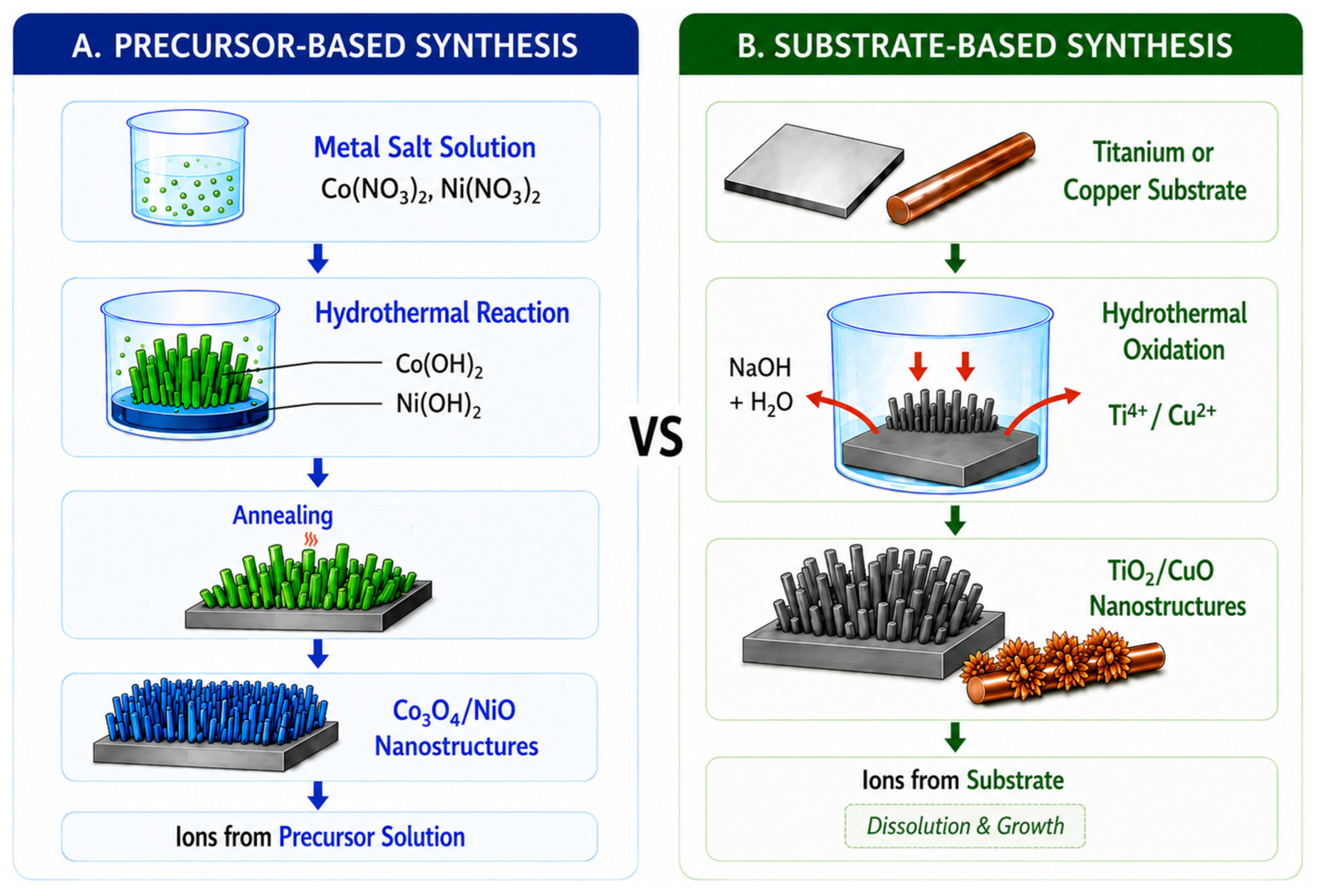
3.2. Hydrothermal Synthesis Strategies and Morphology Control of Nanostructured Metal Oxides
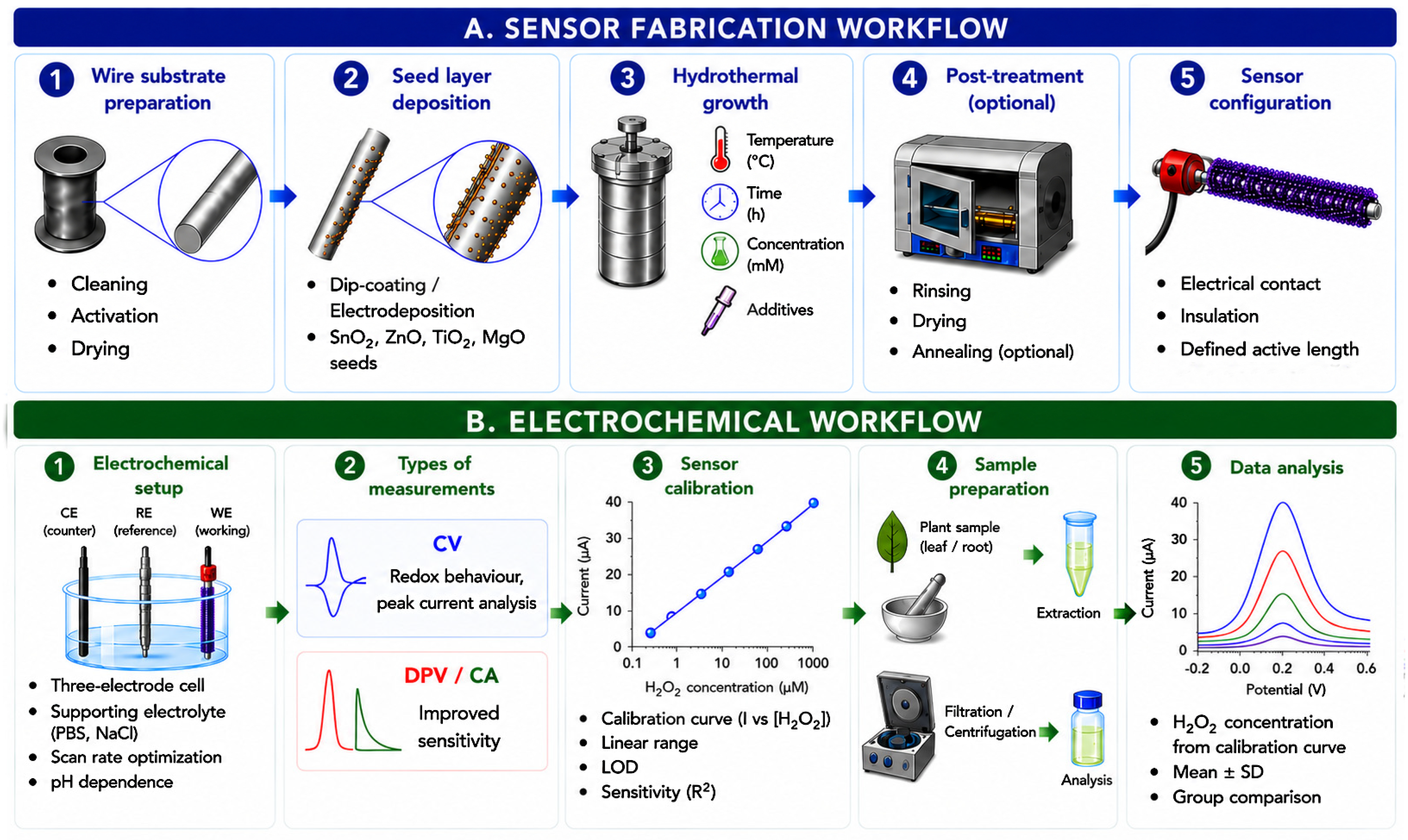
3.3. Sensor Fabrication, Electrochemical Testing, and Analytical
4. Real-Sample H2O2 Analysis and Nanoparticle-Assisted Oxidative Stress Monitoring in Plants
4.1. Stress Mitigation Strategies in Plants
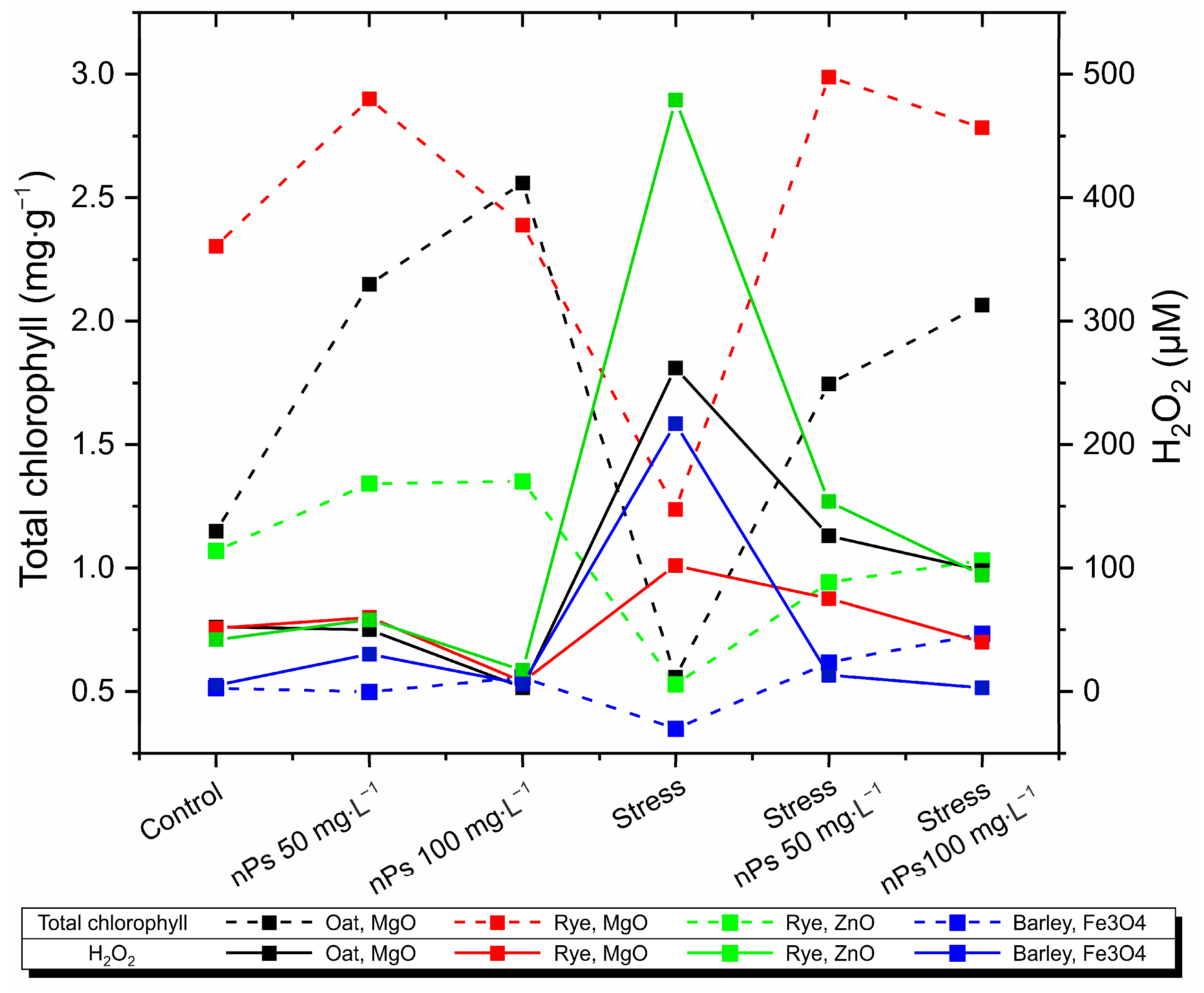
4.2. Real Analysis and Stress Mitigation Study
5. Perspectives and Critical Outlook
6. Conclusions
Author Contributions
Funding
Data Availability Statement
Acknowledgments
Conflicts of Interest
References
- Jamaludin, R.; Mat, N.; Suryati Mohd, K.; Afiza Badaluddin, N.; Mahmud, K.; Hailmi Sajili, M.; Khandaker, M.M. Influence of Exogenous Hydrogen Peroxide on Plant Physiology, Leaf Anatomy and Rubisco Gene Expression of the Ficus deltoidea Jack var. Deltoidea. Agronomy 2020, 10, 497. [Google Scholar] [CrossRef]
- Anjum, N.A.; Gill, S.S.; Corpas, F.J.; Ortega-Villasante, C.; Hernandez, L.E.; Tuteja, N.; Sofo, A.; Hasanuzzaman, M.; Fujita, M. Editorial: Recent Insights into the Double Role of Hydrogen Peroxide in Plants. Front. Plant Sci. 2022, 13, 843274. [Google Scholar] [CrossRef] [PubMed]
- Tavu, L.E.J.; Redillas, M.C.F.R. Oxidative Stress in Rice (Oryza sativa): Mechanisms, Impact, and Adaptive Strategies. Plants 2025, 14, 1463. [Google Scholar] [CrossRef] [PubMed]
- Sachdev, S.; Ansari, S.A.; Ansari, M.I.; Fujita, M.; Hasanuzzaman, M. Abiotic Stress and Reactive Oxygen Species: Generation, Signaling, and Defense Mechanisms. Antioxidants 2021, 10, 277. [Google Scholar] [CrossRef] [PubMed]
- Chauhan, J.; Prathibha, M.D.; Singh, P.; Choyal, P.; Mishra, U.N.; Saha, D.; Kumar, R.; Anuragi, H.; Pandey, S.; Bose, B.; et al. Plant Photosynthesis under Abiotic Stresses: Damages, Adaptive, and Signaling Mechanisms. Plant Stress 2023, 10, 100296. [Google Scholar] [CrossRef]
- Sood, M. Reactive Oxygen Species (ROS): Plant Perspectives on Oxidative Signalling and Biotic Stress Response. Discov. Plants 2025, 2, 187. [Google Scholar] [CrossRef]
- Ahmed, M.; Marrez, D.A.; Rizk, R.; Zedan, M.; Abdul-Hamid, D.; Decsi, K.; Kovács, G.P.; Tóth, Z. The Influence of Zinc Oxide Nanoparticles and Salt Stress on the Morphological and Some Biochemical Characteristics of Solanum lycopersicum L. Plants. Plants 2024, 13, 1418. [Google Scholar] [CrossRef] [PubMed]
- Djanaguiraman, M.; Nair, R.; Giraldo, J.P.; Prasad, P.V.V. Cerium Oxide Nanoparticles Decrease Drought-Induced Oxidative Damage in Sorghum Leading to Higher Photosynthesis and Grain Yield. ACS Omega 2018, 3, 14406–14416. [Google Scholar] [CrossRef] [PubMed]
- Ishtiaq, M.; Mazhar, M.W.; Maqbool, M.; Hussain, T.; Hussain, S.A.; Casini, R.; Abd-ElGawad, A.M.; Elansary, H.O. Seed Priming with the Selenium Nanoparticles Maintains the Redox Status in the Water Stressed Tomato Plants by Modulating the Antioxidant Defense Enzymes. Plants 2023, 12, 1556. [Google Scholar] [CrossRef] [PubMed]
- Gao, R.; Bao, S. Advances in the Application of Nano-Enzymes in the Electrochemical Detection of Reactive Oxygen Species: A Review. Chemosensors 2023, 11, 440. [Google Scholar] [CrossRef]
- Sun, S.; Li, J.; Liu, Q.; He, B.; Yang, H.; Xiang, X.; Hao, Y.; Yan, X.; Zhang, T.; Li, T. A Flexible Electrochemical Sensor Based on Fe/Ce Dual Single-Atom Nanozyme for Detection of Hydrogen Peroxide. ACS Appl. Mater. Interfaces 2026, 18, 15332–15344. [Google Scholar] [CrossRef] [PubMed]
- Kaplan, S.; Suna Karatekin, R.; Kahya Dudukcu, M.; Avcı, G. A Novel Ni–Fe3O4@s-rGO/GCE Electrode for Electrochemical Detection of H2O2. Mater. Chem. Phys. 2023, 294, 127051. [Google Scholar] [CrossRef]
- Pi, Z.; Zhang, Y.; Yang, R.; Liu, L.; Huang, Y.; Wu, Y.; Gou, T.; Kang, H.; Zhang, T.; Yang, X.; et al. A Synergistic ZIF-8/RGO/Pt Nanozyme Sensor for Sensitive Electrochemical Detection of H2O2 and Real-Time Monitoring of Oxidative Stress in Zebrafish Embryos. Bioelectrochemistry 2026, 171, 109294. [Google Scholar] [CrossRef] [PubMed]
- Jin, G.; Ko, E.; Kim, M.K.; Tran, V.K.; Son, S.E.; Geng, Y.; Hur, W.; Seong, G.H. Graphene Oxide-Gold Nanozyme for Highly Sensitive Electrochemical Detection of Hydrogen Peroxide. Sens. Actuators B Chem. 2018, 274, 201–209. [Google Scholar] [CrossRef]
- Sönmez Çelebi, M.; Kırlak Kara, S. Non-Enzymatic Hydrogen Peroxide Sensor Based on Palladium-Decorated Poly(thionine) Modified Glassy Carbon Electrode. J. Chin. Chem. Soc. 2024, 71, 482–492. [Google Scholar] [CrossRef]
- Chaudhary, M.; Kumar, A.; Devi, A.; Singh, B.P.; Malhotra, B.D.; Singhal, K.; Shukla, S.; Ponnada, S.; Sharma, R.K.; Vega-Olivencia, C.A.; et al. Prospects of Nanostructure-Based Electrochemical Sensors for Drug Detection: A Review. Mater. Adv. 2023, 4, 432–457. [Google Scholar] [CrossRef]
- Dassallem, S.; Nouneh, K.; Xue, Y.; Tonelli, D.; Taleb, A. A Review on Hierarchical Nanostructures for Electrochemical Sensors. Sensors 2026, 26, 73. [Google Scholar] [CrossRef] [PubMed]
- Li, Y.; Hu, J.; Qi, J.; Zhao, F.; Liu, J.; Chen, L.; Chen, L.; Gu, J.; Wu, H.; Li, Z. Improvement of Leaf K+ Retention Is a Shared Mechanism behind CeO2 and Mn3O4 Nanoparticles Improved Rapeseed Salt Tolerance. Stress Biol. 2022, 2, 46. [Google Scholar] [CrossRef] [PubMed]
- Liu, J.; Li, G.; Chen, L.; Gu, J.; Wu, H.; Li, Z. Cerium Oxide Nanoparticles Improve Cotton Salt Tolerance by Enabling Better Ability to Maintain Cytosolic K+/Na+ Ratio. J. Nanobiotechnol. 2021, 19, 153. [Google Scholar] [CrossRef] [PubMed]
- Gohari, G.; Mohammadi, A.; Akbari, A.; Panahirad, S.; Dadpour, M.R.; Fotopoulos, V.; Kimura, S. Titanium Dioxide Nanoparticles (TiO2 NPs) Promote Growth and Ameliorate Salinity Stress Effects on Essential Oil Profile and Biochemical Attributes of Dracocephalum moldavica. Sci. Rep. 2020, 10, 912. [Google Scholar] [CrossRef] [PubMed]
- Singh, A.; Sharma, A.; Singh, O.; Rajput, V.D.; Movsesyan, H.; Movsesyan, H.S.; Minkina, T.; Alexiou, A.; Papadakis, M.; Singh, R.K.; et al. In-Depth Exploration of Nanoparticles for Enhanced Nutrient Use Efficiency and Abiotic Stresses Management: Present Insights and Future Horizons. Plant Stress 2024, 14, 100576. [Google Scholar] [CrossRef]
- Wang, L.; Wang, E. A Novel Hydrogen Peroxide Sensor Based on Horseradish Peroxidase Immobilized on Colloidal Au Modified ITO Electrode. Electrochem. Commun. 2004, 6, 225–229. [Google Scholar] [CrossRef]
- Xiong, Y.; Wang, C.; Wu, Y.; Luo, C.; Zhan, D.; Wang, S. Electrochemical Enzyme Sensor Based on the Two-Dimensional Metal–Organic Layers Supported Horseradish Peroxidase. Molecules 2022, 27, 8599. [Google Scholar] [CrossRef] [PubMed]
- Yao, H.; Li, N.; Wei, Y.-L.; Zhu, J.-J. A H2O2 Biosensor Based on Immobilization of Horseradish Peroxidase in a Gelatine Network Matrix. Sensors 2005, 5, 277–283. [Google Scholar] [CrossRef]
- Xu, X.; Liu, S.; Ju, H. A Novel Hydrogen Peroxide Sensor via the Direct Electrochemistry of Horseradish Peroxidase Immobilized on Colloidal Gold Modified Screen-printed Electrode. Sensors 2003, 3, 350–360. [Google Scholar] [CrossRef]
- Trifan, A.G.; Apetrei, I.M. Development of Novel Electrochemical Biosensors Based on Horseradish Peroxidase for the Detection of Caffeic Acid. Appl. Sci. 2023, 13, 2526. [Google Scholar] [CrossRef]
- Li, X.; Shi, F.; Wang, L.; Zhang, S.; Yan, L.; Zhang, X.; Sun, W. Electrochemical Biosensor Based on Horseradish Peroxidase and Black Phosphorene Quantum Dot Modified Electrode. Molecules 2023, 28, 6151. [Google Scholar] [CrossRef] [PubMed]
- Muñoz-Ubeda, D.; Carrizo, E.M.; López-Cornejo, A. Inactivation Kinetics of Horseradish Peroxidase (HRP) by Hydrogen Peroxide. Sci. Rep. 2023, 13, 13363. [Google Scholar] [CrossRef] [PubMed]
- Shin, J.H.; Lee, M.J.; Choi, J.H.; Song, J.A.; Kim, T.H.; Oh, B.K. Electrochemical H2O2 Biosensor Based on Horseradish Peroxidase Encapsulated Protein Nanoparticles with Reduced Graphene Oxide-Modified Gold Electrode. Nano Converg. 2020, 7, 39. [Google Scholar] [CrossRef] [PubMed]
- Sardaremelli, S.; Hasanzadeh, M.; Seidi, F. Enzymatic Recognition of Hydrogen Peroxide (H2O2) in Human Plasma Samples Using HRP Immobilized on the Surface of Poly(arginine-toluidine blue)-Fe3O4 Nanoparticles Modified Polydopamine; A Novel Biosensor. J. Mol. Recognit. 2021, 34, e2928. [Google Scholar] [CrossRef] [PubMed]
- Huang, J.-L.; Tsai, Y.-C. Direct Electrochemistry and Biosensing of Hydrogen Peroxide of Horseradish Peroxidase Immobilized at Multiwalled Carbon Nanotube/Alumina-Coated Silica Nanocomposite Modified Glassy Carbon Electrode. Sens. Actuators B Chem. 2009, 140, 267–272. [Google Scholar] [CrossRef]
- Chang, S.-C. Detection of Food-Grade Hydrogen Peroxide by HRP-Biocomposite Modified Biosensors. J. Food Hyg. Saf. 2017, 32, 447–454. [Google Scholar] [CrossRef]
- Alvarez-Paguay, J.; Fernández, L.; Bolaños-Méndez, D.; González, G.; Espinoza-Montero, P.J. Evaluation of an Electrochemical Biosensor Based on Carbon Nanotubes, Hydroxyapatite and Horseradish Peroxidase for the Detection of Hydrogen Peroxide. Sens. Bio-Sens. Res. 2022, 37, 100514. [Google Scholar] [CrossRef]
- Xu, W.; Sakran, M.; Fei, J.; Li, X.; Weng, C.; Yang, W.; Zhu, G.; Zhu, W.; Zhou, X. Electrochemical Biosensor Based on HRP/Ti3C2/Nafion Film for Determination of Hydrogen Peroxide in Serum Samples of Patients with Acute Myocardial Infarction. ACS Biomater. Sci. Eng. 2021, 7, 2767–2773. [Google Scholar] [CrossRef] [PubMed]
- Bilal, M.; Degorska, O.; Szada, D.; Rybarczyk, A.; Zdarta, A.; Kaplon, M.; Zdarta, J.; Jesionowski, T. Support Materials of Organic and Inorganic Origin as Platforms for Horseradish Peroxidase Immobilization: Comparison Study for High Stability and Activity Recovery. Molecules 2024, 29, 710. [Google Scholar] [CrossRef] [PubMed]
- Lu, J.; Hu, Y.; Wang, P.; Liu, P.; Chen, Z.; Sun, D. Electrochemical Biosensor Based on Gold Nanoflowers-Encapsulated Magnetic Metal-Organic Framework Nanozymes for Drug Evaluation with In-Situ Monitoring of H2O2 Released from H9C2 Cardiac Cells. Sens. Actuators B Chem. 2020, 311, 127909. [Google Scholar] [CrossRef]
- Zhan, F.; Luo, H.; Fan, S.; Qu, Y.; Zhuang, Q.; Wang, Y. Non-Enzymatic Electrochemical Sensor for Hydrogen Peroxide Detection Using Nafion/Copper-Based Metal-Organic Gel Modified Glassy Carbon Electrode. J. Electroanal. Chem. 2026, 1011, 120053. [Google Scholar] [CrossRef]
- Dodevska, T.; Hadzhiev, D.; Dimcheva, N. Highly Selective and Stable Electrochemical Sensor for Hydrogen Peroxide—Application in Cosmetics Quality Control. Chemosensors 2025, 13, 376. [Google Scholar] [CrossRef]
- Fu, Y.; Dai, J.; Ge, Y.; Zhang, Y.; Ke, H.; Zhang, W. A Novel Non-Enzymatic Electrochemical Hydrogen Peroxide Sensor Based on a Metal-Organic Framework/Carbon Nanofiber Composite. Molecules 2018, 23, 2552. [Google Scholar] [CrossRef] [PubMed]
- Saravana Achari, D.; Santhosh, C.; Deivasegamani, R.; Nivetha, R.; Bhatnagar, A.; Jeong, S.K.; Grace, A.N. A Non-Enzymatic Sensor for Hydrogen Peroxide Based on the Use of α-Fe2O3 Nanoparticles Deposited on the Surface of NiO Nanosheets. Microchim. Acta 2017, 184, 3223–3229. [Google Scholar] [CrossRef]
- Luo, B.; Li, X.; Yang, J.; Li, X.; Xue, L.; Li, X.; Gu, J.; Wang, M.; Jiang, L. Non-Enzymatic Electrochemical Sensors for the Detection of Hydrogen Peroxide Based on Cu2O/Cu Nanocomposites. Anal. Methods 2014, 6, 1114–1120. [Google Scholar] [CrossRef]
- Puiu, M.; Istrate, O.-M.; Mirceski, V.; Bala, C. Ultrasensitive Detection of Hydrogen Peroxide Using Methylene Blue Grafted on Molecular Wires as Nanozyme with Catalase-like Activity. Anal. Chem. 2023, 95, 16185–16193. [Google Scholar] [CrossRef] [PubMed]
- Jiang, P.; Hao, Y.; Jia, M.; Liu, C. Cu-Fe Oxide Nanozymes with Enhanced Peroxidase-like Activity for Sensitive H2O2 Colorimetric Detection. Korean J. Chem. Eng. 2026. [Google Scholar] [CrossRef]
- Dai, M.; Zhu, Q.; Han, D.; Niu, L.; Wang, Z. An Electrochemical Sensor Based on AuPd@FexOγ Nanozyme for Sensitive and In Situ Quantitative Detection of H2O2 in Real Samples. Analyst 2022, 147, 5739–5746. [Google Scholar] [CrossRef] [PubMed]
- Kader, M.A.; Azmi, N.S.; Kafi, A.K.M.; Hossain, M.S.; Jose, R.; Goh, K.W. Ultrasensitive Nonenzymatic Real-Time Hydrogen Peroxide Monitoring Using Gold Nanoparticle-Decorated Titanium Dioxide Nanotube Electrodes. Biosensors 2023, 13, 671. [Google Scholar] [CrossRef] [PubMed]
- Wu, J.; Yang, Q.; Li, Q.; Li, H.; Li, F. Two-Dimensional MnO2 Nanozyme-Mediated Homogeneous Electrochemical Detection of Organophosphate Pesticides without the Interference of H2O2 and Color. Anal. Chem. 2021, 93, 4084–4091. [Google Scholar] [CrossRef] [PubMed]
- Shu, Y.; Xu, J.; Chen, J.; Xu, Q.; Xiao, X.; Jin, D.; Pang, H.; Hu, X. Ultrasensitive Electrochemical Detection of H2O2 in Living Cells Based on Ultrathin MnO2 Nanosheets. Sens. Actuators B Chem. 2017, 252, 72–78. [Google Scholar] [CrossRef]
- Wang, K.; Sun, Y.; Xu, W.; Zhang, W.; Zhang, F.; Qi, Y.; Zhang, Y.; Zhou, Q.; Dong, B.; Li, C.; et al. Non-Enzymatic Electrochemical Detection of H2O2 by Assembly of CuO Nanoparticles and Black Phosphorus Nanosheets for Early Diagnosis of Periodontitis. Sens. Actuators B Chem. 2022, 355, 131298. [Google Scholar] [CrossRef]
- Zhang, W.; Fan, G.; Yi, H.; Jia, G.; Li, Z.; Yuan, C.; Bai, Y.; Fu, D. Interfacial Engineering of Hierarchical Transition Metal Oxide Heterostructures for Highly Sensitive Sensing of Hydrogen Peroxide. Small 2018, 14, 1703713. [Google Scholar] [CrossRef] [PubMed]
- Al-Hardan, N.H.; Abdul Hamid, M.A.; Shamsudin, R.; Othman, N.K.; Kar Keng, L. Amperometric Non-Enzymatic Hydrogen Peroxide Sensor Based on Aligned Zinc Oxide Nanorods. Sensors 2016, 16, 1004. [Google Scholar] [CrossRef] [PubMed]
- Kong, L.; Ren, Z.; Zheng, N.; Du, S.; Wu, J.; Tang, J.; Fu, H. Interconnected 1D Co3O4 Nanowires on Reduced Graphene Oxide for Enzymeless H2O2 Detection. Nano Res. 2015, 8, 469–480. [Google Scholar] [CrossRef]
- Mai, L.N.T.; Bui, Q.B.; Bach, L.G.; Nhac-Vu, H.-T. A Novel Nanohybrid of Cobalt Oxide-Sulfide Nanosheets Deposited Three-Dimensional Foam as Efficient Sensor for Hydrogen Peroxide Detection. J. Electroanal. Chem. 2020, 857, 113757. [Google Scholar] [CrossRef]
- Heli, H.; Pishahang, J. Cobalt Oxide Nanoparticles Anchored to Multiwalled Carbon Nanotubes: Synthesis and Application for Enhanced Electrocatalytic Reaction and Highly Sensitive Nonenzymatic Detection of Hydrogen Peroxide. Electrochim. Acta 2014, 123, 518–526. [Google Scholar] [CrossRef]
- An, M.; Liu, M.; Liu, Y. Three-Dimensional Carbon Foam Supported Co3O4/NiO Nanosheets as Non-Enzymatic Electrochemical H2O2 Sensors. ECS Meet. Abstr. 2021, MA2021-01, 1166. [Google Scholar] [CrossRef]
- Liang, Y.; Liu, Y.; Zhao, P.; Chen, Y.; Lei, J.; Hou, J.; Hou, C.; Huo, D. An Electrochemical Sensor Based on FeCo Bimetallic Single-Atom Nanozyme for Sensitive Detection of H2O2. Anal. Chim. Acta 2023, 1281, 341867. [Google Scholar] [CrossRef] [PubMed]
- Lei, L.; Jiang, Y.; Qiu, D.; Li, M.; Zhang, Y.; Liu, Y. High-Sensitivity Dual-Mode Detection of H2O2 Secreted by Living Cells Employing a Mesoporous Core-Shell Co-MOF/PBA Probe. Sens. Actuators B Chem. 2025, 424, 136845. [Google Scholar] [CrossRef]
- Alsulami, T.; Alzahrani, A. Enhanced Nanozymatic Activity on Rough Surfaces for H2O2 and Tetracycline Detection. Biosensors 2024, 14, 106. [Google Scholar] [CrossRef] [PubMed]
- Zhang, Y.; Li, N.; Liu, B.; Zhang, H. Hydrogen Peroxide and Dopamine Sensors Based on Electrodeposition of Reduced Graphene Oxide/Silver Nanoparticles. Sensors 2024, 24, 355. [Google Scholar] [CrossRef] [PubMed]
- Chaudhari, N.K.; Jin, H.; Kim, B.; Baek, D.S.; Joo, S.H.; Lee, K. MXene: An Emerging Two-Dimensional Material for Future Energy Conversion and Storage Applications. J. Mater. Chem. A 2017, 5, 24564–24579. [Google Scholar] [CrossRef]
- Rahman, U.U.; Humayun, M.; Ghani, U.; Usman, M.; Ullah, H.; Khan, A.; El-Metwaly, N.M.; Khan, A. MXenes as Emerging Materials: Synthesis, Properties, and Applications. Molecules 2022, 27, 4909. [Google Scholar] [CrossRef] [PubMed]
- Antony Jose, S.; Price, J.; Lopez, J.; Perez-Perez, E.; Menezes, P.L. Advances in MXene Materials: Fabrication, Properties, and Applications. Materials 2025, 18, 4894. [Google Scholar] [CrossRef] [PubMed]
- Rusu, M.M.; Fort, C.I.; Vulpoi, A.; Barbu-Tudoran, L.; Baia, M.; Cotet, L.C.; Baia, L. Ultrasensitive Electroanalytical Detection of Pb2+ and H2O2 Using Bi and Fe—Based Nanoparticles Embedded into Porous Carbon Xerogel—The Influence of Nanocomposite Pyrolysis Temperatures. Gels 2023, 9, 868. [Google Scholar] [CrossRef] [PubMed]
- Yang, L.; Xu, C.; Ye, W.; Liu, W. An Electrochemical Sensor for H2O2 Based on a New Co-Metal-Organic Framework Modified Electrode. Sens. Actuators B Chem. 2015, 215, 489–496. [Google Scholar] [CrossRef]
- Arsalan, M.; Saddique, I.; Baoji, M.; Awais, A.; Khan, I.; Shamseldin, M.A.; Mehrez, S. Novel Synthesis of Sensitive Cu-ZnO Nanorod-Based Sensor for Hydrogen Peroxide Sensing. Front. Chem. 2022, 10, 932985. [Google Scholar] [CrossRef] [PubMed]
- Gao, H.; Yu, H.; Yang, S.; Chai, F.; Wu, H.; Tian, M. Ultrasensitive Detection of H2O2 via Electrochemical Sensor by Graphene Synergized with MOF-on-MOF Nanozymes. Microchim. Acta 2024, 191, 482. [Google Scholar] [CrossRef] [PubMed]
- Aparicio-Martínez, E.; Ibarra, A.; Estrada-Moreno, I.A.; Osuna, V.; Dominguez, R.B. Flexible Electrochemical Sensor Based on Laser Scribed Graphene/Ag Nanoparticles for Non-Enzymatic Hydrogen Peroxide Detection. Sens. Actuators B Chem. 2019, 301, 127101. [Google Scholar] [CrossRef]
- Li, P.; Chen, L.; Yao, Q.; Khan, H.U.; Chen, D.; Guo, Y. Graphene Supported Gold Hollow Sphere for Real-Time Electrochemical Detection of H2O2 Released from Cells. J. Electroanal. Chem. 2024, 958, 118153. [Google Scholar] [CrossRef]
- Praveen Kumar, G.; Maheshwaran, S.; Chen, S.-M.; Akilarasan, M.; Chen, T.-W.; Tseng, T.-W.; Yu, J.; Yu, R. A Facile Synthesis of the Nickel Oxide Nanoparticles for the Effective Electrochemical Detection of Hydrogen Peroxide in Contact Lens Solution. Int. J. Electrochem. Sci. 2020, 15, 8181–8189. [Google Scholar] [CrossRef]
- Cinti, S.; Arduini, F.; Moscone, D.; Palleschi, G.; Killard, A.J. Development of a Hydrogen Peroxide Sensor Based on Screen-Printed Electrodes Modified with Inkjet-Printed Prussian Blue Nanoparticles. Sensors 2014, 14, 14222–14234. [Google Scholar] [CrossRef] [PubMed]
- Ray, C.; Dutta, S.; Roy, A.; Sahoo, R.; Pal, T. Redox Mediated Synthesis of Hierarchical Bi2O3/MnO2 Nanoflowers: A Non-Enzymatic Hydrogen Peroxide Electrochemical Sensor. Dalton Trans. 2016, 45, 4780–4790. [Google Scholar] [CrossRef] [PubMed]
- Yin, D.; Tang, J.; Bai, R.; Yin, S.; Jiang, M.; Kan, Z.; Li, H.; Wang, F.; Li, C. Cobalt Phosphide (Co2P) with Notable Electrocatalytic Activity Designed for Sensitive and Selective Enzymeless Bioanalysis of Hydrogen Peroxide. Nanoscale Res. Lett. 2021, 16, 11. [Google Scholar] [CrossRef] [PubMed]
- Medhi, A.; Giri, M.K.; Mohanta, D. Non-Enzymatic Electrochemical Detection of H2O2 Using Ni(OH)2 Nanoparticles. Mater. Today Proc. 2022, 68, 262–267. [Google Scholar] [CrossRef]
- Dong, S.; Yang, Q.; Fu, Y.; Zhang, D.; Huang, T. Carbon Cloth-Supported Cobalt Phosphide as an Active Matrix for Constructing Enzyme-Based Biosensor. J. Solid State Electrochem. 2018, 22, 1689–1696. [Google Scholar] [CrossRef]
- Liu, M.; He, S.; Chen, W. Co3O4 nanowires supported on 3D N-doped carbon foam as an electrochemical sensing platform for efficient H2O2 detection. Nanoscale 2014, 6, 11769–11776. [Google Scholar] [CrossRef] [PubMed]
- Yassin, M.A.; Abou-Hadid, A.F.; Mousa, H.M.; Park, C.H.; Kim, C.S.; Salem, A.; Mattar, M.A. Enzymeless Electrochemical Detection of Hydrogen Peroxide Using NiO Octahedron Decorated 3D Graphene Hydrogel. Sci. Rep. 2025, 15, 28293. [Google Scholar] [CrossRef] [PubMed]
- Failla, M.; Ferlazzo, A.; Abbate, V.; Neri, G.; Saccullo, E.; Gulino, A.; Rescifina, A.; Patamia, V.; Floresta, G. THP as a Sensor for the Electrochemical Detection of H2O2. Bioorg. Chem. 2024, 152, 107721. [Google Scholar] [CrossRef] [PubMed]
- Wu, W.; Yu, B.; Wu, H.; Wang, S.; Xia, Q.; Ding, Y. Synthesis of Tremella-like CoS and Its Application in Sensing of Hydrogen Peroxide and Glucose. Mater. Sci. Eng. C 2017, 70, 430–437. [Google Scholar] [CrossRef] [PubMed]
- Hossain, M.Z.; Nayem, S.M.A.; Alam, M.S.; Islam, M.I.; Seong, G.; Chowdhury, A.-N. Hydrothermal ZnO Nanomaterials: Tailored Properties and Infinite Possibilities. Nanomaterials 2025, 15, 609. [Google Scholar] [CrossRef] [PubMed]
- Abhilash, M.R.; Gangadhar, A.; Krishnegowda, J.; Chikkamadaiah, M.; Srikantaswamy, S. Hydrothermal Synthesis, Characterization and Enhanced Photocatalytic Activity and Toxicity Studies of a Rhombohedral Fe2O3 Nanomaterial. RSC Adv. 2019, 9, 25158–25169. [Google Scholar] [CrossRef] [PubMed]
- Xu, G.; He, W.; Zhao, Y.; Liu, Y.; Ren, Z.; Shen, G.; Han, G. Hydrothermal Synthesis, Characterization and Growth Mechanism of Single Crystal Lead Titanate Pyrochlore Dendrites. CrystEngComm 2011, 13, 1498–1503. [Google Scholar] [CrossRef]
- Gerbreders, V.; Krasovska, M.; Sledevskis, E.; Gerbreders, A.; Mihailova, I.; Tamanis, E.; Ogurcovs, A. Hydrothermal Synthesis of ZnO Nanostructures with Controllable Morphology Change. CrystEngComm 2020, 22, 1346–1358. [Google Scholar] [CrossRef]
- Tazim, T.Q.; Kawsar, M.; Hossain, M.S.; Bahadur, N.M.; Ahmed, S. Hydrothermal Synthesis of Nano-Metal Oxides for Structural Modification: A Review. Next Nanotechnol. 2025, 7, 100167. [Google Scholar] [CrossRef]
- Cardenas Flechas, L.J.; Bautista-Ruiz, J.; Freire, P.T.C.; Paris, E.C.; Joya, M.R. Ultra-Rapid Synthesis of Co3O4 Nanostructures with Tunable Morphology via Nickel-Assisted Anodization. Inorganics 2025, 13, 350. [Google Scholar] [CrossRef]
- Yang, Q.; Lu, Z.; Liu, J.; Lei, X.; Chang, Z.; Luo, L.; Sun, X. Metal Oxide and Hydroxide Nanoarrays: Hydrothermal Synthesis and Applications as Supercapacitors and Nanocatalysts. Prog. Nat. Sci. Mater. Int. 2013, 23, 351–366. [Google Scholar] [CrossRef]
- Schiopu, A.-G.; Iordache, D.M.; Oproescu, M.; Cursaru, L.M.; Ioța, A.-M. Tailoring the Synthesis Method of Metal Oxide Nanoparticles for Desired Properties. Crystals 2024, 14, 899. [Google Scholar] [CrossRef]
- Pathak, D.K.; Chaudhary, A.; Mishra, S.; Yogi, P.; Saxena, S.K.; Sagdeo, P.R.; Kumar, R. Precursor Concentration Dependent Hydrothermal NiO Nanopetals: Tuning Morphology for Efficient Applications. Superlattices Microstruct. 2019, 125, 138–143. [Google Scholar] [CrossRef]
- Cigarroa-Mayorga, O.E.; Torres-Sandoval, I.; Munguía-Fuentes, M.d.R.; Hernández-Rodríguez, Y.M. Influence of Temperature on the Structural Evolution of Iron–Manganese Oxide Nanoparticles in the Hydrothermal Method. Crystals 2025, 15, 808. [Google Scholar] [CrossRef]
- Lee, K.-H.; Bae, Y.-J.; Byeon, S.-H. pH Dependent Hydrothermal Synthesis and Photoluminescence of Gd2O3:Eu Nanostructures. In Nanowires Science and Technology; Lupu, N., Ed.; IntechOpen: London, UK, 2010. [Google Scholar] [CrossRef] [PubMed]
- Tran, T.T.; Huynh Vo, A.H.; Nguyen, T.T.; Nguyen, A.D.; Huynh Tran, M.H.; Tran, V.C.; Tran, T.N. pH-Dependent Morphology of Copper (II) Oxide in Hydrothermal Process and Their Photoelectrochemical Application for Non-Enzymatic Glucose Biosensor. Appl. Sci. 2024, 14, 5688. [Google Scholar] [CrossRef]
- Hosseinian, A.; Sheybanifard, Z.; Mahjoub, A.R. Investigation of pH Effect on the Hydrothermal Synthesis of Highly Efficient ZnO Nanostructures as Photocatalyst. Inorg. Nano-Met. Chem. 2017, 47, 302–307. [Google Scholar] [CrossRef]
- Khai, T.V.; Long, L.N.; Khoi, N.H.T.; Hoc Thang, N. Effects of Hydrothermal Reaction Time on the Structure and Optical Properties of ZnO/Graphene Oxide Nanocomposites. Crystals 2022, 12, 1825. [Google Scholar] [CrossRef]
- Prasad, K.; Sreekanth, T.V.M.; Yoo, K.; Kim, J. Morphology Controlled Synthesis of Mn2V2O7 Nanoparticles: Hydrothermal Reaction Time Dependent Electrochemical Performance for Hybrid Supercapacitor Application. Inorg. Chem. Commun. 2024, 159, 111848. [Google Scholar] [CrossRef]
- Zhou, Y.-X.; Zhang, Y.; Gong, X.; Deng, Y. Surfactant-Assisted Hydrothermal Synthesis and Magnetic Properties of Urchin-like MnWO4 Microspheres. J. Phys. Chem. C 2008, 112, 13383–13389. [Google Scholar] [CrossRef]
- Tian, J.-H.; Hu, J.; Li, S.-S.; Zhang, F.; Liu, J.; Shi, J.; Li, X.; Tian, Z.-Q.; Chen, Y. Improved Seedless Hydrothermal Synthesis of Dense and Ultralong ZnO Nanowires. Nanotechnology 2011, 22, 245601. [Google Scholar] [CrossRef] [PubMed]
- Popescu, L.M.; Piticescu, R.M.; Petriceanu, M.; Ottaviani, M.F.; Cangiotti, M.; Vasile, E.; Dîrtu, M.M.; Wolff, M.; Garcia, Y.; Schinteie, G.; et al. Hydrothermal Synthesis of Nanostructured Hybrids Based on Iron Oxide and Branched PEI Polymers. Influence of High Pressure on Structure and Morphology. Mater. Chem. Phys. 2015, 161, 95–107. [Google Scholar] [CrossRef]
- Bristy, N.S.; Kawsar, M.; Hossain, M.S. Effects of Different Types of Modifiers on Structural Variation of Nano-Hydroxyapatite for Efficient Application. Nanoscale Adv. 2025, 7, 5133–5160. [Google Scholar] [CrossRef] [PubMed]
- Tang, J.; Zhao, Q.; Zhang, N.; Man, S.-Q. Citrate Ions and Chloride Ions Involved in the Synthesis of Anisotropic Silver Nanostructures. Micro Nano Lett. 2015, 10, 71–75. [Google Scholar] [CrossRef]
- Liu, J.; Huang, X.; Li, Y.; Sulieman, K.M.; He, X.; Sun, F. Hierarchical Nanostructures of Cupric Oxide on a Copper Substrate: Controllable Morphology and Wettability. J. Mater. Chem. 2006, 16, 4427–4434. [Google Scholar] [CrossRef]
- Saadi, N.S.; Hassan, L.B.; Karabacak, T. Metal Oxide Nanostructures by a Simple Hot Water Treatment. Sci. Rep. 2017, 7, 7158. [Google Scholar] [CrossRef] [PubMed]
- Ambaryan, G.N.; Buryakovskaya, O.A.; Kumar, V.; Valyano, G.E.; Kiseleva, E.A.; Grigorenko, A.V.; Vlaskin, M.S. Hydrothermal Oxidation of Coarse Aluminum Granules with Hydrogen and Aluminum Hydroxide Production: The Influence of Aluminum Purity. Appl. Sci. 2023, 13, 7793. [Google Scholar] [CrossRef]
- Guseva, O.; Schmutz, P.; Jeurgens, L.P.H. Predicting Metastable Oxide-to-Hydroxide Phase Transformations by Bulk and Interface Thermodynamics: Application to the Phase Stability of Aluminium Oxides and Hydroxides in Water. Acta Mater. 2025, 283, 120472. [Google Scholar] [CrossRef]
- El-Askary, H.I.; Mohamed, S.S.; El-Gohari, H.M.A.; Ezzat, S.M.; Meselhy, M.R. Quinic Acid Derivatives from Artemisia annua L. Leaves; Biological Activities and Seasonal Variation. S. Afr. J. Bot. 2020, 128, 200–208. [Google Scholar] [CrossRef]
- Zhang, F.-B.; Li, H.-L. Hydrothermal Synthesis of TiO2 Nanofibres. Mater. Sci. Eng. C 2007, 27, 80–82. [Google Scholar] [CrossRef]
- Barbaccia, F.I.; de Caro, T.; Federici, F.; Mezzi, A.; Sansone, L.; Giordano, M.; Macchia, A. Preparation of Copper Oxide Film at Low Temperature in Basic Conditions on a Copper Substrate. Materials 2025, 18, 1487. [Google Scholar] [CrossRef] [PubMed]
- Fan, J.; Tang, D.; Wang, D. Spontaneous Growth of CuO Nanoflakes and Microflowers on Copper in Alkaline Solutions. J. Alloys Compd. 2017, 704, 624–630. [Google Scholar] [CrossRef]
- Guitoume, D.E.; Daamouche, M.; Lahmar, H.; Ababsa, A.; Bouheroum, S.; Boudissa, M.; Farh, H.; Merabti, H. Synthesis of CuO Nanosheets on Cu Foil via One-Step Wet Chemical Process at Different Reaction Temperatures and Their Photoelectrochemical Performance. Polyhedron 2024, 261, 117156. [Google Scholar] [CrossRef]
- Mihailova, I.; Krasovska, M.; Sledevskis, E.; Gerbreders, V.; Keviss, J.; Mizers, V.; Kokina, I.; Plaksenkova, I.; Jermalonoka, M.; Mosenoka, A. Hydrothermally Synthesized TiO2 Nanostructures for Electrochemical Detection of H2O2 in Barley (Hordeum vulgare) Under Salt Stress and Remediation with Fe3O4 Nanoparticles. Chemosensors 2025, 13, 256. [Google Scholar] [CrossRef]
- Mihailova, I.; Krasovska, M.; Sledevskis, E.; Gerbreders, V.; Keviss, J.; Mizers, V.; Bulanovs, A. Growth-Time-Controlled CuO Nanoflower Electrodes for H2O2 Sensing and Assessment of MgO Nanoparticle-Mediated Drought Stress Mitigation in Oat (Avena sativa) and Rye (Secale cereale). Agronomy 2026, 16, 579. [Google Scholar] [CrossRef]
- Mizers, V.; Gerbreders, V.; Krasovska, M.; Sledevskis, E.; Mihailova, I.; Ogurcovs, A.; Bulanovs, A.; Gerbreders, A. Non-Enzymatic Co3O4 Nanostructure-Based Electrochemical Sensor for H2O2 Detection. Latv. J. Phys. Tech. Sci. 2023, 60, 63–84. [Google Scholar] [CrossRef]
- Gerbreders, V.; Krasovska, M.; Sledevskis, E.; Mihailova, I.; Mizers, V. Co3O4 Nanostructured Sensor for Electrochemical Detection of H2O2 as a Stress Biomarker in Barley: Fe3O4 Nanoparticles-Mediated Enhancement of Salt Stress Tolerance. Micromachines 2024, 15, 311. [Google Scholar] [CrossRef] [PubMed]
- Gerbreders, V.; Krasovska, M.; Sledevskis, E.; Mihailova, I.; Mizers, V.; Keviss, J.; Bulanovs, A. Enhancing Salt Stress Tolerance in Rye with ZnO Nanoparticles: Detecting H2O2 as a Stress Biomarker by Nanostructured NiO Electrochemical Sensor. Crystals 2024, 14, 423. [Google Scholar] [CrossRef]
- Villalobos, J.; Morales, D.M.; Antipin, D.; Schuck, G.; Golnak, R.; Xiao, J.; Risch, M. Stabilization of Co Oxide during Oxygen Evolution in Alkaline Media by the Introduction of Mn Oxide. arXiv 2022, arXiv:2202.10836. [Google Scholar] [CrossRef]
- Hanssen, B.L.; Siraj, S.; Wong, D.K.Y. Recent Strategies to Minimise Fouling in Electrochemical Detection Systems. Rev. Anal. Chem. 2016, 35, 1–28. [Google Scholar] [CrossRef]
- Tukimin, N.; Abdullah, J.; Sulaiman, Y. Review—Electrochemical Detection of Uric Acid, Dopamine and Ascorbic Acid. J. Electrochem. Soc. 2018, 165, B258–B267. [Google Scholar] [CrossRef]
- Sajid, M.; Nazal, M.K.; Mansha, M.; Alsharaa, A.; Jillani, S.M.S.; Basheer, C. Chemically Modified Electrodes for Electrochemical Detection of Dopamine in the Presence of Uric Acid and Ascorbic Acid: A Review. TrAC Trends Anal. Chem. 2016, 76, 15–29. [Google Scholar] [CrossRef]
- Rivera, P.; Della Pelle, F.; Stonyte, J.; Melo, W.C.M.A.; Abouhagger, A.; Pauliukaite, R. Overcoming Challenges in Electrochemical Sensing: Toward Continuous Monitoring. ACS Sens. 2025, 10, 9183. [Google Scholar] [CrossRef] [PubMed]
- Bruckschlegel, C.; Pugliese, G.; Gartner, A.; Wonpayak, A.; Schwarz, S.; Boonyasit, Y.; Ounnunkad, K.; Thavarungkul, P.; Schulte, A.; Wongkaew, N. Non-Enzymatic Electrochemical Sensors for Point-of-Care Detection and Beyond. Talanta 2025, 291, 127850. [Google Scholar] [CrossRef] [PubMed]
- Ferrag, C.; Kerman, K. Grand Challenges in Nanomaterial-Based Electrochemical Sensors. Front. Sens. 2020, 1, 583822. [Google Scholar] [CrossRef]
- Wei, X.; Liu, S.; Sun, C.; Xie, G.; Wang, L. Convergence and Divergence: Signal Perception and Transduction Mechanisms of Cold Stress in Arabidopsis and Rice. Plants 2021, 10, 1864. [Google Scholar] [CrossRef] [PubMed]
- Thilakarathne, A.S.; Liu, F.; Zou, Z. Plant Signaling Hormones and Transcription Factors: Key Regulators of Plant Responses to Growth, Development, and Stress. Plants 2025, 14, 1070. [Google Scholar] [CrossRef] [PubMed]
- Tuteja, N.; Sopory, S.K. Chemical Signaling under Abiotic Stress Environment in Plants. Plant Signal. Behav. 2008, 3, 525–536. [Google Scholar] [CrossRef] [PubMed]
- Wani, S.H.; Singh, N.B.; Haribhushan, A.; Mir, J.I. Compatible Solute Engineering in Plants for Abiotic Stress Tolerance—Role of Glycine Betaine. Curr. Genom. 2013, 14, 157–165. [Google Scholar] [CrossRef] [PubMed]
- Ashraf, M.; Foolad, M.R. Roles of Glycine Betaine and Proline in Improving Plant Abiotic Stress Resistance. Environ. Exp. Bot. 2007, 59, 206–216. [Google Scholar] [CrossRef]
- Chen, J.; Zhang, J.; Liu, Y.; Zhang, K.; Zhu, F.; Xie, Y. Advances in the Biosynthetic Regulation and Functional Mechanisms of Glycine Betaine for Enhancing Plant Stress Resilience. Int. J. Mol. Sci. 2025, 26, 7971. [Google Scholar] [CrossRef] [PubMed]
- Kaur, V.; Yadav, S.K.; Yadav, B.; Madaan, S.; Kheralia, M.; Chinnusamy, V. Root System Architecture and Drought Adaptation: Emerging Tools and Genetic Insights. Front. Plant Sci. 2026, 17, 1753086. [Google Scholar] [CrossRef] [PubMed]
- Bawa, G.; Yu, X.; Liu, Z.; Zhou, Y.; Sun, X. Surviving the Enemies: Regulatory Mechanisms of Stomatal Function in Response to Drought and Salt Stress. Environ. Exp. Bot. 2023, 209, 105291. [Google Scholar] [CrossRef]
- Khan, A.A.; Iqbal, B.; Akbar, R.; Du, D.; Wang, Y.-F. From Molecules to Field: Integrated Insights into Cuticle-Mediated Drought Tolerance in Plants. Biotechnol. Adv. 2026, 89, 108877. [Google Scholar] [CrossRef] [PubMed]
- Gümüş, T.; Aydın, T.; Gündüz, B.; Meriç, S.; Ayan, A.; Atak, Ç. Stress Memory and Priming Applications in Plants: Potential for Breeders. In Recent Trends in Plant Breeding and Genetic Improvement; El-Esawi, M.A., Ed.; IntechOpen: London, UK, 2024. [Google Scholar] [CrossRef]
- Singh, A.K.; Pal, P.; Sahoo, U.K.; Sharma, L.; Pandey, B.; Prakash, A.; Sarangi, P.K.; Prus, P.; Pașcalău, R.; Imbrea, F. Enhancing Crop Resilience: The Role of Plant Genetics, Transcription Factors, and Next-Generation Sequencing in Addressing Salt Stress. Int. J. Mol. Sci. 2024, 25, 12537. [Google Scholar] [CrossRef] [PubMed]
- Marwein, R.; Debbarma, J.; Sarki, Y.N.; Baruah, I.; Saikia, B.; Boruah, H.P.D.; Velmurugan, N.; Chikkaputtaiah, C. Genetic Engineering/Genome Editing Approaches to Modulate Signaling Processes in Abiotic Stress Tolerance. In Plant Signaling Molecules; Iqbal, M., Khan, R., Eds.; Elsevier: Amsterdam, The Netherlands, 2019; pp. 63–82. [Google Scholar] [CrossRef]
- Fasusi, O.A.; Babalola, O.O.; Adejumo, T.O. Harnessing of Plant Growth-Promoting Rhizobacteria and Arbuscular Mycorrhizal Fungi in Agroecosystem Sustainability. CABI Agric. Biosci. 2023, 4, 26. [Google Scholar] [CrossRef]
- Ansabayeva, A.; Makhambetov, M.; Rebouh, N.Y.; Abdelkader, M.; Saudy, H.S.; Hassan, K.M.; Nasser, M.A.; Ali, M.A.A.; Ebrahim, M. Plant Growth-Promoting Microbes for Resilient Farming Systems: Mitigating Environmental Stressors and Boosting Crops Productivity—A Review. Horticulturae 2025, 11, 260. [Google Scholar] [CrossRef]
- Shirvani-Naghani, S.; Fallah, S.; Pokhrel, L.R.; Rostamnejadi, A. Drought Stress Mitigation and Improved Yield in Glycine max through Foliar Application of Zinc Oxide Nanoparticles. Sci. Rep. 2024, 14, 27898. [Google Scholar] [CrossRef] [PubMed]
- Soleymani, S.; Piri, S.; Aazami, M.A.; Salehi, B. Cerium Oxide Nanoparticles Alleviate Drought Stress in Apple Seedlings by Regulating Ion Homeostasis, Antioxidant Defense, Gene Expression, and Phytohormone Balance. Sci. Rep. 2025, 15, 11805. [Google Scholar] [CrossRef] [PubMed]
- Fatima, K.; Ashraf, K.; Jamshaid, N.; Rauf, T.; Tabassum, S.; Hussain, A.; Ali, M.; Ahmad, Z.; Sultan, K.; Alfagham, A.T.; et al. Enhancing Cadmium Stress Tolerance in Mungbean through Foliar Application of Selenium Nanoparticles by Modulating Photosynthetic Efficiency and Antioxidative Mechanisms. Sci. Rep. 2025, 15, 32159. [Google Scholar] [CrossRef] [PubMed]
- Rezayian, M.; Niknam, V.; Arabloo, M. Iron Nanoparticle Regulate Succinate Dehydrogenase Activity in Canola Plants under Drought Stress. Sci. Rep. 2023, 13, 9628. [Google Scholar] [CrossRef] [PubMed]
- Shaikhaldein, H.O.; Al-Qurainy, F.; Nadeem, M.; Khan, S.; Tarroum, M.; Salih, A.M.; Al-Hashimi, A. Biosynthesis of Copper Nanoparticles Using Solenostemma argel and Their Effect on Enhancing Salt Tolerance in Barley Plants. Sci. Rep. 2024, 14, 12701. [Google Scholar] [CrossRef] [PubMed]
- Mishra, M.; Afzal, S.; Yadav, R.; Singh, N.K.; Zarbakhsh, S. Salinity Stress Amelioration through Selenium and Zinc Oxide Nanoparticles in Rice. Sci. Rep. 2025, 15, 27554. [Google Scholar] [CrossRef] [PubMed]
- Khan, M.N.; Li, Y.; Khan, Z.; Chen, L.; Liu, J.; Hu, J.; Wu, H.; Li, Z. Nanoceria Seed Priming Enhanced Salt Tolerance in Rapeseed through Modulating ROS Homeostasis and α-Amylase Activities. J. Nanobiotechnol. 2021, 19, 276. [Google Scholar] [CrossRef] [PubMed]
- Rizwan, H.M.; Shafqat, U.; Ishfaq, A.; Batool, F.; Mahmood, F.; Su, Q.; Yaseen, N.; Raza, T.; Altihani, F.A. Identifying the Phytotoxicity of Biosynthesized Metal Oxide Nanoparticles and Their Impact on Antioxidative Enzymatic Activity in Maize Under Drought Stress. Plants 2025, 14, 1075. [Google Scholar] [CrossRef] [PubMed]
- Jabeen, S.; Mukhtar, A.; Hussain, S.; Hussain, S.; Hussan, M.U.; Ahmad, M.; Ahmad, M.; Lixin, Z. Silver Nanoparticles Mitigated Cadmium Toxicity in Tobacco by Modulating Biochemical, Cellular and Genetic Responses. Environ. Sci. Nano 2025, 12, 4081–4095. [Google Scholar] [CrossRef]
- Venzhik, Y.; Deryabin, A.; Naraikina, N.; Zhukova, K.; Dykman, L. The Influence of Au-Based Nanoparticles on Some Physiological, Biochemical and Molecular Characteristics of Wheat Plants during Low Temperature Hardening. Plant Physiol. Biochem. 2024, 215, 108837. [Google Scholar] [CrossRef] [PubMed]
- Mogazy, A.M.; Hanafy, R.S. Foliar Spray of Biosynthesized Zinc Oxide Nanoparticles Alleviate Salinity Stress Effect on Vicia faba Plants. J. Soil Sci. Plant Nutr. 2022, 22, 2647–2662. [Google Scholar] [CrossRef]
- Ghani, M.I.; Saleem, S.; Rather, S.A.; Rehmani, M.S.; Alamri, S.; Rajput, V.D.; Kalaji, H.M.; Saleem, N.; Sial, T.A.; Liu, M. Foliar Application of Zinc Oxide Nanoparticles: An Effective Strategy to Mitigate Drought Stress in Cucumber Seedling by Modulating Antioxidant Defense System and Osmolytes Accumulation. Chemosphere 2022, 289, 133202. [Google Scholar] [CrossRef] [PubMed]
- Karami, A.; Sepehri, A. Nano Titanium Dioxide and Nitric Oxide Alleviate Salt Induced Changes in Seedling Growth, Physiological and Photosynthesis Attributes of Barley. Zemdirbyste-Agriculture 2018, 105, 123–132. [Google Scholar] [CrossRef]
- Nie, L.; Zhou, G.; Yin, Y.; Guo, X.; He, A.; Li, S.; Wu, G.; Zhang, R.; Zeng, Y.; Chen, H. Foliar Titanium Dioxide Nanoparticles Enhance Rice Yield by Improving Photosynthesis, Ion Balance, and Antioxidant Defense Under Salt Stress. Plants 2026, 15, 826. [Google Scholar] [CrossRef] [PubMed]
- Larkunthod, P.; Boonlakhorn, J.; Pansarakham, P.; Pongdontri, P.; Thongbai, P.; Theerakulpisut, P. Synthesis and Characterization of Silica Nanoparticles from Rice Husk and Their Effects on Physiology of Rice under Salt Stress. Chil. J. Agric. Res. 2022, 82, 412–425. [Google Scholar] [CrossRef]
- Kadri, O.; Chaoui, A.; Karmous, I. Unveiling the Dual Effects of Aluminum Oxide (Al2O3) Nanoparticles at Varying Doses: Assessing Low- vs. High-Dose Impacts on Pisum sativum L. Seedlings and Their Potential in Lead Mitigation. ACS Agric. Sci. Technol. 2026, 6, 174–188. [Google Scholar] [CrossRef]
- Shafiq, H.; Shani, M.Y.; Ashraf, M.Y.; De Mastro, F.; Cocozza, C.; Abbas, S.; Ali, N.; Zaib-un-Nisa; Tahir, A.; Iqbal, M.; et al. Copper Oxide Nanoparticles Induced Growth and Physio-Biochemical Changes in Maize (Zea mays L.) in Saline Soil. Plants 2024, 13, 1080. [Google Scholar] [CrossRef] [PubMed]
- Gautam, A.; Kumar, V.; Guleria, P. Magnesium Oxide Nanoparticles Improved Biochemical and Antioxidant Parameters of Radish to Induce Salt Stress Tolerance. Plant Nano Biol. 2025, 13, 100176. [Google Scholar] [CrossRef]
- Chaachouay, N. Carbon Nanotubes in Plant Stress Alleviation: Role in Photosynthesis, Oxidative Stress Reduction, and Nutrient Uptake. In Nanoparticles in Abiotic and Biotic Stress Alleviation: Mechanisms and Sustainable Plant Solutions; Abdel Latef, A.A.H., Ed.; Springer: Cham, Switzerland, 2026; Volume 6, pp. 83–99. [Google Scholar] [CrossRef]
- D’Eugenio, M.; Casentini, B.; Iannelli, M.A. Reduced Graphene Oxide Modulates Physiological Responses of Lemna minor Under Environmental Heavy Metal Stress. Environments 2025, 12, 407. [Google Scholar] [CrossRef]
- Hassanpouraghdam, M.B.; Mehrabani, L.V.; Khoshmaram, L.; Seifi, E.; Aazami, M.A.; Salehi, B.; Pessarakli, M. Amelioration of the Growth and Physiological Responses of Capsicum annum L. via Quantum Dot-Graphene Oxide, Cerium Oxide, and Titanium Oxide Nanoparticles Foliar Application under Salinity Stress. Sci. Rep. 2025, 15, 467. [Google Scholar] [CrossRef] [PubMed]
- Choudhary, Y.; Rani, N.; Boora, M.; Devi, S.; Kumar, A.; Kumari, S.; Grewal, S. Chitosan Nanoparticles and Their Conjugates in Drought Stress Management: A Cutting-Edge Strategy for Crop Resilience. Plant Nano Biol. 2026, 15, 100251. [Google Scholar] [CrossRef]
- Zhang, Q.; Li, Y.; Cao, K.; Xu, H.; Zhou, X. Transcriptome and Proteome Depth Analysis Indicate ABA, MAPK Cascade and Ca2+ Signaling Co-Regulate Cold Tolerance in Rhododendron chrysanthum Pall. Front. Plant Sci. 2023, 14, 1146663. [Google Scholar] [CrossRef] [PubMed]
- Roychoudhury, A.; Banerjee, A. Abscisic Acid Signaling and Involvement of Mitogen Activated Protein Kinases and Calcium-Dependent Protein Kinases During Plant Abiotic Stress. In Mechanism of Plant Hormone Signaling Under Stress; Pandey, G.K., Ed.; John Wiley & Sons, Inc.: Hoboken, NJ, USA, 2017; Volume 1, pp. 197–241. [Google Scholar] [CrossRef]
- Jardim-Messeder, D.; de Souza-Vieira, Y.; Sachetto-Martins, G. Dressed Up to the Nines: The Interplay of Phytohormones Signaling and Redox Metabolism During Plant Response to Drought. Plants 2025, 14, 208. [Google Scholar] [CrossRef] [PubMed]
- Mohamed, I.A.A.; Foda, M.F.; Khan, I.U.; Batool, M.; Awad-Allah, E.F.A.; Fan, C.; Fu, C.; Wang, J.; Yin, Z.; Wu, H. Nano-Improved Plant Salinity Tolerance: The Importance of K+/Na+ Homeostasis and Crosstalk between Ca2+ and Hormones. Plant Nano Biol. 2025, 13, 100196. [Google Scholar] [CrossRef]
- Al-Selwey, W.A.; Alsadon, A.A.; Ibrahim, A.A.; Labis, J.P.; Seleiman, M.F. Effects of Zinc Oxide and Silicon Dioxide Nanoparticles on Physiological, Yield, and Water Use Efficiency Traits of Potato Grown under Water Deficit. Plants 2023, 12, 218. [Google Scholar] [CrossRef] [PubMed]
- Gao, F.; Hong, F.; Liu, C.; Zheng, L.; Su, M.; Wu, X.; Yang, F.; Wu, C.; Yang, P. Mechanism of Nano-Anatase TiO2 on Promoting Photosynthetic Carbon Reaction of Spinach: Inducing Complex of Rubisco-Rubisco Activase. Biol. Trace Elem. Res. 2006, 111, 239–253. [Google Scholar] [CrossRef] [PubMed]
- Yadav, M. Nanoparticle-Facilitated Targeted Nutrient Delivery in Plants: Breakthroughs and Mechanistic Insights. Plant Nano Biol. 2025, 12, 100156. [Google Scholar] [CrossRef]
- Talarico, E.; Zambelli, A.; Araniti, F.; Greco, E.; Chiappetta, A.; Bruno, L. Unravelling the Epigenetic Code: DNA Methylation in Plants and Its Role in Stress Response. Epigenomes 2024, 8, 30. [Google Scholar] [CrossRef] [PubMed]
- Gowtham, H.G.; Shilpa, N.; Singh, S.B.; Aiyaz, M.; Abhilash, M.R.; Nataraj, K.; Amruthesh, K.N.; Ansari, M.A.; Alomary, M.N.; Murali, M. Toxicological Effects of Nanoparticles in Plants: Mechanisms Involved at Morphological, Physiological, Biochemical and Molecular Levels. Plant Physiol. Biochem. 2024, 210, 108604. [Google Scholar] [CrossRef] [PubMed]
- Gao, M.; Chang, J.; Wang, Z.; Zhang, H.; Wang, T. Advances in Transport and Toxicity of Nanoparticles in Plants. J. Nanobiotechnol. 2023, 21, 75. [Google Scholar] [CrossRef] [PubMed]
- Cao, J.; Wu, Q.; Liu, X.; Zhu, X.; Huang, C.; Wang, X.; Song, Y. Mechanistic Insight on Nanomaterial-Induced Reactive Oxygen Species Formation. J. Environ. Sci. 2025, 151, 200–210. [Google Scholar] [CrossRef] [PubMed]
- Čapek, J.; Roušar, T. Detection of Oxidative Stress Induced by Nanomaterials in Cells—The Roles of Reactive Oxygen Species and Glutathione. Molecules 2021, 26, 4710. [Google Scholar] [CrossRef] [PubMed]
- Yu, Z.; Li, Q.; Wang, J.; Yu, Y.; Wang, Y.; Zhou, Q.; Li, P. Reactive Oxygen Species-Related Nanoparticle Toxicity in the Biomedical Field. Nanoscale Res. Lett. 2020, 15, 115. [Google Scholar] [CrossRef] [PubMed]
- Das, D.; Paul, P. Environmental Impact of Silver Nanoparticles and Its Sustainable Mitigation by Novel Approach of Green Chemistry. Plant Nano Biol. 2025, 14, 100210. [Google Scholar] [CrossRef]
- Gupta, A.; Saharan, B.S. Nanotech Innovations in Agriculture: Enhancing Plant Growth and Navigating Microbial Interactions. Next Bioeng. 2026, 2, 100012. [Google Scholar] [CrossRef]
- Dwivedi, A.; Ratnakar, A.; Jaiswal, N.; Kumari, N.; Pandey, A.K. The Phytotoxic Response of Copper Oxide Nanoparticles on Aquatic Flora: Internalization, Risk, and Defence Strategies. Results Eng. 2025, 28, 107657. [Google Scholar] [CrossRef]
- Nath, S. Environmental Transformation and Trophic Transfer of Engineered Nanomaterials in the Agri-Food Chain and Implications for Human Health. ChemFoodChem 2026, 2, e00001. [Google Scholar] [CrossRef]
- Haydar, M.S.; Alzate Zuluaga, M.Y.; Astolfi, S.; Del Buono, D.; Cesco, S.; Pii, Y. Nanoparticle-Rhizosphere Crosstalk: Insights into Transformation, Microbial Interaction, Plant Uptake and Translocation. Chemosphere 2026, 403, 144936. [Google Scholar] [CrossRef] [PubMed]
- Thiruvengadam, M.; Chi, H.Y.; Kim, S.-H. Impact of Nanopollution on Plant Growth, Photosynthesis, Toxicity, and Metabolism in the Agricultural Sector: An Updated Review. Plant Physiol. Biochem. 2024, 207, 108370. [Google Scholar] [CrossRef] [PubMed]
- Xuan, L.; Jiang, R.; Wu, X.; Zhu, J.; Zhao, Y. Nanoparticles-Induced Potential Toxicity on Human Health: Applications, Toxicity Mechanisms, and Evaluation Models. MedComm 2023, 4, e327. [Google Scholar] [CrossRef] [PubMed]
- Neogi, N.; Choudhury, K.P.; Hossain, I.; Hossain, S.; Sazid, M.G. Nanoparticle-Induced Oxidative Stress: Mechanisms and Implications for Human Health and Environmental Safety. Environ. Earth Sci. Proc. 2025, 37, 1. [Google Scholar] [CrossRef]
- Mihailova, I.; Krasovska, M.; Sledevskis, E.; Gerbreders, V.; Mizers, V.; Ogurcovs, A. Assessment of Oxidative Stress by Detection of H2O2 in Rye Samples Using a CuO- and Co3O4-Nanostructure-Based Electrochemical Sensor. Chemosensors 2023, 11, 532. [Google Scholar] [CrossRef]
- Patterson, B.D.; MacRae, E.A.; Ferguson, I.B. Estimation of Hydrogen Peroxide in Plant Extracts Using Titanium(IV). Anal. Biochem. 1984, 139, 487–492. [Google Scholar] [CrossRef] [PubMed]
- Kanna, V.K.; Djanaguiraman, M.; Senthil, A.; Sathya Moorthy, P.; Iyanar, K.; Veerappan, A. Improvement of Maize Drought Tolerance by Foliar Application of Zinc Selenide Quantum Dots. Front. Plant Sci. 2024, 15, 1478654. [Google Scholar] [CrossRef] [PubMed]
- Wahid, I.; Kumari, S.; Ahmad, R.; Hussain, S.J.; Alamri, S.; Siddiqui, M.H.; Khan, M.I.R. Silver Nanoparticle Regulates Salt Tolerance in Wheat Through Changes in ABA Concentration, Ion Homeostasis, and Defense Systems. Biomolecules 2020, 10, 1506. [Google Scholar] [CrossRef] [PubMed]
- Maduraimuthu, D.; Alagarswamy, S.; Prabhakaran, J.; Karuppasami, K.M.; Venugopal, P.B.R.; Koothan, V.; Natarajan, S.; Dhashnamurthi, V.; Veerasamy, R.; Rathinavelu, S.; et al. Drought Tolerance of Mungbean Is Improved by Foliar Spray of Nanoceria. Agronomy 2023, 13, 201. [Google Scholar] [CrossRef]
- González-García, Y.; Cárdenas-Álvarez, C.; Cadenas-Pliego, G.; Benavides-Mendoza, A.; Cabrera-de-la-Fuente, M.; Sandoval-Rangel, A.; Valdés-Reyna, J.; Juárez-Maldonado, A. Effect of Three Nanoparticles (Se, Si and Cu) on the Bioactive Compounds of Bell Pepper Fruits under Saline Stress. Plants 2021, 10, 217. [Google Scholar] [CrossRef] [PubMed]
- Faizan, M.; Bhat, J.A.; Chen, C.; Alyemeni, M.N.; Wijaya, L.; Ahmad, P.; Yu, F. Zinc Oxide Nanoparticles (ZnO-NPs) Induce Salt Tolerance by Improving the Antioxidant System and Photosynthetic Machinery in Tomato. Plant Physiol. Biochem. 2021, 161, 122–130. [Google Scholar] [CrossRef] [PubMed]



| Electrode, Morphology | Synthesis Method | Sensitivity | Linear Range | LOD | Selectivity | Reference |
|---|---|---|---|---|---|---|
| TiO2 NTs/Au NPs, nanotubes | Anodic oxidation | ~519 µA·mM−1 | 1–9.97806 μM 19.93–198.47 μM | ~104 nM | AA, Glu, UA, NaNO3, KCl, EtOH, AcOH | [45] |
| NiO NPs/GCE, nanoparticles | Co-precipitation method | – | 8.6 nM–433.24 μM | 4.28 nM | DA, UA, Glu, FA, AA, 3NT | [68] |
| SPEs/PBNPs, nanoparticles | Co-precipitation method | 762 μA·mM−1·cm−2 | 0–4.5 mM | 0.2 μM | Not reported | [69] |
| Co3O4/MWCNTs/CPE, nanoparticles | Microwave decomposition method | 729.7 μA·mM−1 | 20–430 μM | 2.46 μM | AA, UA, DA, Glu, AcOH | [53] |
| Co3O4/rGO, nanowires | Hydrothermal synthesis | 1140 μA·μM−1·cm−2 | 15–675 μM | 2.4 μM | Not reported | [51] |
| Co3O4/NiO-NSs/CF-1801, nanosheets | Solvothermal synthesis | 7.67 mA·mM−1·cm−2 | 0.20–4.00 mM | 5.51 µM | Glu, AA, UA, DA | [54] |
| CoO-CoS/NF, nanosheets | Amperometry process in aqueous solution | 590 μAm·M−1 | 2–954 μM | 0.890 μM | AA, UA, GL, urea, KCl, Na2SO4, DA, L-Cysteine, OA | [52] |
| Bi2O3/MnO2, nanoflowers | Redox reaction and hydrothermal treatment | 0.914 μA·μM−1·cm−2 | 0.2–290 μM | 0.05 μM | Na+, K+, NH4+, SO42−, Cl−, NO3−, CA, Glu, UA, AA, DA, Cys | [70] |
| AZO/ZnO nRs, nanorods | Hydrothermal synthesis | 1.1 μA·μM−1·cm−2 and 295 nA·μM−1·cm−2 | 10–700 μM | 42 μM and 143.5 μM | Not reported | [50] |
| Pd/PTH@GCE, porous film | Coating | 40.0 μA·mM−1 | 0.2–7.0 mM | 12.3 μM | Not reported | [15] |
| Rh/GCE, nanoparticles | Electrodeposition | 172.24 mM−1·cm−2 | 5–1000 µM | 1.2 µM | Gly, SA, Na-EDTA, H3PO4, K+, Na+, Mg2+, Cl−, NO3−, SO42− | [38] |
| rROGO-S-Au HS/GCE, hollow spheres | Oxidation in aqueous solution | 0.19 mA·mM−1·cm−2 | 0.005–11.5 mM | 5 μM | UA, AA, DA, Glu, NaNO3 | [67] |
| Co2P/ITO, nanoparticles | Hydrothermal synthesis | 668.6, 339.0 and 102.3 mA·mM−1·cm−2 | 0.0001–1.0 mM, 1.0–5.0 mM, 5.0–10.0 mM | 0.65 μM | NaCl, KCl, Glu, Fru, urea, L-Gly, L-Arg, L-Lys, AA, DA, UA, APAP | [71] |
| AgNPs/rGO/GCE, nanoparticles | Electrodeposition | 49 μA·mM−1·cm−2 | 5–620 μM | 3.19 μM | DA, NaCl, KCl, Glu, UA | [58] |
| Ni(OH)2 nPs, nanoparticles | Chemical reduction method | 1660 μA·mM−1·cm−2 | 30–320 μM | 26.4 μM | Not reported | [72] |
| Hb/CoP/CC, nanowires | Calcination | 56.2μA·mM−1·cm−2 | 2–2670 μM | 0.67 μM | Glu, AA, UA, DA | [73] |
| [Co(pbda)(4,4-bpy) (2H2O)]n/GCE, 3D crystals | Hydrothermal synthesis | 83.10 mA·mM−1·cm−2 | 50–9000 μM | 3.76 μM | sorbitol, Gly, EtOH, Glu, LA | [63] |
| GC/Chi- (CXBiFe-1050), nanocomposite | Pyrolysis | 4.55 μA·mM−1 | 50–1000 μM | 2.5 μM | Not reported | [62] |
| Co3O4 nW/N- carbon foam, nanowires | Hydrothermal synthesis | 230 μA·mM−1·cm−2 | 0.01–1.4 mM | 1.4 μM | Glu, AA, DA, UA, L-Cys, NaCl | [74] |
| CuO/CoO, leaf-like | Hydrothermal synthesis | 6349 μA·mM−1 | 2–4000 μM | 1.4 μM | NaCl, Glu, Fru, UA, DA, AA | [49] |
| 3DGH/NiO, octahedrons | Hydrothermal synthesis | 117.26 µA· mM−1·cm−2 | 0.01–33.58 mM | 5.3 µM | DA, AA, NaNO2, Glu, urea, KCl, UA | [75] |
| LSG-Ag, nanoparticles | Laser induced | – | 0.1–10 mM | 7.9 μM | Glu, AA, NaCl, KCl | [66] |
| Cu-ZnO nR, nanorods | Hydrothermal synthesis | 3415 μA·mM−1·cm−2 | 0.001–11 mM | 0.16 μM | Fru, CA, AA, DA, UA, Val, Ala, CA, Phe, Gly, Pen | [64] |
| THP/SPCE, coating | Chemical synthesis | – | 0–1000 μM | 0.14 μM | Na+, K+, NO2−, DA, Glu, UA | [76] |
| CoS, tremella-like | Hydrothermal synthesis | 459 µA· mM−1 ·cm−2 | 0.005–14.82 mM | 1.5 μM | Glu, AA, UA, DA, AAP, Fru | [77] |
| Oxide | SEM Image | Morphology | XRD Pattern | Synthesis Solution | Synthesis Parameters | Reference |
|---|---|---|---|---|---|---|
| TiO2 |  | Nanowires network, fiber diameter 50–120 nm, pore size 0.2–1.0 μm |  | Ti metal substrate, NaOH (1–7 M) aqueous solution | 1–3 h in autoclave 20–180 °C | [107] |
| CuO |  | Nanoflowers, flower diameter 1–4 μm, nanosheet thickness 20–80 nm |  | Cu wire substrate, 10 M NaOH + 1 M (NH4)2S2O8 aqueous solution | 3 h, 90 °C in glass beaker | [108] |
| Co3O4 (acetate precursor) |  | Porous nanosheet network, pore size 0.3–1.5 μm, sheet thickness 10–50 nm | 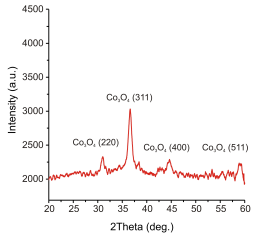 | Fe wire substrate, 0.1 M (CH3COO)2Co·4H2O + 0.1 M CH4N2O aqueous solution | 5 h, 95 °C hydrothermal synthesis in glass beaker; 1 h 450 °C annealing | [109] |
| Co3O4 (nitrate precursor) |  | Wrinkled nanosheets, lateral sheet size 0.5–3 μm, sheet thickness 20–70 nm | 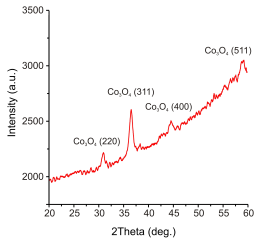 | Fe wire substrate, 0.1 M Co(NO3)2·6H2O + 0.1 M CH4N2O aqueous solution | 5 h, 95 °C hydrothermal synthesis in glass beaker; 1 h 450 °C annealing | [110] |
| Co3O4 (cloride precursor) |  | Nanowires, diameter 80–200 nm |  | Fe wire substrate, 0.1 M CoCl2·6H2O + 0.1 M CH4N2O aqueous solution | 5 h, 95 °C hydrothermal synthesis in glass beaker; 1 h 450 °C annealing | [109] |
| NiO | 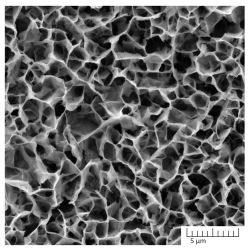 | Nanowalls, pore diameter 0.5–2.0 μm, wall thickness 100–300 nm | 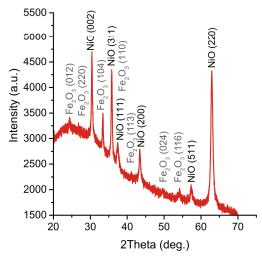 | Fe wire substrate, 0.1M Ni(NO3)2·6H2O + 0.1M C6H12N4 aqueous solution | 5 h, 95 °C hydrothermal synthesis in glass beaker; 3 h 450 °C annealing | [111] |
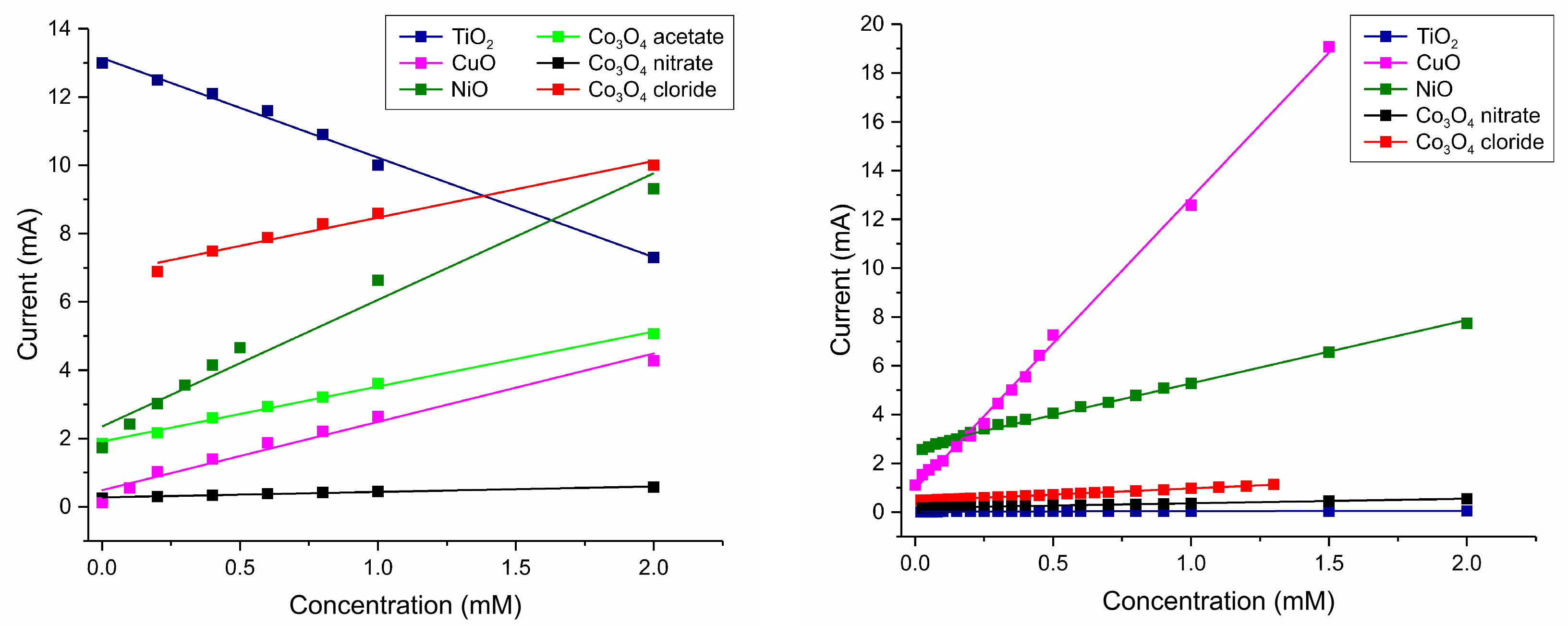
| Oxide | Morphology | CV Graph | Supporting Electrolyte | Measurement Potential (vs. Ag/AgCl) | Sensitivity (mA·mM−1) | LOD (µM) | Linear Detection Range (mM) | Selectivity | Reference |
|---|---|---|---|---|---|---|---|---|---|
| TiO2 | Nanowires network |  | PBS (pH = 7.4) | −1.1 V | 2.91 | 31 | 0–5 | NaCl, KNO3, Glu, CA, AA | [107] |
| CuO | Nanoflowers | 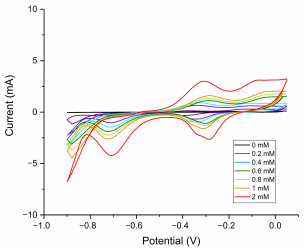 | NaOH (pH = 13) | −0.7 V | 2.00 | 12.3 | 0–3 | CA, AA, NaCl, Glu, KNO3, urea | [108] |
| Co3O4 (acetate precursor) | Porous nanosheet network | 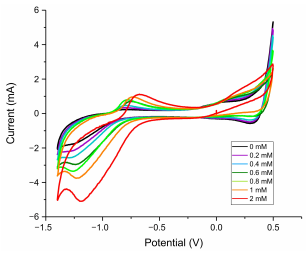 | NaOH (pH = 13) | −1.23 V | 1.61 | 55 | 0–5 | NaCl, KNO3, Glu, CA, AA | [109] |
| Co3O4 (nitrate precursor) | Wrinkled nanosheets |  | NaOH (pH = 13) | −1.23 V | 0.16 | 33 | 0–2 | AA, UA, NaCl, Glu | [110] |
| Co3O4 (cloride precursor) | Nanowires |  | NaOH (pH = 13) | −1.23 V | 1.71 | 45 | 0–5 | AA, UA, NaCl, Glu | [109] |
| NiO | Nanowalls |  | NaOH (pH = 13) | −1.3 V | 3.7 | 25 | 0–2 | AA, UA, NaCl, Glu | [111] |
| Oxide | Method of Measurement | Supporting Electrolyte | Sensitivity (mA·mM−1) | LOD (µM) | Changes of Sensitivity (Compared to CV) | Changes in LOD (Compared to CV) | Reference |
|---|---|---|---|---|---|---|---|
| TiO2 | Chronoamperometry | PBS (pH = 7.4) | 0.04 | 2.8 | −98.63% | 90.97% | [107] |
| CuO | DPV | NaOH (pH = 13) | 11.9 | 1.9 | +495.00% | 84.55% | [108] |
| Co3O4 (nitrate precursor) | Chronoamperometry | NaOH (pH = 13) | 0.19 | 5.2 | +18.75% | 84.22% | [110] |
| Co3O4 (cloride precursor) | Chronoamperometry | NaOH (pH = 13) | 0.51 | 1.59 | −70.18% | 96.47% | [109] |
| NiO | Chronoamperometry | NaOH (pH = 13) | 2.48 | 1.05 | −32.97% | 95.80% | [111] |
| Crop | Stress | nPs for Mitigation | Morphology | H2O2 Found (µM) Control | H2O2 Found (µM) nPs 50 mg·L−1 | H2O2 Found (µM) nPs 100 mg·L−1 | Stress H2O2 Found (µM) | H2O2 Found (µM) Stress nPs 50 mg·L−1 | H2O2 Found (µM) Stress nPs 100 mg·L−1 | Reference |
| Oat (Avena sativa) | Drought | MgO | Irregular particles, up to 20 nm, composed in clusters up to 200 nm | 52 | 50 | 3 | 262 | 126 | 98 | [108] |
| Rye (Secale cereale) | Drought | MgO | Irregular particles, up to 20 nm, composed in clusters up to 200 nm | 51 | 60 | 8 | 102 | 75 | 40 | [108] |
| Rye (Secale cereale) | Salinity | ZnO | Spherical particles, 10–25 nm agglomerated into submicron rice-like clusters | 42 | 58 | 17 | 479 | 154 | 94 | [111] |
| Barley (Hordeum vulgare) | Salinity | Fe3O4 | Spherical particles, up to 10 nm | 5 | 30 | 6 | 217 | 13 | 3 | [110] |
| Rye (Secale cereale) | Herbicide | − | 3 | − | − | 223 | − | − | [176] | |
| Rye (Secale cereale) | Salinity | − | 3 | − | − | 130 | − | − | [176] | |
| Crop | Stress | nPs for Mitigation | Morphology | H2O2 Increase Under Stress (vs. Unstressed Control) | H2O2 Mitigation by 50 mg·L−1 nPs (vs. Stressed Control) | H2O2 Mitigation by 100 mg·L−1 nPs (vs. Stressed Control) | Reference | |||
| Oat (Avena sativa) | Drought | MgO | Irregular particles, up to 20 nm, composed in clusters up to 200 nm | 403.8% | 51.9% | 62.6% | [108] | |||
| Rye (Secale cereale) | Drought | MgO | Irregular particles, up to 20 nm, composed in clusters up to 200 nm | 100% | 26.5% | 60.8% | [108] | |||
| Rye (Secale cereale) | Salinity | ZnO | Spherical particles, 10–25 nm agglomerated into submicron rice-like clusters | 1040.5% | 67.8% | 80.4% | [111] | |||
| Barley (Hordeum vulgare) | Salinity | Fe3O4 | Spherical particles, up to 10 nm | 4240.0% | 94.0% | 98.6% | [110] | |||
| Rye (Secale cereale) | Herbicide | − | − | − | [176] | |||||
| Rye (Secale cereale) | Salinity | − | − | − | [176] | |||||
| Plant (Crop), Stress | Nanoparticle (Formulation) & Conc. (Application) | H2O2 Detection Method | Reported % Decrease in H2O2 (NPs vs. Stressed Control) | Reference |
|---|---|---|---|---|
| Rapeseed (Brassica Napus), salt stress | PNC (CeO2; 0.05 mM ≈ 5.6 mg/L), foliar; PMO (Mn3O4; 300 mg/L), foliar | H2O2 kit (A04-1-1 and 20210903) | 44.5% (CeO2 PNC) or 38.6% (Mn3O4 PMO) | [18] |
| Cotton (Gossypium hirsutum L.), salt stress | PNC (CeO2 polyacrylic acid coated), 0.1 mL, 0.9 mM, foliar | Ti(SO4)2 precipitation method | 79% | [19] |
| Rice (Oryza sativa L.), salt stress | SiO2 SNPs, 120 mg·L−1, foliar spray | Modified Góth method | 8% to 31% | [147] |
| Sorghum (Sorghum bicolor), drought stress | CeO2 nPs, foliar spray 10 mg·L−1 | Spectrophotometric H2O2 assay | 36% | [8] |
| Maize (Zea mays L.), drought stress | ZnSe QDs, 20 mg·L−1, foliar spray | Patterson method [177] | 23% | [178] |
| Tomato (Solanum lycopersicum), salt stress | ZnO nPs, foliar spray 75 mg·L−1 and 150 mg·L−1 | KI colorimetric H2O2 assay | 41.1% for 75 mg·L−1 nPs and 51.8% for 150 mg·L−1 nPs | [7] |
| Wheat (Triticum aestivum), salt stress | Ag nPs, foliar spray—300 ppm | Biochemical colorimetric assay | 56% | [179] |
| Moldavian balm (Dracocephalum moldavica L.), salt stress | TiO2 nPs, 0–200 mg·L−1, irrigation | KI spectrophotometry (A390) | 20–26% | [20] |
| Rapeseed (Brassica Napus), salt stress | 0.1 mM PNC CeO2, seed priming | H2O2 kit (A04-1-1) | 23% | [139] |
| Tomato (Solanum lycopersicum), drought stress | SeNPs, 25–100 ppm, seed priming | Spectrophotometric H2O2 assay | 39.3% | [9] |
| Maize (Zea mays L.), drought stress | FeO nPs, MnO nPs, CuO nPs 25–100 ppm, seed priming | Biochemical H2O2 assay | 23–27% depending on drought level | [140] |
| Mungbean (Vigna radiata), drought stress | CeO2 nPs, foliar spray 100 mg·L−1 | Spectrophotometric H2O2 assay | 28% | [180] |
| Barley (Hordeum vulgare L.), salt stress | TiO2 nPs, 500, 1000 and 2000 mg·kg−1, powder added to the soil | KI spectrophotometry (A390) | 25.8–43.1% depending on nPs dose | [145] |
| Tobaccco (Nicotiana tabacum L.), Cd-induced stress | 50 μM Ag nPs suspension, irrigation | Guaiacol method and ultraviolet absorption spectrometry | - | [141] |
| Rice (Oryza sativa L.), salt stress | TiO2 nPs, 15–60 mg·L−1, water spray | Titanium salt colorimetric method | 22.1–24.7% | [146] |
| Crop | Stress | nPs for Mitigation | Total Chlorophyll Control | Total Chlorophyll nPs 50 mg·L−1 | Total Chlorophyll nPs 100 mg·L−1 | Total Chlorophyll Stress | Total Chlorophyll Stress nPs 50 mg·L−1 | Total Chlorophyll Stress nPs 100 mg·L−1 | Reference |
| Oat (Avena sativa) | Drought | MgO | 1.1493 | 2.1490 | 2.5595 | 0.5570 | 1.7450 | 2.0653 | [108] |
| Rye (Secale cereale) | Drought | MgO | 2.3035 | 2.9008 | 2.3889 | 1.2363 | 2.9894 | 2.7833 | [108] |
| Rye (Secale cereale) | Salinity | ZnO | 1.0689 | 1.3428 | 1.3506 | 0.5280 | 0.9424 | 1.0303 | [111] |
| Barley (Hordeum vulgare) | Salinity | Fe3O4 | 0.5121 | 0.4976 | 0.5568 | 0.3478 | 0.6167 | 0.7326 | [110] |
| Rye (Secale cereale) | Herbicide | − | 0.6375 | − | − | 0.4579 | − | − | [176] |
| Rye (Secale cereale) | Salinity | − | 0.6375 | − | − | 0.4931 | − | − | [176] |
| Crop | Stress | nPs for Mitigation | Chlorophyll Decrease Under Stress (vs. Unstressed Control) | Chlorophyll Mitigation by 50 mg·L−1 nPs (vs. Stressed Control) | Chlorophyll Mitigation by 100 mg·L−1 nPs (vs. Stressed Control) | Reference | |||
| Oat (Avena sativa) | Drought | MgO | −59% | 213% | 271% | [108] | |||
| Rye (Secale cereale) | Drought | MgO | −46% | 142% | 125% | [108] | |||
| Rye (Secale cereale) | Salinity | ZnO | −51% | 79% | 95% | [111] | |||
| Barley (Hordeum vulgare) | Salinity | Fe3O4 | −32% | 77% | 111% | [110] | |||
| Rye (Secale cereale) | Herbicide | − | 28% | − | − | [176] | |||
| Rye (Secale cereale) | Salinity | − | 23% | − | − | [176] | |||
| Plant (Crop), Stress | Reported Chlorophyll Decrease Under Stress (vs. Unstressed Control) | Nanoparticle (Formulation) & Conc. (Application) | Reported Chlorophyll Mitigation by NPs (vs. Stressed Control) | Reference |
|---|---|---|---|---|
| Rice (Oryza sativa cv. Pusa Basmati 1), Salinity | Total chlorophyll −18.15% (reported) | Se nP 10 mg·kg−1, soil + ZnO nP 20 mg·kg−1, soil | Total chlorophyll +35.38% (reported) | [138] |
| Bell pepper (Capsicum annuum), Salinity | Total chlorophyll −55% (reported) | Se NPs 10 and 50 mg·L−1, Si NPs 200 and 1000 mg·L−1, Cu NPs 100 and 500 mg·L−1, soil | From +52% to +72% depending on stress conditions and nanoparticle concentration (reported) | [181] |
| Canola (Brassica napus), Drought | Not reported | Fe nPs (1.5 and 3 mg·L−1), soil | Total chlorophyll +24.43% (reported) | [136] |
| Soybean (Glycine max), Drought | Chlorophyll a −47.7% and Chlorophyll b −41.4% (reported) | ZnO nPs, foliar spray | Chlorophyll a +33.1% and Chlorophyll b +20.7% (reported) | [133] |
| Apple (Malus domestica cv. Red Delicious on M9), Drought | Total chlorophyll −19.9% (reported) | CeO2 NPs 50 or 100 mg·L−1, foliar spray | Total chlorophyll +7.14% and +15.88% depending on nPs concentration (reported) | [134] |
| Mungbean (Vigna radiata), Cadmium stress | Total chlorophyll −26.48% (reported) | SeNP 75 mg·L−1, foliar spray, | Best level of foliar applied SeNPs 3.30 mg·g−1 of total chlorophyll (reported in text), + 235% (calculated from graph) | [135] |
| Pepper (Capsicum annum L.), Salinity | Total chlorophyll −39% and −50% depending on stress level (calculated from table data) | C QDs-GO, foliar spray | +40% and +54,8% depending on stress level (calculated from table data) | [153] |
| Barley (Hordeum vulgare), Salinity | Chlorophyll a −42.3% and Chlorophyll b −37.5% (calculated from graph) | Cu nPs 50 mg·L−1, soil | Chlorophyll a 80% and Chlorophyll b 62% (calculated from graph) | [137] |
| Faba bean (Vicia faba), Salinity | Total chlorophyll −43.4% | ZnO nPs (50 mg·L−1 and 100 mg·L−1), foliar spray | Total Chlorophyll +17.5% and −20.5% depending on nanoparticle concentration | [143] |
| Tomato (Lycopersicon esculentum Mill.), Salinity | SPAD chlorophyll −29.2% (calculated from graph) | ZnO nPs (10 mg·L−1, 50 mg·L−1, 100 mg·L−1), foliar | SPAD chlorophyll 23.5%, 70.6% and 35.3% (calculated from graph) | [182] |
| Cucumber (Cucumis sativus L.), Drought | Total chlorophyll −71.4% (calculated from graph) | ZnO (25 mg·L−1 and 100 mg·L−1), foliar | +75% and +275% depending on nanoparticle dose (calculated from graph) | [144] |
Disclaimer/Publisher’s Note: The statements, opinions and data contained in all publications are solely those of the individual author(s) and contributor(s) and not of MDPI and/or the editor(s). MDPI and/or the editor(s) disclaim responsibility for any injury to people or property resulting from any ideas, methods, instructions or products referred to in the content. |
© 2026 by the authors. Licensee MDPI, Basel, Switzerland. This article is an open access article distributed under the terms and conditions of the Creative Commons Attribution (CC BY) license.
Share and Cite
Sledevskis, E.; Krasovska, M.; Mihailova, I.; Gerbreders, V.; Mizers, V.; Keviss, J.; Bulanovs, A. Hydrothermally Synthesized Metal Oxide Nanostructures for H2O2 Sensing and Oxidative Stress Management in Plants. Appl. Nano 2026, 7, 18. https://doi.org/10.3390/applnano7030018
Sledevskis E, Krasovska M, Mihailova I, Gerbreders V, Mizers V, Keviss J, Bulanovs A. Hydrothermally Synthesized Metal Oxide Nanostructures for H2O2 Sensing and Oxidative Stress Management in Plants. Applied Nano. 2026; 7(3):18. https://doi.org/10.3390/applnano7030018
Chicago/Turabian StyleSledevskis, Eriks, Marina Krasovska, Irena Mihailova, Vjaceslavs Gerbreders, Valdis Mizers, Jans Keviss, and Andrejs Bulanovs. 2026. "Hydrothermally Synthesized Metal Oxide Nanostructures for H2O2 Sensing and Oxidative Stress Management in Plants" Applied Nano 7, no. 3: 18. https://doi.org/10.3390/applnano7030018
APA StyleSledevskis, E., Krasovska, M., Mihailova, I., Gerbreders, V., Mizers, V., Keviss, J., & Bulanovs, A. (2026). Hydrothermally Synthesized Metal Oxide Nanostructures for H2O2 Sensing and Oxidative Stress Management in Plants. Applied Nano, 7(3), 18. https://doi.org/10.3390/applnano7030018