
Article

Quantitative Pulse-Shape-Instability Analysis Using 2D-Runs FROG
1
Deutsches Elektronen-Synchrotron DESY, Notkestr. 85, 22607 Hamburg, Germany
2
Institute of Quantum Optics, Leibniz University Hannover, Welfengarten 1, 30167 Hannover, Germany
3
School of Physics, Georgia Institute of Technology, 837 State Street NW, Atlanta, GA 30332, USA
4
Department of Statistics and Data Science, Faculty of Science, National University of Singapore, 6 Science Drive 2, Singapore 117546, Singapore
*
Author to whom correspondence should be addressed.
Optics 2026, 7(3), 42; https://doi.org/10.3390/opt7030042
Submission received: 10 April 2026 / Revised: 27 May 2026 / Accepted: 28 May 2026 / Published: 3 June 2026
(This article belongs to the Section Laser Sciences and Technology)

Abstract

We present a method for quantifying ultrashort pulse-shape instability in a train of pulses using multi-shot second-harmonic-generation frequency-resolved optical gating (SHG FROG). All versions of multi-shot FROG have previously shown the ability to qualitatively distinguish stable from unstable pulse trains, as systematic differences appear between measured and retrieved FROG traces when instability is present. This has proved possible because the recently introduced retrieved-amplitude N-grid algorithmic (RANA) approach provides highly reliable pulse retrieval, even for unstable pulse trains and in the presence of noise, thereby eliminating the possibility that algorithm stagnation, which also yields such systematic differences, could be confused for such instability. In other words, RANA’s excellent performance ensures that any non-random discrepancies between measured and retrieved FROG traces reflect physical pulse-shape instability rather than algorithmic stagnation. To quantify such instability, we now introduce an instability parameter, R . It involves an extension of the well-known statistical “Runs” test, which has been used for decades to test for systematic error in fits to one-dimensional (1D) data. A runs test counts the “runs”—consecutive points in the plot of the difference between the data and fit with the same sign (+ or −), yielding an evaluation of the goodness of the fit, largely independent of random error. Specifically, the more runs, the better the fit. However, because FROG traces are functions of two variables, we must extend the usual 1D runs test to two dimensions, that is, to enumerate the 2D runs—“hills” and “valleys” in the difference between measured and retrieved 2D FROG traces. Many small 2D runs indicate only random noise-like differences, that is, a good fit, and, hence, a stable pulse train, whereas few large runs reflect systematic error, that is, a poor fit, and, hence, pulse-shape instability. Finally, because random noise could contribute numerous meaningless runs in the wings of a FROG trace, where the intensity is near zero, we must also weight each hill and valley by its average measured trace intensity in order to minimize its effects. We show that R is intuitive and reasonable and, in addition, is independent of pulse complexity and trace size. As a result, it provides a clear metric of pulse-shape stability vs. instability.

1. Introduction

Since the invention of the first lasers in the 1960s, techniques such as mode-locking [1,2,3], dispersion management [4,5,6], optical parametric chirped-pulse amplification (OPCPA) [7], and post-compression methods [8,9,10,11,12] have enabled the generation of ultrashort laser pulses with durations spanning from hundreds of nanoseconds down to almost a single optical cycle. In parallel, advances in high-energy laser technology have made it possible to deliver pulses ranging from millijoules to hundreds of joules, with durations as short as tens of femtoseconds [13,14,15,16,17,18,19,20,21,22]. Recently developed high-peak-power laser systems now routinely achieve peak powers on the order of 10 PW per pulse, achieving irradiances exceeding 1023 W/cm2 at focus [23]. Such energetic ultrashort pulses have enabled transformative applications across science and technology, most notably the emergence of laser-plasma accelerators, which employ intense femtosecond laser pulses to drive plasma waves capable of accelerating charged particles to near-light speeds over distances of only a few millimeters to centimeters. The idea was first proposed by Tajima and Dawson in 1979 [24] and became experimentally viable after the development of chirped-pulse amplification [25], which enabled the generation of sufficiently intense femtosecond pulses. Since particle acceleration is highly sensitive to laser parameters, maintaining a stable and reproducible pulse train is essential to produce consistent, high-quality charged particle beams [26]. These secondary sources generate energetic photons [27], neutrons [28] and charged particles [29,30,31,32,33,34], with applications ranging from cancer proton therapy [32], phase-contrast imaging using laser-driven K α X-ray sources [35], to neutron imaging [36], soft X-ray phase-contrast tomography [37], high-resolution MeV x-ray tomography [38], and fast ignition schemes in inertial confinement fusion (ICF) [39,40].
In high-power regimes, whether the application involves multi-shot averaging or not, pulse-shape stability from shot to shot is critically important, as even small fluctuations or a slight temporal delay of a pre-pulse relative to the main pulse can severely perturb or even destroy the target under study. Pulse-shape stability is equally critical in fundamental research areas such as high-harmonic generation and attosecond light sources [41], extreme ultraviolet switching [42], attosecond optical switching [43], ultrafast optoelectronics [44], attosecond spectroscopy [45,46], and high-harmonic generation in gas and solid phase [47], all of which require precise control over both the temporal intensity and phase of the driving pulses. Similarly, in supercontinuum generation using hollow-core or photonic crystal fibers, the stability of the supercontinuum strongly depends on the pump laser characteristics [48,49]. In nonlinear optical microscopy applications, particularly those involving raster-scanned imaging, pulse-to-pulse variations can significantly degrade image quality. This is particularly critical in techniques such as optical coherence tomography and stimulated Raman scattering microscopy, where instability in the laser pulses can lead to image distortions or spectral artifacts [50,51,52,53].
Although major advances in laser science and engineering have made it possible to generate amplified ultrashort pulses with extreme peak and average powers at high repetition rates [54,55] and even pulse durations as short as a single optical cycle, ensuring pulse-shape stability remains a significant challenge. Even state-of-the-art systems can exhibit pulse-to-pulse fluctuations in intensity and phase vs. time and frequency that severely complicate experiments using them. Such instabilities can arise from a variety of sources, including pump-laser instability, thermal fluctuations, imperfect mode-locking, and even air turbulence in the laser beam path.
Since the early days of ultrafast optics, shot-to-shot variations in pulse shape, in both intensity and phase, have presented a major challenge for devices that measure ultrashort pulses [56,57]. When presented with a train of unstable pulses, intensity autocorrelation, the earliest method for measuring ultrashort pulses, displays a narrow “spike” atop a broad background, with the spike representing the coherent (repeatable) portion of the pulse train’s intensity [57]. This spike is always narrower than the average pulse in the unstable train and generally indicates the shortest temporal spikes within more complex pulses [58]. While it is a fairly reliable indicator of the presence of significant pulse-intensity instability, it is not quantitative, and it can be misleading. When instability is large, the broad background, indicating the actual average pulse length, may be overlooked, and when instability is small, but nonzero, the spike blends into the more meaningful background, reducing the width of the autocorrelation trace and causing the pulse to appear shorter than it actually is. Both cases can lead to the erroneous conclusion of a more stable and shorter pulse than is in fact present.
More recently, typically interferometric, techniques that measure the spectral phase have proven to be even more problematic. This is because long complex pulses generally have complex spectral phases, while short simple pulses have a flat spectral phase. Indeed, for a given spectrum, the shortest pulse corresponds to a flat spectral phase. Thus, averaging the spectral phase over many different complex pulses necessarily yields an artificially flatter (or even perfectly flat) measured average spectral phase, misleadingly providing a shorter, often even transform-limited pulse. In other words, the average spectral phase is the frequency-domain description of the coherent artifact (a simple fact that is unfortunately not widely known). As a result, techniques that measure the average spectral phase, such as SPIDER, measure only the coherent artifact [59]. It should be mentioned that the presence of small amounts of background can indicate such averaging, but actual measurements are generally afflicted with other sources of background; thus, it cannot be used to distinguish the presence of instability. As a result, such interferometric techniques can only be trusted for a perfectly stable pulse train, but, as no device exists to confirm this latter fact, such measurements are prone to yielding erroneously short pulses and, therefore, should not be used for conclusions about pulse lengths.
Single-shot intensity-and-phase-shape measurements would, of course, see pulse-to-pulse shape variations. For example, a recent study at Lawrence Berkeley National Laboratory (LBNL) demonstrated such an approach for measuring pulses from a 100 TW Ti:Sapphire laser capable of delivering 2.5 J, sub-40 fs pulses at 1 Hz. In that work, single-shot complete intensity-and-phase measurements were made using the GRENOUILLE technique (a simple single-shot version of FROG), and corrections were performed to help stabilize their laser-plasma accelerator [26]. But such single-shot measurements are only possible for amplified systems and are not usually possible in unamplified lasers due to their low pulse energies and high rep rates.
In practice, however, multi-shot averaging is employed in most practical pulse measurements, even for high-intensity pulses. Fortunately, frequency-resolved optical gating (FROG) and its variations have been known to provide a qualitative indicator of pulse-shape instability for over two decades [58]. Indeed, the first observation of this fact was quite dramatic, involving ultrabroadband supercontinuum pulses, initially thought to have smooth and stable spectra, but, instead, were shown using FROG to have extremely complex and chaotic spectra, with thousands of random spikes [58]. Such conclusions are possible because, for unstable pulse trains, the measured FROG trace, an average over the traces of the many pulses in the measurement, no longer corresponds to that of any single pulse in the train, whereas FROG algorithms can (and should) only retrieve a trace corresponding to a single pulse. As a result, discrepancies between the measured and retrieved FROG traces reveal pulse-shape instability. This works even for measurements over many billions of pulses, and the above measurement remarkably involved averaging over 108 pulses.
There has been one complication, however. Even the well-established standard generalized projections (GPs) FROG pulse-retrieval algorithm may stagnate, especially for complex pulses, and, because stagnation also yields such discrepancies, these two unrelated effects could be confused for each other [60]. Fortunately, the recently developed, improved algorithm, the retrieved-amplitude N-grid algorithmic (RANA) approach, has proven extremely reliable, eliminating the possibility of stagnation and the associated confusion. RANA’s main innovation is to simply retrieve the pulse’s approximate spectrum directly from the measured FROG trace and then use this recovered spectrum to construct vastly improved initial guesses for the pulse electric field, which can then be used with any phase-retrieval algorithm, such as GP. RANA (using GP), which has proven 100% reliable in retrieving stable, extremely complex pulses with time-bandwidth products (TBP) up to 100, even in the presence of significant noise, and has been tested on sets of thousands of FROG traces [61,62,63]. Even for unstable pulse trains, it reliably converges to the field whose trace best matches the measured trace, ensuring that any difference reflects true pulse-shape instability rather than algorithm stagnation. Additionally, although the retrieved pulse field exhibits some smoothing of the pulse intensity vs. time, it exhibits a pulse duration and TBP that closely match the average values of the unstable pulses in the train, making it the best available representation of a typical pulse in the train [64,65].
To reiterate, the conclusion from these studies is that, when retrieving the pulse from a FROG trace using RANA, algorithm stagnation is no longer a problem, and any discrepancies between the measured and retrieved traces are due to the usual random noise and possible systematic error due entirely to pulse-shape instability [64,65].
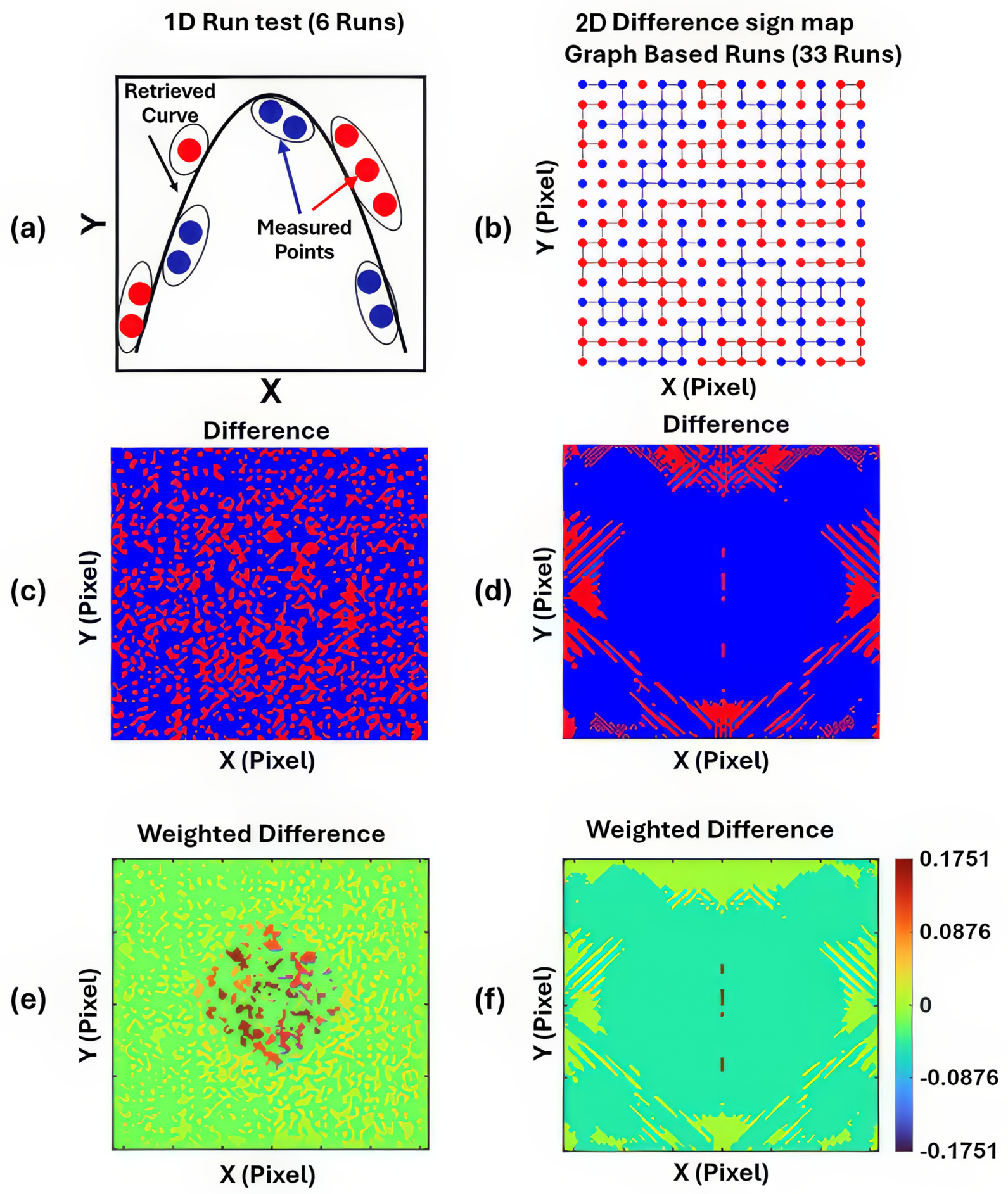
The next challenge is to quantify the pulse-shape instability, rather than merely indicating its presence by eye. Thus, in this work, we have developed a parameter for this purpose. Our approach involves quantifying the systematic error in the difference between the measured and retrieved FROG traces. We use an extension of a well-known statistical approach for quantifying goodness of fit in one-dimensional data sets, called the “one-dimensional (1D) runs test” (or the Wald–Wolfowitz Runs Test, after its inventors) [66], which is commonly used to evaluate how well a model fits 1D experimental data, independent of random noise. Its use for a simple example data set, where the quantity, Y, is measured vs. the independent variable, X, is shown in Figure 1a. A runs test is a reliable non-parametric statistical test used to check whether the differences between observed data points and a fit are random or there is some pattern in their ordering (indicating the presence of systematic error). In the difference data, a “run” is defined as a sequence of consecutive data points that share the same sign. For a good fit, that is, with the absence of systematic error, there should be many short runs due to frequent sign changes in the difference data due only to random error. This behavior confirms that the model has successfully reproduced the main features of the data and that the remaining differences are merely due to random noise. In contrast, when the differences maintain the same sign over long stretches of consecutive data points, that is, there are only a few runs, then the model consistently overestimates or underestimates the data, providing conclusive evidence of systematic error (in other words, a poor fit).
A FROG trace inherently involves a two-dimensional (2D) data trace; however, any runs-based diagnostic for it must be extended to 2D. Multidimensional generalizations of runs tests are far less common but have been developed and have been reported in the statistics literature, beginning with the seminal work of Friedman and Rafsky [67]. Their approach replaced the linear ordering of observations by a graph-theoretic construction. A more robust graph-based method was later introduced by Biswas et al. [68]. Unfortunately, neither approach is directly applicable to FROG traces due to the underlying geometry of the FROG’s regular grid graphs. However, motivated by these ideas, we introduce a variation on their notion of 2D runs, tailored specifically to regular grid graphs, which naturally respects the geometry of FROG data.
We define our 2D runs statistic by first forming the pointwise difference between the measured and retrieved FROG traces (See Figure 1b) for every grid point, where we will, in this example figure, use X and Y as the two generic independent variables. This difference is itself a two-dimensional trace, and 2D runs are defined as connected sets of points of the (X,Y) grid over which the sign of the difference remains the same (+ or −). We then count the number of such connected 2D regions in the resulting sign graph. Visually, these regions can be interpreted as “hills” and “valleys” in the 2D difference-trace landscape.
When the retrieved trace faithfully reproduces the measured trace, the difference trace appears as random noise, with frequent sign changes between consecutive grid points that fragment the landscape into many small regions (hills and valleys). Conversely, systematic error manifests as extended patches of the same sign, yielding hills and valleys of larger areas and fewer of them. The resulting statistic, therefore, provides a geometrically intuitive and distribution free (“non-parametric”) measure of structured mismatch between measured and retrieved FROG traces.
It is worth noting that, in general, a very large number of runs, whether 1D or 2D, while seemingly desirable, does not necessarily mean that a model is meaningful. Such a case can imply “overfitting,” that is, the use of too many parameters in the fitting function. In practice, a realistic, good fit is one with an intermediate number of runs. However, overfitting is not relevant in FROG, where the model is known and fixed in advance and does not allow for variations in the number of parameters. Thus, in FROG, the more runs the better the fit and, hence, the more stable the pulse train. Figure 1c shows the 2D runs in a sample difference trace corresponding to a lack of systematic error, while Figure 1d shows the runs for a difference sample trace with considerable systematic error.
Another important issue unique to FROG is that the edge pixels of a FROG trace necessarily carry much less signal intensity, thereby contributing much less information to the trace. As a result, their contributed runs are numerous and dominated by even small amounts of random noise. To avoid these mostly meaningless contributions, we must introduce a weighting approach to emphasize the more significant (central) higher-intensity regions of the FROG trace. Each 2D run must therefore be weighted by the average intensity of the measured FROG trace for points in that run. This measure then considers only the statistically meaningful runs while minimizing the influence of low-signal areas or trace wings, where noise dominates the geography of the 2D runs. Figure 1e,f show sample traces of weighted 2D runs for cases of a good and poor fit, respectively. Applying this idea to FROG, it would then correspond to stable and unstable pulse trains for pulses with an average Gaussian shape. Note that the values in the difference-trace wings are near zero due to their low weights, as desired.
Applying this weighted 2D runs approach to the difference trace enables reliable identification of systematic errors in FROG difference traces, indicative of the degree of pulse-shape instability. To quantify this effect in a trace-size-independent manner, we introduce (in the next section) a parameter that we call R, a scalar metric that directly measures the amount of systematic error in the difference trace and, hence, the pulse-shape instability.
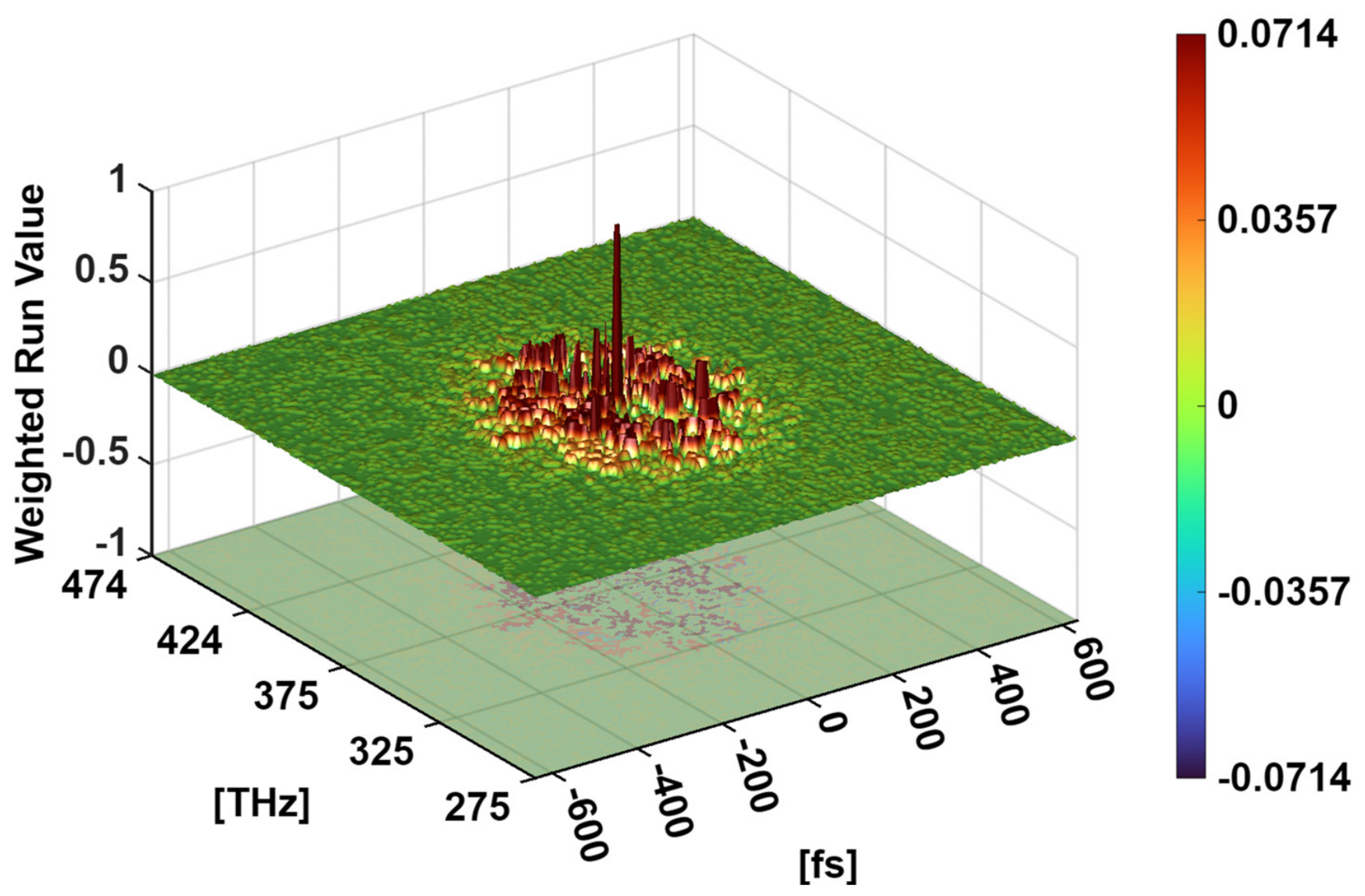
To better illustrate the concept of our 2D weighted-runs approach, interpreted as a landscape of weighted “hills” and “valleys,” we can use a three-dimensional visualization of the signed weighted map, as shown in Figure 2. In this representation, the difference trace of a stable pulse train with a TBP of 10 is plotted as a surface over delay and frequency, where the height corresponds to the weighted run value and the color indicates its magnitude and sign. To better illustrate the structure, a semi-transparent projection of the same map is shown on the bottom plane, allowing the underlying 2D distribution to be seen together with the 3D surface.

2. Graph-Based Method for 2D Run Analysis

We begin by defining the difference trace, Δ i j , which captures pixel-by-pixel discrepancies between the measured and retrieved traces, where the sign of each element indicates whether the retrieved intensity overestimates or underestimates the measured intensity locally. Measured FROG traces are assumed to be normalized to have a peak value of 1. We then compute the 2D runs as described previously.
If the FROG trace is an N   ×   N array, let the difference trace be
Δ i j = I F R O G m e a s ω i , τ j I F R O G r e t r ω i , τ j   f o r   i , j { 1 , , N } ,
Also, let K be the total number of 2D runs, R k be the set of pixels in the k t h run, which we define to have R k pixels. As a result, the k t h run will have a mean measured intensity as follows:
I k = 1 R k i , j R ( k ) I F R O G m e a s ω i , τ j ,
and the normalized weighted runs statistic, R , is defined to be
R = k = 1 K I k i , j I F R O G m e a s ω i , τ j .
In the unrealistically ideal case in which the sign alternates from each pixel to the next (like a checkerboard), there will be K   =   N 2 runs, comprising one point each, and each run’s weight will be the measured trace’s value at that point. Both the numerator and denominator of R will then have N 2 terms, each equaling a measured trace data point, I F R O G m e a s ω i , τ j . As a result, in this case, R   =   1 . In the worst-case scenario of an extremely poor fit (also unrealistic), where all measured points are larger (or smaller) than retrieved ones, there will be only one 2D run ( K   =   1 ), yielding R 1   =   N 2 and I k = 1 N 2 Σ   I F R O G m e a s , which yields R   =   1 / N 2 . Thus, R ranges from 1 / N 2 to 1, and the more unstable the pulse shape, the lower the R value.
Finally, R is trace-size independent because both numerator and denominator scale in the same way when the trace size changes. In other words, when the measured and retrieved traces are resized (for example, by interpolation or by acquiring data with a higher or lower sampling rate), the total number of pixels can increase or decrease, provided that the discrete Fourier transform condition remains satisfied for the delay and frequency axes. This means that both the number of pixels contributing to each run and the sum of all pixel weights increase or decrease proportionally. This independence of R from the trace size is shown in more detail in Appendix A.

3. Simulation Details

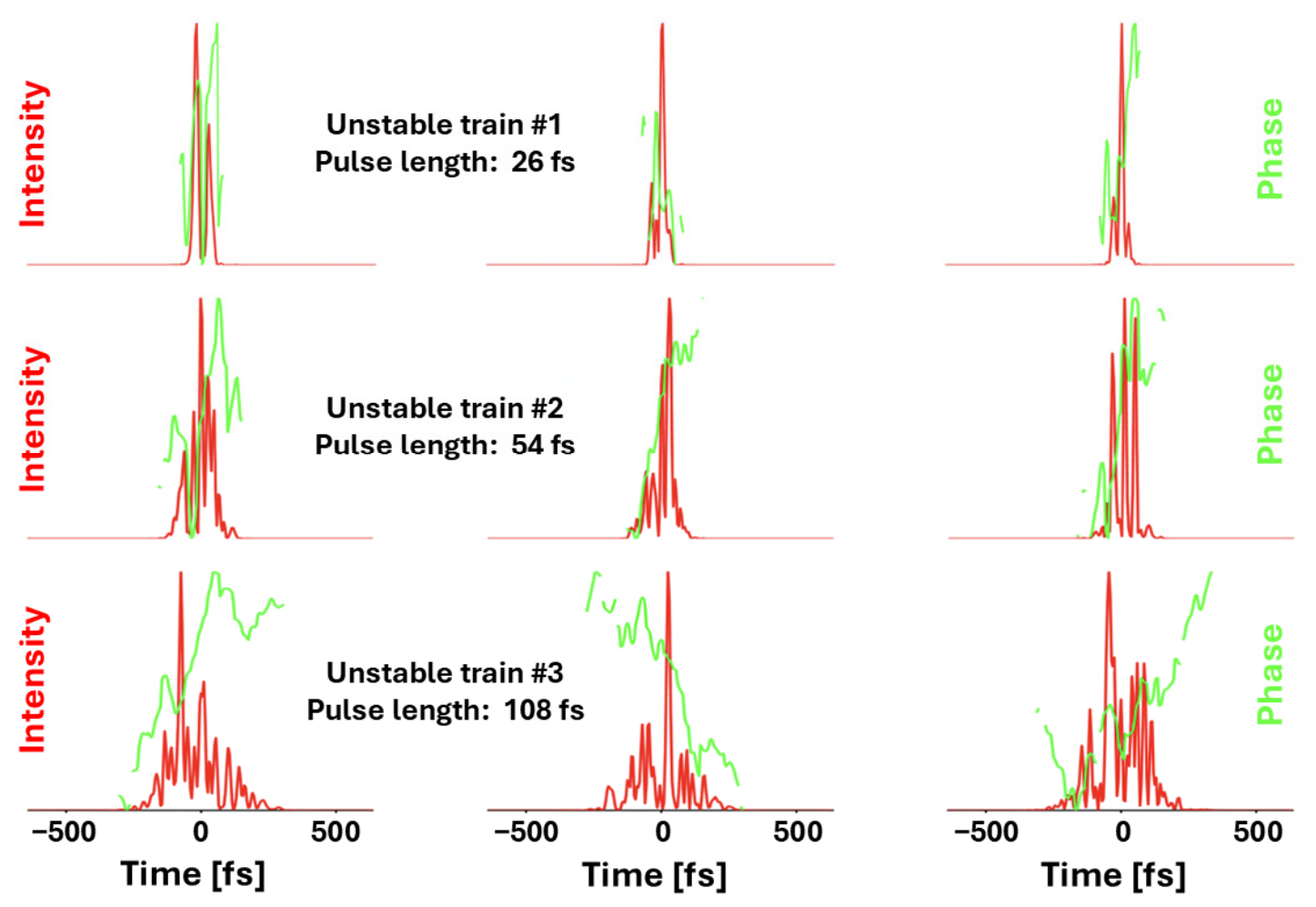
We investigated the performance of the 2D-runs analysis using three different pairs of stable and unstable pulse trains. For consistency with our prior SHG FROG simulations (in which the pulse instability was qualitatively identified by visually observing the difference trace for systematic error), we used the same sets of stable and unstable test pulses. This includes three stable pulse trains, each comprising a single pulse (or, equivalently, 5000 identical pulses). In addition, it includes three unstable pulse trains, each comprising 5000 different, randomly varying pulses of the same average pulse lengths and TBPs as the stable trains [59,64,65]. The pairs of trains have TBPs of 2.5, 5.0, and 10, respectively. These complex pulses were constructed by adding to a short constant-phase Gaussian pulse a longer, more complex component. For the stable train, this was performed once for each of the three values of the TBP, and all pulses in such trains were the same. For the unstable trains, 5000 different random complex components were added, thereby introducing controlled pulse-shape instability in the unstable trains. The stable pulse component in each pulse had a temporal full width at half maximum (FWHM) of 12 fs in all cases. Since the random components were necessarily longer, they were assigned higher energies before being added to the stable pulses, resulting in average temporal FWHMs of 26 fs, 54 fs, and 108 fs for both the stable and unstable trains. The pulse energies in the unstable trains were tailored to follow a normal distribution with a coefficient of variation of 10% (i.e., standard deviation over the mean). Figure 3 illustrates sample pulses in the time domain from the three unstable pulse trains.
Multi-shot SHG FROG traces for the stable pulse trains were computed for the single pulse comprising it, since every pulse in it, by definition, yielded the same trace. Multi-shot SHG FROG traces for the unstable pulse trains were generated by averaging the individual SHG FROG traces of all the pulses in each train. Additionally, in all cases, 3% additive and 5% multiplicative noise were applied to all the traces. Finally, before the retrieval process, the traces were preprocessed using the same preprocessing techniques as are always performed when retrieving pulses from experimental FROG traces [60]. For the pulse trains with average temporal FWHMs of 26, 54, and 108 fs, we used trace sizes of 64 × 64, 128 × 128, and 256 × 256, respectively, ensuring that the intensities at the trace perimeters were less than 10−4 of the peak of the trace to satisfy the FROG sampling rate [69]. We then retrieved pulses from the six resulting traces using the RANA approach [61,62,63], which incorporated the GP algorithm [60]. For the stable pulse-train cases, each pulse in the train is identical. Each SHG FROG trace was analyzed individually.

4. Results and Discussion

As mentioned earlier, the retrieval process using the RANA approach reliably converges even for an unstable pulse train. Any discrepancy between the retrieved and measured FROG traces, therefore, reflects random noise and pulse-shape instability, rather than algorithmic stagnation. To quantitatively assess the degree of instability, the R value was calculated for the traces of both stable and unstable pulse trains. In Figure 4, the measured and retrieved SHG FROG traces, along with their corresponding differences, for both stable and unstable pulse trains with a TBP of 10.0 (representing the most complex pulse shape examined in this study) are shown. The difference trace for the stable pulse train exhibits randomly distributed positive and negative pixels with no apparent large-scale connected regions (2D runs), indicating a high degree of pulse-train stability. In contrast, the difference trace for the unstable pulse displays only a few large runs, revealing the presence of systematic error and, consequently, pulse-train instability. Additionally, a distinct vertical feature visible in both the measured and retrieved traces of the unstable pulse train indicates the presence of a coherent artifact (analogous to that of autocorrelation), providing additional qualitative evidence of instability within the pulse ensemble. Note that this feature does not cause the FROG algorithm to yield an anomalously short pulse because it prevents the trace from corresponding to a single pulse, as is required by the algorithm; hence, it cannot converge to the measured trace and instead retrieves the best possible representative pulse for that trace. In other words, it generally ignores this spike. For completeness, Appendix B presents additional examples of the measured, retrieved, and difference traces for both stable and unstable pulse trains with TBP values of 2.5 and 5.0, whose behavior is similar.
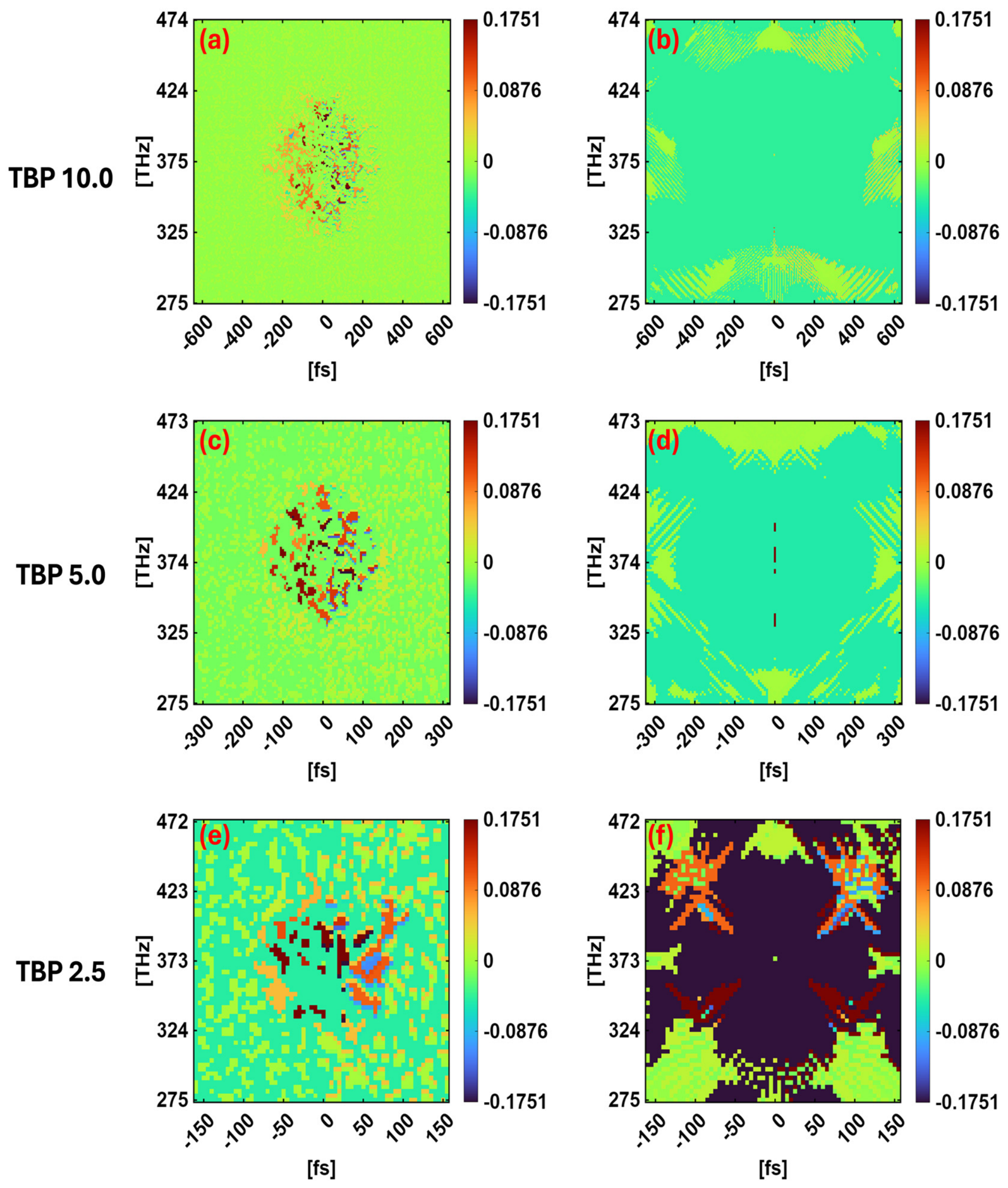
We computed the values of R for the measured and retrieved SHG FROG traces for the various pulse trains. Figure 5 shows the weighted-difference traces and 2D runs for both stable and unstable pulse trains with TBP values of 10, 5, and 2.5. As shown, the unstable pulse trains exhibit a few large runs, while the stable pulse trains are characterized by numerous small runs distributed throughout the weighted-difference trace. Our weighted-run approach emphasizes the runs occurring in the central, high-intensity region of the trace, while suppressing the influence of runs in the low-signal trace wings. As we mentioned, this is desirable because the central region contains more physically meaningful information, whereas the edges primarily contain noise or low-intensity artifacts.
For pulse trains with average TBP values of 2.5, 5.0, and 10, the obtained R values for the stable pulse trains were 0.0361, 0.0362, and 0.0427, respectively. In contrast, for the unstable pulse trains, the corresponding R values were much lower, as expected: 0.0051, 0.0052, and 0.0035, respectively. The comparison between the R values obtained for stable and unstable pulse trains is summarized in Table 1. As predicted and discussed in Section 2, stable pulse trains exhibit larger R values than unstable ones. Here, the stable pulse trains exhibit R values that are much larger than those of the corresponding unstable pulse trains. Therefore, we conclude that the R parameter provides a robust quantitative measure of ultrashort laser pulse-train instability. Note also that R is similar for the different values of TBP, although noise affects the R value somewhat; thus, we do not expect perfectly consistent values for all cases.

5. Conclusions

In this study, we introduced a quantitative parameter for assessing ultrashort pulse-train stability by combining reliable multi-shot pulse retrieval using the RANA approach with a novel 2D-runs analysis applied to SHG FROG traces. Because the RANA algorithm achieves convergence even in the presence of pulse-train instability and noise, any systematic difference between measured and retrieved traces reflects true pulse-to-pulse variation within the pulse train, rather than algorithm stagnation. By counting and weighting connected 2D regions of uniform sign (positive or negative) in the difference trace, we defined the R value, a metric that distinguishes random, noise-like deviations from systematic discrepancies. Stable pulse trains produce differences dominated by many small, noise-like runs and therefore yield larger R values, whereas unstable trains produce only a few large runs and consequently exhibit much smaller R values.
Using simulated stable and unstable pulse trains with time–bandwidth products ranging from 2.5 to 10, we demonstrated that stable pulse trains consistently yield R values an order of magnitude larger than those of unstable pulse trains. The R value, therefore, provides a robust and trace-size-independent quantitative measure of pulse-train stability. This approach complements conventional error metrics such as the G-error, which can guarantee a high-quality measurement, but alone does not distinguish random noise from systematic error (and, hence, physical instability) in the case of discrepancies between the measured and retrieved traces. Our method is readily applicable to a wide range of ultrafast laser systems, from low-power high-repetition-rate oscillators to kHz high-power sources and from the shortest pulses to many-cycle pulses, in all cases where FROG can measure pulses and averages over many pulses. It should be useful especially when pulse stability is critical.
In future work, we plan to analyze pulse-train instability across a broader range of pulse and stability characteristics, including intermediate cases. Additionally, this approach could be integrated into a real-time monitoring system for pulse-train stability, in addition to complete-intensity-and-phase measurement, which would be highly valuable for optimizing ultrashort-pulse lasers in various applications, such as laser-plasma accelerators.
Finally, while we are not aware of any approaches at this time to experimentally generate pulse trains with controllable pulse-shape instability, it is our hope that this capability will be available soon, allowing experimental confirmation of this measure of pulse-shape instability.

Author Contributions

The original idea to use a runs test and the definition of the runs parameter, R, were provided by R.T., who also oversaw the work. R.J. wrote the code to generate the pulses and traces and also to retrieve the pulses from the traces and performed a critical reading of the manuscript. E.P.D.C. performed a literature search. B.B. provided the specific 2D-runs approach. A.D. performed analytical calculations. P.A., R.J. and A.D. wrote and ran runs computation code. P.A., A.D., B.B. and R.T. wrote the manuscript. All authors have read and agreed to the published version of the manuscript.

Funding

Georgia Tech. This research received no external funding.

Data Availability Statement

Data underlying the results presented in this paper are not publicly available at this time but may be obtained from the authors upon reasonable request.

Conflicts of Interest

R.T. owns a company that sells pulse measurement devices. R.J. consults for this company. Other co-authors do not have any conflicts of interest.

Appendix A. Analytical Proof of the Invariance of the Weighted 2D Runs Statistic R

In this appendix, we show that the R parameter is invariant on rescaling a FROG trace, in general, and, in particular, by rescaling it when obeying the discrete Fourier-transform condition, as is often done.
As discussed in the text, a FROG measurement is represented by two real-valued N × N matrices:
I F R O G m e a s ω i , τ j   a n d   I F R O G r e t r ω i , τ j ,                 f o r   i , j { 1 , , N } .
The difference trace is Δ i j = I F R O G m e a s ω i , τ j I F R O G r e t r ω i , τ j , and its sign map is
S i j = s g n Δ i j { 1 , 0 , + 1 } .
A 2D run is defined as a maximally 4 -connected component of the nonzero entries of S having the same sign. In other words, a run is a contiguous region of pixels where the residual difference has the same sign. Let R = { R 1 , , R K } denote the set of all such runs.
For each run, R(k), which has R k pixels, we define its mean measured intensity as follows:
I k = 1 R k i , j R ( k ) I F R O G m e a s ω i , τ j ,
The weighted runs statistic is
R = k = 1 K I k i , j I F R O G m e a s ω i , τ j .
where the denominator represents the total measured intensity of the FROG trace.
We now prove that the statistic R is invariant under any smooth area-preserving reparameterization of the time-frequency domain. Consider the TBP-preserving transformation
τ = α τ , ω = ω α
and define the smooth invertible transformation
T ω , τ = α ω ,   τ / α .
The Jacobian determinant of this transformation is
J = | d e t   D T | = α 0 0 1 / α = 1 ,
Thus, the transformation preserves the phase-space area element
d ω   d τ = d ω   d τ
Under this map,
I F R O G m e a s ω , τ = I F R O G m e a s T ω , τ ,
and similarly for the retrieved trace. Hence the residual field satisfies
Δ ω , τ = Δ T ω , τ
Because this transformation T simply rescales the coordinate axes, it does not break apart or merge regions of the residual sign field. As a result, the positive and negative regions of the sign map remain intact, and the number of runs K is unchanged.
Next, we will show that R’ = R, where R’ is the R parameter for the transformed coordinates. Let Ω α denote a run region in ω , τ coordinates and Ω α = T 1 Ω α its image. Using the change-of-variables formula and det D T = 1 ,
Ω α I F R O G m e a s ω , τ   d ω   d τ = Ω α I F R O G m e a s ω , τ   d ω   d τ ,
and Ω α = Ω α . Hence the mean intensity of each run is preserved as
I k = I k .
The total trace intensity is also invariant,
Ω I F R O G m e a s = Ω I F R O G m e a s .
Therefore, the number of runs, the mean intensity of each run, and the total intensity of the trace are unchanged under the transformation. Consequently,
R = R .
Thus, the statistic R depends only on the intrinsic geometry of the residual sign field and is invariant under time–bandwidth-preserving reparameterizations of the FROG trace.

Appendix B. Logarithmic SHG FROG Traces (Measured, Retrieved, and Difference)

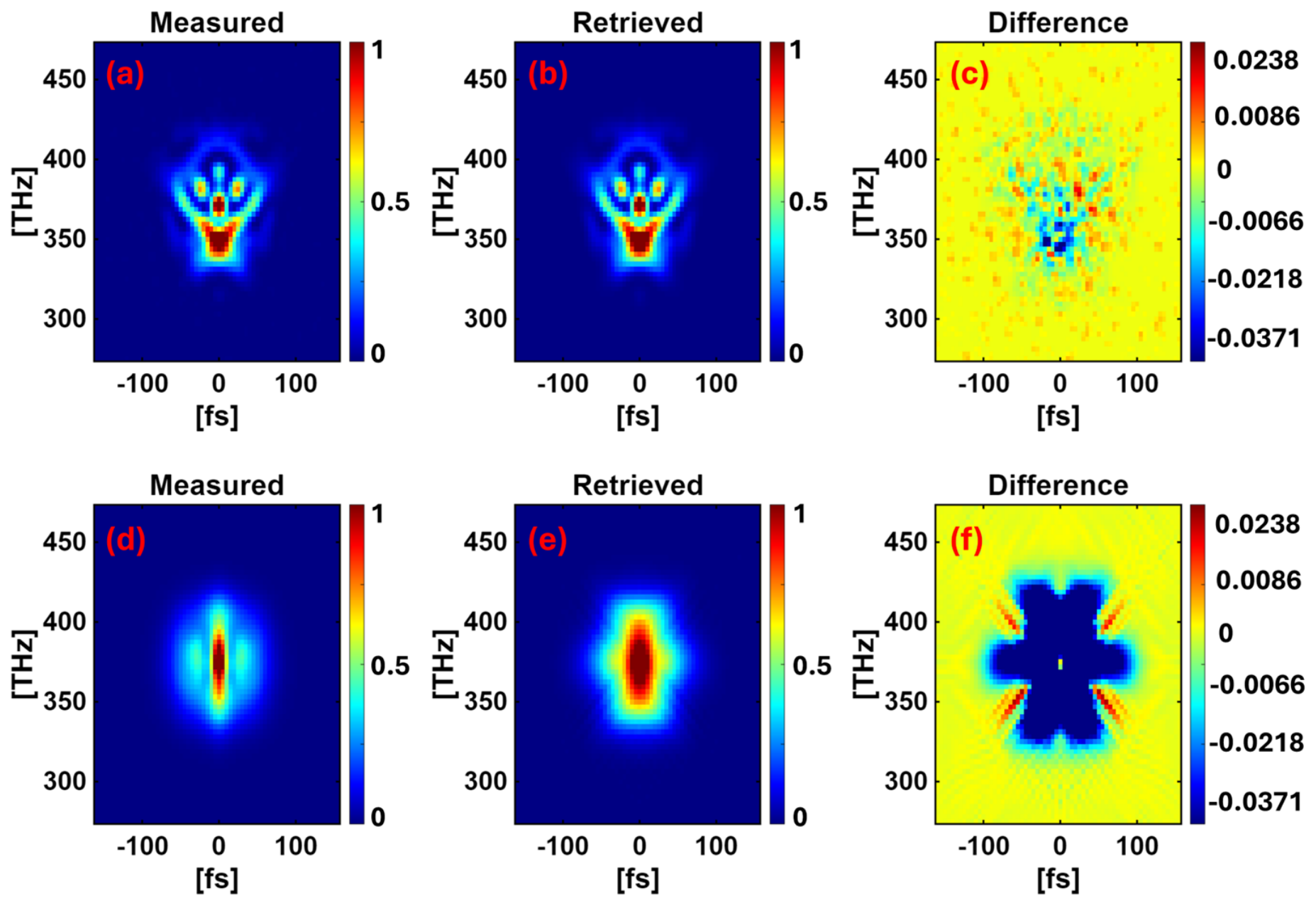
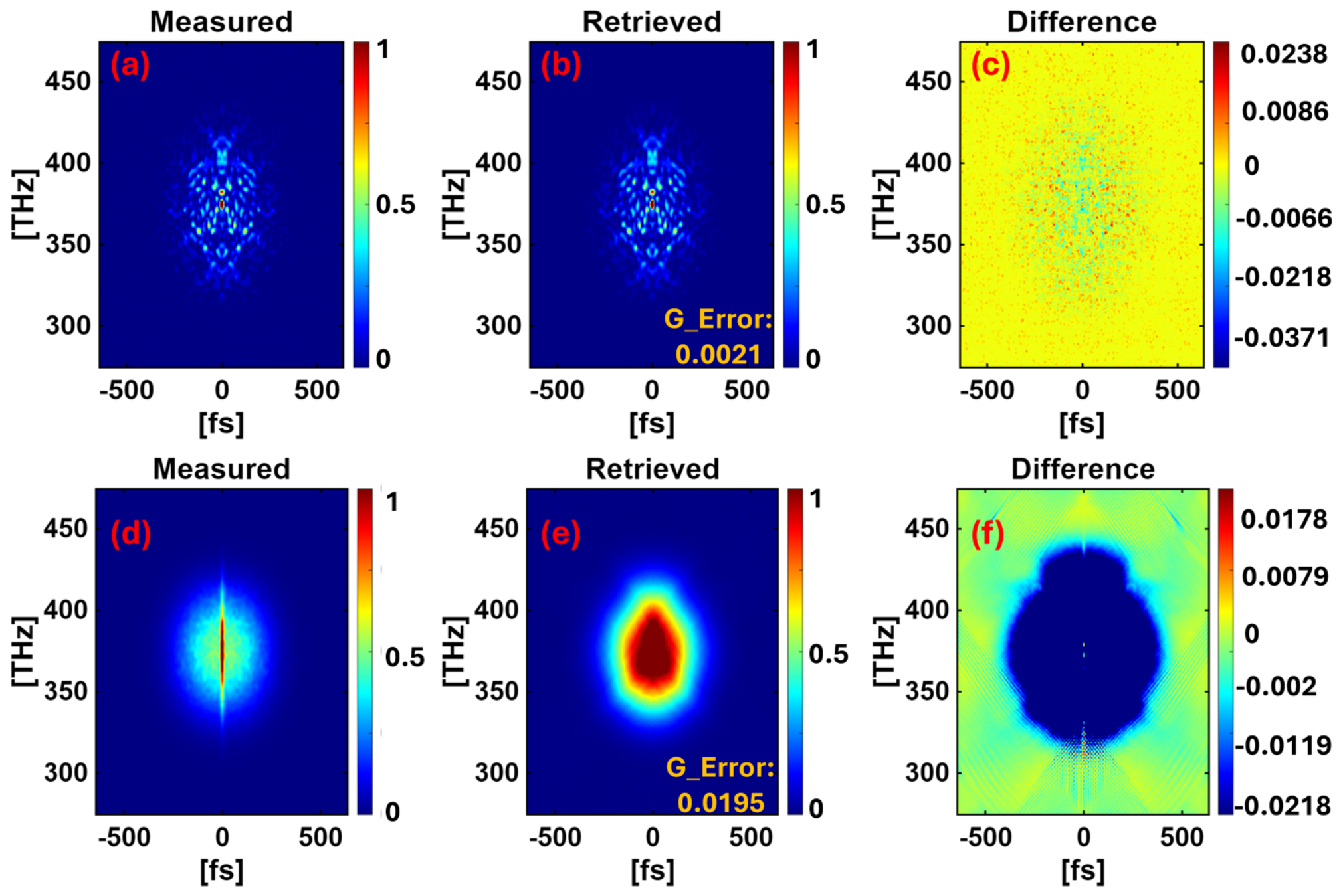
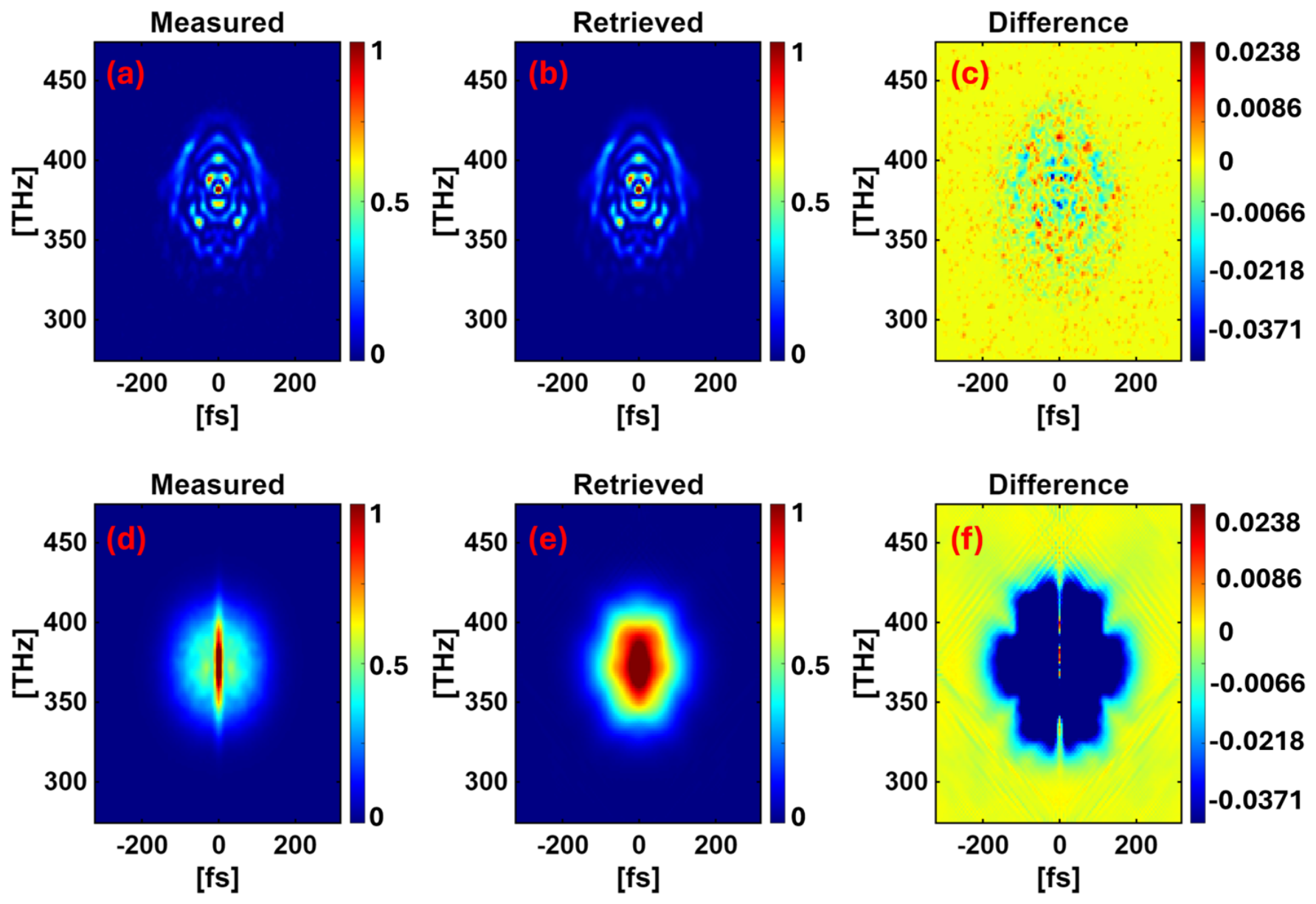
This appendix presents the measured, retrieved, and difference SHG-FROG traces for TBPs of 2.5 and 5.0, shown for both stable and unstable pulse trains. Each figure contains three panels: the measured, the retrieved, and the difference traces (measured minus retrieved), displayed on a logarithmic scale to emphasize weak features.
Figure A1. (a) Measured, (b) retrieved, and (c) difference SHG FROG traces for a stable pulse train with a TBP of 5. (d) Measured, (e) retrieved, and (f) difference SHG FROG traces for an unstable pulse train with a TBP of 5.
Optics 07 00042 g0a1
Figure A2. (a) Measured, (b) retrieved, and (c) difference SHG FROG traces for a stable pulse train with a TBP of 2.5. (d) Measured, (e) retrieved, and (f) difference SHG FROG traces for an unstable pulse train with a TBP of 2.5.
Optics 07 00042 g0a2
Note that each set of figures reveals that same features as the case of TBP = 10 discussed in the main body of the text.

References

  1. Foster, L.C.; Ewy, M.D.; Crumly, C.B. Laser mode locking by an external doppler cell. Appl. Phys. Lett. 1965, 6, 6–8. [Google Scholar] [CrossRef]
  2. Hargrove, L.E.; Fork, R.L.; Pollack, M.A. Locking of he–ne laser modes induced by synchronous intracavity modulation. Appl. Phys. Lett. 1964, 5, 4–5. [Google Scholar] [CrossRef]
  3. Yariv, A. Internal Modulation in Multimode Laser Oscillators. J. Appl. Phys. 1965, 36, 388–391. [Google Scholar] [CrossRef]
  4. Zhou, J.; Christov, I.P.; Taft, G.; Huang, C.-P.; Murnane, M.M.; Kapteyn, H.C. Pulse evolution in a broad-bandwidth Ti:sapphire laser. Opt. Lett. 1994, 19, 1149–1151. [Google Scholar] [CrossRef]
  5. Christov, I.P.; Murnane, M.M.; Kapteyn, H.C.; Stoev, V.D. Sub-10-fs operation of Kerr-lens mode-locked lasers. Opt. Lett. 1996, 21, 1493–1495. [Google Scholar] [CrossRef] [PubMed]
  6. Xu, L.; Spielmann, C.; Poppe, A.; Brabec, T.; Krausz, F.; Hänsch, T.W. Route to phase control of ultrashort light pulses. Opt. Lett. 1996, 21, 2008–2010. [Google Scholar] [CrossRef]
  7. Dubietis, A.; Jonušauskas, G.; Piskarskas, A. Powerful femtosecond pulse generation by chirped and stretched pulse parametric amplification in BBO crystal. Opt. Commun. 1992, 88, 437–440. [Google Scholar] [CrossRef]
  8. Nisoli, M.; De Silvestri, S.; Svelto, O. Generation of high energy 10 fs pulses by a new pulse compression technique. Appl. Phys. Lett. 1996, 68, 2793–2795. [Google Scholar] [CrossRef]
  9. De Silvestri, S.; Nisoli, M.; Sansone, G.; Stagira, S.; Svelto, O. Few–cycle pulses by external compression. Top. Appl. Phys. 2004, 95, 137–178. [Google Scholar] [CrossRef]
  10. Schulte, J.; Sartorius, T.; Weitenberg, J.; Vernaleken, A.; Russbueldt, P. Nonlinear pulse compression in a multi-pass cell. Opt. Lett. 2016, 41, 4511–4514. [Google Scholar] [CrossRef]
  11. Ivanov, M.; Doiron, É.; Scaglia, M.; Abdolghader, P.; Tempea, G.; Légaré, F.; Trallero-Herrero, C.A.; Vampa, G.; Schmidt, B.E. Advancing High-Power Hollow-Core Fiber Pulse Compression. IEEE J. Sel. Top. Quantum Electron. 2024, 30, 5100310. [Google Scholar] [CrossRef]
  12. Abdolghader, P.; Scaglia, M.; Doiron, É.; Ivanov, M.; Beniwal, M.; Tempea, G.; Zheng, X.; Abdolghader, P.; Vampa, G.; Schmidt, B.E. Gigawatt level, 10 fs high efficiency visible pulse generation. APL Photonics 2025, 10, 080804. [Google Scholar] [CrossRef]
  13. Ditmire, T. Strong Field Physics—Ultra-Intense Light Interaction with Matter; Cambridge University Press: Cambridge, UK, 2025. [Google Scholar] [CrossRef]
  14. Nagymihály, R.S.; Kalashnikov, M.; Lehotai, L.; Pajer, V.; Bohus, J.; Csernus-Lukács, N.; Csontos, J.; Tóth, S.; Tari, B.; Balciunas, I.; et al. High contrast few-cycle frontend with hybrid amplification for petawatt-class lasers. arXiv 2025, arXiv:2508.06268. [Google Scholar]
  15. Danson, C.N.; Haefner, C.; Bromage, J.; Butcher, T.; Chanteloup, J.C.-F.; Chowdhury, E.A.; Galvanauskas, A.; Gizzi, L.A.; Hein, J.; Hillier, D.I.; et al. Petawatt and exawatt class lasers worldwide. High Power Laser Sci. Eng. 2019, 7, e54. [Google Scholar] [CrossRef]
  16. Nakamura, K.; Mao, H.-S.; Gonsalves, A.J.; Vincenti, H.; Mittelberger, D.E.; Daniels, J.; Magana, A.; Toth, C.; Leemans, W.P. Diagnostics, Control and Performance Parameters for the BELLA High Repetition Rate Petawatt Class Laser. IEEE J. Quantum Electron. 2017, 53, 1200121. [Google Scholar] [CrossRef]
  17. Wang, Y.; Wang, S.; Rockwood, A.; Luther, B.M.; Hollinger, R.; Curtis, A.; Calvi, C.; Menoni, C.S.; Rocca, J.J. 0.85 PW laser operation at 3.3 Hz and high-contrast ultrahigh-intensity λ = 400 nm second-harmonic beamline. Opt. Lett. 2017, 42, 3828–3831. [Google Scholar] [CrossRef]
  18. Paliesek, T.; Navrátil, P.; Pilař, J.; Divoký, M.; Smrž, M.; Mocek, T. Beam shaping in the high-energy kW-class laser system Bivoj at the HiLASE facility. High Power Laser Sci. Eng. 2023, 11, e79. [Google Scholar] [CrossRef]
  19. Meadows, A.R.; Yamamoto, K.; Graumann, I.; Szlafsztein, F.; Chvykov, V.; Hollinger, R.; Aparajit, C.; Shpilman, Z.; Geiss, O.; Abdolghader, P.; et al. Fifteen millijoule, few-cycle pulse compression using a large-bore hollow fiber for relativistic laser–matter interactions. Opt. Lett. 2025, 50, 3313–3316. [Google Scholar] [CrossRef]
  20. Nagymihály, R.S.; Falcoz, F.; Bussiere, B.; Bohus, J.; Pajer, V.; Lehotai, L.; Ravet-Senkans, M.; Roy, O.; Calvez, S.; Mollica, F.; et al. The petawatt laser of ELI ALPS: Reaching the 700 TW level at 10 Hz repetition rate. Opt. Express 2023, 31, 44160–44176. [Google Scholar] [CrossRef] [PubMed]
  21. Fourmaux, S.; Lassonde, P.; Mironov, S.Y.; Hallin, E.; Légaré, F.; Maclean, S.; Khazanov, E.A.; Mourou, G.; Kieffer, J.C. Laser wakefield acceleration based x ray source using 225-TW and 13-fs laser pulses produced by thin film compression. Opt. Lett. 2022, 47, 3163–3166. [Google Scholar] [CrossRef] [PubMed]
  22. Atamalek, G.; Pakmanesh, N.; Rastegari, A.; Abdolghader, P.; Feizollah, P.; Siadati, N. Surface plasma preionization produced on a specially patterned PCB and its application in a pulsed CO2 laser. Opt. Laser Technol. 2016, 78, 83–86. [Google Scholar] [CrossRef]
  23. Lureau, F.; Matras, G.; Chalus, O.; Derycke, C.; Morbieu, T.; Radier, C.; Casagrande, O.; Laux, S.; Ricaud, S.; Rey, G.; et al. High-energy hybrid femtosecond laser system demonstrating 2 × 10 PW capability. High Power Laser Sci. Eng. 2020, 8, e43. [Google Scholar] [CrossRef]
  24. Tajima, T.; Dawson, J.M. Laser electron accelerator. Phys. Rev. Lett. 1979, 43, 267. [Google Scholar] [CrossRef]
  25. Strickland, D.; Mourou, G. Compression of amplified chirped optical pulses. Opt. Commun. 1985, 56, 219–221. [Google Scholar] [CrossRef]
  26. Kohrell, F.; Barber, S.; Jensen, K.; Doss, C.; Berger, C.; Schroeder, C.; Esarey, E.; Grüner, F.; van Tilborg, J. Investigation of correlations between spectral phase fluctuations of the laser pulse and the performance of an LPA. In Nuclear Instruments and Methods in Physics Research Section A: Accelerators, Spectrometers, Detectors and Associated Equipment; Elsevier: Amsterdam, The Netherlands, 2025; p. 170267. [Google Scholar] [CrossRef]
  27. Albert, F.; Anderson, S.G.; Gibson, D.J.; Hagmann, C.A.; Johnson, M.S.; Messerly, M.; Semenov, V.; Shverdin, M.Y.; Rusnak, B.; Tremaine, A.M.; et al. Characterization and applications of a tunable, laser-based, MeV-class Compton-scattering γ-ray source. Phys. Rev. Spec. Top. Accel. Beams 2010, 13, 070704. [Google Scholar] [CrossRef]
  28. Perkins, L.; Logan, B.; Rosen, M.; Perry, M.; de la Rubia, T.D.; Ghoniem, N.; Ditmire, T.; Springer, P.; Wilks, S. The investigation of high intensity laser driven micro neutron sources for fusion materials research at high fluence. Nucl. Fusion 2000, 40, 1–19. [Google Scholar] [CrossRef]
  29. Siders, C.W.; Le Blanc, S.P.; Fisher, D.; Tajima, T.; Downer, M.C.; Babine, A.; Stepanov, A.; Sergeev, A. Laser Wakefield Excitation and Measurement by Femtosecond Longitudinal Interferometry. Phys. Rev. Lett. 1996, 76, 3570–3573. [Google Scholar] [CrossRef] [PubMed]
  30. Snavely, R.A.; Key, M.H.; Hatchett, S.P.; Cowan, T.E.; Roth, M.; Phillips, T.W.; Stoyer, M.A.; Henry, E.A.; Sangster, T.C.; Singh, M.S.; et al. Intense High-Energy Proton Beams from Petawatt-Laser Irradiation of Solids. Phys. Rev. Lett. 2000, 85, 2945–2948. [Google Scholar] [CrossRef]
  31. Jung, D.; Yin, L.; Albright, B.J.; Gautier, D.C.; Letzring, S.; Dromey, B.; Yeung, M.; Hörlein, R.; Shah, R.; Palaniyappan, S.; et al. Efficient carbon ion beam generation from laser-driven volume acceleration. New J. Phys. 2013, 15, 023007. [Google Scholar] [CrossRef]
  32. Bulanov, S.V.; Khoroshkov, V.S. Feasibility of using laser ion accelerators in proton therapy. Plasma Phys. Rep. 2002, 28, 453–456. [Google Scholar] [CrossRef]
  33. Lécz, Z.; Majorosi, S.; Hafz, N.A.M. Single-mode laser guiding in non-parabolic plasma channels for high-energy electron acceleration. Plasma Phys. Control. Fusion 2025, 67, 115015. [Google Scholar] [CrossRef]
  34. Lécz, Z.; Andreev, A.; Papp, D.; Kamperidis, C.; Hafz, N.A.M. Three-stage laser wakefield accelerator scheme for sub-Joule few-cycle laser pulses. Plasma Phys. Control. Fusion. 2023, 65, 105001. [Google Scholar] [CrossRef]
  35. Gambari, M.; Clady, R.; Stolidi, A.; Utéza, O.; Sentis, M.; Ferré, A. Exploring phase contrast imaging with a laser-based Kα x-ray source up to relativistic laser intensity. Sci. Rep. 2020, 10, 6766. [Google Scholar] [CrossRef] [PubMed]
  36. Williams, G.J.; Aufderheide, M.; Champley, K.M.; Djordjević, B.Z.; Ma, T.; Ryan, C.; Simpson, R.A.; Wilks, S.C. Dual-energy fast neutron imaging using tunable short-pulse laser-driven sources. Rev. Sci. Instrum. 2022, 93, 2018. [Google Scholar] [CrossRef]
  37. Svendsen, K.; González, I.G.; Hansson, M.; Svensson, J.B.; Ekerfelt, H.; Persson, A.; Lundh, O. Optimization of soft X-ray phase-contrast tomography using a laser wakefield accelerator. Opt. Express 2018, 26, 33930–33941. [Google Scholar] [CrossRef]
  38. Hollinger, R.; Wang, S.; Anaraki, S.Z.; King, J.; Zhang, P.; Zeraouli, G.; Bengoa, A.F.; Sheats, M.; Scott, S.; Heidemann, J.; et al. Laser-driven high-resolution MeV x-ray tomography. Optica 2025, 12, 433–436. [Google Scholar] [CrossRef]
  39. Robinson, A.; Strozzi, D.; Davies, J.; Gremillet, L.; Honrubia, J.; Johzaki, T.; Kingham, R.; Sherlock, M.; Solodov, A. Theory of fast electron transport for fast ignition. Nucl. Fusion 2014, 54, 054003. [Google Scholar] [CrossRef]
  40. Kemp, A.J.; Wilks, S.C.; Tabak, M. Laser-to-proton conversion efficiency studies for proton fast ignition. Phys. Plasmas 2024, 31, 042709. [Google Scholar] [CrossRef]
  41. Midorikawa, K. Progress on table-top isolated attosecond light sources. Nat. Photonics 2022, 16, 267–278. [Google Scholar] [CrossRef]
  42. Rupprecht, P.; Neumark, D.M.; Leone, S.R. All-optical logic gates for extreme ultraviolet switching via attosecond four-wave mixing. arXiv 2025, arXiv:2510.00699. [Google Scholar] [CrossRef]
  43. Hassan, M.T. Lightwave electronics: Attosecond optical switching. ACS Photonics 2024, 11, 334–338. [Google Scholar] [CrossRef]
  44. Sengupta, K.; Nagatsuma, T.; Mittleman, D.M. Terahertz integrated electronic and hybrid electronic–photonic systems. Nat. Electron. 2018, 1, 622–635. [Google Scholar] [CrossRef]
  45. Goulielmakis, E.; Loh, Z.-H.; Wirth, A.; Santra, R.; Rohringer, N.; Yakovlev, V.S.; Zherebtsov, S.; Pfeifer, T.; Azzeer, A.M.; Kling, M.F.; et al. Real-time observation of valence electron motion. Nature 2010, 466, 739–743. [Google Scholar] [CrossRef]
  46. Luu, T.T.; Garg, M.; Kruchinin, S.Y.; Moulet, A.; Hassan, M.T.; Goulielmakis, E. Extreme ultraviolet high-harmonic spectroscopy of solids. Nature 2015, 521, 498–502. [Google Scholar] [CrossRef]
  47. Li, J.; Lu, J.; Chew, A.; Han, S.; Li, J.; Wu, Y.; Wang, H.; Ghimire, S.; Chang, Z. Attosecond science based on high harmonic generation from gases and solids. Nat. Commun. 2020, 11, 2748. [Google Scholar] [CrossRef]
  48. Corwin, K.L.; Newbury, N.R.; Dudley, J.M.; Coen, S.; Diddams, S.A.; Weber, K.; Windeler, R.S. Fundamental Noise Limitations to Supercontinuum Generation in Microstructure Fiber. Phys. Rev. Lett. 2003, 90, 113904. [Google Scholar] [CrossRef]
  49. Adamu, A.I.; Habib, S.; Smith, C.R.; Lopez, J.E.A.; Jepsen, P.U.; Amezcua-Correa, R.; Bang, O.; Markos, C. Noise and spectral stability of deep-UV gas-filled fiber-based supercontinuum sources driven by ultrafast mid-IR pulses. Sci. Rep. 2020, 10, 4912. [Google Scholar] [CrossRef] [PubMed]
  50. Abdolghader, P.; Pegoraro, A.F.; Joly, N.Y.; Ridsdale, A.; Lausten, R.; Légaré, F.; Stolow, A. All normal dispersion nonlinear fibre supercontinuum source characterization and application in hyperspectral stimulated Raman scattering microscopy. Opt. Express 2020, 28, 35997–36008. [Google Scholar] [CrossRef]
  51. Rampur, A.; Spangenberg, D.-M.; Sierro, B.; Hänzi, P.; Klimczak, M.; Heidt, A.M. Perspective on the next generation of ultra-low noise fiber supercontinuum sources and their emerging applications in spectroscopy, imaging, and ultrafast photonics. Appl. Phys. Lett. 2021, 118, 240504. [Google Scholar] [CrossRef]
  52. Rao, D.S.S.; Jensen, M.; Grüner-Nielsen, L.; Olsen, J.T.; Heiduschka, P.; Kemper, B.; Schnekenburger, J.; Glud, M.; Mogensen, M.; Israelsen, N.M.; et al. Shot-noise limited, supercontinuum-based optical coherence tomography. Light. Sci. Appl. 2021, 10, 133. [Google Scholar] [CrossRef]
  53. Abdolghader, P.; Ridsdale, A.; Grammatikopoulos, T.; Resch, G.; Légaré, F.; Stolow, A.; Pegoraro, A.F.; Tamblyn, I. Unsupervised hyperspectral stimulated Raman microscopy image enhancement: Denoising and segmentation via one-shot deep learning. Opt. Express 2021, 29, 34205–34219. [Google Scholar] [CrossRef]
  54. Ma, T.; Mariscal, D.; Anirudh, R.; Bremer, T.; Djordjevic, B.Z.; Galvin, T.; Grace, E.; Herriot, S.; Jacobs, S.; Kailkhura, B.; et al. Accelerating the rate of discovery: Toward high-repetition-rate HED science. Plasma Phys. Control. Fusion 2021, 63, 104003. [Google Scholar] [CrossRef]
  55. Horáček, J.; Hubka, L.; Chyla, M.; Mocek, T. Active alignment control system for thin disk regenerative amplifier. Rev. Sci. Instrum. 2025, 96, 013003. [Google Scholar] [CrossRef] [PubMed]
  56. Trebino, R. The Most Important Paper You’ve Never Read. Opt. Photonics News 2020, 31, 46–53. [Google Scholar] [CrossRef]
  57. Fisher, R.A.; Fleck, J.J.A. On the Phase Characteristics and Compression of Picosecond Pulses. Appl. Phys. Lett. 1969, 15, 287–290. [Google Scholar] [CrossRef]
  58. Gu, X.; Xu, L.; Kimmel, M.; Zeek, E.; O’Shea, P.; Shreenath, A.P.; Trebino, R.; Windeler, R.S. Frequency-resolved optical gating and single-shot spectral measurements reveal fine structure in microstructure-fiber continuum. Opt. Lett. 2002, 27, 1174–1176. [Google Scholar] [CrossRef] [PubMed]
  59. Rhodes, M.; Steinmeyer, G.; Ratner, J.; Trebino, R. Pulse-shape instabilities and their measurement. Laser Photonics Rev. 2013, 7, 557–565. [Google Scholar] [CrossRef]
  60. Trebino, R. Frequency-Resolved Optical Gating: The Measurement of Ultrashort Laser Pulses; Kluwer Academic Publishers: Dordrecht, The Netherlands, 2002. [Google Scholar] [CrossRef]
  61. Jafari, R.; Jones, T.; Trebino, R. 100% reliable algorithm for second-harmonic-generation frequency-resolved optical gating. Opt. Express 2019, 27, 2112. [Google Scholar] [CrossRef]
  62. Jafari, R.; Trebino, R. Highly Reliable Frequency-Resolved Optical Gating Pulse-Retrieval Algorithmic Approach. IEEE J. Quantum Electron. 2019, 55, 8600107. [Google Scholar] [CrossRef]
  63. Jafari, R.; Trebino, R. Extremely Robust Pulse Retrieval From Even Noisy Second-Harmonic-Generation Frequency Resolved Optical Gating Traces. IEEE J. Quantum Electron. 2020, 56, 8600108. [Google Scholar] [CrossRef]
  64. Jafari, R.; Grace, E.; Trebino, R. Reliable Determination of Pulses and Pulse-Shape Instability in Ultrashort Laser Pulse Trains Using Polarization-Gating and Transient-Grating Frequency-Resolved Optical Gating Using the RANA Approach. Appl. Sci. 2025, 15, 2617. [Google Scholar] [CrossRef]
  65. Jafari, R.; Khosravi, S.D.; Trebino, R. Reliable determination of pulse-shape instability in trains of ultrashort laser pulses using frequency-resolved optical gating. Sci. Rep. 2022, 12, 21006. [Google Scholar] [CrossRef] [PubMed]
  66. Wald, A.; Wolfowitz, J. An Exact Test for Randomness in the Non-Parametric Case Based on Serial Correlation. Ann. Math. Stat. 1943, 14, 378–388. [Google Scholar] [CrossRef]
  67. Friedman, J.H.; Rafsky, L.C. Multivariate generalizations of the Wald–Wolfowitz and Smirnov two-sample test. Ann. Stat. 1979, 7, 697–717. [Google Scholar] [CrossRef]
  68. Biswas, M.; Mukhopadhyay, M.; Ghosh, A.K. A distribution-free two-sample run test applicable to high-dimensional data. Biometrika 2014, 101, 913–926. [Google Scholar] [CrossRef]
  69. DeLong, K.; Fittinghoff, D.; Trebino, R. Practical issues in ultrashort-laser-pulse measurement using frequency-resolved optical gating. IEEE J. Quantum Electron. 1996, 32, 1253–1264. [Google Scholar] [CrossRef]
Figure 1. (a) Example of the use of 1D runs in a 1D experiment, where the difference curve contains 6 runs, with red dots indicating data points greater than the fit and blue dots indicating data points less than the fit. (We will also use this convention in subfigures (bd)). (b) 2D graph-based run-counting is performed by connecting neighboring pixels with identical signs, thereby forming distinct 2D runs. A 2D run is a region of such adjacent points of the same sign isolated by points of opposite sign, i.e., a hill or valley in the 2D landscape. Here, a graph-based two-dimensional runs test applied to a sample 15 × 15 difference trace with randomly distributed + and pixels, as defined in (a). Line segments connect adjacent points of the same sign. (c) Example of such an unweighted graph-based two-dimensional runs test applied to the difference between measured and reconstructed FROG traces ( 128 × 128 pixels) for a stable pulse train. (d) Corresponding example with significant systematic error due an unstable pulse train. The difference trace exhibits a small number of large, connected regions (especially blue), resulting in fewer but significantly larger runs. (e) Corresponding example of weighted 2D runs for a trace with minimal systematic error and, hence, a stable pulse train, assuming a 2D Gaussian plot, corresponding to a FROG trace of stable Gaussian pulses. The difference trace exhibits a large number of small connected regions. (f) Corresponding example of weighted 2D runs for a trace with large systematic error and, hence, corresponding to an unstable pulse train, also assuming 2D Gaussian weights, showing fewer but significantly larger runs. Note that runs in the wings, where the data trace is near zero, contribute very little, as desired.
Optics 07 00042 g001
Figure 2. A 3D visualization of the map for the 2D weighted runs in the difference trace of a stable pulse train with a TBP of 10. The surface height represents the weighted run value, while the color encodes its magnitude and sign. Because the valleys are hidden below the zero-value surface, a semi-transparent projection on the bottom plane allows the underlying 2D structure to be seen simultaneously, highlighting regions of positive and also negative weighted contributions.
Optics 07 00042 g002
Figure 3. Sample pulses from the unstable trains with mean durations of 26, 54, and 108 fs, arranged from top to bottom. The red curves denote the temporal intensities, while the green curves represent the associated temporal phases.
Optics 07 00042 g003
Figure 4. Measured and retrieved SHG FROG traces, together with their corresponding difference trace for stable and unstable trains of pulses with a TBP of 10. (a) Measured FROG trace for a stable pulse train. (b) Retrieved FROG trace for the stable pulse train. (c) Difference trace for the stable case, showing randomly signed pixels forming numerous small runs, characteristic of a stable pulse train. (d) Measured FROG trace for the unstable pulse train. (e) Retrieved FROG trace for the unstable pulse train. (f) Difference trace for the unstable case, which exhibits a few large runs, indicating the presence of systematic error and, consequently, pulse-train instability. The FROG trace plots have been normalized to have the same peak values.
Optics 07 00042 g004
Figure 5. The weighted-runs analysis based on the graph method for stable and unstable trains of pulses with TBPs of 10, 5, and 2.5. (a,c,e): the weighted-difference traces of the stable pulse trains each show many small runs, as expected, whereas (b,d,f) show the weighted-difference traces of the unstable pulse trains, each of which exhibits a small number of large runs, an indication of significant systematic error and, consequently, pulse train instability. The larger range of weighted runs in the wings of (f) for the shortest pulses occurs due to the use of the smallest data array, so that the large values of the measured trace extend over a larger fraction of the data array. In addition, the coherent-artifact spikes in (b,d) dominate the weighted-difference traces, dwarfing the remaining runs, which are, as a result, less visible.
Optics 07 00042 g005
Table 1. Comparison of the R values for stable and unstable pulse trains. The stable trains consistently exhibit larger R values than the unstable ones, indicating higher pulse-shape stability. This behavior is consistent with the interpretation provided in Section 2. Since the RANA approach is an always-converging retrieval method, any discrepancy between the measured and retrieved traces arises solely from the instability of the pulse trains.
Trace SizeTBP R S t a b l e t r a i n R U n s t a b l e t r a i n
64 × 642.50.03610.0051
128 × 1285.00.03620.0052
256 × 25610.00.04270.0035
Disclaimer/Publisher’s Note: The statements, opinions and data contained in all publications are solely those of the individual author(s) and contributor(s) and not of MDPI and/or the editor(s). MDPI and/or the editor(s) disclaim responsibility for any injury to people or property resulting from any ideas, methods, instructions or products referred to in the content.