Article

Wide-Band White-Light Emission of CaWO4:Eu3+/g-C3N4 Composite Phosphor Under Near-Ultraviolet Excitation


1
School of Materials Science and Engineering, Shanghai Institute of Technology, Shanghai 201418, China
2
Key Laboratory of Inorganic Functional Materials and Devices, Chinese Academy of Sciences, Shanghai 200050, China
3
State Key Laboratory of Crystal Materials, Jinan 250100, China
4
State Key Laboratory of Urban Water Resource and Environment, Harbin Institute of Technology, Harbin 150090, China
5
State Key Laboratory for Advanced Metals and Materials, University of Science and Technology Beijing, Beijing 100083, China
*
Author to whom correspondence should be addressed.
Optics 2026, 7(3), 32; https://doi.org/10.3390/opt7030032
Submission received: 23 March 2026 / Revised: 28 April 2026 / Accepted: 28 April 2026 / Published: 30 April 2026

Abstract

The development of efficient, single-phase-excitable white-light phosphors remains a critical challenge for solid-state lighting applications. In this work, white-light-emitting CaWO4:Eu3+/g-C3N4 composites were successfully developed by integrating red-emitting CaWO4:7%Eu3+ with blue-emitting graphitic carbon nitride (g-C3N4). Under 365 nm near-UV excitation, the composite exhibits dual-band emission originating from the 5D07F2 transition of Eu3+ (~616 nm) and the intrinsic band-edge luminescence of g-C3N4 (~460 nm). The optimal white-light performance is achieved at a g-C3N4 content of 0.5 wt%, yielding CIE chromaticity coordinates of (0.294, 0.324) and a correlated color temperature (CCT) of 7673 K. This sample demonstrates a photoluminescence quantum yield (PLQY) of 3.25%. Moreover, the CaWO4:Eu3+/g-C3N4 composite shows enhanced thermal stability, retaining 78% of its initial emission intensity at 175 °C, with an activation energy of 0.41 eV—significantly higher than that of the pristine CaWO4:Eu3+ (0.22 eV). These results indicate that the CaWO4:Eu3+/g-C3N4 heterostructured phosphor is a promising candidate for single-phase-excitable white-light applications.

1. Introduction

In the field of optics, rare-earth-doped phosphors have attracted extensive attention due to their unique luminescence intensity, fluorescence lifetime, and other characteristics. Light-emitting diodes (LEDs), the fourth-generation lighting source, are widely used in lighting and display fields because of their high energy efficiency and conversion rate [1,2,3,4,5]. However, current white LEDs suffer from a low color-rendering index and a high correlated color temperature, mainly due to the lack of red emission [6]. Developing efficient red-emitting phosphors is therefore urgent [7]. The CaWO4 host can effectively transfer the absorbed UV energy to doped RE3+ (RE = Eu, Tb, Sm, Dy, Er, and Pr) ions via resonant energy transfer, generating characteristic RE3+ emission [8,9]. Among oxysalt systems, tungstates (AW4, A = Pb, Zn, Ca, etc.) are particularly attractive. Their unique structure, comprising tetrahedral [WO4]2− units and dodecahedral Ca2− coordination environments, enables O2− → W6+ charge-transfer transitions, realizing effective self-activated luminescence in the UV-to-blue spectral region [10]. This charge transfer endows tungstates with strong and broad absorption bands in the near-UV and visible regions, and they have been widely applied in X-ray intensifying screens, optical fiber devices, lasers, and medical instruments [11].
Currently, tungstate phosphors are mostly activated by Eu3+, Sm3+, Tb3+, Ho3+, etc. Eu3+, possessing a 4f electron configuration, exhibits 4f → 4f transitions that yield high-color-purity red emission independent of the host lattice; it can be efficiently excited by UV or blue light and is therefore the preferred red center [12]. Studies have shown that the luminescence efficiency of Eu3+-doped tungstate red phosphors can be twice that of commercial Y2O2S:Eu3+, indicating excellent prospects. Cai et al. [13] synthesized CaWO4:Eu3+ via a high-temperature solid-state method and optimized the Eu3+ concentration to achieve high-purity red emission. Liu Zheng-wei et al. [14] first observed long-persistent red luminescence in CaWO4:Eu3+. F B Xiong et al. [15] demonstrated that Eu3+- and Li+-co-doped CaWO4 phosphors can be effectively excited by 270 nm ultraviolet (UV) or 394 nm near-ultraviolet chips, and exhibit a red emission derived from the 5D07FJ (J = 1 and 2) transition of Eu3+. Although CaWO4:Eu3+exhibits dual emission from the WO42− groups (blue–green) and Eu3+ ions (red), the spectral balance is inherently difficult to optimize [16]. The energy transfer from WO42− to Eu3+ is highly efficient, which often leads to complete quenching of the host emission at moderate-to-high Eu3+ doping levels. Consequently, the resulting luminescence is dominated by red emission, lacking sufficient green components for high-quality white light. Even at low Eu3+ concentrations where host emission persists, the overall spectrum typically shows poor color rendering and limited tunability under single-wavelength excitation.
To address this spectral limitation, we herein construct a heterocomposite between CaWO4:7%Eu3+—optimized for strong red emission—and graphitic carbon nitride, a metal-free semiconductor with intense and broad blue–green photoluminescence (450–550 nm). g-C3N4 possesses a suitable bandgap (~2.7 eV) [17], high thermal stability (>500 °C) [18], and a two-dimensional layered structure composed of triazine/heptazine units linked by amino groups, forming a highly π-conjugated network [19,20,21]. Its conduction-band minimum (−1.1 V vs. Normal Hydrogen Electrode) and valence-band maximum (+1.6 V vs. Normal Hydrogen Electrode) enable the formation of Type-II heterojunctions with CaWO4 [22], promoting spatial separation of photogenerated carriers and suppressing non-radiative recombination. Surface functional groups (–NH2, –NH, –C≡N) can interact with [WO4]2− tetrahedra via hydrogen bonding, van der Waals forces, or electrostatic interactions [23,24], enhancing interfacial coupling. The flexible 2D framework also mitigates lattice–mismatch stress, thereby improving the emission uniformity of Eu3+ ions [25].
CaWO4/g-C3N4 heterostructures have been extensively investigated for photocatalytic environmental remediation. Tuna et al. [26] fabricated CaWO4/tubular g-C3N4 hybrids via ultrasonication combined with thermal mixing, achieving a significant bandgap reduction from 3.60 eV to 1.85 eV. Their optimized composite exhibited 79.3% degradation of Allura red within 120 min under visible light, with a reaction rate constant 31.3-fold higher than pristine CaWO4, and additionally demonstrated bifunctional potential for thermal-energy storage applications. In parallel, Vadivu et al. [27] synthesized CaWO4/g-C3N4 nanocomposites via a simple ultrasonication method for rhodamine B degradation under visible light. Their optimal composition (3 wt% g-C3N4) achieved nearly 98% dye removal within 150 min, exhibiting a narrowed bandgap of 2.47 eV and following an S-scheme charge-transfer mechanism with excellent cyclic stability. While these studies established the efficacy of g-C3N4 heterojunctions for photocatalytic pollutant degradation through enhanced charge separation and broadened light absorption, the potential of such composites for lighting applications—particularly white-light generation via spectral tuning of rare-earth phosphors—remains unexplored [28,29,30,31].
Building on our earlier work on the Lu2MoO6:Eu3+/g-C3N4 phosphor system, white-light generation from rare-earth phosphors under near-UV excitation is a key route for energy-saving w-LEDs. Recently, we demonstrated that coupling g-C3N4 with Lu2MoO6:Eu3+ produces white light via blue–red dual emission. However, the high cost of lutetium oxide and significant thermal quenching hinder its commercial viability. This study investigates a tungstate-based heterostructure, CaWO4:Eu3+/g-C3N4. The tungstate lattice provides a self-activating blue-emission component that complements the broadband luminescence of g-C3N4 and the characteristic red emission of Eu3+. This combination expands the spectral functionality of the composite while maintaining the benefit of a single-composite phosphor that is excitable under near-UV light.

2. Experimental Section

2.1. Experimental Raw Materials and Preparation Methods

CaWO4:xEu3+ phosphors were prepared by high-temperature solid-state reaction. The raw materials were melamine (99.0%), CaCO3 (99.9%), Eu2O3 (99.9%), and WO3 (99.9%). Melamine was calcined at 550 °C for 4 h (5 °C·min−1) to obtain g-C3N4. Stoichiometric amounts of CaCO3, WO3, and Eu2O3 were thoroughly ground, placed in alumina crucibles, and calcined at 900 °C for 8 h in air (5 °C·min−1). After natural cooling, CaWO4:xEu3+ powders were obtained.
For the fabrication of CaWO4:Eu3+/g-C3N4 composites, the as-prepared CaWO4:Eu3+ red phosphor (specifically the optimal 7% doped sample) was dispersed in de-ionized water and ultrasonicated at 70 °C for 10 min. A designed amount of g-C3N4 was then added to the suspension.
The mixture was stirred at room temperature for 12 h, followed by filtration and drying at 70 °C for 12 h to yield the final composites. In this study, the pristine phosphor CaWO4:7%Eu3+ is denoted as CW:7%Eu, and pure g-C3N4 is denoted as CN. The composite samples with g-C3N4 loadings of 5.0 wt%, 1.0 wt%, and 0.5 wt% are labeled as CW-CN-5, CW-CN-1, and CW-CN-0.5, respectively.

2.2. Materials Characterization and Performance Testing

The powder X-ray diffraction patterns of the synthetic products were monitored by a Rigaku SmartLab SE X-ray diffractometer (Rigaku Corporation, Tokyo, Japan). The morphology and particle size of the samples were observed by scanning electron microscopy (ZEISS Sigma 300, Carl Zeiss AG, Oberkochen, Germany). The Fourier-transform infrared spectra in the range of 400–4000 cm−1 were collected by an infrared spectrophotometer (Thermo Fisher Scientific, Waltham, MA, USA). The ultraviolet diffuse reflection spectra ranging from 200 to 800 nm were measured using a Shimadzu UV-3600 from Japan(Shimadzu Corporation, Kyoto, Japan). The excitation spectrum, emission spectrum, quantum efficiency, and fluorescence lifetime were determined by the Edinburgh FLS1000 fluorescence spectrophotometer(Edinburgh Instruments Ltd., Livingston, UK). For lifetime measurements, each sample was measured three times independently; the reported lifetimes represent the average ± standard deviation (n = 3).

3. Results and Discussion

3.1. Crystal Structure and Compositional Characterization

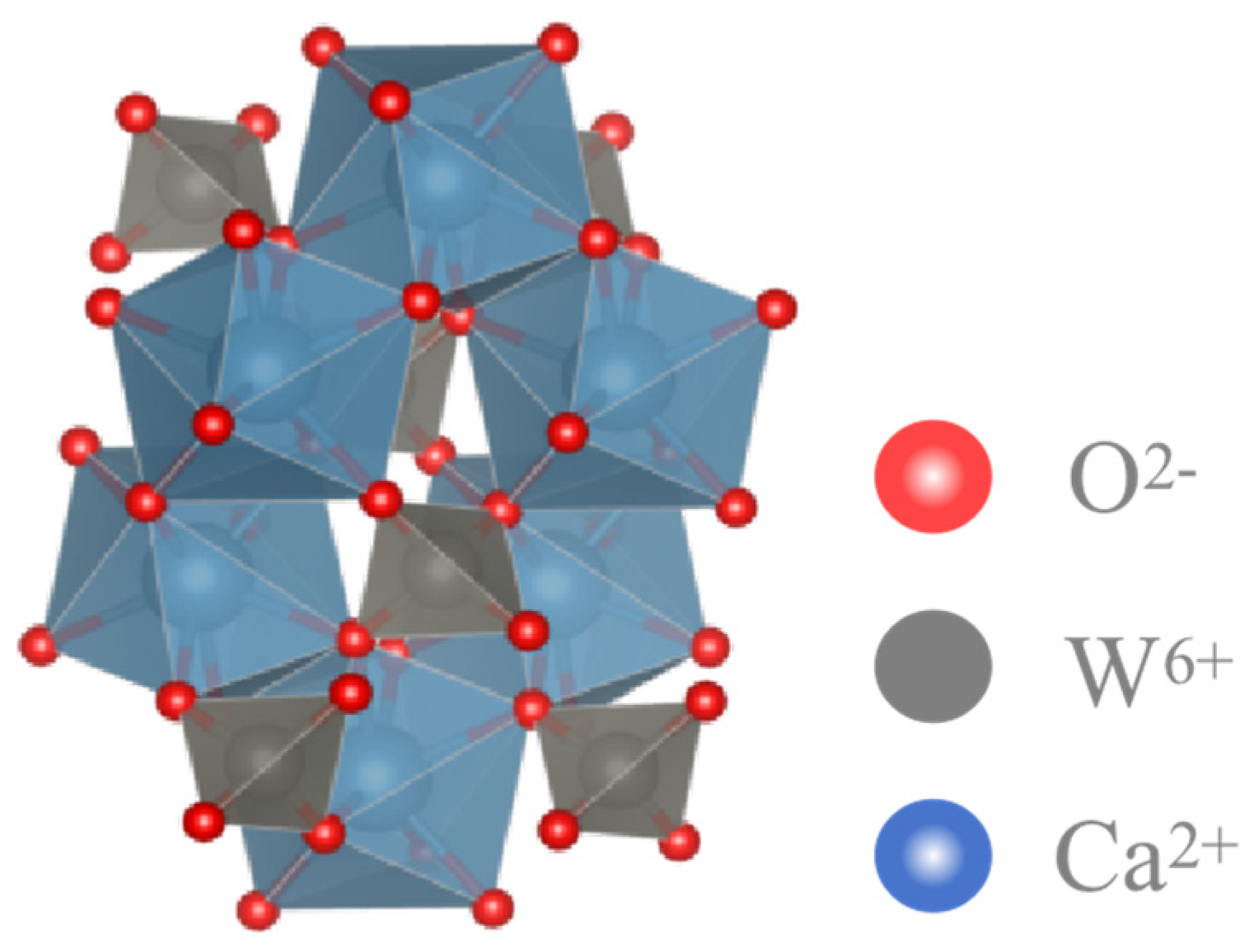
CaWO4 crystallizes in a regular and ordered scheelite-type structure, in which W6+ and O2− form tetrahedral polyhedra (Figure 1), while Ca2+ occupies specific interstitial sites surrounded by eight oxygen atoms in a dodecahedral coordination environment, endowing CaWO4 with certain stability and unique physicochemical properties. Upon the introduction of Eu3+ as an activator dopant, it partially substitutes for Ca2+ sites, because Eu3+ and Ca2+ are non-isovalent cations with different valence states. Such non-isovalent partial substitution inevitably induces local lattice distortion, thereby affecting the electronic environment and luminescence-transition characteristics of Eu3+ ions [32].
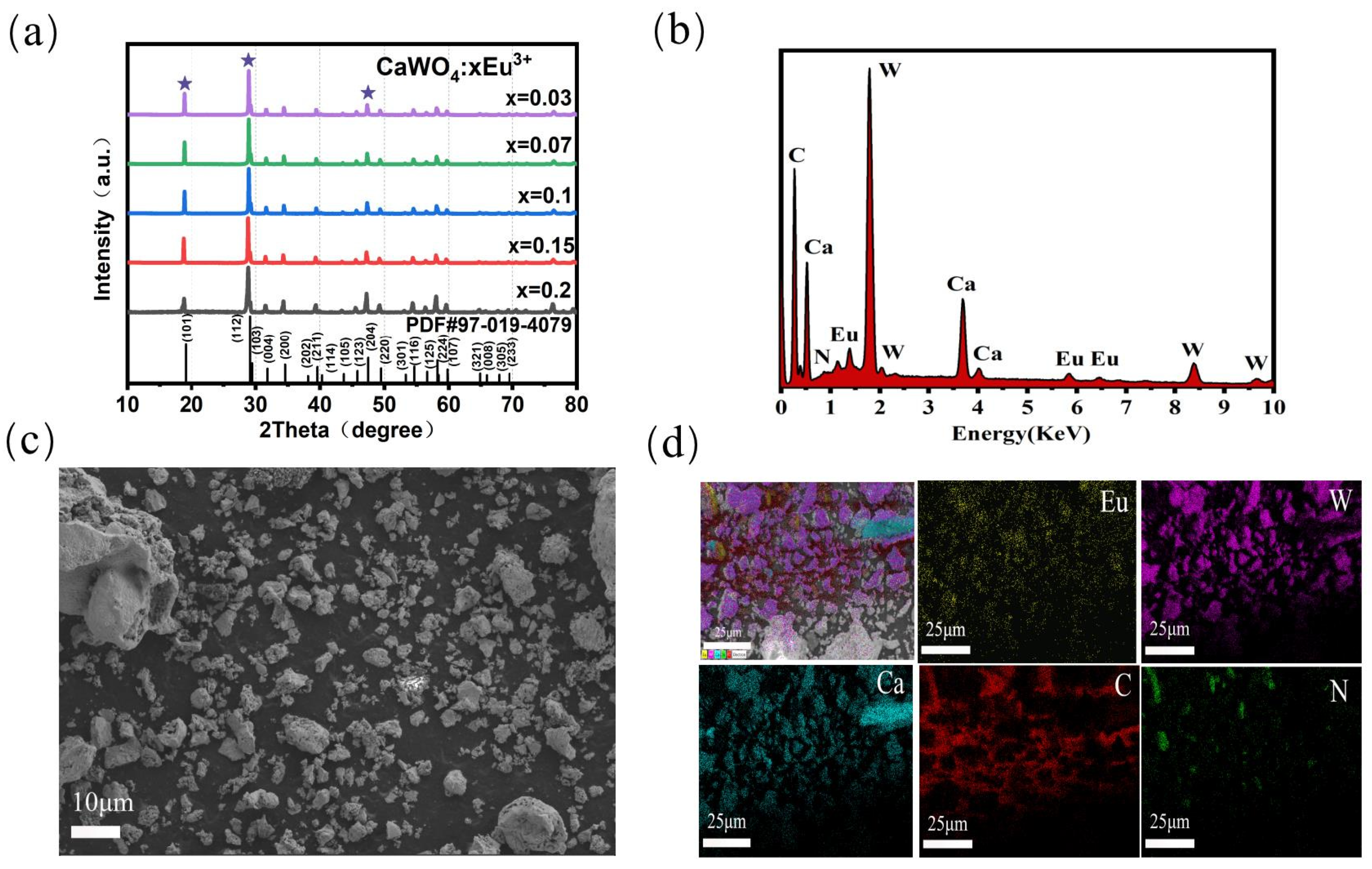
CaWO4:xEu3+ samples with different Eu3+ doping levels (x = 0.03, 0.07, 0.10, 0.15, 0.20) were synthesized and characterized to investigate the effects of Eu3+ incorporation on phase purity, elemental composition, and microstructural evolution. XRD patterns reveal that all diffraction peaks match well with the standard card of tetragonal CaWO4 (PDF#97-019-4079), indicating the formation of a pure scheelite-type phase without detectable impurities across the entire doping range (Figure 2a). The elemental composition of CaWO4 doped with different Eu3+ concentrations (x), as determined by EDS analysis, is listed in Table 1.
The consistent peak positions demonstrate that Eu3+ doping does not alter the main crystal structure of CaWO4, suggesting that Eu3+ successfully substitutes for Ca2+ sites in the lattice due to their comparable ionic radius [33]. This is further corroborated by EDS analysis, which clearly reveals the presence of C, Ca, Eu, W, and N elements in the samples (Figure 2b). Notably, the Eu peak intensity gradually increases with increasing doping level, while the relative contents of other elements change accordingly, confirming the successful incorporation of Eu3+ into the host lattice.
The microstructural morphology and spatial distribution of constituent elements were further characterized by SEM and EDS mapping, with the representative data presented in Figure 2c and Figure 2d, respectively [34].

3.2. Spectral Analysis of CaWO4:xEu3+ Phosphor

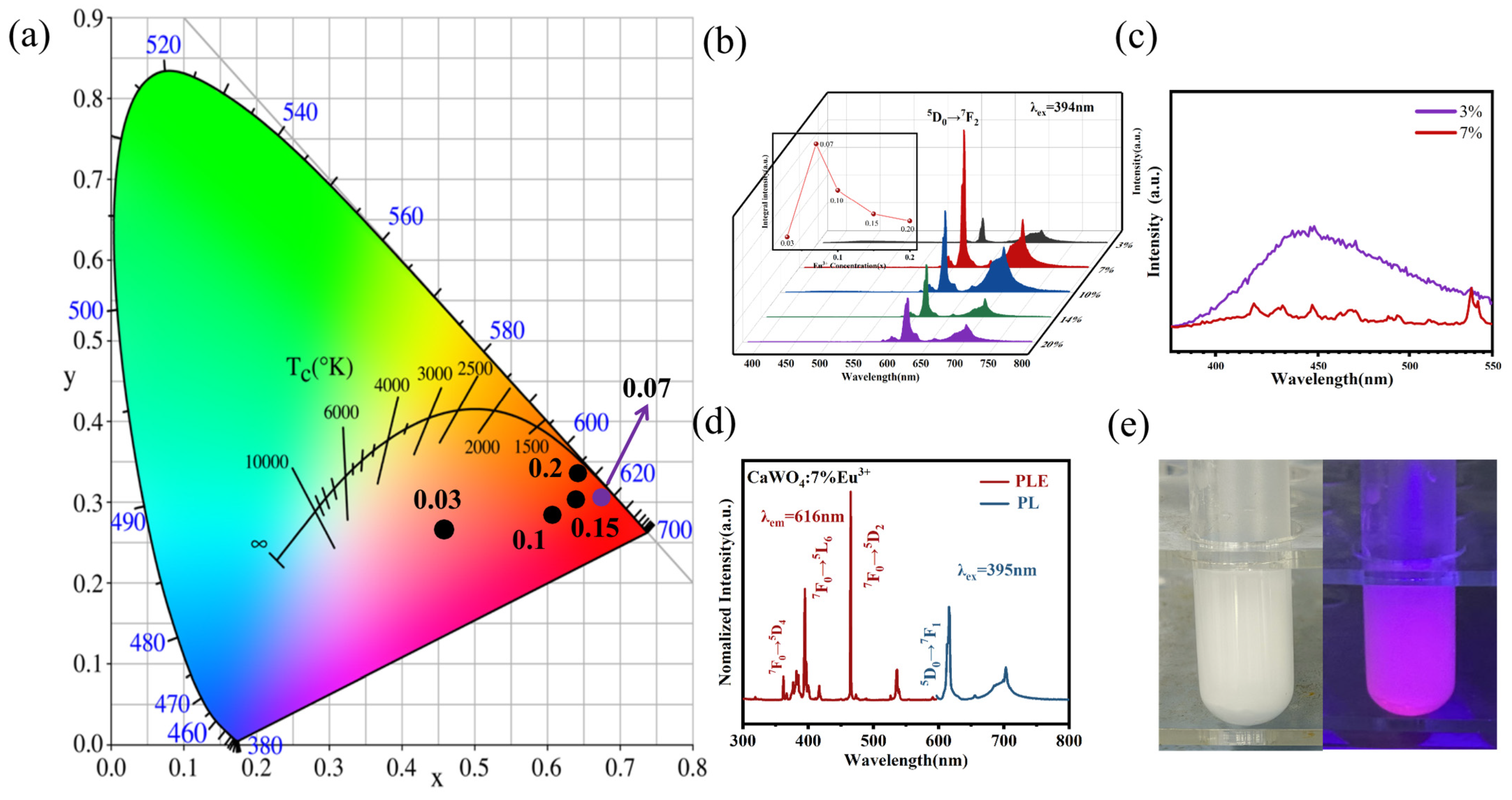
The influence of Eu3+ doping concentration on the photoluminescence performance of CaWO4:xEu3+ materials was systematically investigated. Under excitation at 394 nm, the emission intensity exhibits a trend of initial enhancement followed by attenuation as the Eu3+ content increases from 3% to 20% (Figure 3b), reaching a maximum at x = 0.07. The integrated emission intensity plotted as a function of Eu3+ concentration (Figure 3c) provides quantitative evidence for this concentration-quenching behavior and corroborates the selection of 7% as the optimal doping level. At low doping levels, the increased concentration of Eu3+ raises the number of luminescent centers, thereby enhancing the emission intensity; at elevated doping levels, the reduced interionic distance between Eu3+ ions facilitates more frequent interionic energy transfer, increases the probability of non-radiative transitions, and induces concentration quenching [35]. This phenomenon is consistent with the literature reports, as the Eu3+ content increases, the decreased separation between luminescent centers enhances energy migration to defects, impurities, or multi-phonon relaxation, ultimately leading to luminescence quenching. According to the Judd–Ofelt theory [36,37], the 5D07F1 transition is a magnetic-dipole transition, while the 5D07F2 transition is an electric-dipole transition (Figure 3b), with the latter being highly sensitive to the crystal-field environment. The optimal doping concentration is determined to be 7%, at which the 5D07F2 transition displays the strongest emission peak at 616 nm.
The photoluminescence excitation and emission spectral characteristics and chromaticity performance of CaWO4:7%Eu3+ further elucidate its optical properties. The excitation spectrum monitored at an emission wavelength of 616 nm exhibits multiple characteristic peaks (Figure 3d), wherein intense peaks include the 7F05L6 transition at 394 nm and the 7F05D2 transition at ~465 nm, while the weaker component at ~365 nm is assigned to the 7F05D4 transition; other transitions appear with relatively lower intensity [38]. The emission spectrum displays the characteristic electric-dipole 5D07F2 transition at ~616 nm as the dominant emission band. This multi-wavelength excitation characteristic broadens the excitation spectral range, enabling the material to match different light sources such as UV and blue LEDs. Chromaticity analysis reveals that the CIE 1931 chromaticity coordinates of samples with different doping concentrations determine the position of their emission color in the color space (Figure 3a). This shift originates from changes in the relative intensities of characteristic emission peaks, and the emission color of the material can be tuned by regulating the Eu3+ doping concentration [39]. The photographic image in Figure 3e shows CaWO4:7%Eu3+ phosphor in daylight (presenting white) and 365 nm ultraviolet light (showing bright red emission), confirming its potential for practical lighting and anti-counterfeiting applications.

3.3. Energy-Level Transition Diagram of g-C3N4 and Eu3+

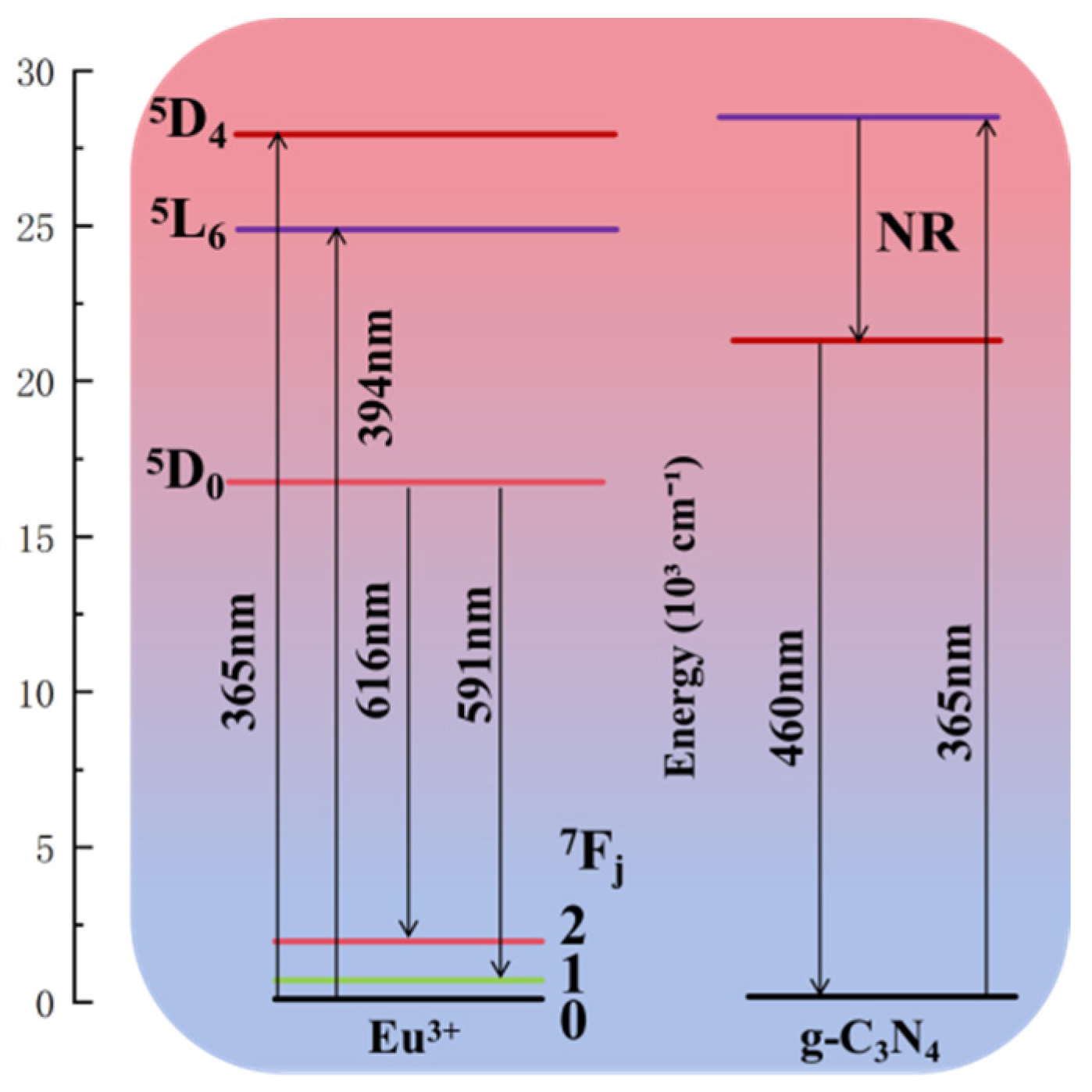
The photoluminescence mechanism of the CaWO4:Eu3+/g-C3N4 heterostructure under near-ultraviolet excitation can be elucidated through the energy-level diagram depicted in Figure 4. Under 365 nm excitation, both constituents of the composite are simultaneously activated, generating dual-band emission through distinct optical transition pathways.
For the g-C3N4 semiconductor component, the 365 nm photons promote electrons from the valence band (VB) to excited states above the conduction-band (CB) minimum via the intrinsic n → π* electronic transition. Subsequent non-radiative (NR) relaxation to the CB edge leads to radiative recombination, producing the broad blue–green emission centered at ~460 nm. This broadband luminescence originates from the surface radiative recombination of charge carriers in the π-conjugated triazine/heptazine units, serving as the essential blue component for white-light generation.
Concurrently, the Eu3+ activator ions are excited via direct f–f transitions, including the 7F05D4 transition at 365 nm and the 7F05L6 transition at 394 nm, as well as indirectly through [WO4]2− host absorption in the near-UV region followed by efficient host-to-Eu3+ energy transfer. Rapid non-radiative relaxation populates the metastable 5D0 emitting level, from which characteristic red emission at 616 nm occurs via the electric-dipole 5D07F2 transition. The magnetic-dipole 5D07F1 transition at ~591 nm is also observed with lower intensity, consistent with the Judd–Ofelt theory predictions for Eu3+ in a low-symmetry crystal-field environment.

3.4. Structural and Optical Properties of CaWO4:7%Eu3+/(y wt%) g-C3N4 Composites

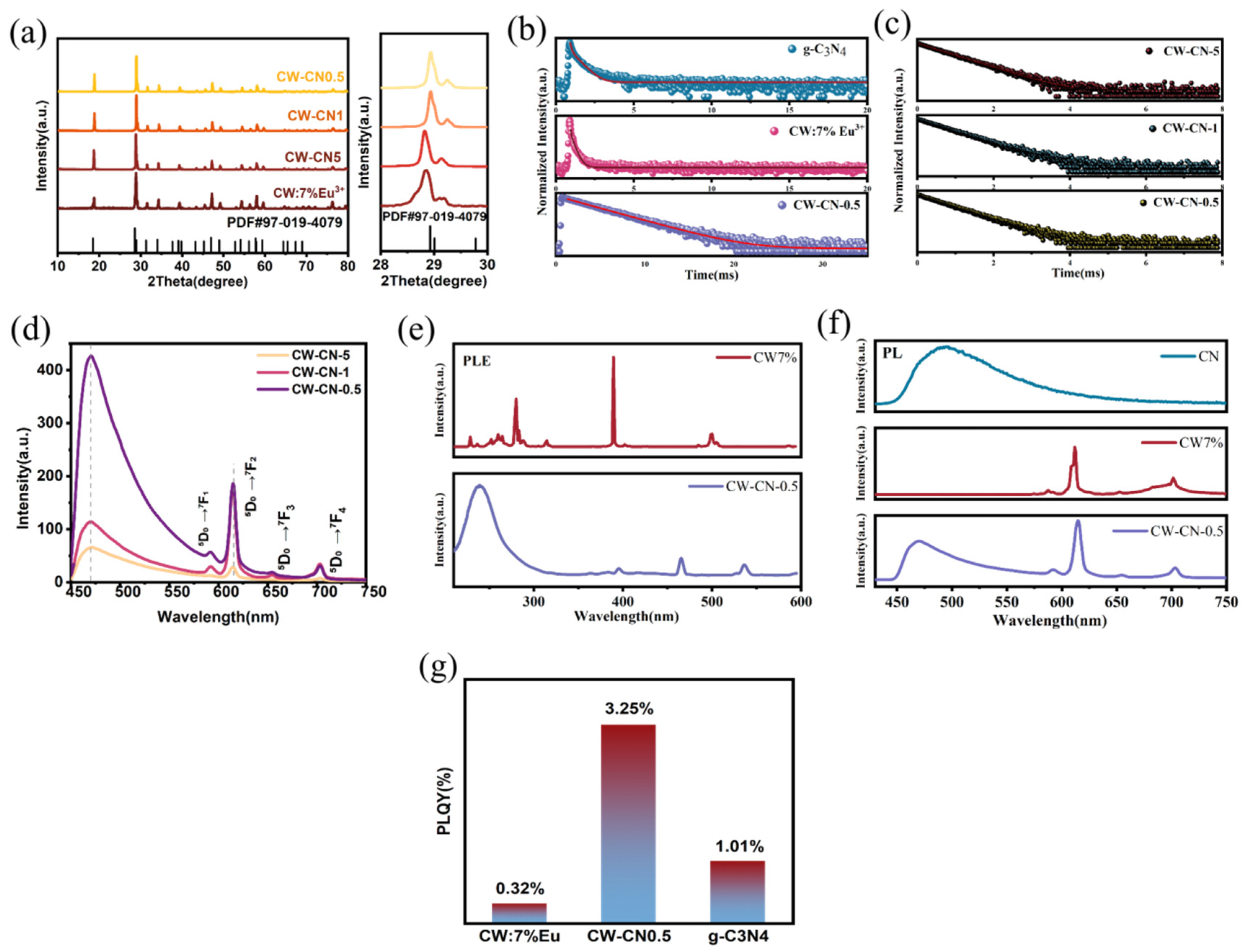
Upon incorporation of graphitic carbon nitride (g-C3N4) into the CaWO4:7%Eu3+ matrix, the elemental composition analysis by EDS confirms the successful fabrication of the heterostructured composites with tunable carbon and nitrogen contents increasing from 0.145 wt% C and 0.226 wt% N (CW-CN-0.5) to 1.45 wt% C and 2.26 wt% N (CW-CN-5), as summarized in Table 2. The Ca content gradually decreased from 25.76 wt% to 24.32 wt% with the increase in g-C3N4 loading, which was consistent with the expected dilution effect. In contrast, the content of Eu3+ remained statistically unchanged in all samples (8.64 wt%). Systematic structural and spectroscopic investigations reveal profound modulations in both the crystallographic integrity and photophysical behavior. X-ray diffraction (XRD) analysis demonstrates that all diffraction peaks of the composite samples (CW-CN-0.5, CW-CN-1, and CW-CN-5) align precisely with the tetragonal scheelite structure of CaWO4 (PDF#97-019-4079), confirming that g-C3N4 integration does not induce phase segregation or structural decomposition of the host lattice [40,41,42,43,44] (Figure 5a). Nevertheless, subtle peak shifts and variations in relative intensity are observed with increasing g-C3N4 content, which is particularly evident in the magnified view of the (112) reflection region (2θ = 28–30°), indicating localized lattice distortion and modified interatomic interactions at the heterointerface. Such structural perturbations originate from the electrostatic and van der Waals interactions between the terminal functional groups (–NH2, –NH) of g-C3N4 and the [WO4]2− tetrahedra, which induce microscopic strain fields without compromising the long-range crystallographic order of the CaWO4 framework.
Photoluminescence spectroscopic analysis under near-ultraviolet excitation (λex = 365 nm) reveals a dual-band emission profile [45] (Figure 5d). The emission spectrum exhibits emission comprising the characteristic 5D07F2 transition of Eu3+ ions (~616 nm) and the broad blue–green luminescence of g-C3N4 centered at ~465 nm; the characteristic blue emission of [WO4]2− expected at ~430 nm is not distinctly observed due to efficient energy transfer under a high Eu3+ doping concentration (7%).
Critically, quantitative comparison of the emission spectra reveals that the intensity of the characteristic 5D07F2 red emission from Eu3+ (~616 nm) in CW-CN-0.5 is significantly attenuated relative to pristine CaWO4:7%Eu3+ under identical measurement conditions (Figure 5f). This observation conclusively refutes the possibility of g-C3N4-to-Eu3+ sensitization. Instead, the apparent enhancement in integrated emission intensity arises exclusively from the superposition of two independently excited emission centers: (i) the residual red emission from Eu3+ (attenuated but still present) via [WO4]2− → Eu3+ energy transfer within the CaWO4 host; and (ii) the direct blue–green luminescence (450–550 nm) from photoexcited g-C3N4.
To verify the absence of energy transfer from g-C3N4 to Eu3+, photoluminescence excitation (PLE) spectra of the constituent materials and composite were compared (Figure 5e). The PLE spectrum of pristine CaWO4:7%Eu3+ monitored at 616 nm exhibits characteristic Eu3+ excitation peaks at 394 nm (7F05L6) and 465 nm (7F05D2). In CW-CN0.5, these Eu3+ peaks persist but with markedly reduced intensity, accompanied by a broad absorption band below 400 nm attributed to Eu–O/W–O charge-transfer states and the low-energy absorption tail of the [WO4]2− host matrix, rather than to g-C3N4. Notably, the characteristic absorption edge of g-C3N4 near ~350 nm is absent in the PLE spectrum, indicating that no g-C3N4 → Eu3+ energy transfer is observed. Crucially, if sensitization were operative, excitation into the g-C3N4 absorption band (365 nm) should enhance the Eu3+ emission relative to direct excitation; however, the opposite is observed, confirming that g-C3N4 and Eu3+ function as isolated emitters.
Time-resolved photoluminescence decay measurements monitored at the 5D07F2 emission wavelength (616 nm) reveal distinct luminescence kinetics for the constituent materials and composites. The decay curves for pristine g-C3N4, CaWO4:7%Eu3+, and the CW-CN-0.5 composite are presented in Figure 5b,c, revealing that g-C3N4 exhibits significantly faster decay kinetics (τ = 0.156 ± 0.012 ms) compared to the millisecond-scale lifetimes of the Eu3+-doped samples (τ = 1.245 ± 0.032 ms for CaWO4:7%Eu3+, and τ = 0.832 ± 0.028 ms for CW-CN-0.5; mean ± SD, n = 3). Furthermore, systematic variation in g-C3N4 loading (CW-CN-5, CW-CN-1, and CW-CN-0.5) demonstrates a progressive modulation of the fluorescence lifetime (Figure 5c), wherein the decay rates become more rapid with increasing g-C3N4 content (τ decreases from 1.245 ± 0.032 ms to 0.521 ± 0.029 ms), signifying an increased probability of non-radiative deactivation pathways. Consequently, the intrinsic quantum efficiency of the Eu3+ sublattice experiences marginal suppression, consistent with the observed lifetime shortening. However, despite this localized quenching effect, the integrated photoluminescence quantum yield (PLQY) of the CW-CN0.5 composite achieves a substantial enhancement to 3.25%, representing approximately a 10-fold improvement over the 0.32% value recorded for the CaWO4:7%Eu3+ host (Figure 5g), reflecting the dominant contribution of the broadband g-C3N4 emission to the total photon output.

3.5. FT-IR and UV–Vis DRS Analysis

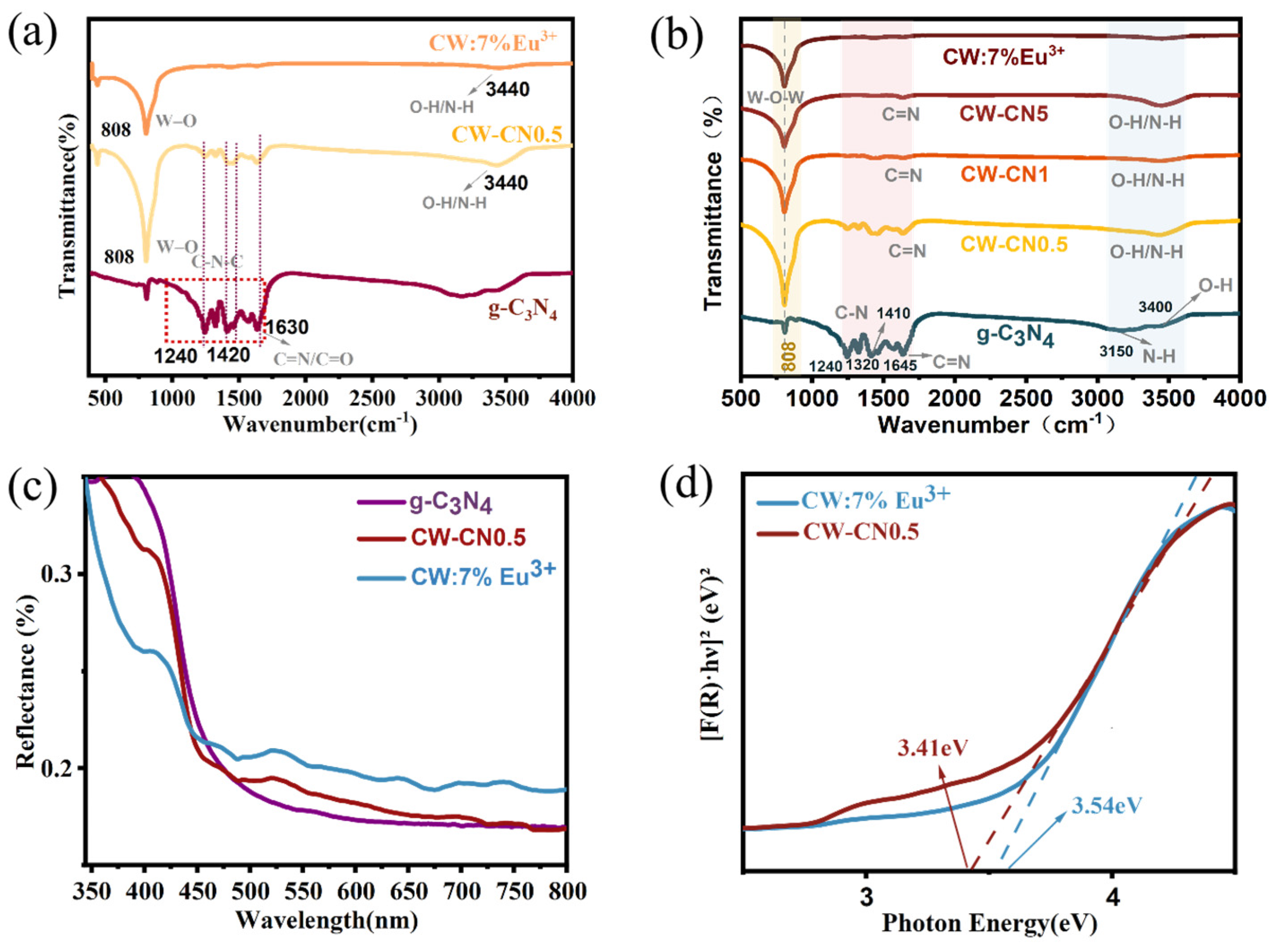
The molecular-level structural and electronic characteristics of the CW-CN series composites were systematically investigated using Fourier-transform infrared (FT-IR) spectroscopy and UV–Vis diffuse reflectance spectroscopy, providing critical insights into the interfacial interactions and optoelectronic properties arising from the integration of g-C3N4 with CaWO4-based phosphors. The FT-IR spectrum of CW-CN0.5 (Figure 6a) reveals distinct vibrational modes characteristic of both components: the broad absorption bands centered at 1240–1420 cm−1 are attributed to C–N–C stretching vibrations of g-C3N4, while the peak near 1630 cm−1 corresponds to C=N or C=O stretching modes [46,47,48,49,50], which are typical signatures of graphitic carbon nitride. Additionally, a weak N–H bending vibration is observed around 3150 cm−1, and a broad band near 3400 cm−1 is assigned to O–H stretching from adsorbed water molecules [51]. Concurrently, the presence of CaWO4 is confirmed by the characteristic absorption features of the [WO4]2− tetrahedron: the ν1 symmetric stretching mode at ~808 cm−1 and the lattice vibrations below 600 cm−1, consistent with the tetragonal scheelite structure. These observations collectively confirm the coexistence of both g-C3N4 and CaWO4 phases within the composite.
To assess the influence of g-C3N4 loading on the composite composition, the FT-IR spectra of the CW-CN series (Figure 6b) were compared. As the g-C3N4 content decreases from CW-CN5 to CW-CN0.5, the intensity of the C=N stretching vibration near 1645 cm−1 progressively diminishes and exhibits a slight redshift, indicating a reduction in the density of conjugated nitrogen-containing units. Similarly, the N–H bending mode at ~3150 cm−1 and the O–H stretching band near 3400 cm−1 show systematic attenuation, reflecting a decreasing contribution of g-C3N4-related functional groups. This trend corroborates the controlled modulation of the composite’s chemical environment and supports the hypothesis that the interfacial interaction strength may be tuned via g-C3N4 concentration.
The optical absorption behavior was further probed using UV–Vis diffuse reflectance spectroscopy (Figure 6c). The diffuse reflectance spectra display the reflectance (%) in the extended wavelength range of 350–800 nm, clearly revealing the absorption edges corresponding to the bandgap energies. The reflectance profile of CW-CN0.5 lies intermediate between those of pure g-C3N4 and CW:7%Eu3+, demonstrating enhanced visible-light harvesting capability compared to the bare tungstate host. A slight redshift in the absorption edge relative to CW:7%Eu3+ suggests a modification of the electronic structure due to the formation of a heterostructure.
To extract the optical bandgap, Tauc plots were constructed based on the Kubelka–Munk function [52,53] (Figure 6d), where F(R) = (1 − R)2/(2R) was applied to convert the diffuse reflectance data into the absorption coefficient-related function. Using the Tauc relationship [F(R)hν]2 versus photon energy (hν) for the direct-bandgap semiconductor, linear extrapolation of the [F(R)hν]2 curves to the photon-energy axis yields bandgap energies of 3.54 eV for CW:7%Eu3+ and 3.41 eV for CW-CN0.5. This reduction in bandgap energy is attributed to the formation of a Type-II heterojunction or charge-transfer states at the interface between CaWO4 and g-C3N4, which facilitates electron delocalization and lowers the effective energy barrier for excitation. The narrowed bandgap not only enhances light absorption in the visible range but also implies improved potential for energy transfer processes, particularly in the context of luminescent down-conversion applications.
In summary, the combined FT-IR and UV–Vis analysis demonstrates that the incorporation of g-C3N4 into the CaWO4 matrix results in a well-defined heterostructured composite with preserved phase integrity and modified electronic properties. The observed changes in vibrational modes and optical bandgap provide direct evidence of interfacial coupling and electronic hybridization, laying the foundation for understanding the enhanced photophysical performance observed in these materials.

3.6. Thermal-Quenching Behaviour

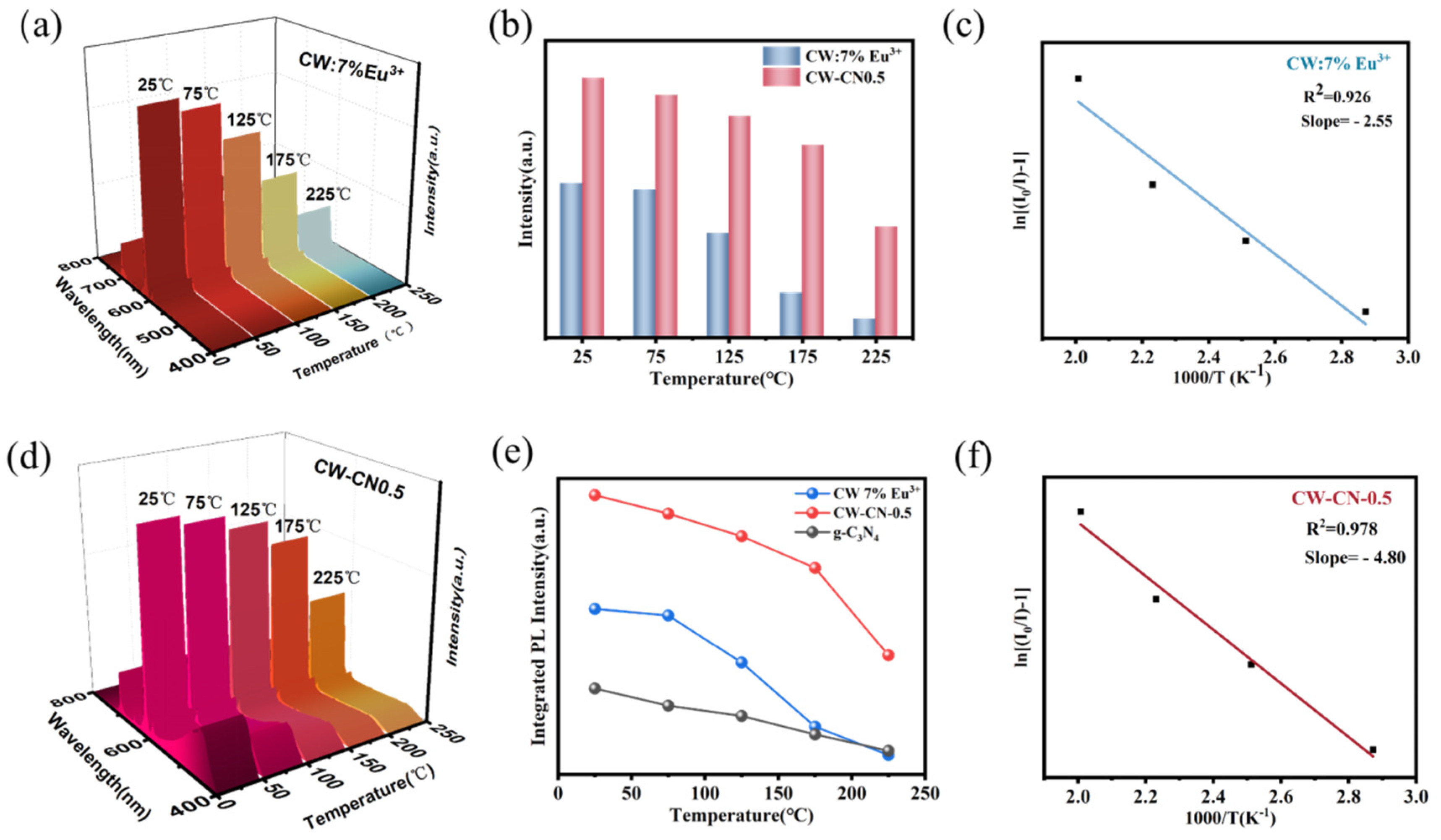
The thermal stability of phosphors is a decisive factor for their practical deployment in solid-state lighting devices. Temperature-dependent emission spectra (Figure 7a,d,e) reveal that g-C3N4, CaWO4:7%Eu3+, and CW-CN-0.5 exhibit typical thermal quenching: their characteristic 616 nm emission and integrated intensity decrease monotonically over 25–225 °C [54]. Pristine g-C3N4 demonstrates severe intrinsic thermal instability, retaining merely 35% of its room-temperature intensity at 175 °C. This arises from thermally enhanced lattice vibrations, which increase the phonon energy density around luminescent centers and thereby elevate non-radiative transition probability [55]. Notably, at 175 °C, CW-CN-0.5 retains 78% of its room-temperature intensity, surpassing the 74% retention of the pristine phosphor and demonstrating that g-C3N4 incorporation effectively improves high-temperature luminescence retention.
The thermal-quenching activation energy reflects the material’s ability to resist thermal quenching. The higher the activation energy, the less likely the material is to undergo thermal quenching [56]. At 175 °C, the composite retains 78% of its room-temperature intensity, compared to 74% for the pristine phosphor (Figure 7b), indicating that the composite phosphor displays a modest improvement in maintaining luminescence performance at elevated temperatures.
According to the Arrhenius equation, the relationship between the luminescence intensity I(T) and the temperature T is:
I ( T )   =   I 0 1 + A   e x p ( E K B T )
where I(T) is the luminescence intensity at temperature T; I0 is the luminescence intensity at low temperature (usually taken as room temperature); A is a constant; kB is the Boltzmann constant (kB = 8.617 × 10⁻⁵ ev/K−1); and T is the absolute temperature (T = t + 273.15, where t is the Celsius temperature).
Based on the fitting results shown in Figure 7c and Figure 7f, the activation energies are determined to be 0.22 eV for CW:7%Eu3+ and 0.41 eV for CW-CN-0.5, respectively. The increase in activation energy from 0.22 eV to 0.41 eV suggests that g-C3N4 incorporation may help mitigate non-radiative losses, though further optimization is needed. With increasing temperature, the relative luminescence intensities of both CW:7%Eu3+ and CW-CN-0.5 decrease, but the composite maintains higher intensity at the same temperature. This indicates that CW-CN-0.5 shows slightly better thermal stability, as reflected by its higher activation energy [57].
In the evaluation of thermal stability of luminescent materials, the Arrhenius model is commonly employed to quantitatively analyze the temperature-dependent decay of emission intensity. Taking the CW:7%Eu3+ sample as an example, its thermal-quenching behavior in the temperature range of 75–175 °C is well described by the following equation:
l n [ ( I 0 / I ) 1 ] = 6.56     2.55   ×   ( 1000 / T ) ( R 2 = 0.926 )
as shown in Figure 7c, indicating that the system follows a typical thermally activated quenching mechanism. As the temperature increases, intensified lattice vibrations perturb the local crystal-field symmetry [58], thereby altering the energy-level structure and transition probabilities of Eu3+ ions. Consequently, a greater proportion of the excitation energy originally destined for radiative transitions is instead dissipated via non-radiative pathways, resulting in a progressive decrease in luminescence intensity.
Upon further incorporation of carbon nitride, the composite sample CW-CN-0.5 exhibits significantly enhanced resistance to thermal quenching. Its corresponding Arrhenius fitting equation is:
l n [ ( I 0 / I )     1 ]   =   11.5     4.80   ×   ( 1000 / T ) ( R 2 = 0.978 )
with a markedly increased slope (Figure 7f), reflecting a higher activation energy. This enhancement can be attributed to the modulation of the host lattice parameters and chemical bonding characteristics induced by carbon nitride, which collectively improve the overall lattice thermal stability [51]. Moreover, the weak van der Waals interactions between carbon nitride layers may effectively absorb a portion of the thermal vibrational energy, thereby buffering the perturbation of the local crystal-field environment around rare-earth ions caused by the rising temperature, and maintaining a relatively stable coordination environment for Eu3+ even at elevated temperatures [59].
The CW-CN-0.5 composite phosphor retains 78% of its room-temperature emission intensity at 175 °C, demonstrating excellent thermal stability. These characteristics highlight its potential as a red-emitting conversion material for white-light-emitting diode (w-LED) applications and provide a viable pathway for further optimization of its high-temperature luminescent performance.

3.7. Chromaticity Engineering Toward White-Light Emission

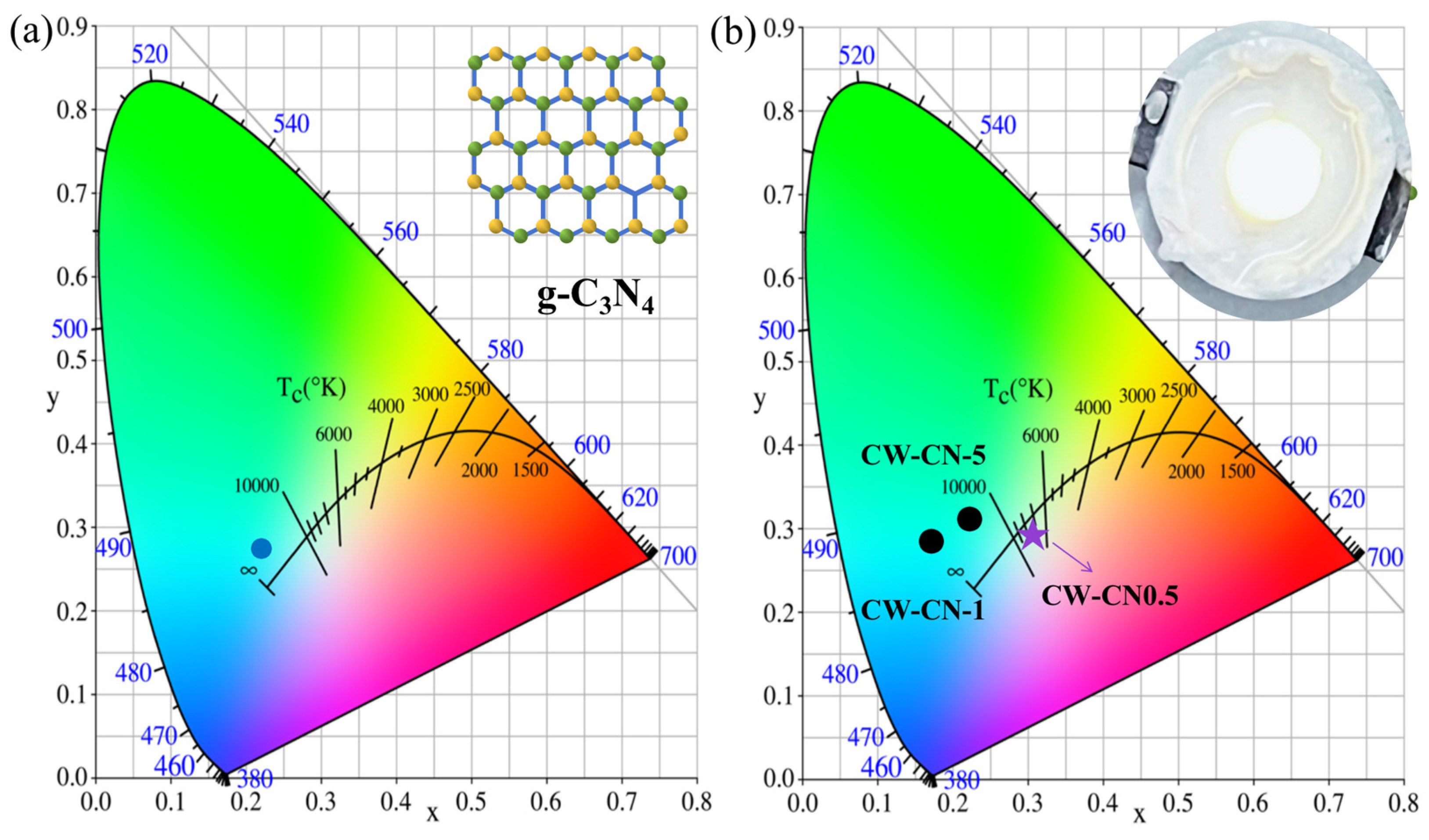
The strategic impetus underlying the heterostructuring of CaWO4:7%Eu3+ with g-C3N4 originates from the inherent spectral deficiency of conventional europium-doped tungstate phosphors. Specifically, CaWO4:Eu3+ systems typically exhibit dominant red emission centered at 616 nm (5D07F2) accompanied by weak host emission, resulting in high correlated color temperatures (CCTs) and compromised color-rendering indices (CRIs) due to the absence of sufficient green spectral components—a critical limitation for solid-state lighting applications [60]. To circumvent this constraint, the present work exploits the complementary spectral characteristics of g-C3N4, whose broadband blue–green luminescence (450–550 nm), arising from n–π* electronic transitions, ideally fills the spectral gap between the UV excitation source and the red emission of Eu3+ [61], as evidenced by its chromaticity coordinate (0.206, 0.281) positioned in the blue region of the CIE 1931 diagram (Figure 8a).
The chromaticity engineering proceeds via precise modulation of the g-C3N4 loading ratio to achieve balanced spectral integration. As depicted in the CIE 1931 chromaticity diagram, pristine CaWO4:7%Eu3+ occupies the deep red region with coordinates of (0.656, 0.329), whereas pure g-C3N4 resides in the blue region at (0.206, 0.281). Through systematic compositional optimization, the CW-CN-0.5 heterocomposite successfully bridges these extremes, achieving chromaticity coordinates of (0.294, 0.324) that fall squarely within the white-light region. This coordinate shift from the red toward the blue–green region with increasing g-C3N4 content (CW-CN-1: 0.216, 0.317; CW-CN5: 0.240, 0.349) substantiates the efficacy of Type-II heterojunction-mediated energy transfer in redistributing spectral weights [62]. The underlying mechanism involves the partial energy funneling from photoexcited [WO4]2− groups and g-C3N4 to Eu3+ activators, concurrent with the direct radiative recombination within the g-C3N4 semiconductor, thereby generating simultaneous blue–green and red emissions from a single-phase phosphor matrix.
The complete CIE chromaticity data for all samples are summarized in Table 3. Quantitative assessment of the white-light quality reveals that the CW-CN-0.5 phosphor exhibits a correlated color temperature (CCT) of 7673 K, calculated via McCamy’s empirical formula T = −449n3 + 3525n2 − 6823.3n + 5520.33, where n = x x e y y e , (xe = 0.3320) (ye = 0.1858), categorizing it as a high-quality cold-white-light source suitable for display backlighting and medical illumination applications [63].To further quantify the color rendering capability, the general color rendering index (Ra) was calculated according to the CIE 13.3-1995 standard method based on the measured emission spectra. The special color rendering indices (Ri) for 14 selected Munsell test samples were obtained by the following equation:
Ri = 100 − 4.6ΔEi (i = 1, 2, 3, …, 14)
where ΔEi represents the color difference in the i-th test sample between the test illuminant and the reference illuminant (blackbody radiator of the same CCT) in the CIE 1964 UCS color space. The general color rendering index (Ra) is given as the average of the first eight test samples:
R a   =   1 8 i = 1 8 R i
The calculated results reveal that pristine CW:7%Eu3+ exhibits a low Ra of merely 52.0, attributable to its emission spectrum being overly concentrated in the red region (616 nm) with severe deficiency in the blue–green band. In contrast, the CW-CN-0.5 composite demonstrates a significantly enhanced Ra of 89.6, approaching the high-quality white-light LED standard (Ra > 90) This substantial improvement stems from the complementary spectral combination of g-C3N4’s broad blue–green emission (~460 nm) and Eu3+ red emission (~616 nm), which effectively broadens the visible spectral coverage and validates the efficacy of the heterostructure strategy in overcoming the spectral deficiency of conventional CaWO4:Eu3+ phosphors.
Crucially, the photographic inset in Figure 8b captures the operational near-UV-pumped LED device, fabricated using the optimized CW-CN-0.5 composite phosphor, exhibiting uniform, intense white luminescence without perceptible color segregation or intensity inhomogeneity. This visual demonstration validates the practical viability of the heterostructure strategy, confirming that the engineered energy-transfer pathways between CaWO4:Eu3+ and g-C3N4 successfully circumvent the spectral limitations of individual constituents. The realization of single-phase white-light emission from this cost-effective tungstate/carbon nitride system not only establishes a paradigm for designing rare-earth-based luminescent composites with tunable chromaticity but also offers a scalable technological solution for next-generation energy-saving w-LEDs, eliminating the need for multi-phosphor blends and their associated color-mixing complexities.

4. Conclusions

In summary, we have successfully constructed a CaWO4:Eu3+/g-C3N4 heterostructured composite wherein the incorporation of g-C3N4 modulates interfacial interactions and reduces the optical bandgap without inducing structural decomposition. Photoluminescence analysis reveals that under 365 nm excitation, the composite exhibits dual-band emission components: characteristic red emission from Eu3+ and broad blue–green luminescence (450–550 nm) originating from g-C3N4, thereby enabling tunable, cold-white-light emission from a single-phase phosphor.
Furthermore, XRD and thermal-quenching analyses demonstrate that g-C3N4 incorporation enhances lattice rigidity and stabilizes the crystal field surrounding Eu3+ ions, increasing the thermal-quenching activation energy from 0.22 eV to 0.41 eV and improving emission retention to 78% at 175 °C compared to 74% for the pristine sample. Notably, consistent with the enhancement mechanism previously observed in our group’s Lu2MoO6:Eu3+/g-C3N4 system [26], the present work confirms that this heterostructuring strategy is equally effective in tungstate-based hosts, validating the universality of g-C3N4 coupling for designing advanced rare-earth luminescent composites with high thermal stability and tunable chromaticity.

Author Contributions

Material preparation, data collection, and analysis were performed by H.S. and Y.K. SEM and EDS mapping were carried out by H.S. The first draft of the manuscript was written by H.S. and Y.K. G.J. conceived and designed the research, supervised the entire study, reviewed and revised the manuscript, and was responsible for the revision and submission process. All authors have read and agreed to the published version of the manuscript.

Funding

This research received no external funding.

Data Availability Statement

The data presented in this study are available on request from the corresponding author due to the data containing unpublished follow-up research results and preliminary findings that are still under preparation for subsequent publication.

Acknowledgments

The authors would like to express their sincere gratitude to Harbin Institute of Technology, Chinese Academy of Sciences, Shandong University and the State Key Laboratory of Advanced Metals and Materials for their support in this work.

Conflicts of Interest

The authors declare no conflict of interest.

References

  1. Zhang, C.; Uchikoshi, T.; Takeda, T.; Hirosaki, N. Research Progress on Surface Modifications for Phosphors Used in Light-Emitting Diodes (LEDs). Phys. Chem. Chem. Phys. 2023, 25, 24214–24233. [Google Scholar] [CrossRef] [PubMed]
  2. Kunkel, N.; Goldner, P. Recent advances in rare-earth doped inorganic crystalline materials for quantum information processing. Z. Für Anorg. Und Allg. Chem. 2018, 644, 66–76. [Google Scholar] [CrossRef]
  3. Kottaisamy, M.; Thiyagarajan, P.; Mishra, J.; Rao, M.R. Color tuning of Y3Al5O12:Ce phosphor and their blend for white LEDs. Mater. Res. Bull. 2008, 43, 1657–1663. [Google Scholar] [CrossRef]
  4. Papadimitriou, D.; Roupakas, G.; Dimitriadis, C.A.; Logothetidis, S. Raman scattering and photoluminescence of nitrogenated amorphous carbon films. J. Appl. Phys. 2002, 92, 870–875. [Google Scholar] [CrossRef]
  5. Joos, J.J.; Van der Heggen, D.; Martin, L.I.D.J.; Amidani, L.; Smet, P.F.; Barandiarán, Z.; Seijo, L. Broadband infrared LEDs based on europium-to-terbium charge transfer luminescence. Nat. Commun. 2020, 11, 3647. [Google Scholar] [CrossRef]
  6. Li, G.; Tian, Y.; Zhao, Y.; Lin, J. Recent progress in luminescence tuning of Ce3+ and Eu2+-activated phosphors for pc-WLEDs. Chem. Soc. Rev. 2015, 44, 8688–8713. [Google Scholar] [CrossRef]
  7. Zhao, Y.; Zhang, D.; Song, Y.; Li, Z.; Zheng, B.; Zheng, Z.; Zheng, X.; Zuo, H. Single-phase white light emission Ca9NaLu0.667(PO4)7: Eu2+, Mn2+ phosphor for the application of WLED. Ceram. Int. 2023, 49, 25831–25839. [Google Scholar] [CrossRef]
  8. Xiao, H.; Meng, Q. Eu3+ doped CaWO4 nanophosphors for high-sensitivity optical thermometry. Spectrochim. Acta A Mol. Biomol. Spectrosc. 2024, 305, 123542. [Google Scholar] [CrossRef]
  9. Guo, X.; Song, S.; Jiang, X.; Wang, X.; Guo, J.; Song, Q.; Han, Y.; Wang, L. Strategy to enhance the red emission of CaWO4:Eu3+ phosphors assisted by polyacrylic acid (PAA). Solid State Sci. 2019, 97, 105979. [Google Scholar] [CrossRef]
  10. Wang, Z.; Wang, Y.; Li, Y.; Liu, B. Low dimensional effects on luminescent properties of CaWO4:Tb nanophosphor. J. Electrochem. Soc. 2010, 157, J125–J129. [Google Scholar] [CrossRef]
  11. Piskuła, Z.; Czajka, J.; Staninski, K.; Lis, S. Luminescence properties of calcium tungstate activated by lanthanide (III) ions. J. Rare Earths 2014, 32, 221–225. [Google Scholar] [CrossRef]
  12. Li, L.; Tang, X.H.; Wu, Z.J.; Zheng, Y.F.; Jiang, S.; Tang, X.; Xiang, G.T.; Zhou, X.J. Simultaneously tuning emission color and realizing optical thermometry via efficient Tb3+ → Eu3+ energy transfer in whitlockite-type phosphate multifunctional phosphors. J. Alloy. Compd. 2019, 780, 266–275. [Google Scholar] [CrossRef]
  13. Du, P.; Wu, S.Q.; Yu, J.S. Synthesis, electronic structure and luminescence properties of color-controllable Dy3+/Eu3+-codoped CaWO4 phosphors. J. Lumin. 2016, 173, 192–198. [Google Scholar] [CrossRef]
  14. Wang, W.; Yang, P.; Cheng, Z.; Hou, Z.; Li, C.; Lin, J. Patterning of Red, Green, and Blue Luminescent Films Based on CaWO4:Eu3+, CaWO4:Tb3+, and CaWO4 Phosphors via Microcontact Printing Route. ACS Appl. Mater. Interfaces 2011, 3, 3921–3928. [Google Scholar] [CrossRef] [PubMed]
  15. Ramakrishna, P.V.; Lakshmana Rao, T.; Singh, A.; Benarji, B.; Dash, S. Structural and photoluminescence behavior of thermally stable Eu3+ activated CaWO4 nanophosphors via Li+ incorporation. J. Mol. Struct. 2017, 1149, 426–431. [Google Scholar] [CrossRef]
  16. Zhang, Y.; Gong, W.; Yu, J.; Cheng, Z.; Ning, G. Multi-color luminescence properties and energy transfer behavior in host-sensitized CaWO4: Tb3+, Eu3+ phosphors. RSC Adv. 2016, 6, 30886–30894. [Google Scholar] [CrossRef]
  17. Narkbuakaew, T.; Sujaridworakun, P. Synthesis of Tri-S-Triazine Based g-C3N4 Photocatalyst for Cationic Rhodamine B Degradation under Visible Light. Top. Catal. 2020, 63, 1086–1096. [Google Scholar] [CrossRef]
  18. Ji, H.; Fan, Y.; Yan, J.; Xu, Y.; She, X.; Gu, J.; Fei, T.; Cui, H.; Li, H. Construction of SnO2/graphene-like g-C3N4 with enhanced visible light photocatalytic activity. RSC Adv. 2017, 7, 36101–36111. [Google Scholar] [CrossRef]
  19. Sun, L.; Qi, Y.; Jia, C.J.; Jin, Z.; Fan, W. Enhanced visible-light photocatalytic activity of g-C3N4/Zn2GeO4 heterojunctions with effective interfaces based on band match. Nanoscale 2014, 6, 2649–2659. [Google Scholar] [CrossRef]
  20. Ji, C.; Wang, G.S. Degradation of berberine by visible light over Ag3PO4/g-C3N4 heterojunction catalyst. Inorg. Chem. Ind. 2022, 54, 175–180. [Google Scholar]
  21. Zhang, Z.; Yao, S.; Cheng, J.; Hu, F.; Wei, R.; Guo, H. Luminescence and thermometric properties of Ba2LaSbO6:Eu3+/g-C3N4 Mixed Materials. J. Fluoresc. 2026, 36, 243–255. [Google Scholar] [CrossRef]
  22. Lin, W.-T.; Fu, P.; Li, W.-L.; Yu, Y.-H.; Zhang, Z.-L.; Fan, H.-Y.; Huang, X.-J.; Xu, Z.-K.; Wan, L.-S. Cross-linked g-C3N4 nanofibers enable thermally stable composite membranes for high-performance loose nanofiltration. Chem. Eng. J. 2024, 494, 153197. [Google Scholar] [CrossRef]
  23. Sharma, A.; Varshney, M.; Chae, K.H.; Won, S.O. Mechanistic investigations on emission characteristics from g-C3N4, g-C3N4@Pt and g-C3N4@Ag nanostructures using X-ray absorption spectroscopy. Curr. Appl. Phys. 2018, 18, 1458–1464. [Google Scholar] [CrossRef]
  24. Paušová, Š.; Baudys, M.; Kosina, J.; Praus, P.; Pintar, A.; Žerjav, G.; Roškarič, M.; Finšgar, M.; Krýsa, J. Photochemical stability of g-C3N4 in the gas phase. J. Environ. Chem. Eng. 2022, 10, 107647. [Google Scholar] [CrossRef]
  25. Jung, J.Y.; Yi, S.S.; Hwang, D.H.; Son, C.S. Structure, Luminescence, and Magnetic Properties of Crystalline Manganese Tungstate Doped with Rare Earth Ion. Materials 2021, 14, 3717. [Google Scholar] [CrossRef]
  26. Vadivu, A.; Venkatachalam, M.; Silambarasan, A. Assessment of the photocatalytic activity of scheelite CaWO4/g-C3N4 nanocomposites via rhodamine B degradation under visible light. Transit. Met. Chem. 2025, 50, 609–624. [Google Scholar] [CrossRef]
  27. Tuna, O.; Mert, H.H.; Mert, M.S.; Simsek, E.B. Tailoring the surface features of CaWO4 by coupling with tubular g-C3N4 for enhanced solar photocatalysis and thermal energy storage. J. Energy Storage 2024, 86, 111398. [Google Scholar] [CrossRef]
  28. Wu, H.Y.; Yang, J.F.; Wang, X.X. Tune color of single-phase LiGd(MoO4)2−x(WO4)x: Sm3+,Tb3+ via adjusting the proportion of matrix and energy transfer to create white-light phosphor. Solid State Sci. 2018, 77, 20–26. [Google Scholar] [CrossRef]
  29. Su, J.Y.; Zhang, X.Y.; Li, X.L. Synthesis and luminescence properties of Yb3+, Tm3+ and Ho3+ co-doped SrGd2(WO4)2(MoO4)2 nanocrystal. Adv. Powder Technol. 2020, 31, 1051–1059. [Google Scholar] [CrossRef]
  30. Yu, M.; Zhang, W.T.; Qin, S.Y.; Li, J.F.; Qiu, K.H. Synthesis and luminescence properties of single-component Ca5(PO4)3F:Dy3+, Eu3+ white-emitting phosphors. J. Am. Ceram. Soc. 2018, 101, 4582–4590. [Google Scholar] [CrossRef]
  31. Wang, W.; Yang, P.; Gai, S.; Niu, N.; He, F.; Lin, J. Fabrication and luminescent properties of CaWO4: Ln3+ (Ln = Eu, Sm, Dy) nanocrystals. J. Nanoparticle Res. 2010, 12, 2295–2305. [Google Scholar] [CrossRef]
  32. Kolesnikov, I.E.; Mamonova, D.V.; Kurochkin, M.A. Ratiometric thermometry using single Eu3+-doped CaWO4 phosphors. Nanotechnology 2023, 34, 055501. [Google Scholar] [CrossRef]
  33. Phuruangrat, A.; Thongtem, T.; Thongtem, S. Synthesis, characterisation and photoluminescence of nanocrystalline calcium tungstate. J. Exp. Nanosci. 2010, 5, 263–270. [Google Scholar] [CrossRef]
  34. Liu, F.; Zhao, C.C.; Yang, W.C.; Zhang, D.Q. Research progress of the tungstate luminescence material. New Chem. Mater. 2016, 44, 14–16. [Google Scholar]
  35. Yuan, G.; Li, M.; Yu, M.; Tian, C.; Wang, G.; Fu, H. In situ synthesis, enhanced luminescence and application in dye sensitized solar cells of Y2O3/Y2O2S:Eu3+ nanocomposites by reduction of Y2O3:Eu3+. Sci. Rep. 2016, 6, 37133. [Google Scholar] [CrossRef] [PubMed]
  36. Barbosa, H.P.; Silva, I.G.; Felinto, M.C.F.; Teotonio, E.E.; Malta, O.L.; Brito, H.F. Photoluminescence of single-phased white light emission materials based on simultaneous Tb3+, Eu3+ and Dy3+ doping in CaWO4 matrix. J. Alloy. Compd. 2017, 696, 820–827. [Google Scholar] [CrossRef]
  37. Geng, X.; Xie, Y.; Ma, Y.; Liu, Y.; Luo, J.; Wang, J.; Yu, R.; Deng, B.; Zhou, W. Abnormal thermal quenching of w-LED and its application: Double perovskite Ca2InSbO6:Eu3+ red phosphor. J. Alloy. Compd. 2020, 847, 156249. [Google Scholar] [CrossRef]
  38. Zhang, Y.; Abraha, A.; Zhang, R.; Shahbazyan, T.; Fadavi, M.; Heydari, E.; Dai, Q. Luminescence properties of CaWO4 and CaWO4: Eu3+ nanostructures prepared at low temperature. Opt. Mater. 2018, 84, 115–122. [Google Scholar] [CrossRef]
  39. Huang, X.; Li, B.; Guo, H. Molybdenum-doping-induced photoluminescence enhancement in Eu3+-activated CaWO4 red-emitting phosphors for white light-emitting diodes. Dye. Pigment. 2017, 143, 86–94. [Google Scholar] [CrossRef]
  40. Lovisa, L.X.; da Silva, J.M.P.; Santiago, A.A.G.; Li, M.S.; Longo, E.; Paskocimas, C.A.; Bomio, M.R.D.; Motta, F.V. Red-emitting CaWO4:Eu3+, Tm3+ phosphors for solid-state lighting: Luminescence characteristics and morphological evolution. J. Rare Earths 2021, 40, 226–233. [Google Scholar] [CrossRef]
  41. Xia, M.; Ju, Z.; Yang, H.; Wang, Z.; Gao, X.; Pan, F.; Liu, W. Red-emitting enhancement by inducing lower crystal field symmetry of Eu3+ site in CaWO4:Eu3+ phosphor for n-UV w-LEDs. J. Alloy. Compd. 2018, 739, 439–446. [Google Scholar] [CrossRef]
  42. Kumar, D.; Singh, B.P.; Srivastava, M.; Srivastava, A.; Singh, P.; Srivastava, A.; Srivastava, S.K. The structure and photoluminescence properties of thermally stable Eu3+ activated CaWO4 nano-phosphors doped with Li+. J. Lumin. 2018, 203, 507–514. [Google Scholar] [CrossRef]
  43. Nazarov, M.V.; Tsukerblat, B.S.; Popovici, E.J. Polarization selection rules for the allowed optical transitions in europium-terbium dual-activated calcium tungstate phosphors. Solid State Commun. 2004, 133, 203–208. [Google Scholar] [CrossRef]
  44. Rostami, S.; Yahyazadeh, A.; Adibi, H. Designing a new magnetic g-C3N4 nanocatalyst based on Ag nanoparticles supported by β-cyclodextrin for effective reduction of nitroaromatic compounds. Sci. Rep. 2024, 14, 31586. [Google Scholar] [CrossRef] [PubMed]
  45. Yu, M.; Xu, H.; Li, Y.; Dai, Q.; Wang, G.; Qin, W. Morphological luminescence and photovoltaic properties of lanthanide doped CaWO4 nanocrystals. J. Colloid Interface Sci. 2020, 559, 162–168. [Google Scholar] [CrossRef]
  46. Wang, Y.; Tan, G.; Dang, M.; Dong, S.; Liu, Y.; Liu, T.; Ren, H.; Xia, A.; Lv, L. Study on surface modification of g-C3N4 photocatalyst. J. Alloy. Compd. 2022, 908, 164507. [Google Scholar] [CrossRef]
  47. Kaur, P.; Khanna, A.; Singh, M.N.; Sinha, A.K. Structural and optical characterization of Eu and Dy doped CaWO4 nanoparticles for white light emission. J. Alloy. Compd. 2020, 835, 154804. [Google Scholar] [CrossRef]
  48. Zhang, Y.; Pan, Q.; Chai, G.; Liang, M.; Dong, G.; Zhang, Q.; Qiu, J. Synthesis and luminescence mechanism of multicolor-emitting g-C3N4 nanopowders by low temperature thermal condensation of melamine. Sci. Rep. 2013, 3, 1943. [Google Scholar] [CrossRef]
  49. Feng, B.; Liu, X.; Yao, P.; Liang, M.; Long, J.; Cui, S. Study on synthesis and properties of white light SrMoO4:Eu3+, K+@g-C3N4 phosphors. Inorg. Salt Ind. 2023, 5, 95–101. [Google Scholar]
  50. Gong, S.; Jiang, Z.; Zhu, S.; Fan, J.; Xu, Q.; Min, Y. The synthesis of graphene-TiO2/g-C3N4 super-thin heterojunctions with enhanced visible-light photocatalytic activities. J. Nanopart. Res. 2018, 20, 310. [Google Scholar] [CrossRef]
  51. Wang, L.X. Preparation and luminescence properties of Na+, Li+, Bi3+ doped CaWO4:Eu3+ phosphors. J. Chem. 2018, 39, 25–31. [Google Scholar]
  52. Chen, Y.Q.; Moon, B.K.; Choi, B.C. Growth mechanism and photoluminescence investigation of double-broccoli-like CaWO4:Eu3+ super-structures via hydrothermal synthesis. J. Am. Ceram. Soc. 2013, 96, 3596–3602. [Google Scholar] [CrossRef]
  53. Zhang, Y.; Gong, W.; Yu, J.; Pang, H.; Song, Q.; Ning, G. A new single-phase white-lightemitting CaWO4:Dy3+ phosphor: Synthesis, luminescence and energy transfer. RSC Adv. 2015, 5, 62527–62533. [Google Scholar] [CrossRef]
  54. Wang, C.H.; Ye, S.; Zhang, Q.Y. Unraveling the distinct luminescence thermal quenching behaviours of Eu3+ ions at A/B sites in double perovskite Sr2CaMoO6:Eu3+. Opt. Mater. 2018, 75, 337–346. [Google Scholar] [CrossRef]
  55. Dwivedi, A.; Srivastava, M.; Srivastava, A. Tunable photoluminescence and energy transfer of Eu3+, Ho3+-doped Ca0.05Y1.93-xO2 nanophosphors for warm white LEDs applications. Sci. Rep. 2022, 12, 5824. [Google Scholar] [CrossRef]
  56. You, Z.; Wu, C.; Shen, Q.; Yu, Y.; Chen, H.; Su, Y.; Wang, H.; Wu, C.; Zhang, F.; Yang, H. A novel efficient g-C3N4@BiOI p–n heterojunction photocatalyst constructed through the assembly of g-C3N4 nanoparticles. Dalton Trans. 2018, 47, 7353–7361. [Google Scholar] [CrossRef]
  57. Zhu, J.; Du, P.; Wang, J. Optical and thermometric properties of K0.3Bi0.7F2.4:Eu3+@g-C3N4 composites for optical thermometers. J. Lumin. 2022, 248, 118929. [Google Scholar]
  58. Qin, L.Q.; Yang, H.G.; Li, D.L. Assisted hydrothermal synthesis of novel CaWO4:Ln3+ (Ln = Tb, Eu, Dy, Sm) and its luminescence properties. Chin. Ceram. 2019, 55, 20–25. [Google Scholar]
  59. Cadan, F.M.; Ribeiro, C.; Azevedo, E.B. Improving g-C3N4:WO3 Z-Scheme Photocatalytic Performance under Visible Light by Multivariate Optimization of g-C3N4 Synthesis. Appl. Surf. Sci. Eng. 2021, 537, 147904. [Google Scholar] [CrossRef]
  60. Kitagawa, Y.; Tomikawa, T.; Aikawa, K. Charge transfer emission between π- and 4f-orbitals in a trivalent europium complex. Commun. Chem. 2025, 8, 24. [Google Scholar] [CrossRef]
  61. Gonçalves, R.; Cavalcante, L.; Nogueira, I.; Longo, E.; Godinho, M.; Sczancoski, J.; Mastelaro, V.; Pinatti, I.; Rosa, I.; Marques, A. Rietveld refinement, cluster modelling, growth mechanism and photoluminescence properties of CaWO4:Eu3+ microcrystals. CrystEngComm 2015, 17, 1654–1666. [Google Scholar] [CrossRef]
  62. Ke, P.; Zeng, D.; Cui, J.; Li, X.; Chen, Y. Improvement in Structure and Visible Light Catalytic Performance of g-C3N4 Fabricated at a Higher Temperature. Catalysts 2022, 12, 247. [Google Scholar] [CrossRef]
  63. Zhou, Z.; Wang, H.; Zhang, J.; Su, J.; Ge, P. LED chip-on-board package with high colour rendering index and high luminous efficacy. Light. Res. Technol. 2018, 50, 482–488. [Google Scholar] [CrossRef]
Figure 1. Crystal structure of CaWO4:xEu3+.
Optics 07 00032 g001
Figure 2. (a) XRD patterns of CaWO4:xEu3+ with varied doping the stars mark the characteristic diffraction peaks of CaWO4); (b) CaWO4:xEu3+/g-C3N4 energy spectrum analysis (EDS) diagram; (c) CaWO4:xEu3+/g-C3N4 scanning electron microscope (SEM) image; (d) the distribution mapping diagram of Ca, W, Eu, C, and N elements in the composite sample.
Optics 07 00032 g002
Figure 3. (a) CaWO4:xEu3+ chromaticity diagram; (b) three-dimensional fluorescence intensity map of CaWO4:xEu3+; (c) concentration-quenching curve showing the integrated emission intensity as a function of Eu3+ doping concentration(x= 0.03, 0.07, 0.10); (d) normalized excitation spectrum (PLE, λem = 616 nm) and emission spectrum of CaWO4:7%Eu3+; (e) photographs of CaWO4:7%Eu3+ phosphor under daylight (left) and 365 nm UV light (right).
Optics 07 00032 g003
Figure 4. Energy-level diagrams of g-C3N4 and Eu3+ in CaWO4:Eu3+/g-C3N4 composites and schematic diagrams of the double-emission mechanism.
Optics 07 00032 g004
Figure 5. (a) Structural and photoluminescence characterization of CaWO4:7%Eu3+/g-C3N4 composites and XRD patterns (112) peak showing phase purity and lattice distortion. (b,c) Fluorescence decay curves (λex = 365 nm, λem = 616 nm). (d) PL spectra of composites with varying g-C3N4 content. (e) PLE spectra of CW:7%Eu3+ and CW-CN-0.5. (f) PL spectra of constituent materials (CW:7%Eu3+) and CW-CN-0.5 (λex = 365 nm), showing attenuated Eu3+ emission in the composite. (g) Quantum yield chart.
Optics 07 00032 g005
Figure 6. (a) Comparison of the infrared spectra (FT-IR) of CW:7%Eu3+, CW–CN0.5, and g-C3N4; (b) characteristic peak map of CW-CN0.5; (c) UV–Vis diffuse reflectance spectra of the as-prepared samples; (d) Tauc plots of [F(R)hν]2 versus photon energy for bandgap determination.
Optics 07 00032 g006
Figure 7. (a) Luminescence intensity of CW:7%Eu3+ phosphor at different temperatures; (b) bar chart of luminous intensity comparison; (c,f) Arrhenius plots of ln[(I0/I) − 1] versus 1000/T for activation energy determination; (d) the luminous intensity graph of CW-CN-0.5 phosphor at different temperatures; (e) normalized integrated PL intensity as a function of temperature for CW:7%Eu3+, CW-CN-0.5, and g-C3N4.
Optics 07 00032 g007
Figure 8. (a) CIE coordinate of g-C3N(blue dot)4; (b) chromaticity coordinates showing the tunable emission from CaWO4:7%Eu3+ (black dots: CW-CN-0.5, CW-CN-1, CW-CN-5) toward white light.
Optics 07 00032 g008
Table 1. CaWO4 with different Eu3+ doping amounts (x): xEu3+ sample determined by EDS analysis.
x (wt%)CaEuWO
0.0327.883.7120.6239.43
0.0725.928.6419.9836.46
0.124.3612.3519.6636.38
0.1521.9217.8819.4334.21
0.219.4823.4119.1932.12
Table 2. Elemental composition (wt%) of CaWO4:7%Eu3+/(y wt%) g-C3N4 samples determined by EDS analysis.
g-C3N4 Content (wt%)CaEuWOCN
5.024.328.6419.234.731.452.26
1.025.68.6419.736.110.290.45
0.525.768.6419.936.270.150.23
Table 3. CIE chromaticity coordinates of different samples.
SampleCIE (x, y) Coordinates
CW-CN5(0.240, 0.349)
CW-CN1(0.216, 0.317)
CW-CN0.5(0.294, 0.324)
CW:7%Eu3+(0.656, 0.329)
g-C3N4(0.206, 0.281)
Disclaimer/Publisher’s Note: The statements, opinions and data contained in all publications are solely those of the individual author(s) and contributor(s) and not of MDPI and/or the editor(s). MDPI and/or the editor(s) disclaim responsibility for any injury to people or property resulting from any ideas, methods, instructions or products referred to in the content.