Article

Improving Channel Uniformity of Multiplexer with High-Degree-of-Freedom Auxiliary Waveguides

1
School of Information and Communication Engineering, University of Electronic Science and Technology of China, Chengdu 611731, China
2
Key Lab of Optical Fiber Sensing and Communications (MOE), University of Electronic Science and Technology of China, Chengdu 611731, China
*
Author to whom correspondence should be addressed.
Optics 2025, 6(4), 65; https://doi.org/10.3390/opt6040065
Submission received: 13 October 2025 / Revised: 13 November 2025 / Accepted: 27 November 2025 / Published: 11 December 2025

Abstract

In order to further mitigate the channel non-uniformity at the junction between the input slab and the arrayed waveguide grating in traditional AWG structures, we design a highly flexible, structurally adaptive linear auxiliary waveguide. Through systematic parameter scanning utilizing the Particle Swarm Optimization (PSO) algorithm, an optimal set of geometric parameters for the auxiliary waveguide is identified. This optimization strategy achieves a significant reduction in loss non-uniformity by 0.5 dB relative to the conventional AWG configuration, culminating in a final non-uniformity of merely 0.253 dB. This improvement underscores the critical role of advanced structural tuning and algorithmic optimization in enhancing the performance of photonic integrated circuits, particularly in dense wavelength division multiplexing (DWDM) applications for next-generation communication systems such as radio-over-fiber (RoF) architecture-based 6G. The method can provide a scalable and efficient pathway toward high-uniformity, AWG designs without introducing additional fabrication complexity or incurring substantial costs.

1. Introduction

Optical wireless communication is an emerging area where research and development are growing worldwide. The radio-frequency spectral resources in traditional communication bands are exhausted, and frequency allocation will be a big issue, particularly for the future 6G [1]. With the rapid increase in data traffic across various communication systems, especially for next-generation 6G networks [2], wireless access networks are facing the dual challenges of high transmission loss in the millimeter-wave band and limited spectral resources [3]. Meanwhile, the capacity of traditional fiber-optic communication systems is gradually approaching its physical limit. To address this, radio-over-fiber (RoF) technology, by modulating analog radio frequency signals onto optical carriers, enables low-loss and extensive coverage transmission of wireless signals over optical fibers [4]. Concurrently, the synergistic application of dense wavelength division multiplexing (DWDM) in the O-band (1260–1360 nm), which allows for simultaneous transmission of multiple wavelength channels through a single fiber, provides a new paradigm to overcome the spectral efficiency limitations of RoF systems and becomes a key solution for enhancing optical network capacity [5,6]. As a core component of DWDM systems, the arrayed waveguide grating (AWG) gains prominence due to its high precision, low loss, and compact size. Recent innovations, such as compact cascaded AWG designs, continue to enhance their functionality for complex WDM applications like periodic signal routing [7]. It expanded from backbone networks to metropolitan and local area networks, becoming an indispensable element in modern optical communication systems. With the rapid advancement of fiber-optic communication technologies, particularly in RoF applications, the structural design and performance optimization of AWGs attract increasing research interest [8]. Furthermore, the application of AWGs expands beyond telecommunications into high-precision optical sensing systems, such as fiber Bragg grating (FBG) interrogators, where their performance directly dictates the sensing accuracy and dynamic range [9]. Recent demonstrations of on-chip silicon AWGs achieve remarkable performance in FBG demodulation, enabling high-accuracy, wide-dynamic-range, and continuous wavelength interrogation [9]. Such advancements underscore the critical demand for superior AWG channel uniformity and low loss in cutting-edge applications. However, conventional silica-based AWGs are constrained by sensitivity to dimensional variations [10], and if the radius of curvature is small compared to the length of the grating, then the phase difference between light reflecting from adjacent facets on the curved grating can vary with position and the phase coherence and the performance of the device can be impaired [11]. These physical effects induce deviations in the effective refractive index, light scattering, and back-reflection. To maintain the target bit error rate, compensation for these impairments necessitates an increase in input optical power, which in turn alters the output power characteristics [12]. Meanwhile, after long-distance transmission through optical fiber links, optical signals undergo significant attenuation. For channels experiencing substantial insertion loss over extended distances, the signal-to-noise ratio decreases, compromising the overall quality of the communication system [13]. To address the transmission loss issues inherent in conventional AWGs, several methods have been proposed. These include the use of mode-field converters to transform the fundamental mode at the arrayed waveguide into a flat-top far-field distribution at the interface between the output slab waveguide and the output waveguide [14,15,16]; the application of deep ultraviolet (DUV) lithography enhancements to reduce scattering loss non-uniformity and suppress the excitation of higher-order modes in bent waveguide regions [17]; and the cascading of multiple arrayed waveguide gratings to reduce inter-channel loss variation to within 1.5 dB [18]. However, mode-field converters impose stringent design and fabrication requirements, often resulting in notably higher loss at the central wavelength compared to conventional silica-based gratings. DUV-based techniques require pre-established accurate lithography-etching synergy models, and the debugging complexity increases exponentially with device complexity. Cascaded AWG configurations introduce additional insertion losses, including coupling and mode-mismatch losses.
Furthermore, specialized designs at the interface between the arrayed waveguides and the free propagation region are explored. For instance, adjusting the array period to half of the original pitch at the junction between the waveguides and the uniform slab region reduces channel non-uniformity to below 0.5 dB, though at the expense of a 2.3 dB intrinsic material loss [19]. Another approach integrates multimode interference (MMI) devices at the input of the AWG and optimizes the length and width of the MMI region to achieve a channel non-uniformity of 1.55 dB. While effective, this method increases design and manufacturing complexity and demands tighter process control [20]. More recently, the incorporation of auxiliary waveguides is proposed. This approach improves channel uniformity without substantially increasing device footprint or fabrication difficulty [21]. Although this method proves effective in reducing channel non-uniformity, the structural design of the auxiliary waveguides still requires further optimization.
A systematic analysis of existing optimization approaches reveals that current strategies for mitigating loss non-uniformity in conventional arrayed waveguide gratings (AWGs) often lead to deteriorated insertion loss, thereby adversely affecting device performance. Furthermore, these methods tend to increase design and fabrication complexity, resulting in elevated manufacturing costs. To address the issue of mode mismatch caused by fixed auxiliary waveguide structures in traditional AWG optimization, this paper proposes a dynamically reconfigurable auxiliary waveguide architecture based on parametric modulation. By introducing additional degrees of freedom into the device design, this approach enhances the controllability of spectral response. The coupling mechanism between the arrayed waveguides and the input slab waveguide is investigated through free-form optimization of the input side configuration. By evaluating the impact of various structural designs on channel uniformity and insertion loss, an optimal auxiliary waveguide geometry is identified.

2. Principles and Methods

Figure 1 illustrates the structure of a conventional silicon-on-insulator arrayed waveguide grating (SOI-AWG). The device consists of input and output waveguides, a set of arrayed waveguides, and two free propagation regions (FPRs), with a fixed length difference between any two adjacent arrayed waveguides.
When optical signals of different wavelengths are coupled into the input waveguide of the AWG, the multiplexed signals diverge within the slab waveguide on the Rowland circle and form a diffracted Gaussian beam profile, which is then projected onto the input apertures of the arrayed waveguides. Due to the constant path length difference between adjacent waveguides in the array, the transmitted multiplexed optical signals accumulate a wavelength-dependent phase shift (phase delay) [22]. As a result, a principal interference maximum is generated for each specific wavelength, causing signals of different wavelengths to focus onto distinct focal lines within the output slab waveguide. These signals are subsequently coupled into the corresponding output waveguides, thereby achieving demultiplexing.
The parameter design of the AWG primarily involves two components: the slab waveguide and the arrayed waveguides. Based on the effective index method, the effective index of the slab waveguide n s and the effective index of the arrayed waveguides n c are determined using Equations (1) and (2), respectively:
n 1 2 n s 2 1 2 k 0 b = n π + 2 a r c t a n n s 2 n 2 2 n 1 2 n s 2 ,
n s 2 n c 2 1 2 k 0 a = n π + 2 a r c t a n n 1 2 n 2 2 n c 2 n 2 2 n s 2 n c 2 ,
where a and b denote the width and the thickness of the rectangular waveguide core layer, respectively, n denotes the effective refractive index for each waveguide mode. For the fundamental modes in rectangular waveguides (TE01 or TM01 modes), the effective refractive index can be calculated using the formula n e f f = n 1 2 m π a 2 where m is the order of the mode, typically 1 (fundamental mode). k 0 = 2 π / λ denotes the vacuum wave number. By combining the above results with the group index formula n g = n c λ d n c d λ , we can obtain the group index n g . Using the decoupling Formula (3):
d = a + 1 q x l n 2 l k x 2 q x a T k c k x 2 + q x 2 ,
Using Equation (4) and the obtained n s , the k y parameter can be determined. Subsequently, by applying Equations (5) and (6), both k x and q x can be derived, with the final expression incorporated into Equation (3).
k s = k 0 n s = k 0 2 n 1 2 k y 2 1 2 ,
k c = k 0 n c = k 0 2 n 1 2 k x 2 k y 2 1 2 ,
q x = k 0 2 n 1 2 k 0 2 n 2 2 k x 2 1 2 ,
where k s and k c represent the propagation constants of the slab waveguide and the arrayed waveguide, respectively. Thus, the spacing d between the arrayed waveguides can be determined using the above equations.
Meanwhile, given the number of wavelength channels Ν , the central wavelength λ 0 , and the frequency spacing Δ λ , the diffraction order m = i n t λ N m a x   ×   Δ λ can be derived from the following relations F S R = N m a x ×   Δ λ = λ n c m n g . The length difference between adjacent arrayed waveguides is calculated using the expression Δ l = m λ 0 n c [23,24].
Conventional arrayed waveguide gratings, which connect to the free propagation region solely via two straight tapered waveguides, exhibit significant issues of loss non-uniformity. This problem arises because the conventional straight tapered waveguides excite only a Gaussian-like far-field distribution during transmission. In the AWG demultiplexer, the output waveguides couple the focal lines corresponding to different wavelengths generated in the output slab waveguide. This results in similar envelope profiles for the various wavelength channels, which are determined by the far-field distribution of the optical field at the termini of the arrayed waveguides [23]. Under such conditions, the optical intensity distribution becomes uneven between the central and peripheral channels, leading to significantly higher insertion loss in the edge channels compared to the central channels. This phenomenon can be quantitatively characterized by the defined non-uniformity L u :
L u = 10 lg I e / I c ,
where I e and I c denote the optical intensities at the edge and center channels, respectively [25]. In particular, as the number of output channels increases, the channel non-uniformity L u tends to deteriorate. For instance, the channel non-uniformity in 16-channel AWG demultiplexers based on silica or polymer may exceed 2 dB [26,27]. Therefore, to mitigate channel non-uniformity in the device, it is necessary to modify the original waveguide structure to generate a flat-top far-field distribution. This is typically achieved by introducing an auxiliary waveguide structure with a constant spacing width relative to the adjacent arrayed waveguides [21]. However, once this configuration is implemented, the structural parameters of the auxiliary waveguides become fixed. Thus, there is a need to propose a highly tunable waveguide configuration that not only optimizes device performance but also allows for successive refinement of the auxiliary waveguide structure.
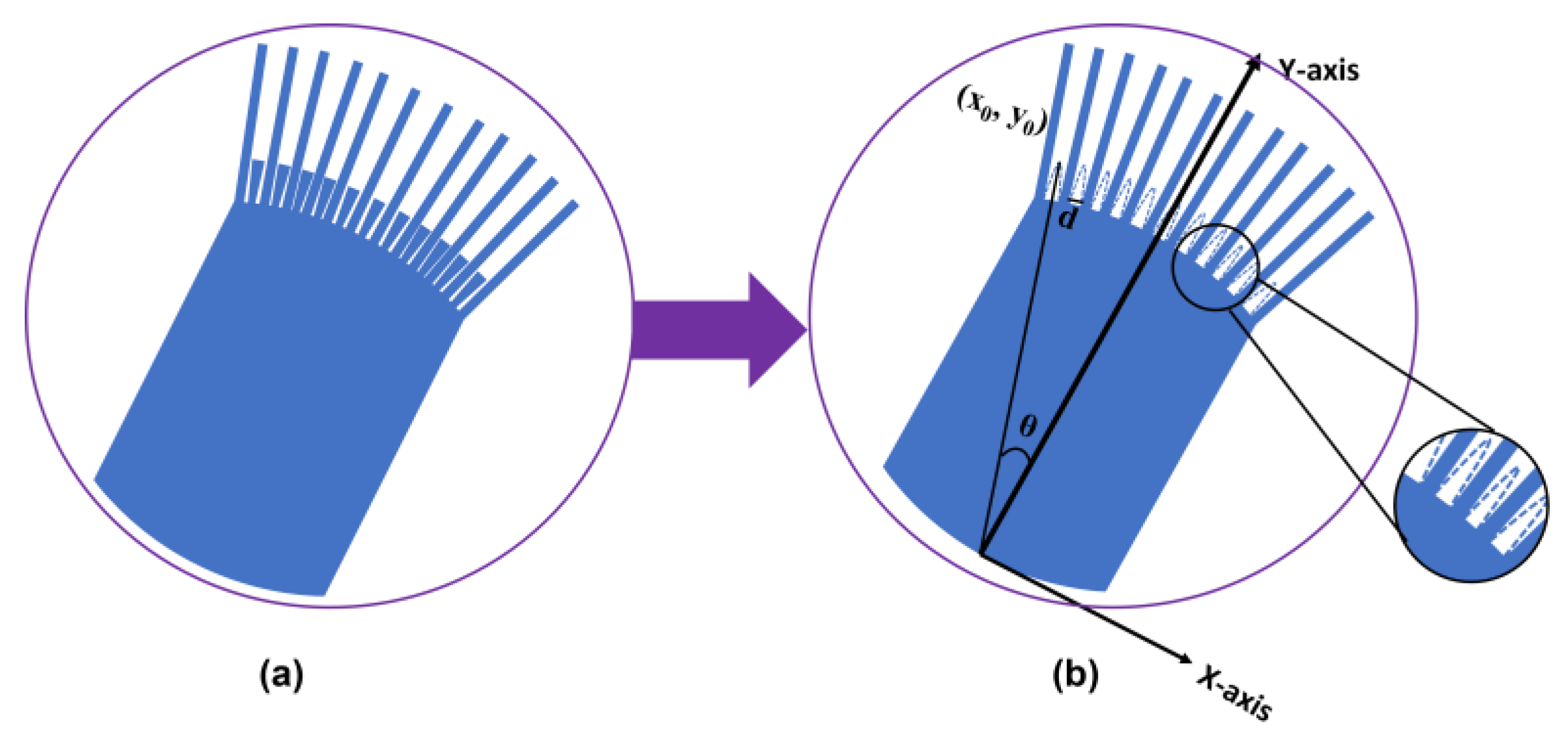
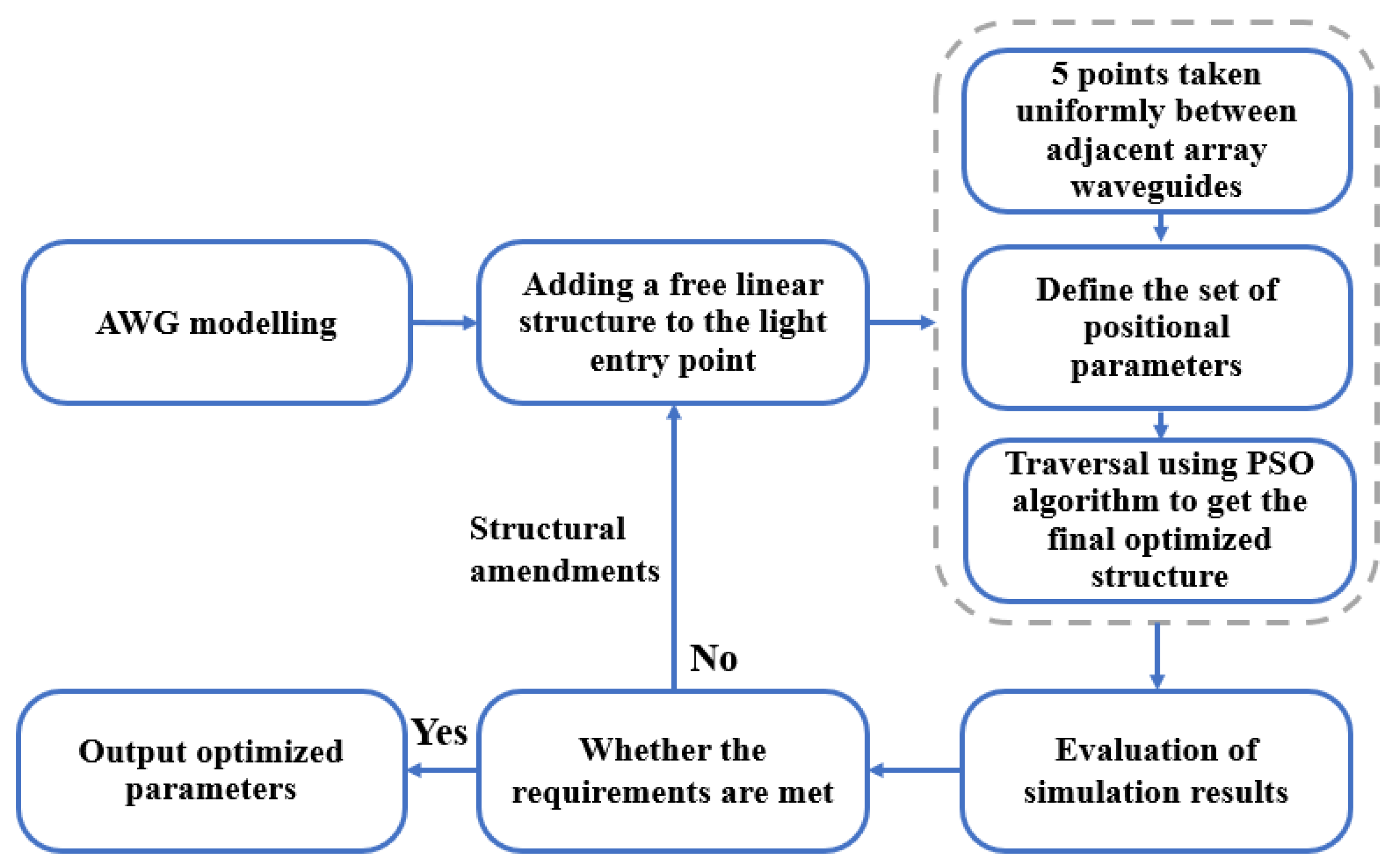
The final optimized structure obtained in this study is illustrated in Figure 2. Since the underlying design principle remains consistent, only a single auxiliary waveguide is selected for description. For completeness, Figure 3 provides an overview of the structure, which is briefly described herein. First, five points are selected between adjacent arrayed waveguides, and the arrangement of adjacent points along the x-axis follows a linear interpolation to ensure a linear transition d x between segments, thereby preserving undisturbed waveguide diffraction and coupling. Among these, where d x = d 4 μ m .
First, select one of these points as the reference point x 0 , y 0 . The position x 0 , y 0 of the point is determined by the center and radius R a of the arrayed waveguide grating circle. Simultaneously, the distance between this point and the input slab waveguide is denoted as h , ensuring that the reverse extension line of this point passes through the center of the grating circle. Defining the center of the arrayed waveguide grating circle as the coordinate origin O, x 0 , y 0 and the angle between the point and the central arrayed waveguide as θ , the following relationship holds:
x 0 = ( R a + h ) cos θ y 0 = ( R a + h ) sin θ
After establishing this reference point x 0 , y 0 , subsequently, the remaining five points are determined. In this study, four relevant parameters are defined for the auxiliary waveguide: N , N s u b ,   y 3 ,   a n d   y 2 . Among these, the highest point is defined as the point located along the radial direction with a length y 3 beyond the radius of the Arrayed Waveguide Grating (AWG) focal circle. The second-highest point is positioned in the opposite radial direction relative to the highest point, offset by a distance y 2 . The parameter N represents the multiple by which the spacing between the two points corresponding to the second-highest point location—measured perpendicular to the radial direction—is reduced from the maximum spacing, specifically by a factor of 1 / N . Similarly, N s u b denotes the multiple by which the spacing between the two points at the bottom location—also measured perpendicular to the radial direction—is reduced from the maximum spacing, specifically by a factor of 1 / N s u b .
The Particle Swarm Optimization (PSO) algorithm is employed to scan these four parameters to obtain an optimal parameter set. Furthermore, these four defined position-related parameters are associated with different points. Based on the discrete data points corresponding to the optimal parameter set identified by the PSO algorithm, the final smooth and continuous structural profile of the auxiliary waveguide is constructed using cubic spline interpolation. This approach ensures a smooth variation in the waveguide structure, which is crucial for minimizing scattering losses and mode coupling during optical wave propagation. Consequently, the final optimized structure of the auxiliary waveguide is determined.

3. Results and Discussion

The main parameters of the conventional arrayed waveguide grating device are shown in Table 1, which primarily include the effective refractive indices of the core and cladding, the diffraction order, and the FSR. The FSR refers to the wavelength difference between two adjacent diffraction peaks. Additionally, determining the number of arrayed waveguides ensures the reception of a significant portion of the optical power from the input slab waveguide.
The output waveform of the conventional arrayed waveguide grating (AWG), obtained through the use of Lumerical and RSoft 2018 software.
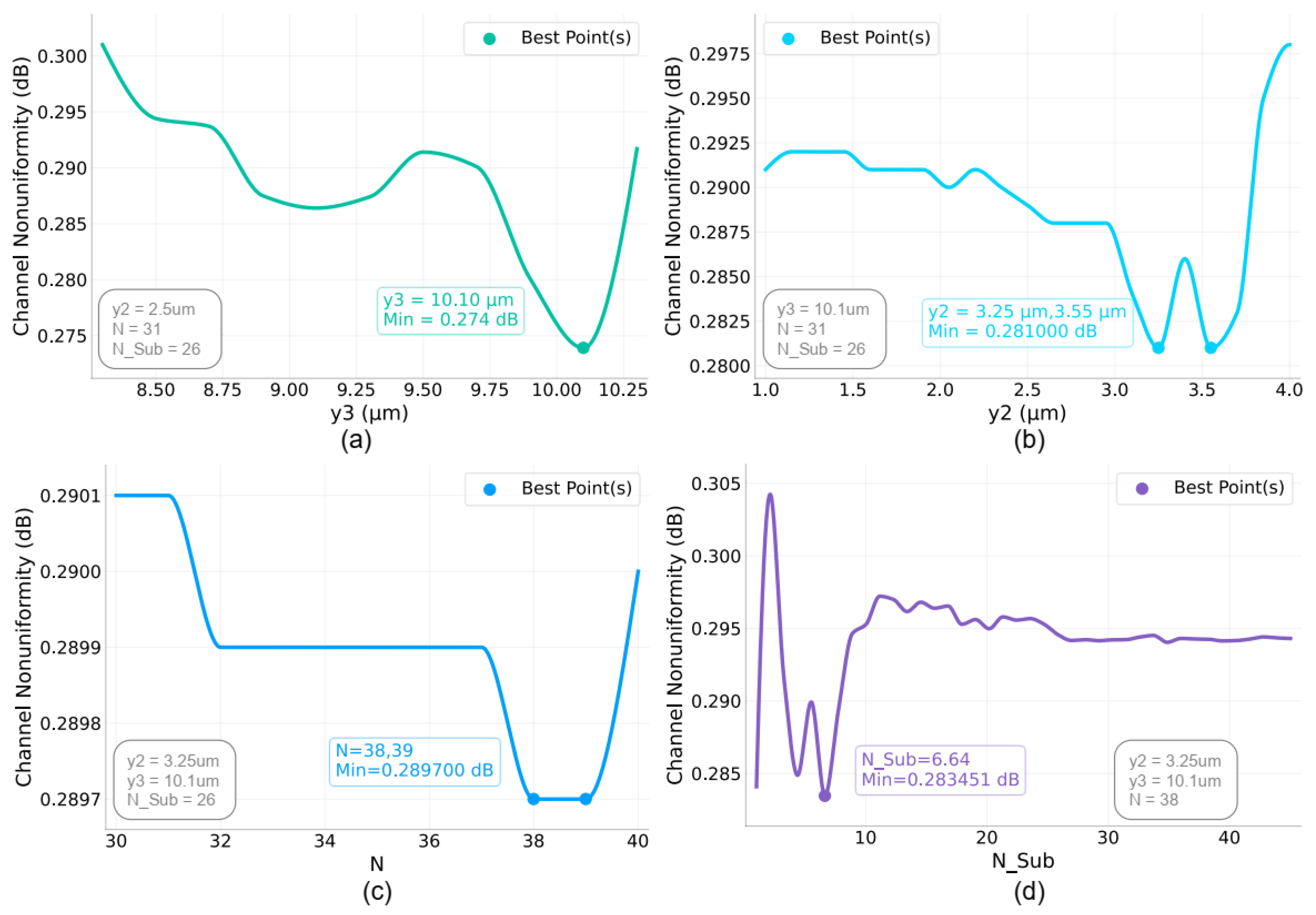
It can be observed that the edge channels exhibit significantly higher loss compared to the central wavelength channels, with a loss non-uniformity of 0.764 dB. Therefore, optimization is carried out using a tunable auxiliary waveguide structure. The parameter scanning results are shown in Figure 4.
The results are illustrated in the figure, revealing a distinct nonlinear relationship between the y 3 value and the achieved insertion loss uniformity. When y 3 falls within the range of 8.2 ×   10 6 to 9.6 ×   10 6 the loss non-uniformity demonstrates a notable improving trend, decreasing from 0.30 dB to an optimal value of 0.27 dB. This improvement can be attributed to the fact that appropriately elevating the vertex enhances the mode field matching between the Free Propagation Region (FPR) and the arrayed waveguides. By deviating from the traditional Rowland circle configuration, the optimized y 3 value effectively transforms the Gaussian far-field distribution into a more flattened profile, thereby promoting more uniform power distribution among different output channels and mitigating the excessive loss in edge channels. However, beyond the optimal point of 9.6 ×   10 6 , a further increase in y 3 leads to a marked performance degradation, as evidenced by the resurgence in non-uniformity. This deterioration arises because an overly protruding waveguide structure introduces excessive scattering loss and excites higher-order modes, which disrupt the smooth phase front and compromise the integrity of the propagating optical field. Similarly, the inflection points observed in the other three parameters arise from the same underlying mechanism as y 3 , culminating in the identification of an optimal parameter set y 2 ,     y 3 ,   N ,   N s u b .
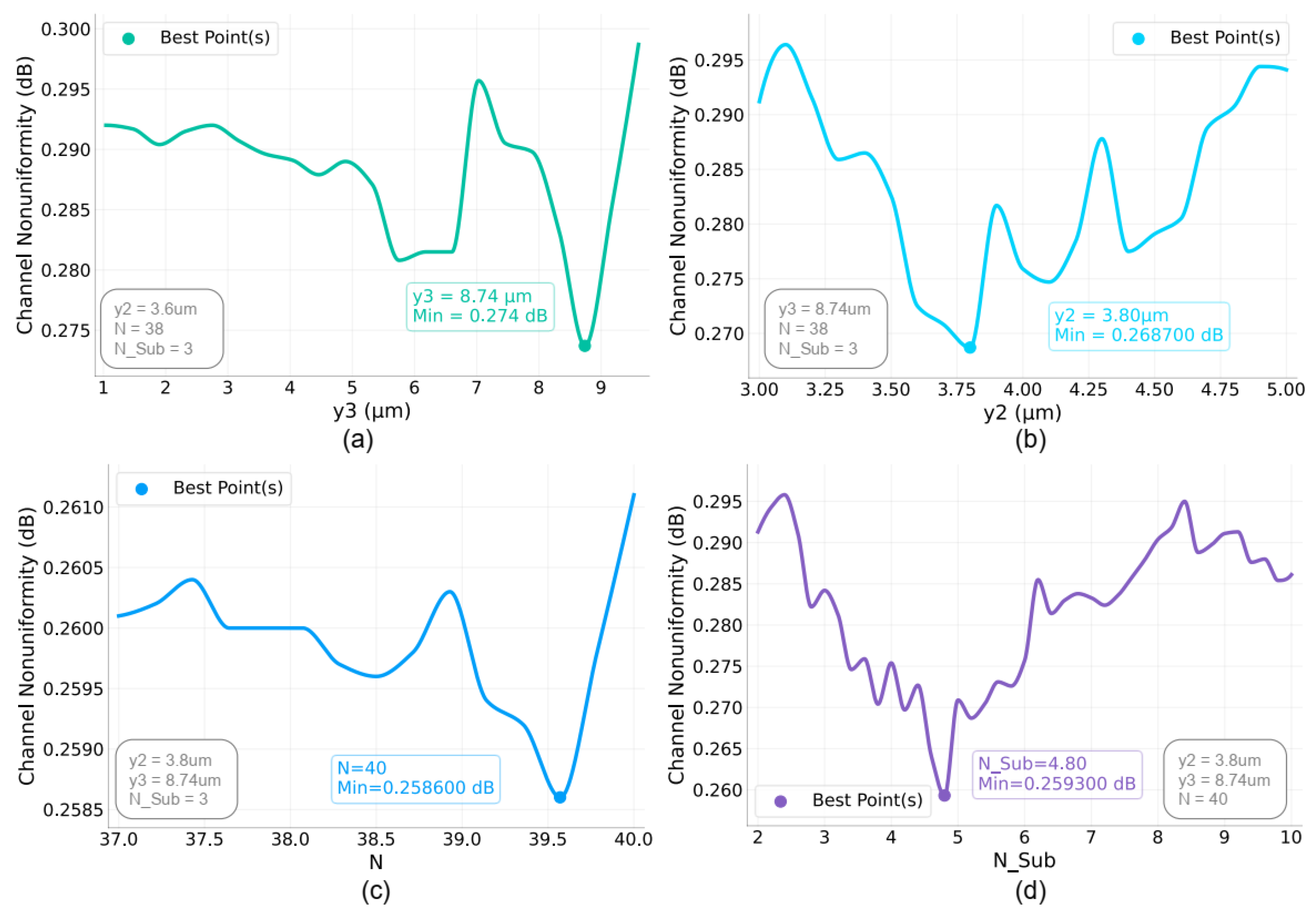
Base on the iterative results from the initial Particle Swarm Optimization scans, the parameter space is systematically refined to enhance convergence behavior and computational efficiency. The preliminary sweeps of key geometric parameters—specifically y 2 ,     y 3 ,   N and N s u b —reveal pronounced nonlinearities and narrow optimal regions, necessitating targeted boundary adjustments. Therefore, more accurate scanning of parameters is required in Figure 5.
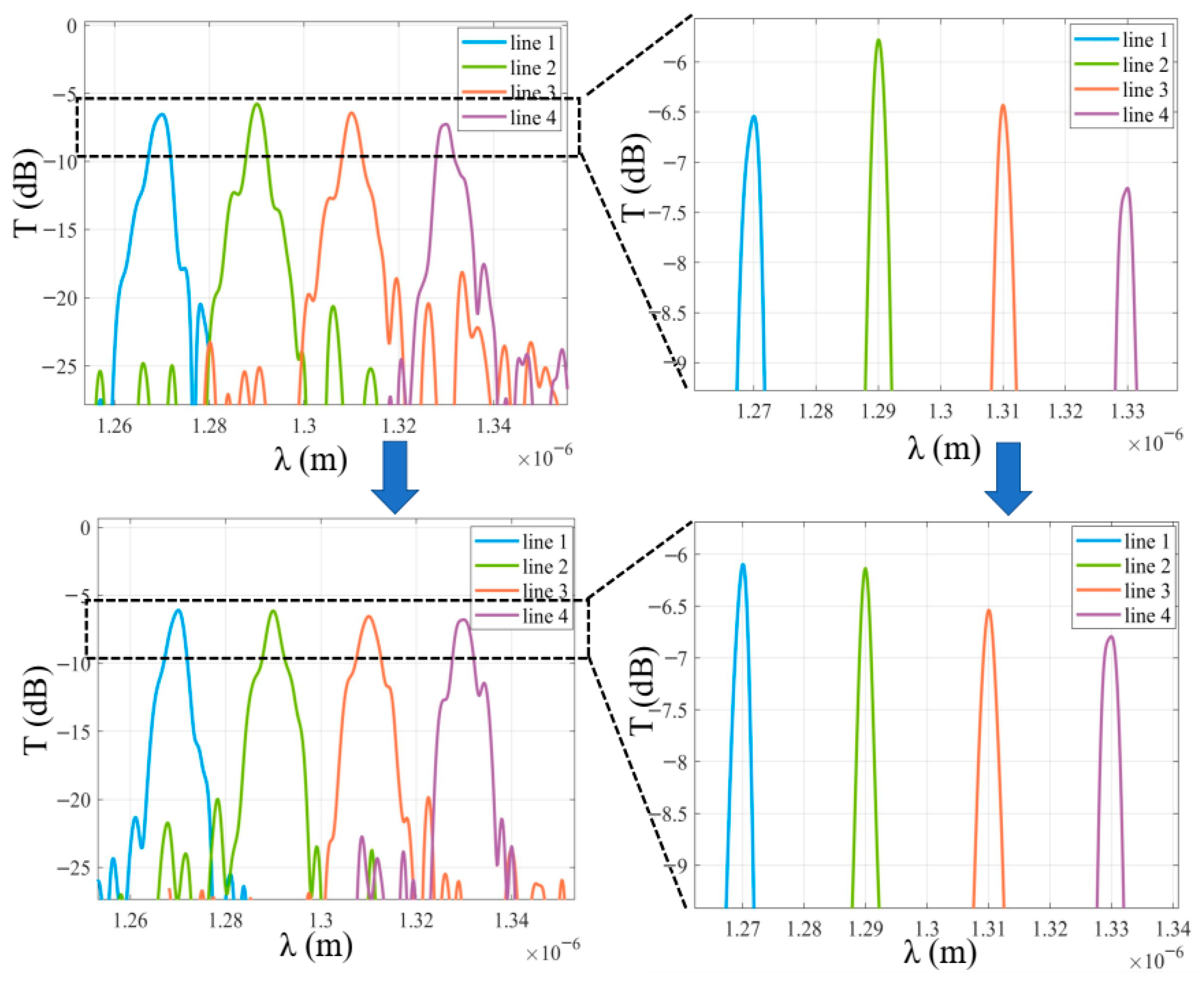
For parameter y 3 , the range was confined to 2 × 10⁻⁶–5 × 10⁻⁶ m, within which the loss uniformity reached an optimal value near 0.27 dB. Similarly, y 2 was constrained to 3 × 10⁻⁶–5 × 10⁻⁶ m, achieving a minimum uniformity of approximately 0.265 dB. Discrete parameter N exhibited high sensitivity, with the range narrowed to 37–40 where loss uniformity varied between 0.2585 dB and 0.2615 dB, indicating a relatively flat but well-defined optimum. In contrast, N s u b demonstrated a broader trend with the optimum around 8–10, corresponding to a uniformity of 0.25–0.26 dB. This deliberate refinement enabled a more intensive and efficient search within the most promising regions of the parameter space, significantly improving the accuracy and reproducibility of the solution. The final optimized structure, derived from these tuned parameters, achieved a consistently low loss non-uniformity of 0.253 dB, closely approaching the theoretical performance limits for the given AWG architecture. And, a comparison of conventional AWG and optimized AWG output spectra is shown in Figure 6.
Among them, Lines 1, 2, 3, and 4 represent the single-wavelength output lights at 1270 n m , 1290 n m , 1310 n m , and 1330   n m , respectively, thus realizing a high-uniformity 1 × 4 transmission demultiplexing process. To achieve this improvement, the light energy is adjusted from a traditionally concentrated distribution to a more uniform distribution, which inevitably sacrifices a portion of the energy. Specifically, the light energy at the central wavelength is distributed not only across the primary diffraction order (m-th order) but also extends to adjacent diffraction orders (m ± 1-th orders). While this adjustment enhances the uniformity of output loss, it also results in a slight increase in insertion loss at the central wavelength. Nevertheless, considering the overall performance improvement, this increase in loss remains acceptable.

4. Conclusions

In this study, we proposed and validated a highly flexible, parametrically optimized auxiliary waveguide structure to significantly improve the channel uniformity of a silicon-based arrayed waveguide grating demultiplexer. By introducing four key geometric parameters y 2 ,   y 3 ,   N ,   N s u b and employing a Particle Swarm Optimization (PSO) algorithm, we achieved precise control over the mode field distribution at the interface between the free propagation region and the arrayed waveguides. The optimized auxiliary waveguide structure effectively reshaped the Gaussian-like far-field into a flattened profile, thereby mitigating the inherent excess loss at edge channels. The final optimized design reduced the insertion loss non-uniformity to 0.253 dB, a remarkable improvement of 0.511 dB compared to the conventional structure. The success of this study not only validated the effectiveness of the high-degree-of-freedom auxiliary waveguide concept but also highlighted the critical importance of fine geometric tuning in photonic device optimization. Our findings underscored that by leveraging advanced optimization techniques and carefully considering geometric parameters, significant improvements can be achieved in the performance of photonic devices, paving the way for more efficient and reliable optical communication systems in the future.

Author Contributions

Methodology, Q.L. and C.Z. (Chongfu Zhang); software, Q.L. and P.H.; validation, Q.L., C.Z. (Chenyan Zhang) and H.C.; formal analysis, Q.L., X.X. and C.Z. (Chongfu Zhang); investigation, Q.L. and P.H.; writing—original draft preparation, Q.L.; writing—review and editing, Q.L., C.Z. (Chenyan Zhang) and C.Z. (Chongfu Zhang); visualization, Q.L. and P.H. All authors have read and agreed to the published version of the manuscript.

Funding

This work was supported by the National Key R&D Program of China No. 2023YFB2804803.

Data Availability Statement

The original contributions presented in this study are included in the article. Further inquiries can be directed to the corresponding author.

Conflicts of Interest

The authors declare no conflicts of interest.

References

  1. Chow, C.-W. Recent Advances and Future Perspectives in Optical Wireless Communication, Free Space Optical Communication and Sensing for 6G. J. Light. Technol. 2024, 42, 3972–3980. [Google Scholar] [CrossRef]
  2. Alkhlefat, Y.; Ragheb, A.M.; Esmail, M.A.; Idrus, S.M.; Iqbal, F.M.; Alshebeili, S.A. Experimental Demonstration of Terahertz-Wave Signal Generation for 6G Communication Systems. Optics 2025, 6, 34. [Google Scholar] [CrossRef]
  3. Attaoui, W.; Bouraqia, K.; Sabir, E. Initial Access & Beam Alignment for mmWave and Terahertz Communications. IEEE Access 2022, 10, 35363–35397. [Google Scholar] [CrossRef]
  4. Singh, S.; Arya, S.K.; Singla, S. A Study & Review of Various Optical Linearization Techniques for Next Generation RoF Networks. In Proceedings of the 2019 5th International Conference on Signal Processing, Computing and Control (ISPCC), Solan, India, 10–12 October 2019; IEEE: Piscataway, NJ, USA, 2019; pp. 125–133. [Google Scholar]
  5. Fotiadis, K.; Pitris, S.; Moralis-Pegios, M.; Mitsolidou, C.; De Heyn, P.; Van Campenhout, J.; Broeke, R.; Alexoudi, T.; Pleros, N. Silicon Photonic 16 × 16 Cyclic AWGR for DWDM O-Band Interconnects. IEEE Photonics Technol. Lett. 2020, 32, 1233–1236. [Google Scholar] [CrossRef]
  6. Sarup, V.; Gupta, A. A Study of Various Trends and Enabling Technologies in Radio over Fiber (RoF) Systems. Optik 2015, 126, 2606–2611. [Google Scholar] [CrossRef]
  7. Tang, X.; Cheng, J.; Zeng, K.; Ouyang, X.; Zheng, Y. Compact and Scalable Cascaded AWG with Periodic WDM Functionality for Optical Communications. Opt. Laser Technol. 2025, 192, 113891. [Google Scholar] [CrossRef]
  8. Plazas, C.L.M.P.; de Souza, A.M.; Celino, D.R.; Romero, M.A. Optimization of Arrayed Waveguide Grating-Filtering Response for Efficient Analog Radio-Over-Fiber Fronthaul Over a Wavelength-Division Multiplexing Passive Optical Network. Trans. Emerg. Telecommun. Technol. 2021, 32, e4113. [Google Scholar] [CrossRef]
  9. Jiao, Y.; Lin, Q.; Yao, K.; Zhao, N.; Tang, C.; Xian, D.; Zhang, F.; Meng, Q.; Han, F.; Jiang, Z. High-Accuracy, Wide-Dynamic Range Continuous FBG Interrogator Based on an AWG. IEEE Trans. Instrum. Meas. 2025, 74, 1503812. [Google Scholar] [CrossRef]
  10. Yang, Y.; Hu, X.; Song, J.; Fang, Q.; Yu, M.; Tu, X.; Lo, G.-Q.; Rusli. Thermo-Optically Tunable Silicon AWG With Above 600 GHz Channel Tunability. IEEE Photonics Technol. Lett. 2015, 27, 2351–2354. [Google Scholar] [CrossRef]
  11. Lycett, R.J.; Gallagher, D.F.G.; Brulis, V.J. Perfect Chirped Echelle Grating Wavelength Multiplexor: Design and Optimization. IEEE Photon. J. 2013, 5, 2400123. [Google Scholar] [CrossRef]
  12. Piels, M.; Bauters, J.F.; Davenport, M.L.; Heck, M.J.R.; Bowers, J.E. Low-Loss Silicon Nitride AWG Demultiplexer Heterogeneously Integrated with Hybrid III–V/Silicon Photodetectors. J. Light. Technol. 2014, 32, 817–823. [Google Scholar] [CrossRef]
  13. Yuan, S.; Feng, J.; Yu, Z.; Chen, J.; Liu, H.; Chen, Y.; Guo, S.; Huang, F.; Akimoto, R.; Zeng, H. Silicon Nanowire-Assisted High Uniform Arrayed Waveguide Grating. Nanomaterials 2023, 13, 182. [Google Scholar] [CrossRef]
  14. Sakamaki, Y.; Kamei, S.; Hashimoto, T.; Kitoh, T.; Takahashi, H. Loss Uniformity Improvement of Arrayed-Waveguide Grating with Mode-Field Converters Designed by Wavefront Matching Method. J. Light. Technol. 2009, 27, 5710–5715. [Google Scholar] [CrossRef]
  15. Sakamaki, Y.; Saida, T.; Tamura, M.; Itoh, M.; Hashimoto, T.; Takahashi, H. Loss Reduction of Arrayed Waveguide Grating with Mode Converters Designed by Wavefront Matching. Method. Electron. Lett. 2006, 42, 1300–1301. [Google Scholar] [CrossRef]
  16. Sakamaki, Y.; Saida, T.; Hashimoto, T.; Takahashi, H. New Optical Waveguide Design Based on Wavefront Matching Method. J. Light. Technol. 2007, 25, 3511–3518. [Google Scholar] [CrossRef]
  17. Li, K.-L.; An, J.-M.; Zhang, J.-S.; Wang, Y.; Wang, L.-L.; Li, J.-G.; Wu, Y.-D.; Yin, X.-J.; Hu, X.-W. Crosstalk Analysis of Silicon-on-Insulator Nanowire-Arrayed Waveguide Grating. Chin. Phys. B 2016, 25, 124209. [Google Scholar] [CrossRef]
  18. Ishida, O.; Takahashi, H. Loss-Imbalance Equalization in Arrayed Waveguide-Grating (AWG) Multiplexer Cascades. J. Light. Technol. 1995, 13, 1155–1163. [Google Scholar] [CrossRef]
  19. Dragone, C. Low-Loss Wavelength Routers for WDM Optical Networks and High-Capacity IP Routers. J. Light. Technol. 2005, 23, 66. [Google Scholar]
  20. Pathak, S.; Vanslembrouck, M.; Dumon, P.; Van Thourhout, D.; Bogaerts, W. Optimized Silicon AWG With Flattened Spectral Response Using an MMI Aperture. J. Light. Technol. 2013, 31, 87–93. [Google Scholar] [CrossRef]
  21. Chen, J.C.; Dragone, C. Waveguide Grating Routers with Greater Channel Uniformity. Electron. Lett. 1997, 33, 1951–1952. [Google Scholar] [CrossRef]
  22. Li, H.; Gao, W.; Li, E.; Tang, C. Investigation of Ultrasmall 1 × N AWG for SOI-Based AWG Demodulation Integration Microsystem. IEEE Photonics J. 2015, 7, 7802707. [Google Scholar] [CrossRef]
  23. Smit, M.K.; Van Dam, C. PHASAR-Based WDM-Devices: Principles, Design and Applications. IEEE J. Sel. Top. Quantum Electron. 1996, 2, 236–250. [Google Scholar] [CrossRef]
  24. Zheng, Y.; Wu, X.; Jiang, L.; Wu, Y.; Duan, J. Design of 4-Channel AWG Multiplexer/Demultiplexer for CWDM System. Optik 2020, 201, 163513. [Google Scholar] [CrossRef]
  25. Song, G.; Wang, S.; Zou, J.; Lang, T.; He, J.-J. Silicon-Based Cyclic Arrayed Waveguide Grating Routers with Improved Loss Uniformity. Opt. Commun. 2018, 427, 628–634. [Google Scholar] [CrossRef]
  26. Yoo, H.M.; Lee, M.-H.; Ju, J.J.; Park, S.K.; Do, J.Y. Polymeric 16×16 Arrayed-Waveguide Grating Router Using Fluorinated Polyethers Operating Around 1550 nm. IEEE J. Sel. Top. Quantum Electron. 2001, 7, 806–811. [Google Scholar]
  27. Suzuki, S.; Inoue, Y.; Ohmori, Y. Polarisation-Insensitive Arrayed-Waveguide Grating Multiplexer with SiO2-on-SiO2 Structure. Electron. Lett. 1994, 30, 642–643. [Google Scholar] [CrossRef]
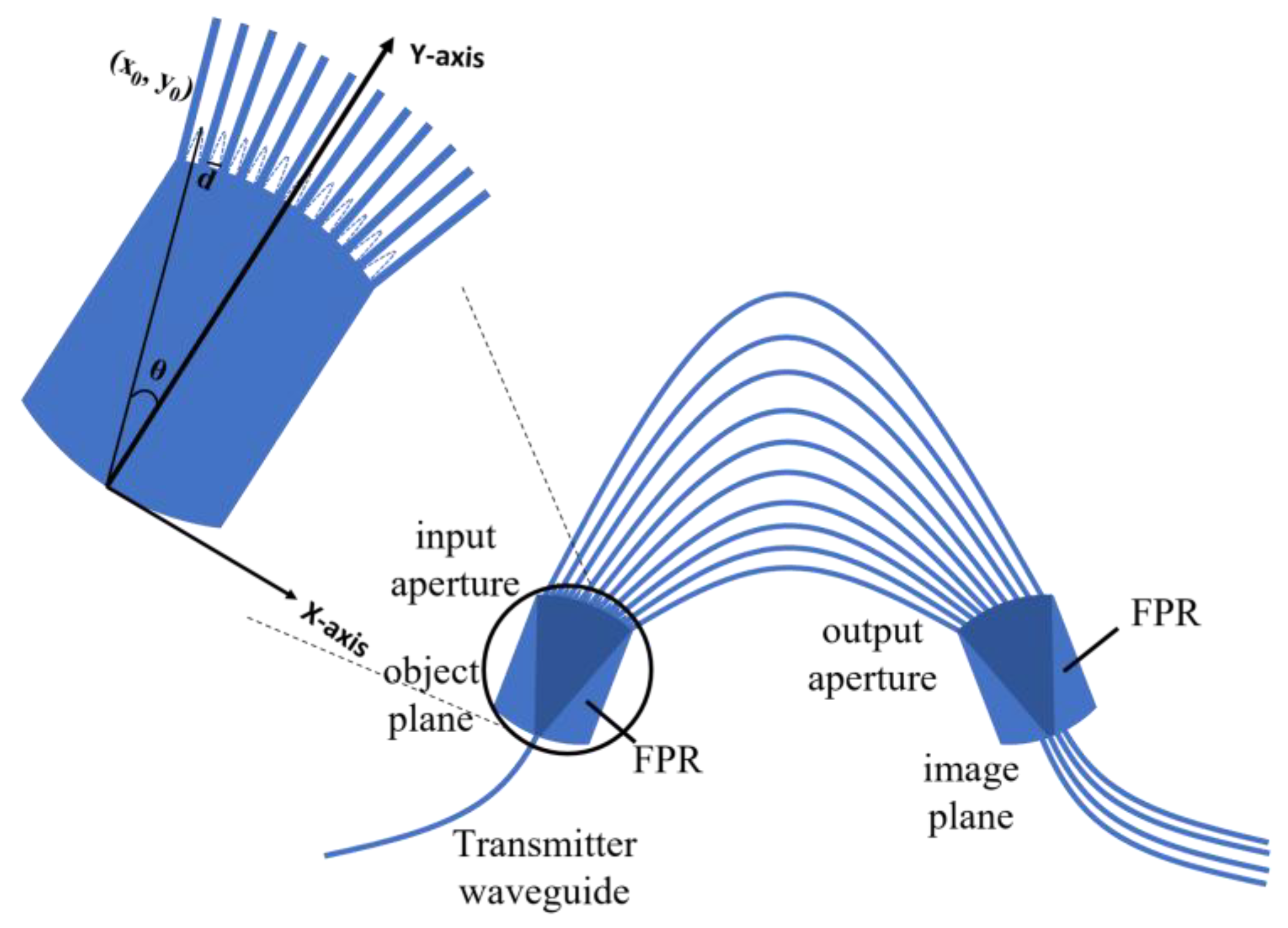
Figure 1. Arrayed Waveguide Grating Structure.
Optics 06 00065 g001
Figure 2. Schematic diagram of the optimized structure: (a) Conventional Slab Waveguide Structure, (b) Optimized Slab Waveguide Structure.
Optics 06 00065 g002
Figure 3. Flowchart of the auxiliary waveguide structure optimization process.
Optics 06 00065 g003
Figure 4. Initial scanning results of optimized structural parameters of arrayed waveguide gratings: (a) y 3 Scanning Result Plot; (b) y 2 Scanning Result Plot; (c) N Scanning result map; (d) N s u b Scanning Result Map.
Optics 06 00065 g004
Figure 5. Plot of optimal value iteration results: (a) y 3 Scanning Result Plot; (b) y 2 Scanning Result Plot; (c)   N Scanning result map; (d) N s u b Scanning Result Map.
Optics 06 00065 g005
Figure 6. Results of conventional and Optimized AWG.
Optics 06 00065 g006
Table 1. Main Parameters of the AWG.
Physical SignificanceSymbolValue
Core Refractive Index n 1 3.47638
Cladding Refractive Index n 2 1
Central Wavelength λ 0 1300   n m
Channel Spacing λ 20   n m
Effective Refractive Index of Slab Waveguide n s 2.975
Effective Refractive Index of Arrayed Waveguide n g 4.003
Diffraction Orderm10
Free Spectral Range (FSR)FSR 86.58   n m
Length Difference between Adjacent Arrayed Waveguides l 10   μ m
Number of Arrayed WaveguidesM24
the width of the rectangular waveguidea 4.5   μ m
the thickness of the rectangular waveguideb 4   μ m
Spacing between Arrayed Waveguidesd 1   μ m
Minimum length of an arrayed waveguide grating L m i n 524   μ m
Disclaimer/Publisher’s Note: The statements, opinions and data contained in all publications are solely those of the individual author(s) and contributor(s) and not of MDPI and/or the editor(s). MDPI and/or the editor(s) disclaim responsibility for any injury to people or property resulting from any ideas, methods, instructions or products referred to in the content.