


Hybrid Graph Retrieval-Augmented Language Agents for Collaborative Recommendation

Abstract
1. Introduction
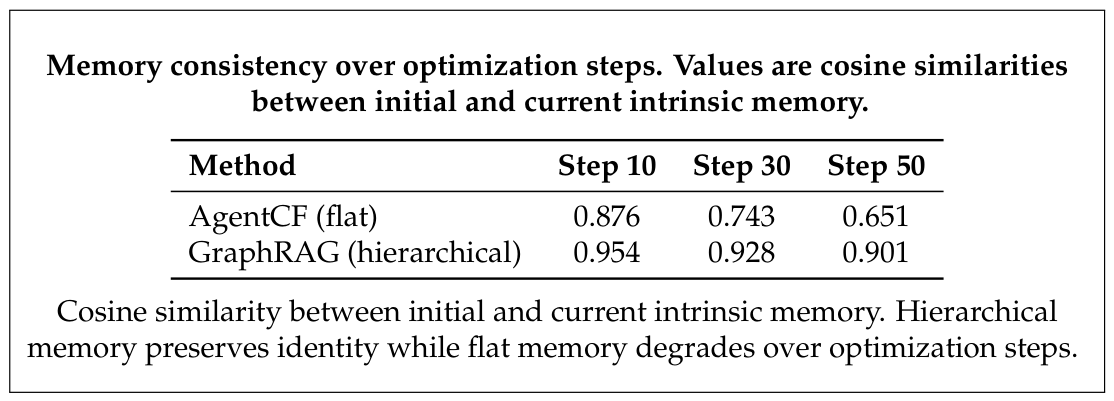
- We formalize hierarchical agent memory for recommender systems and demonstrate that disentangling intrinsic, collaborative, and interaction features improves both recommendation quality and memory consistency.
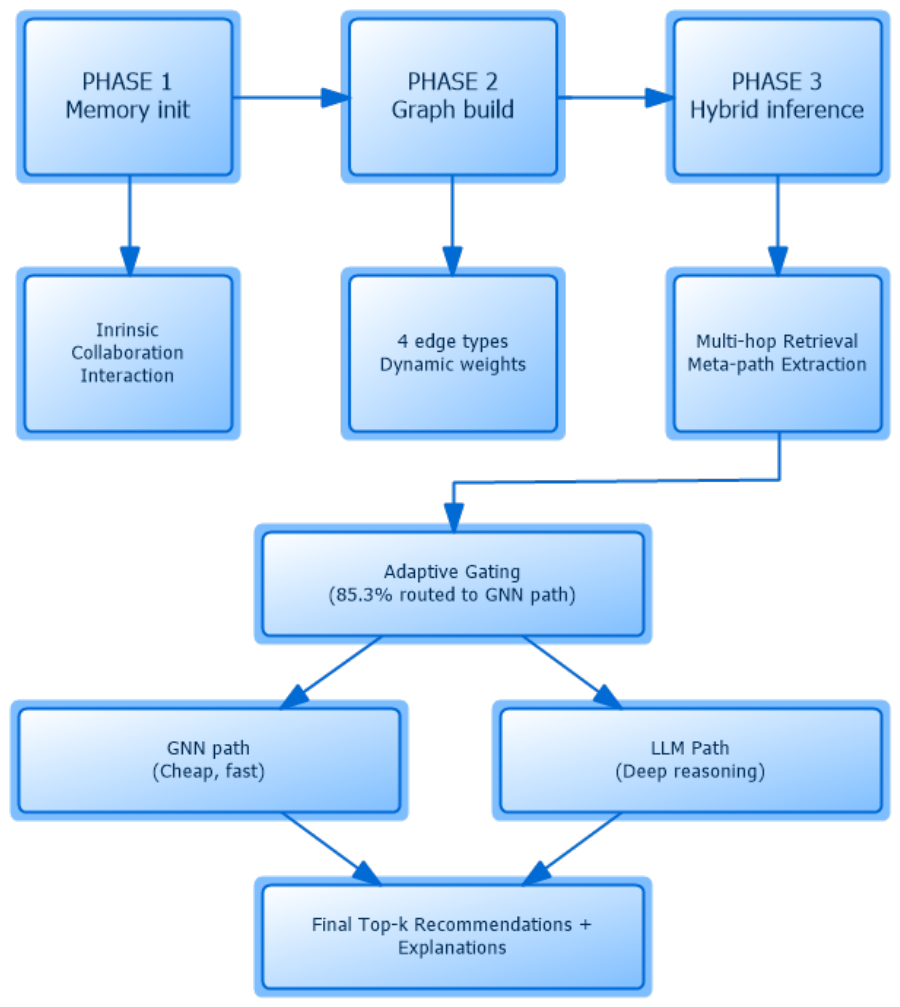
- We design a Graph RAG mechanism for agent-based recommendation that performs multi-hop retrieval with metapath extraction, bridging semantic similarity and collaborative patterns.
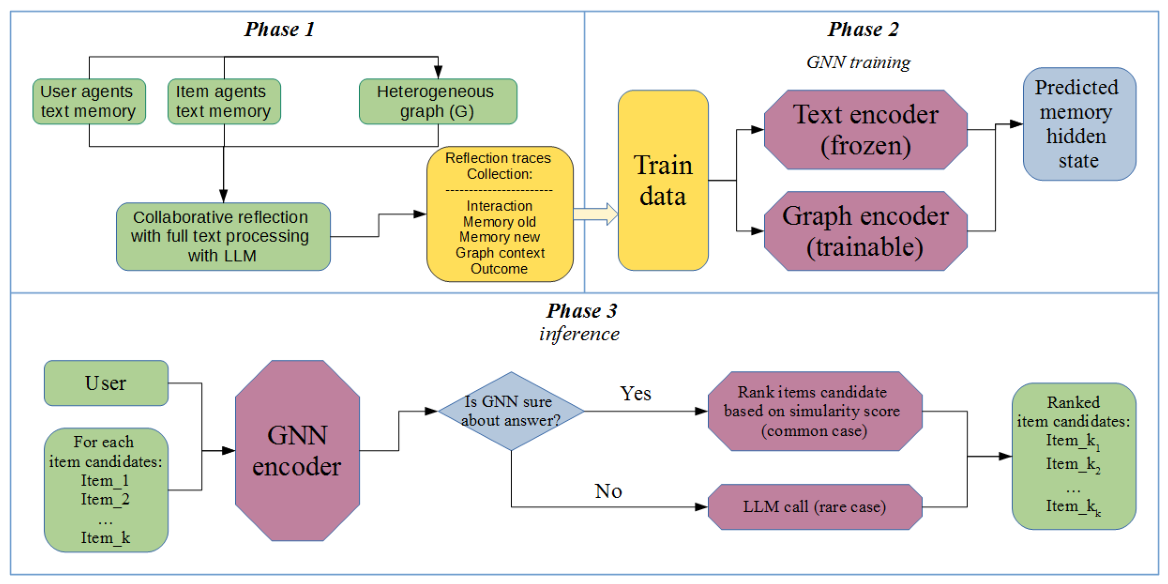
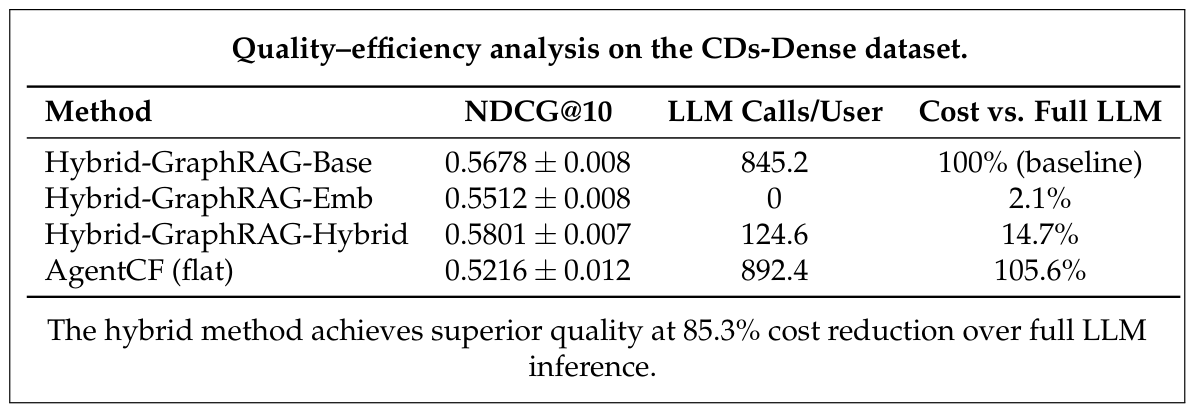
- We propose a three-phase distillation pipeline that compresses expensive LLM-generated memory dynamics into efficient graph encoders, with adaptive gating that achieves an 85% cost reduction while maintaining quality.
- We conduct extensive experiments on two real-world datasets and demonstrate the effectiveness of Hybrid-GraphRAG, with particular benefits for cold-start recommendation and computational efficiency.
2. Related Works
2.1. Graph-Based Recommender Systems
2.2. LLM-Powered Agents for Recommendation
2.3. Knowledge Distillation for Recommendation
2.4. Hierarchical Memory Architectures
3. Materials and Methods
3.1. Datasets and Preprocessing
3.2. Hierarchical Agent Memory Design
3.3. Heterogeneous Graph Construction
3.3.1. Relation Types
3.3.2. Dynamic Graph Evolution
- 1.
- Edge Weight Updates: Interaction edge weights are updated after each collaborative reflection based on decision correctness.
- 2.
- Edge Pruning: Edges with weight below are removed, preventing the graph from accumulating noise from outdated or incorrect interaction patterns.
- 3.
- Similarity Edge Recomputation: User–user and item–item similarity edges are recomputed when the corresponding memory tier changes significantly, defined as a cosine distance greater than , ensuring the graph reflects current agent states.
- 4.
- New Node Integration: When new user or item agents are introduced in Phase 3, they are connected to the graph through initial similarity edges computed from their intrinsic memories, enabling immediate participation in Graph RAG retrieval even without interaction history.
3.4. Multi-Hop Graph RAG Retrieval
- User–Item–User:
- User–User–Item:
- Item–Item Analogy:
3.5. Collaborative Reflection with Graph Context
- If the agent selects the correct item (), the interaction is recorded and the current memory is reinforced—no full reflection is triggered.
- If the agent selects the incorrect item (), the complete collaborative reflection workflow is triggered, including both user-side and item-side reflection.
3.6. Component-Disentangled Knowledge Distillation
3.7. Adaptive Gating for Hybrid Inference
3.8. Evaluation Metrics
3.9. Baseline Methods
- BPR [35]: Bayesian Personalized Ranking with matrix factorization. It is an optimization framework for implicit feedback recommendation that optimizes for ranking instead of rating prediction. The implementation follows the standard matrix factorization approach with BPR-OPT loss. The number of features was set to 128, epochs to 100, learning rate to 0.01, and L2 regularization coefficient to 0.001.
- LLMRank [37]: It investigates the capacity of large language models as zero-shot rankers for recommender systems, using an instruction-following paradigm. It used the model gpt-3.5-turbo-16k-0613, temperature = 0.2, maximum sequence length = 50, and 20 candidate items to rank. Items are represented by their descriptive text (title), candidate items are arranged sequentially in the prompt, output is parsed with heuristic text-matching (KMP algorithm), and results are averaged over three runs to reduce randomness.
- Hybrid-GraphRAG (LLM): Bootstrap phase only (LLM path, no distillation)
- Hybrid-GraphRAG (emb): Full distillation, GNN path only (no adaptive gating)
- Hybrid-GraphRAG (full): Full three-phase pipeline with adaptive gating.
3.10. Experiment Setup
- Iterations: 3 rounds of collaborative reflection.
- Per round: 10 interactions per user.
- Warm start: Initialize from 5 random interactions per user.
- GNN training epochs: 200.
- Batch size: 256 users + 256 items.
- Learning rate: 1e-3 (Adam optimizer).
- Learning rate decay: 0.95 per 10 epochs.
- Early stopping: patience 20 epochs on validation.
- Validation split: 20% of interactions held out.
- Gate training: MLP with 1 hidden layer (64 units, ReLU).
- Gate training epochs: 100.
- Positive labels: decisions where the LLM path would be used (cold-start, user-facing, high-entropy).
- Negative labels: decisions where the GNN path is sufficient.
- Training examples: 5000 sampled decisions from Phase 1.
4. Results
4.1. Overall Recommendation Performance
4.2. Computational Efficiency Analysis
- Hybrid-GraphRAG-Hybrid vs. LightGCN: t = 6.23, p < 0.01 (CDs-Dense).
- Hybrid-GraphRAG-Hybrid vs. AgentCF: t = 5.87, p < 0.01 (CDs-Dense).
4.3. Ablation Study
4.4. Cold-Start Performance
4.5. Memory Consistency Analysis
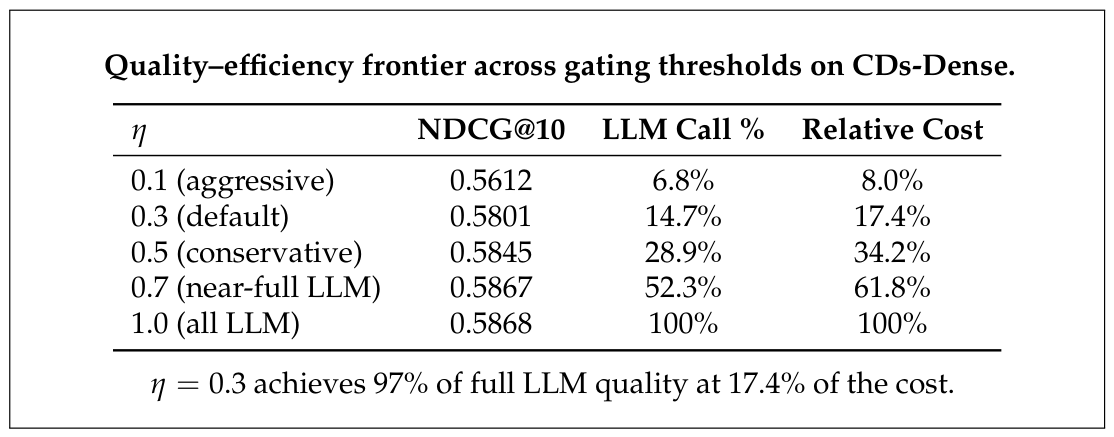
4.6. Sensitivity to Gate Threshold
5. Discussion
6. Conclusions
7. Future Work
Author Contributions
Funding
Institutional Review Board Statement
Informed Consent Statement
Data Availability Statement
Acknowledgments
Conflicts of Interest
Abbreviations
| LLM | Large language model |
| RAG | Retrieval-augmented generation |
Appendix A
Appendix A.1. Model Setup

| Parameter | Symbol | Value | Tuning Range | Tuning Method |
|---|---|---|---|---|
| Similarity threshold (user) | 0.7 | Grid search, step 0.05 | ||
| Similarity threshold (item) | 0.6 | Grid search, step 0.05 | ||
| Co-interaction threshold | 3 | Grid search, step 1 | ||
| Edge weight update rate | 0.1 | Grid search, step 0.025 | ||
| Pruning threshold | 0.05 | Fixed | – | |
| Recompute threshold | 0.15 | Grid search, step 0.05 | ||
| Propagation threshold | 0.3 | Grid search, step 0.05 | ||
| Gating threshold | 0.3 | Validation performance | ||
| Embedding dimension | d | 1536 | Fixed (ADA-002) | – |
| GNN hidden dimension | – | 256 | Grid search | |
| GNN layers | – | 3 | Grid search | |
| Contrastive temperature | 0.1 | Grid search |
Appendix A.2. Prompts
| Prompt Name | Prompt Content |
|---|---|
| Intrinsic Memory Initialization | [SYSTEM] You are a preference description generator.
Given the following item information, generate
a concise summary of its key features, style, and target audience. [ITEM] Title: {title} Category: {category} Description: {description} [OUTPUT FORMAT] Provide a 2–3 sentence summary focusing on: (1) product type, (2) key features, (3) typical users. |
| Collaborative Memory Update (LLM-fuse) | [SYSTEM] You are an agent synthesizing collaborative patterns.
Given the current collaborative memory and information from
users who interacted with this item, generate an updated
collaborative summary. [Current Collaborative Memory]: {current_memory} [User Preferences]: {user_preferences_from_neighbors} [INSTRUCTION] Identify common themes, preferences, and patterns across users. Output a 3–4 sentence summary of collaborative signals. |
| Reflection (Decision + Explanation) | [SYSTEM] You are a recommendation agent reflecting
on an interaction. [User Memory]: {user_memory} [Recommended Item]: {item_name}, {item_description} [Actual Item]: {actual_name}, {actual_description} [Graph Context]: {graph_verbalization} [INSTRUCTION] Analyze this recommendation: (1) Why was this item recommended? (2) What can we learn from the user’s actual choice? (3) How should this update the user’s preference memory? |
| Graph Verbalization | [SYSTEM] Convert the following graph context into a
natural language description for recommendation reasoning. [Graph Context]: {subgraph_with_nodes_and_edges} [INSTRUCTION] Describe: users with similar preferences, items often co-purchased, and content-similar items. Use format: “Users who like {user_profile} also like {similar_users}. Item {item} is related to {similar_items}.” |
| Prompt Name | Prompt Content |
|---|---|
| Fusing three tier memories into one (LLM-fuse-single-user) | [SYSTEM] You are a user profile synthesizer. [Intrinsic Memory]: {intrinsic_core} [Collaborative Memory]: {collaborative_patterns} [Interaction Memory]: {recent_traces} [INSTRUCTION] Integrate these three memory tiers to generate a holistic snapshot of the user’s current preferences. Prioritize the immutable core identity while adjusting for recent behavioral signals and incorporating collaborative influences from similar users. [OUTPUT FORMAT] Provide a 2–3 sentence unified summary describing the user’s current taste context, explicitly noting any recent shifts or cross-user patterns. |
Appendix A.3. Metapaths Extraction and Importance Scoring Implementation
| Algorithm A1 Multi-Hop Meta-Path Extraction for Graph RAG Retrieval | |
| Begin User query u, Candidate item set Heterogeneous graph Maximum path length , Metapath type set Input Context subgraph with verbalized metapaths | |
| 1: function ExtractMetaPaths() | |
| 2: | |
| 3: GetNeighbors | |
| 4: GetNeighbors | |
| 5: for each candidate item do | ▹ Metapath Type 1: User → Item → User |
| 6: | |
| 7: GetItemInteractors | |
| 8: | |
| ▹ Metapath Type 2: User → User → Item | |
| 9: GetSimilarUsers | |
| 10: GetInteractedItems | |
| 11: | |
| ▹ Metapath Type 3: Item → Item → History | |
| 12: GetSimlilarItems | |
| 13: GetHistoricalInteractions | |
| 14: | |
| 15: end for | |
| ▹ Filter paths by importance threshold | |
| 16: FilterPaths | |
| 17: return | |
| 18: end function | |
| 19: function VerbalizeMetapaths() | |
| 20: | |
| 21: for each metapath do | |
| 22: {PathToText(p)} | |
| 23: end for | |
| 24: return verbalized | |
| 25: end function | |
| 26: function PathToText() | |
| 27: if p is of type User–Item–User then | |
| 28: return Format(“Users who liked item {} also include {}”) | |
| 29: else if p is of type User–User–Item then | |
| 30: return Format(“Users similar to {} (i.e., {}) liked item {}”) | |
| 31: else if p is of type Item–Item then | |
| 32: return Format(“Item {} is similar to {}, which was purchased by users of {}”) | |
| 33: end if | |
| 34: end function | |
| Algorithm A2 Importance Score Calculation for Path-Importance Preservation | |
| Require: Graph context with extracted metapaths GNN attention weights from HGNN LLM importance scores from teacher model Temperature parameter for softmax scaling Ensure: Path importance distribution for distillation | |
| 1: function ComputePathImportance() | |
| 2: | ▹ Number of extracted metapaths |
| ▹ Part 1: GNN-based attention importance | |
| 3: for each metapath do | |
| 4: MeanPool | ▹ Aggregate node embeddings |
| 5: | ▹ Softmax attention |
| 6: end for | |
| ▹ Part 2: LLM-based semantic importance | |
| 7: for each metapath do | |
| 8: PathToText | |
| 9: Embed | |
| 10: | |
| 11: end for | |
| ▹ Part 3: Combine importance scores | |
| 12: | |
| 13: for each metapath do | |
| 14: | ▹ balanced weighting |
| 15: end for | |
| ▹ Part 4: Compute KL divergence for distillation | |
| 16: Softmax | |
| 17: Softmax | |
| 18: | ▹ Path-importance preservation loss |
| 19: return | |
| 20: end function | |
| 21: function ComputeLLMImportanceScores() | |
| 22: | |
| 23: for each metapath do | |
| 24: PathToText | ▹ Instruct LLM to rate path relevance |
| 25: FormatPrompt | |
| 26: | ▹ Score in |
| 27: | |
| 28: end for | |
| 29: return | |
| 30: end function | |
| 31: function ComputeReconstructionLikelihood() | |
| 32: ProjectionHead | |
| 33: | ▹ Equation (14): Negative log-likelihood |
| 34: return | |
| 35: end function | |
Appendix A.4. Illustrative Example

Appendix A.5. Adaptive Gate Hard Cases Examples
| Attribute | Value |
|---|---|
| Total Interactions | 2 (minimum threshold: <5) |
| Interaction History | (1) “The Dark Side of the Moon” |
| —Pink Floyd (Progressive Rock), rating: 5.0; | |
| - | (2) “Kind of Blue”—Miles Davis (Jazz), rating: 4.0 |
| Graph Density | 0.12—very sparsely connected |
| Memory Staleness | 0.0 (freshly initialized, no previous LLM calls) |
| Attribute | Value |
|---|---|
| Total Interactions | 18 (well-established) |
| Interaction History | 6x Classic Rock, 5x Alternative Rock, 4x Jazz, |
| 3x Electronic (high genre diversity) | |
| Graph Degree (density) | 0.45 (moderately connected) |
| Memory Staleness | 0.62 (last LLM refresh 14 days ago) |
References
- Zhang, S.; Yao, L.; Sun, A.; Tay, Y. Deep learning based recommender system: A survey and new perspectives. ACM Comput. Surv. 2019, 52, 1–38. [Google Scholar]
- Wang, H.; Zhang, F.; Wang, J.; Zhao, M.; Li, W.; Xie, X.; Guo, M. RippleNet: Propagating user preferences on the knowledge graph for recommender systems. In Proceedings of the 27th ACM International Conference on Information and Knowledge Management, Torino, Italy, 22–26 October 2018; pp. 417–426. [Google Scholar]
- Koren, Y.; Bell, R.; Volinsky, C. Matrix factorization techniques for recommender systems. Computer 2009, 42, 30–37. [Google Scholar] [CrossRef] [Scilit]
- He, X.; Liao, L.; Zhang, H.; Nie, L.; Hu, X.; Chua, T.S. Neural collaborative filtering. In Proceedings of the 26th International Conference on World Wide Web, Perth, Australia, 3–7 April 2017; pp. 173–182. [Google Scholar]
- He, X.; Deng, K.; Wang, X.; Li, Y.; Zhang, Y.; Wang, M. LightGCN: Simplifying and powering graph convolution network for recommendation. In Proceedings of the 43rd International ACM SIGIR Conference, Xi’an, China, 25–30 July 2020; pp. 639–648. [Google Scholar]
- Wang, X.; He, X.; Wang, M.; Feng, F.; Chua, T.S. Neural graph collaborative filtering. In Proceedings of the 42nd International ACM SIGIR Conference, Paris, France, 21–25 July 2019; pp. 165–174. [Google Scholar]
- Park, J.S.; O’Brien, J.C.; Cai, C.J.; Morris, M.R.; Liang, P.; Bernstein, M.S. Generative agents: Interactive simulacra of human behavior. In Proceedings of the 36th Annual ACM Symposium on User Interface Software and Technology, San Francisco, CA, USA, 29 October–1 November 2023; pp. 1–22. [Google Scholar]
- Wang, L.; Zhang, J.; Chen, X.; Lin, Y.; Song, R.; Zhao, W.X.; Wen, J.R. RecAgent: A novel simulation paradigm for recommender systems. arXiv 2023, arXiv:2306.02552. [Google Scholar]
- Wang, Z.; Yu, Z.; Wang, W.; Anand, R.; Wen, X.; Xie, X.; Sun, G. REC-MIND: Large language model powered agent for recommendation. In Proceedings of the 2024 Conference of the North American Chapter of the Association for Computational Linguistics, Mexico City, Mexico, 16–21 June 2024. [Google Scholar]
- Xi, Z.; Chen, W.; Guo, X.; He, W.; Ding, Y.; Hong, B.; Zhang, M.; Wang, J.; Jin, S.; Zhou, E.; et al. The rise and potential of large language model based agents: A survey. arXiv 2023, arXiv:2309.07864. [Google Scholar]
- Zhang, J.; Hou, Y.; Xie, R.; Sun, W.; McAuley, J.; Zhao, W.X.; Lin, L.; Wen, J.-R. AgentCF: Collaborative learning with autonomous language agents for recommender systems. In Proceedings of the Web Conference, Singapore, 13–17 May 2024. [Google Scholar]
- Lewis, P.; Perez, E.; Piktus, A.; Petroni, F.; Karpukhin, V.; Goyal, N.; Küttler, H.; Lewis, M.; Yih, W.T.; Rocktäschel, T.; et al. Retrieval-augmented generation for knowledge-intensive NLP tasks. In Proceedings of the Neural Information Processing Systems 33, Virtual, 6–12 December 2020; pp. 9459–9474. [Google Scholar]
- Edge, D.; Trinh, H.; Cheng, N.; Bradley, J.; Chao, A.; Mody, A.; Truitt, S.; Larson, J. From local to global: A graph RAG approach to query-focused summarization. arXiv 2024, arXiv:2404.16130. [Google Scholar]
- Huang, X.; Lian, J.; Lei, Y.; Yao, J.; Lian, D.; Xie, X. GraphPrompt: Graph-based prompting for recommendation with large language models. In Proceedings of the 33rd ACM International Conference on Information and Knowledge Management, Boise, ID, USA, 21–25 October 2024. [Google Scholar]
- Li, Y.; Zhang, Z.; Liu, Y.; Wu, L.; Wang, X. LLMGraph: Graph-enhanced large language models for recommendation. In Proceedings of the 47th International ACM SIGIR Conference, Washington, DC, USA, 14–18 July 2024. [Google Scholar]
- Bao, K.; Zhang, J.; Lin, X.; Zhang, Y.; Wang, W.; Feng, F. Large language models for recommendation: Past, present, and future. In Proceedings of the 47th International ACM SIGIR Conference on Research and Development in Information Retrieval, Washington, DC, USA, 14–18 July 2024; pp. 2993–2996. [Google Scholar]
- Wu, J.; Wang, X.; Feng, F.; He, X.; Chen, L.; Lian, J.; Xie, X. Self-supervised graph learning for recommendation. In Proceedings of the 44th International ACM SIGIR Conference, Virtual, 11–15 July 2021; pp. 726–735. [Google Scholar]
- Yu, J.; Yin, H.; Xia, X.; Chen, T.; Li, J.; Huang, Z. Self-supervised learning for recommender systems: A survey. IEEE Trans. Knowl. Data Eng. 2022, 36, 335–355. [Google Scholar] [CrossRef] [Scilit]
- Wang, X.; He, X.; Cao, Y.; Liu, M.; Chua, T.S. Kgat: Knowledge graph attention network for recommendation. In Proceedings of the 25th ACM SIGKDD International Conference on Knowledge Discovery & Data Mining, Anchorage, AK, USA, 4–8 August 2019; pp. 950–958. [Google Scholar]
- Wang, S.; Fan, W.; Feng, Y.; Shanru, L.; Ma, X.; Wang, S.; Yin, D. Knowledge graph retrieval-augmented generation for llm-based recommendation. In Proceedings of the 63rd Annual Meeting of the Association for Computational Linguistics (Volume 1: Long Papers), Vienna, Austria, 27 July–1 August 2025; pp. 27152–27168. [Google Scholar]
- Zhang, A.; Chen, Y.; Sheng, L.; Wang, X.; Chua, T.S. On generative agents in recommendation. In Proceedings of the 47th International ACM SIGIR Conference on Research and Development in Information Retrieval, Washington, DC, USA, 14–18 July 2024; pp. 1807–1817. [Google Scholar]
- Bian, J.; Wang, L.; Xu, J. Prioritizing Modalities: Flexible Importance Scheduling in Federated Multimodal Learning. arXiv 2024, arXiv:2408.06549. [Google Scholar]
- Tang, J.; Wang, K. Ranking distillation: Learning compact ranking models with high performance for recommender system. In Proceedings of the 24th ACM SIGKDD International Conference on Knowledge Discovery and Data Mining, London, UK, 19–23 August 2018; pp. 2289–2298. [Google Scholar]
- Chen, C.; Zhang, M.; Ma, W.; Liu, Y.; Ma, S. Cross-modal knowledge distillation for vision-language recommendation. In Proceedings of the 44th International ACM SIGIR Conference, Virtual, 11–15 July 2021. [Google Scholar]
- Pan, B.; Zhang, Z.; Zhang, Y.; Hu, Y.; Zhao, L. Distilling large language models for text-attributed graph learning. In Proceedings of the 33rd ACM International Conference on Information and Knowledge Management, Boise, ID, USA, 21–25 October 2024; pp. 1836–1845. [Google Scholar]
- Hu, S.; Zou, G.; Yang, S.; Lin, S.; Gan, Y.; Zhang, B.; Chen, Y. Large language model meets graph neural network in knowledge distillation. Proc. AAAI Conf. Artif. Intell. 2025, 39, 17295–17304. [Google Scholar] [CrossRef] [Scilit]
- Shinn, N.; Labash, B.; Gopinath, A. Reflexion: Language agents with verbal reinforcement learning. In Proceedings of the Neural Information Processing Systems 36, New Orleans, LA, USA, 10–16 December 2023. [Google Scholar]
- Parisotto, E.; Ba, J.; Salakhutdinov, R. Stabilizing transformers for reinforcement learning. In Proceedings of the 37th International Conference on Machine Learning, Virtual, 13–18 July 2020; pp. 7487–7498. [Google Scholar]
- Zhang, Z.; Bu, J.; Ester, M.; Zhang, J.; Yao, C.; Yu, Z.; Wang, C. Hierarchical Graph Pooling with Structure Learning. arXiv 2019, arXiv:1911.05954. [Google Scholar]
- Zhou, G.; Zhu, X.; Song, C.; Fan, Y.; Zhu, H.; Ma, X.; Yan, Y.; Jin, J.; Li, H.; Gai, K. Deep interest network for click-through rate prediction. In Proceedings of the 24th ACM SIGKDD International Conference, London, UK, 19–23 August 2018; pp. 1059–1068. [Google Scholar]
- Zhou, G.; Mou, N.; Fan, Y.; Pi, Q.; Bian, W.; Zhou, C.; Zhu, X.; Gai, K. Deep interest evolution network for click-through rate prediction. Proc. AAAI Conf. Artif. Intell. 2019, 33, 5941–5948. [Google Scholar] [CrossRef] [Scilit]
- Pi, Q.; Bian, W.; Zhou, G.; Zhu, X.; Gai, K. Practice on long sequential user behavior modeling for click-through rate prediction. In Proceedings of the 25th ACM SIGKDD International Conference on Knowledge Discovery & Data Mining, Anchorage, AK, USA, 4–8 August 2019; pp. 2671–2679. [Google Scholar]
- Ni, J.; Li, J.; McAuley, J. Justifying recommendations using distantly-labeled reviews and fine-grained aspects. In Proceedings of the 2019 Conference on Empirical Methods in Natural Language Processing, Hong Kong, China, 3–7 November 2019; pp. 188–197. [Google Scholar]
- Resheff, Y.S.; Shahar, M. Fusing multifaceted transaction data for user modeling and demographic prediction. arXiv 2017, arXiv:1712.07230. [Google Scholar]
- Rendle, S.; Freudenthaler, C.; Gantner, Z.; Schmidt-Thieme, L. BPR: Bayesian personalized ranking from implicit feedback. In Proceedings of the 25th Conference on Uncertainty in Artificial Intelligence, Montreal, Canada, 18–21 June 2009; pp. 452–461. [Google Scholar]
- Kang, W.C.; McAuley, J. Self-attentive sequential recommendation. In Proceedings of the IEEE International Conference on Data Mining, Singapore, 17–20 November 2018; pp. 197–206. [Google Scholar]
- Hou, Y.; Zhang, J.; Lin, Z.; Lu, H.; Xie, R.; McAuley, J.; Zhao, W.X. Large language models are zero-shot rankers for recommender systems. In Proceedings of the European Conference on Information Retrieval, Glasgow, UK, 24–28 March 2024. [Google Scholar]

| Dataset | Users | Items | Interactions | Sparsity | Avg. Words |
|---|---|---|---|---|---|
| CDs-Sparse (sampled) | 100 | 704 | 800 | 98.86% | 7.76 |
| CDs-Dense (sampled) | 100 | 269 | 800 | 97.03% | 8.47 |
| Office-Sparse (sampled) | 100 | 561 | 600 | 98.93% | 25.06 |
| Office-Dense (sampled) | 100 | 188 | 600 | 96.81% | 25.48 |
| Books-Sparse (sampled) | 100 | 1676 | 800 | 99.23% | 92.13 |
| Books-Dense (sampled) | 100 | 650 | 800 | 98.77% | 92.54 |
| CDs-Full (Phase 1 only) | 500 | 5234 | 12,847 | 99.51% | 8.04 |
| Office-Full (Phase 1 only) | 500 | 3891 | 9562 | 99.49% | 25.14 |
| Books-Full (Phase 1 only) | 500 | 8046 | 17,374 | 99.32% | 92.33 |
| Parameter | Value | Description |
|---|---|---|
| hidden_units | 128 | Dimensionality of self-attention layers |
| num_blocks | 2 | Number of transformer blocks |
| num_heads | 2 | Number of attention heads |
| max_len | 50 | Maximum sequence length |
| num_negatives | 1 | Number of negative samples per positive |
| dropout | 0.2 | Dropout rate for regularization |
| learning_rate | 0.001 | Adam optimizer learning rate |
| epochs | 200 | Maximum training epochs (with early stopping) |
| early_stopping_patience | 5 | Patience for early stopping on validation loss |
| Parameter | Value | Description |
|---|---|---|
| embedding_dim/latent_dim | 128 | Embedding dimension |
| num_layers | 3 | Number of graph convolution layers |
| learning_rate | 0.001 | Adam optimizer learning rate |
| batch_size | 4096 | Training batch size |
| epochs | 1000 | Maximum training epochs (with early stopping) |
| reg_weight | L2 regularization coefficient | |
| node_dropout | 0.0 | Dropout rate for nodes (disabled in LightGCN) |
| message_dropout | 0.0 | Dropout rate for messages (disabled in LightGCN) |
| Parameter | Value | Description |
|---|---|---|
| llm | GPT-3.5-turbo | Backbone LLM for agents |
| temperature | 0.7 | Temperature for generation |
| num_reflection_rounds | 3 | Rounds of collaborative reflection |
| max_memory_length | 180 words (120 words) | Maximum memory update length |
| max_item_memory_length | 50 words (40 words) | Max num of words in item’s memory |
| neg_sample_strategy | Popularity-based | Strategy for negative item selection |
| Parameter | Value | Description |
|---|---|---|
| graph_encoder | LightGCN | Graph neural network backbone |
| embedding_dim | 64 | Graph embedding dimension |
| graph_layers | 2 | Number of GNN layers |
| llm | GPT-3.5-turbo | LLM for reasoning |
| num_heads | 4 | Attention heads in graph encoder |
| dropout | 0.1 | Dropout rate |
| Method | CDs-Dense | Office-Dense | ||||
|---|---|---|---|---|---|---|
| N@1 | N@5 | N@10 | N@1 | N@5 | N@10 | |
| BPR | ||||||
| SASRec | ||||||
| LightGCN | ||||||
| LLMRank | ||||||
| GraphPrompt | ||||||
| AgentCF | ||||||
| Hybrid-GraphRAG(LLM) | ||||||
| Hybrid-GraphRAG(emb) | ||||||
| Hybrid-GraphRAG(full) | ||||||
| Method | NDCG@1 | NDCG@5 | NDCG@10 |
|---|---|---|---|
| SASRec | 0.0567 | 0.0899 | 0.1021 |
| LLMRank | 0.0385 | 0.0811 | 0.1123 |
| AgentCF | 0.0854 | 0.1125 | 0.1543 |
| Hybrid-GraphRAG-Base(LLM only) | 0.2564 | 0.4659 | 0.5793 |
| Hybrid-GraphRAG-Emb(GNN only) | 0.2593 | 0.4965 | 0.5952 |
| Hybrid-GraphRAG-Hybrid | 0.2651 | 0.5146 | 0.6075 |
| Method | CDs-Dense (1K) | Office-Dense (1K) |
|---|---|---|
| LightGCN | ||
| AgentCF | ||
| Hybrid-GraphRAG-Base | ||
| Hybrid-GraphRAG-Emb | ||
| Hybrid-GraphRAG-Hybrid |
| Variant | NDCG@10 | 95% CI | LLM Calls | |
|---|---|---|---|---|
| Hybrid-GraphRAG (full) | 0.5801 | – | [0.5776, 0.5826] | 124.6 |
| - Hierarchical Memory | 0.5518 | −4.9% | [0.5482, 0.5554] | 118.9 |
| - Graph RAG | 0.5432 | −6.4% | [0.5397, 0.5467] | 98.3 |
| - Multi-hop paths | 0.5612 | −3.3% | [0.5581, 0.5643] | 130.1 |
| - Contrastive loss | 0.5714 | −1.5% | [0.5683, 0.5745] | 125.2 |
| - Path importance | 0.5681 | −2.1% | [0.5650, 0.5712] | 124.8 |
| - Adaptive gate | 0.5653 | −2.6% | [0.5622, 0.5684] | 122.4 |
| Method | <5 Interactions | ≥10 Interactions | ||
|---|---|---|---|---|
| NDCG@10 | HR@10 | NDCG@10 | HR@10 | |
| LightGCN | 0.2145 | 0.3124 | 0.5678 | 0.7134 |
| AgentCF | 0.2789 | 0.3845 | 0.5234 | 0.6845 |
| Hybrid-GraphRAG(LLM only) | 0.3156 | 0.4321 | 0.5512 | 0.7023 |
| Hybrid-GraphRAG(full) | 0.3301 | 0.4512 | 0.5745 | 0.7222 |
| Improvement over AgentCF | +18.3% | +17.3% | +9.8% | +5.5% |
Disclaimer/Publisher’s Note: The statements, opinions and data contained in all publications are solely those of the individual author(s) and contributor(s) and not of MDPI and/or the editor(s). MDPI and/or the editor(s) disclaim responsibility for any injury to people or property resulting from any ideas, methods, instructions or products referred to in the content. |
© 2026 by the authors. Licensee MDPI, Basel, Switzerland. This article is an open access article distributed under the terms and conditions of the Creative Commons Attribution (CC BY) license.
Share and Cite
Bulychev, I.; Savchenko, A. Hybrid Graph Retrieval-Augmented Language Agents for Collaborative Recommendation. AI 2026, 7, 380. https://doi.org/10.3390/ai7090380
Bulychev I, Savchenko A. Hybrid Graph Retrieval-Augmented Language Agents for Collaborative Recommendation. AI. 2026; 7(9):380. https://doi.org/10.3390/ai7090380
Chicago/Turabian StyleBulychev, Ivan, and Andrey Savchenko. 2026. "Hybrid Graph Retrieval-Augmented Language Agents for Collaborative Recommendation" AI 7, no. 9: 380. https://doi.org/10.3390/ai7090380
APA StyleBulychev, I., & Savchenko, A. (2026). Hybrid Graph Retrieval-Augmented Language Agents for Collaborative Recommendation. AI, 7(9), 380. https://doi.org/10.3390/ai7090380