1. Introduction
The integration of artificial intelligence (AI) into clinical workflows has created substantial opportunities for more responsive, efficient, and personalised medical care [
1,
2]. Yet despite major progress in medical informatics, a critical gap remains in emergency settings where time-sensitive decisions must be made under conditions of incomplete information [
3,
4]. When a patient presents with acute symptoms but no accessible longitudinal electronic health record, whether due to system unavailability, inter-facility transfer, or first-time presentation, clinicians face the compounded challenge of rapid assessment and safe intervention under uncertainty. This problem is particularly pronounced in emergency medicine, rural healthcare, mass casualty events, and cross-institutional transfers where electronic health record interoperability remains limited [
5,
6].
Consider a representative scenario in which a patient presents with limited accessible history beyond verbal report. Traditional workflows may require time-intensive chart review, specialist consultation, and cautious treatment delays while additional information is obtained. A system capable of retrieving analogous historical cases, proposing an initial treatment plan, screening for medication interactions, and assessing allergy risk could meaningfully accelerate decision-making while reducing the cognitive burden that contributes to error during high-pressure presentations [
7,
8].
However, existing clinical decision support systems (CDSS) remain limited in incomplete-information emergency settings. Rule-based systems often depend on completely structured inputs, while standalone safety databases typically operate without broader clinical contextualization. More broadly, many current CDSS lack integrated adaptive urgency reasoning, mandatory safety verification, retrieval of analogous cases, and auditable provenance within a unified workflow, despite these properties being central to trustworthy adoption in acute-care environments [
9,
10].
Large language models (LLMs) and retrieval-augmented generation (RAG) approaches have demonstrated strong understanding of clinical narratives and promising performance on medical reasoning tasks [
11,
12,
13]. However, deploying LLMs without coordination introduces well-documented safety risks, including hallucinated treatments, overconfident recommendations, and the absence of mechanisms for enforcing mandatory safety checks [
14,
15]. These limitations are particularly consequential in emergency medicine, where an incorrect recommendation may directly harm a patient before it can be detected and corrected.
Recent agentic AI frameworks address these limitations by decomposing complex workflows into coordinated specialist module calls governed by a planning component [
16,
17,
18,
19]. Clinical reasoning is inherently multi-step, encompassing information gathering, urgency assessment, evidence retrieval, treatment planning, and safety verification, making it naturally suited to modular orchestration.
Combining agents with RAG extends this capability further. RAG grounds generation in retrieved evidence [
20,
21], while the orchestration layer adds dynamic routing, mandatory safety checkpoints, parallel verification, and conservative fallback strategies when confidence is low [
22,
23]. In crisis medicine, where a single presentation may require case retrieval, drug interaction screening, allergy assessment, policy checking, and treatment drafting in rapid succession, such orchestration is not merely beneficial but necessary.
Agent systems also extend the source-level traceability of RAG into a structured record of the decision-support process. While RAG systems can attribute generated text to retrieved documents, they do not necessarily capture why a retrieval was performed, what actions followed from it, or whether required safety checks were completed. In this work, we propose an agentic crisis CDS system in which every module invocation, retrieved case, safety check, and policy constraint is logged within a structured hand-off record, producing a decision record that supports clinical review, retrospective audit, and medicolegal accountability. This level of provenance directly addresses one of the major barriers to clinical adoption of AI-based decision support.
TriAgent’s contribution is architectural: the principled composition of established techniques, multi-agent coordination, retrieval augmentation, and structured critique, into a single crisis-oriented workflow defined by adaptive orchestration, structurally enforced safety, and end-to-end auditability. An Orchestrator Agent performs intake, validation, and triage, then adaptively selects and sequences specialist modules, routing critical presentations directly to an emergency pathway. Safety is enforced by the workflow’s structure rather than appended to it: medication, allergy, and policy checks are mandatory steps, and a Critique Agent reviews outputs for medical plausibility and safety consistency before release. Every module call generates a structured hand-off record, giving each decision end-to-end provenance for governance and retrospective review. Our evaluation measures these architectural properties; whether they translate into real-world clinical safety can only be answered by prospective, clinician-involved study.
2. Related Work
We situate the proposed system relative to prior work in CDSS, clinical retrieval-augmented generation, agentic AI, and medication safety systems.
Rule-based CDSS have demonstrated measurable benefits for process adherence, prescribing quality, and medication error reduction when clinical inputs are complete and well structured [
24,
25]. Their principal limitation is brittleness under missing data: when required fields are absent, rule conditions cannot trigger, often resulting in generic outputs or no recommendation at all. Machine learning CDSS improve robustness to noisy inputs and have shown strong predictive performance on retrospective electronic health record (EHR) data [
3,
4,
26]. However, many such systems are developed for complete-record settings and do not directly address real-time triage under incomplete-information conditions.
RAG reduces hallucination and improves source attribution by grounding language model outputs in retrieved documents [
20,
21]. In clinical NLP, where the ability to extract structured information from unstructured narrative text underpins downstream decision support [
27,
28], RAG-style methods have shown promise for question answering, summarization, discharge documentation, and differential diagnosis support. Recent clinical RAG systems have demonstrated this potential in concrete settings, including EHR-grounded question answering, similarity search, and report summarization over MIMIC-IV records [
29], and personalized cardiovascular risk assessment delivered through a retrieval-augmented chatbot interface [
30]. Nevertheless, most current systems rely on single-pass retrieval. When a query is vague, incomplete, or semantically ambiguous, single-pass retrieval may return superficially similar cases with limited clinical relevance. General-domain work has begun to address this limitation through self-reflective retrieval, in which the model decides on-demand whether to retrieve and critiques its own generations [
31]. Our approach extends this direction to clinical RAG via an iterative retrieval module that performs relevance grading and query reformulation before downstream generation proceeds.
Agentic AI frameworks have demonstrated the value of decomposing complex tasks into coordinated reasoning and tool-use steps. Chain-of-thought prompting showed that explicit step-by-step reasoning improves multi-step problem solving in language models [
32]. Building on this, ReAct introduced interleaved reasoning traces with tool invocation, improving interpretability and controllability [
18]. Subsequent approaches, such as Reflexion and Self-Refine showed that iterative self-critique can improve outputs without parameter updates [
22,
23]. These developments are particularly relevant to medicine, where multi-step reasoning, verification, and conservative fallback behaviour are essential. Recent work has begun to instantiate this paradigm clinically through multi-agent collaboration frameworks in which role-specialized LLM agents discuss and refine answers to medical reasoning tasks [
33]. Our system adopts this paradigm through an Orchestrator Agent that coordinates specialist modules and a downstream Critique Agent that verifies safety completeness, evidence grounding, and medical plausibility.
Medication safety remains a core requirement for deployable CDS. Dedicated interaction systems can detect drug-drug contraindications and provide management recommendations, but they are usually deployed as standalone utilities rather than embedded components of broader clinical reasoning workflows. The D3 Drug-Drug-Interaction classifier provides structured interaction prediction with explanatory outputs and management guidance, making it suitable for callable integration within a modular CDS pipeline [
34]. Allergy risk assessment presents a related but distinct challenge, requiring reasoning over prior reactions, compound similarity, likely cross-reactivity, and safer alternatives. These tasks often exceed simple lookup-table logic and benefit from contextual reasoning.
These limitations motivate a unified crisis-oriented CDS architecture combining adaptive triage, iterative retrieval, embedded safety verification, emergency escalation, and end-to-end auditability.
3. Methodology
This section describes the proposed TriAgent system, including the dataset, system architecture, specialist components, operational infrastructure, evaluation and experimental protocol.
3.1. Dataset
Developing and evaluating AI systems in healthcare is frequently constrained by restricted access to clinical data and stringent privacy regulations. In the present setting, evaluation requires a corpus spanning triage severity, medication profiles, and allergy configurations. No suitable public benchmark currently exists, as available resources such as MIMIC-IV primarily contain retrospective discharge documentation rather than incomplete real-time intake scenarios. We therefore constructed a purpose-built evaluation dataset by linking two real, de-identified MIMIC-IV resources: the MIMIC-IV-Note discharge corpus [
35] and the MIMIC-IV-ED emergency-department module [
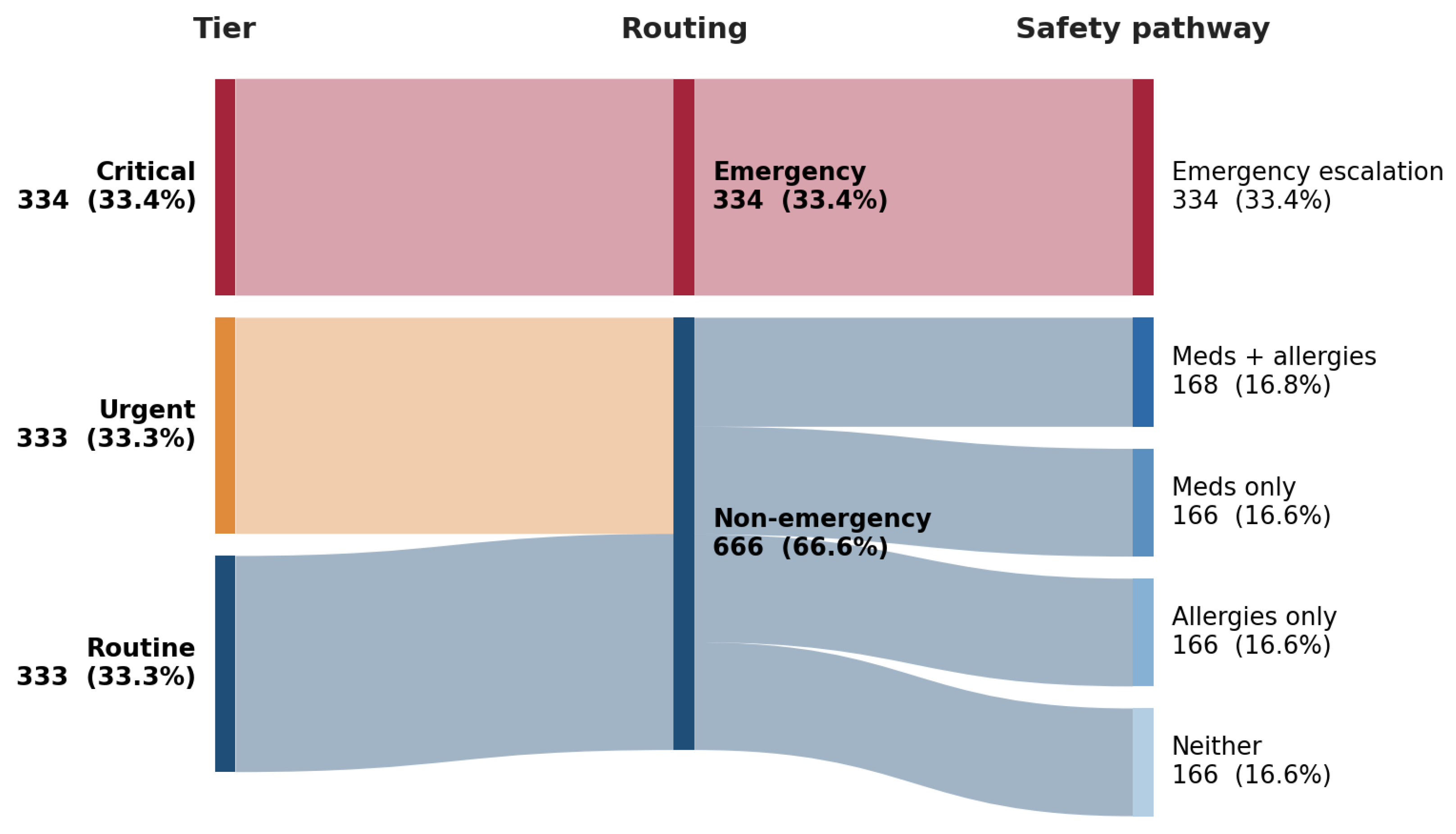
36], which records, for each visit, the Emergency Severity Index (ESI) acuity assigned by the triage nurse, the measured triage vital signs, the chief complaint, and the arrival mode. The resulting cohort comprises 1000 cases balanced across the three urgency tiers (334 critical, 333 urgent, 333 routine).
The ground-truth urgency tier for each case is the ESI acuity assigned by the triage nurse at the time of presentation, mapped as ESI-1 → critical, ESI-2 → urgent, and ESI levels 3–5 → routine. The reference standard is therefore external to the system: it reflects a real clinical judgment made at the point of care rather than a rule applied to the text the system reads. ESI is nonetheless a human judgement with imperfect reliability; a meta-analysis of 19 studies reports pooled inter-rater agreement of
, with study-level values from
to
and nurse-versus-reference agreement near
[
37], which bounds the agreement any automated system can achieve against this standard. Each case additionally carries its measured triage vitals, documented allergies, and home medications, which exercise the medication- and allergy-safety pathways.
The only synthetic element is the model input. Each discharge note is converted into a fragmented, first-person patient narrative that suppresses explicit diagnoses and exact vital values, mimicking the incomplete descriptions typical of crisis presentations. This narrative is the sole free-text input the system receives at inference; the structured ESI label, vitals, and chief complaint serve only as ground truth or, where stated, as structured triage inputs. The underlying clinical data (ESI acuity, vitals, medications, and discharge notes) are therefore real; only the input narratives are synthesized, so the study is best characterized as a retrospective evaluation on real clinical data under synthesized incomplete-information inputs. The use of generated input narratives is consistent with prior evidence that synthetic clinical text can preserve key downstream characteristics [
38]. The composition of the resulting evaluation cohort, from ground-truth ESI tier through routing pathway to documented safety profile, is summarized in
Figure 1.
A separate retrieval index of 49,000 real discharge notes supports the specialist modules. The index is patient-disjoint from the evaluation cohort (zero subject-identifier overlap), so no evaluation case, nor any note from the same patient, can surface during similar-case retrieval.
3.2. System Overview
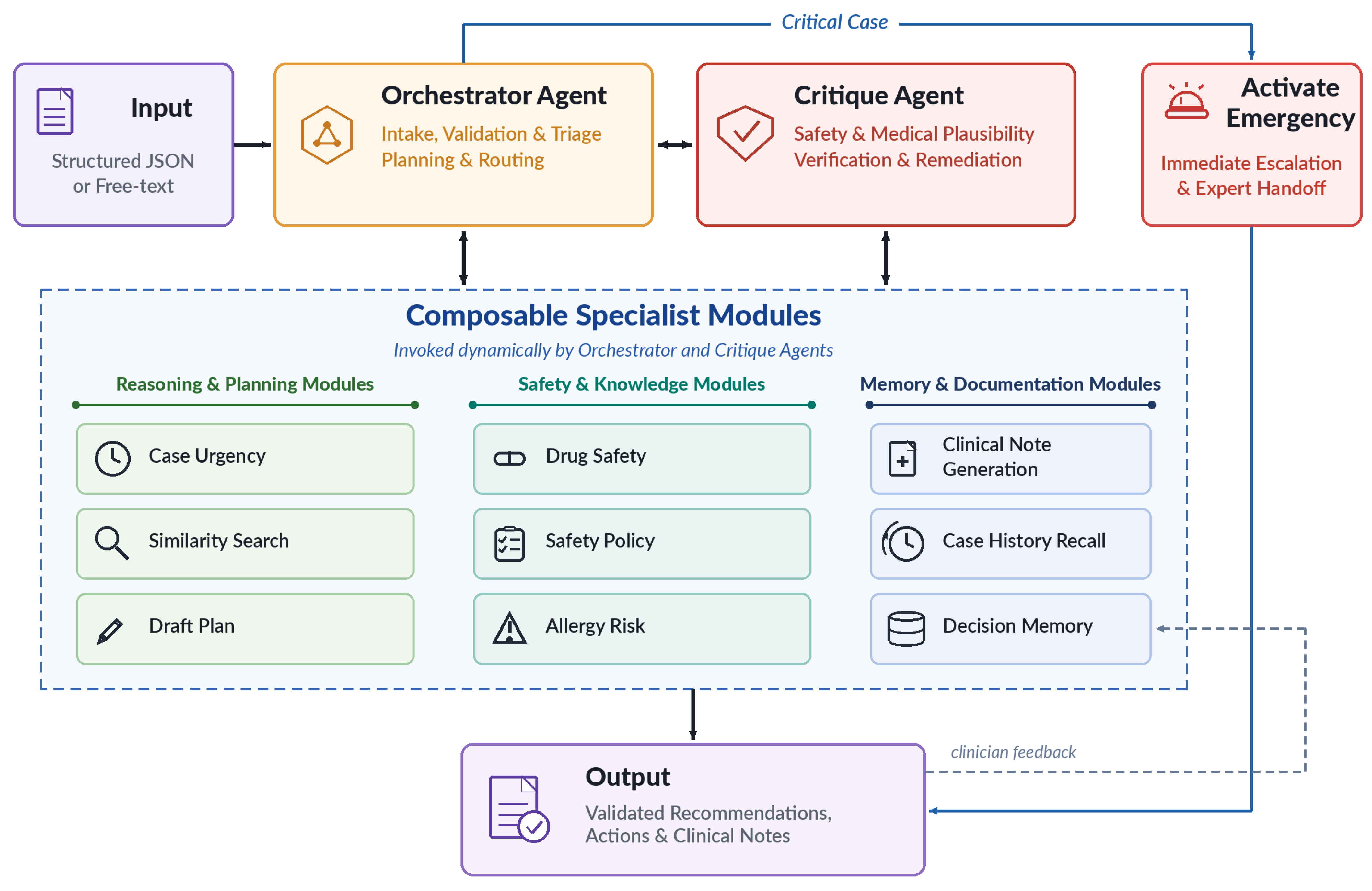
Figure 2 illustrates the end-to-end architecture of the proposed system. The system accepts patient input either as structured JSON or as free-text natural language. An intake parser converts the input into a typed case state containing symptoms, vital signs, medications, allergies, and available past medical history. This state is passed to the Orchestrator Agent, which dynamically selects and sequences specialist modules according to the evolving clinical context. The architecture emphasizes adaptivity, safety by design, and auditability through selective module invocation, embedded safety checks, and structured execution tracing.
The standard continuation pathway consists of urgency assessment, case retrieval, treatment drafting, safety verification, policy review, note compilation, and final critique. Critical presentations follow an emergency bypass pathway in which escalation is triggered immediately to preserve response time.
3.3. Orchestrator Agent
The Orchestrator Agent is the central control component of the system. It receives the parsed case state and dynamically selects from the available specialist modules. The agent is implemented using GPT-5-nano and is responsible for routing, sequencing, evidence gathering, treatment-planning coordination, safety-verification ordering, and termination decisions. GPT-5-nano was selected for the orchestration role because it supports controllable reasoning effort while offering low-latency execution suitable for routing, sequencing, and termination decisions within an iterative ReAct loop [
39]. A single backbone serves the whole pipeline at two reasoning-effort levels, with temperature
and a token budget of 8192. In development, lower reasoning settings sometimes caused repeated tool invocation until the iteration cap, supporting the use of medium effort for control-point decisions. Execution is capped at three complete pipeline passes, where one pass comprises the full tool loop followed by critique; beyond this cap the case is finalized from the accumulated state.
System behavior depends in part on prompt design: the orchestrator, urgency-assessment, critique, and safety-policy modules each use structured prompts that constrain output format and enforce mandatory steps. The source code, including all prompt templates, is publicly available at
https://github.com/serag-ai/TriAgent (accessed on 12 June 2026).
Urgency assessment is always performed first. Emergency escalation overrides all other logic and exits the standard pathway immediately. Treatment drafting must be followed by appropriate safety checks before final recommendation generation. When confidence is low, the Orchestrator Agent may request additional evidence, invoke further modules, or attach conditional (if/then) contingency orders in place of a passive hold (
Section 3.7). The continuation loop terminates once sufficient evidence has been gathered to generate a final recommendation.
Algorithm 1 presents the canonical execution path of the agentic orchestrator for a continuation case with both medications and documented allergies. The canonical tool invocation sequence is: urgency assessment → similarity search → draft planning → [drug screening ‖ allergy assessment] → safety verdict → note compilation, where ‖ denotes concurrent execution via ThreadPoolExecutor. The Orchestrator Agent is not constrained to this order beyond the mandatory initial urgency assessment; it reasons dynamically at each step and may invoke any tool zero or more times per execution.
| Algorithm 1: Agentic orchestrator workflow (canonical continuation path) |
 |
3.4. Composable Specialist Modules
The Orchestrator Agent invokes specialist modules grouped into three functional categories.
3.4.1. Reasoning and Planning Modules
The urgency assessment module classifies cases as critical, urgent, or routine. Because reasoning by the language model alone collapses toward the modal tier and anchors on the presenting complaint (
Section 4.4), this module is built around a dedicated triage classifier based on gradient boosting (
Section 3.5); the language model contributes structured features and the differential of diagnoses that must be excluded first, rather than the final tier. The similarity search module retrieves analogous cases from the 49,000 discharge notes, which are disjoint by patient from the evaluation cohort, using all-MiniLM-L6-v2 sentence embeddings (384 dimensions, normalized to unit length) over an exact FAISS IndexFlatIP index [
40], which implements cosine similarity via inner product. For each query, the top
candidates are graded for relevance by the language model against an acceptance threshold of
; queries falling below it trigger at most one rewrite before the best available results are passed downstream and flagged as low confidence. The draft plan module then generates candidate interventions grounded in this retrieved evidence while explicitly documenting uncertainty arising from incomplete information.
We implemented this retrieval process using an agentic RAG framework [
41], where autonomous reasoning agents dynamically refine searches, assess evidence quality, and coordinate information flow. This approach improves robustness, contextual relevance, and transparency, particularly in high-stakes scenarios with incomplete or ambiguous clinical data.
3.4.2. Safety and Knowledge Modules
The drug safety module uses the D3 Drug-Drug-Interaction classifier [
34] to evaluate medication conflicts. The allergy risk module assesses likely cross-reactivity using contextual reasoning supported by real-world adverse reaction data retrieved from the FDA Adverse Event Reporting System [
42]. The safety policy module integrates these findings with evidence-based clinical safety guidance [
43] into a final verdict, determining whether treatment proceeds as drafted, proceeds with modifications under conditional (if/then) orders, or is rejected; the verdict vocabulary deliberately contains no hold disposition (
Section 3.7).
3.4.3. Memory and Documentation Modules
The case-history recall module retrieves similar prior decisions and outcomes from in-session memory (the nearest by case-state embedding). The clinical note module compiles the final structured recommendation, including approved actions, monitoring requirements, uncertainty disclosures, and evidence citations. The emergency escalation module bypasses the standard pathway and generates a structured escalation payload for critical presentations.
3.5. Triage Classification Head
The Emergency Severity Index is essentially threshold logic: danger-zone vitals such as or mmHg act as discrete cliffs, which linear or purely generative classifiers capture poorly; in development, a tree-based model recovered roughly ten accuracy points over a linear one. The triage head is therefore a gradient-boosted decision tree over two inputs: tier probabilities from a TF–IDF logistic regression on the chief complaint, stacked out-of-sample, and the seven triage vitals plus arrival mode. At inference, the chief complaint is inferred from the lay narrative by the same lightweight language-model call that seeds retrieval.
The head is trained on
MIMIC-IV-ED triage encounters, patient-disjoint from the evaluation cases, using a three-way split for the text model, the tree, and threshold tuning. Missing vitals are left unimputed, since absent charting is itself predictive of high acuity (the sickest patients bypass routine charting). A single threshold on the critical-class probability (
, tuned on a held-out split) assigns the critical tier and triggers an escalation recommendation to the orchestrator, providing an explicit dial between critical sensitivity and over-triage. The language model’s urgency judgment is retained only as the worst-case differential used for planning (
Section 3.7), not as the final tier.
3.6. Critique Agent
Before finalisation, non-emergency outputs are reviewed by a downstream Critique Agent, which examines the complete reasoning trace using four structured checks:
Safety path completeness. If treatment planning was executed, at least one safety tool and the safety policy module must also appear in the trace.
No blocked actions in note. Actions flagged as blocked by the drug conflict screener must not appear in the compiled clinical note.
Evidence retrieval for non-critical cases. If urgency is not critical, the evidence retrieval tool must have been called.
Medical plausibility. A secondary LLM (Qwen3.5-27B) checks proposed medications and actions for fabricated drug names or clinically implausible interventions.
The plausibility check deliberately uses a model family different from the orchestrator’s, so that the system critiquing recommendations shares no foundation with the system producing them; this separation reduces self-confirmation bias. A Qwen model was chosen because the family is among the strongest open-weight performers on medical tasks: Qwen-based models fine-tuned for medical question answering have matched or exceeded larger proprietary models on licensing-exam benchmarks [
44], consistent with the broader emergence of strong open-weight medical reasoners [
45]. Using a stock model rather than a medical fine-tune keeps the critique layer simple and independently reproducible.
A structured critique report is appended to the audit trace. If any check fails and the orchestrator has not yet retried, a feedback message is injected into the conversation and the loop is re-entered for targeted remediation.
3.7. Safety-Oriented Mitigations
The execution pathway embeds three targeted, largely deterministic architectural safeguards intended to reduce the likelihood of known failure modes to which language-model-driven decision support is prone: anchoring on the presenting complaint [
7], passive deferral of decisions, and unsupported or contraindicated medication suggestions [
14]. Whether these safeguards improve patient outcomes can only be confirmed through prospective evaluation; their inclusion here is justified by their structural properties.
3.7.1. Worst-Case Differential Enumeration
To counter anchoring, the urgency-assessment step enumerates the can’t-miss diagnoses for every case. For each plausible serious diagnosis it records the triggering features, the test that would exclude it, whether it can be excluded immediately, and the tier it would imply if confirmed. The resulting rule-out list is passed to the planning module, which must open the plan with the corresponding emergent workup. This differential shapes the plan but has only bounded influence on the tier: a serious possibility that cannot yet be excluded raises acuity to at most urgent, never automatically to critical, because treating diagnostic uncertainty as high acuity is the dominant ESI over-triage error. Genuinely peri-arrest presentations still reach the critical tier through the classifier head and its highest-priority overrides.
3.7.2. Elimination of Passive Holds
The safety-policy vocabulary contains no hold-pending-clarification disposition: an emergency decision-support tool must act on incomplete data rather than suspend care. When data are missing, the verdict must instead approve with modification and attach explicit if/then conditional orders (for example, if mmHg, administer a fluid bolus and reassess), turning a passive hold into an actionable contingency plan. A deterministic post-processing step rewrites any residual hold.
3.7.3. Deterministic Medication Guardrails
A rule-based contraindication screen, independent of the language model, excludes unsafe combinations of drug and clinical context, keyed on the presenting features and the still-open differential: anti-motility agents in possible inflammatory or infectious diarrhea, loop diuretics before a pulmonary embolism has been excluded, and empirical antibiotics without an identified source. The planning prompt additionally requires every proposed drug to be explicitly indicated for the case at hand. The guard fires selectively, intervening only when a risky agent is actually proposed.
3.8. Operational Execution
Each module invocation produces a structured hand-off record containing inputs, outputs, confidence estimates, caveats, and routing metadata (see
Appendix B). These records are appended sequentially to form an end-to-end audit trace suitable for retrospective review, governance, and medicolegal accountability.
When both medication safety and allergy assessment are indicated, the two modules execute concurrently to reduce latency. Cases requiring only one safety pathway invoke only the relevant module.
Finalised recommendations are written to an in-session FAISS memory store (the Decision Memory in
Figure 2) keyed by semantic embeddings of the case state. Clinician feedback, including whether recommendations were accepted, modified, or overridden, may be appended and retrieved in future cases through the case-history recall module.
3.9. Evaluation Protocol
Evaluation was organised into two complementary levels: component-level assessment, which examined the performance of individual modules in isolation, and system-level assessment, which evaluated the behavior of the integrated end-to-end framework.
Across all evaluations, critical-class recall is the pre-specified primary endpoint; overall accuracy, quadratic-weighted , AUC, and the Brier score are supporting metrics. The two LLM-based measures (retrieval relevance grading and the medical-plausibility check) are internal quality indicators and should be interpreted as such rather than as independent validation.
3.9.1. System-Level Assessment
Orchestration. Routing decisions and module invocation patterns were examined qualitatively using representative execution cases to verify adaptive pathway.
Selection, correct escalation behavior, and end-to-end traceability. Triage Classification Performance. The system’s triage performance was evaluated against the real ESI-derived urgency tiers, reporting per-class precision, recall, and F1-scores for critical, urgent, and routine labels, alongside quadratic-weighted agreement, threshold-free discrimination (AUC), calibration (Brier score), and bootstrap confidence intervals.
Baseline Comparison. The full system was compared with two reduced baselines, an LLM-only triage call and a RAG triage call, on the same 1000 cases and with the same underlying language model, so that any difference is attributable to system design rather than model capacity. Each baseline was run both on the narrative alone and with the same structured triage inputs (vitals and arrival mode) that the classifier head receives, ruling out information asymmetry as an explanation. Overall accuracy, critical recall, and paired-bootstrap confidence intervals were reported.
Expert Clinical Adjudication. An experienced physician informaticist reviewed a stratified 20-case subset, blind to the ground-truth label, rating each complete case output (triage tier, differential, disposition, and orders) on a three-level actionability scale: correct (would act as written), passable (would act with modifications), or wrong (would not act). This review assesses whether outputs are clinically actionable, a property that agreement with ESI labels alone cannot capture.
Efficiency and Runtime Performance. End-to-end latency was measured and stratified by routing pathway, together with the orchestrator’s internal dynamics (tool-call count, critique remediation frequency, and token cost). Audit trace structure was reviewed to confirm that routing decisions, evidence sources, and safety outcomes were captured along each evaluated pathway.
3.9.2. Component-Level Assessment
Retrieval Evaluation. Single-pass retrieval was compared with the full iterative similarity search module using LLM-scored relevance, cases above threshold (0.5), rewrite frequency, and low-confidence flags.
Drug Safety Validation. The D3 Drug-Drug-Interaction classifier was evaluated against DDInter [
46] as an independent reference standard. Performance was assessed by interaction severity tier (major, moderate, and minor), with major-interaction sensitivity as the primary endpoint, given its direct clinical consequence. This is deliberately a cross-source evaluation: D3 is fine-tuned predominantly on DrugBank-derived interaction data, whereas DDInter is a separate, independently curated database, so the validation tests generalization to an external reference standard rather than agreement within a shared ecosystem.
Critique Agent Contribution. The full system was compared with a variant in which the Critique Agent was removed and outputs were passed directly to note compilation. In addition to a side-by-side case analysis, the frequency, tier-targeting, and downstream effect of critique-triggered remediation were quantified across the instrumented continuation-pathway cases.
4. Results
4.1. Orchestration
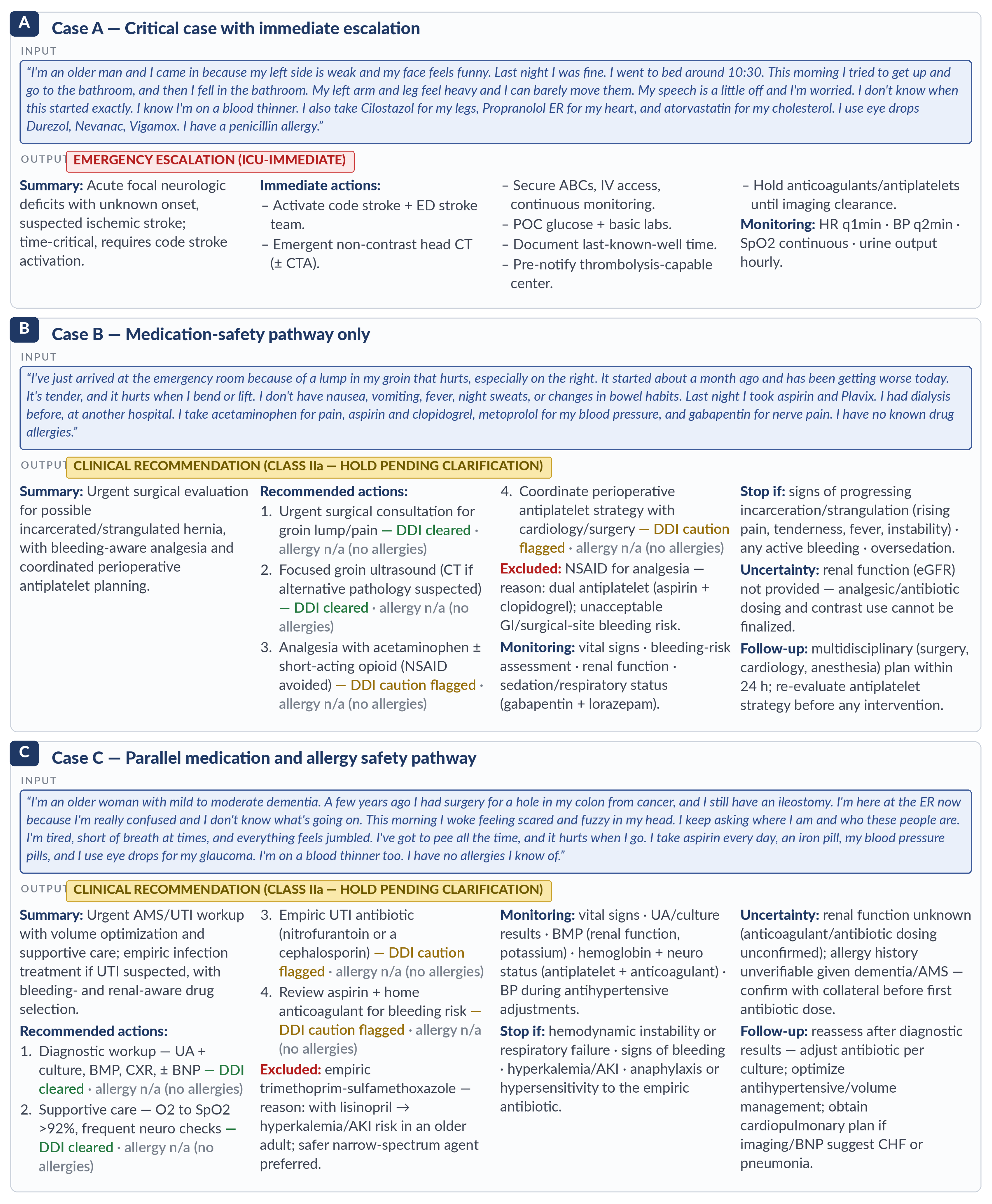
Figure 3 illustrates three representative execution cases generated by the deployed prototype. Case A shows a critical presentation routed directly to emergency escalation, bypassing non-essential modules. Case B shows a continuation pathway requiring medication safety review only. Case C shows a continuation pathway in which medication and allergy checks are executed concurrently before final recommendation generation.
Across all cases, the Orchestrator Agent selected different module sequences without hardcoded routing rules while maintaining complete audit records. These examples demonstrate adaptive pathway selection, correct escalation behavior, and end-to-end traceability.
4.2. Triage Classification Performance
Table 1 summarizes per-class triage performance on the real-ESI cohort (
). The system reaches
overall accuracy (95% confidence interval (CI)
–
), corresponding to a quadratic-weighted agreement of
(95% CI
–
) with the nurse-assigned ESI label. For context, human raters themselves agree imperfectly on ESI: reported study-level
ranges from
to
, with a pooled estimate near
, and nurses agree with a reference standard at roughly
[
37]. The system therefore reaches the lower end of the human range while observing only a fragmented first-person narrative rather than the full triage encounter.
On the primary safety endpoint, the system recalls of critical cases, where critical recall is the proportion of ground-truth critical (ESI-1) cases that the system assigns to the critical tier. The triage head separates critical from non-critical presentations well (AUC ) and its probabilities are well calibrated (Brier ).
When the system errs, it errs by one tier: of predictions fall within one tier of the true label, and the errors skew conservative, with over-triage () roughly double under-triage (). Per class (macro-F1 ), critical presentations are identified reliably, the urgent middle tier is the hardest to separate, and routine assignment is conservative.
4.3. Comparison with Alternative System Configurations
To isolate the effect of architecture, we compared TriAgent with two alternative system configurations on the same 1000 cases, holding the language model and retrieval corpus fixed. Standalone LLM assigns a triage tier from a single model call; Traditional RAG augments that call with the five most similar retrieved cases. All systems received identical inputs, the patient narrative together with the structured triage record (vitals and arrival mode), and the two alternatives used a detailed ESI decision-rule prompt.
Table 2 reports the results: TriAgent improves overall accuracy by 22 points and critical recall by 70 points over the best alternative. The gap is architectural rather than informational; in a narrative-only condition the alternatives scored only about five points lower, with critical recall essentially unchanged. Lacking the classifier triage head, the agentic orchestration layer, and the confidence-gated emergency routing, both alternatives default to the lower-acuity majority tiers and miss nearly all life-threatening presentations.
4.4. Expert Clinical Evaluation
Automated agreement with ESI labels captures triage calibration but not whether a clinician would act on the system’s full output. To complement the automated metrics with expert judgment, an experienced physician informaticist independently reviewed a stratified 20-case subset (7 critical, 7 urgent, 6 routine) drawn from the same real-ESI cohort (single reviewer; formative intent), blind to the ground-truth labels, rating each complete case output on the three-level actionability scale defined in
Section 3.9. This evaluation was conducted on an earlier iteration of the system and was deliberately formative: its purpose was to surface failure modes that automated tier-accuracy could not.
The evaluation yielded encouraging signals alongside clear targets for improvement. Twelve of 20 outputs () were rated clinically acceptable (correct or passable), with 5 () actionable as written; the reviewer highlighted conservative over-triage and broad differential awareness as genuine strengths, summarizing the system as “a great beginning.” All triage errors were confined to an adjacent tier. The evaluation also pinpointed two specific, correctable failure modes: anchoring on the presenting complaint, which collapsed predictions toward the modal urgent tier () and limited critical-case sensitivity to , and a “clinical passivity” pattern in which dispositions deferred to hold pending clarification rather than committing to a worst-case-driven plan.
These expert-identified failure modes directly motivated the safety-oriented refinements in the present system: explicit worst-case differential enumeration to counter chief-complaint anchoring, and dynamic conditional (if/then) orders to replace passive holds. The substantially higher critical recall reported above ( versus on the earlier iteration) is a direct outcome of these changes. To close the loop, the same 20-case subset was re-evaluated on the present system: all 20 outputs () were now rated clinically acceptable, with no wrong ratings, no passive holds, and no flagged medication issues. We report the formative evaluation in full because it is itself the evidence that the system was assessed against human clinical judgment, not merely against recovered label rules. Given its limited scale, these actionability ratings should be read as directional signals rather than definitive performance estimates; larger, multi-reviewer adjudication is planned as future work.
4.5. Mitigation Effects at Scale
We verified that the three mitigations (
Section 3.7) behave as intended across the full 1000-case cohort. The worst-case differential pass produced a non-empty rule-out list in
of cases, confirming that the anti-anchoring mechanism engages near-universally. The elimination of passive holds was complete:
cases terminated in a “hold pending clarification” disposition, compared with
in the earlier iteration assessed in the expert evaluation (
Section 4.4); every case instead reached an actionable disposition (778 approve-with-modification, 216 emergency-bypass, 5 approve-as-written, 1 reject; no missing dispositions). The deterministic medication guard fired selectively rather than indiscriminately, excluding at least one proposed action in
of cases (
), distributed across the urgent (55), routine (45), and critical (31) tiers in proportion to where risky agents were actually proposed. These engagement patterns translate directly into the outcome gains reported above: critical recall rose from
on the earlier iteration to
at scale. Together they confirm that the mitigations operate at population scale with the intended targeting, not merely on the hand-picked cases that motivated them.
4.6. Efficiency and Runtime Performance
Latency and agent dynamics were measured over instrumented runs on the full 1000-case cohort. Adaptive routing cleanly separates the two pathways (
Table 3): emergency bypass (
of cases) skips retrieval, planning, safety verification, and critique and completes in a median of 64 s, while the full continuation pathway takes a median of 186 s (p90 268 s). Continuation latency is dominated by a fixed reasoning-decode base of ≈105 s, with each tool invocation adding ≈12 s; a critique remediation round-trip, triggered in
of instrumented continuation cases (
Section 4.10), adds a further ∼15 s. The orchestrator issues a median of 7 tool calls per case at an average cost of ∼54 k tokens, and every case yields both a triage decision and a safety disposition. Since the bypass pathway governs response time on the presentations where speed matters most, deployment-relevant latency is roughly a third of the continuation figure.
4.7. Reproducibility, Prompt Robustness, and Backbone Sensitivity
Because the orchestrator is language-model-driven, we measured how stable its outputs are under repetition and under a change of backbone model, in both cases on the full 1000-case cohort.
4.7.1. Run-to-Run Variability
We ran the full pipeline three times. The safety-critical emergency-bypass decision was the most stable component, identical across all three runs in of cases, and the final disposition was identical in . The finer exact-tier assignment was less stable (identical across all three runs in of cases): the otherwise deterministic classifier head is fed a chief complaint inferred by the language model, whose wording varies between runs, and the resulting tier changes were confined to adjacent tiers. Per-run overall accuracy averaged with a standard deviation of points across the three runs, while the number of orchestrator tool calls per case varied little (mean per-case standard deviation ). The system is therefore highly reproducible at the level of the safety-critical routing decision and only moderately reproducible at the level of the exact tier.
4.7.2. Backbone Sensitivity
To test whether the findings depend on the specific backbone, we re-ran the pipeline with an independent model from a different family (Claude Sonnet 4.6) substituted for GPT-5-nano, leaving the architecture unchanged. The two backbones produced near-identical overall accuracy and critical recall, agreed on the triage tier in of cases, and the alternative backbone returned a complete disposition on every case, indicating that the results reflect the system design rather than an idiosyncrasy of one model.
4.7.3. Prompt Robustness
A further source of variability not captured by the run-to-run analysis is prompt wording. The structured prompts used for each module were finalized on a held-out development set and held constant across all reported runs; minor rewording of the orchestrator or critique prompts in pilot experiments produced comparable routing behavior, indicating robustness to minor prompt variations. A systematic prompt ablation is outside the scope of the present work and is left to future study.
4.8. Retrieval Evaluation
We compared the iterative retrieval module against a single-pass search strategy, as shown in
Table 4. Iterative retrieval markedly improved mean relevance score and the proportion of cases exceeding the acceptance threshold. A total of 312 cases required at least one rewrite, most of which were successfully resolved within the first refinement cycle. Only a small minority (33 cases, 3.3%) remained below threshold and were automatically flagged as low-confidence, preserving transparency for downstream decision-making.
4.9. Drug Safety Validation
Table 5 presents validation of the D3 Drug-Drug-Interaction classifier against DDInter. Performance was strongest for major interactions, the tier with the greatest potential clinical consequence, where sensitivity exceeded 96%. Performance declined modestly for moderate and minor interactions, while specificity remained high across all tiers.
The overall false positive rate was low, consistent with a caution-alert decision-support setting in which suspicious combinations are surfaced for review rather than automatically blocked. As noted in
Section 3.9, this is a cross-source evaluation: D3 is fine-tuned predominantly on DrugBank-derived interaction data, while DDInter is an independently curated reference, so these figures reflect generalization to an external standard rather than agreement within a shared ecosystem.
4.10. Critique Agent Contribution
To isolate the contribution of the Critique Agent, the full system was compared with a variant in which critique was removed and outputs passed directly to note compilation.
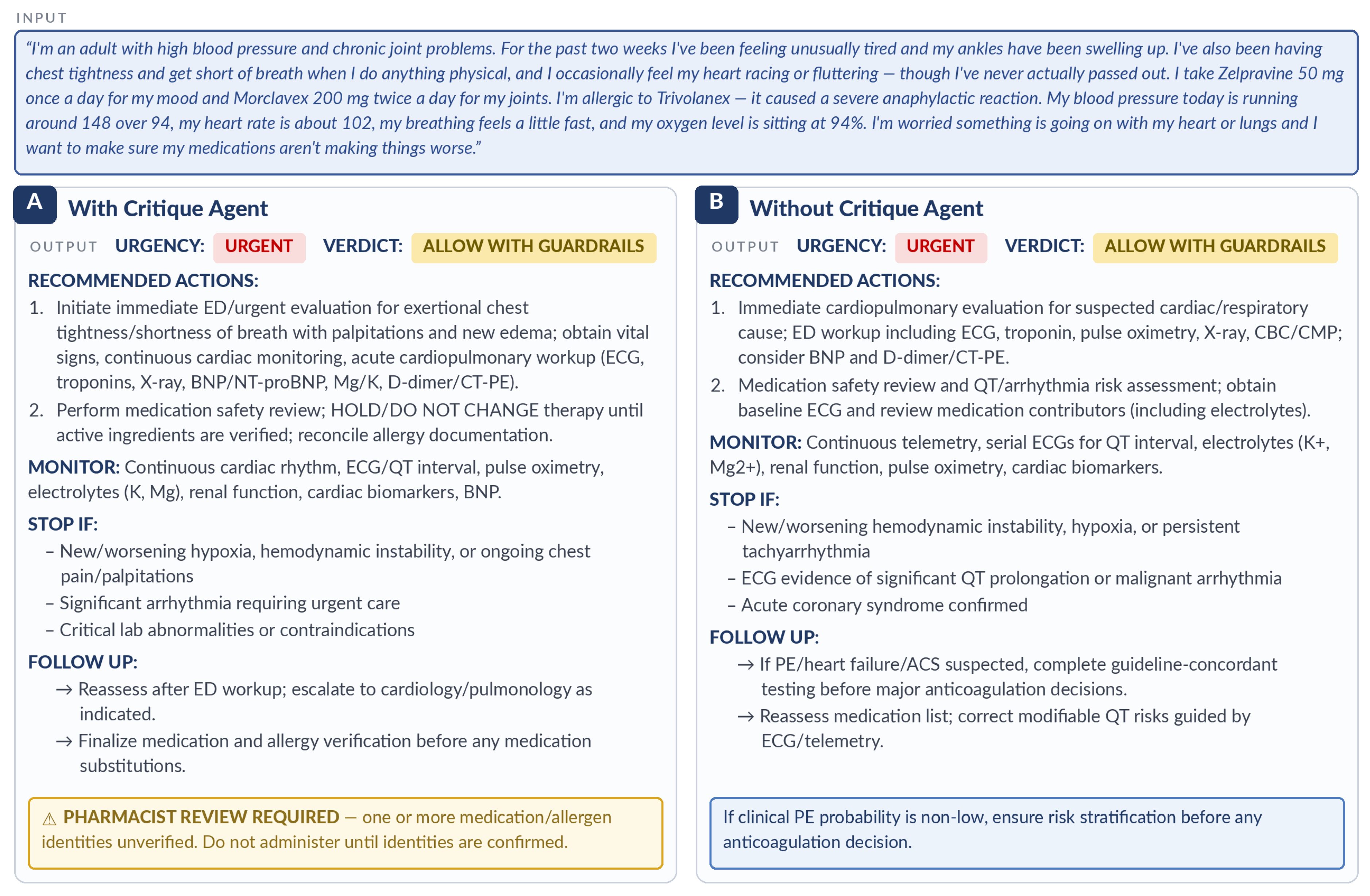
Figure 4 shows a representative case involving medication uncertainty and a conflicting allergy profile. With critique enabled, failed consistency checks triggered a remediation pass and added a pharmacist review flag; without it, the same uncertainty remained implicit in the reasoning trace and never surfaced in the final recommendation. Critique rarely altered straightforward cases, but it consistently improved outputs containing incomplete safety checks, conflicting confidence signals, or latent pharmacological inconsistencies.
To move beyond a single illustrative case, we quantified how often, and how consequentially, critique intervened across the instrumented continuation cases, that is, the continuation cases executed with detailed critique logging enabled (
of 784; emergency-bypass cases skip critique by design). Three findings emerge. First, critique engages frequently: at least one remediation round-trip was initiated in
of continuation cases. Second, it targets the cases that matter most: remediation was triggered in
of cases assigned to the critical tier, versus
of urgent and
of routine cases, so the loop engages disproportionately on the most consequential presentations rather than uniformly. Third, it has a measurable downstream effect: remediated cases were roughly twice as likely to end with at least one candidate action explicitly excluded on safety grounds (
versus
for non-remediated cases). The qualitative pattern in
Figure 4, critique surfacing and pruning latent safety concerns, is thus established at the population level. A full pre-versus-post recommendation diff would require logging the intermediate plan state around each remediation pass and is left to future instrumentation; the present measurements establish frequency, targeting, and downstream effect.
5. Discussion
Taken together, the experiments support one conclusion: in agentic clinical decision support, performance is governed as much by what information reaches each decision stage, and how it is routed through the workflow, as by the quality of the reasoning model itself. The iterative retrieval module raised evidence relevance well above a single-pass strategy, and the embedded medication and allergy screens ensured safety coverage on every continuation pathway. Future gains may therefore come as much from better retrieval resources and structured information flow as from larger reasoning models.
Adaptive orchestration is what delivers this information economy in practice. Presentations assigned the critical tier were recommended for immediate escalation, with the orchestrator routing them to the emergency pathway, while non-critical cases invoked only the modules their context required: medication-only cases bypassed allergy analysis, and cases with both medications and allergies triggered the two safety checks in parallel. A deterministic pipeline, which applies the same sequence of steps to every case regardless of complexity, offers neither the economy nor the adaptivity.
Safety rested on two complementary mechanisms. Medication conflict screening, allergy-risk assessment, and policy review were embedded inside the execution pathway rather than appended as optional downstream checks, and the Critique Agent re-examined completed outputs, triggering remediation whenever they were incomplete, weakly supported, or internally inconsistent. We are careful about what this does and does not demonstrate. Throughout this paper, “safety” refers to structural system properties. The gains we measure are internal system properties: more complete safety-check coverage, remediation of inconsistent or weakly supported outputs, and structured provenance. They are not, by themselves, evidence of improved real-world clinical safety; embedded checks make unsafe omissions less likely and more auditable, but a clinical-safety benefit can only be confirmed through prospective evaluation with clinicians in the loop.
The same structural discipline is what makes the system auditable. Every module invocation generated a hand-off record of routing decisions, evidence sources, outputs, and confidence metadata, yielding complete pathway provenance for every evaluated case. This supports retrospective review, quality assurance, and governance, and remains difficult to achieve in loosely coupled retrieval pipelines, where intermediate decisions are often opaque or incompletely logged.
The principal trade-off for these properties is runtime. Emergency escalation completed in a median of 64 s by short-circuiting planning, retrieval, and verification, whereas the full continuation pathway, with retrieval, treatment planning, safety review, and critique, took a median of 186 s. The continuation figure is substantial for acute care, and we do not claim it is ready to serve as a blocking step; the design intent is that the fast bypass pathway governs the time-critical presentations while the slower deliberative pathway serves non-emergent cases, where a few minutes of added latency is clinically tolerable and is repaid in safety coverage and auditability. Because the latency is dominated by reasoning-model decode rather than tool execution (
Section 4.6), it would also fall substantially with a faster backbone or hardware. Realistic integration would therefore position the system as an asynchronous second reader that surfaces a structured, audited recommendation shortly after triage, not as a synchronous bedside oracle.
Several limitations should be acknowledged. First, the benchmark dataset was derived from retrospective MIMIC-IV discharge notes rather than true point-of-care intake data. We therefore characterize this work as a retrospective evaluation on real clinical data under synthesized incomplete-information inputs, intended to evaluate orchestration, routing, and safety-verification behavior rather than to demonstrate real-world clinical performance: although the ground-truth acuity comes from real triage decisions, the first-person narratives are reformulated from structured discharge documentation and cannot reproduce the noise, missing information, and temporal evolution of live presentations.
Second, retrieval performance remains dependent on corpus coverage, particularly for rare or underrepresented scenarios. Third, LLM-based orchestration introduces some run-to-run variability, quantified in
Section 4.7: the emergency-bypass decision is highly stable across repeated runs, but the finer exact-tier assignment varies in a non-trivial fraction of cases, because the otherwise deterministic classifier head consumes a chief complaint that is itself inferred by the language model.
Fourth, two secondary evaluation components, retrieval relevance grading and the medical-plausibility check, rely on LLM-based scoring. Neither produces the headline results, which are anchored to external references (clinician-assigned ESI acuity, the independently curated DDInter database, and blinded expert review), and the plausibility check uses a model family different from the orchestration backbone so that no component evaluates its own outputs; comprehensive clinician annotation across a substantially larger cohort nevertheless remains planned future work. Fifth, prompt robustness has so far been assessed only informally: all prompts were held constant across the reported runs, and minor rewording in pilot experiments produced comparable routing behavior (
Section 4.7), but a systematic ablation of prompt wording was not conducted, and such an ablation is needed before contributions can be attributed to architecture rather than to prompt design. Finally, the framework has not yet been prospectively validated with clinicians in live operational settings; prospective point-of-care validation, including establishing acceptable response times against clinician decision time, is a prerequisite for any deployment claim.
Future work will focus on expanding retrieval resources to include emergency and pediatric datasets, improving terminology normalization for medications and supplements, calibrating policy thresholds using clinician feedback, and conducting prospective studies in real clinical environments. These steps are necessary to determine whether the gains observed in retrospective benchmarking translate into safer and more efficient bedside decision support.
6. Conclusions
We presented an agentic framework for crisis clinical decision support under incomplete information that integrates adaptive orchestration, specialized safety modules, iterative retrieval, structured critique, and full audit tracing within a unified workflow. Across evaluation experiments, the system demonstrated improved retrieval quality, robust safety verification, and efficient emergency escalation while maintaining complete pathway provenance. These findings suggest that clinically useful AI decision support may depend less on any single modeling advance than on how reasoning, specialized tools, mandatory verification, and transparency are coordinated within a single architecture. Because the evaluation uses retrospective records, with synthesized rather than live patient narratives as inputs, these results characterize the system’s internal behavior rather than its clinical effectiveness; establishing the latter requires prospective validation with clinicians in the loop. Within that scope, however, the present results support agentic orchestration as a promising direction for trustworthy AI-assisted crisis care.
7. Declaration of Generative AI and AI-Assisted Technologies in the Manuscript Preparation Process
During manuscript preparation, Claude Sonnet 4.6 was used for editorial refinement of language. All content was reviewed and verified by the authors, who take full responsibility for the final version.