
Review

Human Evaluation of Large Language Models: A Review and Protocol Selection Framework

1
Center for Applied Brain and Cognitive Sciences, Tufts University, Medford, MA 02155, USA
2
U.S. Army DEVCOM Soldier Center, Natick, MA 01760, USA
AI 2026, 7(5), 174; https://doi.org/10.3390/ai7050174
Submission received: 7 April 2026 / Revised: 30 April 2026 / Accepted: 14 May 2026 / Published: 19 May 2026
(This article belongs to the Special Issue LLMs and AI Agents in Biomedical and Health Sciences)

Abstract

Evaluating large language models (LLMs) critically depends on human judgment. This article reviews and develops a conceptual framework for human-centered LLM evaluation, synthesizing research across evaluation methodology, psychometrics, cognitive science, and domain-specific applications. Four primary challenges are identified that limit current human evaluation practice: imperfect gold standards, evaluator fatigue and overload, shared and unique bias structures across humans and LLM judges, and the routine omission of uncertainty and dispersion estimates. To address these gaps, the STEP-V design framework is proposed: Stakes, Task-type, Evaluator availability, Purpose, and Volume, for selecting human and/or automated LLM evaluation methods under real-world constraints. An evaluator failure mode taxonomy is also proposed that analyzes human and LLM judges within a common error framework, clarifying where hybrid pipelines can compensate for weaknesses and where they might compound them. The framework motivates a more rigorous science of LLM evaluation, one that treats human judgment as a necessary but fallible measurement requiring explicit design, calibration, and uncertainty quantification.

1. Introduction

Large language models (LLMs) have changed not only what artificial intelligence (AI) systems can do, but also what it means to evaluate them. LLM capabilities emerge from a range of training and adaptation paradigms, including self-supervised pretraining, supervised fine-tuning, reinforcement learning from human feedback, and retrieval- or tool-augmented inference; the present review does not provide a taxonomy of model-development methods (see [1,2,3,4] for such reviews); instead, it provides a framework for how resulting system outputs should be evaluated once they are compared, deployed, or monitored. Early natural language processing (NLP) systems were often assessed on narrow, well-specified tasks with relatively stable output spaces and task-aligned benchmarks. By contrast, contemporary LLMs generate open-ended, context-dependent, and often subjective responses across a wide range of tasks, from medical counseling and legal analysis to tutoring, planning, and creative writing. In these settings, evaluation cannot be reduced to surface similarity with a reference answer [5,6,7]. Determining whether an answer is clinically sound, legally defensible, pedagogically useful, or socially appropriate critically requires human judgment.
While there is increasing interest in human evaluation of LLM performance, the field has not yet developed a sufficiently rigorous theory of how to systematically select human evaluation methods [8,9]. In existing work, human judges often function as a practical endpoint: after collecting and tuning a model against automated metrics, researchers may ask humans to rate model outputs. In turn, those ratings can be used as labels when benchmarking a system. This practice is conceptually incomplete: human evaluation goes beyond identifying labels; it is a complex measurement process involving raters, protocols, scales, task definitions, cognitive constraints, biases, and statistical assumptions. Like any measurement system, it can be valid or invalid, reliable or unreliable, calibrated or poorly calibrated, and more or less appropriate for the construct it claims to assess [10,11,12]. This point is increasingly important because LLMs are now deployed in domains where evaluation errors can have meaningful and potentially life-altering consequences, including high-stakes domains such as medicine, the military, and law.
Automated metrics are scalable and cheap, but may fail to capture reasoning quality, social appropriateness, or usefulness in open-ended tasks [9,13,14]. Human evaluation is relatively flexible and often closer to application reality, but is also expensive, heterogeneous, and vulnerable to fatigue, mental workload, framing effects, and other biases [12,15,16]. Between those two endpoints, LLM-as-judge models promise scale with some contextual sensitivity, yet growing evidence suggests they cannot be assumed to reproduce human judgments consistently across tasks and annotator populations [7,16,17,18]. In other words, evaluation quality depends on the interaction among task structure, evaluator type, and protocol design. A central question is how evaluation systems should be structured when no evaluator is unbiased, perfectly reliable, or universally valid [6,7,12]. One solution is to design a measurement strategy appropriate to the stakes, task, and intended use of the model [7,19,20].
LLM evaluation should be reframed as a measurement-design problem, with the central claim that human evaluation should be treated as measurement infrastructure: a system for generating evidence about model quality that must itself be designed, validated, and monitored. In this view, evaluator disagreement provides important information about construct ambiguity, rater heterogeneity, or protocol weakness. Likewise, the common practice of treating human labels as perfect ground truth obscures an imperfect gold standard problem seen in psychometrics and diagnostic statistics, where the reference standard itself is error-prone [21,22]. Addressing these issues requires a broader synthesis than judge models or standard benchmark surveys may provide [11,23].
In addition to reviewing human evaluation methods, this article also integrates them into a conceptual framework that links theoretical validity, practical design, and deployment constraints. To do so, LLM evaluation is organized into three tiers: automated reference-based metrics, LLM-as-judge systems, and direct human evaluation. The third (human) tier is then the focus, examining who evaluates, what is evaluated, and how evaluation is operationalized in practice. Throughout, multiple disciplines are drawn upon, including psychometrics, cognitive science, annotation research, and domain-specific studies to show that evaluator choice, scale design, protocol structure, and statistical reporting are all important aspects of evaluation.
Relative to extant research and theory on this topic, this article uniquely synthesizes several previously distinct lines of work into a unified framework for evaluation design. Prior research on LLM evaluation has tended to take one of several complementary but fragmented approaches. Broad evaluation surveys map the landscape of metrics, benchmarks, and workflows, but typically treat human evaluation as one component among many, not just as a standalone measurement system [24]. LLM-as-judge surveys and empirical comparison studies focus on the reliability and behavior of model-based evaluators, often using human judgments as a reference point, but rarely interrogate the structure and variability of those human judgments themselves. In parallel, psychometric approaches provide rigorous frameworks for reliability, validity, and construct definition, yet are seldom translated into concrete evaluation protocols for LLM systems [25]. Practitioner and industry-oriented work offers valuable operational guidance for deployment and monitoring, but is often under-theorized with respect to measurement principles [26,27]. The present review centers on human evaluation as a measurement-design problem, treating human and LLM judges symmetrically, and connecting empirical findings on alignment and bias with psychometric theory and application-specific constraints. In doing so, it reframes evaluation as an infrastructure problem, one that requires explicit design of evaluators, tasks, aggregation procedures, and uncertainty quantification.
The remainder of the paper proceeds as follows. Section 2 maps the broader landscape of LLM evaluation across the three tiers. Section 3 analyzes direct human evaluation through the lenses of evaluator type, evaluation target, and protocol. Section 4 addresses reliability, validity, and major sources of human judgment error. Section 5 introduces a unified failure mode taxonomy. Section 6 examines domain-specific implications in healthcare, law, finance, and safety. Section 7 presents STEP-V as a design framework for matching evaluation strategy to context. Section 8 proposes methodological best practices, and finally, Section 9 outlines open problems and future research directions.

2. LLM Evaluation: A Three-Tiered Taxonomy

Evaluation methods for LLMs can be organized into three broad tiers distinguished by the identity of the evaluator and the form of judgment produced. Tier 1 consists of automated reference-based or reference-free metrics. Tier 2 consists of LLM-as-judge systems that use language models to score or rank outputs. Tier 3 consists of direct human evaluation. This taxonomy is useful not only descriptively but also analytically, because each tier embodies different assumptions about what qualifies as evidence of quality and what kinds of errors are likely to arise [7,18,28]. The intent is not to rank all methods along a single scale of quality; instead, it is to highlight that evaluation methods differ in construct coverage, interpretability, cost, reproducibility, and failure profiles [10,12].

2.1. Tier 1: Automated Metrics

Automated metrics remain indispensable in LLM evaluation because they provide low-cost, reproducible signals and enable rapid iteration. Classic overlap metrics such as BLEU, ROUGE, and METEOR compare generated text to reference outputs and are useful when lexical or structural similarity to a gold standard answer is a meaningful proxy for task success [29]. More recent semantic metrics, such as BERTScore, improve on surface overlap by capturing paraphrastic similarity in embedding space [30]. Reference-free measures, including perplexity and certain faithfulness metrics in retrieval-augmented generation, attempt to assess quality without requiring a single gold standard response [18,30].
The utility of these metrics is bounded by the constructs they can measure. Surface and semantic similarity do not reliably capture factual correctness, reasoning quality, strategic usefulness, or ethical acceptability [14,31]. In open-ended tasks, multiple responses may be equally good for different reasons, or superficially similar while differing in safety or truthfulness. This creates a construct mismatch between the metric and the quality dimension of actual interest. Automated metrics are therefore best understood as convenient partial instruments; they are not general-purpose substitutes for human judgment [5,10].

2.2. Tier 2: LLM-as-Judge Systems

The rapid rise in LLM-as-judge systems reflects a genuine need: researchers and practitioners want evaluators that scale better than humans while capturing more nuance than classic automated metrics. Recent surveys and empirical studies show that LLM-based judges can perform well in structured or quasi-structured evaluation settings (e.g., in pairwise comparisons or rubric-guided scoring), particularly when evaluation criteria are explicit and human judgments are relatively consistent [16,32]. However, performance varies substantially by task type, evaluated property, language, and the expertise level of the human annotators against whom models are compared [20,28].
This variation has major implications: LLM judges should not be treated as plug-and-play evaluators whose scores are inherently meaningful across contexts. Instead, they are measurement tools whose validity is local; they must be calibrated and tested against the target task, target construct, and target evaluator population. Large-scale empirical work has shown that some judge models align reasonably well with humans on tasks such as instruction following, while performing much less reliably on subjective or expertise-sensitive evaluations [7,20,28]. The strongest takeaway from this literature is not that LLM judges fail universally, but that they require careful validation before they can be used effectively.

2.3. Tier 3: Direct Human Evaluation

Direct human evaluation remains the most flexible approach because humans can assess qualities that are difficult to formalize, including persuasiveness, appropriateness, pedagogical value, harm, and domain-specific adequacy. Humans can also interpret context, detect subtle mismatches between tone and audience, and recognize when multiple valid answers exist. For these reasons, direct human evaluation remains indispensable in high-stakes, high expertise, socially embedded, or normatively contested applications [5,6,12].
At the same time, human evaluation is not a single method; a domain expert rating legal analysis, an end user reporting satisfaction, and a crowdworker comparing two chatbot answers are all performing different measurement acts under different assumptions and constraints. While all three are considered human evaluations, treating them interchangeably obscures crucial design questions. The remainder of this paper focuses on this third tier and argues that its rigor depends on making such differences explicit [10,11,12].

3. Human Evaluation: Who, What, & How

A useful way to structure human evaluation is around three questions directly tied to sources of measurement variation: who evaluates, what is evaluated, and how is evaluation conducted [12,33]. For example, different evaluator populations bring different kinds of expertise, background knowledge, and bias. Different evaluation targets reflect different constructs, some objective and some deeply subjective. Moreover, different protocols impose different cognitive loads and fatigue, and produce different kinds of data. Understanding human evaluation requires analyzing all three together.

3.1. Who Evaluates

Evaluator choice is a critical element of human evaluation. If the aim is to assess clinical safety, domain experts are often necessary because non-experts cannot reliably identify subtle but dangerous errors [34]. If the aim is to assess user satisfaction or practical helpfulness, end users may be the more valid evaluators because ecological validity matters more than formal expertise. Trained annotators and crowdworkers occupy intermediate positions, offering scale and standardization but often with weaker domain knowledge [10,35].
As detailed in Table 1, evaluator selection should be guided by the relationship between the construct of interest and the competencies required to judge it. A useful heuristic is that evaluator validity depends on the degree to which the judgment requires specialized knowledge, lived experience, and/or contextual familiarity. Domain experts may be expensive and still disagree with one another, but disagreement among experts is often more informative than apparent agreement among non-experts who do not have the requisite expertise to understand relevant distinctions. Conversely, end-user evaluations may be the most appropriate signal when the target construct is acceptability, trust, or perceived usefulness in a real interaction context [12,33,35].
These tradeoffs are documented: experts generally provide the strongest construct validity for specialized tasks but are expensive and hard to scale, whereas crowd and annotator pools can be scalable and cost-efficient but require stronger quality control and are less appropriate for expertise-intensive judgments [36,37].

3.2. What Is Evaluated

In practice, evaluation criteria differ by whether they are externally verifiable, partially observable, or fundamentally experiential. Accuracy, citation correctness, and format compliance often have external referents; in contrast, creativity, politeness, and engagement are more subjective, relying on human interpretation and social norms. Domain-specific criteria such as clinical appropriateness, legal soundness, or regulatory adequacy require expert frameworks and often cannot be judged reliably by general annotators [10,33]. For high-stakes tasks, experts should judge more than the output, incorporating judgments of the logic (chain of thought) through reasoning traces [38,39].
For this reason, one of the first steps in evaluation design should be clarifying the target construct [10,11,40]. Researchers should specify whether they are measuring correctness, usefulness, preference, trust, readability, safety, or some combination of these. They should also ask whether the construct can be decomposed into observable subdimensions. Rubric-based evaluation often improves reliability because it transforms vague, holistic impressions into narrower, more observable judgments. Without this step, low agreement may reflect both evaluator weakness and an under-defined construct.

3.3. How It Is Evaluated

Evaluation protocols determine both data quality and interpretability. Pointwise ratings, binary judgments, pairwise comparisons, and rubric-based scoring each come with tradeoffs.
  • Likert-style ratings: Evaluators assign each output a score (e.g., 1–5) for target criteria such as helpfulness or accuracy. This method provides graded distinctions but generates ordinal data and may be sensitive to anchoring and scale interpretation effects [41,42].
  • Binary judgments: Evaluators classify an output into one of two categories, such as acceptable versus unacceptable, or correct versus incorrect. This method can improve agreement when the target distinction is sharp, but can also discard nuance [43,44].
  • Pairwise comparison: Evaluators compare two outputs side-by-side and select the better one for a specified criterion. This often aligns well with human judgments and can be especially useful when raters struggle to apply absolute scales consistently [45,46].
  • Rubric-based protocols: Evaluators score an output on multiple predefined dimensions, each with explicit criteria or anchors (see examples in Supplementary Materials File S1). This method can reduce ambiguity by distributing judgment across multiple explicitly defined dimensions [28,33,35].
These protocol choices determine the statistical structure of the data, the likely sources of bias, and the cognitive burden placed on evaluators. A protocol that appears simple on paper may produce unreliable data if it demands too many simultaneous judgments or if scale labels are underdefined. Likewise, long sessions, large label spaces, and exposure to model suggestions can alter rater behavior. Evaluation design therefore requires not only choosing a rating format but aligning that format with evaluator capability, task complexity, and an analysis plan.

4. Reliability, Validity, and Human Judgment Errors

Reliability and validity are the basis on which evaluation results become interpretable [10,11,12]. Reliability considers the consistency of judgments across raters, items, or occasions; validity considers whether the protocol actually measures the construct it claims to measure. In LLM evaluation, both are infrequently demonstrated.

4.1. Reliability

Inter-rater reliability metrics such as Cohen’s kappa, Krippendorff’s alpha, and intraclass correlation coefficients are widely available, yet many evaluation studies still underreport them or report them without interpretation. This is a serious limitation because aggregated scores can hide deep inconsistency. Recent empirical work comparing LLM judges and humans across many tasks found substantial variability depending on the property being evaluated and the expertise level of the human judges, demonstrating that reliability is not constant across contexts [7,16,23]. Low agreement should therefore not automatically be dismissed as annotator noise; it may indicate ambiguous criteria, mixed constructs, or task designs that overload evaluators [47,48]. In this manner, disagreement often deserves a closer look.
One useful extension is to treat disagreement as a distributional object. For subjective, perspectival, or culturally variable tasks, researchers can compare rating distributions across evaluator groups, items, or model conditions using both classical reliability coefficients and distributional divergence measures. For example, Kullback–Leibler divergence [49] or Earth Mover’s Distance [50] may help quantify whether a model’s response profile matches the spread of human judgments, not merely their central tendency. Large divergences, especially when concentrated within particular subgroups or item types, should motivate targeted audits, revised instructions, or escalation to expert adjudication.
The recent shift toward data perspectivism suggests that in subjective or culturally nuanced tasks, disagreement often represents valid, divergent perspectives that are themselves a critical diagnostic signal [51,52]. Rather than collapsing these to a majority-vote mean, robust evaluation should adopt distributional alignment, measuring whether the model’s output distribution reflects the diversity of human opinion (e.g., via Kullback–Leibler divergence or Earth Mover’s Distance [49,50]). This is particularly important as models increasingly encounter edge-case social norms where no single consensus may exist.
Importantly, preserving disagreement may not be appropriate for all tasks. In subjective, open-ended, or culturally contingent evaluations, disagreement may reflect legitimate perspectival variation and should be retained as a meaningful part of the measurement target. By contrast, for objective and safety-critical criteria (e.g., such as medication contraindications, incorrect legal citations, or other externally verifiable high-stakes errors), substantial disagreement should be treated as a warning signal that triggers stricter adjudication procedures. In such cases, expert review, external verification, conservative decision thresholds, and escalation of borderline or contested cases are likely necessary to establish a minimum safety baseline.

4.2. Validity

Validity is a fundamental issue for any evaluation protocol; indeed, a protocol can be reliable and still invalid (i.e., consistently measuring the wrong thing). For example, verbosity bias may generate stable preferences for longer responses even when length is unrelated to correctness. Likewise, end-user satisfaction may be a valid measure of perceived helpfulness while being an invalid measure of factual accuracy. There is a risk of misaligning the evaluator, criterion, and inference target [10,11,33].
A particularly important validity issue is the imperfect gold standard problem. Human labels are often treated as authoritative ground truth, but in many settings, they are themselves fallible, heterogeneous, and construct-bound [53]. Psychometrics and diagnostic statistics offer tools for dealing with imperfect reference standards, including latent-variable approaches and sensitivity analysis. LLM evaluation has only begun to consider these ideas, but doing so would shift the field toward a more mature measurement framework. It is important to point out, however, that low agreement and rater divergence should not always be collapsed into error; in subjective or socially situated tasks, disagreement can reflect meaningful perspectival variation (i.e., not just noise) [23,44].
A practical consequence is that evaluation studies should increasingly move beyond raw score aggregation toward explicit measurement models. Depending on the protocol, this may include many-facet Rasch models [54] to separate item difficulty, rater severity, and latent performance; hierarchical ordinal models for rubric-based or Likert-style data; and pairwise-comparison models such as Bradley–Terry [55] when evaluators make relative judgments. These approaches are valuable not because they eliminate subjectivity, but because they make sources of variation explicit and estimable. In turn, they can support more defensible inferences about construct validity, evaluator effects, and uncertainty than simple averages alone.

4.3. Bias and Cognitive Constraints

Human evaluation is also shaped by predictable cognitive and social distortions [7,28,56]. Order effects, scale anchoring, framing, fatigue, and automation bias can systematically alter judgments. These problems are not unique to human evaluators; many also appear in LLM judges, including position bias, verbosity bias, and susceptibility to prompt framing. The consequence is that replacing humans with judge models does not remove evaluation bias; rather, it may just change its form or redistribute it.
Human evaluation protocols should be designed with human factors and experimental methods in mind; for example, randomizing response order, limiting session length, blinding model identities, separating dimensions across rating passes, and monitoring performance drift during annotation. These design choices can be critical for shaping whether evaluation outputs can support credible claims. Example calibration prompts can be found in Supplementary Materials File S2.

5. Common Evaluator Failure Modes

A recurring theme in extant research is that both humans and LLM judges fail in patterned ways [16,17,57,58], yet these two phenomena are sometimes presumed independent. Instead, it is useful to analyze them within a single failure-mode framework; this can help clarify which biases are shared, which are distinct, and where hybrid evaluation designs are likely to improve or worsen performance [7,28,56].
One important implication of this unified view is that hybrid systems do not automatically obviate error; for example, if both human raters and judge models prefer longer answers, defer to authoritative phrasing, or struggle with culturally loaded judgments, combining them may simply amplify the same distortions. Indeed, hybrid designs are likely most promising when the human and model components fail for different reasons. For example, LLM judges may be useful for large-scale screening on structured criteria such as formatting or explicit factual consistency, while human experts remain primary judges for subjective, contextual, or high-stakes dimensions. Some common failure modes for humans and LLM judges are detailed in Table 2.
It is important to consider that human-model disagreement is not always a sign that one side is wrong and the other right. Instead of collapsing disagreement into an average score, evaluation systems should preserve it as a diagnostic signal [11,23,44]. This can help indicate when there is a construct mismatch, protocol weakness, or evaluator asymmetry worth further investigation.

6. Domain-Specific Evaluation

The need for measurement-aware evaluation becomes especially clear in domain-specific applications. In healthcare, legal analysis, finance, military, education, and safety, the difference between a fluent answer and a correct answer can be highly consequential. Domain knowledge is not merely helpful in these settings; it is constitutive of valid evaluation. For example, a non-expert may judge a response as coherent and reassuring while missing a clinically dangerous omission or a legally dubious statement [7,36,78].
Frameworks emerging from medical AI evaluation emphasize not only accuracy but also uncertainty communication, harm awareness, and adjudication procedures [36,81,82,83,84,85]. This is consistent with a measurement-design view: the question goes beyond whether the model answered correctly, but whether the evaluation protocol is sensitive to the kinds of failure that matter in practice. Similar points apply in law, where internal coherence is insufficient if citations or jurisdictional assumptions are wrong, and in safety assessment, where harm is context-sensitive and often culturally bound [6,36,86,87,88,89].
The broader point here is that domain-specific evaluation should not be treated as a downstream customization of generic methods. It often requires a different evaluator pool, a different construct definition, and a different tolerance for uncertainty. In high-stakes domains, such as medicine and the military, evaluation should be explicitly tied to the real-world safety and ethical consequences of being wrong. Further, this work should extend beyond static output ratings to consider observable processes in increasingly multi-step and semi-autonomous agentic systems.

7. The STEP-V Framework

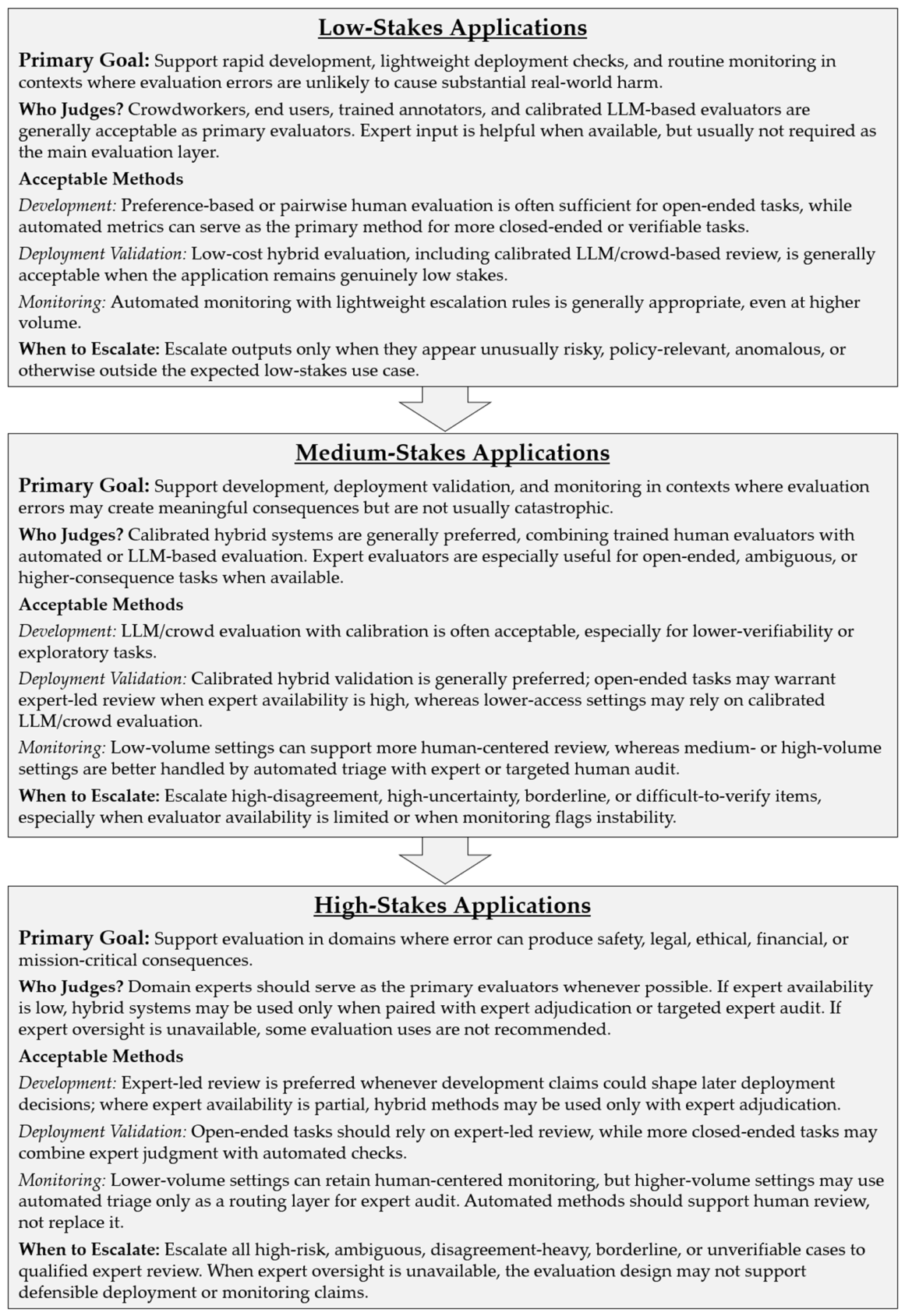
To operationalize these principles, this article introduces a five-dimensional framework for configuring evaluation strategies based on Stakes, Task-type, Evaluator availability, Purpose, and Volume (STEP-V). Figure 1 provides a compact, stakes-based visual summary of the framework, while Supplementary Materials File S5 presents a more detailed set of illustrative configurations. STEP-V is intended to help researchers and practitioners make more defensible evaluation choices in a structured way, but it should be used to guide and constrain design rather than to prescribe a single universally correct solution.

7.1. The STEP-V Dimensions

Stakes refers to the consequences of evaluation error. If a false sense of quality could expose users to harm, legal liability, or serious misinformation, the evaluation design should privilege validity, conservative inference, and expert oversight over cost minimization:
  • Low-stakes applications include settings where evaluation errors have minimal real-world consequences, such as ranking outputs for a creative writing assistant, selecting between alternative marketing slogans, or tuning a chatbot’s tone for engagement. In these contexts, an incorrect evaluation may degrade user experience or preference alignment, but is unlikely to cause harm, making automated metrics or lightweight human preference judgments acceptable.
  • Medium-stakes applications include tasks where evaluation errors can lead to meaningful but non-critical consequences, such as summarizing internal business documents, generating educational explanations for general audiences, or assisting with software development (e.g., code suggestions that are reviewed before deployment). Here, incorrect evaluations may reduce efficiency, introduce errors, or mislead users, but are typically mitigated by downstream human oversight. Hybrid evaluation strategies combining automated metrics, LLM-as-judge systems, and periodic human validation may be appropriate for these applications.
  • High-stakes applications include domains where evaluation errors could result in significant harm, legal exposure, or safety risks, such as medical advice, clinical decision support, legal analysis, financial recommendations, or military planning. In these settings, an incorrect evaluation may falsely certify unsafe or incorrect outputs as acceptable; evaluation designs should therefore prioritize domain experts, multi-dimensional rubrics, conservative decision thresholds, and explicit handling of uncertainty and disagreement, with automated methods used only as support.
Recognizing that resource constraints often conflict with high-stakes requirements, evaluation design should identify a minimum viable validity threshold. When a full expert audit is cost-prohibitive, researchers can leverage a small, high-quality set of expert-vetted labels (approx. 50–100) to calculate a correction factor for a much larger, lower-cost crowd-sourced or LLM-judged dataset [90]. This allows for the calculation of confidence intervals for automated scores, ensuring that borderline cases are flagged for the limited expert time available without compromising the entire pipeline’s integrity [91].
Under evaluator scarcity, sample-size planning should be driven by the uncertainty tolerated for the intended decision (i.e., not by a fixed annotation quota). In practice, this often means beginning with a small expert-labeled anchor set large enough to estimate agreement, calibration error, and obvious subgroup or item-level failure modes, and then allocating additional expert effort preferentially to high-risk, borderline, or disagreement-heavy cases. Lower-cost evaluators such as crowdworkers or LLM judges may then be used to extend coverage, but only after benchmarking them against experts.
Task-type refers to whether the target output is primarily closed-ended and verifiable or open-ended and subjective.
  • Closed-ended tasks include outputs with a clearly defined correct answer or externally verifiable criterion, such as factual question answering (e.g., What is the capital of France?), code generation that must pass unit tests, extraction of structured information from text, or classification tasks with known labels. In these cases, correctness can be evaluated against a reference standard or objective rule, and disagreement is more likely to reflect error than interpretation.
  • Open-ended tasks include outputs where multiple responses may be acceptable depending on context, goals, or audience, such as drafting an essay, providing medical counseling language, generating legal reasoning, summarizing complex documents, or offering strategic recommendations. Here, evaluation depends on subjective or partially observable constructs (e.g., usefulness, clarity, appropriateness), and disagreement may reflect legitimate differences in judgment instead of incorrectness.
Evaluator availability captures which pools are realistically accessible: experts, trained annotators, crowdworkers, end users, or judge models.
  • Low evaluator availability typically arises in domains requiring specialized expertise, such as board-certified physicians evaluating clinical recommendations, legal experts assessing statutory interpretation, or experienced military leaders assessing operational plans. In these cases, evaluators are scarce, expensive, and time-constrained, which places practical limits on sample size and necessitates careful prioritization of what is evaluated and how.
  • Moderate evaluator availability may involve access to trained annotators or smaller, curated participant pools who can apply structured rubrics with some degree of consistency. These evaluators can support more nuanced judgments than crowdworkers but are still limited in scalability and domain expertise.
  • High evaluator availability may include access to large pools of crowdworkers or end users, enabling scalable evaluation of fluency, relevance, or preference through pairwise comparisons or rating tasks. In some settings, LLM-as-judge systems may also be readily available, providing low-cost, high-throughput evaluation for structured or well-defined criteria, albeit with the need for calibration.
Purpose distinguishes early development, pre-deployment validation, and ongoing production monitoring.
  • Early development focuses on rapid iteration and model improvement, where the goal is to identify obvious failure modes and compare alternative model versions. Evaluation at this stage may rely on automated metrics, small-scale human preference tests, or LLM-as-judge systems to provide quick, directional feedback.
  • Pre-deployment validation involves a more rigorous assessment before a system is released into real-world use. Here, the goal is to establish that the model meets predefined performance, safety, and reliability thresholds for its intended application. This often requires structured human evaluation, domain-specific criteria, reliability reporting, and testing across diverse scenarios to ensure the system performs adequately under expected conditions.
  • Ongoing production monitoring occurs after deployment and focuses on detecting performance drift, emerging failure modes, or changes in user interaction patterns over time. Evaluation at this stage is typically high-volume and continuous, relying on automated monitoring, anomaly detection, and selective human review of flagged or high-risk cases to maintain system quality and safety.
Volume refers to the scale and frequency of outputs that must be assessed.
  • Low-volume settings may involve evaluating a small number of outputs, such as benchmarking a new model on a curated test set, conducting expert review of clinical decision-support responses, or auditing a limited set of high-stakes cases. In these scenarios, evaluation can be intensive, allowing for detailed rubrics, multiple expert raters, and adjudication processes.
  • Moderate-volume settings include situations where outputs are generated regularly but not at a massive scale, such as evaluating weekly batches of generated reports, internal tool outputs, or iterative model updates during development. Here, a combination of sampling strategies, structured human evaluation, and partial automation is often used to balance rigor with efficiency.
  • High-volume settings involve continuous or large-scale output generation, such as monitoring millions of chatbot interactions, customer support responses, or real-time recommendation systems. In these contexts, it is infeasible to evaluate every output directly; instead, evaluation relies on automated metrics, statistical sampling, anomaly detection, and escalation pipelines that route a small subset of outputs (e.g., uncertain, high-risk, or outlier cases) to human review.
These distinctions are not rigid; in real-world settings, the boundaries between stakes, task-type, evaluator availability, purpose, and volume are often blurred, interdependent, and context-specific. For example, what constitutes high stakes may differ substantially across domains (e.g., healthcare, finance, education), regulatory environments, or user populations, and the same task may shift in stakes depending on how its outputs are used. Similarly, evaluator availability and volume constraints are shaped by organizational resources, timelines, and deployment scale. As such, these dimensions should be interpreted as guiding variables that must be characterized by the practitioner within their specific operational, legal, and societal context. The STEP-V framework provides a structured rubric to support evaluation design decisions, but it is not a prescriptive formula that yields a single correct configuration.

7.2. Design Logic

The framework dimensions interact; high-stakes, open-ended deployment tasks usually require human experts as primary evaluators, potentially supported by automated prescreening. To bridge the gap between high-stakes requirements and low availability of experts, Expert-Guided Auto-Evaluation is recommended. In this hybrid workflow, the expert’s primary role shifts from labeling individual outputs to architecting the measurement instrument, specifically by designing task-specific rubrics and critique prompts that Tier 2 LLM judges then execute at scale [92]. Recent diagnostic frameworks such as GER-Eval [93] demonstrate that while LLM-generated rubrics can provide consistent scoring, they require expert grounding to maintain alignment with human clinical or legal standards.
Low-stakes, closed-ended development tasks may justify automated metrics or judge models with periodic human calibration. High-volume monitoring settings often require hybrid systems, but those systems should route uncertain, borderline, or high-impact cases to human review; scalable judgment alone is likely insufficient. The framework also makes clear that leveraging humans is not sufficient; which humans, evaluating what, under what rubric, and for what purpose are all essential design questions.
A practical implication is that the evidentiary threshold for adopting LLM-as-judge should itself scale with stakes. In low-stakes development settings, moderate agreement with humans, acceptable perturbation stability, and periodic spot-checking may be sufficient to justify operational use. In medium-stakes settings, stronger calibration and recurring human audits are warranted, especially when judgments affect deployment decisions or user trust. In high-stakes settings, the burden of proof is substantially higher: LLM-as-judge should generally be limited to assistive roles unless there is unusually strong task-specific evidence that it performs comparably to qualified experts on the relevant construct and failure modes. STEP-V therefore does not treat evaluator substitution as a binary decision, but as a context-sensitive measurement claim that must be justified by the application.

7.3. Worked Examples

Consider three examples.
In a medical advice assistant, the stakes are high, as incorrect evaluation could validate outputs that pose safety risks to patients. The task type is largely open-ended, involving interpretation, explanation, and context-sensitive recommendations (i.e., not strictly verifiable answers). Evaluator availability is typically low, requiring domain experts such as physicians or trained clinicians. The immediate purpose is pre-deployment validation, although ongoing monitoring at moderate-to-high volume is also required after deployment. Under these conditions, STEP-V recommends expert-led, rubric-based evaluation as the primary method, emphasizing clinical correctness, safety, uncertainty communication, and appropriateness. Automated metrics or LLM-based evaluators may be used for pre-screening or triage, but should not serve as primary arbiters. During deployment, high-volume monitoring pipelines should incorporate uncertainty estimation and escalation mechanisms, routing ambiguous or high-risk cases to human experts [6,36]. Disagreement among experts should be preserved and analyzed; ideally, it is not collapsed, as it may reflect clinically meaningful ambiguity.
In a consumer writing assistant, the stakes are low to moderate, as evaluation errors primarily affect user satisfaction. The task type is open-ended, with outputs judged on subjective constructs such as clarity, tone, engagement, or creativity. Evaluator availability is high, with access to large pools of end users or crowdworkers. The purpose is typically early-stage development and iterative improvement, with moderate-to-high evaluation volume. In this setting, STEP-V supports pairwise preference testing, user ratings, and LLM-as-judge systems as primary evaluation tools, enabling rapid iteration at scale. Human evaluation may focus on preference alignment and perceived quality, while periodic expert review or targeted audits can be introduced for safety-sensitive or policy-relevant dimensions [12,33,35]. Here, disagreement is expected and often reflects legitimate variation in user preference instead of evaluation error per se.
In a retrieval-based internal enterprise tool answering policy or compliance questions, the stakes are moderate to high, depending on the regulatory or financial implications of incorrect outputs. The task type is more closed-ended or semi-verifiable, as responses should align with known documents or policies. Evaluator availability is moderate, often involving trained internal staff or subject-matter experts, though not necessarily at scale. The purpose includes both pre-deployment validation and ongoing monitoring, with high output volume in deployment. In this configuration, STEP-V supports a hybrid evaluation strategy: automated checks for factual consistency (e.g., retrieval alignment, citation correctness), supplemented by LLM-as-judge systems calibrated against human labels, and periodic human audits of sampled outputs [7,10,28]. High-risk or uncertain cases should be escalated for expert review. Evaluation design should explicitly distinguish between objective correctness (e.g., policy compliance) and subjective qualities (e.g., clarity or usefulness), applying different evaluators and metrics to each.
These examples illustrate that evaluation quality depends on the fit between context and design. STEP-V is intended to make that fit more explicit and more reproducible [11,12].

7.4. When STEP-V Can Fail

STEP-V is a design-support framework, not a guarantee against evaluation error. There are many potential scenarios under which the framework can fail, including:
  • When the construct itself is poorly specified.
  • When available evaluators share the same systematic biases.
  • When high-stakes tasks lack access to minimally sufficient expert oversight.
  • When disagreement is inappropriately collapsed into a single consensus score.
In such cases, STEP-V may be helpful for organizing the decision space, but it cannot rescue an evaluation pipeline built on an invalid construct, an inadequate evaluator pool, or a protocol that masks uncertainty.

8. Methodological Guidance

The literature supports a set of practical recommendations for improving human-centered LLM evaluation and minimal reporting standards (see Supplementary Materials File S3). Evaluation design should begin with explicit operationalization of the target criteria, including clear definitions, representative examples, and treatment of edge cases. Evaluator selection should then be justified in relation to the construct of interest. Protocols should be structured to minimize known sources of bias through measures such as blinding, randomization, calibration, and workload management. Studies should also report reliability statistics and uncertainty estimates alongside average scores, because point estimates alone can create a misleading impression of precision and make results harder to interpret across studies [90,91,94]. In addition, automated metrics and LLM-based evaluators should be calibrated against human judgments on the target task (i.e., they should not be assumed valid by default). Finally, when human labels are used as reference standards in high-stakes settings, researchers should consider methods that explicitly model annotation imperfection [7,47].
Adoption thresholds for LLM-as-judge should be tied to stakes and supported by multiple forms of evidence, not just a single agreement coefficient. For low-stakes applications, LLM-as-judge systems may be used as primary evaluators when they demonstrate acceptable agreement with the target human evaluator population, stability under prompt and formatting perturbations, and no large systematic bias on known failure modes such as verbosity, position, or authority effects. For medium-stakes applications, these systems should additionally be recalibrated against fresh human judgments at regular intervals and used with explicit escalation rules for uncertain, borderline, or disagreement-heavy cases. For high-stakes applications, LLM-as-judge systems should not replace qualified human experts as the primary arbiter; instead, they should be restricted to supportive roles such as prescreening, structured sub-criterion checks, or prioritization of cases for review. In all cases, acceptance should be based on a bundle of evidence: agreement with qualified humans on the target task, robustness to perturbations, bias audits, and uncertainty estimates.
Sample-size planning should begin from target uncertainty and evaluator scarcity. When expert evaluators are scarce, researchers should first define the precision required for the intended decision, for example a target confidence interval width for mean ratings, agreement estimates, or calibration errors. A practical strategy is to build a small expert-vetted anchor set, then use that set to calibrate a larger, lower-cost annotation pool, such as trained annotators, crowdworkers, or LLM judges. In high-stakes settings, expert effort should be concentrated on ambiguous, high-risk, or disagreement-prone cases. In high-volume settings, stratified sampling, active sampling, or uncertainty-based escalation can improve efficiency by routing the most informative cases to experts. Where a full expert audit is infeasible, a small but high-quality expert set can still support correction factors and confidence intervals for a larger, lower-cost sample.
Evaluation studies should use psychometric models that match the rating protocol and explicitly estimate rater and item effects. For ordinal rubric or Likert-style ratings, hierarchical ordinal models can estimate construct scores while accounting for rater severity, item difficulty, and uncertainty. For structured multi-rater settings, many-facet Rasch models [54] are especially useful because they separate latent performance from rater harshness and item difficulty. For pairwise preference data, Bradley–Terry [55,95] or related Thurstone-style [96] models provide principled estimates of relative quality. In settings where no evaluator should be assumed error-free, latent-class or imperfect-gold-standard models may be preferable to a simple majority vote. The specific model should be selected based on the data structure and construct definition, but the general goal is the same: to avoid treating observed ratings as direct, error-free measurements.
Disagreement should be reported and interpreted as a first-class result. In addition to reporting aggregate means or win rates, researchers should present dispersion across raters, subgroup-specific rating distributions, and human-model divergence. For ordinal or categorical judgments, useful summaries include agreement coefficients, confusion patterns, and subgroup-stratified distributions. For distributional alignment between model outputs and human judgments, measures such as Kullback–Leibler divergence [49] and Earth Mover’s Distance [50] can quantify whether a system matches the full spread of human opinion (i.e., versus only its mean). Practically, large disagreement, subgroup divergence, or instability under perturbation should trigger adjudication, protocol review, or targeted expert audit. In subjective or culturally contingent tasks, divergence should not automatically be interpreted as error; it may instead indicate construct ambiguity or legitimate perspectival variation.
To increase practical utility, future evaluations should include at least a minimal reporting standard covering evaluator recruitment, training, task instructions, scale format, session length, adjudication rules, reliability statistics, and uncertainty reporting [8,97]. Without such documentation, evaluation results remain difficult to interpret, reproduce, or compare across studies [10,94]. To further improve reproducibility and uptake, practical reporting materials should accompany evaluation studies whenever possible. These materials may include example rubrics, calibration prompts, adjudication rules, audit checklists, and minimal analysis templates for reliability, disagreement, and uncertainty reporting. Even when a study is not primarily methodological, releasing such materials can clarify how constructs were operationalized, how raters were trained, and how borderline or contested cases were handled in practice. An example audit template is provided in Supplementary Materials File S4.

9. Limitations and Future Directions

The literature on LLM evaluation is moving rapidly, and any synthesis risks near-term obsolescence. STEP-V and the failure-mode taxonomy are conceptual frameworks that require prospective validation. Their value will depend on whether they improve real evaluation design and whether their predictions about bias, disagreement, and hybrid-system performance are borne out empirically.
Several research directions follow naturally. One is longitudinal work on how human evaluators change as they gain familiarity with LLM outputs and failure modes. Another is deeper integration with psychometrics, including formal treatment of rater effects, latent constructs, measurement invariance across cultures and evaluator populations, and practical model templates that can be applied to common LLM evaluation datasets. Future work should also operationalize disagreement-aware pipelines more concretely by specifying distributional metrics, visualization standards, subgroup-audit procedures, and escalation rules for cases where human–human or human-model divergence is large. A further need is decision-support tooling for study design, including sample-size and power planning under evaluator scarcity, uncertainty-targeted allocation of expert effort, and practical calculators that translate desired precision into annotation requirements under different STEP-V configurations. Finally, field-wide progress would benefit from stronger reporting norms, shared evaluation methods, and benchmark ecosystems that preserve contextual richness while maintaining enough standardization to support comparison across studies.
An additional future direction is to operationalize STEP-V as a semi-quantitative decision tool. Each dimension could be assigned ordinal levels and linked to predicted risk outputs such as construct validity threat, inter-rater reliability risk, shared-bias amplification, review cost, and escalation burden. With prospective benchmarking across tasks, these mappings could eventually support bounded error estimates or confidence intervals for candidate evaluation designs. At present, however, STEP-V is best interpreted as a conceptual framework whose quantitative instantiation remains an empirical research agenda.

10. Conclusions

Evaluating LLMs has reached a critical bottleneck: while model capabilities continue to scale exponentially, frameworks for judging those capabilities remain somewhat fragmented and under-theorized. Human evaluation is not only a ground truth to be reached, but a measurement infrastructure that must be engineered with the same precision as the models themselves.
Through the proposed STEP-V framework, a roadmap is provided to help align evaluation strategies with the frictions of real-world constraints. Whether in the high-stakes corridors of healthcare or the creative playground of writing assistants, the choice of who evaluates and how they are prompted determines the validity of the resulting data. Furthermore, the failure mode taxonomy warns against the uncritical adoption of hybrid AI-human pipelines, showing that without careful calibration, there is a risk of compounding rather than mitigating bias. As LLMs become more like humans in their outputs, the rigor with which they are evaluated must become more scientific and guided by the established theories, tools, and techniques of the cognitive sciences, psychometrics, and human factors engineering.

Supplementary Materials

The following supporting information can be downloaded at https://www.mdpi.com/article/10.3390/ai7050174/s1, File S1. Illustrative Scoring Rubrics; File S2. Example Calibration Prompts; File S3. Example Reporting Template; File S4. Example Audit Checklist; File S5. STEP-V Illustrative Configurations.

Funding

This work was supported by the U.S. Army DEVCOM Soldier Center under the Augmented Decisions via Intelligent Systems Recommendations (ADVISR) program (BC1/3D).

Institutional Review Board Statement

Not applicable.

Informed Consent Statement

Not applicable.

Data Availability Statement

Not applicable.

Conflicts of Interest

The author declares no conflicts of interest. The opinions or assertions contained herein are the private views of the author and are not to be construed as official or reflecting the views, policies, or positions of the United States Army or the United States Department of War. Any citations of commercial organizations and trade names in this report do not constitute an official Department of the Army endorsement or approval of the products or services of these organizations.

Abbreviations

The following abbreviations are used in this manuscript:
AIArtificial Intelligence
NLPNatural Language Processing
LLMLarge Language Model
IRRInter-Rater Reliability
BLEUBilingual Evaluation Understudy
ROUGERecall-Oriented Understudy for Gisting Evaluation
METEORMetric for Evaluation of Translation with Explicit Ordering
BERTBidirectional Encoder Representations from Transformers
STEP-VStakes, Task-type, Evaluator availability, Purpose, Volume
CoTChain-of-Thought
RLHFReinforcement Learning from Human Feedback
SxSSide-by-Side (comparison)
ELOElo Rating System

References

  1. Annepaka, Y.; Pakray, P. Large Language Models: A Survey of Their Development, Capabilities, and Applications. Knowl. Inf. Syst. 2025, 67, 2967–3022. [Google Scholar] [CrossRef]
  2. Minaee, S.; Mikolov, T.; Nikzad, N.; Chenaghlu, M.; Socher, R.; Amatriain, X.; Gao, J. Large Language Models: A Survey. arXiv 2025, arXiv:2402.06196. [Google Scholar]
  3. Luo, J.; Wu, B.; Luo, X.; Xiao, Z.; Jin, Y.; Tu, R.-C.; Yin, N.; Wang, Y.; Yuan, J.; Ju, W.; et al. A Survey on Efficient Large Language Model Training: From Data-Centric Perspectives. In Proceedings of the 63rd Annual Meeting of the Association for Computational Linguistics (Volume 1: Long Papers), Vienna, Austria, 27 July–1 August 2025; Che, W., Nabende, J., Shutova, E., Pilehvar, M.T., Eds.; Association for Computational Linguistics: Stroudsburg, PA, USA, 2025; pp. 30904–30920. [Google Scholar]
  4. Bohnet, B.; Dangovski, R.; Swersky, K.; Moore, S.; Chaudhry, A.; Kenealy, K.; Fiedel, N. A Comparative Analysis of LLM Adaptation: SFT, LoRA, and ICL in Data-Scarce Scenarios. arXiv 2025, arXiv:2511.00130. [Google Scholar]
  5. Celikyilmaz, A.; Clark, E.; Gao, J. Evaluation of Text Generation: A Survey. arXiv 2020, arXiv:2006.14799. [Google Scholar]
  6. Awasthi, R.; Bhattad, A.; Ramachandran, S.P.; Mishra, S.; Khanna, A.K.; Cywinski, J.B.; Maheshwari, K.; Mahapatra, D.; DiRosa, I.; Cohen, A.; et al. Human Evaluation of Large Language Models in Healthcare: Gaps, Challenges, and the Need for Standardization. npj Health Syst. 2025, 2, 40. [Google Scholar] [CrossRef]
  7. Gu, J.; Jiang, X.; Shi, Z.; Tan, H.; Zhai, X.; Xu, C.; Li, W.; Shen, Y.; Ma, S.; Liu, H.; et al. A Survey on LLM-as-a-Judge. Innovation 2026. [Google Scholar] [CrossRef]
  8. Belz, A.; Thompson, C.; Reiter, E.; Mille, S. Non-Repeatable Experiments and Non-Reproducible Results: The Reproducibility Crisis in Human Evaluation in NLP. In Proceedings of the Findings of the Association for Computational Linguistics, Toronto, ON, Canada, 9–14 July 2023; Association for Computational Linguistics: Stroudsburg, PA, USA, 2023; pp. 3676–3687. [Google Scholar]
  9. Schmidtová, P.; Calò, E.; Balloccu, S.; Gkatzia, D.; Huidrom, R.; Lango, M.; Same, F.; Zouhar, V.; Mahamood, S.; Dušek, O. Do My Eyes Deceive Me? A Survey of Human Evaluations of Hallucinations in NLG; Association for Computational Linguistics (ACL): Stroudsburg, PA, USA, 2025; pp. 60–79. [Google Scholar]
  10. Elangovan, A.; Liu, L.; Xu, L.; Bodapati, S.B.; Roth, D. Considers-the-Human Evaluation Framework: Rethinking Human Evaluation for Generative Large Language Models. In Proceedings of the 62nd Annual Meeting of the Association for Computational Linguistics (Volume 1: Long Papers), Bangkok, Thailand, 11–16 August 2024; Association for Computational Linguistics: Stroudsburg, PA, USA, 2024; pp. 1137–1160. [Google Scholar]
  11. Serapio-García, G.; Safdari, M.; Crepy, C.; Sun, L.; Fitz, S.; Romero, P.; Matarić, M. A Psychometric Framework for Evaluating and Shaping Personality Traits in Large Language Models. Nat. Mach. Intell. 2025, 7, 1954–1968. [Google Scholar] [CrossRef]
  12. van der Lee, C.; Gatt, A.; van Miltenburg, E.; Wubben, S.; Krahmer, E. Best Practices for the Human Evaluation of Automatically Generated Text. In Proceedings of the 12th International Conference on Natural Language Generation, Tokyo, Japan, 29 October–1 November 2019; Association for Computational Linguistics: Stroudsburg, PA, USA, 2019; pp. 355–368. [Google Scholar]
  13. Gehman, S.; Gururangan, S.; Sap, M.; Choi, Y.; Smith, N.A. RealToxicityPrompts: Evaluating Neural Toxic Degeneration in Language Models. In Proceedings of the Findings of the Association for Computational Linguistics: EMNLP 2020; Cohn, T., He, Y., Liu, Y., Eds.; Association for Computational Linguistics: Stroudsburg, PA, USA, 2020; pp. 3356–3369. [Google Scholar]
  14. Liu, Y.; Iter, D.; Xu, Y.; Wang, S.; Xu, R.; Zhu, C. G-Eval: NLG Evaluation Using Gpt-4 with Better Human Alignment. In Proceedings of the 2023 Conference on Empirical Methods in Natural Language Processing; Bouamor, H., Pino, J., Bali, K., Eds.; Association for Computational Linguistics: Stroudsburg, PA, USA, 2023; pp. 2511–2522. [Google Scholar]
  15. Ouyang, L.; Wu, J.; Jiang, X.; Almeida, D.; Wainwright, C.; Mishkin, P.; Zhang, C.; Agarwal, S.; Slama, K.; Ray, A.; et al. Training Language Models to Follow Instructions with Human Feedback. In Proceedings of the Advances in Neural Information Processing Systems; Curran Associates, Inc.: New York, NY, USA, 2022; Volume 35, pp. 27730–27744. [Google Scholar]
  16. Zheng, L.; Chiang, W.-L.; Sheng, Y.; Zhuang, S.; Wu, Z.; Zhuang, Y.; Lin, Z.; Li, Z.; Li, D.; Xing, E.; et al. Judging LLM-as-a-Judge with MT-Bench and Chatbot Arena. Adv. Neural Inf. Process. Syst. 2023, 36, 46595–46623. [Google Scholar]
  17. Wang, P.; Li, L.; Chen, L.; Cai, Z.; Zhu, D.; Lin, B.; Cao, Y.; Kong, L.; Liu, Q.; Liu, T.; et al. Large Language Models Are Not Fair Evaluators. In Proceedings of the 62nd Annual Meeting of the Association for Computational Linguistics (Volume 1: Long Papers); Ku, L.-W., Martins, A., Srikumar, V., Eds.; Association for Computational Linguistics: Stroudsburg, PA, USA, 2024; pp. 9440–9450. [Google Scholar]
  18. Fu, X.; Liu, W. How Reliable Is Multilingual LLM-as-a-Judge? arXiv 2025, arXiv:2505.12201. [Google Scholar] [CrossRef]
  19. Bavaresco, A.; Bernardi, R.; Bertolazzi, L.; Elliott, D.; Fernández, R.; Gatt, A.; Ghaleb, E.; Giulianelli, M.; Hanna, M.; Koller, A.; et al. LLMs Instead of Human Judges? A Large Scale Empirical Study Across 20 NLP Evaluation Tasks. In Proceedings of the 63rd Annual Meeting of the Association for Computational Linguistics (Volume 2: Short Papers); Association for Computational Linguistics: Stroudsburg, PA, USA, 2025; pp. 238–255. [Google Scholar]
  20. Calderon, N.; Reichart, R.; Dror, R. The Alternative Annotator Test for LLM-as-a-Judge: How to Statistically Justify Replacing Human Annotators with LLMs. In Proceedings of the 63rd Annual Meeting of the Association for Computational Linguistics (Volume 1: Long Papers); Association for Computational Linguistics: Stroudsburg, PA, USA, 2025; pp. 16051–16081. [Google Scholar]
  21. Waikar, S.S.; Betensky, R.A.; Emerson, S.C.; Bonventre, J.V. Imperfect Gold Standards for Biomarker Evaluation. Clin. Trials 2013, 10, 696–700. [Google Scholar] [CrossRef]
  22. Xu, Q.; Walder, C.; Xu, C. Humanly Certifying Superhuman Classifiers. arXiv 2021, arXiv:2109.07867. [Google Scholar] [CrossRef]
  23. Weber-Genzel, L.; Peng, S.; De Marneffe, M.-C.; Plank, B. VariErr NLI: Separating Annotation Error from Human Label Variation. In Proceedings of the 62nd Annual Meeting of the Association for Computational Linguistics (Volume 1: Long Papers); Association for Computational Linguistics: Stroudsburg, PA, USA, 2024; pp. 2256–2269. [Google Scholar]
  24. Croxford, E.; Gao, Y.; Pellegrino, N.; Wong, K.; Wills, G.; First, E.; Liao, F.; Goswami, C.; Patterson, B.; Afshar, M. Current and Future State of Evaluation of Large Language Models for Medical Summarization Tasks. npj Health Syst. 2025, 2, 6. [Google Scholar] [CrossRef]
  25. Kratzke, N.; Beuter, N.; Drews, A.; Janneck, M. PSYCH—Psychometric Assessment of Large Language Model Characters: An Exploration of the German Language. Analytics 2026, 5, 5. [Google Scholar] [CrossRef]
  26. Jing, F.; Zhang, Y.; Gao, M.; Zhang, X.; Zhou, H. A Review of Federated Large Language Models for Industry 4.0. Sensors 2026, 26, 1116. [Google Scholar] [CrossRef]
  27. Larraz, R. The Convergence of Artificial Intelligence and Industrial Transformation. In Prompt Engineering and the Transformation of Petroleum Refining: From Historical Innovation to Net Zero Systems; Larraz, R., Ed.; Springer Nature: Cham, Switzerland, 2026; pp. 1–9. ISBN 978-3-031-99728-0. [Google Scholar]
  28. Gao, Y.; Xiong, Y.; Gao, X.; Jia, K.; Pan, J.; Bi, Y.; Dai, Y.; Sun, J.; Wang, M.; Wang, H. Retrieval-Augmented Generation for Large Language Models: A Survey. arXiv 2024, arXiv:2312.10997. [Google Scholar]
  29. Chen, A.; Stanovsky, G.; Singh, S.; Gardner, M. Evaluating Question Answering Evaluation. In Proceedings of the 2nd Workshop on Machine Reading for Question Answering; Fisch, A., Talmor, A., Jia, R., Seo, M., Choi, E., Chen, D., Eds.; Association for Computational Linguistics: Stroudsburg, PA, USA, 2019; pp. 119–124. [Google Scholar]
  30. Zhang, T.; Kishore, V.; Wu, F.; Weinberger, K.Q.; Artzi, Y. BERTScore: Evaluating Text Generation with BERT. In Proceedings of the International Conference on Learning Representations, Addis Ababa, Ethiopia, 26 April–1 May 2020. [Google Scholar]
  31. Zhou, C.; Liu, P.; Xu, P.; Iyer, S.; Sun, J.; Mao, Y.; Ma, X.; Efrat, A.; Yu, P.; Yu, L.; et al. LIMA: Less Is More for Alignment. Adv. Neural Inf. Process. Syst. 2023, 36, 55006–55021. [Google Scholar]
  32. Huang, L.; Yu, W.; Ma, W.; Zhong, W.; Feng, Z.; Wang, H.; Chen, Q.; Peng, W.; Feng, X.; Qin, B.; et al. A Survey on Hallucination in Large Language Models: Principles, Taxonomy, Challenges, and Open Questions. ACM Trans. Inf. Syst. 2025, 43, 42. [Google Scholar] [CrossRef]
  33. Howcroft, D.M.; Belz, A.; Clinciu, M.; Gkatzia, D.; Hasan, S.A.; Mahamood, S.; Rieser, V. Twenty Years of Confusion in Human Evaluation: NLG Needs Evaluation Sheets and Standardised Definitions. In Proceedings of the 13th International Conference on Natural Language Generation; Association for Computational Linguistics: Stroudsburg, PA, USA, 2020; pp. 169–182. [Google Scholar]
  34. Singhal, K.; Azizi, S.; Tu, T.; Mahdavi, S.S.; Wei, J.; Chung, H.W.; Scales, N.; Tanwani, A.; Cole-Lewis, H.; Pfohl, S.; et al. Large Language Models Encode Clinical Knowledge. Nature 2023, 620, 172–180. [Google Scholar] [CrossRef] [PubMed]
  35. Reiter, E. Types of NLG Evaluation: Which Is Right for Me? Available online: https://ehudreiter.com/2017/01/19/types-of-nlg-evaluation/ (accessed on 12 February 2026).
  36. Tam, T.Y.C.; Sivarajkumar, S.; Kapoor, S.; Stolyar, A.V.; Polanska, K.; McCarthy, K.R.; Osterhoudt, H.; Wu, X.; Visweswaran, S.; Fu, S.; et al. A Framework for Human Evaluation of Large Language Models in Healthcare Derived from Literature Review. npj Digit. Med. 2024, 7, 258. [Google Scholar] [CrossRef] [PubMed]
  37. Klie, J.-C.; Eckart de Castilho, R.; Gurevych, I. Analyzing Dataset Annotation Quality Management in the Wild. Comput. Linguist. 2024, 50, 817–866. [Google Scholar] [CrossRef]
  38. Lee, J.; Hockenmaier, J. Evaluating Step-by-Step Reasoning Traces: A Survey. In Proceedings of the 2025 Conference on Empirical Methods in Natural Language Processing (EMNLP 2025); Association for Computational Linguistics: Stroudsburg, PA, USA, 2025. [Google Scholar]
  39. Bhambri, S.; Biswas, U.; Kambhampati, S. Do Cognitively Interpretable Reasoning Traces Improve LLM Performance? arXiv 2025, arXiv:2508.16695. [Google Scholar] [CrossRef]
  40. Brookhart, S.M. Appropriate Criteria: Key to Effective Rubrics. Front. Educ. 2018, 3, 22. [Google Scholar] [CrossRef]
  41. Jamieson, S. Likert Scales: How to (Ab)Use Them. Med. Educ. 2004, 38, 1217–1218. [Google Scholar] [CrossRef]
  42. Tourangeau, R.; Rips, L.J.; Rasinski, K. The Psychology of Survey Response; Cambridge University Press: Cambridge, UK, 2000; ISBN 978-0-521-57629-1. [Google Scholar]
  43. Fleiss, J.L.; Levin, B.; Paik, M.C. Statistical Methods for Rates and Proportions; John Wiley & Sons: Oxford, UK, 2003; ISBN 0-471-52629-0. [Google Scholar]
  44. Fleisig, E.; Blodgett, S.L.; Klein, D.; Talat, Z. The Perspectivist Paradigm Shift: Assumptions and Challenges of Capturing Human Labels. In Proceedings of the 2024 Conference of the North American Chapter of the Association for Computational Linguistics: Human Language Technologies (Volume 1: Long Papers); Duh, K., Gomez, H., Bethard, S., Eds.; Association for Computational Linguistics: Stroudsburg, PA, USA, 2024; pp. 2279–2292. [Google Scholar]
  45. Goto, T.; Sakai, Y.; Watanabe, T. Rethinking Evaluation Metrics for Grammatical Error Correction: Why Use a Different Evaluation Process than Human? In Proceedings of the 63rd Annual Meeting of the Association for Computational Linguistics (Volume 2: Short Papers); Che, W., Nabende, J., Shutova, E., Pilehvar, M.T., Eds.; Association for Computational Linguistics: Stroudsburg, PA, USA, 2025; pp. 1165–1172. [Google Scholar]
  46. Mohankumar, A.K.; Khapra, M. Active Evaluation: Efficient NLG Evaluation with Few Pairwise Comparisons. In Proceedings of the 60th Annual Meeting of the Association for Computational Linguistics (Volume 1: Long Papers); Muresan, S., Nakov, P., Villavicencio, A., Eds.; Association for Computational Linguistics: Stroudsburg, PA, USA, 2022; pp. 8761–8781. [Google Scholar]
  47. Artstein, R.; Poesio, M. Inter-Coder Agreement for Computational Linguistics. Comput. Linguist. 2008, 34, 555–596. [Google Scholar] [CrossRef]
  48. Passonneau, R.J. Measuring Agreement on Set-Valued Items (MASI) for Semantic and Pragmatic Annotation. In Proceedings of the Fifth International Conference on Language Resources and Evaluation (LREC 2006); European Language Resources Association: Luxembourg, 2006; pp. 831–836. [Google Scholar]
  49. Kullback, S.; Leibler, R.A. On Information and Sufficiency. Ann. Math. Stat. 1951, 22, 79–86. [Google Scholar] [CrossRef]
  50. Rubner, Y.; Tomasi, C.; Guibas, L.J. A Metric for Distributions with Applications to Image Databases. In Proceedings of the Sixth International Conference on Computer Vision; IEEE: New York, NY, USA, 1998; pp. 59–66. [Google Scholar]
  51. Orlikowski, M.; Pei, J.; Röttger, P.; Cimiano, P.; Jurgens, D.; Hovy, D. Beyond Demographics: Fine-Tuning Large Language Models to Predict Individuals’ Subjective Text Perceptions. In Proceedings of the 63rd Annual Meeting of the Association for Computational Linguistics (Volume 1: Long Papers); Che, W., Nabende, J., Shutova, E., Pilehvar, M.T., Eds.; Association for Computational Linguistics: Stroudsburg, PA, USA, 2025; pp. 2092–2111. [Google Scholar]
  52. Xu, Y.; Jurgens, D. Beyond Consensus: Perspectivist Modeling and Evaluation of Annotator Disagreement in NLP. arXiv 2026, arXiv:2601.09065. [Google Scholar] [CrossRef]
  53. Brunyé, T.T.; Balla, A.; Drew, T.; Elmore, J.G.; Kerr, K.F.; Shucard, H.; Weaver, D.L. From Image to Diagnosis: Characterizing Sources of Error in Histopathologic Interpretation. Mod. Pathol. 2023, 36, 100162. [Google Scholar] [CrossRef]
  54. Myford, C.M.; Wolfe, E.W. Detecting and Measuring Rater Effects Using Many-Facet Rasch Measurement: Part I. J. Appl. Meas. 2003, 4, 386–422. [Google Scholar]
  55. Bradley, R.A.; Terry, M.E. Rank Analysis of Incomplete Block Designs: I. The Method of Paired Comparisons. Biometrika 1952, 39, 324–345. [Google Scholar] [CrossRef]
  56. Shi, L.; Ma, C.; Liang, W.; Diao, X.; Ma, W.; Vosoughi, S. Judging the Judges: A Systematic Study of Position Bias in LLM-as-a-Judge. arXiv 2025. [Google Scholar] [CrossRef]
  57. Tversky, A.; Kahneman, D. Judgment under Uncertainty: Heuristics and Biases. Biases in Judgments Reveal Some Heuristics of Thinking under Uncertainty. Science 1974, 185, 1124–1131. [Google Scholar] [CrossRef]
  58. Krippendorff, K. Content Analysis: An Introduction to Its Methodology; SAGE Publications: Thousand Oaks, CA, USA, 2018; ISBN 978-1-5063-9567-8. [Google Scholar]
  59. Hogarth, R.M.; Einhorn, H.J. Order Effects in Belief Updating: The Belief-Adjustment Model. Cogn. Psychol. 1992, 24, 1–55. [Google Scholar] [CrossRef]
  60. Chaiken, S. Heuristic versus Systematic Information Processing and the Use of Source versus Message Cues in Persuasion. J. Personal. Soc. Psychol. 1980, 39, 752–766. [Google Scholar] [CrossRef]
  61. Petty, R.E.; Briñol, P. The Elaboration Likelihood and Metacognitive Models of Attitudes: Implications for Prejudice, the Self, and Beyond. In Dual-Process Theories of the Social Mind; The Guilford Press: New York, NY, USA, 2014; pp. 172–187. ISBN 978-1-4625-1439-7. [Google Scholar]
  62. Oppenheimer, D.M. Consequences of Erudite Vernacular Utilized Irrespective of Necessity: Problems with Using Long Words Needlessly. Appl. Cogn. Psychol. 2006, 20, 139–156. [Google Scholar] [CrossRef]
  63. Asch, S.E. Effects of Group Pressure upon the Modification and Distortion of Judgments. In Groups, Leadership and Men; Research in Human Relations; Carnegie Press: Oxford, UK, 1951; pp. 177–190. [Google Scholar]
  64. Cialdini, R.B.; Goldstein, N.J. Social Influence: Compliance and Conformity. Annu. Rev. Psychol. 2004, 55, 591–621. [Google Scholar] [CrossRef]
  65. Griffin, D.; Tversky, A. The Weighing of Evidence and the Determinants of Confidence. Cogn. Psychol. 1992, 24, 411–435. [Google Scholar] [CrossRef]
  66. Moore, D.A.; Healy, P.J. The Trouble with Overconfidence. Psychol. Rev. 2008, 115, 502–517. [Google Scholar] [CrossRef] [PubMed]
  67. Jiang, Z.; Araki, J.; Ding, H.; Neubig, G. How Can We Know When Language Models Know? On the Calibration of Language Models for Question Answering. Trans. Assoc. Comput. Linguist. 2021, 9, 962–977. [Google Scholar] [CrossRef]
  68. Xiong, M.; Hu, Z.; Lu, X.; Li, Y.; Fu, J.; He, J.; Hooi, B. Can LLMs Express Their Uncertainty? An Empirical Evaluation of Confidence Elicitation in LLMs. arXiv 2024, arXiv:2306.13063. [Google Scholar] [CrossRef]
  69. Boksem, M.A.S.; Meijman, T.F.; Lorist, M.M. Effects of Mental Fatigue on Attention: An ERP Study. Cogn. Brain Res. 2005, 25, 107–116. [Google Scholar] [CrossRef]
  70. Hopstaken, J.F.; van der Linden, D.; Bakker, A.B.; Kompier, M.A.J.; Leung, Y.K. Shifts in Attention during Mental Fatigue: Evidence from Subjective, Behavioral, Physiological, and Eye-Tracking Data. J. Exp. Psychol. Hum. Percept. Perform. 2016, 42, 878–889. [Google Scholar] [CrossRef]
  71. Vinay, V. Failure Modes in LLM Systems: A System-Level Taxonomy for Reliable AI Applications. arXiv 2025, arXiv:2511.19933. [Google Scholar] [CrossRef]
  72. Chi, M.T.H.; Feltovich, P.J.; Glaser, R. Categorization and Representation of Physics Problems by Experts and Novices. Cogn. Sci. 1981, 5, 121–152. [Google Scholar] [CrossRef] [PubMed]
  73. Nourani, M.; King, J.T.; Ragan, E.D. The Role of Domain Expertise in User Trust and the Impact of First Impressions with Intelligent Systems. In Proceedings of AAAI Conference on Human Computation and Crowdsourcing (HCOMP); Association for the Advancement of Artificial Intelligence (AAAI): Washington, DC, USA, 2020. [Google Scholar]
  74. Mallen, A.; Asai, A.; Zhong, V.; Das, R.; Khashabi, D.; Hajishirzi, H. When Not to Trust Language Models: Investigating Effectiveness of Parametric and Non-Parametric Memories. In Proceedings of the 61st Annual Meeting of the Association for Computational Linguistics (Volume 1: Long Papers); Rogers, A., Boyd-Graber, J., Okazaki, N., Eds.; Association for Computational Linguistics: Stroudsburg, PA, USA, 2023; pp. 9802–9822. [Google Scholar]
  75. Henrich, J.; Heine, S.J.; Norenzayan, A. The Weirdest People in the World? Behav. Brain Sci. 2010, 33, 61–83. [Google Scholar] [CrossRef]
  76. Markus, H.R.; Kitayama, S. Culture and the Self: Implications for Cognition, Emotion, and Motivation. In College Student Development and Academic Life; Routledge: Oxfordshire, UK, 1998. [Google Scholar]
  77. Bender, E.M.; Gebru, T.; McMillan-Major, A.; Shmitchell, S. On the Dangers of Stochastic Parrots: Can Language Models Be Too Big? In Proceedings of the 2021 ACM Conference on Fairness, Accountability, and Transparency; Association for Computing Machinery: New York, NY, USA, 2021; pp. 610–623. [Google Scholar]
  78. Bommasani, R.; Hudson, D.A.; Adeli, E.; Altman, R.; Arora, S.; von Arx, S.; Bernstein, M.S.; Bohg, J.; Bosselut, A.; Brunskill, E.; et al. On the Opportunities and Risks of Foundation Models. arXiv 2022, arXiv:2108.07258. [Google Scholar]
  79. DePaulo, B.M.; Lindsay, J.J.; Malone, B.E.; Muhlenbruck, L.; Charlton, K.; Cooper, H. Cues to Deception. Psychol. Bull. 2003, 129, 74–118. [Google Scholar] [CrossRef]
  80. Pennycook, G.; Rand, D.G. Lazy, Not Biased: Susceptibility to Partisan Fake News Is Better Explained by Lack of Reasoning than by Motivated Reasoning. Cognition 2019, 188, 39–50. [Google Scholar] [CrossRef]
  81. Sendak, M.P.; D’Arcy, J.; Kashyap, S.; Gao, M.; Nichols, M.; Corey, K.; Ratliff, W.; Balu, S. A Path for Translation of Machine Learning Products into Healthcare Delivery. EMJ Innov. 2020, 10, 19–00172. [Google Scholar] [CrossRef]
  82. Hernandez-Boussard, T.; Bozkurt, S.; Ioannidis, J.P.A.; Shah, N.H. MINIMAR (MINimum Information for Medical AI Reporting): Developing Reporting Standards for Artificial Intelligence in Health Care. J. Am. Med. Inform. Assoc. 2020, 27, 2011–2015. [Google Scholar] [CrossRef] [PubMed]
  83. Wiens, J.; Saria, S.; Sendak, M.; Ghassemi, M.; Liu, V.X.; Doshi-Velez, F.; Jung, K.; Heller, K.; Kale, D.; Saeed, M.; et al. Do No Harm: A Roadmap for Responsible Machine Learning for Health Care. Nat. Med. 2019, 25, 1337–1340. [Google Scholar] [CrossRef]
  84. Rajpurkar, P.; Chen, E.; Banerjee, O.; Topol, E.J. AI in Health and Medicine. Nat. Med. 2022, 28, 31–38. [Google Scholar] [CrossRef] [PubMed]
  85. Brunyé, T.T.; Mitroff, S.R.; Elmore, J.G. Artificial Intelligence and Computer-Aided Diagnosis in Diagnostic Decisions: 5 Questions for Medical Informatics and Human-Computer Interface Research. J. Am. Med. Inform. Assoc. 2026, 33, 543–550. [Google Scholar] [CrossRef]
  86. Dahl, M.; Magesh, V.; Suzgun, M.; Ho, D.E. Large Legal Fictions: Profiling Legal Hallucinations in Large Language Models. J. Leg. Anal. 2024, 16, 64. [Google Scholar] [CrossRef]
  87. Hu, Y.; Liu, H.; Wang, C.; Li, K.; Wu, T.-H.; Li, H.; Xu, X.; Huo, S.; Su, W.; Zheng, N.; et al. Evaluation of Large Language Models in Legal Applications: Challenges, Methods, and Future Directions. arXiv 2026, arXiv:2601.15267. [Google Scholar] [CrossRef]
  88. Magesh, V.; Surani, F.; Dahl, M.; Suzgun, M.; Manning, C.D.; Ho, D.E. Hallucination-Free? Assessing the Reliability of Leading AI Legal Research Tools. J. Empir. Leg. Stud. 2025, 22, 216–242. [Google Scholar] [CrossRef]
  89. Vongpradit, P.; Imsombut, A.; Kongyoung, S.; Damrongrat, C.; Phaholphinyo, S.; Tanawong, T. SafeCultural: A Dataset for Evaluating Safety and Cultural Sensitivity in Large Language Models. In Proceedings of the 2024 8th International Conference on Information Technology (InCIT); IEEE: New York, NY, USA, 2024; pp. 740–745. [Google Scholar]
  90. Gligoric, K.; Zrnic, T.; Lee, C.; Candes, E.; Jurafsky, D. Can Unconfident LLM Annotations Be Used for Confident Conclusions? In Proceedings of the 2025 Conference of the Nations of the Americas Chapter of the Association for Computational Linguistics: Human Language Technologies (Volume 1: Long Papers); Chiruzzo, L., Ritter, A., Wang, L., Eds.; Association for Computational Linguistics: Stroudsburg, PA, USA, 2025; pp. 3514–3533. [Google Scholar]
  91. Meister, N.; Guestrin, C.; Hashimoto, T. Benchmarking Distributional Alignment of Large Language Models. In Proceedings of the 2025 Conference of the Nations of the Americas Chapter of the Association for Computational Linguistics: Human Language Technologies (Volume 1: Long Papers); Chiruzzo, L., Ritter, A., Wang, L., Eds.; Association for Computational Linguistics: Stroudsburg, PA, USA, 2025; pp. 24–49. [Google Scholar]
  92. Bommasani, R.; Liang, P.; Lee, T. Holistic Evaluation of Language Models. Ann. N. Y. Acad. Sci. 2023, 1525, 140–146. [Google Scholar] [CrossRef]
  93. Siro, C.; Aliannejadi, P.; Aliannejadi, M. Learning to Judge: LLMs Designing and Applying Evaluation Rubrics. In Proceedings of the Findings of the Association for Computational Linguistics: EACL 2026; Demberg, V., Inui, K., Marquez, L., Eds.; Association for Computational Linguistics: Stroudsburg, PA, USA, 2026; pp. 6371–6389. [Google Scholar]
  94. Hashimoto, T.B.; Zhang, H.; Liang, P. Unifying Human and Statistical Evaluation for Natural Language Generation. In Proceedings of the 2019 Conference of the North American Chapter of the Association for Computational Linguistics: Human Language Technologies, Volume 1 (Long and Short Papers); Association for Computational Linguistics: Stroudsburg, PA, USA, 2019; pp. 1689–1701. [Google Scholar]
  95. Davidson, R.R. On Extending the Bradley-Terry Model to Accommodate Ties in Paired Comparison Experiments. J. Am. Stat. Assoc. 1970, 65, 317–328. [Google Scholar] [CrossRef]
  96. Thurstone, L.L. A Law of Comparative Judgment. In Scaling; Routledge: Oxfordshire, UK, 1974. [Google Scholar]
  97. Belz, A.; Thomson, C. HEDS 3.0: The Human Evaluation Data Sheet Version 3.0. In Proceedings of the Fourth Workshop on Generation, Evaluation and Metrics (GEM2); Arviv, O., Clinciu, M., Dhole, K., Dror, R., Gehrmann, S., Habba, E., Itzhak, I., Mille, S., Perlitz, Y., Santus, E., et al., Eds.; Association for Computational Linguistics: Stroudsburg, PA, USA, 2025; pp. 60–81. [Google Scholar]
Figure 1. Stakes-based (low, medium, high) overview of the STEP-V framework. The three panels summarize recommended evaluator configurations, acceptable evaluation methods across development, deployment validation, and monitoring, and escalation logic for low-, medium-, and high-stakes applications. The figure is intended as a compact decision aid that complements the more detailed recommendations in Supplementary Materials File S5.
Ai 07 00174 g001
Table 1. Evaluator types and appropriate use cases, with reference to validity (for specialized tasks), reliability, cost, and scalability.
EvaluatorValidityReliabilityCostScalabilityBest Use Case
Domain ExpertsVery HighModerateVery HighLowHigh-stakes, domain-specific; e.g., medicine, law, military, finance.
Trained AnnotatorsModerateModerateModerateModerateGeneral-purpose quality assessment with rubrics and calibration.
Crowd WorkersLow to ModerateLow to ModerateLowVery HighFluency, relevance, basic comprehension, large low-stakes annotation.
End
Users
High EcologicalLowLowModerateSatisfaction, usability, real-world utility in deployment context.
Table 2. Failure modes, how they manifest in humans and LLM judges, and design implications to mitigate their impact.
Failure ModeHuman ManifestationLLM-as-Judge
Manifestation
Design Implication
Order EffectsPrimacy, recency, anchoring [57,59]Position bias [17,56]Randomize order and blind presentation.
Verbosity BiasLonger responses perceived as better [60,61]Preference for length over substance [16,17]Control length or evaluate brevity separately.
Authority BiasDeference to prestigious sources or tone [62] Favoring authoritative-sounding outputs [16,17]Remove source cues where
possible.
Social ConformityHerding toward prior judgments [63,64] Reinforcement of prior signals [17]Isolate evaluators and prevent score leakage.
OverconfidenceExcess certainty in ratings [65,66]Excess certainty in judgments [67,68]Require justification or confidence reporting.
Fatigue and OverloadAttention decline within & across sessions [69,70] Degradation under context length, task complexity, repeated inference [71]Limit session length and audit drift by position.
Subjectivity FailureLow interrater reliability (IRR) on creative or cultural judgments [47,58]Weak alignment with humans on subjective tasks [7,16]Use multiple raters and preserve disagreement, examine noise for signal.
Knowledge GapsInability to detect specialized errors [53,72]Weak domain-specific judgment [73,74]Match evaluator expertise to task.
Cultural
Bias
Ratings shaped by demographic or cultural background [75,76]Bias inherited from training data [77,78]Diversify evaluator pools and test subgroup effects.
Hallucination TrustFailure to detect confident misinformation [79,80]Scoring fabricated content as valid [74]Add external verification on factual dimensions.
Disclaimer/Publisher’s Note: The statements, opinions and data contained in all publications are solely those of the individual author(s) and contributor(s) and not of MDPI and/or the editor(s). MDPI and/or the editor(s) disclaim responsibility for any injury to people or property resulting from any ideas, methods, instructions or products referred to in the content.