
Adoption of Artificial Intelligence in Organizational Coaching Processes



Abstract
1. Introduction
2. Research Methodology
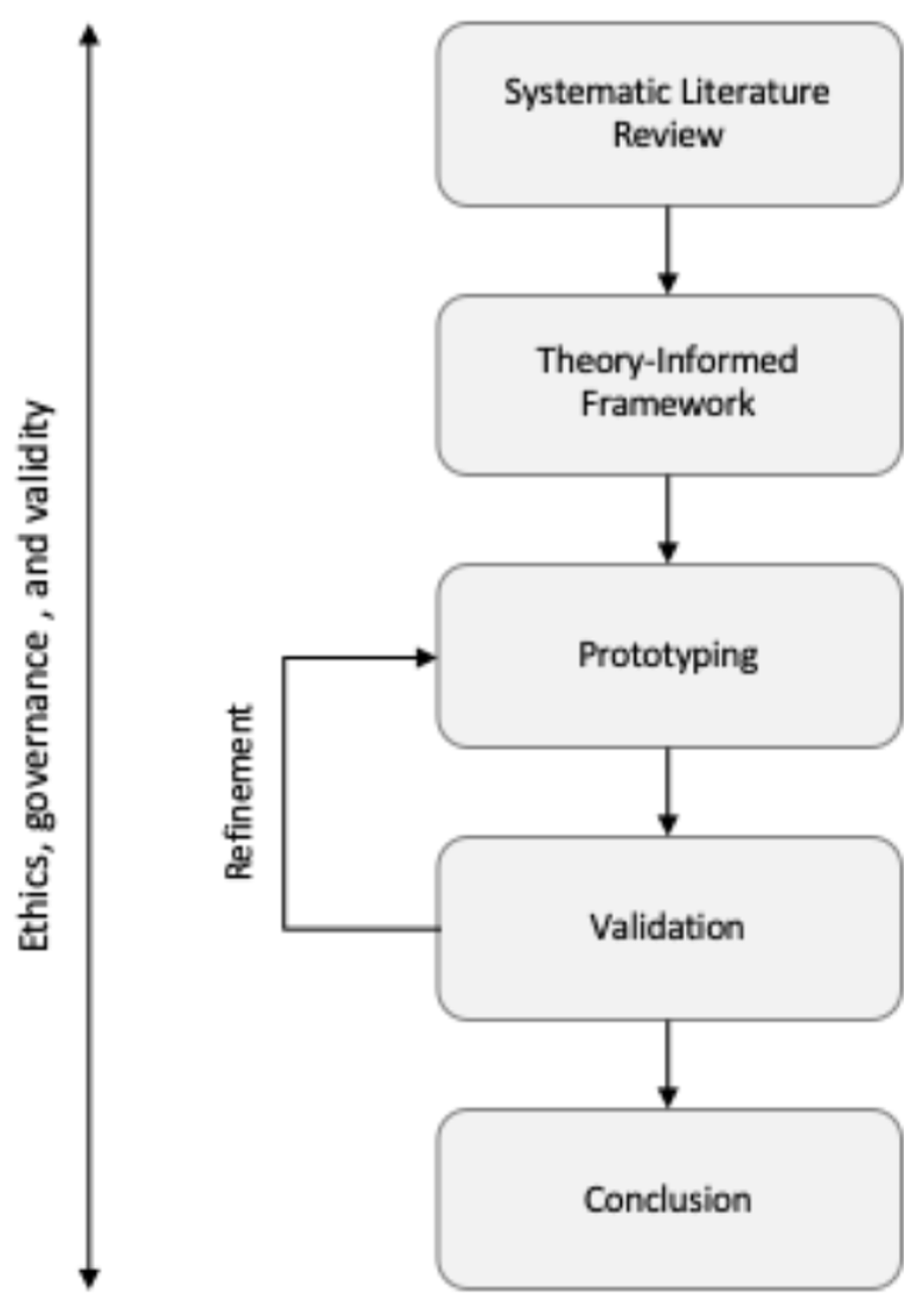
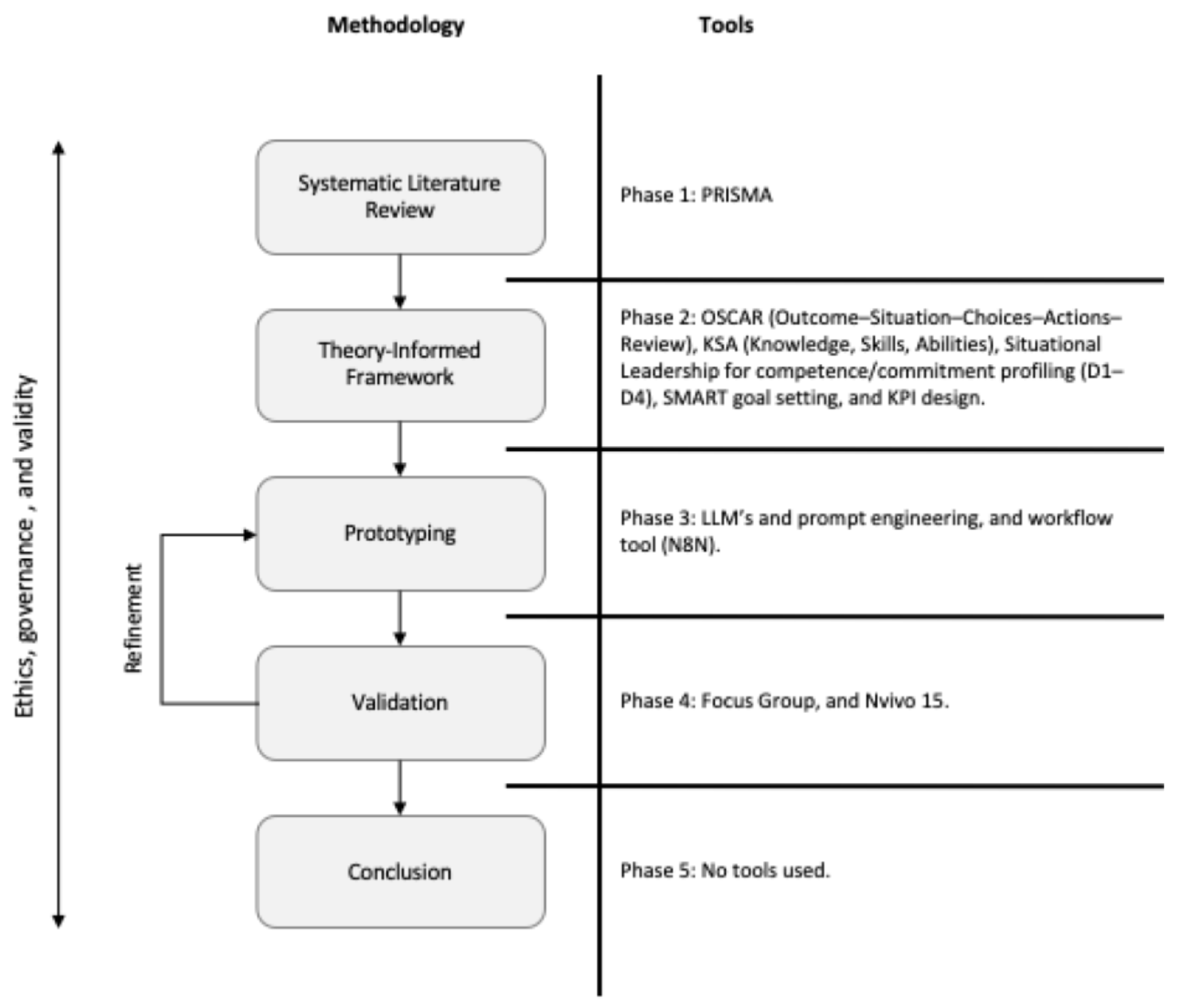
- Phase 1—Systematic Literature Review (SLR): Phase 1 consisted of a structured review of the literature intended to map the state of the art on AI-supported coaching and to inform the design requirements of the proposed framework. Databases/search engines included Scopus (primary), the EBSCOhost interface, Elicit (an AI-assisted search tool), and Google Scholar for complementary and grey literature. The review synthesized adoption factors, perceived benefits and risks, fielded systems, design principles, governance requirements, and the available empirical evidence on AI-supported coaching outcomes. Notably, the corpus was uneven: studies on usefulness, intention to use, and illustrative applications were more common than rigorous evaluations of goal attainment, behavioral change, working alliance, KPI attainment, or organizational performance. This imbalance informed the structure of the background review and reinforced the need to distinguish clearly between adoption evidence and outcome-based evidence in the literature. Although the review was conducted systematically in terms of source selection and thematic synthesis, it was not reported as a fully reproducible PRISMA-compliant systematic review. Therefore, the findings from Phase 1 should be interpreted as a structured knowledge base for framework design rather than as a formal systematic review with complete protocol disclosure.
- Phase 2—Theory-informed framework construction: Drawing on established coaching and management concepts, the initial framework version (V1) integrates: OSCAR (Outcome–Situation–Choices–Actions–Review), KSA (Knowledge, Skills, Abilities), Situational Leadership for competence/commitment profiling (D1–D4), SMART goal setting, and KPI design for progress tracking. The resulting ten-stage sequence personalizes coaching to align with organizational goals and employee context. It includes a Review command for automated progress recaps and a DONE command to generate a consolidated report of the session.
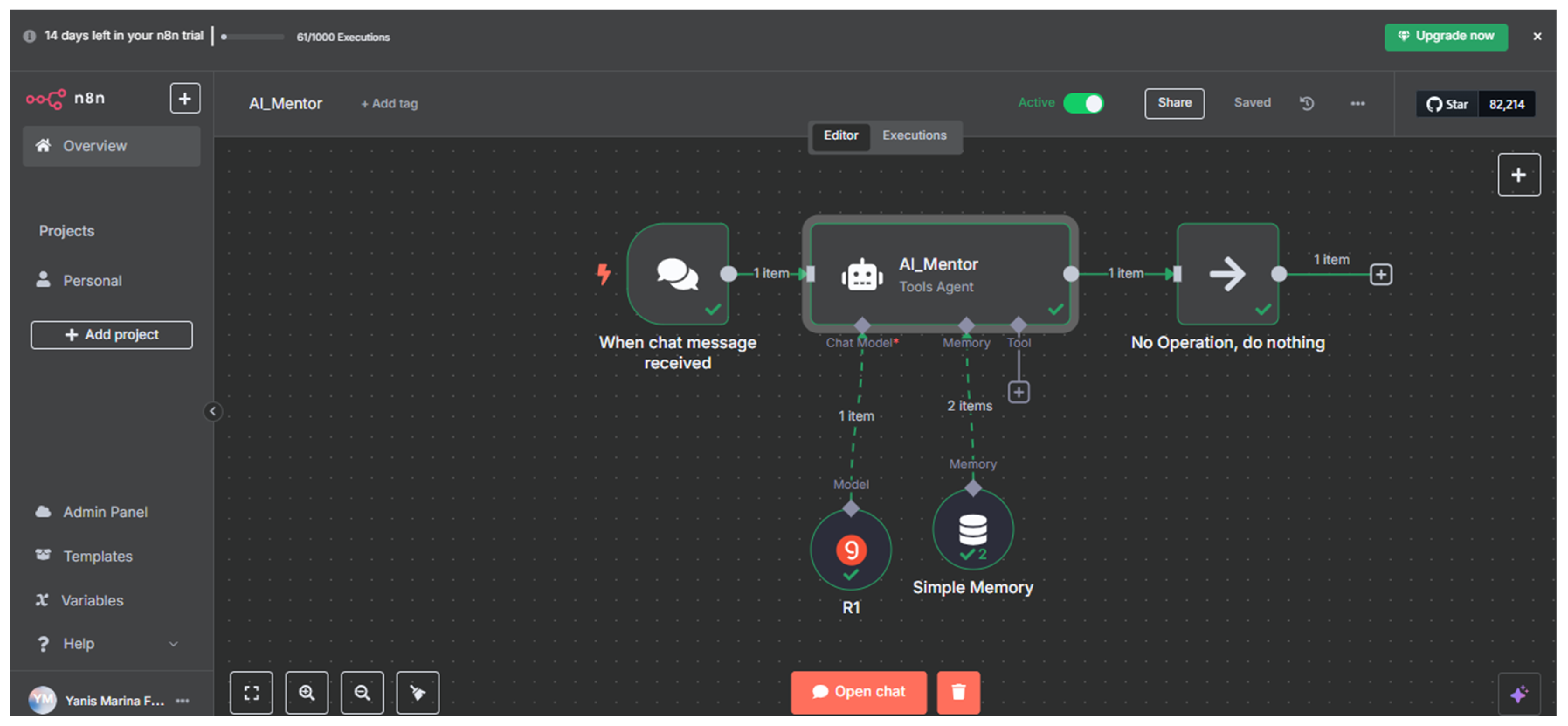
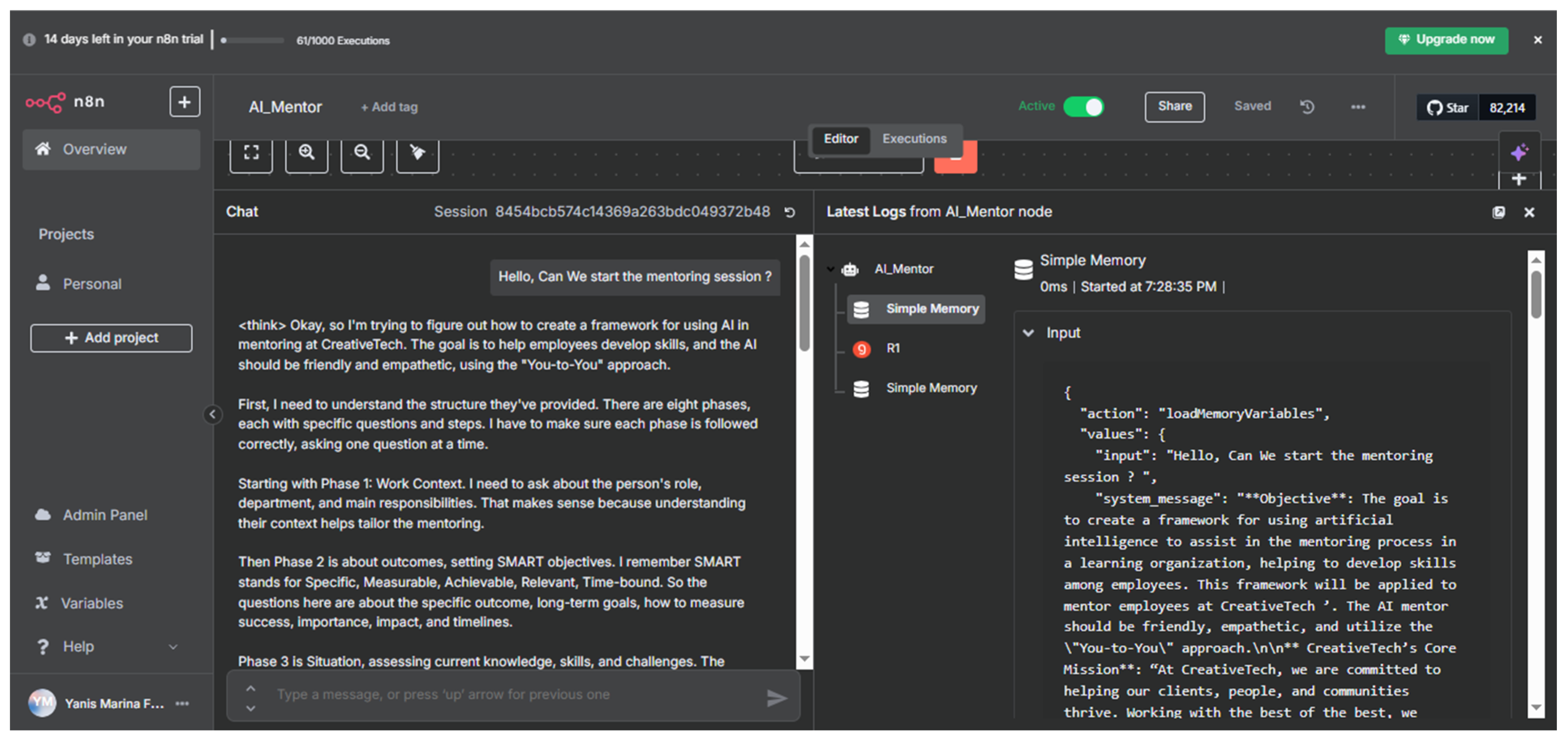
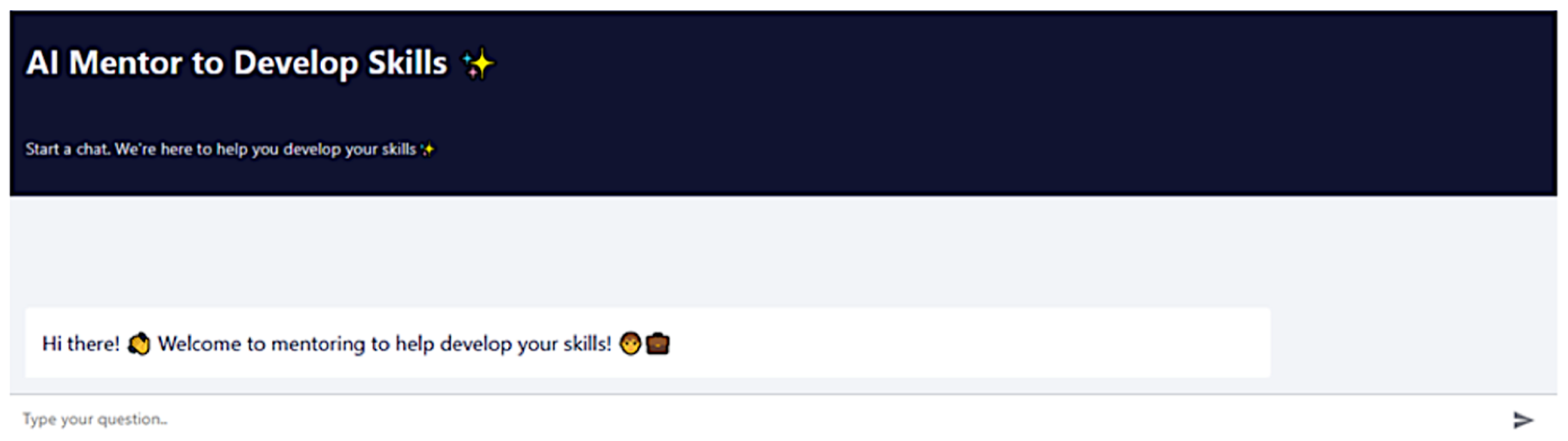
- Phase 3—Operational prototyping with LLMs and prompt engineering: To test feasibility, workflow logic, and artefact generation, the framework was instantiated as prompts and exercised in two case scenarios within a fictional firm (“CreativeTech): (1) a UX manager (Noah) balancing research quality with constraints; and (2) a frontend developer (Emily) transitioning to Angular. The tests used ChatGPT 4.5, Gemini 3, and DeepSeek-V3.2 (free tiers), following recognized prompt-engineering heuristics—clarity/precision, explicit output formats, logical structure, and iterative refinement [23,24,25]. The purpose of this phase was not to conduct a rigorous performance benchmark or effectiveness evaluation, but to assess whether different LLMs could consistently operationalize the same coaching flow and generate the expected framework artefacts with sufficient completeness and coherence. Still in this phase, the artefact included workflow automation and a transparent reasoning trace. A proof-of-concept automation was implemented in n8n to simulate end-to-end AI-assisted coaching sessions. The flow used consisted of a Trigger node (chat message), a Tools Agent node seeded with the framework prompt, LLaMA3-70B-8192 as the LLM (via Groq credentials), and a Memory node to preserve conversational context. The purpose of this automation layer was to demonstrate workflow orchestration, state carry-over, and traceability at the prototype level. It was not designed or evaluated as a production-grade enterprise deployment. It therefore did not test scalability under concurrent use, robustness under failure conditions, advanced error handling, security hardening, or operational constraints such as authentication, observability, and infrastructure resilience.
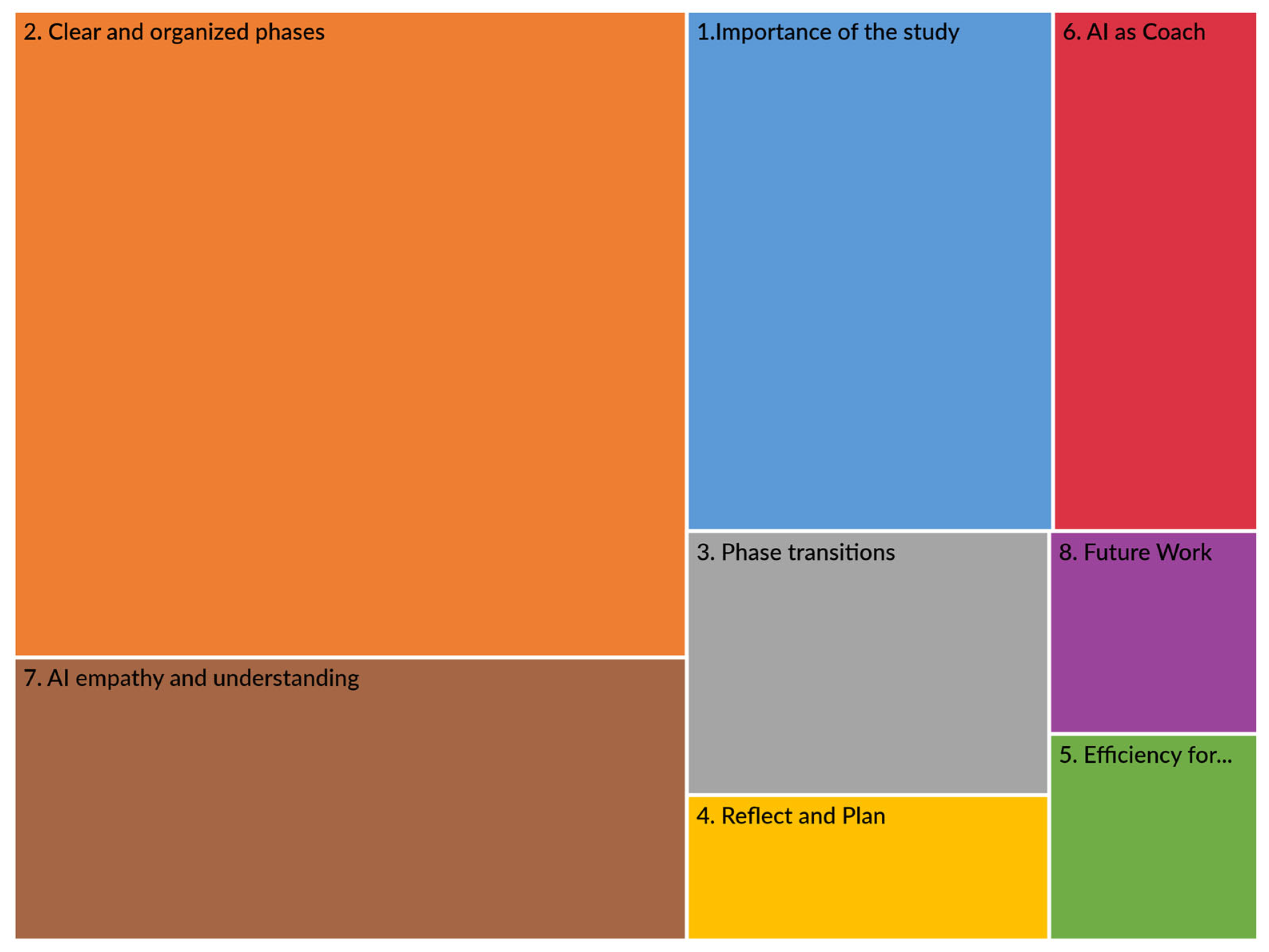
- Phase 4—Qualitative evaluation via synchronous online focus group: To assess perceived clarity, flow, utility for competency development, and acceptance of AI as a coach, we conducted a single synchronous online focus group (cost-effective, inclusive, and rapid to organize) with six participants recruited from coaching, psychology, learning-organization practice, and human resources. The focus group was held via Microsoft Teams, and the session was audio-recorded and transcribed for analysis. A structured Focus Group Guide (nine prompts) probed participants’ understanding of the study aims, phase clarity, and transition fluency, contribution to competence development, perceptions of AI empathy, and recommendations. Data were coded in NVivo 15, with categories/sub-categories developed inductively; NVivo’s AI-assisted summarization supported concise within-code synthesis. Phase 4 was designed as a qualitative expert appraisal rather than a user-based field usability study. Its purpose was to elicit informed judgments about framework clarity, governance requirements, perceived usefulness, and refinement needs. Consequently, the focus group evidence should not be interpreted as broadly generalizable to employees or organizations, nor as a direct measure of real-world coaching impact. Although the study adopts a mixed-methods design in the sense of combining structured literature review, prototyping, workflow demonstration, and qualitative expert appraisal, its empirical validation component remains exploratory and small-scale. Accordingly, the mixed-methods label should not be interpreted as implying broad generalizability or large-sample validation.
- Refinement: Iteration—From Version 1 to Version 2: Feedback from the focus group was used to refine Version 1 into Version 2, primarily by (i) tightening governance/decision gates, (ii) specifying minimum required fields for core deliverables, and (iii) clarifying escalation and manager involvement.
- Phase 5—Conclusions: The results of this research are summarized, and new research directions are pointed out.
3. Background Research
3.1. What Organizational Coaching Delivers—And Where AI Adds Value
3.2. Adoption Evidence: Informative but Not Sufficient for Effectiveness Claims
Broader Organizational AI Literatures Relevant to Coaching Design and Adoption
3.3. Outcome-Oriented Evidence: What Has Been Measured So Far
3.4. Process Scaffolds That Transfer Well to AI-Mediated Coaching
3.5. Design Frameworks: How to Build AI Coaches That People Trust and Use
3.6. Ethics, Governance, and Validation—Principles That Must Be Operationalized
3.7. Findings
- Implementation gap. Few studies detail how organizations should deploy AI-supported coaching in practice, including governance arrangements, role design, process integration, review mechanisms, and measurable outputs.
- Design-integration gap. Existing studies discuss AI-coaching concepts, bounded assistants, adoption factors, or design principles. Yet, they do not sufficiently integrate coaching process structure, competency modeling, performance monitoring, and organizational governance into a single framework suitable for organizational deployment.
- Ethics-to-practice gap. Ethical principles are widely stated, but actionable patterns such as disclosure rules, audit trails, bias testing, escalation logic, and human-override mechanisms are rarely operationalized within concrete coaching workflows and with enough detail to support accountable implementation.
4. Solution Proposal
4.1. Proposal Background
4.1.1. Rationale for the Chosen Foundations
4.1.2. Theoretical Positioning of the Framework
4.1.3. OSCAR Framework as the Process Scaffold
- ○
- Outcome clarifies desired end-states and success criteria.
- ○
- Situation surfaces present realities, constraints, and strengths.
- ○
- Choices broaden the set of options and anticipate consequences.
- ○
- Actions convert intent into dated, resourced commitments.
- ○
- The review establishes a cadence, provides feedback, and captures learning.
4.1.4. Supporting Constructs Extending the OSCAR-Based Framework
- Outcome-first orchestration. Begin with explicit success criteria and maintain a phase-aware state machine that enforces the OSCAR flow [13].
- Adaptive scaffolding. Detect D1–D4 profiles and adjust prompt depth, exemplars, and autonomy [17].
- Human agency preserved. AI facilitates option generation and planning but leaves decisions and accountability with the coachee/organization.
- Reusability and governance. Express the framework as modular prompts/templates, incorporating data minimization, transparency notices, and review logs for audit purposes.
4.2. Proposal
- ○
- Company—provides strategy, mission, constraints);
- ○
- Employee/coachee—supplies work context, chooses options, commits to actions);
- ○
- AI coach/assistant—structures dialogue and outputs; adapts style by development level.
- ○
- Step 1—Company Setup (Context Anchoring): The session begins by loading organizational information—sector, strategy, principles, and targets—so that subsequent dialogue and recommendations are context-aware rather than generic. This step ensures strategic alignment and reduces the need for later rework. Actor: company. Output: minimal org profile used by the AI’s prompts and safety rails.
- ○
- Step 2—Role and Work Context (Clarification of Role Profile): The coachee provides their job title, unit, core responsibilities, and current projects. That informs the tailoring of examples, resources, and constraints in later phases. Actors: employee + AI. Output: role profile.
- ○
- Step 3—Outcome (goal definition with SMART): Guided by the OSCAR step Outcome [13], the AI assists the coachee in crafting a SMART goal (specific, measurable, achievable, relevant, and time-bound), clarifying the value and costs of non-achievement. Actors: employee + AI. Output: SMART goal statement; initial success criteria.
- ○
- Step 4—Situation (present-state analysis): Following OSCAR’s Situation, the AI prompts for the current status, constraints, enablers, and emotions affecting performance, thereby increasing self-awareness and surfacing hidden blockers. Actors: employee + AI. Output: concise situation map and candidate obstacles/resources.
- ○
- Step 5—Level (development profiling via Situational Leadership): The AI administers brief questions on competence (experience, knowledge, practical skill) and commitment (motivation, confidence, initiative) to classify the coachee as D1–D4, then adjusts its style accordingly (S1 directive → S4 delegative). Actors: employee + AI. Output: development-level tag with Rationale; style settings for subsequent phases.
- ○
- Step 6—Choices (option generation and consequences): Consistent with OSCAR’s Choices, the AI facilitates brainstorming, helps articulate pros/cons, and feasibility (including “what would you do if you weren’t afraid?” prompts), while preserving human agency—the coachee makes the decision. Actors: employee + AI. Output: option set, decision rationale, risk/assumption notes.
- ○
- Step 7—Actions (commitment and planning): The chosen path becomes a dated, resourced action plan (near-term micro-steps + longer-term milestones). The AI elicits a commitment rating (1–10) and explores what would increase it, thereby enhancing the likelihood of execution. Actors: employee + AI. Output: action checklist with owners, dates, and support needs.
- ○
- Step 8—KSA Generation (Competency Targeting): To anchor development, the AI proposes KSA triplets aligned with the SMART goal (knowledge to acquire, skills to practice/demonstrate, abilities to leverage), which the coachee can accept/edit. Actor: AI (with human confirmation). Output: approved KSA plan linked to actions.
- ○
- Step 9—KPI generation (measurement by design): The AI co-creates KPIs—balanced leading and lagging indicators—and a review cadence (e.g., weekly micro-check-ins; monthly milestone review). KPIs map to the SMART goal and KSA plan. Actor: AI (with human confirmation). Output: KPI sheet (target, source, frequency, owner).
- ○
- Step 10—Review (monitoring, learning, celebration, and re-entry): The Review phase operates as the framework’s main iterative control point. It has two layers: (a) scheduling of check-ins from the first session; and (b) ongoing evaluation that tracks actions and KPIs, surfaces drift, captures learning, and celebrates milestones to reinforce motivation. Crucially, Review does not only close the cycle; it may also reopen it. When progress is insufficient, contextual conditions change, the chosen option proves inadequate, or the original SMART goal needs revision, the framework returns to the relevant earlier phase (e.g., Outcome, Situation, Level, Choices, Actions, KSA, or KPI) rather than forcing a purely forward sequence. Actors: employee + AI. Output: review log; adjustments to actions/KPIs; risk note where relevant; re-entry decision where needed; next-session agenda.
4.2.1. Iterative Logic and Re-Entry Rules
4.2.2. Ethical Governance and Operational Controls
- Disclosure and informed use. At the beginning of the interaction, the coachee is informed that the session is AI-supported, that outputs are advisory drafts rather than binding decisions, and that human oversight remains available.
- Data minimization. Only the minimum information required for the coaching task is processed: organizational context, role profile, goal, current situation, development level, action plan, and review-related progress notes. Sensitive personal data not required for the coaching objective should not be requested or retained.
- Scope restriction. The AI is constrained to the approved development topic and organizationally accepted coaching scope. If the conversation drifts into out-of-scope, sensitive, or high-risk matters, the system must flag this and redirect or escalate.
- Human validation and override. All key outputs—SMART goals, selected options, action plans, KSA maps, KPI sheets, and review decisions—are treated as draft artefacts subject to human confirmation. Final authority remains with the coachee and, where applicable, the organizational approver or manager. For clarity, this confirmation does not occur only at the end of the process; it is distributed across the coaching cycle at the specific phase-level decision points defined in Table 4.
- Auditability. The framework requires a persistent review log recording outputs, changes, KPI readings, review decisions, and escalation events. This log supports accountability, traceability, and later governance review.
- Bias and harms review. Generated outputs should be periodically checked for unfair assumptions, exclusionary recommendations, inappropriate tone, or strategically misaligned suggestions. In the present research, this control is specified at the framework level and highlighted as a required review activity, although full deployment-grade testing remains future work.
- Escalation pathways. The framework requires escalation to human oversight when outputs concern high-stakes issues, when repeated KPI stagnation suggests risk of inappropriate persistence, when scope boundaries are exceeded, or when ethical ambiguity arises.
4.2.3. Risk Controls and Governance Enforcement
5. Prototyping and Demonstration
5.1. Framework Instantiation
5.1.1. Implementation Environment and Tooling
- LLM services—Three general-purpose LLM services were used to exercise the framework logic and check portability across providers: ChatGPT [ChatGPT 5.2], Gemini [Gemini 2.5], and DeepSeek [DeepSeek V4]. The tests were conducted using the publicly available free-tier versions accessible at the time of data collection. These models were not benchmarked against each other; the aim was to verify whether each service could follow the same coaching flow and generate the expected artefacts (SMART goal, D-level, Choices, Action plan, KSA, KPIs, Review plan). These were not benchmarked against each other; the aim was to verify that each model could follow the same coaching flow and generate the expected artifacts (SMART goal, D-level, Choices, Action plan, KSA, KPIs, Review plan). Accordingly, this stage should be interpreted as operational prototyping rather than as a formal experimental comparison of model performance. The focus was on framework instantiation, artefact generation, and procedural coherence, not on estimating comparative model superiority or intervention effectiveness. The purpose of this prototyping stage was therefore not to determine which model was more effective, nor to infer the effectiveness of AI-supported coaching as an intervention. Rather, it was to assess whether the framework could be consistently operationalized across tools and whether the expected artefacts could be generated with sufficient completeness and coherence.
- Workflow orchestration—A proof-of-concept n8n flow was built to automate the coaching conversation, preserve context, and render a simple interface. The pipeline used a Trigger node → Tools Agent seeded with the coaching prompt → LLaMA-3-70B-8192 → Memory node for state carry-over. At the prototype level, this setup demonstrated that the framework could be orchestrated as a traceable workflow and that coaching artefacts could be generated and preserved across steps. However, this layer should be interpreted as a workflow demonstration rather than as an enterprise-ready implementation. The prototype did not evaluate concurrent-user scalability, queueing, rate-limit handling, node failure recovery, provider fallback, access control, secrets management, monitoring dashboards, or deployment architecture constraints.
- Project context—A fictional firm (“CreativeTech”) provided an organizational backdrop (mission, values) to anchor the coach’s questions and suggestions in a business context, ensuring comparable runs across models.
5.1.2. Prompt Scaffold Mapped to Framework Phases
- ○
- REVIEW—recap decisions, check progress blockers, refresh following actions.
- ○
- DONE—generate a consolidated session report (goal, plan, KSA, KPIs, dates).
- ○
- Lack of long-term memory between extended phases;
- ○
- Limited context capacity, which hindered coherence over more prolonged interactions;
- ○
- Lower reliability in state management can lead to potential phase skipping or contextual loss.
5.2. Test Data and Use Case Setup
- Use case 1 (Noah)—Senior UX manager balancing usability rigor with sprint constraints; the desired outcome was an MVP-grade testing pipeline aligned with product cadence. Outputs compared in Table/Figure summaries for use case 1 in Table 11.
- Use case 2 (Emily)—React developer transitioning to Angular under time pressure; the desired outcome was a time-bounded upskilling plan with demonstrable productivity milestones. Outputs compared for use case 2 in Table 12.
- Initialize session (LLM chat or N8N UI) and paste the framework prompt.
- Inject CreativeTech context + role vignette (UX manager or frontend developer).
- Walk through the phases in order. The agent asks one phase at a time, discourages compound questions, and requires the user to confirm completion before advancing.
- At the level, the model gathers indicators of competence (experience, knowledge, practical skill) and commitment (motivation, confidence, initiative) to assign D1–D4 and adapt tone/detail (directive → delegative).
- Choices → Actions turn options into a dated, resourced plan; collect a commitment rating and “what would raise it” nudges.
- KSA generation (knowledge to acquire, skills to practice; abilities to leverage) is tied to the specific goal and plan.
- KPI generation with leading/lagging indicators and review cadence (e.g., weekly micro-check-ins; monthly milestone review).
- Trigger REVIEW and DONE to record the final recap/report for analysis.
- Export artefacts (SMART goal, D-level, plan, KSA, KPIs, Review plan) for cross-model comparison.
- A SMART goal with clear business relevance;
- A D-level classification with rationale;
- At least three options with pros/cons and a selected option;
- A dated action plan with owners/support;
- A KSA triplet (or set) aligned to the goal and actions;
- A KPI set with targets, sources, and frequency; and
- A review plan and a session report via DONE.
5.3. Prototyping Results Summary
- Operational completeness—For both roles, the framework generated the expected artefact stack from goal setting to monitoring (SMART goal, D-level, option set, action plan, KSA map, KPI set, and review plan), indicating that the phases can be instantiated coherently across different LLMs.
- Procedural coherence—Across models and use cases, the framework logic remained recognizable and the intended phase sequence was largely preserved, suggesting that the process design is stable enough to be operationalized in software.
- Organizational plausibility—The generated outputs were sufficiently structured to support later governance-oriented assessment (e.g., review cadence, measurable fields, and auditable artefacts), which is relevant for organizational implementation.
6. Preliminary Qualitative Validation
6.1. Design and Participants
6.2. Focus Group Execution
6.3. Results
6.3.1. Organizational Decisions Influenced by the Framework
- Readiness gating (do not proceed without KSA baseline + role clarity),
- Scope boundaries (what the AI coach may and may not do; escalation conditions),
- Evidence cadence (KPI frequency, review gates, and manager checkpoints),
- Accountability & escalation (who signs off, who intervenes, and what triggers escalation).
- (1)
- Skill approval and intake decision (go/no-go to proceed): Participants stressed that the coaching process must begin with a validated focus on the right skill. They recommended that skills should either be selected from a company-validated set or, if proposed by the employee, should require a justification and SMART framing, followed by explicit organizational validation before proceeding to downstream planning.
- (2)
- Scope boundaries decision (what the AI is allowed to coach on): The framework also changes decisions by making the scope of coaching explicit and governable. Focus group feedback highlighted the importance of establishing guardrails so that AI remains within the selected development scope and can flag when conversation drifts beyond agreed boundaries.
- (3)
- Timeline realism decision (approving SMART timelines based on competence evidence): Participants cautioned against defining timelines before establishing whether the target competence level is realistic for the employee’s current knowledge state. One recommendation was to include a technical knowledge assessment before fixing timelines and milestones.
- (4)
- KPI cadence and review-gates decision (when to measure, review, and re-enter earlier phases): Organizational control is further embedded through decisions about review cadence and corrective gates. Participants recommended “regular check-ins” and KPI readings, with explicit allowance to re-enter earlier framework phases when evidence indicates misalignment or insufficient progress. This reframes evaluation from an end-point audit to a continuous governance mechanism (Plan–Do–Check–Act logic), strengthening accountability and adaptability. This point is theoretically important as well as operationally useful. It indicates that practitioners did not interpret the framework as a rigid sequence, but as a structured cycle in which review evidence can legitimately trigger a return to earlier phases. This feedback directly informed the revised interpretation of the framework as iterative and adaptive rather than merely linear.
- (5)
- Escalation and oversight decision (when managers intervene; budget/effort thresholds): Finally, focus group input emphasized that responsible AI coaching requires clear escalation rules. Participants proposed explicit guardrails that specify when managers should intervene, including budget and effort thresholds, and recommended the presence of a designated approver to validate development proposals.
6.3.2. Measurable Deliverables Produced by the Framework
6.3.3. Synthesis: Decision-Gating and Auditable Deliverables as Value Mechanisms
7. Discussion
7.1. Empirical Validation Agenda
7.2. Managerial Implications: A Staged Implementation Roadmap
8. Conclusions
Author Contributions
Funding
Institutional Review Board Statement
Informed Consent Statement
Data Availability Statement
Acknowledgments
Conflicts of Interest
Abbreviations
| AI | Artificial Intelligence |
| DAIC | Designing an AI Coach |
| ICF | International Coaching Federation |
| KPI | Key Performance Indicator |
| KSA | Knowledge, Skills, Abilities |
| LLM | Large Language Model |
| OSCAR | Outcome, Situation, Choices, Action, Review |
| PRISMA | Preferred Reporting Items for Systematic Reviews and Meta-Analyses |
| SLR | Systematic Literature Review |
| UTAUT | Unified Theory of Acceptance and Use of Technology |
References
- Bachkirova, T.; Kemp, R. ‘AI coaching’: Democratising coaching service or offering an ersatz? Coaching 2024, 18, 27–45. [Google Scholar] [CrossRef]
- Terblanche, N. A design framework to create artificial intelligence coaches. Int. J. Evid. Based Coach. Mentor. 2020, 18, 152–165. [Google Scholar] [CrossRef]
- Graßmann, C.; Schermuly, C.C. Coaching with Artificial Intelligence: Concepts and Capabilities. Hum. Resour. Dev. Rev. 2021, 20, 106–126. [Google Scholar] [CrossRef]
- Terblanche, N.; Kidd, M. Adoption Factors and Moderating Effects of Age and Gender That Influence the Intention to Use a Non-Directive Reflective Coaching Chatbot. SAGE Open 2022, 12, 21582440221096136. [Google Scholar] [CrossRef]
- Terblanche, N. Artificial Intelligence (AI) Coaching: Redefining People Development and Organizational Performance. J. Appl. Behav. Sci. 2024, 60, 631–638. [Google Scholar] [CrossRef]
- Khandelwal, K.; Upadhyay, A.K. The advent of artificial intelligence-based coaching. Strateg. HR Rev. 2021, 20, 137–140. [Google Scholar] [CrossRef]
- Arora, S.; Tiwari, S.; Negi, N.; Pargaien, S.; Misra, A. The Role of Artificial Intelligence in Mentoring Students. In Proceedings of the 2023 1st International Conference on Circuits, Power, and Intelligent Systems, CCPIS 2023, Bhubaneswar, India, 1–3 September 2023. [Google Scholar] [CrossRef]
- Terblanche, N.; Molyn, J.; Williams, K.; Maritz, J. Performance matters: Students’ perceptions of factors influencing Artificial Intelligence Coach adoption. Coaching 2023, 16, 100–114. [Google Scholar] [CrossRef]
- Terblanche, N.H.D.; Tau, T. Exploring the use of a goal-attainment, artificial intelligence (AI) chatbot coach to support first-time graduate employees. Ind. High. Educ. 2024, 39, 279–290. [Google Scholar] [CrossRef]
- Passmore, J.; Tee, D. The library of Babel: Assessing the powers of artificial intelligence in knowledge synthesis, learning, development, and coaching. J. Work-Appl. Manag. 2024, 16, 4–18. [Google Scholar] [CrossRef]
- High-Level Expert Group on Artificial Intelligence. Ethics Guidelines for Trustworthy AI; European Commission: Brussels, Belgium, 2019. Available online: https://digital-strategy.ec.europa.eu/en/library/ethics-guidelines-trustworthy-ai (accessed on 27 July 2025).
- ICF. ICF Artificial Intelligence (AI) Coaching Framework and Standards; ICF: Lexington, KY, USA, 2025; Available online: https://coachingfederation.org/resource/icf-artificial-intelligence-ai-coaching-framework-and-standards/ (accessed on 2 September 2025).
- Gilbert, A.; Whittleworth, K. The OSCAR Coaching Model; Worth Publishing: Boston, MA, USA, 2009. [Google Scholar]
- Stevens, M.J.; Campion, M.A. The Knowledge, Skill, and Ability Requirements for Teamwork: Implications for Human Resource Management. J. Manag. 1994, 20, 503–530. [Google Scholar] [CrossRef]
- Hlavac, J. Knowledge, skills, and abilities (KSAs) as a metric to re-conceptualize aptitude: A multi-stakeholder perspective. Interpret. Transl. Train. 2023, 17, 29–53. [Google Scholar] [CrossRef]
- Parmenter, D. Key Performance Indicators: Developing, Implementing, and Using Winning KPIs; John Wiley & Sons: Hoboken, NJ, USA, 2015. [Google Scholar]
- Hersey, P.; Blanchard, K.H. Management of Organizational Behavior: Utilizing Human Resources; Prentice Hall: Saddle River, NJ, USA, 1988. [Google Scholar]
- Passmore, J.; Olafsson, B.; Tee, D. A systematic literature review of artificial intelligence (AI) in coaching: Insights for future research and product development. J. Work Appl. Manag. 2025, 18, 110–129. [Google Scholar] [CrossRef]
- Papagiannidis, E.; Mikalef, P.; Conboy, K. Responsible artificial intelligence governance: A review and research framework. J. Strateg. Inf. Syst. 2024, 34, 101885. [Google Scholar] [CrossRef]
- Bach, T.A.; Kaarstad, M.; Solberg, E.; Babic, A. Insights into suggested Responsible AI (RAI) practices in real-world settings: A systematic literature review. AI Ethics 2025, 5, 3185–3232. [Google Scholar] [CrossRef]
- Do Khac, L.T.; Leyer, M. Towards an integrative model of organizational human-AI collaboration: A semi-systematic review of the current state of the art. Technol. Soc. 2026, 84, 103064. [Google Scholar] [CrossRef]
- Doyle, L.; Brady, A.M.; Byrne, G. An overview of mixed methods research. J. Res. Nurs. 2009, 14, 175–185. [Google Scholar] [CrossRef]
- Lo, L.S. The Art and Science of Prompt Engineering: A New Literacy in the Information Age. Internet Ref. Serv. Q. 2023, 27, 203–210. [Google Scholar] [CrossRef]
- White, J.; Fu, Q.; Hays, S.; Sandborn, M.; Olea, C.; Gilbert, H.; Elnashar, A.; Spencer-Smith, J.; Schmidt, D.C. A Prompt Pattern Catalog to Enhance Prompt Engineering with ChatGPT. arXiv 2023, arXiv:2302.11382. [Google Scholar] [CrossRef]
- Sahoo, P.; Singh, A.K.; Saha, S.; Jain, V.; Mondal, S.; Chadha, A. A Systematic Survey of Prompt Engineering in Large Language Models: Techniques and Applications. arXiv 2024, arXiv:2402.07927. [Google Scholar] [CrossRef]
- Budhwar, P.; Chowdhury, S.; Wood, G.; Aguinis, H.; Bamber, G.J.; Beltran, J.R.; Boselie, P.; Cooke, F.L.; Decker, S.; DeNisi, A.; et al. Human resource management in the age of generative artificial intelligence: Perspectives and research directions on ChatGPT. Hum. Resour. Manag. J. 2023, 33, 606–659. [Google Scholar] [CrossRef]
- Krakowski, S. Human-AI agency in the age of generative AI. Inf. Organ. 2025, 35, 100560. [Google Scholar] [CrossRef]
- Bar-Gil, O.; Ron, T.; Czerniak, O. AI for the people? Embedding AI ethics in HR and people analytics projects. Technol. Soc. 2024, 77, 102527. [Google Scholar] [CrossRef]
- Hughes, L.; Davies, F.; Li, K.; Gunaratnege, S.M.; Malik, T.; Dwivedi, Y.K. Beyond the hype: Organizational adoption of Generative AI through the lens of the TOE framework—A mixed methods perspective. Int. J. Inf. Manag. 2026, 86, 102982. [Google Scholar] [CrossRef]
- Arroyabe, M.F.; Arranz, C.F.A.; Fernandez de Arroyabe, I.; Fernandez de Arroyabe, J.C. Analyzing AI adoption in European SMEs: A study of digital capabilities, innovation, and external environment. Technol. Soc. 2024, 79, 102733. [Google Scholar] [CrossRef]
- Terblanche, N.; Molyn, J.; de Haan, E.; Nilsson, V.O. Comparing artificial intelligence and human coaching goal attainment efficacy. PLoS ONE 2022, 17, e0270255. [Google Scholar] [CrossRef] [PubMed]
- Barger, A.S. Artificial intelligence vs. human coaches: Examining the development of working alliance in a single session. Front. Psychol. 2025, 15, 1364054. [Google Scholar] [CrossRef]
- Terblanche, N.H.D.; van Heerden, M.; Hunt, R. The influence of an artificial intelligence chatbot coach assistant on the human coach-client working alliance. Coach. Int. J. Theory Res. Pract. 2024, 17, 189–206. [Google Scholar] [CrossRef]
- Bjerke, M.B.; Renger, R. Being smart about writing SMART objectives. Eval. Program Plan. 2017, 61, 125–127. [Google Scholar] [CrossRef] [PubMed]
- Balanced Scorecard Institute. Balanced Scorecard Basics; Balanced Scorecard Institute: Cary, NC, USA, 2025; Available online: https://balancedscorecard.org/bsc-basics-overview/ (accessed on 26 September 2025).
- Doran, G.T. There’s a S.M.A.R.T. Way to Write Management’s Goals and Objectives. Manag. Rev. 1981, 70, 35. [Google Scholar]
- N8N. Flexible Workflow Automation Platform with IA. Available online: https://n8n.io/ (accessed on 30 September 2025).
- Iorliam, A.; Ingio, J.A. A Comparative Analysis of Generative Artificial Intelligence Tools for Natural Language Processing. J. Comput. Theor. Appl. 2024, 1, 311–325. [Google Scholar] [CrossRef]
- Stewart, D.W.; Shamdasani, P. Online Focus Groups. J. Advert. 2017, 46, 48–60. [Google Scholar] [CrossRef]



| OSCAR Phase | Questions | Objective |
|---|---|---|
| Outcome | For short-term outcomes, the opening issue to be coached on: What would you like to talk about today? What would you like to cover today? What issues would you like to focus on? For the long-term outcome, some questions could be asked: What is your long-term desired outcome around this issue? What would success look like/feel like to you? How will you know you’ve achieved it? What will happen? Which outcome do you want to focus on? How important is it to you to achieve this outcome? What will it cost you if you don’t? What impact will not achieving this outcome have? What impact will achieving this outcome have? Over what period do you want to achieve this outcome? | Helping coaches and coachees effectively define and articulate their goals enables them to specify exactly what they want to achieve and what result they will focus on. |
| Situation | These are some questions that the coach may ask the individual to encourage discussion: What is the current situation? What do you consider the primary issues at present? Where are you now in terms of your goals? What impact is that having on you? (your family, your performance, etc.)? What impact is that having on others? Who is contributing to the problem? What are you doing that could be contributing to this problem/issue? What do you feel now, and how does that impact the issue? What do you do now, in this situation or a similar one, that works well for you? What made you aware that you need to do something different? | Enable coaches to identify and understand their current situation before planning for the future. The coachee begins by describing their context and evaluating their progress toward their goals, which helps build a clear image of where they are now. This enables the identification of critical issues and challenges that may be hindering progress, as well as their impact on employers and others. |
| Choices and Consequences | These are some questions that the coach may ask the individual to encourage discussion [13]: What can you do to start resolving the situation? What do you need to do or say to start resolving the situation? What choices do you have? What’s stopping you from doing that now? How far towards your desired outcome would that option take you? What advice would you give to somebody else in your position? What else could you do? Who else could help you? What’s stopping you from asking them? What would you like to do differently? What’s stopping you? What’s really stopping you? What would you do if you weren’t afraid? What would be the consequences? Upsides and downsides? What would you do if there were no downsides? What’s the worst thing that could happen? What’s the best thing that could happen? Which choice/choices will best move you toward your outcome? How far would that take you towards achieving your outcome? | Help coaches explore different options and strategies for achieving their goals. |
| Actions | These are some questions that the coach may ask the individual to encourage discussion: What actions are you going to take? What will you do to move yourself forward? What specific actions are you willing to take? When will you take them? What support will you need? Where will you find that support? How will you maintain your motivation? What actions will you take in the next 24 h to move forward? On a scale of 1 to 10, how committed are you to take this action? What’s stopping it from being 9 or 10? | Measure progress toward goals and clarify a concrete action plan. They help coaches reflect on previously established options and decide on the next steps simply and systematically. |
| Review | These are some questions that the coach may ask the individual to encourage discussion: How will you review your progress? What will you do to check whether your actions are moving you toward your outcome? How will you measure your success? How will you celebrate your success? When will you and I get together to review your progress? What would you like to tell me next time you see me? How will you maintain your momentum? What support do you need? | Assessing progress toward the goal, enabling a structured reflection on the actions taken and the lessons learned throughout the process. |
| Component | Design Function in the Framework | Why Was It Selected | What Would Be Lost if Omitted? |
|---|---|---|---|
| OSCAR | Primary process scaffold | Provides a sequential coaching structure (Outcome–Situation–Choices–Actions–Review) that can be operationalized in prompts, state transitions, and review cycles. | The framework would lose its process spine and become a set of disconnected coaching prompts. |
| KSA | Competency specification layer | Translates broad development goals into explicit knowledge, skills, and abilities, linking coaching dialogue to trainable capability targets. | The framework would produce goals and actions, but with less precision about what capability is being developed. |
| Situational Leadership | Adaptive guidance layer | Adjusts the style and granularity of support according to competence and commitment (D1–D4/S1–S4). | The framework would remain structured, but the AI support would be less tailored to readiness differences. |
| KPI | Monitoring and governance layer | Converts coaching plans into measurable indicators, reviews cadence, and auditable follow-up aligned with organizational accountability. | The framework would support reflection and planning, but not systematic review, traceability, or organizational oversight. |
| Step | Step Designation | Objective | Actor | Concept Used | Output |
|---|---|---|---|---|---|
| 1 | Company setup | Context anchoring | Company | — | The AI prompts and safety rails use the minimal org profile |
| 2 | Role and work context | Clarification of role profile | Employee + AI | — | Role profile. |
| 3 | Outcome | Goal definition with SMART | Employee + AI | OSCAR + SMART | SMART goal statement; initial success criteria |
| 4 | Situation | Present-state analysis | Employee + AI | OSCAR | Concise situation map and candidate obstacles/resources |
| 5 | Level | Development Profiling via Situational Leadership | Employee + AI | Situational Leadership | Development-level tag with rationale; style settings for subsequent phases |
| 6 | Choices | Option generation and consequences | Employee+ AI | OSCAR | Option set, decision rationale, risk/assumption notes |
| 7 | Actions | Commitment and planning | Employee + AI | OSCAR | Action checklist with owners, dates, and support needs |
| 8 | KSA generation | Competency targeting | AI (with human confirmation) | KSA | Approved KSA plan linked to actions |
| 9 | KPI generation | Measurement by design | AI (with human confirmation) | KPI | KPI sheet (target, source, frequency, owner) |
| 10 | Review | Monitoring, learning, celebration | Employee + AI | OSCAR + KPI |
| Step | Framework Phase | What the AI May Do | What Must Be Decided or Validated by Humans | Final Authority |
|---|---|---|---|---|
| 1 | Company Setup | Ingest organizational profile, apply predefined constraints, and prompt boundaries | Define strategy-relevant scope, permissible coaching topics, and governance constraints | Company/organizational approver |
| 2 | Role and Work Context | Elicit and structure role/context information; summarize inputs | Confirm role accuracy and relevance of the contextual information | Employee/coachee |
| 3 | Outcome (SMART goal) | Scaffold SMART formulation; propose refinements and clarification prompts | Select the actual development goal; validate relevance and, where applicable, approve the topic for organizational coaching | Employee/coachee; organizational approver where required |
| 4 | Situation | Prompt reflection: summarize current blockers, enablers, and context factors | Confirm the accuracy of the situation diagnosis and whether it is sufficient to proceed | Employee/coachee |
| 5 | Level (development profiling) | Propose a provisional D1–D4 classification and adapt style settings | Treat the classification as provisional and validate it if it affects planning, timeline realism, or approval | Employee/coachee; manager/approver where relevant |
| 6 | Choices | Generate options, articulate pros/cons, and surface feasibility considerations | Choose among options; reject unsuitable options; validate feasibility where resources, budget, or policy are implicated | Employee/coachee; manager/approver where relevant |
| 7 | Actions | Draft sequenced actions, milestones, and support needs | Commit to the action path; validate timeline, resources, ownership, and feasibility | Employee/coachee; manager/approver where relevant |
| 8 | KSA Generation | Propose KSA targets linked to the chosen development path | Confirm whether the proposed KSAs are relevant, realistic, and aligned with the intended development objective | Employee/coachee; organizational approver where formal capability mapping is required |
| 9 | KPI Generation | Draft KPI definitions, targets, sources, frequency, owner, and review cadence | Approve what will actually be monitored, by whom, how often, and under which governance rules | Employee/coachee; manager/approver |
| 10 | Review | Evaluate progress against KPIs, summarize drift, suggest adjustments, and flag escalation conditions | Decide whether to continue, revise, re-enter earlier phases, or escalate to human oversight | Employee/coachee for reflection and revision; manager/approver/human coach for escalation and high-stakes decisions |
| Control Area | Operational Mechanism in the Framework | Purpose |
|---|---|---|
| Disclosure and informed use | Initial notice that the interaction is AI-supported and that outputs are advisory drafts subject to human validation | Ensures transparency and prevents misleading automation authority |
| Data minimization | Limit inputs to organizational context, role data, goal, situation, actions, KSA, KPI, and review-relevant progress data | Reduces unnecessary data exposure and supports privacy by design |
| Scope restriction | AI is limited to approved coaching topics and must flag or escalate out-of-scope or sensitive matters | Prevents role drift and constrains inappropriate use |
| Human validation and override | All major outputs require the coachee and/or organizational approval before adoption | Ensures accountability remains with humans |
| Auditability and logging | Review logs, KPI records, decision notes, and escalation events are retained as governance artefacts | Supports traceability, review, and organizational oversight |
| Bias and harms review | Periodic review of outputs for unfair assumptions, exclusionary suggestions, inappropriate tone, or strategic misalignment | Supports responsible monitoring of AI-generated recommendations |
| Escalation pathways | Defined triggers for referral to a manager, approver, or human coach | Provides a safety mechanism for ambiguous or high-risk cases |
| Role-based governance | Decision rights are assigned to the employee, AI, manager, and organizational approver at different stages | Clarifies accountability and prevents autonomous AI decision-making |
| Ethical Principle | Operational Meaning in This Study | Executable Control in the Framework | Where Enacted | Auditable Evidence |
|---|---|---|---|---|
| Transparency and disclosure | The user must know that the interaction is AI-supported and that outputs are advisory drafts | Disclosure and informed-use notice before or at the beginning of the interaction | Before Step 2/session start | Disclosure statement recorded in the session setup or system configuration |
| Human oversight and override | AI may structure and propose, but humans retain final authority over decisions | Human validation and override for goals, options, actions, KSAs, KPIs, and review decisions | Steps 3, 6, 7, 8, 9, and 10 | Approved artefacts; review log; decision records |
| Scope restriction | AI must remain within approved developmental boundaries and flag drift | Scope boundaries and escalation rules are linked to the approved topic and organizational constraints | Steps 1, 3, 4, and 10 | Scope statement; guardrail rule; flagged deviations; escalation note |
| Data minimization | Only the minimum necessary information should be processed for the coaching task | Restricted input structure limited to organizational context, role profile, goal, situation, development level, actions, KSA plan, KPI set, and review data | Throughout the workflow | Input schema; retained artefact list; logging policy |
| Auditability and accountability | Outputs and key decisions must be reviewable after the session | Persistent review log, KPI sheet, decision notes, and escalation events | Steps 9 and 10, plus governance logging across the cycle | KPI sheet; review log; escalation record; versioned artefacts |
| Bias and harms review | Outputs must be reviewable for unfair assumptions, inappropriate tone, or exclusionary recommendations | Periodic human review of competency assessments, recommendations, and review outputs | Steps 5, 8, 9, and 10 | Reviewer comments, revised outputs; bias/harms review note |
| Escalation to human intervention | Sensitive, ambiguous, high-risk, or out-of-scope cases must be transferred to humans | Explicit escalation pathways to manager, approver, or human coach | Steps 3, 6, 9, and 10 | Escalation trigger; escalation outcome; approver decision |
| Role-based governance | Decision rights must be allocated explicitly rather than left implicit | Decision authority is assigned across employee/coachee, AI, manager, and organizational approver | Across the 10-phase cycle | Decision-rights table; approved outputs; governance records |
| Risk Area | Why It Matters in Coaching | Control Is Built into the Framework |
|---|---|---|
| Hallucination in developmental recommendations | Incorrect or unfounded advice may distort goals, actions, or perceived development needs. | AI outputs are treated as draft artefacts requiring human confirmation; review checkpoints and decision authority remain with humans. |
| Privacy and confidentiality of coaching conversations | Coaching may involve sensitive personal, interpersonal, or organizational information. | Data minimization, role-bound access, disclosure, and auditable logging are required; unnecessary sensitive data should not be requested or retained. |
| Bias in competency assessments or development-level classification | AI may generate unfair or exclusionary judgments about competence, commitment, or readiness | Assessments are treated as provisional; human review, override, and escalation are required where outputs affect approval, scope, or progression |
| Overdependence on automated coaching systems | Users or organizations may defer excessively to AI suggestions and weaken critical reflection. | The AI is restricted to a facilitative role; final acceptance of goals, plans, KSAs, KPIs, and reviews remains human. |
| Escalation threshold failures | Some cases exceed the appropriate scope of AI support and require human intervention. | Escalation rules are attached to scope boundaries, KPI review gates, feasibility concerns, and ethical ambiguity; managers/approvers intervene when thresholds are triggered |
| Dimension | What the Current Prototype Demonstrates | What Was Not Evaluated in the Present Study |
|---|---|---|
| Workflow orchestration | Phase-aware orchestration of the coaching flow through Trigger, Tools Agent, LLM, and Memory nodes | Production-grade orchestration under sustained organizational load |
| Traceability | Loggable artefact generation and visible workflow steps | Enterprise observability stack, monitoring dashboards, and incident management |
| State handling | Context carry-over through the Memory node | Long-session resilience, rollback logic, recovery from corrupted or incomplete state |
| Scalability | Feasibility of automated session flow at proof-of-concept level | Concurrent-user load, queueing, throughput limits, horizontal scaling |
| Robustness | Basic end-to-end execution in controlled prototype conditions | Node-failure recovery, provider outages, retry policies, fallback routing |
| Error handling | Implicit manual supervision during prototype use | Formal exception handling, timeout management, malformed-input handling, and automatic recovery |
| Security and access | General governance intent in framework design | Authentication, authorization, secrets management, environment hardening, and deployment isolation |
| Deployment readiness | Conceptual plausibility for organizational workflows | Full enterprise deployment architecture, cost/performance analysis, service-level validation |
| Step | Framework Phase | Prompt |
|---|---|---|
| 1 | Objective and Company Data | Objective: The goal is to develop a framework that utilizes artificial intelligence to support the coaching process in a learning organization, thereby helping employees develop their skills. This framework will be applied to coach employees at CreativeTech. The AI coach should be friendly and empathetic, utilizing the “You-to-You” approach. CreativeTech’s Core Mission: “At CreativeTech, we are committed to helping our clients, people, and communities thrive. Working with the best, we offer a comprehensive range of services to diverse industries. Whether we’re helping transform organizations, protecting financial markets, or working with governments to support societies, the impact we make every day is profound and far-reaching. |
| 2 | Employee’s position in the company | The coaching framework follows a structured, step-by-step approach, guiding employees through the learning and skill development process. The framework includes six phases: Phase 1: Work Context Before starting the mentoring process, it’s essential to understand the person’s role and the context in which they work in order to tailor the questions and strategies more effectively Phase 1 Questions: What is your current role? Which department or area do you work in? What are the main responsibilities and tasks you perform on a daily basis? |
| 3 | Outcome | This phase focuses on identifying the desired outcomes and defining SMART objectives for the employee. SMART Objective Questions: 1. What specific outcome would you like to focus on? 2. What is the long-term goal you are trying to achieve? 3. How will you measure success in this area? 4. How important is this result to you, and why? 5. What impact would not achieving this result have on you or your role? 6. How will you know you’ve achieved your desired outcome? 7. What timeline are you aiming for to achieve this result? |
| 4 | Situation | This phase assesses the employee’s current knowledge, skills, and abilities (KSAs). Situation Questions: 1. What is the current situation you’re facing? 2. What do you think are the main challenges or obstacles right now? 3. How is this impacting your personal or professional life? 4. Who or what is contributing to this challenge? 5. What actions are you currently taking that might be contributing to the issue? 6. What has worked well in this situation or similar ones? 7. What made you realize that something needs to change? Realize what knowledge, skills, and abilities the person has. |
| 5 | Level | This phase evaluates the employee’s competence and commitment. Competence Assessment: 1. Have you performed this task before? 2. How often do you engage in this task? 3. How comfortable would you feel teaching this task to someone else? 4. How would you feel about solving an unexpected problem in this area? 5. Are you familiar with the best practices for completing this task efficiently?Commitment Assessment: 1. How motivated are you to improve in this area? 2. Would you be willing to take on a project related to this skill? 3. How confident are you in making decisions related to this task? 4. When an unexpected issue arises, do you try to solve it independently or seek guidance? 5. If no one supervised your work, would you continue to give it your best effort? Based on the answers, categorize the employee into one of the following profiles and adjust communication style accordingly: - D1—Enthusiastic Beginner (Directive) - D2—Disappointed Apprentice (Persuasive) - D3—Capable but Cautious Contributor (Participative) - D4—Self-Employed (Delegative) |
| 6 | Choices | This phase helps the employee explore various options and evaluate their pros and cons. Choice Exploration Questions: 1. What are the potential actions you could take to resolve the situation? 2. What’s stopping you from acting on those options? 3. What would be the consequences (both positive and negative) of each option? 4. Who could support you in taking action? 5. What would you do if there were no downsides to your decision? 6. Which option is most likely to help you achieve your desired outcome? |
| 7 | Actions | This phase focuses on creating an actionable plan and setting short-term goals. Action Planning Questions: 1. What concrete actions are you ready to take? 2. How committed are you to moving forward with these actions (on a scale from 1 to 10)? 3. When will you start acting, and what support will you need? 4. How will you maintain your motivation throughout this process? 5. What are your immediate next steps within the next 24 h? 6. What could prevent you from being fully committed to these actions? |
| 8 | KSA | In this phase, the AI will generate the Knowledge, Skills, and Abilities (KSAs) related to the objective you’ve set. These KSAs are crucial for your development and will help guide your learning path. The AI will analyze your goal and create a customized list of key skills and abilities (KSAs) required to achieve proficiency in the target area. Must show the KSA generated. |
| 9 | KPI Generation | In this phase, the artificial intelligence (coach) must generate specific KPIs to measure progress toward the objectives defined in the previous phase. These KPIs should be customized to the coachee’s goals, helping track development and ensuring the mentee understands how their progress will be evaluated.1. Analyze the Coachee’s Goal: The AI should review the goal set in Phase 1 (Results) 2. Generate Customized KPIs: Based on the goal, the AI creates specific KPIs that will be used to measure the coachee’s progress throughout the learning process. These KPIs may include indicators related to task completion, quality of work, time to completion, and the level of independence required for work. 3. Present the KPIs: The AI must present the generated KPIs to the coachee in a clear and detailed manner so that the coachee knows how their progress will be tracked and what metrics will be used to evaluate their growth. |
| 10 | Review | When the ‘REVIEW’ keyword is entered in capital letters, review questions should be asked, assuming that X amount of time has passed since the last conversation. To understand the person’s progress. Ask one question at a time This phase emphasizes reviewing progress, celebrating milestones, and measuring success. Review Questions: 1. How will you track your progress toward your goal? 2. When will you check in with yourself to assess whether you’re making progress toward the desired outcome? 3. How will you celebrate when you hit milestones or achieve success? 4. What support do you need from others to stay on track? 5. When will we meet again to review your progress? 6. What would you like to be able to report at that time? 7. Ask about the KPI that was generated in Phase 5.1 When the ‘DONE’ command is entered in capital letters, a report must be made of all phases. Note: During each phase, ask one question at a time, allowing the employee to reflect and respond before proceeding. Use their responses to inform the next question and tailor your advice based on their specific needs and goals accordingly. Only provide solutions if the employee struggles to answer. Start by asking for the name, and from now on, act like the coach and follow the framework. Ask one question at a time, pay attention to go through all the steps. |
| Element | Reported Condition |
|---|---|
| LLM services used | ChatGPT; Gemini; DeepSeek |
| Model version reporting | [Insert exact model labels if visible in the interfaces; otherwise, report provider free-tier default model as accessed on date] |
| Use cases | Use case 1: Noah (UX manager); Use case 2: Emily (frontend developer) |
| Prompting condition | Same prompt skeleton, same organizational context, same role vignette structure, same phase order, same REVIEW and DONE commands |
| Tool-specific prompt adaptation | None during comparison runs. |
| Run structure | [Single-run per model/use case OR insert repeated-trial design] |
| Comparison dimensions | Artefact completeness; internal coherence; procedural adherence; field-level actionability |
| Primary artefacts assessed | SMART goal; D-level; options set; action plan; KSA map; KPI set; review plan |
| Subjectivity control | Predefined artefact criteria; same protocol across tools; comparison based on observable output features; no blinded inter-rater scoring |
| Step | Framework Phase | ChatGPT | Gemini | DeepSeek |
|---|---|---|---|---|
| 1 | Company setup | (Minimal AI role; assumes predefined organizational context) | (Minimal AI role; assumes predefined organizational context) | (Minimal AI role; assumes predefined organizational context) |
| 2 | Role and work context | Formal and structured language; profile D3—Capable but Cautious | Technical and detailed language; profile D4—Self-Employed | Technical and action-oriented language; profile D4—Self-Employed |
| 3 | Outcome | Defines goal: learning UX research, workshops, and continuous testing | Defines hybrid goal (UX + continuous testing) | Defines a goal based on comparison with React to facilitate adaptation |
| 4 | Situation | Context and skill gap analysis identifies UX and agile integration challenges. | More technical description focused on usability gaps and iteration | Emphasizes framework transition and adaptation barriers |
| 5 | Level | D3—shows moderate confidence and caution | D4—demonstrates autonomy and self-direction | D4—demonstrates self-sufficiency and results orientation |
| 6 | Choices | Generates multiple options (workshops, continuous testing, stakeholder focus) | Suggests rapid integration and MVP testing | Recommends a practical comparison between React and Angular for decision-making |
| 7 | Actions | Defines a minimum viable plan, pilot for the next sprint, and stakeholder alignment | Defines MVP testing, rapid integration, and alignment session | Defines workshop, evaluation criteria, recap document, and plan B supported by ROI data |
| 8 | KSA Generation | Knowledge | ||
| - UX Methods - Stakeholder - Communication - Agile UX Integration - Usability Testing - Methodologies - Data Analysis & Synthesis | - Lean UX Principles - Agile Development - Usability Testing - Methodologies - Stakeholder - Management - Data Analysis and Synthesis | - Agile UX Research - Stakeholder - Management - Rapid Testing Tools | ||
| Skills | ||||
| - | - Facilitation - Communication - Time Management - Problem-Solving - Adaptability | - Workshop Facilitation - Insight Synthesis - Metrics Advocacy | ||
| Abilities | ||||
| - | - Strategic Thinking - Collaboration - Critical Thinking - Influence - Organization | - Balancing Rigor vs. Speed - Influence Without - Authority | ||
| 9 | KPI Generation | KPIs: testing time reduction, stakeholder satisfaction, testing frequency, insight actionability | KPIs: UX testing cycle time, adoption of UX recommendations, continuous testing frequency | KPIs: testing cycle time, stakeholder adoption, insight quality score |
| 10 | Review | Weekly check-ins, team celebration | Weekly check-ins, team brunch | Weekly check-ins, team celebration |
| Step | Framework Phase | ChatGPT | Gemini | DeepSeek |
|---|---|---|---|---|
| 1 | Company setup | (Minimal AI role; assumes predefined organizational context) | (Minimal AI role; assumes predefined organizational context) | (Minimal AI role; assumes predefined organizational context) |
| 2 | Role and work context | Technical and structured tone; profile D2—Disappointed Apprentice | Structured and motivational tone; profile D1—Enthusiastic Beginner | Inspirational and direct tone; profile D1—Enthusiastic Beginner |
| 3 | Outcome | Defines a logical and measurable goal focused on mastering Angular structure | Defines clear objectives with visualization of progress and coaching tone | Defines goal through React–Angular comparison to ease adaptation |
| 4 | Situation | Identifies knowledge gaps in Angular core concepts (dependency injection, lifecycle hooks) | Maps technical weaknesses and learning potential in TypeScript and RxJS | Focuses on adaptation barriers from React to Angular and learning speed |
| 5 | Level | D2—moderate competence but low confidence | D1—beginner profile, high enthusiasm | D1—beginner with fast learning potential |
| 6 | Choices | Suggests structured learning: exercises → Todo App → complex projects | Suggests guided path: tutorials → small projects → avoid React comparisons | Suggests a comparative project, React vs. Angular (Login Flow) |
| 7 | Actions | Defines a sequential roadmap focusing on progression and feedback | Defines learning milestones tracked weekly on Trello | Defines a self-commitment plan using GitHub activity as motivation |
| 8 | KSA Generation | Knowledge | ||
| - Angular architecture, - Dependency injection, Routing, Forms and validation, RxJS, Lifecycle hooks | - Angular Architecture - TypeScript - RxJS - Angular CLI - Angular Lifecycle Hooks - Dependency Injection - Angular Modules - Angular Services - Routing | - Angular Architecture - RxJS Fundamentals - State Management | ||
| Skills | ||||
| - Angular architecture, - Dependency injection, Routing, Forms and validation, RxJS, Lifecycle hooks | - Component - Development - Template Syntax - Form Handling - HTTP Communication - State Management - Debugging - Testing - Problem Solving | - Translating React - Patterns - Debugging Angular - Reactive APIs | ||
| Abilities | ||||
| - Problem solving - Debugging - Collaboration - Project structuring | - Adaptability - Collaboration - Continuous Learning - Time Management - Communication - Critical Thinking - Self-directed Learning | - Architectural Thinking - Performance - Optimization - Coaching-readiness Potential | ||
| 9 | KPI Generation | KPIs: Component development mastery, Routing proficiency, Dependency Injection understanding, RxJS use, Test coverage, Code review feedback | KPIs: Independent task completion, Code review quality, Contribution to projects, Learning roadmap progress | KPIs: Task independence, RxJS proficiency, Speed-to-market |
| 10 | Review | Fixed review scheduled for the following week | Weekly Trello check-ins | Weekly review based on deliverables |
| Participant ID | Professional Domain | Experience Level | Highest Degree | Relevance to Framework Evaluation |
|---|---|---|---|---|
| P1 | Coaching practice | 10–15 years | Bachelor | Practical view of coaching flow, dialogue quality, and coachee engagement |
| P2 | Psychology | 15–20 years | Master | Relational, empathy, and behavioral change perspective |
| P3 | Learning organizations/e-learning | 30+ years | Master | Learning design, capability-building, and organizational learning perspective |
| P4 | Human resources management | 15–20 years | Bachelor | Governance, approval, role-boundaries, and organizational implementation perspective |
| P5 | Information systems/higher education | 30+ years | Ph.D. | Process structure, digital systems, and evaluation perspective |
| P6 | Artificial intelligence research | 20–25 years | Ph.D. | AI capability, technical risk, and responsible-use perspective |
| Evaluation Prompt | Description |
|---|---|
| 1 | Perceived importance and clarity of objectives |
| 2 | Clarity and logical organization of phases |
| 3 | Smoothness of transitions |
| 4 | Contribution to competence development |
| 5 | Support for reflection/planning of specific competencies |
| 6 | Support for setting realistic learning goals and actions |
| 7 | Views on AI “as a coach.” |
| 8 | Perceived empathy/understanding |
| 9 | Recommendations for future work. |
| Decision (What Changes) | Who Decides (Decision Rights) | Framework Trigger/Artifact (What Prompts the Decision) | Decision Rule (Measurable/Auditable) | Focus Group Evidence |
|---|---|---|---|---|
| D1. Skill approval/intake (Go/No-Go to proceed) | Organization (designated approver); employee proposes, organization validates | Skill selection + justification, SMART draft (Step 3) | Proceed only if (i) skill is from the company-approved list OR (ii) employee-proposed skill includes justification + SMART framing and is explicitly validated by the organization; otherwise, stop/revise | Practitioners recommended company-validated skills or employee-proposed skills requiring justification + SMART and organizational validation; emphasis on a designated approver and organizational involvement |
| D2. Scope boundaries (what the AI is allowed to coach on) | Manager/organization sets boundaries; AI enforces within-session; employee operates within scope | Scope statement + guardrails attached to the coaching goal (Step 3–4) | Proceed only if scope is explicitly defined; when conversation/output drifts beyond scope, flag and return to scope (or trigger escalation if repeated) | Need for guardrails so AI stays within the selected scope and flags drift |
| D3. Timeline realism (approve SMART-T only after competence evidence) | Manager/approver validates feasibility; employee/AI proposes | Pre-assessment of current competence/knowledge + SMART goal (Step 3–4) | Approve timeline only if competence evidence exists (e.g., assessment performed and gap stated); otherwise, revise timeline/milestones | Recommendation to add a technical knowledge assessment before fixing timelines |
| D4. KPI cadence & review gates (when to measure, review, and re-enter earlier phases) | Manager/organization sets cadence and gate rules; employee executes; AI supports reminders/structure. | KPI sheet + review plan (Step 7–10) | KPI plan must specify target, source, frequency, and owner; reviews occur at agreed cadence; if KPI readings show insufficient progress, trigger a review gate: adjust plan and re-enter earlier phases (goal/plan/skill selection) | Practitioners emphasized regular check-ins and KPI readings and the ability to re-enter earlier phases; KPI fields include target, source, frequency, and owner |
| D5. Escalation & oversight (when managers intervene; budget/effort thresholds) | Manager/organization (oversight); employee escalates; AI flags thresholds | Escalation rule + thresholds attached to plan and review log (Step 9–10) | Escalate to manager/approver when (i) KPI stagnates for N cycles, (ii) effort/budget threshold exceeded, or (iii) scope/risk concerns arise; escalation outcome must be recorded in the review log | Need for guardrails specifying when managers should intervene, incl. budget/effort thresholds; call for a designated approver |
| D6. Decision authority (governance principle that applies across all decisions) | Humans retain final authority; AI supports structure and drafts artifacts | All framework outputs (SMART goal, KSA map, KPI sheet, review log) | AI output is treated as a draft; final acceptance requires human validation (employee + approver/manager as appropriate) | Framework stance that AI provides structure, but humans retain decision authority |
| Deliverable | Minimum Required Fields (Measurable/Auditable) | Acceptance Rule (Binary Pass/Fail) | Generated in Framework Step(s) | Evidence Basis |
|---|---|---|---|---|
| SMART goal specification | Specific outcome; measurable indicator; target; timebox; relevance/alignment statement; baseline (if available) | Pass if all SMART fields are explicitly stated; Fail if any field is missing/ambiguous. | Step 3 | Artifact list includes SMART goal; required in a successful instantiation set. |
| Competence target (D-level rationale) and justification | Current competence state; target state; rationale for gap; evidence/assessment input (e.g., quick knowledge check) | Pass if current vs. target and rationale are explicit; Fail otherwise | Step 4 | “D-level and justification” included as framework output |
| Options set + development-path decision | At least 2–3 options; selection rationale; constraints considered (time, cost, access); decision owner | Pass if a clear choice is made with rationale and constraints; Fail if output remains exploratory only. | Step 5 | Framework specifies options + decision rationale as outputs |
| Action plan (development plan) | Activities; sequencing; timeline/milestones; required resources; responsible parties (who does what) | Pass if plan includes activities + timeline + responsibilities; Fail if missing any element. | Step 6 | The action plan is listed as a key artifact, included in “successful instantiation” deliverables. |
| KSA map (Knowledge–Skills–Attitudes mapping) | KSA elements linked to target competence; mapping to planned activities; gaps to be addressed | Pass if KSA map links competence target to activities; Fail if KSA is generic or unlinked. | Step 7 | KSA map is listed as an artifact; included in “successful instantiation.” |
| KPI sheet (measurement plan + cadence) | KPI definition(s); target; source; frequency; owner; measurement method | Pass if the KPI sheet includes target/source/frequency/owner for each KPI; Fail otherwise | Step 8 | Step output requires a KPI sheet including target/source/frequency/owner; KPI deliverable included in “successful instantiation” |
| Review plan and review log (governance record) | Review dates; KPI readings; decisions taken (continue/adjust/escalate); next actions; approver/manager sign-off when required | Pass if at least one review cycle is specified and the log structure supports audit; Fail if no governance record is produced. | Steps 9–10 | Review and follow-up are explicit steps; review/reporting is included in the successful instantiation set. |
| Topic | Remark |
|---|---|
| The phases were considered clear, logically organized, and reflective of a natural coaching conversation. However, participants requested more explicit interdependence between phases and smoother “gates” (micro-checkpoints) to reduce mechanical transitions. They also recommended adding a technical-knowledge assessment before fixing timelines, so SMART “T” estimates are grounded in current competence. | Future directions. |
| Stakeholders stressed the need for stronger organizational involvement—beyond a single touchpoint—to validate need, feasibility, timelines, and alignment with the department’s mission. They recommended clearer guardrails (e.g., when managers should intervene, budget/effort thresholds, and how the organization constrains AI recommendations) to assure strategic fit. | Future directions. |
| The framework makes the company a first-class actor: it supplies mission, vision, values, departments, roles, and coaching policies (e.g., time budget), and validates what will (and will not) be coached. This creates pre-validated coaching paths aligned with strategy. A designated approver in the company validates development proposals. | Confirmation of our research. |
| The framework introduces a good goal-setting flow: (a) Predefined, company-validated skills the employee can pick (via referral by the company or the employee’s initiative), and (b) Employee-proposed skills, where the employee must justify relevance, draft a SMART objective, and submit for organizational validation before proceeding. Access to skills is limited to the person’s role. | Confirmation of our research. |
| The framework emphasizes AI’s role in raising situational awareness for the coachee. | Confirmation of our research. |
| The framework adds AI-generated technical knowledge tests tailored to the selected skill (grounded in the Knowledge component of KSA), plus deeper commitment probing (motivation, effort, alignment with work). The output maps to situational leadership levels D1–D4, on a firmer diagnostic basis. | Confirmation of our research. |
| The framework constrains proposals to methods previously attempted and proven by the organization, so options are not only personalized but also operationally feasible and aligned with rules/resources. | Confirmation of our research. |
| The framework cross-references objective data with employee profile and industry/role requirements to produce a more customized KSA map. | Confirmation of our research. |
| The framework formalizes regular check-ins, uses KPI readings to track progress, and explicitly allows re-entry to earlier phases when adjustments are needed—tightening plan-do-check-act discipline. | Confirmation of our research. |
| It will be necessary to specify that the company recognizes thematic areas (to ensure strategic alignment), but not the confidential content of one-to-one coaching. Also need to instruct the AI to keep conversations within the selected scope and to flag drift. | Future directions |
| Theme | Representative Insight | Implication for Framework Refinement |
|---|---|---|
| Phase clarity and flow | “The phases follow a natural coaching logic, but the transitions need smoother gates so the process feels less mechanical.” | Add micro-checkpoints and clearer transition logic between phases. |
| Timeline realism and competence evidence | “SMART timelines should not be fixed before checking whether the target competence level is realistic for the employee’s current knowledge state.” | Add a technical-knowledge or competence-baseline check before timeline approval. |
| Governance and organizational involvement | “The organization needs a stronger role in validating scope, feasibility, timelines, and intervention thresholds.” | Strengthen approver role, scope boundaries, and governance gates. |
| Scope boundaries and confidentiality | “The company may validate the thematic area, but not the confidential content of one-to-one coaching conversations.” | Differentiate organizational governance of the topic/scope from private coaching content. |
| AI empathy and tone | “The AI can be useful, but tone sometimes feels impersonal or overly effusive.” | Add tone/style parameterization and preserve coachee centrality. |
| Review, escalation, and iteration | “KPI reviews should allow return to earlier phases and should define when manager or human-coach intervention becomes necessary.” | Make review gates and escalation logic more explicit in the framework. |
| Stage | Managerial Objective | Key Actions | Minimum Outputs/Controls |
|---|---|---|---|
| 1. Pilot definition | Start with a bounded and manageable use case | Select one development area, one employee segment, and one limited coaching objective; define expected use of the framework. | Approved pilot scope; selected skill/topic; initial SMART goal template |
| 2. Governance setup | Establish decision rights and organizational guardrails | Define approver role, scope boundaries, validation rules, escalation thresholds, and human override responsibilities | Scope statement; approval rule; escalation criteria; role/responsibility map |
| 3. Monitored execution | Run coaching cycles with auditable follow-up | Use the framework to generate action plans, KSA maps, KPI sheets, and review logs; schedule review cadence | Action plan; KSA map; KPI sheet (target/source/frequency/owner); review log |
| 4. Ethical safeguards | Protect confidentiality, fairness, and responsible use | Implement disclosure, data minimization, restricted access, human validation, and escalation for sensitive or ambiguous cases | Disclosure statement; minimum-data rule; human validation checkpoint; escalation pathway |
| 5. Controlled scale-up | Expand only if pilot evidence supports it | Review pilot outputs, governance performance, and user feedback before extending the scope | Scale-up decision; revised governance rules; updated monitoring cadence |
Disclaimer/Publisher’s Note: The statements, opinions and data contained in all publications are solely those of the individual author(s) and contributor(s) and not of MDPI and/or the editor(s). MDPI and/or the editor(s) disclaim responsibility for any injury to people or property resulting from any ideas, methods, instructions or products referred to in the content. |
© 2026 by the authors. Licensee MDPI, Basel, Switzerland. This article is an open access article distributed under the terms and conditions of the Creative Commons Attribution (CC BY) license.
Share and Cite
Faquir, Y.; Santos, A.; Mamede, H.S. Adoption of Artificial Intelligence in Organizational Coaching Processes. AI 2026, 7, 175. https://doi.org/10.3390/ai7050175
Faquir Y, Santos A, Mamede HS. Adoption of Artificial Intelligence in Organizational Coaching Processes. AI. 2026; 7(5):175. https://doi.org/10.3390/ai7050175
Chicago/Turabian StyleFaquir, Yanis, Arnaldo Santos, and Henrique S. Mamede. 2026. "Adoption of Artificial Intelligence in Organizational Coaching Processes" AI 7, no. 5: 175. https://doi.org/10.3390/ai7050175
APA StyleFaquir, Y., Santos, A., & Mamede, H. S. (2026). Adoption of Artificial Intelligence in Organizational Coaching Processes. AI, 7(5), 175. https://doi.org/10.3390/ai7050175