To use AI effectively requires skill [
5]. AI and ML ought to be made with knowledge in the application domain, and in some cases, their outputs must be interpretable by humans [
4]. In order to make more effective use of ML/AI resources, interdisciplinary fields need to have ontological standardization (standard terms and descriptions of experiments, data, and findings) [
8]. Building AI is also difficult because the user feels performance in terms of response rate and perception of correctness [
43]. For example, if a developer wants to make an AI that will be adopted for use, they are required to know what makes an AI “feel correct.” This is a soft requirement that is not necessary for the function of the algorithm, but it has the possibility to determine if the end user is comfortable using the AI.
3.1.1. Applications
This subsection covers a wide variety of applications from 2010 to 2024, focusing mainly on the performance of algorithms in an application.
In 2010, NASA developed a new sequential pattern methodology to identify patterns that precede riots, rebellions, and coups [
11]. This model was created using a finite-state machine, and it was shown to have a low false-alarm rate. Exact metrics were not discussed; however, it performed well in the test case.
By 2014, NASA was using a Bayes network for sense-and-avoid conflict resolution [
45]. This network can determine which direction to turn the UAS to avoid threats and collisions. The work was preliminary and did not yet have results; however, it is a step in the march toward autonomous aircraft. That same year, NASA created a neural network with heavily weighted safety concerns to ensure that safety violations do not occur while in flight [
46]. The algorithm was safe and reliable while remaining comparatively quick and achieved 92% of the theoretically optimum performance. NASA also created a Multi-Layer Perceptron (MLP) for the simulation performance classification of a physics-based aerospace vehicle simulation given a series of inputs [
47]. The output layer of the MLP was reduced with a Support Vector Machine (SVM) to give the simulation a pass–fail prediction. This algorithm can be used to speed up simulations because it can suggest to omit a simulation that is likely to fail. The MLP successfully predicted if a simulation will result in a pass an average of 80% of the time with ten training instances.
In 2015, NASA released a paper going over friction–stir–welding properties [
48]. The features are spindle speed, plunge force, welding speed, and an empirical force index, and the predicted outcome is the ultimate tensile strength of aluminum alloy joints. They used an adaptive neuro-fuzzy inference system (ANFIS) and an ANN. The ANN used is an MLP trained with back propagation. The evaluation metrics used are Root Mean Square Error (RMSE) and Mean Absolute Percentage Error (MAPE). The ANFIS architecture is based on human knowledge and uses a neural network as its backend, where human knowledge informs the weights attributed to each node. Both models were trained using leave-one-out cross-validation. In total, 73 unique weld types were made by a machine and were then fed into the two different models. The ANN (w/o spindle speed) produced an of RMSE 36.7 MPa and an MAPE of 10.09%, while ANFIS (w/o spindle speed) produced an RMSE of 29.7 MPA and an MAPE of 7.7%. Both are good results with ANFIS outperforming the ANN. Also in 2015, a supervised-autonomy robotics platform was developed [
49]. This platform uses a camera, laser scanner and inertial measurement unit to create a 3D map of the environment. They used this with a unique ML algorithm to detect obstacles. These data were used with a nearest-neighbor algorithm to detect its own poses. The platform also had enhanced planning and was able to perform complex movements from simple commands from the human operator (including movement and pathing).
One problem addressed in 2016 was reducing the simulation data required for knowledge bots that determine if a simulation will result in a favorable outcome [
50]. The authors of [
50] attempted to find the decision manifold to reduce the number of simulations required. They used Reinforcement Learning for feature extraction and an SVM for the separation of features, minimizing the number of simulations that are required to train the DNN from 10,000 simulations to 25.
In 2017, researchers created an Autonomy Operating System (AOS) for UAVs featuring diagnostic reasoning, planning and natural language processing [
51]. This was completed using several ML methods including Bayesian reasoning and a non-descript “Machine Learning” tool.
In 2018, the Pilot Engaged Expert Response (PEER) system used a re-trained Watson Discovery Advisor (WDA) to give pilots and crew relevant information to assist in their duties while in the air [
52]. WDA is a complex model featuring natural language processing and ML to find information in unstructured text with simple prompts by the user. WDA uses five steps to give the answers: (1) natural language processing of the question, (2) text retrieval queries that find sections of the text that may respond to the question, (3) natural language processing to determine which queries are most relevant to the question, (4) ranking the responses, and (5) displaying the top result. This system was shown to correctly answer questions with a notable example correctly identifying why wind speed was being displayed erratically. Another effort in 2018 involved automating the process of generating air traffic scenarios [
53]. The automatic scenario creation speeds up data collection for automated systems, and it has validation techniques to ensure that the quality of generated scenarios matches the quality of hand-designed scenarios. A final example from 2018 shows how a convolutional neural network was developed to detect optical fiber placement defects on a per-pixel basis [
54]. A Resnet architecture was used, wherein the hyperparameters were tuned using a genetic algorithm. The authors noted problems obtaining a large enough balanced dataset to achieve great results. Their results were promising; most faults were identified as a fault, but the specific fault type was often mislabeled.
In 2019, Minnis et al. used an ANN to detect multi-layer ice-over-water clouds in satellite data [
55]. Each hidden layer of the ANN had 50–70 neurons. They achieved a combined multi-layer and single-layer cloud hit rate of 80% in the day and 77% at night. Minnis et al. reported a cloud layer height that was accurate to ±1.6 km and an optical depth accurate to ±0.556. In another application, NASA introduced a reinforcement algorithm for adaptive stress testing that finds the most likely path for a failure [
56]. The problem is set up as a Markov decision process, and Reinforcement Learning is used for optimization. In large systems, an exhaustive search for potential failures becomes difficult and “generally cannot prove the absence of failures” [
56]. This system examined multiple simulations where the learning algorithm had (1) full access, (2) partial access, and (3) no access to the simulation state. They used a modified Monte Carlo algorithm to generate simulation states and examined how well their system worked in an airborne collision system. The algorithm performed as expected and helped to find faults.
Tong (2020) showed a supervised ML to help in the design of turbofan engines by predicting their performance specifically in terms of cruise thrust-specific fuel consumption (TSFC) and core sizes [
57]. This was accomplished using DNNs for cruise TSFC and SVMs for core size. They did an 80–20 train–test split and implemented 6-fold cross-validation. Both models achieved an accuracy of ∼98%.
In 2021, NASA worked on Gaussian Naive Bayes, SVM and ANN to identify rats that are more likely to be impaired after being exposed to galactic cosmic radiation [
58]. To categorize the rats as impaired or not, statistical methods were applied to a control group of rats to determine a threshold for performance. An attentional set-shifting test was then performed on the rats before the radiation exposure. The results from this test and the dosage of radiation are used as inputs to the ML algorithms. A variety of ML algorithms were chosen because they employ different mathematical concepts as part of training and inference. Overall, 95% of the rats were unimpaired, resulting in an imbalanced dataset; class weighting was used to account for this. The result was mixed but showed more prediction power than random chance: between 50% and 86%, depending upon the model and radiation dosage.
Recognizing that ML is difficult to implement correctly, this team released a tool to help others utilize ML appropriately in 2022 [
59]. This tool created a pipeline—from pre-processing to model deployment—to help those who are less familiar with AI be able to implement AI systems. Also in 2022, NASA used satellite data from China to fill in the surface
concentration [
60]. They integrated weighted space and time information with an extra-trees and deep forest model to fill in the missing data. The model achieved an R-squared value of 0.89–0.96, showing that it has good performance on the test set. NASA also used satellite data from low earth orbit and geostationary earth orbit satellites along with a CNN to generate high spatiotemporal resolution temperature data [
61], reporting an MAE of 1.73 K. The CNN was called NASA Earth eXchange Artificial Intelligence Land Surface Temperature (NEXAI-LST). The combined data performed better than just GEO or LEO. In 2022, NASA also worked on precipitation type (convective, stratiform, mixture, no precipitation, and other precipitation) classification using satellite data [
62]. A dual-frequency precipitation radar was used as ground truth for training the ML models. Five out of the six models they tried were able to achieve 90% or greater accuracy (SVM, Neural Network (NN), Random Forest (RF), Gradient Boosting, and 1D CNN). All variables were normalized and unitless before training. To account for class imbalance in the data, the authors used (1) a random majority undersampling method to randomly removes examples from the larger classes and (2) a smoothed bootstrap resampling technique to generate synthetic examples of low-count classes.
The year 2023 saw significant increases in ML applications. In [
63], NASA produced an ML model for predicting a turbofan’s TSFC, engine weight, core size, and turbomachinery stage counts using inputs for a turbofan design. The ML algorithm was implemented using supervised deep learning and K-nearest neighbors regression. This algorithm achieved 90–98% accuracy depending on which parameter is being predicted. In [
64], the authors used AI to monitor major Brazilian aquifers with Gravity Recovery and Climate Experiment (GRACE) data (with wavelet and seasonal decompositions) and ground-based hydrological measurements. The AI approaches examined were Extreme Gradient Boosting (XGBoost), Light Gradient Boosting Model and CatBoost, which were followed by a linear regression step. Satellite data from GRACE were used as input for the ML models. Linear regression worked the best, outperforming Global Land Data Assimilation System (GLDAS) estimations. In [
8], multiple ML algorithms (SVM, RF, XGBoost and logistic regression) were used to detect small-cell lung cancer in CT scans. This study also looked into using a CNN for cancer risk assessment to see how aggressive the treatment plan should be. Performance showed good results and the algorithms demonstrated potential for both detection and risk assessment. In [
65], the authors used a deep Recurrent Neural Network (RNN) to determine the feedback sensitivities between permafrost degradation and release of soil carbon. In total, 13.1 million unique field measurements were used to train the model. These data also had high dimensionality, and so they used various dimensionality reduction techniques to reduce it to only 56 features. The RNN had 2.5 million parameters and was called GeoCryoAI. In [
66], the authors describe the impact AI has on protein modeling. They found that AI can help to rapidly evaluate protein engineering tests. Sequence-based feature embedding (derived from NLP) seems to be the most popular way of embedding protein features. NLP does so well because proteins can be represented as a string of amino acids, and NLP works well with strings of data. Small labeled datasets are common in the field of protein modeling, and so simple models such as SVMs are used instead of larger NNs that require more data. In [
67], NASA made an MLP and RNN to predict the stiffness and fatigue life of an eight-ply symmetric polymer metric composite laminate. Both models performed well, though RNNs performed better at predicting the fatigue.
In 2024, NASA released a video showing a chat bot powered by ChatGPT-4o that interfaces between a graph database and an end user for air traffic management [
68]. System engineers report completing their tasks up to seven times faster using the chat bot. The chat bot even suggested some requirements that the engineers did not initially think of.
3.1.2. Summary and Synthesis of Applications
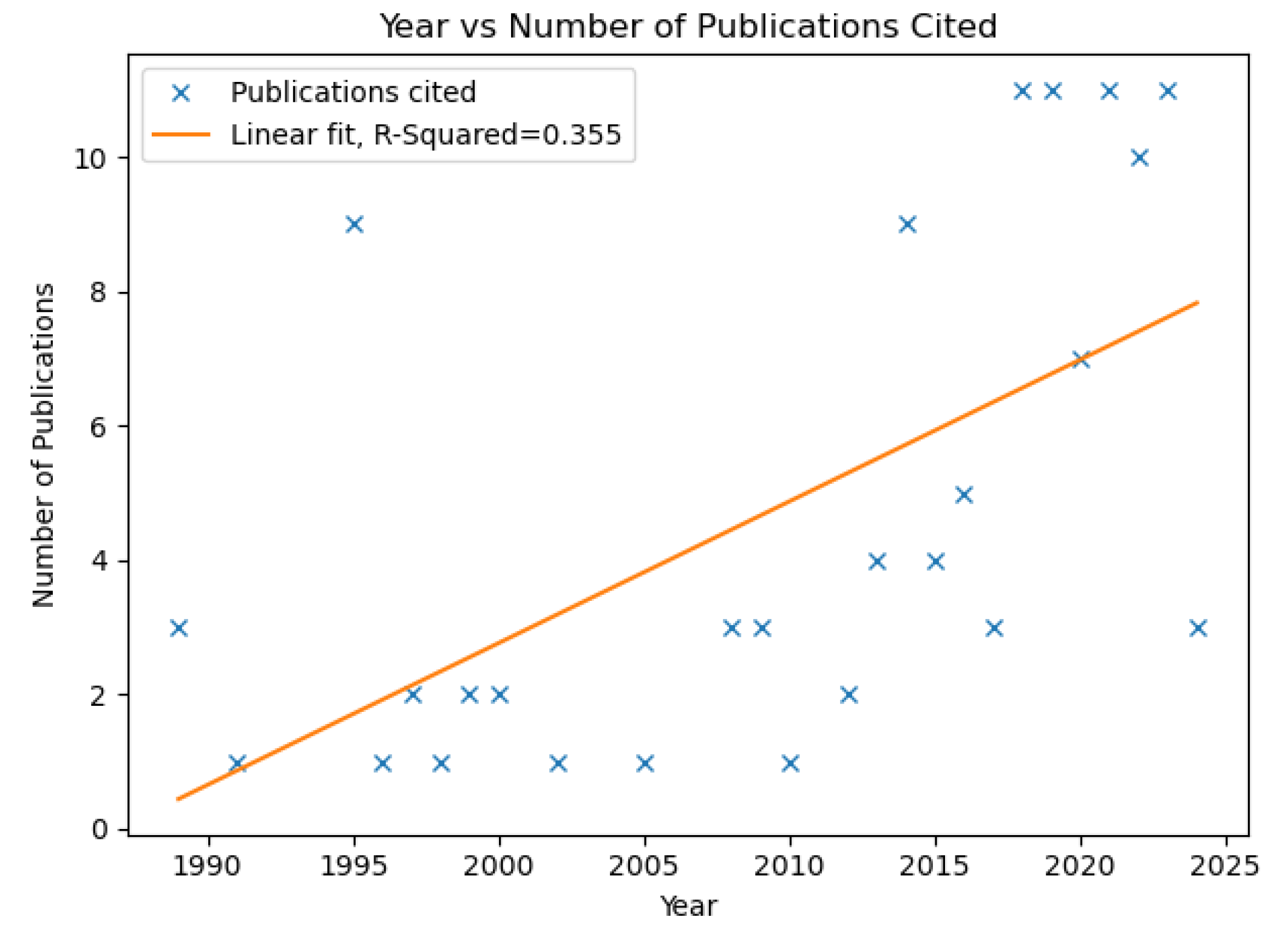
A total of 26 papers from 2010 to 2024 were described in this applications section; their distribution timeline can be seen in
Table 1. In 2010–2015, AI was designed to detect riots, resolve mid-flight conflicts while maintaining safety, and predict the properties of friction stir welding.
In 2016–2020, NASA used AI to reduce the simulation data required to train an AI algorithm, create an AI-enhanced UAV operating system, perceive and interact with the world in a robotics context, provide relevant information to the crew of an aircraft, create air traffic scenarios, detect optical fiber defects, detect multi-layer ice-over-water clouds, find likely routes toward failure in stress testing, and design turbofans.
The years 2021–2024 showed additional progress, as NASA used AI to identify rats that are likely to be impaired from exposure to cosmic radiation, create a platform which allows non-experts to easily use AI, detect surface from satellite data, generate surface temperature from satellite data, classify precipitation types, improve turbofan designs, monitor aquifers, detect lung cancer, find sensitivities between permafrost degradation and the release of soil carbon, model proteins, predict the stiffness and fatigue life of a polymer composite laminate, and create requirements for air traffic management.
NASA has tackled more complex problems with AI as the years passed. The increase in complexity and dataset size (such as those produced by satellites) shows how AI improved over the past decade. That being said, recent improvements are not at the rate as was seen from the 1990s to the mid-2000s.
Over the past couple of decades, the use of neural networks has increased. This could, in part, be because of an increase in computational power over the past decade or the good performance of neural networks across a wide variety of use cases. Neural networks, and other AI algorithms, need good data to perform well. Well-balanced large datasets were identified as a necessary step forward for the improvement of AI techniques.
The open research for this subsection is to find new application spaces or researchers applying different algorithms to existing application spaces. We recognize this is a broad recommendation. However, due to the broad nature of applications, it is difficult to provide specific recommendations.
3.1.3. New Algorithms and Insights
NASA has worked to create new algorithms, improve existing ones and gain insight into ones that already exist. The improvements can come in many forms such as combining multiple algorithms or creating a new objective function. This section provides an overview of NASA’s progress in this area from 2008 to 2022.
In 2008, NASA produced an ANN for autonomous real-time moving object detection with changing illumination and perspective [
69]. The new improvement they made was combining two different object-recognition methods: one based on shape and one based on color.
In 2009, NASA created an evolvable synthetic neural system that included at least one neural basis function, where each of these neural basis functions included an “evolvable neural interface operably coupled to a heuristic neural system to perform high-level functions and an autonomic neural system to perform low-level functions” [
70]. These evolvable systems can be combined to create an evolvable system hierarchy. That same year, NASA released
A Complexity Metric for Automated Separation [
71], wherein they define a Maneuver Option (MO) that is a metric for determining the directions an aircraft can move that do not cause conflict within five minutes. The directions considered are 15° and 30° left and right, straight, and five different altitudes at 1000 feet increments. The newly developed metric was able to quantify the complexity of an airspace at a given moment in time and then identify aircraft that were particularly at risk. While not directly an AI algorithm, the MO metric development did introduce a level of automation in air traffic monitoring.
In 2010, NASA introduced a sequential pattern methodology used to identify patterns that precede riots, rebellions and coups [
11]. The sequential pattern methodology “generates easily interpretable patterns based on direct observations of sampled factor data for a deeper understanding of societal behaviors that is tolerant of observation noise and missing data” [
11]. This new algorithm is designed to be best at forecasting future events, and it showed promise in predicting riots and rebellions.
NASA patented a new ML algorithm, modeled after the immune system, for aircraft defensive maneuvers in 2014 [
72]. The same year, NASA created a “memetric learning” ML model [
73]. In memetric learning, memes are shared across multiple agents. The agents use the memes as a set of instructions to complete their tasks. The best memes are then kept and new memes are made from these memes. This idea is similar to RL and GA, and it is intended to be less brittle to new environments than typical AI.
By 2016, ML was shown to be a feasible and effective way of quickly modeling simulations [
50]. NASA also created a new mathematical representation of the dispatchability property of a simple temporal network [
74].
In 2018, NASA tackled the problem of human speech variability and background noise making speech recognition difficult. They determined that the difficulty can partially be mitigated by choosing an appropriate vocabulary consisting of sounds that were “different enough” for a machine to effectively separate the selection [
75]. This paper also presents various other errors that prevent making a good speech recognition system, but it did not address them. Also in 2018, Dolph et al. looked into what features a CNN locks onto during object classification by looking at the intermittent layers [
13]. Early layers are image primitives similar to edge detectors, while the higher layers are more abstract. At those higher layers, deconvolution can be used to gain some visual idea of what is being learned by the CNN. In another work that year, Zhang et al. introduced a new algorithm for a self-organizing map (SOM) [
76]. SOMs are ANNs used to “map” a high-dimensional input to a low-dimensional space while preserving the topology relations [
76]. Self-organizing maps are typically random; however, this paper proposed a way to make a deterministic model. This process can also be applied to other AI algorithms. To ensure their process worked, they tested it on cloud classification. Their SOM algorithm outperformed a k-means algorithm and produced quality cloud regimes.
By 2020, NASA had completed a formal approach to generating runtime monitors for UASs in a structured natural language [
77]. FRET (Formal Requirements Elicitation Tool) allows the user to input structured natural language to output requirements for the UAS that can then be set as hard requirements in a runtime verification software Copilot (v4.2). Copilot monitors the system in real time to ensure that the requirements are not broken. This entire system is called the Independent Configurable Architecture for the Reliable Operations of Unmanned Systems (ICAROUS).
In 2021, Cooper et al. used an external perception system as a way to detect a clutter field during navigation [
78]. Rather than detect individual items to move around, a clutter field allows an algorithm to focus on the macro level, creating zones with different clutter levels so that multiple autonomous agents can stay within their given maximum clutter level.
In 2022, Razavi et al. presented an argument and method for merging ML algorithms with the historic standard of Process-Based Modeling (PBM) [
79]. The current framework for the hybridization of ML and PBM has three parts:
Sequential framework—ML receives the output of a PBM and estimates error or model uncertainty.
Modular framework—ML is a sub-model for PBM that can serve as an analog for processes that are not yet well understood, or PBM can serve as an input to ML when the process is well understood.
Surrogate modeling—ML is used to make an emulator of some PBM with a better computational efficiency.
Razavi et al. argues this is not enough, and that co-evolution is necessary to receive the advantages of both. Examples include designing a training function that enforces physical relationships with known differential equations or using ML to derive equations.
3.1.4. Summary and Synthesis of New Algorithms and Insights
A total of 14 papers from 2008 to 2022 were used; their year distribution can be seen in
Table 2.
In 2008–2015, NASA created a real-time moving object detector that locked onto both shape and color, an evolvable synthetic neural system, a complexity metric for automated separation, a sequential pattern methodology to forecast future events, an ML model designed after the immune system, and an ML model designed after memes.
In 2016–2020, NASA created a new mathematical representation of the dispatchability property of a simple temporal network, a deterministic algorithm for a self-organizing map, and a formal approach to generating runtime monitors for UASs in a structured natural language. In this same time period, NASA was looking into how the algorithms work and discovered neural networks were starting to outperform other algorithms in some applications, vocabulary selection can make speech recognition easier or harder, and what features a CNN prefers at what layer of convolution.
In 2021–2022, NASA created an algorithm for clutter field detection to aid in robotic navigation, and they considered how to best use AI in tandem with more traditional PBM methods.
As time progressed, NASA seemed to shift focus from creating new AI algorithms to finding new insights about existing algorithms. Understanding how the algorithms work on a deeper level can help reduce the black box nature of the more effective neural networks and allow people to more fully understand their limitations. In addition, NASA is working on making AI tools that can work in tandem with physics-based models to create AI that can behave more in line with the real world. These adjustments will make AI more reliable and trustworthy.
Despite these advances, there are still open research challenges, including the following:
Understanding how “black box” models work.
Creating explanations for how AI algorithms work.
Creating AI models that use domain expertise, such as PBM, to make predictions.
Most of the future directions have a common theme of “understanding AI systems.” This is because having a better understanding of AI systems can lead to better performing algorithms and a wider adoption of AI systems. In order for the algorithms to be more widely adopted, the system must be more than just easier to understand; it must also be explained to the end user.
As can be seen in
Table 3, AI has many capabilities. Because of its adaptability, it performs well on a multitude of tasks. The main challenge addressed by the reviewed papers is in adoption. If the systems do not meet performance expectations, satisfy certification requirements, or produce explainable outputs, then they will not be used.