
The Role of Artificial Intelligence in the Diagnosis and Prognosis of Heart Diseases: A Systematic Review

 ,
,  , , and
Abstract
1. Introduction
2. Materials and Methods
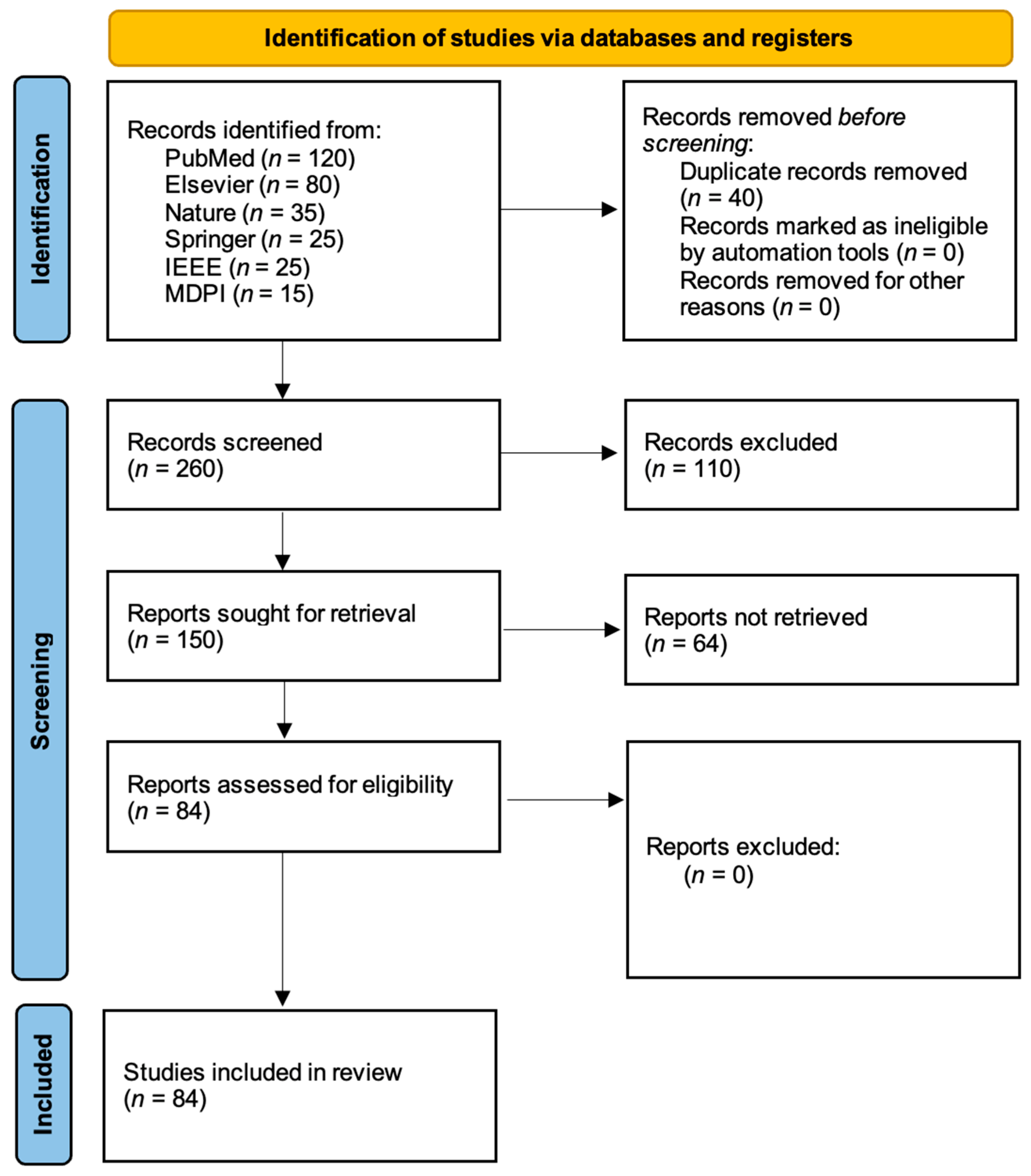
Search Strategy and Criteria Selection
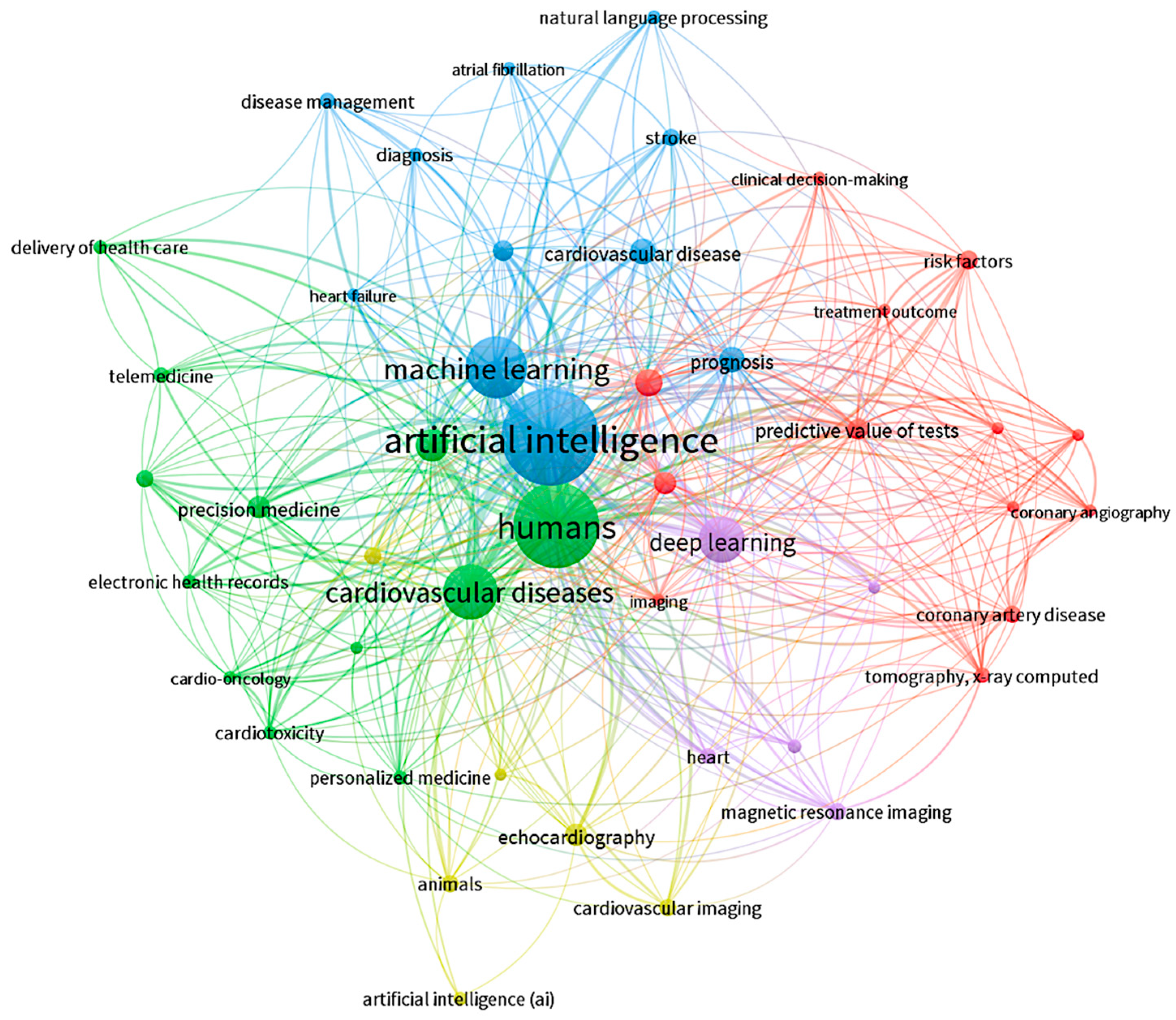
- The blue group represents clinical applications and decision support, including fundamental concepts such as diagnosis, prognosis, stroke, and atrial fibrillation.
- The red group proposes models based on prognosis and treatment outcomes for heart-related diseases.
- The green group shows healthcare systems related to heart disease, precision medicine, and telemedicine.
- The yellow group is related to fundamental techniques for implementing AI systems in heart healthcare, such as medical imaging.
- The purple group is specialized, showing the most sophisticated computational advances used to obtain data for diagnosing heart disease.
3. Results
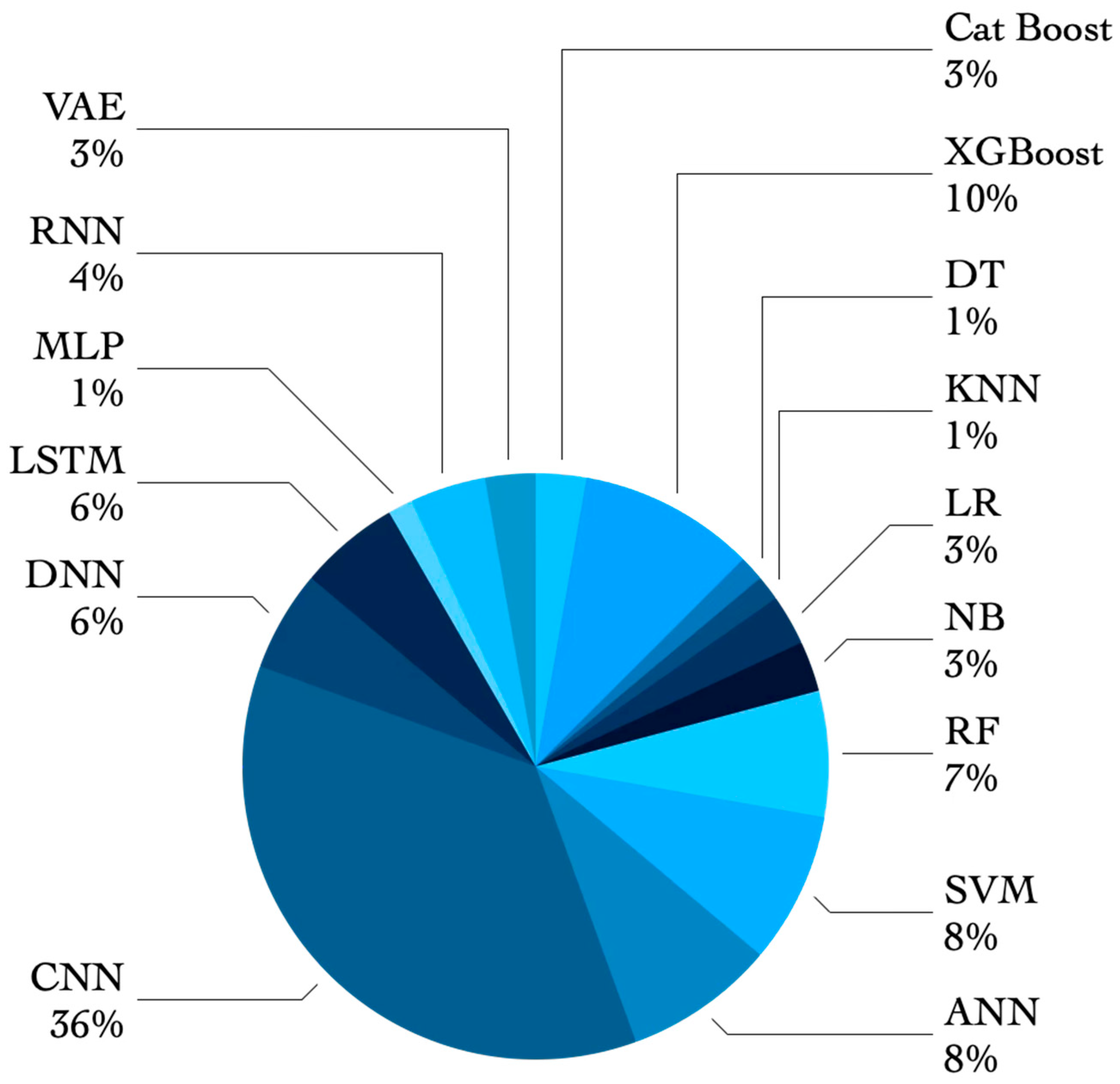
3.1. Performance Evaluation for AI Models
3.2. AI in Heart Diseases Diagnosis
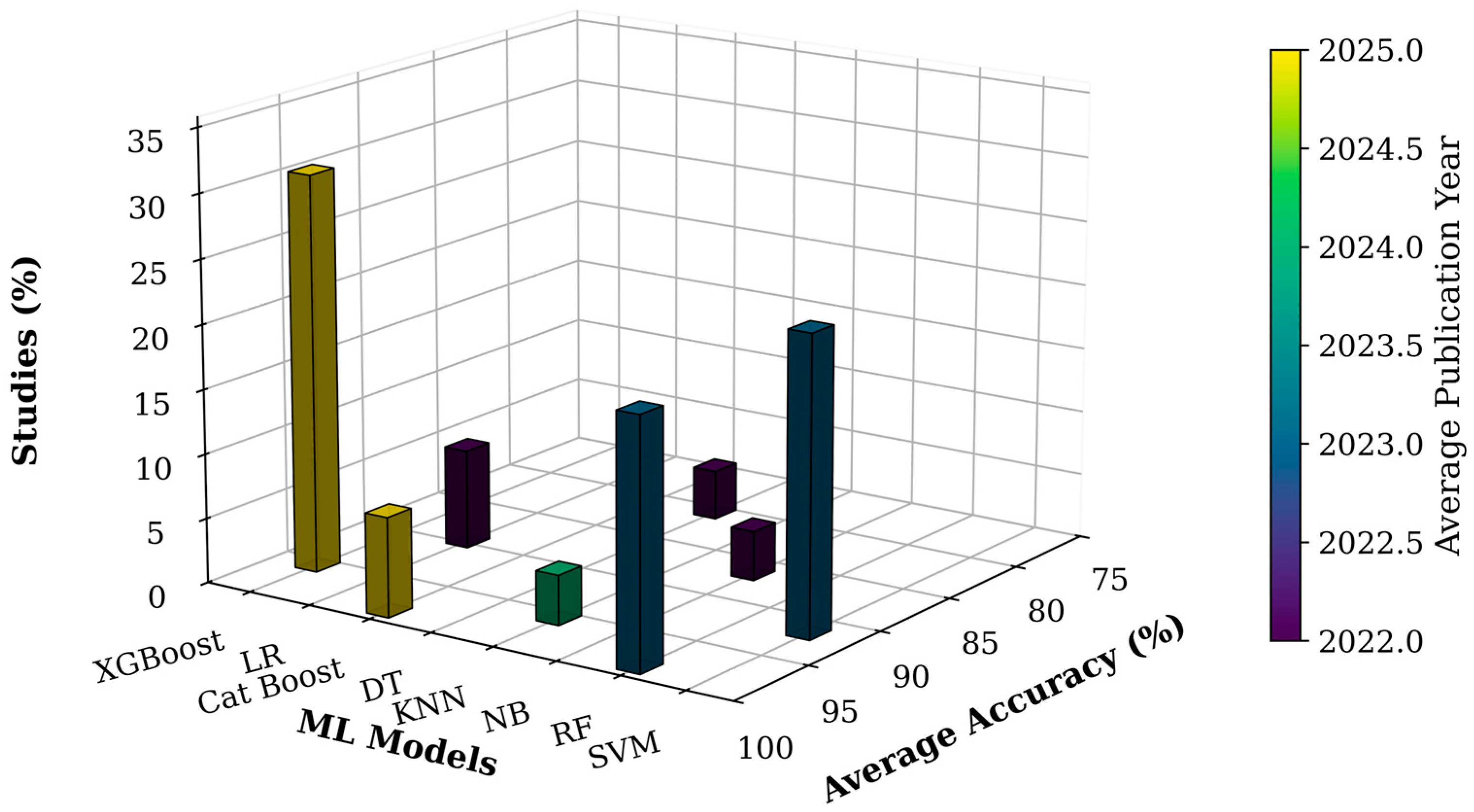
3.2.1. ML Models for Diagnosing Heart Diseases
3.2.2. DL Models for Diagnosing Heart Diseases
3.3. AI in Heart Diseases Prognosis
4. Discussions
5. Challenges and Trends
5.1. Limitations
5.2. Research Gaps and Future Roadmap
6. Conclusions
Author Contributions
Funding
Institutional Review Board Statement
Informed Consent Statement
Data Availability Statement
Acknowledgments
Conflicts of Interest
Abbreviations
| Acc | Accuracy |
| AI | Artificial Intelligence |
| ANN | Artificial neural networks |
| AUC | Area under the curve |
| CHD | Congenital heart disease |
| CVI | Chronic venous insufficiency |
| CNN | Convolutional neural networks |
| DL | Deep learning |
| DNN | Deep neural network |
| DT | Decision trees |
| EGCs | Electrocardiograms |
| F1 | F1-score |
| FDA | Food and Drug Administration |
| Grad-CAM | Gradient-weighted Class Activation Mapping |
| IoMT | Internet of medical things |
| IoT | Internet of things |
| KNN | K-nearest neighbors |
| LIME | Local Interpretable Model-Agnostic Explanations |
| LLM | Large language models |
| LR | Linear regression |
| LSTM | Long short-term memory |
| MAE | Mean average error |
| ML | Machine learning |
| MLP | Multilayer perceptron |
| NB | Naive Bayesians |
| NLP | Natural language processing |
| P | Precision |
| PAD | Peripheral artery disease |
| PROBAST | Prediction model risk of bias assessment tool |
| R2 | Coefficient of determination |
| RAG | Retrieval-Augmented Generation |
| RNN | Recurrent neural network |
| ROC | Receiver operating characteristic curve |
| SHAP | Shapley Additive Explanations |
| Sen | Sensitivity |
| Spe | Specificity |
| STARD-AI | Standards for reporting diagnostic accuracy |
| SVM | Support vector machines |
| TL | Transfer learning |
| TRIPOD-AI | Transparent reporting of a multivariable prediction model for individual prognosis or diagnosis |
| VAE | Variational autoencoder |
| XAI | Explainable artificial intelligence |
References
- Moshawrab, M.; Adda, M.; Bouzouane, A.; Ibrahim, H.; Raad, A. Cardiovascular Events Prediction using Artificial Intelligence Models and Heart Rate Variability. Procedia Comput. Sci. 2022, 203, 231–238. [Google Scholar] [CrossRef]
- Neves, I.; Folgado, D.; Santos, S.; Barandas, M.; Campagner, A.; Ronzio, L.; Cabitza, F.; Gamboa, H. Interpretable heartbeat classification using local model-agnostic explanations on ECGs. Comput. Biol. Med. 2021, 133, 104393. [Google Scholar] [CrossRef] [PubMed]
- Narula, S.; Shameer, K.; Omar, A.M.S.; Dudley, J.T.; Sengupta, P.P. Machine-Learning Algorithms to Automate Morphological and Functional Assessments in 2D Echocardiography. J. Am. Coll. Cardiol. 2016, 68, 2287–2295. [Google Scholar] [CrossRef] [PubMed]
- Asare, J.W.; Appiahene, P.; Donkoh, E.T. Detection of anaemia using medical images: A comparative study of machine learning algorithms—A systematic literature review. Inform. Med. Unlocked 2023, 40, 101283. [Google Scholar] [CrossRef]
- Seber, G.A.F.; Lee, A.J. Linear Regression Analysis; John Wiley & Sons: Hoboken, NJ, USA, 2003. [Google Scholar] [CrossRef]
- Rokach, L.; Maimon, O. Decision Trees. In Data Mining and Knowledge Discovery Handbook; Springer US: Boston, MA, USA, 2006; pp. 165–192. [Google Scholar] [CrossRef]
- Cortes, C. Support-Vector Networks. Mach. Learn. 1995, 20, 273–297. [Google Scholar] [CrossRef]
- Boser, B.E.; Guyon, I.M.; Vapnik, V.N. Training algorithm for optimal margin classifiers. In Proceedings of the Fifth Annual ACM Workshop on Computational Learning Theory; Association for Computing Machinery: New York, NY, USA, 1992; pp. 144–152. [Google Scholar] [CrossRef]
- Fix, E.; Hodges, J.L. Discriminatory Analysis. Nonparametric Discrimination: Consistency Properties. Int. Stat. Rev. 1989, 57, 238. [Google Scholar] [CrossRef]
- MacQueen, J. Some methods for classification and analysis of multivariate observations. In Proceedings of the 5th Berkeley Symposium on Mathematical Statistics and Probability, Volume 1: Statistics; University of California Press: Berkeley, CA, USA, 1967; Volume 5.1, pp. 281–298. [Google Scholar]
- Lecun, Y.; Bengio, Y.; Hinton, G. Deep learning. Nature 2015, 521, 436–444. [Google Scholar] [CrossRef]
- Chang, V.; Bhavani, V.R.; Xu, A.Q.; Hossain, M.A. An artificial intelligence model for heart disease detection using machine learning algorithms. Healthc. Anal. 2022, 2, 100016. [Google Scholar] [CrossRef]
- Tsao, C.W.; Aday, A.; Almarzooq, Z.; Alonso, A.; Beaton, A.; Bittencourt, M.; Boehme, A.; Buxton, A. Heart Disease and Stroke Statistics-2022 Update: A Report from the American Heart Association. Circulation 2022, 145, E153–E639. [Google Scholar] [CrossRef] [PubMed]
- Varela-Chinchilla, C.D.; Sánchez-Mejía, D.E.; Trinidad-Calderón, P.A. Congenital Heart Disease: The State-of-the-Art on its Pharmacological Therapeutics. J. Cardiovasc. Dev. Dis. 2022, 9, 201. [Google Scholar] [CrossRef]
- Duncan, K.; Al-Haddad, M. Arrhythmias. In Intensive Care Fundamentals; Lessons from the ICU; Springer: Cham, Switzerland, 2023; pp. 185–194. [Google Scholar] [CrossRef]
- Cheng, X.S.; VanWagner, L.; Costa, S.; Axelrod, D.; Bangalore, S.; Norman, S.; Herzog, C.; Lentine, K. Emerging Evidence on Coronary Heart Disease Screening in Kidney and Liver Transplantation Candidates: A Scientific Statement From the American Heart Association. Circulation 2022, 146, E299–E324. [Google Scholar] [CrossRef] [PubMed]
- Sadeghi, R.; Tomka, B.; Khodaei, S.; Garcia, J.; Ganame, J.; Keshavarz-Motamed, Z. Reducing Morbidity and Mortality in Patients With Coarctation Requires Systematic Differentiation of Impacts of Mixed Valvular Disease on Coarctation Hemodynamics. J. Am. Heart Assoc. 2022, 11, e022664. [Google Scholar] [CrossRef]
- Baylis, R.A.; Smith, N.L.; Klarin, D.; Fukaya, E. Epidemiology and Genetics of Venous Thromboembolism and Chronic Venous Disease. Circ. Res. 2021, 128, 1988–2002. [Google Scholar] [CrossRef]
- Klarin, D.; Tsao, P.S.; Damrauer, S.M. Genetic Determinants of Peripheral Artery Disease. Circ. Res. 2021, 128, 1805–1817. [Google Scholar] [CrossRef] [PubMed]
- Niazai, A.; Jamil, H.; Hameed, M.; Sheikh, S.; Nisar, M.R. Artificial intelligence in cardiovascular diagnostics: A systematic review and descriptive analysis of clinical applications and diagnostic performance. BMC Cardiovasc. Disord. 2025, 25, 849. [Google Scholar] [CrossRef] [PubMed]
- Balogh, E.P.; Miller, B.T.; Ball, J.R. Improving Diagnosis in Health Care; Academies Press: Cambridge, MA, USA, 2015; pp. 1–472. [Google Scholar] [CrossRef]
- Blaha, M.J.; DeFilippis, A.P. Multi-Ethnic Study of Atherosclerosis (MESA): JACC Focus Seminar 5/8. J. Am. Coll. Cardiol. 2021, 77, 3195–3216. [Google Scholar] [CrossRef]
- Andersson, C.; Nayor, M.; Tsao, C.W.; Levy, D.; Vasan, R.S. Framingham Heart Study: JACC Focus Seminar, 1/8. J. Am. Coll. Cardiol. 2021, 77, 2680–2692. [Google Scholar] [CrossRef]
- Detrano, R.; Steinbrunn, W.; Pfisterer, M.; Schmid, J.; Sandhu, S.; Guppy, K.; Lee, S.; Froelicher, V. International application of a new probability algorithm for the diagnosis of coronary artery disease. Am. J. Cardiol. 1989, 64, 304–310. [Google Scholar] [CrossRef]
- Moody, G.B.; Mark, R.G. The impact of the MIT-BIH arrhythmia database. IEEE Eng. Med. Biol. Mag. 2001, 20, 45–50. [Google Scholar] [CrossRef]
- Goldberger, A.L.; Amaral, L.; Glass, L.; Hausdorff, J.; Ivanov, P.; Mark, R.; Mietus, J.; Moody, G.; Peng, C.; Stanley, H. PhysioBank, PhysioToolkit, and PhysioNet: Components of a new research resource for complex physiologic signals. Circulation 2000, 101, e215–e220. [Google Scholar] [CrossRef]
- Johnson, A.E.W.; Pollard, T.; Shen, L.; Lehman, L.; Feng, M.; Ghassemi, M.; Moody, B.; Szolovits, P.; Anthony, L.; Mark, R. MIMIC-III, a freely accessible critical care database. Sci. Data 2016, 3, 160035. [Google Scholar] [CrossRef] [PubMed]
- Ouyang, D.; He, B.; Ghorbani, A.; Lungren, M.P.; Ashley, E.A.; Liang, D.H.; Zou, J.Y. Echonet-dynamic: A large new cardiac motion video data resource for medical machine learning. In Proceedings of the NeurIPS ML4H Workshop, Vancouver, BC, Canada, 13 December 2019. [Google Scholar]
- Gupta, C.; Saha, A.; Reddy, N.V.S.; Acharya, U.D. Cardiac Disease Prediction using Supervised Machine Learning Techniques. J. Phys. Conf. Ser. 2022, 2161, 012013. [Google Scholar] [CrossRef]
- Alimadadi, A.; Manandhar, I.; Aryal, S.; Munroe, P.B.; Joe, B.; Cheng, X. Machine learning-based classification and diagnosis of clinical cardiomyopathies. Physiol. Genom. 2020, 52, 391–400. [Google Scholar] [CrossRef]
- Ragone, M.; Yurkiv, V.; Ramasubramanian, A.; Xu, X.; Ho, S.; Trac, H.; Discetti, S.; Liu, Y.; Sai, V.; Meghana, P.; et al. Prediction on Cardiovascular disease using Decision tree and Naïve Bayes classifiers. J. Phys. Conf. Ser. 2022, 2161, 012015. [Google Scholar] [CrossRef]
- Zhang, H.; Mu, R. Refining heart disease prediction accuracy using hybrid machine learning techniques with novel metaheuristic algorithms. Int. J. Cardiol. 2024, 416, 132506. [Google Scholar] [CrossRef]
- Shrestha, D. Comparative Analysis of Machine Learning Algorithms for Heart Disease Prediction Using the Cleveland Heart Disease Dataset. Preprints 2024, 2024071333. [Google Scholar] [CrossRef]
- Baseer, K.K.; Sivakumar, K.; Veeraiah, D.; Chhabra, G.; Kumar, P.; Jahir, M.; Gandikota, R.; Harikrishnan, G. Healthcare diagnostics with an adaptive deep learning model integrated with the Internet of medical Things (IoMT) for predicting heart disease. Biomed. Signal Process. Control 2024, 92, 105988. [Google Scholar] [CrossRef]
- El-Sofany, H.; Bouallegue, B.; El-Latif, Y.M.A. A proposed technique for predicting heart disease using machine learning algorithms and an explainable AI method. Sci. Rep. 2024, 14, 23277. [Google Scholar] [CrossRef]
- Rohan, D.; Reddy, G.P.; Kumar, Y.V.P.; Prakash, K.P.; Reddy, C.P. An extensive experimental analysis for heart disease prediction using artificial intelligence techniques. Sci. Rep. 2025, 15, 6132. [Google Scholar] [CrossRef]
- Babu, S.V.; Ramya, P.; Gracewell, J. Revolutionizing heart disease prediction with quantum-enhanced machine learning. Sci. Rep. 2024, 14, 7453. [Google Scholar] [CrossRef]
- Bouqentar, M.A.; Terrada, O.; Hamida, S.; Saleh, S.; Lamrani, D.; Cherradi, B.; Raihani, A. Early heart disease prediction using feature engineering and machine learning algorithms. Heliyon 2024, 10, e38731. [Google Scholar] [CrossRef]
- Han, D.; Kolli, K.; Gransar, H.; Lee, J.; Choi, S.; Chun, E.; Han, H.; Park, S.; Sung, J.; Jung, H.O.; et al. Machine learning based risk prediction model for asymptomatic individuals who underwent coronary artery calcium score: Comparison with traditional risk prediction approaches. J. Cardiovasc. Comput. Tomogr. 2020, 14, 168–176. [Google Scholar] [CrossRef]
- Narasimhan, G.; Victor, A. Bio-inspired disease prediction: Harnessing the power of electric eel foraging optimization algorithm with machine learning for heart disease prediction. Artif. Intell. Rev. 2024, 57, 345. [Google Scholar] [CrossRef]
- Victor, O.A.; Chen, Y.; Ding, X. Non-Invasive Heart Failure Evaluation Using Machine Learning Algorithms. Sensors 2024, 24, 2248. [Google Scholar] [CrossRef] [PubMed]
- Goli, E.; Sah, M. Heterogeneous Committee-Based Adaptive Active Learning for Efficient Heart Disease Prediction. IEEE Access 2026, 14, 19050–19062. [Google Scholar] [CrossRef]
- Almazroi, A.A. Survival prediction among heart patients using machine learning techniques. Math. Biosci. Eng. 2022, 19, 134–145. [Google Scholar] [CrossRef] [PubMed]
- Sherazi, S.W.A.; Zheng, H.; Lee, J.Y. A Machine Learning-Based Applied Prediction Model for Identification of Acute Coronary Syndrome (ACS) Outcomes and Mortality in Patients during the Hospital Stay. Sensors 2023, 23, 1351. [Google Scholar] [CrossRef]
- Sumwiza, K.; Twizere, C.; Rushingabigwi, G.; Bakunzibake, P.; Bamurigire, P. Enhanced cardiovascular disease prediction model using random forest algorithm. Inform. Med. Unlocked 2023, 41, 101316. [Google Scholar] [CrossRef]
- Gupta, G.; Adarsh, U.; Reddy, N.V.S.; Rao, B.A. Comparison of various machine learning approaches uses in heart ailments prediction. J. Phys. Conf. Ser. 2022, 2161, 012010. [Google Scholar] [CrossRef]
- Ambrish, G.; Ganesh, B.; Ganesh, A.; Srinivas, C.; Dhanraj; Mensinkal, K. Logistic regression technique for prediction of cardiovascular disease. Glob. Transit. Proc. 2022, 3, 127–130. [Google Scholar] [CrossRef]
- Hassan, J. Heart Disease Prediction Using Machine Learning Algorithms. J. Innov. Comput. Emerg. Technol. 2024, 4. [Google Scholar] [CrossRef]
- Asadi, F.; Homayounfar, R.; Mehrali, Y.; Masci, C.; Talebi, S.; Zayeri, F. Detection of cardiovascular disease cases using advanced tree-based machine learning algorithms. Sci. Rep. 2024, 14, 22230. [Google Scholar] [CrossRef] [PubMed]
- Doudesis, D.; Lee, K.K.; Boeddinghaus, J.; Bularga, A.; Ferry, A.V.; Tuck, C.; Lowry, M.T.H.; Lopez-Ayala, P.; Nestelberger, T.; Koechlin, L.; et al. Machine learning for diagnosis of myocardial infarction using cardiac troponin concentrations. Nat. Med. 2023, 29, 1201–1210. [Google Scholar] [CrossRef]
- Lu, J.; Hutchens, R.; Hung, J.; Bennamoun, M.; McQuillan, B.; Briffa, T.; Sohel, F.; Murray, K.; Stewart, J.; Chow, B.; et al. Performance of multilabel machine learning models and risk stratification schemas for predicting stroke and bleeding risk in patients with non-valvular atrial fibrillation. Comput. Biol. Med. 2022, 150, 106126. [Google Scholar] [CrossRef]
- Sen, J.; Bhattacharya, S. An explainable hybrid framework for early detection of cardiovascular diseases using Categorical Boosting and Bees algorithm. Sci. Rep. 2025, 15, 45748. [Google Scholar] [CrossRef] [PubMed]
- Wu, B.; Huang, K.; Hong, X.; Zhao, S.S.; Yuan, C.; Li, X.G.; Peng, C.T.; Li, Y.H.; Wu, Q.C.; Zhou, X.L. Building and validating a machine learning model to predict coronary heart disease risk based on non-invasive indicators. Comput. Methods Programs Biomed. 2026, 275, 109186. [Google Scholar] [CrossRef]
- Kumar, V.D.A.; Swarup, C.; Murugan, I.; Kumar, A.; Singh, K.U.; Singh, T.; Dubey, R. Prediction of cardiovascular disease using machine learning technique-a modern approach. Comput. Mater. Contin. 2022, 71, 855–869. [Google Scholar] [CrossRef]
- Abdullah, M. Artificial intelligence-based framework for early detection of heart disease using enhanced multilayer perceptron. Front. Artif. Intell. 2024, 7, 1539588. [Google Scholar] [CrossRef]
- Hussain, S.; Nanda, S.K.; Barigidad, S.; Akhtar, S.; Suaib, M.; Ray, N.K. Novel Deep Learning Architecture for Predicting Heart Disease using CNN. In Proceedings—2021 19th OITS International Conference on Information Technology, OCIT 2021, Bhubaneswar, India, 16–18 December 2021; IEEE: Piscataway, NJ, USA, 2021; pp. 353–357. [Google Scholar] [CrossRef]
- Darmawahyuni, A.; Nurmaini, S.; Rachmatullah, M.N.; Tutuko, B.; Sapitri, A.I.; Firdaus, F.; Fansyuri, A.; Predyansyah, A. Deep learning-based electrocardiogram rhythm and beat features for heart abnormality classification. PeerJ Comput. Sci. 2022, 8, e825. [Google Scholar] [CrossRef]
- Ahmad, B.; Chen, J.; Chen, H. Feature Selection Strategies for Optimized Heart Disease Diagnosis Using ML and DL Models. arXiv 2025, arXiv:2503.16577. [Google Scholar] [CrossRef]
- Kanchanamala, P.; Alphonse, A.S.; Reddy, P.V.B. Heart disease prediction using hybrid optimization enabled deep learning network with spark architecture. Biomed. Signal Process. Control 2023, 84, 104707. [Google Scholar] [CrossRef]
- Dileep, P.; Rao, K.N.; Bodapati, P.; Gokuruboyina, S.; Peddi, R.; Grover, A.; Sheetal, A. An automatic heart disease prediction using cluster-based bi-directional LSTM (C-BiLSTM) algorithm. Neural Comput. Appl. 2023, 35, 7253–7266. [Google Scholar] [CrossRef]
- Rajkumar, G.; Devi, T.G.; Srinivasan, A. Heart disease prediction using IoT based framework and improved deep learning approach: Medical application. Med. Eng. Phys. 2023, 111, 103937. [Google Scholar] [CrossRef] [PubMed]
- Rehman, A.; Xing, H.; Hussain, M.; Gulzar, N.; Khan, M.A.; Hussain, A.; Mahmood, S. HCDP-DELM: Heterogeneous chronic disease prediction with temporal perspective enabled deep extreme learning machine. Knowl.-Based Syst. 2024, 284, 111316. [Google Scholar] [CrossRef]
- Aarthy, S.T.; Iqbal, J.L.M. A novel deep learning approach for early detection of cardiovascular diseases from ECG signals. Med. Eng. Phys. 2024, 125, 104111. [Google Scholar] [CrossRef]
- Baviskar, V.; Verma, M.; Chatterjee, P.; Singal, G. Efficient Heart Disease Prediction Using Hybrid Deep Learning Classification Models. IRBM 2023, 44, 100786. [Google Scholar] [CrossRef]
- Barfungpa, S.P.; Sarma, H.K.D.; Samantaray, L. An intelligent heart disease prediction system using hybrid deep dense Aquila network. Biomed. Signal Process. Control 2023, 84, 104742. [Google Scholar] [CrossRef]
- Arystan, A.Z.; Kane, G.C.; Pislaru, S.V.; Lopez-jimenez, F. Automated Echocardiographic Detection of Heart Failure With Preserved Ejection Fraction Using Artificial Intelligence. JACC Adv. 2023, 2, 100452. [Google Scholar] [CrossRef]
- Cho, Y.; Yoon, M.; Lee, J.H.; Oh, I.-Y.; Park, J.J.; Kim, J.; Choi, D.-J. Ecg Biomarker Using Artificial Intelligence for the Outcome Prediction in Patients With Acute Heart Failure. J. Am. Coll. Cardiol. 2023, 81, 2151. [Google Scholar] [CrossRef]
- Oo, M.M.; Gao, C.; Cole, C.; Hummel, Y.; Guignard-Duff, M.; Jefferson, E.; Hare, J.; Voors, A.A.; de Boer, R.A.; Lam, C.S.P.; et al. Artificial intelligence-assisted automated heart failure detection and classification from electronic health records. ESC Heart Fail. 2024, 11, 2769–2777. [Google Scholar] [CrossRef]
- Pan, X.; Wang, C.; Yu, Y.; Reljin, N.; McManus, D.D.; Darling, C.E.; Chon, K.H.; Mendelson, Y.; Lee, K. Deep cross-modal feature learning applied to predict acutely decompensated heart failure using in-home collected electrocardiography and transthoracic bioimpedance. Artif. Intell. Med. 2023, 140, 102548. [Google Scholar] [CrossRef]
- Siontis, K.C.; Liu, K.; Bos, J.M.; Attia, Z.I.; Cohen-Shelly, M.; Arruda-Olson, A.M.; Zanjirani Farahani, N.; Friedman, P.A.; Noseworthy, P.A.; Ackerman, M.J. Detection of hypertrophic cardiomyopathy by an artificial intelligence electrocardiogram in children and adolescents. Int. J. Cardiol. 2021, 340, 42–47. [Google Scholar] [CrossRef]
- Haimovich, J.S.; Diamant, N.; Khurshid, S.; Di Achille, P.; Reeder, C.; Friedman, S.; Singh, P.; Spurlock, W.; Ellinor, P.T.; Philippakis, A.; et al. Artificial intelligence–enabled classification of hypertrophic heart diseases using electrocardiograms. Cardiovasc. Digit. Health J. 2023, 4, 48–59. [Google Scholar] [CrossRef]
- Elshewey, A.M.; Abed, A.H.; Khafaga, D.S.; Alhussan, A.A.; Eid, M.M.; El-Kenawy, E.S.M. Enhancing heart disease classification based on greylag goose optimization algorithm and long short-term memory. Sci. Rep. 2025, 15, 1277. [Google Scholar] [CrossRef]
- Holste, G.; Oikonomou, E.K.; Mortazavi, B.J.; Coppi, A.; Faridi, K.F.; Miller, E.J.; Forrest, J.K.; McNamara, R.L.; Ohno-Machado, L.; Yuan, N.; et al. Severe aortic stenosis detection by deep learning applied to echocardiography. Eur. Heart J. 2023, 44, 4592–4604. [Google Scholar] [CrossRef] [PubMed]
- Krishna, H.; Desai, K.; Slostad, B.; Bhayani, S.; Arnold, J.H.; Ouwerkerk, W.; Hummel, Y.; Lam, C.S.P.; Ezekowitz, J.; Frost, M.; et al. Fully Automated Artificial Intelligence Assessment of Aortic Stenosis by Echocardiography. J. Am. Soc. Echocardiogr. 2023, 36, 769–777. [Google Scholar] [CrossRef] [PubMed]
- Kwon, J.M.; Lee, S.Y.; Jeon, K.H.; Lee, Y.; Kim, K.H.; Park, J.; Oh, B.H.; Lee, M.M. Deep learning–based algorithm for detecting aortic stenosis using electrocardiography. J. Am. Heart Assoc. 2020, 9, 14717. [Google Scholar] [CrossRef] [PubMed]
- Cohen-Shelly, M.; Attia, Z.I.; Friedman, P.A.; Ito, S.; Essayagh, B.A.; Ko, W.Y.; Murphree, D.H.; Michelena, H.I.; Enriquez-Sarano, M.; Carter, R.E.; et al. Electrocardiogram screening for aortic valve stenosis using artificial intelligence. Eur. Heart J. 2021, 42, 2885–2896. [Google Scholar] [CrossRef]
- Alzubaidi, L.; Zhang, J.; Humaidi, A.J.; Al-Dujaili, A.; Duan, Y.; Al-Shamma, O.; Santamaría, J.; Fadhel, M.A.; Al-Amidie, M.; Farhan, L. Review of deep learning: Concepts, CNN architectures, challenges, applications, future directions. J. Big Data 2021, 8, 53. [Google Scholar] [CrossRef]
- Tiwari, P.; Colborn, K.L.; Smith, D.E.; Xing, F.; Ghosh, D.; Rosenberg, M.A. Assessment of a Machine Learning Model Applied to Harmonized Electronic Health Record Data for the Prediction of Incident Atrial Fibrillation. JAMA Netw. Open 2020, 3, e1919396. [Google Scholar] [CrossRef]
- Cai, W.; Chen, Y.; Guo, J.; Han, B.; Shi, Y.; Ji, L.; Wang, J.; Zhang, G.; Luo, J. Accurate detection of atrial fibrillation from 12-lead ECG using deep neural network. Comput. Biol. Med. 2020, 116, 103378. [Google Scholar] [CrossRef]
- Lou, Y.S.; Lin, C.S.; Fang, W.H.; Lee, C.C.; Lin, C. Extensive deep learning model to enhance electrocardiogram application via latent cardiovascular feature extraction from identity identification. Comput. Methods Programs Biomed. 2023, 231, 107359. [Google Scholar] [CrossRef]
- Arroyo, J.C.T.; Delima, A.J.P. An Optimized Neural Network Using Genetic Algorithm for Cardiovascular Disease Prediction. J. Adv. Inf. Technol. 2022, 13, 95–99. [Google Scholar] [CrossRef]
- Sadr, H.; Salari, A.; Ashoobi, M.T.; Nazari, M. Cardiovascular disease diagnosis: A holistic approach using the integration of machine learning and deep learning models. Eur. J. Med. Res. 2024, 29, 455. [Google Scholar] [CrossRef] [PubMed]
- Mehmood, A.; Iqbal, M.; Mehmood, Z.; Irtaza, A.; Nawaz, M.; Nazir, T.; Masood, M. Prediction of Heart Disease Using Deep Convolutional Neural Networks. Arab. J. Sci. Eng. 2021, 46, 3409–3422. [Google Scholar] [CrossRef]
- Anetta, K.; Horak, A.; Wojakowski, W.; Wita, K.; Jadczyk, T. Deep Learning Analysis of Polish Electronic Health Records for Diagnosis Prediction in Patients with Cardiovascular Diseases. J. Pers. Med. 2022, 12, 869. [Google Scholar] [CrossRef]
- Mandava, M.; Vinta, S.R. MDensNet201-IDRSRNet: Efficient cardiovascular disease prediction system using hybrid deep learning. Biomed. Signal Process. Control 2024, 93, 106147. [Google Scholar] [CrossRef]
- Nandy, S.; Adhikari, M.; Balasubramanian, V.; Menon, V.G.; Li, X.; Zakarya, M. An intelligent heart disease prediction system based on swarm-artificial neural network. Neural Comput. Appl. 2023, 35, 14723–14737. [Google Scholar] [CrossRef]
- Asha, M.M.; Ramya, G. Predator crow search optimization with explainable AI for cardiac vascular disease classification. Sci. Rep. 2025, 15, 11692. [Google Scholar] [CrossRef]
- Zreik, M.; Van Hamersvelt, R.W.; Khalili, N.; Wolterink, J.M.; Voskuil, M.; Viergever, M.A.; Leiner, T.; Isgum, I. Deep Learning Analysis of Coronary Arteries in Cardiac CT Angiography for Detection of Patients Requiring Invasive Coronary Angiography. IEEE Trans. Med. Imaging 2020, 39, 1545–1557. [Google Scholar] [CrossRef]
- Cho, Y.; Kwon, J.M.; Kim, K.H.; Medina-Inojosa, J.R.; Jeon, K.H.; Cho, S.; Lee, S.Y.; Park, J.; Oh, B.H. Artificial intelligence algorithm for detecting myocardial infarction using six-lead electrocardiography. Sci. Rep. 2020, 10, 20495. [Google Scholar] [CrossRef]
- Heinrich, A.; Streckenbach, F.; Beller, E.; Groß, J.; Weber, M.A.; Meinel, F.G. Deep learning-based image reconstruction for CT angiography of the aorta. Diagnostics 2021, 11, 2037. [Google Scholar] [CrossRef] [PubMed]
- Ribeiro, P.; Sá, J.; Paiva, D.; Rodrigues, P.M. Cardiovascular Diseases Diagnosis Using an ECG Multi-Band Non-Linear Machine Learning Framework Analysis. Bioengineering 2024, 11, 58. [Google Scholar] [CrossRef]
- Nedadur, R.; Wang, B.; Tsang, W. Artificial intelligence for the echocardiographic assessment of valvular heart disease. Heart 2022, 108, 1592–1599. [Google Scholar] [CrossRef] [PubMed]
- Kwon, J.M.; Jeon, K.H.; Kim, H.M.; Kim, M.J.; Lim, S.M.; Kim, K.H.; Song, P.S.; Park, J.; Choi, R.K.; Oh, B.H. Comparing the performance of artificial intelligence and conventional diagnosis criteria for detecting left ventricular hypertrophy using electrocardiography. Europace 2020, 22, 412–419. [Google Scholar] [CrossRef] [PubMed]
- Xie, F.; Li, J.; Liu, H. MultiASNet: Multimodal Label Noise Robust Framework for the Classification of Aortic Stenosis in Echocardiography. IEEE Trans. Med. Imaging 2025, 45, 799–810. [Google Scholar] [CrossRef]
- Li, G.; Tan, J.; Wang, R.; Wang, J. Multi-Class Diagnosis of Pulmonary Hypertension in the Presence of COPD via CT Imaging and Transformer-CNN Fusion. IEEE Access 2026, 14, 26647–26661. [Google Scholar] [CrossRef]
- Hekmat-Ardakani, A.; Rabiee, H.R.; Behnamnia, A.; Kazemi, A.H.; Rakhshankhah, A.S.; Mahmoudi Kashani, R.; Yargholi, A.; Morshed-Behbahani, B.; Malekahmadi, A.; Hekmat, H.; et al. AI-driven tongue image analysis for diagnosing and predicting coronary artery disease. Sci. Rep. 2025, 15, 44722. [Google Scholar] [CrossRef]
- McDonald, A.; Gales, M.; Rana, B.S.; Shun-Shin, M.; Lukban, B.F.; Adrego, R.; Papachristidis, A.; Hajee, F.; Shapiro, L.; Wilson, J.; et al. Development and validation of AI-Enhanced auscultation for valvular heart disease screening through a multi-centre study. npj Cardiovasc. Health 2026, 3, 5. [Google Scholar] [CrossRef]
- Manivannan, G.S.; Talawar, S.V.; Vasundhara, M.G.; Karthik Lal, A.; Gagana, S.M.; Hemanth, S.K.; Srijan Gowda, H.L. An efficient deep CNN based BiLSTM framework with RanA optimization for accurate cardiac arrhythmia detection. Sci. Rep. 2026, 16, 7156. [Google Scholar] [CrossRef]
- Celestin, B.; Bagherzadeh, S.P.; Santana, E.; Frost, M.; Iversen, M.; Hermansson, F.N.; Sweatt, A.; Zamanian, R.T.; Hummel, Y.M.; Rendon, G.G.; et al. Artificial Intelligence-Based Echocardiography in Pulmonary Arterial Hypertension. Chest 2026, 169, 207–219. [Google Scholar] [CrossRef]
- Qayyum, A.; Qadir, J.; Bilal, M.; Al-Fuqaha, A. Secure and Robust Machine Learning for Healthcare: A Survey. IEEE Rev. Biomed. Eng. 2021, 14, 156–180. [Google Scholar] [CrossRef]
- Kalyuta, T.Y.; Emelyanova, I.P.; Suvorov, V.V.; Fedonnikov, A.S. Artificial intelligence systems for predicting chronic ischemic heart disease outcomes in cardiac surgery patients based on presence of anemia: A literature review. Russ. Med. 2024, 30, 486–493. [Google Scholar] [CrossRef]
- van Assen, M.; Varga-Szemes, A.; Schoepf, U.J.; Duguay, T.M.; Hudson, H.T.; Egorova, S.; Johnson, K.; St. Pierre, S.; Zaki, B.; Oudkerk, M.; et al. Automated plaque analysis for the prognostication of major adverse cardiac events. Eur. J. Radiol. 2019, 116, 76–83. [Google Scholar] [CrossRef]
- Kim, G.; Yang, M.; Kim, G.H.; Eom, S.H.; Lee, T.S.; Park, S. Predicting heart failure prognosis using deep learning based on FT-transformer. In Proceedings of the International Conference on Ubiquitous and Future Networks, ICUFN, Paris, France, 4–7 July 2023; IEEE: Piscataway, NJ, USA, 2023; pp. 932–936. [Google Scholar] [CrossRef]
- Zhang, W.; Tian, Z.; Song, F.; Xu, P.; Shi, D.; He, M. Enhancing stability in cardiovascular disease risk prediction: A deep learning approach leveraging retinal images. Inform. Med. Unlocked 2023, 42, 101366. [Google Scholar] [CrossRef]
- Chen, H.Y.; Lin, C.S.; Fang, W.H.; Lou, Y.S.; Cheng, C.C.; Lee, C.C.; Lin, C. Artificial Intelligence-Enabled Electrocardiography Predicts Left Ventricular Dysfunction and Future Cardiovascular Outcomes: A Retrospective Analysis. J. Pers. Med. 2022, 12, 455. [Google Scholar] [CrossRef] [PubMed]
- Kim, S.T.; Yang, M.; Kim, G.H.; Eom, S.H.; Lee, T.S.; Park, S. Artificial intelligence based electrocardiogram analysis for prediction of cardiovascular prognosis in dystrophinopathy patients. EP Eur. 2025, 27, 5–8. [Google Scholar] [CrossRef]
- Apostolopoulos, I.D.; Tzani, B.A. Towards an Internet of Things application for the prognosis of Coronary Artery Disease using Machine Learning and Fuzzy Logic. In Proceedings of the 13th International Conference on Information, Intelligence, Systems and Applications, IISA 2022, Corfu, Greece, 18–20 July 2022; IEEE: Piscataway, NJ, USA, 2022. [Google Scholar] [CrossRef]
- Johnson, K.M.; Johnson, H.E.; Zhao, Y.; Dowe, D.A.; Staib, L.H. Scoring of Coronary Artery Disease Characteristics on Coronary CT Angiograms by Using Machine Learning. Radiology 2019, 292, 354–362. [Google Scholar] [CrossRef] [PubMed]
- Weissler, E.H.; Zhang, J.; Lippmann, S.; Rusincovitch, S.; Henao, R.; Jones, W.S. The use of natural language processing to improve identification of patients with peripheral artery disease. Circ. Cardiovasc. Interv. 2020, 13, e009447. [Google Scholar] [CrossRef]
- Baloch, Z.Q.; Raza, S.A.; Pathak, R.; Marone, L.; Ali, A. Machine Learning Confirms Nonlinear Relationship between Severity of Peripheral Arterial Disease, Functional Limitation and Symptom Severity. Diagnostics 2020, 10, 515. [Google Scholar] [CrossRef]
- Postolache, O.; Hemanth, D.J.; Alexandre, R.; Gupta, D.; Geman, O.; Khanna, A. Remote Monitoring of Physical Rehabilitation of Stroke Patients Using IoT and Virtual Reality. IEEE J. Sel. Areas Commun. 2021, 39, 562–573. [Google Scholar] [CrossRef]
- Bisio, I.; Garibotto, C.; Lavagetto, F.; Sciarrone, A. When eHealth Meets IoT: A Smart Wireless System for Post-Stroke Home Rehabilitation. IEEE Wirel. Commun. 2019, 26, 24–29. [Google Scholar] [CrossRef]
- Gurusubramani, S.; Latha, B. Deep Convolutional Generative Adversarial Network for Improved Cardiac Image Classification in Heart Disease Diagnosis. J. Imaging Inform. Med. 2025, 38, 2146–2169. [Google Scholar] [CrossRef]
- Khan Mamun, M.M.R.; Elfouly, T. Detection of Cardiovascular Disease from Clinical Parameters Using a One-Dimensional Convolutional Neural Network. Bioengineering 2023, 10, 796. [Google Scholar] [CrossRef]
- Ashika, T.; Grace, G.H. Enhancing heart disease prediction with stacked ensemble and MCDM-based ranking: An optimized RST-ML approach. Front. Digit. Health 2025, 7, 1609308. [Google Scholar] [CrossRef] [PubMed]
- Jang, J.H.; Jo, Y.Y.; Kang, S.; Son, J.M.; Lee, H.S.; Kwon, J.M.; Lee, M.S. A novel XAI framework for explainable AI-ECG using generative counterfactual XAI (GCX). Sci. Rep. 2025, 15, 23608. [Google Scholar] [CrossRef]
- Abousaber, I. A Novel Explainable Attention-Based Meta-Learning Framework for Imbalanced Brain Stroke Prediction. Sensors 2025, 25, 1739. [Google Scholar] [CrossRef]
- Ackerman, J.P.; Bartos, D.C.; Kapplinger, J.D.; Tester, D.J.; Delisle, B.P.; Ackerman, M.J. The Promise and Peril of Precision Medicine: Phenotyping Still Matters Most. Mayo Clin. Proc. 2016, 91, 1606–1616. [Google Scholar] [CrossRef]
- Polisena, J.; Coyle, D.; Coyle, K.; McGill, S. Home telehealth for chronic disease management: A systematic review and an analysis of economic evaluations. Int. J. Technol. Assess. Health Care 2009, 25, 339–349. [Google Scholar] [CrossRef]
- Buchholz, S.W.; Mowbray, F.I.; Allman, G.; Verboncoeur, J.P.; Beam, L.; Small, L. Wearable Devices and Nurses’ Health: Protocol for an Integrative Review. JMIR Res. Protoc. 2023, 12, e48178. [Google Scholar] [CrossRef]
- Wagan, S.A.; Koo, J.; Siddiqui, I.F.; Attique, M.; Shin, D.R.; Qureshi, N.M.F. Internet of medical things and trending converged technologies: A comprehensive review on real-time applications. J. King Saud Univ.-Comput. Inf. Sci. 2022, 34, 9228–9251. [Google Scholar] [CrossRef]
- Basile, C.; Parlati, A.L.M.; Paolillo, S.; Marzano, F.; Nardi, E.; Chirico, A.; Buonocore, D.; Colella, A.; Fontanarosa, S.; Cotticelli, C.; et al. Depression in Heart Failure with Reduced Ejection Fraction, an Undervalued Comorbidity: An Up-To-Date Review. Medicina 2023, 59, 948. [Google Scholar] [CrossRef]
- Rashid, S.; Gulfam, A.; Noor, T.A.; Yaseen, K.; Sheikh, M.A.A.; Malik, M.; Malik, J. Anxiety and Depression in Heart Failure: An Updated Review. Curr. Probl. Cardiol. 2023, 48, 101987. [Google Scholar] [CrossRef]
- Sobolewska-Nowak, J.; Wachowska, K.; Nowak, A.; Orzechowska, A.; Szulc, A.; Płaza, O.; Gałecki, P. Exploring the Heart–Mind Connection: Unraveling the Shared Pathways between Depression and Cardiovascular Diseases. Biomedicines 2023, 11, 1903. [Google Scholar] [CrossRef]
- Shiga, T. Depression and cardiovascular diseases. J. Cardiol. 2023, 81, 485–490. [Google Scholar] [CrossRef] [PubMed]
- Sinha, S.K.; Sharma, A.K.; Razi, M.; Shukla, P.; Sachan, M.; Pandey, U.; Varma, C.M.; Thakur, R.; Krishna, V. Telecardiology and its outcome among patients with implantable cardiac devices during COVID-19 pandemic. ARYA Atheroscler. 2021, 17, 1. [Google Scholar] [CrossRef]
- Neha, F.; Bhati, D.; Shukla, D.K. Retrieval-Augmented Generation (RAG) in Healthcare: A Comprehensive Review. AI 2025, 6, 226. [Google Scholar] [CrossRef]
- Montenegro, L.; Gomes, L.M.; Machado, J.M. What We Know About the Role of Large Language Models for Medical Synthetic Dataset Generation. AI 2025, 6, 109. [Google Scholar] [CrossRef]
- Okwor, I.A.; Hitch, G.; Hakkim, S.; Akbar, S.; Sookhoo, D.; Kainesie, J. Digital Technologies Impact on Healthcare Delivery: A Systematic Review of Artificial Intelligence (AI) and Machine-Learning (ML) Adoption, Challenges, and Opportunities. AI 2024, 5, 1918–1941. [Google Scholar] [CrossRef]
- Mulliqi, N.; Blilie, A.; Ji, X.; Szolnoky, K.; Olsson, H.; Titus, M.; Martinez Gonzalez, G.; Boman, S.E.; Valkonen, M.; Gudlaugsson, E.; et al. Development and retrospective validation of an artificial intelligence system for diagnostic assessment of prostate biopsies: Study protocol. BMJ Open 2025, 15, e097591. [Google Scholar] [CrossRef]
- Tian, C.; Chen, H.; Shao, W.; Zhang, R.; Yao, X.; Shu, J. Accuracy of machine learning in identifying candidates for total knee arthroplasty (TKA) surgery: A systematic review and meta-analysis. Eur. J. Med. Res. 2025, 30, 317. [Google Scholar] [CrossRef]
- Arina, P.; Kaczorek, M.R.; Hofmaenner, D.A.; Pisciotta, W.; Refinetti, P.; Singer, M.; Mazomenos, E.B.; Whittle, J. Prediction of Complications and Prognostication in Perioperative Medicine: A Systematic Review and PROBAST Assessment of Machine Learning Tools. Anesthesiology 2024, 140, 85–101. [Google Scholar] [CrossRef]



| Database | Search Strategy |
|---|---|
| PubMed | (“artificial intelligence” OR “machine learning” OR “deep learning”) AND (“diagnosis” OR “prognosis”) AND (“heart” OR “cardiac” OR “cardiovascular”) |
| Nature | (“artificial intelligence” OR “machine learning” OR “deep learning”) AND (“diagnosis” OR “prognosis”) AND (“heart” OR “cardiac” OR “cardiovascular”) |
| Springer | TITLE-ABS-KEY (“artificial intelligence” OR “machine learning” OR “deep learning”) AND (“diagnosis” OR “prognosis”) AND (“heart” OR “cardiac” OR “cardiovascular”) |
| Elsevier | TITLE-ABS-KEY (“artificial intelligence” OR “machine learning” OR “deep learning”) AND (“diagnosis” OR “prognosis”) AND (“heart” OR “cardiac” OR “cardiovascular”) |
| IEEE | (“artificial intelligence” OR “machine learning” OR “deep learning”) AND (“diagnosis” OR “prognosis”) AND (“heart” OR “cardiac” OR “cardiovascular”) |
| MDPI | (“artificial intelligence” OR “machine learning” OR “deep learning”) AND (“diagnosis” OR “prognosis”) AND (“heart” OR “cardiac” OR “cardiovascular”) |
| Heart Disease Condition | ML Algorithm | DL Algorithm |
|---|---|---|
| Heart disease | LR, RF, DT, XGBoost, Cat Boost, SVM | ANN, CNN, LSTM, RNN |
| Heart failure | NB, RF, SVM | MLP, CNN |
| Cardiovascular disease | RF, LR, KNN, RF, Cat Boost, LSTM | CNN, ANN |
| Coronary artery disease | XGBoost, RF | CNN |
| Pulmonary hypertension | - | CNN |
| Myocardial ischemia | XGBoost | VAE, ANN |
| Arrythmia | - | CNN |
| Aortic stenosis | - | ANN, CNN |
| Atrial fibrillation | - | CNN, DNN |
| Myocardial infarction | - | VAE, ANN |
| Ref. | Contribution | ML Model | Performance | Validation |
|---|---|---|---|---|
| [29] | Heart disease prediction | LR | Acc = 92% P = 90% Sen = 96% F1 = 93% | Internal |
| [30] | Genome transcriptomic data for clinical cardiomyopathy diagnosis | SVM | P = 90% | Unspecified |
| [31] | Heart failure disease prediction | NB | Acc = 86% P = 73% Sen = 73% | Internal |
| [32] | Heart disease prediction | XGBoost | Acc = 97% | Unspecified |
| [33] | Heart disease prediction | XGBoost | Acc = 90% AUC = 94% | Internal |
| [34] | Heart disease risks prediction | Cat Boost | Acc = 98% Sen = 97% Spe = 96% | Unspecified |
| [35] | Heart disease early detection | XGBoost | Acc = 97% P = 95% Sen = 96% Spe = 90% F1 = 92% AUC = 98% | Unspecified |
| [36] | Heart disease prediction | XGBoost | Acc = 97% P = 97% Sen = 98% Spe = 98% F1 = 99% AUC = 98% | Unspecified |
| [37] | Heart disease prediction | SVM | Acc = 95% P = 96% Sen = 94% Spe = 95% | Unspecified |
| [38] | Early heart disease prediction | SVM | Acc = 92% P = 86% Sen = 90% Spe = 93% | Internal |
| [39] | All-cause mortality for 1, 2, 3, 4, and 5-years prediction | RF | AUC = 76% | Unspecified |
| [40] | Heart failure prediction | RF | Acc = 96% P = 98% Sen = 95% Spe = 98% Spe = 98% | Unspecified |
| [41] | Heart failure assessment | SVM | Acc = 98% P = 97% Sen = 97% Spe = 96% | Unspecified |
| [42] | Heart disease prediction | XGBoost | Acc = 96% P = 95% Sen = 98% F1 = 96% AUC = 96% | Internal |
| [43] | Heart disease prediction | DT | Acc = 80% P = 78% Sen = 65% F1 = 71% | Unspecified |
| Ref. | Contribution | ML Model | Performance | Validation |
|---|---|---|---|---|
| [44] | Acute coronary syndrome outcomes and mortality prediction | RF | Acc= 99% P = 99% Sen= 99% F1 = 99% AUC = 99% | Unspecified |
| [45] | Cardiovascular disease prediction | RF | Acc = 99% P = 96% Sen= 96% F1 = 96% | Unspecified |
| [46] | Analyze healthcare data to predict heart disease | SVM | Acc = 91% P = 90% Sen = 94% Spe = 87% F1 = 92% | Unspecified |
| [47] | Risk of cardiovascular disease prediction | LR | Acc = 87% | Unspecified |
| [48] | Cardiovascular disease prediction | KNN | Acc = 95% | Unspecified |
| [49] | Cardiovascular disease detection | RF | AUC = 80% | Unspecified |
| [50] | Myocardial infarction diagnosis using cardiac troponin concentrations | XGBoost | AUC = 95% | Unspecified |
| [51] | Coronary artery disease prediction | XGBoost | AUC = 88% | Unspecified |
| [52] | Cardiovascular diseases prediction | Cat Boost | Acc = 98% P = 97% Sen = 98% F1 = 98% Spe = 97% | Internal |
| [53] | Coronary heart disease risk prediction | XGBoost | AUC = 82% | External |
| [54] | Early stage of cardiovascular disease prediction | SVM | Acc = 81% Sen = 93% Spe = 89% | Unspecified |
| Ref. | Contribution | DL Model | Performance | Validation |
|---|---|---|---|---|
| [55] | Cardiac disease detection | MLP | Acc = 92% P = 95% Sen = 96% F1 = 94% | Unspecified |
| [56] | Early identification of the disease | CNN | P = 98% Spe = 96% Sen = 100% | Unspecified |
| [57] | Categorization analysis of electrocardiogram using rhythm or beat features | CNN | Acc = 99% P = 99% Sen = 99% Spe = 99% | Unspecified |
| [58] | Heart disease diagnosis | ANN | Acc = 82% P = 82% Sen = 94% | Unspecified |
| [59] | Heart disease prediction | CNN | Acc = 93% Sen = 94% Spe = 91% | Unspecified |
| [60] | Heart disease prediction | LSTM | Acc = 94% | Unspecified |
| [61] | Heart disease prediction | LSTM | Acc = 98% | Unspecified |
| [62] | Heart disease prediction | LSTM | Acc = 96% Spe = 95% Sen = 95% | Unspecified |
| [63] | Heart disease threat detection | DNN | Acc = 94% P = 98% Sen = 100% | Unspecified |
| [64] | Heart disease detection | RNN | Acc = 99% | Unspecified |
| [65] | Possibility of heart diseases prediction | DNN | Acc = 99% Spe = 99% Sen = 99% | Unspecified |
| [66] | Heart failure diagnosis with preserved ejection fraction | CNN | Sen = 84% Spe = 81% AUC = 95% | Unspecified |
| [67] | Prediction of acute heart failure | CNN | AUC = 81% | Unspecified |
| [68] | Classification of heart failure subtypes | CNN | Sen = 100% Spe = 94% | Unspecified |
| [69] | Heart failure acutely decompensated prediction | CNN | Acc = 94% Sen = 79% F1 = 85% | Unspecified |
| [70] | Detection of hypertrophic cardiomyopathy by EGC | CNN | AUC = 98% Sen = 92 Spe = 95% | Unspecified |
| [71] | Detection and classification of left ventricular hypertrophy. | CNN | AUC = 95% | Unspecified |
| [72] | Heart disease classification | LSTM | Acc = 91% | Unspecified |
| Ref. | Contribution | DL Model | Performance | Validation |
|---|---|---|---|---|
| [73] | Detection of severe aortic stenosis | CNN | AUC = 97% | Internal |
| [74] | Aortic Stenosis diagnosis by echocardiography | ANN | - | Internal |
| [75] | Detect aortic stenosis using ECG data | CNN | Acc = 97% Sen = 98% Spe = 96% | Unspecified |
| [76] | Screening for aortic valve stenosis using ECG data | CNN | Acc = 74% Sen = 74% Spe = 78% AUC = 85% | Unspecified |
| [77] | Detection of subclinical Atrial Fibrillation | CNN | Acc = 83% Sen = 82% Spe = 83% AUC = 90% | Unspecified |
| [78] | Atrial Fibrillation detection model | CNN | AUC = 79% | Unspecified |
| [79] | Detection of Atrial Fibrillation | DNN | Acc = 99% Sen = 99% Spec = 99% | Unspecified |
| [80] | Cardiovascular feature data extraction | CNN | Sen = 96% Spe = 92% ROC = 98% | Unspecified |
| [81] | Prediction of heart disease | ANN | Acc = 73% | Unspecified |
| [82] | Cardiovascular disease prediction | LSTM | P = 95% Sen = 92% F1 = 95% | Unspecified |
| [83] | Cardiovascular disease existing prediction | CNN | Acc = 97% | Unspecified |
| [84] | Polish summary texts of patient hospitalizations | CNN | Acc = 78% | Unspecified |
| [85] | Cardiovascular disease detection | CNN | Acc = 99% | Unspecified |
| [86] | Cardiovascular disease detection | ANN | Acc = 95% | Unspecified |
| [87] | Cardiovascular disease detection | ANN | Acc = 73% | Unspecified |
| [88] | Detection of Patients Requiring Invasive Coronary Angiography | CNN | Acc = 80% AUC = 87% | Internal |
| [89] | Myocardial infarction detection using ECG | VAE | AUC = 72% | Unspecified |
| [90] | Myocardial ischemia detection | ANN | Sen = 88% Spe = 86% | Unspecified |
| [91] | Myocarditis diagnosis | VAE | Sen = 78% Spe = 92% | Unspecified |
| [92] | Valvular heart disease by echocardiographic assessment | CNN | AUC = 99% | Unspecified |
| [93] | Detection of left ventricular hypertrophy | CNN | AUC = 88% | Internal |
| [94] | Severity Aortic Stenosis prediction | CNN | Acc = 93% | Internal |
| [95] | Pulmonary hypertension prediction from computed tomography images | CNN | Acc = 85% P = 86% Sen = 86% F1 = 85% | Internal |
| [96] | Coronary artery disease prediction by tongue image analysis | CNN | Acc = 77% F1 = 60% AUC = 57% | External |
| [97] | Valvular heart disease prediction | RNN | Sen = 72% Spe = 82% AUC = 83% | External |
| [98] | Arrhythmia detection from ECG signals | CNN | Acc = 95% F1 = 93% AUC = 96% | Internal |
| [99] | Pulmonary arterial hypertension prediction from echocardiography | CNN | AUC = 79% | External |
| Ref. | Contribution | Technique | Performance | Validation |
|---|---|---|---|---|
| [102] | Prognosis of major adverse cardiac events | LR | Acc = 87% AUC = 92% | External |
| [103] | Prognosis of heart failure | FT-Transformer | AUC = 74% | Internal |
| Ref. | Contribution | Technique | Performance | Validation |
|---|---|---|---|---|
| [104] | Prediction of cardiovascular disease risk | Swin Transformer | Sen = 0.81% Spe = 66% R2 = 0.5 MAE = 1.58 | Unspecified |
| [105] | Cardiovascular outcomes | CNN | AUC = 0.94% | Unspecified |
| [106] | Cardiovascular prognosis in dystrophinopathy patients | AI-based | AUC = 91% | Internal |
| [107] | Prognosis of coronary artery disease | ANN | - | Unspecified |
| [108] | Prognosis of cardiovascular events | KNN | AUC = 79% | Unspecified |
| [109] | Prognosis of peripheral artery | NLP | AUC = 88% | Unspecified |
| [110] | Relationship between severity of peripheral arterial disease and symptom severity | RF | AUC = 68% | Unspecified |
| [111] | Rehabilitation monitoring of stroke | IoT | - | Unspecified |
| [112] | Post-stroke home rehabilitation | IoT | - | Unspecified |
Disclaimer/Publisher’s Note: The statements, opinions and data contained in all publications are solely those of the individual author(s) and contributor(s) and not of MDPI and/or the editor(s). MDPI and/or the editor(s) disclaim responsibility for any injury to people or property resulting from any ideas, methods, instructions or products referred to in the content. |
© 2026 by the authors. Licensee MDPI, Basel, Switzerland. This article is an open access article distributed under the terms and conditions of the Creative Commons Attribution (CC BY) license.
Share and Cite
Tapia-Mendez, E.; Cruz-Albarran, I.A.; Tovar-Arriaga, S.; Gonzalez-Islas, D.; Orea-Tejeda, A.; Morales-Hernandez, L.A. The Role of Artificial Intelligence in the Diagnosis and Prognosis of Heart Diseases: A Systematic Review. AI 2026, 7, 155. https://doi.org/10.3390/ai7050155
Tapia-Mendez E, Cruz-Albarran IA, Tovar-Arriaga S, Gonzalez-Islas D, Orea-Tejeda A, Morales-Hernandez LA. The Role of Artificial Intelligence in the Diagnosis and Prognosis of Heart Diseases: A Systematic Review. AI. 2026; 7(5):155. https://doi.org/10.3390/ai7050155
Chicago/Turabian StyleTapia-Mendez, Enoc, Irving A. Cruz-Albarran, Saul Tovar-Arriaga, Dulce Gonzalez-Islas, Arturo Orea-Tejeda, and Luis A. Morales-Hernandez. 2026. "The Role of Artificial Intelligence in the Diagnosis and Prognosis of Heart Diseases: A Systematic Review" AI 7, no. 5: 155. https://doi.org/10.3390/ai7050155
APA StyleTapia-Mendez, E., Cruz-Albarran, I. A., Tovar-Arriaga, S., Gonzalez-Islas, D., Orea-Tejeda, A., & Morales-Hernandez, L. A. (2026). The Role of Artificial Intelligence in the Diagnosis and Prognosis of Heart Diseases: A Systematic Review. AI, 7(5), 155. https://doi.org/10.3390/ai7050155