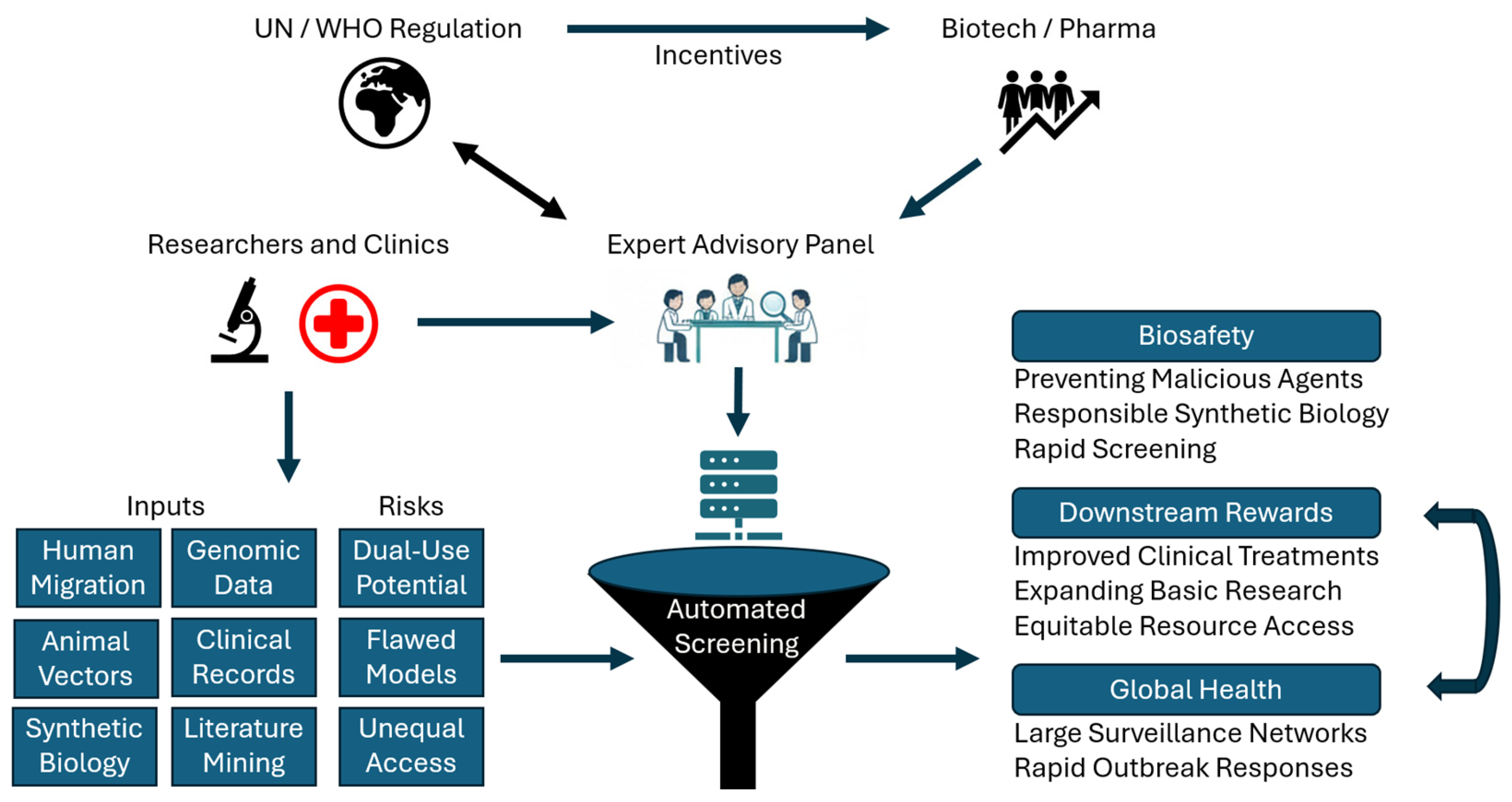

Viruses, Vectors, and Villains: Governing the Risks and Rewards of Artificial Intelligence in Virology


Abstract
1. Introduction
“Technology is neither good nor bad; nor is it neutral.”—Melvin Kranzberg’s first law of technology.
“If we’re bad people we use technology for bad purposes and if we’re good people we use it for good purposes.”—Herbert A. Simon.
2. Background
3. Governance of AI Use in Clinical Virology Diagnostics
- 1.
- Standardize AI Model Development and Validation for Diagnostics.
- Training Dataset Transparency.
- ○
- Developers must disclose training dataset sources, size, and diversity. The metadata of each dataset should be standardized before incorporating multiple databases into the training process. Data should reflect geographic, demographic, and temporal variation in virus circulation.
- ○
- International standards must be set for sample size and tolerable variability between controls, for instance, to avoid comparing scans of infected adults to healthy children, so an algorithm identifies age instead of infection [31].
- Performance Benchmarking.
- ○
- The World Health Organization (WHO) or national labs should establish standardized pathogen reference panels for cross-platform evaluation.
- ○
- Diagnostic platforms should be evaluated by network analysis tools such as those described by the “Foundation for Innovative New Diagnostics” [32].
- ○
- Software competitions awarding successful models should be promoted [33].
- Adaptive Revalidation.
- ○
- Mandate periodic model reassessment, particularly when new viral variants emerge. Models should progress towards desired outcomes, rather than just acceptable ones, for instance, following the rationale in “target product profiles” established by the UK government for COVID-19 test development [34].
- 2.
- Support Clinically Meaningful AI Integration.
- Context-Dependent Approval.
- ○
- Define specific thresholds for validation, such as rapid triage in emergencies vs. long-term care standards, allowing models with lower sensitivity but high specificity in triage settings to reduce overload during outbreaks.
- Explainability Requirements.
- ○
- Models must include interpretable outputs, such as attention heatmaps, feature contribution rankings, decision trees, and confidence intervals.
- ○
- Experts must determine the balance between performance speed and the availability of transparency outputs [35]. Should logic be given on demand, delaying calculations, or does output speed supersede human understanding in emergencies, with rationale being analyzed afterwards?
- Post-Deployment Feedback Loops.
- ○
- Require monitoring of false positive/negative rates over time and integrate feedback from lab personnel and clinicians.
- ○
- The WHO’s Global Laboratory Initiative could serve as a host for feedback frameworks.
- 3.
- Preclinical Validation Pipelines for AI-Predicted Drug Candidates.
- Minimum Evidence Standards.
- ○
- Form open, crowdsourced networks modeled after the COVID Moonshot initiative, where labs across institutions collaborated to rapidly identify unpatented antiviral compounds [36] rather than relying on singular experts.
- ○
- Establish standard in vitro testing protocols (e.g., viral replication assays, pseudovirus entry systems) to assess AI-predicted inhibitors.
- ○
- Set guidelines that in silico results alone are insufficient; require at least:
- ▪
- One functional antiviral assay and one test of toxicity for fast-tracked drugs.
- ▪
- One biophysical binding method to target molecules for prolonged clinical use.
- Time-Based Reassessment.
- ○
- Emergency deployments must expire after a set time, say, a reasonable window of 6 months, unless follow-up clinical data are collected.
- ○
- Models must be updated when underlying viral proteins change due to recombination or mutation.
- 4.
- Emergency Conditional Deployment Mechanisms.
- AI-Evidence-Based Conditional Approval.
- ○
- Permit emergency use if a candidate:
- Clinical Registry and Oversight.
- ○
- Create a WHO or UN-hosted Registry for AI-Prioritized Antivirals, listing:
- ▪
- Chemical structure;
- ▪
- Mechanism-of-action hypotheses;
- ▪
- Source model and dataset details;
- ▪
- Testing status and outcomes.
- 5.
- Recommended International Support Structures.
- Global Repository of Validated AI Tools.
- ○
- Hosted by the WHO, Coalition for Epidemic Preparedness Innovations (CEPI), or another neutral body.
- ○
- Includes metadata on AI model validation, geographic bias, and clinical deployment records.
- Capacity Building for Low- and Middle-Income Countries.
4. AI in Synthetic Virus Biology
- 1.
- Strengthening Sequence Screening at the Point of Synthesis.
- Customer identity verification and establishment of cases for licensed exemption in virology research. Include third-party customer verification and safety officer contact at the purchasing institution for assistance in reviewing flagged orders [52].
- Sequence-based screening using established databases for organisms of concern that are regularly updated, as well as defining risk levels [53]. A standardized ruleset for the length of sequences screened and the inclusion of single-stranded DNA should be adopted, as company protocols currently vary considerably [54]. There can also be screening for patterns that suggest attempts to avoid detection by ordering multiple small fragments that can later be joined together [55].
- Contextual review when sequences are flagged, including defining a threshold of risk level violations for reporting to authorities.
- Establishing an internationally recognized database for pathogens and sequences of concern, for instance, based on the Australia Group control list or the US Federal Select Agent Program [57,58]. This can also include databases of functional elements to proactively detect the synthesis of toxic factors from organisms or artificially designed proteins not yet classified as pathogenic [59].
- 2.
- Development and Adoption of Automated Screening Pipelines.
- Pipelines should be open source so the community can continue to develop them alongside advances in both natural and synthetic biology, such as SeqScreen [62].
- Develop and host standardized test datasets for screening tools.
- Certify tools against transparent performance benchmarks (e.g., sensitivity to sequences of concern, false positive rates).
- Update these benchmarks regularly to reflect emerging viral threats.
- 3.
- Incentivizing Voluntary Compliance.
- a.
- Certification and Recognition Programs.
- Establish a UN-endorsed “Responsible Synthesis Partner” certification for providers who adhere to recognized screening protocols and participate in benchmarking.
- Publicize certified providers in a centralized registry accessible to national biosafety authorities and grant-making agencies.
- b.
- Economic and Strategic Incentives.
- Encourage government research agencies and public health labs to procure synthetic DNA only from certified providers.
- Provide preferential access to shared sequence databases, updated regulatory lists, or screening pipelines as a benefit for certified participants.
- Offer small grants or tax incentives to companies developing or adopting automated screening infrastructure, particularly in low- and middle-income countries.
- 4.
- Extend High-Risk Classification to Pathogen Design AI Models.
- Push to amend the European Union Artificial Intelligence Act [65], and similar national legislation, to classify AI models trained to generate, evolve, or optimize viral genomes as high-risk systems. Legal definitions of biological misuse can be based on recent guidelines of the US AI Safety Institute [66].
- Regulatory requirements for AI in designing novel organisms for research:
- ○
- Documentation of training data provenance.
- ○
- Disclosure of filtering or safety layers used to restrict misuse.
- ○
- Risk assessments by independent technical reviewers prior to deployment.
- ○
- In line with operative paragraph 9 of UN resolution A/RES/78/265 [67], the private sector should be encouraged to develop safe AI systems, for example, widely accessible models with inherent safeguards against biological design. Such considerations have been outlined by the Nuclear Threat Institute [68] and are already considered for xAI and OpenAI [69].
5. Strategies for Epidemiological Monitoring and Response
- 1.
- Establish an Integrated AI-Assisted Surveillance Network.
- Environmental Surveillance: Existing wastewater and metagenomic sampling programs can upload their data to centralized servers. These can then be parsed with machine learning models to detect deviations from baseline viral loads. Several tools already exist for identifying viruses from such datasets, where most of the isolated material is likely nonviral. These include ViraMiner [75], DeepVirFinder [76], LucaProt [77], and EdeepVPP [78]. Many tools can predict completely new viruses with no known reference sequence [79]. Companies such as Ginko Biosecurity have airport wastewater monitoring programs that can directly flag potential spread of viruses.
- Zoonotic Risk Modeling: AI-assisted mapping of animal reservoirs and vector habitats, alongside climate and land-use data, can forecast crossover risk zones. Major groups such as the U.S. Department of Agriculture, the World Organisation for Animal Health, and the Food and Agriculture Organization of the United Nations Emergency Prevention System conduct surveillance of zoonotic diseases in livestock, wildlife, and migratory species, often in partnership with regional and national veterinary services. Linking their datasets with AI platforms could enable earlier detection and support predictive modeling of emerging zoonotic threats as part of an integrated global biosurveillance network. AI tools have even been developed to classify mosquito vectors from images of wings, simplifying fieldwork [80].
- 2.
- Automate Pipelines for Identifying Viruses and Variants.
- Analyze and Classify Viral Genomes.
- PyR0 to identify relative geographic prevalence and fitness of viral strains [84];
- NetMHCpan [85] to identify if new viruses are less visible to the immune system;
- BioLaboro [86] to automate PCR-based diagnostics against flagged sequences.
- b.
- Detect Patterns of Synthetic Alteration Models.
- Restriction sites flanking key genes of interest that indicate genome editing.
- A change in the global nucleotide patterns. This includes variation in GC-richness, codon usage and codon-pair biases that may optimize a virus for a particular host, and dinucleotide patterns, particularly CpG and ApU.
- New functional elements and genomic configurations. This can include gene expression factors such as promoters, internal ribosomal entry sites, peptide cleavage or frameshifting signals from unrelated viruses, or genes arising in different configurations or overlapping with prototypical sequences.
- Mutational hotspots in one region of the genome and not in others, particularly those that change the corresponding amino acids.
- A panel of experts should be formed to manually validate sequences flagged by a validated autonomous system as synthetically altered, and output formats should be graphical and easily understood.
- c.
- Proactively Identify Variants of Concern.
- Protein folding tools, such as AlphaMissense [89], DDMut [90], FoldX [91], or ESM-2 [92], combined with automated protein–protein interaction predictions, such as HADDOCK [93] or ClusPro [94], could theoretically be used to determine if new viral strains bind better to host factors or calculate what mutations would improve viral fitness before they are seen in the clinic.
- ○
- These tools can also predict mutations in viral genes that preserve biological function but bypass diagnostics from PCR or antibody tests.
- ○
- Generated structures could be tested for resistance to antiviral drugs [95].
- 3.
- Model-Driven Outbreak Control for Predicting Transit Hubs and Spread.
- Establish tools to prioritize transit hubs. In the event of an outbreak, total shutdowns are economically and politically unfavorable. Certain routes could still facilitate trade without spreading disease, or their closure could be ineffective in controlling diseases with animal vectors. Combined with biological data such as transmission routes (e.g., droplet or by mosquitoes) and time between infection and onset of symptoms, several tools can be used to predict the spread and, therefore, which transit hubs should be monitored or restricted or which destination hubs should be on alert. In addition to the commercial firms mentioned in part 1 of this section, computational tools include GLEaMviz [96] and EPIRISK [97], based on major transportation hubs, EpiModel for customizable factors [98], or tools using cellular networks to map mobility [99,100].
- Support the development of national response plans. Local agencies should develop action plans in the event of an outbreak. These should account for the transmission modes of the virus and testing protocols. A UN or WHO-backed bulletin outlining effective strategy goals could normalize the efficacy of these plans.
6. Conclusions
7. Future Directions and Policy Limitations
Author Contributions
Funding
Institutional Review Board Statement
Informed Consent Statement
Data Availability Statement
Acknowledgments
Conflicts of Interest
Abbreviations
| AI | Artificial Intelligence |
| ASAP | AI-driven Structure-enabled Antiviral Platform |
| AViDD | Antiviral Drug Discovery |
| CDC | Centers for Disease Control and Prevention |
| CEPI | Coalition for Epidemic Preparedness Innovations |
| COVID-19 | Coronavirus Disease 2019 |
| CT | Computed Tomography |
| DNA | Deoxyribonucleic Acid |
| EU | European Union |
| FAO | Food and Agriculture Organization of the United Nations |
| GISAID | Global Initiative on Sharing All Influenza Data |
| GOARN | Global Outbreak Alert and Response Network |
| NIH | National Institutes of Health |
| NTI | Nuclear Threat Initiative |
| PCR | Polymerase Chain Reaction |
| RNA | Ribonucleic Acid |
| SARS-CoV-2 | Severe Acute Respiratory Syndrome Coronavirus 2 |
| UK | United Kingdom |
| UN | United Nations |
| UNEP | United Nations Environment Programme |
| USAID | United States Agency for International Development |
| US | United States |
| USDA | U.S. Department of Agriculture |
| WHO | World Health Organization |
| WOAH | World Organisation for Animal Health |
References
- Shortliffe, E.H.; Axline, S.G.; Buchanan, B.G.; Merigan, T.C.; Cohen, S.N. An Artificial Intelligence program to advise physicians regarding antimicrobial therapy. Comput. Biomed. Res. 1973, 6, 544–560. [Google Scholar] [CrossRef] [Scilit]
- Krizhevsky, A.; Sutskever, I.; Hinton, G.E. ImageNet classification with deep convolutional neural networks. Commun. ACM 2017, 60, 84–90. [Google Scholar] [CrossRef] [Scilit]
- Luo, R.; Sun, L.; Xia, Y.; Qin, T.; Zhang, S.; Poon, H.; Liu, T.-Y. BioGPT: Generative pre-trained transformer for biomedical text generation and mining. Brief. Bioinform. 2022, 23, bbac409. [Google Scholar] [CrossRef] [Scilit] [PubMed]
- Jumper, J.; Evans, R.; Pritzel, A.; Green, T.; Figurnov, M.; Ronneberger, O.; Tunyasuvunakool, K.; Bates, R.; Žídek, A.; Potapenko, A.; et al. Highly accurate protein structure prediction with AlphaFold. Nature 2021, 596, 583–589. [Google Scholar] [CrossRef] [Scilit]
- Stebbing, J.; Krishnan, V.; de Bono, S.; Ottaviani, S.; Casalini, G.; Richardson, P.J.; Monteil, V.; Lauschke, V.M.; Mirazimi, A.; Youhanna, S.; et al. Mechanism of baricitinib supports artificial intelligence-predicted testing in COVID -19 patients. EMBO Mol. Med. 2020, 12, e12697. [Google Scholar] [CrossRef] [Scilit] [PubMed]
- McKinney, S.M.; Sieniek, M.; Godbole, V.; Godwin, J.; Antropova, N.; Ashrafian, H.; Back, T.; Chesus, M.; Corrado, G.S.; Darzi, A.; et al. International evaluation of an AI system for breast cancer screening. Nature 2020, 577, 89–94. [Google Scholar] [CrossRef] [Scilit]
- Roberts, M.; Driggs, D.; Thorpe, M.; Gilbey, J.; Yeung, M.; Ursprung, S.; Aviles-Rivero, A.I.; Etmann, C.; McCague, C.; Beer, L.; et al. Common pitfalls and recommendations for using machine learning to detect and prognosticate for COVID-19 using chest radiographs and CT scans. Nat. Mach. Intell. 2021, 3, 199–217. [Google Scholar] [CrossRef] [Scilit]
- Poplin, R.; Chang, P.-C.; Alexander, D.; Schwartz, S.; Colthurst, T.; Ku, A.; Newburger, D.; Dijamco, J.; Nguyen, N.; Afshar, P.T.; et al. A universal SNP and small-indel variant caller using deep neural networks. Nat. Biotechnol. 2018, 36, 983. [Google Scholar] [CrossRef] [Scilit]
- Hadfield, J.; Megill, C.; Bell, S.M.; Huddleston, J.; Potter, B.; Callender, C.; Sagulenko, P.; Bedford, T.; Neher, R.A. Nextstrain: Real-time tracking of pathogen evolution. Bioinformatics 2018, 34, 4121–4123. [Google Scholar] [CrossRef] [Scilit] [PubMed]
- Flamholz, Z.N.; Biller, S.J.; Kelly, L. Large language models improve annotation of prokaryotic viral proteins. Nat. Microbiol. 2024, 9, 537–549. [Google Scholar] [CrossRef] [Scilit]
- Lin, Z.; Akin, H.; Rao, R.; Hie, B.; Zhu, Z.; Lu, W.; Smetanin, N.; VerKuil, R.; Kabeli, O.; Shmueli, Y.; et al. Evolutionary-scale prediction of atomic-level protein structure with a language model. Science 2023, 379, 1123–1130. [Google Scholar]
- Shu, Y.; McCauley, J. GISAID: Global initiative on sharing all influenza data—From vision to reality. Eurosurveillance 2017, 22, 30494. [Google Scholar] [CrossRef] [Scilit]
- Urbina, F.; Lentzos, F.; Invernizzi, C.; Ekins, S. Dual use of artificial-intelligence-powered drug discovery. Nat. Mach. Intell. 2022, 4, 189–191. [Google Scholar] [CrossRef] [Scilit]
- Imai, M.; Watanabe, T.; Hatta, M.; Das, S.C.; Ozawa, M.; Shinya, K.; Zhong, G.; Hanson, A.; Katsura, H.; Watanabe, S.; et al. Experimental adaptation of an influenza H5 HA confers respiratory droplet transmission to a reassortant H5 HA/H1N1 virus in ferrets. Nature 2012, 486, 420–428. [Google Scholar] [CrossRef] [Scilit]
- Herfst, S.; Schrauwen, E.J.A.; Linster, M.; Chutinimitkul, S.; de Wit, E.; Munster, V.J.; Sorrell, E.M.; Bestebroer, T.M.; Burke, D.F.; Smith, D.J.; et al. Airborne transmission of influenza A/H5N1 virus between ferrets. Science 2012, 336, 1534–1541. [Google Scholar] [CrossRef] [Scilit]
- Hoffmann, S.A.; Diggans, J.; Densmore, D.; Dai, J.; Knight, T.; Leproust, E.; Boeke, J.D.; Wheeler, N.; Cai, Y. Safety by design: Biosafety and biosecurity in the age of synthetic genomics. iScience 2023, 26, 106165. [Google Scholar] [CrossRef] [Scilit] [PubMed]
- Cello, J.; Paul, A.V.; Wimmer, E. Chemical synthesis of poliovirus cDNA: Generation of infectious virus in the absence of natural template. Science 2002, 297, 1016–1018. [Google Scholar] [CrossRef] [Scilit] [PubMed]
- Becker, M.M.; Graham, R.L.; Donaldson, E.F.; Rockx, B.; Sims, A.C.; Sheahan, T.; Pickles, R.J.; Corti, D.; Johnston, R.E.; Baric, R.S.; et al. Synthetic recombinant bat SARS-like coronavirus is infectious in cultured cells and in mice. Proc. Natl. Acad. Sci. USA 2008, 105, 19944–19949. [Google Scholar] [CrossRef] [Scilit] [PubMed]
- Noyce, R.S.; Lederman, S.; Evans, D.H. Construction of an infectious horsepox virus vaccine from chemically synthesized DNA fragments. PLoS ONE 2018, 13, e0188453. [Google Scholar] [CrossRef] [Scilit]
- Götting, J.; Medeiros, P.; Sanders, J.G.; Li, N.; Phan, L.; Elabd, K.; Justen, L.; Hendrycks, D.; Donoughe, S. Virology Capabilities Test (VCT): A Multimodal Virology Q&A Benchmark. arXiv 2025, arXiv:2504.16137. [Google Scholar] [CrossRef] [Scilit]
- Sweeney, T.E.; Wong, H.R.; Khatri, P. Robust classification of bacterial and viral infections via integrated host gene expression diagnostics. Sci. Transl. Med. 2016, 8, 346ra91. [Google Scholar] [CrossRef] [Scilit]
- Shen, Y.; Han, D.; Qu, W.; Yu, F.; Zhang, D.; Xu, Y.; Shen, E.; Chu, Q.; Timko, M.P.; Fan, L.; et al. Robust Diagnosis of Acute Bacterial and Viral Infections via Host Gene Expression Rank-Based Ensemble Machine Learning Algorithm: A Multi-Cohort Model Development and Validation Study. Clin. Chem. 2025, 71, 497–509. [Google Scholar] [CrossRef] [Scilit]
- Luebbert, L.; Sullivan, D.K.; Carilli, M.; Hjörleifsson, K.E.; Winnett, A.V.; Chari, T.; Pachter, L. Detection of viral sequences at single-cell resolution identifies novel viruses associated with host gene expression changes. Nat. Biotechnol. 2025, 44, 100–109. [Google Scholar] [CrossRef] [Scilit] [PubMed]
- Wynants, L.; Van Calster, B.; Collins, G.S.; Riley, R.D.; Heinze, G.; Schuit, E.; Albu, E.; Arshi, B.; Bellou, V.; Bonten, M.M.J.; et al. Prediction models for diagnosis and prognosis of covid-19: Systematic review and critical appraisal. BMJ 2020, 369, 29. [Google Scholar] [CrossRef] [Scilit] [PubMed]
- High-Level Expert Group on Artificial Intelligence. Ethics Guidelines for Trustworthy AI; European Commission: Brussels, Belgium, 2019. [Google Scholar]
- Zhou, Y.; Wang, F.; Tang, J.; Nussinov, R.; Cheng, F. Artificial intelligence in COVID-19 drug repurposing. Lancet. Digit. Health 2020, 2, e667. [Google Scholar] [PubMed]
- Chenthamarakshan, V.; Hoffman, S.C.; Owen, C.D.; Lukacik, P.; Strain-Damerell, C.; Fearon, D.; Malla, T.R.; Tumber, A.; Schofield, C.J.; Duyvesteyn, H.M.E.; et al. Accelerating drug target inhibitor discovery with a deep generative foundation model. Sci. Adv. 2023, 9, eadg7865. [Google Scholar] [CrossRef] [Scilit]
- Kang, Y.; Jin, K.; Pan, L. AI designed, mutation resistant broad neutralizing antibodies against multiple SARS-CoV-2 strains. Sci. Rep. 2025, 15, 15533. [Google Scholar] [CrossRef] [Scilit]
- Ridgway, J.P.; Lee, A.; Devlin, S.; Kerman, J.; Mayampurath, A. Machine Learning and Clinical Informatics for Improving HIV Care Continuum Outcomes. Curr. HIV/AIDS Rep. 2021, 18, 229. [Google Scholar] [CrossRef] [Scilit]
- Paul, D.; Sanap, G.; Shenoy, S.; Kalyane, D.; Kalia, K.; Tekade, R.K. Artificial intelligence in drug discovery and development. Drug Discov. Today 2021, 26, 80–93. [Google Scholar] [CrossRef] [Scilit]
- Narayanan, A.; Kapoor, S. Why an overreliance on AI-driven modelling is bad for science. Nature 2025, 640, 312–314. [Google Scholar] [CrossRef] [Scilit]
- Foundation for Innovative New Diagnostics (FIND). Diagnostic Network Optimization: A Network Analytics Approach to Design Patient-Centred and Cost-Efficient Diagnostic Systems; FIND: Geneva, Switzerland, 2022. [Google Scholar]
- Makridakis, S.; Spiliotis, E.; Assimakopoulos, V. Statistical and Machine Learning forecasting methods: Concerns and ways forward. PLoS ONE 2018, 13, e0194889. [Google Scholar] [CrossRef] [Scilit] [PubMed]
- Medicines & Healthcare Products Regulatory Agency. Target Product Profile: Laboratory-Based SARS-CoV-2 Viral Detection Tests; Medicines & Healthcare Products Regulatory Agency: London, UK, 2023.
- Ahmad, M.A.; Eckert, C.; Teredesai, A.; Mckelvey, G. Interpretable Machine Learning in Healthcare. In Proceedings of the 2018 ACM International Conference on Bioinformatics, Computational Biology, and Health Informatics; ACM International: New York, NY, USA, 2018; Volume 19, pp. 559–560. [Google Scholar]
- Boby, M.L.; Fearon, D.; Ferla, M.; Filep, M.; Koekemoer, L.; Robinson, M.C.; Chodera, J.D.; Lee, A.A.; London, N.; von Delft, A.; et al. Open science discovery of potent noncovalent SARS-CoV-2 main protease inhibitors. Science 2023, 382, eabo7201. [Google Scholar] [CrossRef] [Scilit]
- Ochoa, D.; Hercules, A.; Carmona, M.; Suveges, D.; Gonzalez-Uriarte, A.; Malangone, C.; Miranda, A.; Fumis, L.; Carvalho-Silva, D.; Spitzer, M.; et al. Open Targets Platform: Supporting systematic drug–target identification and prioritisation. Nucleic Acids Res. 2021, 49, D1302–D1310. [Google Scholar] [CrossRef] [Scilit]
- Gaulton, A.; Hersey, A.; Nowotka, M.; Bento, A.P.; Chambers, J.; Mendez, D.; Mutowo, P.; Atkinson, F.; Bellis, L.J.; Cibrián-Uhalte, E.; et al. The ChEMBL database in 2017. Nucleic Acids Res. 2016, 45, D945. [Google Scholar] [CrossRef] [Scilit]
- Gopalkrishnan, S. From labs to legislation: The interplay between academic research and political realities. SLAS Discov. 2024, 29, 100175. [Google Scholar] [CrossRef] [Scilit]
- Google. Open Health Stack. Available online: https://developers.google.com/open-health-stack?hl=zh-cn (accessed on 11 May 2025).
- World Health Organization; International Telecommunication Union. National eHealth Strategy Toolkit; WHO: Geneva, Switzerland, 2012. [Google Scholar]
- United States Department of Health and Human Services. Screening Framework Guidance for Providers of Synthetic Double-Stranded DNA; United States Department of Health and Human Services: Washington, DC, USA, 2010.
- International Gene Synthesis Consortium. Harmonized Screening Protocol © v2.0 Gene Sequence & Customer Screening to Promote Biosecurity; International Gene Synthesis Consortium: South San Francisco, CA, USA, 2017. [Google Scholar]
- DiEuliis, D.; Carter, S.R.; Gronvall, G.K. Options for Synthetic DNA Order Screening, Revisited. mSphere 2017, 2, e00319-17. [Google Scholar] [CrossRef] [Scilit]
- White House Office of Science and Technology Policy; U.S. Department of Health and Human Services. Screening Framework Guidance for Providers and Users of Synthetic Nucleic Acids; U.S. Department of Health and Human Services: Washington, DC, USA, 2024.
- I. & T. Department for Science. UK Screening Guidance on Synthetic Nucleic Acids for Users and Providers; Department for Science, Innovation and Technology: London, UK, 2024.
- World Health Organization. Global Guidance Framework for the Responsible Use of the Life Sciences: Mitigating Biorisks and Governing Dual-Use Research; WHO: Geneva, Switzerland, 2022. [Google Scholar]
- Gibson, D.G.; Benders, G.A.; Andrews-Pfannkoch, C.; Denisova, E.A.; Baden-Tillson, H.; Zaveri, J.; Stockwell, T.B.; Brownley, A.; Thomas, D.W.; Algire, M.A.; et al. Complete chemical synthesis, assembly, and cloning of a Mycoplasma genitalium genome. Science 2008, 319, 1215–1220. [Google Scholar] [CrossRef] [Scilit] [PubMed]
- Fredens, J.; Wang, K.; de la Torre, D.; Funke, L.F.H.; Robertson, W.E.; Christova, Y.; Chia, T.; Schmied, W.H.; Dunkelmann, D.L.; Beránek, V.; et al. Total synthesis of Escherichia coli with a recoded genome. Nature 2019, 569, 514–518. [Google Scholar] [CrossRef] [Scilit]
- Richardson, S.M.; Mitchell, L.A.; Stracquadanio, G.; Yang, K.; Dymond, J.S.; DiCarlo, J.E.; Lee, D.; Huang, C.L.V.; Chandrasegaran, S.; Cai, Y.; et al. Design of a synthetic yeast genome. Science 2017, 355, 1040–1044. [Google Scholar] [CrossRef] [Scilit]
- Garfinkel, M.S.; Endy, D.; Epstein, G.L.; Friedman, R.M. Synthetic genomics|options for governance. Biosecur. Bioterror. 2007, 5, 359–362. [Google Scholar] [CrossRef] [Scilit]
- Alexanian, T.; Nevo, S. Supporting Follow-Up Screening for Flagged Nucleic Acid Synthesis Orders; The Council on Strategic Risks: Washington, DC, USA, 2024. [Google Scholar]
- Gemler, B.T.; Mukherjee, C.; Fullerton, P.A.; Diggans, J.; Bartling, C. A Sensitivity Study for Interpreting Nucleic Acid Sequence Screening Regulatory and Guidance Documentation: Toward a Foundational Synthetic Nucleic Acid Sequence Screening Framework. Appl. Biosaf. 2024, 29, 150–158. [Google Scholar] [CrossRef] [Scilit]
- Kane, A.; Parker, M.T. Screening State of Play: The Biosecurity Practices of Synthetic DNA Providers. Appl. Biosaf. J. Am. Biol. Saf. Assoc. 2024, 29, 85. [Google Scholar] [CrossRef] [Scilit]
- Tayouri, S.; Kogan, V.; Beal, J.; Levy, T.; Farbiash, D.; Flyangolts, K.; Murphy, S.T.; Mitchell, T.; Rotblat, B.; Vaksler-Lublinsky, I.; et al. Defending Synthetic DNA Orders Against Splitting-Based Obfuscation. bioRxiv 2025. [Google Scholar] [CrossRef] [Scilit]
- United States Department of Health and Human Services. Screening Framework Guidance for Providers and Users of Synthetic Oligonucleotides. Fed. Regist. 2022, 87, 25495–25499. [Google Scholar]
- Australia Group. Australia Group Common Control List Handbook: Volume II—Biological Weapons-Related Common Control Lists; U.S. Department of State: Washington, DC, USA, 2023.
- Centers for Disease Control and Prevention; U.S. Department of Agriculture. 2023 Annual Report of the Federal Select Agent Program; Federal Select Agent Program: Washington, DC, USA, 2023.
- Gemler, B.T.; Mukherjee, C.; Howland, C.A.; Huk, D.; Shank, Z.; Harbo, L.J.; Tabbaa, O.P.; Bartling, C.M. Function-based classification of hazardous biological sequences: Demonstration of a new paradigm for biohazard assessments. Front. Bioeng. Biotechnol. 2022, 10, 979497. [Google Scholar] [CrossRef] [Scilit] [PubMed]
- World Economic Forum. Nuclear Threat Initiative, “Biosecurity Innovation and Risk Reduction: A Global Framework for Accessible, Safe and Secure DNA Synthesis”; World Economic Forum: Geneva, Switzerland, 2020. [Google Scholar]
- Simon, A. Preventing Biosecurity Risks Posed by Next-Gen Benchtop DNA Synthesizers. Health Econ. Manag. Rev. 2025, 1, 146. [Google Scholar] [CrossRef] [Scilit]
- Balaji, A.; Kille, B.; Kappell, A.D.; Godbold, G.D.; Diep, M.; Elworth, R.A.L.; Qian, Z.; Albin, D.; Nasko, D.J.; Shah, N.; et al. SeqScreen: Accurate and sensitive functional screening of pathogenic sequences via ensemble learning. Genome Biol. 2022, 23, 133. [Google Scholar] [CrossRef] [Scilit]
- Gemler, B.T.; Gemler, B.T.; Mukherjee, C.; Howland, C.; Fullerton, P.A.; Spurbeck, R.R.; Catlin, L.A.; Smith, A.; Minard-Smith, A.T.; Bartling, C. UltraSEQ, a Universal Bioinformatic Platform for Information-Based Clinical Metagenomics and Beyond. Microbiol. Spectr. 2023, 11, e04160-22. [Google Scholar] [CrossRef] [Scilit]
- Baum, C.; Berlips, J.; Chen, W.; Cozzarini, H.; Cui, H.; Damgård, I.; Dong, J.; Esvelt, K.M.; Foner, L.; Gao, M.; et al. A system capable of verifiably and privately screening global DNA synthesis. Natl. Sci. Rev. 2026, nwag103. [Google Scholar] [CrossRef] [Scilit]
- European Commission. Regulation (EU) 2024/1689 of the European Parliament and of the Council of 13 June 2024 Laying Down Harmonised Rules on Artificial Intelligence (Artificial Intelligence Act); European Commission: Brussels, Belgium, 2024. [Google Scholar]
- US AI Safety Institute. Managing Misuse Risk for Dual-Use Foundation Models; US AI Safety Institute: Gaithersburg, MD, USA, 2025. [CrossRef] [Scilit]
- UN General Assembly (78th Sess.: 2023–2024), Seizing the Opportunities of Safe, Secure and Trustworthy Artificial Intelligence Systems for Sustainable Development: Resolution/Adopted by the General Assembly (UN, 2024). Available online: https://digitallibrary.un.org/record/4043244 (accessed on 11 May 2025).
- Carter, S.R.; Wheeler, N.E.; Isaac, S.R.C.C.; Yassif, J.; Chwalek, S. The Convergence of Artificial Intelligence and the Life Sciences: Safeguarding Technology, Rethinking Governance, and Preventing Catastrophe; Nuclear Threat Initiative: Washington, DC, USA, 2023. [Google Scholar]
- Chow, A.R. Exclusive: AI Bests Virus Experts, Raising Biohazard Fears. 2025. Available online: https://time.com/7279010/ai-virus-lab-biohazard-study/ (accessed on 5 May 2025).
- Carlson, C.J.; Albery, G.F.; Merow, C.; Trisos, C.H.; Zipfel, C.M.; Eskew, E.A.; Olival, K.J.; Ross, N.; Bansal, S. Climate change increases cross-species viral transmission risk. Nature 2022, 607, 555–562. [Google Scholar] [CrossRef] [Scilit]
- Bogoch, I.I.; Watts, A.; Thomas-Bachli, A.; Huber, C.; Kraemer, M.U.G.; Khan, K. Pneumonia of unknown aetiology in Wuhan, China: Potential for international spread via commercial air travel. J. Travel Med. 2020, 27, taaa008. [Google Scholar] [CrossRef] [Scilit] [PubMed]
- The Texas Epidemic Public Health Institute (TEPHI) Dashboards. Available online: https://dashboard.tephi.texas.gov/ (accessed on 13 May 2025).
- Madoff, L.C.; Woodall, J.P. The Internet and the Global Monitoring of Emerging Diseases: Lessons from the First 10 Years of ProMED-mail. Arch. Med. Res. 2005, 36, 724–730. [Google Scholar] [CrossRef] [Scilit]
- Allam, Z. The Rise of Machine Intelligence in the COVID-19 Pandemic and Its Impact on Health Policy. In Surveying the Covid-19 Pandemic and Its Implications: Urban Health, Data Technology and Political Economy; Elsevier: Amsterdam, The Netherlands, 2020. [Google Scholar] [CrossRef] [Scilit]
- Tampuu, A.; Bzhalava, Z.; Dillner, J.; Vicente, R. ViraMiner: Deep learning on raw DNA sequences for identifying viral genomes in human samples. PLoS ONE 2019, 14, e0222271. [Google Scholar] [CrossRef] [Scilit]
- Ren, J.; Song, K.; Deng, C.; Ahlgren, N.A.; Fuhrman, J.A.; Li, Y.; Xie, X.; Poplin, R.; Sun, F. Identifying viruses from metagenomic data using deep learning. Quant. Biol. 2020, 8, 64–77. [Google Scholar] [CrossRef] [Scilit]
- Hou, X.; He, Y.; Fang, P.; Mei, S.-Q.; Xu, Z.; Wu, W.-C.; Tian, J.-H.; Zhang, S.; Zeng, Z.-Y.; Gou, Q.-Y.; et al. Using artificial intelligence to document the hidden RNA virosphere. Cell 2024, 187, 6929–6942.e16. [Google Scholar] [CrossRef] [Scilit]
- Dasari, C.M.; Bhukya, R. Explainable deep neural networks for novel viral genome prediction. Appl. Intell. 2022, 52, 3002–3017. [Google Scholar] [CrossRef] [Scilit]
- Bartoszewicz, J.M.; Seidel, A.; Renard, B.Y. Interpretable detection of novel human viruses from genome sequencing data. NAR Genom. Bioinforma. 2021, 3, lqab004. [Google Scholar] [CrossRef] [Scilit]
- Nolte, K.; Agboli, E.; Garcia, G.A.; Badolo, A.; Becker, N.; Loc, D.H.; Dworak, T.V.; Eguchi, J.; Eisenbarth, A.; de Freitas, R.M.; et al. Comprehensive Mosquito Wing Image Repository for Advancing Research on Geometric Morphometric- and AI-Based Identification. Sci. Data 2025, 12, 715. [Google Scholar] [CrossRef] [Scilit] [PubMed]
- Dávila, A.M.R.; Lorenzini, D.M.; Mendes, P.N.; Satake, T.S.; Sousa, G.R.; Campos, L.M.; Mazzoni, C.J.; Wagner, G.; Pires, P.F.; Grisard, E.C.; et al. GARSA: Genomic analysis resources for sequence annotation. Bioinformatics 2005, 21, 4302–4303. [Google Scholar] [CrossRef] [Scilit] [PubMed]
- Pond, S.L.K.; Posada, D.; Gravenor, M.B.; Woelk, C.H.; Frost, S.D.W. GARD: A genetic algorithm for recombination detection. Bioinformatics 2006, 22, 3096–3098. [Google Scholar] [CrossRef] [Scilit]
- Turakhia, Y.; Thornlow, B.; Hinrichs, A.S.; De Maio, N.; Gozashti, L.; Lanfear, R.; Haussler, D.; Corbett-Detig, R. Ultrafast Sample placement on Existing tRees (UShER) enables real-time phylogenetics for the SARS-CoV-2 pandemic. Nat. Genet. 2021, 53, 809–816. [Google Scholar] [CrossRef] [Scilit] [PubMed]
- Obermeyer, F.; Jankowiak, M.; Barkas, N.; Schaffner, S.F.; Pyle, J.D.; Yurkovetskiy, L.; Bosso, M.; Park, D.J.; Babadi, M.; MacInnis, B.L.; et al. Analysis of 6.4 million SARS-CoV-2 genomes identifies mutations associated with fitness. Science 2022, 376, 1327–1332. [Google Scholar] [CrossRef] [Scilit] [PubMed]
- Reynisson, B.; Alvarez, B.; Paul, S.; Peters, B.; Nielsen, M. NetMHCpan-4.1 and NetMHCIIpan-4.0: Improved predictions of MHC antigen presentation by concurrent motif deconvolution and integration of MS MHC eluted ligand data. Nucleic Acids Res. 2020, 48, W449–W454. [Google Scholar] [CrossRef] [Scilit]
- Holland, M.; Negrón, D.; Mitchell, S.; Dellinger, N.; Ivancich, M.; Barrus, T.; Thomas, S.; Jennings, K.W.; Goodwin, B.; Sozhamannan, S. BioLaboro: A bioinformatics system for detecting molecular assay signature erosion and designing new assays in response to emerging and reemerging pathogens. bioRxiv 2020. [Google Scholar] [CrossRef] [Scilit]
- Szklarczyk, D.; Kirsch, R.; Koutrouli, M.; Nastou, K.; Mehryary, F.; Hachilif, R.; Gable, A.L.; Fang, T.; Doncheva, N.T.; Pyysalo, S.; et al. The STRING database in 2023: Protein–protein association networks and functional enrichment analyses for any sequenced genome of interest. Nucleic Acids Res. 2023, 51, D638–D646. [Google Scholar] [CrossRef] [Scilit] [PubMed]
- Oughtred, R.; Rust, J.; Chang, C.; Breitkreutz, B.-J.; Stark, C.; Willems, A.; Boucher, L.; Leung, G.; Kolas, N.; Zhang, F.; et al. The BioGRID database: A comprehensive biomedical resource of curated protein, genetic, and chemical interactions. Protein Sci. 2021, 30, 187–200. [Google Scholar] [CrossRef] [Scilit]
- Cheng, J.; Novati, G.; Pan, J.; Bycroft, C.; Žemgulytė, A.; Applebaum, T.; Pritzel, A.; Wong, L.H.; Zielinski, M.; Sargeant, T.; et al. Accurate proteome-wide missense variant effect prediction with AlphaMissense. Science 2023, 381, eadg7492. [Google Scholar] [CrossRef] [Scilit]
- Zhou, Y.; Pan, Q.; Pires, D.E.V.; Rodrigues, C.H.M.; Ascher, D.B. DDMut: Predicting effects of mutations on protein stability using deep learning. Nucleic Acids Res. 2023, 51, W122. [Google Scholar] [CrossRef] [Scilit]
- Schymkowitz, J.; Borg, J.; Stricher, F.; Nys, R.; Rousseau, F.; Serrano, L. The FoldX web server: An online force field. Nucleic Acids Res. 2005, 33, W382–W388. [Google Scholar] [CrossRef] [Scilit]
- Meier, J.; Rao, R.; Verkuil, R.; Liu, J.; Sercu, T.; Rives, A. Language models enable zero-shot prediction of the effects of mutations on protein function. Adv. Neural Inf. Process. Syst. 2021, 34, 29287–29303. [Google Scholar]
- Honorato, R.V.; Trellet, M.E.; Jiménez-García, B.; Schaarschmidt, J.J.; Giulini, M.; Reys, V.; Koukos, P.I.; Rodrigues, J.P.G.L.M.; Karaca, E.; van Zundert, G.C.P.; et al. The HADDOCK2.4 web server for integrative modeling of biomolecular complexes. Nat. Protoc. 2024, 19, 3219–3241. [Google Scholar] [CrossRef] [Scilit]
- Kozakov, D.; Hall, D.R.; Xia, B.; Porter, K.A.; Padhorny, D.; Yueh, C.; Beglov, D.; Vajda, S. The ClusPro web server for protein–protein docking. Nat. Protoc. 2017, 12, 255–278. [Google Scholar] [CrossRef] [Scilit] [PubMed]
- Park, H.; Bradley, P.; Greisen, P., Jr.; Liu, Y.; Mulligan, V.K.; Kim, D.E.; Baker, D.; DiMaio, F. Simultaneous Optimization of Biomolecular Energy Functions on Features from Small Molecules and Macromolecules. J. Chem. Theory Comput. 2016, 12, 6201–6212. [Google Scholar] [CrossRef] [Scilit] [PubMed]
- Balcan, D.; Colizza, V.; Gonçalves, B.; Hu, H.; Ramasco, J.J.; Vespignani, A. Multiscale mobility networks and the spatial spreading of infectious diseases. Proc. Natl. Acad. Sci. USA 2009, 106, 21484–21489. [Google Scholar] [CrossRef] [Scilit]
- Chen, X.; Kunasekaran, M.P.; Hutchinson, D.; Stone, H.; Zhang, T.; Aagerup, J.; Moa, A.; MacIntyre, C.R. Enhanced EPIRISK tool for rapid epidemic risk analysis. Public Health 2023, 224, 159–168. [Google Scholar] [CrossRef] [Scilit]
- Jenness, S.M.; Goodreau, S.M.; Morris, M. EpiModel: An R Package for Mathematical Modeling of Infectious Disease over Networks. J. Stat. Softw. 2018, 84, 1–47. [Google Scholar] [CrossRef] [Scilit]
- Chang, S.; Pierson, E.; Koh, P.W.; Gerardin, J.; Redbird, B.; Grusky, D.; Leskovec, J. Mobility network models of COVID-19 explain inequities and inform reopening. Nature 2020, 589, 82–87. [Google Scholar] [CrossRef] [Scilit]
- Oliver, N.; Lepri, B.; Sterly, H.; Lambiotte, R.; Deletaille, S.; De Nadai, M.; Letouzé, E.; Salah, A.A.; Benjamins, R.; Cattuto, C.; et al. Mobile phone data for informing public health actions across the COVID-19 pandemic life cycle. Sci. Adv. 2020, 6, eabc0764. [Google Scholar] [CrossRef] [Scilit]
- Wittmann, B.J.; Alexanian, T.; Bartling, C.; Beal, J.; Clore, A.; Diggans, J.; Flyangolts, K.; Gemler, B.T.; Mitchell, T.; Murphy, S.T.; et al. Strengthening nucleic acid biosecurity screening against generative protein design tools. Science 2025, 390, 82–87. [Google Scholar] [CrossRef] [Scilit]
- King, S.H.; Driscoll, C.L.; Li, D.B.; Guo, D.; Merchant, A.T.; Brixi, G.; Wilkinson, M.E.; Hie, B.L. Generative design of novel bacteriophages with genome language models. bioRxiv 2025. [Google Scholar] [CrossRef] [Scilit]
- Brackmann, M.; Zysset, D.; Liechti, N.; Hunger-Glaser, I.; Engler, O. The WHO BioHub system: Experiences from the pilot phase. BMJ Glob. Health 2023, 8, e01342. [Google Scholar] [CrossRef] [Scilit] [PubMed]
- Corbett, K.S.; Edwards, D.K.; Leist, S.R.; Abiona, O.M.; Boyoglu-Barnum, S.; Gillespie, R.A.; Himansu, S.; Schäfer, A.; Ziwawo, C.T.; DiPiazza, A.T.; et al. SARS-CoV-2 mRNA vaccine design enabled by prototype pathogen preparedness. Nature 2020, 586, 567–571. [Google Scholar] [CrossRef] [Scilit] [PubMed]
- Richardson, P.; Griffin, I.; Tucker, C.; Smith, D.; Oechsle, O.; Phelan, A.; Rawling, M.; Savory, E.; Stebbing, J. Baricitinib as potential treatment for 2019-nCoV acute respiratory disease. Lancet 2020, 395, e30–e31. [Google Scholar] [CrossRef] [Scilit] [PubMed]
- Lentzos, F. Compliance and Enforcement in the Biological Weapons Regime; UNIDIR: Geneva, Switzerland, 2019. [Google Scholar]
- World Health Organization. Piloting of the Global Guidance Framework for the Responsible Use of the Life Sciences: Mitigating Biorisks and Governing Dual-Use Research in Uganda; WHO: Geneva, Switzerland, 2024. [Google Scholar]
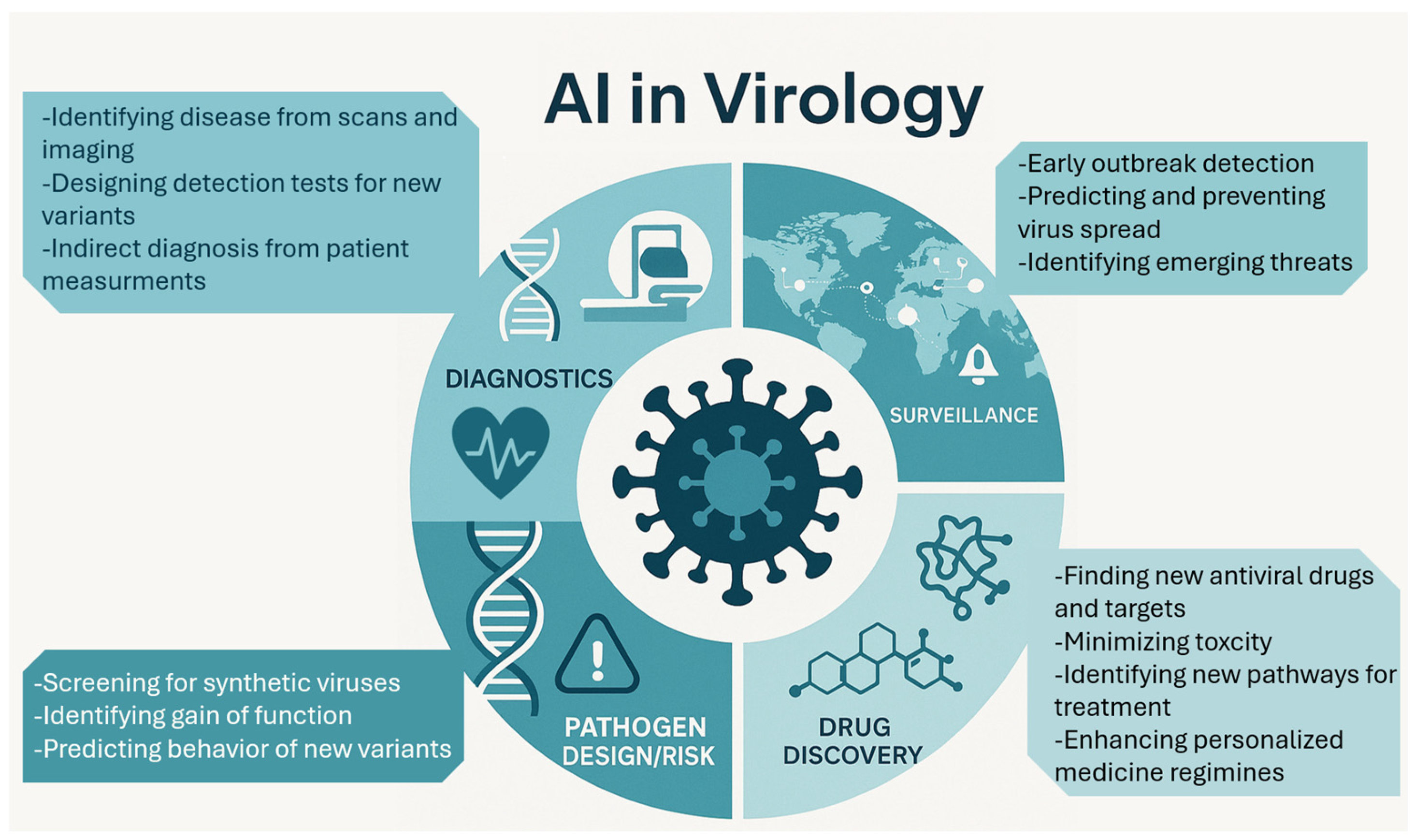


Strengths
| Weaknesses
|
Opportunities
| Threats
|
Disclaimer/Publisher’s Note: The statements, opinions and data contained in all publications are solely those of the individual author(s) and contributor(s) and not of MDPI and/or the editor(s). MDPI and/or the editor(s) disclaim responsibility for any injury to people or property resulting from any ideas, methods, instructions or products referred to in the content. |
© 2026 by the authors. Licensee MDPI, Basel, Switzerland. This article is an open access article distributed under the terms and conditions of the Creative Commons Attribution (CC BY) license.
Share and Cite
Whisnant, A.W.; Dölken, L. Viruses, Vectors, and Villains: Governing the Risks and Rewards of Artificial Intelligence in Virology. AI 2026, 7, 93. https://doi.org/10.3390/ai7030093
Whisnant AW, Dölken L. Viruses, Vectors, and Villains: Governing the Risks and Rewards of Artificial Intelligence in Virology. AI. 2026; 7(3):93. https://doi.org/10.3390/ai7030093
Chicago/Turabian StyleWhisnant, Adam W., and Lars Dölken. 2026. "Viruses, Vectors, and Villains: Governing the Risks and Rewards of Artificial Intelligence in Virology" AI 7, no. 3: 93. https://doi.org/10.3390/ai7030093
APA StyleWhisnant, A. W., & Dölken, L. (2026). Viruses, Vectors, and Villains: Governing the Risks and Rewards of Artificial Intelligence in Virology. AI, 7(3), 93. https://doi.org/10.3390/ai7030093