1. Introduction
Digital Twins (DTs) are virtual representations of physical systems that remain continuously synchronized with them in real-time through high-frequency data exchange [
1]. At this point, it is important to distinguish an actual DT from conventional simulation models or decision support systems. Simulations reproduce the behavior of systems but fail to maintain a continuing connection to the physical system. Similarly, decision–support systems process data to make decisions, yet they do not provide dynamic updates of their decisions. In this work, DTs are considered as all systems that update based on the evolving state of their physical asset, either dynamically or in near-real time. DTs have currently entered several agricultural applications aiming to revolutionize the scenery of the agricultural industry [
2]. Their even wider adaptation is due to pioneer technologies finally being mature enough to make feasible the implementation of real-time synchronization of virtual and physical worlds. The explosion of Internet of Things (IoT) and the wide availability of low-cost sensors, drones, and satellites that can provide high-resolution images, transformed DTs from static simulations to virtual living systems [
3]. Continuous data streams and edge-cloud architectures, providing reliable and fast communication, enable DTs to operate continuously and support real-time simulation and data analytics. Moreover, recent advancements in artificial intelligence (AI) and machine learning (ML) models made it possible to combine and interpret large volumes of multi-sensory data and make reliable predictions to dynamically update the status of DTs [
4].
DTs can offer multiple high-value benefits to agriculture, considering the fact that smart and sustainable farming, a legal obligation under the Common Agricultural Policy (CAP) 2023–2027 of the European Commission [
5], relies on data-driven and resource-efficient farm management. Benefits span across productivity, sustainability, risk reduction, and operational efficiency. Specifically, DTs can enable precise and adaptive farm management in a virtual environment before real-world application, reducing related risks, optimizing resources, and leading to more accurate and timely interventions. Continuous synchronization between physical and virtual systems can allow the early identification of irregularities related to water stress, pest outbreaks, nutrients shortages, machinery malfunctions, etc., reducing yield losses and improving sustainability and resilience. Based on the above, it is clear that DTs are essentially the next evolutionary step of precision agriculture.
Precision agriculture grew out of the need to deal with variability inside fields rather than treating them as uniform spaces. Over the last decade, farmers have gained access to tools like unmanned aerial vehicle (UAV) imagery, soil probes, canopy sensors, and machine-guided equipment; yet these systems often run separately from each other. This fragmentation is directly reported in the literature, through studies focusing on UAV-based crop assessment [
6,
7] or soil and microbial activity monitoring [
8] that tend to operate on their own data streams, while attempts to merge these sources into a single decision-making structure are limited. So, even though precision agriculture has expanded, most reported technologies deliver only partial views of plant or soil behavior. DTs can fill this gap and provide the necessary architecture to fuse all heterogenous data sources towards creating a holistic synchronized and predictive model of the entire farm environment.
However, even though DTs are seen as a transformative opportunity for precision agriculture, early implementations are limited and mostly experimental. To this end, this work aims to provide a scoping review of recent advancements in digital twins’ technologies in agricultural applications. Scoping reviews are valuable for emerging fields, such as in the case of integration of DTs in agriculture, towards mapping the landscape. Thus, the goal of this work is to map the existing literature on how DTs are currently being used or attempted in precision agriculture, to identify gaps, trends, concepts, and future research directions, based on PRISMA-ScR methodology.
Although systematic literature reviews on the same subject exist [
2,
4,
9,
10,
11,
12,
13], they focus on specific agricultural aspects, e.g., forestry, soil and nutrients, water stress and irrigation, machinery, crop monitoring, livestock, etc.; thus, a scoping review is needed to map the broader landscape, synthesize all heterogenous approaches, and identify research gaps and future directions. Our research is motivated by the need to bring conceptual clarity and methodological direction to the fragmented development of DTs in agriculture.
The rest of the section comparatively reviews related work and highlights the contributions of the present work. The review continues by providing a historical overview of DTs in agriculture in
Section 2, followed by the methodological approach used to screen and categorize the selected literature in
Section 3.
Section 4 presents quantitative and qualitative results of our research. The integration of AI is analyzed in
Section 5. Research outcomes, benefits and opportunities, challenges and limitations, as well as future research directions are discussed in
Section 6, while
Section 7 concludes the paper.
Related Works and Contributions
In order to define the related works, i.e., review articles related to DTs in agriculture, a Scopus research on articles’ title, abstract and keywords was conducted based on the query: TITLE-ABS-KEY ((“digital twin” OR “digital twins”) AND “agriculture”) AND (LIMIT-TO (SUBJAREA, “COMP”)) AND (LIMIT-TO (DOCTYPE, “re”)) AND (LIMIT-TO (EXACTKEYWORD, “Digital Twin”) OR LIMIT-TO (EXACTKEYWORD, “Digital Twins”)) AND (LIMIT-TO (LANGUAGE, “English”)). The research included only review articles written in English, related to the computer science subject area, while DT or DTs had to be included in the keywords of the article, as well as in the title, meaning that articles truly focused on DTs, and not just referred DTs within their abstract would be identified. Our search was collated into 16 articles (No. 1 to 17 in
Table 1). Complementary to Scopus, the research was expanded to Google Scholar, yet in a less structured way since it does not allow precise field-restricted searches, resulting in additionally five articles (No. 18 to 22). Finally, a search on IEEE Xplore using the same query and eligibility criteria resulted in additionally five articles (No. 23 to 27).
Table 1 includes all related works identified in the literature and their main characteristics, compared with the present work (Ours).
Table 2 includes the results of complementary research in Scopus, Google Scholar, and IEEE Xplore, after applying the same eligibility criteria. The majority of papers identified in complementary databases overlap with Scopus. The latter confirms that Scopus was able to provide sufficient coverage of the literature, while ensuring that no significant works were omitted.
As seen from
Table 1, related works are mainly cross-domain focused, while only limited works are solely agriculture-oriented. Out of these works, none of them explicitly discusses the integration of AI in DTs. Additionally, a historical overview of the rise of DTs is hardly available, while all these aspects, along with DT components and enabling technologies, are not reviewed holistically in one single work.
Moreover, the present review is the only one that proposes taxonomies, which can be a scholarly contribution, since it proposes structure to a newly emerging scientific field, highlighting relationships between concepts, increasing clarity and usefulness of the review, revealing gaps, trends, and research opportunities, while providing a conceptual framework for future work. Through the proposed taxonomies, this work aims to provide analytical depth and synthesize knowledge rather than just summarize it. The latter can be assumed to be a contribution, since it is novel, i.e., offers new perspectives; it is justified, i.e., grounded in academic literature; it is useful, i.e., helps readers to better understand the field; it is generalizable, i.e., can be adopted from future studies and guide new research.
2. The Rise of DTs
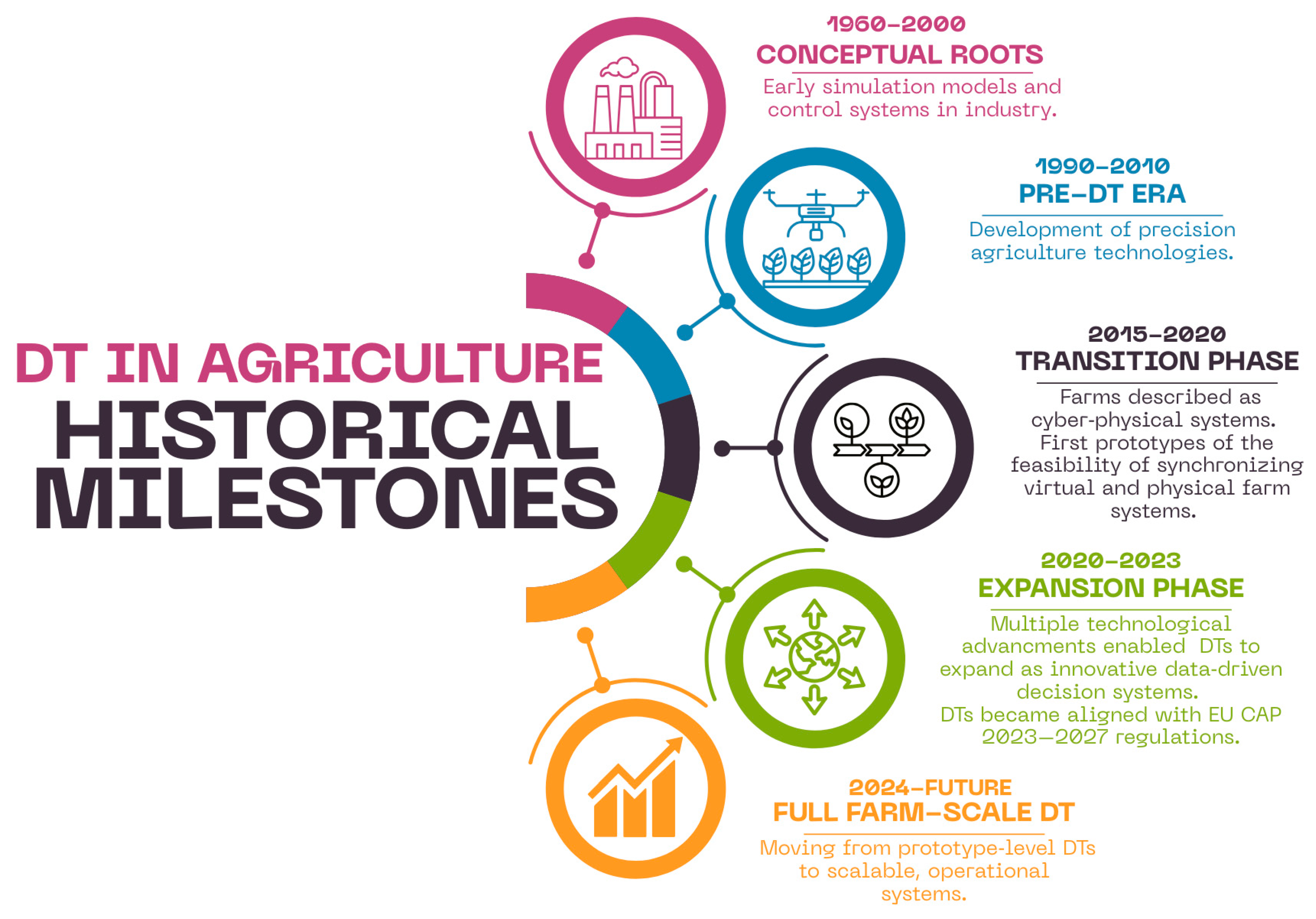
The idea of DTs evolved through decades and entered agriculture slowly (
Figure 1).
Figure 1 presents the evolution of DTs through time. Originally, the concept was developed for industrial applications, introducing simulation models and control systems that created the theoretical and technological foreground for DTs to eventually enter the agricultural sector. Specifically, the term DT first appeared in aerospace and manufacturing, where engineers needed a dependable way to test a system without touching the real asset. The basic idea was to maintain a digital replica that behaved closely enough to the physical system so that it could be used to predict failures or simulate “what-if” scenarios. Over time, the concept expanded from product design to operational monitoring and eventually into other fields that rely heavily on environmental sensing or dynamic processes [
22,
32,
33].
The advent of precision agriculture, based on advancements in IoT and remote sensors, drones, and global positioning system (GPS) navigated machinery, provided the basis for high-resolution data streams that are necessary for DTs. However, the adoption of DTs in agriculture was after 2018, when early DT prototypes were employed to demonstrate the feasibility of the virtual–physical world synchronization. Early efforts were modest, usually involving conventional crop or soil models occasionally updated with sensor data, such as the 3D architectural crop model by Mitsanis et al. [
34]. The authors managed to capture the structure and growth of plants, but they were not continuously synchronized with the field. DTs became a research trend after 2020, when advances in AI, edge computing, and ML led to their wide expansion and formalization as innovative data-driven decision systems. As the field matured, researchers began experimenting with more reactive systems. Development of autonomous cultivators [
6] and ML-enabled mechanistic models [
35] shows how agricultural processes can be mirrored digitally in real time, although they still fall short of the fully coupled DTs seen in engineering. Limited works report a complete feedback loop between sensing, modelling, and physical action, but only the intention to build toward that direction [
6,
7,
8,
34,
35,
36,
37].
Agriculture is now under constant pressure from climate extremes and the need to manage water, fertilizer, and energy more carefully, as imposed by the EU CAP 2023–2027. Thus, from 2023, DTs have become aligned with regulatory needs, which has further accelerated their adoption. A microdialysis digital twin for soil nutrient was developed, [
8] demonstrating how nutrient dynamics shift over short intervals, and UAV-ML water stress detection digital twins [
7,
36] show how quickly plant conditions can change within the same field. Traditional models rarely keep up with such fluctuations. DTs, at least in principle, offer a way to track these short-term changes while also running predictions ahead of time. In irrigation, DT setups allow researchers to test hypothetical watering strategies before applying them in the field [
7,
34], which could reduce water use or avoid stress periods. Likewise, cost-efficient autonomous cultivator frameworks [
6], show how linking real-time sensor data with a virtual machinery model can help farmers plan operations more safely and efficiently.
The current review revealed an uneven depth of current systems. Many studies call their prototype a “DT,” but the actual implementation is often limited to a model that accepts periodic sensor updates rather than a fully synchronized digital–physical pair. This is particularly noticeable in several plant-modelling papers [
34,
37], where the model is detailed but the connection to live field data is weak or intermittent.
Despite this variation, the common thread is the intention to link a physical agricultural process with a computational model that updates as conditions change. Yet integration remains the biggest practical challenge: datasets coming from UAV imagery, soil probes, and environmental sensors rarely align in time or resolution. Studies using ML-driven remote sensing [
7,
36] do not always connect easily with mechanistic or physics-based simulations [
8,
34,
35]. Long-term evaluation is also missing. Most experiments last only a single season or use controlled greenhouse environments rather than real farms. Another research gap concerns economic and logistical feasibility; only a few papers mention what it would cost to maintain a DT system over several years. Therefore, currently, full farm-scale DTs are presumed, integrating soil, water, crops, livestock, machinery, and climate, thereby achieving real-time synchronization. It is obvious that the field of DTs in agriculture is continuously transforming, expecting to see fully operational and scalable DTs in the near future.
3. Methodology
In this work, a scoping scientific review methodology was followed in accordance with the PRISMA-ScR statement to locate, evaluate, and synthesize relevant literature on DTs in Precision Agriculture. The aim was to provide a structured and analytical overview of how DT concepts are currently implemented in agricultural systems and to identify the key enabling technologies and application areas shaping the field.
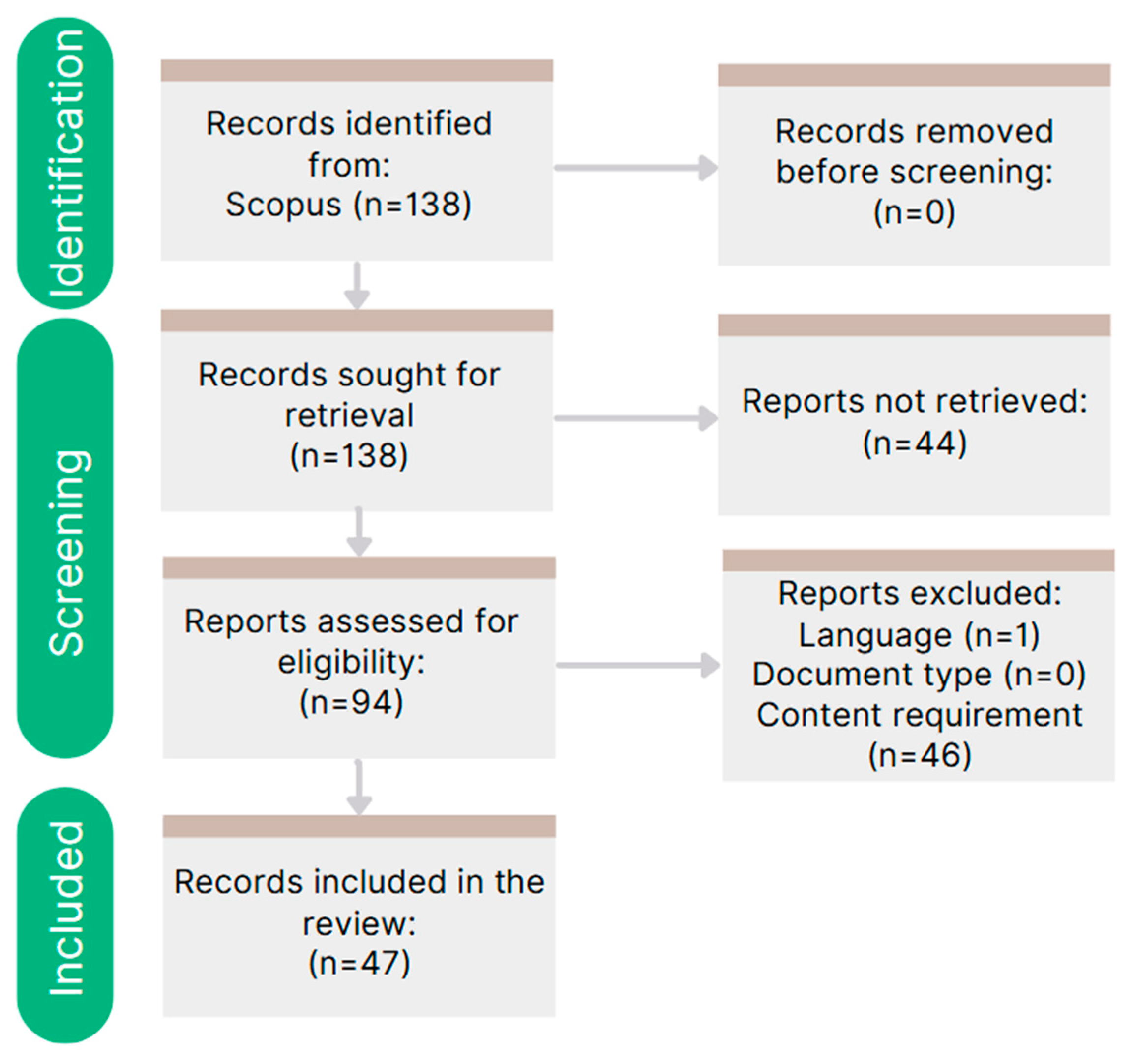
Initially, a search was conducted in the Scopus database using the query “Digital Twins” AND “Precision Agriculture”, which returned 138 records (Scopus results count at the time of retrieval, on 10 December 2025). Scopus was selected as the primary database because it offers broad coverage of journals and conference proceedings across agriculture, engineering, and computer science, where DT research typically appears.
It should be noted that the present work is a scoping review, thus the objective is to map available evidence from the literature rather than to exhaustively investigate all the existing literature related to the subject, as a systematic review would do. A multi-database search, including Web of Science (WoS) and IEEE Xplore, could have been additionally conducted. However, Scopus-based reviews can be methodologically stronger, since Scopus has a broader coverage of articles across different disciplines. Specifically, Scopus indexes more journals and conference proceedings than WoS and includes most IEEE content anyway, among others in computer science, which is the field of focus in this work. It provides more flexible and transparent searching tools, such as Boolean logic and field-restricted searches, and provides more complete and high-quality metadata, e.g., abstracts, keywords, subject classification, etc., compared to both WoS and IEEE [
38], enabling a structured and reproducible searching strategy. Moreover, since in a scoping review transparency is more important than completeness, possible missing articles not indexed in Scopus would not alter the thematic synthesis of this work.
Screening was performed in two steps: First, all records were screened at title and abstract level to remove clearly irrelevant studies (e.g., DTs outside agriculture, papers that only mention precision agriculture superficially, or remote-sensing-only studies without modelling or update mechanisms). This step resulted in the exclusion of 44 records. The remaining papers were filtered using eligibility rules aligned with the scope of this review:
Only English-language documents were considered.
Document types were restricted to journal articles, conference papers/proceedings, reviews, and book chapters with sufficient technical detail.
The topic relevance requirement was that the study must either explicitly describe a DT or present a twin-like approach linking a physical agricultural asset (crop, soil, greenhouse environment, or farm machinery) to a digital representation updated or constrained by real data.
A set of 47 papers met the inclusion criteria and were retained for synthesis.
The overall study selection procedure is summarized using a PRISMA flow diagram (
Figure 2). This scoping review was prospectively registered on the Open Science Framework (OSF) at
https://osf.io/7wfcr/overview (assessed on 19 February 2026).
4. Results
In what follows, quantitative and qualitative results are presented. Note that because the included papers differ widely in methods and evaluation designs, the synthesis in this review is primarily thematic and comparative rather than meta-analytic.
4.1. Quantitative Results
Data extraction and comparative normalization were performed using the Excel sheet as a structured extraction tool, where each included study was assigned attributes such as application domain, DT scope and type, data sources, and modelling approach referring to the use of ML algorithms. This normalization enabled the studies to be grouped into themes and compared systematically despite heterogeneity in crops, sensing setups, and validation strategies.
Table 3 includes details of the selected literature.
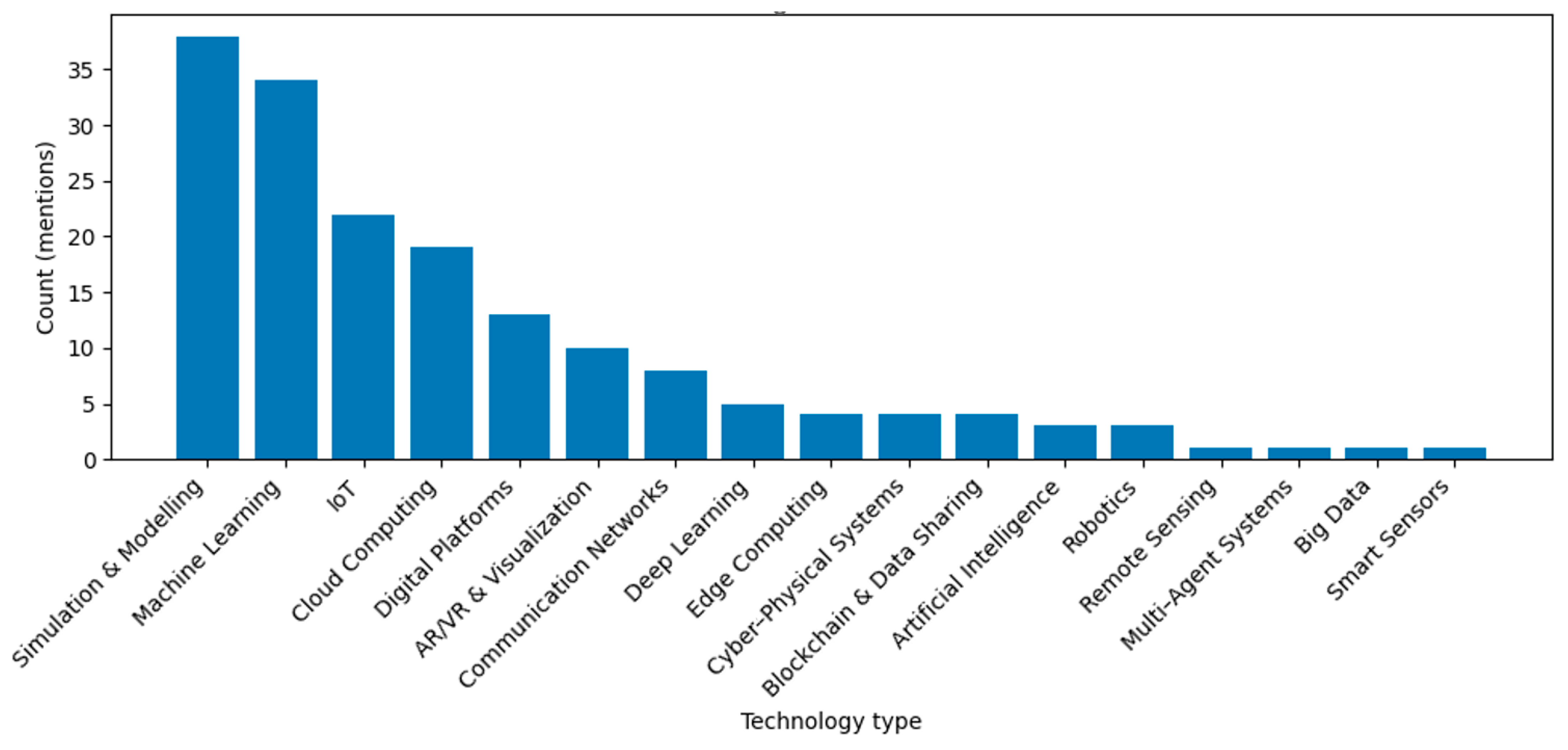
Figure 3 indicates that the technological foundation of DTs in precision agriculture is primarily model-centric, with Simulation & Modelling (38 mentions) and ML (34 mentions) being the most frequently reported components. This suggests that most implementations follow a hybrid modelling paradigm, where mechanistic or simulation-based representations are complemented by data-driven inference. Supporting infrastructure technologies, particularly IoT (22 mentions) and Cloud Computing (19 mentions), are also prominent, reflecting the need for continuous data acquisition and scalable processing.
In contrast, enabling technologies associated with mature cyber–physical deployment (e.g., edge computing, cyber–physical systems, and blockchain, with four mentions each) and advanced autonomy (robotics, with three mentions) remain comparatively underrepresented, highlighting that many reported DT systems are still at a prototype or partial-integration stage rather than fully operational, standardized deployments.
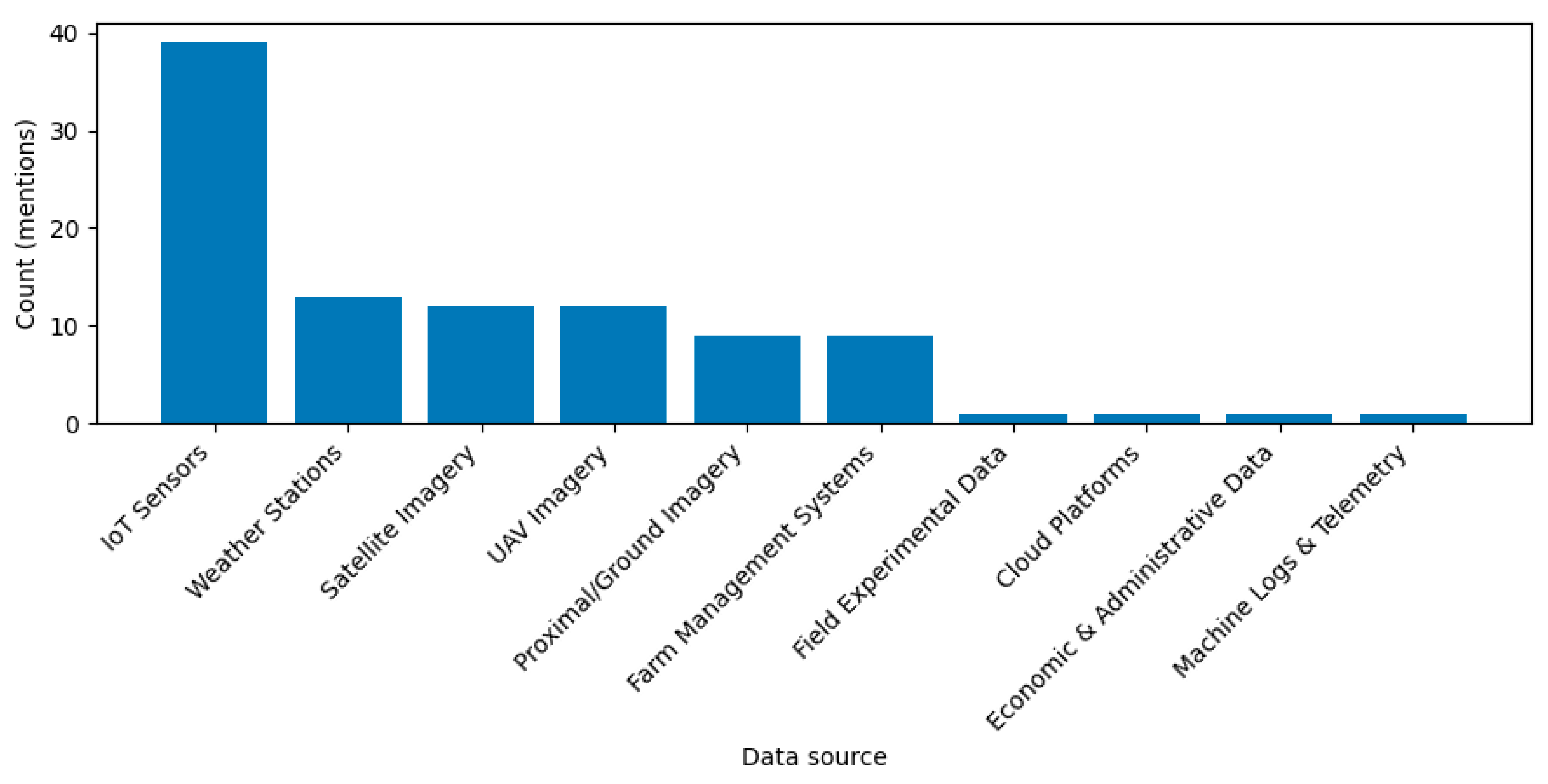
Figure 4 illustrates the most commonly used data source types mentioned across the selected literature. The data-source distribution is strongly sensor-centric: IoT sensors dominate (39 mentions), followed by environmental context from weather stations (13 mentions) and remote sensing via satellite and UAV imagery (12 mentions each). Management systems and proximal imagery data appear moderately (9 mentions each), whereas operational telemetry and economic/administrative inputs are rarely used (1 mention each), indicating limited integration of farm business and machinery logs into current DT implementations.
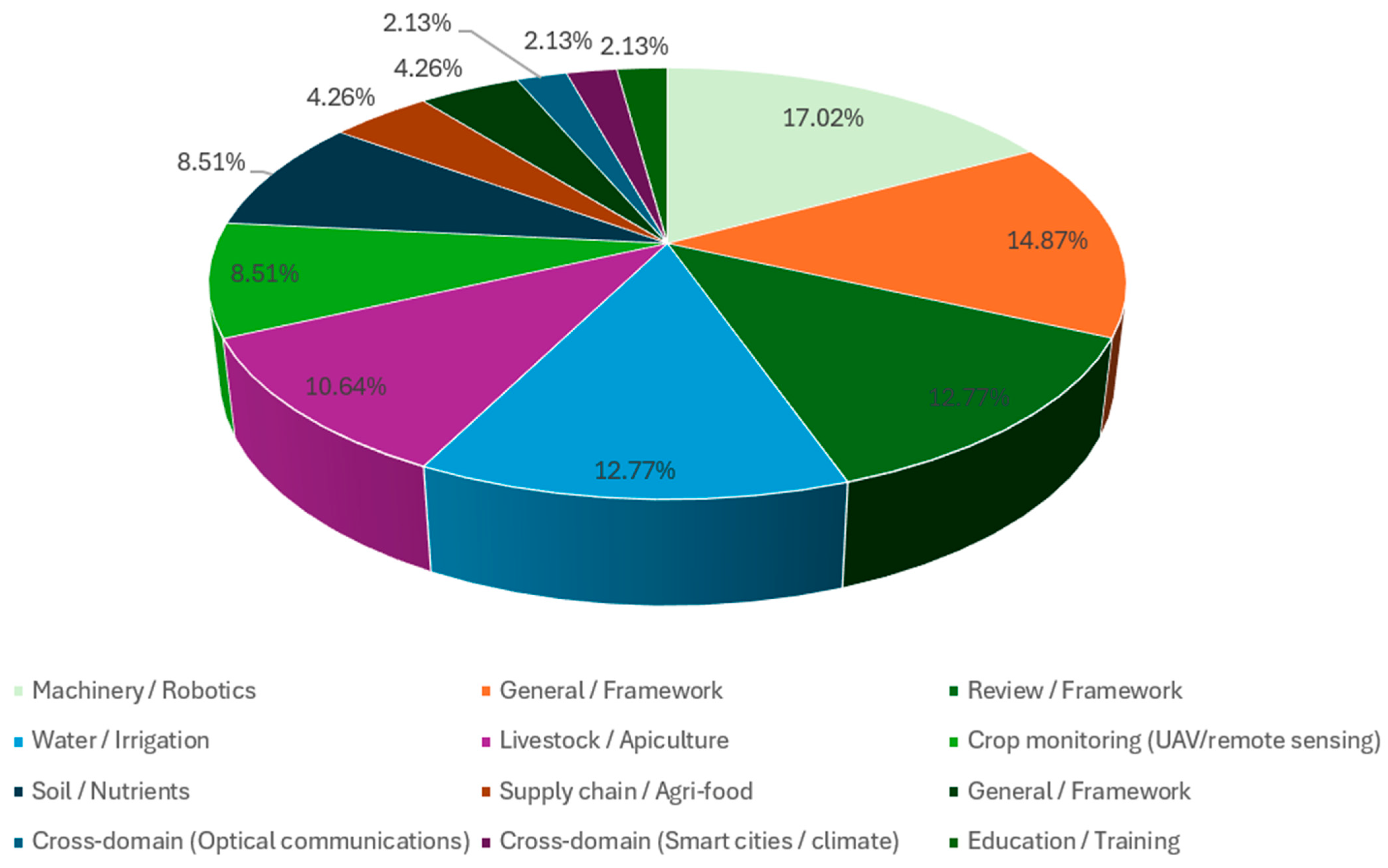
Figure 5 summarizes the identified application areas of DT in agriculture. Most popular are the applications involving machinery and agricultural robots (agribots). This can be attributed to the fact that these systems already generate plenty of sensory data, due to their on-board sensors, are easier to model, and offer immediate commercial value, e.g., for machinery predictive maintenance, greenhouse environmental control, or crop and growth modeling for yield estimation and resources management. Theoretical general DT frameworks and review works are, however, dominant in the examined literature, since the field is still emerging, while several challenges and existing limitations (e.g., complex crop biological factors and technological barriers) currently obstruct real-world DT deployments. Thus, conceptual works are easier to produce compared to fully operational DT systems. Other DT application areas include irrigation and nutrient management, as well as crop monitoring using UAV data, and more (
Figure 5).
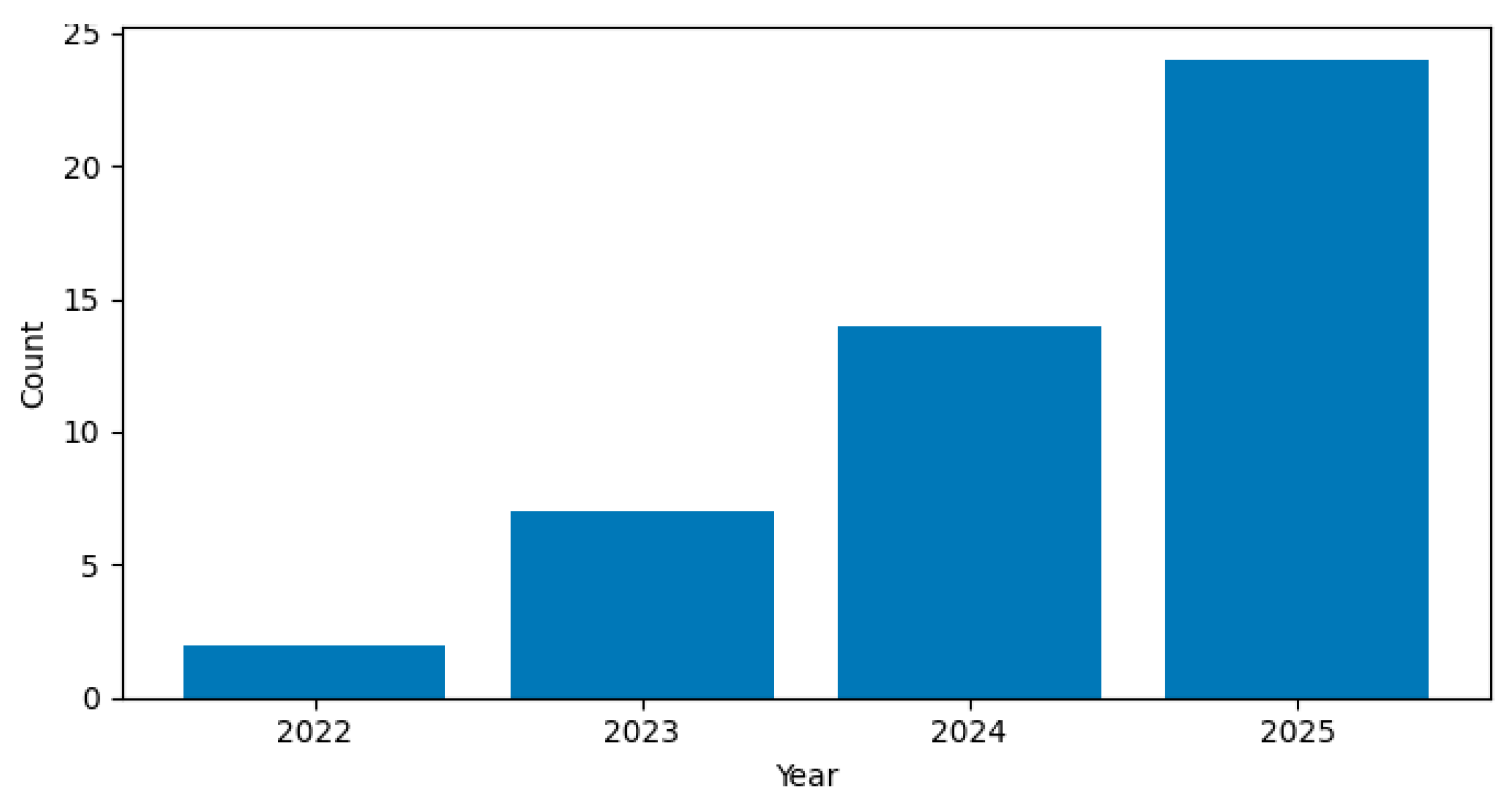
Figure 6 indicates the distribution of the selected literature by year. An increase in publications after 2023 is observed, with 2024–2025 accounting for the majority of studies. This trend indicates rapidly growing research interest in DTs for precision agriculture, while also suggesting that the field is still emerging and dominated by recent, exploratory contributions, as also indicated by the provided historical overview illustrated in
Figure 1.
Recall that in this work, DTs are considered all systems that update based on the evolving state of their physical asset, dynamically or in near-real time. Decision support systems are defined as systems that process data to make decisions, yet they do not provide dynamic updates of their decisions, while simulation models reproduce the behavior of systems but do not maintain a continuing connection to the physical system. Based on these definitions, each DT type identified in the literature is further characterized as DT, decision support system, or simulation model in
Table 3. As seen from
Table 3, seven DTs fully meet our introduced definition, while 10 partially approximate it (five simulation models and five decision support systems). These findings suggest that agricultural DT research is still transitioning, moving forward with operational DT implementations. The results highlight the need for a clearer definition of DTs based on standardized criteria, towards ensuring conceptual consistency across studies.
Interpretative Analysis
Interpretation of quantitative results indicates a rapidly increasing research attention for DTs. Specifically, results show that this scientific field is transitioning from conceptual exploration, mainly between 2022–2023, to academic engagement, between 2024–2025. The latter is evidence of technological maturity, meaning that DT enabling technologies have developed in recent years to a more accessible and stable stage, allowing the actual implementation of DTs in agriculture. While referenced works are increasing through the years, suggesting that the field is progressing, the latter does not automatically imply full maturity. In order to further interpret numbers to conceptual maturity levels, a DT Maturity Indicator (DTMI) is determined, consisting of three levels: low, middle, and high.
Specifically, each article is classified according to the degree of data integration, real-time connectivity, and real-world deployment. To reduce subjectivity, the DTMI is numerically calculated and averaged across the years, using three measurable criteria:
Data integration, assigning scores from 0 to 2 for none, offline, and real-time or near real-time, respectively.
Connectivity, assigning scores from 0 to 2 for no connection, periodic updates, and continuous live connection, respectively.
Deployment, assigning scores from 0 to 2 for conceptual only, lab prototype, and in-field implementation.
Thus, by assigning 0 to 2 points per dimension and averaging across the years, maturity levels are numerically defined as follows: low (0 to 2 points), middle (3 to 4 points), and high (5 to 6 points). DTMI is numerically calculated for applied research only. Based on the above,
Table 4 includes the classification results of selected literature in two broader categories, that of conceptual and applied research, to define the maturity levels. Low maturity is attributed to years including conceptual models and frameworks; middle maturity is attributed to years of real-time data integration and development of specific DT architectures; high maturity is attributed to more targeted agricultural-specific implementations and prototypes.
The dominance of general simulation/framework/review DT applications suggests that most DT implementations remain in early conceptual stages, with limited real-time integration within the same year, especially in the early years, indicating low maturity levels. In recent years, DT applications have been connected to live data, are predictive, and serve real-world practical scenarios, corresponding to high maturity levels.
Interpretation levels attributed in
Table 4 aim to reflect the actual level of integration and practical use of DTs in agriculture, clearly indicating an ever-evolving research field.
4.2. Qualitative Results
4.2.1. Main Components of a DT
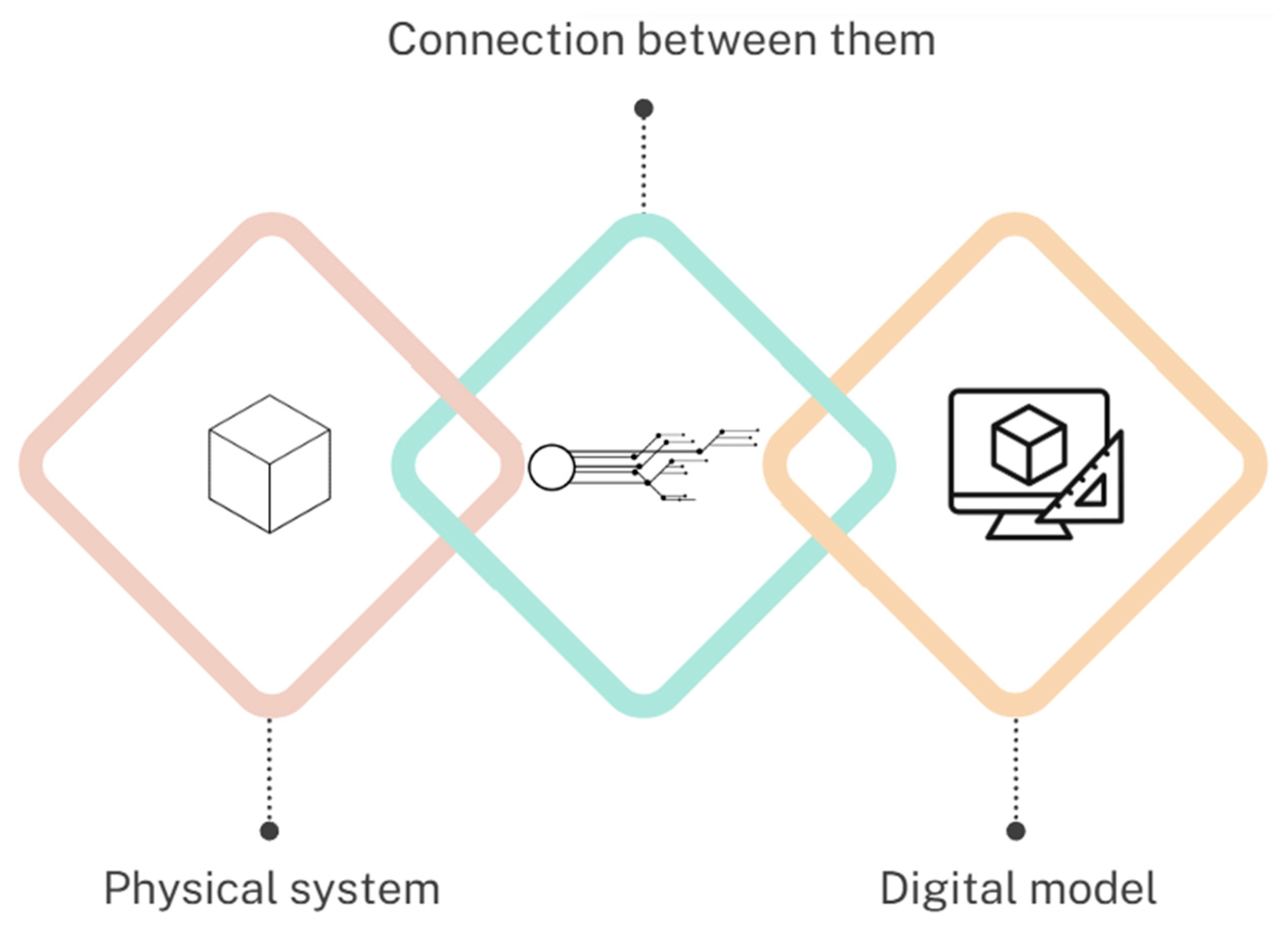
Even though the terminology varies across the 47 studies, most agricultural DTs, whether complete or partial, can be thought of as having three broad components, illustrated in
Figure 7.
A physical system, such as a field, a crop canopy, a soil layer, or a piece of machinery. In the dataset, this ranges from soil nutrient processes [
8], to whole-plant structural models [
34], to field machinery operating in real time [
6,
47,
59].
A digital model, which may be mechanistic, data-driven, or a hybrid version of both. Many plant-focused papers rely on process-based or structural crop models [
32,
34,
36], whereas UAV-based papers often employ ML pipelines to detect patterns in image data [
3,
16,
21,
33,
42,
43,
45,
46]. Machinery studies, on the other hand, tend to use kinematic or rule-based models for navigation and control [
6,
47,
48,
59,
65,
67].
A communication channel or exchange layer that allows the real system to update the model. This is where a wide variation appears. Some studies attempt continuous or near-real-time data exchange, such as works linking soil probes to simulation outputs [
22,
70], while others only synchronize at discrete intervals (e.g., updating a canopy model when new UAV imagery becomes available [
7,
37,
61]). Machinery-focused papers often implement closer-to-real-time loops because the equipment must respond quickly to changing terrain or crop conditions [
6]. It should be noted that agricultural DTs rarely achieve the tight synchrony found in industrial engineering, yet in almost all reviewed papers, the connection between digital and physical components is highlighted [
34,
43,
59].
4.2.2. Data Sources
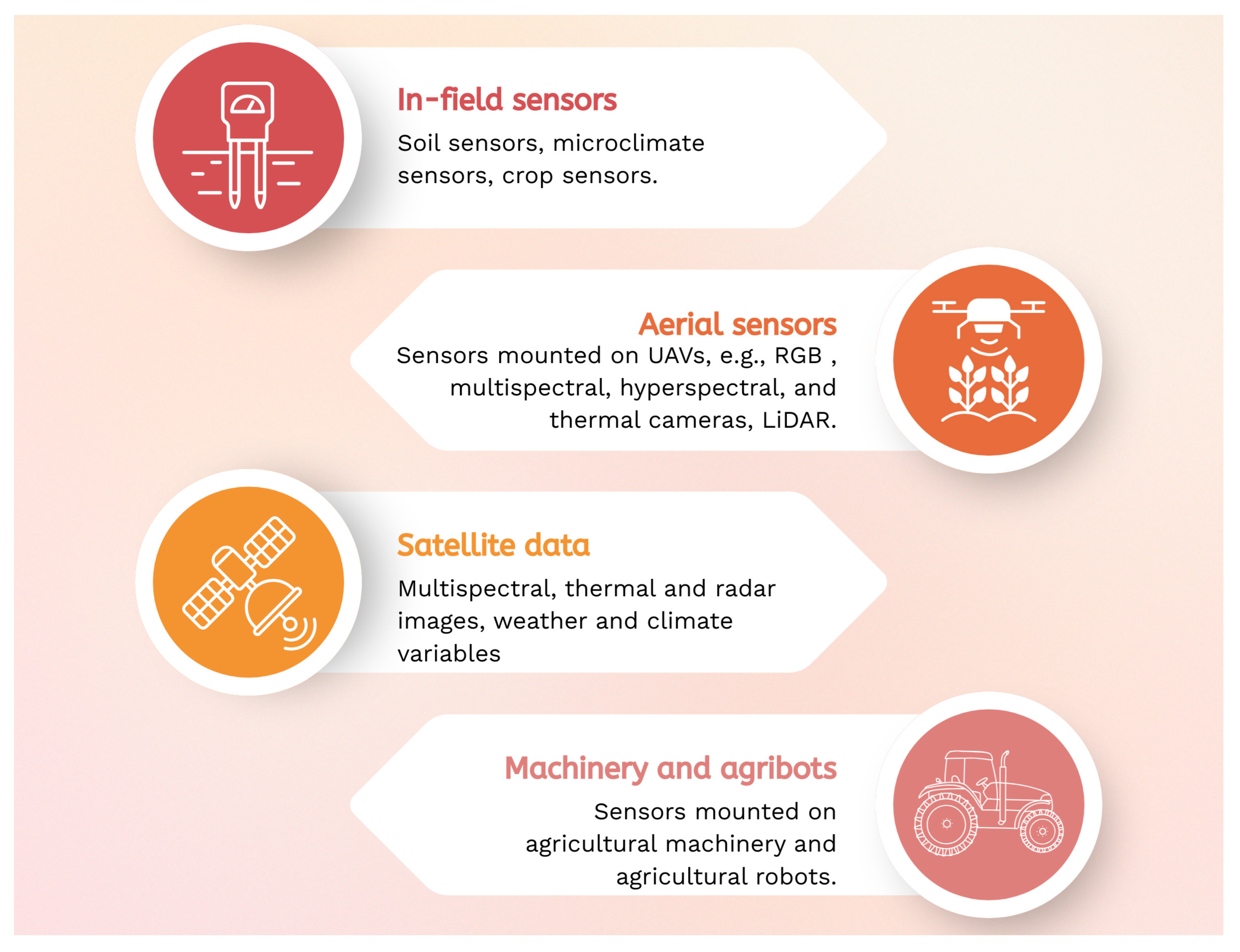
In
Figure 4, the most used data source types are mentioned across the selected literature. The data streams that feed agricultural DTs vary widely across the 47 studies, and this diversity is one of the defining features of the field. The mentioned source types can be categorized into four broader categories (
Figure 8):
In-field sensors. Soil moisture probes, spectral sensors, and environmental nodes are heavily used. The main focus is usually on soil–plant interactions, micro-environment dynamics, or physiological processes that benefit from dense, localized measurements.
UAV (drone) imagery. UAV platforms, often paired with ML models, are equipped with sensors, such as multispectral or RGB cameras, to detect water stress, disease symptoms, or canopy structure. In some cases, UAV data serves as an episodic update to a simulation model rather than a continuous stream.
Satellite data. Less frequently, DTs rely exclusively on satellite imagery, while in some cases satellite indices are combined with ground measurements, e.g., for yield modelling and environmental stress detection [
16,
45]. Satellites provide broader coverage but lower temporal resolution, so they usually serve as contextual input rather than the main driver of a DT.
Farm machinery and agricultural robotic (agribot) data. Current works mainly involve machinery that feeds real-time or semi-real-time data into a digital representation. These are often related to navigation, trajectory optimization, or operational scheduling. DTs in this category resemble engineering twins more closely since machines produce clean, high-frequency data streams that can be used to instantly update digital models.
Across all reviewed works, the main reported difficulties were related to integration, aligning sensor frequencies, spatial resolution, and data quality so that the digital representation could behave reliably over time.
4.2.3. DT Applications in Agriculture
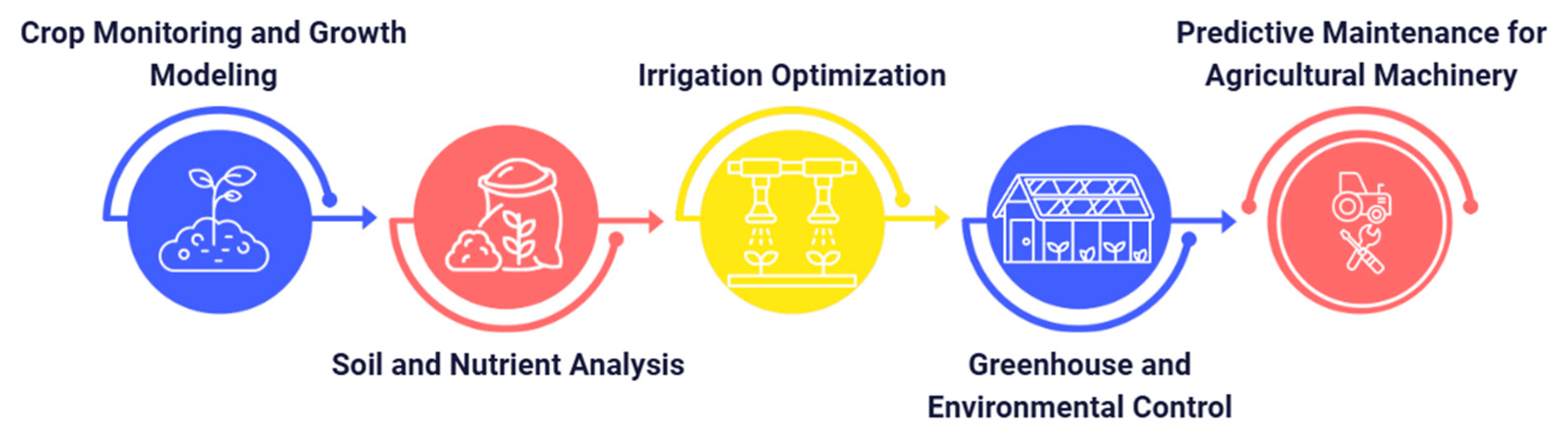
While
Figure 5 includes the general agricultural DT application areas identified in the selected literature, a more detailed analysis reveals four main specific agricultural tasks (
Figure 9): (1) crop monitoring and growth modeling, (2) soil and nutrient analysis, (3) irrigation optimization, (4) greenhouse and environmental control, and (5) predictive maintenance for agricultural machinery.
Many reviewed works deal with crop monitoring, although approaches differ between them. Earlier papers focus on structural or physiological crop modeling, often trying to build a digital representation of plant architecture or development stages, such as functional 3D plant models and canopy-structure frameworks [
6,
7,
32,
34,
36,
37,
39]. Such studies aim to simulate how plants grow under different environmental conditions, and they sometimes use sensor inputs or imaging data to adjust the model parameters. UAV-based applications [
7,
36,
37,
60,
61] lean more toward crop condition assessment, such as detecting water stress or changes in canopy reflectance. In such applications, the DT component is more implicit; the UAV images act as periodic updates to a model that predicts crop conditions between flights. While most of the reviewed works do not establish a full real-time feedback loop, they show how a digital representation of the field can be refreshed as new imagery becomes available, which gradually moves toward DT behavior. Across these monitoring studies, the greatest difficulty seems to be the synchronization of the model with incoming observations; some models refresh easily when only a few parameters change, but more detailed plant-structure approaches, such as in [
6,
7,
34,
36,
37], report that updating a complex geometry is time-consuming and sometimes impractical for real-time use.
Our work also revealed DT applications dedicated to the below-ground environment [
8,
22,
70], such as a microdialysis-DT work and ML-assisted mechanistic soil models. In these applications, the soil is treated as a dynamic system in which nutrient concentrations or microbial activity shift over short time intervals. Since soil processes can change rapidly with temperature, moisture, or root activity, DT approaches for soil and nutrient analysis are proven to be rather appealing. The continuous sensing from probes allows the simulation DT system to adjust more frequently than traditional soil models would. However, the soil-oriented studies face a challenge that is mentioned repeatedly: soil data is noisy and can vary dramatically over just a few meters. This means that digital representations must compensate for spatial uncertainty. In some cases, soil sensors are combined with satellite or canopy data [
36,
61,
69,
70], using the additional information to constrain predictions. Note that DTs can rely entirely on local probes; this would make the DT more accurate in a small area, yet less generalizable across the field.
Irrigation is one of the most promising DT application areas, partly because it is well suited to predictive modeling and partly because crop-water interactions respond strongly to short-term environmental variation. Several works combine UAV sensory data with ML algorithms [
12,
40,
63,
68,
69] to identify water stress early using spectral features. These works usually feed the predictions into an ML model that estimates how much water is needed or how fast conditions will deteriorate. Other works, especially those linked to soil or physiology models [
40,
41,
68,
69], attempt to simulate moisture dynamics directly. They run scenarios such as “what happens if irrigation is delayed by 12 h” and evaluate them before deciding on a real action. This scenario-testing component is one of the most valuable characteristics of a DT, even if synchronization is not continuous. All related works acknowledge practical barriers like sensor calibration, data latency, and weather unpredictability, but still show measurable improvements in water-use efficiency when the model is used consistently [
12,
40,
63].
A smaller but distinct set of studies focuses on greenhouse environments and controlled growing spaces [
56,
68]. These works typically involve more complete feedback loops because data in greenhouses is easier to obtain continuously. Temperature, humidity, and CO
2 sensors are fed directly into a DT model, which in turn guides automated climate-control systems or evaluates plant stress under different environmental conditions. Greenhouses offer cleaner data streams compared to open fields, thus, DT frameworks for such controlled environments tend to be more mature. Model-predicted control strategies can run in real time, adjusting ventilation or irrigation based on deviations from the virtual model. Despite being relatively advanced compared to in-field approaches, these works mention limitations as well, mostly around energy consumption and the difficulty of scaling greenhouse-tuned models to outdoor environments.
Other works [
6,
47,
48,
59,
65,
66,
67] focus on machinery, robotics, and operational decision-making. These include studies on autonomous cultivators, navigation algorithms, and simulation-based planning for field operations. Here, the DT system is used similarly to its engineering origins: a machine or robotic system has a digital counterpart that predicts how it will behave under different terrain, speed, or load conditions. Some works use the digital model to identify when a machine is likely to deviate from expected performance or when a component may require maintenance. Others treat the DT as a planning environment, testing field trajectories, optimizing fuel use, or evaluating obstacle-avoidance strategies before executing them on real machinery. These machinery-focused studies generally have higher frequency sensor data compared to crop- or soil-related DT applications. That makes synchronization more realistic, although the authors note that field conditions (mud, dust, vibration) often degrade sensor reliability, which in turn creates drift between the physical system and its digital representation.
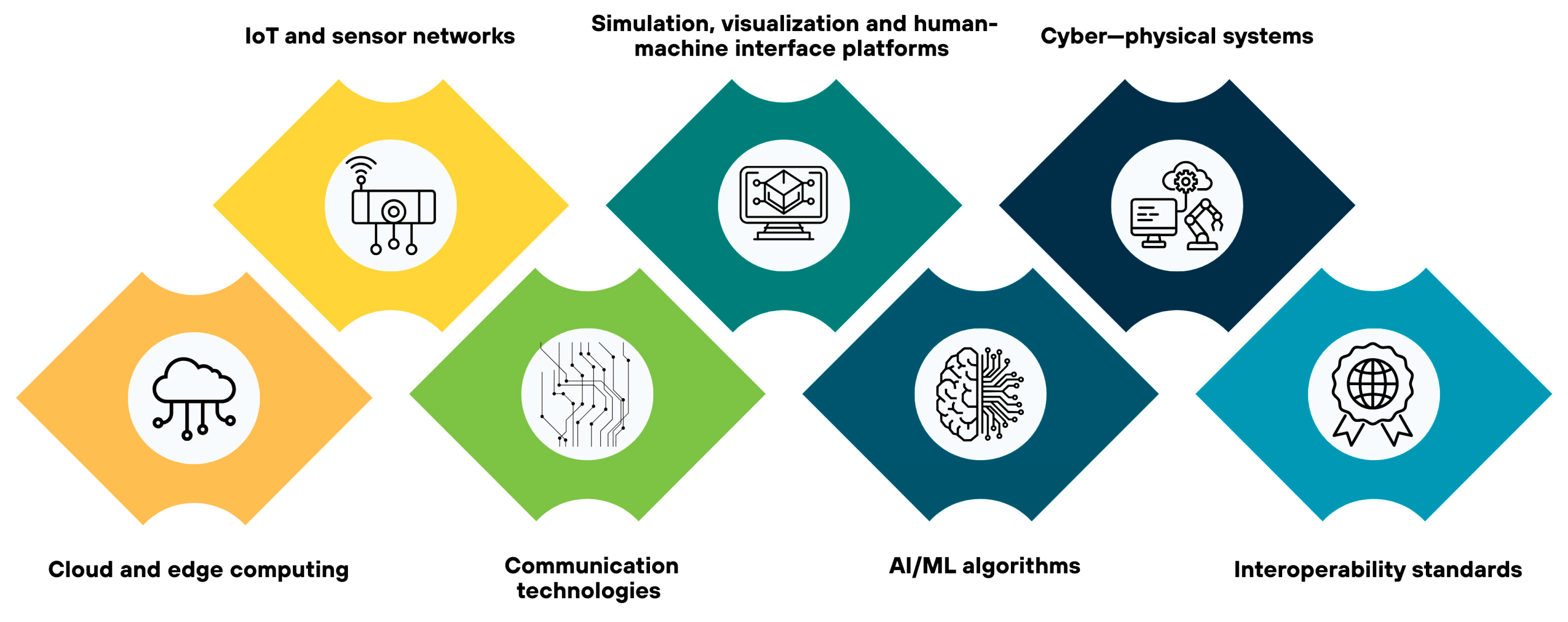
4.2.4. Enabling Technologies
DT enabling technologies mainly include IoT and sensor networks, AI/ML algorithms for predictive modeling, simulation platforms (e.g., computer-aided design (CAD), physics-based models), cloud and edge computing, interoperability and data integration standards (
Figure 10).
Many agricultural DT efforts rely on fairly ordinary sensor networks, even if they describe them using more advanced terminology. The soil-oriented DTs [
8,
22,
70] make heavy use of in situ probes, microdialysis samplers, and environmental sensors. These sensor setups are usually the core of the DT, since without frequent soil or microclimate updates, the model drifts quickly. Other DT works, especially those on crop monitoring, use simpler IoT nodes that measure temperature, humidity, leaf wetness, or radiation [
16,
40,
56,
68]. Most of these are deployed sparsely because of cost, so the data they send is more episodic than continuous. DT greenhouse works [
56,
68] use denser sensor networks, which allow DTs to operate closer to real time. Reported limitation across all the aforementioned works is that agricultural IoT systems still struggle with coverage and noise: missing packets, unstable wireless links, and battery limitations.
ML/AI algorithms appear in all reviewed work, yet they do not always have the same role. In UAV-based crop monitoring DTs [
7,
36,
60,
61], ML is used mainly to interpret images, i.e., detect stress patterns, estimate biomass, or identify areas with unusual reflectance profiles. In this case, ML is feeding DT rather than being the twin itself. In other cases, ML is used to supplement mechanistic models. The soil-process DTs [
8,
22,
70] combine ML regressions with physics-based or biochemical simulations to fill gaps in sensor data or to correct forecast drift. Robotic and machinery DTs [
6,
47,
59,
65,
66,
67] usually rely on ML for path planning or anomaly detection during equipment operation. These approaches are closer to classical engineering applications, where ML supports real-time decision-making. In general, ML is mainly used as a corrective layer, towards linking raw data to simulation parameters. Only a few works [
50] attempt pure ML-driven twins and provide warnings about interpretability and data requirements.
Other works put effort into the digital model rather than the sensing side. The plant-structure modeling DTs are such examples, since they use physics-based or geometry-based simulation tools to represent canopy shape, organ growth, or light interception. These studies treat the crop almost like an engineered object, building it piece by piece in a CAD-like environment. Meanwhile, machinery DTs often use simulation engines to test navigation or kinematic behaviors before deploying them in the field. These simulations tend to be more abstract, focused on trajectories, forces, or robot interactions, but they align closely with the idea of original industrial DTs. A common challenge across simulation-heavy works is the update of the digital model without slowing it down. Authors note that highly detailed plant models or soil-layer simulations run too slowly for any form of real-time synchronization, which is why most DTs in agriculture remain lighter and more approximate [
8,
16,
34].
A smaller number of works mention cloud or edge processing as part of their infrastructure. In UAV-ML DTs [
7,
37,
60,
61], the authors upload the image data to cloud servers where the ML models run due to demanding computations exceeding the capabilities of field device. Greenhouse studies [
40,
56,
68] experiment with edge devices, referring to small controllers that run parts of the model locally so they can adjust climate changes without delay. Machinery-oriented DTs also employ edge computing. Machines can generate data too fast to rely on the cloud, so digital models run partly onboard and update as the robot moves. The observed split between edge and cloud is attributed to limited rural connectivity in agricultural settings, which several authors mention as a practical limitation.
Almost all examined works encounter interoperability issues. Sensor-based soil and crop DTs struggle with inconsistent data formats or irregular timestamps. Remote-sensing DTs face problems integrating UAV imagery with ground sensors, due to the fact that spatial and temporal resolutions do not always match. Machinery-related DTs face hardware-level compatibility issues, different communication protocols, and incompatible controller units. Standards are rarely mentioned across literature and when mentioned, tend to reference general ideas rather than established frameworks. The lack of common architectures is probably one of the reasons agricultural DTs remain limited; without common data layers or exchange protocols, every research group builds its own solution, which makes comparison and scaling difficult [
34,
67].
4.3. Taxonomy of Papers
Taxonomy of the selected papers into clusters is an essential analytical tool aiming to provide a useful structure to review articles.
Based on the results included in
Table 3, the selected papers fall into a few broad families based on their goals and methods, and these groups cut across different crop types and agricultural contexts.
The first group is that of the soil and physiological modeling works, which tend to rely on high-resolution mechanistic models and dense sensor data. These papers aim to push the scientific understanding of plant–soil interactions; yet most remain small-scale proof-of-concepts due to the related costs and effort required to maintain the sensing systems.
The next identified cluster is of the
UAV-ML field-monitoring studies [
5,
6,
7,
36,
37]. These works are not related to specific crops, with some focusing on cereals and others on orchards or vegetables. However, they all share a common structure: drone flights, extraction of spectral features, plugging of the results into a predictive model, and updating the digital representation of the field. These studies, on the one hand, show good potential for scaling since UAV flights are able to cover large areas quickly, but on the other hand they face persistent issues with temporal gaps and noisy image data.
Another set of papers centers on controlled environment or greenhouse DTs. These studies differ from in-field studies since they have controlled conditions, stable sensor networks, and more reliable communication links. As a result, their DTs tend to demonstrate tighter synchronization between the model and the physical system. They also focus more on control decisions, like adjusting CO2 or ventilation, than on mapping field variation. The downside is that greenhouse models do not transfer well to open fields, where weather, soil variability, and sensor inconsistencies complicate things.
Finally, machinery and robotics studies form a distinct group because they emphasize operational performance rather than biological processes. The DTs in these papers typically serve as planning or prediction layers for robots, tractors, or autonomous implements. The main strength here is the high frequency of machinery data, which allows closer-to-real-time modeling. The limitation is that these systems often require specialized hardware and calibration that farmers may not be eager to manage.
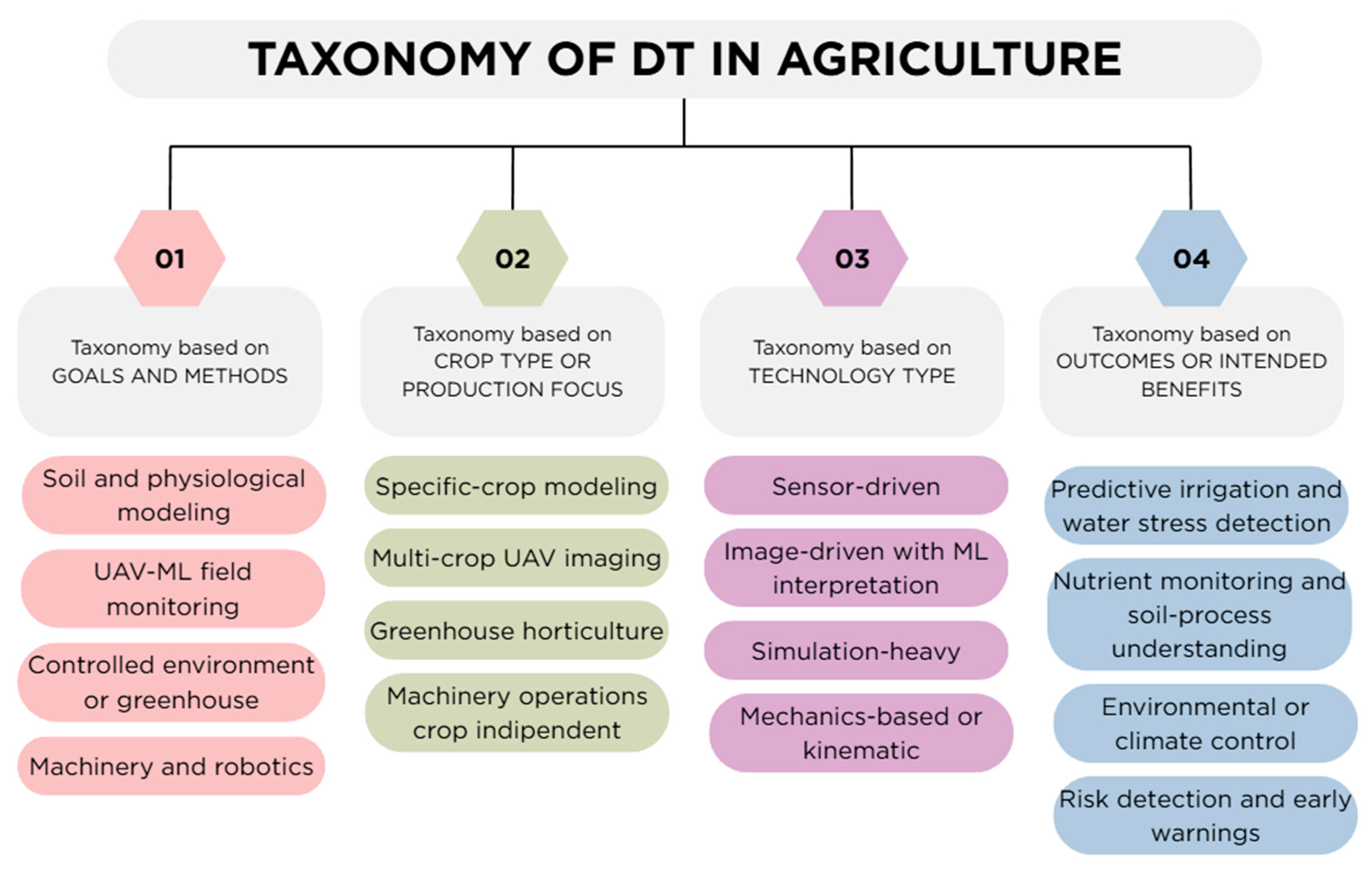
Apart from the suggested taxonomy (1 of
Figure 11), other patterns also emerge since selected studies show several cross-cutting themes, such as different crop focus, used technology types, and different desired outcomes. Based on the latter criteria, alternative taxonomies can arise.
Taxonomy based on crop type or production focus (2 of
Figure 11):
Specific-crop modeling (e.g., wheat or maize canopy structures)
Multi-crop UAV imaging, often able to generalize across crop types.
Greenhouse horticulture, implemented on tomatoes, lettuce, or leafy greens.
Machinery operations independent of crop type.
Sensor-driven.
Image-driven with ML interpretation.
Simulation-heavy (plant architecture, greenhouse climate models).
Mechanics-based or kinematic.
Outcomes or intended benefits (4 of
Figure 11):
Predictive irrigation and water stress detection, involving mainly UAV and soil clusters.
Nutrient monitoring and soil-process understanding, mostly soil-focused.
Environmental or climate control, involving greenhouse studies.
Operational efficiency and route planning, involving machinery-focused papers.
Risk detection and early warnings, including UAV-ML work.
An interesting observation made by comparing different suggested taxonomies is that most studies connect across groups. For instance, UAV-based stress detection papers rarely incorporate detailed physiological models, and greenhouse climate DTs rarely integrate remote sensing. Likewise, machinery-focused DTs hardly ever interact with crop- or soil-driven models. This fragmentation suggests that agricultural DTs are still emerging in isolated subfields rather than forming a unified framework.
The taxonomy based on goals and methods was selected, since crop type focus was limited, the technology type was mainly sensor-driven, and intended outcomes in most cases were for predictive maintenance or irrigation practices, as also indicated in
Figure 4. Therefore, in what follows, studies are referenced as either soil- and nutrient-based, UAV-ML-based, greenhouse-based, or machinery- and robotics-based. Note that review papers, general frameworks, and cross-domain studies may fall into more than one category.
4.4. Comparison Based on Selected Taxonomy
Towards strengthening the outcomes of our research, an explicit comparison of the selected literature, classified based on their goals and methods, is provided towards building a structured framework. Thus, for the basic selected taxonomy of articles, a side-by-side analysis is provided to synthesize the qualitative findings and show how each class performs relatively to others.
For this scope, qualitative insights from the selected articles were retrieved, focusing on three main aspects relevant to DT maturity: type of synchronization, scalability, and data quality, while three levels were selected to map their maturity, i.e., low, medium, and high.
Table 5 summarizes these differences between soil and physiological modeling, UAV-ML field monitoring, greenhouse and machinery/robotics applications.
Soil-oriented DTs mainly rely on low-frequency updates and exhibit high scalability but medium data quality due to sensor noise. UAV-based DT systems provide medium synchronization and high-resolution data, although scalability is restricted by UAV battery endurance and weather conditions. Greenhouse-based DTs provide high synchronization capabilities as well as high-quality data streams, but their scalability is limited within a greenhouse. Finally, machinery/robotics-based DTs demonstrate high synchronization competences and high data quality but require robust connectivity to scale effectively. These qualitative aspects highlight how each domain contributes differently to the overall maturity of DT implementations. Note that machinery and robotics-based DTs provide the highest levels of maturity.
As a result of this qualitative analysis, machinery and robotics-based DTs reveal higher levels of maturity in all examined aspects, compared to other agricultural applications. Moreover, based on our quantitative analysis (
Figure 5), such DT applications are the most common within the selected literature (17.02%).
Both these key observations, which emerged from our quantitative and qualitative analysis, indicate a strong scientific interest as well as an underlying commercial interest in machinery/robotic-based DTs. This can be attributed to the already concrete technological foundations of agribots and agricultural machinery, successfully employed in precision agriculture over the last decade [
71,
72]. Thus, this research domain is not conceptual but applied, revealing a higher technological readiness than other domains to easily integrate a DT system, while indicating real-world applications stemming from their usefulness for sustainable farm management, related to strong commercial interest.
5. AI Integration
Among all the enabling technologies, the integration of the AI component into DTs attracts significant attention due to the underlying transformative capabilities it offers for precision farming. AI technologies, specifically computer vision along with deep learning (DL) and ML algorithms, can support predictive decision-making, in real- or near-real-time monitoring as well as in purely simulation (non-real time) DT applications. AI models can find patterns from large amounts of captured data from IoT sensors and make data-driven predictions by examining current data streams along with historical data to suggest optimal and sustainable farm management practices.
In this context, AI integration was identified in several of the reviewed works. Regarding soil and physiological modeling DTs, in [
35], a genetic algorithm the (GA)-based ML method is used to optimize the DT system towards obtaining optimal representations of canopy surface growth. For UAV-ML field monitoring DTs, Pal et al. [
7] employ ML regression to extract crop features from images.
For controlled environment/greenhouse-based DTs, Tancredi et al. [
40] employ ML for data-driven irrigation decision support in a greenhouse. Specifically, a multi-layer perceptron (MLP) is used to predict irrigation needs and dynamically adjust irrigation schedules, reporting an accuracy of 98.1% using a three-fold validation method. Akintan et al. in [
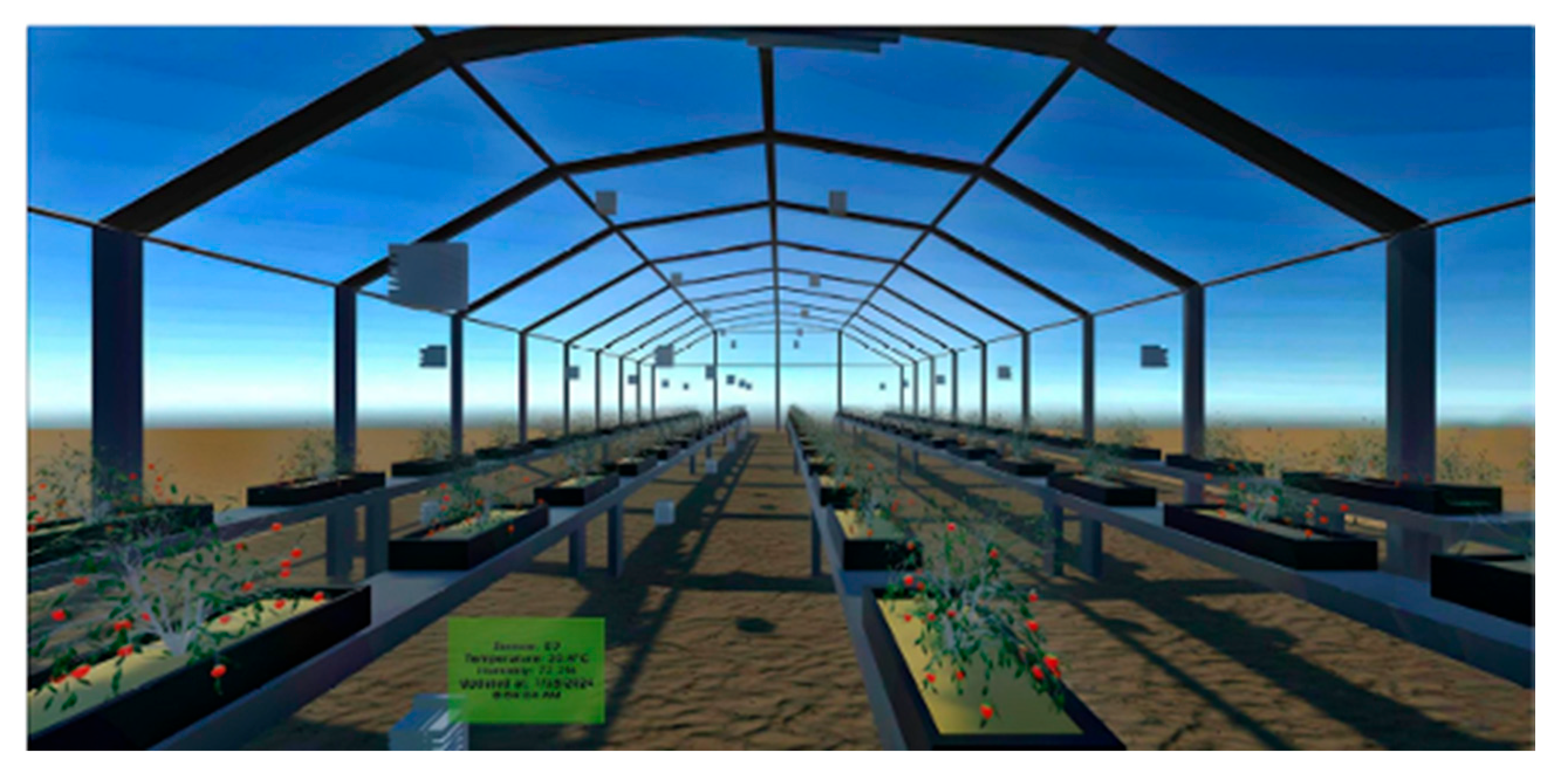
56] use reinforcement learning (RF) to define the optimal location of humidity and temperature sensors in a DT strawberry greenhouse (
Figure 12).
Machinery/robotics-based DTs report AI vision systems to discriminate crops from weed [
47]. In [
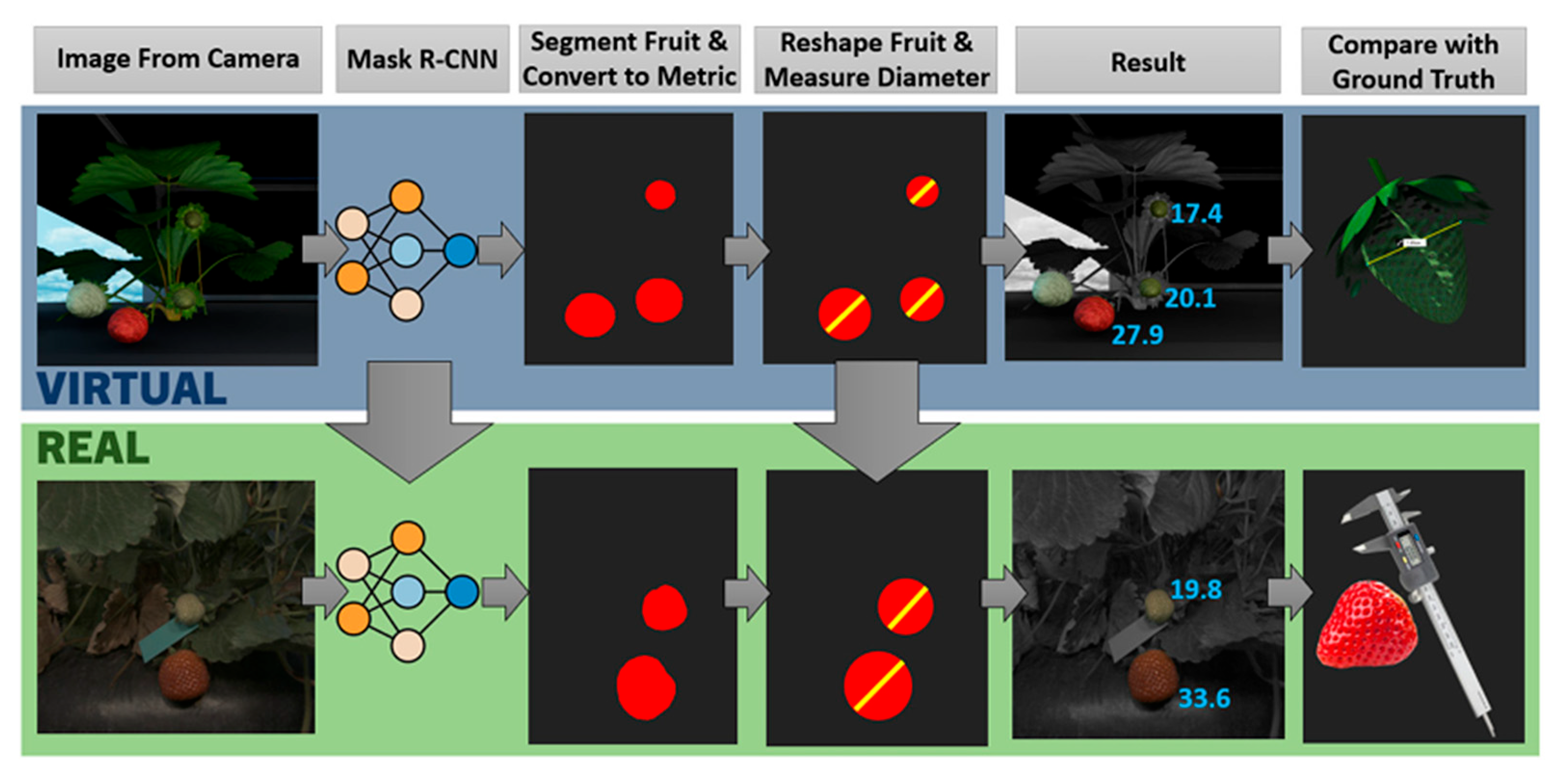
55], Mirbod et al. employ a ground robot to collect data for a DT to replicate field characteristics such as raised bed geometry and strawberry crop distribution, based on DL pipelines to validate fruit size. Specifically, a Mask Region-based Convolutional Neural Network (R-CNN) is used for strawberry segmentation from data provided by the DT (
Figure 13), reporting F1-scores of up to 92%.
As observed, AI methods can be employed for different objectives. In all works, where AI has not already been implemented, the prospect of its integration is mentioned, as well as the capabilities that it could bring to the DT.
Specifically, AI-based predictive maintenance can be achieved by using both real-time and historical data with DL/ML algorithms, towards evaluating the status of machinery and predicting early errors and possible failures. Such approaches can be found on machinery/robotics DTs. RF can be employed to dynamically optimize systems’ conditions, boosting predictions, and minimizing errors. Thus, AI can optimize resource management through crop growth monitoring and soil and weather conditions. Such implementations are depicted mainly in soil and physiological modeling-based DTs, as well as greenhouse-based DTs.
ML/DL algorithms are also used to identify fruits and leaves, aiming to provide data such as fruit size and location, yield estimation, and disease detection insights. Such algorithms are applied to image data from UAV or ground robots. Regression algorithms are also applied in these implementations for sensory data imputation. Moreover, ML/DL is used for path planning and navigation purposes of agribots. UAV-ML field monitoring-based DTs also use such approaches to detect stress/anomaly patterns on crop fields, to estimate biomass, or perform yield and disease predictions.
Table 6 summarizes how AI can be integrated into the identified domains as a result of our selected taxonomy.
Across the selected works, DL-based vision models such as Mask R-CNN, relying on image data, reported the highest predictive performance; however, numerical performance results as well as details on validation strategies are scarce in the literature. The same accounts for interpretability, which remains limited across all AI-enabled DTs in the selected literature. Explainable AI (XAI) techniques, such as feature attribution or saliency maps, which reinforce trust and adoption in real farming environments, have not yet been reported. XAI could therefore be integrated into a DT data pipeline towards making predictions, recommendations, and simulated scenarios transparent and trustworthy for agronomists and farmers.
It is obvious that further advancements in AI can revolutionize agriculture by enhancing the capabilities of DTs, since DTs can simulate multiple alternative scenarios to optimize agricultural practices. In conclusion, DTs can provide powerful tools to farmers, enabling real-time insights and predictive and optimization capabilities, aiming to improve decision-making, enhance productivity, and tackle challenges linked to sustainability and efficient resource management.
6. Discussion
The conducted research accomplished quantitative and qualitative results that both revealed the evolving nature of DTs in agriculture. The temporal distribution of selected works indicates the transition of DTs from conceptual frameworks to more applied implementation, reflecting the maturity of enabling technologies, i.e., IoT, AI, and cloud architectures, that enable the development of operational DTs. Yet an increasing number of publications over the years does not imply maturity. More works remain theoretical or refer to offline simulation applications that could be integrated into a DT.
The introduction of the DTMI aims to identify the evolving maturity level of DTs over the years. Our quantitative analysis using DTMI revealed that the field is moving from low maturity to high, presenting real-time data integration and operational DT prototype architectures. This revealed pattern suggests that DT related research is still evolving and gradually shifting from theoretical to practical, while this shift is not homogenous across identified application domains, as a result of our proposed taxonomy.
Our conducted qualitative analysis across the four DT taxonomies (soil/physiological modeling, UAV-ML field monitoring, greenhouses and machinery/robotic-based DTs) better highlights this uneven development. Each domain exhibits different strengths and limitations in synchronization, scalability, and data quality, which directly impact its identified maturity level. Machinery/robotic-based DTs consistently demonstrate the highest maturity across all examined aspects. Their long-standing integration of automations and robotics in precision agriculture, combined with the capabilities for high-quality data streams and established communication infrastructures, placed machinery/robotic-based DTs as the most advanced and readily deployable category. The latter is also verified from the related research in the examined literature, ranking machinery/robotics DT related implementations as the most popular.
Based on the above, our analysis concluded that research activity tends to concentrate where technological readiness, industrial support, and commercial motivations are the strongest.
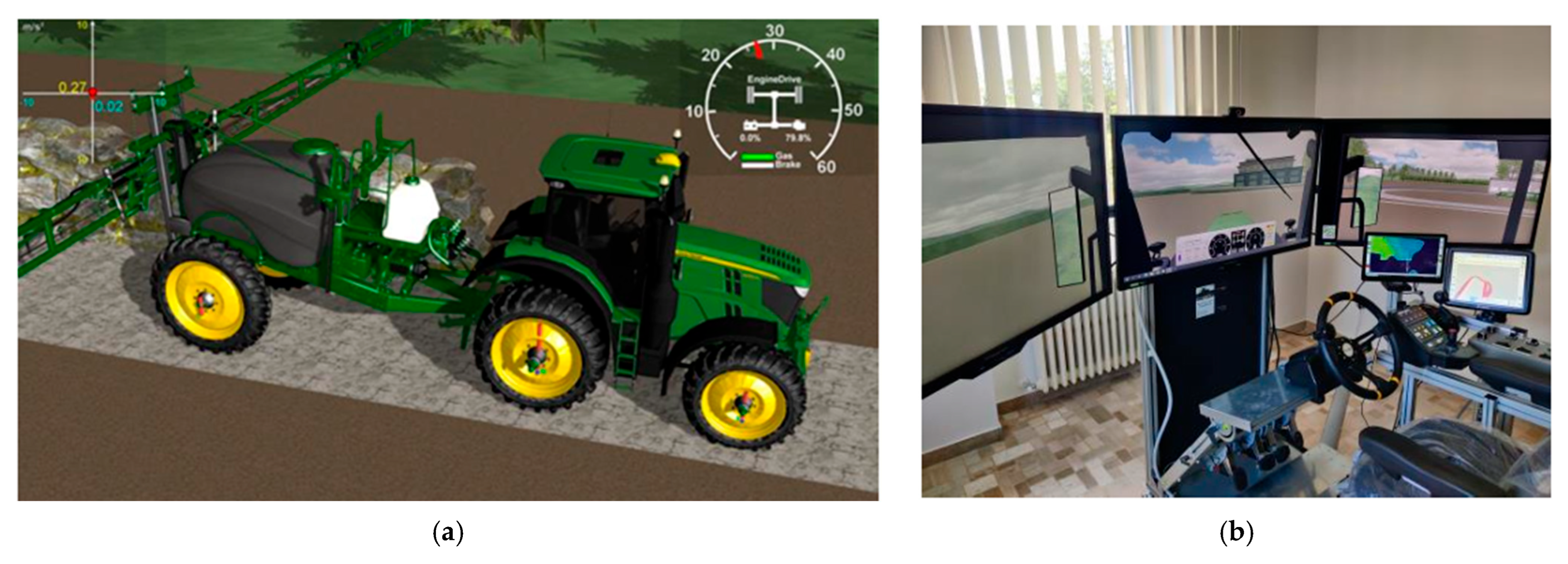
An indicative DT example in this research field is presented in
Figure 14. The simulation system, including three virtual agricultural machineries (DTs of agricultural tractors) to perform sowing, fertilizing, and spraying operations, and the DT of the farm environment where the machinery navigates, reflect all the changes in the physical entity’s state [
48].
Across domains, the AI component emerges as a key enabler of smarter DTs. While currently most DTs exist without AI, the integration of ML, DL, RF, and computer vision can transform them into more adaptive, highly predictive systems capable of real-time decision making. AI components can resolve limitations of each domain: soil-based DTs can use AI to compensate for noisy data; UAV-based DTs can rely on AI-empowered image interpretation; greenhouse-based DTs can employ AI for efficient close-loop environmental control; machinery-based DTs can use AI to enhance autonomy and predictive maintenance. Our research confirms that AI integration can play a vital role in the shift of conceptual DTs to operational ones, aspiring implementations of high maturity.
6.1. Benefits and Opportunities
6.1.1. Real-Time Decision Support
One of the main motivations behind DTs in agriculture is the possibility of making decisions based on information that continuously updates. Even though our review revealed that limited studies manage real-time operation, several works demonstrate how partial synchronization could clearly improve decision-making. For example, the soil-process DTs indicate how nutrient, or moisture conditions can shift within hours, while by keeping the DT model aligned with those changes can help to avoid applying water or fertilizer at the wrong moment: greenhouse DTs that receive steady sensor feeds, are able to predict short-term environmental changes and enable the control system to timely interfere before plants experience stress; machinery DTs can predict problems, like mechanical failures due to sudden changes in terrain or an inefficient trajectory, before they occur. Even though most of the current systems are prototypes, they still provide solid evidence that sensing and timely action can eventually be synchronized.
6.1.2. Optimization of Agricultural Inputs
Across the UAV, soil, and crop DTs, the authors indicate that DTs can help cut down on input sources, such as water, fertilizers, and pesticides, simply because they make timing and targeting more precise. Irrigation-oriented DTs [
12,
40,
63,
68,
69] aim to evaluate different watering scenarios before any water is applied, which reduces the guesswork that normally leads to over-irrigation: soil-related DTs [
8,
22,
70] use continuous or near-continuous nutrient monitoring to fine-tune fertilizer application; pest and disease detection DTs based on UAV data [
7,
53,
61], employ image-derived indicators to guide selective application. In the latter case, the DT is not much of a full simulation but rather a structured way of situating the observations within a model of expected plant behavior, which helps towards avoiding unnecessary spraying. Even though input resource reductions are not quantified in the examined works directly, in all cases, the authors state that the use of DTs reduces overuse or wasteful use.
6.1.3. Improved Sustainability and Environmental Protection
Environmental benefits are reported across all examined studies, without being the primary research goal. Soil and nutrient DT applications [
22,
70] emphasize that better timing of fertilizer application can reduce leaching or runoff: UAV-based DTs for the detection of water stress [
7,
41,
61] indirectly contribute to sustainability goals by preventing excessive irrigation, which is particularly relevant in water-scarce regions; greenhouse DTs [
56,
63] mention energy efficiency as a secondary outcome since when DTs predict environmental changes ahead of time, the system avoids unnecessary heating or cooling cycles; machinery-oriented DTs [
6,
47] achieve sustainability by optimizing field trajectories and thus fuel use. It should be noted that even though these works generally introduce improved sustainability and environmental protection, their main research focus of the DT is in a different direction.
6.1.4. Scalability and Digital Transformation of Farms
The potential for DTs to help farms scale their monitoring and management systems is reported across the literature. In UAV-ML reported DTs [
60,
61], the authors suggest that imagery-based updating of the DT could allow large fields to be monitored more consistently without massive sensor deployment. However, soil-process DTs [
8] highlight the opposite challenge, that detailed models can be very accurate but do not always scale well beyond a tightly instrumented plot. Machinery- and robotics-related DTs [
6] provide another dimension of scalability, that of operational automation. When machines work based on a digital model that can evaluate routes, predict slippage, or schedule tasks, the management of large farms becomes less dependent on human intervention. Although none of the examined studies presents a full farm-scale DT, they all indicate that the concept of DTs will digitally transform farms by eventually providing a unifying framework for connecting sensors, models, and machinery into a single operational system.
6.2. Challenges and Limitations
6.2.1. Data Quality, Heterogeneity, and Missing Data Issues
Almost all examined works report some type of data limitation. In soil and micro-environment DTs, the authors mention that soil measurements can fluctuate sharply, even between sensors placed a short distance apart; probes drift over time or the chemical signals they rely on are noisy, which makes it hard for the DT to stay aligned with the real system. In UAV-based crop monitoring DTs, the authors report that data is rich but not consistent; lighting changes, altitude differences, wind movement, and uneven ground cover all affect the captured images. Moreover, many implementations require heavy preprocessing or calibration to extract usable indices. In some cases, UAV flights are not frequent enough to maintain continuity, and the DT model must guess the in-between observations stages. Even in machinery DTs, the authors describe issues like sensor dropouts, GPS drift, and mechanical vibration interfering with readings. These interruptions create gaps that DTs must either ignore or interpolate, while both choices could lead to prediction errors.
6.2.2. High Computational Requirements for Real-Time Twins
A reported limitation, mainly among plant-modeling and greenhouse studies is that high-resolution simulations are too slow to operate continuously. Some functional plant models could take minutes or hours to update, which makes true real-time integration infeasible. Examined works mention simplifications of their models so that computations can keep pace with incoming data streams.
In UAV-ML studies, computational bottlenecks are reported because ML models usually run off devices, sometimes even in the cloud, while the upload of large images from rural fields is slow or unreliable. Moreover, until the model becomes updated, crop conditions may have altered.
In machinery-related works, authors also acknowledge computational limitations, usually related to the hardware on the machine itself. Autonomous cultivators or robots must make instant decisions; thus, DT models must be lightweight enough to run on embedded hardware. The more complex the DT, the harder it is to be deployed in-field.
6.2.3. Lack of Standardization
The examination of the literature indicated that researchers interpret the term DT differently:
Soil and nutrient studies treat DTs mostly as real-time or near-real-time process models.
UAV-based studies treat DTs as periodically updated field representations.
Machinery studies use DTs mainly as simulation environments for operational planning.
Therefore, it is difficult to compare the success or maturity of different DT systems. Inconsistent terminology is also reported across the literature, for synchronization, feedback loops, and even for what “real time” refers to. Data formats also differ, with some studies relying on standard sensor messages, while others invent their own structures. This profound lack of standardization indicates that current DT systems are essentially handcrafted and cannot be easily transferred or reused in different settings.
6.2.4. Economic and Adoption Barriers Among Farmers
Several papers, especially those dealing with UAVs and multi-sensor systems, briefly mention implementation or maintenance costs. Drones, multispectral cameras, microdialysis sensors, high-frequency environmental probes, and edge-computing devices all add up to related costs. It should be noted that the soil-related papers acknowledge that their instruments are expensive and require maintenance.
Machinery-oriented studies face additional challenges: farmers are skeptical of adopting systems that require constant calibration or seem fragile in rough field conditions, while they do not feel sufficiently confident or trained enough to use such technologies. Our research identified a common mindset among farmers that even if DTs improve in efficiency, they might still avoid them if they complicate routine operations. Moreover, some of the reviewed papers note that using DTs effectively requires some familiarity with model outputs, uncertainty, or sensor behavior, skills that not all farm managers have the time or interest to acquire. These adoption challenges do not undermine the potential of DTs but indicate the reason why many of the systems referenced in the literature remain at the research or pilot stage rather than being used widely in real farm settings.
6.3. Future Research Directions
6.3.1. Need for Multi-Scale Digital Twins (Farm → Region → Climate)
In comparison to all 47 studies, the thing that kept resurfacing is how “local” most of these DTs still are. The soil and microdialysis papers barely extend beyond a few meters of ground, while the 3D plant models usually stick to single-plant structures. The UAV papers cover a wider area, but even then, the models treat each field almost as if it only exists in isolation from everything around it. None of these approaches really tackle what happens when one moves from one field to an entire farm, or from one farm to a full region where weather and water availability connect through multiple landscapes.
A more complete version of a DT would need to move between scales, something that none of the works in the dataset has yet managed. It is not that the individual models are wrong. They are just designed for fine-grain decisions. But agricultural decisions often occur at larger scales: irrigation districts, catchments, market zones. Future work needs to explore how smaller models (like the nutrient-based ones) could feed into larger ones, and how the UAV-based stress indicators might be linked with regional hydrology or even seasonal forecasts.
6.3.2. Integration of Climate-Change Models
Something else that stood out is that almost all 47 studies treat the environment as “given” rather than as something shifting year after year. Greenhouse papers mention heat waves or ventilation stress, and some UAV studies refer to drought symptoms, but none actually include climate-change projections into their DT concept. The latter indicates a research gap, especially since farmers increasingly plan for long-term risk rather than just next week’s predictions.
Future DTs could experiment with a combination of crop or soil models with downscaled climate projections. This might help anticipate how certain parts of a field react to heat stress or how nutrient cycles shift under prolonged dry periods. Even machinery studies might gain from this research direction, since climate affects soil hardness, operational windows, and equipment wear. Currently, this holistic framework is basically absent from the applied literature.
6.3.3. Ethical Concerns and Data Governance
UAV-ML works in all cases generate data that extends beyond the farm boundary, since drone images sometimes capture neighboring properties. The soil and environmental works produce extremely detailed logs of farm activity, and depending on who has access, those logs could reveal management patterns that some farmers would prefer to keep private. None of the studies seriously deals with such sensitive ethical issues.
Expected wide use of DTs in the near future needs to be accompanied by clearer rules about who owns sensory data, how long it is stored, who gets access, and under what conditions. This is especially relevant for cloud-connected systems, which appear in several papers even if the authors do not emphasize such implications. The mismatch between technical capacity and data governance is one of the gaps that future work will need to confront more directly.
6.3.4. Paths Towards Standardized Architectures
One of the more practical problems is simply the lack of a shared way of building DT systems. Soil models use one type of pipeline, UAV-ML models use another, and the machinery studies rely on robotics frameworks that do not match anything used in crop modelling. When placed side by side, these works look like they come from different application fields.
Development of a common architecture could help the field move forward. It does not need to be rigid. It just needs to give researchers a sense of how sensing, modelling, and actuation pieces should fit together. Right now, every group reinvents everything from scratch, which slows progress and makes comparison nearly impossible. Several studies acknowledge this indirectly, especially the more simulation-heavy ones [
3,
4,
5,
6,
7,
8,
9], which note the difficulty of linking their models with external data sources.
7. Conclusions
In this work, a scoping review was conducted for DTs in agriculture, aiming to identify the current status and provide insights, research gaps, and a useful future research direction. Our quantitative analysis revealed a shift from low to high maturity over the examined years, with the most recent works demonstrating the capabilities of real-time data integration and operational prototype architectures. Yet this progress is not homogenous across the identified taxonomy domains. Our qualitative analysis indicated that each domain exhibits strengths and limitations in synchronizations, scalability, and data quality. Machinery and robotic-related DTs emerged as the most mature domain, indicating that research activity naturally concentrates where technological readiness and economic motivations are the highest.
Our findings carry important theoretical implications. Currently, DTs in agriculture lack a unified conceptual model. Each domain operationalizes the DT paradigm differently, posing its own sensing constraints and data flows; thus, reported DTs span from conceptual, to simulation, to decision support tools. Essential characteristics such as synchronization, data fidelity, and bidirectional interaction need to be defined so as to shape common theoretical foundations to distinguish a DT from all other resembling implementations.
Methodologically, our review highlighted that agricultural DT related research is dominated by isolated prototypes rather than integrated architectures. Future work needs to focus less on building entirely new prototypes and more on finding ways to connect the ones that already exist. The addition of climate information could also help shift from day-to-day decisions to longer-term planning. For practical farming, machinery and operational decision DTs seem more feasible, mostly because they already run in real time and since farmers see an immediate benefit there, in saving time and resources.
Across all domains, AI integration emerges as a critical enabler for DTs of higher maturity. While DTs can operate without AI, the integration of ML, DL, RF, and computer vision could transform them into useful, real-time, data-driven predictive tools to support sustainable farm management operations. Our analysis confirms that AI integration is a central component for the acceleration and transition from conceptual to operational high-maturity DT implementations. Overall, the present work indicates the potential of DTs in agriculture, towards supporting farm-scale coordinated and informed decision-making.