Review

Multimodal Classification Algorithms for Emotional Stress Analysis with an ECG-Centered Framework: A Comprehensive Review


Faculty of Engineering and Information Technology, University of Technology Sydney, Ultimo, NSW 2007, Australia
*
Author to whom correspondence should be addressed.
Submission received: 1 December 2025 / Revised: 19 January 2026 / Accepted: 3 February 2026 / Published: 9 February 2026

Abstract

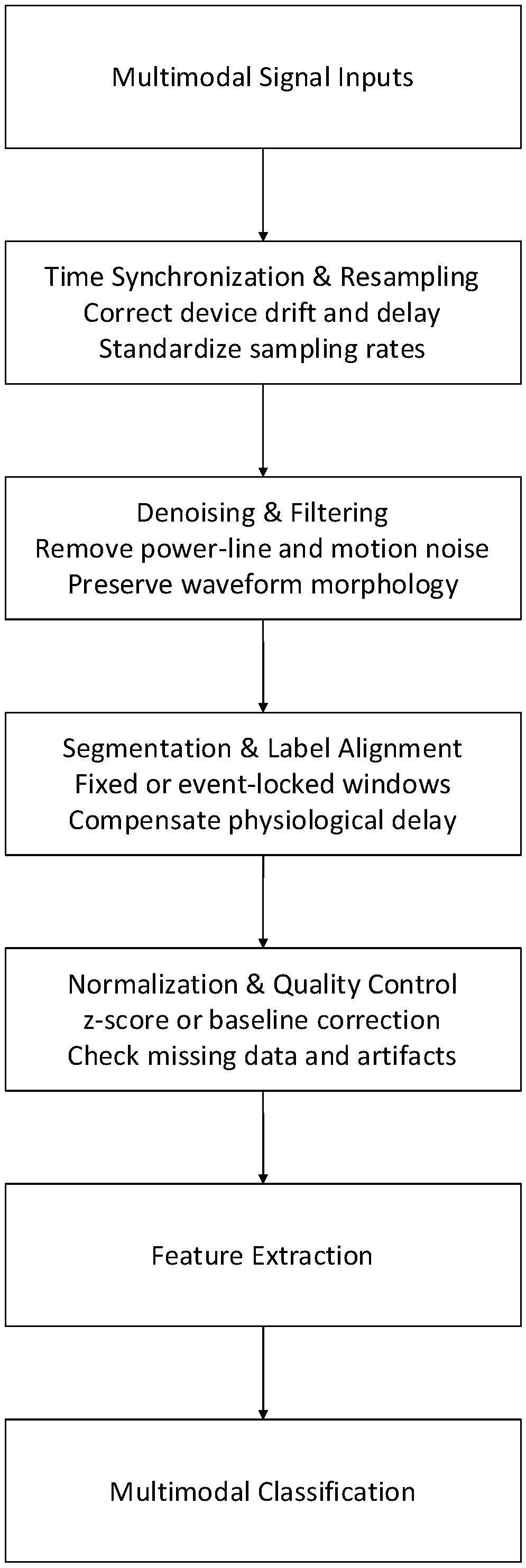
Emotional stress plays a critical role in mental health conditions such as anxiety, depression, and cognitive decline, yet its assessment remains challenging due to the subjective and episodic nature of conventional self-report methods. Multimodal physiological approaches, integrating signals such as electrocardiogram (ECG), electrodermal activity (EDA), and electromyography (EMG), offer a promising alternative by enabling objective, continuous, and complementary characterization of autonomic stress responses. Recent advances in machine learning and artificial intelligence (ML/AI) have become central to this paradigm, as they provide the capacity to model nonlinear dynamics, inter-modality dependencies, and individual variability that cannot be effectively captured by rule-based or single-modality methods. This paper reviews multimodal physiological stress recognition with an emphasis on ECG-centered systems and their integration with EDA and EMG. We summarize stress-related physiological mechanisms, catalog public and self-collected databases, and analyze their ecological validity, synchronization, and annotation practices. We then examine preprocessing pipelines, feature extraction methods, and multimodal fusion strategies across different stages of model design, highlighting how ML/AI techniques address modality heterogeneity and temporal misalignment. Comparative analysis shows that while deep learning models often improve within-dataset performance, their generalization across subjects and datasets remains limited. Finally, we discuss open challenges and future directions, including self-supervised learning, domain adaptation, and standardized evaluation protocols. This review provides practical insights for developing robust, generalizable, and scalable multimodal stress recognition systems for mental health monitoring.
Keywords: emotional stress; multimodal physiological signals; electrocardiogram; electrodermal activity; multimodal fusion; machine learning emotional stress; multimodal physiological signals; electrocardiogram; electrodermal activity; multimodal fusion; machine learning