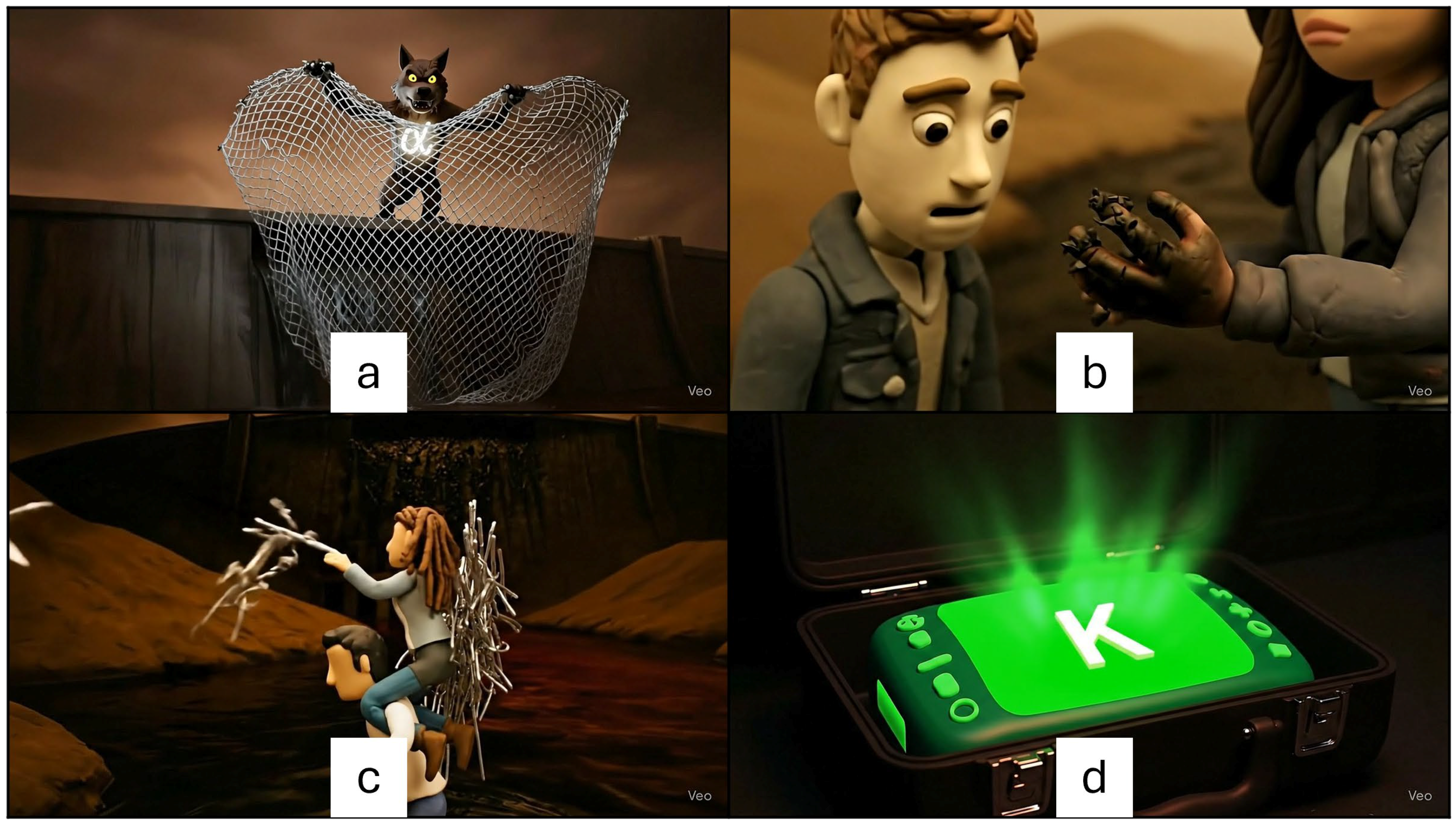

A Multisite Study of an Animated Cinematic Clinical Narrative for Anticoagulant Pharmacology Education
Abstract
1. Introduction
2. Materials and Methods
2.1. Study Design
2.2. Participants
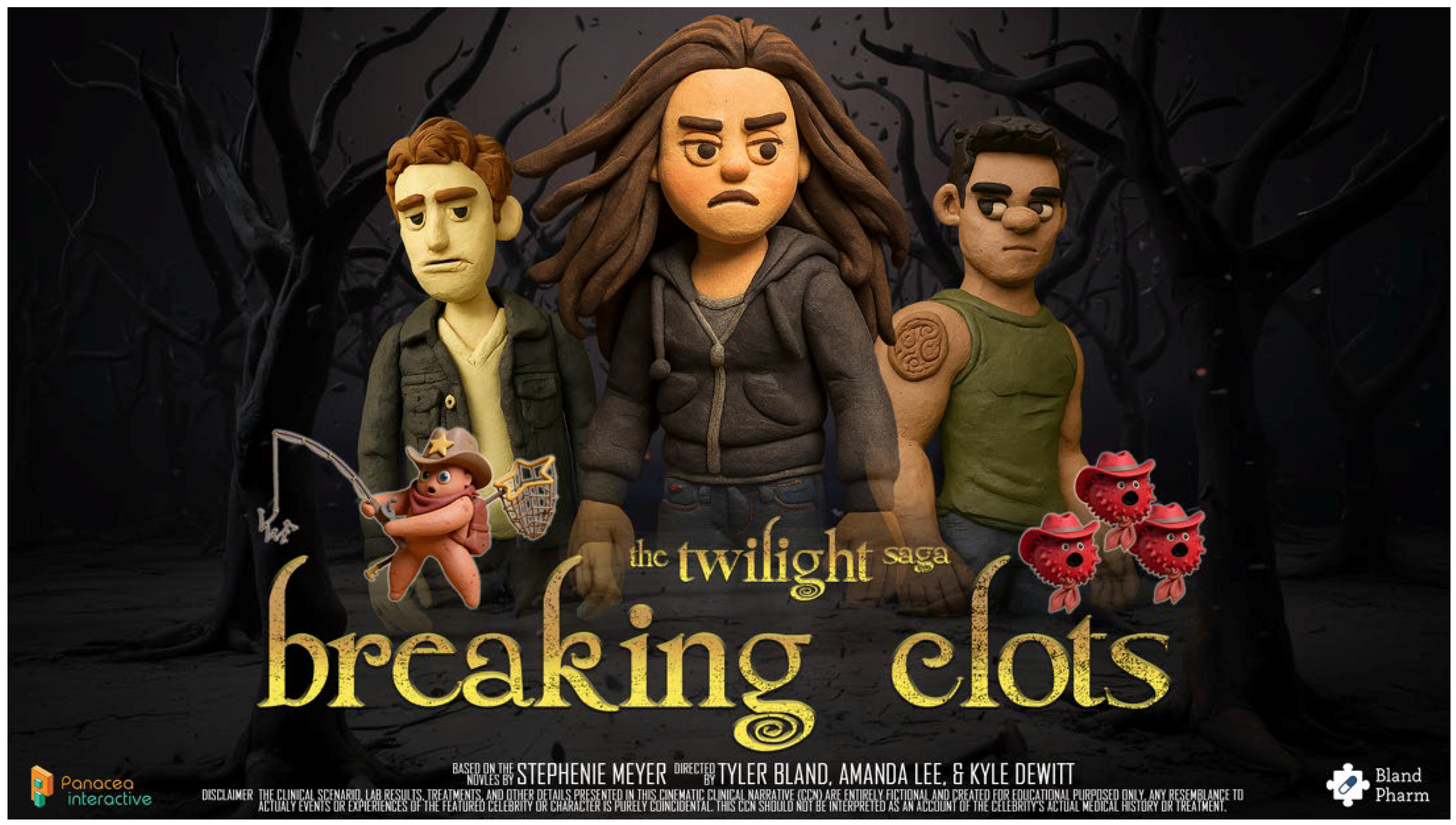
2.3. Intervention: Twilight: Breaking Clots
2.4. Educational Outcome Measures
2.5. Engagement Measures
2.6. Biometric Measures
2.7. Data Collection Procedures
2.8. Data Analysis
2.9. Ethics
3. Results
3.1. Learning Outcomes
3.2. Interest Survey Results
- Theme 1: Distinct Pedagogical Roles: Memorization via Animation vs. Application via Non-Animated Cases.
- Theme 2: Heightened Engagement and Affective Appeal of the Animated Narrative.
- Theme 3: Instructional Design and Complementary Use.
3.3. Biometric Results
4. Discussion
4.1. Summary of Key Findings
4.2. Limitations
4.3. Future Directions
5. Conclusions
Supplementary Materials
Author Contributions
Funding
Institutional Review Board Statement
Informed Consent Statement
Data Availability Statement
Conflicts of Interest
Abbreviations
| genAI | Generative Artificial Intelligence |
| CCN | Cinematic Clinical Narrative |
| SIS-M | Situational Interest Survey for Multimedia |
| TSI | Triggered Situational Interest |
| OMI | Overall Maintained Interest |
| MFI | Maintained Feeling Interest |
| MVI | Maintained Value Interest |
| WWAMI | Washington, Wyoming, Alaska, Montana, Idaho |
| LLM | Large Language Model |
| MCQ | Multiple-Choice Question |
Appendix A

| SIS Type | Survey Item |
|---|---|
| SI-triggered | The “case style” was interesting. |
| The “case style” grabbed my attention. | |
| The “case style” was often entertaining. | |
| The “case style” was so exciting, it was easy to pay attention. | |
| SI-maintained-feeling | What I learned from the “case style” is fascinating to me. |
| I am excited about what I learned from the “case style”. | |
| I like what I learned from the “case style”. | |
| I found the information from the “case style” interesting. | |
| SI-maintained-value | What I studied in the “case style” is useful for me to know. |
| The things I studied in the “case style” are important to me. | |
| What I learned from the “case style” can be applied to my major/career. | |
| I learned valuable things from the “case style”. |
References
- Van Merriënboer, J.J.G.; Sweller, J. Cognitive load theory in health professional education: Design principles and strategies. Med. Educ. 2010, 44, 85–93. [Google Scholar] [CrossRef]
- Young, J.Q.; Van Merrienboer, J.; Durning, S.; Cate, O.T. Cognitive Load Theory: Implications for medical education: AMEE Guide No. 86. Med. Teach. 2014, 36, 371–384. [Google Scholar] [CrossRef] [PubMed]
- Hirsh, J.; Dalen, J.E.; Anderson, D.R.; Poller, L.; Bussey, H.; Ansell, J.; Deykin, D. Oral Anticoagulants: Mechanism of Action, Clinical Effectiveness, and Optimal Therapeutic Range. Chest 2001, 119, 8S–21S. [Google Scholar] [CrossRef] [PubMed]
- Heidbuchel, H.; Verhamme, P.; Alings, M.; Antz, M.; Diener, H.-C.; Hacke, W.; Oldgren, J.; Sinnaeve, P.; Camm, A.J.; Kirchhof, P.; et al. Updated European Heart Rhythm Association Practical Guide on the use of non-vitamin K antagonist anticoagulants in patients with non-valvular atrial fibrillation. Ep Eur. 2015, 17, 1467–1507. [Google Scholar] [CrossRef] [PubMed]
- Sweller, J. Cognitive Load Theory. Psychol. Learn. Motiv.—Adv. Res. Theory 2011, 55, 37–76. [Google Scholar] [CrossRef]
- Dunlosky, J.; Rawson, K.A.; Marsh, E.J.; Nathan, M.J.; Willingham, D.T. Improving students’ learning with effective learning techniques: Promising directions from cognitive and educational psychology. Psychol. Sci. Public Interest 2013, 14, 4–58. [Google Scholar] [CrossRef]
- Budnitz, D.S.; Pollock, D.A.; Weidenbach, K.N.; Mendelsohn, A.B.; Schroeder, T.J.; Annest, J.L. National Surveillance of Emergency Department Visits for Outpatient Adverse Drug Events. JAMA 2006, 296, 1858–1866. [Google Scholar] [CrossRef]
- Piazza, G.; Nguyen, T.N.; Cios, D.; Labreche, M.; Hohlfelder, B.; Fanikos, J.; Fiumara, K.; Goldhaber, S.Z. Anticoagulation-associated adverse drug events. Am. J. Med. 2011, 124, 1136–1142. [Google Scholar] [CrossRef]
- Boshuizen, H.P.A.; Schmidt, H. The development of clinical reasoning expertise. In Clinical Reasoning in the Health Professions; Elsevier: Amsterdam, The Netherlands, 2024; pp. 57–65. [Google Scholar]
- Bandura, A.; Walters, R. Social Learning Theory; Prentice-Hall: Upper Saddle River, NJ, USA, 1976. [Google Scholar]
- Monrouxe, L.V.; Bullock, A.; Gormley, G.; Kaufhold, K.; Kelly, N.; Roberts, C.E.; Mattick, K.; Rees, C. New graduate doctors’ preparedness for practice: A multistakeholder, multicentre narrative study. BMJ Open 2018, 8, e023146. [Google Scholar] [CrossRef]
- Mayer, R.E. Cognitive Theory of Multimedia Learning. In The Cambridge Handbook of Multimedia Learning; Cambridge University Press: Cambridge, UK, 2012; pp. 31–48. [Google Scholar]
- Fasinu, P.S.; Wilborn, T.W. Pharmacology education in the medical curriculum: Challenges and opportunities for improvement. Pharmacol. Res. Perspect. 2024, 12, e1178. [Google Scholar] [CrossRef]
- Brinkman, D.J.; Tichelaar, J.; Graaf, S.; Otten, R.H.J.; Richir, M.C.; van Agtmael, M.A. Do final-year medical students have sufficient prescribing competencies? A systematic literature review. Br. J. Clin. Pharmacol. 2018, 84, 615–635. [Google Scholar] [CrossRef] [PubMed]
- Tobaiqy, M. Exploring medical students’ preferences and challenges in clinical pharmacology education: Insights and improvement strategies. BMC Med. Educ. 2025, 25, 374. [Google Scholar] [CrossRef] [PubMed]
- Aksakal, N. Theoretical View to The Approach of The Edutainment. Procedia Soc. Behav. Sci. 2015, 186, 1232–1239. [Google Scholar] [CrossRef]
- Sokolova, A.; Deviatnikova, K. Edutainment as a New Educational Technology: A Comparative Analysis. Lect. Notes Netw. Syst. 2023, 830, 302–318. [Google Scholar] [CrossRef]
- Mayer, R.E. Introduction to Multimedia Learning. In The Cambridge Handbook of Multimedia Learning; Cambridge University Press: Cambridge, UK, 2005; pp. 1–16. [Google Scholar]
- Singhal, A.; Rogers, E.M. Entertainment-Education: A Communication Strategy for Social Change; Taylor and Francis: Abingdon, UK, 2012; Available online: https://www.taylorfrancis.com/books/mono/10.4324/9781410607119/entertainment-education-arvind-singhal-everett-rogers (accessed on 28 December 2025).
- Dzinamarira, T.; Nachipo, B.; Nyathi, A.; Madziva, R.; Herrera, H.; Siegel, H.; Musuka, G. The case to scale up edutainment as an effective public health communication intervention to combat the COVID-19 pandemic in Zimbabwe. Health Promot. Perspect. 2022, 12, 34–36. [Google Scholar] [CrossRef]
- Tekeş, E.; Güngör, B.; Sılan, C.; Toraman, Ç. Enhancing pharmacology education through role-play: Impact on student attitudes. BMC Med. Educ. 2025, 25, 1306. [Google Scholar] [CrossRef]
- Fischbein, R.; Bonfine, N. Pharmacy and Medical Students’ Mental Health Symptoms, Experiences, Attitudes and Help-Seeking Behaviors. Am. J. Pharm. Educ. 2019, 83, 7558. [Google Scholar] [CrossRef]
- Worthley, B.; Guo, M.; Sheneman, L.; Bland, T. Antiparasitic Pharmacology Goes to the Movies: Leveraging Generative AI to Create Educational Short Films. AI 2025, 6, 60. [Google Scholar] [CrossRef]
- Bland, T. Enhancing Medical Student Engagement Through Cinematic Clinical Narratives: Multimodal Generative AI-Based Mixed Methods Study. JMIR Med. Educ. 2025, 11, e63865. [Google Scholar] [CrossRef]
- Clark, J.M.; Paivio, A. Dual coding theory and education. Educ. Psychol. Rev. 1991, 3, 149–210. [Google Scholar] [CrossRef]
- Paivio, A. Dual coding theory: Retrospect and current status. Can. J. Psychol./Rev. Can. Psychol. 1991, 45, 255–287. [Google Scholar] [CrossRef]
- Artsi, Y.; Sorin, V.; Glicksberg, B.; Korfiatis, P.; Thomas, D.C.; Nadkarni, G.N.; Klang, E. AI-generated videos in medical education: Systematic review. BMJ Open Qual. 2025, 14, e003704. [Google Scholar] [CrossRef] [PubMed]
- Massaad, C.; Howe, H.; Guo, M.; Bland, T. A Multi-Institution Mixed Methods Analysis of a Novel Acid-Base Mnemonic Algorithm. Multimodal Technol. Interact. 2025, 9, 113. [Google Scholar] [CrossRef]
- Law, A.K.; So, J.; Lui, C.T.; Choi, Y.F.; Cheung, K.H.; Hung, K.K.-C.; Graham, C.A. AI versus human-generated multiple-choice questions for medical education: A cohort study in a high-stakes examination. BMC Med. Educ. 2025, 25, 208. [Google Scholar] [CrossRef] [PubMed]
- Paudel, K.R. AI-Generated Podcasts as a Supplemental Pharmacology Learning Tool: A Feasibility Study in Undergraduate Medical Education. Med. Sci. Educ. 2025, 2025, 1–7. [Google Scholar] [CrossRef]
- Jones, E.M.; Newman, J.D.; Kim, B.; Fogle, E.J. AI-Generated “Slop” in Online Biomedical Science Educational Videos: Mixed Methods Study of Prevalence, Characteristics, and Hazards to Learners and Teachers. JMIR Med. Educ. 2025, 11, e80084. [Google Scholar] [CrossRef]
- Hernandez-de-Menendez, M.; Morales-Menendez, R.; Escobar, C.A.; Arinez, J. Biometric applications in education. Int. J. Interact. Des. Manuf. 2021, 15, 365. [Google Scholar] [CrossRef]
- Van Gog, T.; Scheiter, K. Eye tracking as a tool to study and enhance multimedia learning. Learn. Instr. 2010, 20, 95–99. [Google Scholar] [CrossRef]
- Van Buren, D. Guided scenarios with simulated expert personae: A remarkable strategy to perform cognitive work. arXiv 2023, arXiv:2306.03104. [Google Scholar] [CrossRef]
- Wang, R.; Mi, F.; Chen, Y.; Xue, B.; Wang, H.; Zhu, Q.; Wong, K.-F.; Xu, R. Role Prompting Guided Domain Adaptation with General Capability Preserve for Large Language Models. In Proceedings of the Findings of the Association for Computational Linguistics: NAACL 2024—Findings 2024, Mexico City, Mexico, 16–21 June 2024; pp. 2243–2255. [Google Scholar]
- Rath, A. Structured Prompting and Feedback-Guided Reasoning with LLMs for Data Interpretation. arXiv 2025, arXiv:2505.01636. [Google Scholar] [CrossRef]
- Chen, B.; Zhang, Z.; Langrené, N.; Zhu, S. Unleashing the potential of prompt engineering for large language models. Patterns 2025, 6, 101260. [Google Scholar] [CrossRef] [PubMed]
- Li, C.; Wang, J.; Zhang, Y.; Zhu, K.; Hou, W.; Lian, J.; Luo, F.; Yang, Q.; Xie, X. Large Language Models Understand and Can be Enhanced by Emotional Stimuli. arXiv 2023, arXiv:2307.11760. [Google Scholar] [CrossRef]
- Bland, T.; Guo, M. Visual Mnemonics and Gamification: A New Approach to Teaching Muscle Physiology. J. Technol.-Integr. Lessons Teach. 2024, 3, 73–82. [Google Scholar] [CrossRef]
- Duchastel, P.C. Retention of prose following testing with different types of tests. Contemp. Educ. Psychol. 1981, 6, 217–226. [Google Scholar] [CrossRef]
- Karpicke, J.D.; Roediger, H.L. The critical importance of retrieval for learning. Science 2008, 319, 966–968. [Google Scholar] [CrossRef]
- Dousay, T.A. Effects of redundancy and modality on the situational interest of adult learners in multimedia learning. Educ. Technol. Res. Dev. 2016, 64, 1251–1271. [Google Scholar] [CrossRef]
- Dousay, T.A.; Trujillo, N.P. An examination of gender and situational interest in multimedia learning environments. Br. J. Educ. Technol. 2019, 50, 876–887. [Google Scholar] [CrossRef]
- Bland, T.; Guo, M.; Dousay, T.A. Multimedia design for learner interest and achievement: A visual guide to pharmacology. BMC Med. Educ. 2024, 24, 113. [Google Scholar] [CrossRef]
- Marx, J.D.; Cummings, K. Normalized change. Am. J. Phys. 2007, 75, 87–91. [Google Scholar] [CrossRef]
- Free Statistics App: T-Test, Chi-Square, Correlation, ANOVA, Regression. Available online: https://statisty.app/ (accessed on 1 January 2026).
- Renninger, K.A.; Hidi, S. Revisiting the conceptualization, measurement, and generation of interest. Educ. Psychol. 2011, 46, 168–184. [Google Scholar] [CrossRef]
- Hidi, S.; Ann Renninger, K. The four-phase model of interest development. Educ. Psychol. 2006, 41, 111–127. [Google Scholar] [CrossRef]
- Guo, J.; An, F. Exploring the categories of students’ interest and their relationships with deep learning in technology supported environments. Sci. Rep. 2025, 15, 10370. [Google Scholar] [CrossRef] [PubMed]
- Moreno, R.; Mayer, R. Interactive Multimodal Learning Environments. Educ. Psychol. Rev. 2007, 19, 309–326. [Google Scholar] [CrossRef]
- Green, M.C.; Brock, T.C. The role of transportation in the persuasiveness of public narratives. J. Pers. Soc. Psychol. 2000, 79, 701–721. [Google Scholar] [CrossRef]
- Schmidt, H.G.; Rotgans, J.I.; Yew, E.H.J. The process of problem-based learning: What works and why. Med. Educ. 2011, 45, 792–806. [Google Scholar] [CrossRef]
- Bransford, J.D.; Brown, A.L.; Cocking, R.R. How People Learn: Brain, Mind, Experience, and School: Expanded Edition; National Academy Press: Washington, DC, USA, 2000. [Google Scholar] [CrossRef]
- van Merriënboer, J.J.G.; Kirschner, P.A. Ten Steps to Complex Learning: A Systematic Approach to Four-Component Instructional Design; Routledge: London, UK, 2017. [Google Scholar] [CrossRef]
- Kalyuga, S.; Ayres, P.; Chandler, P.; Sweller, J. The expertise reversal effect. Educ. Psychol. 2003, 38, 23–31. [Google Scholar] [CrossRef]
- Pekrun, R.; Goetz, T.; Titz, W.; Perry, R.P. Academic emotions in students’ self-regulated learning and achievement: A program of qualitative and quantitative research. Educ. Psychol. 2002, 37, 91–105. [Google Scholar] [CrossRef]
- Um, E.; Plass, J.L.; Hayward, E.O.; Homer, B.D. Emotional design in multimedia learning. J. Educ. Psychol. 2012, 104, 485–498. [Google Scholar] [CrossRef]
- Ryan, R.M.; Deci, E.L. Intrinsic and Extrinsic Motivations: Classic Definitions and New Directions. Contemp. Educ. Psychol. 2000, 25, 54–67. [Google Scholar] [CrossRef]
- Cook, D.A.; Artino, A.R. Motivation to learn: An overview of contemporary theories. Med. Educ. 2016, 50, 997–1014. [Google Scholar] [CrossRef]
- Dyrbye, L.; Shanafelt, T. A narrative review on burnout experienced by medical students and residents. Med. Educ. 2016, 50, 132–149. [Google Scholar] [CrossRef]
- Norman, G. Research in medical education: Three decades of progress. BMJ Br. Med. J. 2002, 324, 1560. [Google Scholar] [CrossRef]
- Daher, R. Integrating AI literacy into teacher education: A critical perspective paper. Discov. Artif. Intell. 2025, 5, 217. [Google Scholar] [CrossRef]
- De Koning, B.B.; Tabbers, H.K.; Rikers, R.M.J.P.; Paas, F. Towards a Framework for Attention Cueing in Instructional Animations: Guidelines for Research and Design. Educ. Psychol. Rev. 2009, 21, 113–140. [Google Scholar] [CrossRef]
- Mayer, R.E.; Fiorella, L. Principles for Reducing Extraneous Processing in Multimedia Learning: Coherence, Signaling, Redundancy, Spatial Contiguity, and Temporal Contiguity Principles. In The Cambridge Handbook of Multimedia Learning, 2nd ed.; Cambridge University Press: Oxford, UK, 2014; pp. 279–315. [Google Scholar]
- Jarodzka, H.; Skuballa, I.; Gruber, H. Eye-Tracking in Educational Practice: Investigating Visual Perception Underlying Teaching and Learning in the Classroom. Educ. Psychol. Rev. 2020, 33, 1–10. [Google Scholar] [CrossRef]
- Holmqvist, K.; Nyström, M.; Andersson, R.; Dewhurst, R.; Jarodzka, H.; Van de Weijer, J. Eye Tracking: A Comprehensive Guide to Methods and Measures; Oxford University Press: Oxford, UK, 2011. [Google Scholar]


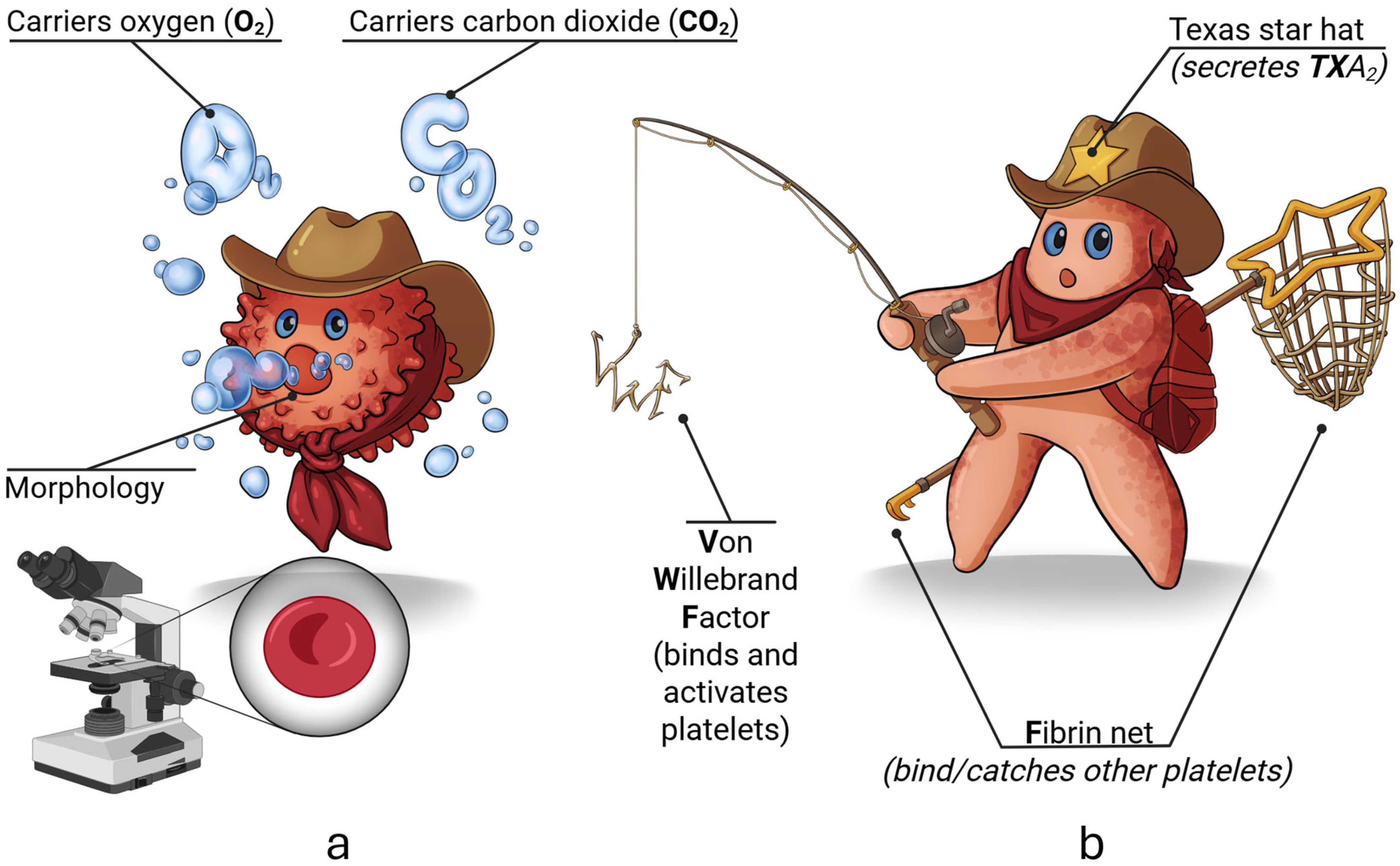
| Visual/Story Mnemonic | Meaning |
|---|---|
| The werewolves have dammed the river which is causing the town and crops to die. | A clot obstructing an artery can cause ischemia and tissue death. |
| Bella attacks the dam with hairpins, which the werewolves block with Proh Solvite shields | Heparin is an anticoagulant that can be reversed with protamine sulfate. |
| Edward HITs fastballs at the dam, which only cause the Platelet Medimon to fall off. | An adverse effect of heparin treatment is heparin-induced thrombocytopenia (HIT) causing a decrease in platelet levels. |
| Edward calls in an “X” truck to let the river rock the dam, but is blocked by a Dexa Net from Jacob the alpha wolf. | Rivaroxaban is a direct factor Xa inhibitor which can be reversed with Andexanet alpha. |
| Edward and Bella declare war on the werewolves and use a K-bomb received from the Volturi (numbered robes) | Warfarin inhibits vitamin K metabolism, leading to decrease in factors II, VII, IX, and X. |
| The K-bomb causes the town to be flooded and Bella to get necrotic burns. | Warfarin adverse effects included increased risk of bleeding and warfarin-induced skin necrosis. |
| Edward and Bella are arrested by CYP robots and charged with war CrYmes for flooding the town. | CYP2C9 mutations can cause increased levels of warfarin leading to increased risk of bleeding. |
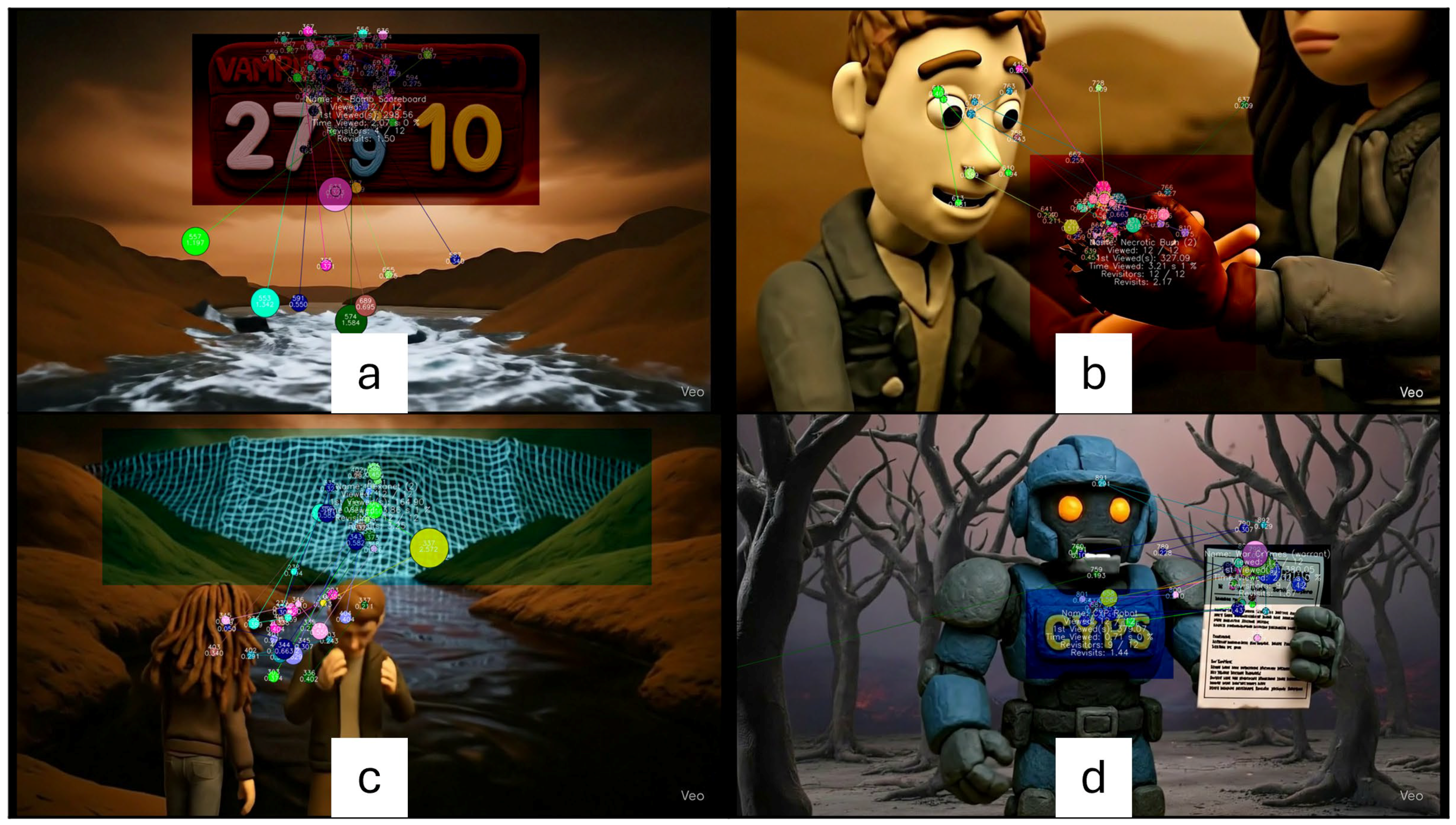
| AOI | Hit Rate (%) | Viewed (n) | Median TTFF (s, rel) | Median Dwell/ AOI Dur | Median Dwell (s) | Median Fixations |
|---|---|---|---|---|---|---|
| K-Bomb Scoreboard | 100.0 | 12.0 | 0.250 | 0.743 | 2.240 | 8.0 |
| Necrotic Burn (2) | 100.0 | 12.0 | 0.381 | 0.533 | 3.034 | 8.0 |
| Dexanet (2) | 100.0 | 12.0 | 0.000 | 0.532 | 3.778 | 11.0 |
| War CrYmes (warrant) | 100.0 | 12.0 | 0.073 | 0.475 | 2.094 | 4.5 |
| Dexanet (1) | 100.0 | 12.0 | 0.062 | 0.434 | 3.162 | 9.0 |
| K-Bomb (3) | 100.0 | 12.0 | 0.984 | 0.408 | 2.248 | 4.0 |
| Heparin Score Board | 100.0 | 12.0 | 0.015 | 0.397 | 3.106 | 10.0 |
| HIT (1) | 100.0 | 12.0 | 0.562 | 0.390 | 1.254 | 4.0 |
| Platelet Strike (2) | 100.0 | 12.0 | 0.445 | 0.387 | 1.343 | 3.0 |
| K-Bomb (2) | 100.0 | 12.0 | 0.532 | 0.342 | 0.808 | 2.5 |
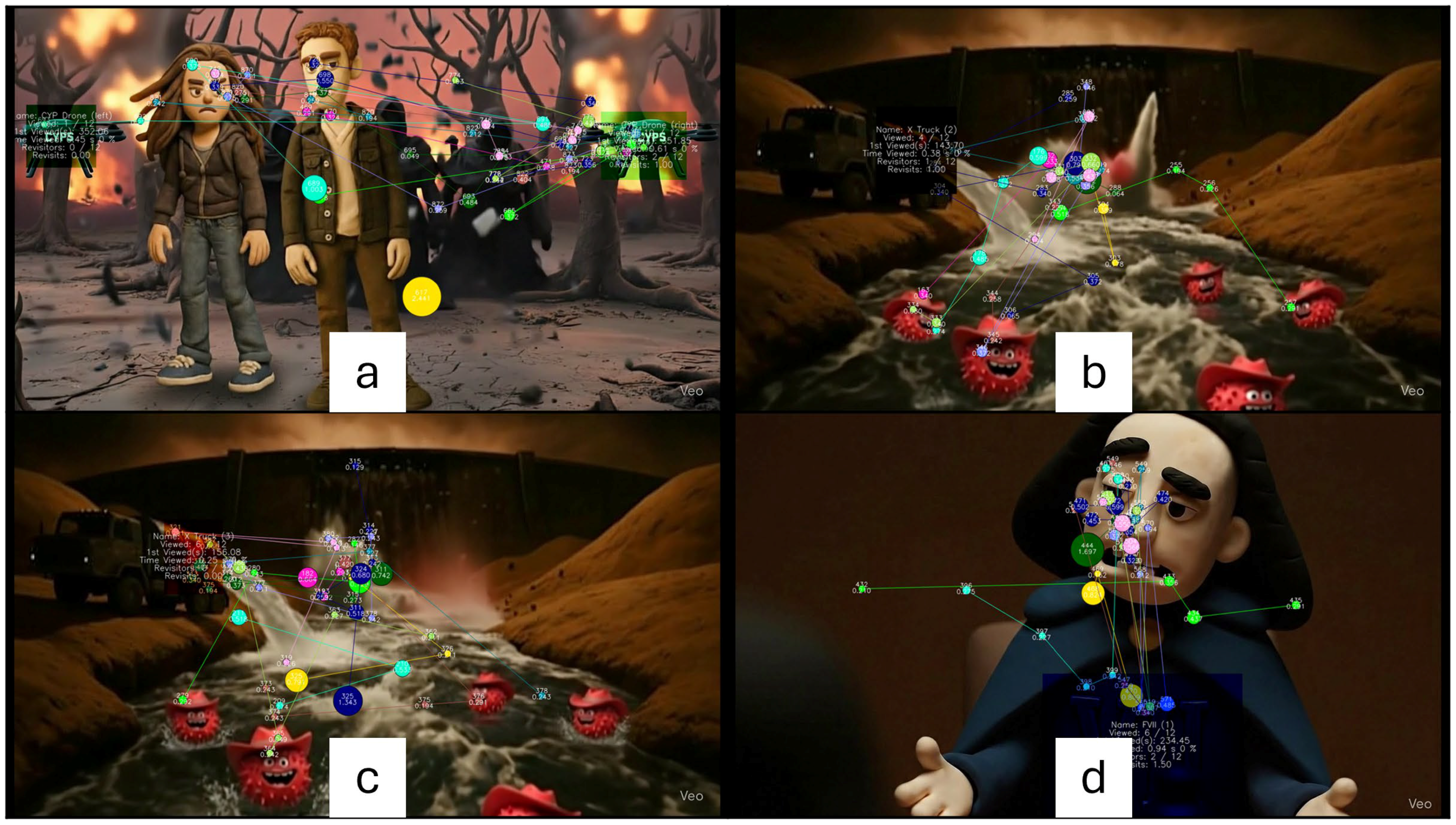
| AOI | Hit Rate (%) | Viewed (n) | Median TTFF (s, rel) | Median Dwell/ AOI Dur | Median Dwell (s) | Median Fixations |
|---|---|---|---|---|---|---|
| CYP Drone (left) | 8.3 | 1.0 | 0.613 | 0.301 | 0.452 | 1.0 |
| X Truck (2) | 33.3 | 4.0 | 0.479 | 0.157 | 0.364 | 1.0 |
| X Truck (3) | 50.0 | 6.0 | 0.858 | 0.088 | 0.170 | 1.0 |
| FVII (1) | 50.0 | 6.0 | 0.544 | 0.313 | 0.865 | 2.0 |
| FVII (2) | 58.3 | 7.0 | 0.709 | 0.303 | 1.616 | 4.0 |
| FIX (2) | 66.7 | 8.0 | 0.661 | 0.142 | 0.624 | 2.0 |
| Proh Solvite Shield (3) | 75.0 | 9.0 | 2.999 | 0.052 | 0.275 | 1.0 |
| Hairpin (right) | 75.0 | 9.0 | 1.107 | 0.123 | 0.502 | 2.0 |
| Proh Solvite Shield (1) | 75.0 | 9.0 | 0.687 | 0.212 | 1.132 | 4.0 |
| FX (2) | 83.3 | 10.0 | 0.698 | 0.046 | 0.364 | 2.0 |
| Mnemonic Concept | Hit Rate (%) | Viewed (n) | Median Total Dwell (s) | Median First TTFF (s, rel) |
|---|---|---|---|---|
| Dexanet | 100.0 | 12 | 7.462 | 0.000 |
| Necrotic Burn | 100.0 | 12 | 6.450 | 0.381 |
| Hairpins | 91.7 | 11 | 4.487 | 0.084 |
| K-Bomb | 100.0 | 12 | 4.351 | 0.229 |
| Heparin Score Board | 100.0 | 12 | 3.106 | 0.015 |
| Proh Solvite Shield | 100.0 | 12 | 3.089 | 0.096 |
| Platelet Medimon | 83.3 | 10 | 2.822 | 0.013 |
Disclaimer/Publisher’s Note: The statements, opinions and data contained in all publications are solely those of the individual author(s) and contributor(s) and not of MDPI and/or the editor(s). MDPI and/or the editor(s) disclaim responsibility for any injury to people or property resulting from any ideas, methods, instructions or products referred to in the content. |
© 2026 by the authors. Licensee MDPI, Basel, Switzerland. This article is an open access article distributed under the terms and conditions of the Creative Commons Attribution (CC BY) license.
Share and Cite
Lee, A.; DeWitt, K.; Guo, M.; Bland, T. A Multisite Study of an Animated Cinematic Clinical Narrative for Anticoagulant Pharmacology Education. AI 2026, 7, 59. https://doi.org/10.3390/ai7020059
Lee A, DeWitt K, Guo M, Bland T. A Multisite Study of an Animated Cinematic Clinical Narrative for Anticoagulant Pharmacology Education. AI. 2026; 7(2):59. https://doi.org/10.3390/ai7020059
Chicago/Turabian StyleLee, Amanda, Kyle DeWitt, Meize Guo, and Tyler Bland. 2026. "A Multisite Study of an Animated Cinematic Clinical Narrative for Anticoagulant Pharmacology Education" AI 7, no. 2: 59. https://doi.org/10.3390/ai7020059
APA StyleLee, A., DeWitt, K., Guo, M., & Bland, T. (2026). A Multisite Study of an Animated Cinematic Clinical Narrative for Anticoagulant Pharmacology Education. AI, 7(2), 59. https://doi.org/10.3390/ai7020059