
Hand Involvement and Its Association with Burn Characteristics, Surgical Management, and Length of Stay in Paediatric Inpatients: A 10-Year Cross-Sectional Study from Western Australia
 , , ,
, , ,  and
and
Highlights
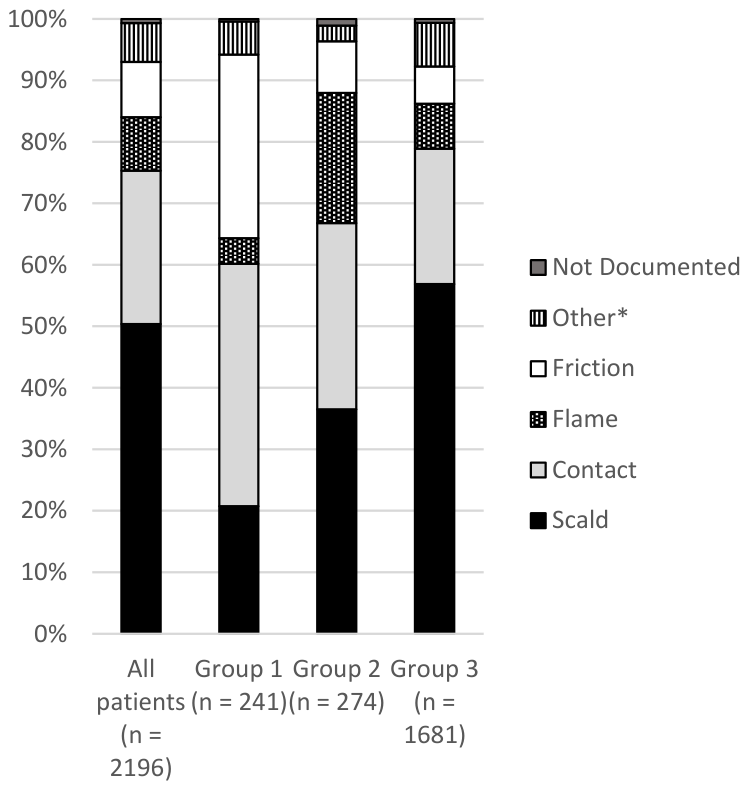
- Paediatric isolated hand burns occur in younger children and are more often caused by contact or friction injuries.
- Hand involvement did not independently prolong length of stay; however TBSA, flame injury, surgery, and rural residence independently did.
- Length of stay is driven by injury severity and management rather than hand burn location.
- The impact of hand burns may relate more to functional and rehabilitation needs than acute admission duration.
Abstract
1. Introduction
2. Materials and Methods
2.1. Study Population
2.2. Data Collection
2.3. Statistical Analysis
3. Results
Regression Analyses
4. Discussion
5. Conclusions
Supplementary Materials
Author Contributions
Funding
Institutional Review Board Statement
Informed Consent Statement
Data Availability Statement
Acknowledgments
Conflicts of Interest
Abbreviations
| LOS | Length of stay |
| BSWA | Burn Service of Western Australia |
| TBSA | Total body surface area |
| ICU | Intensive care unit |
| PCH | Perth Children’s Hospital |
| PMH | Princess Margaret Hospital |
| CAHS | Child and Adolescent Health Service |
| STROBE | Strengthening the Reporting of Observational Studies in Epidemiology |
| IQR | Interquartile range |
| M | Mean |
| SD | Standard deviation |
| CI | Confidence interval |
| AIC | Akaike Information Criterion |
| BIC | Bayesian Information Criterion |
| HREC | Human Research Ethics Committee |
References
- Marino, M.J.; Kimble, R.M.; Stockton, K.A. Paediatric burns patients: Reasons for admission at a tertiary centre. Burns 2015, 41, 708–713. [Google Scholar] [CrossRef]
- Norbury, W.B.; Herndon, D.N. Management of acute pediatric hand burns. Hand Clin. 2017, 33, 237–242. [Google Scholar] [CrossRef]
- Global Burden of Disease Study 2019 (GBD 2019) Reference Life Table. Available online: https://vizhub.healthdata.org/gbd-results/ (accessed on 4 October 2024).
- Bhatti, D.S.; Chowdhury, R.; Ang, K.K.; Greenhowe, J. Paediatric burns of the hand: Our experience over three years. Cureus 2021, 13, e18970. [Google Scholar] [CrossRef] [PubMed]
- Yarrow, J.; Moiemen, N.; Gulhane, S. Early management of burns in children. Paediatr. Child Health 2009, 19, 509–516. [Google Scholar] [CrossRef]
- Burns Registry of Australia and New Zealand Annual Report. Available online: https://www.monash.edu/__data/assets/pdf_file/0011/3678563/BRANZ-14th-Annual-Report-Jul-22-Jun-23-Public.pdf (accessed on 4 October 2024).
- Shah, A.; Suresh, S.; Thomas, R.; Smith, S. Epidemiology and profile of pediatric burns in a large referral center. Clin. Pediatr. 2011, 50, 391–395. [Google Scholar] [CrossRef] [PubMed]
- Battle, C.E.; Evans, V.; James, K.; Guy, K.; Whitley, J.; Evans, P.A. Epidemiology of burns and scalds in children presenting to the emergency department of a regional burns unit: A 7-year retrospective study. Burn. Trauma 2016, 4, 19. [Google Scholar] [CrossRef] [PubMed]
- Kemp, A.M.; Jones, S.; Lawson, Z.; Maguire, S.A. Patterns of burns and scalds in children. Arch. Dis. Child. 2014, 99, 316–321. [Google Scholar] [CrossRef]
- Sorenson, T.J.; Mohr, W.J.; Mahajan, A.Y. Pediatric hand burns requiring emergency care in the United States. J. Burn Care Res. 2023, 44, 704–708. [Google Scholar] [CrossRef]
- Cowan, D.; Ho, B.; Sykes, K.J.; Wei, J.L. Pediatric oral burns: A ten-year review of patient characteristics, etiologies, and treatment outcomes. Int. J. Pediatr. Otorhinolaryngol. 2013, 77, 1325–1328. [Google Scholar] [CrossRef]
- Ewings, E.L.; Pollack, J. Pediatric upper extremity burns: Outcomes of emergency department triage and outpatient management. J. Burn Care Res. 2008, 29, 77–81. [Google Scholar] [CrossRef]
- Rawlins, J.M.; Khan, A.A.; Shenton, A.F.; Sharpe, D.T. Epidemiology and outcome analysis of 208 children with burns attending an emergency department. Pediatr. Emerg. Care 2007, 23, 289–293. [Google Scholar] [CrossRef] [PubMed]
- Lee, C.J.; Mahendraraj, K.; Houng, A.; Marano, M.; Petrone, S.; Lee, R.; Chamberlain, R.S. Pediatric burns: A single institution retrospective review of incidence, etiology, and outcomes in 2,273 burn patients (1995–2013). J. Burn Care Res. 2016, 37, e579–e585. [Google Scholar] [CrossRef]
- Riedlinger, D.I.; Jennings, P.A.; Edgar, D.W.; Harvey, J.G.; Cleland, M.H.; Wood, F.M.; Cameron, P.A. Scald burns in children aged 14 and younger in Australia and New Zealand—An analysis based on the Burn Registry of Australia and New Zealand (BRANZ). Burns 2015, 41, 462–468. [Google Scholar] [CrossRef]
- D’Souza, A.L.; Nelson, N.G.; McKenzie, L.B. Pediatric burn injuries treated in US emergency departments between 1990 and 2006. Pediatrics 2009, 124, 1424–1430. [Google Scholar] [CrossRef]
- Wibbenmeyer, M.A.; Gittelman, M.A.; Kluesner, K.; Liao, J.; Xing, Y.; Faraklas, I.; Anyan, W.; Gamero, C.; Moulton, S.; Nederveld, C.; et al. A multicenter study of preventable contact burns from glass-fronted gas fireplaces. J. Burn Care Res. 2015, 36, 240–245. [Google Scholar] [CrossRef]
- Agran, P.F.; Anderson, C.; Winn, D.; Trent, R.; Walton-Haynes, L.; Thayer, S. Rates of pediatric injuries by 3-month intervals for children 0 to 3 years of age. Pediatrics 2003, 111, e683–e692. [Google Scholar] [CrossRef]
- Nolan, M.M.; Reppucci, M.L.; Urban, A.; Kierulf, G.; Fields, T.; Boulter, T.; Drelles, A.; Moulton, S.L. A single institution’s recent experience with pediatric hand burns. J. Burn Care Res. 2023, 44, 955–962. [Google Scholar] [CrossRef]
- Suman, A.; Owen, J. Update on the management of burns in paediatrics. BJA Educ. 2020, 20, 103–110. [Google Scholar] [CrossRef]
- van Zuijlen, P.P.; Kreis, R.W.; Vloemans, A.F.; Groenevelt, F.; Mackie, D.P. The prognostic factors regarding long-term functional outcome of full-thickness hand burns. Burns 1999, 25, 709–714. [Google Scholar] [CrossRef] [PubMed]
- Johnson, S.P.; Chung, K.C. Outcomes assessment after hand burns. Hand Clin. 2017, 33, 389–397. [Google Scholar] [CrossRef] [PubMed]
- Scott, J.R.; Costa, B.A.; Gibran, N.S.; Engrav, L.H.; Heimbach, D.H.; Klein, M.B. Pediatric palm contact burns: A ten-year review. J. Burn Care Res. 2008, 29, 614–618. [Google Scholar] [CrossRef]
- Sorkin, M.; Cholok, D.; Levi, B. Scar management of the burned hand. Hand Clin. 2017, 33, 305–315. [Google Scholar] [CrossRef]
- Kowalske, K. Outcome assessment after hand burns. Hand Clin. 2009, 25, 557–561. [Google Scholar] [CrossRef] [PubMed]
- Sheridan, R.L.; Baryza, M.J.; Pessina, M.A.; O’Neill, K.M.; Cipullo, H.M.; Donelan, M.B.; Ryan, C.M.; Schulz, J.T.; Schnitzer, J.J.; Tompkins, R.G. Acute hand burns in children: Management and long-term outcome based on a 10-year experience with 698 injured hands. Ann. Surg. 1999, 229, 558–564. [Google Scholar] [CrossRef] [PubMed]
- Marchalik, R.; Rada, E.M.; Albino, F.P.; Sauerhammer, T.M.; Boyajian, M.J.; Rogers, G.F.; Oh, A.K. Upper extremity friction burns in the pediatric patient: A 10-year review. Plast. Reconstr. Surg. Glob. Open 2018, 6, e2048. [Google Scholar] [CrossRef]
- Omar, M.T.; Ibrahim, Z.M.; Salama, A.B. Patterns and predictors of hand functional recovery following pediatric burn injuries: Prospective cohort study. Burns 2022, 48, 1863–1873. [Google Scholar] [CrossRef]
- Management of Burns. Available online: https://www.anzba.org/index.cfm/quality-care/management-of-burns/ (accessed on 24 June 2024).
- Guidelines for Burn Patient Referral. Available online: https://ameriburn.org/resources/burnreferral/ (accessed on 24 June 2024).
- National Burn Care Referral Guidance. Available online: https://www.britishburnassociation.org/national-burn-care-referral-guidance/ (accessed on 24 June 2024).
- Dodd, A.R.; Nelson-Mooney, K.; Greenhalgh, D.G.; Beckett, L.A.; Li, Y.; Palmieri, T.L. The Effect of Hand Burns on Quality of Life in Children. J. Burn Care Res. 2010, 31, 414–442. [Google Scholar] [CrossRef]
- Declaration of Helsinki–Medical Research Involving Human Participants. Available online: https://www.wma.net/what-we-do/medical-ethics/declaration-of-helsinki/ (accessed on 31 May 2024).
- The Strengthening the Reporting of Observational Studies in Epidemiology (STROBE) Statement: Guidelines for Reporting Observational Studies. Available online: https://www.equator-network.org/reporting-guidelines/strobe/ (accessed on 31 May 2024).
- Parcel Post–Domestic Delivery Estimator 2024. Available online: https://auspost.com.au/content/dam/auspost_corp/media/documents/domestic-parcels-delivery-estimator.pdf (accessed on 12 June 2024).
- StataCorp. Stata Statistical Software: Release 18; StataCorp LLC: College Station, TX, USA, 2023. [Google Scholar]
- Vittinghoff, E.; Shiboski, S.C.; Glidden, D.V.; McCulloch, C. Regression Methods in Biostatistics: Linear, Logistic, Survival and Repeated Measures Models, 2nd ed.; Springer: New York, NY, USA, 2012. [Google Scholar]
- Stockton, K.A.; Harvey, J.; Kimble, R.M. A prospective observational study investigating all children presenting to a specialty paediatric burns centre. Burns 2015, 41, 476–483. [Google Scholar] [CrossRef]
- Lorch, M.; Goldberg, J.; Wright, J.; Burd, R.S.; Ryan, L.M. Epidemiology and disposition of burn injuries among infants presenting to a tertiary-care pediatric emergency department. Pediatr. Emerg. Care 2011, 27, 1022–1026. [Google Scholar] [CrossRef]
- Ahmed, O.Z.; Cheng, M.; Burd, R.S. 421 pediatric treadmill friction burns: Outcomes of an initial non-operative approach. J. Burn Care Res. 2018, 39, S182. [Google Scholar] [CrossRef]
- Duke, J.; Wood, F.; Semmens, J.; Spilsbury, K.; Edgar, D.; Hendrie, D.; Rea, S. A 26-Year Population-Based Study of Burn Injury Hospital Admissions in Western Australia. J. Burn Care Res. 2011, 32, 379–386. [Google Scholar] [CrossRef] [PubMed]
- Perkins, M.; Wood, F.; Griffin, B.; Gus, E.; Carney, B.; Teague, W.; Tracy, L. Variation in burn wound management approaches for paediatric burn patients in Australia and New Zealand. ANZ J. Surg. 2022, 92, 753–758. [Google Scholar] [CrossRef] [PubMed]
- Duke, J.M.; Randall, S.M.; Vetrichevvel, T.P.; McGarry, S.; Boyd, J.H.; Rea, S.; Wood, F.M. Long-term mental health outcomes after unintentional burns sustained during childhood: A retrospective cohort study. Burn. Trauma 2018, 6, 32. [Google Scholar] [CrossRef] [PubMed]



| Variable | All Patients (n = 2196) | Hand Only (n = 241) | Hand and Other Sites (n = 274) | Other Sites Only (n = 1681) | |||
|---|---|---|---|---|---|---|---|
| Sex, n (%) | Male | 1314 (60%) | 150 (62%) | 156 (57%) | 1008 (60%) | 1.55(2) | 0.460 |
| Female | 882 (40%) | 91 (38%) | 118 (43%) | 673 (40%) | |||
| Age at Injury, median (IQR) range | Years | 3.2 (1.5–8.6) 0–17 | 2.3 (1.1–4.3) 0–17 | 3.6 (1.5–9.4) 0.1–16 | 3.4 (1.5–8.9) 0–17 | 27.7(2) | <0.001 |
| Area of Residence *, n (%) | Metropolitan | 1448 (66%) | 169 (70%) | 162 (59%) | 1117 (66%) | 7.92(4) | 0.095 |
| Country | 729 (33%) | 71 (29%) | 108 (39%) | 550 (33%) | |||
| Overseas | 15 (0.7%) | 1 (0.4%) | 3 (1%) | 11 (0.7%) | |||
| Other */Unknown | 4 (0.2%) | 0 (0%) | 1 (0.4%) | 3 (0.2%) | |||
| Mechanism of Injury †, n (%) | Scald | 1106 (50%) | 50 (21%) | 100 (37%) | 956 (57%) | 295(8) | <0.001 |
| Contact | 548 (25%) | 95 (39%) | 83 (30%) | 370 (22%) | |||
| Flame | 191 (9%) | 10 (4%) | 58 (21%) | 123 (7%) | |||
| Friction | 197 (9%) | 72 (30%) | 23 (8%) | 102 (6%) | |||
| Other † | 139 (6%) | 13 (5%) | 7 (3%) | 119 (7%) | |||
| Not Documented | 15 (0.7%) | 1 (0.4%) | 3 (1%) | 11 (0.7%) | |||
| Burn Depth, n (%) | Superficial Dermal | 130 (6%) | 7 (3%) | 18 (7%) | 105 (6%) | 10.6(6) | 0.100 |
| Mid-Dermal | 621 (28%) | 61 (25%) | 72 (26%) | 488 (29%) | |||
| Deep Dermal | 506 (23%) | 64 (27%) | 65 (24%) | 377 (22%) | |||
| Full Thickness | 251 (11%) | 37 (15%) | 30 (11%) | 184 (11%) | |||
| Not Documented | 688 (31%) | 72 (30%) | 89 (32%) | 527 (31%) | |||
| TBSA, median (IQR) range | Percentage body surface area | 2 (1–4) 0.1–90 | 1 (0.5–1) 0.1–3 | 2.5 (1.5–4) 0.1–90 | 2 (1–4) 0.1–46 | 267(2) | <0.001 |
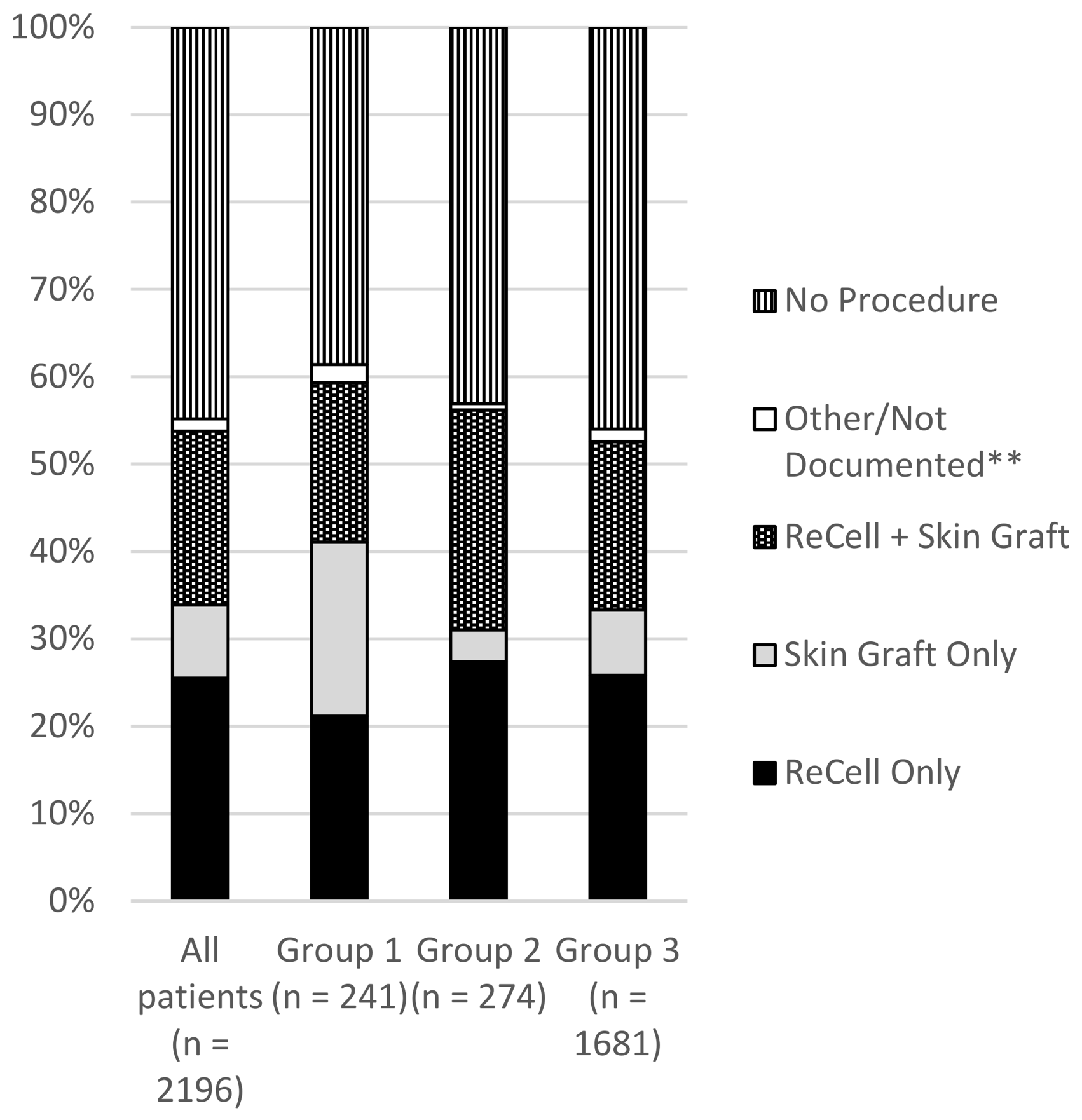
| Burn Management Procedure in Theatre ‡, n (%) | Yes | 1212 (55%) | 148 (61%) | 156 (57%) | 908 (54%) | 5.05(2) | 0.080 |
| No | 984 (45%) | 93 (39%) | 118 (43%) | 773 (46%) | |||
| Procedure Type, n (%) | ReCell® Only | 560 (26%) | 51 (21%) | 75 (27%) | 434 (26%) | 47.6(4) | <0.001 |
| Skin Graft Only | 184 (8%) | 48 (20%) | 10 (4%) | 126 (8%) | |||
| ReCell® + Skin Graft | 437 (20%) | 44 (18%) | 69 (25%) | 324 (19%) | |||
| Other Procedure/ Not Documented ‡ | 31 (1%) | 5 (2%) | 2 (0.7%) | 24 (1%) | |||
| No Procedure | 984 (45%) | 93 (39%) | 118 (43%) | 773 (46%) | |||
| Intensive Care Unit Admission, n (%) | Yes | 20 (0.9%) | 0 (0%) | 6 (2%) | 14 (0.8%) | 7.3(2) | 0.026 |
| No | 2176 (99%) | 241 (100%) | 268 (98%) | 1667 (99%) | |||
| Length of Stay, median (IQR) range | No | 3 (1.5–6.4) 0.1–77 | 1.8 (0.5–3.8) 0.2–31 | 3.6 (1.7–7.1) 0.1–68 | 3.3 (1.6–6.6) 0.21–77 | 62.3(2) | <0.001 |
| Variable | Coef | Lower 95% CI † | Upper 95% CI † | ||
|---|---|---|---|---|---|
| Group | Hand + other sites | 0.78 | 0.55 | 1.02 | <0.001 *** |
| No hand burn | 0.57 | 0.40 | 0.74 | <0.001 *** |
| Variable | Coef | Lower 95% CI | Upper 95% CI | p > |z| | |
|---|---|---|---|---|---|
| Group | Hand + other sites | −0.08 | −0.30 | 0.13 | 0.458 |
| No hand burn | −0.05 | −0.24 | 0.14 | 0.577 | |
| Mechanism of Injury | Flame | 0.36 | 0.23 | 0.49 | <0.001 *** |
| Area of Residence | Country | 0.41 | 0.32 | 0.50 | <0.001 *** |
| TBSA | TBSA (log) | 0.45 | 0.39 | 0.51 | <0.001 *** |
| Burn Management Procedure | ReCell® and graft | 0.33 | 0.23 | 0.43 | <0.001 *** |
Disclaimer/Publisher’s Note: The statements, opinions and data contained in all publications are solely those of the individual author(s) and contributor(s) and not of MDPI and/or the editor(s). MDPI and/or the editor(s) disclaim responsibility for any injury to people or property resulting from any ideas, methods, instructions or products referred to in the content. |
© 2026 by the authors. Published by MDPI on behalf of the European Burns Association. Licensee MDPI, Basel, Switzerland. This article is an open access article distributed under the terms and conditions of the Creative Commons Attribution (CC BY) license.
Share and Cite
Madge, L.J.; Martin, L.J.; Mill, E.C.; Wood, F.M.; Grisbrook, T.L. Hand Involvement and Its Association with Burn Characteristics, Surgical Management, and Length of Stay in Paediatric Inpatients: A 10-Year Cross-Sectional Study from Western Australia. Eur. Burn J. 2026, 7, 23. https://doi.org/10.3390/ebj7020023
Madge LJ, Martin LJ, Mill EC, Wood FM, Grisbrook TL. Hand Involvement and Its Association with Burn Characteristics, Surgical Management, and Length of Stay in Paediatric Inpatients: A 10-Year Cross-Sectional Study from Western Australia. European Burn Journal. 2026; 7(2):23. https://doi.org/10.3390/ebj7020023
Chicago/Turabian StyleMadge, Lachlan James, Lisa J. Martin, Emma Catherine Mill, Fiona M. Wood, and Tiffany L. Grisbrook. 2026. "Hand Involvement and Its Association with Burn Characteristics, Surgical Management, and Length of Stay in Paediatric Inpatients: A 10-Year Cross-Sectional Study from Western Australia" European Burn Journal 7, no. 2: 23. https://doi.org/10.3390/ebj7020023
APA StyleMadge, L. J., Martin, L. J., Mill, E. C., Wood, F. M., & Grisbrook, T. L. (2026). Hand Involvement and Its Association with Burn Characteristics, Surgical Management, and Length of Stay in Paediatric Inpatients: A 10-Year Cross-Sectional Study from Western Australia. European Burn Journal, 7(2), 23. https://doi.org/10.3390/ebj7020023