Article

Environmental Drivers of the Epipelagic Pteropod Community Structure in the Deep-Water Basin of the Southern Gulf of Mexico During Summer


by
Erik Coria-Monter
1,*,
Adolfo Gracia
1,
Elizabeth Durán-Campos
2,
César Flores-Coto
1,
Zayra López-Cabello
3,
Magali Roa-Venicio
4 and
Alejandra Itzel Domínguez-Tavera
4
1
Instituto de Ciencias del Mar y Limnología, Universidad Nacional Autónoma de México, Av. Universidad 3000, Copilco, Coyoacán, Mexico City 04510, Mexico
2
Escuela Nacional de Ciencias de la Tierra, Universidad Nacional Autónoma de México, Av. Universidad 3000, Copilco, Coyoacán, Mexico City 04510, Mexico
3
Posgrado en Ciencias Biológicas, Universidad Nacional Autónoma de México, Av. Universidad 3000, Copilco, Coyoacán, Mexico City 04510, Mexico
4
Facultad de Ciencias, Universidad Nacional Autónoma de México, Av. Universidad 3000, Copilco, Coyoacán, Mexico City 04510, Mexico
*
Author to whom correspondence should be addressed.
Oceans 2026, 7(3), 47; https://doi.org/10.3390/oceans7030047
Submission received: 13 May 2026 / Revised: 27 May 2026 / Accepted: 2 June 2026 / Published: 4 June 2026

Abstract

Holoplanktonic mollusks (Mollusca: Gastropoda: Pteropoda) are vital structural and functional components of marine zooplankton communities, characterized by high sensitivity to physicochemical shifts in the water column. Consequently, multidisciplinary assessments are essential to elucidate their community dynamics. This study investigated the epipelagic pteropod community structure in the deep-water basin of the southern Gulf of Mexico (sGoM) in relation to hydrographic features and circulation patterns. During the summer (September) of 2016, we collected high-resolution hydrographic data and zooplankton samples using CTD casts and oblique bongo net tows. Hydrographic data revealed intense temperature and density gradients, including a cold-dense core associated with a well-defined cyclonic eddy. The pteropod assemblage comprised 25 species from 13 genera and 10 families. Heliconoides inflatus (947.5 ind 100 m−3) and Limacina trochiformis (396.8 ind 100 m−3) were the most abundant species, whereas Cavolinia gibbosa (0.4 ind 100 m−3) and Cymbulia sp. (0.3 ind 100 m−3) were the least abundant. Horizontal distribution analyses revealed that the peak population densities occurred within the influence of the cyclonic eddy, particularly at its periphery where strong currents (>0.5 m/s) were recorded. A Canonical Correspondence Analysis identified temperature and salinity as the primary environmental drivers of community variability, while current systems significantly influenced the horizontal distribution of key species. Although pteropod research in the sGoM spans decades, most studies have been limited to taxonomic checklists, often overlooking environmental drivers and hydrographic influences. By applying a multidisciplinary approach to examine physical–biological coupling, this study advances the ecological understanding of this group within the historically underrepresented deep-water basin of the sGoM.

1. Introduction

Marine zooplankton comprises a highly heterogeneous group distributed across all ocean basins, representing nearly every marine phylum [1]. Among this taxonomic diversity, mollusks are a numerically and functionally significant component of pelagic communities.
Within the phylum Mollusca, pteropods (Gastropoda: Pteropoda) are a diverse and abundant group that occupy a pivotal ecological role. As primarily strict herbivores [2], they function as critical intermediaries in pelagic food webs, exerting significant top-down control on phytoplankton communities [3] while serving as essential prey for various higher-order consumers [4]. Furthermore, their specialized swimming appendages facilitate diel vertical migrations, which drive the efficient vertical flux of organic matter and carbon through the water column [5].
Pteropods are notably sensitive to environmental change. Their composition, distribution, and abundance are significantly influenced by temperature fluctuations [6] and shifts in water column hydrography, often driven by ocean eddies, which serve as a critical mechanism shaping pteropod community structures [7].
Ocean eddies, classified as cyclonic, anticyclonic, or mode-water, act as keystone structures that fundamentally shape planktonic communities [8]. In the Northern Hemisphere, cyclonic eddies generate counterclockwise circulation that triggers the upwelling of nutrient-rich water masses. This influx of nitrogen fertilizers in the euphotic zone stimulates both primary and secondary production. Conversely, anticyclonic eddies exhibit clockwise rotation, inducing the downwelling of warm, oligotrophic waters that typically suppress biological productivity [9].
Ocean eddies are fundamental drivers of zooplankton population dynamics [10], particularly profound on pteropod community composition. In the North Pacific, for example, eddies propitiate high densities of species such as Clio pyramidata and Limacina helicina [7], while in the Gulf of Alaska, these features act as primary agents for the distribution of L. helicina [11]. Similarly, within the California Current System, eddy-linked fronts exert a strong influence on both the vertical and horizontal distribution of regional populations [12]. Recent findings confirm that this impact extends to the southern Gulf of Mexico (sGoM), where eddy activity significantly shapes local pteropod communities [13].
The sGoM is a highly productive and biodiverse ecosystem renowned for its rich zooplankton assemblages. Although research in this region dates back to the early 20th century, historical studies have primarily focused on copepods and ichthyoplankton [14]. Subsequent investigations have characterized the pteropod community by its high taxonomic richness and localized abundance. Initial inventories identified 15 species, dominated by Creseis acicula and Heliconoides inflatus (formerly Limacina inflata) [15]. Further analysis of the vertical distribution of five key genera (Cavolinia, Diacavolinia, Diacria, Oxygyrus, and Clio) revealed that adult distributions exhibit greater overlap within the water column than those of juveniles [16].
In the neritic waters of the sGoM, taxonomic inventories have registered 27 species, with nearly 95% of total abundance attributed to four dominant taxa: C. acicula (recorded as C. clava), H. inflatus, Limacina trochiformis, and Creseis virgula [17]. Comparative studies between continental shelf and oceanic environments have further refined this picture, identifying a total of 29 species [18]. These findings indicate higher overall abundance in the neritic zone (particularly near river mouths) while the oceanic region is characterized by the dominance of two indicator species, H. inflatus and Limacina lesueurii [18].
Studies of pteropods in the deepest regions of the sGoM remain scarce. Recent multidisciplinary research has begun to address this by examining how the physical environment dictates species composition. For instance, in the Campeche Canyon, a deep thermocline at 90 m and circulation patterns driven by cyclonic and anticyclonic eddies were found to support an assemblage of 33 species [13]. Similarly, in the deep sGoM, research identified 32 species, with four dominant taxa comprising 63% of the total abundance. In this instance, an anticyclonic eddy increased water column stratification [19] and reduced chlorophyll-a concentrations, fostering a pteropod community specifically adapted to oligotrophic conditions [19].
Although these studies [13,19] have been important for uncovering previously unreported distribution patterns in the deep Gulf basin, they are inherently limited by their temporal and spatial focus. The former [13] was conducted in the Campeche Canyon during the coldest months (February), under the influence of an eddy dipole, while the latter [19] was restricted to the deep Gulf basin during late spring. Consequently, these findings leave significant gaps in our understanding of how this group responds to environmental variability throughout the year.
While recent studies integrating hydrographic, current, and satellite data have advanced our knowledge of pteropod composition in the deep sGoM, broader environmental drivers remain unresolved. To address these data gaps, our study examines how hydrography and circulation patterns can influence pteropod composition, distribution, and abundance in the deep-water basin of the sGoM. Utilizing in situ hydrographic data and zooplankton samples collected during summer of 2016 (September), we test the hypothesis that current patterns, specifically cyclonic eddies, regulate species composition by altering horizontal distribution.

2. Materials and Methods

2.1. Study Area

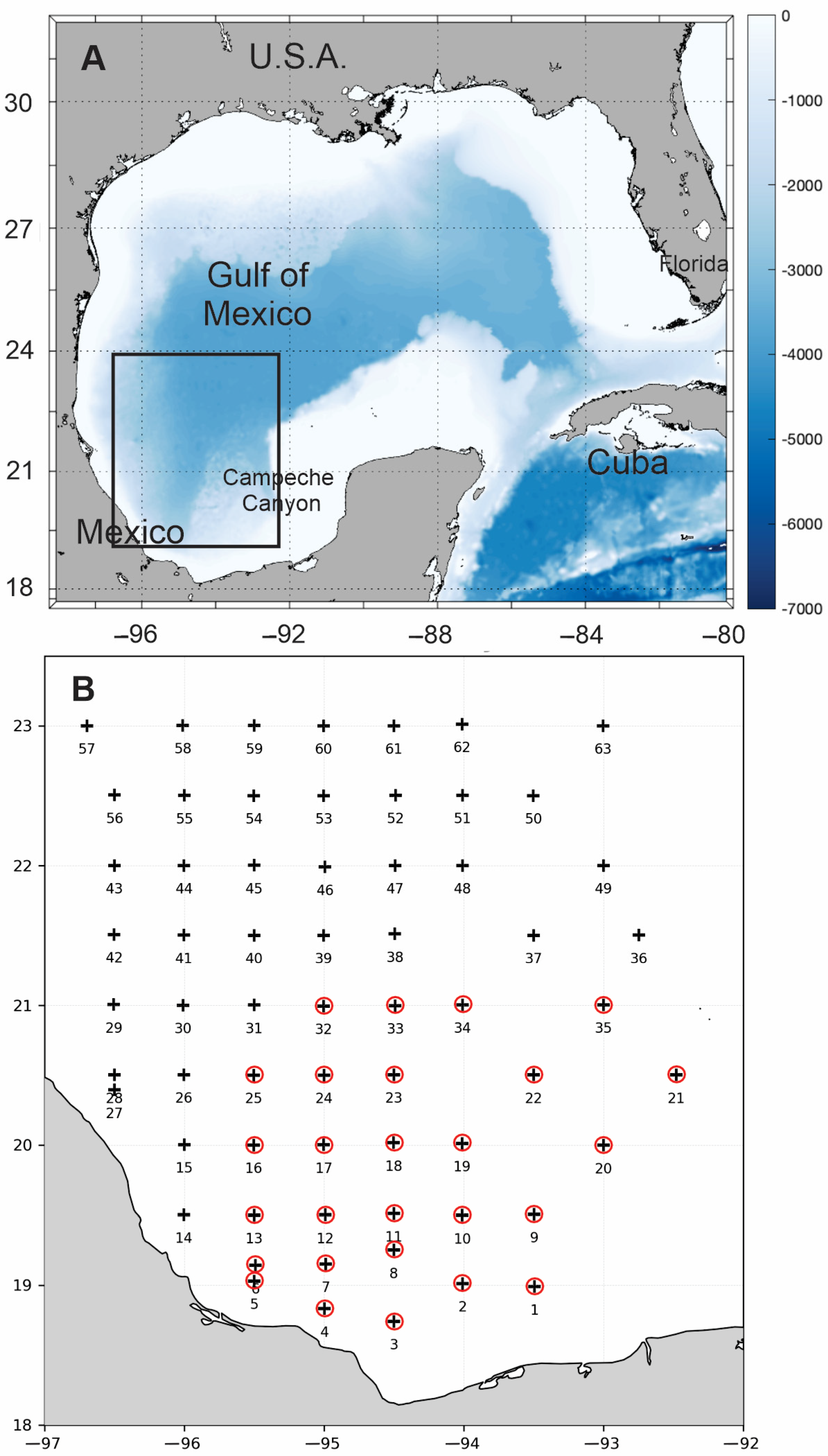
The Gulf of Mexico is a large, semi-enclosed marginal sea in North America, covering an area exceeding 1.5 million km2 and bordered by Mexico, Cuba, and the United States (Figure 1A). Geomorphologically, the basin exhibits highly heterogeneous bathymetry, including extensive continental shelves, submarine canyons, and escarpments, culminating in a maximum depth of nearly 4000 m within the central abyssal plain [20].
The Gulf hydrodynamic regime is governed by a multiscale complex of physical processes, ranging from localized turbulent mixing and internal waves propagation to mesoscale eddy activity [21,22]. Central to this system is the Loop Current, a major current that enters the basin through the Yucatán Channel and exits via the Florida Straits into the North Atlantic. This circulation pattern is a primary driver of flux of heat, salt, and kinetic energy fluxes [23]. Furthermore, these physical forcing mechanisms facilitate the vertical and horizontal transport of nutrients, which are essential for sustaining primary productivity and supporting higher trophic levels [14].
Ecologically, the Gulf of Mexico serves as a vital habitat for numerous species of conservation and socio-economic importance [24]. The region maintains high taxonomic diversity within planktonic communities, including both phytoplankton and zooplankton [14]. The spatiotemporal distribution of these organisms is intricately linked to the aforementioned hydrodynamic features, which modulate nutrients availability and the overall stability of the marine food web.

2.2. Sampling

Sampling was conducted in the sGoM at depths ranging from 227 to 3774 m during the multidisciplinary “SOGOM-2” research cruise aboard the R/V Justo Sierra (UNAM) from 2 to 28 September 2016. The sampling design included 62 hydrographic stations and 27 zooplankton collection sites (Figure 1B). The number of hydrographic locations was implemented to provide a high-resolution characterization of regional circulation and environmental conditions. Although incomplete spatial overlap between hydrographic and zooplankton sampling limits our ability to fully characterize the influence of environmental gradients on pteropod community structure, these data remain highly valuable. They provide essential insights into previously undocumented ecological dynamics within the deep-water basin of the sGoM.
Hydrographic profiles were acquired using a Sea-Bird SBE 9plus, Bellevue, WA, USA, CTD integrated with a General Oceanics rosette system, equipped with SBE 43 dissolved oxygen and ECO-Wet Labs chlorophyll-a fluorescence sensors. All sensors were calibrated by the manufacturer prior to the cruise. Vertical casts were performed from the surface to within approximately 100 m of the seafloor. To ensure optimal vertical resolution and minimize sensor lag, the instrument was lowered at a constant rate of 0.5 m/s with a sampling frequency of 24 Hz.
Following each CTD cast, zooplankton were collected using a Bongo net system (60 cm mouth diameter) equipped with 333 μm nylon mesh. A calibrated flowmeter (General Oceanics 2030R, Miami, FL, USA) was mounted in the net mouth to quantify the volume of filtered water. Oblique tows were conducted from a maximum depth of 200 m to the surface at a vessel speed of 2 knots for approximately 15 min. Upon recovery, samples were immediately fixed in 4% borax-buffered formalin. After 24 h, the organisms were transferred to 70% ethanol for long-term preservation.

2.3. Laboratory Analyses

In the laboratory, pteropods were sorted from the samples using a Zeiss Stemi 508, Oberkochen, Germany, stereomicroscope and identified to the species level using standard keys [25,26]. Identifications were verified against international biological databases, including MolluscaBase and the Tree of Life Project. Finally, organisms counts were standardized to density (ind 100 m−3) based on flowmeter data, following the standard protocols of Kramer et al. [27].

2.4. Data Analyses

CTD data were initially processed using standard protocols within the SBE Data Processing (v.7.26.7) software suite, with filters applied to exclude low-quality data. Following quality control, conservative temperature (°C), absolute salinity (g kg−1), and density (sigma-t, kg m−3) values were calculated using the algorithms of the thermodynamic equation for seawater (TEOS-10). The resulting data were finally averaged to 1-decibar bins.
Geostrophic velocities were then calculated from this dataset following standard methods [28], assuming a level of no motion at 1000 m depth. For calculation purposes, we define the no-motion level at a depth of 1000 m. This reference level is chosen based on the geostrophic method, which relates horizontal pressure gradients to the Coriolis force. By setting velocity to zero at 1000 m (v = 0), we assume that the resulting geostrophic velocities—driven by density variations in temperature and salinity—are well-represented. This depth serves as a practical baseline, as deep-water velocities are significantly lower than surface currents, effectively isolating the bulk of the wind-driven circulation. This methodology is consistent with previous studies calculating geostrophic velocities in the southern Gulf of Mexico [13]. Finally, the results were synthesized into maps of hydrographic parameters and geostrophic currents.
To evaluate the influence of environmental drivers on the pteropod community during the study period, a Canonical Correspondence Analysis (CCA) was performed. This approach yields a low-dimensional ordination space that highlights the primary ecological drivers of community structure [29].
All statistical routines were implemented using CANOCO v5.10 software [30]. To stabilize variance and reduce the influence of the most abundant species, data were square-root-transformed prior to analysis [31]. In CCA, the square-root-transformation is a standard preprocessing technique used to stabilize variance and mitigate the disproportionate influence of highly abundant species. This transformation is particularly beneficial for ecological datasets; by addressing the positive skewness common in zero-inflated, highly peaked count data, it prevents ordination axes from being driven solely by a few dominant taxa. Consequently, this method helps normalize count distributions while ensuring that meaningful ecological signals are preserved [31].
The final plot was used to visualize the positioning of species relative to the vectors of the measured physical and chemical variables.

3. Results

3.1. Environmental Drivers

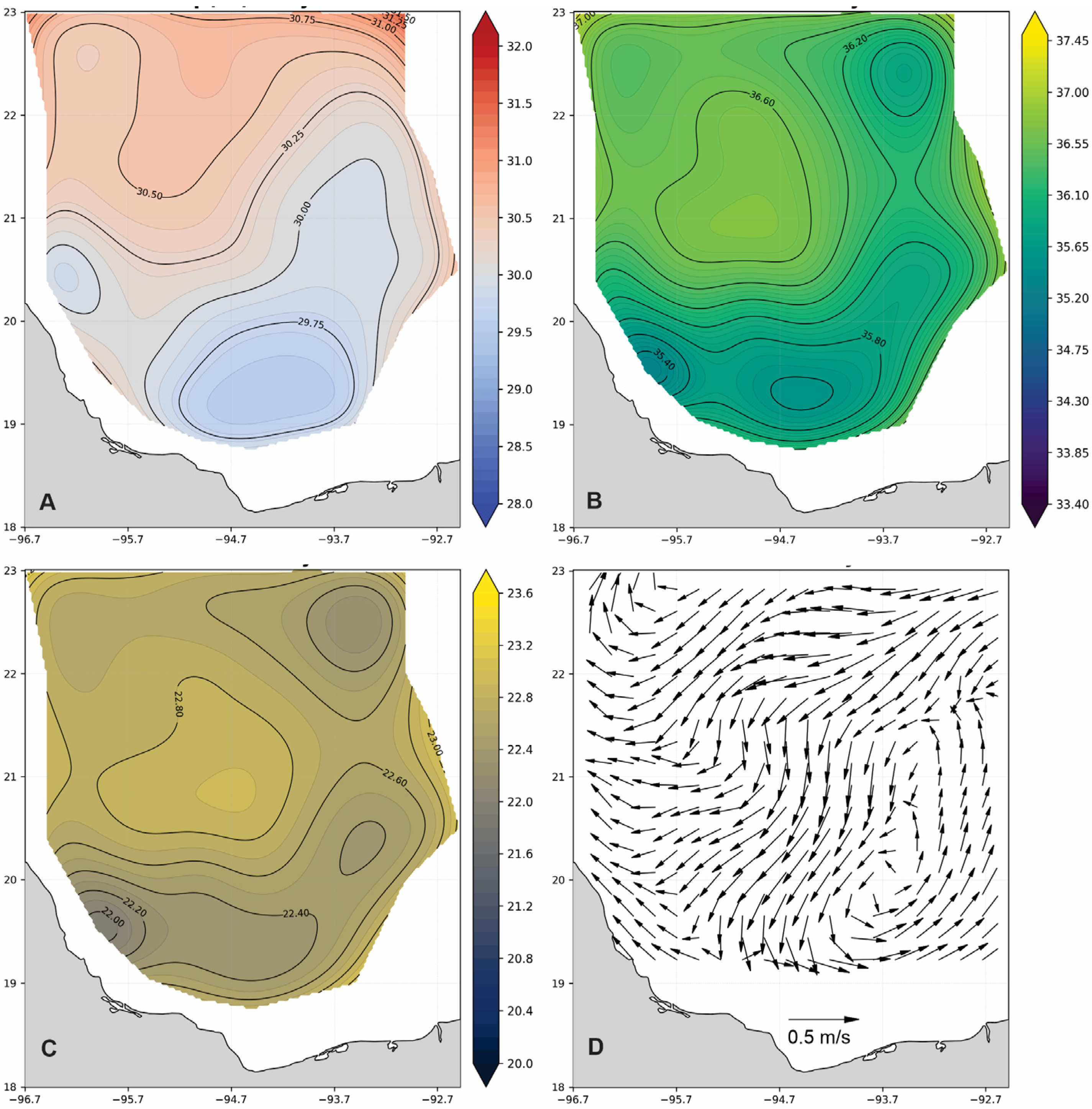
The surface horizontal distribution of the hydrographic parameters and the circulation pattern observed during our study showed interesting features. The conservative temperature (Figure 2A) showed a clear gradient with warmer waters (up to 31 °C) in the northeastern and northwestern sections of the sampled area. A distinct core of cooler water (<29.5 °C) was visible in the south–central region (centered around 20° N, 94° W), which likely suggests the presence of a cyclonic eddy. The absolute salinity distribution (Figure 2B) remained relatively uniform, with most of the region characterized by typical marine values near 36.4 g kg−1. However, localized high-salinity patches (>37 g kg−1) were observed in the northern sector, likely resulting from evaporation-driven concentration. In terms of density (Figure 2C), this parameter reflects the temperature patterns, the highest density values (>22.8 kg m−3) coincided with the cooler regions, which reinforced the idea of a physical feature bringing denser, deeper water toward the surface. Finally, the geostrophic velocity (Figure 2D) revealed a well-defined cyclonic (counterclockwise) circulation in the south–central region. This feature aligns with the low temperatures and high densities shown in Figure 2A,C. Notably, strong peripheral currents reached velocities of 0.5 m/s, flowing from northeast toward southwest and extending into coastal waters.
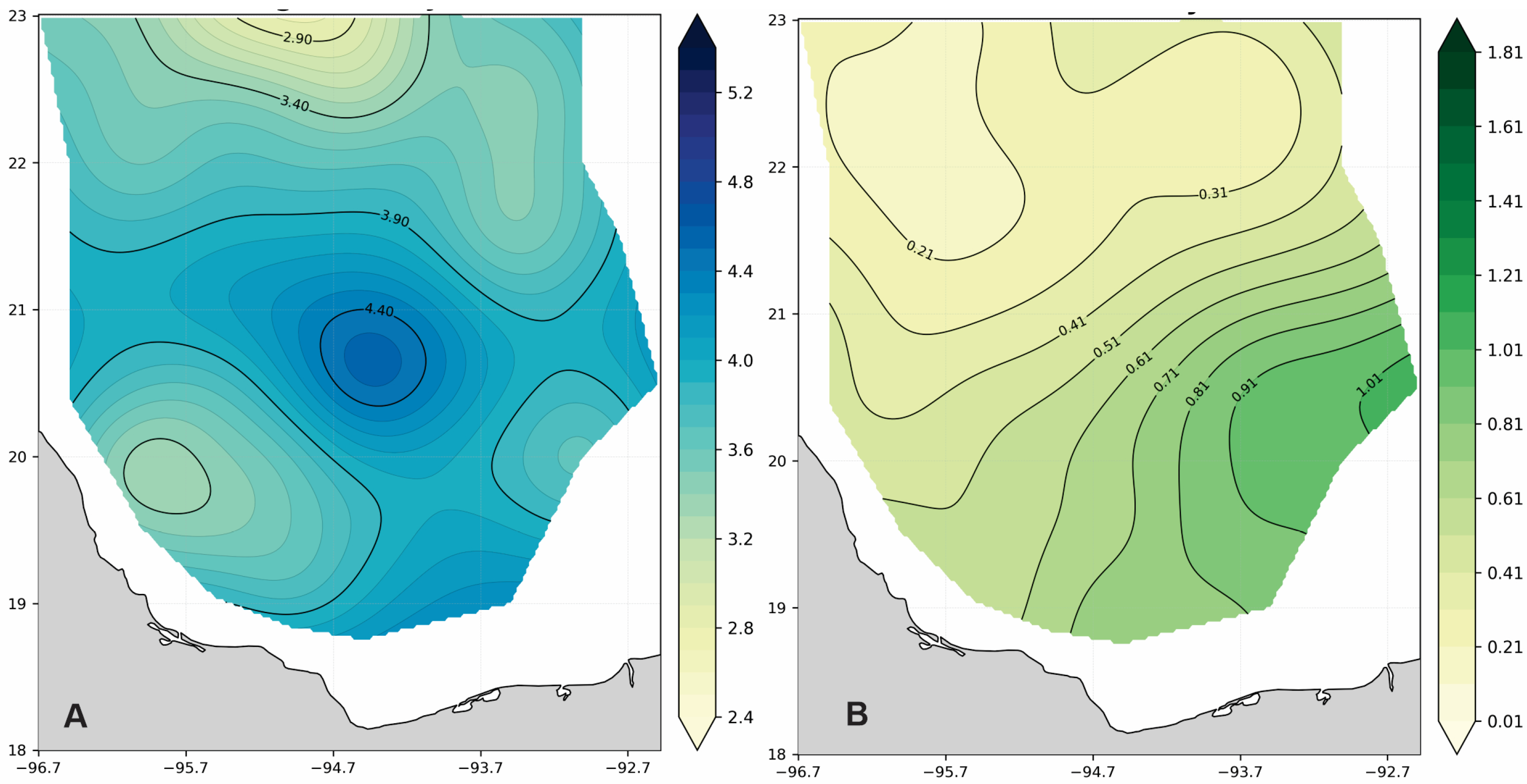
The dissolved oxygen distribution (Figure 3A) showed moderate to high oxygenation, with a maximum core (>4.5 mL/L) located in the central region. Interestingly, this high-oxygen patch sits just above the cooler, denser water mass noted in previous figures. The chlorophyll-a distribution showed a clear contrast between the northern and southern regions (Figure 3B). The southeastern region exhibited high biomass (>1.2 mg m−3); in contrast, the northern area remained oligotrophic, with values below 0.3 mg m−3.

3.2. Pteropod Community Structure

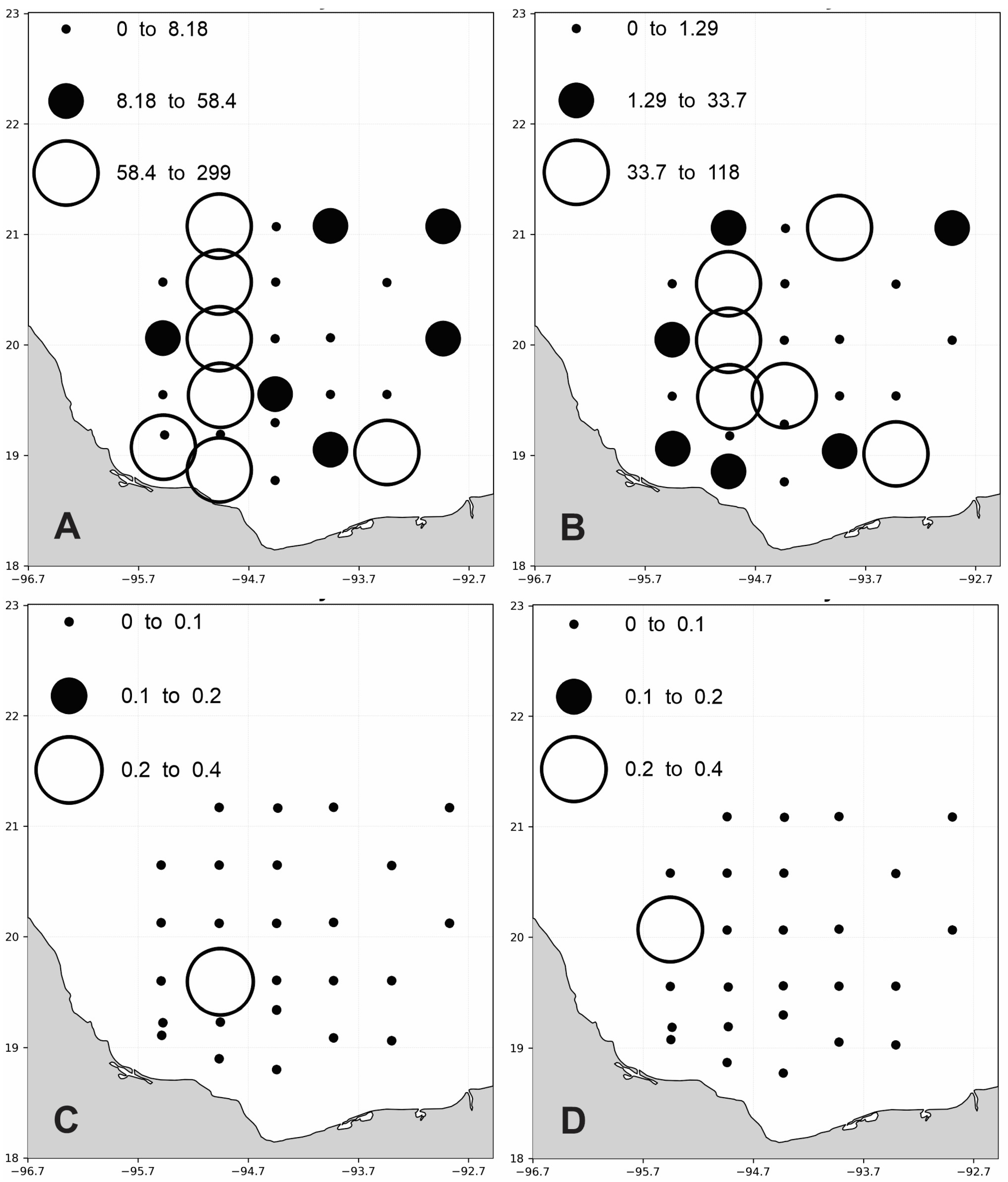
The pteropod community structure identified in this study comprised 25 species of 13 genera and 10 families. Heliconoides inflatus (947.5 ind 100 m−3) and Limacina trochiformis (396.8 ind 100 m−3) were the most abundant taxa, whereas Cavolinia gibbosa (0.4 ind 100 m−3) and Cymbulia sp. (0.3 ind 100 m−3) were the least frequent.
The horizontal distribution analyses of the most abundant species revealed significant spatial variability (Figure 4). Note that bubble scales were adjusted individually for each species to enhance visual clarity. Heliconoides inflatus (Figure 4A) and Limacina trochiformis (Figure 4B) exhibited similar patterns, with peak abundances concentrated in the central and southern regions. In contrast, Cavolinia gibbosa (Figure 4C) was primarily restricted to the southern sector, while Cymbulia sp. (Figure 4D) peaked in the westernmost portion. Broadly, the highest concentrations of these four species align with the cyclonic circulation and intense currents identified in Figure 2D, suggesting a strong biological response to the regional dynamics.

3.3. Statistical Analysis

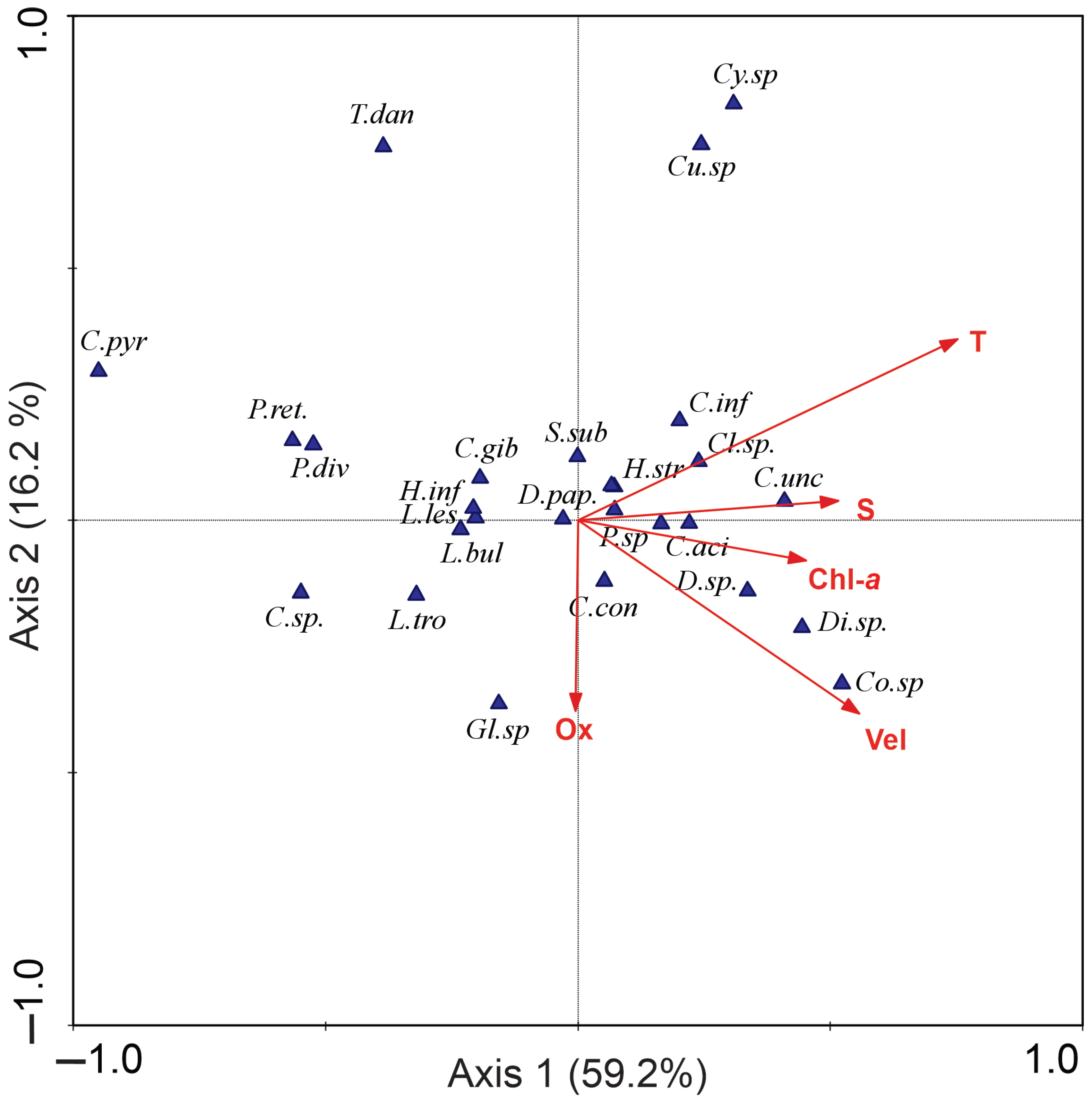
The CCA showed that the first two axes explain 75.4% of the cumulative variance in the pteropod–environment relationship, reflecting a robust coupling between the community structure and environmental forcing (Figure 5). Axis 1 (59.2%) represents a primary hydrographic gradient defined by temperature (T) and salinity (S). Species positioned along the positive end of this axis, such as Cavolinia uncinata (C. unc), Clio sp. (Cl. sp.), and Cavolinia inflexa (C. inf), present a strong affinity for warmer, more saline water masses. Conversely, species like Clio pyramidata (C. pyr.), Peracle reticulata (P. ret.), and P. diversa (P. div) were negatively correlated with these parameters, likely indicating their distribution in cooler, less saline, or deeper layers.
Figure 5. Canonical Correspondence Analysis biplot. The vectors in red represent environmental variables. T: temperature; S: salinity; Chl-a: chlorophyll-a; Vel: current velocities; Ox: dissolved oxygen. Purple triangles indicate the distribution of pteropod species within the ordination space. Specific species names corresponding to the abbreviations detailed in Table 1. The two first axes accounted for 75.4% of the total variance.
Oceans 07 00047 g005
Table 1. Pteropod community structure and its density (ind 100 m−3) in the deep southern Gulf of Mexico during summer. Total density represents the sum of all stations.
FamilyGenusSpeciesAbbreviationTotal Density (ind 100 m−3)
LimacinidaeLimacinaLimacina bulimoides
(A. d’Orbigny, 1835)
L. bul.82.1
Limacina trochiformis
(A. d’Orbigny, 1835)
L. tro.396.8
Limacina lesueuri
(A. d’Orbigny, 1836)
L. les.131.5
HeliconoididaeHeliconoidesHeliconoides inflatus
(A. d’Orbigny, 1835)
H. inf.947.5
CavoliniidaeCavoliniaCavolinia sp.C. sp. 4.2
Cavolinia gibbosa
(A. d’Orbigny, 1835)
C. gib0.4
Cavolinia inflexa (Lesueur, 1813)C. inf.55.3
Cavolinia uncinata
(A. d’Orbigny, 1835)
C. unc.3.1
Diacavolinia sp.D. sp. 15.5
Diacria sp.Di. sp. 108.7
Telodiacria danae
(van Leyen & van der Spoel, 1982)
T. dan.2.3
CliidaeClioClio sp.Cl. sp. 5.9
Clio pyramidata Linnaeus, 1767C. pyr.2.1
CreseidaeCreseisCreseis acicula (Rang, 1828)C. aci.177.6
Creseis conica Eschscholtz, 1829C.con.256.0
StyliolaStyliola subula
(Quoy & Gaimard, 1827)
S. sub.107.3
HyalocylidaeHyalocylisHyalocylis striata (Rang, 1828)H. str.120.2
CuvierinidaeCuvierinaCuvierina sp.Cu. sp. 0.7
CymbuliidaeCymbuliaCymbulia sp.Cy. sp. 0.3
CorollaCorolla sp.Co. sp. 0.7
GlebaGleba sp.Gl. sp. 1.6
DesmopteridaeDesmopterusDesmopterus papilio Chun, 1889D. pap.155.1
PeraclidaePeraclePeracle sp.P. sp. 60.2
Peracle diversa (Monterosato, 1875)P. div.3.1
Peracle reticulata
(A. d’Orbigny, 1835)
P. ret.6.2
Axis 2 (16.2%) identifies a secondary ecological gradient characterized by dissolved oxygen (Ox), which appears largely independent of the thermohaline properties of the first axis. A distinct assemblage including Corolla sp. (Co.sp), Diacria sp. (Di.sp.), and Diacavolinia sp. (D.sp.) showed a strong relationship with current velocity (Vel) and chlorophyll-a (Chl-a), suggesting that their presence is modulated by water movement and food availability. Furthermore, the vertical orientation of the oxygen vector indicates that taxa such as Gleba sp. (Gl.sp) and Creseis conica (C.con.) are primarily influenced by oxygen concentration. Finally, species clustered near the origin, including Desmopterus papilio (D.pap.) and Styliola subula (S.sub.), exhibit a more generalist distribution with less specialization relative to the measured environmental gradients. Eigenvalues of the axes obtained from the CCA are summarized in Table 2.

4. Discussion

During our sampling, the water column exhibited pronounced hydrographic and biochemical gradients, reflecting the region’s intense hydrodynamic activity. Local circulation was characterized by a cyclonic eddy that drove strong northeast–southwest currents toward the coastline.
Since the late 1980s, the sGoM, specifically the Bay of Campeche, has been recognized as a highly dynamic region. This dynamism is driven by density gradients from the Grijalva–Usumacinta freshwater discharge, which sustains surface currents of up to 0.12 m/s [32]. Historical hydrographic data from 1958 to 1991 first suggested the presence of a permanent cyclonic circulation in the upper 800 m of the Bay [33]. This feature was subsequently confirmed by surface drifters, satellite altimetry, and direct ADCP measurements [34,35], which identified that its influence extends to a depth of 1000 m. Despite this established physical framework, the role of this circulation in shaping planktonic distribution has only been addressed within the last decade.
The cyclonic circulation in the sGoM facilitates the shoaling of isotherms and isopycnals, a process that pumps nutrient-rich subsurface water into the euphotic zone. This localized enrichment promotes an increase in phytoplankton biomass, dominated by diatoms, coccolithophores, and dinoflagellates [22], which in turn shapes higher trophic levels. Consequently, larval fish assemblages are closely associated with this cyclonic feature, with peak densities concentrated within its area of influence [36]. Recent findings further confirm that high biological diversity in this region coincides with the elevated nutrient and chlorophyll-a concentrations intrinsically linked to the regional cyclonic eddy [37]. Although direct nutrient measurements were not available for this study, we infer that concentrations were elevated within the eddy’s area of influence, consistent with the nutrient-pumping mechanism described above.
Pteropod research in the sGoM has long established the region’s high biodiversity, with historical inventories identifying up to 51 species [38,39]. These studies also highlighted substantial seasonal fluctuation richness, with reported counts ranging from 15 species in winter to 29 in spring, 18 in summer, and 27 in autumn [15,17,18,38,40]. Our summer sampling aligns with these historical records, reinforcing the significance of the sGoM as a key habitat for pteropod communities.
Research exploring how circulation patterns in the sGoM influence pteropod communities has only recently emerged. For instance, a dipole eddy (cyclonic–anticyclonic) identified in the Campeche Canyon is now known to fertilize the surface layer, supporting a diverse assemblage of 33 species. While maximum species richness occurs just below the thermocline (at 100 m depth), peak population densities are concentrated in surface waters [13].
Similar patterns were recently documented in the deeper sGoM during the summer, where 32 species were observed under warm (>27.5 °C) and oligotrophic conditions (chlorophyll-a < 0.5 mg m−3) [19]. In that study, four species (Heliconoides inflatus, Creseis conica, Limacina trochiformis, and Creseis acicula) accounted for 63% of total abundance, a distribution that closely aligns with our observations.
Our findings are consistent with observations from other highly dynamic marine environments where physical forcing dictates pteropod composition, distribution, and abundance. For example, in the South China Sea, 24 species reach peak abundance during summer, primarily within the influence of cyclonic eddies [41]. Similarly, in the California Current System, eddy-associated fronts create sharp hydrographic gradients that foster favorable habitats for regional species [12] and high concentrations have been documented in the Alaska Gyre, particularly for Clio pyramidata [7].
As final remarks, the integration of our findings with existing historical and contemporary data confirms that the sGoM is a region of high biodiversity. The transition from early taxonomic inventories to recent mechanistic studies highlights the pivotal role of cyclonic circulation in sustaining pteropod communities. By facilitating nutrient enrichment and creating favorable hydrographic gradients, these eddies act as ecological anchors for pteropods. Our study reinforces the global consensus that cyclonic eddies are essential habitats, providing a critical framework for predicting how these sentinel organisms may respond to future shifts in ocean dynamics. Nevertheless, further investigations are required to evaluate seasonal and interannual variability of these physical parameters and their subsequent influence on zooplankton communities, particularly pteropods.

Author Contributions

Conceptualization, E.C.-M., A.G., E.D.-C. and C.F.-C.; methodology, E.C.-M., A.G., E.D.-C., C.F.-C., Z.L.-C., M.R.-V. and A.I.D.-T.; software, E.C.-M., A.G. and E.D.-C.; validation, E.C.-M., A.G., E.D.-C. and C.F.-C.; formal analysis, E.C.-M., A.G., E.D.-C. and C.F.-C.; investigation, E.C.-M., A.G., E.D.-C., C.F.-C. and Z.L.-C.; resources, E.C.-M., A.G., E.D.-C. and C.F.-C.; data curation, E.C.-M., A.G., E.D.-C., C.F.-C., Z.L.-C., M.R.-V. and A.I.D.-T.; writing—original draft preparation, E.C.-M., A.G. and E.D.-C.; writing—review and editing, E.C.-M., A.G. and E.D.-C.; supervision, E.C.-M., A.G. and E.D.-C.; funding acquisition, E.C.-M., A.G., E.D.-C. and C.F.-C. All authors have read and agreed to the published version of the manuscript.

Funding

This study was funded by the Mexican National Council for Science and Technology—Mexican Ministry of Energy—Hydrocarbon Fund, project 201441, as part of the Gulf of Mexico Research Consortium (CIGoM) due to PEMEX’s specific request to the Hydrocarbon Fund to address the environmental effects of oil spills in the Gulf of Mexico. Additional funding was provided by Instituto de Ciencias del Mar y Limnología (UNAM).

Data Availability Statement

The datasets generated during this study are available from the corresponding authors on request.

Acknowledgments

The authors would like to thank all participants of the research cruise SOGOM-2, including the captains and crew of the R/V Justo Sierra (UNAM). Francisco Ponce Núñez provided valuable technical support during the analyses. Carlos Mauricio Torres-Martínez provided assistance in the preparation of the figures.

Conflicts of Interest

The authors declare no conflicts of interest.

References

  1. Beaugrand, G. Plankton Biodiversity and Biogeography. In Marine Plankton, A Practical Guide to Ecology, Methodology, and Taxonomy; Castellani, C., Edwards, M., Eds.; Oxford University Press: Oxford, UK, 2017; pp. 12–23. [Google Scholar]
  2. Karleskint, G.; Turner, R.; Small, J. Introduction to Marine Biology, 4th ed.; Cengage Learning Inc.: San Francisco, CA, USA, 2012; p. 576. [Google Scholar]
  3. Weldrick, C.K.; Trebilco, R.; Davies, D.M.; Swadling, K.M. Trophodynamics of Southern Ocean pteropods on the southern Kerguelen Plateau. Ecol. Evol. 2019, 9, 8119–8132. [Google Scholar] [CrossRef]
  4. Hunt, B.P.V.; Pakhomov, E.A.; Hosie, G.W.; Siegel, V.; Ward, P.; Bernard, K. Pteropods in Southern Ocean ecosystems. Progr. Oceanogr. 2008, 78, 193–221. [Google Scholar] [CrossRef]
  5. Manno, C.; Tirelli, V.; Accornero, A.; Fonda Umani, S. Importance of the contribution of Limacina helicina faecal pellets to the carbon pump in Terra Nova Bay (Antarctica). J. Plankton Res. 2010, 32, 145–152. [Google Scholar] [CrossRef]
  6. Keul, N.; Peijnenburg, K.T.C.A.; Andersen, N.; Kitidis, V.; Goetze, E.; Schneider, R.R. Pteropods are excellent recorders of surface temperature and carbonate ion concentration. Sci. Rep. 2017, 7, 12645. [Google Scholar] [CrossRef]
  7. Tsurumi, M.; Mackas, D.L.; Whitney, F.A.; DiBacco, C.; Galbraith, M.D.; Wong, C.S. Pteropods, eddies, carbon flux, and climate variability in the Alaska Gyre. Deep Sea Res. Part II Top. Stud. Oceanogr. 2005, 52, 1037–1053. [Google Scholar] [CrossRef]
  8. McGillicuddy, D., Jr. Mechanisms of physical-biological-biogeochemical interaction at the oceanic mesoscale. Annu. Rev. Mar. Sci. 2016, 8, 125–159. [Google Scholar] [CrossRef]
  9. McGillicuddy, D.J., Jr.; Anderson, L.A.; Bates, N.R.; Bibby, T.; Buesseler, K.O.; Carlson, C.A.; Davis, C.S.; Ewart, C.; Falkowski, P.G.; Goldthwait, S.A.; et al. Eddy wind interactions stimulate extraordinary mid-ocean plankton blooms. Science 2007, 316, 1021–1026. [Google Scholar] [CrossRef]
  10. Han, G.; Quartly, G.D.; Wang, H.; Yang, J.; Chen, G. Latitudinal transitions of eddy-affected zooplankton abundance in the mid-latitude North Atlantic. Deep Sea Res. Part I Oceanogr. Res. Pap. 2025, 226, 104605. [Google Scholar] [CrossRef]
  11. Batten, S.D.; Crawford, W.R. The influence of coastal origin eddies on oceanic plankton distributions in the eastern Gulf of Alaska. Deep Sea Res. Part II Top. Stud. Oceanogr. 2005, 2, 991–1009. [Google Scholar] [CrossRef]
  12. Bednaršek, N.; Ohman, M.D. Changes in pteropod distributions and shell dissolution across a frontal system in the California Current System. Mar. Ecol. Prog. Ser. 2015, 523, 93–103. [Google Scholar] [CrossRef]
  13. López-Cabello, Z.; Coria-Monter, E.; Monreal-Gómez, M.A.; Salas-de-León, D.A.; Durán-Campos, E.; Gracia, A. Vertical assemblage of the holoplanktonic mollusks (Pteropoda and Pterotracheoidea: Carinaiidae, Pterotracheidae) in the Campeche Canyon, southern Gulf of Mexico, during a “Nortes” season. PeerJ 2025, 13, e19118. [Google Scholar] [CrossRef]
  14. Coria-Monter, E.; Durán-Campos, E. Research trends on marine zooplankton in the southern Gulf of Mexico: A short review. Lat. Am. J. Aquat. Res. 2025, 53, 541–559. [Google Scholar] [CrossRef]
  15. Suárez, M.E.; Gasca, R. Pterópodos (Gastropoda: Thecosomata y Pseudothecosomata) de aguas superficiales (0–50 m) del sur del Golfo de México. An. Del Inst. De Cienc. Del Mar Y Limnol. Univ. Nac. Autónoma De México 1992, 19, 199–207. [Google Scholar]
  16. Sanvicente-Añorve, L.; Lemus-Santana, E.; Flores-Coto, C.; Alatorre-Mendieta, M. Vertical segregation of holoplanktonic molluscs in the epipelagic layer, southern Gulf of Mexico. Helgol. Mar. Res. 2013, 67, 397–405. [Google Scholar] [CrossRef]
  17. Lemus-Santana, E.; Sanvicente-Añorve, L.; Hermoso-Salazar, M.; Flores-Coto, C. The holoplanktonic Mollusca from the southern Gulf of Mexico. Part 2: Pteropods. Cah. Biol. Mar. 2014, 55, 241–258. [Google Scholar]
  18. López-Arellanes, H.S.; Funes-Rodríguez, R.; Flores-Coto, C.; Zavala-García, F.; Espinosa-Fuentes, M.L. Comparison of pteropod assemblages and their relationship with environmental variables in the southern Gulf of Mexico. J. Molluscan Stud. 2018, 84, 386–396. [Google Scholar] [CrossRef]
  19. López-Arellanes, H.S.; Cruz-Barraza, J.A.; Ruvalcaba-Aroche, E.D.; Silva-Segundo, C.A. Pteropod assemblages in the oceanic waters of the southern Gulf of Mexico (June 2015). Deep Sea Res. Part I Oceanogr. Res. Pap. 2025, 216, 104431. [Google Scholar] [CrossRef]
  20. Goff, J.A.; Gulick, S.P.S.; Pérez-Cruz, L.; Stewart, H.A.; Davis, M.; Duncan, D.; Saustrup, S.; Sanford, J.; Fucugauchi, J.U. Solution pans and linear sand bedforms on the bare-rock limestone shelf of the Campeche Bank, Yucatán Peninsula, Mexico. Cont. Shelf Res. 2016, 117, 57–66. [Google Scholar] [CrossRef]
  21. Santiago-Arce, T.; Salas de León, D.A. Vorticity and internal waves in the Campeche Canyon, Gulf of Mexico. In Experimental and Theoretical Advances in Fluid Dynamics, Environmental Science and Engineering; Klapp, J., Cros, A., Velasco Fuentes, O., Stern, C., Rodriguez Meza, M., Eds.; Springer: Berlin/Heidelberg, Germany, 2012; pp. 163–169. [Google Scholar]
  22. Durán-Campos, E.; Salas de León, D.A.; Monreal-Gómez, M.A.; Coria-Monter, E. Patterns of chlorophyll-a distribution linked to mesoscale structures in two contrasting areas, Campeche Canyon and Bank, southern Gulf of Mexico. J. Sea Res. 2017, 123, 30–38. [Google Scholar] [CrossRef]
  23. Morey, S.L.; He, R.; Chassignet, E.P.; Sheinbaum, J. Editorial: Understanding and predicting the Gulf of Mexico ocean dynamics. Front. Mar. Sci. 2024, 11, 1400560. [Google Scholar] [CrossRef]
  24. McKinney, L.D.; Shepherd, J.G.; Wilson, C.A.; Hogarth, W.; Chanton, J.; Murawski, S.; Sandifer, P.; Sutton, T.; Yoskowitz, D.; Wowk, K.; et al. The Gulf of Mexico: An Overview. Oceanography 2021, 34, 30–43. [Google Scholar] [CrossRef]
  25. Tesch, J.J. The Gymnosomata II. The Carlsberg Foundation’s Oceanographical Expedition round the world 1928-30 and previous “DANA” Expedition. Dan. Rep. 1950, 6, 1–55. [Google Scholar]
  26. Van der Spoel, S.; Dadon, J.R. Pteropoda. In South Atlantic Zooplankton; Backhuys Publishers: Leiden, The Netherlands, 1999; pp. 649–706. [Google Scholar]
  27. Kramer, D.; Kalin, M.J.; Stevens, E.G.; Thrailkill, J.R.; Zweifel, J.R. Collecting and Processing Data on Fish Eggs and Larvae in the California Current; NOAA Technical Report NMFS 370; NMFS: Seattle, WA, USA, 1972; pp. 1–38.
  28. Pond, S.; Pickard, G.L. Introductory Dynamical Oceanography; Pergamon Press: Oxford, UK, 1983; p. 329. [Google Scholar]
  29. Legendre, P.; Legendre, L. Numerical Ecology; Elsevier: Amsterdam, The Netherlands, 2012; p. 1006. [Google Scholar]
  30. ter Braak, C.J.F.; Šmilauer, P. Canoco Reference Manual and User’s Guide: Software for Ordination, Version 5.10; Wageningen University & Research: Wageningen, The Netherlands, 2018; p. 536. [Google Scholar]
  31. ter Braak, C.J.F. Canonical correspondence analysis: A new eigenvector technique for multivariate direct gradient analysis. Ecology 1986, 67, 1167–1179. [Google Scholar] [CrossRef]
  32. Monreal-Gómez, M.A.; Salas-de-León, D.A.; Padilla Pilotze, A.R.; Alatorre Mendieta, M.A. Hydrography and estimation of density currents in the southern part of the Bay of Campeche, Mexico. Cienc. Mar. 1992, 18, 115–133. [Google Scholar] [CrossRef][Green Version]
  33. Vázquez de la Cerda, A.M.; Reid, R.O.; DiMarco, S.F.; Jochens, A.E. Bay of Campeche Circulation: An Update. In Circulation in the Gulf of Mexico: Observations and Models; Sturges, W., Lugo-Fernandez, A., Eds.; American Geophysical Union Book Series, Geophysical Monograph Series; American Geophysical Union: Washington, DC, USA, 2005; pp. 279–293. [Google Scholar]
  34. Pérez-Brunius, P.; García-Carrillo, P.; Dubranna, J.; Sheimbaum, J.; Candela, J. Direct observations of the upper layer circulation in the southern Gulf of Mexico. Deep Sea Res. Part II Top. Stud. Oceanogr. 2013, 85, 182–194. [Google Scholar] [CrossRef]
  35. Díaz-Flores, M.A.; Salas-de-León, D.A.; Monreal-Gómez, M.A. Origen y evolución del giro ciclónico de la Bahía de Campeche, Golfo de México. Rev. Biol. Mar. Oceanogr. 2017, 52, 441–450. [Google Scholar] [CrossRef]
  36. Echeverri-García, L.P.; Daudén-Bengoa, G.; Compaire, J.C.; Jiménez-Rosenberg, S.P.A.; Pérez-Brunius, P.; Ferreira-Bartrina, V.; Herzka, S.Z. Variability of fish larvae assemblages relative to mesoscale features in the deep water region of the southern Gulf of Mexico. Hydrobiologia 2022, 849, 147–1493. [Google Scholar] [CrossRef]
  37. Daudén-Bengoa, G.; Jiménez-Rosenberg, S.P.A.; Echeverri-García, L.P.; Fernández-Álamo, M.A.; Ordóñez-López, U.; Herzka, S.Z. Distribution and densities of fish larvae species with contrasting life histories as a function of oceanographic variables in the deep-water region of the southern Gulf of Mexico. PLoS ONE 2023, 18, e0280422. [Google Scholar] [CrossRef]
  38. Flores-Coto, C.; Arellanes, H.L.; Sánchez-Robles, J.; López Serrano, A. Composición, abundancia y distribución de Pteropoda (Mollusca: Gastropoda) en la zona nerítica, del sur del Golfo de México (Agosto, 1995). Hidrobiológica 2013, 23, 348–364. [Google Scholar]
  39. Suárez-Morales, E. Distribución de los pterópodos (Gastropoda: Thecosomata y Pseudothecosomata) del Golfo de México y zonas adyacentes. Rev. Biol. Trop. 1994, 42, 523–530. [Google Scholar]
  40. Leal-Rodríguez, D. Distribución de pterópodos de Veracruz. An. Inst. Biol. Univ. Nac. Autón. México-Ser. Zool. 1965, 36, 249–251. [Google Scholar]
  41. Liang, J.; Liu, Y.; Li, K.; Tan, Y.; Liu, J.; Xiong, P.; Zhong, Y. Spatio-temporal patterns of holoplanktonic mollusc assemblages and indicator species of hydrodynamic conditions in the northwestern South China Sea. Ecol. Inform. 2025, 90, 103206. [Google Scholar] [CrossRef]
Figure 1. Study area. (A) The Gulf of Mexico showing bathymetry (depth in meters). The black square indicates the region sampled during the “SOGOM-2” research cruise. (B) Detail of the sampling area. Black plus signs (+) indicate hydrographic stations; red circles (∘) indicate zooplankton collection sites.
Oceans 07 00047 g001
Figure 2. Horizontal distribution at the surface (5 m depth) of (A) conservative temperature (°C), (B) absolute salinity (g kg−1), (C) density (kg m−3) and (D) geostrophic velocities (m/s).
Oceans 07 00047 g002
Figure 3. Horizontal distribution at the surface (5 m depth) of (A) dissolved oxygen (ml/L) and (B) chlorophyll-a (mg m−3).
Oceans 07 00047 g003
Figure 4. Horizontal distribution of the density (ind 100 m−3) of (A) Heliconoides inflatus, (B) Limacina trochiformis, (C) Cavolinia gibbosa and (D) Cymbulia sp.
Oceans 07 00047 g004
Table 2. Eigenvalues of the axes obtained from the Canonical Correspondence Analysis.
Axes1234Total Inertia
Eigenvalues0.1140.0310.0220.0150.777
Species–environment correlations0.7200.7150.6910.679
Cumulative percentage variance
Of species data14.718.721.523.4
Of species–environment relation59.275.486.694.5
Sum of all eigenvalues 0.777
Sum of all canonical eigenvalues 0.193
Disclaimer/Publisher’s Note: The statements, opinions and data contained in all publications are solely those of the individual author(s) and contributor(s) and not of MDPI and/or the editor(s). MDPI and/or the editor(s) disclaim responsibility for any injury to people or property resulting from any ideas, methods, instructions or products referred to in the content.