1. Introduction
Maritime transport underpins global trade, carrying the majority of world merchandise while operating within a complex regulatory framework designed to ensure safety, environmental protection, and operational reliability. Within this framework, Port State Control (PSC) serves as a key enforcement mechanism, allowing authorities to inspect foreign vessels and verify compliance with international conventions such as SOLAS, MARPOL, and the ISM Code [
1]. PSC detentions, imposed in cases of serious deficiencies, represent critical regulatory events with significant operational and financial consequences, including voyage disruptions, reputational damage, and increased compliance costs.
A substantial body of literature has examined the determinants of vessel detention, highlighting the role of ship-specific characteristics, flag state performance, classification society, and inspection practices. However, relatively little attention has been paid to the broader economic environment in which compliance decisions are made. This omission is notable given the cyclical nature of shipping markets, where fluctuations in freight rates, fleet utilization, and commodity demand continuously reshape operational incentives.
From a theoretical perspective, stronger freight market conditions are generally expected to promote higher compliance. Higher earnings increase the opportunity cost of detention, strengthen incentives to maintain uninterrupted operations, and provide shipowners with the financial capacity to invest in maintenance and regulatory adherence. However, this assumption has not been systematically tested within an empirical framework that accounts for potential feedback effects between regulatory outcomes and freight market conditions.
This study addresses this gap by examining the dynamic relationship between vessel detention and freight market conditions. Using manually collected monthly data from the Paris and Tokyo Memoranda of Understanding (MoUs) over the period 2010–2021, we estimate a system of simultaneous equations employing the Generalized Method of Moments (GMM) and Three-Stage Least Squares (3SLS) to capture the bidirectional interaction between detention activity and freight market conditions, proxied by the Baltic Dry Index (BDI) and, for tanker specifications, the Baltic Dirty Tanker Index (BDTI). The results are consistent with a positive and statistically significant bidirectional association between detention activity and freight market conditions, with institutional factors found to vary in their influence across MoUs and vessel segments. In doing so, the study makes the following three contributions. First, it provides empirical evidence of a bidirectional association between PSC detentions and freight market conditions. Second, it offers a theoretically grounded interpretation, drawing on a principal-agent framework, linking compliance incentives to market cycles. Third, it provides aggregate-level evidence consistent with regulatory outcomes and freight market dynamics evolving as jointly determined processes. The remainder of the paper is structured as follows.
Section 2 reviews the relevant literature.
Section 3 presents the hypotheses development.
Section 4 presents the model specification.
Section 5 discusses empirical results,
Section 6 provides the discussion and
Section 7 concludes with policy implications and directions for future research.
2. Literature Review
A substantial body of research has examined vessel detention under Port State Control (PSC), with most studies focusing on the determinants of detention and the effectiveness of inspection regimes. Existing evidence shows that detention risk is shaped by a combination of ship-specific, institutional, and inspection-related factors, including vessel age, flag state performance, classification society, ship type, and deficiencies related to safety and environmental compliance, particularly under the International Safety Management (ISM) Code.
Several studies highlight the importance of technical and operational deficiencies in explaining detention outcomes. Using Tokyo MoU data, Ref. [
2] identifies crew certification, watertight integrity, emergency systems, and ISM-related deficiencies as key drivers of detention. Similar findings are reported by [
3], while Ref. [
4] shows that pollution-related deficiencies significantly increase detention risk. These studies suggest that detention is a predictable outcome linked to observable compliance failures.
A parallel strand of literature emphasizes institutional characteristics. Flag state quality has consistently been found to affect detention probability, with poorly performing flags associated with higher detention risk [
5,
6]. Reference [
6] demonstrates that detention is better explained by structural variables, such as age, flag, classification society, and vessel characteristics, rather than by the number of deficiencies alone. In addition, vessels classified by reputable organizations, particularly members of the International Association of Classification Societies (IACS), are generally less likely to be detained [
7], though this relationship is not uniform across regulatory regimes, as evidenced by the present study.
Geographical and institutional variation in PSC enforcement is also well documented. Differences in inspection intensity across Memoranda of Understanding (MoUs), as well as port-specific practices, have been shown to influence detention outcomes [
8]. Refs. [
8,
9] highlight the role of inspector experience and professional background, suggesting that enforcement outcomes depend not only on vessel characteristics but also on institutional capacity and inspection practices.
A further strand of literature examines the effectiveness of PSC as a regulatory tool. Reference [
10] confirms that PSC contributes to improving maritime safety, while Ref. [
5] shows that inspections may influence strategic responses by shipowners, including decisions related to flag registration. Reference [
11] further demonstrates that inspection-related practices, such as emergency drills, can affect compliance outcomes.
Despite these contributions, the literature remains focused primarily on the determinants of detention and the functioning of inspection regimes. Much less attention has been paid to the broader economic environment in which compliance decisions are made. There is limited empirical evidence on whether vessel detentions vary systematically with freight market conditions or whether compliance incentives change across different phases of the shipping cycle.
From a theoretical perspective, the relationship between freight market conditions and compliance remains ambiguous. Strong market conditions may promote compliance by increasing financial capacity and the opportunity cost of detention. At the same time, high freight earnings may incentivize shipowners to prioritize uninterrupted operations, potentially leading to deferred maintenance or greater tolerance for regulatory risk, particularly under imperfect monitoring. These competing mechanisms point to a gap in the literature regarding the interaction between market cycles and compliance behaviour. This study addresses this gap by introducing a dynamic and behavioural perspective to the analysis of PSC detentions, employing a simultaneous equations framework to model detention activity and freight market conditions as jointly evolving processes.
3. Hypotheses
The relationship between port state control (PSC) detention activity and freight markets can be theorized to operate in both directions. On the one hand, PSC detentions constrain the effective supply of trading vessels, as detained ships are compelled to cease operations until deficiencies are rectified, thereby disrupting sailing schedules and reducing available fleet capacity [
10,
12]. Given that the supply of dry bulk tonnage is inherently inelastic in the short run—with new vessel construction requiring approximately two years—even marginal reductions in effective fleet supply can exert upward pressure on freight rates as measured by the Baltic Dry Index [
13,
14]. On the other hand, freight market conditions may themselves influence detention rates through several mechanisms. During periods of elevated freight rates, shipowners have a strong economic incentive to retain older and lower-quality vessels in active service rather than sending them for demolition, as even substandard ships can operate profitably in buoyant markets [
12,
15]. This behaviour exposes the trading fleet to a higher proportion of age-related deficiencies, increasing the likelihood of PSC detention [
16]. Furthermore, freight market booms are typically associated with increased port congestion and a higher volume of port calls, mechanically expanding the pool of vessels eligible for inspection and thus raising absolute detention counts [
17,
18]. Based on these theoretical underpinnings, we form the following hypothesis:
H1. There is a positive bidirectional relationship between the ship detention ratio and the Baltic Dry Index, when used as a proxy for freight conditions in the shipping sector.
A substantial body of the literature identifies technical and regulatory deficiencies as primary drivers of detention risk. Deficiencies related to safety systems, environmental compliance, and operational management, especially those associated with the ISM framework, have been consistently linked to higher detention probabilities [
2,
3,
4]. These findings suggest that detention outcomes are systematically related to observable compliance failures rather than occurring randomly.
H2. ISM-related deficiencies are positively associated with vessel detentions.
Institutional characteristics also play a central role in shaping detention risk. Flag state performance and classification society oversight have been shown to significantly influence inspection outcomes. Vessels registered under high-quality (white-listed) flag states are subject to stricter technical standards and monitoring, generally reducing the likelihood of detention [
5,
6,
19]. The role of classification society affiliation is less straightforward: while IACS-classified vessels are broadly expected to exhibit lower detention risk due to enhanced technical oversight, this relationship may vary across regulatory regimes, reflecting differences in enforcement intensity, inspection targeting, and the composition of the inspected fleet.
H3a. Vessels registered under white-listed flags are less likely to be detained.
H3b. The association between IACS classification and detention risk may vary across MoUs and vessel segments, reflecting differences in enforcement regimes and fleet composition.
The relationship between market conditions and compliance behaviour may not be linear. During periods of strong freight market conditions, shipowners may face incentives to prioritize short-term revenue generation over regulatory compliance. High freight rates increase vessel utilization and operational pressure, potentially leading to deferred maintenance or greater tolerance for regulatory risk. At the same time, variations in inspection intensity, enforcement capacity, and inspector behaviour may affect the effectiveness of regulatory oversight [
9,
20].
This dynamic can be interpreted within a principal-agent framework, where misaligned incentives between shipowners, operators, and other stakeholders may weaken compliance behaviour during high-revenue periods, though this mechanism cannot be directly tested at the aggregate level of analysis employed here. As a result, compliance may deteriorate precisely when market conditions are strongest, leading to a reversal of the expected relationship between freight market conditions and detention risk, across segments.
H4. Extending H1, the positive relationship between freight market conditions and vessel detention ratios is hypothesized to strengthen during periods of elevated freight rates, consistent with opportunistic compliance behaviour among shipowners in both the dry bulk and tanker segments.
4. Materials and Methods
4.1. Data
This study employs monthly data from January 2010 to December 2021, combining regulatory and market information to examine the relationship between vessel detentions and maritime freight market conditions. Data on vessel detentions were manually collected from the Paris and Tokyo Memoranda of Understanding (MoUs), resulting in 144 monthly observations for each region. For each detained vessel, we record key characteristics, including flag state, classification society, vessel type (dry bulk, tanker), year built, port of inspection, and the nature of deficiencies. Emphasis is placed on deficiencies related to safety and environmental compliance, especially those associated with the International Safety Management (ISM) Code. To capture broader market conditions, the detention dataset is complemented with economic indicators obtained from Clarkson’s Shipping Intelligence Network. These include the Baltic Dry Index (BDI) as a proxy for freight market conditions for the dry bulk and aggregate specifications, and the Baltic Dirty Tanker Index (BDTI) as the freight market proxy for the tanker segment (see
Section 4.2), Brent crude oil prices as an indicator of bunker fuel costs, iron ore prices as a proxy for dry bulk demand, and fleet growth metrics reflecting changes in vessel supply. Market and freight variables are expressed in natural logarithms to reduce heteroskedasticity and ensure comparability across scales; institutional and compliance variables (WF, IACS, ISM, PAS, PER) are expressed as ratios, as further described in
Section 4.2. All econometric estimations were carried out using EViews, version 14.
4.2. Variable Construction
The main endogenous variables are the ratio of vessel detentions to total inspections (SD), as well as disaggregated measures by vessel type, including the ratio of dry bulk detentions to dry bulk inspections (SDB) and the ratio of tanker detentions to tanker inspections (SDT). Moreover, the natural logarithm of the Baltic Dry Index (LBDI) is employed for the full sample and dry bulk specifications, while for the tanker sub-sample, market conditions are proxied by the natural logarithm of the Baltic Dirty Tanker Index (LBDTI), which more accurately reflects freight rate dynamics in the tanker segment. All institutional and compliance variables are constructed as ratios over their respective inspection denominators: aggregate variables (WF, IACS, PAS, PER, ISM) are expressed as ratios over total inspections, while their segment-level counterparts (WFB/WFT, IACSB/IACST, PASB/PAST, PERB/PERT, ISMB/ISMT) are expressed as ratios over the corresponding segment-specific inspection totals. These variables are therefore best interpreted as compositional characterization variables describing the institutional profile of detained vessels, rather than as independent predictors of detention probability estimated from a full inspection sample, and their coefficients should be read accordingly. Macroeconomic controls include iron ore prices (LIRON), Brent crude oil prices (LBRENT), and fleet growth indicators (FG, FGB, FGT), capturing demand- and supply-side dynamics in the shipping market.
Table 1B presents the descriptive statistics for the variables used. Market and freight variables are expressed in natural logarithms; institutional and compliance variables (WF, IACS, ISM, PAS, PER) are expressed as ratios. Several patterns are worth noting. First, the Tokyo MoU exhibits a lower overall detention ratio (mean SD = 0.022) relative to the Paris MoU (mean SD = 0.040), reflecting differences in fleet composition, inspection targeting practices, and the broader regulatory environment across the two regimes. Second, the Tokyo MoU exhibits a higher detention ratio for dry bulk vessels (mean SDB = 0.031 versus 0.029 under the Paris MoU), while the Tokyo MoU also exhibits a higher detention ratio for tankers (mean SDT = 0.022 versus 0.016 under the Paris MoU), consistent with the stricter commercial and regulatory oversight applied to the tanker segment under the Paris MoU, including oil major vetting procedures, which tends to reduce detention risk for tanker vessels operating within its jurisdiction. Third, a higher ratio of detained vessels with white-listed flags and IACS classification is observed under the Tokyo MoU, suggesting that the composition of the detained fleet differs meaningfully across regulatory regimes. This finding is noteworthy given that IACS classification is generally associated with lower detention risk in the literature; the pattern observed here may reflect differences in fleet composition, inspection targeting, or the broader universe of vessels operating under each MoU. Fourth, the Paris and Tokyo MoUs exhibit broadly similar ratios of detained vessels with ISM-related safety and environmental deficiencies (mean ISM = 0.536 and 0.532, respectively), with the marginal difference offering a limited basis for strong inference, though it is directionally consistent with the view that enforcement under the Paris MoU places somewhat greater emphasis on safety management and environmental compliance. These descriptive patterns motivate the segment-level disaggregation adopted in the empirical analysis and are consistent with the expectation that detention dynamics vary systematically across regulatory regimes and vessel types.
4.3. Model Specification
To investigate the interdependence between vessel detention and freight market conditions, we specify a system of simultaneous equations capturing the bidirectional relationship between regulatory outcomes and market conditions. The baseline system is defined as follows and estimated by GMM and 3SLS:
Panel A: Detention Equation
Panel B: Freight Market Equation
where
is the ratio of detained vessels to total inspections in period
;
is the natural logarithm of the Baltic Dry Index (or LBDTI for tanker specifications) in period
;
is the ratio of detentions in European ports to total inspections;
is the ratio of detentions in Asian ports to total inspections;
is the ratio of detained vessels registered under white-listed flags to total inspections;
is the ratio of detained vessels with IACS classification to total inspections;
is the ratio of ISM-related safety and environmental deficiencies to total deficiencies inspected;
is the natural logarithm of the iron ore spot price;
is the natural logarithm of the Brent crude oil price;
is lagged fleet growth;
is a binary dummy variable capturing the structural disruption of the 2020–2021 pandemic period; and
,
are equation-specific disturbance terms. The model incorporates lagged variables to account for dynamic effects and potential feedback mechanisms between compliance outcomes and freight market conditions. The above system is estimated separately for the aggregate sample (SD, LBDI), the dry bulk segment (SDB, LBDI), and the tanker segment (SDT, LBDTI), with LIRON replaced by INDPG in the tanker freight equation.
4.4. Estimation Strategy
Given the potential endogeneity arising from reverse causality and omitted variable bias, the system is estimated using the Generalized Method of Moments (GMM). The instrument set is constructed as follows: for the detention equation, instruments include lagged values of LBDI (lags 1–2), lagged iron ore prices (lag 1), and lagged fleet growth (lag 1), all of which are plausibly exogenous to monthly PSC inspection outcomes in the short run and operate through the freight market channel. For the BDI equation, instruments include lagged detention ratios (lags 1–2), lagged Brent crude oil prices (lag 1), and lagged fleet growth (lag 1). Hansen’s J-statistics are reported in the results tables to allow assessment of instrument validity. This approach is appropriate in a simultaneous equation framework, as it provides consistent parameter estimates in the presence of endogenous regressors, heteroskedasticity, and autocorrelation.
Prior to estimation, we conduct Augmented Dickey–Fuller (ADF) breakpoint unit root tests for all key variables. Several variables exhibit stationarity only at the 10% significance level, with a small number failing to reject the unit root null at conventional levels, as detailed in
Appendix A. Given the relatively short sample period of 144 monthly observations, differencing would result in a material loss of information. All variables are therefore retained in levels or logarithmic transformations, with HAC standard errors addressing residual serial correlation. This treatment is consistent with practice in the applied time-series literature, where sample length constrains the power of unit root tests. All first-stage F-statistics exceed the conventional threshold of 10, providing evidence against weak identification. Hansen J-statistics reported in
Table 2,
Table 3 and
Table 4 confirm instrument validity across all specifications. In combination, these diagnostics support the consistency of the GMM estimates, though all findings are interpreted as associational evidence given the limitations of the identification strategy. GMM standard errors are heteroskedasticity- and autocorrelation-consistent (HAC), addressing serial correlation in the residuals. The COVID-19 pandemic period is addressed through a binary dummy variable (COVID) included in all specifications, capturing the structural disruption of 2020–2021 on both detention activity and freight market conditions.
In addition to GMM, all specifications are also estimated using Three-Stage Least Squares (3SLS). Unlike equation-by-equation GMM, 3SLS is a systems estimator that accounts for contemporaneous correlation in the disturbances across equations. When cross-equation error correlation is present, as is plausible given common shocks affecting both detention activity and freight rates, 3SLS is asymptotically more efficient. Convergence between the GMM and 3SLS results across all specifications provides an additional informal robustness check, and differences between the two estimators are discussed where relevant in
Section 5.
5. Results
5.1. Baseline Results
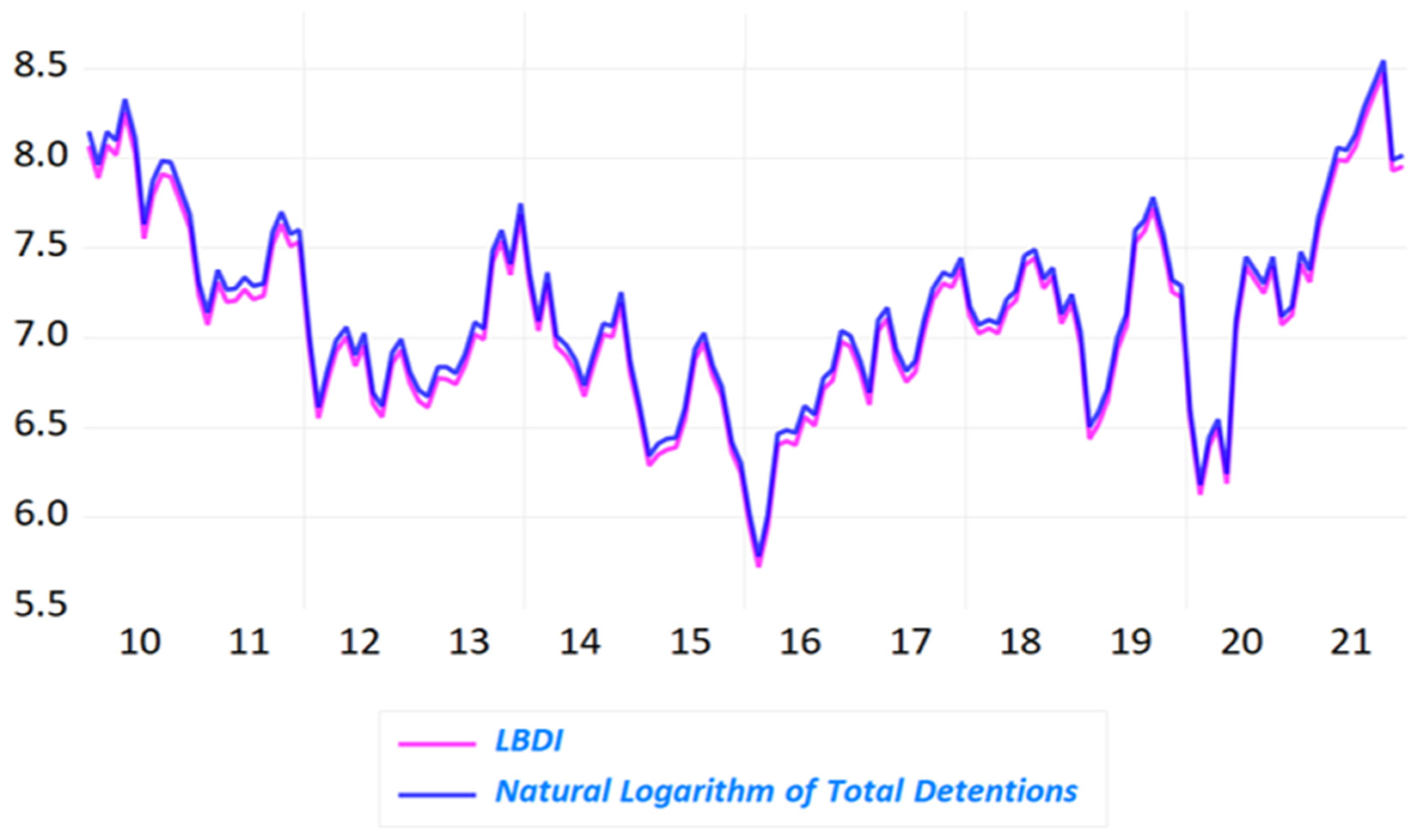
Figure 1 presents the co-movement between the natural logarithm of total dry bulk and tanker detentions recorded by the Paris and Tokyo MoU and the natural logarithm of the Baltic Dry Index (LBDI) over the period 2010–2021. The two series track each other remarkably closely throughout the sample period, exhibiting similar cyclical patterns, shared turning points, and comparable magnitudes of fluctuation. This visual co-movement provides preliminary evidence of a systematic relationship between PSC detention activity and freight market conditions, motivating the formal econometric investigation of a bidirectional relationship between the two variables through the GMM simultaneous system estimated in the following section.
Table 2 reports the GMM and 3SLS estimates for the full sample over the period 2010–2021, where vessel detentions (SD) and maritime freight market conditions (LBDI) are treated as jointly evolving. The results indicate a positive and statistically significant relationship between freight market conditions and vessel detentions, as lagged values of LBDI are associated with higher aggregate detention ratios. This finding contrasts with the conventional expectation that stronger market conditions should enhance compliance by increasing the opportunity cost of detention. Instead, it is consistent with a pattern in which periods of heightened freight market conditions are accompanied by higher aggregate detention ratios. This may reflect a combination of increased inspection exposure due to greater traffic volumes, operational pressures that reduce compliance effort, and higher enforcement intensity, though the aggregate nature of the data does not allow these channels to be separately identified.
The reverse relationship is also present, with lagged detention ratios positively associated with LBDI across most specifications, reaching statistical significance under the Paris GMM and both Tokyo specifications, while remaining insignificant under the Paris 3SLS. This positive association is consistent with a signalling and sentiment channel: elevated detention activity may signal deteriorating fleet quality or tightening enforcement conditions to market participants, influencing chartering decisions and freight rate expectations. We note, however, that the aggregate volume of MoU detentions is unlikely to shift global BDI levels directly through supply withdrawal alone, and the result may also partly reflect common cyclical factors. This is discussed further in
Section 6.
Institutional variables reveal important variation across regulatory regimes. Port region effects differ across MoUs: the ratio of detentions in European ports is negatively associated with the overall detention ratio under the Paris MoU but positively associated under the Tokyo MoU, while the ratio of detentions in Asian ports is negatively associated across both regimes. The effect of white-listed flag registration is negative and statistically significant across all specifications, confirming that vessels registered under white-listed flags are consistently associated with lower detention ratios. The association between IACS classification and detention risk, however, differs markedly across MoUs: the coefficient is negative and significant under the Paris GMM specification, consistent with the expected protective role of classification society oversight, but positive and significant under both Tokyo specifications, suggesting that within the Tokyo MoU the composition of detained vessels includes a disproportionately high share of IACS-classified vessels, possibly reflecting differences in fleet composition or inspection targeting. ISM-related deficiencies are positively and significantly associated with detention ratios under the Tokyo MoU, while the relationship is positive but statistically insignificant under the Paris MoU, suggesting that the role of safety management deficiencies as a driver of detention varies across regulatory regimes. These institutional variables are drawn from the detained population and therefore characterize the composition of detained fleets rather than serving as estimated detention probabilities from a full inspection sample. Overall, the results are consistent with a positive and jointly evolving relationship between regulatory outcomes and market conditions, a pattern consistent with the view that compliance incentives may weaken during economic upswings.
To examine potential heterogeneity across vessel segments, the sample is disaggregated into two major categories: dry bulk and tanker vessels. These segments differ in terms of operational characteristics, regulatory exposure, and inspection intensity, which may influence both compliance behaviour and detention risk. Dry bulk vessels exhibit higher detention ratios across both MoUs, reflecting their large share in the global fleet and the diversity of operational conditions under which they operate. In contrast, tanker detention ratios are comparatively lower, consistent with the stricter regulatory and commercial scrutiny applied to this segment, including enhanced safety standards and additional vetting procedures.
Table 3 presents the estimation results for dry bulk vessel detentions. The positive and statistically significant association between lagged LBDI and detention ratios is confirmed across all four specifications, reinforcing the main finding from the full sample that freight market conditions are positively associated with aggregate detention activity. However, several institutional variables behave differently in the dry bulk segment relative to the full sample results. IACSB is positive and statistically significant across three of the four specifications, indicating that within the dry bulk detained population, a higher share of IACS-classified vessels is associated with higher detention ratios. As discussed in relation to
Table 2, this likely reflects compositional differences in the dry bulk fleet rather than a direct causal effect of classification society membership on detention probability. ISM-related deficiencies (ISMB) are positive and statistically significant across all four specifications, a stronger result than observed in the full sample, where the Paris MoU specifications were insignificant, suggesting that safety management deficiencies are a particularly robust predictor of detention within the dry bulk segment. The white-listed flag variable (WFB) is negative and significant across all specifications, consistent with the full sample findings and confirming the protective role of flag state quality. Port region effects (PERB, PASB) are also consistent with the full sample, with PERB positive and significant across all specifications and PASB negative and significant, reflecting regional variation in enforcement intensity. Overall, while the core relationship between market conditions and detention activity is robust within the dry bulk segment, the role of specific institutional factors varies in magnitude and direction relative to the full sample, underscoring the importance of segment-level disaggregation.
Table 4 reports the GMM and 3SLS estimates for tanker vessel detentions under the Paris MoU and Tokyo MoU. The positive association between lagged freight market conditions (LBDTI (−1)) and detention ratios is confirmed across three of the four specifications, reaching statistical significance under both Paris specifications and the Tokyo GMM, while remaining insignificant under the Tokyo 3SLS. The reverse relationship, lagged detention ratios positively associated with LBDTI, is statistically significant across all four specifications, consistent with the signalling and sentiment channel identified in the full sample and dry bulk results.
Several institutional variables reveal important patterns in the tanker segment. The white-listed flag variable (WFT) is negative and statistically significant across all four specifications, confirming the consistently protective role of flag state quality observed across all segments and both MoUs. The IACS classification variable (IACST), however, is positive and statistically significant across all four specifications, consistent with the pattern observed in the full sample and dry bulk results under the Tokyo MoU, and suggesting that within the tanker detained population, IACS-classified vessels account for a disproportionately high share of detentions. As noted previously, this likely reflects compositional characteristics of the detained fleet rather than a direct effect of classification society membership on detention probability.
ISM-related deficiencies (ISMT) are positive and statistically significant across three of the four specifications, reaching significance at the 10% level under Paris GMM, and at the 1% level under both Tokyo specifications, while remaining insignificant under Paris 3SLS. This is a stronger result than previously suggested in the literature for the tanker segment, and contrasts with the expectation that heightened vetting procedures would reduce the marginal impact of ISM-related deficiencies on detention outcomes.
Port region effects reveal a striking divergence across MoUs. The ratio of detentions in Asian ports (PAST) is negative and statistically significant under both Paris specifications, suggesting that within the Paris MoU tanker detained population, a lower share of detentions occurs in Asian ports. In contrast, PAST is positive and statistically significant under both Tokyo specifications, indicating the opposite pattern under the Tokyo MoU. This divergence likely reflects fundamental differences in the geographic scope, port composition, and enforcement intensity across the two regulatory regimes. Overall, while the core bidirectional relationship between market conditions and detention activity persists in the tanker segment, the role of specific institutional and regional factors varies considerably across MoUs, reinforcing the importance of regime-level disaggregation in the empirical analysis.
5.2. Results by Vessel Type
The segment-level results broadly confirm the positive bidirectional relationship identified in the full sample, while revealing meaningful heterogeneity across vessel types and regulatory regimes. The freight market condition variable remains positive and statistically significant across dry bulk specifications in all four estimations, and across most tanker specifications, except for the Tokyo 3SLS where LBDTI (−1) loses significance. The reverse channel—lagged detention ratios positively associated with freight conditions—is robust across all four tanker specifications and most dry bulk specifications, reinforcing the consistency of the signalling and sentiment channel across segments.
The most notable divergence concerns institutional variables. While the protective role of white-listed flag registration is uniformly confirmed across both segments and both MoUs, the IACS and ISM variables behave differently across segments relative to the full sample. ISM-related deficiencies emerge as a stronger and more consistent predictor of detention within both the dry bulk and tanker segments than in the aggregate specification, suggesting that safety management deficiencies are particularly relevant at the segment level. The positive IACS coefficient, observed under the Tokyo MoU in the full sample, persists across both dry bulk and tanker specifications under both MoUs, pointing to a compositional feature of the detained fleet that transcends vessel type. Port region effects also diverge notably in the tanker segment, where the Asian port ratio reverses sign between the Paris and Tokyo MoUs, reflecting fundamental differences in geographic scope and enforcement intensity across the two regimes. Together, these patterns underscore the importance of segment-level disaggregation and caution against applying full-sample findings uniformly across vessel types.
6. Discussion
The empirical results reveal a pattern that contrasts with the standard expectation of improved compliance during strong market conditions. Conventional reasoning suggests that higher freight earnings should strengthen compliance by increasing financial capacity, raising the opportunity cost of detention, and amplifying reputational concerns. Under this framework, detention ratios would be expected to decline during economic upswings. However, the findings are consistent with the opposite pattern. The positive relationship between freight market conditions and detention activity is consistent with the view that stronger market conditions may, under certain conditions, weaken compliance incentives, though the aggregate nature of the data means this interpretation should be treated as theoretically motivated conjecture rather than a directly tested behavioural hypothesis.
This result stands in contrast to the dominant strand of literature, which emphasizes structural and technical determinants of detention. Previous studies consistently show that detention risk is primarily driven by observable deficiencies and vessel characteristics [
2,
3,
4], as well as institutional factors such as flag state quality and classification society oversight [
5,
6,
19]. Within this framework, detention is typically interpreted as a predictable outcome of substandard vessel conditions and weak institutional controls. By contrast, the present findings suggest that even when these structural factors are accounted for, broader market conditions may play an additional and previously underexplored role in shaping aggregate detention patterns.
At the same time, the results are consistent with strands of literature that highlight variation in enforcement effectiveness and inspection outcomes [
8,
9,
20]. Enforcement is not uniform, and the deterrent effect of inspections may vary across contexts. In this setting, strong market conditions, characterized by higher traffic intensity and operational pressure, may interact with institutional constraints, potentially reducing enforcement effectiveness precisely when incentives to deviate from compliance are strongest.
The findings can also be interpreted through a behavioural and principal-agent lens. While PSC is designed to deter non-compliance and improve safety outcomes [
21], shipowners and operators may face competing incentives during periods of high freight earnings. The aggregate patterns observed are consistent with a scenario in which compliance risk becomes a more acceptable operational trade-off during boom periods, though we emphasize that this mechanism cannot be directly observed at the aggregate level of analysis used here.
The bidirectional nature of the results further highlights the dynamic interaction between regulatory enforcement and market outcomes. The positive association running in the reverse direction, from lagged detention ratios to freight market conditions, is more plausibly interpreted as a signalling and sentiment effect: elevated detention levels may influence chartering decisions and market expectations, rather than causing direct supply withdrawal at a scale sufficient to shift global BDI levels materially. We acknowledge that the reverse relationship may also partly reflect common cyclical factors not fully captured by the model.
A noteworthy finding that warrants specific discussion is the positive and significant association between IACS classification and detention ratios observed consistently across the Tokyo MoU and across both dry bulk and tanker segments. This contrasts with the expected protective role of classification society oversight and with the negative coefficient observed under the Paris GMM specification. As noted in
Section 5, this pattern is most plausibly interpreted as a compositional feature of the detained fleet: under the Tokyo MoU, IACS-classified vessels may account for a larger share of the inspected population, such that their higher absolute representation among detained vessels does not necessarily imply lower compliance standards. This finding highlights the importance of interpreting institutional variables with care when they are constructed from the detained rather than the full inspected population, and points to the value of vessel-level data in future research.
The results also reveal systematic differences between the Paris and Tokyo MoUs that extend beyond the IACS finding. Port region effects, ISM-related deficiencies, and the strength of the bidirectional relationship all vary across regimes, suggesting that enforcement dynamics, fleet composition, and compliance incentives differ meaningfully between the two regulatory environments. These differences underscore the importance of regime-level disaggregation and caution against generalizing findings from one MoU to the other.
A limitation of the analysis is that it relies on aggregated MoU-level data rather than vessel-level observations, which may obscure heterogeneity in compliance behaviour across individual ships and operators. The behavioural mechanisms discussed, including opportunistic responses to freight market cycles and principal-agent dynamics, are offered as theoretically plausible interpretations of the aggregate patterns and should be subject to direct testing with vessel-level or firm-level panel data in future research. A further limitation concerns the dependent variable, which is constructed as the ratio of detained vessels to total inspections. While this normalization partially addresses concerns about variation in inspection exposure, the possibility that some of the observed variation in detention ratios reflects changes in inspection volumes or enforcement intensity rather than underlying compliance behaviour cannot be fully ruled out. The fleet growth variables (FG, FGB, FGT) and port-region ratio controls (PER, PAS) included in the specifications partially mitigate this concern by controlling for variation in fleet size and regional enforcement patterns.
Overall, the findings extend the existing literature in three important ways. First, they complement the established focus on vessel-specific and institutional determinants of detention by introducing a cyclical and market-based dimension. Second, they provide aggregate-level evidence consistent with a behavioural mechanism in which compliance incentives vary across phases of the shipping cycle. Third, they highlight the heterogeneity of detention dynamics across MoUs and vessel segments, pointing to the need for regime-specific enforcement strategies. From a policy perspective, the results imply that enforcement strategies may need to adapt to prevailing market conditions. If strong freight markets are associated with increased incentives for opportunistic behaviour, regulators may need to adjust inspection intensity, targeting mechanisms, or monitoring practices during boom periods to maintain the effectiveness of PSC regimes. The systematic differences observed across MoUs further suggest that greater harmonization of enforcement practices across regulatory regimes could reduce the scope for regulatory arbitrage. Finally, it is important to interpret the results with appropriate caution. While the analysis identifies a robust association between market conditions and detention activity, the underlying behavioural mechanisms cannot be observed directly. Future research could build on these findings by incorporating vessel-level decision data, inspection targeting models, or alternative identification strategies to further explore the causal channels linking economic incentives and compliance behaviour.
7. Conclusions
This study examined the relationship between vessel detentions under Port State Control and freight market conditions in the maritime sector using monthly data from the Paris and Tokyo MoUs over the period 2010–2021. Employing a system of simultaneous equations estimated via GMM and 3SLS, the analysis identifies a positive and statistically significant bidirectional association between detention activity and freight market conditions. The results are consistent with the view that compliance incentives may weaken during boom periods, though the aggregate, MoU-level nature of the data means that the behavioural mechanisms cannot be directly identified. These findings should be interpreted as associational evidence consistent with the theoretical predictions, rather than as causally identified estimates of behavioural responses. At the same time, detention ratios appear to be positively associated with subsequent freight market conditions across most specifications, a pattern consistent with a signalling and sentiment channel, whereby elevated detention activity may influence chartering decisions and freight rate expectations rather than causing direct supply withdrawal.
The analysis also confirms the importance of institutional and technical determinants, while highlighting meaningful variation across regulatory regimes and vessel segments. Vessels operating under white-listed flags consistently exhibit lower detention ratios across all specifications and both MoUs, confirming the protective role of flag state quality. The association between IACS classification and detention risk, however, varies markedly across regimes: the coefficient is negative under the Paris GMM specification, consistent with the expected protective role of classification society oversight, but positive and significant across the Tokyo MoU and most segment-level specifications, most plausibly reflecting compositional differences in the detained fleet rather than a direct effect of classification standards on compliance. ISM-related deficiencies are positively associated with detention ratios across most specifications, with the effect being stronger and more consistent within the dry bulk and tanker segments than in the full sample. Port-region effects also differ across MoUs, with the direction of Asian and European port ratios varying between the Paris and Tokyo specifications, reflecting differences in geographic scope, fleet composition, and enforcement intensity. Differences across vessel types further indicate that compliance dynamics vary across market segments, underscoring the importance of segment-level and regime-level disaggregation in the empirical analysis.
From a policy perspective, the findings highlight the need for adaptive, risk-based inspection strategies that account for prevailing market conditions. If compliance incentives weaken during economic upswings, PSC authorities may need to adjust inspection intensity and targeting mechanisms during boom periods to maintain enforcement effectiveness. Greater harmonization of enforcement practices across port regions and MoUs may also reduce the scope for regulatory arbitrage, particularly given the systematic differences in detention dynamics observed between the Paris and Tokyo regimes. As the industry transitions toward stricter environmental regulation, including the Energy Efficiency Existing Ship Index (EEXI) and Carbon Intensity Indicator (CII) frameworks, the role of PSC in ensuring effective implementation will become increasingly important. Future research could extend the analysis to additional MoU regions, incorporate post-2021 data, and explore the interaction between decarbonisation policies, digital monitoring systems, and compliance behaviour in shipping markets.