
Evolution and Challenges of Marine Oil Spill Governance in Taiwan over Two Decades



Abstract
1. Introduction
2. Methods
2.1. Data Collection
2.1.1. Case Study Selection and Data Sources
2.1.2. Stakeholder Interviews
2.1.3. Policy and Literature Review
2.2. Data Analysis
2.2.1. Comparative Case Analysis
2.2.2. Qualitative Content and Thematic Analysis
2.2.3. Gap Analysis Against International Standards
2.3. Validation and Limitations
3. Results
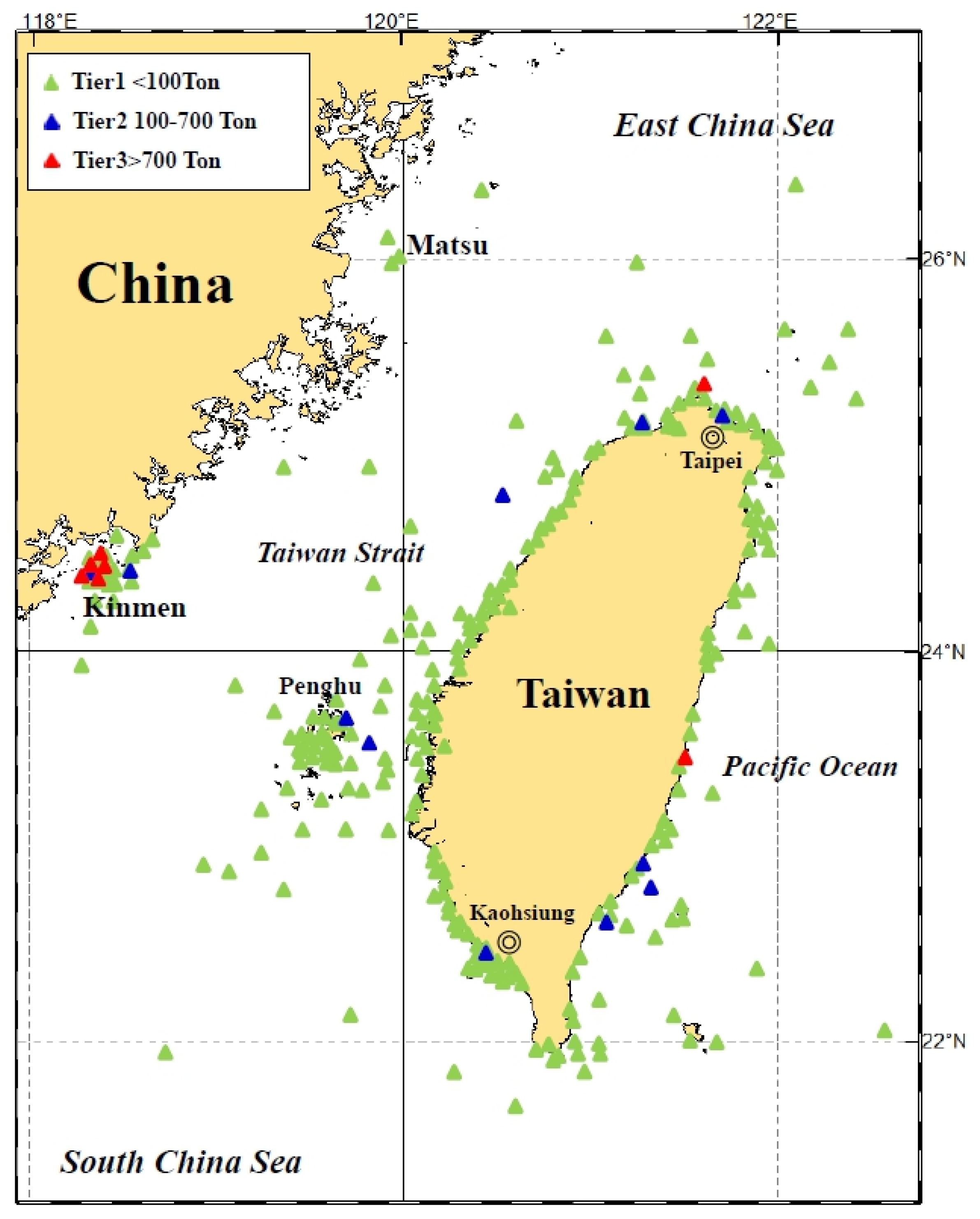
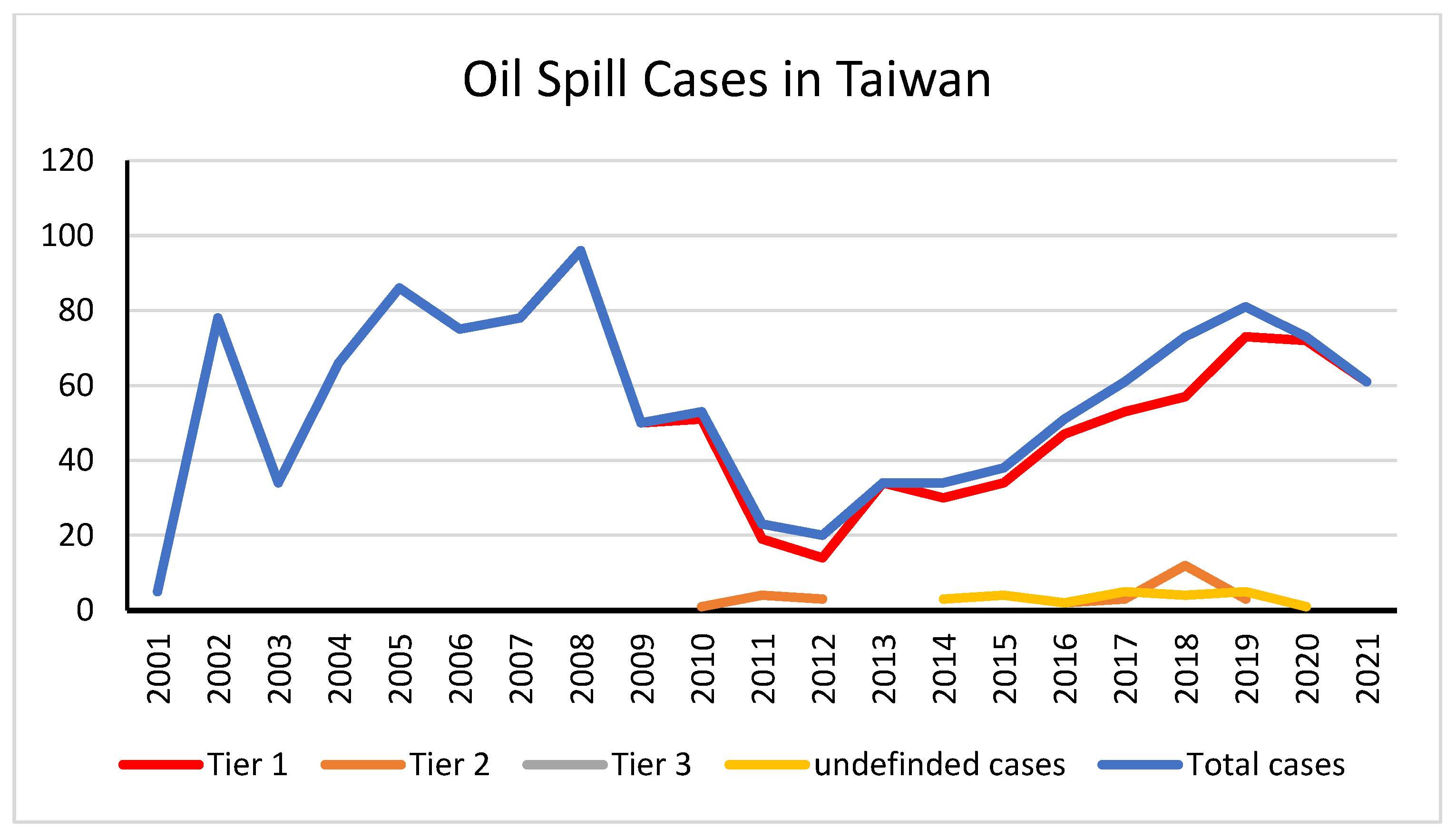
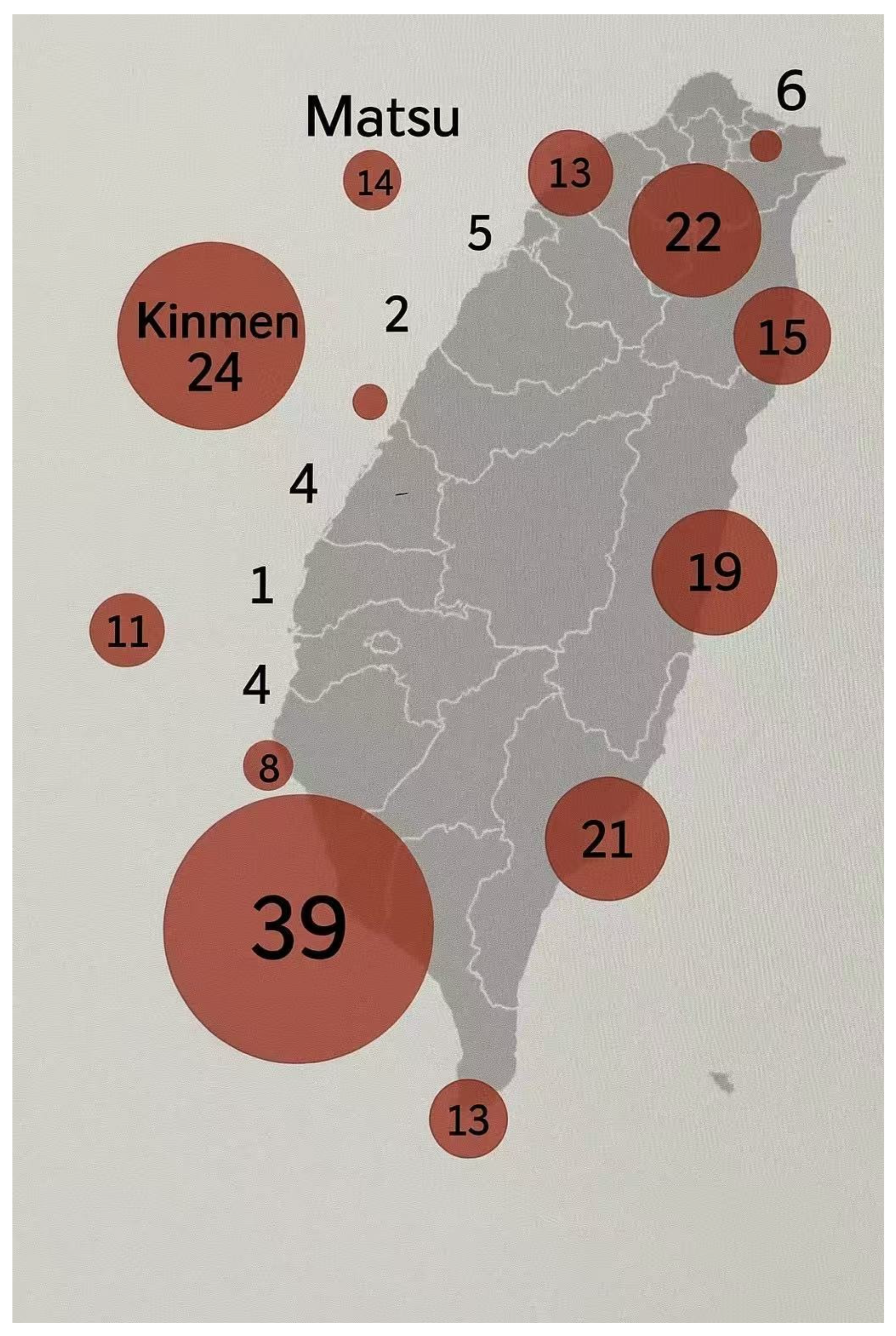
3.1. Historical Trend of Oil Spill Cases
3.2. Institutional Genesis: The Borag Incident (1977)—Awakening of Governance Awareness, and Exposure of Institutional Gaps
3.3. Law-Enforcement Gap: The Amorgos Incident (2001)—Policy Response Failure and Fragmented Coordination Mechanisms
3.4. Compensation–Restoration Dilemma: The T.S. Lines Incident (2018)—Forensic Ecology Gap and Insufficient Scientific Evidence
3.5. Enforcement Challenges: The Angel Incident (2023)—Testing the Effectiveness of Revised Legal Frameworks and Limitations of International Status
3.6. Comparative Analysis of Four Key Cases
4. Discussion
4.1. Theoretical Framing: From Reactive Response to Integrated Risk Governance
4.2. Empirical Findings: Structural Deficits in Taiwan’s Oil Spill Response System
- Deficit 1: Fragmented command authority without statutory integration. The EPD’s role under MPCA is confined to monitoring and approving cleanup plans submitted by vessel insurers, with enforcement limited to “urging” compliance through crew detention. This creates a responsibility–authority asymmetry: the agency bears public accountability for environmental outcomes but lacks directive power over operational execution. The 2023 amendment’s establishment of the Ocean Affairs Council (OAC) as the coordinating body represents partial rectification, yet implementation of regulations delineating OAC–EPD–Coast Guard authority boundaries remains pending [39].
- Deficit 2: Absence of ecological baselines for damage assessment and compensation. Taiwan’s waters host approximately 30,000 tanker transits annually, with 800+ grounding-related spills documented over four decades [40]. However, systematic benthic and pelagic ecosystem surveys are lacking. This baseline deficit constrains three critical functions: (a) pre-spill risk zoning; (b) post-spill injury quantification for natural resource damage assessment; and (c) compensation negotiations grounded in ecosystem service valuation rather than cleanup cost recovery alone. The maritime research community’s advocacy for a “national marine census” reflects recognition of this vulnerability [41].
- Deficit 3: International isolation limiting resource access and norm diffusion. Taiwan’s non-party status to MARPOL 73/78 and exclusion from international tanker owners’ pollution federation membership restrict access to international oil spill response networks, technical protocols, and compensation conventions. While bilateral arrangements with regional partners provide partial alternatives, the absence of formalized joint training exercises and mutual aid agreements leaves Taiwan dependent on ad hoc cooperation during transboundary incidents [34].
4.3. Policy Implications: Pathways Toward Integrated Marine Pollution Governance
5. Conclusions
Author Contributions
Funding
Institutional Review Board Statement
Informed Consent Statement
Data Availability Statement
Acknowledgments
Conflicts of Interest
References
- White, C.; Halpern, B.S.; Kappel, C.V. Ecosystem service tradeoff analysis reveals the value of marine spatial planning for multiple ocean uses. Proc. Natl. Acad. Sci. USA 2012, 109, 4696–4701. [Google Scholar] [CrossRef]
- Huang, Y.; Liu, B.; Liu, B.; Li, Y.; Bing, L.; Cheng, L. DeepLab-AFOS: A marine oil spill detection method based on advantageous features from polarimetric SAR. Mar. Pollut. Bull. 2026, 227, 119526. [Google Scholar] [CrossRef]
- Liu, P.; Shao, P.; Zhao, X.; Wang, X.; Chen, P.; Zhu, X.; Li, Y.; Xu, J.; Liu, B. Noise reduction based on the characteristics of X-band marine radar images for oil spill detection. Remote Sens. Lett. 2026, 17, 190–197. [Google Scholar] [CrossRef]
- Wu, X.; Lu, X.W. Addressing oil pollution compensation in China: An analysis of the CLC and domestic fund models. Front. Mar. Sci. 2025, 12, 1602260. [Google Scholar] [CrossRef]
- Mohammadiun, S.; Hu, G.; Gharahbagh, A.A.; Li, J.; Hewage, K.; Sadiq, R. Intelligent computational techniques in marine oil spill management: A critical review. J. Hazard. Mater. 2021, 419, 126425. [Google Scholar] [CrossRef]
- Ivshina, I.B.; Kuyukina, M.S.; Krivoruchko, A.V.; Elkin, A.A.; Makarov, S.O.; Cunningham, C.J.; Peshkur, T.A.; Atlas, R.M.; Philp, J.C. Oil spill problems and sustainable response strategies through new technologies. Environ. Sci. Process. Impacts 2015, 17, 1201–1219. [Google Scholar] [CrossRef] [PubMed]
- Yang, Z.; Chen, Z.; Lee, K.; Owens, E.; Boufadel, M.C.; An, C.; Taylor, E. Decision support tools for oil spill response (OSR-DSTs): Approaches, challenges, and future research perspectives. Mar. Pollut. Bull. 2021, 167, 112313. [Google Scholar] [CrossRef] [PubMed]
- Farrow, K.; Brinson, A.; Wallmo, K.; Lew, D.K. Environmental attitudes in the aftermath of the Gulf Oil Spill. Ocean Coast. Manag. 2016, 119, 128–134. [Google Scholar] [CrossRef]
- Etkin, D.S. Trends in 50 Years of Oil Spill Statistics, International Oil Spill Conference Proceedings; Allen Press: Lawrence, KS, USA, 2024. [Google Scholar]
- Liu, P.; Wang, X.; Shao, P.; Zhao, X.; Liu, B.; Chen, P.; Zhu, X.; Xu, J.; Li, Y. Oil spill segmentation in marine radar images based on the improved Sauvola algorithm. Remote Sens. Lett. 2026, 17, 182–189. [Google Scholar] [CrossRef]
- Lyu, X.; Su, H.; Grecos, C.; Ren, P. A novel framework for marine oil spill detection in SAR imagery fusing edge supervision enhancement and group attention mechanism. Remote Sens. Appl. Soc. Environ. 2026, 41, 101901. [Google Scholar] [CrossRef]
- Wan, Y.; Peng, L.; Zhang, R.; Zhang, R.; Wang, H. A Dual-Branch EfficientNetV2-S-Based Method for Marine Oil Spill Detection Using Multisource Satellite Data Fusion. IEEE J. Sel. Top. Appl. Earth Obs. Remote Sens. 2026, 19, 1549–1566. [Google Scholar] [CrossRef]
- The International Maritime Organization. “Marpol 73/78: Consolidated Edition, 2002: Articles, Protocols, Annexes, Unified Interpretations of the International Convention for the Prevention of Pollution from Ships, 1973, as Modified by the Protocol of 1978 Relating Thereto”. London: IMO, 2002. Text. Available online: https://treaties.un.org/pages/showDetails.aspx?objid=0800000280291139 (accessed on 10 January 2026).
- Oil Pollution Act of 1990, Pub. L. No. 101-380, 104 Stat. 484 (18 August 1990). Available online: https://www.uscg.mil/Mariners/National-Pollution-Funds-Center/About_NPFC/OPA/ (accessed on 10 January 2026).
- Ye, X.; Chen, B.; Li, P.; Jing, L.; Zeng, G. A simulation-based multi-agent particle swarm optimization approach for supporting dynamic decision making in marine oil spill responses. Ocean Coast. Manag. 2019, 172, 128–136. [Google Scholar] [CrossRef]
- Bajracharya, B.; Pradhan, S.; Shrestha, B.; Salerno, F. An integrated Decision Support Toolbox (DST) for the management of mountain protected areas. Mt. Res. Dev. 2010, 30, 94–102. [Google Scholar] [CrossRef]
- Chen, B.; Ye, X.; Zhang, B.; Jing, L.; Lee, K. Marine oil spills—Preparedness and countermeasures. World Seas Environ. Eval. 2019, 3, 407–426. [Google Scholar] [CrossRef]
- Diez, E.; McIntosh, B.S. Organisational drivers for, constraints on and impacts of decision and information support tool use in desertification policy and management. Environ. Model. Softw. 2011, 26, 317–327. [Google Scholar] [CrossRef]
- Sabela-Rikhotso, P.T.Z.; van Niekerk, D.; Nemakonde, L.D. A critical analysis of the legal frameworks governing oil spill management in South Africa. Mar. Policy 2021, 127, 104433. [Google Scholar] [CrossRef]
- Solís, J.R.R. Taiwan’s Economy at a Crossroads. Challenges and Opportunities for the Future. Portes-Rev. Mex. Estud. Sobre Cuenca Del Pac. 2026, 3, 206–228. [Google Scholar] [CrossRef]
- Huang, Y.H.; Chan, Y.S. The Economic and Environmental Impacts of Floating Offshore Wind Power Generation in a Leading Emerging Market: The Case of Taiwan. Sustainability 2026, 18, 804. [Google Scholar] [CrossRef]
- Ding, J.-F.; Tseng, W.-J.; Hsu, F.-T. An evaluation of key risk factors affecting shipping market operations across the Taiwan Strait for liner carriers. Proc. Inst. Mech. Eng. Part M J. Eng. Marit. Environ. 2014, 228, 302–311. [Google Scholar] [CrossRef]
- Shih, Y.-C. Taiwan’s progress towards becoming an ocean country. Mar. Policy 2020, 111, 103725. [Google Scholar] [CrossRef]
- Lin, S.H.; Wang, Y.C. Enhancing Marine Environmental Protection Enforcement in Taiwan: Legal and Policy Reforms in the Context of International Conventions. Laws 2025, 14, 60. [Google Scholar] [CrossRef]
- Chiau, W.-Y. Changes in the marine pollution management system in response to the Amorgos oil spill in Taiwan. Mar. Pollut. Bull. 2005, 51, 1041–1047. [Google Scholar] [CrossRef]
- Kandel, S.; Stumpf, A.C.; Joshi, A.; Sharma, S.; Taylor, L.E.; Jefferson, A.J.; Kenney, M.A. Comparing Flood Inundation Map Features and Diagnosing Decision Support Design Challenges. Hydrol. Process. 2026, 40, e70362. [Google Scholar] [CrossRef]
- Savvadelli, E.; Kiouvrekis, Y.; Kokkinaki, A. A Literature Review on Rule-Based Systems as Decision Support Systems. In 19th International Symposium on Human Aspects of Information Security and Assurance-HAISA-Annual, Mytilene, GREECE; Springer Nature: Cham, Switzerland, 2025; pp. 376–388. [Google Scholar] [CrossRef]
- Zhang, L.L.; McCartney, G. The Mediating Role of Positive Empathy in Resident Participation in Sustainable Tourism: Evidence from an Ancient Chinese Town. Int. J. Tour. Res. 2026, 28, e70301. [Google Scholar] [CrossRef]
- Fan, C.; Hsu, C.-J.; Lin, J.-Y.; Kuan, Y.-K.; Yang, C.-C.; Liu, J.-H.; Yeh, J.-H. Taiwan’s legal framework for marine pollution control and responses to marine oil spills and its implementation on TS Taipei cargo shipwreck salvage. Mar. Pollut. Bull. 2018, 136, 84–91. [Google Scholar] [CrossRef] [PubMed]
- Ye, J.A.; Pan, Y.M.; Jung, C.H.; Liu, T.K. Good news or bad news? The portrayal and evolution of marine pollution issues in Taiwan’s news coverage. Mar. Pollut. Bull. 2025, 213, 117663. [Google Scholar] [CrossRef]
- Abdel-Mawgoud, A.M.; Aboulwafa, M.M.; Hassouna, N.A. Optimization of surfactin production by Bacillus subtilis isolate BS5. Appl. Biochem. Biotechnol. 2008, 150, 305–325. [Google Scholar] [CrossRef]
- Ahmed, A.; Liu, Y.; Khan, R.; He, P.; He, P.; Wu, Y.; Munir, S.; He, Y. Molecular insights from integrated metabolome-transcriptome into endophyte Bacillus subtilis L1-21 surfactin against citrus Huanglongbing. Microbiol. Res. 2025, 290, 127942. [Google Scholar] [CrossRef]
- Chen, X.; Gong, X. Electrochemically fast preparation of superhydrophobic copper mesh for high-efficiency oil spill adsorption and oil-water separation. J. Hazard. Mater. 2024, 472, 134465. [Google Scholar] [CrossRef]
- Nguyen, T.H.H.; Hou, T.H.; Pham, H.A.; Tsai, C.C. Oil Spill Sensitivity Analysis of the Coastal Waters of Taiwan Using an Integrated Modelling Approach. J. Mar. Sci. Eng. 2024, 12, 155. [Google Scholar] [CrossRef]
- Báscolo, E.; Houghton, N.; Bennett, S. Political economy of primary health care resilience in Latin America and the Caribbean: Insights from the WB/PAHO Commission recommendations. Lancet Reg. Health Am. 2025, 50, 101241. [Google Scholar] [CrossRef]
- Puryear, C.; Vandello, J.A.; Gray, K. Moral panics on social media are fueled by signals of virality. J. Personal. Soc. Psychol. 2024, 127, 84–103. [Google Scholar] [CrossRef]
- Straub, A.M. Post-tropical cyclone Fiona and Atlantic Canada: Media framing of hazard risk in the Anthropocene. Disasters 2024, 48, e12641. [Google Scholar] [CrossRef]
- Chen, I.C. Reframing the Itaewon crowd crush: A systems analysis using Perrow’s framework. Disaster Prev. Manag. 2025, 34, 624–637. [Google Scholar] [CrossRef]
- Tsai, C.T.; Yi, C.H. Taiwan Comparison of Law of the Sea Approaches between 2012–2016 and 2016–2018: Implementation of the Ocean Affairs Council, Strict Regulation of Distant Water Fisheries Agency, and Progress on Marine Spatial Planning. Asia-Pac. J. Ocean Law Policy 2019, 4, 103–108. [Google Scholar] [CrossRef]
- Huang, W.C.; Chang, C.W. Water shortage risk in Taiwan’s Silicon Valley. J. Chin. Inst. Eng. 2022, 45, 513–520. [Google Scholar] [CrossRef]
- Liu, T.K.; Chang, H.; Chen, Y.S. Public awareness of marine environmental quality and its relationship for policy support on marine waste management. Mar. Pollut. Bull. 2023, 195, 115456. [Google Scholar] [CrossRef] [PubMed]
- Swanson, S.R. OPA 90+10: The oil pollution act of 1990 after ten years. J. Marit. Law Commer. 2001, 32, 135–174. [Google Scholar]
- Stout, S.A. Oil spill fingerprinting method for oily matrices used in the Deepwater Horizon NRDA. Environ. Forensics 2016, 17, 218–243. [Google Scholar] [CrossRef]
- Peschken, G.; Langrock, N. PIANC: Global knowledge network for waterborne transport infrastructure. Bautechnik 2025, 102, 382–389. [Google Scholar] [CrossRef]



| Year | Tier 1 | Tier 2 | Tier 3 | Undefined Cases | Total Cases |
|---|---|---|---|---|---|
| 2001 | 5 | 5 | |||
| 2002 | 78 | 78 | |||
| 2003 | 34 | 34 | |||
| 2004 | 66 | 66 | |||
| 2005 | 86 | 86 | |||
| 2006 | 75 | 75 | |||
| 2007 | 78 | 78 | |||
| 2008 | 96 | 96 | |||
| 2009 | 50 | 50 | |||
| 2010 | 51 | 1 | 1 | 53 | |
| 2011 | 19 | 4 | 23 | ||
| 2012 | 14 | 3 | 3 | 20 | |
| 2013 | 34 | 34 | |||
| 2014 | 30 | 1 | 3 | 34 | |
| 2015 | 34 | 4 | 38 | ||
| 2016 | 47 | 2 | 2 | 51 | |
| 2017 | 53 | 3 | 5 | 61 | |
| 2018 | 57 | 12 | 4 | 73 | |
| 2019 | 73 | 3 | 5 | 81 | |
| 2020 | 72 | 1 | 73 | ||
| 2021 | 61 | 61 | |||
| Total | 1113 | 29 | 0 | 28 | 1170 |
| Case | Time | Spill Scale | Core Response Problems | Lessons |
|---|---|---|---|---|
| Borag | 1977 | 15,000 tons | No agency, no law, no equipment | Establish basic governance awareness |
| Amorgos | 2001 | ~1000 tons | 21-day delay, role ambiguity | Enact MPCA and MMOPERP |
| T.S. LINES | 2018 | Medium | Compensation loophole, no resource database | Need forensic ecology data |
| Angel Container | 2023 | ~600 containers | Shipowner non-compliance, weak enforcement | Strengthen penalty and technical capacity |
| Phase | Priority Area | Key Actions | Lead Agency | Performance Indicators |
|---|---|---|---|---|
| Short term (1–2 years) | Institutional integration | Establish statutory Oil Spill Response Task Force under OAC with unified field command authority; clarify agency protocols through inter-ministerial memoranda | Ocean Affairs Council | Response initiation time; inter-agency dispute incidents |
| Medium term (3–5 years) | Capacity building | (a) Complete national marine ecological baseline survey; (b) deploy (DSTs) integrating real-time spill trajectory modeling and resource optimization | OAC + Academia Sinica/National Energy Research | Baseline coverage (% territorial waters); DST deployment in exercises |
| Long term (5+ years) | International alignment | Pursue MARPOL adherence through “Taiwan Clause” or equivalent arrangement; institutionalize regional joint exercises via Northwest Pacific Action Plan or bilateral frameworks | Foreign Ministry + OAC | Formalized mutual aid agreements; annual joint exercise participation |
Disclaimer/Publisher’s Note: The statements, opinions and data contained in all publications are solely those of the individual author(s) and contributor(s) and not of MDPI and/or the editor(s). MDPI and/or the editor(s) disclaim responsibility for any injury to people or property resulting from any ideas, methods, instructions or products referred to in the content. |
© 2026 by the authors. Licensee MDPI, Basel, Switzerland. This article is an open access article distributed under the terms and conditions of the Creative Commons Attribution (CC BY) license.
Share and Cite
Chang, C.-W.; Lu, S.-Y.; Liao, C.-P.; Chiau, W.-Y.; Shih, Y.-C. Evolution and Challenges of Marine Oil Spill Governance in Taiwan over Two Decades. Oceans 2026, 7, 43. https://doi.org/10.3390/oceans7030043
Chang C-W, Lu S-Y, Liao C-P, Chiau W-Y, Shih Y-C. Evolution and Challenges of Marine Oil Spill Governance in Taiwan over Two Decades. Oceans. 2026; 7(3):43. https://doi.org/10.3390/oceans7030043
Chicago/Turabian StyleChang, Chih-Wei, Shiau-Yun Lu, Chun-Pei Liao, Wen-Yan Chiau, and Yi-Che Shih. 2026. "Evolution and Challenges of Marine Oil Spill Governance in Taiwan over Two Decades" Oceans 7, no. 3: 43. https://doi.org/10.3390/oceans7030043
APA StyleChang, C.-W., Lu, S.-Y., Liao, C.-P., Chiau, W.-Y., & Shih, Y.-C. (2026). Evolution and Challenges of Marine Oil Spill Governance in Taiwan over Two Decades. Oceans, 7(3), 43. https://doi.org/10.3390/oceans7030043