Article

Nexus of Ecosystem Services and Hilsa (Tenualosa ilisha) Genetic Diversity to Strengthen Wetland Conservation Policy Within the SDG Framework


by
Atiqur Rahman Sunny
1,*,
Md. Shishir Bhuyian
2,3,
Sharif Ahmed Sazzad
3,
Md. Faruque Miah
1,
Md. Ashrafuzzaman
1,
Kamrul Islam
1,
Md. Abdullah Al Mamun
1 and
Shamsul Haque Prodhan
1,*
1
Department of Genetic Engineering and Biotechnology, Shahjalal University of Science and Technology, Sylhet 3114, Bangladesh
2
Faculty of Biotechnology and Genetic Engineering, Sylhet Agricultural University, Sylhet 3114, Bangladesh
3
Pathfinder Research & Consultancy Center, Astoria, NY 11106, USA
*
Authors to whom correspondence should be addressed.
Oceans 2026, 7(3), 38; https://doi.org/10.3390/oceans7030038
Submission received: 12 August 2025 / Revised: 16 December 2025 / Accepted: 5 January 2026 / Published: 4 May 2026

Abstract

The present study examined fish biodiversity, livelihood dependence, cultural importance, and genetic connectivity in two ecologically linked habitats of the Sylhet region, Bangladesh: Hakaluki Haor and the Surma River. Surveys documented 60 fish species with distinct assemblage patterns between sites. Hakaluki Haor was dominated by floodplain spawners and small indigenous species that contribute to year-round subsistence harvests, whereas the Surma River supported a greater proportion of migratory and pelagic species, most notably Tenualosa ilisha. These ecological contrasts reflected differences in hydrology, habitat diversity, and fishing intensity. Household surveys confirmed the central role of fisheries in sustaining income and food security, while cultural practices surrounding hilsa consumption reinforced local stewardship norms. Mitochondrial cytochrome b sequence analysis of T. ilisha revealed low genetic differentiation between sites, indicating a single, well-connected stock maintained by seasonal flooding and the absence of major migration barriers. This convergence of ecological and genetic evidence supports treating the two sites as an integrated management unit. Effective conservation will require protecting hydrological connectivity, safeguarding dry season refugia, coordinating seasonal fishing restrictions across habitats, and incorporating cultural values into policy frameworks. The findings strengthen the scientific basis for national and regional conservation strategies and demonstrate the value of combining biological, socio-economic, and cultural dimensions in managing connected wetland–river systems. This approach can serve as a transferable model for other tropical floodplain–river complexes facing similar ecological and livelihood challenges.

1. Introduction

Wetlands are widely regarded as some of the most productive ecosystems in the world, providing a wide range of ecological processes and socio-economic benefits. They act as natural reservoirs of biodiversity, regulate hydrological cycles, and support climate resilience [1]. In Bangladesh, wetlands form a complex mosaic of rivers, haors, beels, floodplains, and estuarine zones [2]. These diverse environments underpin the livelihoods of millions of people, while also serving as important habitats for hundreds of fish, crustacean, and plant species. National inventories have recorded over 293 native freshwater fish species along with numerous marine species, reflecting the country’s extraordinary aquatic diversity [3].
The value of wetlands can be systematically understood through the ecosystem services framework, which organizes benefits into four interconnected categories [4]. Provisioning services encompass tangible resources such as capture fisheries, freshwater, and genetic materials important for aquaculture and selective breeding [5]. Regulating services refer to processes that help stabilize environmental conditions, including floodwater retention, sediment trapping, and water purification [6]. Cultural services cover the non-material benefits derived from nature, including recreation, education, spiritual traditions, and aesthetic appreciation [7]. Supporting services form the ecological foundation for all others, such as nutrient cycling, primary productivity, and the maintenance of habitats for diverse organisms [5].
In the northeastern wetland systems of Bangladesh, provisioning services are especially critical [8]. Inland fisheries provide a substantial share of animal protein in local diets, generate employment, and sustain markets [9]. For many rural households, fishing is closely tied to seasonal cycles, with peak harvests during the monsoon months when floodplain species spawn and disperse [10]. Women often play a central role in processing, drying, and marketing small indigenous fish, while men are more frequently engaged in fishing, gear maintenance, and transportation. This gendered division of labor demonstrates the intricate ways in which wetland resources are embedded within community structures [11,12].
Among the fish resources of Bangladesh, Tenualosa ilisha (hilsa) stands out for its ecological, economic, and cultural importance. It is recognized as the national fish and holds Geographical Indication (GI) certification, which highlights its heritage value [13]. Hilsa is an anadromous migratory species that moves between marine and freshwater habitats to complete its life cycle [14]. Spawning generally occurs in inland rivers, while juvenile development often takes place in estuarine or coastal environments. This migration facilitates nutrient transfer between habitats and supports productivity across multiple ecosystems [15]. Economically, hilsa contributes significantly to the national GDP, supports export earnings, and provides income to thousands of fishing households. Its cultural importance is equally prominent, being central to traditional cuisine, religious celebrations, and social gatherings [16].
Management of hilsa fisheries in Bangladesh has concentrated primarily on sanctuary-based interventions in the major central river systems, especially the Padma and Meghna. These measures include seasonal bans on fishing, protection of brood fish, and restrictions on catching juveniles. The introduction of these strategies has led to improvements in hilsa abundance in sanctuary zones [17,18]. However, their applicability to non-sanctuary inland wetlands has received far less attention. Northeastern wetlands, such as Hakaluki Haor and the Surma River, have high biological productivity but have not been included in the national sanctuary framework, partly because of the absence of robust data on their hilsa population structure and connectivity [16].
Population genetics provides an important lens for understanding the sustainability of fisheries. Genetic diversity underpins the adaptive capacity of species, allowing them to respond to environmental change, resist disease, and maintain reproductive fitness [19]. Where populations are highly connected, shared recruitment and genetic exchange can support broader management units. Where there are genetically distinct subpopulations, more localized management strategies may be necessary to prevent the loss of unique genetic resources [20]. For migratory fish such as hilsa, patterns of gene flow are influenced by hydrological connectivity, migration pathways, and anthropogenic pressures including dams and habitat degradation [21].
Studies on hilsa genetics in South Asia have produced mixed results. Some analyses have found evidence of panmixia, with genetic mixing across large geographic ranges, while others have detected subtle population structuring [22]. In Bangladesh, mitochondrial DNA markers such as cytochrome b and the control region have been widely used to examine genetic variation in hilsa. Previous findings have reported both genetic homogeneity across river basins and site-specific differences under certain ecological conditions [16,23,24]. Despite these efforts, little research has been directed toward the northeastern haor and river systems, leaving an important gap in the understanding of population connectivity in these habitats.
The wetlands of northeastern Bangladesh face multiple pressures that threaten their ecological integrity. Overfishing, destructive fishing practices, sedimentation, agricultural expansion, and pollution have altered habitat quality and reduced fish stocks [25]. Climate change adds further challenges through erratic monsoon rainfall, flash flooding, and changing temperature regimes. These environmental changes have direct consequences for the communities that depend on wetland resources [26,27]. It is estimated that over 18 million people in Bangladesh rely directly or indirectly on wetland fisheries, making the maintenance of ecological and economic sustainability a national priority [27,28,29].
Beyond provisioning services, wetlands in the Sylhet region contribute to regulating services that protect communities from environmental hazards. Seasonal floodwaters deposit nutrient-rich sediments that enhance agricultural productivity, while aquatic vegetation helps stabilize banks and filter water [30,31]. Cultural services are also embedded within community life. Fishing festivals, communal harvesting practices, and religious rituals linked to fishing seasons help preserve traditional knowledge and strengthen social cohesion. Supporting services, such as the provision of nursery habitats for juvenile fish and migration corridors for species like hilsa, ensure the long-term productivity of these systems [32,33].
Conservation and management strategies for such multifunctional landscapes must be grounded in integrated assessments that consider ecological, genetic, and socio-economic dimensions. By combining ecosystem service evaluations with genetic monitoring, it is possible to identify both the current condition of the resource base and the biological potential for long-term sustainability [34,35,36,37]. If genetic analyses confirm that hilsa populations in non-sanctuary wetlands are part of the same breeding stock as those in managed rivers, extending current conservation measures to these areas could enhance overall effectiveness. Alternatively, if distinct genetic units are found, locally adapted management strategies would be required to safeguard unique population segments [22].
This study examines two important non-sanctuary wetlands in northeastern Bangladesh: Hakaluki Haor and the Surma River. Both are highly productive fishing grounds that support substantial biodiversity and sustain large numbers of fishing-dependent households. Yet, neither has been included in the existing hilsa sanctuary network. The research integrates community-based assessments of ecosystem services with mitochondrial DNA analysis of hilsa to evaluate biodiversity composition, functional roles of fish species, and genetic connectivity between sites.
Fish biodiversity is documented by grouping species into functional ecological categories rather than strictly by taxonomic order. This approach highlights their respective contributions to provisioning services, such as food supply, income generation, and ecosystem balance. Genetic analyses are used to estimate haplotype diversity, nucleotide diversity, and population differentiation, with the aim of identifying whether the two study sites share a common genetic stock. The integration of these findings provides evidence to inform fisheries policy and wetland conservation planning.
The outcomes of this research are intended to support the development of region-specific conservation strategies that balance ecological protection with the livelihoods of local communities. By aligning findings with the Sustainable Development Goals, particularly Goals 1, 2, 13, 14, and 15 [38,39,40], the study contributes to both biodiversity conservation and socio-economic development objectives.
Earlier studies on Tenualosa ilisha in Bangladesh have largely focused on genetic stock structure within major spawning rivers and coastal sanctuaries, emphasizing mitochondrial or microsatellite variation among migratory populations [14,17,19]. These works established valuable baselines for national conservation but rarely incorporated inland floodplain or haor ecosystems where hilsa also sustains livelihoods. Similarly, most ecosystem service assessments have treated hilsa only as a provisioning species, without integrating molecular evidence of its population continuity or ecological linkages.
This study advances previous research by combining genetic diversity analysis of hilsa populations with an ecosystem services framework in the Sylhet haor–river system, a non-sanctuary, hydrologically connected landscape representing the upper inland limit of the species. By linking mitochondrial diversity patterns with fish biodiversity and functional provisioning roles, this work provides a novel integrative perspective that bridges population genetics, ecosystem functioning, and management relevance, contributing to both hilsa conservation genetics and the broader understanding of wetland ecosystem services in Bangladesh.
Integrating socio-economic information with genetic evidence provides actionable policy insights that single-discipline approaches often miss [1,3]. Socio-economic data identify where fishing pressure, market incentives, and community norms concentrate effort, while genetic data indicate the degree of connectivity relevant for management units. Read together, these strands point to policies that couple hydrological connectivity and coordinated seasonal closures with livelihood support and gender-responsive co-management. This integrative framing links biological processes to feasibility and compliance, thereby improving the likelihood that conservation measures will be effective in the Sylhet haor–river system.

2. Materials and Methods

2.1. Study Areas

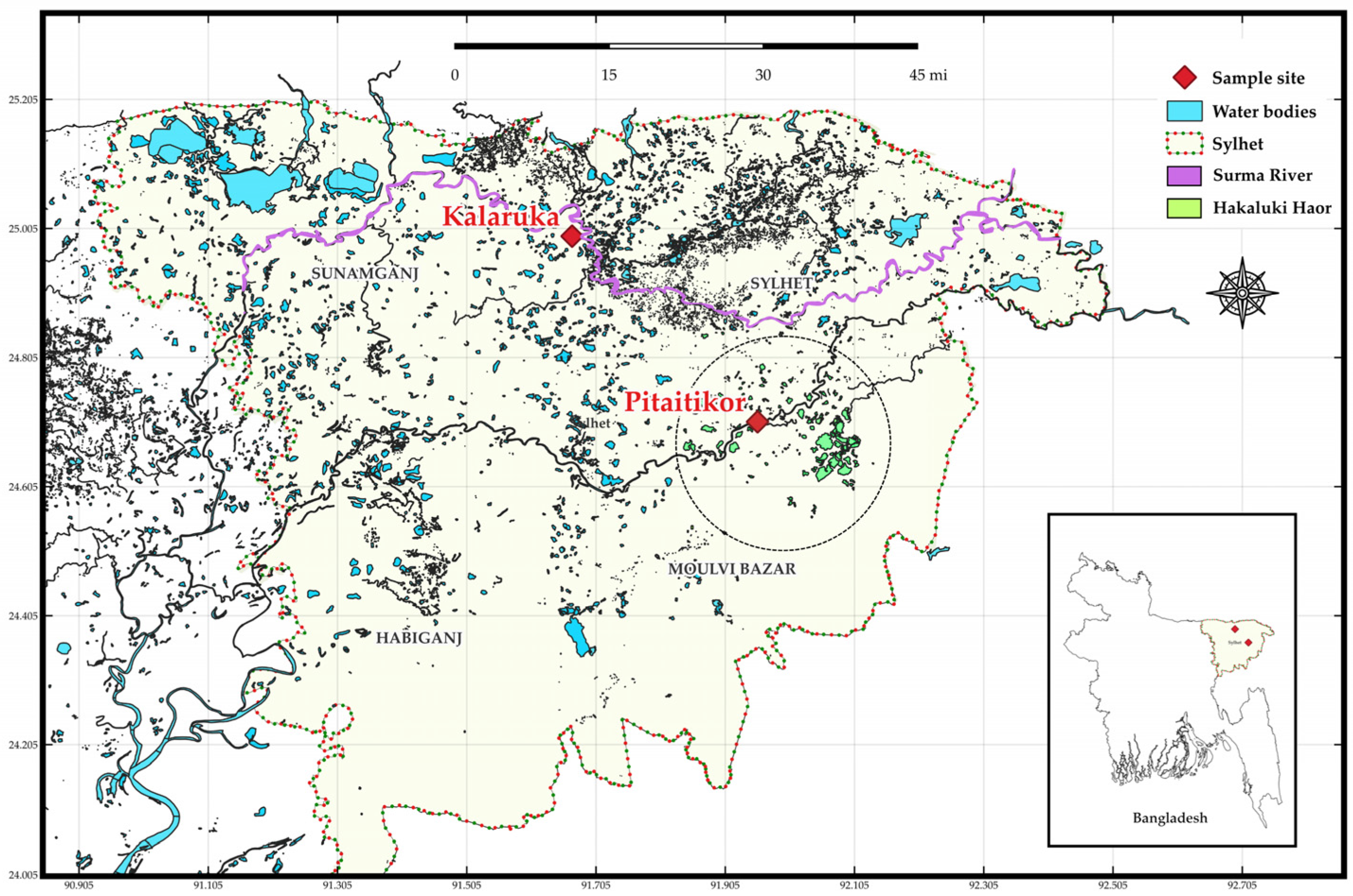
This study was conducted in two significant wetland ecosystems located in the northeastern region of Bangladesh: Hakaluki Haor and the Surma River. Both sites were selected due to their ecological importance, role in supporting rural livelihoods, and observed lack of formal conservation interventions compared to established sanctuary zones elsewhere in the country. Within Hakaluki Haor, sampling was undertaken in the Pitaitikor area, which forms part of the mosaic of seasonal water bodies, floodplains, and vegetated zones that collectively support a diverse array of aquatic and terrestrial species (Figure 1). In the Surma River, field activities were conducted in the Kalaruka area, a section of the river extensively used by artisanal fishing communities for subsistence and trade (Figure 1). The Surma River, a major riverine system originating from the Meghalaya Hills in India, flows through Sylhet and plays a crucial role in regional fisheries. Both sites are increasingly vulnerable to flash flooding, siltation, unregulated fishing, and habitat degradation, making them critical for ecosystem service evaluation and conservation planning.

2.2. Ecosystem Service Assessment

A mixed-method approach was employed to document the range and status of ecosystem services provided by the study sites. Data collection combined household surveys, focus group discussions (FGDs), and key informant interviews (KIIs) between June 2023 and September 2024. A semi-structured questionnaire was designed to capture information on provisioning, regulating, cultural, and supporting services as defined by the Millennium Ecosystem Assessment. Questions also addressed local perceptions of resource availability, observed ecological changes, and conservation priorities. Participatory Rural Appraisal (PRA) tools such as seasonal calendars and resource mapping were used to cross-check community responses. Interviews and discussions were conducted in familiar community spaces, including fishing docks, local markets, and paddy field edges, to ensure participant comfort and openness.

2.3. Fish Biodiversity Sampling

Fish biodiversity was assessed quarterly at landing sites and adjacent markets, including Pitaitikor, Fenchuganj Bazar, and Kalaruka, Chatok Bazar. Species identification followed the Catalogue of Life (accessed 8 August 2025) and the IUCN Red List (v. 2025–1), with both local and scientific names recorded [41]. A total of 60 species representing multiple ecological groups were documented and categorized according to their functional roles in provisioning services rather than strictly by taxonomic order. Species were assigned to five functional groups relevant to provisioning services (floodplain spawners, small indigenous species, predatory, migratory, and benthic) based on ecological characteristics described in the literature and verified through focus group discussions and key informant interviews with local fishers. To compare sites, we summarized the share of each functional group in landing records by site and by season. Given the opportunistic nature of sampling, results are reported descriptively without formal hypothesis tests.

2.4. Hilsa Sample Collection

To evaluate the genetic diversity of Tenualosa ilisha, three specimens were collected from each wetland between May and October 2023. Freshly landed fish were obtained with the cooperation of local fishers and traders. Dorsal fin tissues were excised aseptically and preserved in 100% ethanol before being transferred to the laboratory at the Department of Genetic Engineering and Biotechnology, Shahjalal University of Science and Technology, Sylhet, where they were stored at −20 °C until analysis [42].

2.5. Socio-Economic Collection

Household information was compiled from structured interviews and focus group discussions. Respondents were grouped into livelihood clusters reflecting their primary income source, fishing frequency, and degree of market access. These clusters were derived through descriptive cross-tabulation of socio-economic indicators (e.g., occupation, gear type, seasonal dependence, income range) and verified qualitatively with key informants. No inferential or multivariate clustering was applied, as the objective was to identify functional livelihood groups rather than statistical strata.

2.6. DNA Extraction

Genomic DNA was isolated from muscle tissue using the GeneJET Genomic DNA Purification Kit (Thermo Fisher Scientific, Waltham, MA, USA) in accordance with the manufacturer’s instructions. Prior to extraction, tissues were rinsed in sterile phosphate-buffered saline (PBS) to remove residual ethanol. Samples were minced using sterile blades, lysed with proteinase K and lysis buffer, and processed through silica-membrane spin columns. DNA was eluted in 50 µL of elution buffer and stored at −20 °C. Concentration and purity were assessed using a NanoDrop 2000 spectrophotometer (Thermo Fisher Scientific, Wilmington, DE, USA), and DNA integrity was verified via 1% agarose gel electrophoresis.

2.7. PCR Amplification

The mitochondrial cytochrome b (cytob) gene was amplified using primers reported by Xiao et al. (2001) [42] (Forward: 5′-GACTTGAAAAACCACCGTTG-3′, Reverse: 5′-CTCGGATCTCCGGATTACAAGAC-3′) (Table 1). Each 50 µL PCR reaction contained 10× buffer, 2.5 mM of each dNTP, 5 pmol of each primer, 1.5 mM MgCl2, 3 U of Taq DNA polymerase (Genei, India), and 25–50 ng of template DNA. The thermal cycling program consisted of an initial denaturation at 94 °C for 5 min, followed by 29 cycles of denaturation at 94 °C for 1 min, annealing at 55 °C for 1 min, and extension at 72 °C for 90 s. A final extension was performed at 72 °C for 10 min. Amplified products were visualized on 0.8% agarose gels stained with ethidium bromide and photographed under UV light.

2.8. Sequencing

PCR products were purified and subjected to bidirectional sequencing using an Applied Biosystems 3130 Genetic Analyzer. Sequencing reactions were prepared in 20 µL volumes containing BigDye Terminator v3.1 Ready Reaction Mix, (Applied Biosystems, Foster City, CA, USA) sequencing buffer, primer, and purified amplicon. Cycle sequencing was conducted following the manufacturer’s recommendations. Raw chromatograms were inspected manually, and sequences were edited and aligned in BioEdit before submission to the GenBank database.

2.9. Data Analysis

Chromatograms were inspected and trimmed for quality, then aligned in BioEdit. Nucleotide identity was verified with BLAST (v2.15.0) against the NCBI database. Genetic diversity metrics, including haplotype diversity (Hd), nucleotide diversity (π), and Watterson’s theta (θw), were calculated in DnaSP v6 [43]. Pairwise genetic differentiation (FST) between sites and pairwise distances were obtained in MEGA11 [44,45,46,47].
Phylogenetic relationships were inferred in MEGA11 using the Neighbor-Joining method under the Kimura 2-parameter model, with all codon positions included. Ambiguous sites were excluded by pairwise deletion, and node support was assessed with 1000 bootstrap replicates. The K2P model was used because cytob typically shows modest divergence and K2P accounts for transition–transversion differences in mitochondrial coding regions [44,45].
To provide comparative context, a small set of GenBank reference sequences from related clupeids was included to benchmark interspecific divergence and anchor the topology (e.g., MN101849.1, MN748960.1, MN792855.1, MN271715.1). These references were not used for within-site diversity estimates. Demographic model fitting, such as mismatch distribution, was not attempted due to limited sample size; interpretations of neutrality tests are therefore made cautiously.

2.10. Ethical Considerations

This research was conducted in accordance with national ethical principles for studies involving human participants. Prior to data collection, informed consent was obtained verbally and/or in writing from all participants, who were made fully aware of the study’s objectives, procedures, and their right to withdraw at any time without consequence. No personally identifiable information was recorded, and all responses were anonymized to ensure confidentiality.

3. Results and Discussion

3.1. Socio-Economic Dependence and Ecosystem Service Dynamics

Household survey results from the two study sites, Hakaluki Haor and the Surma River, highlight the central role of wetland resources in sustaining rural livelihoods. Among the 180 households surveyed, 92 percent reported direct involvement in fishing-related activities, either as a primary occupation or as part of a diversified livelihood strategy. The remaining 8 percent depended indirectly on wetland-based services, engaging in fish processing, marketing, boat-making, or providing transport services to fishers and traders.
Analysis of household income sources revealed three distinct livelihood clusters (Table 2). The first, classified as fishing-dominant households, represented 48 percent of the sample. These households generated over 70 percent of their annual income from fishing, with income peaks corresponding to seasonal hilsa runs in the Surma River and monsoon floodplain harvests in Hakaluki Haor. The second group, mixed-livelihood households, accounted for 37 percent of respondents. They combined small-scale farming with occasional fishing, largely for household consumption, selling surplus fish only during high-catch periods. The final group, agriculture-dominant households, made up 15 percent of the sample and relied primarily on crop production, using wetland resources mainly for irrigation water, aquatic vegetables, and opportunistic fishing to supplement protein intake.
The observed distribution of livelihood types aligns with patterns documented in other Asian floodplain fisheries, such as the Mekong Delta [48] and Tonle Sap Lake [49], where household reliance on fisheries varies along a gradient from subsistence to commercial orientation. Similarly to these regions, the fishing-dominant cluster in Sylhet’s wetlands exhibits high economic vulnerability to regulatory interventions such as seasonal fishing bans or gear restrictions [13,43]. In contrast, agriculture-focused households are more sensitive to changes in water availability for irrigation rather than direct fishing constraints [26].
Local perceptions gathered through focus group discussions indicated that fishing bans, while ecologically beneficial, disproportionately affect fishing-dominant households. These groups reported income losses during closed seasons and expressed limited access to alternative livelihoods. In Bangladesh’s national hilsa management program, compensation schemes exist for sanctuary-zone fishers during ban periods [50,51], but such benefits do not extend to fishers in non-sanctuary wetlands like Hakaluki Haor or the Surma River. This disparity highlights the need for equitable policy frameworks that address livelihood security alongside conservation goals [52].
From a gender perspective, women in both sites are more involved in post-harvest processing, small-scale marketing, and subsistence-level fishing for small indigenous species (SIS), such as Amblypharyngodon mola (Mola) and Puntius sophore (Punti). These roles are crucial for household nutrition and income smoothing during lean fishing periods. Studies from Indian floodplain systems show similar patterns, where women’s involvement in SIS processing contributes significantly to micronutrient intake and household food security [53,54]. Recognizing and supporting these gender-specific contributions is essential for designing inclusive wetland management strategies.
The dependence on wetland resources also extends beyond direct fishery outputs. Respondents from mixed- and agriculture-dominant households noted the importance of wetlands for irrigation, livestock watering, and harvesting of aquatic plants [40]. These services are tightly linked to the provisioning, regulating, and supporting ecosystem service categories, illustrating the multifunctionality of these landscapes [55,56].
Policy implications emerge directly from these socio-economic patterns. First, fisheries management in non-sanctuary wetlands should be tailored to livelihood profiles, ensuring that conservation measures do not disproportionately harm the most dependent households [43]. Second, incentive-based mechanisms, such as seasonal compensation or alternative income-generating programs, could improve compliance with fishing regulations [40,50]. Third, the integration of gender considerations into policy design could enhance household resilience and align management actions with SDG 1 (No Poverty), SDG 2 (Zero Hunger), and SDG 14 (Life Below Water) [30,43].

3.2. Fish Biodiversity as a Provisioning Service

The biodiversity survey recorded 60 fish species (see Table S1) distributed across multiple ecological functional groups (Table 3). This functional approach, which classifies species based on their ecological roles and contributions to provisioning services, provides a more practical lens for resource management than purely taxonomic listings. It links biological diversity directly to human well-being by identifying which species groups are most critical for food supply, income generation, and ecosystem stability. Across seasons, Hakaluki Haor showed a higher share of benthic and small indigenous species, whereas the Surma River exhibited seasonal peaks of migratory groups during hilsa runs.

3.2.1. Floodplain Spawners

Floodplain spawners, including Labeo rohita, Cirrhinus mrigala, and Catla catla, contribute significantly to seasonal protein availability and rural market activity during the monsoon. These species depend on lateral connectivity between river channels and inundated floodplains for spawning and juvenile recruitment [10]. However, community feedback indicates that siltation and reduced water exchange have already limited access to spawning habitats in both Hakaluki Haor and the Surma River. Comparable declines have been reported in the Ganga floodplain fisheries of India [54] and the Mekong Basin [49], where altered hydrology has disrupted flood-dependent life cycles.

3.2.2. Small Indigenous Species (SIS)

Small indigenous species, such as Amblypharyngodon mola, Puntius sophore, and Mastacembelus pancalus, are nutrient-rich and affordable, playing a vital role in household nutrition security. Rich in calcium, iron, and vitamin A, SIS are particularly important for women and children in low-income households [57]. Women frequently lead the collection, drying, and marketing of SIS, making these species integral to gendered livelihood strategies. Evidence from Bangladesh [58] and Cambodia [59] underscores the link between SIS availability and improved nutritional outcomes.

3.2.3. Predatory Species

Large predatory fish, including Channa marulius and Wallago attu, regulate prey populations and maintain ecosystem balance. Their decline, noted by fishers at both sites, is consistent with patterns in other overexploited floodplain fisheries [7]. The scarcity of apex predators is often an early warning indicator of ecosystem degradation, reflecting cumulative pressures from overharvesting and habitat loss.

3.2.4. Migratory Species

Migratory species, notably Tenualosa ilisha and Bagarius bagarius, connect riverine and floodplain ecosystems, facilitating nutrient flows and supporting cultural traditions [1]. Hilsa, in particular, holds both high market value and strong cultural significance. Its availability in the Surma River, though seasonal, provides critical income during peak runs. Similar ecological and economic roles are observed for Alosa sapidissima (American shad) in North America and Sardinella longiceps (Indian oil sardine) along the southwest coast of India [60,61]. Anguilla bengalensis is a catadromous species, spending most of its life in freshwater but migrating to the sea for spawning, thereby linking inland habitats with marine nutrient cycles. Raiamas bola and Eutropiichthys vacha are potamodromous, undertaking seasonal movements entirely within freshwater systems, often between main channels and floodplains, which supports both spawning success and fishery productivity. Hyporhamphus limbatus demonstrates partial migration between rivers and adjacent coastal waters, contributing to energy and nutrient exchange across habitat boundaries.

3.2.5. Benthic Species

Benthic fish such as Mystus vittatus and Macrognathus aculeatus offer year-round availability, particularly in the dry season when pelagic species become scarce. Their capacity to persist in residual pools during low-water periods ensures a continuous protein supply, though heavy exploitation in these refugia can rapidly deplete stocks. Similar risks have been documented in Sri Lanka’s seasonal reservoirs [62].

3.2.6. Implications for Provisioning Services

The composition and functional diversity of fish species are central to sustaining wetland provisioning services. Each functional group contributes differently to food security, income generation, and ecological balance [63]. The loss of any group, particularly floodplain spawners or SIS, would have disproportionate impacts on both ecosystem function and community well-being.
From a management perspective, conservation strategies need to reflect these functional roles. Protecting spawning migrations through seasonal connectivity, safeguarding dry season refugia, and promoting SIS-friendly fishing practices are all critical steps [64]. Functional group-based monitoring can also act as a practical, community-accessible indicator of wetland health, aligning biodiversity conservation with SDG 14 (Life Below Water) and SDG 15 (Life on Land).

3.3. Seasonal Dynamics and Vulnerability Patterns

Seasonal hydrology exerts a profound influence on fish availability and species composition in both Hakaluki Haor and the Surma River. The monsoon period, typically spanning June to September, floods extensive areas of floodplain, creating temporary habitats that serve as spawning and nursery grounds for numerous species. This hydrological expansion facilitates the migration of floodplain spawners such as Labeo rohita, Catla catla, and Cirrhinus mrigala from main channels into inundated areas. It also enables the upstream movement of migratory species, including Tenualosa ilisha, which utilize flood pulses for reproductive migration and early development.
Survey data and fisher interviews confirm that fish abundance and species richness peak during the monsoon. Market surveys conducted at Pitaitikor and Kalaruka revealed a seasonal drop in prices during this period due to increased supply, improving accessibility for low-income households. Similar dynamics are reported from the Tonle Sap floodplain in Cambodia [65] and the Niger Delta in Mali [66], where monsoon or flood-season surpluses enhance both dietary diversity and economic opportunity for fishing communities.
In contrast, the dry season, extending from December to March, sees a sharp contraction in available habitat as water bodies recede. Fishing activity shifts toward species capable of persisting in residual pools, particularly benthic fish such as Mystus vittatus and Macrognathus aculeatus, and hardy small indigenous species like Amblypharyngodon mola. However, intensified harvest from these limited refugia can result in overexploitation, as documented in Sri Lanka’s dry-zone reservoirs [62] and in West African floodplain fisheries [66].
Both sites also exhibit seasonal vulnerabilities linked to climatic variability. Fishers report increasing unpredictability in the onset and duration of the monsoon, with shorter flood periods reducing spawning success for flood-dependent species. Erratic rainfall patterns and sudden flash floods have been particularly disruptive in Hakaluki Haor, displacing breeding adults and washing away fish larvae. This mirrors climate-related disruptions observed in the Mekong [67], where altered flood timing has reduced recruitment success for key commercial species.
Dry season challenges are compounded by increasing siltation, which reduces the depth and water retention capacity of wetland basins. In the Surma River, upstream sediment loads from the Meghalaya Hills have visibly altered channel morphology, creating shallower, more fragmented habitats. Habitat fragmentation not only reduces available dry season refuges but also impedes the lateral and longitudinal connectivity required for seasonal fish migrations [68].
Policy and management implications emerging from these seasonal patterns are threefold. First, maintaining hydrological connectivity between rivers and floodplains is essential for sustaining the monsoon spawning migrations that underpin peak fish abundance. Second, identifying and protecting key dry season refugia could safeguard year-round fish availability and prevent overexploitation of resilient species [62]. Third, incorporating climate adaptation strategies, such as flood-timing forecasts and early warning systems, into fisheries management plans would help mitigate the impacts of erratic monsoon cycles [68].
Global experience shows that adaptive co-management approaches, which integrate community knowledge with scientific monitoring, are particularly effective in variable environments [69,70]. Applying such models in Hakaluki Haor and the Surma River could help sustain provisioning services while reducing vulnerability to climatic and hydrological uncertainty.

3.4. Cultural and Social Dimensions

The fisheries of Hakaluki Haor and the Surma River extend beyond economic and nutritional contributions, serving as cultural anchors for the communities that depend on them. Among these, the hilsa (Tenualosa ilisha) holds particular significance, functioning as both a cultural emblem and a central element of local culinary traditions [13,14]. In Sylhet, hilsa is featured prominently in festive meals, religious celebrations, and family gatherings, symbolizing prosperity and seasonal abundance. Its consumption during special occasions mirrors cultural practices in the Padma–Meghna delta, West Bengal, and coastal Myanmar, where hilsa is similarly regarded as a “festival fish” [24,50].
Field interviews reveal that fishing is embedded within local identity, with knowledge and skills passed across generations. Many fishers trace their family’s involvement in fishing back several generations, and fishing-related customs mark seasonal transitions in the community calendar. For example, the arrival of the first hilsa run is celebrated informally with communal meals and reciprocal fish exchanges among households. These traditions create strong social bonds, reinforcing community cohesion and a collective sense of stewardship toward the resource. Cultural value is also reflected in the use of fish in ritual contexts. Certain species, such as Channa marulius, are used symbolically in wedding feasts or offered during religious ceremonies. These customs are paralleled in other parts of South and Southeast Asia; for example, the ceremonial use of Probarbus jullieni in Lao PDR’s Mekong River villages [71] or Oncorhynchus tshawytscha (Chinook salmon) in the First Nations communities of North America [72].
Gendered roles within cultural fisheries activities are particularly pronounced. While men typically dominate capture fishing, women are more involved in post-harvest handling, preparation for festivals, and the sale of high-value fish like hilsa in local markets. This gendered participation extends to cultural expression, women often curate recipes, drying methods, and preservation techniques that hold both practical and symbolic significance. In Hakaluki Haor, women-led fish preservation for marriage gifts or religious events is a tradition that strengthens both cultural continuity and household economies. Importantly, cultural attachment to fish resources often fosters informal conservation norms. Fishers at both sites reported self-imposed restrictions, such as avoiding the capture of gravid hilsa during peak spawning weeks, even outside formal ban periods. This reflects a parallel seen in Pacific Island nations where culturally significant fish species, such as Naso unicornis, are protected through customary marine tenure systems [73].
Policy implications arising from these cultural dynamics emphasize the integration of intangible heritage into fisheries management. Recognizing cultural values within national fisheries policy can strengthen public support for conservation measures, especially when regulations align with traditional norms. Community-led awareness campaigns, built upon cultural narratives, can enhance compliance with fishing restrictions more effectively than enforcement alone. Furthermore, integrating cultural ecosystem services into wetland valuation frameworks aligns with international guidance from the Intergovernmental Science-Policy Platform on Biodiversity and Ecosystem Services (IPBES), ensuring that heritage and identity are formally acknowledged alongside ecological and economic factors [74].

3.5. Site-Specific Contrasts Between Hakaluki Haor and Surma River

The survey identified three main livelihood clusters in the two wetlands: full-time fishers, part-time fishers with mixed income, and non-fishing households engaged in processing or trading—based on occupational dependence and market access. Although Hakaluki Haor and the Surma River are part of the same broader Sylhet wetland–riverine system, the two sites differ markedly in their biodiversity composition, functional group dominance, and the ecosystem service portfolios they provide. These differences are shaped by variations in hydrological connectivity, habitat structure, fishing pressure, and market access.

3.5.1. Biodiversity Profiles

Hakaluki Haor supports a higher representation of floodplain spawners and small indigenous species (SIS) compared to the Surma River. This is consistent with its large seasonal inundation area, which creates extensive spawning and nursery habitats. The presence of vegetated shallow margins and flood-connected beels fosters recruitment success for species such as Labeo rohita and Puntius sophore. In contrast, the Surma River, with its permanent flow and relatively deep channels, harbors more riverine specialists and larger-bodied migratory species, particularly Tenualosa ilisha and Bagarius bagarius [10].

3.5.2. Functional Group Dominance

Functional group analysis reveals that benthic species make up a larger share of catches in Hakaluki Haor, reflecting the seasonal persistence of residual pools that sustain benthic communities during the dry season. In the Surma River, pelagic and migratory species dominate during peak flow periods, while benthic catches are less prominent due to greater current velocities and fewer depositional zones. This functional divergence has implications for both ecological stability and market dynamics, as benthic species often fetch lower prices but provide year-round food security, whereas pelagic and migratory fish are high value yet seasonally limited [9,10].

3.5.3. Fishing Pressure and Gear Use

Interviews with fishers and landing-site checks indicate widespread small-scale operations in Hakaluki Haor using traditional gears such as lift nets and traps. Although effort is spatially variable across beels and channels, these gears are broadly unselective, and landings reflect multi-species extraction that can include non-target taxa; hence localized depletion remains possible even where effort is dispersed. By contrast, the Surma River experiences more concentrated effort during hilsa runs, with gillnets and drift nets deployed to target schooling migratory fish, producing seasonally distinct catch profiles. These differences in effort distribution and gear selectivity help explain the contrasting species composition observed in market landings at the two sites.

3.5.4. Market Access and Economic Roles

The Surma River’s proximity to urban centers like Sylhet city ensures rapid market turnover for high-value species, particularly hilsa, with prime-size fish often fetching more than twice the per-kilogram price of most floodplain spawners in Hakaluki Haor. Bangladesh regulates extraction of spawning hilsa through seasonal closures during peak spawning, designated sanctuary zones in the Padma–Meghna system, and mesh-size restrictions to protect brood fish and juveniles. In practice, enforcement is strongest within sanctuary reaches and along major river corridors, while compliance in non-sanctuary wetlands such as Hakaluki Haor is variable due to dispersed fishing and limited monitoring. These regulatory differences, together with contrasting market access, contribute to site-specific incentives and harvesting patterns that shape the species composition observed in landings.

3.5.5. Management Implications

The contrasting ecological and socio-economic characteristics of the two sites underscore the need for location-specific management strategies. For Hakaluki Haor, priority measures should focus on maintaining floodplain connectivity and preventing overharvest of benthic species in dry season refugia. For the Surma River, management should target sustainable exploitation of migratory species, particularly hilsa, through seasonal catch limits and gear regulations aligned with national conservation programs. In both cases, integrating site-specific biodiversity data into broader wetland management frameworks can enhance resilience and align local strategies with national objectives under the Bangladesh Delta Plan 2100 [9]. These site-based differences also reinforce the value of treating the Sylhet wetland–riverine complex as an interconnected yet functionally diverse system. Policies that acknowledge both shared genetic connectivity and ecological divergence can optimize resource use without compromising long-term sustainability.

3.6. Genetic Diversity of Tenualosa Ilisha Populations

Across the 1114 bp cytob alignment, we detected 11 polymorphic sites and two 1 bp indels, yielding four haplotypes overall. Diversity estimates were low (H = 0.800; π = 0.00420; k = 4.667), and Tajima’s D was near zero and not significant, which we interpret cautiously as consistent with mutation–drift equilibrium given the small sample size. Together with minimal pairwise divergence among sites, these results indicate within-stock variation rather than site-specific differentiation.
Base composition was consistent across populations, with mean nucleotide frequencies of A = 28.22%, T = 23.39%, C = 17.83%, and G = 30.56%, yielding an average GC content of 48.3%. Only two short insertions or deletions (1 bp InDel events) were detected, producing an InDel haplotype diversity of 0.600. Tajima’s D value (−0.05002, p > 0.10) was close to zero and statistically non-significant, indicating that the populations conform to neutral expectations under mutation–drift equilibrium. This lack of significant deviation suggests the absence of recent demographic expansion, bottlenecks, or population subdivision, and is consistent with continuous gene flow across sites [75].
Pairwise evolutionary divergence among Sylhet populations was extremely low (0.000–0.008 substitutions/site), consistent with previous T. ilisha studies reporting negligible FST values for hydrologically connected habitats [15,17] (Table 4). Collectively, the low SNP density, high sequence conservation, non-significant Tajima’s D, and minimal divergence strongly support the interpretation that the Surma River and Hakaluki Haor populations belong to a single interbreeding stock. This genetic connectivity is likely maintained by seasonal migrations and continuous gene flow through the shared drainage system, highlighting the importance of managing the Sylhet haor–river complex as a single fisheries management unit, distinct from geographically distant T. ilisha populations [14,18].

3.6.1. Conserved Sequences

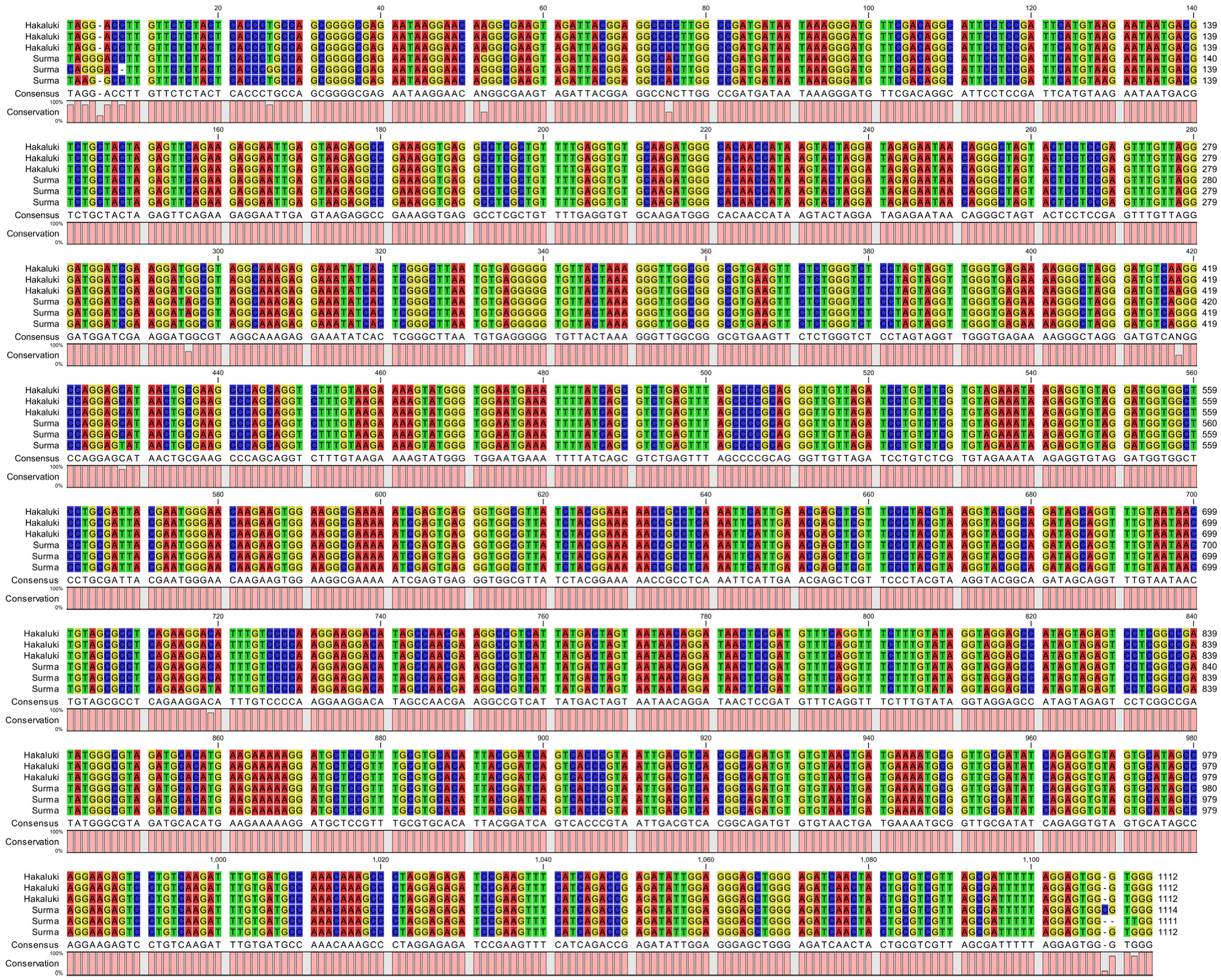
Multiple sequence alignment of the T. ilisha cytochrome b (cytob) gene (1114 bp) from Surma River and Hakaluki Haor populations revealed a high degree of sequence conservation, with 1099 positions invariant (monomorphic), corresponding to over 98% sequence conservation (Figure 2). This conservation underscores the essential role of cytob in mitochondrial oxidative phosphorylation, where sequence stability is maintained by strong purifying selection [17].
The 11 polymorphic sites detected were distributed unevenly across the gene, comprising both singleton variable sites and parsimony-informative sites, which may represent evolutionary hotspots shaped by environmental pressures, migration dynamics, or historical demographic processes [18]. Only two short (1 bp) insertion–deletion (InDel) events were detected, supporting the structural stability of the cytob gene. The rarity of such events further indicates that the gene is under functional constraint, with minor variation potentially contributing to local adaptation. The combination of high sequence conservation, minimal indel events, and low nucleotide diversity reinforces the view that these populations are part of a single, interbreeding unit, with variation occurring within the stock rather than between distinct subpopulations [15,23].

3.6.2. Phylogenetic Analysis

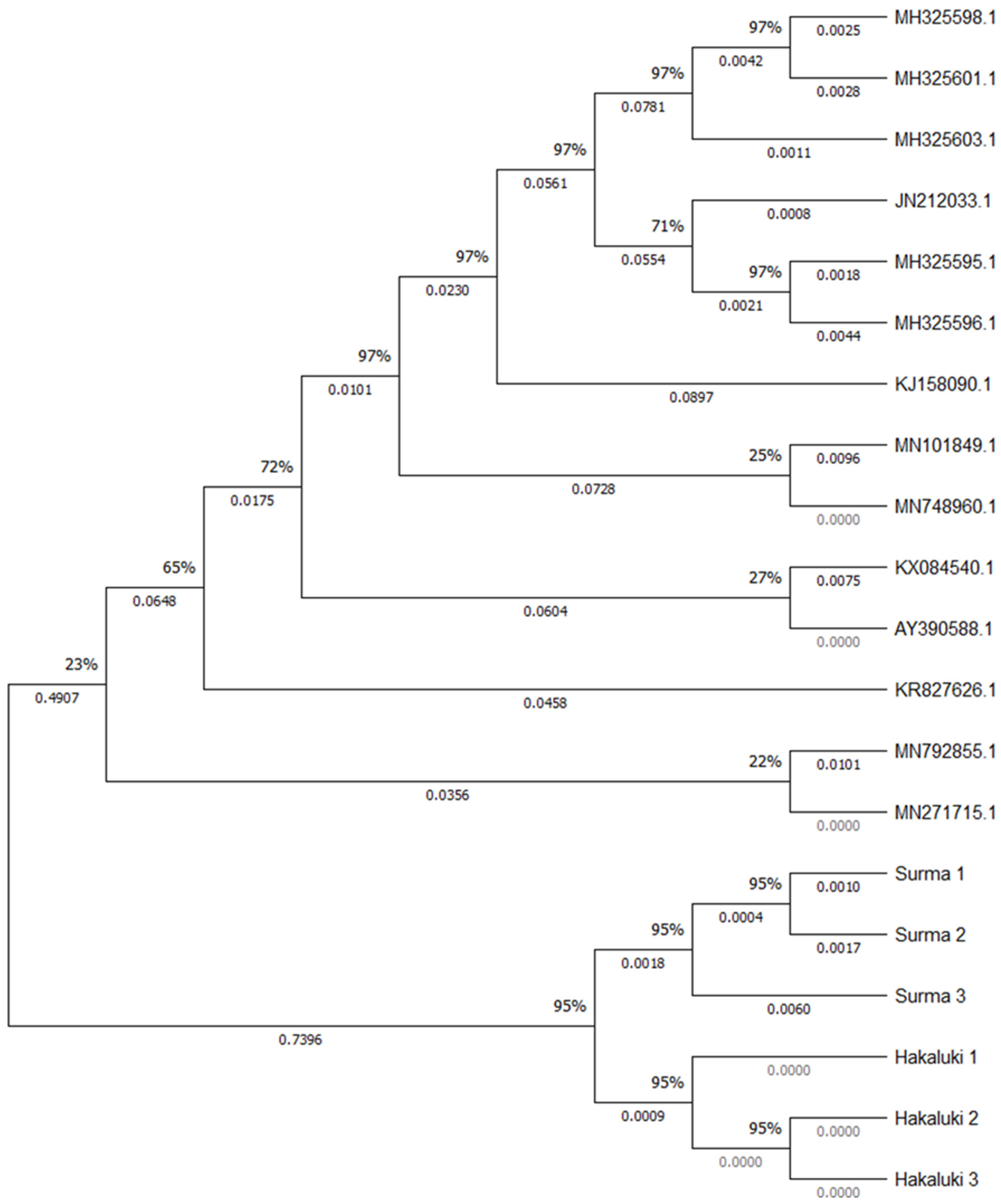
Phylogenetic analysis was conducted using the Neighbor-Joining method with the Kimura 2-parameter model in MEGA11, incorporating all codon positions and noncoding sites while excluding ambiguous positions via pairwise deletion. The resulting topology showed that all Sylhet T. ilisha sequences formed a well-supported monophyletic clade, with bootstrap values from 1000 replicates confirming the robustness of this grouping. Sequences from Surma River and Hakaluki Haor clustered closely, exhibiting minimal genetic divergence (0.000–0.008 substitutions per site), consistent with low FST values and indicating high gene flow within the Sylhet haor–river system (Figure 3).
Comparisons with GenBank reference sequences revealed that T. ilisha shares its closest genetic affinity with Gudusia chapra, Tenualosa macrura, and Tenualosa toli, whereas Ilisha melastoma, Ilisha elongata, and Hilsa kelee occupy more basal phylogenetic positions, indicating greater genetic distance [21,23,51]. Within the limits of the cytob dataset, the Sylhet samples cluster together with minimal pairwise divergence, which is consistent with an absence of deep subdivision in these sequences; however, this marker alone is not sufficient to resolve population structure [17,21].
From a fisheries management perspective, this level of genetic homogeneity suggests that the Sylhet haor–river populations should be managed as a single unit, while maintaining awareness of their genetic separation from other regional stocks [15,16].

3.7. Ecological Interpretation and Integrative Analysis

The integration of socio-economic, biodiversity, and genetic findings from Hakaluki Haor and the Surma River provides a holistic understanding of the Sylhet wetland–riverine system as a socio-ecological network. This integrated perspective highlights the interdependence between ecological integrity, livelihood security, and cultural continuity, and underscores the necessity of management approaches that operate across multiple scales and disciplines.

3.7.1. Linking Biodiversity and Livelihood Dependence

Species diversity, as reflected in the presence of 60 identified fish species (see Table S1) spanning multiple functional groups, forms the biological foundation of the provisioning, cultural, and regulating services that sustain local livelihoods. Floodplain spawners and small indigenous species (SIS) directly support household nutrition, while high-value migratory species such as hilsa provide substantial seasonal income [9,10]. The differentiation of livelihood clusters, from fishing-dominant to agriculture-dominant households, reflects varying levels of dependency on these biodiversity assets. The ecological availability of functional groups directly shapes the resilience of these livelihood types [27].

3.7.2. Hydrological Connectivity as an Ecological Driver

Hydrological connectivity between the Surma River and Hakaluki Haor underpins both biodiversity maintenance and genetic homogeneity of hilsa populations. Seasonal flooding facilitates the dispersal of juveniles, enhances nutrient cycling, and connects disparate habitats into a single ecological unit. This connectivity is also critical for maintaining genetic exchange among hilsa subpopulations, preventing the isolation effects seen in other migratory fish species when hydrological barriers are introduced. The parallels with the Mekong floodplain [67] and the Amazon várzea [76] reinforce the role of hydrological regimes as primary structuring forces in large floodplain–river systems.

3.7.3. Integrated Socio-Ecological Resilience

The Sylhet wetland–river system functions as a coupled socio-ecological network where ecological connectivity, cultural heritage, and adaptive livelihoods reinforce resilience. Seasonal flooding sustains biodiversity and gene flow, while diversified livelihood practices buffer communities against climate shocks. Cultural attachment to hilsa and community-based norms of restraint complement formal conservation rules, reflecting a locally embedded stewardship ethic. Maintaining this interplay among ecological, genetic, and cultural dimensions is essential for long-term system stability.

3.8. Policy Implications

The integrative results highlight three major priorities for sustainable management of the Sylhet haor–river complex. First, safeguarding hydrological connectivity is essential to sustain spawning migrations and maintain gene flow; flood-control or water-management structures should incorporate fish-passage provisions and maintain environmental flow. Second, expanding hilsa conservation beyond existing sanctuary boundaries is necessary, as the genetic findings indicate stock continuity between the Surma River and Hakaluki Haor [62,67,71]. Harmonized seasonal bans and coordinated monitoring would strengthen population recovery. Third, promoting inclusive co-management that integrates livelihood diversification, gender-responsive participation, and community-based surveillance of dry season refugia can enhance local stewardship. Collectively, these measures align with the Bangladesh Delta Plan 2100 and contribute directly to achieving SDGs 2, 5, 13, 14, and 15 [27,73].

4. Conclusions

This study demonstrates that the Hakaluki Haor and Surma River constitute an ecologically and genetically interconnected system supporting high biodiversity, vital livelihoods, and cultural heritage centered on Tenualosa ilisha. The low genetic divergence and strong ecological linkages justify treating these habitats as one management unit. Sustaining this resilience requires preserving hydrological connectivity, protecting seasonal refugia, and embedding cultural and gender dimensions within fisheries’ governance. A streamlined, ecosystem-based co-management approach offers the most viable pathway for balancing biodiversity conservation with rural well-being in Bangladesh’s northeastern wetlands.

Supplementary Materials

The following supporting information can be downloaded at: https://www.mdpi.com/article/10.3390/oceans7030038/s1, Table S1: List of 60 fish species identified by the study.

Author Contributions

Conceptualization, A.R.S. and S.H.P.; methodology, A.R.S., M.S.B., S.A.S., M.F.M., M.A., K.I., M.A.A.M. and S.H.P.; software, A.R.S.; validation, A.R.S., M.S.B., S.A.S., M.F.M., M.A., K.I., M.A.A.M. and S.H.P.; formal analysis, A.R.S., M.S.B., S.A.S. and S.H.P.; investigation, A.R.S., M.F.M., M.A., K.I., M.A.A.M. and S.H.P.; resources, A.R.S.; data curation, A.R.S., M.S.B. and S.A.S.; writing—original draft preparation, A.R.S.; writing—review and editing, A.R.S., M.S.B., S.A.S., M.F.M., M.A., K.I., M.A.A.M. and S.H.P.; visualization, M.S.B., S.A.S. and S.H.P.; supervision, S.H.P.; project administration, S.H.P.; funding acquisition, S.H.P. All authors have read and agreed to the published version of the manuscript.

Funding

This research received no external funding.

Institutional Review Board Statement

Not applicable.

Informed Consent Statement

Written informed consent was obtained from the participants.

Data Availability Statement

The original contributions presented in this study are included in the article/Supplementary Materials. Further inquiries can be directed to the corresponding authors.

Acknowledgments

The authors would like to acknowledge the support of the Department of Genetic Engineering and Biotechnology of Shahjalal University of Science and Technology, Sylhet, Bangladesh.

Conflicts of Interest

The authors declare no conflicts of interest.

References

  1. Sunny, A.R.; Sazzad, S.A.; Bhuyian, M.S.; Hasan, M.N.; Miah, M.F.; Ashrafuzzaman, M.; Prodhan, S.H. Fish genetic resources and wetland conservation in Bangladesh: Comparative insights on biodiversity, sustainable management, and Sustainable Development Goals. Limnol. Rev. 2025, 25, 20. [Google Scholar] [CrossRef]
  2. Tikadar, K.K.; Kunda, M.; Mazumder, S.K. Diversity of fishery resources and catch efficiency of fishing gears in Gorai River, Bangladesh. Heliyon 2021, 7, 12. [Google Scholar] [CrossRef] [PubMed]
  3. Sultana, M.A.; Pandit, D.; Barman, S.K.; Tikadar, K.K.; Tasnim, N.; Fagun, I.A.; Kunda, M. A review of fish diversity, decline drivers, and management of the Tanguar Haor ecosystem: A globally recognized Ramsar site in Bangladesh. Heliyon 2022, 8, 11. [Google Scholar] [CrossRef]
  4. Yang, Q.; Liu, G.; Gonella, F.; Wang, Q.; Chen, S.; Yang, Z. Revisiting mid-long term ecosystem services projections: Integrating the interaction effects of future climate and land use changes. Fundam. Res. 2024; in press. [CrossRef]
  5. Mengist, W.; Soromessa, T. Assessment of forest ecosystem service research trends and methodological approaches at global level: A meta-analysis. Environ. Syst. Res. 2019, 8, 22. [Google Scholar] [CrossRef]
  6. Sultana, M.A.; Sunny, A.R.; Hussain, M.A.; Islam, M.R.; Raposo, A.; Al Shiam, S.A.; Prodhan, S.H. Beyond economics: The multitude of benefits from ecosystem services in the Meghna river basin. Reg. Stud. Mar. Sci. 2025, 81, 103985. [Google Scholar] [CrossRef]
  7. Miah, M.Y.; Hossain, M.M.; Schneider, P.; Mozumder, M.M.H.; Mitu, S.J.; Shamsuzzaman, M.M. Assessment of ecosystem services and their drivers of change under human-dominated pressure—The Meghna River estuary of Bangladesh. Sustainability 2021, 13, 4458. [Google Scholar] [CrossRef]
  8. Mehvar, S.; Filatova, T.; Sarker, M.H.; Dastgheib, A.; Ranasinghe, R. Climate change-driven losses in ecosystem services of coastal wetlands: A case study in the west coast of Bangladesh. Ocean Coast. Manag. 2019, 169, 273–283. [Google Scholar] [CrossRef]
  9. Shamsuzzaman, M.M.; Islam, M.M.; Tania, N.J.; Al-Mamun, A.M.; Barman, P.P.; Xu, X. Fisheries resources of Bangladesh: Present status and future direction. Aquac. Fish. 2017, 2, 145–156. [Google Scholar] [CrossRef]
  10. Sunny, A.R.; Reza, M.J.; Chowdhury, M.A.; Hassan, M.N.; Baten, M.A.; Hasan, M.R. Biodiversity assemblages and conservation necessities of ecologically sensitive natural wetlands of north-eastern Bangladesh. Indian J. Geo-Mar. Sci. 2020, 49, 135–148. [Google Scholar]
  11. Sarker, F.C.; Rahman, M.K.; Sadat, M.A.; Shahriar, A.; Nowsad Alam, A.K.M. Haor-based floodplain-rich freshwater ichthyofauna in Sylhet Division, Bangladesh: Species availability, diversity, and conservation perspectives. Conservation 2022, 2, 639–661. [Google Scholar] [CrossRef]
  12. Haque, M.M.; Mahmud, M.N. Potential role of aquaculture in advancing Sustainable Development Goals (SDGs) in Bangladesh. Aquac. Res. 2025, 2025, 6035730. [Google Scholar] [CrossRef]
  13. Mozumder, M.M.H.; Schneider, P.; Islam, M.M.; Deb, D.; Hasan, M.; Monzer, M.A.; Nur, A.A.U. Climate change adaptation strategies for small-scale Hilsa fishers in the coastal area of Bangladesh: Social, economic, and ecological perspectives. Front. Mar. Sci. 2023, 10, 1151875. [Google Scholar] [CrossRef]
  14. Alam, M.M.; Haque, M.M.; Santi, M.; Rahman, M.A.; Hasan, N.A.; Mahalder, B. Current status of Hilsa (Tenualosa ilisha) fisheries in Bangladesh and implications for future research and development. Aquac. Fish Fish. 2025, 5, e70040. [Google Scholar] [CrossRef]
  15. Mohindra, V.; Divya, B.K.; Kumar, R.; Singh, R.K.; Dwivedi, A.K.; Mandal, S.; Jena, J.K. Genetic population structure of a highly migratory hilsa shad, Tenualosa ilisha, in three river systems, inferred from four mitochondrial genes analysis. Environ. Biol. Fishes 2019, 102, 939–954. [Google Scholar] [CrossRef]
  16. Sunny, A.R.; Rahman, M.A.; Hasan, M.N.; Bhuyian, M.S.; Miah, M.F.; Ashrafuzzaman, M.; Pervin, A.; Rahman, J.F.; Prodhan, S.H. Hilsa (Tenualosa ilisha) genetic diversity and conservation strategies for sustainable wetland management in Northeastern Bangladesh. Egypt. J. Aquat. Biol. Fish. 2025, 29, 1089–1105. [Google Scholar] [CrossRef]
  17. Sultana, S.; Hasan, M.M.; Hossain, M.S.; Alim, M.A.; Das, K.C.; Moniruzzaman, M. Assessment of genetic diversity and population structure of Tenualosa ilisha in Bangladesh based on partial sequence of mitochondrial DNA cytochrome b gene. Ecol. Genet. Genom. 2022, 25, 100139. [Google Scholar] [CrossRef]
  18. Ahammad, A.K.S.; Hasan, N.A.; Haque, M.M.; Bashar, A.; Ahmed, M.B.U.; Alam, M.A. Environmental factors and genetic diversity as drivers of early gonadal maturation: A gonadosomatic index-based investigation on Indian shad, Tenualosa ilisha population of Bangladesh. Front. Mar. Sci. 2021, 8, 758868. [Google Scholar] [CrossRef]
  19. Asaduzzaman, M.; Igarashi, Y.; Wahab, M.A.; Nahiduzzaman, M.; Rahman, M.J.; Phillips, M.J.; Huang, S.; Asakawa, S.; Rahman, M.M.; Wong, L.L. Population genomics of an anadromous hilsa shad Tenualosa ilisha species across its diverse migratory habitats: Discrimination by fine-scale local adaptation. Genes 2020, 11, 46. [Google Scholar] [CrossRef] [PubMed]
  20. Asaduzzaman, M.; Wahab, M.A.; Rahman, M.J.; Nahiduzzaman, M.; Dickson, M.W.; Igarashi, Y.; Wong, L.L. Fine-scale population structure and ecotypes of anadromous Hilsa shad (Tenualosa ilisha) across complex aquatic ecosystems revealed by NextRAD genotyping. Sci. Rep. 2019, 9, 16050. [Google Scholar] [CrossRef]
  21. Asaduzzaman, M.; Wahab, M.A.; Rahman, M.M.; Mariom; Nahiduzzaman, M.; Rahman, M.J.; Wong, L.L. Morpho-genetic divergence and adaptation of anadromous hilsa shad (Tenualosa ilisha) along their heterogenic migratory habitats. Front. Mar. Sci. 2020, 7, 554. [Google Scholar] [CrossRef]
  22. Habib, K.A.; Nam, K.; Xiao, Y.; Sathi, J.; Islam, M.N.; Panhwar, S.K.; Habib, A.S. Population structure, phylogeography and demographic history of Tenualosa ilisha populations in the Indian Ocean region inferred from mitochondrial DNA sequence variation. Reg. Stud. Mar. Sci. 2022, 54, 102478. [Google Scholar] [CrossRef]
  23. Sarker, A.; Jiang, J.; Naher, H.; Huang, J.; Sarker, K.K.; Yin, G.; Li, C. Cross-species gene enrichment revealed a single population of Hilsa shad (Tenualosa ilisha) with low genetic variation in Bangladesh waters. Sci. Rep. 2021, 11, 11560. [Google Scholar] [CrossRef] [PubMed]
  24. Hossain, M.S.; Sharifuzzaman, S.M.; Rouf, M.A.; Pomeroy, R.S.; Hossain, M.D.; Chowdhury, S.R.; AftabUddin, S. Tropical hilsa shad (Tenualosa ilisha): Biology, fishery and management. Fish Fish. 2019, 20, 44–65. [Google Scholar] [CrossRef]
  25. Mahjabin, Z.; Dey, D.; Islam, M.M.; Mahamud, S.; Sunny, A.R. Anthropogenic and environmental factors affecting biodiversity and human well-being in an ecologically sensitive wetland. Pathfind. Res. 2024, 2, 40–57. [Google Scholar]
  26. Mozumder, M.M.H.; Uddin, M.M.; Schneider, P.; Deb, D.; Hasan, M.; Saif, S.B.; Nur, A.A.U. Governance of illegal, unreported, and unregulated (IUU) fishing in Bangladesh: Status, challenges, and potentials. Front. Mar. Sci. 2023, 10, 1150213. [Google Scholar] [CrossRef]
  27. Ema, S.J.; Das, A.R.; Sazzad, S.A. Coastal livelihoods under pressure: Vulnerability and adaptation among Bangladesh’s small-scale fishers. Pathfind. Res. 2025, 3, 42–71. [Google Scholar] [CrossRef]
  28. Ferdous, M.J.; Sultana, M.A.; Mia, R.; Pandit, D.; Khan, M.G.Q.; Alam, M.S. Fish and shellfish diversity of Malam Beel, Bangladesh: Status, trends, and management strategies. Aqua. Sci. Eng. 2023, 38, 212–221. [Google Scholar] [CrossRef]
  29. Sultana, M.A.; Hussain, M.A.; Schneider, P.; Nahiduzzaman, M.; Barman, B.K.; Wahab, M.A.; Kunda, M. Community-driven insights into fish assemblage, microhabitats, and management strategies in the Meghna River basin of Bangladesh. Sustainability 2023, 15, 11466. [Google Scholar] [CrossRef]
  30. Sunny, A.R.; Mithun, M.H.; Prodhan, S.H.; Ashrafuzzaman, M.; Rahman, S.M.A.; Billah, M.M.; Hossain, M.M. Fisheries in the context of attaining Sustainable Development Goals (SDGs) in Bangladesh: COVID-19 impacts and future prospects. Sustainability 2021, 13, 9912. [Google Scholar] [CrossRef]
  31. Bokhtiar, S.M.; Islam, M.J.; Samsuzzaman, S.; Jahiruddin, M.; Panaullah, G.M.; Salam, M.A.; Hossain, M.A. Constraints and opportunities of agricultural development in Haor ecosystem of Bangladesh. Ecologies 2024, 5, 256–278. [Google Scholar] [CrossRef]
  32. Islam, M.M.; Sunny, A.R.; Hossain, M.M.; Friess, D.A. Drivers of mangrove ecosystem service change in the Sundarbans of Bangladesh. Singap. J. Trop. Geogr. 2018, 39, 244–265. [Google Scholar] [CrossRef]
  33. Pownkumar, V.; Ananthan, P.S.; Ekka, A.; Qureshi, N.W.; T, V. Fisheries as ecosystem services: A case study of the Cauvery river basin, India. Front. Environ. Sci. 2022, 10, 892012. [Google Scholar] [CrossRef]
  34. Hoban, S.; Bruford, M.; D’Urban Jackson, J.; Lopes-Fernandes, M.; Heuertz, M.; Hohenlohe, P.A.; Paz-Vinas, I.; Sjögren-Gulve, P.; Segelbacher, G.; Vernesi, C. Genetic diversity targets and indicators in the CBD post-2020 Global Biodiversity Framework must be improved. Biol. Conserv. 2020, 248, 108654. [Google Scholar] [CrossRef]
  35. Runting, R.K.; Bryan, B.A.; Dee, L.E.; Maseyk, F.J.; Mandle, L.; Hamel, P.; Wilson, K.A.; Yetka, K.; Possingham, H.P.; Rhodes, J.R. Incorporating climate change into ecosystem service assessments and decisions: A review. Glob. Change Biol. 2017, 23, 28–41. [Google Scholar] [CrossRef]
  36. Laikre, L.; Hoban, S.; Bruford, M.W.; Segelbacher, G.; Allendorf, F.W.; Gajardo, G.; Godoy, J.A.; Martínez-Palacios, C.A.; Orozco-terWengel, P.; Primmer, C.R.; et al. Post-2020 goals overlook genetic diversity. Science 2020, 367, 1083–1085. [Google Scholar] [CrossRef]
  37. Hoban, S.; Bruford, M.W.; da Silva, J.M.; Funk, W.C.; Frankham, R.; Gill, M.J.; Laikre, L. Genetic diversity goals and targets have improved, but remain insufficient for clear implementation of the post-2020 Global Biodiversity Framework. Conserv. Genet. 2023, 24, 181–191. [Google Scholar] [CrossRef]
  38. Mohanty, S.; Pandey, P.C.; Pandey, M.; Srivastava, P.K.; Dwivedi, C.S. Wetlands contribution and linkage to support SDGs, its indicators and targets—A critical review. Sustain. Dev. 2024, 32, 5348–5392. [Google Scholar] [CrossRef]
  39. Jaramillo, F.; Desormeaux, A.; Hedlund, J.; Jawitz, J.W.; Clerici, N.; Piemontese, L.; Åhlén, I. Priorities and interactions of Sustainable Development Goals (SDGs) with focus on wetlands. Water 2019, 11, 619. [Google Scholar] [CrossRef]
  40. Islam, M.M.; Shamsuddoha, M. Coastal and marine conservation strategy for Bangladesh in the context of achieving blue growth and sustainable development goals (SDGs). Environ. Sci. Policy 2018, 87, 45–54. [Google Scholar] [CrossRef]
  41. IUCN. Red List of Bangladesh, A Brief on Assessment Result 2025; International Union for Conservation of Nature: Dhaka, Bangladesh, 2025. [Google Scholar]
  42. Xiao, W.; Zhang, Y.; Liu, H. Molecular systematics of Xenocyprinae (Teleostei: Cyprinidae): Taxonomy, biogeography, and coevolution of a special group restricted in East Asia. Mol. Phylogenet. Evol. 2001, 18, 163–173. [Google Scholar] [CrossRef]
  43. Rozas, J.; Ferrer-Mata, A.; Sanchez-DelBarrio, J.C.; Guirao-Rico, S.; Librado, P.; Ramos-Onsins, S.E. DnaSP 6: DNA sequence polymorphism analysis of large data sets. Mol. Biol. Evol. 2017, 34, 3299–3302. [Google Scholar] [CrossRef]
  44. Saitou, N.; Nei, M. The neighbor-joining method: A new method for reconstructing phylogenetic trees. Mol. Biol. Evol. 1987, 4, 406–425. [Google Scholar] [CrossRef]
  45. Felsenstein, J. Confidence limits on phylogenies: An approach using the bootstrap. Evolution 1985, 39, 783–791. [Google Scholar] [CrossRef] [PubMed]
  46. Tamura, K.; Stecher, G.; Kumar, S. MEGA11: Molecular evolutionary genetics analysis version 11. Mol. Biol. Evol. 2021, 38, 3022–3027. [Google Scholar] [CrossRef]
  47. Thompson, J.D.; Higgins, D.G.; Gibson, T.J. CLUSTAL W: Improving the sensitivity of progressive multiple sequence alignment through sequence weighting, position-specific gap penalties and weight matrix choice. Nucleic Acids Res. 1994, 22, 4673–4680. [Google Scholar] [CrossRef]
  48. Hortle, K.G.; Bush, S.R. Consumption in the Lower Mekong Basin as a measure of fish yield. In New Approaches for the Improvement of Inland Capture Fishery Statistics in the Mekong Basin; FAO Regional Office for Asia and the Pacific: Bangkok, Thailand; Mekong River Commission: Phnom Penh, Cambodia, 2003; pp. 76–82. [Google Scholar]
  49. Campbell, I.C.; Say, S.; Beardall, J. Tonle Sap Lake, the heart of the lower Mekong. In The Mekong: Biophysical Environment of an International River Basin; Academic Press: Cambridge, MA, USA, 2009; pp. 251–272. [Google Scholar]
  50. Dutta, S.; Al-Abri, I.; Paul, S. Bio-economic trends of hilsa (Tenualosa ilisha) fishery: Perspectives of transboundary management between India and Bangladesh. Mar. Policy 2021, 128, 104483. [Google Scholar] [CrossRef]
  51. Hossain, M.A.; Das, I.; Genevier, L.; Hazra, S.; Rahman, M.; Barange, M.; Fernandes, J.A. Biology and fisheries of hilsa shad in Bay of Bengal. Sci. Total Environ. 2019, 651, 1720–1734. [Google Scholar] [CrossRef] [PubMed]
  52. Hasnat, G.N.; Kabir, M.A.; Hossain, M.A. Major environmental issues and problems of South Asia, particularly Bangladesh. In Handbook of Environmental Materials Management; Hussain, C.M., Ed.; Springer: Cham, Switzerland, 2019; pp. 109–148. [Google Scholar]
  53. Rakkasagi, S.; Goyal, M.K. Protecting wetlands for future generations: A comprehensive approach to the water-climate-society nexus in South Asia. Environ. Impact Assess. Rev. 2025, 115, 107988. [Google Scholar] [CrossRef]
  54. Sarkar, U.K.; Mishal, P.; Borah, S.; Karnatak, G.; Chandra, G.; Kumari, S.; Das, B.K. Status, potential, prospects, and issues of floodplain wetland fisheries in India: Synthesis and review for sustainable management. Rev. Fish. Sci. Aquac. 2020, 29, 1–32. [Google Scholar] [CrossRef]
  55. Carrasco De La Cruz, P.M. The knowledge status of coastal and marine ecosystem services—Challenges, limitations and lessons learned from the application of the ecosystem services approach in management. Front. Mar. Sci. 2021, 8, 684770. [Google Scholar] [CrossRef]
  56. Millennium Ecosystem Assessment (MEA). Ecosystems and Human Well-Being: Synthesis; Island Press: Washington, DC, USA, 2005. [Google Scholar]
  57. Islam, M.M.; Islam, N.; Mostafiz, M.; Sunny, A.R.; Keus, H.J.; Karim, M.; Sarker, S. Balancing between livelihood and biodiversity conservation: A model study on gear selectivity for harvesting small indigenous fishes in southern Bangladesh. Zool. Ecol. 2018, 28, 86–93. [Google Scholar] [CrossRef]
  58. Thilsted, S.H.; Thorne-Lyman, A.; Webb, P.; Bogard, J.R.; Subasinghe, R.; Phillips, M.J.; Allison, E.H. Sustaining healthy diets: The role of capture fisheries and aquaculture for improving nutrition in the post-2015 era. Food Policy 2016, 61, 126–131. [Google Scholar] [CrossRef]
  59. Skau, J.K.; Touch, B.; Chhoun, C.; Chea, M.; Unni, U.S.; Makurat, J.; Filteau, S.; Wieringa, F.T.; Dijkhuizen, M.A.; Ritz, C.; et al. Effects of animal source food and micronutrient fortification in complementary food products on body composition, iron status, and linear growth: A randomized trial in Cambodia. Am. J. Clin. Nutr. 2015, 101, 742–751. [Google Scholar] [CrossRef] [PubMed]
  60. Quinn, T.P.; Wetzel, L.A.; Hasselman, D.J.; Larsen, K. Differences in life history patterns of American shad (Alosa sapidissima) populations between ancestral, Atlantic coast, and non-native Pacific coast rivers of North America. Can. J. Fish. Aquat. Sci. 2024, 81, 862–878. [Google Scholar] [CrossRef]
  61. Akash, S.; Shah, P.; Shafeeque, M.; Pooja, A.S.; Zacharia, P.U.; Ajith, J.K.; Thomas, S.; George, G. Observed links between coastal ocean processes and Indian oil sardine (Sardinella longiceps) fishery along the southwest coast of India. Reg. Stud. Mar. Sci. 2021, 46, 101850. [Google Scholar] [CrossRef]
  62. Amarasinghe, U.S.; Pushpalatha, K.B.C.; Wijenayake, W.M.H.K. New paradigm for inland fisheries development in Sri Lanka: A transdisciplinary approach for addressing food and nutritional security. J. Natl. Sci. Found. Sri Lanka 2022, 50, 123–140. [Google Scholar] [CrossRef]
  63. Seifollahi-Aghmiuni, S.; Nockrach, M.; Kalantari, Z. The potential of wetlands in achieving the Sustainable Development Goals of the 2030 Agenda. Water 2019, 11, 609. [Google Scholar] [CrossRef]
  64. Chan, C.; Armitage, D.; Alexander, S.M.; Campbell, D. Examining linkages between ecosystem services and social wellbeing to improve governance for coastal conservation in Jamaica. Ecosyst. Serv. 2019, 39, 100997. [Google Scholar] [CrossRef]
  65. Thapa, J.; English, M.; Ou, C.; Lanoue, J.; Walker, R.H. Assessment of the floodplain fishery of Tonle Sap Lake in Cambodia. Fish. Manag. Ecol. 2024, 31, e12683. [Google Scholar] [CrossRef]
  66. Onwude, A.M.; Fran, A.E.; Abel, I.; Eric, O. Biodiversity of fish fauna in River Niger at Agenebode, Edo State, Nigeria. Egypt. J. Aquat. Biol. Fish. 2019, 23, 159–166. [Google Scholar] [CrossRef]
  67. Sabo, J.L.; Ruhi, A.; Holtgrieve, G.W.; Elliott, V.; Arias, M.E.; Ngor, P.B.; Räsänen, T.A.; Nam, S. Designing river flows to improve food security futures in the Lower Mekong Basin. Science 2017, 358, eaao1053. [Google Scholar] [CrossRef]
  68. Stoffels, R.J.; Humphries, P.; Bond, N.R.; Price, A.E. Fragmentation of lateral connectivity and fish population dynamics in large rivers. Fish Fish. 2022, 23, 680–696. [Google Scholar] [CrossRef]
  69. Berkes, F. Evolution of co-management: Role of knowledge generation, bridging organizations and social learning. J. Environ. Manag. 2009, 90, 1692–1702. [Google Scholar] [CrossRef] [PubMed]
  70. Djenontin, I.N.S.; Meadow, A.M. The art of co-production of knowledge in environmental sciences and management: Lessons from international practice. Environ. Manag. 2018, 61, 885–903. [Google Scholar] [CrossRef]
  71. Campbell, T.; Pin, K.; Ngor, P.B.; Hogan, Z. Conserving Mekong megafishes: Current status and critical threats in Cambodia. Water 2020, 12, 1820. [Google Scholar] [CrossRef]
  72. Turner, N.J.; Berkes, F.; Stephenson, J.; Dick, J. Blundering intruders: Extraneous impacts on two indigenous food systems. Hum. Ecol. 2013, 41, 563–574. [Google Scholar] [CrossRef]
  73. Robertson, T.; Greenhalgh, S.; Korovulavula, I.; Tikoibua, T.; Radikedike, P.; Stahlmann-Brown, P. Locally managed marine areas: Implications for socio-economic impacts in Kadavu, Fiji. Mar. Policy 2020, 117, 103950. [Google Scholar] [CrossRef]
  74. Ferrier, S.; Ninan, K.N.; Leadley, P.; Alkemade, R.; Acosta, L.A.; Akçakaya, H.R.; Brotons, L.; Cheung, W.; Christensen, V.; Harhash, K.A.; et al. IPBES Methodological Assessment of Scenarios and Models of Biodiversity and Ecosystem Services; IPBES Secretariat of the Intergovernmental Platform for Biodiversity and Ecosystem Services: Bonn, Germany, 2016; 348p. [Google Scholar]
  75. Chowdhury, M.A.A.; Islam, M.R.; Amin, A.; Mou, S.N.; Ullah, K.N.; Baten, A.; Islam, M.R. Integrated transcriptome catalog of Tenualosa ilisha as a resource for gene discovery and expression profiling. Sci. Data 2023, 10, 214. [Google Scholar] [CrossRef] [PubMed]
  76. Junk, W.J.; Piedade, M.T.F.; Schöngart, J.; Wittmann, F. A classification of major natural habitats of Amazonian white-water river floodplains (várzeas). Wetl. Ecol. Manag. 2012, 20, 461–475. [Google Scholar] [CrossRef]
Figure 1. Geographic location of the study sites in northeastern Bangladesh, showing Hakaluki Haor and the Surma River within Sylhet. The inset situates Bangladesh relative to India, Myanmar, and the Bay of Bengal. Major rivers, administrative boundaries, and wetland zones highlight hydrological connectivity. Sampling sites (Pitaitikor in Hakaluki Haor and Kalaruka in the Surma River) are marked in red.
Oceans 07 00038 g001
Figure 2. Multiple sequence alignment of the cytochrome b (cytob) gene (1114 bp) from Tenualosa ilisha populations in the Sylhet haor–river system (Surma River and Hakaluki Haor) alongside GenBank reference sequences. Conserved sites are indicated by identical nucleotide positions across all sequences, while polymorphic sites are marked by base substitutions. Over 98% of the sites are conserved, reflecting strong purifying selection on cytob due to its critical role in mitochondrial oxidative phosphorylation.
Oceans 07 00038 g002
Figure 3. Neighbor-Joining phylogenetic tree of Tenualosa ilisha and related clupeid species based on mitochondrial cytochrome b sequences, constructed in MEGA11 under the Kimura 2-parameter model. Bootstrap values (1000 replicates) are shown at branch nodes, indicating the proportion of times the associated taxa clustered together. Sequences from the Sylhet haor–river sites (Surma River and Hakaluki Haor) cluster closely with minimal divergence, forming a well-supported group relative to geographically distant reference haplotypes. Within the limits of the cytob dataset, this pattern indicates no deep subdivision in these mitochondrial sequences rather than a definitive stock designation.
Oceans 07 00038 g003
Table 1. Primers used for amplification of mtDNA Cytob regions of Tenualosa ilisha.
mtDNA
Regions
Forward/ReversePrimer SequenceReference
CytobForward5′-GACTTGAAAAACCACCGTTG-3[42]
Reverse5’-CTCGGATCTCCGGATTACAAGAC-3′
Table 2. Livelihood dependency clusters in Hakaluki Haor and Surma River wetlands.
Cluster NameHouseholds (%)Primary Income SourceSecondary Income SourceKey Seasonal Resource Use
Fishing-dominant48FishingOccasional agriculture or wage laborHilsa runs (Surma River), monsoon floodplain harvest (Hakaluki Haor)
Mixed-livelihood37Smallholder
farming
Seasonal fishingHousehold nutrition from wetland fish, surplus sales in monsoon
Agriculture-dominant15AgricultureOpportunistic fishingIrrigation water, aquatic vegetables,
occasional fish for diet
Table 3. Functional groups of recorded fish species and their provisioning roles.
Functional GroupSpecies List (Scientific Names)IUCN Status (BD/Global)Main Provisioning Role
Floodplain spawnersLabeo rohita, Catla catla, Cirrhinus cirrhosus, Labeo calbasu, Labeo bata, Chagunius chagunio, Labeo angra, Labeo gonius, Labeo nandina, Cirrhinus reba, Osteobrama cotioNT–EN/LC–NTSeasonal protein and
income during monsoon spawning; supports peak markets
Small indigenous species (SIS)Amblypharyngodon mola, Puntius sophore, Puntius ticto, Puntius chola, Pethia guganio, Esomus danrica, Salmostoma phulo, Aplocheilus panchax, Colisa fasciatus, Parambassis lala, Chanda beculis, Corica soborna, Gudusia chapra, Mystus bleekeri, Mystus cavasius, Mystus tengara, Tetraodon cutcutiaLC–NT/LCMicronutrient-rich foods for household diets; affordable year-round protein
Predatory speciesWallago attu, Channa marulius, Channa striatus, Channa punctatus, Channa orientalis, Rita rita, Sperata aor, Clupisoma garua, Xenentodon cancila, Anabas testudineus, Chitala chitala, Notopterus notopterus, Pangasius pangasiusVU–CR/NT–LCHigh market value; regulates prey populations;
indicator of ecosystem balance
Migratory Tenualosa Ilisha (Anadromous, Migration range: Sea ⇄ River), Anguilla bengalensis (Catadromous, Migration range: River ⇄ Sea), Raiamas bola (Potadromous, Migration range: Within freshwater), Eutropiichthys vacha (Potadromous, Migration range: Within freshwater), Hyporhamphus limbatus (Migration range: River ⇄ Coastal water)NT–CR/NT–LCCultural and economic significance; connect river and floodplain ecosystems
Benthic speciesGarra gotyla, Schistura corica, Schistura scaturigina, Somileptes gongota, Botia dario, Macrognathus aculeatus, Mastacembelus armatus, Mastacembelus pancalus, Clarias batrachus, Heteropneustes fossilis, Glossogobius giuris, Ailia coilaLC–NT/LCYear-round availability in residual pools; contributes to nutrient cycling
Table 4. Pairwise evolutionary divergence between T. ilisha haplotypes, expressed as substitutions per site, calculated under the Kimura 2-parameter model in MEGA11. For comparative context, a small set of GenBank reference sequences from related clupeids (Gudusia chapra, Tenualosa macrura, Tenualosa toli, Ilisha melastoma, Ilisha elongata, Hilsa kelee) was included to benchmark interspecific distances and anchor the topology, consistent with the phylogenetic comparisons described in Section 3.6.2.
PopulationSurma_1Surma_2Surma_3Hakaluki_1Hakaluki_2Hakaluki_3MN101849.1MN748960.1MN792855.1MN271715.1
Surma_1
Surma_20.00271
Surma_30.007240.00816
Hakaluki_10.006320.007240.00633
Hakaluki_20.006320.007240.006330.00000
Hakaluki_30.006320.007240.006330.000000.00000
MN101849.11.749371.728641.746681.713461.713461.71346
MN748960.11.335701.335701.308671.308671.308671.308670.00338
MN792855.11.311911.311911.284881.311911.311911.311910.222050.21428
MN271715.11.201161.201161.177901.177901.177901.177900.215150.209680.00772
Disclaimer/Publisher’s Note: The statements, opinions and data contained in all publications are solely those of the individual author(s) and contributor(s) and not of MDPI and/or the editor(s). MDPI and/or the editor(s) disclaim responsibility for any injury to people or property resulting from any ideas, methods, instructions or products referred to in the content.