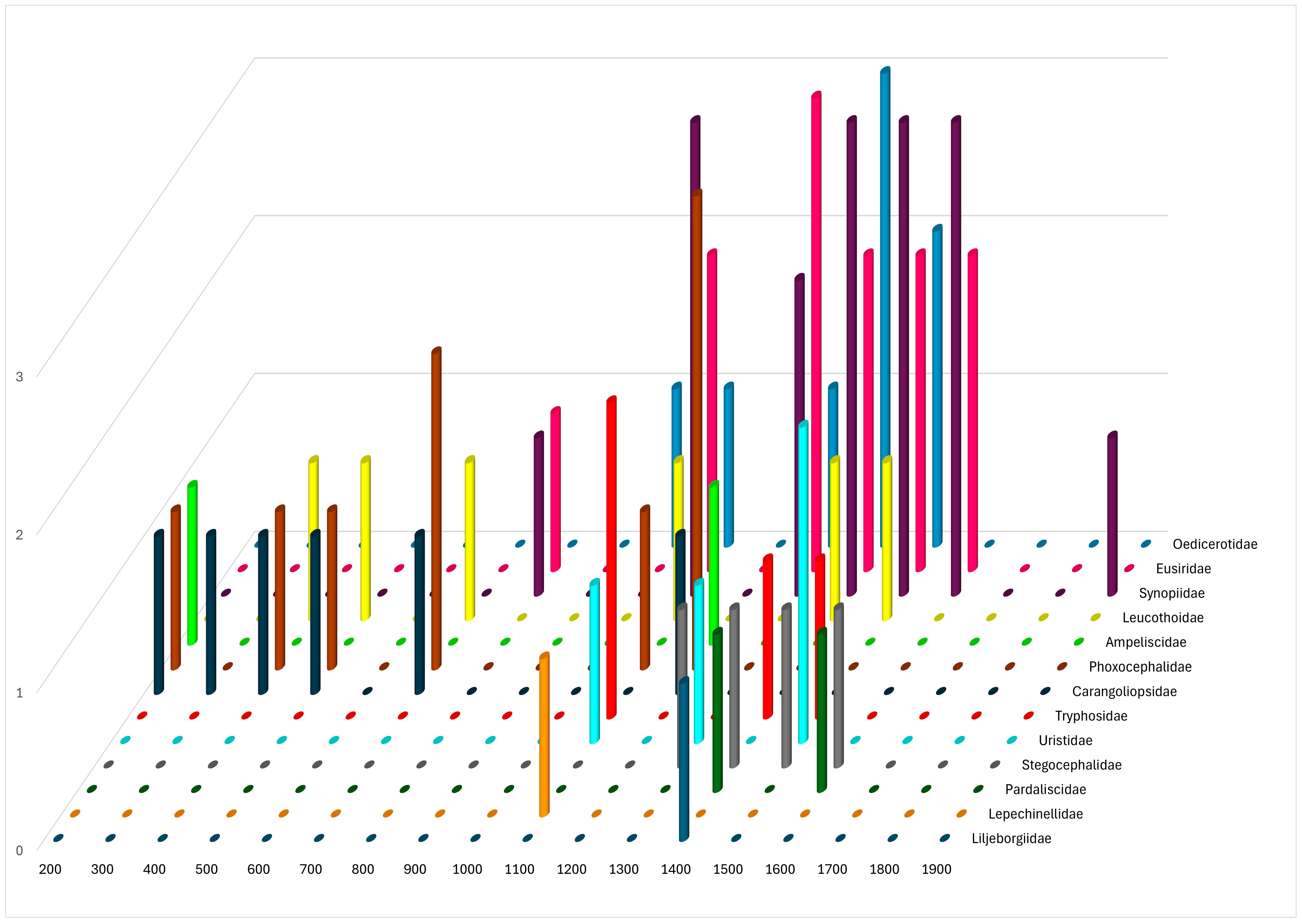

Amphipod Fauna Enhances Understanding of Eastern Mediterranean Deep-Sea Biodiversity




Abstract
1. Introduction
2. Materials and Methods
3. Results

| Family | Species | This Paper | Site ID (This Paper) | Previous Study | Taxonomic Authorities Reference and Link |
|---|---|---|---|---|---|
| Ampeliscidae | Ampelisca jaffaensis Bellan-Santini & Kaim-Malka, 1977 | confirmed | g18; S4_01; | [20] | [20] marinespecies.org /aphia.php?p=taxdetails&id=101902 accessed 2 December 2025 |
| Carangoliopsidae | Carangoliopsis spinulosa Ledoyer, 1970 | new record § | H02; g18; s2_02; S3_01; S3_02; S3_03; S4_01; s4_02; HS360C | * | [31] marinespecies.org/ aphia.php?p=taxdetails&id=102074 accessed 2 December 2025 |
| Eusiridae | Eusirus longipes Boeck, 1861 | 1 ind. [15] | [32] marinespecies.org/ aphia.php?p=taxdetails&id=102202 accessed 2 December 2025 | ||
| Rhachotropis caeca Ledoyer, 1977 | confirmed previous data | Net-1400 m | [15] | [33] marinespecies.org/ aphia.php?p=taxdetails&id=102226 accessed 2 December 2025 | |
| Rhachotropis grimaldii (Chevreux, 1887) | 2 ind. [15] | [34] marinespecies.org/ aphia.php?p=taxdetails&id=102231 accessed 2 December 2025 | |||
| Rhachotropis rostrata Bonnier, 1896 | [15] | [35] marinespecies.org/ aphia.php?p=taxdetails&id=102242 accessed 2 December 2025 | |||
| Lepechinellidae | Lepechinella manco J. L. Barnard, 1973 | 1 ind. [15] | [36] marinespecies.org/ aphia.php?p=taxdetails&id=102454 accessed 2 December 2025 | ||
| Leucothoidae | Leucothoe lilljeborgii Boeck, 1861 | confirmed previous data | H02; H03 | 4 ind. [15] | [32] marinespecies.org/ aphia.php?p=taxdetails&id=102462 accessed 2 December 2025 |
| Liljeborgiidae | Idunella pirata Krapp-Schickel, 1975 | [15] | [37] marinespecies.org/ aphia.php?p=taxdetails&id=102478 accessed 2 December 2025 | ||
| Oedicerotidae | Bathymedon monoculodiformis Ledoyer, 1983 | 10 ind. [15] | [38] marinespecies.org/ aphia.php?p=taxdetails&id=102874 accessed 2 December 2025 | ||
| Oediceroides pilosa Ledoyer, 1983 | confirmed previous data | g23; | [15] | [38] marinespecies.org/ aphia.php?p=taxdetails&id=102903 accessed 2 December 2025 | |
| Oediceropsis brevicornis Lilljeborg, 1865 | 2 ind. [15] | [27] marinespecies.org/ aphia.php?p=taxdetails&id=102904 accessed 2 December 2025 | |||
| Westwoodilla caecula (Spence Bate, 1857) | new record | s1_04; | [39] marinespecies.org/ aphia.php?p=taxdetails&id=102932 accessed 2 December 2025 | ||
| Pardaliscidae | Halice abyssi Boeck, 1871 | 2 ind. [15] | [28] marinespecies.org/ aphia.php?p=taxdetails&id=102939 accessed 2 December 2025 | ||
| Phoxocephalidae | Harpinia antennaria Meinert, 1890 | new record | H02; H03; g18; S3_02; S3_03; S4_02; | [40] marinespecies.org/ aphia.php?p=taxdetails&id=102960 accessed 2 December 2025 | |
| Harpinia crenulata (Boeck, 1871) | new record § | g18; S4_01 | [28] marinespecies.org/ aphia.php?p=taxdetails&id=102963 accessed 2 December 2025 | ||
| Harpinia dellavallei Chevreux, 1911 | 3 ind. [15] | [41] marinespecies.org/ aphia.php?p=taxdetails&id=102966 | |||
| Harpinia pectinata G.O. Sars, 1891 | new record § | S4_03 | [29] marinespecies.org/ aphia.php?p=taxdetails&id=102972 accessed 2 December 2025 | ||
| Paraphoxus oculatus (G. O. Sars, 1879) | new record | g18 | [42] marinespecies.org/ aphia.php?p=taxdetails&id=102986 accessed 2 December 2025 | ||
| Stegocephalidae | Stegocephaloides christianiensis Boeck, 1871 | [15] | [28] marinespecies.org/ aphia.php?p=taxdetails&id=103102 accessed 2 December 2025 | ||
| Synopiidae | Bruzelia typica Boeck, 1871 | [15] | [28] marinespecies.org/ aphia.php?p=taxdetails&id=103182 accessed 2 December 2025 | ||
| Ileraustroe ilergetes (J. L. Barnard, 1964) | [15] | [43] marinespecies.org/ aphia.php?p=taxdetails&id=103183 accessed 2 December 2025 | |||
| Pseudotiron bouvieri Chevreux, 1895 | confirmed previous data | g11; g26 | [15] | [44] marinespecies.org/ aphia.php?p=taxdetails&id=103184 accessed 2 December 2025 | |
| Syrrhoe affinis Chevreux, 1908 | 3 ind. [15] | [45] marinespecies.org/ aphia.php?p=taxdetails&id=103186 accessed 2 December 2025 | |||
| Tryphosidae | Orchomene grimaldii Chevreux, 1890 | 8 ind. [15] | [46] marinespecies.org/ aphia.php?p=taxdetails&id=102664 accessed 2 December 2025 | ||
| Paracentromedon crenulatus (Chevreux, 1900) | 1 ind. [15] | [47] marinespecies.org/ aphia.php?p=taxdetails&id=102701 accessed 2 December 2025 | |||
| Tryphosites alleni Sexton, 1911 | 2 ind. [15] | [48] marinespecies.org/ aphia.php?p=taxdetails&id=102778 accessed 2 December 2025 | |||
| Uristidae | Caeconyx caeculus (G.O. Sars, 1891) | 8 ind. [15] | [49] marinespecies.org/ aphia.php?p=taxdetails&id=102543 accessed 2 December 2025 | ||
| Tmetonyx similis (G. O. Sars, 1891) | 1 ind. [15] | [49] marinespecies.org/ aphia.php?p=taxdetails&id=102742 accessed 2 December 2025 |
4. Discussion
Supplementary Materials
Author Contributions
Funding
Data Availability Statement
Acknowledgments
Conflicts of Interest
References
- Danovaro, R.; Company, J.B.; Corinaldesi, C.; D’Onghia, G.; Galil, B.; Gambi, C.; Gooday, A.J.; Lampadariou, N.; Luna, G.M.; Morigi, C.; et al. Deep-sea biodiversity in the Mediterranean Sea: The known, the unknown, and the unknowable. PLoS ONE 2010, 5, e11832. [Google Scholar] [CrossRef] [PubMed]
- Lejeusne, C.; Chevaldonné, P.; Pergent-Martini, C.; Boudouresque, C.F.; Pérez, T. Climate change effects on a miniature ocean: The highly diverse, highly impacted Mediterranean Sea. Trends Ecol. Evol. 2010, 25, 250–260. [Google Scholar] [CrossRef]
- Danovaro, R.; Dell’Anno, A.; Fabiano, M.; Pusceddu, A.; Tselepides, A. Deep-sea ecosystem response to climate changes: The eastern Mediterranean case study. Trends Ecol. Evol. 2001, 16, 505–510. [Google Scholar] [CrossRef]
- Company, J.B.; Puig, P.; Sarda, F.; Palanques, A.; Latasa, M.; Scharek, R. Climate influence on deep sea populations. PLoS ONE 2008, 3, e1431. [Google Scholar] [CrossRef]
- Danovaro, R.; Dell’Anno, A.; Pusceddu, A. Biodiversity response to climate change in a warm deep sea. Ecol. Lett. 2004, 7, 821–828. [Google Scholar] [CrossRef]
- Moranta, J.; Massutı́, E.; Morales-Nin, B. Fish catch composition of the deep-sea decapod crustacean fisheries in the Balearic Islands (western Mediterranean). Fish. Res. 2000, 45, 253–264. [Google Scholar] [CrossRef]
- Tselepides, A.; Sevastou, K.; Lampadariou, N. Environmental factors influencing the benthic ecology of the deep Eastern Mediterranean Sea–A review. Deep Sea Res. Part I Oceanogr. Res. Pap. 2023, 202, 104177. [Google Scholar] [CrossRef]
- Kröncke, I.; Turkay, M.; Fiege, D. Macrofauna communities in the Eastern Mediterranean deep sea. Mar. Ecol. 2003, 24, 193–216. [Google Scholar] [CrossRef]
- Albano, P.G.; Azzarone, M.; Amati, B.; Bogi, C.; Sabelli, B.; Rilov, G. Low diversity or poorly explored? Mesophotic molluscs highlight undersampling in the Eastern Mediterranean. Biodivers. Conserv. 2020, 29, 4059–4072. [Google Scholar] [CrossRef]
- Navarro-Barranco, C.; Ros, M.; de Figueroa, J.M.T.; Guerra-García, J.M. Marine crustaceans as bioindicators: Amphipods as case study. Fish. Aquac. 2020, 9, 435–463. [Google Scholar]
- Bakalem, A.; Dauvin, J.C.; Menioui, M. Diversity of marine Amphipods (Crustacea, Peracarida) from the North African shelf of the Mediterranean Sea (Morocco, Algeria, Tunisia, Libya, Egypt). An updated checklist for 2023. Mediterr. Mar. Sci. 2024, 25, 311–373. [Google Scholar] [CrossRef]
- Jamieson, A.J.; Brooks, L.S.R.; Reid, W.D.K.; Piertney, S.B.; Narayanaswamy, B.E.; Linley, T.D. Microplastics and synthetic particles ingested by deep-sea amphipods in six of the deepest marine ecosystems on Earth. R. Soc. Open Sci. 2019, 6, 180667. [Google Scholar] [CrossRef]
- Jamieson, A.J.; Lörz, A.N.; Fujii, T.; Priede, I.G. In situ observations of trophic behaviour and locomotion of Princaxelia amphipods (Crustacea: Pardaliscidae) at hadal depths in four West Pacific Trenches. J. Mar. Biol. Assoc. U. K. 2012, 92, 143–150. [Google Scholar] [CrossRef]
- Blankenship, L.E.; Levin, L.A. Extreme food webs: Foraging strategies and diets of scavenging amphipods from the ocean’s deepest 5 kilometers. Limnol. Oceanogr. 2007, 52, 1685–1697. [Google Scholar] [CrossRef]
- Sorbe, J.C.; Galil, B.S. The bathyal amphipoda off the Levantine coast, eastern Mediterranean. Crustaceana 2002, 75, 957–968. [Google Scholar] [CrossRef]
- Lubinevsky, H.; Hyams-Kaphzan, O.; Almogi-Labin, A.; Silverman, J.; Harlavan, Y.; Crouvi, O.; Herut, B.; Kanari, M.; Tom, M. Deep-sea soft bottom infaunal communities of the Levantine Basin (SE Mediterranean) and their shaping factors. Mar. Biol. 2017, 164, 36. [Google Scholar] [CrossRef]
- Iaciofano, D.; Lubinevsky, H.; Lo Brutto, S. First record of Carangoliopsis spinulosa Ledoyer, 1970 (Amphipoda: Carangoliopsidae) in the bathyal Israeli Mediterranean waters. Ecol. Montenegrina 2024, 78, 224–227. [Google Scholar] [CrossRef]
- QGIS.org. QGIS Geographic Information System; QGIS Association, 2025. Available online: https://www.qgis.org (accessed on 2 December 2025).
- Horton, T.; De Broyer, C.; Bellan-Santini, D.; Coleman, C.O.; Copilaș-Ciocianu, D.; Corbari, L.; Daneliya, M.E.; Dauvin, J.C.; Decock, W.; Fanini, L.; et al. The World Amphipoda Database: History and progress. Rec. Aust. Mus. 2023, 75, 329–342. [Google Scholar] [CrossRef]
- Bellan-Santini, D.; Kaim-Malka, R.A. Ampelisca nouvelles de Méditerranée (Crustacea–Amphipoda). Boll. Mus. Civ. Stor. Nat. Verona 1977, 4, 479–523. [Google Scholar]
- Schellenberg, A. Die Gammariden der Deutschen Südpolar-Expedition 1901–1903; De Gruyter: Berlin, Germany, 1926; Volume 18, pp. 235–414. [Google Scholar]
- Stebbing, T.R.R. Revision of Amphipoda. Ann. Mag. Nat. Hist. 1899, 4, 205–211. [Google Scholar] [CrossRef]
- Dana, J.D. On the classification of the Crustacea Choristopoda or Tetradecapoda. Am. J. Sci. 1852, 14, 297–316. [Google Scholar]
- Lowry, J.K.; Stoddart, H.E. Amphipoda Crustacea IV. Families Aristiidae, Cyphocarididae, Endevouridae, Lysianassidae, Scopelocheiridae, Uristidae. Mem. Hourglass Cruises 1997, 10, 148. [Google Scholar]
- Hurley, D.E. Amphipoda of the family Lysianassidae from the west coast of North and Central America. Allan Hancock Found. Publ. Occas. Pap. 1963, 25, 1–160. [Google Scholar]
- Stebbing, T.R.R. Report on the Amphipoda collected by H.M.S. Challenger during the years 1873–1876. Zoology 1888, 29, 1–212. [Google Scholar]
- Lilljeborg, W. On the Lysianassa magellanica H. Milne Edwards, and on the Crustacea of the suborder Amphipoda and subfamily Lysianassina found on the coast of Sweden and Norway. Nova Acta Regiae Soc. Sci. Upsal. 1865, 6, 1–38. [Google Scholar]
- Boeck, A. Crustacea amphipoda borealia et arctica. Forh. Vidensk.-Selsk. Kristiania 1871, 1870, 83–280. [Google Scholar]
- Sars, G.O. Amphipoda. Part VII. Phoxocephalidae. An account of the Crustacea of Norway, with short descriptions and figures of all the species. A. Cammermeyer 1891, 1, 141–160. [Google Scholar]
- Dana, J.D. Crustacea. Part II. United States Exploring Expedition, During the Years 1838–1842; C. Sherman, Printer: Philadelphia, PA, USA, 1853; Volume 14, pp. 691–1618. [Google Scholar]
- Ledoyer, M. Contributions à l’étude bionomique de la Méditerranée occidentale (Côte du Var et des Alpes maritimes-côte occidentale de Corse). Fascicule 9. Les Amphipodes des vase profondes des côtes corses et monégasques. Bull. Inst. Océanographique 1970, 69, 1–32. [Google Scholar]
- Boeck, A. Bemaerkninger angaaende de ved de norske Kyster forekommende Amphipoder. Forhandler. Skand. Naturf. Ott. Mode Kjopenhavn 1861, 8, 631–677. [Google Scholar]
- Ledoyer, M. Contribution à l’étude de l’écologie de la faune vagile profonde de la Méditerranée nord occidentale. I. Les Gammariens (Crustacea, Amphipoda). Bolletino Mus. Civ. Stor. Nat. Verona 1977, 4, 321–421. [Google Scholar]
- Chevreux, E. Crustaces amphipodes nouveaux dragues par “l’Hirondelle” pendant sa campagne de 1886. Bull. Société Zool. Fr. 1887, 12, 566–580. [Google Scholar]
- Bonnier, J. Édriophthalmes. In: Koehler, R., Résultats scientifiques de la campagne du “Caudan” dans le Golfe de Gascogne. Edriophthalmes. Ann. L’université Lyon 1896, 26, 527–689. [Google Scholar]
- Barnard, J.L. Deep-sea Amphipoda of the genus Lepechinella (Crustacea). Smithson. Contrib. Zool. 1973, 133, 1–31. [Google Scholar] [CrossRef]
- Krapp-schickel, G. Neues uber die Liljeborgiiden des Mittelmeeres (Crustacea, Amphipoda). Boll. Mus. Civ. Stor. Nat. Verona 1975, 1, 455–472. [Google Scholar]
- Ledoyer, M. Les Oedicerotidae (Crustacea Amphipoda) de la Mer Méditerranée. Boll. Mus. Civ. Stor. Nat. Verona 1983, 9, 45–84. [Google Scholar]
- Spence Bate, C. A synopsis of the British edriophthalmous Crustacea. Part I. Amphipoda. Ann. Mag. Nat. Hist. Ser. 2 1857, 19, 135–152. [Google Scholar] [CrossRef]
- Meinert, F. Crustacea Malacostraca. I; Cohens Bogtrykkeri: Copenhagen, Denmark, 1890; pp. 148–230. [Google Scholar]
- Chevreux, E. Campagnes de la “Melita”. Les amphipodes d’Algérie et de Tunisie. Mémoires Société Zool. Fr. 1911, 23, 145–285. [Google Scholar]
- Sars, G.O. Crustacea et Pycnogonida nova in itinere 2do et 3tio expeditionis Norvegicae anno 1877 & 78 collecta (prodromus descriptionis). [New Crustacea and Pycnogonida collected during the 2nd and 3rd voyages of the Norwegian expedition in 1877 & 78 (prologue to the description). Arch. Math. Naturvidenskab 1879, 4, 427–476. [Google Scholar]
- Barnard, J.L. Deep-sea Amphipoda (Crustacea) collected by R.V.”Vema” in the eastern Pacific Ocean and the Carribbean and Mediterranean Seas. Bull. Am. Mus. Nat. Hist. 1964, 127, 3–46. [Google Scholar]
- Chevreux, E. Campagne de la “Melita”, 1892. Sur un amphipode, Pseudotiron bouvieri, nov. gen. et sp., de la famille des Syrrhoidae, nouvelle pour la faune mediterraneenne. Bull. Soc. Zool. Fr. 1895, 20, 165–170. [Google Scholar]
- Chevreux, E. Diagnoses d’amphipodes nouveaux provenant des campagnes de la “Princesse-Alice” dans l’ Atlantique nord. (suite). Bull. Inst. Oceanogr. 1908, 129, 1–12. [Google Scholar]
- Chevreux, E. Description de l’Orchomene grimaldii, amphipode nouveau des eaux profondes de la Mediterranee. Bull. Soc. Zool. Fr. 1890, 15, 164–166. [Google Scholar]
- Chevreux, E. Amphipodes Provenant des Campagnes de “l’Hirondelle” 1885–1888; Résultats des Campagnes Scientifiques du Prince Albert I de Monaco: Monaco City, Monaco, 1900; Volume 16. [Google Scholar]
- Sexton, E.W. A new amphipod species, Tryphosites alleni. Ann. Mag. Nat. Hist. 1911, 7, 510–513. [Google Scholar] [CrossRef]
- Sars, G.O. Amphipoda. Part V. Lysianassidae (Concluded). In An Account of the Crustacea of Norway, with Short Descriptions and Figures of All the Species; Alb. Cammermeyer: Christiania, Denmark, 1891; Volume I, pp. 93–120. [Google Scholar]
- Galil, B.S. The limit of the sea: The bathyal fauna of the Levantine Sea. Sci. Mar. 2004, 68, 63–72. [Google Scholar] [CrossRef]
- Krøyer, H. Nye nordiske slægter og arter af amfipodernes orden, henhørende til familien Gammarina. Naturhist. Tidsskr. 1842, 4, 141–166. [Google Scholar]
- Bousfield, E.L. A new look at the systematics of Gammaroidean amphipods of the world. Crustaceana 1977, 4, 282–316. [Google Scholar]
- Ruffo, S. (Ed.) The Amphipoda of the Mediterranean. Part 4. Localities and Map. Addenda to Parts –4. Key to Families. Ecology. Faunistics and Zoogeography. Bibliography. Index. In Mémoires de l’Institut Océanographique (Monaco); Institut Océanographique: Monaco City, Monaco, 1998; Volume 13, pp. 815–959. [Google Scholar]
- Lörz, A.; Kaiser, S.; Oldeland, J.; Stolter, C.; Kürzel, K.; Brix, S. Biogeography, diversity and environmental relationships of shelf and deep-sea benthic Amphipoda around Iceland. PeerJ 2021, 9, e11898. [Google Scholar] [CrossRef]
- Frutos, I.; Jażdżewska, A.M. Deep-sea amphipod fauna of the Sea of Okhotsk. Prog. Oceanogr. 2019, 178, 102147. [Google Scholar] [CrossRef]
- Badalucco, A.; Auriemma, R.; Bonifazi, A.; Cimmaruta, R.; Esposito, V.; Iaciofano, D.; Krapp, T.; Latella, L.; Lattanzi, L.; Lezzi, M.; et al. Checklist of amphipods of Italian seas: Baseline for monitoring biodiversity. Monit. Mediterr. Coast. Areas 2024, 2, 7–13. [Google Scholar] [CrossRef]
- Christodoulou, M.; Paraskevopoulou, S.; Syranidou, E.; Koukouras, A. The amphipod (Crustacea: Peracarida) fauna of the Aegean Sea, and comparison with those of the neighbouring seas. J. Mar. Biol. Assoc. U. K. 2013, 93, 1303–1327. [Google Scholar] [CrossRef]
- Bakir, A.K.; Katağan, T. Distribution of littoral benthic amphipods off the Levantine coast of Turkey with new records. Turk. J. Zool. 2014, 38, 23–34. [Google Scholar] [CrossRef]
- Iaciofano, D.; Mancini, E.; Lubinevsky, H.; Lo Brutto, S. The amphipod fauna assemblage along the Mediterranean Israeli coast, a spatiotemporal overview. Ecol. Montenegrina 2024, 80, 244–272. [Google Scholar] [CrossRef]
- Segal, Y.; Lubinevsky, H. Spatiotemporal distribution of seabed litter in the SE Levantine Basin during 2012–2021. Mar. Pollut. Bull. 2023, 188, 114714. [Google Scholar] [CrossRef]
- Momtazi, F.; Saeedi, H. Exploring latitudinal gradients and environmental drivers of amphipod biodiversity patterns regarding depth and habitat variations. Sci. Rep. 2024, 14, 30547. [Google Scholar] [CrossRef] [PubMed]
- Larson, D.M.; DeJong, D.; Anteau, M.J.; Fitzpatrick, M.J.; Keith, B.; Schilling, E.G.; Thoele, B. High abundance of a single taxon (amphipods) predicts aquatic macrophyte biodiversity in prairie wetlands. Biodivers. Conserv. 2022, 31, 1073–1093. [Google Scholar] [CrossRef]
- Jamieson, A.J.; Weston, J.N. Amphipoda from depths exceeding 6000 meters revisited 60 years on. J. Crustac. Biol. 2023, 43, ruad020. [Google Scholar] [CrossRef]
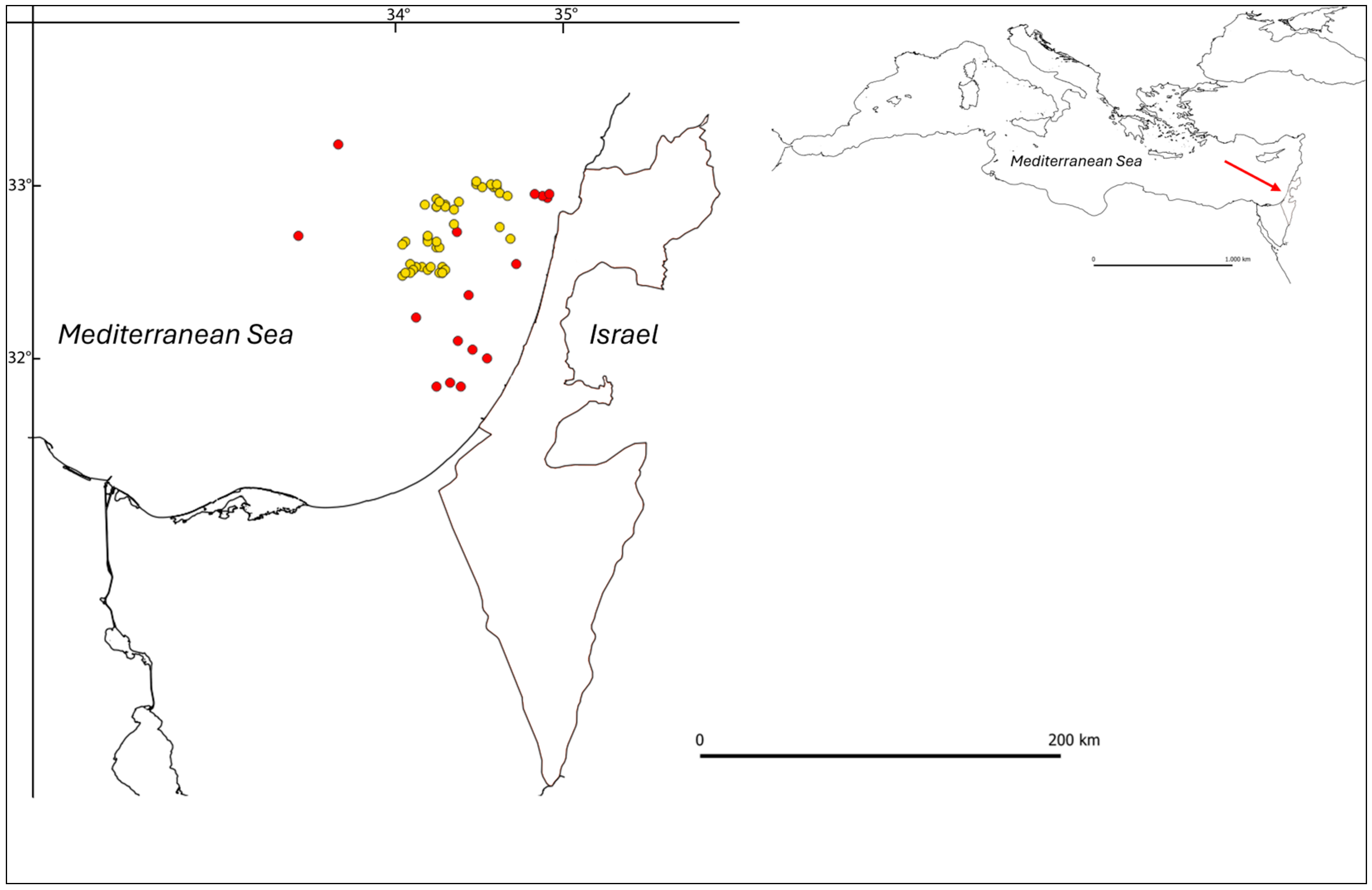

| Site ID | Depth (m) | Latitude (°N) | Longitude (°E) | Date | Reference |
|---|---|---|---|---|---|
| 93H2 | 1397 | 32.6333 | 34.2333 | October 1993 | [15] |
| 93H4 | 1297 | 32.5167 | 34.2667 | October 1993 | [15] |
| 93H5 | 1377 | 32.5167 | 34.1500 | October 1993 | [15] |
| 95A1 | 1012 | 32.7500 | 34.6000 | January 1995 | [15] |
| 95A2 | 1454 | 32.8500 | 34.3333 | January 1995 | [15] |
| 95A4 | 1503 | 32.8833 | 34.2833 | January 1995 | [15] |
| 95A5 | 1533 | 32.8667 | 34.2333 | January 1995 | [15] |
| 95A6 | 1538 | 32.9167 | 34.2333 | January 1995 | [15] |
| 95A7 | 1558 | 32.8833 | 34.1667 | January 1995 | [15] |
| 95HF1 | 1362 | 32.9833 | 34.5667 | September 1995 | [15] |
| 95HF2 | 1355 | 32.9833 | 34.5833 | November 1995 | [15] |
| 95HF3 | 1243 | 32.9500 | 34.6000 | September 1995 | [15] |
| 95HF4 | 1384 | 33.0000 | 34.5500 | September 1995 | [15] |
| 95HF5 | 1456 | 33.0000 | 34.4667 | November 1995 | [15] |
| 95HF6 | 1433 | 32.9833 | 34.5000 | September 1995 | [15] |
| 95HF7 | 1243 | 32.9333 | 34.6500 | October 1995 | [15] |
| 95HF8 | 1350 | 33.0000 | 34.5833 | November 1995 | [15] |
| 95HF9 | 1471 | 33.0167 | 34.4667 | September 1995 | [15] |
| 95HA | 1350 | 32.5000 | 34.1833 | November 1995 | [15] |
| 95H2 | 1300 | 32.4833 | 34.2667 | November 1995 | [15] |
| 95H4 | 1300 | 32.4833 | 34.2500 | November 1995 | [15] |
| 95H7 | 1480 | 32.6667 | 34.0500 | November 1995 | [15] |
| 95H13 | 1485 | 32.6833 | 34.1833 | November 1995 | [15] |
| 95H14 | 1400 | 32.6333 | 34.2500 | November 1995 | [15] |
| 95H15 | 1450 | 32.6667 | 34.2333 | November 1995 | [15] |
| 95H19 | 1400 | 32.5167 | 34.1167 | November 1995 | [15] |
| 95H20 | 1420 | 32.5333 | 34.0833 | November 1995 | [15] |
| 95700 | 734 | 32.6833 | 34.6667 | November 1995 | [15] |
| 96A1 | 1427 | 32.7667 | 34.3333 | September 1996 | [15] |
| 96A2 | 1453 | 32.9000 | 34.3667 | September 1996 | [15] |
| 96A4 | 1501 | 32.8667 | 34.2833 | September 1996 | [15] |
| 96A5 | 1518 | 32.8667 | 34.2333 | September 1996 | [15] |
| 96A6 | 1528 | 32.9000 | 34.2500 | September 1996 | [15] |
| 96HA | 1365 | 32.5167 | 34.2000 | October 1996 | [15] |
| 96H4 | 1292 | 32.5000 | 34.2833 | October 1996 | [15] |
| 96H5 | 1382 | 32.4667 | 34.0333 | October 1996 | [15] |
| 96H7 | 1505 | 32.6500 | 34.0333 | October 1996 | [15] |
| 96H14 | 1391 | 32.6667 | 34.1833 | October 1996 | [15] |
| 96H15 | 1461 | 32.7000 | 34.1833 | October 1996 | [15] |
| 96H20 | 1374 | 32.5000 | 34.1000 | October 1996 | [15] |
| 96H21 | 1281 | 32.4833 | 34.2667 | October 1996 | [15] |
| 96H22 | 1420 | 32.4833 | 34.0833 | October 1996 | [15] |
| 96H23 | 1386 | 32.4833 | 34.0500 | October 1996 | [15] |
| H02 | 303 | 32.9202 | 34.8802 | June 2013 | This paper |
| H03 | 601 | 32.9301 | 34.8503 | June 2013 | This paper |
| g11 | 1812 | 33.2321 | 33.6624 | June 2013 | This paper |
| g18 | 1122 | 32.3557 | 34.4210 | June 2013 | This paper |
| g23 | 1301 | 32.2223 | 34.1164 | June 2013 | This paper |
| g26 | 1388 | 32.6991 | 33.4287 | June 2013 | This paper |
| s1_04 | 994 | 32.9420 | 34.8052 | June 2013 | This paper |
| s2_02 | 422 | 32.5358 | 34.7018 | June 2013 | This paper |
| S3_01 | 214 | 31.9837 | 34.5299 | June 2013 | This paper |
| S3_02 | 400 | 32.0335 | 34.4431 | June 2013 | This paper |
| S3_03 | 682 | 32.0842 | 34.3611 | June 2013 | This paper |
| S4_01 | 198 | 31.8212 | 34.3761 | July 2013 | This paper |
| S4_02 | 452 | 31.8406 | 34.3151 | July 2013 | This paper |
| S4_03 | 698 | 31.8188 | 34.2334 | July 2013 | This paper |
| Net-1400 m | 1370 | 32.7215 | 34.3540 | July 2013 | This paper |
| HS360C | 394 | 32.9458 | 34.8903 | July 2013 | This paper |
| Species | AO | WM | CM | AD | AE | LE | IP | ZC |
|---|---|---|---|---|---|---|---|---|
| Ampelisca jaffaensis Bellan-Santini & Kaim-Malka, 1977 | E | |||||||
| Carangoliopsis spinulosa Ledoyer, 1970 | AM | |||||||
| Eusirus longipes Boeck, 1861 | AM | |||||||
| Rhachotropis caeca Ledoyer, 1977 | AM | |||||||
| Rhachotropis grimaldii (Chevreux, 1887) | AM | |||||||
| Rhachotropis rostrata Bonnier, 1896 | AM | |||||||
| Lepechinella manco J. L. Barnard, 1973 | AM | |||||||
| Leucothoe lilljeborgi Boeck, 1861 | AM | |||||||
| Idunella pirata Krapp-Schickel, 1975 | E | |||||||
| Bathymedon monoculodiformis Ledoyer, 1983 | AM | |||||||
| Oediceroides pilosa Ledoyer, 1983 | AM | |||||||
| Oediceropsis brevicornis Lilljeborg, 1865 | AM | |||||||
| Westwoodilla caecula (Spence Bate, 1857) | AM | |||||||
| Halice abyssi Boeck, 1871 | AM | |||||||
| Harpinia antennaria Meinert, 1890 | AM | |||||||
| Harpinia crenulata (Boeck, 1871) | AM | |||||||
| Harpinia dellavallei Chevreux, 1911 | AM | |||||||
| Harpinia pectinata G.O. Sars, 1891 | AM | |||||||
| Paraphoxus oculatus (G. O. Sars, 1879) | C | |||||||
| Stegocephaloides christianiensis Boeck, 1871 | AM | |||||||
| Bruzelia typica Boeck, 1871 | AM | |||||||
| Ileraustroe ilergetes (J. L. Barnard, 1964) | E | |||||||
| Pseudotiron bouvieri Chevreux, 1895 | E | |||||||
| Syrrhoe affinis Chevreux, 1908 | C | |||||||
| Orchomene grimaldii Chevreux, 1890 | E | |||||||
| Paracentromedon crenulatus (Chevreux, 1900) | AM | |||||||
| Tryphosites alleni Sexton, 1911 | AM | |||||||
| Caeconyx caeculus (G.O. Sars, 1891) | AM | |||||||
| Tmetonyx similis (G. O. Sars, 1891) | AM |
Disclaimer/Publisher’s Note: The statements, opinions and data contained in all publications are solely those of the individual author(s) and contributor(s) and not of MDPI and/or the editor(s). MDPI and/or the editor(s) disclaim responsibility for any injury to people or property resulting from any ideas, methods, instructions or products referred to in the content. |
© 2026 by the authors. Licensee MDPI, Basel, Switzerland. This article is an open access article distributed under the terms and conditions of the Creative Commons Attribution (CC BY) license.
Share and Cite
Iaciofano, D.; Lubinevsky, H.; Lo Brutto, S. Amphipod Fauna Enhances Understanding of Eastern Mediterranean Deep-Sea Biodiversity. Oceans 2026, 7, 9. https://doi.org/10.3390/oceans7010009
Iaciofano D, Lubinevsky H, Lo Brutto S. Amphipod Fauna Enhances Understanding of Eastern Mediterranean Deep-Sea Biodiversity. Oceans. 2026; 7(1):9. https://doi.org/10.3390/oceans7010009
Chicago/Turabian StyleIaciofano, Davide, Hadas Lubinevsky, and Sabrina Lo Brutto. 2026. "Amphipod Fauna Enhances Understanding of Eastern Mediterranean Deep-Sea Biodiversity" Oceans 7, no. 1: 9. https://doi.org/10.3390/oceans7010009
APA StyleIaciofano, D., Lubinevsky, H., & Lo Brutto, S. (2026). Amphipod Fauna Enhances Understanding of Eastern Mediterranean Deep-Sea Biodiversity. Oceans, 7(1), 9. https://doi.org/10.3390/oceans7010009