1. Introduction
Harmful algal blooms (HABs) are a global marine ecological disaster. Under the dual pressures of human activities and global environmental changes, the scale of HABs continues to expand, and the number of HABs species continues to increase [
1,
2]. It is particularly noteworthy that HAB-forming organisms show a tendency to evolve into toxic dinoflagellates [
3,
4].
Alexandrium spp. are typical harmful toxic dinoflagellates in coastal waters around the world, which are the main sources of paralytic shellfish toxins (PSTs). Outbreaks of PSTs not only directly harm aquatic organisms but also spread through the food chain, posing serious threats to seafood safety, human health, and the balance of marine ecosystems. It is estimated that approximately 2000 cases of PST poisoning occur worldwide each year, making it a global public health issue [
5].
The toxin production mechanism of
Alexandrium and the environmental behavior of the toxins have always been research hotspots in the study field of HABs. Currently, research mainly focuses on the toxin synthesis and secretion process of
Alexandrium [
6], as well as its migration and transformation in the water environment [
7,
8] and its toxic effects on marine organisms (especially shellfish) [
9,
10,
11]. However, due to land-based pollution, aquaculture activity, and other human activities, HABs and microplastic (MP) pollution have started to coexist in coastal areas in recent years [
12]. Studies have shown that microplastics can promote toxin synthesis in harmful algal species (such as
Microcystis aeruginosa and
Alexandrium pacificum) and accelerate the release of algal toxins [
13,
14]. They can also directly or indirectly alter the toxin-producing characteristics and environmental behavior of algal cells by influencing microbial community structure [
15] and adsorbing various toxins [
16].
In coastal environments, the coexistence of microplastics and toxigenic dinoflagellates and the resulting combined stress on aquatic organisms have become a common occurrence. Microalgae can colonize the surface of MPs, altering the fate of MPs in aquatic environments [
17]. These microalgae-MP aggregates enhance the adsorption of pollutants such as heavy metals and persistent organic pollutants (POPs) through stronger electrostatic and hydrophilic interactions [
17], further increasing their toxic effects. Lu et al. (2018) conducted a combined exposure experiment on zebrafish using MPs with a particle size of 5 μm and heavy metal Cd
2+ [
18]. They found that the presence of MPs increased the accumulation of Cd
2+ in the gills, intestines, and liver tissues of zebrafish. When the concentration of MPs increased from 20 μg/L to 200 μg/L, the Cd
2+ accumulation in these tissues further increased. This may be because MPs can adsorb Cd
2+, and the ingestion of MPs by zebrafish allows Cd
2+ to be carried into their gill, intestinal, and liver tissues. Numerous studies have also shown that MPs have a certain adsorption capacity for algal toxins such as okadaic acid (OA) and microcystin in the water column. Demo et al. (2025) demonstrated that PS nanoplastics could adsorb 78% of DTX1 in water within 24 h [
19]. Pestana et al. (2021) found that polystyrene (PS) had a significant adsorption capacity for microcystin-LF, with a concentration enrichment of up to 28 times from the aqueous phase to the plastics, and a toxin concentration of 142 ± 7 μg·g
−1 on the plastics [
20]. Therefore, microplastics in seawater are highly likely to act as concentrators of algal toxins. Dissolved algal toxins released by algal cells into the water may be adsorbed by microplastic particles and then ingested by farmed organisms such as shellfish, with microplastics serving as carriers. Preliminary studies have confirmed that co-exposure of
Protoceratium reticulatum and PS significantly reduced the survival and reproduction rates of zooplankton such as rotifers and copepods [
21], producing notable synergistic toxicity. Thus, uncovering the potential combined toxic effects of microplastics and toxin-producing dinoflagellates has become a new challenge for accurately assessing the ecological risks of coastal algal blooms.
The scallop, Argopecten irradians, which is native to the western North Atlantic, is an important edible bivalve species and historically supported commercial fisheries along the eastern coast of the United States. It has now been introduced for aquaculture in China and other regions, becoming an important component of marine farming and fisheries economies. Its distribution and exploitation highlight the global significance of bivalve resources for fisheries and ecosystem services. In this study, the important economic scallop species A. irradians was selected as the experimental organism, and the combined toxic effects of PS and A. pacificum on A. irradians were systematically investigated. Through short-term exposure experiments, this study revealed: (1) the ingestion of PS and A. pacificum cells by A. irradians; (2) the physiological responses of A. irradians under single and combined exposures, including survival rate, filtration rate, and antioxidant enzyme activity; and (3) the individual and combined toxic effects of PS and A. pacificum on A. irradians from the perspective of transcriptomics. The results of this study are helpful for understanding the environmental effects of toxigenic dinoflagellate/microplastic combined pollution, and will provide an important theoretical basis and data support for the comprehensive assessment of the threat of coastal combined pollution to aquaculture.
2. Materials and Methods
2.1. Experimental Materials
A. irradians scallops with a shell height of 62.40 ± 5.70 mm and a shell length of 65.20 ± 7.60 mm were selected as the experimental subjects. The scallops were collected from Haizhou Bay (Lianyungang) in March 2025. Before the experiment, the scallops were acclimated for 5 days at a temperature of 14–16 °C and pH of 7.8–8.3. Seawater was obtained from Haizhou Bay (Lianyungang), filtered through a 0.45 μm filter and aerated for 24 h to maintain the dissolved oxygen level above 6.1 mg/L. The scallops were fed daily with an appropriate amount of diatom Nitzschia closterium f. minutissima (final cell density was about 1 × 10⁵ cells/mL). After feeding, all seawater was completely replaced.
The toxic dinoflagellate, A. pacificum (strain ATHK), was maintained by the School of Marine Science and Fisheries, Jiangsu Ocean University. Seawater was obtained from Haizhou Bay (Lianyungang), filtered through a 0.45 μm filter, and sterilized at 121 °C for 30 min. The cells were grown in L1 medium under a 12 h light/12 h dark photoperiod at 20 (±1) °C.
The microplastic PS microspheres (20 μm) were commercially obtained (Zhichuang Technology Co., Ltd., Lianyungang, China). These microplastics were unaged, non-fluorescently labeled, and non-functionalized ordinary microspheres.
2.2. Experimental Methods
The experiments were carried out in glass tanks (687 × 287 × 294 mm). The control group, PS treatment group, A. pacificum treatment group and PS-A. pacificum combined treatment group were established in triplicate. A total of 12 scallops were placed in each tank. For the control group, 12 L of seawater was added. For the PS treatment group, 12 L of seawater was added followed by an appropriate amount of PS microspheres to achieve a final concentration of 1 mg/L. For the A. pacificum treatment group, 11 L of seawater was added first, followed by 1 L of A. pacificum culture at a density of 1.8 × 10⁴ cells/mL (during the later stage of exponential growth), resulting in a final algal density of 1500 cells/mL in the tank. For the combined treatment group, 11 L of seawater was added along with PS microspheres and 1 L of algal culture to achieve final concentrations of 1 mg/L PS and 1500 cells/mL A. pacificum.
A 4-day exposure experiment was conducted, during which residual algal cell density, the number of PS microspheres in the scallops, and the scallops’ survival rate were measured. At the end of the 4-day experiment, filtration rate, antioxidant enzyme activities, and MDA content were determined, and transcriptomic analysis was performed on the muscle tissue and digestive gland.
2.3. Sampling and Parameter Analysis
2.3.1. Algal Cell Density in the Experimental System
Algal cell density in the A. pacificum treatment group and the combined treatment group was measured at 6 h, 12 h, 24 h, 48 h, and 96 h. Ten milliliters of water column was collected after thoroughly mixing the experimental system and fixed with Lugol’s solution. The algal cells were counted under a microscope (LAO L1200B, Laiao, Shanghai, China).
2.3.2. Number of PS Microspheres in the Scallops
The number of PS microspheres in the scallops of the PS treatment group and the combined treatment group was measured at 2 days/4 days. A certain mass of muscle tissue and digestive gland was placed in 50 mL of 12% KOH solution and homogenized, then diluted with purified water to 300 mL. After digestion in a 60 °C constant-temperature water bath for 24 h, the mixture was filtered through a 10 µm mixed-fiber membrane. The number of PS microspheres was then counted under a stereomicroscope (Stem 508, Zeiss, Oberkochen, Germany).
2.3.3. Filtration Rate of the Scallops
On day 4 of the experiment, four scallops were taken from each tank and placed sequentially into new tanks (30 × 17 × 20 mm). Each tank was filled with 2.5 L of seawater and 0.5 L of
Nitzschia closterium f. minutissima algal suspension of the same batch for the filtration rate measurement experiment. The calculation of the filtration rate followed the method of Coughlan (1969) [
22].
2.3.4. Antioxidant Enzyme Activities, Malondialdehyde (MDA) Content, and Total Protein Content
On day 4 of the experiment, digestive gland and muscle tissues of the scallops were collected and homogenized. Physiological saline was added at a mass-to-volume ratio of 1 mg:9 µL (1 mg of sample was mixed with 9 µL of 0.9% physiological saline for grinding). After thorough homogenization, the mixture was centrifuged at 4500 rpm for 5 min, and the supernatant was collected for the measurement of catalase (CAT), superoxide dismutase (SOD), and glutathione S-transferase (GSH-ST) activities, as well as MDA and total protein contents. The assay kits were obtained from Nanjing Jiancheng Bioengineering Institute (Nanjing, China), and the measurements were performed according to the kit instructions.
2.3.5. RNA Extraction, cDNA Library Preparation, Sequencing and Analysis
The muscle and digestive gland tissues were placed into freezing tubes, rapidly frozen in liquid nitrogen, and stored at −80 °C for total RNA extraction. Total RNA was extracted using the Trizol method. The concentration of the extracted RNA was measured with an Agilent 2100 Bioanalyzer (Agilent, Santa Clara, CA, USA), and quality control was performed. Samples meeting the quality standards were then used for library construction, high-throughput sequencing, and subsequent analysis.
Qualified total RNA samples were used to construct a cDNA library. First, mRNA was enriched and purified using Oligo(dT) magnetic beads. The purified mRNA was then fragmented by adding fragmentation buffer to break it into short fragments. The fragmented mRNA was used as a template for cDNA synthesis. The purified double-stranded cDNA was end-repaired, an adenine “A” tail was added to the 3′ ends, and sequencing adapters were ligated. Fragment size selection was performed using AMPure XP Beads (1.0×) (Beckman Coulter, Los Angeles, CA, USA), followed by PCR amplification and purification with AMPure XP Beads to obtain the final cDNA library.
The constructed and quality-checked cDNA library was sequenced using the Illumina NovaSeq 6000 platform (Illumina, San Diego, CA, USA). Raw reads were filtered with fastp (v0.18.0) to obtain high-quality clean reads, and rRNA reads were removed. The remaining clean reads were assembled using StringTie v1.3.1, and transcripts were clustered. Redundant sequences were removed to obtain unigenes. The unigenes were then aligned and annotated against reference databases, including the Non-redundant Protein Sequence Database (Nr) and Kyoto Encyclopedia of Genes and Genomes (KEGG).
The expression levels of unigenes in each group were normalized to fragments per kilobase of transcript per million mapped reads (FPKM), and RSEM software was used to analyze differential expression and enrichment between treatment groups. DESeq was applied for significance analysis of gene expression differences. Genes with a fold-change ≥2 and a false discovery rate (FDR) ≤ 0.05 were defined as DEGs. Q-values indicated the significance of gene expression differences. Pathway enrichment analysis of DEGs was performed according to the KEGG database.
2.4. Data Analysis
In this study, data were analyzed by two-way analysis of variance (ANOVA) using Excel 2016 and IBM SPSS Statistics 23, with p < 0.05 considered statistically significant. Data visualization was performed using Origin 2021.
3. Results
3.1. The Intake of PS and A. pacificum Cells by A. irradians
As shown in
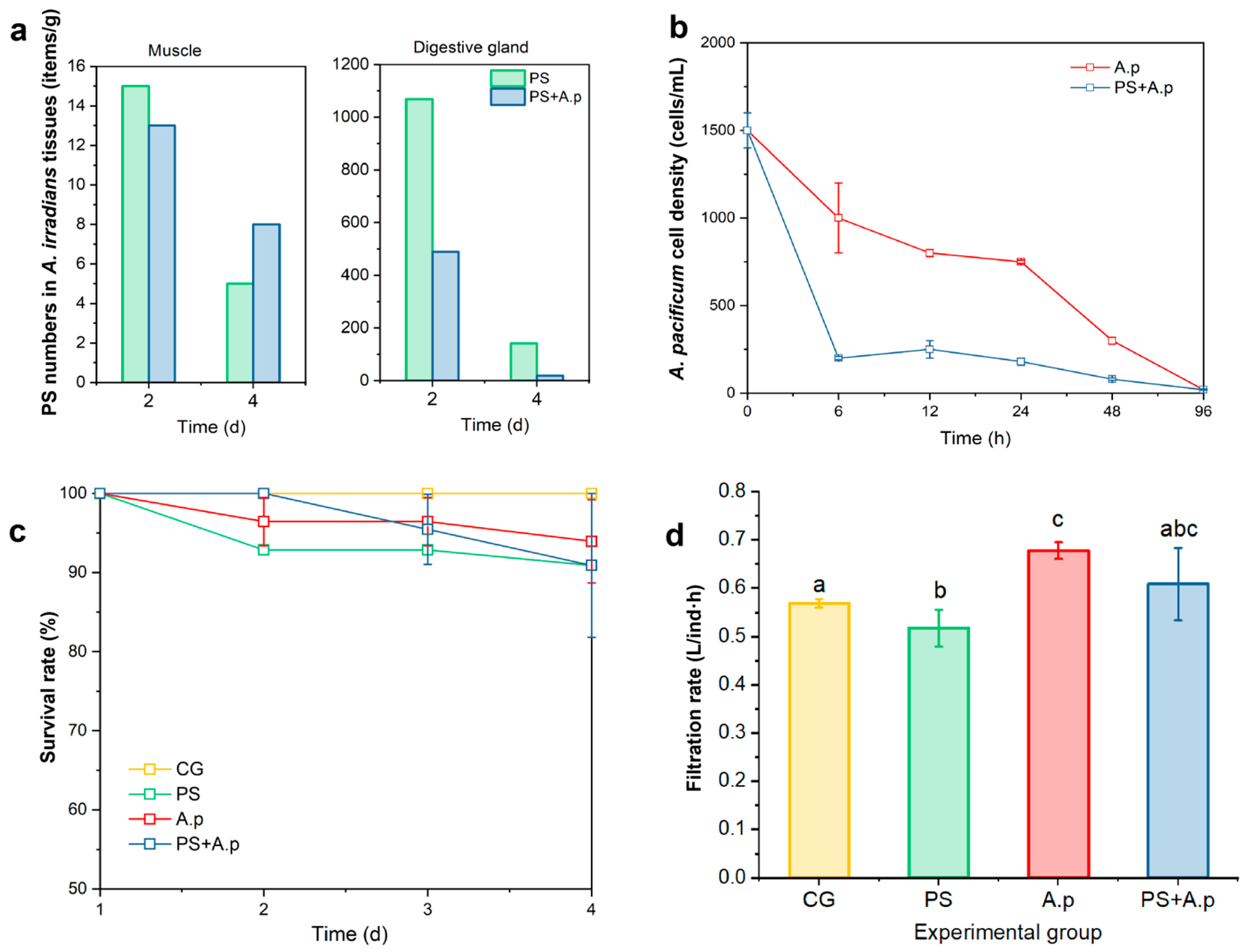
Figure 1a, in the PS treatment group, the number of PS microspheres in the digestive gland of
A. irradians reached 1069 items/g after 2 days of treatment. In the PS and
A. pacificum combined treatment group, the number of PS microspheres in the digestive gland was 489 items/g after 2 days of treatment. During the experiment, the number of PS microspheres in the muscle was much lower than that in the digestive gland. After 2 days of PS alone treatment, the number of PS microspheres in the muscle was 15 items/g, and after 2 days of the PS and
A. pacificum combined treatment, the number of PS microspheres in the muscle of scallops was 13 items/g.
The initial density of
A. pacificum cells in seawater in the
A. pacificum group and the PS and
A. pacificum combined treatment group was 1500 cells/mL. The changes in algal cell density during the experiment are shown in
Figure 1b. The results indicate that the algae cells density decreased over time in both the
A. pacificum group and the combined treatment group. After 6 h of the experiment, the algal cell density in the
A. pacificum group and the combined treatment group rapidly decreased to 1012 ± 198 cells/mL and 212 ± 10 cells/mL, respectively. After 4 days of the experiment, the algal cell density in the
A. pacificum group and the combined treatment group decreased to 19 ± 1 cells/mL and 20 ± 3 cells/mL, respectively.
3.2. The Impact of PS and A. pacificum on the Survival of A. irradians
As shown in
Figure 1c, no deaths of
A. irradians were observed in the control group throughout the entire experiment. However, in each experimental group, deaths of
A. irradians occurred successively after the second day of the experiment. At the end of the experiment, the survival rates of
A. irradians in the PS treatment group, the
A. pacificum treatment group, and the combined treatment group were 90.91 ± 0.00%, 93.94 ± 5.25%, and 90.91 ± 9.09%, respectively. There was no significant difference in the survival rates among these three treatment groups (
p > 0.05).
This study further analyzed the filtration rate of the surviving scallops after 4 days of treatment (
Figure 1d). At this time, the filtration rate of
A. irradians in the control group was 0.57 ± 0.01 L/ind·h; the filtration rate of
A. irradians in the PS treatment group was 0.52 ± 0.04 L/ind·h, significantly lower than that of the control group (
p < 0.05); the filtration rate of
A. irradians in the
A. pacificum treatment group was 0.68 ± 0.02 L/ind·h, significantly higher than that of the control group (
p < 0.01). However, there was no significant difference between the filtration rate of
A. irradians in the combined treatment group and that in the control group (
p > 0.05).
3.3. Changes in Oxidative Stress Parameters of the A. irradians
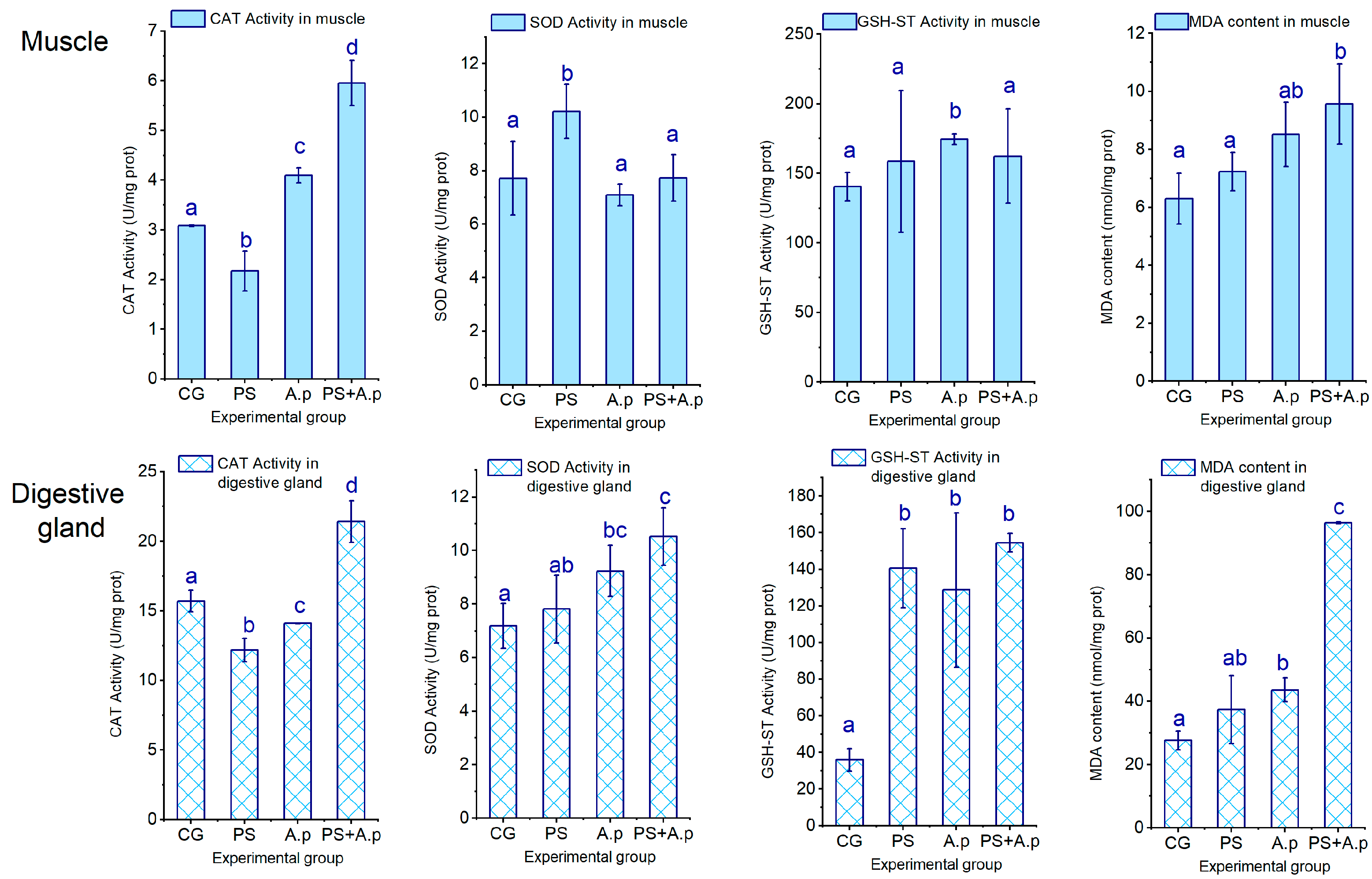
After 4 days of treatment, the activities of antioxidant enzymes and the MDA content in
A. irradians muscle tissue and digestive glands were measured (
Figure 2). For muscle tissue, the CAT activity in the control group was 3.08 ± 0.01 U/mg prot. The PS treatment group showed a significant decrease in CAT activity compared with the control group (
p < 0.05). In the
A. pacificum treatment group, CAT activity increased to 4.10 ± 0.15 U/mg prot, which was 33.12% higher than that of the control group. And in the combined treatment group, CAT activity increased to 5.96 ± 0.46 U/mg prot, which was 93.51% higher than that of the control group. And based on the two-way ANOVA, a significant interaction effect between PS and
A. pacificum was observed on the CAT activity in the muscle tissue (
p < 0.01). In addition, as a product of lipid peroxidation of cell membranes, MDA is also an important indicator for assessing the degree of oxidative stress. The results showed that the MDA content in the control group was 6.30 ± 0.87 nmol/mg prot. There was no significant difference in MDA content between the PS or
A. pacificum treatment group and the control group (
p > 0.05). However, in the combined treatment group, the MDA content reached 9.56 ± 1.38 nmol/mg prot, which was significantly higher than that of the control group (
p < 0.05).
In the digestive glands of the A. irradians under PS treatment, among the three antioxidant enzymes, only GSH-ST activity showed a significant increase compared with the control group (p < 0.01). In the A. pacificum treatment group, SOD and GSH-ST activities were both significantly higher than those in the control group (p < 0.01). However, in the combined treatment group, all the CAT, SOD, and GSH-ST activities in the digestive glands showed significant increases compared with the control group (p < 0.01), and the increase was greater than that in the PS or A. pacificum treatment group. Regarding MDA, the MDA content in the PS treatment group was not significantly different from that in the control group, while the MDA content in the A. pacificum treatment group and the combined treatment group was significantly higher than that in the control group (p < 0.01), and the MDA content in the combined treatment group was even as high as 3.49 times that of the control group. Based on the two-way ANOVA, significant interaction effects between PS and A. pacificum were observed on the CAT activity, GST activity, and MDA content in the digestive gland (p < 0.05).
3.4. Analysis of Differentially Expressed Genes (DEGs) and Metabolic Pathways in A. irradians
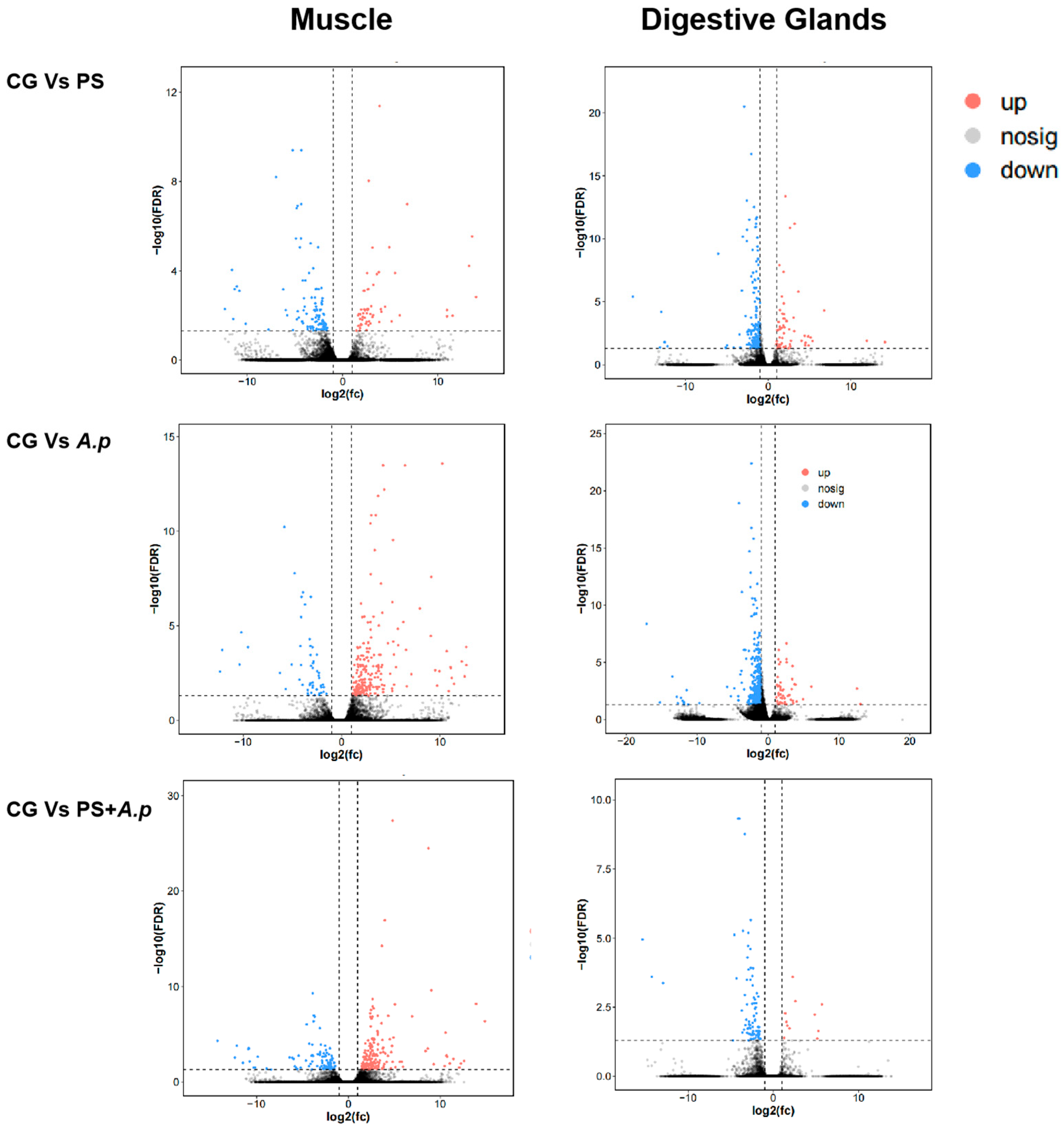
The transcriptomic results showed that after 4 days of treatment with PS, 59 genes in the muscle tissues were significantly upregulated, and 110 genes were significantly downregulated; 57 genes in the digestive glands were significantly upregulated, and 164 genes were significantly downregulated. After 4 days of treatment with
A. pacificum, the number of DEGs was more than the PS treatment group. Among them, 207 genes in the muscle tissues were significantly upregulated, and 52 genes were significantly downregulated; 49 genes in the digestive glands were significantly upregulated, and 454 genes were significantly downregulated. And in the combined treatment group, 163 genes in muscle tissues were significantly upregulated, and 97 genes were significantly downregulated; 11 genes in the digestive glands were significantly upregulated, and 87 genes were significantly downregulated (
Figure 3).
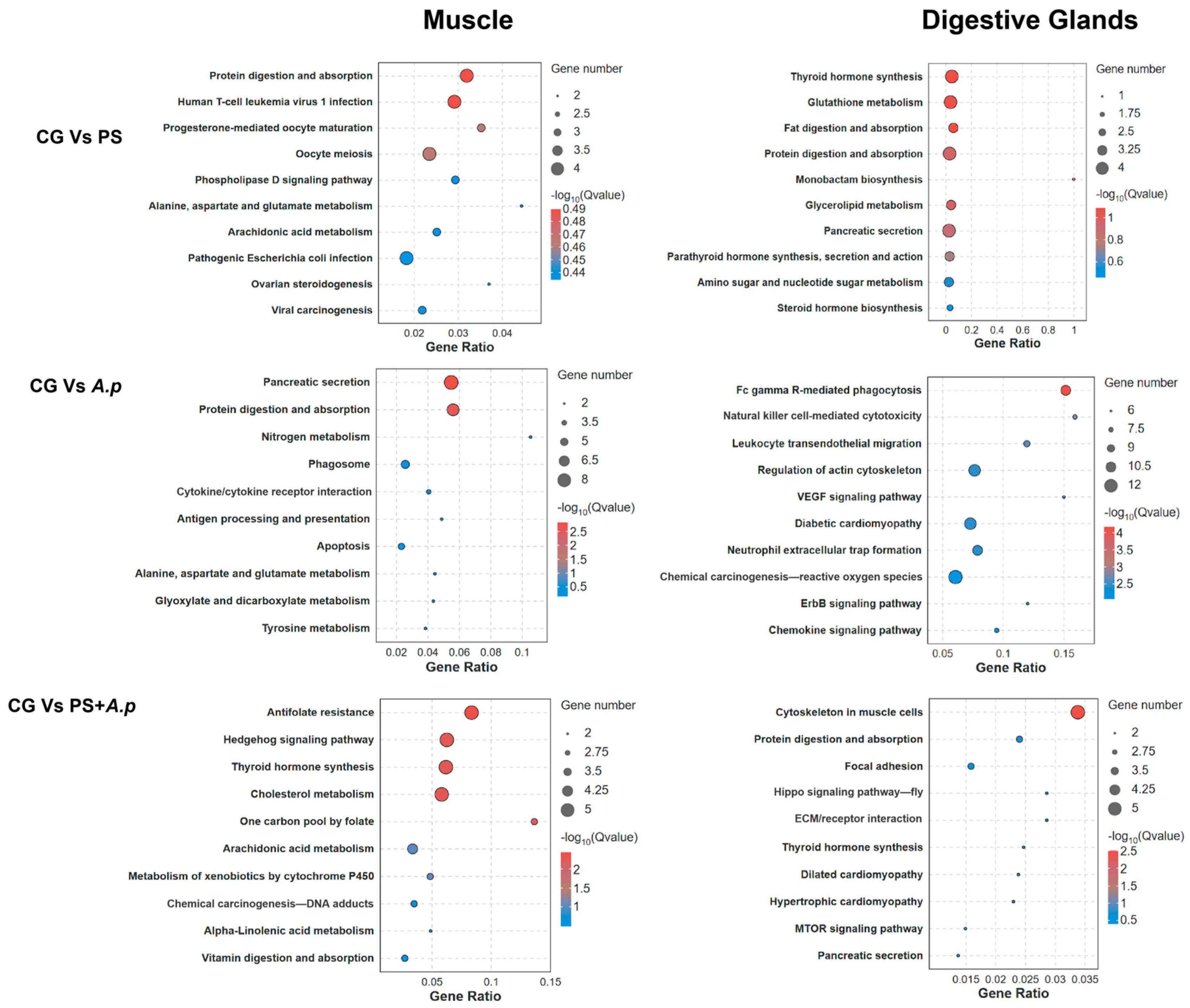
The DEGs were subjected to pathway enrichment analysis using the KEGG database (
Figure 4). Based on the Q-values, the top 10 significantly enriched KEGG pathways are shown in
Figure 4. The PS mainly affected the metabolic process of the
A. irradians and interfered with their endocrine function. Under the condition of PS exposure, the processes of protein digestion and absorption, as well as alanine, aspartate, and glutamate metabolism, were significantly altered in the muscle and digestive gland tissues. Meanwhile, in the digestive glands, the pathways of parathyroid hormone synthesis, secretion and action, as well as steroid hormone biosynthesis, were also disrupted, further confirming the endocrine-disrupting effects of PS.
The KEGG enrichment pathways of DEGs in the A. pacificum treatment group showed that the core characteristics of A. pacificum’s toxicity were its cytotoxic effect on scallops, which led to immune stress. The pathways of phagosome, cytokine/cytokine receptor interaction, antigen processing and presentation, and apoptosis were significantly upregulated in muscle tissue, providing direct evidence that A. irradians initiated a specific immune response to cope with the toxic algae cells. However, in the digestive glands, immune-related pathways such as phagocytosis, natural killer cell-mediated cytotoxicity, leukocyte transendothelial migration, regulation of the actin cytoskeleton, and neutrophil extracellular trap formation were significantly downregulated. This may be because the toxic algae cells accumulated extensively in the digestive glands, and the excessive exposure impaired its immune functions.
Compared with single stress exposure, the results of the combined treatment group indicated that PS and A. pacificum had a synergistic toxic effect, which would trigger more complex new effects, mainly manifested in aspects such as exogenous substance metabolism, developmental signals, and genetic material stability. In addition to metabolic pathways such as protein digestion and absorption and thyroid hormone synthesis, pathways including alpha-linolenic acid metabolism and metabolism of xenobiotics by cytochrome P450 were also impacted in A. irradians from the combined treatment group, indicating a stronger response to exogenous pollutants. Furthermore, in the digestive gland, pathways such as cytoskeleton in muscle cells, the Hippo signaling pathway, ECM/receptor interaction, and the mTOR signaling pathway were disordered under the combined effect of PS and A. pacificum, revealing that the combined exposure exerted specific toxic effects on the cellular structure, proliferation, and autophagy processes of A. irradians.
4. Discussion
When organisms are subjected to environmental stress, reactive oxygen species (ROS) will rapidly accumulate within tissues or cells. CAT, SOD, and GSH-ST are important components of the biological antioxidant system in organisms, playing a role in removing and balancing the ROS within cells. They are important indicators for detecting the degree of oxidative stress in scallops. MDA, as a product of lipid peroxidation, is also an important biomarker for the level of oxidative stress. The results of this study showed that under the treatment with PS alone, only the GSH-ST activity in the digestive glands of the scallops was significantly higher than that of the control group. Under the treatment with A. pacificum alone, the SOD activity, GSH-ST activity and MDA content in the digestive glands of the scallops were all significantly higher than those of the control group. The combined treatment of PS and A. pacificum induced the strongest responses in antioxidant enzyme activities (CAT, SOD, and GSH-ST) as well as the highest levels of the lipid peroxidation product MDA. This indicated that both PS and A. pacificum exerted stress effects on scallops, and that scallops experienced more severe toxic stress under the combined treatment. In this study, the survival rates of A. irradians in all three treatment groups were above 90%, indicating that the concentrations of PS and A. pacificum set in the experiment did not reach levels that seriously affected the survival of the scallops in a short period of time. The use of a single concentration and a short exposure period in this study presents certain limitations. Additional work is needed to more comprehensively evaluate how different concentrations of microplastics or toxigenic microalgae and varying exposure periods impact scallop survival, and the present study aims to elucidate the short-term toxic effects of PS and A. pacificum on scallops.
It was found that in both the PS single treatment group and the combined treatment group, a large number of PS microspheres accumulated in the bodies of the scallops. And the accumulation of PS in the digestive glands of the scallops was much higher than that in the muscle tissues, indicating that 20 μm PS could have been filtered and eaten by the scallops and entered their bodies. The consumption of microplastics by scallops can lead to the blockage of food channels or cause pseudo-satiety, thereby affecting their feeding efficiency, resulting in biological energy deficiency and even death [
23]. Based on the results of this study, the filtration rate of
A. irradians in the PS group was significantly lower than that in the control group. This might be due to the fact that after the scallops ingested a large number of PS microspheres, their food channels were blocked, thereby hindering their filtration and feeding behaviors. In addition, microplastics can release additives into drinking water, fresh water and seawater environments [
24]. The components primarily include phthalate acid esters (PAEs), bisphenol A (BPA), and brominated flame retardants (BFRs) [
25,
26,
27]. PAEs, BPA, and BFRs are all typical endocrine-disrupting chemicals (EDCs). After scallops ingest microplastics, various EDCs will slowly be released within the scallops and disrupt the normal hormone balance. The transcriptomic results showed that in the PS treatment group, the basic metabolic pathways such as arachidonic acid metabolism and glycerolipid metabolism in the scallops were significantly affected. In the combined treatment group, the thyroid hormone synthesis pathway in the scallops was also significantly affected. This suggested that various EDCs might be gradually released from the PS microspheres, thereby disturbing the normal hormonal homeostasis of the scallops. Therefore, PS might exert stress on scallops through both physical stress and chemical effects, which could be verified in future studies by including a PS leachate treatment group.
During the experiment, the density of
A. pacificum cells in the water of both the
A. pacificum single treatment group and the combined treatment group continued to decrease, indicating that the
A. pacificum cells could have also been filtered and eaten by the
A. irradians scallop and entered its body.
A. pacificum is a typical toxigenic dinoflagellate that can produce paralytic shellfish toxins (PSTs) [
28]. Previous studies have shown that PSTs ingested by scallops will accumulate continuously in their bodies. When reaching a certain concentration in scallops, it can cause shell closure response, oxygen consumption response, cardiac beating [
29], and neurophysiological response and feeding response, and even affect their survival. Previous studies have also shown that after ingesting certain PSTs, enzyme activities such as SOD, glutathione peroxidase (GSH-Px), and GSH-ST in organisms like
Cerastoderma edule,
Mytilus chilensis, and
Patinopecten yessoensis will be activated to varying degrees [
9,
10,
11], which is consistent with the results of this study. Moreover, based on the results of the transcriptomic analysis, it can be found that the DEGs in the scallops under
A. pacificum exposure were significantly enriched in multiple immune-related pathways such as phagocytosis, antigen processing and presentation, and leukocyte transendothelial migration. This further confirmed that
A. pacificum, as an exogenous stressor, induced immune stress in scallops. However, whether this effect was indeed mediated by algal toxins should be further verified by using a cell-free algal toxin solution.
Therefore, both PS and
A. pacificum could induce toxic effects through different mechanisms, and under their combined exposure, the levels of antioxidant enzymes and MDA indicated that the scallops experienced a stronger toxic stress. Based on the results of transcriptomic analysis, under the combined effect of PS and
A. pacificum, the metabolism of xenobiotics by cytochrome P450 of the scallops was significantly affected. Cytochrome P450 is the main drug-metabolizing enzyme system in organisms, responsible for converting hydrophobic exogenous substances (such as drugs, toxins, environmental pollutants, etc.) into more easily excretable hydrophilic metabolites [
30]. This indicated that under combined stress, the metabolic pressure on scallops to process exogenous substances is increased. On the one hand, numerous studies have shown that PS has a certain adsorption capacity for algal toxins such as OA and microcystin in a water column. Demo et al. (2025) demonstrated that PS nanoplastics could adsorb 78% of DTX1 in water within 24 h [
19]. Pestana et al. (2021) found that PS has a significant adsorption capacity for microcystin-LF, with a concentration enrichment of up to 28 times from the aqueous phase to the plastics, and a toxin concentration of 142 ± 7 μg·g
−1 on the plastics [
20]. So under the combined stress of PS and toxin-producing microalgae, scallops might accumulate higher levels of algal toxins by ingesting PS microspheres enriched with these toxins. On the other hand, the presence of PS might interfere with the metabolic detoxification of algal toxins in scallops. In the PS and
A. pacificum combined treatment group, the filtration rate showed no significant difference from the control group and was significantly lower than that of the
A. pacificum treatment group. This indirectly indicated that the presence of microplastics might hinder the filtration behavior of scallops, further impeding their metabolism and excretion of algal toxins. Furthermore, the Hedgehog signaling pathway, mTOR signaling pathway and Hippo signaling pathway under the combined treatment were significantly affected. The abnormalities of these pathways are closely related to uncontrolled cell proliferation, differentiation and apoptosis [
31,
32], and are important indicators of long-term toxicity. This indicated that under the combined action of the two factors, cumulative damage might have been inflicted on the scallops, confirming that multiple key developmental and homeostasis regulatory pathways in the scallops were disturbed under the combined treatment.
In summary, combined contamination by microplastics and toxin-producing dinoflagellates can exert stronger toxic stress effects on scallops. However, this study still has some follow-up work that needs to be further improved: (1) histopathological analyses should be conducted to validate the biochemical and transcription results; (2) the mechanisms of microplastics and toxin-producing dinoflagellates on scallops should be further verified through experiments including PS leachate and cell-free algal toxin solution treatment groups, respectively; and (3) a more comprehensive evaluation is needed to reveal the toxic effects and mechanisms associated with different concentrations of microplastics or toxin-producing microalgae, as well as varying exposure durations, in scallops.
Under the dual pressures of climate change and coastal eutrophication, both microplastic inputs and the frequency of harmful algal blooms are expected to continue increasing, posing a serious potential threat to the shellfish aquaculture industry. On the one hand, the ingestion and bioaccumulation of microplastics and toxic dinoflagellates may prolong growth cycles, reduce survival rates, and lead to inconsistent product size, thereby directly diminishing aquaculture yield and economic returns. On the other hand, the accumulation of algal toxins not only increases mortality risk in shellfish but also markedly elevates food safety hazards and the likelihood of poisoning incidents, resulting in frequent harvest closures and product recalls that severely disrupt the stability of the industrial supply chain. The ecological and economic consequences arising from the combined pollution of microplastics and harmful algal blooms therefore warrant heightened attention and comprehensive management.