Article

Strandings of Tuna Remains Along Italian Coasts: Insights from Citizen Science into Potential Illegal Fishing


by
Alessandro Nota
1,2,*,
Thomas Hesselberg
3,4 and
Francesco Tiralongo
2,5
1
Department of Veterinary Sciences, University of Turin, 10095 Grugliasco, Italy
2
Ente Fauna Marina Mediterranea, Scientific Organization for Research and Conservation of Marine Biodiversity, 96012 Avola, Italy
3
Department for Continuing Education, University of Oxford, Oxford OX1 1AB, UK
4
Department of Biology, University of Oxford, Oxford OX1 2JA, UK
5
Department of Biological, Geological and Environmental Sciences, University of Catania, 95124 Catania, Italy
*
Author to whom correspondence should be addressed.
Oceans 2026, 7(1), 12; https://doi.org/10.3390/oceans7010012
Submission received: 31 December 2025 / Revised: 24 January 2026 / Accepted: 30 January 2026 / Published: 31 January 2026

Abstract

The Atlantic bluefin tuna (Thunnus thynnus) is a high-value species subject to strict catch quotas and seasonal closures in the Mediterranean Sea. However, detecting illegal, unreported, and unregulated fishing remains challenging, particularly for small-scale activities. The aim of this study is to investigate whether citizen-reported strandings of tuna remains along Italian coasts can provide potential indirect indications of illegal fishing activities. To address this question, we collected and verified photographic records of stranded tuna remains (e.g., skulls, vertebral elements, complete specimens) reported on social networks. A similar search was conducted for two other conspicuous fishes, the ‘dusky grouper’ (Epinephelus marginatus) and the ‘greater amberjack’ (Seriola dumerili), as controls. Thirty-two strandings of tuna remains were recorded, with no records of amberjacks and only one of dusky grouper. Most strandings involved tuna heads or neurocrania, some of which showed clear mechanical cuts indicating post-capture processing. Several remains were older and degraded, suggesting long-term persistence in the sea. Overall, our results indicate that citizen-reported strandings could provide low-cost, spatially broad potential indications of discards resulting from illegal fishing activities. Wider adoption of standardised public reporting could not only engage the public in marine conservation, but also provide valuable data for policymakers tackling illegal fishing and complement traditional fisheries monitoring.

1. Introduction

The Atlantic bluefin tuna (Thunnus thynnus) is one of the most valuable and iconic fishes exploited in global fisheries. This species is a long-lived, highly migratory predator with complex population structure, spawning aggregations, and trans-Atlantic movements, making its management particularly challenging [1,2]. The Mediterranean Sea is a primary spawning ground for the eastern stock of the species, with adults migrating from the eastern Atlantic to their natal areas including the Balearic Islands, the Tyrrhenian, the Ionian, and the Levantine seas [2,3,4]. In the Mediterranean, following decades of overexploitation and catch under-reporting by both professional and recreational fisheries, the fish has been subject to strict conservation and management measures [5].
In Italy, recreational fishing for bluefin tuna (BFT) is regulated under the national implementation of International Commission for the Conservation of Atlantic Tunas (ICCAT) recommendations. The authorised recreational season typically runs from 16 June to 14 October, in accordance with the European Council Regulation (EC) No 302/2009, repealed by Regulation No 2016/1627 and then by Regulation 2023/2053, which established a multiannual recovery plan for BFT in the Eastern Atlantic and Mediterranean [6,7,8]. Every year, a national decree establishes the quota of BFT assigned to each fishing sector; once this quota is reached, fishing is permitted only under a catch-and-release regime [9,10,11]. In practice, the recreational quota is usually reached before the official end of the season on 14 October, leading to an early suspension of catches. Notably, in the past five years (2021–2025), the recreational bluefin tuna season has closed in the first half of August [12,13,14,15,16]. Fishing outside the authorized periods is prohibited, and the presence of tuna remains on beaches during closed seasons may indicate illegal, unreported, or unregulated (IUU) fishing activities.
Within this regulatory framework, detecting illegal or unreported fishing is particularly difficult. Therefore, alternative data sources, such as citizen science observations, may provide complementary insights into an otherwise poorly detected phenomenon. Citizen science, the collection of scientific observations by members of the public, is a versatile approach for studying various aspects of environmental sciences. For example, it has been applied to track species distributions and detect invasive species [17,18], document wildlife mortality events [19], and monitor changes in phenology and abundance over large spatial and temporal scales [20,21]. When properly validated, such data can complement formal scientific surveys and expand geographic coverage at a very low cost [22].
This study examines (i) whether beach strandings of bluefin tuna along Italian coasts reported by citizen scientists are more frequent than those of other conspicuous fish species, and (ii) whether their temporal distribution is biased toward closed fishing periods, suggesting discards of illegally fished specimens. First, we outline the dataset of tuna strandings collected via citizen science. Then, we compare these strandings with control species, and examine their temporal distribution relative to open and closed recreational fishing seasons. We then interpret these results in terms of potential illegal fishing activities and discuss the implications and limitations of our approach. The results evidence the potential of involving citizen scientists to provide indirect indicators of possible IUU fishing.

2. Materials and Methods

2.1. Data Collection

To search for records of beached Atlantic bluefin tuna, a targeted search was conducted between July and August 2025 on Facebook, particularly in Italian marine biology and fishing groups. Keywords used for the search: ‘Thunnus’, ‘Thunnus thynnus’, ‘tonno’ (Italian for ‘tuna’). A similar search was performed on iNaturalist, inspecting all observations attributed to the Carangidae family. Each resulting post, photo or observation was carefully examined, and only those clearly showing remains attributable to T. thynnus were considered. For each of these, the author of the observation was privately contacted to clarify the date and locality of observation, to gather the best possible photographic material, and to ask for permission to use such data for the research. The photographic material was carefully examined to validate the identity of the species, evaluate which body parts were involved in the stranding (e.g., neurocranium/whole head/whole body), the integrity of the bones, and the presence or absence of soft tissues over the bones. Species identification was based on diagnostic osteological characters of Thunnus thynnus, following comparative anatomical descriptions (e.g., [23,24]) and the authors’ direct experience with tuna skeletal material from previous examinations. Overall, 62 observers were contacted, and approximately 52% of them provided additional information and confirmation; only fully validated records were included in the analyses. All records were independently reviewed by two authors to confirm species identity.
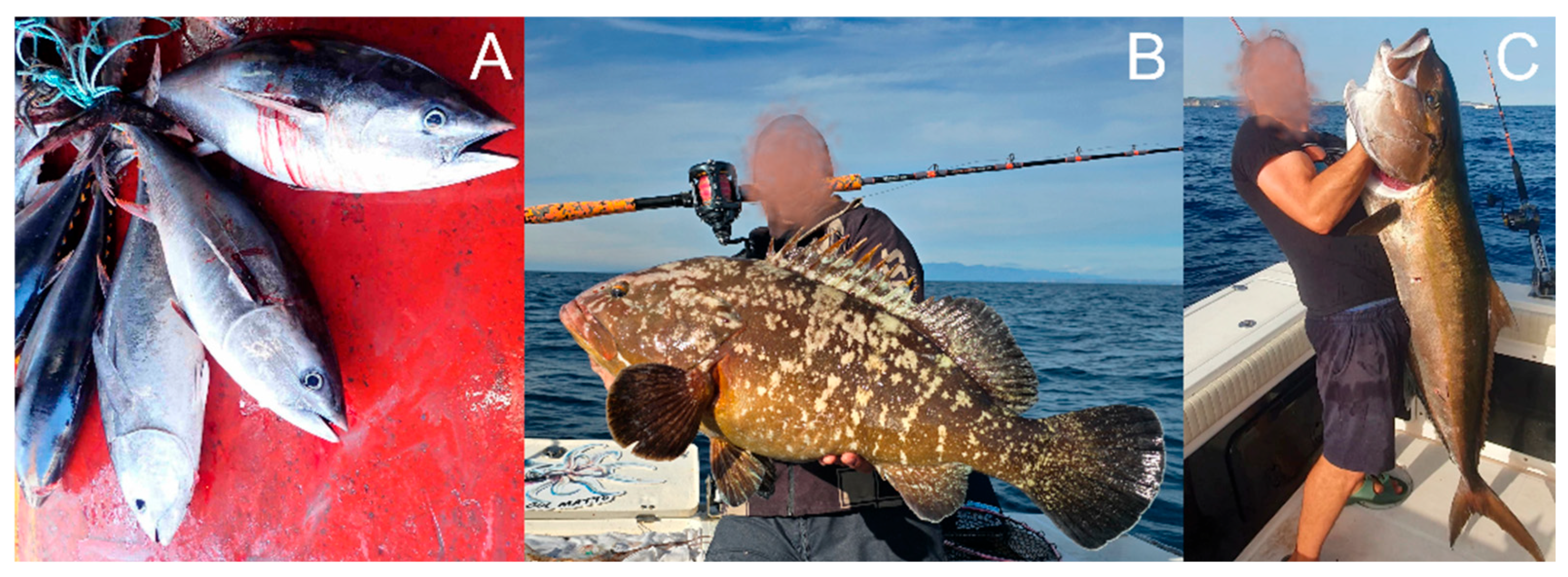
A similar approach was used on the same platforms and groups for two control species, the dusky grouper Epinephelus marginatus and the amberjack Seriola dumerili (Figure 1) for the same period.
These species were selected because they are large-bodied, common, and easy to recognize; besides, they are commonly targeted by fishermen. The study period considered included records from 1 January 2021 to 19 August 2025.

2.2. Statistical Analyses

To account for the different number of days in the open and closed seasons, a chi square test with an uneven expected distribution was used to compare the frequencies of tuna strandings between open and closed season, with expected values proportional to the number of days in each. To account for the postmortem interval occurring between the death of an individual and its stranding [25], the same analysis was repeated by shifting the open season window forward one week, that is, considering the open season as starting seven days after the official opening date and ending seven days after the official closing date.
Analyses were performed using R v. 4.4.2 (R Core Team, Vienna, Austria).

3. Results

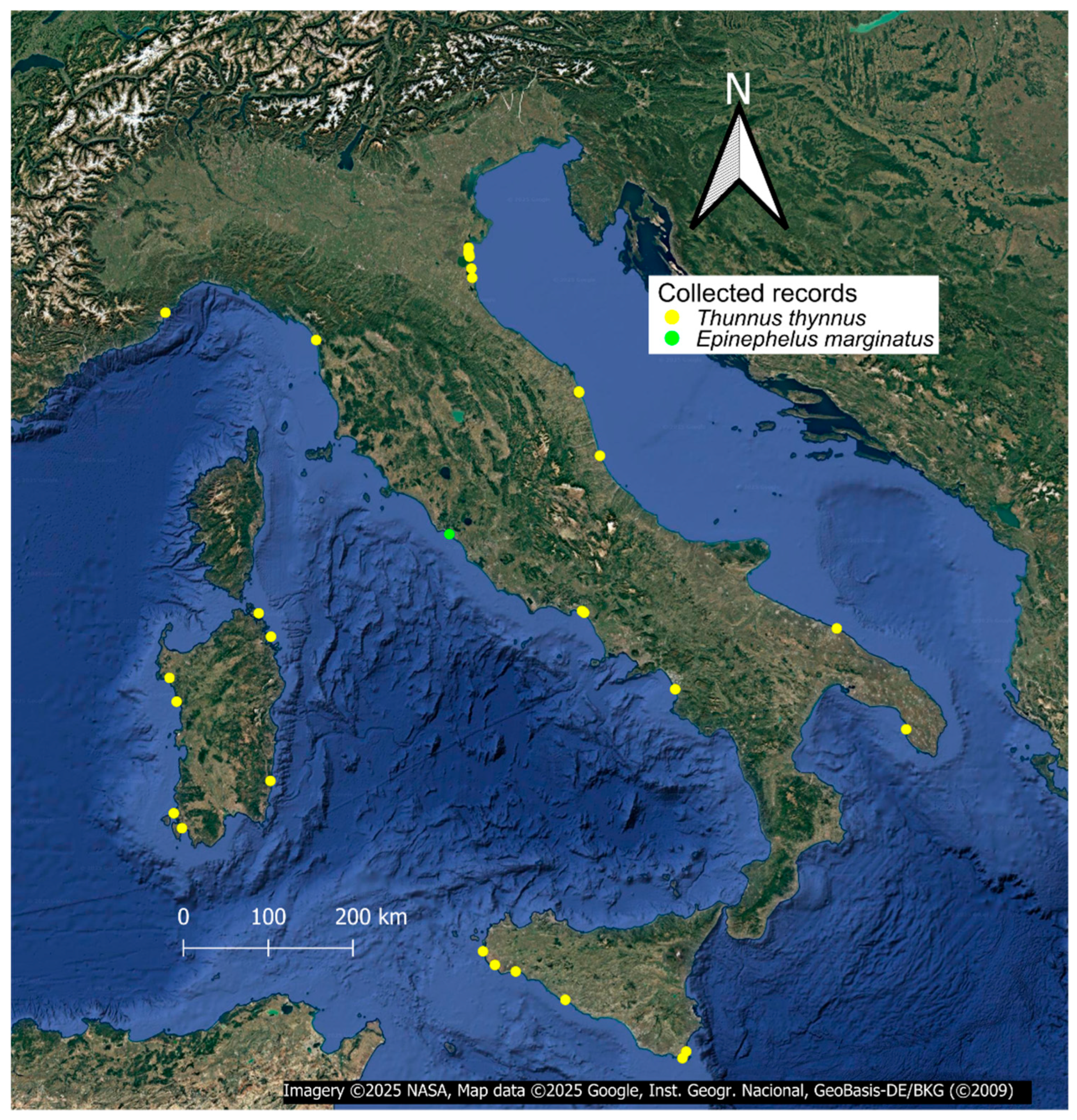
The geographic distribution of T. thynnus remains recorded across Italian coasts is shown in Figure 2.
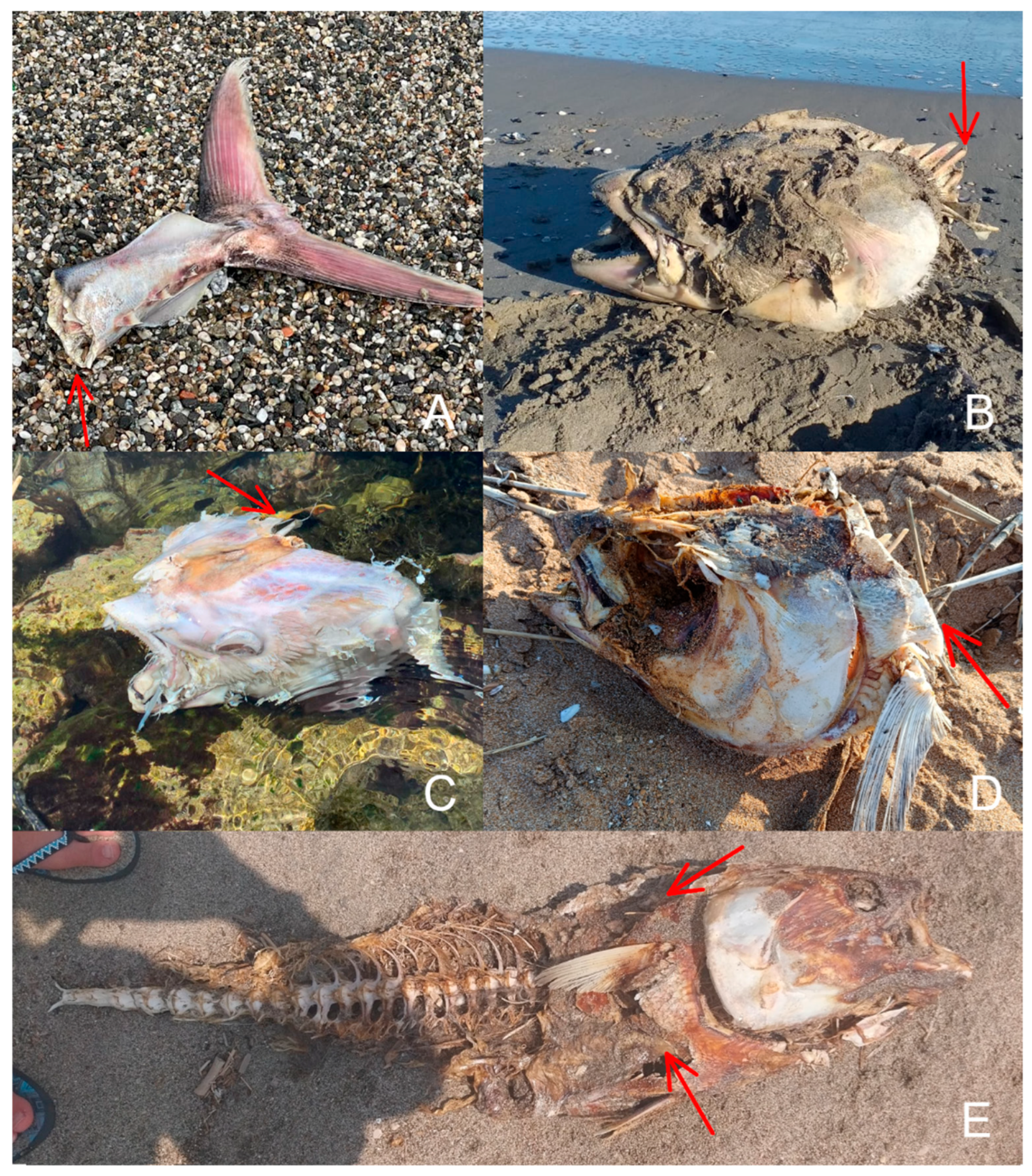
A total of 32 records of beached remains of T. thynnus were collected from citizen science sources. The records referred to different body parts: only four involved the complete or quasi-complete body of the fish, while the others concerned other bones, mainly neurocrania (Table 1). Multiple observations display sharp, mechanical cut marks, such as cut fins, vertebral bones, or flesh (Figure 3). Figure 3E shows a complete but filleted individual (cut marks are visible behind the pectoral fin).
Fifteen of the collected records reported the presence of soft tissues on the remains, while 17 involved bones completely cleaned of flesh. In several cases (16 records), the bones appeared at least partially damaged, potentially indicating a long post-mortem persistence. No records were found for the greater amberjack (S. dumerili), and only one was found on iNaturalist for the dusky grouper (E. marginatus).
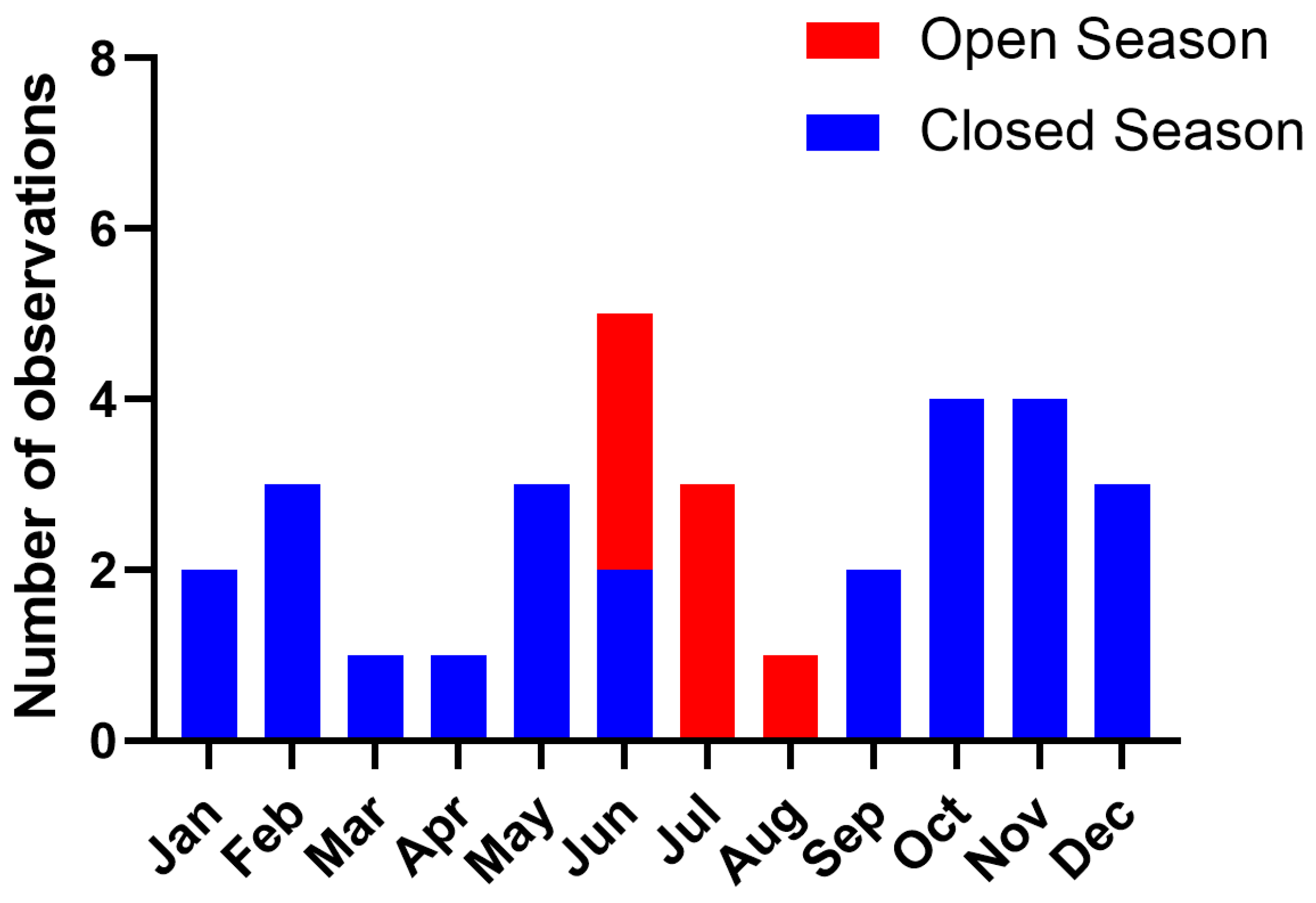
The monthly distribution of BFT records, pooled across the five years (2021–2025), is shown in Figure 4.
The chi-square test with uneven expected distribution showed no significant difference between open and closed seasons (χ2 = 0.27, df = 1, p = 0.60). The second test, repeated by shifting the open season forward by one week, also yielded a non-significant result (χ2 = 0.21, df = 1, p = 0.65). Nevertheless, given the limited sample size, the tests had low statistical power, and the analyses should be interpreted as exploratory only.
The complete dataset, including date, location, number of specimens, body parts observed, and presence or absence of soft tissue, is provided in Table 1.

4. Discussion and Conclusions

The presented dataset indicates a clear asymmetry: beach-cast remains attributable to BFT are documented far more often than for the two control, conspicuous, common and commercially relevant coastal species (E. marginatus and S. dumerili). This pattern is consistent with a species-specific fishing activity and post-capture processing rather than a generic ‘big fish’ beaching bias. Although strandings can result from natural mortality and predation, the frequent presence of clean cuts and decapitations (Figure 3, Table 1) is difficult to reconcile with purely natural causes. Indeed, this suggests retention of edible portions and subsequent discard of less valuable parts, likely by recreational fishers. However, it is impossible to exclude that some of the records may originate from discards of entire specimens as bycatch from professional activities targeting other fish species.
It is important to recognise that stranded material usually represents only a fraction of what is discarded at sea [26,27]. Carcasses that sink rapidly or drift offshore rarely reach the shore, meaning that the visible strandings are probably only a small portion, the tip of a much larger iceberg. It is reasonable to think that many more tuna carcasses might be lying on the seabed, potentially concentrated near fishing grounds or where underwater currents carry them.
The lack of statistical significance in the results of the two chi-square tests (standard and shifted period) may be due to various factors. First, even during the open season, beach-cast remains might also originate from illegal fishing, for example, when the number of specimens captured exceeds the single one permitted per sea trip [6]. Second, our approach relies on opportunistic, citizen-generated content, where observation effort is uneven across space and time [28,29]. A seasonal bias in coastal use (i.e., more people on beaches in June–August) probably resulted in more records in the open fishing season. Indeed, a large peak in observation is evident in June (Figure 4), as tourists begin to arrive at the beaches. An additional source of uncertainty involves postmortem intervals and carcass persistence that can blur the exact timing of the death and make species-level identification challenging.
Citizen-reported strandings are not intended to replace traditional fisheries monitoring, and direct indicators of illegal fishing, such as vessel monitoring systems and onboard inspections remain essential for fisheries management [30]. Nevertheless, citizen science data provide low-cost indicators that can flag suspicious events and help prioritise patrols or targeted checks, complementing traditional approaches. While citizen data alone does not prove illegality, it can help direct limited enforcement resources. In this case, the preponderance of tuna remains compared to the other two species, along with the mechanical processing marks, suggest discards of illegally retained fish, which can occur in both the open and closed fishing seasons, and which may warrant closer inspection by authorities. Future implementations of standardised public reporting protocols, including minimum photographic requirements and basic metadata, could enhance the applicability and usefulness of citizen-reported strandings.

Author Contributions

Conceptualization, A.N. and F.T.; methodology, A.N.; validation, A.N., T.H. and F.T.; formal analysis, A.N. and T.H.; investigation, A.N. and F.T.; data curation, A.N. and T.H.; writing—original draft preparation, A.N.; writing—review and editing, A.N., T.H. and F.T.; visualization, A.N. and T.H.; supervision, F.T.; project administration, A.N. All authors have read and agreed to the published version of the manuscript.

Funding

This research received no external funding.

Institutional Review Board Statement

Not applicable.

Data Availability Statement

The original contributions presented in this study are included in the article. Further inquiries can be directed to the corresponding author.

Acknowledgments

The authors are grateful to all the collaborators that made this research possible providing the required data. In particular, many thanks to Andrea Battisti, Ian Bertolucci, Monica Boccafogli, Leonardo Bonamico, Fabrizio Borghesi, Paola Colombo, Nicoletta Congia, Carlo D’Amelio, Laura De Martino, Vincenzo Di Biase, Angelo Ditta, Matteo Felicioni, Massimiliano Finzi, Nicola Florio, Clarissa Guarneri, Andrea Macera, Ivan Mannu, Octávio Mateus, Riccardo Mattolin, Mairo Mingarelli, Vittorio Oriani, Marco Pecoraro, Annalisa Plaitano, Alessandro Pregnolato, Andrea Ravagnani, Morena Scaglione, Alessandro Stellini, Mariacristina Torrisi, Carola Vallini, Dominique Zimmermann. The authors are also very grateful to Paolo Pignalosa for his opinion and suggestions for the paper.

Conflicts of Interest

The authors declare no conflicts of interest.

Abbreviations

The following abbreviations are used in this manuscript:
BFTBluefin tuna

References

  1. Fromentin, J.; Powers, J.E. Atlantic Bluefin Tuna: Population Dynamics, Ecology, Fisheries and Management. Fish Fish. 2005, 6, 281–306. [Google Scholar] [CrossRef]
  2. Block, B.A.; Teo, S.L.H.; Walli, A.; Boustany, A.; Stokesbury, M.J.W.; Farwell, C.J.; Weng, K.C.; Dewar, H.; Williams, T.D. Electronic Tagging and Population Structure of Atlantic Bluefin Tuna. Nature 2005, 434, 1121–1127. [Google Scholar] [CrossRef] [PubMed]
  3. Karakulak, F.; Oray, I.; Corriero, A.; Deflorio, M.; Santamaria, N.; Desantis, S.; Metrio, G. Evidence of a Spawning Area for the Bluefin Tuna (Thunnus thynnus L.) in the Eastern Mediterranean. J. Appl. Ichthyol. 2004, 20, 318–320. [Google Scholar] [CrossRef]
  4. Malca, E.; Quintanilla, J.M.; Gerard, T.; Alemany, F.; Sutton, T.; García, A.; Lamkin, J.T.; Laiz-Carrión, R. Differential Larval Growth Strategies and Trophodynamics of Larval Atlantic Bluefin Tuna (Thunnus thynnus) from Two Discrete Spawning Grounds. Front. Mar. Sci. 2023, 10, 1233249. [Google Scholar] [CrossRef]
  5. International Commission for the Conservation of Atlantic Tunas (ICCAT). Report of the Standing Committee on Research and Statistics (SCRS); Hybrid/Madrid (Spain). 2024. Available online: https://www.iccat.int/Documents/Meetings/Docs/2024/Reports/2024_SCRS_ENG.pdf (accessed on 26 December 2025).
  6. European Union Council Regulation (EC) No. 302/2009 Concerning a Multiannual Recovery Plan for Bluefin Tuna in the Eastern Atlantic and Mediterranean, Amending Regulation (EC) No. 43/2009 and Repealing Regulation (EC) No. 1559/2007. 2009. Available online: https://eur-lex.europa.eu/eli/reg/2009/302/oj/eng (accessed on 26 December 2025).
  7. European Union Regulation (EU) 2016/1627 of the European Parliament and of the Council of 14 September 2016 on a Multiannual Recovery Plan for Bluefin Tuna in the Eastern Atlantic and the Mediterranean, and Repealing Council Regulation (EC) No 302/2009. 2016. Available online: https://eur-lex.europa.eu/eli/reg/2016/1627/oj/eng (accessed on 26 December 2025).
  8. European Union Regulation (EU) 2023/2053 of the European Parliament and of the Council of 13 September 2023 Establishing a Multiannual Management Plan for Bluefin Tuna in the Eastern Atlantic and the Mediterranean, Amending Regulations (EC) No 1936/2001, (EU) 2017/2107, and (EU) 2019/833 and Repealing Regulation (EU) 2016/1627. 2023. Available online: https://eur-lex.europa.eu/eli/reg/2023/2053/oj/eng (accessed on 26 December 2025).
  9. Ministero dell’Agricoltura, della Sovranità Alimentare e delle Foreste. Campagna Di Pesca Del Tonno Rosso—Anno 2023; 2023; Vol. 23A03365. Available online: https://www.gazzettaufficiale.it/eli/id/2023/06/14/23A03365/sg (accessed on 26 December 2025).
  10. Ministero dell’Agricoltura, della Sovranità Alimentare e delle Foreste. Campagna Di Pesca Del Tonno Rosso—Anno 2024; 2024; Vol. 24A02500. Available online: https://www.gazzettaufficiale.it/atto/serie_generale/caricaDettaglioAtto/originario?atto.dataPubblicazioneGazzetta=2024-05-21&atto.codiceRedazionale=24A02500&elenco30giorni=false (accessed on 26 December 2025).
  11. Ministero dell’Agricoltura, della Sovranità Alimentare e delle Foreste. Campagna Di Pesca Del Tonno Rosso—Anno 2025; 2025; Vol. 25A02738. Available online: https://www.gazzettaufficiale.it/atto/serie_generale/caricaDettaglioAtto/originario?atto.dataPubblicazioneGazzetta=2025-05-17&atto.codiceRedazionale=25A02738&elenco30giorni=false (accessed on 26 December 2025).
  12. Ministero delle Politiche Agricole Alimentari, Forestali e del Turismo. Campagna Di Pesca Del Tonno Rosso—Anno 2021—Esaurimento Del Contingente Assegnatoalla Pesca Sportiva/Ricreativa (SPOR). 2021. Available online: https://www.masaf.gov.it/flex/cm/pages/ServeAttachment.php/L/IT/D/e%252F0%252F5%252FD.963e0f00649d10b77a8c/P/BLOB%3AID%3D16892/E/pdf?mode=download (accessed on 26 December 2025).
  13. Ministero delle Politiche Agricole Alimentari e Forestali. Campagna Di Pesca Del Tonno Rosso—Anno 2022—Esaurimento Del Contingente Assegnato Alla Pesca Sportiva/Ricreativa (SPOR). 2022. Available online: https://www.masaf.gov.it/flex/cm/pages/ServeAttachment.php/L/IT/D/1%252F3%252F2%252FD.5f2644ee0925da545455/P/BLOB%3AID%3D18113/E/pdf?mode=download (accessed on 26 December 2025).
  14. Ministero dell’Agricoltura, della Sovranità Alimentare e delle Foreste. Campagna Di Pesca Del Tonno Rosso—Anno 2023—Esaurimento Del Contingente Assegnato Alla Pesca Sportiva/Ricreativa (SPOR). 2023. Available online: https://www.marinadorica.it/wp-content/uploads/2023/09/Sa_16082023121339.pdf (accessed on 26 December 2025).
  15. Ministero dell’Agricoltura, della Sovranità Alimentare e delle Foreste. Campagna Di Pesca Del Tonno Rosso, Anno 2024—Esaurimento Del Contingente Assegnato Alla Pesca Sportiva/Ricreativa (SPOR). 2024. Available online: https://irp.cdn-website.com/83b4217f/files/uploaded/MASAF-2024-0347930-BFT2024Chiusuirapescasportiva_ricreativa_signed_%281%29.pdf (accessed on 26 December 2025).
  16. Ministero dell’Agricoltura, della Sovranità Alimentare e delle Foreste. Campagna Di Pesca Del Tonno Rosso, Anno 2025—Esaurimento Del Contingente Assegnatoalla Pesca Sportiva/Ricreativa (SPOR). 2025. Available online: https://www.guardiacostiera.gov.it/portale/documents/116383/215063/Campagna+di+pesca+del+tonno+rosso%2C+anno+2025+-+Esaurimento+del+contingente+assegnato.pdf/0feb82eb-b0f5-e3e8-4944-85f7e9908b47?version=1.0&t=1755000440557null (accessed on 26 December 2025).
  17. Tiralongo, F.; Crocetta, F.; Riginella, E.; Lillo, A.O.; Tondo, E.; Macali, A.; Mancini, E.; Russo, F.; Coco, S.; Paolillo, G.; et al. Snapshot of Rare, Exotic and Overlooked Fish Species in the Italian Seas: A Citizen Science Survey. J. Sea Res. 2020, 164, 101930. [Google Scholar] [CrossRef]
  18. Nota, A.; Tiralongo, F.; Santovito, A.; Torroni, A.; Olivieri, A. Chronicles of Kyphosus in the Mediterranean Sea: New Records and Complete Mitogenomes Support the Scenario of One Expanding Fish Species. Front. Mar. Sci. 2024, 11, 1411111. [Google Scholar] [CrossRef]
  19. Taylor, L.U.; Barychka, T.; McKeon, S.; Bartolotta, N.; Avery-Gomm, S. Strengths and Limitations of Using Participatory Science Data to Characterize a Wildlife Mass Mortality Event. Ecosphere 2024, 15, e70051. [Google Scholar] [CrossRef]
  20. Hurlbert, A.H.; Liang, Z. Spatiotemporal Variation in Avian Migration Phenology: Citizen Science Reveals Effects of Climate Change. PLoS ONE 2012, 7, e31662. [Google Scholar] [CrossRef] [PubMed]
  21. Dennis, E.B.; Morgan, B.J.T.; Brereton, T.M.; Roy, D.B.; Fox, R. Using Citizen Science Butterfly Counts to Predict Species Population Trends. Conserv. Biol. 2017, 31, 1350–1361. [Google Scholar] [CrossRef] [PubMed]
  22. Lee, K.A.; Lee, J.R.; Bell, P. A Review of Citizen Science within the Earth Sciences: Potential Benefits and Obstacles. Proc. Geolog. Assoc. 2020, 131, 605–617. [Google Scholar] [CrossRef]
  23. Gibbs, R.H. Comparative Anatomy and Systematics of the Tunas, Genus Thunnus. Fish. Bull. U. S. Fish Wildl. Serv. 1967, 66, 65–130. [Google Scholar]
  24. De Sylva, D.P. The Osteology and Phylogenetic Relationships of the Blackfin Tuna, Thunnus atlanticus (Lesson). Bull. Mar. Sci. 1955, 5, 1–41. [Google Scholar]
  25. da Cunha Ramos, H.G.; Colosio, A.C.; Marcondes, M.C.C.; Lopez, R.P.G.; Michalski, B.E.; Ghisolfi, R.D.; Gonçalves, M.I.C.; Bovendorp, R.S. Postmortem Interval Applied to Cetacean Carcasses: Observations from Laboratory and Field Studies with the Abrolhos Bank Region, Brazil. Forensic Sci. Int. Anim. Environ. 2024, 5, 100082. [Google Scholar] [CrossRef]
  26. Galgani, F.; Hanke, G.; Maes, T. Global Distribution, Composition and Abundance of Marine Litter. In Marine Anthropogenic Litter; Bergmann, M., Gutow, L., Klages, M., Eds.; Springer International Publishing: Cham, Switzerland, 2015; pp. 29–56. ISBN 978-3-319-16510-3. [Google Scholar]
  27. Haarr, M.L.; Falk-Andersson, J.; Fabres, J. Global Marine Litter Research 2015–2020: Geographical and Methodological Trends. Sci. Total Environ. 2022, 820, 153162. [Google Scholar] [CrossRef] [PubMed]
  28. Rosário, I.T.; Tiago, P.; Chozas, S.; Capinha, C. When Do Citizen Scientists Record Biodiversity? Non-Random Temporal Patterns of Recording Effort and Associated Factors. People Nat. 2025, 7, 860–870. [Google Scholar] [CrossRef]
  29. Mair, L.; Ruete, A. Explaining Spatial Variation in the Recording Effort of Citizen Science Data across Multiple Taxa. PLoS ONE 2016, 11, e0147796. [Google Scholar] [CrossRef] [PubMed]
  30. Orofino, S.; McDonald, G.; Mayorga, J.; Costello, C.; Bradley, D. Opportunities and Challenges for Improving Fisheries Management through Greater Transparency in Vessel Tracking. ICES J. Mar. Sci. 2023, 80, 675–689. [Google Scholar] [CrossRef]
Figure 1. (A) Thunnus thynnus specimens; (B) Epinephelus marginatus specimen; (C) Seriola dumerili specimen. Photo by Francesco Tiralongo (A) and Mattia Giovannini (B,C).
Oceans 07 00012 g001
Figure 2. Geographic distribution of the collected records of Thunnus thynnus and Epinephelus marginatus strandings along Italian coasts.
Oceans 07 00012 g002
Figure 3. Some of the collected records, numbered in Table 1 as n. 2 (A), 8 (B), 17 (C), 31 (D), 32 (E). Red arrows indicate cut marks.
Oceans 07 00012 g003
Figure 4. Monthly distribution of tuna strandings observations pooled across the five years 2021–2025, from 1 January 2021 to 19 August 2025.
Oceans 07 00012 g004
Table 1. Collected records of beached tuna remains along Italian coasts, with information on the date, site, and coordinates of observation (in World Geodetic System 1984, WGS84), bones integrity (intact/slightly damaged/broken), flesh persistence on the remains (no/few/complete), and source of the data (either iNaturalist–iNat or Facebook–Fb).
NDateSiteLatitudeLongitudeElementBone StatusFlesh ResidualsSource
113 May 2021Marsala37.79212.432Neurocranium, dentary bones, at least 14 vertebrae, cleithra, other unidentified bonesSlightly damagedNoiNat
225 June 2021Villafranca Tirrena38.24515.435Caudal fin, caudal peduncleIntactCompleteFb
313 July 2021Cala Coticcio (La Maddalena)41.2189.486Neurocranium, ~28 vertebraeSlightly damagedFewFb
431 July 2021Lido delle Nazioni44.73512.244Complete or quasi-complete skullSlightly damagedFewiNat
527 August 2021Syracuse36.74815.102NeurocraniumSlightly damagedNoiNat
623 September 2021Bosa40.3388.407NeurocraniumBrokenNoiNat
72 November 2021Ravenna44.54012.280Complete body without caudal finIntactCompleteiNat
827 November 2021Comacchio44.69512.241Complete headIntactFewiNat
95 October 2021Portoscuso39.2118.370Preopercular, opercularSlightly damagedNoFb
1011 May 2022Viareggio43.86610.240Neurocranium, first three vertebraeIntactNoFb
1121 September 2022Pachino (SR)36.67815.052Neurocranium and first six vertebraeIntactNoFb
126 November 2022Porto Potenza43.36713.696Neurocranium, first two vertebraeSlightly damagedNoFb
1322 January 2023Porto Garibaldi44.68212.243CleithrumBrokenNoFb
1421 February 2023Mazara del Vallo37.65012.589Two neurocraniaSlightly damagedNoFb
154 March 2023Porto Empedocle37.29013.514Complete, beheaded bodyIntactCompleteFb
166 May 2023Alghero40.5768.314Complete or quasi-complete head, first ~11 vertebraeIntactFewFb
173 June 2023Gallipoli40.06017.991Quasi-complete headIntactFewFb
1819 July 2023Villaputzu39.5399.640NeurocraniumSlightly damagedNoFb
19October 2023Comacchio44.66612.252Dentary boneSlightly damagedNoiNat
20October 2023Loano44.1258.260NeurocraniumSlightly damagedNoFb
211 November 2023Porto Potenza43.37513.692Dentary right boneSlightly damagedNoFb
2226 December 2023Lido di Spina (Comacchio)44.65112.256Neurocranium, posttemporals, other head bones, complete or semi-complete dorsal spineIntactFewFb
231 January 2024Lido Estensi (FE)44.66912.252Neurocranium, 4 vertebrae, posttemporals, other head bonesIntactFewFb
2420 February 2024Minturno41.24113.733Complete or quasi-complete headSlightly damagedFewFb
2517 June 2024Carloforte39.1678.308Complete or quasi-complete bodyIntactFewiNat
26October 2024Mola di Bari41.06817.079Last three vertebraeSlightly damagedNoFb
274 December 2024Minturno41.22413.761Complete headIntactFewFb
2810 December 2024Giulianova42.75813.969Neurocranium, first three vertebral bonesSlightly damagedNoFb
2924 February 2025Sant’Antioco39.0598.4774 caudal vertebraeIntactNoFb
3018 April 2025Cala Moresca (Capo Figari)40.9879.647One vertebral boneSlightly damagedNoFb
3114 June 2025Castelvetrano37.58212.862Complete headIntact FewiNat
3220 June 2025Capaccio Paestum40.46214.957Complete, filleted bodyIntactFewiNat
Disclaimer/Publisher’s Note: The statements, opinions and data contained in all publications are solely those of the individual author(s) and contributor(s) and not of MDPI and/or the editor(s). MDPI and/or the editor(s) disclaim responsibility for any injury to people or property resulting from any ideas, methods, instructions or products referred to in the content.