Article

Persistent Geographic Patterns of Coral Recruitment in Hawaiʻi

1
Center for Global Discovery and Conservation Science, Arizona State University, 60 Nowelo Street, Hilo, HI 96720, USA
2
School of Ocean Futures, Arizona State University, 60 Nowelo Street, Hilo, HI 96720, USA
3
Department of Environmental Science, Policy, and Management, University of California Berkeley, Berkeley, CA 94720, USA
*
Author to whom correspondence should be addressed.
Oceans 2025, 6(4), 80; https://doi.org/10.3390/oceans6040080 (registering DOI)
Submission received: 31 August 2025 / Revised: 19 November 2025 / Accepted: 23 November 2025 / Published: 1 December 2025

Abstract

Coral life cycle dynamics are poorly understood in most reefs, especially at the large geographic scales commensurate with ocean transport, genetic flow, and other synoptic scale processes. We present a spatially explicit, large-scale, and multi-temporal study of coral settlement along a 30 km long reef system in the Southwest portion of Hawaiʻi Island. Here, we focused on interannual variability in coral recruitment from 2021 to 2024, a period without a major marine heatwave. We used stratified random site selection to place 320 coral settlement tiles at 32 sites (10 tiles per site) at 10 ± 3 m water depth annually to monitor recruitment of the three most common coral genera found in the region (Montipora, Pocillopora, Porites). Site-level interannual variability in coral recruitment was high yet the overall geographic distribution of recruits was consistent through time. This occurred despite a decrease in benthic temperature and recruitment rates during the study period. Persistent geographic patterns in coral recruitment strengthen our understanding of mechanisms and conditions that drive reef resilience. They also strongly suggest a need to protect areas of high recruitment while studying drivers of low recruitment in contrasting habitats. This approach will further increase support of coral production in an era of climate- and coastal pollution-driven declines in coral reefs.

1. Introduction

Coral recruitment—the process by which free-swimming larvae settle and metamorphose into juvenile colonies—is widely recognized as a foundation of reef resilience and recovery [1,2,3]. Recruitment is arguably the most critical step in the life cycle of corals since the process depends upon both source (i.e., coral cover, reproduction) and sink (i.e., substrate availability, currents) drivers in a larger reef geography. Global surveys demonstrate dramatic geographic variation in recruitment rates, and rates of coral recruitment also vary widely within regional reef geographies [4].
Previous studies have emphasized physical controls over coral recruitment. Reef topography at the millimeter scale enhances larval settlement by creating flow refugia [5]. Structural complexity on reefs plays a positive role in enhancing early post-settlement survival [6,7]. A regional-scale study in Hawaiʻi linked multi-resolution reef morphology to coral recruitment success [8], finding that microscale topographic complexity combined with larger reef structure greatly influences larval settlement by modulating flow and eddy formation (sensu [5]). Importantly, Carlson et al. [8] found that these reef morphology factors interacted with biological mediators, such as live coral cover and grazer fish density, to predict a spatially complex regional distribution of coral recruitment along a coastal fringing reef with a consistent nearshore current.
While regional studies like these are growing in the literature to reveal biogeophysical controls over coral recruitment, our understanding of recruitment dynamics through time is less robust. Many studies rely on snapshot or single-season surveys rather than on long-term, multi-year monitoring, making it difficult to assess trends through time [1]. Some multitemporal studies have revealed strong interannual fluctuations in coral recruitment [9,10,11], but the combination of spatially extensive and multitemporal observations has not generated a clear sense for whether the biogeophysical controls found in determining patterns of recruitment in short-duration studies persist over time.
Understanding coral recruitment is critical for the management and enhancement of reef resilience, but our understanding of the patterns through space and over time remains limited [12,13]. Long-term and large-scale monitoring is needed to understand conditions affecting larval recruitment including baseline recruitment in advance of coral bleaching events, restoration, and the timing of infrequent extremes, when rare influxes of coral larvae to isolated reefs can have a significant influence over coral population structure [14,15,16]. Long-term time series and broader spatial coverage—especially in under-sampled regions—would support more robust inference about coral resilience and would guide planning [17,18,19].
We present a spatially explicit, large-scale, and multitemporal study of coral recruitment along a 30 km long reef system in the Southwest portion of Hawaiʻi Island. Our four-year study from 2021 to 2024 builds upon a single-year study conducted in 2021 [8], at which time we determined that benthic complexity (rugosity) is the primary determinant of coral recruitment, with secondary mediators including live coral cover, corallivory, and water depth. In the present study, we focus on interannual spatial variability in coral recruitment, testing the hypothesis that geospatial patterns of recruitment should be persistent if certain biogeophysical controls remain consistent, even if total recruitment varies through time due to synoptic processes such as ocean temperature variability. To test this hypothesis, we assessed the geospatial and temporal dynamics of coral recruitment in a period without a major marine heatwave. We did consider regional-scale benthic temperature as an overarching mediator of recruitment rates, and we predict that interannual variation in temperature will not impact the regional spatial patterning of recruitment since such patterns are biogeophysically mediated as per Carlson et al. [8]. Our model reef system is particularly suited for interannual coral dynamics research because nearshore ocean currents are consistent and well known, and live coral cover was stable throughout our period of study [8,20,21,22].

2. Materials and Methods

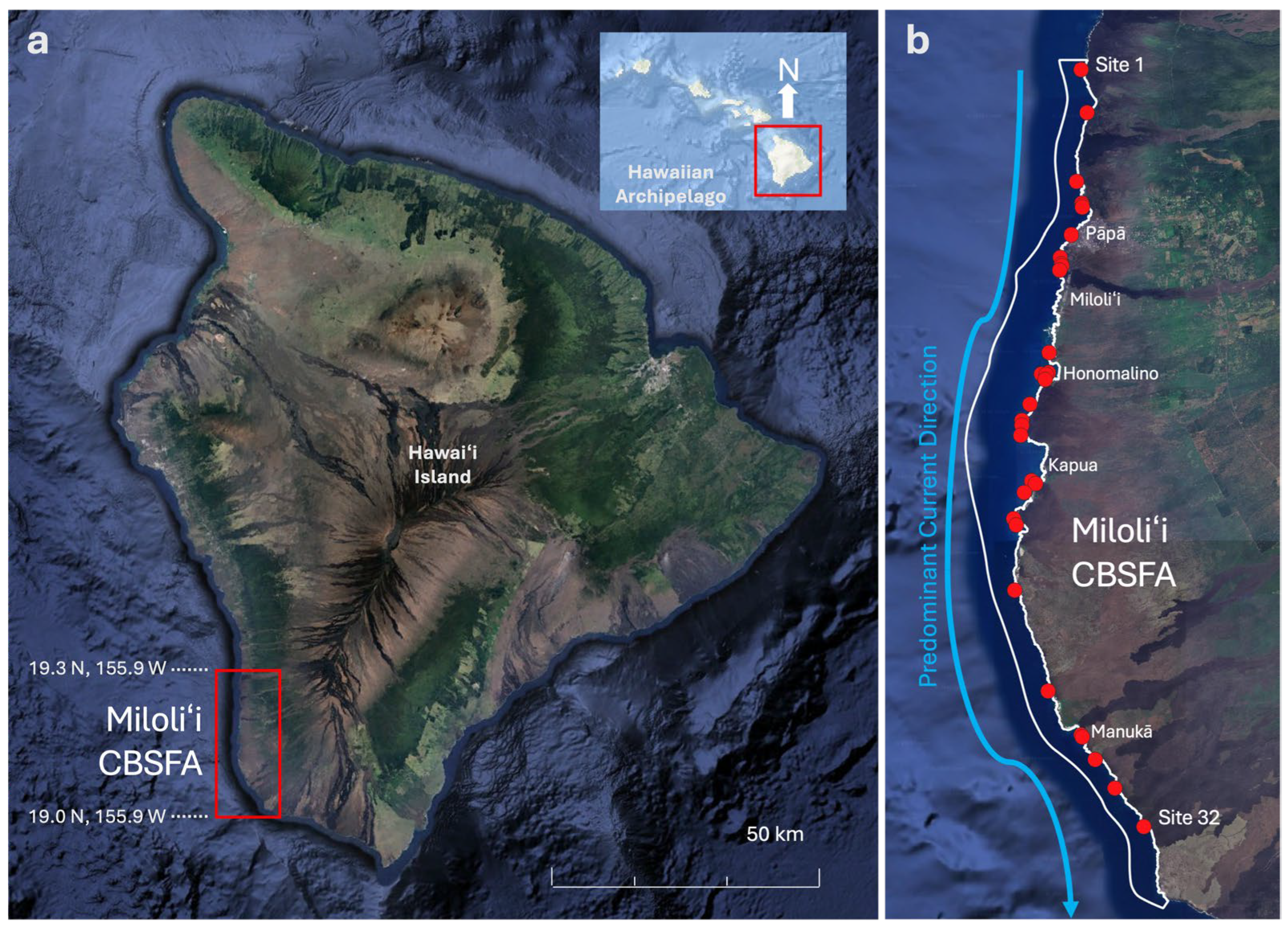
We carried out annual monitoring to map the distribution of coral recruits within the Miloliʻi Community Based Subsistence Fishing Area (CBSFA) of Hawaiʻi Island (Figure 1). The Miloliʻi CBSFA provides protections for all coral species and hardbottom substrates upon which corals attach. Reef fishing throughout the area is also managed, providing a region conducive to benthic research under conditions of high fish biomass [20,23]. Additionally, the region undergoes low levels of land-based pollution from sedimentation, urban runoff, or wastewater effluent [24].
We used coral settlement tiles to monitor coral recruitment of the three most common coral genera found across the region (Pocillopora, Porites, and Montipora) [25]. These three genera spawn between May and August of each year (e.g., [4,26]). We deployed 320 coral settlement tiles at 32 sites (10 tiles per site) during the 2021–2024 coral reproductive seasons in Hawaiʻi (Table 1). The sites were selected using the stratified random mapping approach after removal of sand (softbottom) areas where corals do not settle [20].
The imbalanced temporal nature of our recruitment tile deployments shown in Table 1 was caused by operational and access limitations. However, we assert that as long as the tiles are deployed during and after the months of actual coral spawning in Hawaiʻi, which runs from May through August for our genera of interest, the tiles collect recruits to be counted at a later date well after spawning season. Nonetheless, to account for variable length deployments, we include a comparison of relative recruitment between sites, i.e., each site’s proportional contribution to the annual recruitment tally. This relative index should be unaffected by the length of deployment.
The recruitment tiles were constructed from natural, unglazed limestone with dimensions 2.5 cm × 10 cm × 10 cm. Each tile was affixed to the reef using cable ties on dead substrate at depths of 10 ± 3 m, at distances of 1–3 m apart. After the reproductive season, we retrieved tiles from the ocean and rinsed the tiles for 24 h in a dilute bleach solution to remove fleshy algae and reveal coral skeletal structure. Following recruit identification and counting, the tiles were cleaned and prepared for redeployment to the same locations in the following year. See Appendix A for a listing of the number of tiles retrieved per site each year.
We counted and identified coral skeletons to genus based on skeleton morphology under a stereoscopic microscope with magnification of 45× (AmScope SM-1, Irvine, CA, USA). All processing procedures and morphological identifications followed Carlson et al. [8]. Summarizing here, we counted recruit skeletons on all sides of the tiles, which had been placed on mounting rods 10 cm above the benthic surface, allowing for coral recruits to accumulate on up to six sides on each tile. Total surface area available for recruitment was 300 cm2. Recruits were identified and recorded at the genus level as Pocillopora, Porites, or Montipora. While recruitment identifications are typically made at the family taxonomic level, our three genera solely occupy their respective families in our region, allowing us to report at the genus level. Tile sites were evenly balanced between embayments (18 sites) and non-embayments (14 sites) and represented varying levels of adult coral cover and structural complexity via stratified sampling. Further details on methods are provided by Carlson et al. [8].
We monitored benthic temperature throughout the study period at the centrally located Kapua site within the Miloliʻi CBSFA (Figure 1). Data were collected using in situ temperature loggers set at 30 min collection intervals at 5 m and 10 m depth stations (Tidbit-2 Loggers, ONSET Hobo, Bourne, MA, USA). Interannual variation in coral recruitment was assessed against the benthic temperature data on annual timescales as well as for the spawning months of May–August of each year. Regression analyses were used to assess potential relationships between recruitment rates and benthic temperature statistics including mean, variance, minimum and maximum monthly temperature each year.
To test for differences in total and genus-level recruitment between years and sites, we performed permutational multivariate analysis of variance (PERMANOVA) using Bray–Curtis dissimilarities. We then performed a univariate PERMANOVA with Euclidean distance for each genus (Montipora, Pocillopora and Porites) to identify which taxa contributed to the genus-level patterns. For total coral recruitment, analyses were conducted at the tile level to assess site and year effects and their interaction. For genus-level analyses, recruit counts were aggregated by site, year, and genus and normalized to relative abundances. Pseudo-F statistics were computed using 999 permutations to evaluate significance for each factor (year, site, and year × site), which was performed at both the total and genus recruitment levels. Analyses were performed in Python (v3.12, Python Software Foundation, Wilmington, DE, USA) using the skbio.stats.distance.permanova function from scikit-bio (v0.5.8, open-source community project, USA) [27].
We also used Mantel tests based on pairwise Bray–Curtis dissimilarity matrices to evaluate temporal persistence of spatial patterns in recruitment among sites. For each year, a site-by-site distance matrix was calculated from mean recruitment per site for total recruits or from proportional genus composition (for genus-level recruits). Mantel correlations (Spearman’s ρ) were then computed between matrices from all pairs of years using 999 permutations to assess significance. Positive Mantel r values indicate consistent spatial patterning among years (i.e., persistence of the regional patterns over time). Mantel tests were implemented in Python (v3.12) using the skbio.stats.distance.mantel function [27].
To quantify temporal persistence in total coral and genus-level recruitment across sites, we calculated Spearman rank correlation coefficients (ρ) across years. For total recruitment, the relative proportion of recruits per site in each year was correlated across all year pairs and across the full four-year dataset to capture overall stability and persistence in site rankings. For genus level, mean proportional abundances per genus were compared across years to assess persistence in taxonomic dominance, followed by separate correlations for each genus to quantify the consistency of recruitment patterns for individual taxa across sites and years. All correlations were computed in Python (v3.12) using the scipy.stats.spearmanr function [28].

3. Results

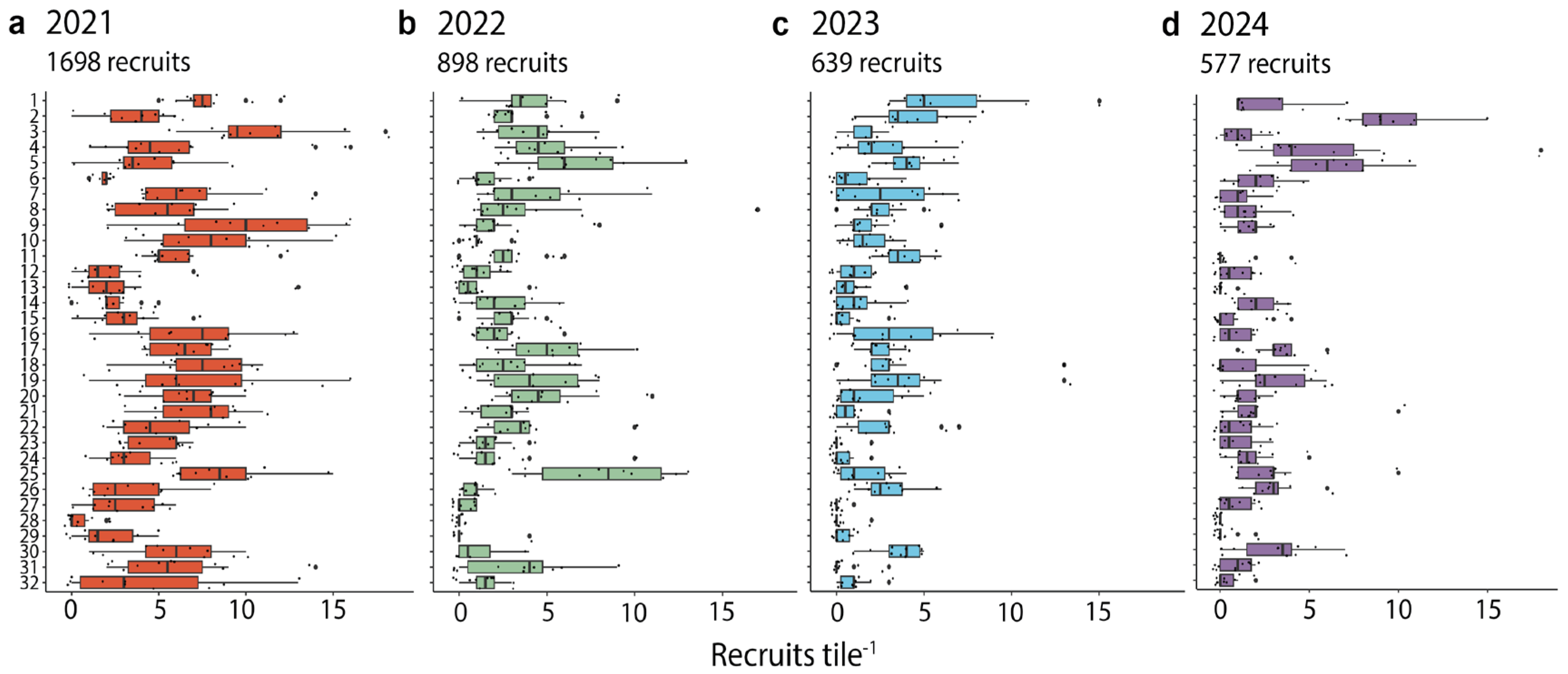
Coral recruitment was highest in 2021, with a total of 1698 recruits identified among the 32 reef sites (Figure 2). Recruitment was lowest in 2024, with 577 recruits. The most recruits were generally found in the northernmost sites (1–5) as well several central sites (25–26) near and including Kapua Bay (Figure 1). Coral recruitment density on settlement tiles each year ranged from 5.3 ± 2.5 recruits per tile in 2021, 2.8 ± 1.9 per tile in 2022, 2.0 ± 1.5 per tile in 2022, and a low of 2.0 ± 2.0 per tile in 2024.
Mean annual benthic temperature decreased by ~0.5 °C from 2021 to 2024 (Table 2). Regressing temperature against total recruitment, we found a significant positive relationship between both mean annual and mean spawning-season benthic temperature at 5 m and 10 m depths (r = 0.87–0.97; p < 0.01). We also found a significant positive correlation between annual minimum temperature and total coral recruitment at 5 m and 10 m depths (r = 0.87–0.89; p < 0.01). No other significant relationships were found.
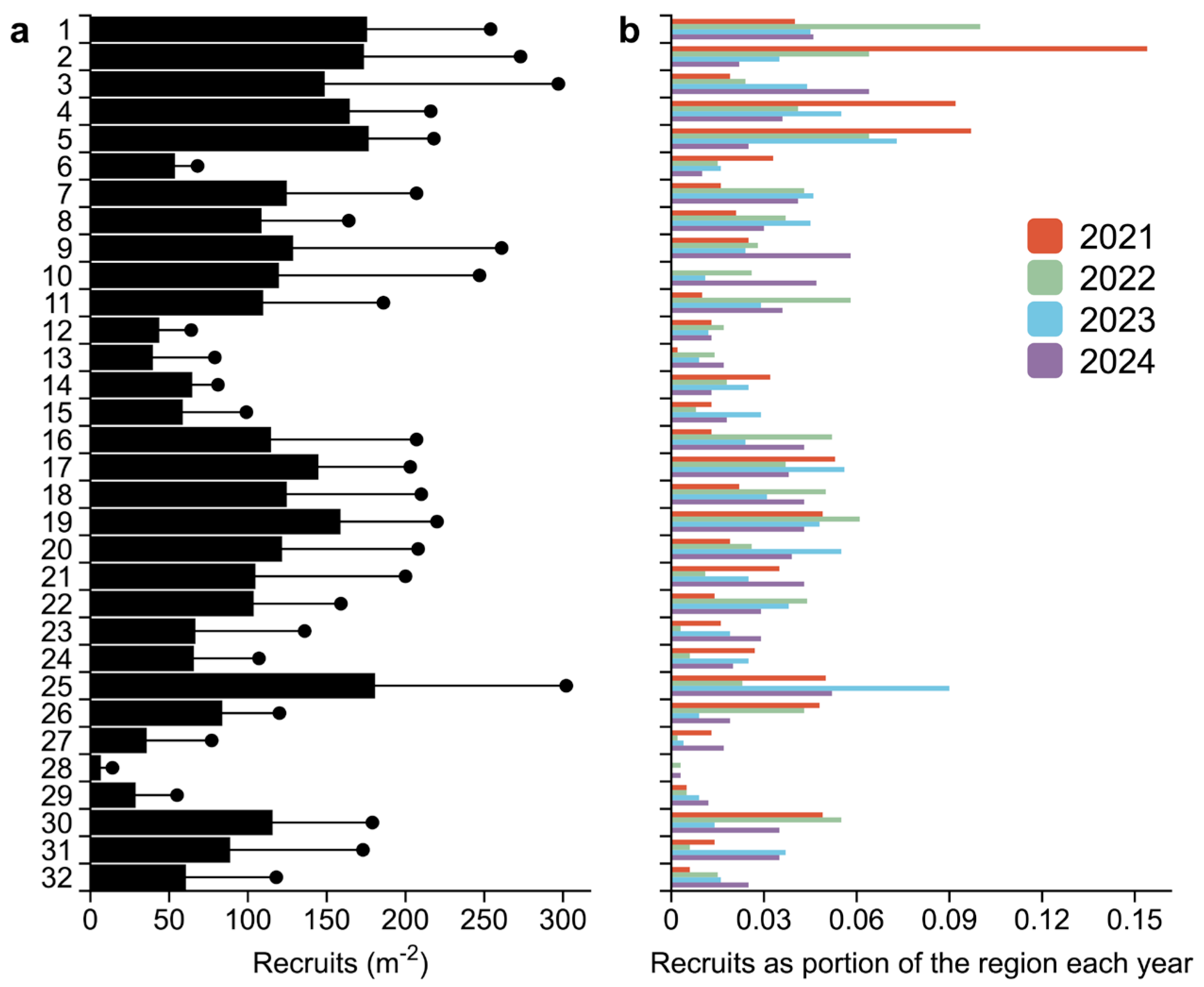
On the basis of reef substrate area, higher recruitment was consistently found in the north end of the study region as well as in an embayment area at site 25 (Figure 3a). Site 25 yielded the highest mean annual recruitment of 175 m−2. However, interannual variability was also high (80 m−2) at that site. Lowest rates of recruitment were found at site 28 (6 ± 8 m−2). Whereas high-yielding recruit sites were highly variable interannually, low-yielding sites displayed consistently low interannual variability in recruitment (Figure 3a).
We calculated the proportional contribution of each site to the total geographic distribution of recruitment across the region (Figure 3b). Mean proportional contribution among all sites was 0.03 ± 0.02, indicating that on average, a site generates 3% of the total yield in recruits. Interannually, this 3% value was highly consistent. However, sites with high mean annual recruitment (Figure 3a) displayed highly variable proportional contributions to the regional recruitment pool (Figure 3b). Among high recruit sites 1–5 and 25, each contributed 4–6% of the regional settlement, resulting in a total proportional contribution each year of 25% of entire region in 2021 to a sum of 45% of the entire region in 2024. In sum, six of 32 sites (19%) accounted for 25–45% of total regional recruitment per year. These patterns are further supported results of the PERMANOVA, Mantel and Spearman rank correlation analyses described below.
The relative abundance of recruits by coral genus was fairly consistent between years, with Pocillopora > Porites > Montipora from 2021 to 2023 (Table 3). In 2024, the proportion of Porites exceeded that of Pocillopora, while Montipora remained a distant third in relative abundance of recruits, followed by Porites and Montipora (Table 1).
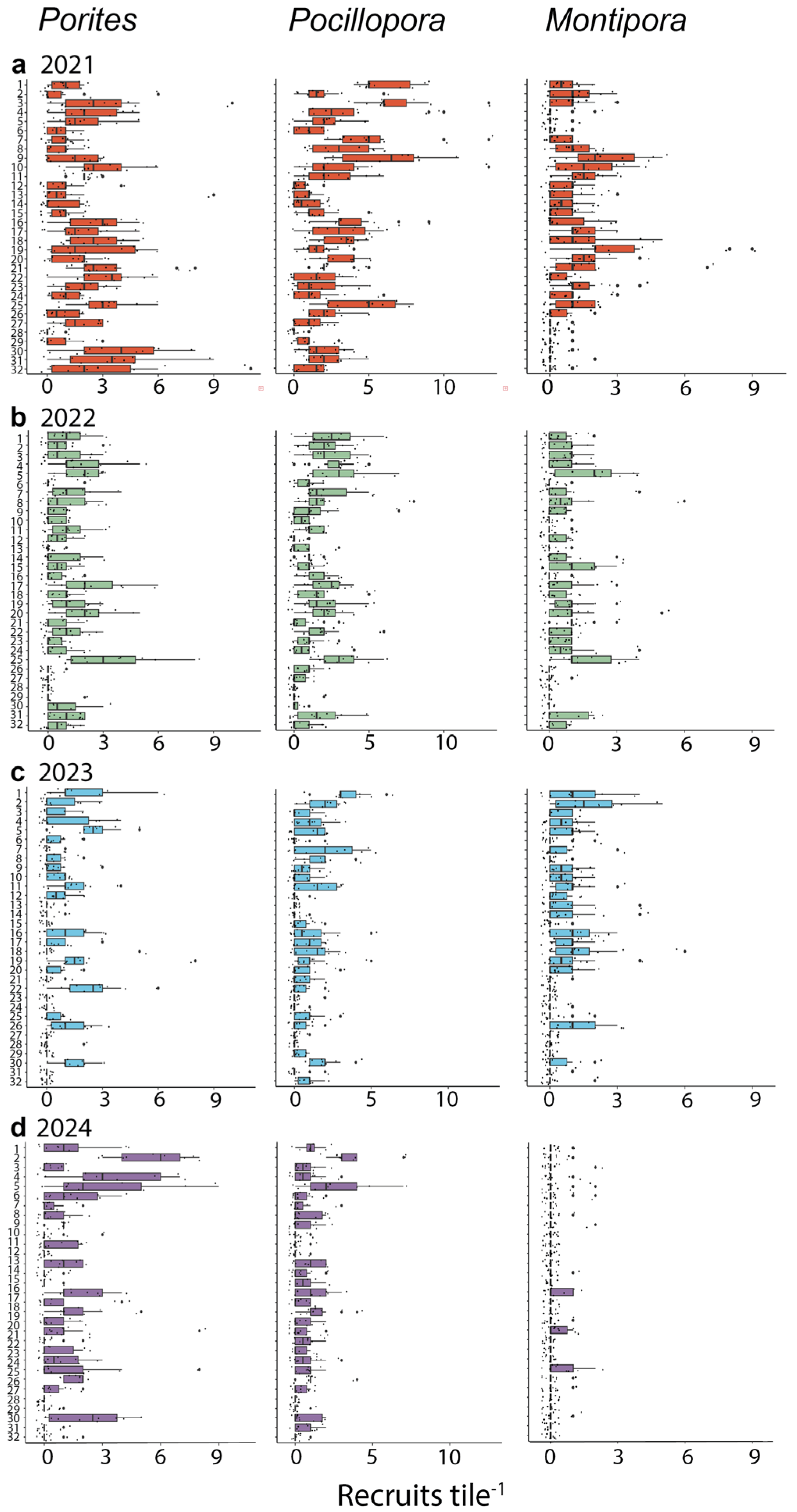
Site-based analyses by coral genus indicated highly variable interannual rates of recruitment (Figure 4). Note the different x-axis for Montipora in Figure 4. Porites and Pocillopora declined in total recruitment from 2021 to 2022–2024 (Table 3, Figure 4). Montipora, with a much lower overall recruitment rate, only showed a decline from 2021 to 2022 and then again from 2023 to 2024. Despite the temporal variability noted here, overall higher rates of recruitment occurred in the northern sites 1–5 and the central-southern site 25 and vicinity.
Total recruitment showed strong spatial and low temporal variation across sites from 2021 to 2024. The PERMANOVA revealed significant spatial effects among sites (pseudo-F = 13.01, p = 0.001; Table 4) and a strong interaction between year and site (pseudo-F = 7.53, p = 0.001). Temporal effects were not significant (p = 1.0). Genus-level analyses indicated significant differences among years (pseudo-F = 15.34, p = 0.001), across sites (pseudo-F = 2.70, p = 0.001), and for the year, site interaction (pseudo-F = 2.63, p = 0.001). For each genus, the univariate PERMANOVA results indicated that spatial differences among sites were the dominant source of variation in recruitment for all three genera, while temporal effects across years were not significant. Pocillopora showed the strongest site effect (pseudo-F = 12.01, p < 0.01), followed by Porites (pseudo-F = 6.84, p < 0.01) and Montipora (pseudo-F = 3.67, p < 0.01; Table 4).
Mantel tests indicated that site-level recruitment patterns were stable through time. Correlations between years were mostly significant for adjacent years, albeit low correlations. Genus-level assemblages showed little temporal correlation, with Mantel r values near zero and insignificant in all pairwise year comparisons. Mantel tests were not performed on each genus separately because of the lack of significance at the combined three genus-level. Spearman rank correlations provided a complementary measure of temporal persistence in site-level recruitment. Rank order of total recruitment among sites was strongly correlated between consecutive years and remained significant, though weaker, over longer intervals (Table 4). Multi-year correlation was strongest (ρ = 0.76, p < 0.01), indicating persistent relative rates of recruitment through time even as absolute abundance fluctuated. At the genus level, rank structure was highly persistent, with very strong correlations among consecutive years (ρ = 0.97–1.00, p < 0.01). The across-year correlation remained moderate (ρ = 0.59, p = 0.04), which indicated that the proportions of genera shifted slightly among years, the dominant taxa maintained stable rankings through time. Together, these results indicate that temporal variability in the pattern of recruitment is low or insignificant, and taxonomically persistent, with genera maintaining consistent relative abundances through time despite year-to-year fluctuations in total recruitment intensity.
Spearman rank correlations revealed varying levels of temporal consistency in genus-specific recruitment patterns across years (Table 4). Pocillopora showed the strongest and most consistent correlations, with significant positive relationships among nearly all year pairs (ρ = 0.40–0.66, p < 0.05), indicating persistent spatial patterns in recruitment across sites. Montipora exhibited weaker and less consistent correlations (ρ = –0.06–0.37), with only a few significant year pairs (notably 2021–2023 and 2022–2024), suggesting greater temporal variability in recruitment distribution. Porites showed moderate stability, with correlations increasing over time and becoming significant between later years (ρ = 0.36–0.48, p < 0.05). When pooled across all years, overall recruitment patterns remained significantly correlated for each genus (Pocillopora ρ = 0.53, Montipora ρ = 0.19, Porites ρ = 0.30; p < 0.05), reflecting moderate long-term persistence in site-level recruitment structure.
Coral genera displayed unique correlations with interannual variability in benthic temperature. Porites showed very strong positive correlation with mean minimum temperature at 5 m and 10 m depths (r = 0.95–0.96; p < 0.01), but no other temperature metrics were associated with this genus. Pocillopora recruitment, on the other hand, was positively correlated with both mean benthic temperature (r = 0.90–0.91; p < 0.01) and mean minimum temperature (r = 0.92–0.97; p < 0.01). In stark contrast, Montipora was not correlated with those temperature metrics, and instead was negatively correlated with variability (standard deviation) in both seasonal and annual benthic temperature at 5 m and 10 m depths (r = −0.82 to −0.92; p < 0.01).
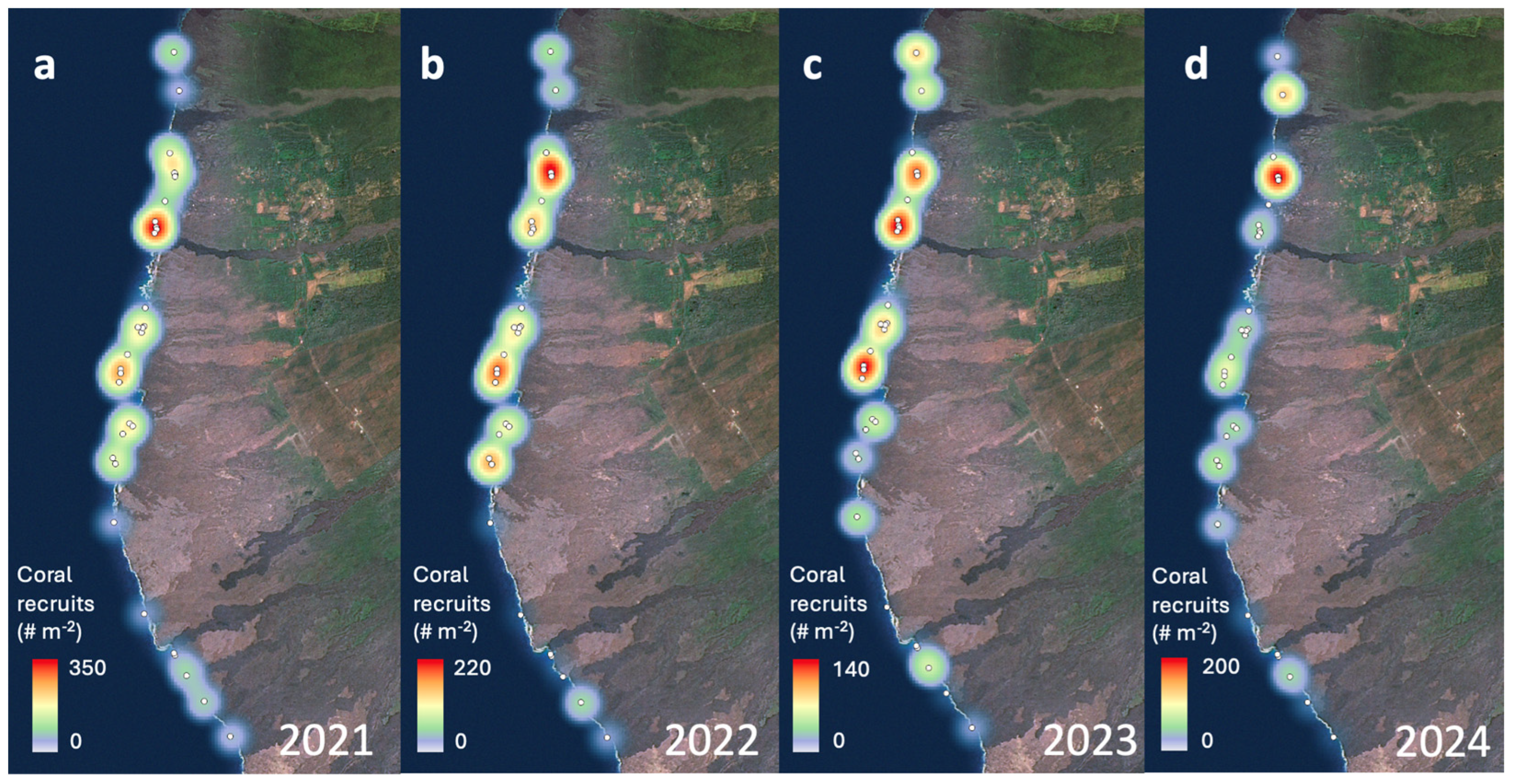
Heat maps of total coral recruitment in each of the four years further demonstrated persistent geographic hotspots and coldspots of recruitment (Figure 5), even after fully controlling for hardbottom (non-sand) substrate. It is clear that recruitment dominates in the northern portion of the study area, and this regional pattern is driven largely by the recruitment geography of Pocillopora species (see Figure 4). Porites, and to a lesser degree, Montipora, contribute to overall recruitment in the central portion of the region (Figure 4). Very little recruitment occurs as the land bends to the east along the southernmost portion of the study region (Figure 5).

4. Discussion

The dynamics of coral production, settlement, and growth are poorly understood in many reefs, especially at large geographic scales commensurate with ocean transport, genetic flow, migration, and other synoptic-scale processes. Most regional- to basin-level studies appropriately utilize computer simulation models that are necessarily driven by or populated with relatively sparse in situ data. Our study is unique because we utilize a region that is highly suited for direct observation of large-scale ecological patterns under well-known oceanographic conditions, which can then be used to interpret and disentangle processes over time. As a fundamental control, the nearshore current in the study region predominantly flows southward from site 1 to 32 [8,29]. Second, we have a detailed understanding of spatial distribution of benthic habitat types, which comprises a continuous band of reefscape hugging the coastline along the southwest margin of Hawaiʻi Island [20]. Third, we have mapped the location of live coral cover throughout the entire region, which indicates the potential for larval production [30]. Conversely, we have mapped sand cover throughout the regional benthos, allowing us to control for softbottom that precludes coral settlement. Our study region also controls for land-based impacts prevalent in other parts of Hawaiʻi, including sedimentation, urban runoff, and wastewater effluent [24]. Finally, our region is entirely contained within an actively managed community subsistence fishing area, which guards against overfishing that can affect coral predation and survival [20]. Taken together, the Miloliʻi CBSFA remains one of our best outdoor laboratories for studies of pattern and process in Hawaiian coral reefs.
Based on this well understood 30 km long reef system, our most important finding is that interannual variability in total coral recruitment is high, yet the overall geographic pattern is persistent through time (Figure 2, Figure 3, Figure 4 and Figure 5). This persistence is not simply based on the availability of hardbottom substrate within the region, but rather it is heavily controlled by reef structure (rugosity), depth, light levels, existing live coral cover, corallivory, and hydrodynamic inputs of larvae, as formerly established in a preceding study by several of us in Carlson et al. [8]. In that study, we only considered one year of data in 2021, which yielded the first habitat-specific distribution of coral recruitment in our region. Specifically, we established the principal biotic and abiotic correlates with coral recruitment that give rise to the geographic pattern of overall recruitment that we observe. In the present paper, we see the same general regional pattern repeatedly emerge for three subsequent years, during which time, ocean temperatures were conducive to coral reproduction (i.e., no marine heatwaves or major bleaching events). Along with this persistent geography of recruitment over time, we found that sites with the highest levels of annual coral settlement were also the most variable through time (Figure 3). Low yielding sites were consistently low from year to year. This finding further emphasizes that there are habitat conditions that are generally less suitable for coral settlement. The persistence of high- and low-yielding recruitment areas (Table 4) suggests that the biotic and abiotic controls determined in Carlson et al. [8] exert a similar influence through time.
While the emergent geospatial pattern is clear, the multitemporal aspect of our study revealed a trend of decreasing recruitment from 2021 through 2024. During this period, there were no marine heatwaves; however, the last bleaching event to occur in the region was in 2019, yielding losses of live coral cover of up to 15% in our study region [31,32]. It is possible that the observed high recruitment levels of 2021 were a delayed response to reduced larval production in previous warm years, as observed in other studies [33,34], which may have been followed by a return to lower background rates in subsequent years through 2024. Further study is needed to assess this possibility, specifically by continuing long-term coral recruitment research networks such as ours during and after future marine heatwaves. Doing so will help determine the longer-term resilience and/or vulnerability of Hawaiian corals to periodic heatwaves in terms of reproduction, settlement, and survival of corals in our region.
In concert with a theory of post-heatwave enhanced production, the observed decrease in recruitment from 2021 to 2024 displayed correlative relationships with ocean temperature. This four-year period was marked by La Niña conditions and a cool phase of the Pacific Decadal Oscillation [35,36], resulting in progressively decreasing benthic temperatures. For all coral genera combined, mean annual benthic temperature was positively correlated with recruitment. Relatively little is known about optimal temperature for larval production in Hawaiian reefs, but ex situ research strongly suggests that growth and production are suppressed in Hawaiian corals when temperatures drop below 26 °C [37,38,39]. During our four-year study, mean annual temperature decreased by ~0.5 °C, and temperatures below 26 °C became more common, which may partially account for observed decreasing rates of coral recruitment through time. Interestingly, while the two most abundant genera—Pocillopora and Porites—followed the same declining trend, the genus with an even steeper decline in recruitment over time—Montipora—was the only one displaying a strong negative correlation with variability in benthic temperature. This inability to cope with temperature variability has been reported for this genus in laboratory studies [40,41]. Beyond these initial inferences, longer in situ time series observations spanning a wider range of ocean temperature conditions, sufficient to capture potential lag effects, are needed to advance our understanding of production and recruitment dynamics relative to benthic temperature trends.
Persistent patterns in coral recruitment strengthen our understanding of mechanisms and conditions that drive reef resilience. Regional-scale patterns and dynamics of recruitment also serve as key inputs to larval production, transport, and settlement models, and they support decision-making on where to place marine protections. Our study reveals that the Miloliʻi Community-based Subsistence Fishing Area CBSFA supports a regionally patchy distribution of coral recruitment (Figure 5), owing to variability in substrate structures and localized hydrodynamic flow patterns. Yet, the persistent geography of coral recruitment uncovered in our work justifies the extensive latitudinal range (30 km) of the CBSFA. It also strongly suggests the need to protect areas of high recruitment while studying the causes of low recruitment in contrasting habitats within the area. Such an approach will further support efforts to enhance coral production in an era of climate- and coastal pollution-driven declines in coral reefs.

5. Conclusions

We implemented a geospatially dense network of coral settlement tiles, distributed across a range of hardbottom benthic substrates along a 30 km long fringing reef in Southwest Hawaiʻi Island. Deploying 320 tiles across 32 sites annually from 2021 through 2024 in this region, we collected and counted coral recruits, and we analyzed geospatial patterns and interannually variability in recruitment. We found persistent geographic patterns of high and low coral recruitment through time. Reef areas with high recruitment, previously determined to be associated with reef structure (rugosity), depth, light level, existing live coral cover, corallivory, and hydrodynamic inputs of larvae, remained consistent over time. A four-year decreasing trend of total and genus-level recruitment was correlated with decreasing benthic temperature. However, additional multitemporal observations spanning a wider range of ocean temperature conditions are needed to further advance our understanding of coral reproduction and recruitment dynamics relative to benthic temperature trends.
Persistent patterns of high and low coral recruitment strengthen our understanding of the mechanisms and conditions that support reef resilience. Developing a geography of coral recruitment is central to ensuring that marine protected areas and similar management designations are purposefully designed to harbor a sufficient range of habitat conditions needed to ensure successful coral reproduction at the ecosystem to regional levels. The Miloliʻi CBSFA is one of the largest marine managed areas in the State of Hawaiʻi, and its extensive size is well justified by our findings indicating a persistent geography of both high and low coral recruitment over time. Such findings are foundational to the conservation of the reef system as a whole.

Author Contributions

Conceptualization, G.P.A., R.R.C. and R.E.M.; methodology, G.P.A., R.R.C. and R.E.M.; formal analysis, R.R.C., C.L., D.E.H. and R.E.M.; investigation, G.P.A., R.R.C., C.L., D.E.H. and R.E.M.; resources, G.P.A., R.R.C. and R.E.M.; data curation, G.P.A., R.R.C., C.L., D.E.H. and R.E.M.; writing—original draft preparation, G.P.A. and R.R.C.; writing—review and editing, G.P.A., R.R.C., D.E.H. and R.E.M.; supervision, G.P.A., R.R.C. and R.E.M.; project administration, G.P.A., R.R.C. and R.E.M.; funding acquisition, G.P.A. and R.R.C. All authors have read and agreed to the published version of the manuscript.

Funding

This research was funded by Dorrance Family Foundation grant number G-10759-300.

Data Availability Statement

Coral settlement tile data are available at https://zenodo.org/records/17509540 (accessed on 22 May 2025).

Acknowledgments

We thank the Hawaiʻi Marine Education and Research Center and the people of Miloliʻi Village and the surrounding area who support and champion our research, particularly Maile Brown, Laurie Casuga, Nelson Kahele, Willy Kaupiko, Kaʻimi Kaupiko, Lei and Laila Kaupu, Will Mae Huihui, Kevin Tadlock, and Ronald Tai See.

Conflicts of Interest

The authors declare no conflicts of interest.

Appendix A

Table A1. Number of tiles retrieved from 32 sites distributed in north to south in the Miloliʻi CBSFA (Figure 1).
Site2021202220232024
1101098
21010109
31010510
410101010
51010109
68101010
71010107
810101010
91010109
1010101010
1110101010
1210101010
1310101010
141010109
1510101010
161010106
171010109
181010108
1910101010
201010109
2110101010
2210101010
231010106
2410101010
251010109
261010108
2710101010
281091010
291051010
301041010
3110101010
3210101010

References

  1. Nativ, H.; Scucchia, F.; Martinez, S.; Einbinder, S.; Chequer, A.; Goodbody-Gringley, G.; Mass, T. In Situ Estimation of Coral Recruitment Patterns From Shallow to Mesophotic Reefs Using an Optimized Fluorescence Imaging System. Front. Mar. Sci. 2021, 8, 709175. [Google Scholar] [CrossRef]
  2. Harrison, P.L.; Wallace, C.C. Reproduction, Dispersal and Recruitment of Scleractinian Corals. In Coral Reefs; Elsevier: Amsterdam, The Netherlands, 1990; Volume 25, pp. 133–207. [Google Scholar]
  3. Stubler, A.D.; Stevens, A.K.; Peterson, B.J. Using Community-Wide Recruitment and Succession Patterns to Assess Sediment Stress on Jamaican Coral Reefs. J. Exp. Mar. Biol. Ecol. 2016, 474, 29–38. [Google Scholar] [CrossRef]
  4. Schmidt-Roach, S.; Johnston, E.; Fontana, S.; Jury, C.P.; Forsman, Z. Daytime Spawning of Pocillopora Species in Kaneohe Bay, Hawai‘i. Galaxea. J. Coral Reef Stud. 2014, 16, 11–12. [Google Scholar] [CrossRef]
  5. Levenstein, M.A.; Gysbers, D.J.; Marhaver, K.L.; Kattom, S.; Tichy, L.; Quinlan, Z.; Tholen, H.M.; Wegley Kelly, L.; Vermeij, M.J.; Wagoner Johnson, A.J. Millimeter-Scale Topography Facilitates Coral Larval Settlement in Wave-Driven Oscillatory Flow. PLoS ONE 2022, 17, e0274088. [Google Scholar] [CrossRef] [PubMed]
  6. Guibert, I.; Hayden, R.; Sidobre, C.; Lecellier, G.; Berteaux-Lecellier, V. Effect of Coral-giant Clam Artificial Reef on Coral Recruitment: Insights for Restoration and Conservation Efforts. Restor. Ecol. 2024, 32, e14145. [Google Scholar] [CrossRef]
  7. Yanovski, R.; Abelson, A. Structural Complexity Enhancement as a Potential Coral-Reef Restoration Tool. Ecol. Eng. 2019, 132, 87–93. [Google Scholar] [CrossRef]
  8. Carlson, R.R.; Crowder, L.B.; Martin, R.E.; Asner, G.P. The Effect of Reef Morphology on Coral Recruitment at Multiple Spatial Scales. Proc. Natl. Acad. Sci. USA 2024, 121, e2311661121. [Google Scholar] [CrossRef] [PubMed]
  9. Botosoamananto, R.L.; Todinanahary, G.; Gasimandova, L.M.; Randrianarivo, M.; Guilhaumon, F.; Penin, L.; Adjeroud, M. Coral Recruitment in the Toliara Region of Southwest Madagascar: Spatio-Temporal Variability and Implications for Reef Conservation. Mar. Ecol. 2024, 45, e12794. [Google Scholar] [CrossRef]
  10. Adjeroud, M.; Penin, L.; Carroll, A. Spatio-Temporal Heterogeneity in Coral Recruitment around Moorea, French Polynesia: Implications for Population Maintenance. J. Exp. Mar. Biol. Ecol. 2007, 341, 204–218. [Google Scholar] [CrossRef]
  11. Sola, E.; Marques da Silva, I.; Glassom, D. Spatio-Temporal Patterns of Coral Recruitment at Vamizi Island, Quirimbas Archipelago, Mozambique. Afr. J. Mar. Sci. 2015, 37, 557–565. [Google Scholar] [CrossRef]
  12. Thomson, D.P.; Babcock, R.C.; Evans, R.D.; Feng, M.; Moustaka, M.; Orr, M.; Slawinski, D.; Wilson, S.K.; Hoey, A.S. Coral Larval Recruitment in North-Western Australia Predicted by Regional and Local Conditions. Mar. Environ. Res. 2021, 168, 105318. [Google Scholar] [CrossRef]
  13. Adjeroud, M.; Peignon, C.; Gauliard, C.; Penin, L.; Kayal, M. Extremely High but Localized Pulses of Coral Recruitment in the Southwestern Lagoon of New Caledonia and Implications for Conservation. Mar. Ecol. Prog. Ser. 2022, 692, 67–79. [Google Scholar] [CrossRef]
  14. Kojis, B.L.; Quinn, N.J. The Importance of Regional Differences in Hard Coral Recruitment Rates for Determining the Need for Coral Restoration. Bull. Mar. Sci. 2001, 69, 967–974. [Google Scholar]
  15. Bak, R.; Meesters, E. Coral Population Structure: The Hidden Information of Colony Size-Frequency Distributions. Mar. Ecol. Prog. Ser. 1998, 162, 301–306. [Google Scholar] [CrossRef]
  16. Adjeroud, M.; Kayal, M.; Iborra-Cantonnet, C.; Vercelloni, J.; Bosserelle, P.; Liao, V.; Chancerelle, Y.; Claudet, J.; Penin, L. Recovery of Coral Assemblages despite Acute and Recurrent Disturbances on a South Central Pacific Reef. Sci. Rep. 2018, 8, 9680. [Google Scholar] [CrossRef] [PubMed]
  17. Edmunds, P.J. Why Keep Monitoring Coral Reefs? BioScience 2024, 74, 552–560. [Google Scholar] [CrossRef]
  18. Price, N.; Muko, S.; Legendre, L.; Steneck, R.; van Oppen, M.; Albright, R.; Ang, P.J.; Carpenter, R.; Chui, A.; Fan, T.; et al. Global Biogeography of Coral Recruitment: Tropical Decline and Subtropical Increase. Mar. Ecol. Prog. Ser. 2019, 621, 1–17. [Google Scholar] [CrossRef]
  19. Edmunds, P.J. Recruitment Hotspots and Bottlenecks Mediate the Distribution of Corals on a Caribbean Reef. Biol. Lett. 2021, 17, 20210149. [Google Scholar] [CrossRef]
  20. Asner, G.P.; Vaughn, N.; Grady, B.W.; Foo, S.A.; Anand, H.; Carlson, R.R.; Shafron, E.; Teague, C.; Martin, R.E. Regional Reef Fish Survey Design and Scaling Using High-Resolution Mapping and Analysis. Front. Mar. Sci. 2021, 8, 683184. [Google Scholar] [CrossRef]
  21. Wong-Ala, J.A.; Comfort, C.M.; Gove, J.M.; Hixon, M.A.; McManus, M.A.; Powell, B.S.; Whitney, J.L.; Neuheimer, A.B. How Life History Characteristics and Environmental Forcing Shape Settlement Success of Coral Reef Fishes. Front. Mar. Sci. 2018, 5, 65. [Google Scholar] [CrossRef]
  22. Abecassis, M.; Polovina, J.; Baird, R.W.; Copeland, A.; Drazen, J.C.; Domokos, R.; Oleson, E.; Jia, Y.; Schorr, G.S.; Webster, D.L.; et al. Characterizing a Foraging Hotspot for Short-Finned Pilot Whales and Blainville’s Beaked Whales Located off the West Side of Hawai‘i Island by Using Tagging and Oceanographic Data. PLoS ONE 2015, 10, e0142628. [Google Scholar] [CrossRef]
  23. Fukunaga, A.; Asner, G.P.; Grady, B.W.; Vaughn, N.R. Fish Assemblage Structure, Diversity and Controls on Reefs of South Kona, Hawaiʻi Island. PLoS ONE 2023, 18, e0287790. [Google Scholar] [CrossRef] [PubMed]
  24. Gove, J.M.; Williams, G.J.; Lecky, J.; Brown, E.; Conklin, E.; Counsell, C.; Davis, G.; Donovan, M.K.; Falinski, K.; Kramer, L.; et al. Coral Reefs Benefit from Reduced Land–Sea Impacts under Ocean Warming. Nature 2023, 621, 536–542. [Google Scholar] [CrossRef] [PubMed]
  25. Bhattacharya, D.; Stephens, T.G.; Tinoco, A.I.; Richmond, R.H.; Cleves, P.A. Life on the Edge: Hawaiian Model for Coral Evolution. Limnol. Oceanogr. 2022, 67, 1976–1985. [Google Scholar] [CrossRef]
  26. Padilla-Gamiño, J.L.; Gates, R.D. Spawning Dynamics in the Hawaiian Reef-Building Coral Montipora Capitata. Mar. Ecol. Prog. Ser. 2012, 449, 145–160. [Google Scholar] [CrossRef]
  27. Rideout, J.R.; Bolyen, E.; McDonald, D.; Baeza, Y.V.; Alastuey, J.C.; Pitman, A.; Morton, J.; Zhu, Q.; Navas, J.; Gorlick, K.; et al. Scikit-Bio/Scikit-Bio: Scikit-Bio 0.7.0; Zenodo: Geneva, Switzerland, 2025. [Google Scholar]
  28. Virtanen, P.; Gommers, R.; Oliphant, T.E.; Haberland, M.; Reddy, T.; Cournapeau, D.; Burovski, E.; Peterson, P.; Weckesser, W.; Bright, J.; et al. SciPy 1.0: Fundamental Algorithms for Scientific Computing in Python. Nat. Methods 2020, 17, 261–272. [Google Scholar] [CrossRef]
  29. Whitney, J.L.; Gove, J.M.; McManus, M.A.; Smith, K.A.; Lecky, J.; Neubauer, P.; Phipps, J.E.; Contreras, E.A.; Kobayashi, D.R.; Asner, G.P. Surface Slicks Are Pelagic Nurseries for Diverse Ocean Fauna. Sci. Rep. 2021, 11, 3197. [Google Scholar] [CrossRef]
  30. Asner, G.P.; Vaughn, N.R.; Heckler, J.; Knapp, D.E.; Balzotti, C.; Shafron, E.; Martin, R.E.; Neilson, B.J.; Gove, J.M. Large-Scale Mapping of Live Corals to Guide Reef Conservation. Proc. Natl. Acad. Sci. USA 2020, 117, 33711–33718. [Google Scholar] [CrossRef]
  31. Winston, M.; Oliver, T.; Couch, C.; Donovan, M.K.; Asner, G.P.; Conklin, E.; Fuller, K.; Grady, B.W.; Huntington, B.; Kageyama, K.; et al. Coral Taxonomy and Local Stressors Drive Bleaching Prevalence across the Hawaiian Archipelago in 2019. PLoS ONE 2022, 17, e0269068. [Google Scholar] [CrossRef]
  32. Asner, G.P.; Vaughn, N.R.; Martin, R.E.; Foo, S.A.; Heckler, J.; Neilson, B.J.; Gove, J.M. Mapped Coral Mortality and Refugia in an Archipelago-Scale Marine Heat Wave. Proc. Natl. Acad. Sci. USA 2022, 119, e2123331119. [Google Scholar] [CrossRef] [PubMed]
  33. Johnston, E.C.; Counsell, C.W.; Sale, T.L.; Burgess, S.C.; Toonen, R.J. The Legacy of Stress: Coral Bleaching Impacts Reproduction Years Later. Funct. Ecol. 2020, 34, 2315–2325. [Google Scholar] [CrossRef]
  34. Edmunds, P.J. Spatiotemporal Variation in Coral Recruitment and Its Association with Seawater Temperature. Limnol. Oceanogr. 2021, 66, 1394–1408. [Google Scholar] [CrossRef]
  35. NOAA (NCEI) Pacific Decadal Oscillation (PDO) 2025. Available online: https://www.ncei.noaa.gov/access/monitoring/pdo/ (accessed on 22 May 2025).
  36. Li, X.; Hu, Z.; McPhaden, M.J.; Zhu, C.; Liu, Y. Triple-dip La Niñas in 1998–2001 and 2020–2023: Impact of Mean State Changes. J. Geophys. Res. Atmos. 2023, 128, e2023JD038843. [Google Scholar] [CrossRef]
  37. Bouwmeester, J.; Daly, J.; Zuchowicz, N.; Lager, C.; Henley, E.M.; Quinn, M.; Hagedorn, M. Solar Radiation, Temperature and the Reproductive Biology of the Coral Lobactis Scutaria in a Changing Climate. Sci. Rep. 2023, 13, 246. [Google Scholar] [CrossRef]
  38. Jokiel, P.L.; Coles, S.L. Effects of Temperature on the Mortality and Growth of Hawaiian Reef Corals. Mar. Biol. 1977, 43, 201–208. [Google Scholar] [CrossRef]
  39. Jokiel, P.L.; Guinther, E.B. Effects of Temperature on Reproduction in the Hermatypic Coral Pocillopora Damicornis. Bull. Mar. Sci. 1978, 28, 786–789. [Google Scholar]
  40. Edmondson, C.H. The Ecology of an Hawaiian Coral Reef; The Bernice P. Bishop Museum: Honolulu, HI, USA, 1928; Volume 45. [Google Scholar]
  41. Henley, E.M.; Quinn, M.; Bouwmeester, J.; Daly, J.; Zuchowicz, N.; Lager, C.; Bailey, D.W.; Hagedorn, M. Reproductive Plasticity of Hawaiian Montipora Corals Following Thermal Stress. Sci. Rep. 2021, 11, 12525. [Google Scholar] [CrossRef]
Figure 1. (a) The regional context of the study in the Miloliʻi Community-based Subsistence Fishing Area (CBSFA) of Hawaiʻi Island within the Hawaiian Archipelago. (b) The Miloliʻi CBSFA (white line) marked with place names for major embayments and the location of 32 coral recruitment tile sites (red dots). The predominant nearshore current is also shown with a blue line.
Oceans 06 00080 g001
Figure 2. Annual coral recruitment at 32 sites organized from north to south on the y-axis and following Figure 1. Panels (ad) 2021 to 2024. Site numbers on the y-axis go from north to south as in Figure 1. Boxplot indicates median with 1st and 3rd quartiles at box edges. Whiskers indicate minimum and maximum values without outliers. Black dots indicate individual settlement tile values.
Oceans 06 00080 g002
Figure 3. (a) Mean annual coral recruitment at 32 sites organized from north to south on the y-axis and following Figure 1. Uncertainty bars and dots indicate the standard deviation in recruitment between years. (b) Coral recruits as a proportion of total regional recruitment each year. Colored bars indicate year of measurement.
Oceans 06 00080 g003
Figure 4. Annual recruitment by coral genus at 32 sites organized from north to south on the y-axis and following Figure 1. Panels (ad) 2021 to 2024. Sites on the y-axis follow Figure 1. Boxplot indicates median with 1st and 3rd quartiles at box edges. Whiskers indicate minimum and maximum without outliers. Black dots indicate individual settlement tile values.
Oceans 06 00080 g004
Figure 5. Heatmaps depicting the persistent regional geography of all coral recruits by year (# m−2). Panels (ad) 2021 to 2024. White dots indicate the locations of the 32 field sites. Heatmaps were made using “heatmap” function in QGIS v3.32.1, in which sites were weighted based on total recruits per site and visualized using a quartic kernel rendering.
Oceans 06 00080 g005
Table 1. Dates of installation and removal, as well as total days deployed, of coral recruitment tiles at 32 sites within the Miloliʻi CBSFA. See Figure 1 for locations.
YearInstallationRemovalDays Deployed
202116 April29 September166
20226 May8 December216
202310 April15 November219
202415 April15 April 2025365
Table 2. Benthic temperature statistics taken from continuous 30 min data collection stations at 5 m and 10 m depth at the Kapua Site (Figure 1) within the Miloliʻi CBSFA. Data are presented annually and as the mean of the coral spawning season months of May–August of each year. Values shown are Mean|Standard Deviation|Minimum|Maximum.
Year5 m Depth10 m Depth
Annual
202126.4|0.8|24.6|28.126.4|0.8|24.5|28.0
202226.2|0.9|24.6|28.126.2|0.8|24.0|28.1
202326.1|0.8|23.8|28.226.1|0.8|23.6|27.8
202426.0|0.9|23.9|28.225.9|0.8|23.5|27.9
Spawning Season
202126.5|0.7|24.7|28.126.4|0.6|23.8|28.0
202226.4|0.6|25.1|28.126.3|0.6|24.9|27.6
202326.3|0.5|25.4|28.126.2|0.5|25.2|27.7
202426.2|0.7|24.8|27.726.1|0.6|24.7|27.6
Table 3. Annual total and relative abundance of recruits by coral genus at all 32 regional sites.
Genus2021202220232024
Porites588 (34.9%)279 (31.1%)207 (32.4%)331 (57.5%)
Pocillopora817 (48.4%)448 (49.9%)264 (41.4%)212 (36.8%)
Montipora281 (16.7%)171 (19.0%)168 (26.2%)33 (5.7%)
Table 4. PERMANOVA, Mantel, and Spearman rank correlation analysis results. Columns show the response variable (total coral recruits, genus-level or each genus), test term (year, site, or interaction), sample size (n), number of groups, test statistic (pseudo-F, Mantel r, or ρ (rho)), and associated details.
PERMANOVA
RecruitsTermnPseudo Fp Value
TotalYear1226−1.51 × 1031.00
TotalSite122613.01<0.01
TotalYear × Site12267.53<0.01
GenusYear94815.34<0.01
GenusSite9482.7<0.01
GenusYear × Site9482.63<0.01
MontiporaSite12263.67<0.01
MontiporaYear12261.51 × 10−131.00
MontiporaYear × Site12262.73<0.01
PocilloporaSite122612.01<0.01
PocilloporaYear1226−2.27 × 10−131.00
PocilloporaYear × Site12265.97<0.01
PoritesSite12266.84<0.01
PoritesYear122601.00
PoritesYear × Site12264.60<0.01
Mantel Test
RecruitsYear-1Year-2Mantel rp value
Total202120220.16<0.01
Total202120230.120.02
Total202120240.020.70
Total202220230.140.02
Total202220240.060.11
Total202320240.100.04
Genus202120220.010.96
Genus202120230.090.31
Genus202120240.040.60
Genus202220230.090.31
Genus202220240.030.74
Genus202320240.090.30
Spearman’s Rank Correlation
RecruitsYear-1Year-2rhop value
Total202120220.54<0.01
Total202120230.46<0.01
Total202120240.350.05
Total202220230.5<0.01
Total202220240.56<0.01
Total202320240.53<0.01
TotalAll yearsAll years0.76<0.01
Genus202120220.97<0.01
Genus202120230.97<0.01
Genus202120240.870.05
Genus202220231.00<0.01
Genus202220240.890.04
Genus202320240.890.04
GenusAll yearsAll years0.590.04
Montipora202120220.330.07
Montipora202120230.370.04
Montipora202120240.050.81
Montipora20222023−0.060.76
Montipora202220240.350.05
Montipora202320240.110.55
MontiporaAll yearsAll years0.190.04
Pocillopora202120220.66<0.01
Pocillopora202120230.64<0.01
Pocillopora202120240.340.06
Pocillopora202220230.55<0.01
Pocillopora202220240.59<0.01
Pocillopora202320240.400.02
PocilloporaAll yearsAll years0.53<0.01
Porites202120220.260.15
Porites202120230.180.31
Porites202120240.110.56
Porites202220230.360.04
Porites202220240.400.02
Porites202320240.48<0.01
PoritesAll yearsAll years0.30<0.01
Disclaimer/Publisher’s Note: The statements, opinions and data contained in all publications are solely those of the individual author(s) and contributor(s) and not of MDPI and/or the editor(s). MDPI and/or the editor(s) disclaim responsibility for any injury to people or property resulting from any ideas, methods, instructions or products referred to in the content.