Article

Comparison of Accuracy of Static Surgical Guide Versus Dynamic Navigation System for Implant Placement During Inferior Alveolar Nerve Bypass: An In Vitro Study

by
Rishwan Omar Salih
* and
Bayad Jaza Mahmood Fars
College of Dentistry, University of Sulaimani, Sulaymaniyah 46001, Iraq
*
Author to whom correspondence should be addressed.
Prosthesis 2026, 8(6), 58; https://doi.org/10.3390/prosthesis8060058 (registering DOI)
Submission received: 28 April 2026 / Revised: 6 June 2026 / Accepted: 11 June 2026 / Published: 14 June 2026

Abstract

Background: Precise implant placement is crucial during inferior alveolar nerve (IAN) bypass in the posterior mandible where bone height above the IAN is limited. This in vitro study compared the accuracy of static computer-assisted implant surgery (sCAIS) and dynamic computer-assisted implant surgery (dCAIS) for implant placement during IAN bypass. Methods: Two cone-beam computed tomography (CBCT) mandibular models with deficient bone height (<7 mm) above the IAN canal, classified as clinical scenario I and clinical scenario II, were used as an in vitro setting. Thirty models per clinical scenario were prepared, after which 60 dental implants were placed in the edentulous area of tooth no. 47. Software-based analysis compared planned and actual implant placements by postoperative CBCT. The two models were compared for deviation in distance to the inferior alveolar nerve (DIAN), entry-3D deviation, entry-2D deviation, apex-3D deviation, apex-vertical deviation, and angular deviation by comparative statistical analysis. Results: Both sCAIS and dCAIS showed less deviation from planned implant position in both scenarios. No statistically significant differences were detected except for angular deviation (sCAIS: 1.73° vs. dCAIS: 1.19°, p = 0.004), including clinical scenario I (sCAIS: 1.65° vs. dCAIS: 1.19°, p = 0.033) and II (sCAIS: 1.98° vs. dCAIS: 1.2°, p = 0.033). Conclusions: Both approaches showed minor deviation in both IAN bypass models, while dCAIS showed better angular control, requiring future in vitro and in vivo research in complex clinical environments.

1. Introduction

Dental implant is the best replacement choice for missing teeth and plays a major role in restorative dentistry; however, successful outcomes depend on accurate three-dimensional (3D) positioning with respect to restorative requirements and vital anatomy [1,2]. The posterior mandible represents a major limitation for implant placement, especially in cases where bone height might not be sufficient because of the presence of the inferior alveolar nerve (IAN), which might increase the risk of injury of IAN and permanent paresthesia or dysesthesia [3].
Vertical ridge augmentation has been used to address issues associated with limited alveolar bone height in the posterior mandible [4]. However, the outcome is not predictable and usually more prone to complications, including infection, wound dehiscence with graft or membrane exposure, and neurosensory abnormalities that may impair healing and lead to failure. Therefore, thorough case selection is necessary for dental implant placement with limited alveolar bone height close to the IAN, and alternative approaches that reduce morbidity and neurovascular risks should be considered [5]. On the other hand, the selection of dental implants affects the treatment outcome; it has been reported that narrow-diameter dental implants supporting posterior fixed prostheses have long-term survival rates (over a typical follow-up of 10 years), along with less marginal bone loss and high patient satisfaction, suggesting an appropriate option when ridge width is limited [6].
In an atrophic alveolar bone in the posterior mandible region (bone height of <7 mm), where a short dental implant (5 mm) cannot be used, the IAN bypass technique has been introduced to overcome this limitation, considering the issues related to vertical ridge augmentation as described above [7,8]. Although dense cortical bone can increase primary dental implant stability, it increases the chances for drill deflection, resulting in slight angular deviation, which ultimately leads to more deviation in the apical region close to IAN [9].
Cone-beam computed tomography (CBCT) can accurately determine the position of vital structures such as the IAN canal and maxillary sinus and is hence widely used for diagnostics and surgical dental implant planning [10]. However, discrepancies between the plan and clinical execution have been reported, particularly when a freehand surgical procedure was used [11,12]. Therefore, computer-assisted implant surgery (CAIS), either static computer-assisted implant surgery (sCAIS) or dynamic computer-assisted implant surgery (dCAIS), have been used to improve the accuracy in dental implant placement by enhancing procedural precision and reducing deviations between the planned and actual implant position [13,14].
sCAIS was introduced via computer-aided design and manufacturing from the CBCT-derived 3D data, which allow the transfer of the virtually planned dental implant trajectory directly to the surgical field. This is essential to constrain drill angulation and depth through a tooth- or mucosa-supported template as reference points, thereby enhancing spatial accuracy [1,13].
In the atrophic alveolar bone of the posterior mandible, where buccal or lingual tilting is required to bypass the IAN canal, sCAIS can help reduce the risk of intraoperative neurovascular injury, as well as improve accessibility and enhance the treatment outcome [7].
On the other hand, dCAIS has been introduced recently as a computer-assisted technique for dental implant placement as an alternative to both conventional freehand and sCAIS. dCAIS provides real-time tracking and visual feedback during osteotomy drilling and implant placement, facilitating transfer of the virtual and prosthetically driven plan to the operative field [14]. dCAIS has demonstrated favorable dental implant-placement accuracy and outperforms the freehand in coronal, apical, and angular deviation outcomes [15,16]. Nevertheless, the accuracy may still vary according to the virtual plan, clinical scenario, operator-related factors, and system calibration; thus, caution should be exercised regarding its precision [15].
In the atrophic alveolar bone in the posterior mandible region, IAN bypass can be used to increase the success rate of dental implant as well as reduce the risk of injury of neurovascular tissues [17]. In such situations, freehand surgery for dental implant placement is not recommended [18]; hence, both sCAIS and dCAIS can be used. To the best of our knowledge, no study has examined and compared the accuracy of these two approaches in the context of IAN bypass. Although sCAIS and dCAIS have been investigated for implant-placement accuracy in several anatomical settings, their comparative accuracy during IAN bypass has yet to be examined. This represents a clinically relevant methodological gap because IAN bypass requires controlled buccolingual implant angulation and close spatial planning relative to the IAN. Therefore, direct comparison of sCAIS and dCAIS under standardized IAN-bypass conditions is necessary to determine whether one approach provides superior control of implant positioning in this specific high-risk anatomical situation. Thus, the current in vitro study aims to compare the accuracy of sCAIS and dCAIS for dental implant placement when used to bypass the IAN.

2. Materials and Methods

2.1. Study Eligibility and Patient Selection

Eligibility was predetermined to standardize anatomical risk of IAN bypass and provide reliable measurements of implant-placement accuracy.

2.1.1. Inclusion Criteria

  • Posterior mandibular residual bone height < 7 mm from the alveolar crest to the superior border of the IAN canal.
  • Buccolingual width of at least 6 mm from the outer surface of the inferior alveolar canal to the buccal bone plate.
  • Adequate anatomy to support the planned implant while maintaining a minimum 1.5 mm safety clearance from the canal [19].
  • CBCT datasets allowing clear visualization and accurate tracing of the IAN.

2.1.2. Exclusion Criteria

  • Local defects in the posterior mandibular region.
  • Cystic or osseous pathology.
  • Anatomical irregularities.
  • Imaging artifacts that distorted the natural anatomy or compromised identification of the mandibular canal or alveolar boundaries.
  • Retained roots or residual posterior dental structures that could interfere with virtual implant planning.
Ultimately, this in vitro experimental study included CBCTs of 2 patients with deficient alveolar bone height in the posterior region of the mandible. The CBCT scans used were previously obtained using a standardized protocol (10 cm × 10 cm FOV, 120 kV, 3.2 mA, 60 ms, 1.02 mGy·cm2, and voxel size of 150 µm × 150 µm × 150 µm, standard resolution) by (CS 9600®, Carestream Dental, Atlanta, GA, USA). The first patient was a female (age = 39 years old) with right-side unilateral edentulous posterior mandible of bone height of 6.9 mm at position of tooth no. 47, called “clinical scenario I”, while the second patient was a male patient (age = 61 years old) with bilateral edentulous posterior mandible with bone height of 6.1 mm in the position of tooth no. 47, called “clinical scenario II”.
The study proposal was approved by the Scientific Committee of the College of Dentistry, University of Sulaimani (Unique protocol no: 293/24, 16 December 2024), and the study was conducted according to the ethical principles of the World Medical Association Declaration of Helsinki and the later amendments. Informed consents were obtained from the patients whose CBCTs were used in the study.

2.2. Study Design

The CBCTs for both clinical scenarios (I and II) were exported in Digital Imaging and Communications in Medicine (DICOM) format, then segmented and converted to stereolithography (STL) files using BlueSky Bio software (v5.0 rc; BlueSky Bio, Grayslake, IL, USA). The IAN was traced in each dataset and replicated within the digital mandibular model as a hollow canal to simulate the radiographic appearance of the mandibular canal on clinical CBCT scans. All STL files were labelled with a unique model code to ensure traceability throughout fabrication and analysis; after dimensional validation and the elimination of defective models, models within each clinical scenario were allocated to the sCAIS or dCAIS group by computer-generated block randomisation, guaranteeing an equal distribution of 15 models per approach inside each clinical scenario. Allocation was performed prior to virtual implant planning to prevent selection bias.
Thus, a total of 60 models for both clinical scenarios (30 models each) were prepared, and the models were further subdivided into two equal groups of 15 models for dental implant placement using either sCAIS or dCAIS. Later, the dental implants were virtually planned (described further in Section 2.5) and then placed into the models in the laboratory by either sCAIS or dCAIS (as described in Section 2.6). Postoperatively, CBCT scans were obtained again to check the position of the placed dental implants using the same machine and imaging parameters as described in Figure 1.

2.3. Sample Size Calculation

Sample size calculation was performed using G*Power software (v3.1; Heinrich Heine University, Düsseldorf, Germany) based on the 3D deviation data presented by Zhou et al. [20]. With a two-sided alpha level of 0.05, a statistical power of 95%, and a 1:1 allocation ratio, an effect size of 1.40 required a minimum total sample size of 30 dental implants. To improve the accuracy and consistency of the comparisons, ensure equal group distribution, and reduce the influence of any technical exclusions throughout the experimental process, a total of 60 dental models were fabricated, with 30 dental implants allocated to each intervention group (sCAIS and dCAIS). This sample size was sufficient to detect clinically meaningful differences in implant placement accuracy between the two groups under the defined assumptions.

2.4. Models Preparation

Models for both clinical scenarios (I and II) were produced using a DLP 3D printer machine (Formlabs Form 4B, Somerville, MA, USA), using FDA-approved resin (Precision Resin V1, Formlabs, Somerville, MA, USA), with a stated dimensional precision of ≤50 μm [21]. The experimental workflow used additively manufactured Precision Resin V1 mandibular models and Surgical Guide Resin V1 templates, showing the wide range of applications of polymer-based and composite/resin-based materials in advanced manufacturing and dental/medical fields, as their physical, mechanical, and tribological properties can be tailored through material composition and reinforcement [22]. Printing was carried out on an automatically temperature-controlled build platform maintained at 35 °C. In each printing session, up to five complete mandibular models were fabricated simultaneously. Each session took approximately 2 h 30 min, required printing of approximately 800–900 resin layers, and consumed approximately 180 mL of resin. Post-processing comprised sequential washing in isopropyl alcohol using the Form Wash V2, followed by ultraviolet curing in the Form Cure V2 (Formlabs, Somerville, MA, USA), in accordance with the manufacturer’s recommendations, to ensure complete polymerization. Any 3D-printed model showing dimensional distortion or structural deformation throughout validation scans was discarded to preserve geometric fidelity and comparability across experimental groups. All criteria were carried out before randomization and virtual planning.

Dimensional Verification and Reproducibility Assessment

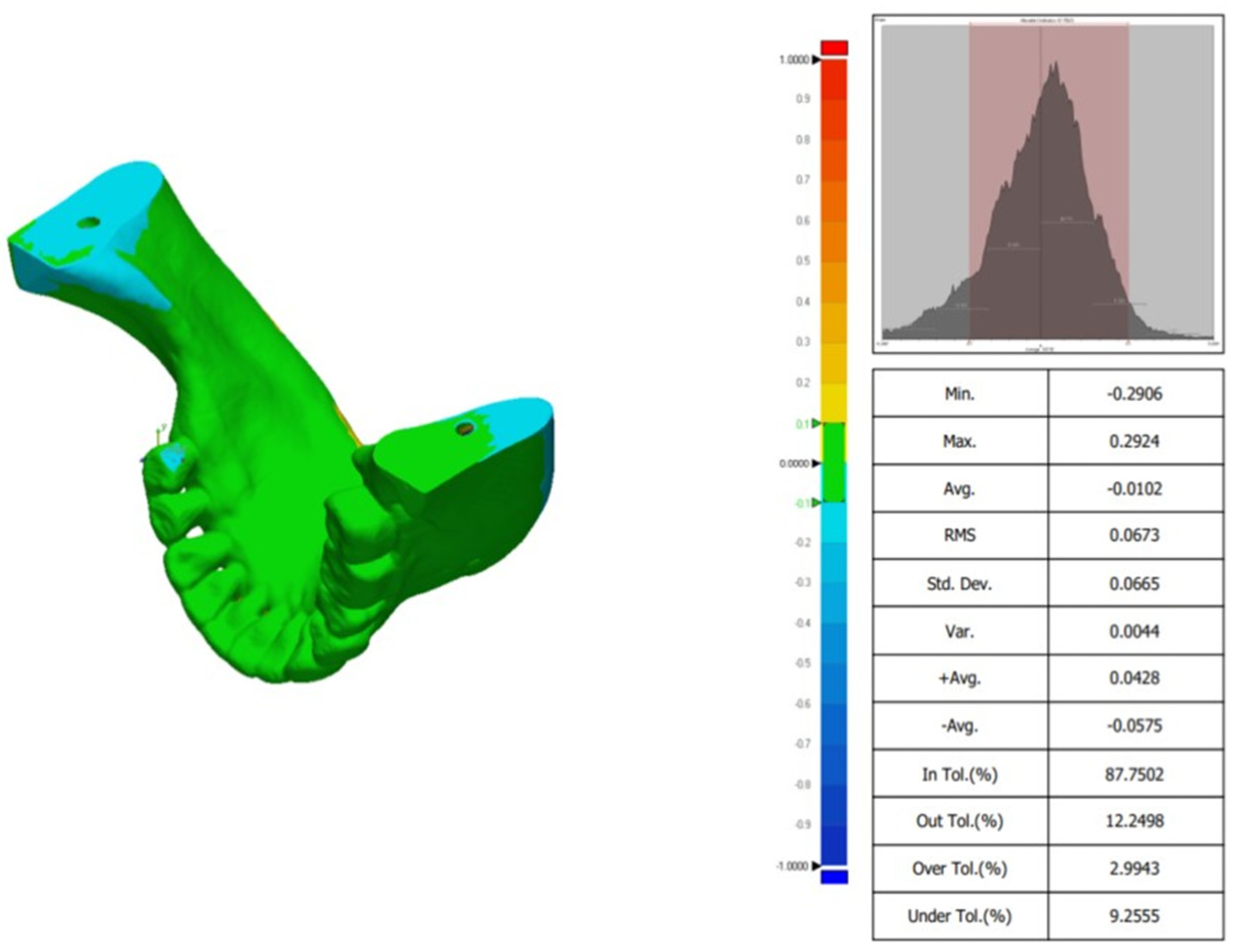
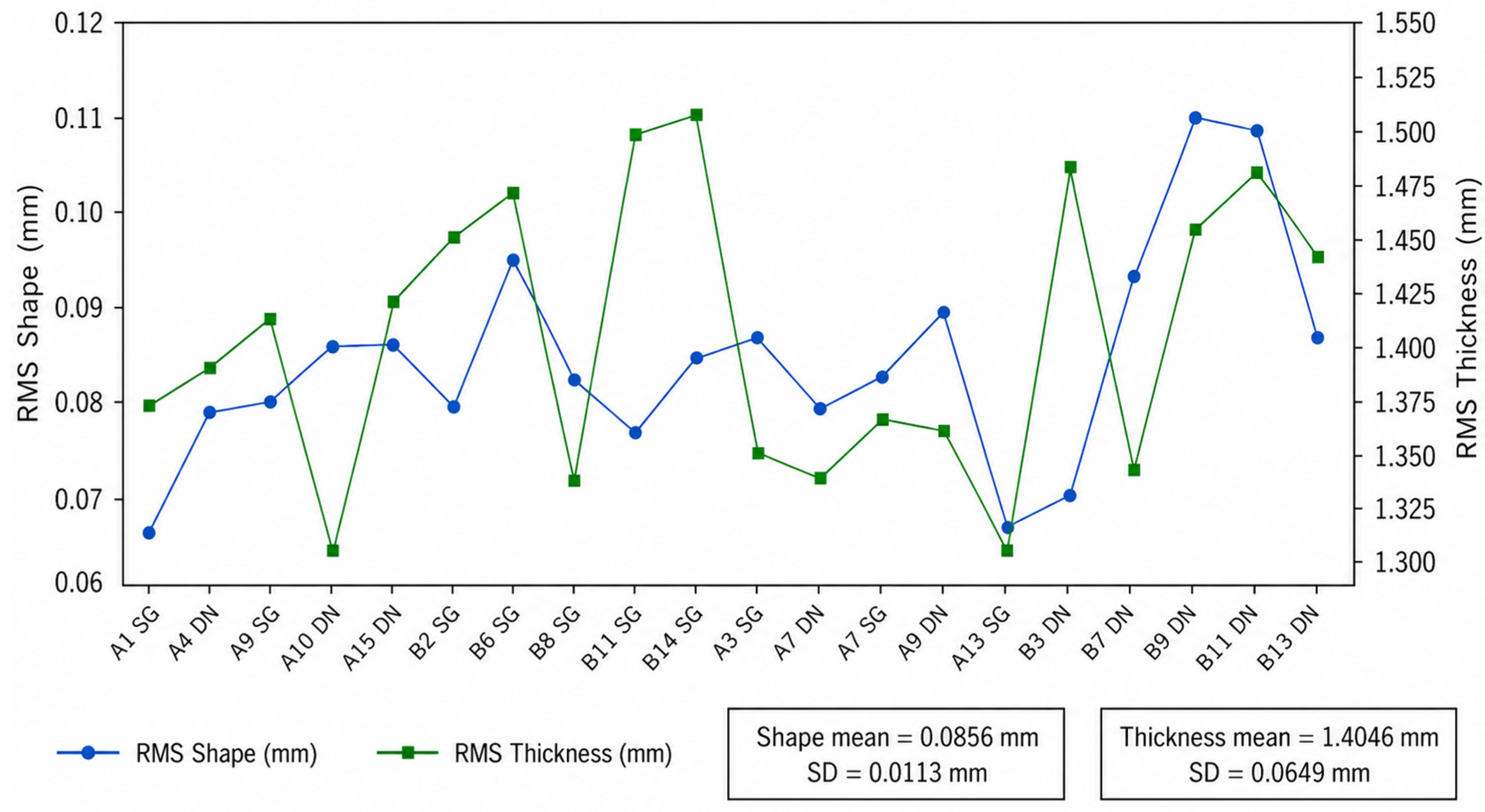
To verify dimensional accuracy and reproducibility, 20 printed models were randomly selected and converted to a digital form using an intraoral scanner (Medit i900; Medit Corp., Seoul, Republic of Korea). The resulting STL files were aligned to their corresponding original STL files and analyzed in Geomagic Control X 2022.1.0 (3D Systems, Rock Hill, SC, USA) using best-fit registration. This alignment was performed to assess dimensional deviations and structural deformation occurring during printing and post-processing procedures [23]. Following alignment, geometric agreement was quantified using surface-comparison outputs by measuring root-mean-square (RMS) surface deviation (shape trueness) and a corresponding RMS thickness metric, with dispersion as the standard deviation (SD), for each model. The uniformity of these alignment indicators across all printed specimens demonstrates clustering around their respective means with minimal variation, thereby supporting reproducible manufacturing output within the standardized workflow, which includes a 50 µm printing resolution and uniform post-processing. Moreover, an RMS value of <120 µm was considered indicative of acceptable reproduction accuracy relative to the original STL geometry [24]. Figure 2 presents a screenshot from Geomagic Control X software illustrating the alignment between the intraoral scan of the printed model and the original STL file.

2.5. Virtual Implant Planning and Surgical Guide Design

Virtual implant planning was performed using (v5.0 rc; BlueSky Bio, Grayslake, IL, USA). For each clinical scenario, a single implant Neodent Helix GM 3.5 mm × 10 mm (Straumann Group, Curitiba, Brazil) was virtually placed at the posterior mandibular edentulous area of tooth no. 47. The planned implant to IAN safety distance was standardized with a clearance of 1.99 mm in clinical scenario I and 1.6 mm in clinical scenario II. These planned positions served as the reference for subsequent sCAIS and dCAIS placement.
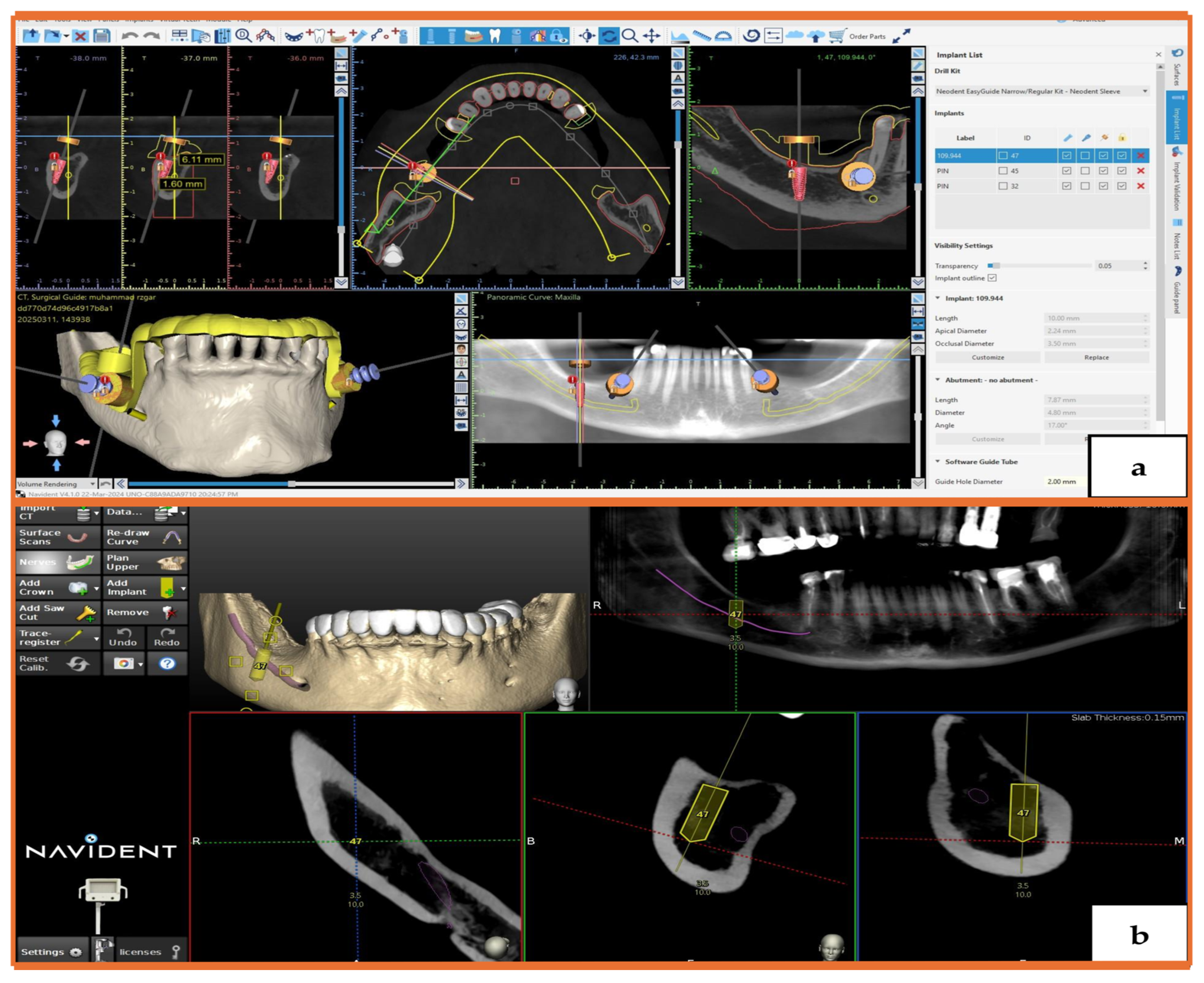
For the sCAIS groups, surgical guides were designed individually for each clinical scenario. In clinical scenario I, the surgical guide was fabricated with an extension to the contralateral second premolar region. On the edentulous side, it was extended to the most posterior aspect of the edentulous area, and a fixation pin was planned in the region of the intended dental implant to maximize stability. Meanwhile, in clinical scenario II, the surgical guide was extended bilaterally to maximize seating and stabilization on the model. Two fixation pins were incorporated into the distal extensions to improve guide retention and reduce intraoperative micromovement, thereby supporting drilling accuracy. The guide design, including drill-sleeve insertion and fixation-pin holes, was generated using the software and exported as STL files for each clinical scenario (Figure 3a). Surgical guide templates were subsequently fabricated using high-precision resin-based additive manufacturing to produce anatomical replicas. The guides were printed using biocompatible Surgical Guide Resin V1 (Formlabs, Somerville, MA, USA) and incorporated predefined drill sleeves for each implant site. Thereafter, all narrow-guided sleeves (REF 125.168) and fixation-pin sleeves (REF 125.143) were manually fitted into their designated positions. All guides were constructed as tooth-supported templates to enhance stability and reduce intraoperative displacement.
For the dCAIS groups, a license was obtained from (ClaroNav Inc., Toronto, ON, Canada). The finalized dental implant planning for each clinical scenario was exported from BlueSky Plan (v5.0 rc; BlueSky Bio, Grayslake, IL, USA) as XML files and subsequently transferred to Navident. Thereafter, the CBCT dataset for each clinical scenario was imported separately into Navi Plan software (Navident UNO v4.1.0, ClaroNav Inc., Toronto, ON, Canada), the jaw curve was marked, and the IAN was delineated. The dental implant plan was exported from BlueSky Plan (v5.0 rc; BlueSky Bio, Grayslake, IL, USA) and then imported into Navi Plan software to verify the dental implant position (Figure 3b).

2.6. Dental Implant Placement

A total of 60 Neodent bone-level dental implants were placed by a single expert oral surgeon experienced in guided and navigation-assisted implant placement according to the virtual plan, using either sCAIS (n = 30) or dCAIS (n = 30). For each approach, five implants were placed consecutively at 10-day intervals.
In the sCAIS groups, each surgical guide was positioned on the printed model and secured with fixation pins (REF 125.100) according to their respective clinical scenario (clinical scenario I or II). The guide was then verified for complete seating and stability on the corresponding model by securing on a prefabricated base mounted to a mannequin to standardize positioning. Dental implant placement was performed using a fully guided workflow with the Neodent Narrow surgical kit, strictly following the manufacturer’s drilling sequence and the predefined virtual plan. Later the dental implant was inserted accordingly.
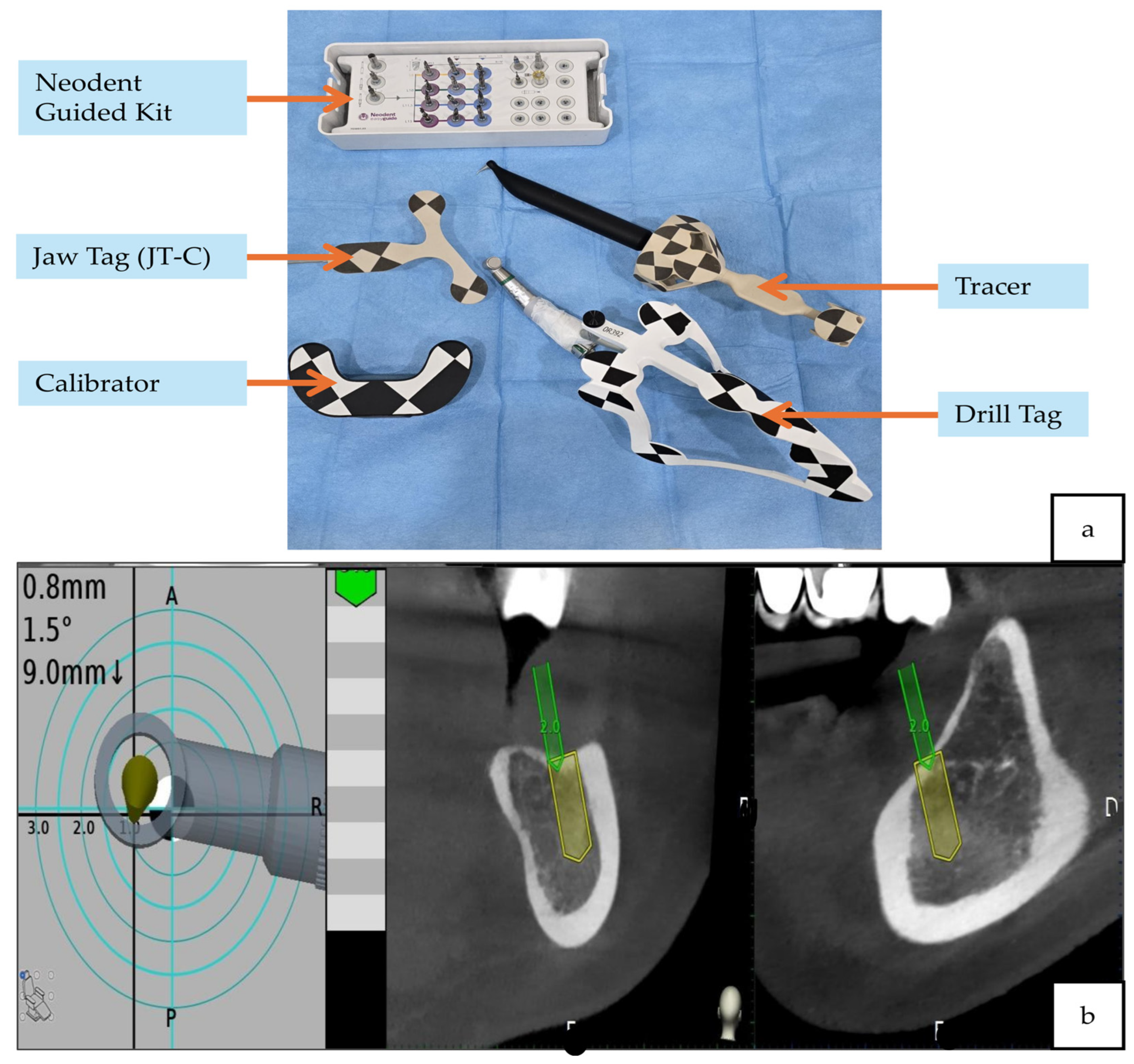
For the dCAIS groups, each model was similarly stabilized on a prefabricated base within a mannequin. Registration was performed in the NaviDent software (Navident UNO v4.1.0, ClaroNav Inc., Toronto, ON, Canada) by acquiring approximately 100 reference points with the tracer tool from at least four predefined anatomical landmarks corresponding to the CBCT data, preferentially using the more reliable tooth edges. The accuracy of registration was subsequently checked and verified with the tracer tool; ideally, this value should range between −0.5 and 0.5 mm. A JT-C Jaw Tag was attached to the tooth surface using a light-cured flowable composite resin to provide a stable tracking reference. Before osteotomy preparation, a Drill Tag was mounted on the Bien-Air CA 20:1 contra-angle surgical handpiece (Bien-Air Dental, Biel, Switzerland). The handpiece and drill were calibrated using the Navident Calibrator and the Navident optical camera according to the manufacturer’s recommendations. Dental implant site preparation and placement were then performed under real-time navigation based on the imported CBCT data and the pre-established virtual surgical plan. Figure 4a,b show the accessories required for dental implant placement and the real-time navigation procedure.

2.7. Deviation Analysis

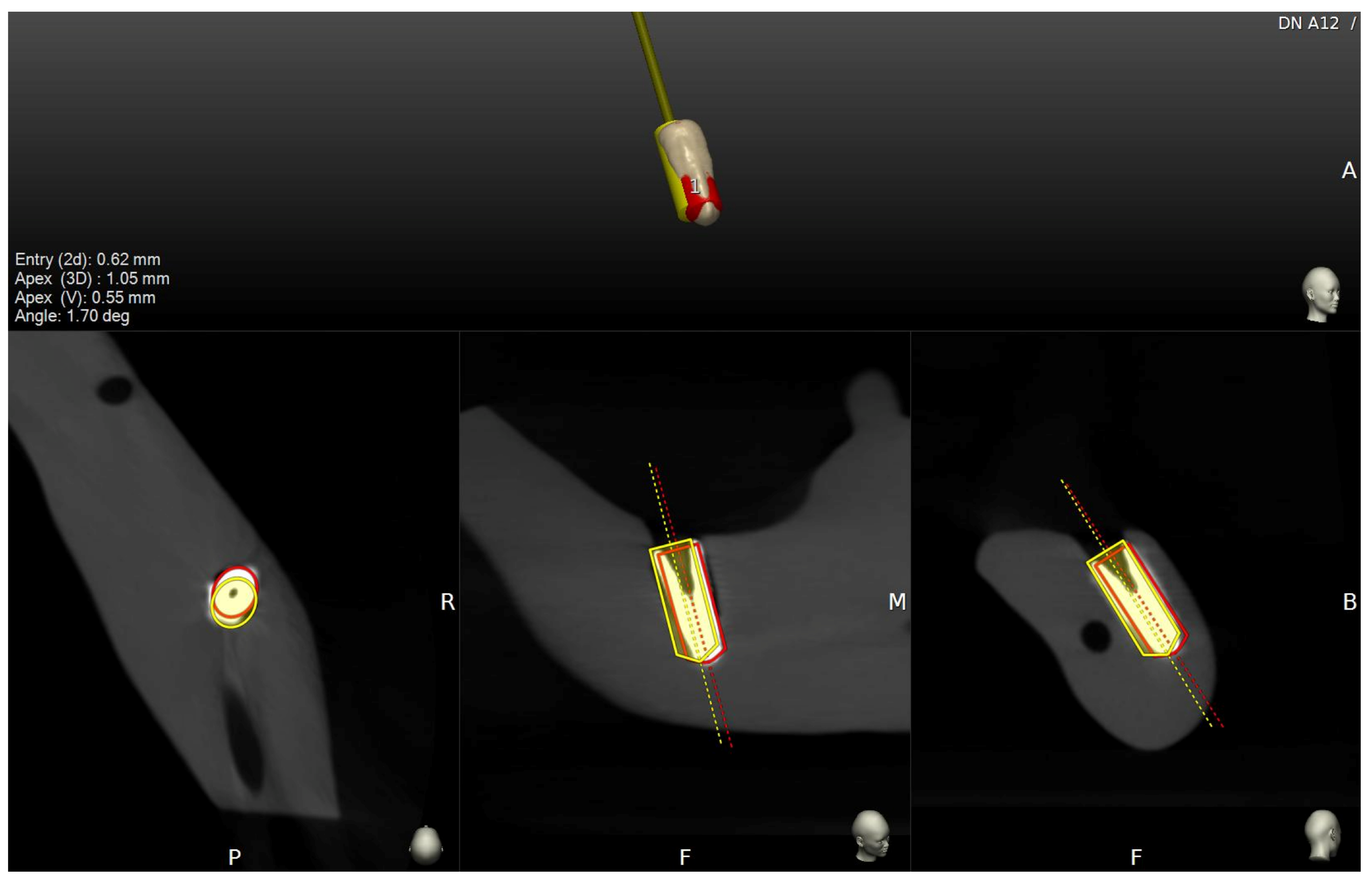
Following dental implant placement, postoperative CBCT scans were acquired for all 60 models using the same manufacturer and settings as described previously, to ensure optimal standardization. To assess the implant 3D position, Evalunav software v4.1.0 developed by ClaroNav Inc. (Toronto, ON, Canada) was used. Each postoperative CBCT was registered to its respective preoperative virtually planned CBCT by matching the corresponding anatomical landmarks. After image registration, the dental implant was automatically delineated, and deviation analysis was performed. The deviation parameters included entry-2D, entry-3D deviation, apical-3D deviation, vertical deviation and angular deviation, as shown in Figure 5.
To assess dental implant clearance from the IAN, all postoperative CBCT scans were additionally analyzed using CS Imaging Viewer (version 3.10.21, CS 9600®, Carestream Dental, Atlanta, GA, USA). The dental implant-to-IAN distance (DIAN) was recorded, and DIAN deviation relative to the corresponding virtual plan was calculated for both clinical scenarios (I and II).
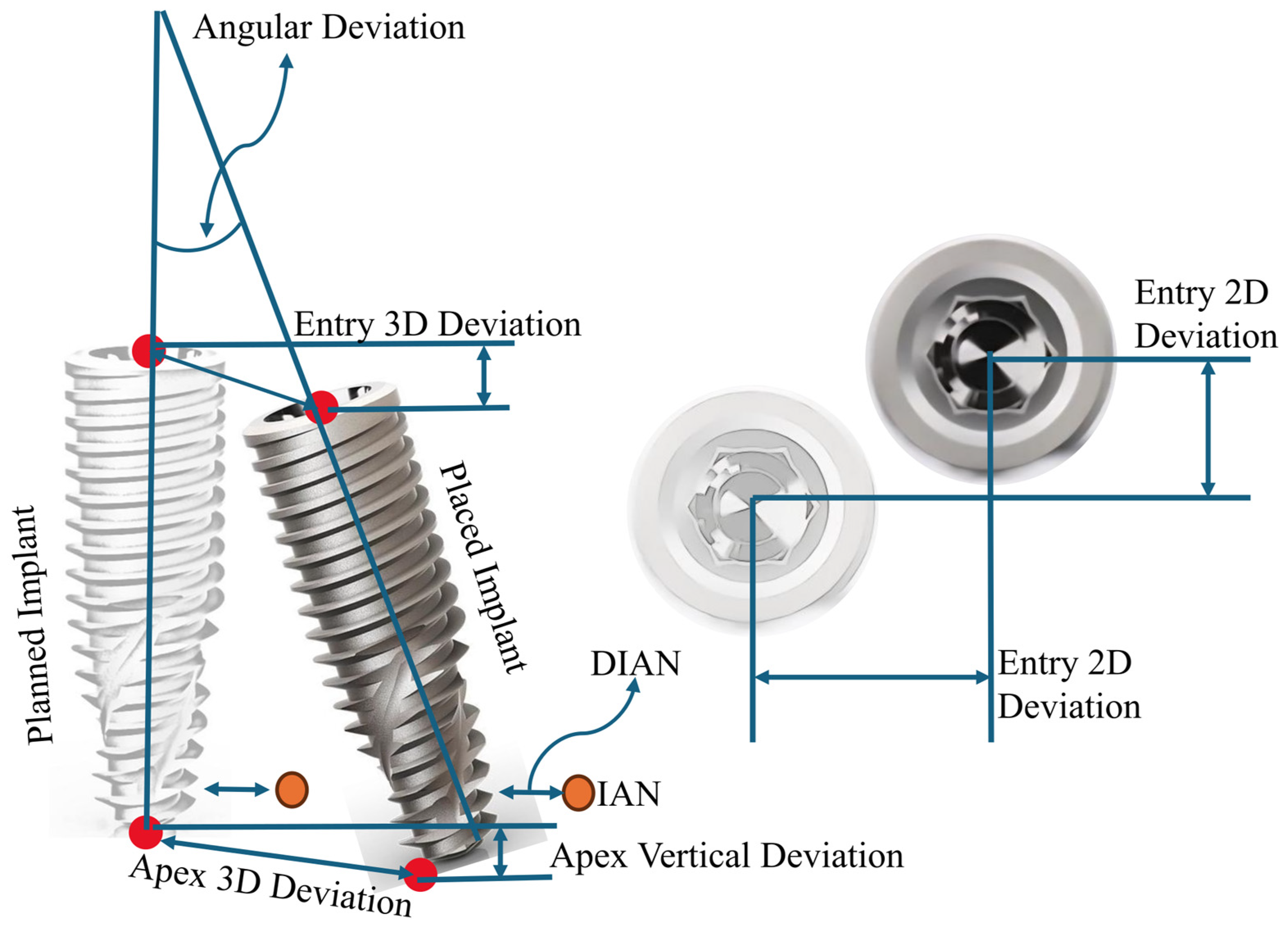
The primary outcome measures were the deviation of dental implant placement from the virtual plan, measured from the dental implant to the IAN, indicating clinically significant nerve clearance. Secondary outcome measures included positioning and angulation deviations at other critical dental implant locations. Entry-2D deviations were defined as the two-dimensional coronal-plane deviation between the actual implant position and the virtual plan at the most coronal aspect of the implant. In contrast, entry-3D deviations were defined as the mesiodistal and buccolingual 3D distances between the intended and actual implant at the center of the coronal platform. Apical-3D deviation indicates the 3D distance at the apex of the implant. Apical-vertical deviation indicates apico-coronal deviation of the apex of the placed implant. Angular deviation refers to the discrepancy in implant-axis alignment between the planned and the ultimate implant placement (Figure 6). Collectively, these measurements provide a thorough evaluation of translational and rotational precision across guidance methodologies and anatomical contexts. All deviations were calculated following standardized coordinate registration.

2.8. Reliability Assessment of Measurements

The reliability of the measurements was evaluated using the intraclass correlation coefficient (ICC), derived from the repeated assessment of 20 samples to determine intra-examiner reliability. To assess intra-observer agreement over time, the same examiner repeated all measurements after a 1-month interval. Values below 0.5 signify poor reliability; values between 0.5 and 0.75 indicate moderate reliability; values between 0.75 and 0.9 represent high reliability; and values over 0.90 indicate excellent reliability [25].

2.9. Statistical Analysis

Statistical analyses were conducted using IBM SPSS Statistics software, version 29, developed by IBM Corporation (New York, NY, USA). Data normality was assessed using the Shapiro–Wilk test before selecting the appropriate comparative test. Comparisons between static and dynamic navigation systems were performed using the Mann–Whitney U test and independent t-test; the scatter plot was generated using Python V.3.15. The results of the normality test show that amongst the parameters examined, entry-3D deviation (p = 0.025) and apex-vertical deviation (p < 0.001) were not normally distributed and, hence, nonparametric tests were used, while angle deviation (p = 0.050), entry-2D deviation (p = 0.187), apex-3D deviation (p = 0.395), and DIAN deviation (p = 0.175) were normally distributed. Therefore, parametric tests were used for further analysis.

3. Results

3.1. Study Sample and Data Distribution

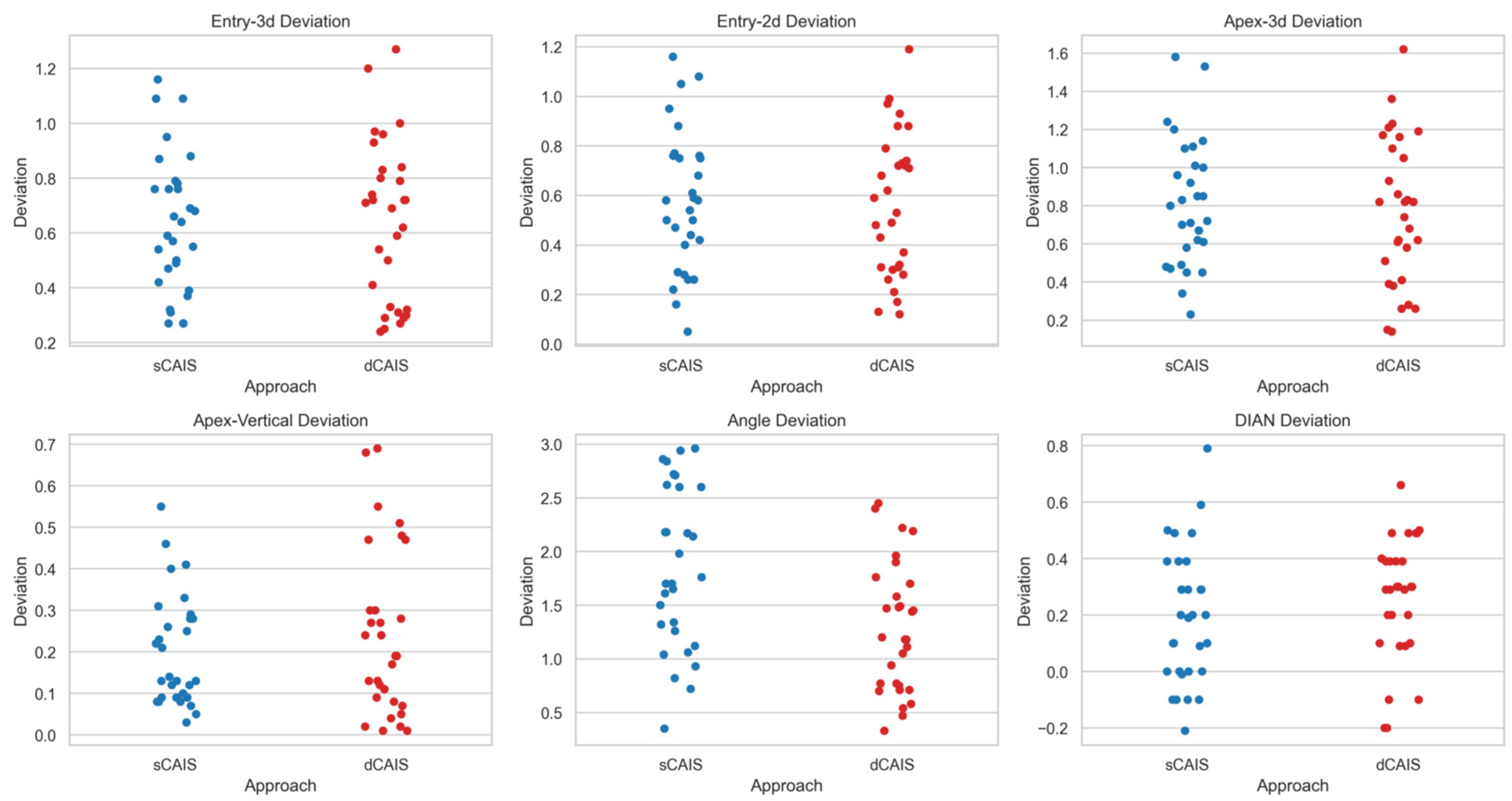
In total, the sample examined in the current study consisted of 60 dental implants, with 30 implants in each of the clinical scenarios (I & II). Further, 15 implants were placed using either sCAIS or dCAIS. The overall descriptive and comparison statistics of all parameters are presented in Table 1. The intra-examiner reliability tests for all examined parameters, using the ICC, showed excellent reliability (0.95 to 0.98) except for apex vertical deviation, which showed good reliability (0.77). Across 20 printed models, the RMS surface deviation remained very low (mean 0.0856 ± 0.0113 mm, ranging from 0.0673 to 0.1104 mm), supporting high geometric trueness between printed and original STL geometry. The RMS thickness metric showed similarly consistent behavior (mean 1.4046 ± 0.0649 mm, ranging from 1.3105 to 1.5067 mm). The stability of these exact alignment indicators across all prints is visualized in a dual-axis control chart. Figure 7 illustrates the stability of these exact alignment trueness indicators across all prints, as shown in a dual-axis control chart. Furthermore, the scatter plot deviation from the virtual planned (presented as zero in the y axis) by static surgical guides and dynamic navigation systems is presented in Figure 8. It is important to acknowledge that the lower the value of each parameter, the closer to the planned position, which was zero for all examined parameters.

3.2. Comparison Between sCAIS and dCAIS Approaches

When all parameters were examined in both clinical scenarios (Table 1), no statistically significant differences between sCAIS and dCAIS approaches were detected (p > 0.05), except for angular deviation, which showed a statistically significant difference between the sCAIS and dCAIS approaches (p = 0.004).

3.3. Comparison and Correlation Between the sCAIS and dCAIS Approaches Within Clinical Scenarios

Later, to examine the effect of each clinical scenario on the parameters, comparisons of all parameters were conducted within each scenario, as described below. In each scenario, 15 dental implants were placed using the sCAIS approach and 15 dental implants using dCAIS.

3.3.1. Clinical Scenario I

The comparison of nonparametric parameters using the Mann–Whitney U test (Table 2) showed that the entry-3D deviation by sCAIS (median = 0.54 mm, IQ range = 0.49 mm) and dCAIS (median = 0.5 mm, IQ range = 0.52 mm) approaches was not statistically significant (p = 0.512). Regarding apex-vertical deviation across approaches, sCAIS (median = 0.12 mm, IQ range = 0.06 mm) and dCAIS (median = 0.19 mm, IQ range = 0.36 mm) approaches were also tested, and the results were not statistically significant (p = 0.061). However, angular deviation showed a statistically significant difference between the sCAIS (median = 1.65°, IQ range = 1.06°) and dCAIS (median = 1.18°, IQ range = 0.88°) approaches (p = 0.033).
On the other hand, using an independent test for parametric parameters showed that the apex-3D deviation parameter, measured by either sCAIS (0.793 ± 0.345 mm) or dCAIS (0.684 ± 0.367 mm), showed no statistically significant difference (p = 0.413). Similarly, the 2D deviation parameters reported by sCAIS and dCAIS were 0.608 ± 0.304 mm and 0.482 ± 0.27 mm, respectively, with no statistically significant difference between them (p = 0.241). Lastly, the DIAN deviation for the sCAIS approach was 0.317 ± 0.243 mm, and for the dCAIS approach was 0.368 ± 0.152 mm. Again, no statistically significant difference was detected by either approach (p = 0.495).
Spearman’s correlation test was conducted for all parameters according to the sCAIS and dCAIS approaches, and significant correlations (either positive or negative) between some parameters were detected (Table 3). The strongest association was detected between entry-3D deviation and entry-2D deviation (sCAIS: r = 0.995, p < 0.0001, dCAIS: r = 0.949, p < 0.0001) as well as between entry-3D deviation and apex-3D deviation (sCAIS: r = 0.906, p < 0.0001, dCAIS: r = 0.956, p < 0.0001) and between entry-2D deviation and apex-3D deviation (sCAIS: r = 0.888, p < 0.0001, dCAIS: r = 0.938, p < 0.0001). Further, in the sCAIS approach, only the deviation between entry-2D and DIAN showed a strong negative association (r = −0.702, p = 0.004), whereas in the dCAIS approach, only the association between apex-3D deviation and angle deviation was statistically significant (r = 0.794, p < 0.001). However, no significant association was detected between apex-vertical deviation and DIAN deviation by either sCAIS or dCAIS approaches (sCAIS: r = 0.422, p = 0.117, dCAIS: r = −0.156, p = 0.578) or between angle deviation and DIAN deviation (sCAIS: r = 0.033, p = 0.907, dCAIS: r = −0.126, p = 0.655).

3.3.2. Clinical Scenario II

The comparison between nonparametric parameters using the Mann–Whitney U test showed that entry 3D deviation by sCAIS (median = 0.66 mm, IQ range = 0.27 mm) and dCAIS (median = 0.72 mm, IQ range = 0.30 mm) approaches was not statistically significant (p = 0.512). Further, apex-vertical deviations by sCAIS (median = 0.28 mm, IQ range = 0.27 mm) and dCAIS (median = 0.19 mm, IQ range = 0.26 mm) approaches were not statistically significant (p = 0.061). However, for angular deviation there was a statistically significant difference between sCAIS (median = 1.98°, IQ range = 1.38°) and dCAIS (median = 1.2°, IQ range = 1.42°) approaches (p = 0.033), as shown in Table 4.
On the other hand, when the parametric parameters were compared, for the apex-3D deviation parameter, neither sCAIS (0.828 ± 0.328 mm) nor the dCAIS (0.835 ± 0.404 mm) approach demonstrated any statistically significant difference (p = 0.413). Similarly, the entry-2D deviation parameters by sCAIS and dCAIS were 0.527 ± 0.269 mm and 0.641 ± 0.293 mm, respectively, with no statistically significant difference (p = 0.241). Finally, the comparison of DIAN deviation parameter by sCAIS (0.667 ± 0.163 mm) and dCAIS (0.153 ± 0.216 mm) approaches revealed no statistically significant difference (p = 0.495) (Table 4).
Again, the associations among all tested parameters in clinical scenario 2, according to the sCAIS and dCAIS approaches, were analyzed using Spearman’s correlation test (Table 5). The associations between parameters were either positively or negatively correlated. Amongst the parameter tests, the strongest associations were identified between entry-3D deviation and entry-2D deviation (sCAIS: r = 0.929, p < 0.001, dCAIS: r = 0.887, p < 0.001), entry-3D deviation and apex-3D deviation (sCAIS: r = 0.869, p < 0.0001, dCAIS: r = 0.935, p < 0.001) as well as between entry-2D deviation and apex-3D deviation (sCAIS: r = 0.903, p < 0.001, dCAIS: r = 0.874, p < 0.001), whereas all other parameters showed no statistically significant association (p > 0.05).

4. Discussion

The present in vitro study was designed to compare sCAIS and dCAIS for dental implant placement during IAN bypass procedures. Optimally placing a dental implant is necessary for functional efficiency, sustainable outcomes, and esthetic success before dental implant loading. Tooth loss results in alveolar bone resorption, and the degree of resorption can be reduced by therapeutic techniques such as atraumatic tooth extraction and tension-free suturing. However, if alveolar ridge resorption is progressive, implant surgery becomes increasingly unfavorable. To address these challenges, some researchers have suggested unconventional alternatives, such as placing implants buccally or lingually relative to the IAN. This approach presents numerous advantages, including minimal invasiveness, reduced treatment duration, and suitability for patients who are unable to undergo bone augmentation procedures due to relative or absolute contraindications [18].
To the best of our knowledge, this is the first study to evaluate CAIS for IAN bypass in sites with limited residual bone height. Its originality is further reinforced by using a single software platform for preoperative virtual planning and postoperative deviation analysis across both approaches, thereby ensuring methodological uniformity within the comparative workflow.
CAIS was implemented to convert the surgical process into a digital format and enhance the use of optimal virtual planning in the surgical setting. Multiple studies have shown improved placement accuracy with CAIS compared with freehand implant surgery. Although many comparative studies comparing sCAIS and dCAIS have shown no significant differences between these guidance approaches [26], their accuracy for IAN bypass has yet to be examined.
Prior studies showed that dCAIS could exhibit superiority over sCAIS, particularly in angular deviation; however, these findings were inconsistent across studies and require further investigation [16,27]. In sCAIS, the transfer of the planned implant position to the surgical site may depend on the quality of the radiograph, the precision of 3D printing, and the surgical guide seating [28,29].
Therefore, these factors must be meticulously incorporated into preoperative planning when considering dental implant placement near the IAN or other vital anatomical structures [30].
The current study compared the degree of deviation of dental implant placement using sCAIS and dCAIS in a partially edentulous model. Both procedures demonstrated minimal deviation from the original virtual plan, with the only significant difference in angular deviation favoring dCAIS. The other parameters of entry-2D and entry-3D deviations were comparable across sCAIS and dCAIS in clinical scenario I and clinical scenario II. These results align with other studies that reported comparable coronal deviations, despite minor variations [16,26,31,32].
Further, Shi et al. [33] exhibited comparable deviations for dCAIS and sCAIS in posterior premolar/molar position, without a significant difference between them. The increased precision in the current study is likely due to the in vitro design, which eliminates soft tissue, saliva, blood, and surgical access limitations, allowing for enhanced visual control and procedural standardization, thus minimizing operator-related variability [8,9].
Similarly, apex-3D deviation remained non-significant in clinical scenarios I and II. This finding is commensurate with Younis et al. [16] and Kivovics et al. [31], who found no significant difference in apical deviation, despite larger absolute values than those observed here. Additionally, Liu et al. [34] reported comparable apical deviations between dCAIS and sCAIS, whereas Shi et al. [33] noted better accuracy with dCAIS; however, the difference was not statistically significant. By contrast, Zhang et al. [17] reported significantly smaller apical deviation with dCAIS in the posterior mandible, and Li et al. [35] similarly favored dCAIS in meta-analytic pooled analysis.
Likewise, apex-vertical deviation was also non-significant within both clinical scenarios. This agrees with findings by Younis et al. [16] and Taheri Otaghsara et al. [26] that showed no significant difference in apical-coronal directional deviation between the approaches. While Li et al. [35] reported an advantage of dCAIS over sCAIS in apex-vertical deviation, this discrepancy appears more methodological than conceptual, since depth control in clinical settings is more susceptible to access limitations, reduced visibility, and registration- or calibration-dependent steps. In contrast, such sources of variation are substantially reduced in in vitro studies like this [17,31,34].
In the present study, angular deviation emerged as the only parameter exhibiting a significant difference between the approaches, with dCAIS demonstrating a lower angular deviation than sCAIS. This result corresponds with previous studies [34,36] indicating improved control of angular deviation with dCAIS. However, some studies reported no significant difference between dCAIS and sCAIS [11,37]. The potential cause for this discrepancy lies in the influence of technical variability, navigation systems, registration techniques, operator learning curves, case complexity, and site-specific positioning, all of which affect the accuracy of implant placement in CAIS techniques [32,38]. Further, a meta-analysis demonstrated no significant angular deviation among various CAIS techniques. This suggests that the observed discrepancies among these techniques are the result of case-specific characteristics or methodological variations rather than a meaningful difference in efficacy between sCAIS and dCAIS [39,40]. In this study the lower angular deviation noted with dCAIS may be attributed to the real-time visualisation of the drill axis in relation to the virtual plan, facilitating prompt adjustments to the drilling trajectory during osteotomy preparation and implant placement. Meanwhile, sCAIS transfers the intended trajectory via a pre-constructed template, with angular control potentially affected by guide seating, sleeve tolerance, drill-sleeve interaction, and slight guide micromovement. These characteristics may become significance in IAN bypass scenarios, where buccolingual tilting is necessary to ensure nerve clearance. Therefore, the noted angular advantage must be understood within the limits of this controlled in vitro model.
As for DIAN deviation, which is the most important parameter in the current study, although dCAIS demonstrated less deviation from the planned dental implant than sCAIS in clinical scenario II, no significant difference was observed at either the overall or clinical scenario level. This finding can be justified by the fact that the comparison was performed with the planned dental implant position, which is a virtual position rather than a comparison to actual clinical parameters, such as distance from the IAN canal, as used by Zhang et al. [17], or the use of a 2 mm safety zone from the IAN canal by Pimkhaokham et al. [41]. On the other hand, Chen et al. [42] demonstrated the technical validity of dCAIS for nerve bypass placement without providing a sCAIS comparison. Nevertheless, our findings support the idea that DIAN deviation, whether assessed by either approach, is comparable and can be further investigated in clinical settings.
Across both clinical scenarios, correlation analysis showed a strong association between coronal and apical deviation parameters. For example, in clinical scenario I, entry-3D deviation correlated with entry-2D deviation and apex-3D deviation in both the sCAIS and dCAIS approaches; further, entry-2D deviation correlated with apex-3D deviation. The same trend was noticed in clinical scenario II. This can be explained by the fact that the deviation from the planned position propagated coherently from the entry to the apex rather than occurring as an isolated error. It is worth noting that some parameters are inversely associated, particularly with angle deviation. Again, this is rational, as the angle deviation can be in a different direction (for example toward the buccal or lingual side), and a negative angle deviation can lead to a deviation of the other parameter in the opposite direction.
From a clinical perspective, deviations in implant angulation and implant-to-IAN distance are relevant because they may influence nerve safety, restorative trajectory, and prosthetically driven emergence. In the present study, DIAN deviation was assessed as a surrogate measure of spatial accuracy relative to the IAN rather than as a direct clinical neurosensory outcome. Similarly, although improved angular control may support a more favorable restorative trajectory and emergence profile, the present model did not evaluate prosthetic restoration, peri-implant soft-tissue response, loading, or marginal bone stability. Therefore, long-term implant survival cannot be inferred from these in vitro findings and should be investigated in future clinical in vivo studies with follow-up assessment.

4.1. Limitations

This research has some limitations. The in vitro nature of the study does not present the complexity of clinical implant surgery such as soft-tissue interference, saliva, blood, patient movement, and limited intraoperative visibility. Further, the study examined only two CBCT-derived clinical scenarios, hence constraining the generalisability to a wider range of anatomical variances. On the other hand, the operator’s experience and learning curve may still affect the reproducibility of both sCAIS and dCAIS procedures. Nevertheless, this is the first study to examine and compare use of sCAIS and dCAIS for IAN bypass with standardized models, which allows fair comparison between these two approaches without the effect of confounding variables.

4.2. Recommendations for Future Research

Further study should be conducted to validate the findings of this study by employing a wider range of mandibular anatomical scenarios, including various residual bone heights, buccolingual canal positions, and more complex edentulous scenarios. Future studies should evaluate additional navigation systems to investigate if the identified accuracy patterns are dependent upon the system or workflow. Clinical in vivo investigations are necessary to assess postoperative neurosensory outcomes, patient-related factors, surgical access limitations, learning-curve impacts, workflow efficiency, and cost-effectiveness. Such studies would determine whether the angular advantage noted for dCAIS in controlled laboratory settings persists in clinically complex IAN-bypass surgeries.

5. Conclusions

Within the limitations of this in vitro study, both sCAIS and dCAIS enabled accurate implant placement, supporting the overall precision of digitally guided workflows in IAN bypass. dCAIS, however, demonstrated lower angular deviation, suggesting a potential advantage in directional control. However, these findings should be interpreted cautiously due to the in vitro nature of the study without the complexity of clinical implant surgery. Further in vitro and in vivo studies are needed in more complicated anatomical positions with multi-implant scenarios, taking operator experience, learning curve, and cost-effectiveness between systems into account.

Author Contributions

Conceptualization, R.O.S.; methodology, R.O.S.; software, R.O.S.; validation, R.O.S.; formal analysis, R.O.S.; investigation, R.O.S.; resources, R.O.S.; data curation, R.O.S.; writing—original draft preparation, R.O.S.; writing—review and editing, B.J.M.F.; visualization, B.J.M.F.; supervision, B.J.M.F.; project administration, B.J.M.F.; funding acquisition, R.O.S. All authors have read and agreed to the published version of the manuscript.

Funding

This research received no external funding.

Institutional Review Board Statement

The study was conducted in accordance with the Declaration of Helsinki, and approved by the Scientific Committee of the College of Dentistry, University of Sulaimani (protocol code no: 293/24 and date of approval 16 December 2024).

Informed Consent Statement

Informed consent was obtained from all subjects involved in the study. Written informed consent has been obtained from the patients to publish this paper.

Data Availability Statement

The original data generated in this study are presented within the article. Further information may be obtained from the corresponding author upon reasonable request.

Acknowledgments

The authors gratefully acknowledge B&R Dental Center for providing access to the CBCT unit and the radiographic data used in this study. The authors also thank Mohammed H. Karim for his support and for facilitating access to the Navident system.

Conflicts of Interest

The authors declare that they have no financial or personal affiliations that might be perceived as influencing the execution, analysis, or reporting of this work.

References

  1. Nulty, A. A literature review on prosthetically designed guided implant placement and the factors influencing dental implant success. Br. Dent. J. 2024, 236, 169–180. [Google Scholar] [CrossRef]
  2. Mahmood, M.; Mahmood, B. Clinical, Physiological, and Psychological Evaluation of Implant-Related Full Mouth Rehabilitation. Sulaimani Dent. J. 2023, 10, 44–51. [Google Scholar] [CrossRef]
  3. Pena-Cardelles, J.F.; Markovic, J.; Akhondi, S.; Pedrinaci, I.; Lanis, A.; Gallucci, G.O. Inferior alveolar nerve damage related to dental implant placement. A systematic review and meta-analysis. Med. Oral Patol. Oral Cir. Bucal 2025, 30, e578–e589. [Google Scholar] [CrossRef]
  4. Urban, I.A.; Montero, E.; Monje, A.; Sanz-Sanchez, I. Effectiveness of vertical ridge augmentation interventions: A systematic review and meta-analysis. J. Clin. Periodontol. 2019, 46, 319–339. [Google Scholar] [CrossRef] [PubMed]
  5. Saez-Alcaide, L.M.; Gonzalez Gallego, B.; Fernando Moreno, J.; Moreno Navarro, M.; Cobo-Vazquez, C.; Cortes-Breton Brinkmann, J.; Meniz-Garcia, C. Complications associated with vertical bone augmentation techniques in implant dentistry: A systematic review of clinical studies published in the last ten years. J. Stomatol. Oral Maxillofac. Surg. 2023, 124, 101574. [Google Scholar] [CrossRef]
  6. Shi, J.Y.; Xu, F.Y.; Zhuang, L.F.; Gu, Y.X.; Qiao, S.C.; Lai, H.C. Long-term outcomes of narrow diameter implants in posterior jaws: A retrospective study with at least 8-year follow-up. Clin. Oral Implant. Res. 2018, 29, 76–81. [Google Scholar] [CrossRef]
  7. Filipov, I.; Chirila, L.; Bolognesi, F.; Cristache, C.M. Buccally or Lingually Tilted Implants in the Lateral Atrophic Mandible: A Three-Year Follow-Up Study Focused on Neurosensory Impairment, Soft-Tissue-Related Impaction and Quality of Life Improvement. Medicina 2023, 59, 697. [Google Scholar] [CrossRef]
  8. Felice, P.; Barausse, C.; Pistilli, R.; Ippolito, D.R.; Esposito, M. Five-year results from a randomised controlled trial comparing prostheses supported by 5-mm long implants or by longer implants in augmented bone in posterior atrophic edentulous jaws. Int. J. Oral Implant. 2019, 12, 25–37. [Google Scholar]
  9. Streichfuss, C.; Wolfart, S.; Waltenberger, L. Influence of Bone Density and Guide Protocol on the Accuracy of Self-Cutting Implants Using Static Guided Implant Placement-An In Vitro Study. Clin. Oral Implant. Res. 2025, 36, 1248–1260. [Google Scholar] [CrossRef] [PubMed]
  10. Jaskari, J.; Sahlsten, J.; Jarnstedt, J.; Mehtonen, H.; Karhu, K.; Sundqvist, O.; Hietanen, A.; Varjonen, V.; Mattila, V.; Kaski, K. Deep Learning Method for Mandibular Canal Segmentation in Dental Cone Beam Computed Tomography Volumes. Sci. Rep. 2020, 10, 5842. [Google Scholar] [CrossRef]
  11. Kaewsiri, D.; Panmekiate, S.; Subbalekha, K.; Mattheos, N.; Pimkhaokham, A. The accuracy of static vs. dynamic computer-assisted implant surgery in single tooth space: A randomized controlled trial. Clin. Oral Implant. Res. 2019, 30, 505–514. [Google Scholar] [CrossRef]
  12. Rasheed, M.; Mahmood, B. Accuracy Comparison of Guided Implant Placement Between Tooth and Mucosal Supported Stereolithographic Models in the Maxillary Arch. (An experimental study). Sulaimani Dent. J. 2025, 12, 12–18. [Google Scholar] [CrossRef]
  13. Varga, E., Jr.; Antal, M.; Major, L.; Kiscsatari, R.; Braunitzer, G.; Piffko, J. Guidance means accuracy: A randomized clinical trial on freehand versus guided dental implantation. Clin. Oral Implant. Res. 2020, 31, 417–430. [Google Scholar] [CrossRef]
  14. Yotpibulwong, T.; Arunjaroensuk, S.; Kaboosaya, B.; Sinpitaksakul, P.; Arksornnukit, M.; Mattheos, N.; Pimkhaokham, A. Accuracy of implant placement with a combined use of static and dynamic computer-assisted implant surgery in single tooth space: A randomized controlled trial. Clin. Oral Implant. Res. 2023, 34, 330–341. [Google Scholar] [CrossRef]
  15. Khaohoen, A.; Powcharoen, W.; Yoda, N.; Rungsiyakull, C.; Rungsiyakull, P. Accuracy in dental implant placement: A systematic review and meta-analysis comparing computer-assisted (static, dynamic, robotics) and noncomputer-assisted (freehand, conventional guide) approaches. J. Prosthet. Dent. 2025, 134, 91.e1–91.e25. [Google Scholar] [CrossRef]
  16. Younis, H.; Lv, C.; Xu, B.; Zhou, H.; Du, L.; Liao, L.; Zhao, N.; Long, W.; Elayah, S.A.; Chang, X.; et al. Accuracy of dynamic navigation compared to static surgical guides and the freehand approach in implant placement: A prospective clinical study. Head Face Med. 2024, 20, 30. [Google Scholar] [CrossRef]
  17. Zhang, C.; Al-Awadhi, Z.A.; Geng, N.; Mo, S.; Chen, S. Dynamic navigation-assisted flapless implant placement in the posterior mandible: A retrospective and comparative study. Oral Surg. Oral Med. Oral Pathol. Oral Radiol. 2025, 139, 670–683. [Google Scholar] [CrossRef] [PubMed]
  18. Sleman, N. Inferior alveolar nerve bypass during tilted implant insertion: A 3-year retrospective cohort study. Adv. Oral Maxillofac. Surg. 2025, 17, 100502. [Google Scholar] [CrossRef]
  19. Froum, S.J.; Bergamini, M.; Reis, N.; Wang, W.; Leung, M.; Kaufman, Z.; Cho, S.C. A New Concept of Safety Distance to Place Implants in the Area of the Inferior Alveolar Canal to Avoid Neurosensory Disturbance. Int. J. Periodontics Restor. Dent. 2021, 41, e139–e146. [Google Scholar] [CrossRef] [PubMed]
  20. Zhou, M.; Zhou, H.; Li, S.Y.; Zhu, Y.B.; Geng, Y.M. Comparison of the accuracy of dental implant placement using static and dynamic computer-assisted systems: An in vitro study. J. Stomatol. Oral Maxillofac. Surg. 2021, 122, 343–348. [Google Scholar] [CrossRef]
  21. Arslan Acicbe, B.; Deniz, S.; Diken Turksayar, A.A.; Donmez, M.B.; Demirel, M. Fabrication and fit accuracy of definitive resin fixed partial dentures additively manufactured using different vat polymerization technologies. J. Dent. 2025, 162, 106052. [Google Scholar] [CrossRef]
  22. Yadav, R.; Sonwal, S.; Sharma, Y.K.; Huh, Y.S.; Brambilla, E.; Khan, R.; Ionescu, A.C. A Mini Review on Physical, Mechanical, Tribology Analysis of Micro-Nano Fibers and Ceramics Reinforced Polymer Composites for Advanced Manufacturing Processes. Polym. Adv. Technol. 2025, 36, e70205. [Google Scholar] [CrossRef]
  23. George, E.; Liacouras, P.; Rybicki, F.J.; Mitsouras, D. Measuring and Establishing the Accuracy and Reproducibility of 3D Printed Medical Models. Radiographics 2017, 37, 1424–1450. [Google Scholar] [CrossRef]
  24. Nemeth, A.; Vitai, V.; Czumbel, M.L.; Szabo, B.; Varga, G.; Keremi, B.; Hegyi, P.; Hermann, P.; Borbely, J. Clear guidance to select the most accurate technologies for 3D printing dental models—A network meta-analysis(✰). J. Dent. 2023, 134, 104532. [Google Scholar] [CrossRef] [PubMed]
  25. Koo, T.K.; Li, M.Y. A Guideline of Selecting and Reporting Intraclass Correlation Coefficients for Reliability Research. J. Chiropr. Med. 2016, 15, 155–163. [Google Scholar] [CrossRef]
  26. Taheri Otaghsara, S.S.; Joda, T.; Thieringer, F.M. Accuracy of dental implant placement using static versus dynamic computer-assisted implant surgery: An in vitro study. J. Dent. 2023, 132, 104487. [Google Scholar] [CrossRef] [PubMed]
  27. Vinnakota, D.N.; Kamatham, R.; Nagaraj, E.; Reddy, P.S. Is dynamic computer-assisted surgery more accurate than the static method for dental implant placement? A systematic review and meta-analysis. J. Prosthet. Dent. 2025, 133, 1448–1460. [Google Scholar] [CrossRef]
  28. Block, M.S. Accuracy Using Static or Dynamic Navigation. J. Oral Maxillofac. Surg. 2016, 74, 2–3. [Google Scholar] [CrossRef]
  29. Sun, Y.; Ding, Q.; Yuan, F.; Zhang, L.; Sun, Y.; Xie, Q. Accuracy of a chairside, fused deposition modeling three-dimensional-printed, single tooth surgical guide for implant placement: A randomized controlled clinical trial. Clin. Oral Implant. Res. 2022, 33, 1000–1009. [Google Scholar] [CrossRef] [PubMed]
  30. Scherer, U.; Stoetzer, M.; Ruecker, M.; Gellrich, N.C.; von See, C. Template-guided vs. non-guided drilling in site preparation of dental implants. Clin. Oral Investig. 2015, 19, 1339–1346. [Google Scholar] [CrossRef] [PubMed]
  31. Kivovics, M.; Takacs, A.; Penzes, D.; Nemeth, O.; Mijiritsky, E. Accuracy of dental implant placement using augmented reality-based navigation, static computer assisted implant surgery, and the free-hand method: An in vitro study. J. Dent. 2022, 119, 104070. [Google Scholar] [CrossRef] [PubMed]
  32. Wang, X.; Shaheen, E.; Shujaat, S.; Meeus, J.; Legrand, P.; Lahoud, P.; do Nascimento Gerhardt, M.; Politis, C.; Jacobs, R. Influence of experience on dental implant placement: An in vitro comparison of freehand, static guided and dynamic navigation approaches. Int. J. Implant. Dent. 2022, 8, 42. [Google Scholar] [CrossRef]
  33. Shi, J.Y.; Wu, X.Y.; Lv, X.L.; Liu, M.; Fu, X.J.; Liu, B.L.; Lai, H.C.; Tonetti, M.S. Comparison of Implant Precision with Robots, Navigation, or Static Guides. J. Dent. Res. 2025, 104, 37–44. [Google Scholar] [CrossRef]
  34. Liu, Q.; Liu, Y.; Chen, D.; Wu, X.; Huang, R.; Liu, R.; Chen, Z.; Chen, Z. Placement accuracy and primary stability of implants in the esthetic zone using dynamic and static computer-assisted navigation: A retrospective case-control study. J. Prosthet. Dent. 2024, 131, 427–435. [Google Scholar] [CrossRef]
  35. Li, K.; Li, T.; Guo, G.; Liu, L.; Jiang, Z.; Ma, L.; Li, Y.; Jia, J. Dynamic navigation vs. static navigation in implant placement: A meta-analysis. J. Dent. 2024, 151, 105395. [Google Scholar] [CrossRef]
  36. Fang, Q.; Lozada, J.; Kan, J.; Al-Ardah, A.; Li, Y. Effect of Clinical Experience on Accuracy of Implant Placement Using Dynamic Navigation and Static Guidance: An In Vitro Study. J. Oral Implantol. 2024, 50, 626–635. [Google Scholar] [CrossRef]
  37. Wu, D.; Zhou, L.; Yang, J.; Zhang, B.; Lin, Y.; Chen, J.; Huang, W.; Chen, Y. Accuracy of dynamic navigation compared to static surgical guide for dental implant placement. Int. J. Implant. Dent. 2020, 6, 78. [Google Scholar] [CrossRef] [PubMed]
  38. Struwe, M.; Leontiev, W.; Connert, T.; Kuhl, S.; Filippi, A.; Herber, V.; Dagassan-Berndt, D. Accuracy of a dynamic navigation system for dental implantation with two different workflows and intraoral markers compared to static-guided implant surgery: An in-vitro study. Clin. Oral Implant. Res. 2023, 34, 196–208. [Google Scholar] [CrossRef] [PubMed]
  39. Reiff, F.S.; Kroeger, A.; Roehling, S.; Reiff, C.; Kebschull, M. Accuracy of Freehand, Static, and Dynamic Computer-Assisted Implant Placement: A Systematic Review and Meta-Analysis. J. Periodontal Res. 2026, 61, 111–137. [Google Scholar] [CrossRef]
  40. Castro, F.; Pereira, P.; Falcao-Costa, C.; Falcao, A.; Fernandes, J.C.H.; Fernandes, G.V.O.; Rios, J.V. Comparison of the accuracy/precision among guided (static), manual, and dynamic navigation in dental implant surgery: A systematic review and meta-analysis. Oral Maxillofac. Surg. 2025, 29, 170. [Google Scholar] [CrossRef]
  41. Pimkhaokham, A.; Jiaranuchart, S.; Kaboosaya, B.; Arunjaroensuk, S.; Subbalekha, K.; Mattheos, N. Can computer-assisted implant surgery improve clinical outcomes and reduce the frequency and intensity of complications in implant dentistry? A critical review. Periodontology 2000 2022, 90, 197–223. [Google Scholar] [CrossRef] [PubMed]
  42. Chen, L.W.; Zhao, X.E.; Yan, Q.; Xia, H.B.; Sun, Q. Dynamic navigation system-guided trans-inferior alveolar nerve implant placement in the atrophic posterior mandible: A case report. World J. Clin. Cases 2022, 10, 3907–3915. [Google Scholar] [CrossRef] [PubMed]
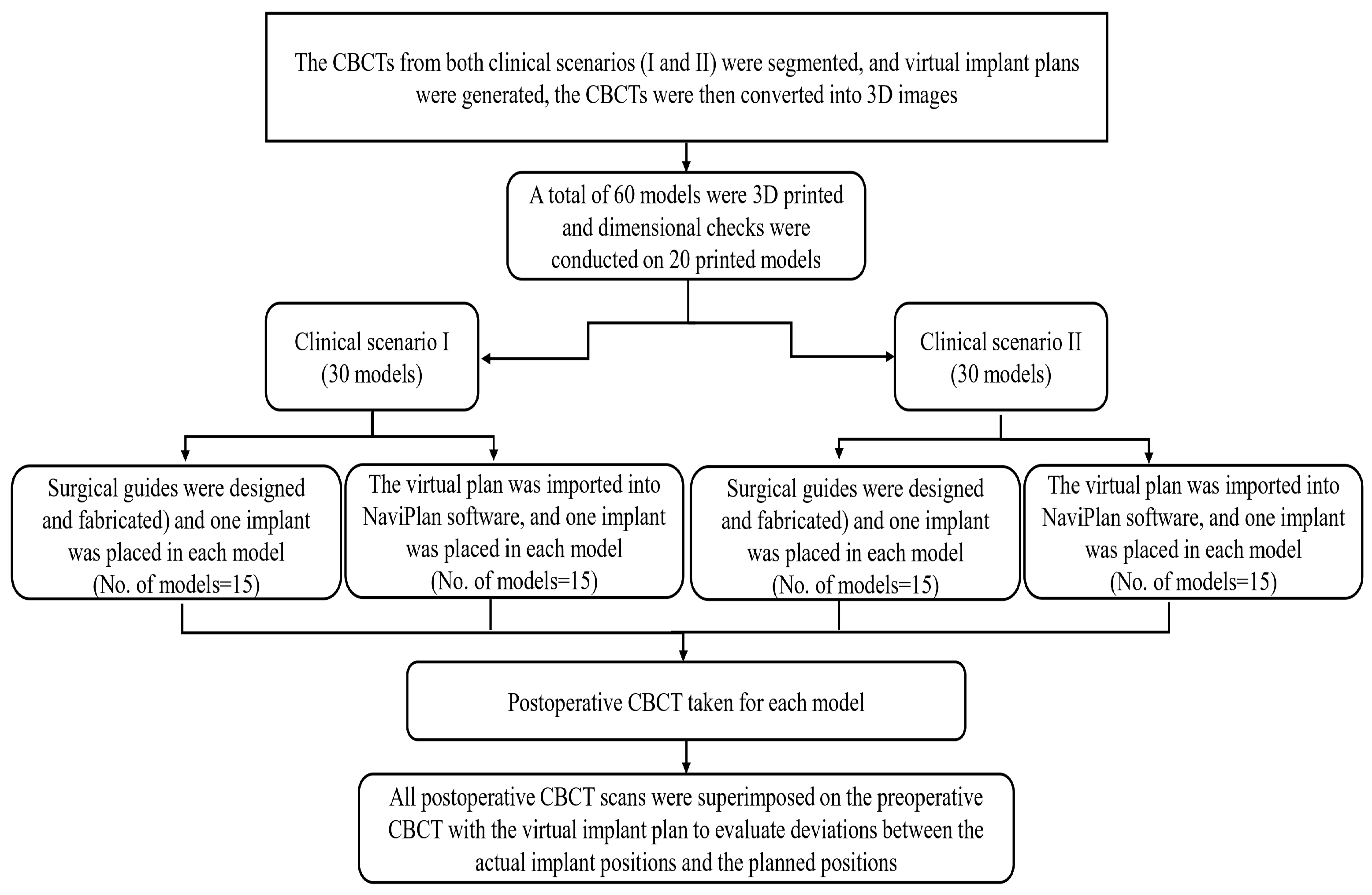
Figure 1. Study design flow diagram.
Prosthesis 08 00058 g001
Figure 2. Dimensional deviations and structural deformation of the printed model and the original STL file.
Prosthesis 08 00058 g002
Figure 3. (a) sCAIS dental implant planning using v5.0 rc; Bluesky Bio Software; (b) dCAIS dental implant planning using NaviDent Software UNO v4.1.0 from Claro Nav.
Prosthesis 08 00058 g003
Figure 4. (a) Neodent guided surgical kit, DNS calibrator, tracer and tags; (b) real-time position of the drill during surgical procedure.
Prosthesis 08 00058 g004
Figure 5. Deviation analysis of planned and placed implants using EvaluNav software. The dental implant delineated in yellow corresponds to the virtually planned dental implant position. In contrast, the dental implant delineated in red represents the postoperatively placed dental implant within the evaluated site.
Prosthesis 08 00058 g005
Figure 6. Schematic representation of the parameters used to measure variations in implant position. The vertical implant reflects the virtually designed position, while the angled implant indicates the clinically placed position. The blue lines show the exact center axes of the corresponding implants.
Prosthesis 08 00058 g006
Figure 7. Statistical analysis of the geometric accuracy of the printed models.
Prosthesis 08 00058 g007
Figure 8. Scatter plot distribution of data by the sCAIS and dCAIS approaches. A virtual plan represents 0 on the Y axis.
Prosthesis 08 00058 g008
Table 1. Comparison between all examined parameters by the sCAIS and dCAIS approaches.
ParametersApproachMean ± SDMedian (IQR)p Value *
Entry-3D Deviation (mm)sCAIS0.63 ± 0.2540.615 (0.37)0.9 *
dCAIS0.64 ± 0.2930.7 (0.52)
Apex-Vertical Deviation (mm)sCAIS0.20 ± 0.1340.135 (0.193)0.78 *
dCAIS0.24 ± 0.200.19 (0.265)
Angle Deviation (°)sCAIS1.85 ± 0.7541.73 (1.38)0.004 *
dCAIS1.28 ± 0.601.19 (0.975)
Apex-3D Deviation (mm)sCAIS0.81 ± 0.3360.76 (0.48)0.59 †
dCAIS0.76 ± 0.3870.78 (0.71)
Entry-2D Deviation (mm)sCAIS0.568 ± 0.2850.56 (0.47)0.93 †
dCAIS0.562 ± 0.290.56 (0.44)
DIAN Deviation (mm)sCAIS0.192 ± 0.240.20 (0.39)0.24 †
dCAIS0.261 ± 0.2140.30 (0.29)
* Mann–Whitney U test. † Calculated by independent t-test.
Table 2. Comparison of all examined parameters between the sCAIS and dCAIS approaches in clinical scenario I.
ParametersApproachesMean ± SDMedian (IQR)p Value
NonparametricEntry-3D Deviation (mm)sCAIS0.629 ± 0.2910.54 (0.49)0.512 *
dCAIS0.568 ± 0.3000.5 (0.52)
Apex-Vertical Deviation (mm)sCAIS0.125 ± 0.6970.12 (0.06)0.061 *
dCAIS0.259 ± 0.2050.19 (0.36)
Angle Deviation (°)sCAIS1.671 ± 0.6931.65 (1.06)0.033 *
dCAIS1.151 ± 0.5311.18 (0.88)
ParametricApex-3D Deviation (mm)sCAIS0.793 ± 0.3450.72 (0.40)0.413 †
dCAIS0.684 ± 0.3670.62 (0.66)
Entry-2D Deviation (mm)sCAIS0.608 ± 0.3040.50 (0.59)0.241 †
dCAIS0.482 ± 0.2720.37 (0.32)
DIAN Deviation (mm)sCAIS0.317 ± 0.2430.29 (0.30)0.495 †
dCAIS0.368 ± 0.1520.39 (0.20)
* Mann–Whitney U test, † independent t-test.
Table 3. Correlation between all examined parameters in clinical scenario I.
ParameterssCAISdCAIS
Spearman’s Rho (95% CI)p ValueSpearman’s Rho (95% CI)p Value
Entry-3D Deviation—Entry-2D Deviation0.995 (0.983 to 0.998)<0.0010.949 (0.849 to 0.983)<0.001
Entry-3D Deviation—Apex-3D Deviation0.906 (0.735 to 0.969)<0.0010.956 (0.870 to 0.986)<0.001
Entry-3D Deviation—Apex-Vertical Deviation−0.058 (−0.554 to 0.468)0.8370.767 (0.419 to 0.918)<0.001
Entry-3D Deviation—Angle Deviation0.282 (−0.269 to 0.694)0.3080.639 (0.188 to 0.867)0.01
Entry-3D Deviation—DIAN Deviation−0.67 (−0.884 to −0.255)0.005−0.357 (−0.735 to 0.190)0.191
Entry-2D Deviation—Apex-3D Deviation0.888 (0.688 to 0.962)<0.0010.938 (0.819 to 0.980)<0.001
Entry-2D Deviation—Apex-Vertical Deviation−0.015 (−0.615 to 0.393)0.5940.532 (0.027 to 0.820)0.041
Entry-2D Deviation—Angle Deviation0.229 (−0.321 to 0.664)0.4110.682 (0.261 to 0.885)0.005
Entry-2D Deviation—DIAN Deviation−0.702 (−0.893 to −0.296)0.004−0.421 (−0.768 to 0.116)0.118
Apex-3D Deviation—Apex-Vertical Deviation0.095 (−0.439 to 0.579)0.7370.678 (0.251 to 0.883)0.006
Apex-3D Deviation—Angle Deviation0.495 (−0.023 to 0.804)0.0610.794 (0.475 to 0.929)<0.001
Apex-3D Deviation—DIAN Deviation−0.591 (−0.847 to −0.112)0.02−0.259 (−0.681 to 0.292)0.352
Apex-Vertical Deviation—Angle Deviation0.515 (0.004 to 0.813)0.0490.379 (−0.165 to 0.746)0.163
Apex-Vertical Deviation—DIAN Deviation0.422 (−0.115 to 0.768)0.117−0.156 (−0.619 to 0.387)0.578
Angle Deviation—DIAN Deviation0.033 (−0.488 to 0.536)0.9070.126 (−0.413 to 0.599)0.655
Table 4. Comparison of all examined parameters between the sCAIS and dCAIS approaches in clinical scenario II.
ParametersApproachesMean ± SDMedian (IQR)p Value
NonparametricEntry-3D Deviation (mm)sCAIS0.630 ± 0.2220.66 (0.27)0.512 *
dCAIS0.709 ± 0.2790.72 (0.30)
Apex-Vertical Deviation (mm)sCAIS0.276 ± 0.1420.28 (0.27)0.061 *
dCAIS0.219 ± 0.2000.19 (0.26)
Angle Deviation (°)sCAIS2.021 ± 0.7931.98 (1.38)0.033 *
dCAIS1.415 ± 0.6541.2 (1.42)
ParametricApex-3D Deviation (mm)sCAIS0.828 ± 0.3280.80 (0.61)0.413 †
dCAIS0.835 ± 0.4040.83 (0.75)
Entry-2D Deviation (mm)sCAIS0.527 ± 0.2690.58 (0.48)0.241 †
dCAIS0.641 ± 0.2930.72 (0.36)
DIAN Deviation (mm)sCAIS0.667 ± 0.1630.00 (0.30)0.495 †
dCAIS0.153 ± 0.2160.20 (0.40)
* Mann–Whitney U test, † independent t-test.
Table 5. Correlation between all examined parameters in clinical scenario II.
ParameterssCAISdCAIS
Spearman’s Rho (95% CI)p ValueSpearman’s Rho (95% CI)p Value
Entry-3D Deviation—Entry-2D Deviation0.929 (0.789 to 0.977)<0.0010.887 (0.678 to 0.963)<0.001
Entry-3D Deviation—Apex-3D Deviation0.869 (0.634 to 0.957)<0.0010.935 (0.807 to 0.979)<0.001
Entry-3D Deviation—Apex-Vertical Deviation0.159 (−0.398 to 0.631)0.5710.381 (−0.180 to 0.754)0.162
Entry-3D Deviation—Angle Deviation−0.296 (−0.710 to 0.271)0.2850.147 (−0.409 to 0.623)0.601
Entry-3D Deviation—DIAN Deviation−0.198 (−0.655 to 0.364)0.479−0.474 (−0.800 to 0.068)0.075
Entry-2D Deviation—Apex-3D Deviation0.903 (0.720 to 0.969)0.0010.874 (0.645 to 0.959)<0.001
Entry-2D Deviation—Apex-Vertical Deviation−0.106 (−0.597 to 0.443)0.7080.081 (−0.463 to 0.581)0.773
Entry-2D Deviation—Angle Deviation−0.312 (−0.719 to 0.254)0.2580.225 (−0.339 to 0.670)0.42
Entry-2D Deviation—DIAN Deviation−0.006 (−0.529 to 0.520)0.982−0.487 (−0.806 to 0.050)0.065
Apex-3D Deviation—Apex-Vertical Deviation−0.254 (−0.687 to 0.312)0.3610.386 (−0.173 to 0.757)0.155
Apex-3D Deviation—Angle Deviation−0.104 (−0.596 to 0.445)0.7130.295 (−0.272 to 0.710)0.286
Apex-3D Deviation—DIAN Deviation−0.091 (−0.587 to 0.455)0.748−0.361 (−0.745 to 0.201)0.186
Apex-Vertical Deviation—Angle Deviation−0.345 (−0.736 to 0.220)0.2080.433 (−0.119 to 0.780)0.107
Apex-Vertical Deviation—DIAN Deviation−0.349 (−0.739 to 0.214)0.2020.095 (−0.452 to 0.590)0.736
Angle Deviation—DIAN Deviation0.006 (−0.520 to 0.528)0.9840.417 (−0.137 to 0.773)0.122
Disclaimer/Publisher’s Note: The statements, opinions and data contained in all publications are solely those of the individual author(s) and contributor(s) and not of MDPI and/or the editor(s). MDPI and/or the editor(s) disclaim responsibility for any injury to people or property resulting from any ideas, methods, instructions or products referred to in the content.